CONTENTS.
Reading edition

SHEEP AND THEIR DISEASES.
PAGE
HISTORY AND VARIETIES 15
American Sheep 21
Native Sheep 22
The Spanish Merino 25
The Saxon Merino 36
The New Leicester 41
The South-Down 47
The Cotswold 52
The Cheviot 54
The Lincoln 56
Natural History of the Sheep 57
Formation of the Teeth 59
Structure of the Skin 63
Anatomy of the Wool 64
Long Wool 76
Middle Wool 78
Short Wool 80
CROSSING AND BREEDING 81
Breeding 81
Points of the Merino 93
Breeding Merinos 97
General Principles of Breeding 106
Use of Rams 112
Lambing 117
Management of Lambs 121
Castration and Docking 127
FEEDING AND MANAGEMENT 129
Feeding 129
Shade 133
Fences 133
Hoppling 133
Dangerous Rams 134
Prairie Feeding 135
Fall Feeding 137
Winter Feeding 137
Feeding with other Stock 142
Division of Flocks 142
Regularity in Feeding 143
Effect of Food 144
Yards 146
Feeding-Racks 147
Troughs 150
Barns and Sheds 151
Sheds 155
Hay-Holder 156
Tagging 157
Washing 160
Cutting the Hoofs 165
Shearing 166
Cold Storms 171
Sun-Scald 171
Ticks 171
Marking or Branding 172
Maggots 173
Shortening the Horns 174
Selection and Division 174
The Crook 176
Driving and Slaughtering 177
Driving 177
Points of Fat Sheep 181
Slaughtering 184
Cutting Up 186
Relative qualities 187
Contributions to Manufactures 191
DISEASES AND THEIR REMEDIES 195
Administering Medicine 197
Bleeding 197
Feeling the Pulse 199
Apoplexy 200
Braxy 201
Bronchitis 201
Catarrh 202
Malignant Epizoötic Catarrh 203
Colic 205
Costiveness 206
Diarrhœa 206
Disease of the Biflex Canal 207
Dysentery 208
Flies 209
Fouls 209
Fractures 210
Garget 211
Goitre 211
Grub in the Head 212
Hoof-Ail 214
Hoove 225
Hydatid on the Brain 226
Obstruction of the Gullet 228
Ophthalmia 229
Palsy 229
Pelt-Rot 230
Pneumonia 230
Poison 233
Rot 233
Scab 236
Small-Pox 239
Sore Face 242
Sore Mouth 243
Ticks 243
ILLUSTRATIONS.
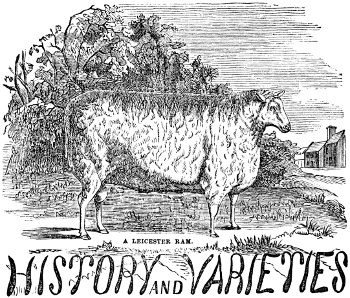
A Leicester Ram 15
Rocky Mountain Sheep 19
A Merino Ram 25
A Spanish Sheep-Dog 28
Out at Pasture 35
A Country Scene 41
A South-Down Ram 47
The Cotswold 52
A Cheviot Ewe 54
Skeleton of the Sheep as Covered by the Muscles 57
The Wallachian Sheep 64
The Happy Trio 81
The Scotch Sheep-Dog or Colley 100
Ewe and Lambs 117
Feeding and Management 129
A Covered Salting-Box 130
A Convenient Box-Rack 147
A Hole-Rack 148
The Hopper-Rack 150
An Economical Sheep-Trough 151
Sheep-Barn with Sheds 152
A Shed of Rails 155
Washing Apparatus 162
Toe-nippers 166
Fleece 167
Shepherd’s Crook 176
The Shepherd and his Flock 179
Drover’s or Butcher’s Dog 185
Quiet Enjoyment 195
An English Rack for Feeding Sheep 203
A Barrack for Storing Sheep Fodder 228
The Broad-tailed Sheep 236
CONTENTS.
SWINE AND THEIR DISEASES.
HISTORY AND BREEDS 245 (7)
American Swine 254 (16)
The Byefield 256 (18)
The Bedford 256 (18)
The Leicester 257 (19)
The Yorkshire 257 (19)
The Chinese 258 (20)
The Suffolk 260 (22)
The Berkshire 261 (23)
Natural History of the Hog 263 (25)
Formation of the Teeth 265 (27)
BREEDING AND MANAGEMENT 267 (29)
Breeding 267 (29)
Points of a Good Hog 274 (36)
Treatment during Pregnancy 276 (38)
Abortion 277 (39)
Parturition 279 (41)
Treatment while Suckling 282 (44)
Treatment of Young Pigs 283 (45)
Castration 284 (46)
Spaying 286 (48)
Weaning 287 (49)
Ringing 289 (51)
Feeding and Fattening 290 (52)
Piggeries 295 (57)
Slaughtering 298 (60)
Pickling and Curing 300 (62)
Value of the Carcass 304 (66)
DISEASES AND THEIR REMEDIES 307 (69)
Catching the Pig 308 (70)
Bleeding 309 (71)
Drenching 310 (72)
Catarrh 310 (72)
Cholera 311 (73)
Crackings 314 (76)
Diarrhœa 314 (76)
Fever 315 (77)
Foul Skin 317 (79)
Inflammation of the Lungs 317 (79)
Jaundice 318 (80)
Leprosy 319 (81)
Lethargy 319 (81)
Mange 320 (82)
Measles 322 (84)
Murrain 323 (85)
Quinsy 323 (85)
Staggers 323 (85)
Swelling of the Spleen 323 (85)
Surfeit 325 (87)
Tumors 325 (87)
ILLUSTRATIONS.
The Wild Boar 245 (7)
The Wild Boar at Bay 252 (14)
The Chinese Hog 259 (21)
The Suffolk 260 (22)
A Berkshire Boar 261 (23)
Skeleton of the Hog as Covered by the Muscles 263 (25)
The Old Country Well 267 (29)
Wild Hogs 279 (41)
The Old English Hog 299 (61)
A Wicked-Looking Specimen 307 (69)
Hunting The Wild Boar 315 (77)
CONTENTS.
POULTRY AND THEIR DISEASES.
HISTORY AND VARIETIES 327 (7)
The Domestic Fowl 327 (7)
The Bantam 330 (10)
The African Bantam 331 (11)
The Bolton Gray 333 (13)
The Blue Dun 334 (14)
The Chittagong 335 (15)
The Cochin China 336 (16)
The Cuckoo 339 (19)
The Dominique 340 (20)
The Dorking 340 (20)
The Fawn-colored Dorking 343 (23)
The Black Dorking 343 (23)
The Dunghill Fowl 344 (24)
The Frizzled Fowl 344 (24)
The Game Fowl 345 (25)
The Mexican Hen-Cock 347 (27)
The Wild Indian Game 348 (28)
The Spanish Game 348 (28)
The Guelderland 349 (29)
The Spangled Hamburgh 350 (30)
The Golden Spangled 350 (30)
The Silver Spangled 351 (31)
The Java 352 (32)
The Jersey-Blue 352 (32)
The Lark-Crested Fowl 352 (32)
The Malay 354 (34)
The Pheasant-Malay 356 (36)
The Plymouth Rock 357 (37)
The Poland 358 (38)
The Black Polish 360 (40)
The Golden Polands 361 (41)
The Silver Polands 363 (43)
The Black-topped White 364 (44)
The Shanghae 364 (44)
The White Shanghae 367 (47)
The Silver Pheasant 368 (48)
The Spanish 369 (49)
Natural History of Domestic Fowls 372 (52)
The Guinea Fowl 378 (58)
The Pea Fowl 381 (61)
The Turkey 386 (66)
The Wild Turkey 386 (66)
The Domestic Turkey 391 (71)
The Duck 394 (74)
The Wild Duck 396 (76)
The Domestic Duck 398 (78)
The Goose 402 (82)
The Wild Goose 402 (82)
The Domestic Goose 404 (84)
The Bernacle Goose 407 (87)
The Bremen Goose 409 (89)
The Brent Goose 410 (90)
The China Goose 411 (91)
The White China 413 (93)
The Egyptian Goose 414 (94)
The Java Goose 415 (95)
The Toulouse Goose 415 (95)
The White-fronted Goose 416 (96)
The Anatomy of the Egg 417 (97)
BREEDING AND MANAGEMENT 421 (101)
Breeding 421 (101)
High Breeding 422 (102)
Selection of Stock 429 (109)
Feeding 432 (112)
Bran 435 (115)
Millet 436 (116)
Rice 436 (116)
Potatoes 436 (116)
Green Food 437 (117)
Earth-Worms 437 (117)
Animal Food 438 (118)
Insects 439 (119)
Laying 439 (119)
Preservation of Eggs 443 (123)
Choice of Eggs for Setting 446 (126)
Incubation 449 (129)
Incubation of Turkeys 453 (133)
Incubation of Geese 454 (134)
Rearing of the Young 455 (135)
Rearing of Guinea Fowls 458 (138)
Rearing of Turkeys 459 (139)
Rearing of Ducklings 461 (141)
Rearing of Goslings 463 (143)
Caponizing 464 (144)
Fattening and Slaughtering 468 (148)
Slaughtering and Dressing 472 (152)
Poultry-Houses 474 (154)
DISEASES AND THEIR REMEDIES 478 (158)
Asthma 479 (159)
Costiveness 480 (160)
Diarrhœa 481 (161)
Fever 482 (162)
Indigestion 482 (162)
Lice 483 (163)
Loss of Feathers 485 (165)
Pip 485 (165)
Roup 488 (168)
Wounds and Sores 490 (170)
ILLUSTRATIONS.
Varieties of Fowl 327 (7)
The Bantam 331 (11)
Bantam 332 (12)
Bolton Grays or Creole Fowl 333 (13)
Cochin Chinas 337 (17)
White Dorkings 341 (21)
Gray Game Fowls 346 (26)
Guelderlands 349 (29)
Hamburgh Fowls 350 (30)
Malays 354 (34)
Poland Fowls 359 (39)
Shanghaes 365 (45)
White Shanghaes 367 (47)
Spanish Fowls 369 (49)
The Guinea Fowl 379 (59)
The Pea Fowl 382 (62)
The Wild Turkey 386 (66)
The Domestic Turkey 392 (72)
The Eider Duck 395 (75)
Wild Duck 397 (77)
Rouen Duck 399 (79)
Wild or Canada Goose 403 (83)
A Bremen Goose 409 (89)
China or Hong Kong Goose 411 (91)
Barnyard Scene 421 (101)
Fighting Cocks 429 (109)
On the Watch 439 (119)
Marquee Or Tent-shaped Coops 456 (136)
Duck-Pond and Houses 461 (141)
A Bad Style of Slaughtering 468 (148)
Rustic Poultry-House 475 (155)
A Fancy Coop in Chinese or Gothic Style 476 (156)
Among the Straw 478 (158)
Prairie Hens 483 (163)
Swans 488 (168)
With a single exception—that of the dog—there is no member of the beast family which presents so great a diversity of size, color, form, covering, and general appearance, as characterizes the sheep; and none occupy a wider range of climate, or subsist on a greater variety of food. This animal is found in every latitude between the Equator and the Arctic circle, ranging over barren mountains and through fertile valleys, feeding upon almost every species of edible forage—the cultivated grasses, clovers, cereals, and roots—browsing on aromatic and bitter herbs alike, cropping the leaves and barks from stunted forest shrubs and the pungent, resinous evergreens. In some parts of Norway and Sweden, when other resources fail, he subsists on fish or flesh during the long, rigorous winter, and, if reduced to necessity, even devours his own wool.
In size, he is diminutive or massive; he has many horns, or but two large or small spiral horns, or is polled or hornless. His tail may be broad, or long, or a mere button, discoverable only by the touch. His covering is long and coarse, or short and hairy, or soft and furry, or fine and spiral. His color varies from white or black to every shade of brown, dun, buff, blue, and gray. This wide diversity results from long domestication under almost every conceivable variety of condition.
Among the antediluvians, sheep were used for sacrificial offerings, and their fleeces, in all probability, furnished them with clothing. Since the deluge their flesh has been a favorite food among many nations. Many of the rude, wandering tribes of the East employ them as beasts of burden. The uncivilized—and, to some extent, the refined—inhabitants of Europe use their milk, not only as a beverage, but for making into cheese, butter, and curds—an appropriation of it which is also noticed by Job, Isaiah, and other Old Testament writers, as well as most of the Greek and Roman authors. The ewe’s milk scarcely differs in appearance from that of the cow, though it is generally thicker, and yields a pale, yellowish butter, which is always soft and soon becomes rancid. In dairy regions the animal is likewise frequently employed at the tread-mill or horizontal wheel, to pump water, churn milk, or perform other light domestic work.
The calling of the shepherd has, from time immemorial, been conspicuous, and not wanting in dignity and importance. Abel was a keeper of sheep; as were Abraham and his descendants, as well as most of the ancient patriarchs. Job possessed fourteen thousand sheep. Rachel, the favored mother of the Jewish race, “came with her father’s sheep, for she kept them.” The seven daughters of the priest of Midian “came and drew water for their father’s flocks.” Moses, the statesman and lawgiver, “learned in all the wisdom of the Egyptians,” busied himself in tending “the flocks of Jethro, his father-in-law.” David, too, that sweet singer of Israel and its destined monarch—the Jewish hero, poet, and divine—was a keeper of sheep. To shepherds, “abiding in the field, keeping watch over their flocks by night,” came the glad tidings of a Saviour’s birth. The Hebrew term for sheep signifies, in its etymology, fruitfulness, abundance, plenty—indicative of the blessings which they were destined to confer upon the human family. In the Holy Scriptures, this animal is the chosen symbol of purity and the gentler virtues, the victim of propitiatory sacrifices, and the type of redemption to fallen man.
Among profane writers, Homer and Hesiod, Virgil and Theocritus, introduce them in their pastoral themes; while their heroes and demi-gods—Hercules and Ulysses, Eneas and Numa—carefully perpetuate them in their domains.
In modern times, they have engaged the attention of the most enlightened nations, whose prosperity has been intimately linked with them, wherever wool and its manufactures have been regarded as essential staples. Spain and Portugal, during the two centuries in which they figured as the most enterprising European countries, excelled in the production and manufacture of wool. Flanders, for a time, took precedence of England in the perfection of the arts and the enjoyments of life; and the latter country then sent what little wool she raised to the former to be manufactured. This being soon found highly impolitic, large bounties were offered by England for the importation of artists and machinery; and by a systematic and thorough course of legislation, which looked to the utmost protection and increase of wool and woollens, she gradually carried their production beyond any thing the world had ever seen.
Of the original breed of this invaluable animal, nothing certain is known; four varieties having been deemed by naturalists entitled to that distinction.
These are, 1. The Musimon, inhabiting Corsica, Sardinia, and other islands of the Mediterranean, the mountainous parts of Spain and Greece, and some other regions bordering upon that inland sea. These have been frequently domesticated and mixed with the long-cultivated breeds.
2. The Argali ranges over the steppes, or inland plains of Central Asia, northward and eastward to the ocean. They are larger and hardier than the Musimon and not so easily tamed.
3. The Rocky Mountain Sheep—frequently called the Bighorn by our western hunters—is found on the prairies west of the Mississippi, and throughout the wild, mountainous regions extending through California and Oregon to the Pacific. They are larger than the Argali—which in other respects they resemble—and are probably descended from them, since they could easily cross upon the ice at Behring’s Straits, from the north-eastern coast of Asia. Like the Argali, when caught young they are readily tamed; but it is not known that they have ever been bred with the domestic sheep. Before the country was overrun by the white ram, they probably inhabited the region bordering on the Mississippi. Father Hennepin—a French Jesuit, who wrote some two hundred years ago—often speaks of meeting with goats in his travels through the territory which is now embraced by Illinois, Wisconsin, and a portion of Minnesota. The wild, clambering propensities of these animals—occupying, as they do, the giddy heights far beyond the reach of the traveller—and their outer coating of hair—supplied underneath, however, with a thick coating of soft wool—give them much the appearance of goats. In summer they are generally found single; but when they descend from their isolated, rocky heights in winter, they are gregarious, marching in flocks under the guidance of leaders.
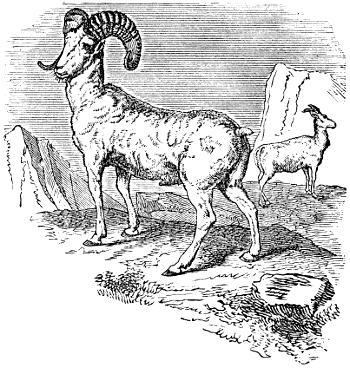
ROCKY MOUNTAIN SHEEP.
4. The Bearded Sheep of Africa inhabit the mountains of Barbary and Egypt. They are covered with a soft, reddish hair, and have a mane hanging below the neck, and large, locks of hair at the ankle.
Many varieties of the domesticated sheep—that is, all the subjugated species—apparently differ less from their wild namesakes than from each other.
The fat-rumped and the broad-tailed sheep are much more extensively diffused than any other, and occupy nearly all the south-eastern part of Europe, Western and Central Asia, and Northern Africa. They are supposed, from various passages in the Pentateuch in which “the fat and the rump” are spoken of in connection with offerings, to be the varieties which were propagated by the patriarchs and their descendants, the Jewish race. They certainly give indisputable evidence of remote and continued subjugation. Their long, pendent, drowsy ears, and the highly artificial posterior developments, are characteristic of no wild or recently domesticated race.
This breed consists of numerous sub-varieties, differing in all their characteristics of size, fleece, color, etc., with quite as many and marked shades of distinction as the modern European varieties. In Madagascar, they are covered with hair; in the south of Africa, with coarse wool; in the Levant, and along the Mediterranean, the wool is comparatively fine; and from that of the fat-rumped sheep of Thibet the exquisite Cashmere shawls of commerce are manufactured. Both rams and ewes are sometimes bred with horns, and sometimes without, and they exhibit a great diversity of color. Some yield a carcass of scarcely thirty pounds, while others have weighed two hundred pounds dressed. The tail or rump varies greatly, according to the purity and style of breeding; some are less than one-eighth, while others exceed one-third of the entire dressed weight. The fat of the rump or tail is esteemed a great delicacy; in hot climates resembling oil, and in colder, suet.
It is doubtful whether sheep are indigenous to Great Britain; but they are mentioned as existing there at very early periods.
AMERICAN SHEEP.
In North America, there are none, strictly speaking, except the Rocky Mountain breed, already mentioned. The broad-tailed sheep of Asia and Africa were brought into the United States about seventy years ago, under the name of the Tunisian Mountain sheep, and bred with the native flocks. Some of them were subsequently distributed among the farmers of Pennsylvania, and their mixed descendants were highly prized as prolific, and good nurses, coming early to maturity, attaining large weight, of a superior quality of carcass, and yielding a heavy fleece of excellent wool. The principal objection made to them was the difficulty of propagation, which always required the assistance of the shepherd. The lambs were dropped white, red, tawny, bluish, or black; but all, excepting the black, grew white as they approached maturity, retaining some spots of the original color on the cheeks and legs, and sometimes having the entire head tawny or black. The few which descended from the original importations have become blended with American flocks, and have long ceased to be distinguishable from them. The common sheep of Holland were early imported by the Dutch emigrants, who originally colonized New York; but they, in like manner, have long since ceased to exist as a distinct variety.
Improved European breeds have been so largely introduced during the present century, that the United States at present possesses every known breed which could be of particular benefit to its husbandry. By the census of 1860, there were nearly twenty-three and a half millions of sheep in this country, yielding upwards of sixty and a half million pounds of wool. An almost infinite variety of crosses have taken place between the Spanish, English, and “native” families; carried, indeed, to such an extent that there are, comparatively speaking, few flocks in the United States that preserve entire the distinctive characteristics of any one breed, or that can lay claim to unmixed purity of blood.
The principal breeds in the United States are the so-called “Natives;” the Spanish and Saxon Merinos, introduced from the countries whose names they bear: the New Leicester, or Bakewell; the South-Down; the Cotswold; the Cheviot; and the Lincoln—all from England.
NATIVE SHEEP.
This name is popularly applied to the common coarse-woolled sheep of the country, which existed here previously to the importation of the improved breeds. These were of foreign and mostly of English origin, and could probably claim a common descent from no one stock. The early settlers, emigrating from different sections of the British Empire, and a portion of them from other parts of Europe, brought with them, in all probability, each the favorite breed of his own immediate neighborhood, and the admixture of these formed the mongrel family now under consideration. Amid the perils of war and the incursions of beasts of prey, they were carefully preserved. As early as 1676, New England was spoken of as “abounding with sheep.”
These common sheep yielded a wool suitable only for the coarsest fabrics, averaging, in the hands of good farmers, from three to three and a half pounds of wool to the fleece. They were slow in arriving at maturity, compared with the improved English breeds, and yielded, when fully grown, from ten to fourteen pounds of a middling quality of mutton to the quarter. They were usually long-legged, light in the fore-quarter, and narrow on the breast and back; although some rare instances might be found of flocks with the short legs, and some approximation to the general form of the improved breeds. They were excellent breeders, often rearing, almost entirely destitute of care, and without shelter, one hundred per cent. of lambs; and in small flocks, a still larger proportion. These, too, were usually dropped in March, or the earlier part of April. Restless in their disposition, their impatience of restraint almost equalled that of the untamed Argali, from which they were descended; and in many sections of the country it was common to see from twenty to fifty of them roving, with little regard to enclosures, over the possessions of their owner and his neighbors, leaving a large portion of their wool adhering to bushes and thorns, and the remainder placed nearly beyond the possibility of carding, by the tory-weed and burdock, so common on new lands.
To this general character of the native flocks, there was but one exception—a considerably numerous and probably accidental variety, known as the Otter breed, or Creepers. These were excessively duck-legged, with well-formed bodies, full chests, broad backs, yielding a close, heavy fleece, of medium quality of wool. They were deserved favorites where indifferent stone or wood fences existed, since their power of locomotion was absolutely limited to their enclosures, if protected by a fence not less than two feet high. The quality of their mutton equalled, while their aptitude to fatten was decidedly superior to, their longer-legged contemporaries. The race is now quite extinct.
An excellent variety, called the Arlington sheep, was produced by General Washington, from a cross of a Persian ram upon the Bakewell, which bore wool fourteen inches in length, soft, silky, and admirably suited to combing. These, likewise, have long since become incorporated with the other flocks of the country.
The old common stock of sheep, as a distinct family, have nearly or quite disappeared, owing to universal crossing, to a greater or less extent, with the foreign breeds of later introduction. The first and second cross with the Merino resulted in a decided improvement, and produced a variety exceedingly valuable for the farmer who rears wool solely for domestic purposes. The fleeces are of uneven fineness, being hairy on the thighs, dew-lap, etc.; but the general quality is much improved, the quantity is considerably augmented, the carcass is more compact and nearer the ground, and they have lost their unquiet and roving propensities. The cross with the Saxon, for reasons hereafter to be given, has not generally been so successful. With the Leicester and Downs, the improvement, so far as form size, and a propensity to take on fat are concerned, is manifest.
THE SPANISH MERINO.
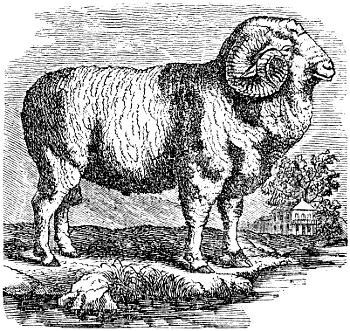
A MERINO RAM.
The Spanish sheep, in different countries, has, either directly or indirectly, effected a complete revolution in the character of the fleece. The race is unquestionably one of the most ancient extant. The early writers on agriculture and the veterinary art describe various breeds of sheep as existing in Spain, of different colors—black, red, and tawny. The black sheep yielded a fine fleece, the finest of that color which was then known; but the red fleece of Bætica—a considerable part of the Spanish coast on the Mediterranean, comprising the modern Spanish provinces of Gaen, Cordova, Seville, Andalusia, and Granada, which was early colonized by the enterprising Greeks—was, according to Pliny, of still superior quality, and “had no fellow.”
These sheep were probably imported from Italy, and of the Tarentine breed, which had gradually spread from the coast of Syria, and of the Black Sea, and had then reached the western extremity of Europe. Many of them mingled with and improved the native breeds of Spain, while others continued to exist as a distinct race, and, meeting with a climate and an herbage suited to them, retained their original character and value, and were the progenitors of the Merinos of the present day. Columella, a colonist from Italy, and uncle of the writer of an excellent work on agriculture, introduced more of the Tarentine sheep into Bætica, where he resided in the reign of the Emperor Claudius, in the year 41, and otherwise improved on the native breed; for, struck with the beauty of some African rams which had been brought to Rome to be exhibited at the public games, he purchased them, and conveyed them to his farm in Spain, whence, probably, originated the better varieties of the long-woolled breeds of that country.
Before his time, however, Spain possessed a valuable breed; since Strabo, who flourished under Tiberius, speaking of the beautiful woollen cloths that were worn by the Romans, says that the wool was brought from Truditania, in Spain.
The limited region of Italy—overrun, as it repeatedly was, by hordes of barbarians during and after the times of the latest emperors—soon lost her pampered flocks; while the extended regions of Spain—intersected in every direction by almost impassable mountains—could maintain their more hardy race, in defiance of revolution or change.
To what extent the improvements which have been noticed were carried is unknown; but as Spain was at that time highly civilized, and as agriculture was the favorite pursuit of the greater part of the colonists that spread over the vast territory, which then acknowledged the Roman power, it is highly probable that Columella’s experiments laid the foundation for a general improvement in the Spanish sheep—an improvement, moreover, which was not lost, nor even materially impaired, during the darker ages that succeeded.
The Merino race possess inbred qualities to an extent surpassed by no others. They have been improved in the general weight and evenness of their fleece, as in the celebrated flock of Rambouillet; in the uniformity and excessive fineness of the fibre, as in the Saxons; and in their form and feeding qualities, in various countries; but there has never yet been deterioration, either in quantity or quality of fleece or carcass, wherever they have been transported, if supplied with suitable food and attention. Most sheep annually shed their wool if unclipped; while the Merino retains its fleece, sometimes for five years, when allowed to remain unshorn.
Conclusive evidence is thus afforded of continued breeding among themselves, by which the very constitution of the wool-producing organs beneath the skin have become permanently established; and this property is transmitted to a great extent, even among the crosses, thus marking the Merino as an ancient and peculiar race.
The remains of the ancient varieties of color, also, as noticed by Pliny, Solinus, and Columella, may still be discovered in the modern Merino. The plain and indeed the only reason that can be assigned for the union of black and gray faces with white bodies, in the same breed, is the frequent intermixture of black and white sheep, until the white prevails in the fleece, and the black is confined to the face and legs. It is still apt to break out occasionally in the individual, unless it is fixed and concentrated in the face and legs, by repeated crosses and a careful selection; and, on the contrary, in the Merino South-Down the black may be reduced by a few crosses to small spots about the legs, while the Merino hue overspreads the countenance. This hue—variously described as a velvet, a buff, a fawn, or a satin-colored countenance, but in which a red tinge not infrequently predominates, still indicates the original colors of the indigenous breeds of Spain; and the black wool, for which Spain was formerly so much distinguished, is still inclined to break out occasionally in the legs and ears of the Merino. In some flocks half the ear is invariably brown, and a coarse black hair is often discernible in the finest pile.
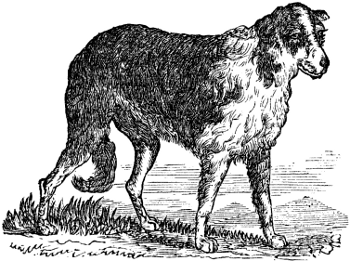
A SPANISH SHEEP DOG.
The conquest, in the eighth century, by the Moors of those fine provinces in the south of Spain, so far from checking, served rather to encourage the production of fine wool. The conquerors were not only enterprising, but highly skilled in the useful arts, and carried on extensive manufactories of fine woollen goods, which they exported to different countries. The luxury of the Moorish sovereigns has been the theme of many writers; and in the thirteenth century, when the woollen manufacture flourished in but few places, there were found in Seville no less than sixteen thousand looms. A century later, Barcelona, Perpignan, and Tortosa were celebrated for the fineness of their cloths, which became staple articles of trade throughout the greater part of Europe, as well as on the coast of Africa.
After the expulsion of the Moors, in the fifteenth century, by Ferdinand and Isabella, the woollen manufacture languished, and was, in a great degree, lost to Spain, owing to the rigorous banishment of nearly one million industrious Moors, most of whom were weavers. As a consequence, the sixteen thousand looms of Seville dwindled down to sixty. The Spanish government perceived its fatal mistake too late, and subsequent efforts to gain its lost vantage-ground in respect to this manufacture proved fruitless. During all that time, however, the Spanish sheep appear to have withstood the baneful influence of almost total neglect; and although the Merino flocks and Merino wool have improved under the more careful management of other countries, the world is originally indebted to Spain for the most valuable material in the manufacture of cloth.
The perpetuation of the Merino sheep in all its purity, amid the convulsions which changed the entire political framework of Spain and destroyed every other national improvement, strikingly illustrates the primary determining power of blood or breeding, as well as the agency of soil and climate—possibly too much underrated in modern times.
These Spanish sheep are divided into two classes: the stationary, or those that remain during the whole of the year on a certain farm, or in a certain district, there being a sufficient provision for them in winter and in summer; and the migratory, or those which wander some hundreds of miles twice in the year, in quest of pasturage. The principal breed of stationary sheep consists of true Merinos; but the breeds most sought for, and with which so many countries have been enriched, are the Merinos of the migratory description, which pass the summer in the mountains of the north, and the winter on the plains toward the south of Spain.
The first impression made by the Merino sheep on one unacquainted with its value would be unfavorable. The wool lying closer and thicker over the body than in most other breeds, and being abundant in yolk—or a peculiar secretion from the glands of the skin, which nourishes the wool and causes it to mat closely together—is covered with a dirty crust, often full of cracks. The legs are long, yet small in the bone; the breast and the back are narrow, and the sides somewhat flat; the fore-shoulders and bosoms are heavy, and too much of their weight is carried on the coarser parts. The horns of the male are comparatively large, curved, and with more or less of a spiral form; the head is large, but the forehead rather low. A few of the females are horned; but, generally speaking, they are without horns. Both male and female have a peculiar coarse and unsightly growth of hair on the forehead and cheeks, which the careful shepherd cuts away before the shearing-time; the other part of the face has a pleasing and characteristic velvet appearance. Under the throat there is a singular looseness of skin, which gives them a remarkable appearance of throatiness, or hollowness in the neck. The pile or hair, when pressed upon, is hard and unyielding, owing to the thickness into which it grows on the pelf, and the abundance of the yolk, retaining all the dirt and gravel which falls upon it; but, upon examination, the fibre exceeds, in fineness and in the number of serrations and curves, that which any other sheep in the world produces. The average weight of the fleece in Spain is eight pounds from the ram, and five from the ewe. The staple differs in length in different provinces. When fatted, these sheep will weigh from twelve to sixteen pounds per quarter.
The excellence of the Merinos consist in the unexampled fineness and felting property of their wool, and in the weight of it yielded by each individual sheep; the closeness of that wool, and the luxuriance of the yolk, which enable them to support extremes of cold and wet quite as well as any other breed; the readiness with which they adapt themselves to every change of climate, retaining, with common care, all their fineness of wool, and thriving under a burning tropical sun, and in the frozen regions of the north; an appetite which renders them apparently satisfied with the coarsest food; a quietness and patience into whatever pasture they are turned; and a gentleness and tractableness not excelled in any other breed.
Their defects—partly attributable to the breed, but more to the improper mode of treatment to which they are occasionally subjected—are, their unthrifty and unprofitable form; a tendency to abortion, or barrenness; a difficulty of yeaning, or giving birth to their young; a paucity of milk; and a too frequent neglect of their lambs. They are likewise said, notwithstanding the fineness of their wool, and the beautiful red color of the skin when the fleece is parted, to be more subject to cutaneous affections than most other breeds. Man, however, is far more responsible for this than Nature. Every thing was sacrificed in Spain to fineness and quantity of wool. These were supposed to be connected with equality of temperature, or, at least, with freedom from exposure to cold; and, therefore, twice in the year, a journey of four hundred miles was undertaken, at the rate of eighty or a hundred miles per week—the spring journey commencing when the lambs were scarcely four months old. It is difficult to say in what way the wool of the migratory sheep was, or could be, benefited by these periodical journeys. Although among them is found the finest and most valuable wool in Spain, yet the stationary sheep, in certain provinces—Segovia, Leon, and Estremadura—are more valuable than the migratory flocks of others. Moreover, the fleece of some of the German Merinos—which do not travel at all, and are housed all the winter—greatly exceeds that obtained from the best migratory breed—the Leonese—in fineness and felting property; and the wool of the migratory sheep has been, comparatively speaking, driven out of the market by that from sheep which never travel. With respect to the carcass, these harassing journeys, occupying one-quarter of the year, tend to destroy all possibility of fattening, or any tendency toward it, and the form and the constitution of the flock are deteriorated, and the lives of many sacrificed.
The first importation of Merinos into the United States took place in 1801; a banker of Paris, Mr. Delessert, having shipped four, of which but one arrived in safety at his farm near Kingston, in New York; the others perished on the passage. The same year, Mr. Seth Adams, of Massachusetts, imported a pair from France. In 1802, Chancellor Livingston, then American Minister at the court of Versailles, sent two choice pairs from the Rambouillet flock—which was started, in 1786, by placing four hundred ewes and rams, selected from the choicest Spanish flocks, on the royal farm of that name, in France—to Claremont, his country-seat, on the Hudson river. In the latter part of the same year, Colonel Humphreys, American Minister to Spain, shipped two hundred, on his departure from that country. The largest importations, however, were made through Hon. William Jarvis, of Vermont, then American Consul at Lisbon, Portugal, in 1809, 1810, and 1811, who succeeded in obtaining the choicest sheep of that country. Various subsequent importations took place, which need not be particularized.
The cessation of all commercial intercourse with England, in 1808 and 1809, growing out of difficulties with that country, directed attention, in an especial manner, toward manufacturing and wool-growing. The Merino, consequently, rose into importance, and so great was the interest aroused, that from a thousand to fourteen hundred dollars a head was paid for them. Some of the later importations, unfortunately, arrived in the worst condition, bringing with them those scourges of the sheep family, the scab and the foot-rot; which evils, together with increased supply, soon brought them down to less than a twentieth part of their former price. When, however, it was established, by actual experiment, that their wool did not deteriorate in this country, as had been feared by many, and that they became readily acclimated, they again rose into favor. The prostration of the manufacturing interests of the country, which ensued soon afterwards, rendered the Merino of comparatively little value, and ruined many who had purchased them at their previous high prices. Since that period, the valuation of the sheep which bear the particular wool has, as a matter of course, kept pace with the fluctuations in the price of the wool.
The term Merino, it must be remembered, is but the general appellation of a breed, comprising several varieties, presenting essential points of difference in size, form, quality and quantity of wool. These families have generally been merged, by interbreeding, in the United States and other countries which have received the race from Spain. Purity of Merino blood, and actual excellence in the individual and its ancestors, form the only standard in selecting sheep of this breed. Families have, indeed, sprung up in this country, exhibiting wider points of difference than did those of Spain. This is owing, in some cases, doubtless, to particular causes of breeding; but more often, probably, to concealed or forgotten infusions of other blood. The question, which has been at times raised, whether there are any Merinos in the United States, descendants of the early importations, of unquestionable purity of blood, has been conclusively settled in the affirmative.
The minor distinctions among the various families into which, as has already been intimated, the American Merino has diverged, are numerous, but may all, perhaps, be classed under three general heads.
The first is a large, short-legged, strong, exceedingly hardy sheep, carrying a heavy fleece, ranging from medium to fine, free from hair in properly bred flocks; somewhat inclined to throatiness, but not so much so as the Rambouillets; bred to exhibit external concrete gum in some flocks, but not commonly so; their wool rather long on back and belly, and exceedingly dense; wool whiter within than the Rambouillets; skin the same rich rose-color. Sheep of this class are larger and stronger than those originally imported, carry much heavier fleeces, and in well-selected flocks, or individuals, the fleece is of a decidedly better quality.
The second class embraces smaller animals than the preceding; less hardy; wool, as a general thing, finer, and covered with a black, pitchy gum on its extremities; fleece about one-fourth lighter than in the former class.
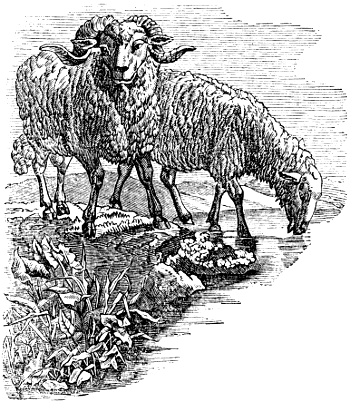
OUT AT PASTURE.
The third class, bred at the South, mostly, includes animals still smaller and less hardy, and carrying still finer and lighter fleeces. The fleece is destitute of external gum. The sheep and wool have a close resemblance to the Saxon; and, if not actually mixed with that blood, they have been formed into a similar variety, by a similar course of breeding.
The mutton of the Merino, notwithstanding the prejudices existing on the subject, is short-grained, and of good flavor, when killed at a proper age, and weighs from ten to fourteen pounds to the quarter. It is remarkable for its longevity, retaining its teeth, and continuing to breed two or three years longer than the common sheep, and at least half a dozen years longer than the improved English breeds. It should, however, be remarked, in this connection, that it is correspondingly slow in arriving at maturity, as it does not attain its full growth before three years of age; and the ewes, in the best managed flocks, are rarely permitted to breed before they reach that age.
The Merino is a far better breeder than any other fine-woolled sheep, and its lambs, when newly dropped, are claimed to be hardier than the Bakewell, and equally so with the high-bred South-Down. The ewe, as has been intimated, is not so good a nurse, and will not usually do full justice to more than one lamb. Eighty or ninety per cent. is about the ordinary number of lambs reared, though it often reaches one hundred per cent., in carefully managed or small flocks.
Allusion has heretofore been made to the cross between the Merino and the native sheep. On the introduction of the Saxon family of the Merinos, they were universally engrafted on the parent stock, and the cross was continued until the Spanish blood was nearly bred out. When the admixture took place with judiciously selected Saxons, the results were not unfavorable for certain purposes. These instances of judicious crossing were, unfortunately, rare. Fineness of wool was made the only tests of excellence, no matter how scanty its quantity, or how diminutive or miserable the carcass. The consequence was, as might be supposed, the ruin of most of the Merino flocks.
THE SAXON MERINO.
The indigenous breed of sheep in Saxony resembled that of the neighboring states, and consisted of two distinct Varieties—one bearing a wool of some value, and the other yielding a fleece applicable only to the coarsest manufactures.
At the close of the seven years war, Augustus Frederic, the Elector of Saxony, imported one hundred rams and two hundred ewes from the most improved Spanish flocks, and placed a part of them on one of his own farms, in the neighborhood of Dresden, which he kept unmixed, as he desired to ascertain how far the pure Spanish breed could be naturalized in that country The other part of the flock was distributed on other farms, and devoted to the improvement of the Saxon sheep.
It was soon sufficiently apparent that the Merinos did not degenerate in Saxony. Many parcels of their wool were not inferior to the choicest Leonese fleeces. The best breed of the native Saxons was also materially improved: The majority of the shepherds were, however, obstinately prejudiced against the innovation; but the elector, resolutely bent upon accomplishing his object, imported an additional number, and compelled the crown-tenants, then occupying lands under him, to purchase a certain number of the sheep.
Compulsion was not long necessary; the true interest of the shepherds was discovered; pure Merinos rapidly increased in Saxony, and became perfectly naturalized. Indeed, after a considerable lapse of years, the fleece of the Saxon sheep began, not only to equal the Spanish, but to exceed it in fineness and manufacturing value. To this result the government very materially contributed, by the establishment of an agricultural school, and other minor schools for shepherds, and by distributing various publications, which plainly and intelligibly showed the value and proper management of the Merino. The breeders were selected with almost exclusive reference to the quality of the fleece. Great care was taken to prevent exposure throughout the year, and they were housed on every slight emergency. By this course of breeding and treatment the size and weight of the fleece were reduced, and that hardiness and vigor of constitution, which had universally characterized the migratory Spanish breed, were partially impaired. In numerous instances, this management resulted in permanent injury to the character of the flocks.
The first importation of Saxons into this country was made in 1823, by Samuel Heustan, a merchant of Boston, Massachusetts, and consisted of four good rams, of which two went to Boston, and the others to Philadelphia. The following year, seventy-seven—about two-thirds of which number only were pure-blooded—were brought to Boston, sold at public auction at Brooklyn, N.Y., as “pure-blooded electoral Saxons,” and thus scattered over the country. Another lot, composed of grade sheep and pure-bloods, was disposed of, not long afterwards, by public sale, at Brighton, near Boston, and brought increased prices, some of them realizing from four hundred to five hundred and fifty dollars.
These prices gave rise to speculation, and many animals, of a decidedly inferior grade, were imported, which were thrown upon the market for the most they could command. The sales in many instances not half covering the cost of importation, the speculation was soon abandoned. In 1827, Henry D. Grove, of Hoosic, N.Y., a native of Germany, and a highly intelligent and thoroughly bred shepherd, who had accompanied some of the early importations, imported one hundred and fifteen choice animals for his own breeding, and, in the following year, eighty more. These formed the flock from which Mr. Grove bred, to the time of his decease, in 1844. The average weight of fleece from his entire flock, nearly all of which were ewes and lambs, was ten pounds and fourteen ounces, thoroughly washed on the sheep’s back. This was realized after a short summer and winter’s keep, when the quantity of hay or its equivalent fed to the sheep did not exceed one and a half pounds, by actual weight, per day, except to the ewes, which received an additional quantity just before and after lambing. This treatment was attended with no disease or loss by death, and with an increase of lambs, equalling one for every ewe.
The Saxon Merino differs materially in frame from the Spanish; there is more roundness of carcass and fineness of bone, together with a general form and appearance indicative of a disposition to fatten. Two distinct breeds are noticed. One variety has stouter legs, stouter bodies, head and neck comparatively short and broad, and body round; the wool grows most on the face and legs; the grease in the wool is almost pitchy. The other breed, called Escurial, has longer legs, with a long, spare neck and head; very little wool on the latter; and a finer, shorter, and softer character in its fleece, but less in quantity.
From what has just been stated it will be seen that there are few Saxon flocks in the United States that have not been reduced to the quality of grade sheep, by the promiscuous admixture of the pure and the impure which were imported together; all of them being sold to our breeders as pure stock. Besides, there are very few flocks which have not been again crossed with the Native or the Merino sheep of our country, or with both. Those who early purchased the Merino crossed them with the Native; and when the Saxons arrived those mongrels were bred to Saxon rams. This is the history of three-quarters, probably, of the Saxon flocks of the United States.
As these sheep have now so long been bred toward the Saxon that their wool equals that of the pure-bloods, it may well be questioned whether they are any worse for the admixture; when crossed only with the Merino, it is, undoubtedly, to their advantage. The American Saxon, with these early crosses in its pedigree, is, by general admission, a hardier and more easily kept animal than the pure Escurial or Electoral Saxon. Climate, feed, and other causes have, doubtless, conspired, as in the case of the Merino, to add to their size and vigor; but, after every necessary allowance has been made, they generally owe these qualities to those early crosses.
The fleeces of the American Saxons weigh, on the average, from two or two and a quarter to three pounds. They are, comparatively speaking, a tender sheep, requiring regular supplies of good food, good shelter in winter, and protection in cool weather from storms of all kinds; but they are evidently hardier than the parent German stock. In docility and patience under confinement, in late maturity and longevity, they resemble the Merinos, from which they are descended; though they do not mature so early as the Merino, nor do they ordinarily live so long. They are poorer nurses; their lambs are smaller, fatter, and far more likely to perish, unless sheltered and carefully watched; they do not fatten so well, and, being considerably lighter, they consume an amount of food considerably less.
Taken together, the American Saxons bear a much finer wool than the American Merinos; though this is not always the case, and many breeders of Saxons cross with the Merino, for the purpose of increasing the weight of their fleeces without deteriorating its quality. Our Saxon wool, as a whole, falls considerably below that of Germany; though individual specimens from Saxons in Connecticut and Ohio compare well with the highest German grades. This inferiority is not attributable to climate or other natural causes, or to a want of skill on the part of our breeders; but to the fact that but a very few of our manufacturers have ever felt willing to make that discrimination in prices which would render it profitable to breed those small and delicate animals which produce this exquisite quality of wool.
THE NEW LEICESTER.
The unimproved Leicester was a large, heavy, coarse-woolled breed of sheep, inhabiting the midland counties of England. It was a slow feeder, its flesh coarse-grained, and with little flavor. The breeders of that period regarded only size and weight of fleece.
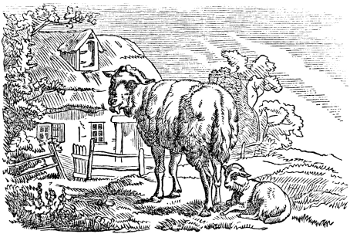
A COUNTRY SCENE.
About the middle of the last century, Robert Bakewell, of Dishley, in Leicestershire, first applied himself to the improvement of the sheep in that country. Before his improvements, aptitude to fatten and symmetry of shape—that is, such shape as should increase as much as possible the most valuable parts of the animal, and diminish the offal in the same proportion—were entirely disregarded. Perceiving that smaller animals increased in weight more rapidly than the very large ones, that they consumed less food, that the same quantity of herbage, applied to feeding a large number of small sheep, would produce more meat than when applied to feeding the smaller number of large sheep, which alone it would support, and that sheep carrying a heavy fleece of wool possessed less propensity to fatten than those which carried one of a more moderate weight, he selected from the different flocks in his neighborhood, without regard to size, the sheep which appeared to him to have the greatest propensity to fatten, and whose shape possessed the peculiarities which, in his judgment, would produce the largest proportion of valuable meat, and the smallest quantity of bone and offal.
He was also of opinion that the first object to be attended to in breeding sheep is the value of the carcass, and that the fleece ought always to be a secondary consideration; and this for the obvious reason that, while the addition of two or three pounds of wool to the weight of a sheep’s fleece is a difference of great amount, yet if this increase is obtained at the expense of the animal’s propensity to fatten, the farmer may lose by it ten or twelve pounds of mutton.
The sort of sheep, therefore, which he selected were those possessed of the most perfect symmetry, with the greatest aptitude to fatten, and rather smaller in size than the sheep generally bred at that time. Having formed his stock from sheep so selected, he carefully attended to the peculiarities of the individuals from which he bred, and, so far as can be ascertained—for all of Mr. Bakewell’s measures were kept secret, even from his most intimate friends, and he died without throwing, voluntarily, the least light on the subject—did not object to breeding from near relations, when, by so doing, he brought together animals likely to produce a progeny possessing the characteristics which he wished to obtain.
Having thus established his flock, he adopted the practice—which has since been constantly followed by the most eminent breeders of sheep—of letting rams for the season, instead of selling them to those who wished for their use. By this means the ram-breeder is enabled to keep a much larger number of rams in his possession; and, consequently, his power of selecting those most suitable to his flock, or which may be required to correct any faults in shape or quality which may occur in it, is greatly increased. By cautiously using a ram for one season, or by observing the produce of a ram let to some other breeder, he can ascertain the probable qualities of the lambs which such ram will get, and thus avoid the danger of making mistakes which would deteriorate the value of his stock. The farmers, likewise, who hire the rams, have an opportunity of varying the rams from which they breed much more than they otherwise could do; and they are also enabled to select from sheep of the best quality, and from those best calculated to effect the greatest improvement in their flocks.
The idea, when first introduced by him, was so novel that he had great difficulty in inducing the farmers to act upon it; and his first ram was let for sixteen shillings. So eminent, however, was his success, that, in 1787, he let three rams, for a single season, for twelve hundred and fifty pounds (about six thousand two hundred dollars), and was offered ten hundred and fifty pounds (about five thousand two hundred dollars) for twenty ewes. Soon afterwards he received the enormous price of eight hundred guineas (or four thousand dollars) for two-thirds of the services of a ram for a single season, reserving the other third for himself.
The improved Leicester is of large size, but somewhat smaller than the original stock, and in this respect falls considerably below the coarser varieties of Cotswold, Lincoln, etc. Where there is a sufficiency of feed, the New Leicester is unrivalled for its fattening propensities; but it will not bear hard stocking, nor must it be compelled to travel far in search of its food. It is, in fact, properly and exclusively a lowland sheep. In its appropriate situation—on the luxuriant herbage of the highly cultivated lands of England—it possesses unequalled earliness of maturity; and its mutton, when not too fat, is of a good quality, but is usually coarse, and comparatively deficient in flavor, owing to that unnatural state of fatness which it so readily assumes, and which the breeder, to gain weight, so generally feeds for. The wethers, having reached their second year, are turned off in the succeeding February or March, and weigh at that age from thirty to thirty-five pounds to the quarter. The wool of the New Leicester is long, averaging, after the first shearing, about six inches; and the fleece of the American animal weighs about six pounds. It is of coarse quality, and little used in the manufacture of cloth, on account of its length, and that deficiency of felting properties common, in a greater or less extent, to all English breeds. As a combing wool, however, it stands first, and is used in the manufacture of the finest worsteds, and the like textures.
The high-bred Leicesters of Mr. Bakewell’s stock became shy breeders and poor nurses; but crosses subsequently adopted have, to some extent, obviated these defects. The lambs are not, however, generally regarded as very hardy, and they require considerable attention at the time of yeaning, particularly if the weather is even moderately cold or stormy. The grown sheep, too, are much affected by sudden changes in the weather; an abrupt change to cold being pretty certain to be registered on their noses by unmistakable indications of catarrh or “snuffles.”
In England, where mutton is generally eaten by the laboring classes, the meat of this variety is in very great demand; and the consequent return which a sheep possessing such fine feeding qualities is enabled to make renders it a general favorite with the breeder. Instances are recorded of the most extraordinary prices having been paid for these animals. They have spread into all parts of the British dominions, and been imported into the other countries of Europe and into the United States.
They were first introduced into our own country, some forty years since, by Christopher Dunn, of Albany, N.Y. Subsequent importations have been made by Mr. Powel, of Philadelphia, and various other gentlemen. The breed, however, has never proved a favorite with any large class of American farmers. Our long, cold winters—but, more especially, our dry, scorching summers, when it is often difficult to obtain the rich, green, tender feed in which the Leicester delights—together with the general deprivation of green feed in the winter, rob it of its early maturity, and even of the ultimate size which it attains in England. Its mutton is too fat, and the fat and lean are too little intermixed to suit American taste. Its wool is not very salable, owing to the dearth of worsted manufactures in our country. Its early decay and loss of wool constitute an objection to it, in a country where it is often so difficult to advantageously turn off sheep, particularly ewes. But, notwithstanding all these disadvantages, on rich lowland farms, in the vicinity of considerable markets, it will always in all probability make a profitable return.
The head of the New Leicester should be hornless, long, small, tapering towards the muzzle, and projecting horizontally forward; the eyes prominent, but with a quiet expression; the ears thin, rather long, and directed backward; the neck full and broad at its base, where it proceeds from the chest, so that there is, with the slightest possible deviation, one continued horizontal line from the rump to the poll; the breast broad and full; the shoulders also broad and round, and no uneven or angular formation where the shoulders join either the neck or the back—particularly no rising of the withers, or hollow behind the situation of these bones; the arm fleshy throughout its whole extent, and even down to the knee; the bones of the leg small, standing wide apart; no looseness of skin about them, and comparatively void of wool; the chest and barrel at once deep and round; the ribs forming a considerable arch from the spine, so as, in some cases—and especially when the animal is in good condition—to make the apparent width of the chest even greater than the depth; the barrel ribbed well home; no irregularity of line on the back or belly, but on the sides; the carcass very gradually diminishing in width towards the rump; the quarters long and full, and, as with the fore-legs, the muscles extending down to the hock; the thighs also wide and full; the legs of a moderate length; and the pelt also moderately thin, but soft and elastic, and covered with a good quantity of white wool, not so long as in some breeds, but considerably finer.
THE SOUTH-DOWN.
A long range of chalky hills, diverging from the chalky stratum which intersects England from Norfolk to Dorchester, is termed the South-Downs. They enter the county of Sussex on the west side, and are continued almost in a direct line, as far as East Bourne, where they reach the sea. They may be regarded as occupying a space of more than sixty miles in length, and about five or six in breadth, consisting of a succession of open downs, with few enclosures, and distinguished by their situation and name from a more northern tract of similar elevation and soil, passing through Surrey and Kent, and terminating in the cliffs of Dover, and of the Forelands. On these downs a certain breed of sheep has been produced for many centuries, in greater perfection than elsewhere; and hence have sprung those successive colonies which have found their way abroad and materially benefited the breed of short-woolled sheep wherever they have gone.
A SOUTH-DOWN RAM.
It is only, however, within a comparatively recent period that they have been brought to their present perfection. As recently as 1776 they were small in size, and of a form not superior to the common woolled sheep of the United States; they were far from possessing a good shape, being long and thin in the neck, high on the shoulders, low behind, high on the loins, down on the rump, the tail set on very low, perpendicular from the hip-bones, sharp on the back; the ribs flat, not bowing, narrow in the fore-quarters, but good in the leg, although having big bones. Since that period a course of judicious breeding, pursued by Mr. John Ellman, of Glynde, in Sussex, has mainly contributed to raise this variety to its present value; and that, too, without the admixture of the slightest degree of foreign blood.
This pure, improved family, it will be borne in mind, is spoken of in the present connection; inasmuch as the original stock, presenting, with trifling modifications, the same characteristics which they exhibited seventy-five years ago, are yet to be found in England; and the intermediate space between these two classes is occupied by a variety of grades, rising or falling in value, as they approximate to or recede from the improved blood.
The South-Down sheep are polled, but it is probable that the original breed was horned, as it is not unusual to find among the male South-Down lambs some with small horns. The dusky, or at times, black hue of the head and legs fully establishes the original color of the sheep, and, perhaps of all sheep; while the later period at which it was seriously attempted to get rid of this dingy hue proving unsuccessful, only confirms this view. Many of the lambs have been dropped entirely black.
It is an upland sheep, of medium size, and its wool—which in point of length belongs to the middle class, and differs essentially from Merino wool of any grade, though the fibre in some of the finest fleeces maybe of the same apparent fineness with half or one-quarter blood Merino—is deficient in felting properties, making a fuzzy, hairy cloth, and is no longer used in England, unless largely mixed with foreign wool, even for the lowest class of cloths. As it has deteriorated, however, it has increased in length of staple, in that country, to such an extent that improved machinery enables it to be used as a combing-wool, for the manufacture of worsteds. Where this has taken place it is quite as profitable as when it was finer and shorter. In the United States, where the demand for combing-wool is so small that it is easily met by a better article, the same result would not probably follow. Indeed, it may well be doubted whether the proper combing length will be easily reached, or at least maintained in this country, in the absence of that high feeding system which has undoubtedly given the wool its increased length in England. The average weight of fleece in the hill-fed sheep is three pounds; on rich lowlands, a little more.
The South-Down, however, is cultivated more particularly for its mutton, which for quality takes precedence of all other—from sheep of good size—in the English markets. Its early maturity and extreme aptitude to lay on flesh, render it peculiarly valuable for this purpose. It is turned off at the age of two years, and its weight at that age is, in England, from eighty to one hundred pounds. High-fed wethers have reached from thirty-two to even forty pounds a quarter. Notwithstanding its weight, it has a patience of occasional short keep, and an endurance of hard stocking, equal to any other sheep. This gives it a decided advantage over the bulkier Leicesters and Lincolns, as a mutton sheep, in hilly districts and those producing short and scanty herbage. It is hardy and healthy, though, in common with the other English varieties, much subject to catarrh, and no sheep better withstands our American winters. The ewes are prolific breeders and good nurses.
The Down is quiet and docile in its habits, and, though an industrious feeder, exhibits but little disposition to rove. Like the Leicester, it is comparatively a short-lived animal, and the fleece continues to decrease in weight after it reaches maturity. It crosses better with short and middle-woolled breeds than the Leicester. A sheep possessing such qualities, must, of necessity, be valuable in upland districts in the vicinity of markets. The Emperor of Russia paid Mr. Ellman three hundred guineas (fifteen hundred dollars) for two rams; and, in 1800, a ram belonging to the Duke of Bedford was let for one season at eighty guineas (four hundred dollars), two others at forty guineas (two hundred dollars) each, and four more at twenty-eight guineas (one hundred and forty dollars) each. The first importation into the United States was made by Col. J. H. Powell, of Philadelphia. A subsequent importation, in 1834, cost sixty dollars a head.
The desirable characteristics of the South-Down may be thus summed up: The head small and hornless; the face speckled or gray, and neither too long nor too short; the lips thin, and the space between the nose and the eyes narrow; the under-jaw or chap fine and thin; the ears tolerably wide and well-covered with wool, and the forehead also, and the whole space between the ears well protected by it, as a defence against the fly; the eye full and bright, but not prominent; the orbits of the eye, the eye-cap or bone not too projecting, that it may not form a fatal obstacle in lambing; the neck of a medium length, thin toward the head, but enlarging toward the shoulders, where it should be broad and high and straight in its whole course above and below.
The breast should be wide, deep, and projecting forward between the fore-legs, indicating a good constitution and a disposition to thrive; corresponding with this, the shoulders should be on a level with the back, and not too wide above; they should bow outward from the top to the breast, indicating a springing rib beneath, and leaving room for it; the ribs coming out horizontally from the spine, and extending far backward, and the last rib projecting more than others; the back flat from the shoulders to the setting on of the tail; the loin broad and flat; the rump broad, and the tail set on high, and nearly on a level with the spine.
The hips should be wide; the space between them and the last rib on each side as narrow as possible, and the ribs generally presenting a circular form like a barrel; the belly as straight as the back; the legs neither too long nor too short; the fore-legs straight from the breast to the foot, not bending inward at the knee, and standing far apart, both before and behind; the hock having a direction rather outward, and they twist, or the meeting of the thighs behind, being particularly full; the bones fine, yet having no appearance of weakness, and of a speckled or dark color; the belly well defended with wool, and the wool coming down before and behind to the knee and to the hock; the wool short, close, curled and fine, and free from spiny projecting fibres.
THE COTSWOLD.
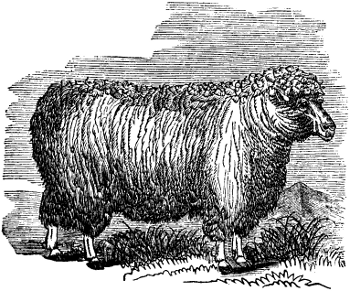
THE COTSWOLD.
The Cotswolds, until improved by modern crosses, were a very large, coarse, long-legged, flat-ribbed variety, light in the fore-quarter, and shearing a long, heavy, coarse fleece of wool. They were formerly bred only on the hills, and fatted in the valleys, of the Severn and the Thames; but with the enclosures of the Cotswold hills, and the improvement of their cultivation, they have been reared and fatted in the same district. They were hardy, prolific breeders, and capital nurses; deficient in early maturity, and not possessing feeding properties equalling those of the South-Down or New Leicester.
They have been extensively crossed with the Leicester sheep—producing thus the modern or improved Cotswold—by which their size and fleece have been somewhat diminished, but their carcasses have been materially improved, and their maturity rendered earlier. The wethers are sometimes fattened at fourteen months old, when they weigh from fifteen to twenty-four pounds to a quarter; and at two years old, increase to twenty or thirty pounds.
The wool is strong, mellow, and of good color, though rather coarse, six to eight inches in length, and from seven to eight pounds per fleece. The superior hardihood of the improved Cotswold over the Leicester, and their adaptation to common treatment, together with the prolific nature of the ewes, and their abundance of milk, have rendered them in many places rivals of the New Leicester, and have obtained for them, of late years, more attention to their selection and general treatment, under which management still farther improvement has been made. They have also been used in crossing other breeds, and have been mixed with the Hampshire Downs. Indeed, the improved Cotswold, under the name of new, or improved Oxfordshire sheep, have frequently been the successful candidates for prizes offered for the best long-woolled sheep at some of the principal agricultural meetings or shows in England. The quality of their mutton is considered superior to that of the Leicester; the tallow being less abundant, with a larger development of muscle or flesh.
The degree to which the cross between the Cotswold and Leicester may be carried, must depend upon the nature of the old stock, and on the situation and character of the farm. In exposed situations, and somewhat scanty pasture, the old blood should decidedly prevail. On a more sheltered soil, and on land that will bear closer stocking, a greater use may be made of the Leicester. Another circumstance that should guide the farmer is the object which he has principally in view. If he expects to derive his chief profits from the wool, he will look to the primitive Cotswolds; if he expects to gain more as a grazier, he will use the Leicester ram more freely.
Sheep of this breed, now of established reputation, have been imported into the United States by Messrs. Corning and Gotham, of Albany, and bred by the latter.
THE CHEVIOT.
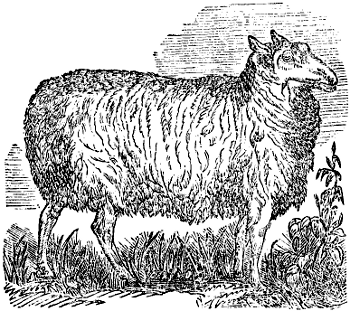
A CHEVIOT EWE.
On the steep, storm-lashed Cheviot hills, in the extreme north of England, this breed first attracted notice for their great hardiness in resisting cold, and for feeding on coarse, heathery herbage. A cross with the Leicester, pretty generally resorted to, constitutes the improved variety.
The Cheviot readily amalgamates with the Leicester—the rams employed in the system of breeding, which has been extensively introduced for producing the first cross of this descent, being of the pure Leicester breed—and the progeny is superior in size, weight of wool, and tendency to fatten, to the native Cheviot. The benefit, however, may be said to end with the first cross; and the progeny of this mixed descent is greatly inferior to the pure Leicester in form and fattening properties, and to the pure Cheviot in hardiness of constitution.
The improved Cheviot has greatly extended itself throughout the mountains of Scotland, and in many instances supplanted the black-faced breed; but the change, though often advantageous, has in some cases been otherwise—the latter being somewhat hardier, and more capable of subsisting on heathy pasturage. They are a hardy race, however, well suited for their native pastures, bearing, with comparative impunity, the storms of winter, and thriving well on poor keep. The purest specimens are to be found on the Scotch side of the Cheviot hills, and on the high and stony mountain farms which lie between that range and the sources of the Teviot. These sheep are a capital mountain stock, provided the pasture resembles those hills, in containing a good proportion of rich herbage. Though less hardy than the black-faced sheep of Scotland, they are more profitable as respects their feeding, making more flesh on an equal quantity of food, and making it more quickly.
They have white faces and legs, open countenances, lively eyes, and are without horns; the ears are large, and somewhat singular, and there is much space between the ears and eyes; the carcass is long; the back straight; the shoulders rather light; the ribs circular; and the quarters good. The legs are small in the bone, and covered with wool, as well as the body, with the exception of the face. The wether is fit for the butcher at three years old, and averages from twelve to eighteen pounds a quarter; the mutton being of a good quality, though inferior to the South-Down, and of less flavor than the black-faced. The Cheviot, though a mountain breed, is quiet and docile, and easily managed.
The wool is about the quality of Leicester, coarse and long, suitable only for the manufacture of low coatings and flushings. It closely covers the body, assisting much in preserving it from the effects of wet and cold. The fleece averages about three and a half pounds. Formerly, the wool was extensively employed in making cloths; but having given place to the finer Saxony wools, it has sunk in price, and been confined to combing purposes. It has thus become altogether a secondary consideration.
The Cheviots have become an American sheep by their repeated importations into this country. The wool on several choice sheep, imported by Mr. Carmichael, of New York, was from five to seven inches long, coarse, but well suited to combing.
THE LINCOLN.
The old breed of Lincolnshire sheep was hornless, had white faces, and long, thin, and weak carcasses; the ewes weighed from fourteen to twenty pounds a quarter; the three-year old wethers from twenty to thirty pounds; legs thick, rough and white; pelts thick; wool long—from ten to eighteen inches—and covering a slow-feeding, coarse-grained carcass of mutton.
A judicious system of breeding, which avoided Bakewell’s errors, has wrought a decided improvement in this breed. The improved Lincolns possess a rather more desirable robustness, approaching, in some few specimens, almost to coarseness, as compared with the finest Leicesters; but they are more hardy, and less liable to disease. They attain as large a size, and yield as great an amount of wool, of about the same value. This breed, indeed, scarcely differs more from the Cotswold than do flocks of a similar variety, which have been separately bred for several generations, from each other. They are prolific, and when well-fed, the ewes will frequently produce two lambs at a birth, for which they provide liberally from their udders till the time for weaning. The weight of the fleece varies from four to eight pounds per head.
Having alluded to the principal points of interest connected with the various breeds of sheep in the United States, our next business is with
THE NATURAL HISTORY OF THE SHEEP.
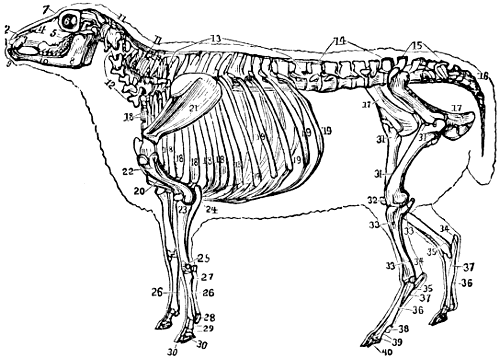
SKELETON OF THE SHEEP AS COVERED BY THE MUSCLES.
1. The intermaxillary bone. 2. The nasal bones. 3. The upper jaw. 4. The union of the nasal and upper jaw-bones. 5. The union of the molar and lachrymal bones. 6. The orbits of the eye. 7. The frontal bone. 8. The lower jaw. 9. The incisor teeth, or nippers. 10. The molars or grinders. 11. The ligament of the neck supporting the head. 12. The seven vertebræ, or the bones of the neck. 13. The thirteen vertebræ, or bones of the back. 14. The six vertebræ of the loins. 15. The sacral bone.[58] 16. The bones of the tail, varying in different breeds from twelve to twenty-one. 17. The haunch and pelvis. 18. The eight true ribs, with their cartilages. 19. The five false ribs, or those that are not attached to the breast-bone. 20. The breast-bone. 21. The scapula, or shoulder-blade. 22. The humerus, bone of the arm, or lower part of the shoulder. 23. The radius, or bone of the fore-arm. 24. The ulna or elbow. 25. The knee with its different bones. 26. The metacarpal or shank-bones—the larger bones of the leg. 27. A rudiment of the smaller metacarpal. 28. One of the sessamoid bones. 29. The first two bones of the foot—the pasterns. 30. The proper bones of the foot. 31. The thigh-bone. 32. The stifle-joint and its bone—the patella. 33. The tibia, or bone of the upper part of the leg. 34. The point of the hock. 35. The other bones of the hock. 36. The metatarsal bones, or bone of the hind-leg. 37. Rudiment of the small metatarsal. 38. A sessamoid bone. 39. The first two bones of the foot—the pasterns. 40. The proper bones of the foot.
Division. Vertebrata—possessing a back-bone. Class. Mammalia—such as give suck. Order. Ruminantia—chewing the cud. Family. Capridæ—the goat kind. Genus. Oris—the sheep family. Of this Genus there are three varieties: Oris, Ammon, or Argali. Oris Musmon. Oris Aries, or Domestic Sheep.
Of the latter—with which alone this treatise is concerned—there are about forty well known varieties. Between the oris, or sheep, and the capra, or goat, another genus of the same family, the distinctions are well marked, although considerable resemblance exists between them. The horns of the sheep have a spiral direction, while those of the goat have a direction upward and backward; the sheep, except in a single wild variety, has no beard, while the goat is bearded; the goat, in his highest state of improvement, when he is made to produce wool of a fineness unequalled by the sheep—as in the Cashmere breed—is mainly, and always, externally covered with hair, while the hair on the sheep may, by domestication, be reduced to a few coarse hairs, or got rid of altogether; and, finally, the pelt or skin of the goat has thickness very far exceeding that of the sheep.
The age of sheep is usually reckoned, not from the time that they are dropped, but from the first shearing; although the first year may thus include fifteen or sixteen months, and sometimes more. When doubt exists relative to the age, recourse is had to the teeth, since there is more uncertainty about the horn in this animal than in cattle; ewes that have been early bred, appearing always, according to the rings on the horn, a year older than others that have been longer kept from the ram.
FORMATION OF THE TEETH.
Sheep have no teeth in the upper jaw, but the bars or ridges of the palate thicken as they approach the forepart of the mouth; there also the dense, fibrous, elastic matter, of which they are constituted, becomes condensed, and forms a cushion or bed, which covers the converse extremity of the upper jaw, and occupies the place of the upper incisor, or cutting teeth, and partially discharge their functions. The herbage is firmly held between the front teeth in the lower jaw and this pad, and thus partly bitten and partly torn asunder. Of this, the rolling motion of the head is sufficient proof.
The teeth are the same in number as in the mouth of the ox. There are eight incisors or cutting-teeth in the forepart of the lower jaw, and six molars in each jaw above and below, and on either side. The incisors are more admirably formed for grazing than in the ox. The sheep lives closer, and is destined to follow the ox, and gather nourishment where that animal would be unable to crop a single blade. This close life not only loosens the roots of the grass, and disposes them to spread, but by cutting off the short suckers and sproutings—a wise provision of nature—causes the plants to throw out fresh, and more numerous, and stronger ones, and thus is instrumental in improving and increasing the value of the crop. Nothing will more expeditiously and more effectually make a thick, permanent pasture than its being occasionally and closely eaten down by sheep.
In order to enable the sheep to bite this close, the upper lip is deeply divided, and free from hair about the centre of it. The part of the tooth above the gum is not only, as in other animals, covered with enamel, to enable it to bear and to preserve a sharpened edge, but the enamel on the upper part rises from the bone of the tooth nearly a quarter of an inch, and presenting a convex surface outward, and a concave within, forms a little scoop or gorge of wonderful execution.
The mouth of the lamb newly dropped is either without incisor teeth or it has two. The teeth rapidly succeed to each other, and before the animal is a month old he has the whole of the eight. They continue to grow with his growth until he is about fourteen or sixteen months old. Then, with the same previous process of diminution as in cattle, or carried to a still greater degree, the two central teeth are shed, and attain their full growth when the sheep is two years old.
In examining a flock of sheep, however, there will often be very considerable difference in the teeth of those that have not been sheared, or those that have been once sheared; in some measure to be accounted for by a difference in the time of lambing, and likewise by the general health and vigor of the animal. There will also be a material difference in different animals, attributable to the good or bad keep which they have had. Those fed on good land, or otherwise well kept, will generally take the start of others that have been half starved, and renew their teeth some months sooner than these. There are also irregularities in the times of renewing the teeth, not to be accounted for by either of these circumstances; in fact, not to be explained by any known circumstance relating to the breed or the keep of the sheep. The want of improvement in sheep, which is occasionally observed, and which cannot be accounted for by any deficiency or change of food, may sometimes be justly attributed to the tenderness of the mouth when the permanent teeth are protruding through the gums.
Between two and three years old the next two incisors are shed; and when the sheep is actually three years old, the four central teeth are fully grown; at four years old, he has six teeth fully grown; and at five years old—one year before the horse or the ox can be said to be full-mouthed—all the teeth are perfectly developed. The sheep is a much shorter-lived animal than the horse, and does not often attain the usual age of the ox. Their natural age is about ten years, to which age they will breed and thrive well; though there are recorded instances of their breeding at the age of fifteen, and of living twenty years.
The careless examiner may be sometimes deceived with regard to the four-year-old mouth. He will see the teeth perfectly developed, no diminutive ones at the sides, and the mouth apparently full; and then, without giving himself the trouble of counting the teeth, he will conclude that the animal is five years old. A process of displacement, as well as of diminution, has taken place here; the remaining outside milk-teeth have not only shrunk to less than a fourth part of their original size, but the four-year-old teeth have grown before them and perfectly conceal them, unless the mouth is completely opened.
After the permanent teeth have all appeared and are fully grown, there is no criterion as to the age of the sheep. In most cases, the teeth remain sound for one or two years, and then, at uncertain intervals—either on account of the hard work in which they have been employed, or from the natural effect of age—they begin to loosen and fall out; or, by reason of their natural slenderness, they are broken off. When favorite ewes, that have been kept for breeding, begin to lose condition, at six or seven years old, their mouths should be carefully examined. If any of the teeth are loose, they should be extracted, and a chance given to the animal to show how far, by browsing early and late, she may be able to make up for the diminished number of her incisors. It frequently happens that ewes with broken teeth, and some with all the incisors gone, will keep pace in condition with the best in the flock; but they must be well taken care of in the winter, and, indeed, nursed to an extent that would scarcely answer the farmer’s purpose to adopt as a general rule, in order to prevent them from declining to such a degree as would make it very difficult afterward to fatten them for the butcher. It may certainly be taken as a general rule, that when sheep become broken-mouthed they begin to decline.
Causes of which the farmer is utterly ignorant, or over which he has no control, will sometimes hasten the loss of the teeth. One thing, however, is certain—that close feeding, causing additional exercise, does wear them down; and that the sheep of farmers who stock unusually and unseasonably hard, lose their teeth much sooner than others do.
THE STRUCTURE OF THE SKIN.
The skin of the sheep, in common with that of most animals, is composed of three textures. Externally is the cuticle, or scarf-skin, which is thin, tough, devoid of feeling, and pierced by innumerable minute holes, through which pass the fibres of the wool and the insensible perspiration. It seems to be of a scaly texture; although is not so evident as in many other animals, on account of a peculiar substance—the yolk—which is placed on it, to protect and nourish the roots of the wool. It is, however, sufficiently evident in the scab and other cutaneous eruptions to which this animal is liable.
Below this cuticle is the rete mucosum, a soft structure; its fibres having scarcely more consistence than mucilage, and being with great difficulty separated from the skin beneath. This appears to be placed as a defence to the terminations of the blood-vessels and nerves of the skin, which latter are, in a manner, enveloped and covered by it. The color of the skin, and probably that of the hair or wool also, is determined by the rete mucosum; or, at least, the hair and wool are of the same color as this substance.
Beneath the rete mucosum is the cutis, or true skin, composed of numberless minute fibres crossing each other in every direction; highly elastic, in order to fit closely to the parts beneath, and to yield to the various motions of the body; and dense and firm in its structure, that it may resist external injury. Blood-vessels and nerves innumerable pierce it, and appear on its surface in the form of papillæ, or minute eminences; while, through thousands of little orifices, the exhalent absorbents pour out the superfluous or redundant fluid. The true skin is composed, principally or almost entirely, of gelatine; so that, although it may be dissolved by long-continued boiling, it is insoluble in water at the common temperature. This organization seems to have been given to it, not only for the sake of its preservation while on the living animal, but that it may afterwards become useful to man. The substance of the hide readily combining with the tanning principle, is converted into leather.
THE ANATOMY OF THE WOOL.
THE WALLACHIAN SHEEP.
On the skin of most animals is placed a covering of feathers, fur, hair, or wool. These are all essentially the same in composition, being composed of an animal substance resembling coagulated albumen, together with sulphur, silica, carbonate and phosphate of lime, and oxides of iron and manganese.
Wool is not confined to the sheep. The under-hair of some goats is not only finer than the fleece of any sheep, but it occasionally has the crisped appearance of wool; being, in fact, wool of different qualities in different breeds—in some, rivalling or excelling that of the sheep, but in others very coarse. A portion of wool is also found on many other animals; as the deer, elk, the oxen of Tartary and Hudson’s Bay, the gnu, the camel, many of the fur-clad animals, the sable, the polecat, and several species of the dog.
Judging from the mixture of wool and hair in the coat of most animals, and the relative situation of these materials, it is not improbable that such was the character of the fleece of the primitive sheep. It has, indeed, been asserted that the primitive sheep was entirely covered with hair; but this is, doubtless, incorrect. There exists, at the present day, varieties of the sheep occupying extensive districts, that are clothed outwardly with hair of different degrees of fineness and sleekness; and underneath the external coat is a softer, shorter, and closer one, that answers to the description of fur—according to most travellers—but which really possesses all the characteristics of wool. It is, therefore, highly improbable that the sheep—which has now become, by cultivation, the wool-bearing animal in a pre-eminent degree—should, in any country, at any time, have ever been entirely destitute of wool. Sheep of almost every variety have at times been in the gardens of the London (Eng.) Zoölogical Society; but there has not been one on which a portion of crisped wool, although exceedingly small, has not been discovered beneath the hair. In all the regions over which the patriarchs wandered, and extending northward through the greater part of Europe and Asia, the sheep is externally covered with hair; but underneath is a fine, short, downy wool, from which the hair is easily separated. This is the case with the sheep at the Cape of Good Hope, and also in South America.
The change from hair to wool, though much influenced by temperature, has been chiefly effected by cultivation. Wherever hairy sheep are now found the management of the animal is in a most disgraceful state; and among the cultivated sheep the remains of this ancient hairy covering only exists, to any great extent, among those that are comparatively neglected or abandoned.
The filament of the wool has scarcely pushed itself through the pore of the skin, when it has to penetrate through another and singular substance, which, from its adhesiveness and color, is called the yolk. This is found in greatest quantity about the breast and shoulders—the very parts that produce the best, and healthiest, and most abundant wool—and in proportion as it extends, in any considerable degree, over other parts, the wool is then improved. It differs in quantity in different breeds. It is very abundant on the Merinos; it is sufficiently plentiful on most of the southern breeds, either to assist in the production of the wool, or to defend the sheep from the inclemency of the weather; but in the northern districts, where the cold is more intense and the yolk of wool is deficient, a substitute for it is sometimes sought by smearing the sheep with a mixture of tar, oil, or butter. Where there is a deficiency of yolk, the fibre of the wool is dry, harsh, and weak, and the whole fleece becomes thin and hairy; where the natural quantity of it is found, the wool is soft, oily, plentiful and strong.
This yolk is not the inspissated or thickened perspiration of the animal; it is not composed of matter which has been accidentally picked up, and which has lodged in the wool; but it is a peculiar secretion from the glands of the skin, destined to be one of the agents in the nourishment of the wool, and at the same time, by its adhesiveness, to mat the wool together, and form a secure defence from the wet and cold.
Chemical experiments have established its composition, as follows: first, of a soapy matter with a basis of potash, which forms the greater part of it; second, a small quantity of carbonate of potash; third, a perceptible quantity of acetate of potash; fourth, lime, in a peculiar and unknown state of combination; fifth, an atom of muriate of potash; sixth, an animal oil, to which its peculiar odor is attributable. All these materials are believed to be essential to the yolk, and not found in it by mere accident, since the yolk of a great number of samples—Spanish, French, English, and American—has been subjected to repeated analyses, with the same result.
The yolk being a true soap, soluble in water, it is not difficult to account for the comparative ease with which sheep that have the natural proportion of it are washed in a running stream. There is, however, a small quantity of fatty matter in the fleece, which is not in combination with the alkali, and which, remaining attached to the wool, keeps it a little glutinous, notwithstanding the most careful washing.
The fibre of the wool having penetrated the skin and escaped from the yolk, is of a circular form, generally larger toward the extremity, and also toward the root, and in some instances very considerably so. The filaments of white wool, when cleansed from grease, are semi-transparent; their surface in some places is beautifully polished, in others curiously incrusted, and they reflect the rays of light in a very pleasing manner. When viewed by the aid of a powerful achromatic microscope, the central part of the fibre has a singularly glittering appearance. Minute filaments, placed very regularly, are sometimes seen branching from the main trunk, like boughs from the principal stem. This exterior polish varies much in different wools, and in wools from the same breed of sheep at different times. When the animal is in good condition, and the fleece healthy, the appearance of the fibre is really brilliant; but when the state of the constitution is bad, the fibre has a dull appearance, and either a wan, pale light, or sometimes scarcely any, is reflected. As a general rule, the filament is most transparent in the best and most useful wools, whether long or short. It increases with the improvement of the breed, and the fineness and healthiness of the fleece; yet it must be admitted that some wools have different degrees of the transparency and opacity, which do not appear to affect their value and utility. It is, however, the difference of transparency in the same fleece, or in the same filament, that is chiefly to be noticed as improving the value of the wool.
As to the size of the fibre, the terms “fine” and “coarse,” as commonly used, are but vague and general descriptions of wool. All fine fleeces have some coarse wool, and all coarse fleeces some fine. The most accurate classification is to distinguish the various qualities of wool in the order in which they are esteemed and preferred by the manufacturer—as the following: first, fineness with close ground, that is, thick-matted ground; second, pureness; third, straight-haired, when broken by drawing; fourth, elasticity, rising after compression in the hand; fifth, staple not too long; sixth, color; seventh, what coarse exists to be very coarse; eighth, tenacity; and ninth, not much pitch-mark, though this is no disadvantage, except the loss of weight in scouring. The bad or disagreeable properties are—thin, grounded, tossy, curly-haired, and, if in a sorted state, little in it that is very fine; a tender staple, as elasticity, many dead white hairs, very yolky. Those who buy wool for combing and other light goods that do not need milling, wish to find length of staple, fineness of hair, whiteness, tenacity, pureness, elasticity, and not too many pitch-marks.
The property first attracting attention, and being of greater importance than any other, is the fineness of the pile—the quantity of fine wool which a fleece yields, and the degree of that fineness. Of the absolute fineness, little can be said, varying, as it does, in different parts of the same fleece to a very considerable degree, and the diameter of the same fibre often being exceedingly different at the extremity and the centre. The micrometer has sometimes indicated that the diameter of the former is five times as much as that of the latter; and, consequently, that a given length of yield taken from the extremity would weigh twenty-five times as much as the same length taken from the centre and cleansed from all yolk and grease. That fibre may be considered as coarse whose diameter is more than the five-hundredth part of an inch; in some of the most valuable samples of Saxony wool it has not exceeded the nine-hundredth part; yet in some animals, whose wool has not been used for manufacturing purposes, it is less than one twelve-hundredth part.