CONTENTS. (continued 3)
Reading edition
It is much better for the lambs and for their dams that they be weaned from three and a half to four months old. When taken away, they should be put for several days in a field distant from the ewes, that they may not hear each other’s bleatings, as the lambs, when in hearing of their dams, continue restless much longer, and make constant and, frequently, successful efforts to crawl through the fences which separate them. One or two tame old ewes are turned into the field with them, to teach them to come at the call, find salt when thrown to them, and eat out of troughs when winter approaches.
When weaned, the lambs should be put on the freshest and tenderest grass—rich, sweet food, but not too luxuriant. The grass and clover, sown the preceding spring, on grain-fields seeded down, is often reserved for them. The dams, on the contrary, should be put for a fortnight on short, dry feed, to stop the flow of milk. They should be looked to after a day or two, and if the bags of any are found much distended, the milk should be drawn away, and the bags washed for a little time in cold water. On short feed, they rarely give much trouble in this respect. When thoroughly dried off, they should have the best fare, to enable them to recover condition for subsequent breeding and wintering. The fall is a critical period in which to lose flesh, either for sheep or lambs; and if any are found deficient, they should at once be provided with extra feed and attention. If cold weather overtake them, poor or in ill health, they will scarcely outlive it; or if by chance they survive, their emaciated carcass, impaired constitution, and scant fleece will ill repay the food and attention they will have cost.
CASTRATION AND DOCKING.
Some breeders advocate castration in a day or two after birth, while others will not allow the operation to be performed until the lamb is a month old. The weight of authority, however, is in favor of any time between two and six weeks after birth, when the creature has attained some strength, and the parts have not become too rigid. In such circumstances, the best English breeders recommend from ten to fifteen days old as the proper time. A lamb of a day old cannot be confirmed in all the functions of its body, and, indeed, in many instances, the testicles can then scarcely be found. At a month old, on the other hand, the lamb may be so fat, and the weather so warm, that the operation may be attended with febrile action. Dry, pleasant weather should be selected for this: a cool day, if possible; if warm, it should be done early in the morning.
Castration is a simple and safe process. Let a man hold a lamb with its back pressed firmly against his breast and stomach, and all four legs gathered in front in his hands. Cut off the bottom of the pouch, free the testicle from the inclosing membrane, and then draw it steadily out, or clip the cord with a knife if it does not snap off at a proper distance from the testicle. Some shepherds draw both testicles at once with their teeth. It is usual to drop a little salt into the pouch. Where the weather is very warm, some touch the end of the pouch with an ointment, consisting of tar, lard, and turpentine. As a general thing, however, the animal will do as well without any application.
The object of docking is to keep the sheep behind clean from filth and vermin; since the tail, if left on, is apt to collect filth, and, if the animal purges, becomes an intolerable nuisance. The tail, however, should not be docked too short, since it is a protection against cold in winter. This operation is by many deferred till a late period, from apprehension of too much loss of blood; but, if the weather be favorable and the lamb in good condition, it may be performed at the same time as castration with the least trouble and without injury.
The tail should be laid upon a plank, the animal being held in the same position as before. With one hand the skin is drawn toward the body, while another person, with a two-inch chisel and mallet, strikes it off at a blow, between the bone-joints, leaving it from one and a half to two inches long. The skin immediately slips back over the wound, which is soon healed. Should bleeding continue—as, however, rarely happens—so long as to sicken the lamb, a small cord should be tied firmly round the end of the tail; but this must not be allowed to remain on above twenty-four hours, as the points of the tail would slough off. Ewe lambs should be docked closer than rams. To prevent flies and maggots, and assist in healing, it is well to apply an ointment composed of lard and tar, in the proportion of four pounds of the former to one quart of the latter. The lambs should be carefully protected from cold and wet till they are perfectly well.
FEEDING.
As soon as the warm weather approaches and the grass appears, sheep become restive and impatient for the pasture. This instinct should be repressed till the ground has become thoroughly dry, and the grass has acquired substance. They ought, moreover, to be provided for the change of food by the daily use of roots for a few days before turning out. The tendency to excessive purging which is induced by the first spring-feed, may be checked by housing them at night and feeding them for the first few days with a little sound, sweet hay. They must be provided with pure water and salt; for, though they may do tolerably well without either, yet thrift and freedom from disease are cheaply secured by this slight attention.
As to water, it may be said that it is not indispensable in the summer pastures, since the dews and the succulence of the feed answer as a substitute; but a wide experience having demonstrated that free access to it is advantageous, particularly to those having lambs, it should be considered a matter of importance on a sheep-farm so to arrange the pastures, if possible, as to bring water into each of them.
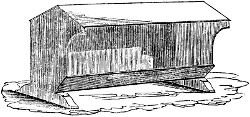
A COVERED SALTING BOX.
Salt is indispensable to the health, especially in the summer. It is common to give it once a week, while they are at grass. It is still better to give them free access to it, at all times, by keeping it in a covered box, open on one side, as in the engraving annexed. A large hollow log, with holes cut along the side for the insertion of the heads of the animals, answers very well. A sheep having free access to salt at all times will never eat too much of it; and it will take its supply at such times and in such quantities as Nature demands, instead of eating of it voraciously at stated periods, as intermediate abstinence will stimulate it to do. When salt is fed but once a week, it is better to have a stated day, so that it will not be forgotten; and it is well to lay the salt on flat stones—though if laid in little handfuls on the grass, very little of it will be lost.
Tar. This is supposed by many to form a very healthful condiment for sheep, and they smear the nose with it, which is licked and swallowed as the natural heat of the flesh, or that of the weather, causes it to trickle down over the nostrils and lips. Others, suffering the flock to get unusually salt-hungry, place tar upon flat stones, or in troughs, and then scatter salt upon it so that both may be consumed together. Applied to the nose, in the nature of a cataplasm, it may be advantageous in catarrhs; and in the same place, at the proper periods, its odor may, perhaps, repel the fly, the eggs of which produce the “gout in the head,” as it is termed. However valuable it may be as a medicine, and even as a debergent in the case specified, there is but slight ground for confidence in it merely as a condiment.
Dry, sweet pastures, and such as abound in aromatic and bitter plants, are best suited for sheep-walks. No animal, with the exception of the goat, crops so great a variety of plants. They eat many which are rejected by the horse and the ox, which are even essential to their own wants. In this respect they are valuable assistants to the husbandman, as they feed greedily on wild mustard, burdock, thistles, marsh-mallows, milk-weed, and various other offending plants; and the Merino exceeds the more recent breeds in the range of his selections.
In pastures, however, where the dry stalks of the burdock, or the hound’s-tongue, or tory-weed have remained standing over the winter, the burs are caught in the now long wool, and, if they are numerous, the wool is rendered entirely unmarketable and almost valueless. Even the dry prickles of the common and Canada thistles, where they are very numerous, get into the neck-wool of sheep, as they thrust their heads under and among them to crop the first scarce feed of the northern spring; and, independently of injuring the wool, they make it difficult to wash and otherwise handle the sheep. Indeed, it is a matter of the soundest policy to keep sheep on the cleanest pastures, those free from these and similar plants; and in a region where they are pastured the year round, they should be kept from contact with them for some months prior to shearing.
Many prepare artificial pastures for their flocks, which may be done with a number of plants. Winter rye, or wheat sown early in the season, may be fed off in the fall, without injury to the crop; and, in the following spring, the rye may be pastured till the stalks shoot up and begin to form a head. This affords an early and nutritious food. Corn may be sown broadcast, or thickly in drills, and either fed off in the fields or cut and carried to the sheep in their folds. White mustard is also a valuable crop for this purpose.
To give sheep sufficient variety, it is better to divide their range into several smaller ones, and change them as often, at least, as once a week. They seek a favorite resting-place, on a dry, elevated part of the field, which soon becomes soiled. By removing them from this for a few days, rain will cleanse or the sun dry it, so as to make it again suitable for them. More sheep may be kept, and in better condition, where this practice is adopted, than where they are confined to the same pasture.
Shade. No one who has observed with what eagerness sheep seek shade in hot weather, and how they pant and apparently suffer when a hot sun is pouring down upon their nearly naked bodies, will doubt that, both as a matter of humanity and utility, they should be provided, during the hot summer-months, with a better shelter than that afforded by a common rail-fence. Forest trees are the most natural and the best shades, and it is as contrary to utility as it is to good taste to strip them entirely from the sheep-walks. A strip of stone-wall or close board fence on the south and west sides of the pasture, forms a tolerable substitute for trees. But in the absence of all these and of buildings of any kind, a shade can be cheaply constructed of poles and brush, in the same manner as the sheds of the same materials for winter shelter, which will be hereafter described.
Fences. Poor fences will teach ewes and wethers, as well as rams, to jump; and for a jumping flock there is no remedy but immoderately high fences, or extirpation. One jumper will soon teach the trick to a whole flock; and if one by chance is brought in, it should be immediately hoppled or killed. The last is by far the surest and safest remedy.
Hoppling is done by sewing the ends of a leather strap, broad at the extremities, so that it will not cut into the flesh, to a fore and hind leg, just above the pastern joints, leaving the legs at about the natural distance apart. Clogging is fastening a billet of wood to the fore leg by a leather strap. Yoking is fastening two rams two or three feet apart, by bows around their necks, inserted in a light piece of timber, some two or three inches in size. Poking is done by inserting a bow in a short bit of light timber, into which bit—worn on the under side of the neck—a rod is inserted, which projects a couple of feet in front of the sheep.
These and similar devices, to prevent rams from scaling fences, may be employed as a last resort by those improvident farmers who prefer, by such troublesome, injurious, and, at best, insecure means, to guard against that viciousness which they might so much more easily have prevented from being acquired.
Dangerous rams. From being teased and annoyed by boys, or petted and played with when young, and sometimes without any other stimulant than a naturally vicious temper, rams occasionally become very troublesome by their propensity to attack men or cattle. Some will allow no man to enter the field where they are without making an immediate onset upon him; while others will knock down the ox or horse which presumes to dispute a lock of hay with them. A ram which is known to have acquired this propensity should at once be hooded, and, if not valuable, at the proper season converted into a wether. But the courage thus manifested is usually the concomitant of great strength and vigor of constitution, and of a powerfully developed frame. If good in other particulars, it is a pity to lose the services of so valuable an animal. In such cases, they may be hooded, by covering their faces with leather in such a manner that they can only see a little backward and forward. They must then, however, be kept apart from the flock of rams, or they will soon be killed or injured by blows, which they cannot see to escape.
It sometimes happens that a usually quiet-tempered ram will suddenly exhibit some pugnacity when one is salting or feeding the flock. If such a person turns to run, he is immediately knocked down, and the ram learns, from that single lesson, the secret of his mastery, and the propensity to exercise it. As the ram gives his blow from the summit of the parietal and the posterior portion of the frontal bones on the top of his head, and not from the forehead, he is obliged to crouch his head so low when he makes his onset that he does not see forward well enough to swerve suddenly from his right line, and a few quick motions to the right and left enable one to escape him. Run in upon him, as he dashes by, with pitch-fork, club, or boot-heel, and punish him severely by blows about the head, if the club is used, giving him no time to rally until he is thoroughly cowed. This may be deemed harsh treatment, and likely to increase the viciousness of the animal. Repeated instances have, however, proved the contrary; and if the animal once is forced to acknowledge that he is overcome, he never forgets the lesson.
Prairie feeding. Sheep, when destined for the prairies, ought to commence their journey as early after the shearing as possible, since they are then disencumbered of their fleece, and do not catch and retain as much dust as when driven later; feed is also generally better, and the roads are dry and hard. Young and healthy sheep should be selected, with early lambs; or, if the latter are too young, and the distance great, they should be left, and the ewes dried off. A large wagon ought to accompany the flock, to carry such as occasionally give out; or they may be disposed of whenever they become enfeebled. With good care, a hardy flock may be driven at the rate of twelve or fourteen miles a day. Constant watchfulness is requisite, in order to keep them healthy and in good plight. One-half the expense of driving may be saved by the use of well-trained shepherd-dogs.
When arrived at their destination, they must be thoroughly washed, to free them from all dirt, and closely examined as to any diseases which they may have contracted, that these may be promptly removed. A variety of suitable food and good shelter must be provided for the autumn, winter, and spring ensuing, and every necessary attention given to them. This would be necessary if they were indigenous to the country; but it is much more so when they have just undergone a campaign to which neither they nor their race have been accustomed.
Sheep cannot be kept on the prairies without much care, artificial food, and proper attention; and losses have often occurred, by reason of a false system of economy attempted by many, from disease and mortality in the flocks, amply sufficient to have made a generous provision for the comfort and security of twice the number lost. More especially do they require proper food and attention after the first severe frosts set in, which wither and kill the natural grasses. By nibbling at the bog—the frostbitten, dead grass—they are inevitably subject to constipation, which a bountiful supply of roots, sulphur, etc., is alone sufficient to remove.
Roots, grain, good hay, straw, corn-stalks, and pea or bean-vines are essential to the preservation of their health and thrift during the winter, everywhere north of thirty-nine degrees. In summer, the natural herbage is sufficient to sustain them in fine condition, till they shall have acquired a denser population of animals, when it will be found necessary to stock their meadows with the best varieties of artificial grasses.
The prairies seem adapted to the usual varieties of sheep introduced into the United States; and of such are the flocks made up, according to the taste or judgment of the owners. Shepherd dogs are invaluable to the owners of flocks, in these unfenced, illimitable ranges, both as a defence against the small prairie wolves, which prowl around the sheep, but have been rapidly thinned off by the settlers, and also as assistants to the shepherds in driving and herding their flocks on the open ground.
Fall feeding. In the North, the grass often gets very short by the tenth or fifteenth of November, and it has lost most of its nutritiousness from repeated freezing and thawing. At this time, although no snow may have fallen, it is best to give the sheep a light, daily foddering of bright hay, and a few oats in the bundle. Given thus for the ten or twelve days which precede the covering of the ground by snow, fodder pays for itself as well as at any other time during the year. It is well to feed oats in the bundle, or threshed oats, about a gill to the head, in the feeding-troughs, carried to the field for that purpose.
Winter feeding. The time for taking sheep from the pastures must depend on the state of the weather and food. Severe frosts destroy much of the nutriment in the grasses, and they soon after cease to afford adequate nourishment. Long exposure to cold storms, with such food to sustain them, will rapidly reduce the condition of these animals. The only safe rule is to transfer them to their winter-quarters the first day they cease to thrive abroad.
There is no better food for sheep than well-ripened, sound Timothy hay; though the clovers and nearly all the cultivated grasses may be advantageously fed. Hundreds and thousands of northern flocks receive, during the entire winter, nothing but ordinary hay, consisting mainly of Timothy, some red and white clover, and frequently a sprinkling of gum, or spear grass. Bean and pea straw are valuable, especially the former, which, if properly cured, they prefer to the best hay; and it is well adapted to the production of wool. Where hay is the principal feed, it may be well, where it is convenient, to give corn-stalks every fifth or sixth feed, or even once a day; or the daily feed, not of hay, might alternate between stalks, pea-straw, straws of the cereal grains, etc. It is mainly a question of convenience with the farmer, provided a proper supply of palatable nutriment within a proper compass is given. It would not, however, be entirely safe to confine any kind of sheep to the straw of the cereal grains, unless it were some of those little hardy varieties of animals which would be of no use in this country.
The expediency of feeding grain to store-sheep in winter depends much on circumstances. If in a climate where they can obtain a proper supply of grass or other green esculents, it would, of course, be unnecessary; nor is it a matter of necessity where the ground is frozen or covered with snow for weeks or months, provided the sheep be plentifully supplied with good dry fodder. Near markets where the coarser grains find a quick sale at fair prices, it is not usual, in the North, to feed grain. Remote from markets it is generally fed by the holders of large flocks. Oats are commonly preferred, and they are fed at the rate of a gill a head per day. Some feed half the same amount of yellow corn. Fewer sheep, particularly lambs and yearlings, get thin and perish where they receive a daily feed of grain; they consume less hay, and their fleeces are increased in weight. On the whole, therefore, it is considered good economy. Where no grain is fed, three daily feeds of hay are given. The smaller sizes of the Saxon may be well sustained on two pounds of hay; but larger sheep will consume from three and a half to four or even five pounds per day. Sheep, in common with all other animals, when exposed to cold, will consume much more than if well protected, or during a warmer season.
It is a common and very good practice to feed greenish cut oats in the bundle, at noon, and give but two feeds of hay, one at morning and one at night. Some feed greenish cut peas in the same way. In warm, thawing weather, when sheep get to the ground and refuse dry hay, a little grain assists materially in keeping up their strength and condition. When the feed is shortest in winter, in the South, there are many localities where sheep can get enough grass to take off their appetite for dry hay, but not quite enough to keep them in prime order. A moderate daily feed of oats or pease, placed in the depository racks, would keep them strong and in good plight for the lambing season, and increase their weight of wool.
Few Northern farmers feed Indian corn to store-sheep, as it is considered too hot and stimulating, and sheep are thought to become more liable to become “cloyed” on it than on oats, pease, etc. Yellow corn is not generally judged a very safe feed for lambs and yearlings. Store-sheep should be kept in good, fair, plump condition. Lambs and yearlings may be as fat as they will become on proper feeding. It is stated that sheep will eat cotton-seed, and thrive on it.
It must be remembered that sheep are not to be allowed to get thin during the winter, with the idea that their condition can at any time be readily raised by better feed, as with the horse or ox. It is always difficult, and, unless properly managed, expensive and hazardous, to attempt to raise the condition of a poor flock in the winter, especially if they have reached that point where they manifest weakness. If the feeding of a liberal allowance of grain be suddenly commenced, fatal diarrhœa will often supervene. All extra feeding, therefore, must be begun very gradually; and it does not appear, in any case, to produce proportionable results.
Roots, such as ruta-bagas, Irish potatoes, and the like, make a good substitute for grain, or as extra feed for grown sheep. The ruta-baga is preferable to the potato in its equivalents of nutriment. No root, however, is as good for lambs and yearlings as an equivalent of grain. Sheep may be taught to eat nearly all the cultivated roots. This is done by withholding salt from them, and then feeding the chopped roots a few times, rubbed with just sufficient salt to induce them to eat the root to obtain it; but not enough to satisfy their appetite for salt before they have acquired a taste for the roots.
It is customary with some farmers to cut down, from time to time in the winter, and draw into the sheep-yards, young trees of the hemlock, whose foliage is greedily eaten by the sheep, after being confined for some time to dry feed. This browse is commonly used, like tar, for some supposed medicinal virtues. It is pronounced “healthy” for sheep. Much the same remarks might be made about this as have been already made concerning tar. No tonics and stimulants are needed for a healthy animal. If the foliage of the hemlock were constantly accessible to them, there would be no possible objection to their eating it, since their instincts, in that case, would teach them whether, and in what quantities, to devour it; but when entirely confined to dry feed for a protracted period, sheep will consume injurious and even poisonous succulents, and of the most wholesome ones, hurtful quantities. As a mere laxative, an occasional feed of hemlock may be beneficial; though, in this point of view, a day’s run at grass, in a thaw, or a feed of roots, would produce the same result. In a climate where grass is procurable most of the time, browse for medicinal purposes is entirely unnecessary.
Sheep undoubtedly require salt in winter. Some salt their hay when it is stored in the barn or stack. This is objectionable, since the appetite of the sheep is much the safest guide in the premises. It may be left accessible to them in the salt-box, as in summer; or an occasional feed of grined hay or straw may be given them in warm, thawing weather, when their appetite is poor. This last is an excellent plan, and serves a double purpose. With a wisp of straw, sprinkle a thin layer of straw with brine, then another layer of straw, and another sprinkling, and so on. Let this lie until the next day, for the brine to be absorbed by the straw, and then feed it to all the grazing animals on the farm which need salting.
Water is indispensable, unless sheep have access to succulent food, or clean snow. Constant access to a brook or spring is best; but, in default of this, they should be watered at least once a day in some other way.
Feeding with other stock. Sheep should not run, or be fed, in yards, with any other stock. Cattle hook them, often mortally; and colts tease and frequently injure them. It is often said that “colts will pick up what sheep leave.” But well-managed sheep rarely leave any thing; and, if they chance so to do, it is better to rake it up and throw it into the colts’ yard, than to feed them together. If sheep are not required to eat their food pretty clean, they will soon learn to waste large quantities. If, however, they are over-fed with either hay or grain, it is not proper to compel them, by starvation, to come back and eat it. This they will not do, unless sorely pinched. Clean out the troughs, or rake up the hay, and the next time feed less.
Division of flocks. If flocks are shut up in small inclosures during winter, according to the northern custom, it is necessary to divide them into flocks of about one hundred each, consisting of sheep of about the same size and strength; otherwise, the stronger rob the weaker, and the latter rapidly decline. This is not so important where the sheep roam at large; but, even in that case, some division and classification are best. It is best, indeed, even in summer. The poorer and feebler can by this means receive better pasture, or a little more grain and better shelter in winter.
By those who grow wool to any extent, breeding ewes, lambs, and wethers, are invariably kept in separate flocks in winter; and it is best to keep yearling sheep by themselves with a few of the smallest two-year-olds, and any old crones which are kept for their excellence as breeders, but which cannot maintain themselves in the flock of breeding ewes.
Old and feeble or wounded sheep, late-born lambs, etc., should be placed by themselves, even if the number be small, as they require better feed, warmer shelter, and more attention. Unless the sheep are of a peculiarly valuable variety, however, it is better to sell them off in the fall at any price, or to give them to some poor neighbor who has time to nurse them, and who may thus commence a flock.
Regularity in feeding. If any one principle in sheep husbandry deserves careful attention more than others, it is, that the utmost regularity must be preserved in feeding.
First, there should be regularity as to the times of feeding. However abundantly provided for, when a flock are foddered sometimes at one hour and sometimes at another—sometimes three times a day, and sometimes twice—some days grain, and some days none—they cannot be made to thrive. They will do far better on inferior keep, if fed with strict regularity. In a climate where they require hay three times a day, the best times for feeding are about sunrise in the morning, at noon, and an hour before dark at night. Unlike cattle and horses, sheep do not feed well in the dark; and, therefore, they should have time to consume their food before night sets in. Noon is the common time for feeding grain or roots, and is the best time, if but two fodderings of hay are given. If the sheep receive hay three times, it is not a matter of much consequence with which feeding grain is given, only that the practice be uniform.
Secondly, it is highly essential that there should be regularity in the amount fed. The consumption of hay will, it is true, depend much upon the weather; the keener the cold, the more the sheep will eat. In the South, much depends upon the amount of grass obtained. In many places, a light, daily foddering supplies; in others, a light foddering placed in the depository racks once in two days, answers the purpose. In the steady cold weather of the North, the shepherd readily learns to determine about how much hay will be consumed before the next foddering time. And this amount should, as near as may be, be regularly fed. In feeding grain or roots, there is no difficulty in preserving entire regularity; and it is vastly more important than in feeding hay. Of the latter, a sheep will not over-eat and surfeit itself; of the former, it will. Even if it be not fed grain to the point of surfeiting, it will expect a like amount, however over-plenteous, at the next feeding; failing to receive which, it will pine for it, and manifest uneasiness. The effect of such irregularity on the stomach and system of any animal is bad; and the sheep suffers more from it than any other animal. It is much better that the flock receive no grain at all, than that they receive it without regard to regularity in the amount. The shepherd should measure out the grain to the sheep in all instances, instead of guessing it out, and measure it to each separate flock.
Effect of food. Well-fed sheep, as has been previously remarked, produce more wool than poorly fed ones. No doctrine is more clearly recognized in agricultural chemistry than that animal tissues derive their chemical components from the same components existing in their food. Various analyses show that the chemical composition of wool, hair, hoofs, nails, horns, feathers, lean meat, blood, cellular tissue, nerves, etc., are nearly identical.
The organic part of wool, according to standard authorities, consists of carbon, 50.65; hydrogen, 7.03; nitrogen, 17.71; oxygen and sulphur, 24.61. The inorganic constituents are small. When burned, it leaves but a trifling per cent. of ash. The large quantity of nitrogen contained in wool shows that its production is increased by highly azotized food; and from various experiments made, a striking correspondence has been found to exist between the amount of wool and the amount of nitrogen in food. Pease rank first in increasing the wool, and very high in the average comparative increase which they produce in all the tissues.
The increase of fat and muscle, as of wool, depends upon the nature of the food. It is not very common, in the North, for wool-growers to fatten their wethers for market by extra winter feeding. Some give them a little more generous keep the winter before they are to be turned off, and then salt them when they have obtained their maximum fatness the succeeding fall.
Stall-feeding is lost on an ill-shaped, unthrifty animal. The perfection of form and health, and the uniform good condition which characterizes the thrifty one, indicate, too plainly to be misunderstood, those which will best repay the care of their owner. The selection of any indifferent animal for stall-fattening will inevitably be attended with loss. Such ought to be got rid of, when first brought from the pasture, for the wool they will bring.
When winter fattening is attempted, sheep require warm, dry shelters, and should receive, in addition to all the hay they will eat, meal twice a day in troughs—or meal once and chopped roots once. The equivalent of from half a pint to a pint of yellow corn meal per head each day is about as much as ordinary stocks of Merino wethers will profitably consume; though in selected flocks, consisting of large animals, this amount is frequently exceeded.
YARDS.
Experience has amply demonstrated that—in the climate of the Northern and Eastern States, where no grass grows from four to four and a half months in the winter, and where, therefore, all that can be obtained from the ground is the repeatedly frozen, unnutritious herbage left in the fall—it is better to keep sheep confined in yards, excepting where the ground is covered with snow. If suffered to roam over the fields at other times, they get enough grass to take away their appetite for dry hay, but not enough to sustain them; they fall away, and toward spring they become weak, and a large proportion of them frequently perish. Flocks of some size are here, of course, alluded to, and on properly stocked farms. A few sheep would do better with a boundless range.
Some let out their sheep occasionally for a single day, during a thaw; others keep them entirely from the ground until let out to grass in the spring. The former course is preferable where the sheep ordinarily get nothing but dry fodder. It affords a healthy laxative, and a single day’s grazing will not take off their appetite from more than one succeeding dry feed. It is necessary, in the North, to keep sheep in the yards until the feed has got a good start in the spring, or they will get off from their feed—particularly the breeding ewes—and get weak at the most critical time for them in the year.
Yards should be firm-bottomed, dry, and, in the northern climate, kept well littered with straw. The yarding system is not practised to any great extent in the South; nor should it be, where sheep can get their living from the fields.
FEEDING-RACKS.
When the ground is frozen, and especially when covered with snow, the sheep eats hay well on the ground; but when the land is soft, muddy, or foul with manure, they will scarcely touch hay placed on it—or, if they do, will tread much of it into the mud, in their restlessness while feeding. It should then be fed in racks, which are more economical, even in the first-named case; since, when the hay is fed on the ground, the leaves and seeds, the most valuable part of the fodder, are almost wholly lost.
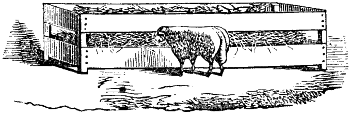
A CONVENIENT BOX-RACK.
To make an economical box-rack—the one in most general use in the North—take six light pieces of scantling, say three inches square, one for each corner, and one for the centre of each side. Boards of pine or hemlock, twelve or fifteen feet long, and twelve or fourteen inches wide, may then be nailed on to the bottom of the posts for the sides, which are separated by similar boards at the ends, two and a half feet long. Boards twelve inches wide, raised above the lower ones by a space of from nine to twelve inches, are nailed on the sides and ends, which completes the rack. The edges of the opening should be made perfectly smooth, to prevent chafing or tearing out the wool. The largest dimensions given are suitable for the large breeds, and the smallest for the Saxon; and still smaller are proper for the lambs. These should be set on dry ground, or under the sheds; and they can be easily removed wherever necessary. Unless over-fed, sheep waste very little hay in them.
Some prefer the racks made with slats, or smooth, upright sticks, in the form of the common horse-rack. This kind should always be accompanied by a broad trough affixed to the bottom, to catch the fine hay which falls in feeding. These racks may be attached to the side of a building, or used double. A small lamb requires fifteen inches of space, and a large sheep two feet, for quiet, comfortable feeding; and this amount of room, at least, should be provided around the racks for every sheep.
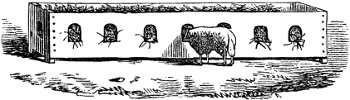
A HOLE-RACK.
With what is termed a hole-rack, sheep do not crowd and take advantage of each other so much as with log-racks; but they are too heavy and unnecessarily expensive for a common out-door rack. This rack is box-shaped, with the front formed of a board nailed on horizontally, or, more commonly, by nailing the boards perpendicularly, the bottoms on the sill of a barn, and the tops to horizontal pieces of timber. The holes should be at least eight inches wide, nine inches high, and eighteen inches from centre to centre.
In the South, racks are not so necessary for that constant use to which they are put in colder sections, as they are for depositories of dry food, for the occasional visitation of the sheep. In soft, warm weather, when the ground is unfrozen, and any kind of green herbage is to be obtained, sheep will scarcely touch dry fodder; though the little they will then eat will be highly serviceable to them. But in a sudden freeze, or on the occurrence of cold storms, they will resort to the racks, and fill themselves with dry food. They anticipate the coming storm by instinct, and eat an extra quantity of food to sustain the animal heat during the succeeding depression of temperature. They should always have racks of dry fodder for resort in such emergencies.
These racks should have covers or roofs to protect their contents from rain, as otherwise the feed would often be spoiled before but a small portion of it would be consumed. Hay or straw, saturated with water, or soaked and dried, is only eaten by the sheep as a matter of absolute necessity. The common box-rack would answer the purpose very well by placing on the top a triangular cover or roof, formed of a couple of boards, one hung at the upper edge with iron or leather hinges, so that it could be lifted up like a lid; making the ends tight; drawing in the lower edges of the sides, so that it should not be more than a foot wide on the bottom; inserting a flow; and then mounting it on, and making it fast to, two cross-sills, four or five inches square, to keep the floor off from the ground, and long enough to prevent it from being easily overturned. The lower side-board should be narrow, on account of the increased height given its upper edge by the sills.
A rack of the same construction, with the sides like those described for the hole-rack, would be still better, though somewhat more expensive; or the sides might consist of rundles, the top being nailed down in either case, and the fodder inserted by little doors in the ends.
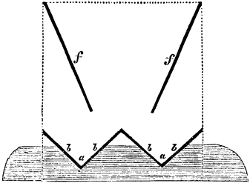
THE HOPPER-RACK.
What is termed the hopper-rack, serving both for a rack and a feeding-trough, is a favorite with many sheep-owners. The accompanying cut represents a section of such a rack. A piece of durable wood, about four and a half feet long, six or eight inches deep, and four inches thick, having two notches, a a, cut into it, and two troughs, made of inch boards, b b b b, placed in these notches, and nailed fast, constitute the formation. If the rack is to be fourteen feet long, three sills are required. The ends of the rack are made by nailing against the side of the sill-boards that reach up as high as it is desired to have the rack; and nails driven through these end-boards into the ends of the side-boards, f f, secure them. The sides may be further strengthened by pieces of board on the outside of them, fitted into the trough. A roof may be put over all, if desired, by means of which the fodder is kept entirely from the weather, and no seeds or chaff can get into the wool.
TROUGHS.
Threshed grain, chopped roots, etc., when fed to sheep, should be placed in troughs. With either of the racks which have been described, except the last, a separate trough would be required. The most economical are made of two boards of any convenient length, ten to twelve inches wide. Nail the lower side of one upon the edge of the other, fastening both into a two or three-inch plank, fifteen inches long, and a foot wide, notched in its upper edge in the form required. In snowy sections they are turned over after feeding, and when falls of snow are anticipated one end is laid on the yard-fence.
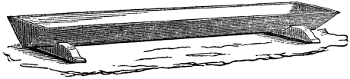
AN ECONOMICAL SHEEP-TROUGH.
Various contrivances have been brought to notice for keeping grain where sheep can feed on it at will, a description of which is omitted, since it is not thought best, by the most successful stock-raisers, in feeding or fattening any quadrupeds, to allow them grain at will, stated feeds being preferred by them; and the same is true of fodder. If this system is departed from in using depository racks, as recommended, it is because it is rendered necessary by the circumstances of the case. A Merino store-sheep, allowed as much grain as it chose to consume, would be likely to inflict injury on itself; and grain so fed would, generally speaking, be productive of more damage than benefit.
BARNS AND SHEDS.
Shelters, in northern climates, are indispensable to profitable sheep-raising; and in every latitude north of the Gulf of Mexico, they would probably be found advantageous. An animal eats much less when thus protected; he is more thrifty, less liable to disease, and his manure is richer and more abundant. The feeding may be done in the open yard in clear weather, and under cover in severe storms: for, even in the vigorous climate of the North, none but the breeders of Saxons make a regular practice of feeding under cover.
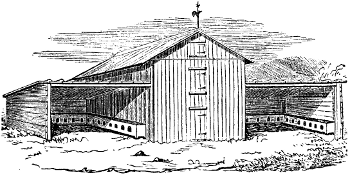
SHEEP-BARN WITH SHEDS.
Humanity and economy alike dictate that, in the North, sheep should be provided with shelters under which to lie nights, and to which they can resort at will. It is not an uncommon circumstance in New York and New England for snow to fall to the depth of from twenty to thirty inches within twenty-four or forty-eight hours, and then to be succeeded by a strong and intensely cold west or northwest wind of several days continuance, which lifts the snow, blocking up the roads, and piling huge drifts to the leeward of fences, barns, etc.
A flock without shelter will huddle closely together, turning their backs to the storm, constantly stepping, and thus treading down the snow as it rises about them. Strong, close-coated sheep do not seem to suffer as much from the cold, for a period, as would be expected. It is, however, almost impossible to feed them enough, or half enough, under such circumstances, without an immense waste of hay—entirely impossible, indeed, without racks. The hay is whirled away in an instant by the wind; and, even if racks are used, the sheep, leaving their huddle, where they were kept warm and even moist by the melting snow in their wool, soon get chilled, and are disposed to return to their huddle. Imperfectly filled with food, the supply of animal heat is lowered, and, at the end of the second or third day, the feeble ones sink down hopelessly, the yearlings, and those somewhat old, receive a shock from which nothing but the most careful nursing will enable them to rally, and even the strongest suffer an injurious loss in condition.
Few persons, therefore, who own as many as forty or fifty sheep, attempt to get along without some kind of shelters, which are variously constructed, to suit their tastes or circumstances. A sheep-barn, built upon a side-hill, will afford two floors: one underneath, surrounded by three sides of wall, should open to the south, with sliding or swinging doors to guard against storms; and another may be provided above, if the floors are perfectly tight, with proper gutters to carry off the urine; and sufficient storage for the fodder can be furnished by scaffolds overhead. They may also be constructed with twelve or fifteen-feet posts on level ground, allowing the sheep to occupy the lower part, with the fodder stored above.
In all cases, however, thorough ventilation should be provided; for of the two evils, of exposure to cold or of too great privation of air, the former is to be preferred. Sheep cannot long endure close confinement without injury. In all ordinary weather, a shed, closely boarded on three sides, with a light roof, is sufficient protection; especially if the open side is shielded from bleak winds, or leads into a well-inclosed yard. If the floors above are used for storage, they should be made tight, that no hay, chaff, or dust can fall upon the fleece. The sheds attached to the barn are not usually framed or silled, but are supported by some posts of durable timber set in the ground. The roofs are formed of boards battened with slats. The barn has generally no partitions within, and is entirely filled with hay.
There are many situations in which open sheds are very liable to have snow drifted under them by certain winds, and they are subject in all severe gales to have the snow carried over them to fall down in large drifts in front, which gradually encroach on the sheltered space, and are very inconvenient, particularly when they thaw. For these reasons, many prefer sheep-houses covered on all sides, with the exception of a wide doorway for ingress and egress, and one or two windows for the necessary ventilation. They are convenient for yarding sheep, and the various processes for which this is required; as for shearing, marking, sorting, etc., and especially so for lambing-places, or the confinement of newly-shorn sheep in cold storms. They should have so much space that, in addition to the outside racks, others can be placed temporarily through the middle when required.
The facts must not be overlooked—as bearing upon the question of shelter, even in the warmer regions of the country—that cold rains, or rains of any temperature, when immediately succeeded by cold or freezing weather, or cold, piercing winds, are more hurtful to sheep than even snow-storms; and that, consequently, sheep must be adequately guarded against them.
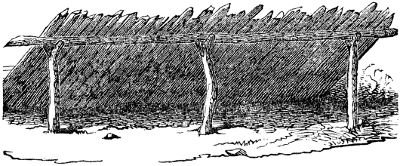
A SHED OF RAILS.
Sheds. The simplest and cheapest kind of shed is formed by poles or rails, the upper end resting on a strong horizontal pole supported by crotched posts set in the ground. It may be rendered rain-proof by pea-vines, straw, or pine boughs. In a region where timber is very cheap, planks or boards, of a sufficient thickness not to spring downward, and thus open the roof, battened with slats, may take the place of the poles and boughs; and they would make a tighter and more durable roof. If the lower ends of the boards or poles are raised a couple of feet from the ground, by placing a log under them, the shed will shelter more sheep.
These movable sheds may be connected with hay-barns—“hay-barracks”—or they may surround an inclosed space with a stack in the middle. In the latter case, the yard should be square, on account of the divergence in the lower ends of the boards or poles, which a round form would render necessary.
Sheds of this description are frequently made between two stacks. The end of the horizontal supporting-pole is placed on the stack-pens when the stacks are built, and the middle is propped by crotched posts. The supporting-pole may rest, in the same way, on the upper girts of two hay-barracks; or two such sheds, at angles with each other, might form wings to this structure.
On all large sheep-farms, convenience requires that there be one barn of considerable size, to contain the shearing-floor, and the necessary conveniences about it for yarding the sheep, etc. This should also, for the sake of economy, be a hay-barn, where hay is used. It may be constructed in the corner of four fields, so that four hundred sheep can be fed from it, without racking flocks of improper size. At this barn it would be expedient to make the best shelters, and to bring together all the breeding-ewes on the farm, if their number does not exceed four hundred. The shepherd would thus be saved much travel at all times, and particularly at the lambing-time, and each flock would be under his almost constant supervision.
The size of this barn is a question to be determined entirely by the climate. For large flocks of sheep, the storage of some hay or other fodder for winter is an indispensable precautionary measure, at least in any part of the United States; and, other things being equal, the farther north, or the more elevated the land, the greater would be the amount necessary to be stored.
Hay-holder. Where hay or other fodder is thrown out of the upper door of a barn into the sheep-yard—as it always must necessarily be in any mere hay-barn—or where it is thrown from a barrack or stack, the sheep immediately rush on it, trampling it and soiling it, and the succeeding forkfuls fall on their backs, filling their wool with dust, seed, and chaff. This is obviated by hay-holders—yards ten feet square—either portable, by being made of posts and boards, or simply a pen of rails, placed under the doors of the barns, and by the sides of each stack or barrack. The hay is pitched into this holder in fair weather, enough for a day’s foddering at a time, and is taken from it by the fork and placed in the racks.
The poles or rails for stack-pens or hay-holders should be so small as to entirely prevent the sheep from inserting their heads in them after hay. A sheep will often insert his head where the opening is wide enough for that purpose, shove it along, or get crowded, to where the opening is not wide enough to withdraw the head, and it will hang there until observed and extricated by the shepherd. If, as often happens, it is thus caught when its foreparts are elevated by climbing up the side of the pen, it will continue to lose its footing in its struggles, and will soon choke to death.
TAGGING.
Tagging, or clatting, is the removal from the sheep of such wool as is liable to get fouled when the animal is turned on to the fresh pastures. If sheep are kept on dry feed through the winter, they will usually purge, more or less, when let out to green feed in the spring. The wool around and below the anus becomes saturated with dung, which forms into hard pellets, if the purging ceases. Whether this take place or not, the adhering dung cannot be removed from the wool in the ordinary process of washing; and it forms a great impediment in shearing, dulling and straining the shears to cut through it, when in a dry state, and it is often impracticable so to do. Besides, it is difficult to force the shears between it and the skin, without frequently and severely wounding the latter. Occasionally, too, flies deposit their eggs under this mass of filth prior to shearing; and the ensuing swarm of maggots, unless speedily discovered and removed, will lead the sheep to a miserable death.
Before the animals are let out to grass, each one should have the wool sheared from the roots of the tail down the inside of the thighs; it should likewise be sheared from off the entire bag of the ewe, that the newly-dropped lamb may more readily find the teat, and from the scrotum, and so much space round the point of the sheath of the ram as is usually kept wet. If the latter place is neglected, soreness and ulceration sometimes ensue from the constant maceration of the urine.
An assistant should catch the sheep and hold them while they are tagged. The latter process requires a good shearer, as the wool must be cut off closely and smoothly, or the object is but half accomplished, and the sheep will have an unsightly and ridiculous appearance when the remainder of their fleeces is taken off; while, on the other hand, it is not only improper to cut the skin of a sheep at any time, but it is peculiarly so to cut that or the bag of a ewe when near lambing. The wool saved by tagging will far more than pay the expenses of the operation. It answers well for stockings and other domestic purposes, or it will sell for nearly half the price of fleece-wool.
Care should be exercised at all times in handling sheep, especially ewes heavy with lamb. It is highly injurious and unsafe to chase them about and handle them roughly; for, even if abortion, the worst consequence of such treatment, is avoided, they become timid and shy of being touched, rendering it difficult to catch them or render them assistance at the lambing period, and even a matter of difficulty to enter the cotes, in which it is sometimes necessary to confine them at that time, without having them driving about pell-mell, running over their lambs, etc. If a sheep is suddenly caught by the wool on her running, or is lifted by the wool, the skin is to a certain extent loosened from the body at the points where it is thus seized; and, if killed a day or two afterward, blood will be found settled about those parts.
When sheep are to be handled, they should be inclosed in a yard just large enough to hold them without their being crowded, so that they shall have no chance to run and dash about. The catcher should stop them by seizing them by the hind-leg just above the hock, or by clapping one hand before the neck and the other behind the buttocks. Then, not waiting for the sheep to make a violent struggle, he should throw its right arm over and about immediately back of the shoulders, place his hand on the brisket, and lift the animal on his hip. If the sheep is very heavy, he can throw both arms around it, clasp his fingers under the brisket, and lift it up against the front part of his body. He should then set it carefully on its rump upon the tagging-table, which should be eighteen or twenty inches high, support its back with his legs, and hold it gently and conveniently until the tagger has performed his duty. Two men should not be allowed to lift the same sheep together, as it will be pretty sure to receive some strain between them. A good shearer and assistant will tag two hundred sheep per day.
When sheep receive green feed all the year round—as they do in many parts of the South—and no purging ensues from eating the newly-starting grasses in the spring, tagging is unnecessary.
WASHING.
Many judicious farmers object to washing sheep, on account of its tendency to produce colds and catarrhal affections, to which this animal is particularly subject; but it cannot well be dispensed with, as the wool is always rendered more salable; and if the operation is carefully done, it need not be attended with injury.
Mr. Randall, the extensive sheep-breeder of Texas, states that he does not wash his sheep at all, for what he deems good reasons. About the middle of April, or at the time when one-half of the ewes have young lambs at their sides, and the balance about to drop, would be the only time in that region when he could wash them. At this period he would not race or worry his ewes at all, on any account; as they should be troubled as little as possible, and no advantage to the fleece from washing could compensate for the injury to the animal. In his high mountain-region, lambing-time could not prudently come before the latter part of March or April—the very period when washing and shearing must be commenced—since in February, and even up to the fifteenth or twentieth of March, there is much bad weather, and a single cold, rainy or sleety norther would carry off one-half of the lambs dropped during its continuance.
In most of that portion of the United States lying north of forty degrees, the washing is performed from the middle of May till the first of June, according to the season and climate. When the streams are hard, which is frequently the case in limestone regions, it is better to attend to it immediately after an abundant rain, which proportionately lessens the lime derived from the springs. The climate of the Southern States would admit of an earlier time. The rule should be to wait until the water has acquired sufficient warmth for bathing, and until cold rains and storms and cold nights are no longer to be expected.
The practice of a large majority of farmers is to drive their sheep to the watering-ground early in the morning, on a warm day, leaving the lambs behind. The sheep are confined on the bank of the stream by a temporary enclosure, from which they are taken, and, if not too heavy, carried into water sufficiently deep to prevent their touching bottom. They are then washed, by gently squeezing the fleece with the hands, after which they are led ashore, and as much of the water pressed out as possible before letting them go, as the great weight retained in the wool frequently staggers and throws them down.
By the best flock-masters, sheep are usually washed in vats. A small stream is dammed up, and the water taken from it in an aqueduct, formed by nailing boards together, and carried till a sufficient fall is obtained to have it pour down a couple of feet or more into the vat. The body of water, to do the work fast and well, should be some twenty-four inches wide, and five or six deep; and the swifter the current the better. The vat should be some three and a half feet deep, and large enough for four sheep to swim in it. A yard is built near the vat, from the gate of which a platform extends to and incloses the vat on three sides. This keeps the washer from standing in the water, and makes it much easier to lift the sheep in and out. The yard is built opposite the corners of two fields—to take advantage of the angle of one of them to drive the sheep more readily into the yard, which should be large enough to contain the entire flock, if it does not exceed two hundred; and the bottom of it, as well as the smaller yard, unless well sodded over, should be covered with coarse gravel, to avoid becoming muddy. If the same establishment is used by a number of flock-masters, gravelling will always be necessary.
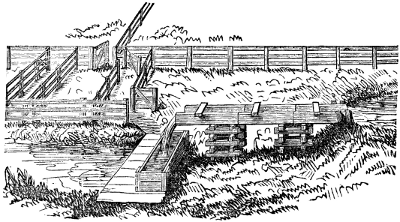
WASHING APPARATUS.
As soon as the flocks are confined in the middle yard, the lambs are all immediately caught out from among them, and set over the fence into the yard to the left, to prevent their being trampled down, as often happens, by the old sheep, or straying off, if let loose. As many sheep are then driven out of the middle yard into the smaller yard to the right, as it will conveniently hold. A boy stands by the gate next to the vat, to open and shut it, or the gate is drawn together with a chain and weight, and two men, catching the sheep as directed under the head of “tagging,” commence placing them in the water for the preparatory process of “wetting.” As soon as the water strikes through the wool, which occupies but an instant, the sheep is lifted out and let loose. Where there are conveniences for so doing, this process may be more readily performed by driving them through a stream deep enough to compel the sheep to swim; but swimming the compact-fleeced, fine-woolled sheep for any length of time—as is practised with the long-wools in England—will not properly cleanse the wool for steaming. The vat should, of course, be in an inclosed field, to prevent their escape. The whole flock should thus be passed over, and again driven round through the field into the middle yard, where they should stand for about an hour before washing commences.
There is a large per centage of potash in the wool oil, which acts upon the dirt independent of the favorable effect which would result from thus soaking it with water alone for some time. If washed soon after a good shower, previous wetting might be dispensed with; and it is not, perhaps, absolutely necessary in any case. If the water is warm enough to allow the sheep to remain in it for the requisite period, they may be got clean by washing without any previous wetting; though the snowy whiteness of fleece, which has such an influence on the purchaser, is not so often nor so perfectly attained in the latter way. But little time is saved by dispensing with “wetting,” as it takes proportionably longer to wash, and it is not so well for the sheep to be kept so long in the water at once.
When the washing commences, two and sometimes four sheep are plunged in the vat. When four are put in, two soak while two are washed. This should not, however, be done, unless the water is very warm, and the washers are uncommonly quick and expert; and it is, upon the whole, rather an objectionable practice, since few animals suffer so much from the effects of a chill as the sheep; and, if they have been previously wetted, it is wholly unnecessary. When the sheep are in the water, the two washers commence kneading the wool with their hands about the dirtier parts—the breech, belly, etc.—and they continue to turn the sheep so that the descending current of water can strike into all parts of the fleece.
As soon as the sheep are clean, which may be known by the water running entirely clear, each washer seizes his own animal by the foreparts, plunges it deep in the vats, and, taking advantage of the rebound, lifts it out, setting it gently down on its breech upon the platform. He then—if the sheep is old and weak, and it is well in all cases—presses out some of the water from the wool, and after submitting the sheep to a process presently to be mentioned, lets it go.
There should be no mud about the vat, the earth not covered with sod, being gravelled. Sheep should be kept on clean pastures, from washing to shearing—not where they can come in contact with the ground, burnt logs, and the like—and they should not be driven over dusty roads. The washers should be strong and capable men, and, protected as they are from any thing but the water running over the sides of the vat, they can labor several hours without inconvenience. Two hundred sheep will employ two experienced men not over half a day, and this rate is at times much exceeded.
It is a great object, not only as a matter of propriety and honesty, but even as an item of profit, to get the wool clean, and of a snowy whiteness, in which condition it will always sell for more than enough extra to offset the increased labor and the diminution in weight. The average loss in American Saxon wool in scouring, after being washed on the back, is estimated at thirty-six per cent.; and in American Merino forty-two and a half per cent.
CUTTING THE HOOFS.
As the hoofs of fine-woolled sheep grow rapidly, turning up in front and under at the sides, they must be clipped as often as once a year, or they become unsightly, give an awkward, hobbling gait to the animal, and the part of the horn which turns under at the sides holds dirt or dung in constant contact with the soles, and even prevents it from being readily shaken or washed out of the cleft of the foot in the natural movement of the sheep about the pastures, as would take place were the hoof in its proper place. This greatly aggravates the hoof-ail, and renders the curing of it more difficult; and it is thought by many to be the exciting cause of the disease.
It is customary to clip the hoofs at tagging, or at or soon after the time of shearing. Some employ a chisel and mallet to shorten the hoofs; but the animal must afterward be turned upon its back, to pare off the crust which projects and turns under. If the weather be dry, or the sheep have stood for some time on dry straw, as at shearing, the hoofs are as tough as horn, and are cut with great difficulty; and this is increased by the grit and dirt adhering to the sole, which immediately takes the edge off from the knife. These periods are ill-chosen, and the method slow and bungling. It is particularly improper to submit heavily-pregnant ewes to all this unnecessary handling at the time of tagging.

TOE-NIPPERS.
When the sheep is washed and lifted out of the vat, and placed on its rump upon the platform, the gate-keeper should advance with a pair of toe-nippers, and the washer present each foot separately, pressing the toes together so that they can be severed at a single clip. The nippers—which can be made by any blacksmith who can temper an axe or a chisel—must be made strong, with handles a little more than a foot long, the rivet being of half-inch iron, and confined with a nut, so that they may be taken apart for sharpening. The cutting-edge should descend upon a strip of copper inserted in the iron, to prevent it from being dulled. With this powerful instrument, the largest hoofs are severed by a moderate compression of the hand. Two well-sharpened knives, which should be kept in a stand or box within reach, are then grasped by the washer and assistant, and with two dexterous strokes to each foot, the side-crust, being free from dirt, and soaked almost as soft as a cucumber, is reduced to the level of the sole. Two expert men will go through these processes in a very short space of time. The closer the paring and clipping the better, if blood be not drawn. An occasional sheep may require clipping again in the fall.
SHEARING.
The time which should elapse between washing and shearing depends altogether on circumstances. From four to six days of bright, warm weather is sufficient; if cold, or rainy, or cloudy, more time must intervene. Sometimes the wool remains in a condition unfit for shearing for a fortnight after washing. The rule to be observed is, that the water should be thoroughly dried out, and the natural oil of the wool should so far exude as to give the wool an unctious feeling, and a lively, glittering look. If it is sheared when dry, like cotton, and before the oil has exuded, it is very difficult to thrust the shears through, the umer is checked, and the wool will not keep so well for long periods. If it is left until it gets too oily, either the manufacturer is cheated, or, what more frequently happens, the owner loses on the price.
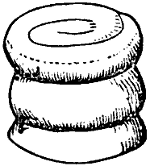
FLEECE.
Shearing, in this country, is always done on the threshing-floors of the barns—sometimes upon low platforms, some eighteen or twenty inches high, but more commonly on the floor itself. The place where the sheep remain should be well littered down with straw, and fresh straw thrown on occasionally, to keep the sheep clean while shearing. No chaff or other substance which will stick in the wool should be used for this purpose. The shearing should not commence until the dew, if any, has dried off from the sheep. All loose straws sticking to the wool should be picked off, and whatever dung may adhere to any of the feet brushed off. The floor or tables used should be planed or worn perfectly smooth, so that they will not hold dirt, or catch the wool. They should all be thoroughly cleaned, and, if necessary, washed, preparatory to the process. If there are any sheep in the pen dirty from purging, or other causes, they should first be caught out, to prevent them from contaminating others.
The manner of shearing varies with almost every district; and it is difficult, if not impossible, to give intelligible practical instructions, which would guide an entire novice in skilfully shearing a sheep. Practice is requisite. The following directions are as plain, perhaps, as can be made:
The shearer may place the sheep on that part of the floor assigned to him, resting on its rump, and himself in a posture with his right knee on a cushion, and the back of the animal resting against his left thigh. He grasps the shears about half-way from the point to the bow, resting his thumb along the blades, which gives him better command of the points. He may then commence cutting the wool at the brisket, and, proceeding downward, all upon the sides of the belly to the extremity of the ribs, the external sides of both sides to the edges of the flanks; then back to the brisket, and thence upward, shearing the wool from the breast, front, and both sides of the neck, but not yet the back of it, and also the poll, or forepart, and top of the head. Then “the jacket is opened” of the sheep, and its position, as well as that of the shearer, is changed by the animal’s being turned flat upon its side, one knee of the shearer resting on the cushion, and the other gently pressing the fore-quarter of the animal, to prevent any struggling. He then resumes cutting upon the flank and rump, and thence onward to the head. Thus one side is complete. The sheep is then turned on the other side—in doing which great care is requisite to prevent the fleeces being torn—and the shearer proceeds as upon the other, which finishes. He must then take the sheep near to the door through which it is to pass out, and neatly trim the legs, leaving not a solitary lock anywhere as a lodging-place for ticks. It is absolutely necessary for him to remove from his stand to trim, otherwise the useless stuff from the legs becomes intermingled with the fleece-wool. In the use of the shears, the blades should be laid as flat to the skin as possible, the points not lowered too much, nor should more than from one to two inches be cut at a clip, and frequently not so much, depending on the part, and the compactness of the wool.
The wool should be cut off as close as conveniently practicable, and even. It may, indeed, be cut too close, so that the sheep can scarcely avoid sun-scald; but this is very unusual. If the wool is left in ridges, and uneven, it betrays a want of workmanship very distasteful to the really good farmer. Great care should be taken not to cut the wool twice in two, as inexperienced shearers are apt to do, since it is a great damage to the wool. This results from cutting too far from the points of the shears, and suffering them to get too elevated. In such cases, every time the shears are pushed forward, the wool before, cut off by the points, say a quarter or three-eighths of an inch from the hide, is again severed. To keep the fleece entire, which is of great importance to its good appearance when done up, and, therefore, to its salableness, it is very essential that the sheep be held easily for itself, so that it will not struggle violently. No man can hold it still by main strength, and shear it well. The posture of the shearer should be such that the sheep is actually confined to its position, so that it is unable to start up suddenly and tear its fleece; but it should not be confined there by severe pressure or force, or it will be continually kicking and struggling. Clumsy, careless men, therefore, always complain of getting the most troublesome sheep. The neck, for example, may be confined to the floor by placing it between the toe and knee of the leg on which the shearer kneels; but the lazy or brutal shearer who suffers his leg to rest directly on the neck, soon provokes that struggle which the animal is obliged to make to free itself from severe pain, and even, perhaps, to draw its breath.
Good shearers will shear, on the average, twenty-five Merinos per day; but a new beginner should not attempt to exceed from one-third to one-half of that number. It is the last process in the world which should be hurried, as the shearer will, in that case, soon leave more than enough wool on his sheep to pay for his day’s wages. Wool ought not to be sheared, and must not be done up with any water in it. If wounds are made, as sometimes happens with unskilful operators, a mixture of tar and grease ought to be applied.
Shearing lambs is, in the Northern climate, at least, an unprofitable practice; since the lamb, at a year old, will give the same amount of wool, and it is thus stripped of its natural protection from cold when it is young and tender, for the mere pittance of the interest on a pound, or a pound and a half of wool for six months, not more than two or three cents, and this all consumed by the expense of shearing. Much the same may be said of the custom, which obtains in some places, of shearing from sheep twice a year. There may be a reason for it, where they receive so little care that a portion are expected to disappear every half year, and the wool to be torn from the backs of the remainder by bushes, thorns, etc., if left for a long period; but when sheep are inclosed, and treated as domestic animals, although there may be less barbarity in shearing them in the fall also, than in the case of the tender lambs, there is no ground for it on the score of utility; since any gain accruing from it cannot pay the additional expense which it occasions.
Cold storms occurring soon after shearing sometimes destroy sheep, in the northern portions of the country, especially the delicate Saxons; forty or fifty of which have, at times, perished out of a single flock, from one night’s exposure. Sheep, in such cases, should be housed; or, where this is impracticable, driven into dense forests.
Sun-scald. When they are sheared close in very hot weather, have no shade in their pastures, and especially where they are driven immediately considerable distances, or rapidly, over burning and dusty roads, their backs are sometimes so scorched by the sun that their wool comes off. If let alone, the matter is not a serious one; but the application of refuse lard to the back will hasten the cure, and the starting of the wool.
Ticks. These vermin, when very numerous, greatly annoy and enfeeble the sheep in winter, and should be kept entirely out of the flock. After shearing, the heat and cold, the rubbing and biting of the sheep, soon drive off the tick, and it takes refuge in the wool of the lamb. Let a fortnight elapse after shearing, to allow all to make this change of residence. Then boil refuse tobacco leaves until the decoction is strong enough to kill ticks beyond a peradventure, which may be ascertained by experiment. Five or six pounds of cheap plug tobacco, or an equivalent in stems, and the like, may be made to answer for a hundred lambs.
This decoction is poured into a deep, narrow box, kept for the purpose, which has an inclined shelf on one side, covered with a wooden grate. One man holds the lamb by its hind legs, while another clasps the fore legs in one hand, and shuts the other about the nostrils, to prevent the liquid from entering them, and then the animal is entirely immersed. It is then immediately lifted out, laid on one side upon the grate, and the water squeezed out of its wool, when it is turned over and squeezed on the other side. The grate conducts the fluid back into the box. If the lambs are regularly dipped every year, ticks will never trouble a flock.
MARKING OR BRANDING.
The sheep should be marked soon after shearing, or mistakes may occur. Every sheep-owner should be provided with a marking instrument, which will stamp his initials, or some other distinctive mark, such as a small circle, an oval, a triangle, or a square, at a single stroke, and with uniformity, on the sheep. It is customary to have the mark cut out of a plate of thin iron, with an iron handle terminating in wood; but one made by cutting a type, or raised letter, or character, on the end of a stick of light wood, such as pine or basswood, is found to be better. If the pigment used be thin, and the marker be thrust into it a little too deeply, as often happens, the surplus will not run off from the wood, as it does from a thin sheet of iron, to daub the sides of the sheep, and spoil the appearance of the mark; and, if the pigment be applied hot, the former will not get heated, like the latter, and increase the danger of burning the hide.
Various pigments are used for marking. Many boil tar until it assumes a glazed, hard consistency when cold, and give it a brilliant, black color by stirring in a little lampblack during the boiling. This is applied when just cold enough not to burn the sheep’s hide, and it forms a bright, conspicuous mark all the year round. The manufacturer, however, prefers the substitution of oil and turpentine for tar, as the latter is cleansed out of the wool with some difficulty. It should be boiled in an iron vessel, with high sides, to prevent it from taking fire, on a small furnace or chafing-dish near which it is to be used. When cool enough, forty or fifty sheep can be marked before it gets too stiff. It is then warmed from time to time, as necessary, on the chafing-dish. Paint, made of lampblack, to which a little spirits of turpentine is first added, and then diluted with linseed or lard oil, is also used. The rump is a better place to mark than the side, since it is there about as conspicuous under any circumstances, and more so when the sheep are huddled in a pen, or running away from one. Besides, should any wool be injured by the mark, that on the rump is less valuable than that on the side. Ewes are commonly distinguished from wethers by marking them on different sides of the rump.
Many mark each sheep as it is discharged from the barn by the shearer; but it consumes much less time to do it at a single job, after the shearing is completed; and it is necessary to take the latter course if a hot pigment is used.
Maggots. Rams with horns growing closely to their heads are very liable to have maggots generated under them, particularly if the skin on the surrounding parts becomes broken by fighting; and these, unless removed, soon destroy the animal. Boiled tar, or the marking substance first described, is both remedy and preventive. If it is put under the horns at the time of marking, no trouble will ever arise from this cause.
Sometimes when a sheep scours in warm weather, and clotted dung adheres about the anus, maggots are generated under it, and the sheep perishes miserably. As a preventive, the dung should be removed; as a remedy, the dung and maggots should be removed—the latter by touching them with a little turpentine—and sulphur and grease afterward applied to the excoriated surface.
Maggot-flies sometimes deposit their eggs on the backs of the long, open-woolled English sheep, and the maggots, during the few days before they assume the pupa state, so tease and irritate the animal, that fever and death ensue. Tar and turpentine, or butter and sulphur, smeared over the parts, are admirable preventives. The Merino and Saxon are exempt from these attacks.
Shortening the horns. A convolution of the horn of a ram sometimes so presses in upon the side of the head or neck that it is necessary to shave or rasp it away on the under side, to prevent ultimately fatal effects. The point of the horn of both ram and ewe both frequently turn in so that they will grow into the flesh, and sometimes into the eye, unless shortened. The toe-nippers will often suffice on the thin extremity of a horn; if not, a fine saw must be used. The marking-time affords the best opportunity for attending to this operation.
SELECTION AND DIVISION.
The necessity of annually weeding the flock, by excluding all its members falling below a certain standard of quality, and the points which should be regarded in fixing that standard, have already been brought to notice in connection with the principles of breeding.
The time of shearing is by far the most favorable period for the flock-master to make his selection. He should be present on the shearing-floor, and inspect the fleece of every sheep as it is gradually taken off; since, if there are faults about it, he will then discover it better than at any other time. A glance will likewise reveal to him every defect in form, previously concealed, wholly, or in part, by the wool, as soon as the newly-shorn sheep is permitted to stand up on its feet. A remarkably choice ewe is frequently retained until she dies of old age; a rather poor nurse or breeder is excluded for the slightest fault, and so on. Whatever animals are to be excluded, may be marked on the shoulder with Venetian red and hog’s lard, conveniently applied with a brush or cob. Such of the wethers as have attained their prime, and those ewes that have passed it, should be provided with the best feed, and fitted for the butcher. If they have been properly pushed on grass, they will be in good flesh by the time they are taken from it; and, if not intended for stall-feeding, the sooner they are then disposed of the better.
Those divisions, also, in large flocks, which utility demands, are generally made at or soon after shearing. Not more than two hundred sheep should be allowed to run together in the pastures; although the number might, perhaps, be safely increased to three hundred, if the range is extensive.
Wethers and dry ewes to be turned off should be kept separate from the nursing-ewes; and if the flock is large enough to require a third division, it is customary to put the yearling and two-year-old ewes and wethers, and the old, feeble sheep together. It is better, in all cases, to separate the rams from all the other sheep at the time of shearing, and to inclose them in a field which is particularly well-fenced. If they are put even with wethers, they are more quarrelsome; and when cool nights arrive, will worry themselves and waste their flesh in constant efforts to ride the wethers.
The Merino ram, although a quiet animal compared with the common-woolled one, will be tempted to jump, by poor fences, or fences half the time down; and if he is once taught this trick, he becomes very troublesome as the rutting period approaches, unless hoppling, yoking, clogging, or poking is resorted to, either of which causes him to waste his strength, besides being the occasion of frequent accidents.
THE CROOK.
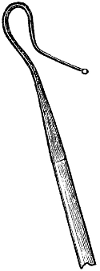
SHEPHERD’S CROOK.
This convenient implement for catching sheep is of the form represented in the cut accompanying, of three-eighths inch round iron, drawn smaller toward the point, which is made safe by a knot. The other end is furnished with a socket, which receives a handle six or eight feet long.
In using it, the hind leg is hooked in from behind the sheep, and it fills up the narrow part beyond that point, while passing along it until it reaches the loop, when the animal is caught by the hook, and when secured, its foot easily slips through the loop. Some caution is required in its use; for, should the animal give a sudden start forward to get away, the moment it feels the crook, the leg will be drawn forcibly through the narrow part, and strike the bone with such violence against the bend of the loop as to cause the animal considerable pain, and even occasion lameness for some days. On first embracing the leg, the crook should be drawn quickly toward the shepherd, so as to bring the bend of the loop against the leg as high up as the hock, before the sheep has time even to break off; and being secure, its struggles will cease the moment the hand seizes the leg.
No shepherd should be without this implement, as it saves much yarding and running, and leads to a prompt examination of every improper or suspicious appearance, and a seasonable application of remedy or preventive, which would often be deferred if the whole flock had to be driven to a distant yard to effect the catching of a single sheep.
Dexterity in its use is speedily acquired by any one; and if a flock are properly tame, any one of its number can be readily caught by it at salting-time, or, generally, at other times, by a person with whom the flock are familiar. It is, however, at the lambing-time, when sheep and lambs require to be so repeatedly caught, that the crook is more particularly serviceable. For this purpose, at that time alone, it will pay for itself ten times over in a single season, in saving time, to say nothing of the advantage of the sheep.
DRIVING AND SLAUGHTERING.
Driving. Mutton can be grown cheaper than any other kind of meat. It is fast becoming better appreciated; and, strange as it may seem, good mutton brings a higher price in our best markets than the same quality does in England. Its substitution in a large measure for pork would contribute materially to the health of the community.
Winter fattening of sheep may often be made very profitable and deserves greater attention, especially where manure is an object; and the instances are few, indeed, where it is not. In England, it is considered good policy to fatten sheep, if the increase of weight will pay for the oil-cake or grain consumed; the manure being deemed a fair equivalent for the other food—that is, as much straw and turnips as they will eat. Lean sheep there usually command as high a price per pound in the fall as fatted ones in the spring; while, in this country, the latter usually bear a much higher price, which gives the feeder a great advantage.
The difference may be best illustrated by a simple calculation. Suppose a wether of a good mutton breed, weighing eighty pounds in the fall, to cost six cents per pound, amounting to four dollars and eighty cents, and to require twenty pounds of hay per week, or its equivalent in other food, and to gain a pound and a half each week; the gain in weight in four months would be about twenty-five pounds, which, at six cents per pound, would be one dollar and fifty cents, or less than ten dollars per ton for the hay consumed; but if the same sheep could be bought in the fall for three cents per pound, and sold in the spring for six cents, the gain would amount to three dollars and ninety cents, or upwards of twenty dollars per ton for the hay—the manure being the same in either case.
For fattening, it is well to purchase animals as large and thrifty, and in as good condition as can be had at fair prices; and to feed liberally, so as to secure the most rapid increase that can be had without waste of food. The fattening of sheep by the aid of oil-cake, or grain purchased for the purpose, may often be made a cheaper mode of obtaining manure than by the purchase of artificial fertilizers, as guano, super-phosphate of lime, and the like; and it is altogether preferable. It is practised extensively and advantageously abroad, and deserves at least a fair trial among us.
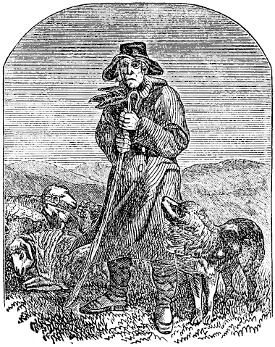
THE SHEPHERD AND HIS FLOCK.
Sheep which are to be driven to market should not begin their journey either when too full or too hungry; in the former state, they are apt to purge while on the road, and in the latter, they will lose strength at once. The sheep selected for market should be those in the best condition at the time; and to ascertain this, it is necessary to examine the whole lot, and separate the fattest from the rest, which is best done at about mid-day, before the sheep feed again in the afternoon. The selected ones are placed in a field by themselves, where they remain until the time for starting. If there be rough pasture to give them, they should be allowed to use it, in order to rid themselves of some of the food which might be productive of inconvenience on the journey. If there is no such pasture, a few cut turnips will answer. All their hoofs should be carefully examined, and every unnecessary appendage removed, though the firm portion of the horn should not be touched. Every clotted piece of wool should also be removed with the shears, and the animals properly marked.
Being thus prepared, they should have feed early in the morning, and be started, in the cold season, about mid-day. Let them walk quietly away; and as the road is new to them, they will go too fast at first, to prevent which, the drover should go before them, and let his dog bring up the rear. In a short time they will assume the proper speed—about one mile an hour. Should the road they travel be a green one, they will proceed nibbling their way onward at the grass along both sides; but if it is a narrow turnpike, the drover will require all his attention in meeting and being passed by various vehicles, to avoid injury to his charge. In this part of their business, drovers generally make too much ado; and the consequence is, that the sheep are driven more from side to side of the road than is requisite. Upon meeting a carriage, it would be much better for the sheep, were the drover to go forward, instead of sending his dog, and point off with his stick the leading sheep to the nearest side of the road; and the rest will follow, as a matter of course, while the dog walks behind the flock and brings up the stragglers. Open gates to fields are sources of great annoyance to drovers, the stock invariably making an endeavor to go through them. On observing an open gate ahead, the drover should send his dog behind him over the fence, to be ready to meet the sheep at the gate. When the sheep incline to rest, they should be allowed to lie down.
When the animals are lodged for the night, a few turnips or a little hay should be furnished to them, if the road-sides are bare. If these are placed near the gate of the field which they occupy, they will be ready to take the road again in the morning. As a precaution against worrying dogs, the drover should go frequently through the flock with a light, retire to rest late, and rise up early in the morning. These precautions are necessary; since, when sheep have once been disturbed by dogs, they will not settle again upon the road. The first day’s journey should be a short one, not exceeding four or five miles. The whole journey should be so marked out as that, allowance being made for unforeseen delays, the animals may have one day’s rest near the market.