POULTRY AND THEIR DISEASES. (continued 3)
Reading edition
Nor are these two alleged tests—the shape of the egg, and the position of the air-tube—consistent with each other; for, if the round egg produces a pullet, and an egg with the air-bag a little on one side does the same, then all round eggs should have the air bag in that position, or one test contradicts the other; and the same argument applies to the long or oval egg. The examination of a few eggs by the light of a candle will satisfy any one that the position of the air-bag differs as much in a long egg as it does in a round.
There are, indeed, no known means of determining beforehand the sex of fowl; except, perhaps, that cocks may be more likely to issue from large eggs, and hens from small ones. As, however, the egg of each hen may be recognized, the means are accessible of propagating from those parents whose race it is judged most desirable to continue.
INCUBATION.
The hen manifests the desire of incubation in a manner different from that of any other known bird. Nature having been sufficiently tasked in one direction, she becomes feverish, and loses flesh; her comb is livid; her eyes are dull; she bristles her feathers to intimidate an imaginary enemy; and, as if her chickens were already around her, utters the maternal “cluck.”
When the determination to sit becomes fixed—it is not necessary to immediately gratify the first faint inclinations—the nest which she has selected should be well cleaned, and filled with fresh straw. The number of eggs to be allowed will depend upon the season, and upon the size of egg and hen. The wisest plan is not to be too greedy; the number of chickens hatched is often in inverse proportion to the number of eggs set—five have only been obtained from sixteen. An odd number is, however, to be preferred, as being better adapted to covering in the nest. Hens will, in general, well cover from eleven to thirteen eggs laid by themselves. A bantam may be trusted with about half a dozen eggs of a large breed, such as the Spanish. A hen of the largest size as a Dorking, will successfully hatch, at the most, five goose-eggs.
When hens are determined to sit at seasons of the year at which there is little chance of bringing up chickens, the eggs of ducks or geese may be furnished her; the young may be reared, with a little painstaking, at any time of the year. The autumnal laying of the China and of the common goose is very valuable for this purpose. Turkey-hens frequently have this fit of unseasonable incubation.
Where, however, it is inconvenient to gratify the desire, one or two doses of jalap will often entirely remove it; and fowls often lay in three weeks afterward. Some place the would-be sitter in an aviary, for four or five days at most, and feed her but sparingly; from the commencement of her confinement, she will gradually leave off clucking, and when this has ceased, she may be again set free, without manifesting the least desire to take to the nest again, and in a short time the hen will commence laying with renewed vigor. The barbarous measures sometimes resorted to should be frowned upon by every person with humane feelings.
Three weeks is the period of incubation; though chickens are sometimes excluded on the eighteenth day. When the hen does not sit close for the first day or two, or in early spring, it will occasionally be some hours longer; when the hen is assiduous, and the weather hot, the time will be a trifle shorter. Chickens have been known to come out as late as the twenty-seventh day.
It may not be uninteresting to note the changes which the egg passes through in hatching. In twelve hours, traces of the head and body of the chicken may be discerned; at the end of the second day, it assumes the form of a horse-shoe, but no red blood as yet is seen; at the fiftieth hour, two vesicles of blood, the rudiments of the heart, may be distinguished, one resembling a noose folded down on itself, and pulsating distinctly; at the end of seventy hours, the wings may be seen, and, in the head, the brain and the bill, in the form of bubbles; toward the end of the fourth day, the heart is more completely formed; and on the fifth day, the liver is discernible; at the end of one hundred and thirty hours, the first voluntary motions may be observed; in seven hours more, the lungs and stomach appear; and, in four hours after this, the intestines, the loins, and the upper jaw. At the end of the one hundred and forty-fourth hour, two drops of blood are observable in the heart, which is also further developed; and, on the seventh day, the brain exhibits some consistence. At the one hundred and ninetieth hour, the bill opens, and the muscular flesh appears on the breast; in four hours more, the breast bone is seen; and, in six hours afterward, the ribs may be observed forming from the back. At the expiration of two hundred and thirty-six hours, the bill assumes a green color, and, if the chicken be taken out of the egg, it will visibly move. At two hundred and sixty-four hours, the eyes appear; at two hundred and eighty-eight hours, the ribs are perfect; and at three hundred and thirty-one hours, the spleen approaches near to the stomach, and the lungs to the chest; at the end of three hundred and fifty-five hours, the bill frequently opens and shuts. At the end of the eighteenth day, the first cry of the chicken is heard; and it gradually acquires more strength, till it is enabled to release itself from confinement.
After the hen has set a week, the fertility of the eggs may be satisfactorily ascertained by taking a thin board with a small orifice in it, placing a candle at the back, and holding up each egg to the points of light. The barren eggs may then be removed, and used, hard-boiled, for young chickens. Some reserve this for the eleventh or twelfth day.
About the twenty-first day, the chicken is excluded from the egg; for the purpose of breaking the shell of which it is furnished with a horny-pointed scale, greatly harder than the bill itself, at the upper tip of the bill—a scale which falls off, or becomes absorbed, after the chicken is two or three days old. The chicken is rolled up in the egg in the form of a ball, with its forepart toward the highest end, and its beak uppermost, the hard scale nearly touching the shell.
The first few strokes of the chicken’s beak produce a small crack, rather nearer the larger than the smaller end of the egg, and the egg is said to be chipped. From the first crack, the chicken turns gradually round, from left to right, chipping the shell as it turns, in a circular manner, never obliquely. All do not succeed in producing the result in the same time; some being able to complete the work within an hour, and others taking two or three hours, while half a day is most usually employed, and some require twenty-four hours or more, but rarely two days. Some have greater obstacles to overcome than others, all shells not being alike in thickness and hardness.
When chickens do not effect their escape easily, some little assistance is needed; but the difficulty is to know when to give it, as a rash attempt to help them, by breaking the shell, particularly in a downward direction toward the smaller end, is often followed by a loss of blood, which can ill be spared. It is better not to interfere, until it is apparent that a part of the brood have been hatched for some time, say twelve hours, and that the rest cannot succeed in making their appearance. It will then generally be found that the whole fluid contents of the egg, yolk and all, are taken up into the body of the chicken, and that weakness alone has prevented its forcing itself out. The causes of such weakness are various; sometimes, insufficient warmth, from the hen having set on too many eggs; sometimes the original feebleness of the vital spark; but, most frequently, the staleness of the eggs employed for incubation.
The chances of rearing such chickens are small; but, if they survive the first twenty-four hours, they may be considered as safe. The only thing to be done is to take them from the hen till she is settled at night, keeping them in the meanwhile as snug and warm as possible. If a gentle hand can persuade a crust of bread down their throats, it will do no harm; but all rough and clumsy manipulation will utterly defeat the end in view. Animal heat will be their greatest restorative. At night, they should be quietly slipped under their mother; the next morning will disclose the sequel.
The period of incubation in the Guinea fowl is twenty-eight days, or one month; in the pea fowl, from twenty-seven to twenty-nine days; in turkeys, a month; in ducks, thirty or thirty-one days; and in geese, from twenty-seven to thirty days.
Incubation of turkeys. When the turkey hen has once selected a spot for her nest, she will continue to lay there till the time for incubation; so that the egg may be brought home from day to day, there being no need of a nest-egg, as with the domestic fowl. She will lay from fifteen to twenty eggs, more or less. If there are any dead leaves or dry grass at hand, she will cover her eggs with these; but if not, she will take no trouble to collect them from a distance.
Her determination to sit will be known by her constantly remaining on the nest, though it is empty; and, as it is seldom in a position sufficiently secure against the weather or pilferers, a nest should be prepared for her, by placing some straw, with her eggs, on the floor of a convenient out-building. She should then be brought home, and gently and kindly placed upon it. With the smallest varieties, thirteen eggs will suffice; a large hen might cover more. At the end of a week, it is usual to add some fowls’ eggs; the activity of the chickens excites some emulation in the larger brethren, and the eggs take up but little room in the nest.
Some believe it necessary to turn the eggs once a day; but the hen herself does that many times daily. If the eggs are marked, and their position noticed when she leaves the nest, they will never be found in the same order. In about four weeks, the young will be hatched.
Incubation of geese. Geese breed in general only once a year; but, if well kept, they sometimes hatch twice a season. During the sitting, in sections where the most attention is paid to breeding them, each bird has a space allotted to it, in rows of wicker-pens, placed one above another, and the person in charge of them drives the whole flock to water three times a day, and, bringing them back to their habitations, places each bird in its own nest.
The most successful breeders of Bremen geese adopt the following method: The birds are, in the first place, carefully and properly fed; the eggs are removed every day in the gentlest manner from the nest, and placed in a basket of cotton kept in a moderate temperature, and free from damp. When all the geese begin to sit steadily, each is furnished with a nest composed of chopped straw; and care is taken that it is sufficiently capacious.
Not more than one of the geese is allowed to leave the eggs at a time. As soon as one leaves, she makes a cackling noise, which is the signal for the attendant to shut up the boxes in which the others are sitting. These are made somewhat like a dog-kennel, with a roof pitched both ways; and are thirty inches long, by twenty-four wide, and twenty-four high; the door is in the end, and is covered by a sliding panel, which moves upward, when egress or ingress is sought, and may be shut down at pleasure. The goose, upon returning, finds only her own box open. When she re-enters her box, the whole of the doors are again opened, and the same rule observed throughout the period of hatching. In this way, each goose is kept to its own nest.
REARING OF THE YOUNG.
For about twenty-four hours after birth, the chickens can not only do well enough without any extraneous nourishment, but will be far more likely to thrive subsequently, if let alone, than if crammed or incited to eat prematurely. More chickens are destroyed by over-feeding than are lost by the want of it. It is, however, well to turn them in among other chickens that already feed themselves; they will, in such cases, generally follow the example of the rest, and pick away at whatever is around.
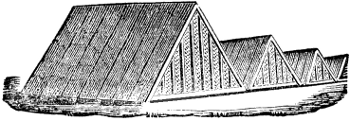
MARQUEE OR TENT-SHADED COOPS.
A roomy, boarded coop, in a dry, sunny spot, is the best position for them during the first month; after which it may be left open during the day, for the hen to retire to when she pleases. In quiet grassy places, it is scarcely necessary to coop the hen at all. As to food, they may have every thing which is not absolutely poisonous; though if wet food is given, the chicken is thus obliged to take water, whether it requires it or not, in order to get a sufficient supply of solid food, and diseased bowels will be likely to follow; whereas, if the food is dry, they can supply themselves with food and water according to their pleasure. If Indian meal is well boiled, and fed not too moist, it will answer a very good purpose, particularly after they are eight or ten days old. Pure water must be placed near them in such a manner as to enable them to drink without getting into the water, which, by wetting their feathers, benumbs and injures them. Meat and insect diet are almost necessary; but, whatever the food, the meals must be given at short intervals; as much as they can swallow, and as often as they can eat. With all their industry, they are only half-clad till flesh and bone stop growing for a while, and allow down and feathers to overtake them.
Chickens should not be let out of their coops too early in the morning, or whilst the dew is on the ground; still less should they be suffered to range over the wet grass, which is a common cause of disease and death. They should also be guarded against sudden unfavorable changes of the weather, more particularly if attended with rain. Nearly all the diseases of gallinaceous fowls arise from cold moisture.
The period at which they are left to shift for themselves depends upon the disposition of the hen. Some will continue their attentions to their chickens till they are nearly full-grown, while others will cast them off much earlier. In the latter case, an eye should be kept upon them for a few days; for chickens in this half-grown state are much more liable to disease than when they were apparently tender little weaklings, crowded under their mother’s wings. They should be kept in a dry, warm, place; dryness is especially necessary.
If the chickens feather rapidly when very young—as is the case with the Golden Pheasant, Black Poland, Guelderland, and some others—they are always weakly, however healthy in other respects, from the fact that their food goes to sustain their feathers rather than their bodies; and they frequently languish and die, from this circumstance alone. If, on the other hand, they feather slowly, as do the Cochin Chinas, Shanghaes, and others, the food in early life goes to nourish and sustain their bodies until they become more vigorous, and old enough to sustain the shock of feathering without detriment. Pure tan-colored Dorkings are more easily raised than others of the race, because they feather more slowly.
Chickens which feather rapidly must be kept perfectly dry and warm, or they will die; while naked chickens, as they are termed, or those which feather at a more advanced age, and very slowly, seldom suffer from the cold, from the fact that their down is very warm, and their blood is hotter, and circulates more rapidly; since their food principally goes to blood, and flesh, and bones, and not to feathers.
Rearing of Guinea fowls. For the young of these, ants’ eggs, so called, hard-boiled eggs chopped fine, small worms, maggots, bread-crumbs, chopped meat, or suet—whatever, in short, is most nutritious, is the most appropriate food. This need not be offered to them in large quantities, as it would only be devoured by the mother Bantam as soon as she saw that they had for the time satisfied their appetites, or it would be stolen by other birds; but it should frequently be administered to them in small supplies. Feeding them three, four, or five times a day, is not often enough; every half hour during daylight they should be tempted to fill their craws, which are soon emptied again by an extraordinary power and quickness of digestion.
The newly-hatched Guinea fowl is a tiny creature, and its growth is, consequently, very rapid, requiring incessant supplies. A check once received can never be recovered. They do not, in such cases, mope and pine for a day or two; like young turkeys under similar circumstances, and then die; but, in half an hour after being in apparent health, they fall on their backs, give a convulsive kick or two, and fall victims, in fact, to starvation. The demands of Nature for the growth of bone, muscle, and particularly of feathers, are so great, that no subsequent abundant supply of food can compensate for a fast of a couple of hours. The feathers still go on growing in geometrical progression, and drawing the sources of vitality still faster than they can be supplied, till the bird faints and expires from inanition.
A dry, sunny corner in the garden will be the best place to coop them with their bantam hen. As they increase in strength, they will do no harm, but much good, by devouring worms, grubs, caterpillars, maggots, and all sorts of insects. By the time their bodies are little longer than those of sparrows, they will be able to fly with some degree of strength; other additions to their complete stature are successively and less immediately developed, the spurs, comb, and ornamental plumage not appearing till a subsequent period.
When they are about the size of thrushes, or a little larger, unless the summer be very fine, the bantam may be allowed to range loose in the orchard and shrubbery, and no longer permitted to enter the garden. The young must, however, still receive a bountiful and frequent supply of food; they are not to be considered safe till the horn on their head is fairly grown. Oatmeal is a great treat; cooked potatoes, boiled rice, or any thing, in short, that is eatable, may be thrown to them; they will pick the bones left after dinner with evident satisfaction. The tamer they can be made, the less troublesome will they be when grown; the more kindly they are treated, the fatter will they be for food, and the better price will they bring in market.
For rearing the young of the pea fowl, the same directions will be found useful, and should be carried out in practice.
Rearing of turkeys. Much quackery has been recommended in the treatment of young turkeys. Nothing, however, should be given to them, nothing done for them; they should remain in the nest, under the shelter of their mother’s wings, for at least eight or ten hours; if hatched in the afternoon, till the following morning. The hen should then be placed on the grass, in the sun, under a roomy coop. If the weather is fine, she may be stationed at any point desired, by a long piece of flannel-list tied round one leg, and fastened to a stump or stone.
At first, a few crumbs of bread should be offered; for some hours, the little ones will be in no hurry to eat; but, when they do commence, they should be supplied constantly and abundantly with chopped egg, shreds of meat and fat, curd, boiled rice mixed with cress, lettuce, and the green of onions; melted mutton-suet poured over barley-meal, and cut up when cold, as also bullock’s liver boiled and minced, are excellent things. Young turkeys do not like to have their food minced much smaller than they can swallow it, preferring to make a meal at three or four mouthfuls, rather than to trouble themselves with the incessant pecking and scratching in which chickens so much delight. Pepper will be found particularly useful in feeding them; as, indeed, all stimulating vegetables, such as horse-radish, and the like.
Young turkeys are sometimes attacked by fasciolæ, or worms in the trachea; but not so often as chickens. Cramp is the most fatal to them, particularly in bad weather. A few pieces of board laid under and about the coop are useful; sometimes rubbing the leg with spirit will bring back the circulation.
The time when the hen may be allowed full liberty with her brood depends most upon the season, the situation, etc. Some think that if the young are thriving, the sooner the old ones are out with them the better, after the first ten days or so. A safer rule may be fixed at the season, called “shooting the red,” when young turkeys approach the size of a partridge, or before the granular, fleshy excrescences on the head and neck begin to appear; soon after, the whole plumage, particularly the tail-feathers, shoot into rapid growth, and liberal nourishment is imperatively required. If let loose at this time, they will obtain much foraging, and still be thankful for all that is given to them. Caraway-seeds, as a tonic, are beneficial, if added to plenty of barley, boiled potatoes, chopped vegetables, and refuse meat. At this time the turkeys, naturally enough, begin to be troublesome and voracious; they have to grow from the size of a lark to twelve or fourteen pounds, in eight or nine months. One great merit in old birds is, that in situations where nuts, acorns, and mast are to be had, they will lead off their brood to these, and all of them will abstain, comparatively, from ravaging other crops.
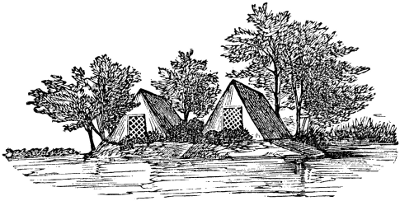
DUCK-POND AND HOUSES.
Rearing of ducklings. The best mode of rearing the young of ducks depends very much upon the situation in which they are hatched. It is customary to dip their feet in water as soon as they are hatched, and then to clip the down on their tails close with a pair of scissors, to prevent their becoming drabbled and water-logged; and before their introduction to the pond, which should not be until a day or two after hatching, it is thought advisable by many to let them have a private swim or two in a small pan of water, that they may try their strength and practice their webbed feet before venturing upon a larger space.
For the first month, the confinement of the mother under a coop is better than too much liberty. Their first food may be boiled eggs, nettles, and a little barley; all kinds of sapped food, cornmeal and water mixed thin, worms, etc., suit them; they will also greedily eat cabbages or other greens, mixed with boiled bran; and this mess, with the addition of pepper, forms a valuable dietetic. In a few days, they require no care, being perfectly able to shift for themselves; but at any age they are the most helpless of the inhabitants of the poultry-yard, having no weapons with which to defend themselves from vermin, or animals of prey, and their awkward, waddling gait precluding their seeking safety in flight. The old duck is not so brave in defence of her brood as the hen; but she will, nevertheless, display at times much spirit. The young seldom die of any disease, and with proper precaution there will be no trouble in raising almost as many ducklings as are hatched. They come early to maturity, being nearly full-grown and in fine eating order at three months old; far excelling, in this respect, all other poultry, except geese.
None are more successful in rearing ducklings than those who keep them, for the first period of their existence, in pens two or three yards square, and cram them night and morning with long, dried pellets of flour and water, or egg and flour, until they are judged old enough to be turned out with their mother to forage for themselves. They are cheerful, harmless, good-natured, cleanly creatures, carefully washing themselves, and arranging their dress, before commencing their meals; and the healthy heartiness of their appetite is amusing, rather than disgusting.
Rearing of goslings. For the first three or four days, goslings must be kept warm and dry, and fed on barley-meal, or oatmeal, mixed with milk, if easily procurable; if not, with water. They will begin to grow in about a week. For a week or two, they should not be turned out until late in the morning, and should always be taken in early in the evening. Their great enemy is the cramp, which can be kept off by making them sleep on dry straw. A little boiled rice, daily, assists their growth; with corn, of course, as soon as they can eat it. When goslings are first allowed to go at large with their mother, every plant of hemlock which grows within their range should be pulled up, as they are very apt to eat it, and it generally proves fatal. Nightshade is equally pernicious to them; and they have been known to be poisoned by eating sprigs of yew-tree.
The young of Bremen geese, when first hatched, are of a very delicate and tender constitution. It is best to let them remain in the breeding-box in which they are hatched for twenty-four hours after they leave the shell. This should, however, be regulated by the weather; since, if it is fair and warm, they may be let out an hour or two in the middle of the day, when they will wet their little bills and nibble at the grass. They ought not to be out in the rain at any time during the first month; and both geese and goslings should be shut up in the boxes at night, during the same period, as a protection against rats and vermin. A very shallow pool, dug in the yard, with a bucket or two of water thrown into it, to suit the temporary purpose of bathing, is sufficient during that period. If well fed on grain from the time they are hatched, twenty-five pounds weight can be secured, at seven or eight months old. By feeding them till four days old, and then literally turning them out to grass, an average weight of from seventeen to eighteen pounds each has been attained, at that age after the feathers are cleanly picked off.
CAPONIZING.
Capons have ever been esteemed among the greatest delicacies of the table; and are made by the extirpation of the reproductive organs in male fowls. If a cock, when young, is emasculated, a remarkable change takes place in him. His natural fierceness is calmed; he becomes placid and peaceful; his pugnacity has deserted him; he no longer seeks the company of the hens; he loses his previous strong, shrill voice; he grows to a far larger size than he would otherwise have done, having nothing to interfere with the main business of his life—to eat, drink, sleep, and get fat as speedily as possible; his flesh is peculiarly white, firm and succulent; and even the fat is perfectly destitute of rankness. The capon may, also, by a little management be converted into an admirable nurse. Some assert that caponized cocks are never afterward subject to the natural process of moulting; but this is denied by others.
The art has been practised from the earliest antiquity, in Greece, India, and China, for the purpose of improving the flesh of birds for the table, in tenderness, juiciness, and flavor. It is extensively performed in the great poultry-breeding districts of England; but in this country it is by no means so generally practised as would naturally be expected.
The instruments most approved by skilful operators consist of two five or seven-pound weights for confining the fowl; a scalpel, for cutting open the thin skin enveloping the testicles; a silver retractor, for stretching open the wound sufficiently wide for operating within; a pair of spring forceps—with a sharp, cutting edge, resembling that of a chisel, having a level half an inch in its greatest width—for making the incision, and securing the thin membrane; a spoon-shaped instrument, with a sharp hook at one end, for pushing and removing the testicles, adjusting the loop, and assisting in tearing open the tender covering; and a double silver canula, for containing the two ends of horse-hair, or fibre, constituting the loop. The expense of these instruments is in the neighborhood of six dollars. A cheap penknife may be used instead of the scalpel; and the other instruments may be obtained of a cheaper construction—the whole not costing more than half the above-named amount.
The cockerel intended for capons should be of the largest breeds, as the Dorking, Cochin China, or the Great Malay. They may be operated upon at any time after they are a month old; the age of from two to three months is considered preferable. If possible, it should be done before July; as capons made later never prove so fine.
The fowl should be confined to a table or board, by laying him with the left side downward, the wings drawn behind the rump, the legs extended backward, with the upper one farthest drawn out, and the head and neck left perfectly free. The feathers are next to be plucked from the right side, near the hip-joint, on a line with, and between the joint of the shoulder. The space uncovered may be from an inch to an inch and a half in diameter, according to the size of the bird. After drawing off the skin from the part, backward—so that, when left to itself after the operation is completed, it will cover the wound in the flesh—make an incision with the bevel-edged knife, at the end of the forceps, between the last two ribs, commencing about an inch from the back-bone, and extending it obliquely downward, from an inch to an inch and a half, cutting just deep enough to separate the ribs, taking due care not to wound the intestines.
Next, adjust and apply the retractor by means of the small thumb-screw, and stretch the wound sufficiently wide apart to afford room for an examination of the organs to be removed. Then, with the scalpel, or a sharp penknife, carefully cut open the skin, or membrane, covering the intestines, which, if not sufficiently drawn up, in consequence of the previous confinement, may be pushed forward toward the breast-bone, by means of the bowl of the spoon-shaped instrument, or—what would answer equally well—with the handle of a tea-spoon.
As the testicles are exposed to view, they will be found connected with the back and sides by a thin membrane, or skin, passing over them. This covering must then be seized with the forceps, and torn open with the sharp-pointed hook at the small end of the spoon-shaped instrument; after which the bowl of the spoon must be introduced, with the left hand, under the lower or left testicle, which is, generally, a little nearer to the rump than the right one. Then take the double canula, adjust the hair-loop, and, with the right hand, pass the loop over the small hooked end of the spoon, running it down under the bowl of the spoon containing the testicle, so as to bring the loop to act upon the parts which connect the testicle to the back. By drawing the ends of the hair-loop backward and forward, and at the same time pushing the lower end of the tube, or canula, toward the rump of the fowl, the cord or fastening of the testicle is severed.
A similar process is then to be repeated with the uppermost or right testicle; after which, any remains of the testicles, together with the blood at or around the bottom of the wound, must be scooped out with the bowl of the spoon. The left testicle is first cut out, in order to prevent the blood which may issue from covering the one remaining, and so rendering it more difficult to be seen. The operation, if skilfully done, occupies but a few moments; when the skin of the fowl should be drawn over the wound with the retractor, and the wound covered with the feathers that were plucked off at the commencement.
In some fowls, the fore part of the thigh covers the two hindmost ribs; in which case, care must be taken to draw the fleshy part of the thigh well back, to prevent it from being cut; since, otherwise, the operation might lame the fowl, or even cause its death.
For loops, nothing answers better than the fibre of a cocoa-nut husk, which is rough, and readily separates the testicles by sawing. The next best substance is the hair of a horse’s mane or tail.
After the operation, the bird may be placed in a warm house, where there are no perches; since if such appliances are present, the newly-made capon will very probably injure himself in his attempts to perch. For about a week, the food should be soft, meal porridge, and that in small quantities, alternated with bread steeped in milk; he may be given as much pure water as he will drink, it being best to use it in a tepid state, or at least with the chill taken off. At the end of a week, or ten days, at most, the fowl, if previously of a sound, vigorous constitution, will be all right, and may be turned out with the others.
The usual method, in France, of making poulardes, or hen-capons, as they are sometimes improperly designated, is to extirpate the egg-cluster, or ovarium, in the same manner as the testicles are extracted from the cockerel; but it is quite sufficient merely to cut across the oviduct, or egg-tube, with a sharp knife. Otherwise, they may be treated in the same manner as the capons. Capons are fattened in precisely the same manner as other fowls.
FATTENING AND SLAUGHTERING.
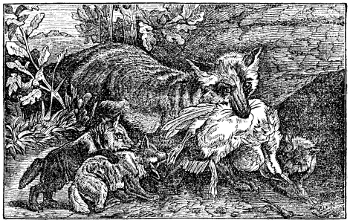
A BAD STYLE OF SLAUGHTERING.
Fat is not a necessary part of any animal body, being the form which superabundant nourishment assumes, which would, if needed, be converted into muscles and other solids. It is contained in certain membranous receptacles provided for it, distributed over the body, and it is turned to use whenever the supply of nourishment is defective, which should be provided by the stomach, and other great organs. In such emergencies it is taken up, in the animal economy, by the absorbents; if the latter, from any cause, act feebly, the health suffers. When, however, nourishment is taken into the system in greater quantities than is necessary for ordinary purposes, the absorbent vessels take it up; and the fat thus made is generally healthy, provided there is a good digestion.
A common method of fattening fowl is to give them the run of a farm-yard, where they thrive upon the offal of the stable and other refuse, with perhaps some small regular daily feeds; but at threshing-time, they become fat, and are styled barn-door fowls, probably the most delicate and high-flavored of all, both from their full allowance of the finest grain, and the constant health in which they are kept, by living in the natural state, and having the full enjoyment of air and exercise; or, they are confined in coops during a certain number of weeks, those fowls which are soonest ready being taken as wanted.
Fowls may also be fattened to the highest pitch, and yet preserved in a healthy state—their flesh being equal in quality to that of the barn-door fowl—when confined in feeding-houses. These should be at once warm and airy, with earth floors, well-raised, and sufficiently capacious to accommodate well the number desired. The floor may be slightly littered down, the litter being often changed; and the greatest cleanliness should be observed. Sandy gravel should be placed in several different layers, and often changed. A sufficient number of troughs, for both water and food, should be placed around, that the fowls may feed with as little interruption as possible from each other; and perches in the same proportion should be furnished for those which are inclined to avail themselves of them; though the number will be few, after they have begun to fatten. This arrangement, however, assists in keeping them quiet and contented until that period. Insects and animal food forming a part of the natural diet of poultry, they are medicinal to them in a weakly state, and the want of such food may sometimes impede their thriving.
The least nutritious articles of food, so far as it can be done conveniently, should be fed out first; afterward, those that are more nutritive. Fattening fowls should be kept quiet, and suffered to take no more exercise than is necessary for their health; since more exercise than this calls for an expenditure of food which does not avail any thing in the process of fattening. They should be fed regularly with suitable food, and that properly prepared; and as much should be given them as they are able to convert into flesh and fat, without waste. The larger the quantity of food which a fattening animal can be made to consume daily, with a good appetite, or which it can digest thoroughly, the greater will be the amount of flesh and fat gained, in proportion to the whole quantity of food consumed.
Substances in which the nutriment is much concentrated should be fed with care. There is danger, especially when the bird is first put to feed, that more may be eaten at once than the digestive organs can manage. Meal of Indian corn is highly nutritive; and, when properly fed, causes fowls to fatten faster than almost any other food. They will not, however, bear to be kept exclusively on this article for a great length of time. Meal made from the heaviest varieties of corn, especially that made from the hard, flinty kinds grown in the Northern and Eastern States, is quite too strong for fowls to be full-fed upon. Attention should also be paid to the bulk of the food given; since sufficient bulk is necessary to effect a proper distending of the stomach, as a necessary condition of healthy digestion.
One simple mode of fattening, which is adopted by many, is the following: Shut the fowls up where they can get no gravel; keep corn by them all the time, and also give them dough enough once a day; for drink, give them skimmed milk; with this feed, they will fatten in ten days; if kept longer, they should have some gravel, or they will fall away.
Oats ground into meal, and mixed with a little molasses and water, barley-meal with sweet milk, and boiled oats, mixed with meat, are all excellent for fattening poultry—reference being had to time, expense, and quality of flesh.
In fattening ducks, it must be remembered that their flesh will be found to partake, to a great extent, of the flavor of the food on which they have been fattened; and as they are naturally quite indiscriminate feeders, care should be taken, for at least a week or so before killing, to confine them to select food. Boiled potatoes are very good feeding, and are still better if a little grain is mixed with them; Indian meal is both economical and nutritive, but should be used sparingly at first. Some recommend butcher’s offal; but, although ducks may be fattened on such food to an unusual weight, and thus be profitable for the market, their flesh will be rendered rank and gross, and not at all fit for the table.
To fatten geese, it is necessary to give them a little corn daily, with the addition of some raw Swedish turnips, carrots, mangel-wurtzel leaves, lucerne, tares, cabbage leaves, and lettuces. Barley-meal and water is recommended by some; but full-grown geese that have never been habituated to the mixture when young, will occasionally refuse to eat it. Cooked potatoes, in small quantities, do no harm; and, apart from the consideration of expense, steeped wheat would produce a first-rate delicacy.
Those who can only afford to bring up one or two, should confine them in a crib or some such place, about the beginning of July, and feed them as directed, giving them a daily supply of clean water for drink. If from a dozen to twenty are kept, a large pen of from fifteen to twenty feet square should be made, well covered with straw on the bottom, and a covered house in a corner for protection against the sun and rain, when required; since exposure to either of these is not good. It will be observed that, about noon, if geese are at liberty, they will seek some shady spot, to avoid the influence of the sun; and when confined in small places, they have not sufficient space for flapping their wings, and drying themselves after being wet, nor have they room for moving about so as to keep themselves warm. There should be three troughs in the crib: one for dry oats; another for vegetables, which ought always to be cut down; and a third for clean water, of which they must always have a plentiful supply. The riper the cabbages and lettuces are with which they are supplied the better.
Slaughtering and Dressing. Both ducks and geese should be led out to the pond a few hours before being slaughtered, where they will neatly purify and arrange their feathers. The common mode of slaughtering the latter—bleeding them from the internal parts of the throat—is needlessly slow and cruel.
Fowls for cooking, that are to be sent to a distance, or to be kept any time before being served, should be plucked, drawn, and dressed immediately after being killed. The feathers strip off much more easily and cleanly while the bird is yet warm. When large numbers are to be slaughtered and prepared in a short time, the process is expedited by scalding the bird in boiling water, when the feathers drop off almost at once. Fowls thus treated are, however, generally thought inferior in flavor, and are more likely to acquire a taint in close, warm weather, than such as are plucked and dressed dry.
In dressing, all bruises or rupturing of the skin should be avoided. A coarse, half-worn cloth, that is pervious to the air, like a wire sieve, and perfectly dry and clean, forms the best wrapper. The color of yellow-skinned turkeys—equally well-flavored, by the way—is improved for appearance at market by wrapping them for twelve or twenty-four hours in cloths soaked in cold salt and water, frequently changed. For the same purpose, the loose fat is first laid in warm salt and water, and afterward in milk and water for two or three hours. Some dust with flour, inside and out, any fowls that are to be carried far or to hang many days before being cooked.
The oldest and toughest fowls, which are often pronounced unfit for eating, thrown away, and wasted, may be made into a savory and nutritious dish by jointing, after the bird is plucked and drawn, as for a pie; it should not be skinned. Stew it five hours in a close saucepan, with salt, mace, onions, or any other flavoring ingredients desired. When tender, turn it out into a deep dish, so that the meat may be entirely covered with the liquor. Let it stand thus in its own jelly for a day or two; it may then be served in the shape of a curry, a hash, or a pie, and will be found to furnish an agreeable repast.
Old geese, killed in the autumn, after they have recovered from moulting, and before they have begun to think about the breeding time, make excellent meat, if cut into small portions, stewed slowly five or six hours with savory condiments, and made into pie the next day. By roasting and broiling, the large quantity of nutriment contained in the bones and cartilages is lost, and what might easily be made tender has to be swallowed tough. Young geese, as well as the old, are, also, often salted and boiled.
POULTRY-HOUSES.
The three grand requisites in a poultry house are cleanliness, dryness, and warmth. A simple arrangement for this purpose is a shed built against the gable of the house, opposite to the part warmed by the kitchen fire, in which are placed cross-bars for roosting, with boxes for laying in, or quantities of fresh straw. This should always have an opening, to allow the poultry-house to be cleansed out, at least once a week. Fowls will never thrive long amidst uncleanliness; and even with the utmost care a place where they have been long kept becomes tainted, as it is called; the surface of the ground becomes saturated with their exuriæ, and is therefore no longer conducive to health.
To avoid this effect, some persons in the country frequently change the sites of their poultry-houses, to obtain fresh ground; while others, who cannot thus change, purify the houses by fumigations of blazing pitch, by washing with hot lime water, and by strewing large quantities of pure sand both within and without. Washing the floor every week is a necessity; for which purpose it is advantageous to have the house paved either with stones, bricks, or tiles. A good flooring, however, and cheaper than either of these, may be formed by using a composition of lime and smithy ashes, together with the riddlings of common kitchen ashes; these, having been all finely broken, must be mixed together with water, put on the floor with a mason’s trowel, and nicely smoothed on the surface. If this is put on a floor which is in a tolerably dry situation, and allowed to harden before being used, it will become nearly as solid and compact as stone, and is almost as durable.
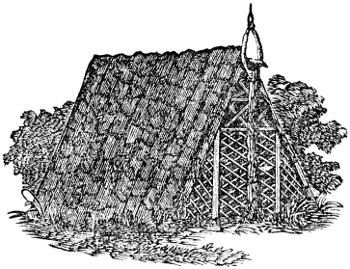
RUSTIC POULTRY-HOUSE.
The inside of the laying-boxes should be frequently washed with hot lime water, to free them from vermin, which greatly torment the sitting hens. For the same purpose, poultry should always have a heap of dry sand, or fine ashes, laid under some covered place or thick tree near their yard, in which they may dust themselves; this being their means of ridding themselves of the vermin with which they are annoyed.
In every establishment for poultry-rearing, there ought to be some separate crib or cribs, into which to remove fowl when laboring under disease; for, not only are many of the diseases to which poultry are liable highly contagious, but the sick birds are also regarded with dislike by such as are in health; and the latter will, generally, attack and maltreat them, aggravating, at least, their sufferings, if not actually depriving them of life. The moment, therefore, that a bird is perceived to droop, or appears pining, it should be removed to one of these infirmaries.
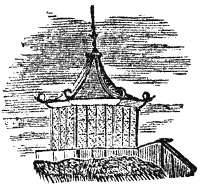
A FANCY COOP IN CHINESE OR GOTHIC STYLE.
Separate pens are also necessary, to avoid quarrelling among some of the highly-blooded birds, more particularly the game fowl. They are also necessary when different varieties are kept, in order to avoid improper or undesirable commixture from accidental crossing. These lodgings may be most readily constructed in rows, parallel to each other; the partitions may be formed of lattice-work, being thus rather ornamental, and the cost of erection but trifling. Each of these lodgings should be divided into two compartments, one somewhat larger than the other; one to be close and warm, for the sleeping-room; and the other, a large one, airy and open, that the birds may enjoy themselves in the daytime. Both must be kept particularly dry and clean, and be well protected from the weather.
A hen-ladder is an indispensable piece of furniture, though frequently absent. This is a sort of ascending scale of perches, one a little higher than the other; not exactly above its predecessor, but somewhat in advance. By neglecting the use of this very simple contrivance, many valuable fowls may be lost or severely injured, by attempting to fly down from their roost—an attempt from succeeding in which the birds are incapacitated, in consequence of the bulk of their body preponderating over the power of their wings.
Some people allow their fowl to roost abroad all night, in all weathers, in trees, or upon fences near the poultry-house. This is a slovenly mode of keeping even the humblest live stock; it offers a temptation to thieves, and the health of the fowls cannot be improved by their being soaked all night long in drenching rain, or having their feet frozen to the branches or rails. There is no difficulty in accustoming any sort of poultry, except the pea fowl, to regular housing at night.
It is better that turkeys should not roost in the same house with the domestic fowl, as they are apt to be cross to sitting and laying hens.
No poultry-house is what it ought to be, it may be suggested, in conclusion, unless it is in such a state as to afford a lady, without offending her sense of decent propriety, a respectable shelter on a showery day.
In our climate, the disorders to which poultry are liable are, comparatively, few in number, and they usually yield to judicious treatment. The little attention that has too generally been bestowed upon this subject may be accounted for from the circumstance that, in an economical point of view, the value of an individual fowl is relatively insignificant; and while the ailments of other domesticated animals generally claim a prompt and efficient care, the unhappy inhabitants of the poultry-yard are too often relieved of their sufferings in the most summary manner. There are reasons, however, which will justify a more careful regard in this matter, besides the humanity of adding to the comfort of these useful creatures; and the attempt to cure, in cases of disease, will often be rewarded by their flesh being rendered more palatable, and their eggs more wholesome.
Most of the diseases to which fowls are subject are the result of errors in diet or management, and should have been prevented, or may be removed by a change, and the adoption of a suitable regimen. When an individual is attacked, it should be forthwith removed, to prevent the contamination of the rest of the flock. Nature, who proves a guardian to fowls in health, will nurse them in their weakness, and act as a most efficient physician to the sick; and the aim of all medical treatment should be to follow the indications which Nature holds out, and assist in the effort which she constantly makes for the restoration of health.
The more common diseases which afflict poultry will be so described that they need not be misapprehended, and such remedies suggested as experience has proved to be salutary; and, taken alphabetically, the first on the list is
ASTHMA.
This common disease seems to differ sufficiently in its characteristics to warrant a distinction into two species. In one it appears to be caused by an obstruction of the air-cells, by an accumulation of phlegm, which interferes with the exercise of their functions. The fowl labors for breath, in consequence of not being able to take in the usual quantity of air at an inspiration. The capacity of the lungs is thereby diminished, the lining membrane of the windpipe becomes thickened, and its minute branches are more or less affected. These effects may, perhaps, be attributed to the fact that, as our poultry are originally natives of tropical climates, they require a more equal temperature than is afforded, except by artificial means, however well they may appear acclimated.
Another variety of asthma is induced by fright, or undue excitement. It is sometimes produced by chasing fowls to catch them, by seizing them suddenly, or by their fighting with each other. In these cases, a blood-vessel is often ruptured, and sometimes one or more of the air-cells. The symptoms are, short breathing; opening of the beak often, and for quite a time; heaving and panting of the chest; and, in case of a rupture of a blood-vessel, a drop of blood appearing on the beak.
Treatment. Confirmed asthma is difficult to cure. For the disease in its incipient state, the fowl should be kept warm, and treated with repeated doses of hippo-powder and sulphur, mixed with butter, with the addition of a small quantity of Cayenne pepper.
COSTIVENESS.
The existence of this disorder will become apparent by observing the unsuccessful attempts of the fowl to relieve itself. It frequently results from continued feeding on dry diet, without access to green vegetables. Indeed, without the use of these, or some substitute—such as mashed potatoes—costiveness is certain to ensue. The want of a sufficient supply of good water will also occasion the disease, on account of that peculiar structure of the fowl, which renders them unable to void their urine, except in connection with the fæces of solid food, and through the same channel.
Treatment. Soaked bread, with warm skimmed-milk, is a mild remedial agent, and will usually suffice. Boiled carrots or cabbage are more efficient. A meal of earth-worms is sometimes advisable; and hot potatoes, mixed with bacon-fat, are said to be excellent. Castor-oil and burned butter will remove the most obstinate cases; though a clyster of oil, in addition, may sometimes be required, in order to effect a cure.
DIARRHŒA.
There are times when fowls dung more loosely than at others, especially when they have been fed on green or soft food; but this, may occur without the presence of disease. Should this state, however, deteriorate into a confirmed and continued laxity, immediate attention is required to guard against fatal effects. The causes of diarrhœa are dampness, undue acidity in the bowels, or the presence of irritating matter there.
The symptoms are lassitude and emaciation; and, in very severe cases, the voiding of calcareous matter, white, streaked with yellow. This resembles the yolk of a stale egg, and clings to the feathers near the vent. It becomes acrid, from the presence of ammonia, and causes inflammation, which speedily extends throughout the intestines.
Treatment. This, of course, depends upon the cause. If the disease is brought on by a diet of green or soft food, the food must be changed, and water sparingly given; if it arises from undue acidity, chalk mixed with meal is advantageous, but rice-flour boluses are most reliable. Alum-water, of moderate strength, is also beneficial. In cases of bloody flux, boiled rice and milk, given warm, with a little magnesia, or chalk, may be successfully used.
FEVER.
The most decided species of fever to which fowls are subject occurs at the period of hatching, when the animal heat is often so increased as to be perceptible to the touch. A state of fever may also be observed when they are about to lay. This is, generally, of small consequence, when the birds are otherwise healthy; but it is of moment, if any other disorder is present, since, in such case, the original malady will be aggravated. Fighting also frequently occasions fever, which sometimes proves fatal.
The symptoms are an increased circulation of the blood; excessive heat; and restlessness.
Treatment. Light food and change of air; and, if necessary, aperient medicine, such as castor oil, with a little burned butter.
INDIGESTION.
Cases of indigestion among fowls are common, and deserve attention according to the causes from which they proceed. A change of food will often produce crop-sickness, as it is called, when the fowl takes but little food, and suddenly loses flesh. Such disease is of little consequence, and shortly disappears. When it requires attention at all, all the symptoms will be removed by giving their diet in a warm state.
Sometimes, however, a fit of indigestion threatens severe consequences, especially if long continued. Every effort should be made to ascertain the cause, and the remedy must be governed by the circumstances of the case.
The symptoms are heaviness, moping, keeping away from the nest, and want of appetite.
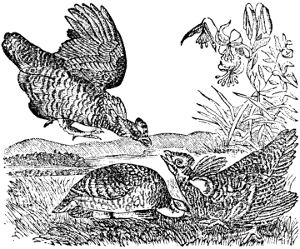
PRAIRIE HENS.
Treatment. Lessen the quantity of food, and oblige the fowl to exercise in an open walk. Give some powdered cayenne and gentian, mixed with the usual food. Iron-rust, mixed with soft food, or diffused in water, is an excellent tonic, and is indicated when there is atrophy, or diminution of the flesh. It may be combined with oats or grain. Milk-warm ale has also a good effect, when added to the diet of diseased fowls.
LICE.
The whole feathered tribe seem to be peculiarly liable to be infested with lice; and there have been instances when fowls have been so covered in this loathsome manner that the natural color of the feathers has been undistinguishable. The presence of vermin is not only annoying to poultry, but materially interferes with their growth, and prevents their fattening. They are, indeed, the greatest drawback to the success and pleasure of the poultry fanciers; and nothing but unremitting vigilance will exterminate them, and keep them exterminated.
Treatment. To attain this, whitewash frequently all the parts adjacent to the roosting-pole, take the poles down and run them slowly through a fire made of wood shavings, dry weeds, or other light waste combustibles. Flour of sulphur, placed in a vessel, and set on fire in a close poultry-house, will penetrate every crevice, and effectually exterminate the vermin. When a hen comes off with her brood, the old nest should be cleaned out, and a new one placed; and dry tobacco-leaves, rubbed to a powder between the hands, and mixed with the hay of the nest, will add much to the health of the poultry.
Flour of sulphur may also be mixed with Indian-meal and water, and fed in the proportion of one pound of sulphur to two dozen fowls, in two parcels, two days apart. Almost any kind of grease, or unctuous matter, is also certain death to the vermin of domestic poultry. In the case of very young chickens, it should only be used in a warm, sunny day, When they should be put into a coop with their mother, the coop darkened for an hour or two, and every thing made quiet, that they may secure a good rest and nap after the fatigue occasioned by greasing them. They should be handled with great care, and greased thoroughly; the hen, also. After resting, they may be permitted to come out and bask in the sun; and in a few days they will look sprightly enough.
To guard against vermin, however, it should not be forgotten that cleanliness is of vital importance; and there must always be plenty of slacked lime, dry ashes, and sand, easy of access to the fowls, in which they can roll and dust themselves.
LOSS OF FEATHERS.
This disease, common to confined fowls, should not be confounded with the natural process of moulting. In this diseased state, no new feathers come to replace the old, but the fowl is left bald and naked; a sort of roughness also appears on the skin; there is a falling off in appetite, as well as moping and inactivity.
Treatment. As this affection is, in all probability, constitutional rather than local, external remedies may not always prove sufficient. Stimulants, however, applied externally, will serve to assist the operation of whatever medicine may be given. Sulphur may be thus applied, mixed with lard. Sulphur and cayenne, in the proportion of one quarter each, mixed with fresh butter, is good to be given internally, and will act as a powerful alterative. The diet should be changed; and cleanliness and fresh air are indispensable.
In diseased moulting, where the feathers stare and fall off, till the naked skin appears, sugar should be added to the water which the fowls drink, and corn and hemp-seed be given. They should be kept warm, and occasionally be treated to doses of cayenne pepper.
PIP.
This disorder, known also as the gapes, is the most common ailment of poultry and all domestic birds. It is especially the disease of young fowls, and is most prevalent in the hottest months, being not only troublesome but frequently fatal.
As to its cause and nature, there has been some diversity of opinion. Some consider it a catarrhal inflammation, which produces a thickening of the membrane lining the nostrils and mouth, and particularly the tongue; others assert that it is caused by want of water, or by bad water; while others describe it as commencing in the form of a vesicle on the tip of the tongue, which occasions a thickened state of the skin, by the absorption of its contents. The better opinion, however, is, that the disease is occasioned by the presence of worms, or fasciolæ, in the windpipe. On the dissection of chickens dying with this disorder, the windpipe will be found to contain numerous small, red worms, about the size of a cambric needle, which, at the first glance, might be mistaken for blood-vessels. It is supposed by some that these worms continue to grow, until, by their enlargement, the windpipe is so filled up that the chicken is suffocated.
The common symptoms of this malady are the thickened state of the membrane of the tongue, particularly toward the tip; the breathing is impeded, and the beak is frequently held open, as if the creature were gasping for breath; the beak becomes yellow at its base; and the feathers on the head appear ruffled and disordered; the tongue is very dry; the appetite is not always impaired; but yet the fowl cannot eat, probably on account of the difficulty which the act involves, and sits in a corner, pining in solitude.
Treatment. Most recommend the immediate removal of the thickened membrane, which can be effected by anointing the part with butter or fresh cream. If necessary, the scab may be pricked with a needle. It will also be found beneficial to use a pill, composed of equal parts of scraped garlic and horse-radish, with as much cayenne pepper as will outweigh a grain of wheat; to be mixed with fresh butter, and given every morning; the fowl to be kept warm.
If the disease is in an advanced state, shown by the chicken’s holding up its head and gaping for want of breath, the fowl should be thrown on its back, and while the neck is held straight, the bill should be opened, and a quill inserted into the windpipe, with a little turpentine. This being round, will loosen and destroy a number of small, red worms, some of which will be drawn up by the feather, and others will be coughed up by the chicken. The operation should be repeated the following day, if the gaping continues. If it ceases, the cure is effected.
It is stated, also, that the disease has been entirely prevented by mixing a small quantity of spirits of turpentine with the food of fowls; from five to ten drops, to a pint of meal, to be made into a dough. Another specific recommended is to keep iron standing in vinegar, and put a little of the liquid in the food every few days.
Some assert that it is promoted by simply scanting fowls in their food; and this upon the ground that chickens which are not confined with the hen, but both suffered to run at large and collect their own food, are not troubled with this disease. There can be little doubt that it is caused by inattention to cleanliness in the habits and lodgings of fowls; and some, therefore, think that if the chicken-houses and coops are kept clean, and frequently washed with thin whitewash, having plenty of salt and brine mixed with it, that it would be eradicated.
ROUP.
This disease is caused mainly by cold and moisture; but it is often ascribed to improper feeding and want of cleanliness and exercise. It affects fowls of all ages, and is either acute or chronic; sometimes commencing suddenly, on exposure; at others gradually, as the consequence of neglected colds, or damp weather or lodging. Chronic roup has been known to extend through two years.
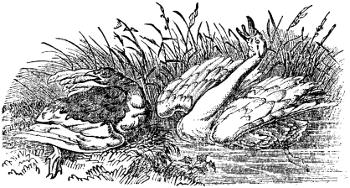
SWANS.
The most prominent symptoms are difficult and noisy breathing and gaping, terminating in a rattling in the throat; the head swells, and is feverish; the eyes are swollen, and the eye-lidsappear livid; the sight decays, and sometimes total blindness ensues; there are discharges from the nostrils and mouth, at first thin and limpid, afterward thick, purulent, and fetid. In this stage, which resembles the glanders in horses, the disease becomes infectious.
As secondary symptoms, it may be noticed that the appetite fails, except for drink; the crop feels hard; the feathers are staring, ruffled, and without the gloss that appears in health; the fowl mopes by itself and seems to suffer much pain.
Treatment. The fowls should be kept warm, and have plenty of water and scalded bran, or other light food. When chronic, change of food and air is advisable. The ordinary remedies—such as salt dissolved in water—are inefficacious. A solution of sulphate of zinc, as an eye-water, is a valuable cleansing application. Rue-pills, and a decoction of rue, as a tonic, have been administered with apparent benefit.
The following is recommended: of powdered gentian and Jamaica ginger, each one part; Epsom salts, one and a half parts; and flour of sulphur, one part; to be made up with butter, and given every morning.
The following method of treatment is practised by some of the most successful poulterers in the country. As soon as discovered, if in warm weather, remove the infected fowls to some well-ventilated apartment, or yard; if in winter, to some warm place; then give a dessert-spoonful of castor-oil; wash their heads with warm Castile-soap suds, and let them remain till next morning fasting. Scald for them Indian-meal, adding two and a half ounces of Epsom salts for ten hens, or in proportion for a less or larger number; give it warm, and repeat the dose in a day or two, if they do not recover.
Perhaps, however, the best mode of dealing with roup and all putrid affections is as follows: Take of finely pulverized, fresh-burnt charcoal, and of new yeast, each three parts; of pulverized sulphur, two parts; of flour, one part; of water, a sufficient quantity; mix well, and make into two doses, of the size of a hazel-nut, and give one three times a day. Cleanliness is no less necessary than warmth; and it will sometimes be desirable to bathe the eyes and nostrils with warm milk and water, or suds, as convenient.
WOUNDS AND SORES.
Fowls are exposed to wounds from many sources. In their frequent encounters with each other, they often result; the poultry-house is besieged by enemies at night, and, in spite of all precaution, rats, weasels, and other animals will assault the occupants of the roost, or nest, to their damage. These wounds, if neglected, often degenerate into painful and dangerous ulcers.
When such injuries occur, cleanliness is the first step toward a cure. The wound should be cleared from all foreign matter, washed with tepid milk and water, and excluded as far as possible from the air. The fowl should be removed from its companions, which, in such cases, seldom or never show any sympathy, but, on the contrary, are always ready to assault the invalid, and aggravate the injury. Should the wound not readily heal, but ulcerate, it may be bathed with alum-water. The ointment of creosote is said to be effectual, even when the ulcer exhibits a fungous character, or proud flesh is present. Ulcers may also be kept clean, if dressed with a little lard, or washed with a weak solution of sugar of lead; if they are indolent, they may be touched with blue-stone.
When severe fractures occur to the limbs of fowls, the best course, undoubtedly, to pursue—unless they are very valuable—is to kill them at once, as an act of humanity. When, however, it is deemed worth while to preserve them, splints may be used, when practicable. Great cleanliness must be observed; the diet should be reduced; and every precaution taken against the inflammation, which is sure to supervene. When it is established, cooling lotions—such as warm milk and water—may be applied.