URBIS RŌMAE VIRĪ INLŪSTRĒS Complete text as printed (continued 2)
Reading edition
Fuisse trāditur excelsā statūrā,7 ōre7 paulō8 plēniōre, nigrīs vegetīsque oculīs,7 capite7 calvō; quam calvitiī dēfōrmitātem, quod saepe obtrēctātōrum iocīs obnoxia erat, aegrē ferēbat. Ideō 205 ex omnibus dēcrētīs sibi ā senātū populōque honōribus nōn alium aut recēpit aut ūsūrpāvit libentius quam iūs laureae9 perpetuō gestandae. Vīnī1 parcissimum eum fuisse nē inimīcī quidem negāvērunt. Verbum Catōnis est ūnum ex omnibus Caesarem ad ēvertendam rem pūblicam sōbrium accessisse. Armōrum et 210 equitandī perītissimus, labōris ultrā fidem patiēns; in āgmine nōnnumquam equō, saepius pedibus anteībat, capite dētēctō, seu sōl, seu imber erat. Longissimās viās incrēdibilī celeritāte cōnficiēbat, ut2 persaepe nūntiōs dē sē praevenīret: neque eum morābantur flūmina, quae vel nandō vel innīxus īnflātīs utribus 215 trāiciēbat.
Skip to next selection.
Text-only version XXVIII. Mārcus Tullius Cicerō

CICERŌ
Mārcus Tullius Cicerō, equestrī genere, Arpīnī, quod est Volscōrum oppidum, nātus est. Ex ēius avīs3 ūnus verrūcam4 in extrēmō nāsō5 sitam habuit, ciceris6 grānō similem; inde cōgnōmen 5 Cicerōnis gentī inditum. Suādentibus quibusdam ut id nōmen mūtāret, “Dabō operam” inquit “ut istud cōgnōmen nōbilissimōrum nōminum splendōrem vincat.” Cum ā patre Rōmam missus, ubi7 celeberrimōrum magistrōrum 10 scholīs interesset, eās artēs dīsceret, quibus aetās puerīlis ad hūmānitātem8 solet īnfōrmārī, tantō successū tantāque cum praeceptōrum tum cēterōrum dīscipulōrum admīrātiōne id fēcit, ut, cum fāma dē Cicerōnis ingeniō et doctrīnā ad aliōs mānāsset,9 nōn paucī, quī ēius videndī et audiendī grātiā scholās adīrent, 15 repertī esse dīcantur.
Cum nūllā rē magis ad summōs in rē pūblicā honōrēs viam mūnīrī posse intellegeret quam arte dīcendī et ēloquentiā, tōtō animō in ēius studium incubuit,1 in quō quidem ita versātus2 est, ut nōn sōlum eōs, quī in Forō et iūdiciīs3 causās perōrārent,4 20 studiōsē sectārētur,5 sed prīvātim quoque dīligentissimē sē exercēret. Prīmum ēloquentiam et lībertātem6 adversus Sullānōs ostendit. Nam cum Rōscium quendam, parricīdiī accūsātum, ob Chrȳsogonī, Sullae lībērtī,7 quī in ēius adversāriīs erat, potentiam nēmō dēfendere audēret, tantā ēloquentiae vī eum dēfendit Cicerō, 25 ut iam tum in arte dīcendī nūllus eī pār esse vidērētur. Ex quō invidiam veritus8 Athēnās studiōrum grātiā petiit, ubi Antiochum philosophum studiōsē audīvit. Inde ēloquentiae causā Rhodum sē contulit, ubi Molōnem, Graecum rhētorem tum disertissimum,9 magistrum habuit. Quī cum Cicerōnem dīcentem audīvisset, 30 flēvisse dīcitur, quod per hunc Graecia ēloquentiae laude prīvārētur.10
Rōmam reversus quaestor Siciliam habuit. Nūllīus vērō quaestūra aut grātior aut clārior fuit; cum māgna tum esset annōnae11 difficultās, initiō molestus erat Siculīs, quōs cōgeret frūmenta in 35 urbem mittere; posteā vērō, dīligentiam et iūstitiam et cōmitātem12 ēius expertī,13 māiōrēs quaestōrī suō honōrēs quam ūllī umquam praetōrī dētulērunt. Ē Siciliā reversus Rōmam in causīs dīcendīs ita flōruit, ut inter omnēs causārum patrōnōs14 et esset et habērētur prīnceps.
40 Cōnsul deinde factus L. Sergiī Catilīnae coniūrātiōnem singulārī virtūte, cōnstantiā, cūrā compressit.15 Catilīnae proavum,16 M. Sergium, incrēdibilī fortitūdine fuisse Plīnius refert. Stīpendia17 is fēcit secundō bellō Pūnicō. Secundō stīpendiō18 dextram manum perdidit: stīpendiīs18 duōbus ter et vīciēs vulnerātus est: 45 ob id neutrā manū, neutrō pede satis ūtilis, plūrimīsque19 posteā stīpendiīs dēbilis1 mīles erat. Bis ab Hannibale captus, bis2 vinculōrum ēius profugus, vīgintī mēnsibus nūllō3 nōn diē in catēnīs4 aut compedibus5 cūstōdītus. Sinistrā manū sōlā quater pūgnāvit, duōbus equīs, īnsidente eō, suffossīs.6 Dextram sibi 50 ferream fēcit eāque religātā7 proeliātus Cremōnam obsidiōne exēmit, Placentiam tūtātus est, duodēna castra hostium in Galliā cēpit. Cēterī profectō, Plīnius addit, victōrēs hominum fuēre, Sergius vīcit etiam fortūnam.
Singulārem hūius virī glōriam foedē dehonestāvit pronepōtis8 55 scelus. Hīc enim reī familiāris, quam profūderat, inopiā multōrumque scelerum cōnscientiā in furōrem āctus et dominandī cupiditāte incēnsus indīgnātusque, quod in petītiōne cōnsulātūs repulsam9 passus esset, coniūrātiōne factā senātum cōnfodere, cōnsulēs trucīdāre,10 urbem incendere, dīripere aerārium cōnstituerat. 60 Āctum11 erat dē pulcherrimō imperiō, nisi illa coniūrātiō in12 Cicerōnem et Antōnium cōnsulēs incidisset, quōrum alter13 indūstriā rem patefēcit, alter manū14 oppressit. Cum Cicerō, habitō senātū, in praesentem reum15 perōrāsset, Catilīna, incendium suum ruīnā16 sē restinctūrum esse minitāns, Rōmā profūgit 65 et ad exercitum, quem parāverat, proficīscitur, sīgna inlātūrus urbī. Sed sociī ēius, quī in urbe remānserant, comprehēnsī in carcere necātī sunt. A. Fulvius, vir senātōriī ōrdinis, fīlium, iuvenem et ingeniō et fōrmā inter aequālēs nitentem,17 prāvō cōnsiliō Catilīnae amīcitiam secūtum inque castra ēius ruentem, 70 ex mediō itinere retrāctum suppliciō mortis adfēcit, praefātus18 nōn sē Catilīnae illum adversus patriam, sed patriae adversus Catilīnam genuisse.19
Neque eō magis ab inceptō Catilīna dēstitit, sed īnfēstīs sīgnīs Rōmam petēns Antōniī exercitū opprimitur. Quam atrōciter 75 dīmicātum sit exitus docuit: nēmō hostium bellō superfuit; quem quisque in pūgnandō cēperat locum, eum āmissā animā1 tegēbat. Catilīna longē ā suīs inter hostium cadāvera2 repertus est: pulcherrimā morte,3 sī prō patriā sīc concidisset! Senātus populusque Rōmānus Cicerōnem patrem patriae appellāvit. Cicerō 80 ipse in ōrātiōne prō Sullā palam praedicat cōnsilium patriae servandae fuisse iniectum sibi ā diīs, cum Catilīna coniūrāsset adversus eam. “Ō diī immortālēs,” inquit “vōs profectō incendistis tum animum meum cupiditāte cōnservandae patriae. Vōs āvocāstis mē ā cōgitātiōnibus omnibus cēterīs et convertistis ad 85 salūtem ūnam patriae. Vōs dēnique praetulistis mentī meae clārissimum lūmen in tenebrīs tantīs errōris et īnscientiae. Tribuam enim vōbīs, quae sunt vestra. Nec vērō possum tantum dare ingeniō meō, ut4 dīspexerim sponte meā in tempestāte illā turbulentissimā reī pūblicae, quid esset optimum factū.”
90 Paucīs post annīs Cicerōnī diem dīxit Clōdius tribūnus plēbis, quod cīvēs Rōmānōs indictā5 causā necāvisset. Senātus maestus,6 tamquam in pūblicō lūctū, veste7 mūtātā prō eō dēprecābātur. Cicerō, cum posset armīs salūtem suam dēfendere, māluit urbe cēdere quam suā causā caedem fierī. Proficīscentem omnēs bonī 95 flentēs prōsecūtī sunt. Dein Clōdius ēdictum prōposuit ut Mārcō Tulliō8 īgnī et aquā interdīcerētur: illīus domum et vīllās incendit. Sed vīs illa nōn diuturna fuit, mox enim tōtus ferē populus Rōmānus ingentī dēsīderiō Cicerōnis reditum flāgitāre coepit et māximō omnium ōrdinum studiō Cicerō in patriam revocātus est. 100 Nihil per tōtam vītam Cicerōnī itinere, quō in patriam rediit, accidit iūcundius. Obviam1 eī redeuntī ab ūniversīs itum est: domus ēius pūblicā pecūniā restitūta est.
Gravissimae illā tempestāte inter Caesarem et Pompēium ortae sunt inimīcitiae, ut rēs2 nisi bellō dīrimī nōn posse vidērētur. 105 Cicerō quidem summō studiō ēnītēbātur3 ut eōs inter sē reconciliāret et ā bellī cīvīlis calamitātibus dēterrēret, sed cum neutrum ad pācem ineundam permovēre posset, Pompēium secūtus est. Sed victō Pompēiō, ā Caesare victōre veniam ultrō accēpit. Quō interfectō Octāviānum, Caesaris hērēdem, fōvit,4 Antōnium 110 impūgnāvit effēcitque ut ā senātū hostis iūdicārētur.
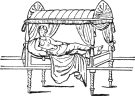
Sed Antōnius, initā cum Octāviānō societāte,5 Cicerōnem iam diū sibi inimīcum prōscrīpsit. Quā rē audītā, Cicerō trānsversīs6 itineribus in vīllam, quae ā marī proximē aberat, fūgit indeque nāvem cōnscendit, in Macedoniam trānsitūrus. Unde aliquotiēns 115 in altum prōvectum cum modo7 ventī adversī rettulissent, modo ipse iactātiōnem maris patī nōn posset, taedium8 tandem eum et fugae et vītae cēpit regressusque ad vīllam “Moriar” inquit “in patriā saepe servātā.” Satis cōnstat, adventantibus percussōribus, servōs fortiter fidēliterque parātōs fuisse ad dīmicandum, LECTĪCA. 120 ipsum dēpōnī lectīcam9 et quiētōs patī, quod sors inīqua cōgeret, iussisse. Prōminentī10 ex lectīcā et immōtam cervīcem11 praebentī10 caput praecīsum est. Manūs quoque abscissae; caput relātum est ad Antōnium ēiusque 125 iussū cum dextrā manū in rōstrīs positum.
Quamdiū rēs pūblica Rōmāna per eōs gerēbātur, quibus sē ipsa commīserat, in eam cūrās cōgitātiōnēsque ferē omnēs suās cōnferēbat Cicerō et plūs1 operae pōnēbat in agendō quam in scrībendō. Cum autem dominātū ūnīus C. Iūliī Caesaris omnia tenērentur, 130 nōn sē angōribus2 dēdidit nec indīgnīs homine doctō voluptātibus. Fugiēns cōnspectum Forī urbisque rūra peragrābat abdēbatque sē, quantum licēbat, et sōlus erat. Nihil agere autem cum animus nōn posset, exīstimāvit honestissimē molestiās posse dēpōnī, sī sē ad philosophiam rettulisset, cuī adulēscēns multum 135 temporis tribuerat, et omne studium cūramque convertit ad scrībendum: atque ut cīvibus etiam ōtiōsus3 aliquid prōdesse4 posset, ēlabōrāvit ut doctiōrēs fierent et sapientiōrēs, plūraque brevī tempore, ēversā rē pūblicā, scrīpsit, quam multīs annīs eā stante scrīpserat. Sīc fācundiae5 et Latīnārum litterārum parēns 140 ēvāsit6 pāruitque virōrum sapientium praeceptō, quī docent nōn sōlum ex7 malīs ēligere minima oportēre, sed etiam excerpere8 ex hīs ipsīs, sī quid īnsit bonī.
Multa exstant facētē9 ab eō dicta. Cum Lentulum, generum10 suum, exiguae statūrae hominem, vīdisset longō gladiō accinctum, 145 “Quis” inquit “generum meum ad gladium adligāvit?”—Mātrōna quaedam iūniōrem sē, quam erat, simulāns dictitābat sē trīgintā tantum annōs habēre; cuī Cicerō “Vērum est,” inquit “nam hōc vīgintī annōs audiō.”—Caesar, alterō cōnsule mortuō diē11 Decembris ūltimā, Canīnium cōnsulem hōrā septimā in 150 reliquam diēī partem renūntiāverat; quem cum plērīque īrent salūtātum dē mōre, “Fēstīnēmus” inquit Cicerō “priusquam abeat magistrātū.” Dē eōdem Canīniō scrīpsit Cicerō: “Fuit mīrificā12 vigilantiā Canīnius, quī tōtō suō cōnsulātū somnum nōn vīderit.13”
Skip to next selection.
Text-only version XXIX. Mārcus Brūtus

BRŪTUS
M. Brūtus, ex illā gente, quae Rōmā Tarquiniōs ēiēcerat, oriundus,1 Athēnīs philosophiam, Rhodī ēloquentiam didicit. Ēius pater, quī Sullae partibus adversābātur, iussū Pompēī interfectus 5 erat, unde Brūtus cum eō gravēs gesserat2 simultātēs. Bellō tamen cīvīlī Pompēī causam, quod iūstior vidērētur, secūtus dolōrem suum reī pūblicae ūtilitātī posthabuit. Victō Pompēiō Brūtus ā Caesare servātus est et praetor etiam 10 factus. Posteā vērō, cum Caesar superbiā ēlātus senātum contemnere et rēgnum adfectāre3 coepisset, populus, praesentī statū haud laetus, vindicem4 lībērtātis requīrēbat. Subscrīpsēre quīdam L. Brūtī5 statuae: “Utinam6 vīverēs!” Item ipsīus Caesaris statuae: “Brūtus, quia rēgēs ēiēcit, prīmus cōnsul factus 15 est; hīc, quia cōnsulēs ēiēcit, postrēmō rēx factus est.” Īnscrīptum quoque est M. Brūtī praetōris tribūnālī: “Dormīs,7 Brūte!”
Cōgnitā populī Rōmānī voluntāte, Brūtus adversus Caesarem cōnspīrāvit. Prīdiē quam Caesar est occīsus, Porcia, Brūtī uxor, Catōnis fīlia, cōnsiliī8 cōnscia, ēgressō cubiculum9 Brūtō, 20 cultellum10 tōnsōrium quasi unguium11 resecandōrum causā popōscit eōque velut forte ēlāpsō sē vulnerāvit. Clāmōre deinde ancillārum12 in cubiculum revocātus obiūrgāre13 eam coepit, quod tōnsōris praeripuisset officium. Cuī sēcrētō Porcia “Nōn est” inquit “hōc temerārium14 factum meum, sed in tālī statū nostrō meī 25 ergā tē amōris certissimum indicium. Experīrī enim voluī, sī15 tibi prōpositum ex sententiā parum cessisset, quam aequō animō mē ferrō essem interēmptūra.” Quibus verbīs audītīs Brūtus ad caelum manūs et oculōs sustulisse dīcitur et exclāmāvisse: “Utinam dīgnus tālī cōniuge marītus vidērī possem!”
30 Interfectō Caesare, cum Antōnius vestem ēius sanguinolentam1 ostentāns populum velutī furōre quōdam adversus coniūrātōs īnflammāsset, Brūtus in Macedoniam concessit ibique apud urbem Philippōs adversus Antōnium et Octāviānum dīmicāvit. Victus aciē, cum in tumulum2 sē nocte recēpisset, audītā Cassiī morte, 35 nē in hostium manūs venīret, ūnī ex comitibus latus trānsfodiendum praebuit. Antōnius Brūtī corpus lībertō suō sepeliendum3 trādidit, quōque4 honōrātius cremārētur, inicī eī suum palūdāmentum5 iussit, iacentem6 nōn hostem, sed cīvem dēpositō exīstimāns odiō. Cumque interceptum ā lībertō palūdāmentum 40 comperisset, īrā percitus7 prōtinus in eum animadvertit, praefātus: “Quid? tū īgnōrāstī cūius tibi virī sepultūram commīsissem?” Nōn eadem fuit Octāviānī ergā Brūtum moderātiō, is enim āvulsum8 Brūtī caput Rōmam mīsit, ut Gāī Caesaris statuae subicerētur. Porcia cum victum et interēmptum virum suum 45 cōgnōvisset, quia ferrum nōn dabātur, ārdentēs ōre carbōnes9 hausit, virīlem patris10 exitum mulier11 imitāta novō mortis genere.
Skip to next selection.
Text-only version XXX. Octāviānus Caesar Augustus
Octāviānus, Iūliae, Gāī Caesaris sorōris, nepōs, quārtum annum agēns patrem āmīsit. Ab avunculō adoptātus profectum eum in Hispāniās12 adversus Gnaeī Pompēī līberōs secūtus est. Deinde ab eō Apollōniam missus studiīs13 vacāvit. Utque prīmum occīsum 5 Caesarem hērēdemque sē comperit, in urbem regressus hērēditātem adiit, nōmen Caesaris sūmpsit conlēctōque veterānōrum YOUNG AUGUSTUS exercitū opem Decimō1 Brūtō tulit, quī ab Antōniō Mutinae obsidēbātur. Cum autem urbis aditū prohibērētur, ut Brūtum dē omnibus 10 rēbus certiōrem faceret, prīmō lītterās mīsit plumbeīs2 lāminīs īnscrīptās, quās ad bracchium3 religātās ūrīnātōrēs4 Scultennam amnem trānsnantēs5 ad Brūtum dēferēbant. Quīn et avibus internūntiīs ūtēbātur. Columbīs6 15 enim, quās inclūsās ante famē7 adfēcerat, epistulās ad collum religābat eāsque ā proximō moenibus locō ēmittēbat. Illae, lūcis cibīque avidae, altissima aedificiōrum petentēs excipiēbantur ā Decimō Brūtō, quī eō modō dē omnibus rēbus certior fīēbat, utique8 postquam dispositō quibusdam locīs 20 cibō columbās illūc dēvolāre īnstituerat.

Bellum Mutinēnse Octāviānus duōbus proeliīs cōnfēcit, quōrum in alterō nōn ducis modo, sed mīlitis etiam fūnctus est officiō atque in mediā dīmicātiōne, aquiliferō legiōnis suae graviter sauciō,9 aquilam umerīs subīsse diūque fertur portāsse. Posteā 25 reconciliātā cum Antōniō grātiā10iūnctīsque cum eō cōpiīs, ut Gāī Caesaris necem ulcīscerētur, ad urbem hostīliter accessit mīsitque quī nōmine exercitūs sibi cōnsulātum dēpōscerent. Cunctante senātū centuriō, prīnceps lēgātiōnis, rēiectō sagulō,11 ostendēns gladiī capulum12 nōn dubitāvit13 in Cūriā dīcere: “Hīc 30 faciet, sī vōs nōn fēceritis.”
Ita cum Octāviānus vīcēsimō aetātis annō cōnsulātum invāsisset, pācem fēcit cum Antōniō et Lepidō, ita ut triumvirī reī pūblicae cōnstituendae per quīnquennium essent ipse et Lepidus et Antōnius, et ut suōs quisque inimīcōs prōscrīberent. Quae 35 prōscrīptiō Sullānā longē crūdēlior fuit. Exstant autem ex eā multa vel extrēmae impietātis vel mīrae fideī āc cōnstantiae exempla. T. Tōranius, triumvirōrum partēs secūtus, prōscrīptī patris suī, praetōriī et ōrnātī virī, latebrās, aetātem notāsque1 corporis, quibus āgnōscī posset, centuriōnibus ēdidit, quī eum 40 persecūtī sunt. Alius quīdam cum prōscrīptum sē cōgnōvisset, ad clientem suum cōnfūgit; sed fīlius ēius per ipsa vēstīgia patris mīlitibus ductīs occīdendum eum in cōnspectū suō obiēcit.
Cum C. Plōtius Plancus ā triumvirīs prōscrīptus in regiōne Salernitānā2 latēret, servī ēius, comprehēnsī multumque āc diū 45 tortī,3 negābant sē scīre ubi dominus esset. Nōn sustinuit deinde Plancus tam fidēlēs tamque bonī exemplī servōs ulterius cruciārī; sed prōcessit in medium iugulumque gladiīs mīlitum obiēcit. Senātōris cūiusdam servus cum ad dominum prōscrīptum occīdendum mīlitēs advēnisse cōgnōsset, commūtātā cum eō veste, 50 permūtātō etiam ānulō, illum postīcō4 clam ēmīsit, sē autem in cubiculum ad lectulum5 recēpit et ut dominum occīdī passus est. “Quantī6 virī est” addit Seneca,7 “cum praemia prōditiōnis ingentia ostendantur, praemium fideī mortem concupīscere!”
Octāviānus deinde M. Brūtum, interfectōrem Caesaris, bellō 55 persecūtus id bellum, quamquam invalidus atque aeger, duplicī proeliō trānsēgit; quōrum priōre castrīs exūtus8 vix fugā ēvāsit. Victor acerbissimē sē gessit: in nōbilissimum quemque captīvum nōn sine verbōrum contumēliā saeviit. Ūnī suppliciter sepultūram precantī respondisse dīcitur iam istam in volucrum fore 60 potestāte. Aliōs, patrem et fīlium, prō vītā rogantēs sortīrī fertur iussisse ut alterutrī9 concēderētur, ac cum, patre quia sē obtulerat occīsō, fīlius quoque voluntāriā occubuisset nece, spectāsse utrumque morientem. Ōrāre veniam vel excūsāre sē cōnantibus, ūnā vōce occurrēbat1 moriendum esse. Scrībunt 65 quīdam trecentōs ex dēditīciīs2 ēlēctōs ad āram dīvō3 Iūliō exstrūctam Īdibus Mārtiīs hostiārum4 mōre mactātōs.5
Abaliēnātus posteā est ab Antōniō, quod is, repudiātā Octāviā sorōre, Cleopatram, Aegyptī rēgīnam, dūxisset uxōrem: quae quidem mulier cum Antōniō lūxū et dēliciīs6 certābat. Ūnā sē cēnā 70 centiēs7 sēstertium absūmptūram aliquandō dīxerat. Cupiēbat dīscere Antōnius, sed fierī posse nōn arbitrābātur. Posterō igitur diē māgnificam8 aliās cēnam, sed cottīdiānam Antōniō apposuit inrīdentī, quod prōmissō stāre nōn potuisset. At illa īnferrī mēnsam9 secundam iussit. Ex praeceptō ministrī ūnum tantum 75 vās ante eam posuēre acētī,10 cūius asperitās vīsque margarītās11 resolvit.12 Exspectante igitur Antōniō quidnam esset āctūra, margarītam, quam auribus gerēbat, dētrāxit et acētō liquefactam absorbuit. Victum Antōnium omnēs, quī aderant, prōnūntiāvērunt.
80 Octāviānus cum Antōniō apud Actium, quī locus est in Ēpīrō, nāvālī proeliō dīmicāvit. Victum et fugientem persecūtus Aegyptum petiit, et Alexandrēam, quō Antōnius cum Cleopatrā cōnfūgerat, obsēdit. Antōnius in ultimā rērum dēspērātiōne, cum habitū rēgis in soliō13 rēgālī sēdisset, mortem sibi ipse cōnscīvit. 85 Cleopatra, quam Octāviānus, Alexandrēā in potestātem redāctā, māgnō opere cupiēbat vīvam comprehendī triumphōque servārī, aspidem14 sibi adferendam cūrāvit ēiusque morsū periit. Cleopatrae mortuae commūnem cum Antōniō sepultūram tribuit.
Tandem Octāviānus, hostibus victīs sōlus imperiō potītus, 90 clēmentem sē exhibuit.1 Omnia deinceps in eō plēna mānsuētūdinis2 et hūmānitātis. Multīs īgnōvit vel iīs quī saepe graviter eum offenderant. Reversus in Ītaliam triumphāns Rōmam ingressus est. Tum bellīs tōtō orbe compositīs Iānī geminī portās suā manū clausit, quae bis tantum anteā clausae fuerant, prīmum 95 sub Numā rēge, iterum post prīmum Pūnicum bellum. Tunc omnēs praeteritōrum malōrum oblīviō cēpit populusque Rōmānus praesentis ōtiī laetitiā perfruēbātur. Octāviānō māximī honōrēs ā senātū dēlātī sunt. Ipse Augustus cōgnōminātus et in honōrem ēius mēnsis Sextīlis3 eōdem nōmine appellātus est, quod illō 100 mēnse bellīs cīvīlibus fīnis esset impositus. Patris patriae cōgnōmen ūniversī māximō cōnsēnsū dētulērunt eī. Dēferentibus lacrimāns respondit Augustus hīs verbīs: “Compos4 factus vōtōrum meōrum, patrēs conscrīptī, quid habeō aliud, quod deōs immortālēs precer, quam ut hunc cōnsēnsum vestrum ad ultimum 105 vītae fīnem mihi perferre liceat!”
Dictātūram māgnā vī offerente populō dēprecātus est. Dominī appellātiōnem semper exhorruit eamque sibi tribuī ēdictō vetuit. Immō5 dē restituendā rē pūblicā nōn semel cōgitāvit, sed reputāns et sē prīvātum nōn sine perīculō fore, et rem pūblicam 110 plūrium arbitriō commissum6 īrī, summam retinuit potestātem, id vērō studuit nē quem novī statūs paenitēret. Bene dē iīs etiam, quōs adversāriōs expertus erat, et sentiēbat et loquēbātur. Legentem aliquandō ūnum ē nepōtibus invēnit; cumque puer territus volūmen Cicerōnis, quod manū tenēbat, veste tegeret, 115 Augustus librum cēpit eōque statim redditō, “Hīc vir,” inquit “fīlī mī, doctus fuit et patriae amāns.”
Pedibus saepe per urbem incēdēbat summāque cōmitāte adeuntēs excipiēbat. Convēnit1 aliquandō eum veterānus mīles, quī vocātus in iūs perīclitābātur rogāvitque ut sibi adesset. Statim 120 Augustus ūnum ē comitātū2 suō ēlēgit advocātum, quī lītigātōrem commendāret. Tum veterānus exclāmāvit: “At nōn ego, tē perīclitante bellō Actiacō, vicārium3 quaesīvī, sed ipse prō tē pūgnāvī,” simulque dētēxit cicātrīcēs.4 Ērubuit5 Augustus atque ipse vēnit in advocātiōnem.
125 Cum post Actiacam victōriam Octāviānus Rōmam reverterētur, occurrit eī inter grātulantēs opifex6 quīdam corvum7 tenēns, quem īnstituerat haec dīcere: “Avē,8 Caesar, victor, imperātor!” Mīrātus Caesar officiōsam avem vīgintī mīlibus nummōrum9 ēmit. Socius opificis, ad quem nihil ex illā līberālitāte pervēnerat, 130 adfīrmāvit Caesarī habēre illum et alium corvum, quem ut adferre cōgerētur rogāvit. Adlātus verba, quae didicerat, expressit: “Avē, Antōnī, victor, imperātor!” Nihil exasperātus Caesar satis dūxit iubēre illum dīvidere dōnātīvum10 cum contubernālī. Salūtātus similiter ā psittacō11 emī eum iussit.
135 Exemplum sūtōrem12 pauperem sollicitāvit ut corvum īnstitueret ad parem salūtātiōnem. Quī impendiō13 exhaustus saepe ad avem nōn respondentem dīcere solēbat “Opera et impēnsa13 periit14!” Aliquandō tamen corvus coepit dīcere dictam salūtātiōnem. Hāc audītā, dum trānsit, Augustus respondit: “Satis 140 domī tālium salūtātōrum habeō.” Superfuit corvō memoria, ut et illa, quibus dominum querentem solēbat audīre, subtexeret15: “Opera et impēnsa periit.” Ad quod Caesar rīsit emīque avem iussit, quantī16 nūllam ante ēmerat.
Solēbat Graeculus quīdam dēscendentī ē palātiō Caesarī honōrificum 145 aliquod epigramma porrigere.17 Id cum frūstrā saepe fēcisset et tamen rūrsus eum idem factūrum dūxisset Augustus, breve suā manū in chartā1 exarāvit2 Graecum epigramma et Graeculō advenientī obviam mīsit. Ille inter legendum laudāre3 mīrārīque3 tam4 vōce quam4 vultū gestūque. Deinde cum accessisset 150 ad sellam, quā Caesar vehēbātur, dēmissā in pauperem crumēnam5 manū paucōs dēnāriōs6 prōtulit, quōs prīncipī daret, dīxitque sē plūs datūrum fuisse, sī plūs habuisset. Secūtō omnium rīsū, dispēnsātōrem7 Caesar vocāvit et satis grandem pecūniae summam numerārī Graeculō iussit.
155 Augustus ferē nūllī sē invītantī negābat. Exceptus igitur ā quōdam cēnā satis parcā et paene cottīdiānā, hōc tantum īnsusurrāvit8: “Nōn putābam mē tibi esse tam familiārem.” Cum aliquandō apud Pōlliōnem quendam cēnāret frēgissetque ūnus ē servīs vās crystallinum, rapī eum ad mortem Pōlliō iussit et 160 obicī mūraenīs9 quās ingēns piscīna10 continēbat. Ēvāsit ē manibus puer et ad pedēs Caesaris cōnfūgit, nihil aliud petītūrus quam ut aliter perīret nec ēsca11 piscium fieret. Mōtus est novō crūdēlitātis genere Caesar et illum quidem mittī,12 crystallina autem omnia cōram sē frangī iussit complērīque piscīnam.
165 Augustus in quādam vīllā aegrōtāns noctēs inquiētās agēbat, rumpente somnum ēius crēbrō noctuae13 cantū. Quā molestiā cum līberārī sē vehementer cupere sīgnificāsset, mīles quīdam, aucupiī perītus, noctuam prehendendam cūrāvit, vīvamque Augustō attulit, spē ingentis praemiī. Cuī cum Augustus mīlle nummōs14 darī 170 iussisset, ille minus dīgnum praemium exīstimāns dīcere ausus est: “Mālō ut vīvat,” et avem dīmīsit. Imperātōrī nec ad īrāscendum causa deerat nec ad ulcīscendum potestās: hanc tamen iniūriam aequō animō tulit Augustus hominemque impūnītum abīre passus est.
Augustus amīcitiās neque facile admīsit et cōnstantissimē retinuit. 175 Imprīmīs familiārem habuit Maecēnātem, equitem Rōmānum; quī eā, quā apud prīncipem valēbat, grātiā ita semper ūsus est, ut prōdesset omnibus, quibus posset, nocēret nēminī. Iūs aliquandō dīcēbat Augustus et multōs capite damnātūrus vidēbātur. AUGUSTUS Aderat tum Maecēnās, quī per 180 circumstantium turbam perrumpere et ad tribūnal propius accēdere cōnābātur. Quod cum frūstrā tentāsset, haec verba in tabellā scrīpsit: “Surge tandem, carnifex1!” eamque tabellam ad Augustum 185 prōiēcit. Quā lēctā is statim surrēxit neque quisquam est morte multātus.
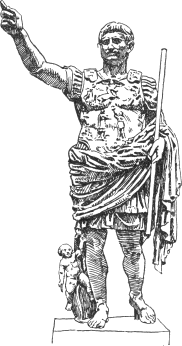
Habitāvit Augustus in aedibus modicīs, neque laxitāte2 neque cultū3 cōnspicuīs, ac per annōs amplius quadrāgintā 190 in eōdem cubiculō hieme et aestāte mānsit. Suppellex4 quoque ēius vix prīvātae ēlegantiae erat. Rārō veste aliā ūsus est quam cōnfectā ab uxōre, sorōre, fīliā neptibusque.5 Item tamen 195 Rōmam, quam prō māiestāte imperiī nōn satis ōrnātam invēnerat, adeō excoluit, ut iūre glōriārētur marmoream sē relinquere, quam laterīciam6 accēpisset.
Fōrmā fuit Augustus eximiā et per omnēs aetātis gradūs venustissimā. Erat tamen omnis lēnōciniī7 neglegēns et in capite 200 cōmendō tam incūriōsus, ut eō ipsō tempore, quō illud tōnsōribus committeret, aut legeret aliquid aut etiam scrīberet.
Paucīs annīs antequam morerētur, gravissimam in Germāniā accēpit clādem, tribus legiōnibus cum duce Vārō lēgātīsque et auxiliīs omnibus caesīs. Hāc nūntiātā excubiās1 per urbem 205 indīxit, nē quis tumultus exsisteret, et māgnōs lūdōs Iovī optimō māximō vōvit, sī rēs pūblica in meliōrem statum vertisset. Adeō dēnique2 cōnsternātum ferunt, ut, per continuōs mēnsēs barbā capillōque submissō,3 caput interdum foribus inlīderet, vōciferāns: “Quīntilī Vāre, legiōnēs redde!” diemque clādis quotannīs 210 maestum habuerit ac lūgubrem.
Tandem adflīctā valētūdine in Campāniam concessit, ubi, remissō ad ōtium animō, nūllō hilaritātis genere abstinuit. Suprēmō vītae diē petītō speculō4 capillum sibi cōmī iussit et amīcōs circumstantēs percontātus ecquid iīs vidērētur mīmum5 vītae commodē 215 trānsēgisse, adiēcit solitam clausulam6: “Ēdite strepitum vōsque omnēs cum gaudiō applaudite.” Obiit Nōlae sextum et septuāgēsimum annum agēns.

EXERCISES FOR TRANSLATION INTO LATIN
Words in round brackets are not to be translated; those in square brackets indicate the Latin rendering. Note the ‘Caution’ on p. xxv. The section numbers refer to the selections.
I. Apposition.
1. Proca left his kingdom to his older son, Numitor. 2. Romulus and Remus were the sons of Rhea Silvia, a priestess of Vesta. 3. The boys were thrown into the river. 4. A shepherd of the king1 carried them to his hut. 5. Who was the grandfather of these boys? 6. Remus, when grown,2 was caught by (some) robbers.3 7. They thus accused him: “You have trespassed on the king’s lands.” 8. A dispute arose between the brothers. 9. Romulus said: “I shall give my name to the new city.” 10. Which of them leaped over the wall?
II. Agreement of adjectives, pronouns, and participles.
1. Robbers and shepherds took refuge in1 the city which Romulus had founded. 2. These were the fathers of the Romans. 3. The envoys that the king sent were nowhere kindly received. 4. The tribes to which he sent did not seek an alliance. 5. Many of those who gathered had not seen Rome. 6. The maidens whom they seized were the children of the Sabines, who now undertook war. 7. (While) advancing to battle, the Romans carried (their) shields on (their) left arms. 8. The Sabines killed Hostilius (while he was) fighting very bravely. 9. The Romans fell fighting bravely. 10. They founded a temple in honor2 of Romulus and worshiped him as a god.
III. Expressions of place; extent of time.
1. Who succeeded Romulus? Numa Pompilius. 2. From what city did he come? From Cures, [from] a city of the Sabines. 3. What did he do at Rome? 4. He established many religious customs and had many useful laws passed. 5. A shield once slipped down from the sky. 6. (There) was a smith in Rome1 who made twelve shields of the same shape. 7. The Romans had peace (for) forty-three years. 8. No temple was erected in honor of Numa, but he was of more use to the state than Romulus.
IV. Ablative absolute; locatives of common nouns.
1. At the death of Numa [Numa having died] the Romans elected a more warlike king. 2. War1 having broken1 out between the Romans and the Sabines, the dispute was settled by a contest between [of] the Curiatii and the Horatii. 3. The young men took up arms and [arms having been taken up]1 advanced to battle. 4. At a given2 signal,2 with drawn swords, they rushed together. 5. As the two Romans fell [the two Romans falling], the Alban army shouted for joy. 6. The sister of Horatius began to weep when she saw her lover’s cloak. 7. He drew his sword and stabbed the girl who forgot [having forgotten] her brothers and her country. 8. When Tullus learned of the treachery of the Alban general, in anger3 he ordered him to be put to death. 9. Then war was declared against the Sabines.4 10. Very many young men were in military service, a few were at home. 11. Tullus5 Hostilius, who succeeded Numa, liked war [war pleased] rather than peace.
V. Ablative of specification; dative with compounds.
1. Ancus Marcius, the fourth king, was like Numa1 in justice and piety, but was more warlike. 2. During2 his reign2 a raid was made on the Roman territory by the Latins. 3. When the king heard of this [which having been learned], he declared war against them. 4. Having defeated the Latins, he destroyed their towns and transferred the citizens to Rome. 5. Romulus had built a wall around the city, but this wall was larger. 6. Of these four kings of Rome, two were distinguished in war, two in peace.
VI. Direct and indirect questions.
1. Tarquin came from Etruria, a city of the Etruscans. 2. When Ancus died,2 Tarquin was made guardian of his children. 3. Thus he obtained the throne. 4. (There) was at Rome a celebrated augur. 5. The king once asked him whether he could cut a whetstone with a razor. Can1 you cut a whetstone with a razor? 7. You cannot2 cut a whetstone with a razor, can you? 8. The sons of Ancus asked the shepherds whether they could commit a crime. 9. Can you commit a crime? 10. The shepherds entered3 the palace and3 began to bawl out. 11. One of them killed the king with an axe. 12. Does not this seem to you an atrocious crime?
VII. Ablative of source; ablative of quality.
1. At the death of Tarquin, Servius Tullius succeeded to the throne. 2. He was born of a woman1 of rank, who, however, was a slave in Tarquin’s house. 3. On the advice of Tanaquil [Tanaquil advising] he was brought up just as the children of the king. 4. He was a young man of great bravery,1 and became the king’s son-in-law. 5. One of Tullius’s daughters was gentle, the other wild. 6. Tarquin’s sons were of like character. 7. The king was slain by order of his own son-in-law. 8. Tullia was a woman of base character and did not love her father. 9. The people asked Tullia what she had done.2
VIII. Temporal clauses with cum; ablative of price.
1. The city of Gabii could not be captured by Tarquin. 2. When Sextus had been chosen general, he sent a messenger to his father. 3. When he learned of the silence1 and act of his father, he killed the chief men of the state. 4. When each of the young men praised his own wife, it was decided to find out who was the best. 5. When Lucretia had summoned her husband1 and father,1 she killed herself with a knife. 6. An old woman once asked Tarquin whether he wished to buy some books at an enormous price. 7. At first Tarquin ridiculed her, but, after she had burned six books, he bought the remaining three at the same price.
IX. Causal clauses with cum; purpose clauses with ut.
1. Since his brother had been killed, Brutus feared the same fate, for he was a young man of great sagacity. 2. He set out for Delphi with Tarquin’s sons. 3. When they had consulted the oracle, they returned to Rome. 4. The Romans chose Brutus and Collatinus, the son of the sister of Tarquin the Elder, consuls. 5. As the sons of Brutus were traitors, they were put to death. 6. In order to regain1 his throne, Tarquin undertook war. 7. Brutus, who had gone ahead with the cavalry to2 reconnoitre,2 met the enemy. 8. Brutus and Aruns fell in the first charge. 9. Since one consul had been slain, the other returned to the city alone.
X. Causal clauses with quod.
1. Mucius received permission to go over [of going over] to the enemy, because (as he said) he wished to kill the king. 2. Because he did not know which was1 the king, he killed the clerk. 3. To punish the hand which had committed the crime, he placed it on a lighted altar. 4. After this he was called Scaevola.
XI. Dative of possessor; construction with paenitet.
1. The Veientes harassed the Romans with repeated raids. 2. The Fabian gens proposed [had in mind] to carry on the war at its own expense. 3. The senate thanked the consul because he had provided for this war. 4. When they arrived at the river Cremera, they established a fortified post and repeatedly routed the enemy. 5. The Veientes soon repented of the peace they had secured and renewed the war. 6. The Fabians roamed about in order to lay waste the enemy’s territory. 7. They were entrapped in an ambush and all slain.
XII. Relative clauses of purpose.
1. I intend to write about the crime of Appius Claudius, the Decemvir. 2. He fell in love with a beautiful girl, and, when he found that he could not entice her with money, he claimed her as a slave [for slavery]. 3. He sent one of his clients to the market place to carry1 her off by force. 4. The girl’s friends sent a messenger to carry the news1 to her father Virginius, who was then away on military duty. 5. Virginius immediately returned to Rome and sought the aid of the people. 6. When he saw that there was no aid anywhere, he seized a knife and killed his daughter. 7. Appius then repented of his crime.
XIII. Complementary infinitive; genitive with oblivīscor; hortatory subjunctive.
1. The tribune of the plebs appointed a day for (the trial of) Manlius, because with great severity he had banished his son to the country. 2. When his son Titus heard of this design of the tribune, he hastened to Rome and forced him to abandon the charge. 3. Such [this] filial devotion reflected great credit on the young man, and his father repented of his harshness. 4. Afterwards, when the Gauls were carrying on war with the Romans, a Gaul of enormous size wanted to fight with the bravest Roman. 5. “Let him come on,” said Titus Manlius, who was now tribune of the soldiers, “that I may show him which of us is the braver.” 6. Between the two lines they joined1 in close1 combat,1 and with a stroke or two of his Spanish sword he thrust through his gigantic foe. 7. Having stripped a necklace from the Gaul, he was afterwards called Torquatus. 8. The son of this same Torquatus, without the consent of the consul, his father, met and conquered a Latin in a single combat. 9. When he returned to camp, his father ordered him to be put to death because he had disobeyed2 his commander. 10. The young man’s companions did not forget the father’s cruelty. 11. Cornelius Piso was also a man of great sternness. 12. He once ordered a soldier to be put to death on the charge of murdering a comrade. 13. The comrade had not been murdered and soon appeared in camp. 14. When they returned to Piso with great rejoicing, he angrily ordered both the comrades and the centurion who had been placed in charge of the execution to be put to death. 15. Another Manlius was guilty of [showed] like cruelty toward his son. 16. The Macedonians sent ambassadors to complain3 about his son Silanus. 17. Manlius wanted to try the case himself, and this was granted by the senate. 18. After he had heard both sides of the case, he forbade his son to return to his home. 19. The next day4 the young man committed5 suicide.5
XIV. Construction of medius, summus, etc.
1. The consul sent Publius Decius to get possession of the summit of a hill. 2. When the consul had escaped, he led his army in safety through the midst of [middle] enemies. 3. In the Latin war he sacrificed himself in order to save his army. 4. Let us never forget this brave man.
XV. Indirect quotation of simple sentences; ablative with opus.
1. “The Samnites are our enemies,” said Curius; “let us set out against them.” 2. Immediately he set out, and, having1 conquered1 the Samnites,1 he took a large amount of land and many captives [men]. 3. He swore (that there) was2 none [nothing] of the booty in his house. 4. Cicero says (that) the Samnites brought [to have brought] a great weight of gold to Curius. 5. Curius scorned1 their gold1 (and) said that he could not be bribed. 6. He told the senate that he was contented with seven jugera of land. 7. He afterwards sold into slavery a young man who refused to serve in the army [military service]. 8. The young man saw that the tribunes could not help him [not to be able to be for an aid to him]. 9. After he had destroyed the army of Pyrrhus, he returned to Rome in triumph [triumphing]. 10. It is said that Pyrrhus was slain by a woman of Argos.3 11. So the Romans4 did not need the aid5 of Curius again.
XVI. Nē with verbs of fearing; ablative with ūtor.
1. It is said that Duilius was the first to conquer the Carthaginians in a naval battle. 2. He used grappling1 irons1 to seize and hold the enemy’s ships. 3. He saw that with this useful contrivance the Romans would have an easy victory [victory to be about to be easy to the Romans]. 4. He now set2 out boldly into the midst3 of the enemy’s fleet, and captured many of their ships. 5. The Romans were pleased with this victory. 6. The Carthaginians feared that the Romans would now be supreme on land and sea. 7. Hannibal, the leader of the Carthaginians, by a shrewd trick escaped punishment for losing his fleet.
XVII. Gerundive with esse; ablative of separation; ablative with comparatives.
1. After the Carthaginians had been defeated by Regulus, Hanno came to negotiate1 [about] peace. 2. The Roman soldiers saw that2 he had come2 treacherously and was not in earnest in his negotiations [did not negotiate seriously]. 3. Hanno was afraid that3 he would be arrested and put in chains. 4. Regulus relieved him of his fear4 and told him that the Romans did not wish to retaliate. 5. In Africa, Regulus5 had6 to fight not only with men, but also with an enormous serpent. 6. As its scales could not be pierced by javelins, Regulus was compelled to use the artillery. 7. In this way the monster was crushed. 8. When Regulus learned that the senate had extended his command to the next year, he asked that his successor should be sent at once.7 9. He said that he had lost his slave and farming implements and that his wife and children had no means of support [he had nothing whence his wife and children should be supported]. 10. The senate relieved him of this anxiety. 11. After he had defeated the Carthaginians in many battles, Regulus himself was defeated and captured. 12. It is said that he was sent from Carthage to Rome to negotiate an exchange of [about exchanging] prisoners. 13. When the senate ordered him to state his opinion, he said that the Carthaginian captives ought not to be returned. 14. He thought that they were better generals than the Romans.8 15. As9 he had given9 his oath,9 he returned to Carthage and was put to death with terrible torture.
XVIII. Ablative of time.
1. Appius Claudius was no1 better than the preceding generals, who did not boast that they would sink the enemy’s fleet (on) the first day2 of the war. 2. The chicken-keeper informed him that the chickens would not [to be unwilling to] eat. 3. “Let3 them drink then,” said Appius, and ordered them to be plunged into the sea. 4. That very [self] day he was defeated, and many thousands of the Romans slain. 5. He afterwards committed suicide, for he knew that he would be put to death by the people. 6. Upon his sister, too, a heavy fine had4 to be imposed.
XIX. Purpose clauses with quō; ablative with potior; unreal conditions; quīn clauses; ablative with dīgnus.
1. It is said that Hannibal, when a boy of nine years, took an oath of undying hatred toward the Romans. 2. On the death of his father, he stirred up war by capturing Saguntum [Saguntum captured]. 3. Fabius said that he carried peace and war in his toga. 4. “Give which you please,” replied the Carthaginians. 5. “I give war,” said Fabius. [“War,” said Fabius, “I give.”] 6. After three Roman consuls had been defeated by Hannibal, Fabius was sent against him. 7. Changing1 the policy1 of the war, he held his soldiers in camp, and did not come to an engagement with the enemy. 8. When, on account of some trifling successes, his soldiers had begun to have more confidence in their valor and fortune, he blockaded Hannibal in a narrow pass. 9. Fabius thought that he could not escape. 10. But Hannibal knew how2 cautious Fabius was,3 and got out (of the trap) without any loss. 11. Minucius,4 the master of horse, did not like the policy of Fabius. 12. He made charges against the dictator in order to obtain greater authority5 himself. 13. When he had joined battle, he had to be rescued from his peril by Fabius. 14. Minucius now confessed that the policy of Fabius was better than his own. 15. They say that some young men of rank betrayed Tarentum to Hannibal. 16. In the middle of the night the gates were opened and the young men entered, followed by Hannibal [Hannibal following] with his army. 17. Fabius recaptured Tarentum the same6 year6 it was lost. 18. If he had not used cunning he would not have recaptured it. 19. When an old man, Fabius, at the command of a lictor, dismounted from a horse which he was riding out of respect for the rank of his son, then consul. 20. “If you were not consul,” said he, “I should not dismount.” 21. No one doubts that Fabius was worthy of the name Maximus. 22. At that time the Romans needed7 a cautious general.
XX. Subjunctive of result; dative with special verbs; partitive genitive.
1. Varro was so rash that,1 although he was opposed by his colleague, he formed1 his army in line and gave1 the signal for battle. 2. In the midst of the carnage a certain military tribune urged2 Paulus to take2 his horse and flee.2 3. But Paulus said that he preferred to perish with his soldiers. 4. When the Carthaginians heard of Hannibal’s victory, they sent messengers to congratulate him.3 5. Maharbal4 did not like4 the advice of the others. 6. He said that Hannibal knew (how) to conquer, but did not know (how) to make use of a victory. 7. Hannibal permitted his army to enjoy the luxuries of Campania. 8. The terror at Rome was so great that they did not delay an instant. 9. No one doubted that5 Hannibal would come5 with his victorious army. 10. If he had advanced at once to Rome, the city would have been captured. 11. Though Varro survived the battle,6 he thought that he was not worthy of office7 again. 12. As the soldiers did not have enough weapons,8 they took down from the temples the ancient spoils of the enemy. 13. One of the ambassadors,9 whom Hannibal had sent to Rome to offer an opportunity of ransoming the captives, did not return. 14. The senate decided that he must be led back to Hannibal in chains [bound]. 15. Rome has no need of citizens who can be captured when armed.
XXI. Concessive clauses with cum; genitive of characteristic; causal relative clauses; gerundive with ad; accusative of extent.
1. Scipio would have been slain in the battle at the river Ticinus, if his son Publius had not rescued him. 2. When Publius Scipio was not yet twenty years old, he thought that he was old enough [had enough of years] to be a candidate for1 the aedileship. 3. After the battle of Cannae, some young men of rank began to form plans for abandoning Italy. 4. Scipio hastened to their meeting-place, and, although2 he was alone, he forced them to give3 up their conspiracy.3 5. After the Romans had suffered two defeats in Spain, Scipio was chosen proconsul and sent thither. 6. Here he prosecuted the war with such wisdom and bravery that he earned the approval of all. 7. Do you not think that he was worthy of the honor? 8. He gained possession of a large amount of money and arms, but let the Spanish captives go without ransom. 9. He did not doubt that in this way he would secure for the Romans the favor of the Spanish [conciliate the Spanish to the Romans]. 10. Among the captive Africans he found a boy of remarkable beauty,4 who said that his grandfather was the king of Numidia, and that he had crossed over into Spain with his uncle Masinissa to carry on war with the Romans. 11. Scipio freed the boy, and thus won the favor of the Numidian king. 12. When the Spaniards wanted to call Scipio king, he asked them to refrain from that title. 13. After Hannibal had been driven from Spain, Scipio, who had5 long been planning to transfer the war to Africa, sent Laelius, whose6 friendship he did not mistrust, to win over some of the African chiefs. 14. Afterwards he crossed over to Africa himself, and it is said that he met Hannibal [to him a meeting with Hannibal to have been] at the court of Syphax. 15. It happened that many of those chiefs were eager to form an alliance with Scipio. 16. His plan, therefore, was easily carried out. 17. Although the young men of Sicily shrank from so great a war themselves, still they were willing to furnish horses and arms. 18. Although they were wealthy, they were not (men) of great bravery. 19. In Africa the Romans fought with such determination that in a short time the Carthaginians recalled Hannibal from Italy to defend his country. 20. A battle was fought [it was fought] at Zama, a town five days’ march from Carthage. 21. The Carthaginians were defeated, and forced to send ambassadors to sue for peace. 22. As peace was now secured, Scipio returned to Italy. 23. On7 his arrival in Rome a vast multitude poured forth to meet him. 24. Scipio was not only the most illustrious general of his age, but he was also a man distinguished for [of distinguished] piety.8 25. The old writers say that he used to visit [resort to] the capitol every day, to consult with Jupiter about the public interests. 26. At Ephesus he9 afterwards had a conversation with Hannibal. 27. It is reported that Hannibal acknowledged that Scipio was the greatest of all commanders. 28. When the senate seemed on the point10 of transferring the conduct of the war against Antiochus from Lucius Scipio to Laelius, because (as was thought) the former11 had too little courage and too little wisdom for such a war, Africanus promised to be himself his brother’s lieutenant. 29. Scipio could endure no dishonor to his family. 30. After Antiochus had been defeated, when the senate demanded from Lucius Scipio an accounting of the spoils, Africanus prevented it. 31. He said that he had been of [for] so great aid to his country that his integrity ought not to be doubted. 32. It happened that Africanus himself was afterwards summoned for trial by the tribunes on the very day on which the battle of Zama had been fought.12 33. When ordered to plead his cause, he mounted the rostrum and said: “Let us offer thanks to Jupiter, by whose aid we obtained13 so great a victory.” 34. As the whole assembly followed him he was relieved from the insults of the tribunes. 35. Soon afterward Scipio retired to the country and never returned to Rome.
XXII. Future conditions.
1. Cornelia, the mother of the Gracchi, was the daughter of Scipio Africanus. 2. She had been educated with such care herself that she was able to train her sons wisely. 3. She told a Campanian woman, who was a guest at her house, that she1 too had some very beautiful jewels. 4. Everybody knows that Cornelia’s jewels were her sons. 5. She has justly been considered one of the wisest women of that age. 6. Though her sons were most worthy of their excellent mother, yet the nobles thought that they were disturbing the republic. 7. Both of the Gracchi thought more of [preferred] their country’s safety than [to] their own lives. 8. Tiberius tried to protect the common people, but the senate thought that he was preparing for himself a way to regal power. 9. So Nasica urged2 all loyal citizens to follow him. 10. When Gracchus saw that the senators were rushing upon him he fled, but was killed by a broken piece of a bench. 11. Caius had the same3 love for the common people as3 his brother. 12. All loyal citizens said that they opposed his plans because they wanted the republic to be safe. 13. “If the law about distributing grain to the common people is4 passed,” said Piso, “I shall come with the others to get the grain.” 14. Finally this was decreed by the senate: “Let the consul see that the republic receive no harm.” 15. Some say that Gracchus armed his household and took possession of the Aventine. 16. When he was put to flight he ordered his slave to kill him that he might not be arrested. 17. Such was the fate of the Gracchi, the jewels of Cornelia, the best sons of the Roman republic.
XXIII. Substantive clauses of purpose; latter supine.
1. When Marius was in Spain with Scipio, some one asked this (question) of Scipio. 2. If anything happens1 to you, what equally great commander will the republic have? 3. Scipio replied that Marius would be a great commander. 4. In the war against Jugurtha it is said that he made charges against Metellus so that he might be appointed commander himself. 5. If you make me consul, I will shortly bring Jugurtha under the power of the Romans. 6. Thus he persuaded the people to make2 him consul. 7. After Jugurtha had been conquered, he carried on war with the Cimbri and Teutones. 8. His soldiers entreated Marius to lead them against the enemy. 9. The battle was fought right at the foot of the Alps. 10. As the Romans3 had no water, Marius told his soldiers that, if they conquered4 the enemy, they would have abundance of water. 11. It is said that after the battle the soldiers drank no less blood than water, because the river was filled with the bodies of the slain. 12. The Cimbri, having now entered Italy, sent messengers to Marius to ask him to give them some land. 13. Marius threatened them5 with the same fate5 which had befallen their brothers. 14. On the next day a battle was fought, and slaughter terrible to witness6 followed. 15. When the women saw that they were defeated they strangled their babes and killed themselves. 16. Marius envied the new consul, Sulla, because the war against Mithridates had been assigned him. 17. When Sulla heard what Marius had done, he returned to Rome with his army and drove him into exile. 18. While Marius was hiding in a swamp, he was caught and thrown into prison. 19. He asked the slave, who was sent to kill him, whether he dared kill the great consul. 20. After Sulla had set out for Asia, Marius, who was a few days’ journey from the city, returned and renewed the civil war. 21. When he had put to death the best men of the state, he gave over their homes to the rabble for plunder. 22. His death afforded the Romans7 more joy than his victory at Aquae Sextiae.
XXIV. Relative clause of characteristic.
1. A woman told Sulla (when he was) a child that he would be a blessing to his country. 2. Was this the same woman who sold the Sibylline books to King Tarquin? 3. Marius was vexed because Sulla had been chosen quaestor. 4. Although Sulla had been dissolute, his military ability was soon displayed. 5. He conquered Mithridates, the king of Pontus, and would have completely subdued him had he not been recalled to Italy. 6. When he had returned, with the greatest cruelty he punished with death all who had supported Marius. 7. There was one young man who ventured to advise him to spare some of his fellow-citizens. 8. If he had killed all, there would have been none to govern [whom he should govern]. 9. He wanted to kill not only his enemies, but also all who had money. 10. When he at last laid down the dictatorship, the people were so crushed that they did not dare to complain. 11. Sulla was fond of literary men and was well versed in Greek literature. 12. He once gave a reward to a wretched poet who had dedicated a poem to him, on condition that he should write nothing thereafter.
XXV. Genitive with adjectives.
1. Lucullus was distinguished both in war and in peace. 2. It is stated by certain writers that he spent all of his early life in law practice and was untrained in the art1 of war. 3. But in the war with Mithridates he surpassed even2 experts in this art.1 4. All say that he was exceedingly fond of money. 5. And this is the more surprising for the reason that he had been educated in Greek philosophy. 6. He was not the only one of the Romans to3 squander his money in building villas. 7. He used to dine with the greatest luxury even when he was alone. 8. Though fond of banquets, he was no less fond of books, and had a great library, which was always open to the public.
larger view
ABBREVIATIONS

abl. = ablative.
abs. = absolute.
acc. = accusative.
act. = active.
adj. = adjective.
adv. = adverb.
cf. = compare.
comp. = comparative.
conj. = conjunction.
dat. = dative.
def. = defective.
dem. = demonstrative.
desid. = desiderative.
dim. = diminutive.
disc. = discourse.
e.g. = for example.
encl. = enclitic.
esp. = especially.
f. = feminine, following.
freq. = frequentative.
gen. = genitive.
i.e. = that is.
imperf. = imperfect.
impers. = impersonal.
indef. = indefinite.
indir. = indirect.
insep. = inseparable.
interj. = interjection.
interr. = interrogative.
intrans. = intransitive.
l. = line.
m. = masculine.
n. = neuter, note.
nom. = nominative.
num. = numeral.
obj. = objective.
orig. = originally.
p. = page.
part. = participle, partitive.
pass. = passive.
perf. = perfect.
pers. = personal.
pl. = plural.
poss. = possessive.
prep. = preposition.
pres. = present.
pron. = pronoun, pronominal.
rel. = relative.
sc. = supply.
sup. = superlative.
trans. = transitive.
The star prefixed to certain verbs, e.g. flīgō and speciō, indicates that the verb was obsolete, i.e. not in ordinary use. Compound verbs are defined under the simple verbs from which they are derived. To this practice there are, however, two exceptions: (1) When neither the simple verb nor any other compound formed from it occurs in the text, and (2) in the case of certain verbs like sūmō and surgō, which, though themselves compounds, came to be regarded virtually as simple verbs and served as the base of further compounds.
The student will therefore save time and labor if he accustoms himself when reading to analyze compound verbs before consulting the Vocabulary. This analysis will often make plain the meaning of the compound, and render it unnecessary to seek the aid of the Vocabulary at all.
VOCABULARY
A B C D E F G H I K L M N O P Q R S T U V
A., abbreviation of the Roman praenomen Aulus.
ā, ab, abs, prep. with abl.; (1) of place, from, away from, out of; (2) of time, from, since, after; (3) of agency, by; (4) of separation, source, cause, from, through, because of; in composition, off, away.
abaliēnō, āre, āvī, ātus [ab + aliēnus], to remove, alienate, estrange.
abdicō, see dicō.
abditus [orig. part. of abdō], adj., hidden, concealed.
abdō, see dō.
abdūcō, see dūcō.
abeō, see (1) eō.
abiciō, see iaciō.
abluō, ere, ī, ūtus [ab + luō, to wash], to wash, cleanse, purify.
abnuō, see *nuō.
abripiō, see rapiō.
abrogō, see rogō.
abs, see ā.
abscēdō, see cēdō.
abscindō, see scindō.
absēns, entis [orig. part. of absum], adj., absent, away.
absistō, see sistō.
absolvō, see solvō.
absorbeō, ēre, uī, absorptus [ab + sorbeō, to swallow], to swallow.
abstinentia, ae [abstineō], f., abstinence, self-restraint, integrity.
abstineō, see teneō.
abstrahō, see trahō.
absum, see sum.
absūmō, see sūmō.
ac, see atque.
Acca, ae, f., praenomen of Acca Larentia, foster-mother of Romulus and Remus.
accēdō, see cēdō.
accendō, see candeō.
accidō, see cadō.
accingō, see cingō.
acciō, īre, īvī, ītus [ad + cieō, to set in motion], to summon, invite.
accipiō, see capiō.
acclāmō, see clāmō.
accommodō, āre, āvī, ātus [ad + commodus], to fit to, adjust, regulate.
accumbō, see *cumbō.
accurrō, see currō.
accūsātiō, ōnis [accūsō], f., accusation, prosecution.
accūsātor, ōris [accūsō], m., accuser, prosecutor.
accūsō, āre, āvī, ātus [ad + causa], to call to trial, accuse, blame.
ācer, ācris, ācre, comp. ācrior, sup. ācerrimus, adj., sharp, bitter, piercing; keen, eager, vigorous, fierce.
acerbē [acerbus, bitter], adv., bitterly, cruelly, severely.
acerbitās, ātis [acerbus, bitter], f., harshness, severity, unkindness.
acētum, ī [cf. ācer], n., vinegar.
aciēs, ēī [cf. ācer], f., a sharp point of a sword or dagger; a battle line (conceived of as a sword point); battle.
ācriter, comp. ācrius, sup. ācerrimē [ācer], adv., sharply, spiritedly, fiercely, grievously.
Actiacus, adj., of or at Actium.
Actium, ī, n., a promontory and town in Epirus, near which, in 31 B.C., Octavianus defeated Antony and Cleopatra in a naval battle.
ad, prep. with accus.; (1) of place, to, towards, to the house of, at, near; (2) of time, up to, towards, until, at; (3) of purpose, to, in order to, for, for the sake of; (4) of other relations, according to, at. In composition, it = to, towards, and also denotes addition and intensity.
adamō, āre, āvī, ātus [ad + amō, to love], to love earnestly.
addīcō, see dīcō.
addō, see dō.
addūcō, see dūcō.
(1) adeō, see (1) eō.
(2) adeō [ad + (2) eō], adv., to this point, so very, so, to such a degree, actually; atque adeō, and in fact.
adequitō, see equitō.
adfectō, āre, āvī, ātus [ad + faciō], to strive after, aspire to.
adferō, see ferō.
adficiō, see faciō.
adfīnis, is [ad + fīnis], m., a relative (by marriage).
adfīrmō, see fīrmō.
adflātus, ūs [adflō], m., a blast, breath; effluvia, exhalation.
adflīctus [orig. part. of adflīgō], adj., shattered, weakened, wretched.
adflīgō, see *flīgō.
adflō, see flō.
adhibeō, see habeō.
adhortātiō, ōnis [adhortor, to encourage], f., encouragement, exhortation.
adiciō, see iaciō.
adigō, see agō.
adipīscor, ī, adeptus sum [ad + apīscor, to reach], to gain by effort, get, acquire.
aditus, ūs [(1) adeō], m., approach, access.
adiūmentum [orig. adiuvāmentum, from adiuvō], n., help, aid, service.
adiungō, see iungō.
adiuvō, āre, iūvī, iūtus [ad + iuvō, to help], to aid, help.
adliciō, see *laciō.
adligō, see ligō.
adloquor, see loquor.
administrō, āre, āvī, ātus [ad + ministrō, to manage], to manage, direct, govern, regulate.
admīrābilis, e [admīror], adj., admirable, wonderful.
admīrandus [admīror], adj., marvelous, wonderful, strange.
admīrātiō, ōnis [admīror], f., wonder, admiration; surprise.
admīrātor, ōris [admīror], m., admirer.
admīror, ārī, ātus sum [ad + mīror, to marvel at], to marvel at, admire.
admittō, see mittō.
admodum [ad + modus], adv., up to the full limit, very, exceedingly.
admoneō, see moneō.
admoveō, see moveō.
adnuō, see *nuō.
adolēscō, ere, olēvī, adultus [ad + olēscō, to grow], to grow up, become mature, reach manhood.
adoperiō, see pariō.
adoptō, see optō.
adōrnō, see ōrnō.
adōrō, see ōrō.
adquīrō, see quaerō.
adripiō, see rapiō.
adscrībō, see scrībō.
adsentātiō, ōnis [adsentor, to agree with, to flatter], f., flattery.
adsequor, see sequor.
adsideō, see sedeō.
adsīdō, see sīdō.
adsiduus [adsideō], adj., incessant, repeated, continued.
adsīgnō, see sīgnō.
adspiciō, see *speciō.
adsuēscō, see suēscō.
adsum, see sum.
adsūmō, see sūmō.
adsurgō, see surgō.
adulēscēns, entis [adolēscō], m. and f., a young man or woman (usually applied to persons between the ages of fifteen and thirty).
adulēscentia, ae [adulēscēns], f., youth.
adulēscentulus, ī [dim. of adulēscēns], m., a very young man, stripling.
adūlor, ārī, ātus sum, to flatter.
adultus [orig. part. of adolēscō], adj., grown up, mature, adult.
advehō, see vehō.
adveniō, see veniō.
adventō, āre, āvī, — [freq. of adveniō], to advance, approach.
adventus, ūs [adveniō], m., coming, approach, arrival.
adversārius, ī [adversor], m., opponent, enemy.
adversor, ārī, ātus sum [adversus], to oppose, withstand, resist.
adversus [ad + vertō], adj., turned towards, facing, in front; opposed, adverse, unfavorable. As noun, adversum, ī, n., misfortune, calamity.
adversus and adversum, prep. with acc., in opposition to, against, towards.
advocātiō, ōnis [advocō], f., advocacy, legal assistance; in advocātiōnem venīre, to come to one’s aid in court.
advocātus, ī [advocō], m., adviser, advocate.
advocō, see vocō.
aedēs, see aedis.
aedificium, ī [aedificō], n., a building.
aedificō, āre, āvī, ātus [aedis + faciō], to build.
aedīlis, is [aedis], m., aedile, commissioner of public works, the name of certain Roman magistrates, four in number, charged with the care of the streets and public buildings, the regulation of the markets, and the duty of distributing the corn which the state furnished to the poor. They took care, also, of the records of the senate and other documents, and superintended the performance of certain public games.
aedīlitās, ātis [aedīlis], f., aedileship.
aedis or aedēs, is, f., in sing., temple; in pl., house, dwelling.
aedituus, ī [aedis + tueor], m., keeper of a temple, sexton.
aeger, aegra, aegrum, adj., sick, ill, feeble.
aegrē [aeger], adv., painfully, with difficulty, scarcely; aegrē ferre, to be vexed at, take amiss.
aegritūdō, inis [aeger], f., sickness; grief, vexation, mortification.
aegrōtō, āre, āvī, — [aeger], to be ill or feeble, lie sick.
Aegyptus, ī, m., Egypt.
Aemilius, ī, m., the name of a Roman gens. See Paulus.
aemulātiō, ōnis [aemulor, to rival], f., rivalry, competition.
aequālis, e [aequus], adj., equal, like (esp. in age). As noun, m., comrade, companion.
aequē [aequus], adv., equally.
aequitās, ātis [aequus], f., evenness, fairness, justice.
aequō, āre, āvī, ātus [aequus], to make even, place on an equality.
aequus, adj., even, level; fair, just; aequō animō, patiently.
aerārium, ī [aes], n., state treasury; public money.
aes, aeris, n., copper, bronze; money (first coined of bronze); aes aliēnum, debt.
aestās, ātis, f., summer.
aestīvus [aestās], adj., of summer, summer.
aetās, ātis, f., time of life, life, age, youth, old age; period, time.
aeternum [acc. sing. neut. of aeternus, eternal], adv., eternally, forever.
Āfer, Āfrī, m., an African, esp. an inhabitant of Carthage.
Āfrica, ae, f., Africa, esp. that part of it which lay near Carthage.
Āfricānus, adj., African. As noun, Āfricānus, ī, m., the cognomen bestowed on Publius Cornelius Scipio, conqueror of Hannibal. See Scīpiō.
agedum, an interj., used with the imperative or hortatory subjunctive, come on! come! quick!
agellus, ī [dim. of ager], m., a little field, small estate.
ager, agrī, m., field, farm, estate; territory, land, district; the country.
agger, eris [ad + gerō], m., mass (esp. of earth and brushwood), mound, rampart.
aggredior, see gradior.
agitō, āre, āvī, ātus [freq. of agō], drive violently hither and thither; discuss, consider, meditate.
con—cōgitō, āre, āvī, ātus, to think, reflect, consider; plan.
ex + con—excōgitō, āre, āvī, ātus, to think out, devise.
āgmen, inis [agō], n., an army (on the march), marching column; troop, array.
āgnōscō, see nōscō.
agō, agere, ēgī, āctus, to set in motion, drive, lead; act, do, perform; treat, deal, arrange; spend, pass (of time); āctum est dē, it was all up with; augurium agere, to perform the augural ceremonies; cōnsulem agere, to act the consul, dēlēctum agere, to hold a levy; grātiās agere, to feel thankful; triumphum agere, to celebrate a triumph.
ad—adigō, ere, ēgī, āctus, drive, urge, compel, constrain.
con—cōgō, ere, coēgī, coāctus, drive together, collect; compel, force.
dē—dēgō, ere, dēgī, ——, pass, spend (of time).
ex—exigō, ere, ēgī, āctus, to drive out; finish; pass, spend.
per—peragō, ere, ēgī, āctus, to finish, accomplish, play (a part); set forth, relate, describe.
re—redigō, ere, ēgī, āctus, to drive back, force, reduce, bring.
sub—subigō, ere, ēgī, āctus, to drive under, conquer, subdue.
trāns—trānsigō, ere, ēgī, āctus, to finish, settle, perform.
agrestis, e [ager], adj., of the fields; rustic; countrified, rude, uncouth.
āiō, ais, ait, āiunt [def. verb], to say.
alacer, cris, cre, adj., lively, nimble, quick; often = an adv., eagerly.
alacritās, ātis [alacer], f., liveliness, eagerness, spirit.
Alba or Alba Longa (sc. urbs), f., an ancient town of the Latins.
Albānus, adj., pertaining to Alba, Alban. As noun, Albānus, ī, m., an inhabitant of Alba.
ālea, ae, f., game of dice; die.
Alexander, drī, m., Alexander the Great, king of Macedonia from 336 to 323 B.C., and conqueror of Persia.
Alexandrēa, ae, f., Alexandria, a city in Egypt, at the mouth of the Nile, founded by Alexander the Great.
aliās [alius], adv., at another time, under other circumstances.
alibī [alius + ibi], adv., elsewhere, in other places.
aliēnus [alius], adj., belonging to another, another’s; aes aliēnum, debt.
alimentum, ī [alō], n., nourishment; in plur., food, provisions.
aliōquī, adv., in other respects, otherwise.
aliquamdiū [aliquis + diū], adv., for a while, for some time.
aliquandō [aliquis], adv., at some time or other, once, on a certain occasion; at length, at last.
aliquantus, adj., some, considerable. As noun, aliquantum, ī, n., a little, something.
aliquī, aliqua, aliquod [alius + quī], indef. pron. adj., some one or other, some, any.
aliquis, qua, quid [alius + quis], indef. pron., some one, something; any one, anything; some, any. As noun, aliquid, n., something, anything.
aliquot [alius + quot], indef. indecl. adj., some, several.
aliquotiēns [aliquot], adv., several times.
aliter [alius], adv., otherwise, differently.
alius, a, ud (gen. alīus, dat. aliī), pron. adj., another, other, different; alius . . . alius, one . . . one, one . . . another; aliī . . . aliī, some . . . others.
alō, ere, uī, tus, to feed, nourish, support, keep.
Alpēs, ium, f., the Alps.
altāria, ium, pl. n., an altar.
alter, altera, alterum (gen. alterīus, dat. alterī), pron. adj., one of two, the other, the second; alter . . . alter, the one . . . the other.
altercor, ārī, ātus sum [alter], to dispute, wrangle.
alteruter, utra, utrum (gen. alterutrīus, dat. alterutrī), pron. adj., one or the other of two, one (only) of two.
altus [alō], adj., high, lofty; deep. As noun, altum, ī, n., the deep sea, the deep; sup. altissimum, ī, n., top.
alveus, ī, m., a basket, trough.
am, amb, ambi, insep. prefix (seen in amputō), around, on both sides.
amāns, antis [part. of amō, to love], adj., loving, fond; with gen., fond of, devoted to.
ambitiō, ōnis [ambiō, to go around], f., canvassing for public office, ambition.
ambō, ae, ō, adj., both.
ambulātiō, ōnis [ambulō], f., a walk, promenade.
ambulō, āre, āvī, —, to walk, stroll.
dē—deambulō, āre, —, —, to walk, stroll, promenade.
in—inambulō, āre, —, —, to walk up and down, stroll.
amīcitia, ae [amīcus], f., friendship.
amictus [orig. part. of amiciō, to wrap about], adj., clothed in, clad in.
amīcus [amō, to love], adj., friendly.
amīcus, ī [amō, to love], m., a friend.
āmittō, see mittō.
amnis, is, m., river, torrent, stream.
amor, ōris [amō, to love], m., love, passion.
āmoveō, see moveō.
amphora, ae, f., a two-handled jar. It held about six gallons.
amplector, ī, amplexus sum, to twine around, embrace.
ampliō, āre, āvī, ātus [amplus], to enlarge, widen, extend.
amplius [comp. of amplus], indecl. adj. and adv., further, more, besides.
amplus, adj., great, large; noble, distinguished.
amputō, see putō.
Amūlius, ī, m., Amūlius, son of Proca, a legendary king of Alba Longa.
anceps, ancipitis [ambi + caput], adj., two-headed; doubtful, hazardous.
ancīle, is, n., a small oval shield, shaped like the faces of a guitar.
ancilla, ae, f., a maid-servant, maid.
Ancus, ī, m., the praenomen of Ancus Marcius, the fourth king of Rome.
angō, ere, —, —, squeeze, choke; vex, annoy.
angor, ōris [angō], m., vexation, sorrow, anguish.
anguis, is [angō], m. and f., a snake.
angulus, ī [angō], m., corner, nook.
angustiae, ārum [angustus], f., narrowness, narrow place, narrow pass.
angustus [angō], adj., narrow.
anima, ae, f., air, breath, soul, life.
animadvertō, ere, vertī, versus [animus + advertō], to turn the mind to, perceive, notice; in aliquem animadvertere, to punish.
animal, ālis [anima], n., a living thing, an animal.
animus, ī, m., mind, soul, reason; courage, spirit; temper, disposition; in plur., affections, allegiance.
Aniō, Aniēnis, m., a tributary of the Tiber.
annālis, is [annus], adj., yearly, annual. As noun, Annālēs (sc. librī), year-books, records; strictly brief abstracts of contemporary events kept in early days by the Pontifex Maximus, and exposed to view on a white-washed plank set up at his official residence. Annālēs is a frequent title of Latin historical works.
annōna, ae [annus], f., the year’s crop, esp. of grain; corn supply.
annus, ī, m., a year.
ante (1) adv.; of space, before, in front of; of time, before, previously, ago; (2) prep. with acc., both of space and time, in front of, before.
anteā [ante], adv., before, formerly.
antecēdō, see cēdō.
anteeō, see (1) eō.
antequam or ante . . . quam, conj., before, until.
Antiochus, ī, m., Antiochus.
1. Antiochus the Great, king of Syria 223-187 B.C., conquered by Scipio Asiaticus in 190.
2. A philosopher, born at Ascalon in Palestine, whose lectures Cicero heard at Athens in 79 B.C.
antīquus, adj., ancient.
Antōnius, ī, m., a Roman gentile name.
1. M. Antōnius, a friend of Julius Caesar and a member of the second triumvirate. He was defeated by Octavianus off Actium in 31 B.C., and killed himself the following year.
2. C. Antōnius Hybrida, uncle of the triumvir, and consul with Cicero, B.C. 63.
ānulus, ī [dim. of ānus, a circle], m., a finger ring.
anus, ūs, f., an old woman.
anxius [angō], adj., anxious, troubled.
aper, aprī, m., a wild boar.
aperiō, see pariō.
apertē [apertus], adv., openly, plainly.
apertus [orig. part. of aperiō], adj., open, manifest.
Apollō, inis, m., Apollo, the Greek god (worshiped by the Romans also) of poetry and music, divination and medicine. His chief shrine was at Delphi, in Greece.
Apollōnia, ae, f., a city of Illyria, on the east coast of the Adriatic. Toward the close of the first century B.C. it was a famous seat of learning.
Apollōnius, ī, m., Apollōnius, surnamed Molō, under whom Cicero studied rhetoric at Rhodes.
apparātus, ūs, m., equipment, preparation; splendor, pomp.
appāreō, see pāreō.
appellātiō, ōnis [(2) appellō], f., name, title.
(1) appellō, see pellō.
(2) appellō, see pellō.
Appennīnus, ī, m., the Apennines, a range of mountains in Italy.
Appius, ī, m., a Roman praenomen, esp. common in the Claudian gens.
applaudō, ere, plausī, plausus [ad + plaudō, to clap the hands], to applaud.
appōnō, see pōnō.
apprehendō, see prehendō.
approbō, see probō.
appropinquō, āre, āvī, — [ad + propinquus], to draw near, approach.
aptē [aptus], adv., fitly, neatly.
aptus, adj., fitted, suited for, adapted to.
apud, prep. with acc.; of place, near; of persons, with, among, in the presence of, at the house of; with the name of an author, in the works of.
Āpūlia, ae, f., Apulia, a district in the southeastern part of Italy.
aqua, ae, f., water.
aquila, ae, f., an eagle; standard (a metal eagle, elevated upon a pole).
aquilifer, ferī [aquila + ferō], m., standard bearer.
āra, ae, f., an altar.
arbiter, trī, m., witness, judge, umpire.
arbitrium, ī [arbiter], n., judgment, decision; will, caprice.
arbitror, ārī, ātus sum [arbiter], to think, believe, consider.
arbor, oris, f., a tree.
arca, ae [arceō], f., chest, box.
arceō, ēre, uī, —, to shut up, inclose; hinder, prevent.
con—coerceō, ēre, uī, itus, to confine closely, shut in; restrain, check.
ex—exerceō, ēre, uī, itus, to exercise, drill, employ; lēgem exercēre, to enforce a law.
arcessō, ere, īvī, ītus, to cause to come, summon, send for.
Ardea, ae, f., Ardea, a town in Latium, about eighteen miles south of Rome.
ārdēns, entis [orig. part. of ārdeō, to burn, glow], adj., glowing, fiery, bright.
ārdor, ōris [ārdeō, to burn, glow], m., heat, glow; zeal, enthusiasm, fire.
argentum, ī, n., silver; money.
Argī, ōrum, m., Argos, a city in the northeastern part of the Peloponnesus.
Argīvus, adj., of Argos, Argive.
arguō, ere, ī, ūtus, to show, prove; charge, accuse, blame.
āridus [āreō, to be dry], adj., dry, arid.
arma, ōrum, n. pl., arms, weapons (esp. for defense); warfare.
armātus [orig. part. of armō], adj., armed, in full armor. As noun, armātī, ōrum, m. pl., armed men, soldiers.
Armenia, ae, f., Armenia, a country in Asia, southeast of the Black Sea.
armilla, ae [armus, shoulder, arm], f., a bracelet, armlet.
armō, āre, āvī, ātus [arma], to arm, equip.
Arpīnum, ī, n., Arpinum, a town of the Volsci, fifty miles southeast of Rome; the birthplace of Marius and Cicero.
ars, artis, f., skill, art, knowledge; accomplishment, esp. in pl.; device, stratagem.
artifex, icis [ars + faciō], m., workman, artist, builder.
artūs, uum, m. pl., joints, limbs.
Ārūns, untis, m., a son of Tarquinius Superbus.
arx, arcis [arceō], f., citadel, stronghold.
ās, assis, m., an as, the unit of Roman coinage, orig. a pound of copper, but finally reduced to half an ounce. It was then worth about a cent.
āscendō, see scandō.
Asia, ae, f., Asia, esp. Asia Minor.
Asiāticus, adj., Asiatic. As noun, Asiāticus, ī, m., (cognomen of Lucius Cornelius Scipio, conqueror of Antiochus.
asper, aspera, asperum, adj., rough, bitter, sharp; harsh, violent, severe.
asperitās, ātis [asper], f., roughness, harshness; acidity (of vinegar).
āspernor, see spernō.
aspis, idis, f., an asp, viper.
āstūtia, ae [āstūtus], f., shrewdness, smartness, cleverness.
āstūtus [āstū, cunning], adj., smart, clever, shrewd, cunning.
asȳlum, ī, n., place of refuge, asylum.
at, conj., but, but yet, nevertheless.
Athēnae, ārum, f. plur., Athens, the chief city of Greece, situated in Attica, in the southeastern part of central Greece.
Athesis, is, m., a river in Cisalpine Gaul, near which Marius defeated the Cimbri in 101 B.C.
Atīlius, ī, m., the name of a Roman gens. See Rēgulus.
atque, ac, conj., and, and also.
atquī, conj., and yet, but yet, yet.
atrōciter [atrōx], adv., fiercely, cruelly.
atrōx, ōcis, adj., savage, fierce, cruel, horrible.
attentus, adj., attentive.
attonitus [attonō, to thunder at], adj., thunder-struck, awe-struck, overwhelmed.
Attus, ī, m., Attus Nāvius, an augur who defied Tarquinius Priscus.
auctor, ōris [augeō], m., producer, originator, cause.
auctōritās, ātis [auctor], f., authority, power; influence, weight, dignity.
aucupium, ī [avis + capiō], n., bird-catching, fowling.
audācia, ae [audāx, bold], f., boldness, daring; rashness, presumption.
audeō, ēre, ausus sum, to venture, dare.
audiō, īre, īvī, ītus, to hear, listen to; dictō audiēns esse, to obey.
ex—exaudiō, īre, īvī, ītus, to hear clearly, distinguish.
auferō, see ferō.
aufugiō, see fugiō.
augeō, ēre, auxī, auctus, to increase, enlarge.
augur, uris [avis], m., an augur, soothsayer, a priest whose business it was to take the auspicia. See auspicium.
augurium, ī [augur], n., observance of omens, divination; augurium agere, to perform the augural ceremonies.
augustus [augeō], adj., majestic, venerable, imposing.
Augustus, ī [augustus], m., a title of honor given to Octavianus in B.C. 27, and after him to all the Roman emperors.
aureus [aurum], adj., golden.
auris, is, f., ear.
aurum, ī, n., gold.
auspicium, ī [avis + *speciō], n., divination by noting the flight or cries of birds. In taking the auspicia, auspices, the augur sought to learn whether the gods favored or disapproved a proposed course of conduct.
aut, conj., or; aut . . . aut, either . . . or.
autem, conj., always postpositive, but, however, moreover.
auxilium, ī [augeō], n., help, aid; plur., auxiliary troops (usually foreign and light-armed troops).
avāritia, ae [avārus], f., greed, avarice.
avārus, adj., greedy, grasping, covetous.
āvellō, ere, vellī, vulsus [ab + vellō, to pluck], to tear off or away, sever.
Aventīnus, ī, m. (sc. mōns), the Aventine, one of the seven hills of Rome.
Aventīnus, adj., of or on the Aventine.
aveō, ēre, —, —, to fare well, used only in the imperative avē! hail! welcome! greetings!
āversor, ārī, ātus sum [āvertō], to scorn, repulse.
āvertō, see vertō.
avidē [avidus], adv., eagerly, greedily.
avidus, adj., desirous, eager, greedy.
avis, is, f., bird; sign, omen.
avītus [avus], adj., ancestral.
āvocō, see vocō.
āvolō, see (2) volō.
avunculus [dim. of avus], m., uncle, mother’s brother.
avus, ī, m., grandfather, ancestor.
B
baculum, ī, n., a staff, stick.
Bagrada(s), ae, m., a river near Carthage.
ballista, ae, f., the ballista, a military engine for hurling stones.
balneum, ī, n., bath, bathing-place.
barba, ae, f., beard.
barbarus, adj., foreign, uncivilized, barbarous. As noun, barbarī, ōrum, pl. m., foreigners, barbarians.
bellātor, ōris [bellō], m., fighter, brawler; warrior, soldier.
bellicōsus [bellicus, warlike], adj., warlike.
bellō, āre, āvī, ātum [bellum], to wage war, fight.
re—rebellō, āre, āvī, ātum, to wage war again, rebel.
bellum, ī (orig. duellum, from duo), n., war, warfare.
bēlua, ae, f., a wild beast; of a person, beast, brute, monster.
bene [bonus], adv., well, successfully; comp. melius, sup. optimē.
beneficium, ī [bene + faciō], n., favor, kindness, service.
benevolentia, ae [bene + (1) volō], f., good will, kindly feeling; favor.
benīgnē [benīgnus], adv., kindly, courteously.
benīgnus, adj., kind, favorable.
bibliothēca, ae, f., library.
bibō, ere, ī, —, to drink.
Bibulus, ī, m., L. Calpurnius, consul with Julius Caesar in 59 B.C.
bīduum, ī [bis + diēs], n., a period of two days, two days’ time.
bis [orig. duis; cf. duo], num. adv., twice.
blanditia, ae, f., flattery; in pl., blandishments, allurements.
Blosius, ī, m., gentile name of C. Blosius Cūmānus, a friend of C. Gracchus.
Bocchus, ī, m., Bocchus, king of the Gaetuli, and ally of Jugurtha.
Boiorix, icis, m., Boiorix, chief of the Cimbri, defeated by Marius, 101 B.C.
bonus, comp. melior, sup. optimus, adj., good; as noun, bonī, ōrum, m. pl., good men, loyal citizens; bona, ōrum, n. pl., goods, possessions.
bōs, bovis, m. and f., ox, cow; pl., cattle.
bracchium, ī, n., forearm, arm.
brevī, see brevis.
brevis, e, adj., short; brevī (sc. tempore), adv., in a little while, soon.
Britannī, ōrum, m. pl., the inhabitants of England, the Britons.
Brundisium, ī, n., Brundisium, a seaport in southeastern Italy, the regular point of embarkation for Greece.
Brūtus, ī, m., a cognomen in the Junian gens.
1. L. Iūnius Brūtus, the Liberator, nephew of Tarquinius Superbus, and consul with Collatinus in 509 B.C.
2. M. Iūnius Brūtus, one of the murderers of Julius Caesar, 44 B.C.
3. D. Iūnius Brūtus, an officer of Julius Caesar in Gaul, but afterwards one of his murderers.
bulla, ae, f., an amulet or charm for the neck, commonly of gold, though often of leather. It was worn by children of free birth, but laid aside with the toga praetexta (see praetextus), and consecrated to the Larēs, or gods of the hearth.
C
C, orig. = English G, later = both C and G, finally = C alone; with proper names = Gāius, a Roman praenomen.
cadāver, eris [cadō], n., a corpse.
cadō, ere, cecidī, cāsūrus, to fall; fall dead, be killed, die; happen.
ad—accidō, ere, cidī, —, to happen, befall, come to pass.
con—concidō, ere, cidī,—, to fall, be slain, perish.
in—incidō, ere, cidī,—, fall, fall into or on, meet; happen, occur; incidere in aliquem, to happen in the time of anybody.
ob—occidō, ere, cidī, —, fall down, fall, perish; set (of the sun).
re—recidō, ere, cidī, —, to fall back, return; fall.
caedēs, is [caedō], f., slaughter, massacre.
caedō, ere, cecīdī, caesus, to cut, cut to pieces; kill, conquer, rout; virgīs caedere, to flog.
ob—occīdō, ere, cīdī, cīsus, to cut down, kill, slay.
prae—praecīdō, ere, cīdī, cīsus, to cut short, cut off.
caelestis, e [caelum], adj., from heaven, heavenly, celestial.
Caelius, ī, m. (sc. mōns), the Caelian hill, one of the seven hills of Rome.
caelum, ī, n., the sky, heavens.
caenōsus [caenum], adj., foul, filthy.
caenum, ī, n., mud, filth, mire.
Caesar, aris, m., Caesar, a family name in the Julian gens.
1. C. Iūlius Caesar, the famous dictator, born 100 B.C., quaestor in 68, aedile in 65, praetor in 62, consul in 59; conquered Gaul, 58-50; engaged in civil war with Pompey and his supporters, 49-46; created perpetual dictator in 46; murdered, March 15, 44.
2. The grandson of Caesar’s sister, C. Octāvius, was adopted by Caesar, and henceforth known as C. Iūlius Caesar Octāviānus. He was born 63 B.C., formed the second triumvirate with Antony and Lepidus in 44; with Antony’s help defeated Brutus and Cassius, the murderers of Caesar, in 42, at Philippi; defeated Antony at Actium, in 31, and became sole master of the Roman world, which he ruled till his death in 14 A.D. See also Augustus.
caesariēs, —, acc. em, f., hair (of the head), locks (only in sing.).
calamitās, ātis, f., calamity, disaster.
calcar, āris, n., a spur.
callidus, adj., shrewd, cunning, sly.
Calpurnia, ae, f., Calpurnia, daughter of L. Calpurnius Piso, and wife of Julius Caesar.
Calpurnius, ī, m., the name of a Roman gens. See Bibulus.
calvitium, ī [calvus], n., baldness.
calvus, adj., bald.
Calvus, ī [calvus], m., cognomen of C. Licinius Macer Calvus, poet and orator, 82-47 B.C.
Camers, ertis, m., an inhabitant of Camerinum, a town of Umbria, a district in Central Italy.
Campānia, ae, f., a district on the west coast of Italy, south of Latium.
Campānus, adj., Campanian.
campus, ī, m., a field, especially the Campus Mārtius, a plain lying between the Capitoline Hill and the Tiber, and thus orig. outside the walls. It was used as a place of exercise, as a parade ground and place for reviews. Later, elections were held there.
candeō, ēre, uī, —, to shine, glow.
ad—accendō, ere, ī, cēnsus, to set fire to, kindle, burn; arouse, fire, anger.
in—incendō, ere, ī, cēnsus, to set on fire; arouse, excite.
candidus [candeō], adj., white.
Canīnius, ī, m., gentile name of C. Canīnius Rēbilus, consul for a few hours on December 31, 45 B.C.
canis, is, m. and f., a dog.
Cannae, ārum, f. pl., a small town in Apulia in southeastern Italy.
Cannēnsis, e, adj., of or at Cannae.
canō, ere, cecinī, —, to sing, chant, play; sound, give signal.
prae—praecinō, ere, uī, —, to play before (one).
cantus, ūs [canō], m., song; note, cry.
Canusium, ī, n., a town in Apulia near Cannae.
capesso, ere, īvī, ītus [desid. of capiō], to take eagerly, seize, resort to.
capillus, ī [caput], m., the hair.
capiō, ere, cēpī, captus, to take, seize, capture; cōnsilium capere, to form a plan.
ad—accipiō, ere, cēpī, ceptus, to take to one’s self, receive, adopt; meet with, welcome; understand, interpret.
con—concipiō, ere, cēpī, ceptus, to take in, imagine, conceive.
dē—dēcipiō, ere, cēpī, ceptus, to take in, catch, deceive, cheat.
ex—excipiō, ere, cēpī, ceptus, to take out, appropriate, overhear; receive, greet; await, confront.
in—incipiō, ere, cēpī, ceptus, to take up, begin, undertake.
inter—intercipiō, ere, cēpī, ceptus, to seize in passing, steal, usurp.
prae—praecipiō, ere, cēpī, ceptum, direct, bid, order.
re—recipiō, ere, cēpī, ceptus, to take back, recover; take, receive; sē recipere, to retreat, withdraw.
sub—suscipiō, ere, cēpī, ceptus, to take up, undertake, assume, succeed to.
Capitōlīnus, adj., pertaining to the Capitol.
Capitōlium, ī, n., the Capitol, the chief temple of Jupiter in Rome; often, also, the hill on which this temple stood, the Mōns Capitōlīnus, the citadel of Rome.
capra, ae, f., a she-goat; Caprae palūs, Goat Swamp, in the Campus Martius.
captīvus [capiō], adj., captive; as noun, captīvus, ī, m., a prisoner, captive.
captō, āre, āvī, ātus [freq. of capiō], to seize eagerly, strive to seize, strive for; take in, deceive, trap.
Capua, ae, f., a city in Campania noted for its luxury.
capulus, ī [capiō], m., hilt, handle.
caput, itis, n., the head, life; head or capital of a nation; capite damnāre, to condemn to death.
carbō, inis, m., a coal, charcoal.
Carbō, inis, m., C. Papīrius, an enemy of Sulla, defeated by Pompey.
carcer, eris, n., a prison, esp. the state prison at Rome, built by Ancus Marcius, and known since the middle ages as the ‘Mamertine Prison.’ It lay at the foot of the Capitoline Hill, on the side towards the Forum. The historian Sallust thus describes it: “In the prison there is a place called the Tulliānum, about twelve feet below the surface of the ground. It is built with strong walls, and above it there is a room constructed with stone vaulting. It is a disgusting and horrible place on account of the filth, the darkness, and the stench.”
carnifex, ficis [carō, flesh + faciō], m., executioner, butcher.
carpentum, ī, n., a two-wheeled carriage.
carpō, ere, sī, tus, to pluck, tear.
dis—discerpō, ere, sī, tus, to pluck or tear in pieces.
ex—excerpō, ere, sī, tus, to pluck out, choose, select.
Carthāginiēnsis, e, adj., Carthaginian.
Carthāgō, inis, f., Carthage, a city on the northern coast of Africa, colonized by Phoenicians from Tyre.
Carthāgō Nova, f., New Carthage, a city on the east coast of Spain, founded by the Carthaginians.
cārus, adj., dear, beloved; costly.
casa, ae, f., a hut, cottage.
Casca, ae, m., C. Servīlius, one of the murderers of Julius Caesar.
Cassius, ī, m., gentile name of C. Cassius Longīnus, one of the foremost conspirators against Caesar in 44 B.C.
castellum, ī [dim. of castrum], n., a stronghold, castle, fort.
castīgō, āre, āvī, ātus [castus, pure + agō], to correct, punish, chastise.
castrum, ī, n., a fortified place; pl., castra, ōrum, a camp.
cāsus, ūs [cadō], m., that which befalls, accident, chance; misfortune, calamity.
catapulta, ae, f., an engine for hurling arrows, catapult.
catēna, ae, f., a chain, fetter.
Catilīna, ae, m., L. Sergius, who conspired against the state during Cicero’s consulship, 63 B.C.
catīllus, ī, m., a small dish, plate.
Catō, ōnis, m., M. Porcius, called Uticēnsis, because he committed suicide at Utica in Africa, after the battle of Thapsus 46 B.C.
Catullus, ī, m., C. Valerius, the famous lyric poet, 87-54 B.C.
catulus, ī, m., a young animal, cub.
Catulus, ī, m., Q. Lutātius, who in 67 B.C. opposed the grant of extraordinary powers to Pompey for the war with the pirates.
cauda, ae, f., tail.
causa, ae, f., cause, reason, occasion; case at law; causā (with preceding gen.), for the sake of, a common expression of purpose; causam dīcere, to plead a case in court.
cautus [orig. part. of caveō], adj., careful, wary, cautious.
cavea, ae [cavus, hollow], f., a cage.
caveō, ēre, cāvī, cautus, to be on one’s guard, beware, guard against.
cēdō, ere, cessī, cessum, to go, move; to go from, retire; yield, submit; ex sententiā cēdere, to turn out to one’s satisfaction.
ab—abscēdō, ere, cessī, cessūrus, to go away, withdraw, depart.
ad—accēdō, ere, cessī, cessūrus, to go or come to, move towards, approach; be added.
ante—antecēdō, ere, cessī, —, to go before, precede.
con—concēdō, ere, cessī, cessus, to withdraw, retire, depart; yield, submit; allow, grant, concede.
dē—dēcēdō, ere, cessī, cessum, to go away, withdraw, depart; to die (sc. vītā).
dis—discēdō, ere, cessī, cessum, to go away, depart; come off.
in—incēdō, ere, cessī, cessūrus, to advance, approach; march; move slowly.
prae—praecēdō, ere, cessī, cessūrus, to go before.
prō—prōcēdō, ere, cessī, cessum, to move forward, advance, make progress.
re—recēdō, ere, cessī, cessum, to move back, withdraw, retire, retreat.
sē—sēcēdō, ere, cessī, cessūrus, to retire, withdraw.
sub—succēdō, ere, cessī, cessum, to follow, succeed; be successful.
celeber, bris, bre, adj., famous.
celebrātus [part. of celebrō, to throng], adj., of a place, thronged, frequented; of persons, places, or things, famous, brilliant.
celer, eris, ere, adj., swift, quick, lively.
celeritās, ātis [celer], f., swiftness, speed, alertness.
celeriter [celer], adv., quickly, soon.
cella, ae, f., chamber, sanctuary, shrine.
cēlō, āre, āvī, ātus, to hide, conceal.
Celtibērī, ōrum, m. pl., the Celtiberi, a tribe in Spain.
cēna, ae, f., dinner, the principal meal of the Romans, taken about three o’clock.
cēnō, āre, āvī, ātus [cēna], to dine, eat.
cēnseō, ēre, uī, us, to rate, value; be of the opinion, think; determine, decide.
cēnsus, ūs [cēnseō], m., an enumeration and classification of the people according to wealth, a census.
centiēs [centum], adv., a hundred times.
centum, indecl. num. adj., a hundred.
centuria, ae [centum], f., a division of the army or the people, containing a hundred persons, a century.
centuriō, ōnis [centuria], m., a commander of a century, centurion, captain.
cernō, ere, crēvī, certus [crētus], to separate; see, perceive; decide, determine.
dē—dēcernō, ere, crēvī, crētus, to decide, determine; decree, vote, entrust (by a decree); contend, fight.
sē—sēcernō, ere, crēvī, crētus, to separate, divide.
certāmen, inis [certō], n., match, trial of skill or strength; contest, battle.
certātim [certō], adv., in rivalry, zealously.
certē [certus], adv., certainly, surely.
certō, āre, āvī, ātum [certus], to vie with, contend.
certus [orig. part. of cernō], adj., determined, fixed; certain, definite, specified, assured; certiōrem facere, to inform; certior fierī, to be informed.
cervīx, īcis, f., neck, throat.
cessō, āre, āvī, ātum [freq. of cēdō], to be inactive, loiter, delay.
cēterum [cēterus], adv. and conj., for the rest, but, moreover, besides.
cēterī, ae, a, adj., the rest, the other, the others.
charta, ae, f., writing material, paper, sheet (of Egyptian papyrus).
Chrȳsogonus, ī, m., L. Cornēlius, a freedman of Sulla.
cibārius [cibus], adj., pertaining to food; rēs cibāria, provisions.
cibus, ī, m., food, victuals.
cicātrīx, īcis, f., a scar.
cicer, ciceris, n., a pea, chickpea.
Cicerō, ōnis [cicer], m., cognomen of M. Tullius Cicerō, the famous orator, born at Arpinum, 106 B.C.; quaestor in Sicily, 75; praetor, 66; consul, 63; killed by Antony’s order in 43.
Cimber, brī, m., a Cimbrian, one of the Cimbri, the Teutonic tribe which, together with the Teutones, invaded Italy, and was defeated by Marius in 101 B.C.
Cimbricus, adj., Cimbrian.
cingō, ere, cinxī, cinctus, to encircle, surround; gird, gird on, equip; obsidiōne cingere, to blockade, besiege.
ad—accingō, ere, cinxī, cinctus, to gird, gird on, equip, arm.
sub—succingō, ere, cinxī, cinctus, to gird, arm, equip.
cinis, eris, m., ashes.
Cinna, ae, m., L. Cornēlius, leader with Marius of the popular party.
circā, adv. and prep, with acc., around, round about, throughout.
circum, adv. and prep, with acc., around, about.
circumdō, see dō.
circumfundō, see fundō.
circumstō, see stō.
circumveniō, see veniō.
circus, ī, m., a circle, enclosure for athletic sports, esp. chariot-races; Circus Māximus: see p. 18, n. 6.
citerior, ōris, adj., on this side, hither, nearer.
citō, āre, āvī, ātus [freq. of cieō, to set in motion], to rouse, urge on; summon.
con—concitō, āre, āvī, ātus, to rouse, excite; move, instigate.
ex—excitō, āre, āvī, ātus, to call or bring forth; rouse, excite.
in—incitō, āre, āvī, ātus, urge on, arouse, incite.
cīvicus [cīvis], adj., of citizens, civic; cīvica corōna, the civic crown, given to a soldier who saved the life of a citizen in battle.
cīvīlis, e [cīvis], adj., of citizens, civil, civic; courteous, polite.
cīvis, is, m., citizen, fellow-citizen.
cīvitās, ātis [cīvis], f., citizenship; state, body of citizens.
clādēs, is, f., disaster, overthrow, defeat; clādem accipere, to sustain a defeat; clāde adficere, to defeat.
clam [cēlō], adv., secretly.
clāmitō, āre, āvī, ātus [freq. of clāmō], to cry aloud, shout loudly.
clāmō, āre, āvī, ātus, to shout.
ad—acclāmō, āre, āvī, ātum, to shout loudly, exclaim.
con—conclāmō, āre, āvī, ātum, cry out together, shout.
ex—exclāmō, āre, āvī, ātum, to cry out, shout aloud, exclaim.
in—inclāmō, āre, āvī, ātus, shout loudly; cry out to, call upon, appeal to.
prō—prōclāmō, āre, āvī, ātum, to call, cry out, proclaim.
sub—succlāmō, āre, āvī, ātus, to shout in answer, to answer loudly.
clāmor, ōris [clāmō], m., shout, cry, noise.
clandestīnus [clam], adj., secret.
clangor, ōris, m., noise, clash, clang.
clārus, adj., bright; famous, renowned; of sound, clear, loud.
classicum, ī [classis], n. (sc. sīgnum), battle signal on the trumpet.
classis, is, f., a class or division of citizens; a fleet.
Claudia, ae, f., a sister of Appius Claudius Pulcher.
Claudius, ī, m., the name of a famous Roman gens.
1. Appius Claudius, one of the Decemvirs of 451 B.C.
2. Appius Claudius Pulcher, consul in 249 B.C., and defeated in a naval battle off Drepanum in Sicily.
claudō, ere, clausī, clausus, to shut, close; shut in, imprison.
ex—exclūdō, ere, clūsī, clūsus, to shut out, exclude.
in—inclūdō, ere, clūsī, clūsus, to shut in, enclose; imprison.
clausula, ae [claudō], f., conclusion.
clāvus, ī, m., a nail.
clēmēns, entis, adj., gentle, kindly, merciful.
clēmenter [clēmēns], adv., quietly, mercifully, mildly.
clēmentia, ae [clēmēns], f., mercifulness, forbearance, kindness.
Cleopatra, ae, f., the famous queen of Egypt, renowned for her wit and beauty. She lived 69-30 B.C.
cliēns, entis [orig. cluēns, from clueō, to hear], m., a vassal, dependent, client. The clientēs attached themselves to some patrician, who aided them in business, esp. legal business, and was practically their father or guardian. The clients in turn were bound to respect and serve their patron, and to assist him financially, esp. in ransoming him, if captured, and in providing a marriage portion for his daughters.
clīvus, ī, m., ascent, slope, hill; Clīvus Capitōlīnus, a street running up from the Forum to the Capitol.
Clōdius, ī, m., plebeian form of Claudius, the gentile name of P. Clōdius Pulcher, Cicero’s enemy, who, as tribune of the people, brought about his banishment.
Clypea, ae, f., a fortified town in Africa, near Carthage.
Cn., abbreviation of the name Gnaeus.
coepī, coepisse, coeptus, to begin.
coerceō, see arceō.
cōgitātiō, ōnis [cōgitō], f., thought, consideration, plan.
cōgitō, see agitō.
cōgnātiō, ōnis [cōgnātus], f., blood relationship, ties of blood.
cōgnātus [con + (g)nāscor], adj., related by blood; as noun, a kinsman, blood relation.
cōgnitiō, ōnis [cōgnōscō], f., a legal investigation, judicial hearing; cōgnitiōnem īnstituere, to hold a hearing.
cōgnōmen, inis [con + (g)nōmen], n., a name added to the individual and clan names of a person; a surname, either as a title of honor, as Āfricānus, Māgnus, Torquātus, or as a nickname, as Cicerō. Cōgnōmina served to distinguish different families of the same gens.
cōgnōminō, āre, āvī, ātus [cōgnōmen], to surname, call.
cōgnōscō, see nōscō.
cōgō, see agō.
cohors, ortis, f., cohort, company (the tenth part of a legion). See legiō.
Collātia, ae, f., a Sabine town near Rome.
Collātīnus, ī, m., L. Tarquinius, the husband of Lucretia, and one of the first two consuls, 509 B.C.
collis, is, m., a hill.
collum, ī, n., neck.
colō, ere, uī, cultus, to till, cultivate; dwell in; practice, cherish; clothe, adorn; honor, esteem.
ex—excolō, ere, uī, cultus, to cultivate, improve, adorn; refine.
in—incolō, ere, uī, —, to dwell, dwell in, live.
colōnia, ae [colō], f., a colony, settlement.
columba, ae, f., a dove, pigeon.
com, con, co, forms of the prep. cum, found only in compound words. See cum.
combūrō, see ūrō.
comes, itis [con + (1) eō], m., companion, comrade; attendant, follower.
cōmitās, ātis [cōmis, courteous], f., courtesy, kindness.
comitātus, ūs [comitor], m., escort, train.
comitium, ī [con + (1) eō], n., the Comitium, a place adjoining the Forum Romanum, where the voters assembled; comitia, ōrum, the comitia, an assembly of the people (esp. for elections); election; comitia indīcere, to set a date for an election.
comitor, ārī, ātus sum [comes], to accompany.
commeātus, ūs, m., a furlough.
commendō, see mandō.
commigrō, see migrō.
commīlitō, ōnis [con + mīles], m., fellow-soldier, comrade.
comminus [con + manus], adv., hand to hand, at close quarters.
committō, see mittō.
commodē [commodus], adv., properly, fittingly, rightly.
commodus [con + modus], adj., in due measure, suitable, fit, convenient.
commoveō, see moveō.
commūniō, see mūniō.
commūnis, e [con + mūnus], adj., common, joint, general.
commūniter [commūnis], adv., in common, together.
commūtō, see mūtō.
cōmō, see emō.
compār, paris [con + pār], adj., equal to, like; fitting, suitable.
comparō, see parō.
compellō, see pellō.
comperiō, see pariō.
compēs, edis [con + pēs], f., usually in the pl., shackles, fetters.
complector, ī, plexus sum, to embrace.
compleō, see *pleō.
complōrātiō, ōnis [complōrō, to bewail], f., lamentation, wailing.
complūrēs, a or ia [con + plūs], adj., several, many, very many.
compōnō, see pōnō.
compos, potis [con + potis, able], adj., master of; vōtī compos fierī, to gain one’s heart’s desire.
compositum, ī [compōnō], n., agreement.
comprehendō, see prehendō.
comprimō, see premō.
comprobō, see probō.
computō, see putō.
con, see com.
concēdō, see cēdō.
concidō, see cadō.
conciliō, āre, āvī, ātus [concilium], to bring together, conciliate; win over, secure.
re—reconciliō, āre, āvī, ātus, to reunite, reconcile.
concilium, ī [con + calō, to call], n., assembly, gathering.
concipiō, see capiō.
concitō, see citō.
conclāmō, see clāmō.
concordia, ae [con + cor, heart], f., union, harmony, concord.
concupīscō, ere, cupīvī, cupītus [con + cupiō], to desire greatly, crave.
concurrō, see currō.
concursus, ūs [concurrō], m., a concourse, throng; attack, charge, onset.
condemnō, see damnō.
condiciō, ōnis [condīcō, to agree], f., agreement, stipulation, terms.
condō, see dō.
condūcō, see dūcō.
cōnferō, see ferō.
cōnfertus [part. of cōnferciō, to stuff together], adj., crowded, dense.
cōnfessiō, ōnis [cōnfiteor], f., confession, acknowledgment.
cōnfēstim, adv., immediately, at once.
cōnficiō, see faciō.
cōnfīdentia, ae [cōnfīdō, to trust], f., boldness, assurance, confidence.
cōnfīrmātus [orig. part. of cōnfīrmō], adj., courageous, resolute.
cōnfīrmō, see fīrmō.
cōnfiteor, see fateor.
cōnflagrō, āre, āvī, — [con + flagrō, to burn], to burn, be destroyed (by fire).
cōnflīgō, see *flīgō.
cōnflō, see flō.
cōnfluō, see fluō.
cōnfodiō, see fodiō.
cōnfugiō, see fugiō.
congerō, see gerō.
congredior, see gradior.
congressus, ūs [congredior], m., meeting, interview, encounter, fight.
congruō, ere, ī, —, to agree, tally.
coniciō, see iaciō.
coniungō, see iungō.
coniunx or coniux [coniungō], m. and f., married person, husband, wife.
coniūrātiō, ōnis [coniūrō], f., a conspiracy, plot.
coniūrātī, ōrum [orig. part. of coniūrō], m. pl., conspirators.
coniūrō, see iūrō.
coniux, see coniunx.
conlaudō, see laudō.
conlēga, ae [con + legō], m., one chosen at the same time, a colleague.
conligō, see legō.
conlocō, see locō.
conloquium, ī [conloquor], n., an interview, conference.
conloquor, see loquor.
cōnor, ārī, ātus sum, to attempt, try.
conqueror, see queror.
conquīrō, see quaerō.
cōnsalūtō, see salūtō.
cōnscendō, see scandō.
cōnscientia, ae [con + sciō], f., consciousness, knowledge.
cōnscīscō, see scīscō.
cōnscius [con + sciō], adj., acquainted with, aware of.
cōnscrībō, see scrībō.
cōnscrīptus [orig. part. of cōnscrībō], adj., enrolled; patrēs cōnscrīptī, the official title of the senators. Roman writers took this phrase as = patrēs et cōnscrīptī, explaining patrēs as patricians, of whom orig. the senate was wholly composed, and cōnscrīptī as denoting the plebeians newly enrolled in the senate in 509 B.C., after the expulsion of the kings. It may, however, = enrolled patricians, to distinguish the senators from the patricians who were not enrolled in the senate.
cōnsecrō, see sacrō.
cōnsēnsus, ūs [cōnsentiō], m., united opinion, consent, agreement.
cōnsentiō, see sentiō.
cōnsequor, see sequor.
cōnserō, see serō.
cōnservō, see servō.
cōnsīderō, āre, āvī, ātus, to look at closely, examine, reflect, consider.
cōnsīdō, see sīdō.
cōnsilium, ī [cf. cōnsulō], n., plan, scheme; judgment, wit, sense, shrewdness; cōnsilium capere or inīre, to plan.
cōnsistō, see sistō.
cōnsobrīnus, ī [con + soror], m., first-cousin, cousin.
cōnsōlor, ārī, ātus sum [con + sōlor, to comfort], to comfort, cheer.
cōnspectus, ūs [cōnspiciō], m., sight, view.
cōnspiciō, see *speciō.
cōnspicuus [cōnspiciō], adj., in plain sight, conspicuous, remarkable.
cōnspīrātiō, ōnis [cōnspīrō, to breathe together, plot], f., a plot.
cōnspīrātī, ōrum [cōnspīrō, to plot], m. pl., conspirators.
cōnstāns, antis [orig. part. of cōnstō], adj., of strong character, firm, resolute; steadfast, consistent.