AMERICAN BOOK COMPANY.
Reading edition
VIRI ROMAE.
W. P. 18
PREFACE

Upon the reviving perception of the true scope of Latin teaching has followed a return to some of the methods of former times, which, with all their faults, were yet imbued with the true spirit of the Classics. Since for many years the study of Latin lay in bondage to the spirit which regarded the language merely as a corpus vile for grammatical dissection, and ignored the rich literature lying beyond the classical trinity of authors, it is not surprising that it fell into disfavor as unsuited to the requirements of the times. The revival upon which the study has now entered is due largely to a recognition of the fact that mental culture rather than mere mental training is its true aim, and that, with this aim kept steadily in view, the study of Latin is not a barren waste of time and energy, but a most potent agency in securing that broad and sympathetic culture which must ever remain the mark of the educated man. The results of classical study most valuable to the character are surely not to be found in the ability, usually lost after a few years, to recite paradigms faultlessly, to give the principal parts of verbs, and to enumerate the various kinds of cum-constructions and the subdivisions of the ablative. Of far greater worth are the mental breadth and sympathy, the weakening of prejudice and Philistinism, and the increased power of entering into higher forms of enjoyment which must inevitably flow from the study of the life of a great people as revealed in its literature and art.
This conception of the sphere of Latin study has brought with it some modifications of the initial steps and a return to some of the texts in use fifty years since. In the traditional sequence of authors, and particularly in the selection of a purely military work as the means by which to introduce the student to the language, the entrance into the fields of Latin literature has frequently been made so distasteful as to destroy the desire for further exploration. More attractive paths, however, are opening to the beginner; and of these the Viri Romae offers in a notable degree material of real interest to the young, and, from the very outset, gives a foretaste of the contents of the literature.
The history of this work is of interest, as showing an early recognition of the correctness of the standpoint to which we are now returning. It was compiled by a Professor of the University of Paris, Charles François Lhomond, who lived from 1727 to 1794, and enjoyed an enviable reputation as a successful teacher, especially of younger pupils. His experience taught him the need of an introductory text combining interest of story with simplicity of style. The best proof of the excellence of his work is the fact that it has ever since remained a favorite with teachers of Latin. The material is taken from the works of various authors, chiefly Livy and Eutropius, but was simplified by Lhomond in vocabulary and construction wherever necessary to fit it to the requirements of beginners. As its title indicates, it deals with the early stories of Rome, so fascinating in any dress to the young, and it is therefore eminently fitted to arouse a desire for further reading.
The present edition has been prepared with reference to the difficulties most likely to embarrass the young pupil at the outset of the new study. One of the most perplexing of these difficulties is the inability to discover in an alphabetical vocabulary the inflected forms encountered in the text. This is met, in part at least, by giving in italics in the footnotes the vocabulary form of verbs not easily recognizable. For a similar reason grammatical constructions are, on their first occurrence, explained in simple language, or their nature briefly indicated, in order that the student may more intelligently consult the grammatical references which follow. For purposes of comparison, and as a means of helping the pupil to form proper habits of study and observation, subsequent occurrences are referred to previous instances, or to the tables of constructions on pages xvi-xxvi.
Although the compiler of the Viri Romae greatly simplified the language of his authorities, there yet remain in the early part of the book many constructions which the beginner is not fitted to discuss. It is strongly recommended, therefore, that the treatment of the more difficult and complex of these constructions be postponed to a later period. At the outset the attention of the pupil should be centered upon matters of primary importance and upon the simplest and most common usages, such as the form of the sentence, the relation of its parts to one another, the significance of terminations, and the modes of expressing the constantly recurring relations of time, place, cause, means, purpose, and result. Even these should be treated as simply as possible and with constant regard to English usage. It is the experience of many teachers that reference to a Latin grammar to explain a construction possessed by English as well as by Latin frequently creates a difficulty where the student, if left to his own devices, would have experienced none.
The notes on matters of Roman custom have been made intentionally full with the aim of adding reality to the stories, and of inducing the pupil, under the teacher’s guidance, to discover for himself further details. The use of other accounts, whether in ancient or modern authors, of photographs, plates, and other graphic aids can not be too strongly encouraged, in accordance with the dictum of Horace:—
Segnius irritant animos demissa per aures Quam quae sunt oculis subiecta fidelibus.
All vowels known to be long have been carefully marked. The text of this edition is, in the main, that of C. Holzer (tenth edition, Stuttgart, 1889). In orthography, however, Brambach has been followed. In the vocabulary compound verbs are given under the simple verbs as an aid to the fuller appreciation of the methods by which they are formed and their meanings derived. The exercises in prose composition have been made simple in order that they may occupy their legitimate place as subordinate and auxiliary to the development of the more important reading power.
The thanks of the editors are due to Mr. E. G. Warner, of the Brooklyn Polytechnic Institute, for his hearty coöperation in the work, and particularly for the labor which he has expended upon the exercises.
ROBERT ARROWSMITH. CHARLES KNAPP.
August, 1895.
CONTENTS
PAGE
Suggestions to the Student ix
Plan of Rome xxviii
I. Rōmānī Imperiī Exōrdium 1
II. Rōmulus 4
III. Numa Pompilius 8
IV. Tullus Hostīlius 10
V. Ancus Mārcius 15
VI. Lūcius Tarquinius Prīscus 17
VII. Servius Tullius 19
VIII. Tarquinius Superbus 22
IX. Iūnius Brūtus 25
X. Mūcius Scaevola 26
XI. Fabiī Trecentī Sex 27
XII. Lūcius Virgīnius 29
XIII. Titus Mānlius Torquātus 30
XIV. Pūblius Decius 35
XV. Mānius Curius 36
XVI. Gāius Duīlius 38
XVII. Mārcus Atīlius Rēgulus 39
XVIII. Appius Claudius Pulcher 42
XIX. Quīntus Fabius Māximus 43
XX. Aemilius Paulus et Terentius Varrō 48
XXI. Pūblius Cornēlius Scīpio Āfricānus 52
XXII. Tiberius Gracchus et Gāius Gracchus 63
XXIII. Gāius Marius 68
XXIV. Lūcius Cornēlius Sulla 74
XXV. Lūcius Lūcullus 77
XXVI. Gnaeus Pompēius Māgnus 80
XXVII. Gāius Iūlius Caesar 86
XXVIII. Mārcus Tullius Cicerō 96
XXIX. Mārcus Brūtus 102
XXX. Octāviānus Caesar Augustus 103
Exercises for Translation 112
Vocabulary 131
SUGGESTIONS TO THE STUDENT

To read Latin quickly and intelligently, and to enjoy the reading properly, we must possess (1) a vocabulary, i.e. a collection of Latin words with whose meanings, whether used singly or in combination, we are thoroughly familiar; (2) a knowledge of the inflectional system of the language, i.e. its declensions and conjugations; (3) a knowledge of its syntax; and (4) a knowledge of the plan upon which the Latin sentence is constructed, or, in other words, we must be able to overcome the difficulties arising out of the peculiar order of the words and clauses that form a Latin sentence.
Vocabulary.—Words are the material out of which sentences are constructed. Hence it is of prime importance to know their meanings. The best way, in fact the only way, to acquire a vocabulary, is by constant reading, and by noting carefully the force of individual words as they occur. It soon becomes evident that certain words are very frequently used, especially verbs which denote actions that have to do with everyday life, such as dīcō, eō, faciō, habeō, veniō, sum, and their compounds. These at least must be mastered at the very outset. It is worth while to notice what prefixes are used in forming compound verbs, and the modifications of meaning which they produce. If the force of the simple verb is mastered, a little practice will enable the student to detect at sight the meaning of any of its compounds without reference to any dictionary.
It is useful also to group together in memory words derived from the same stem, e.g. canō, cantus; certō, certāmen; dūcō, dux; regō, rēx, rēgius; caedō, caedēs. A specially interesting study consists in noting the English words which go back to Latin originals. From various causes a large part of our English vocabulary is borrowed from Latin. Cf. donate with dōnō and dōnum, lucid with lūx, regent with rēx and regō.
Finally, it will be found very helpful constantly to read Latin aloud, for thus the ear will help the eye and words will have meaning when heard as well as when seen. Indeed, we ought to use our ears far more than our eyes in acquiring a Latin vocabulary, in order that Latin words, when heard, shall suggest at once to our minds the same pictures which they suggested to the minds of Roman boys.
Inflections and Syntax.—It is not enough, however, to be familiar with the meanings of individual words, however many we may succeed in mastering. We must possess a knowledge also of inflections, i.e. of the declensions and conjugations, which tell us how individual words may be altered in form in order to express different relations to other words, and of syntax, which tells us how words are combined together into sentences. A knowledge of inflections and an understanding of syntax are the tools by which we arrive at the meaning of sentences as a whole. As the wise workman uses the best and most efficient tools, so one who undertakes to read Latin with speed and pleasure must make his mastery of inflections and syntax as complete as possible. It is assumed that students of this book have already had some drill in the commoner inflections. The principles of syntax can best be studied as they occur in actual reading. The commonest, and therefore most important, are discussed in the notes and illustrated by appropriate references to the grammars in common use and by the tables of constructions on pages xvi to xxvi. A very practical way of fixing the principles of syntax firmly in mind is by frequent translation from English into Latin. It should be remembered, however, that we study syntax simply because such study enables us to read and enjoy the great works of Latin literature.
The Order of Words.—The greatest difficulty that confronts the student of Latin literature is the fact that the order of the words in a Latin sentence is widely different from that which he ordinarily finds in an English sentence. This difference is due mainly to two causes. (1) Every Latin sentence is a kind of word picture, in which the meaning is developed stroke by stroke, the separate parts being introduced in the order of their importance. (2) It is a principle of Latin to keep the meaning in suspense until the very end, so that the last word completes not only the form, but also the meaning of the sentence. Both these principles may be seen at work in lines 1 to 5 of selection I, page 1. Proca naturally stands first, partly because the whole work is a story of the deeds of men, partly because at this point he is especially important, as being the reigning king, with power to choose his own successor. The phrase rēx Albānōrum very properly follows, as defining the scene of the action. Numitor and Amūlius are next mentioned because the Latin loves to emphasize contrasts of persons. The sense of the whole is not complete till we reach the very last word, habuit. In the next sentence Numitōrī is first, because now Numitor is more important, as being Proca’s successor. The relative clause quī . . . erat not only states a fact, but also gives the reason why Proca bequeathed his kingdom (rēgnum relīquit) to Numitor. So in the words ut . . . fēcit, the ut-clause tells why Amulius performed the act indicated by the words Rhēam Silviam . . . fēcit, so that by the time we know what the act was we know also exactly why it was performed. The Latin thus pictures the parts of the scene in their true order, for the motive in every case precedes the act. We see therefore that, however strange at times the Latin order may seem to be, there is always good reason for it. It is our task at the outset, as it soon will be our pleasure, to determine just what this reason is.
Now this freer order of words in the Latin sentence is rendered possible by the fact that Latin possesses an elaborate inflectional system, whereas English does not. Note, however, that one familiar with Latin declensions would know at once that in the first sentence discussed above Proca was actor (i.e. subject), and Numitor and Amulius acted upon (i.e. object). So in the sentence ut . . . fēcit it is clear that Amulius is the actor and that Rhea Silvia is acted upon. Thus the inflectional system serves to relieve, in part at least, the very difficulty which it creates.
How to Read.—By far the best way for the beginner to make himself familiar with the Latin order and its meaning is to make a practice from the very outset of reading the sentence aloud from beginning to end before attempting to translate at all. If the meaning is not clear at once, a repetition of such reading will often serve to make it clear, provided the student knows the force of the individual words and constructions. If he does not, he must seek the aid of the vocabulary or the notes. Then let him read the sentence once more aloud, slowly and carefully. He should not, however, look into either vocabulary or notes until he has read the Latin through at least once. Progress at first will necessarily be slow, but it will be sure. By every page read in the manner indicated above the pupil is preparing himself to read with more and more intelligence and pleasure the pages that remain. Besides, in this way he reads his Latin precisely as he reads English, word after word, in the order in which it is written, and precisely as a Roman boy 1800 years ago read his Latin story or poem. He will gain further the advantage of training his ear as well as his eye and of making it do its fair share of the work. In translating, too, it will be wise to follow as closely as possible the Latin order. Often it will be found that the resulting English order, even if not very common, is none the less intelligible. So the sentence ut . . . fēcit discussed above may be translated almost exactly in the Latin order.
Latin Composition
Its Value.—An exercise which is very practical and helpful, and which may also become extremely delightful, is the rendering into Latin of English sentences based upon that portion of the Latin text which has already been carefully studied. This exercise is helpful, because it calls upon us to put into practice the knowledge which we have acquired in reading; it may become delightful because it shows us accurately the measure of our advance and thus affords us the pleasure which comes from the feeling that one is making sure progress in a given line of study.
Essentials.—To write Latin well one needs precisely the things which we found necessary in reading (page ix). The words and constructions required in the sentences for translation given on pages 112 to 129 are illustrated by the corresponding pages of the Latin text. The pupil should always endeavor to recall the word, inflectional form, phrase, or construction for himself before referring to his text or to his grammar. In other words, he should make the exercise one of thought rather than of mere mechanical copying from a printed model.
The Object.—We read the Latin text in order to understand the thoughts of the writer. So in turning English sentences into Latin our chief object is to clothe the thoughts which such sentences convey in proper Latin dress, not merely to substitute Latin words for English words. Every language has its own peculiar expressions, which are called idioms. Such expressions can never be literally translated from one language into another. Hence in attempting to turn an English sentence into Latin, we must begin by noting carefully the thought which it expresses, and then consider how the Romans gave expression to that thought.
Choice of Expression.—In Latin, just as in English, it often happens that the same thought may be expressed in several ways, which differ greatly in the words used as well as in the form and expression. In English it is often impossible to give a reason for the choice of one form of expression in preference to others. Sometimes the choice is made consciously for the sake of variety, or because there is a very slight shade of difference in meaning,—so slight that we can perhaps feel it, but cannot put it into words; sometimes unconsciously, because every one falls into the habit of using certain phrases and manners of speech with no deeper reason than the habit. The same is true of Latin writers. Their various forms of expression have been noted and collected, and we find them laid down in the grammars as rules. Some of these expressions are found to be used by the best writers more frequently than others, and these are considered the best models. But the student must avoid the error of confining himself absolutely to one iron-bound form because most stress is laid upon it by the grammars, if he finds other modes of expression in the writings of good authors. By searching out the greatest variety of forms in which an idea may be expressed, by trying to discover the differences in meaning between them, and by placing yourself as far as possible in the writer’s place, you will gain a far greater grasp and appreciation of the language than by learning a single rigid rule and forcing it to fit every case.
One of the central ideas of the following exercises, then, should be to render the thought in as many ways as possible, drawing your authority from the text on which the exercise is based, as well as from your grammar.
Examine the tables on pages xvi to xxvi, where you will find several of the most important constructions treated. Compare the examples given and try to trace out the reasons for the different forms. In many cases you will not be able to do so, and are free to choose one of several modes of expression. In others the meaning of the sentences and the aid of the grammar will give the reason for your choice.
Caution.—The pupil should note that all the words and constructions necessary to enable him to write in Latin the sentences given below, pages 112 to 129, are to be found on the pages of the Latin text upon which the exercises are based. An English-Latin vocabulary or dictionary is, therefore, wholly unnecessary. Additional sentences based on the text may be made up by student or teacher as required.
Tables of Constructions
The following tables have been prepared for the purpose of affording the pupil material for study and comparison, by grouping together under appropriate heads examples of certain constructions as they actually occur in this book. It is expected that they will be helpful to the student in two ways: (1) by supplementing and illustrating the notes, and (2) by affording him guides which he may follow in his writing of Latin. No attempt whatever has been made to include under any given head all the examples that are to be found in the text. The pupil will find it both interesting and instructive to add to the lists himself as he finds new instances in his own reading.
A. EXPRESSIONS OF PLACE
1. Place at or near which:
Rōmae, VII, 26, and often; Tarentī, XV, 30; salūbriōra mīlitiae quam domī esse iuvenum corpora, IV, 70 (locative: chiefly used with names of towns);—in siccō, I, 10; in iīs locīs, I, 11; in (on) sinistrīs manibus, II, 21; in colle Quirīnālī, II, 54; in ārā, III, 4; in mediā urbe, V, 23; ponte . . in (over) Tiberī factō, in (at) ōre Tiberis, V, 27;—multīs locīs, XXV, 17; terrā marīque, XXI, 125;—apud Tīcīnum amnem . . apud Trebiam, XIX, 16;—ad Caprae palūdem, II, 44; ad tertium lapidem, XIII, 12; ad flūmen Bagradam, XVII, 18.
B. EXPRESSIONS OF MOTION
1. Place from which:
Curibus . . accītus est, III, 2; Tarquiniīs . . profectus, VI, 1 (simple abl., especially with names of towns);—ā portā . . pergit, XIII, 5; ab urbe profectus, XIII, 13; ā lūdīs pūblicīs revertēns, XVIII, 17;—dēlābitur ē caelō scissō scūtum, III, 15; ex eō locō . . aufūgerat, IV, 20; dōnec novae cōpiae ex Āfricā advenīrent, XVII, 3; ex angustiīs ēvāsit, XIX, 38.
2. Place towards which:
Albam properāvit, I, 25; Quī cum Rōmam vēnisset, III, 3; Rōmam also in IV, 64, V, 20, and often; Pergunt inde Collātiam, VIII, 21; Profectus Delphōs, IX, 4; Carthāginem rediit, XVII, 54; domum dēdūcunt, IV, 31; domum refugiēns, VII, 45; cum . . domum redīret, VII, 48 (simple accusative, chiefly with names of towns);—Cum lupa saepius ad parvulōs . . reverterētur, I, 16; Remum . . ad Amūlium rēgem perdūxērunt, I, 27; ad Gabīnōs sē contulit, VIII, 4;—in Āfricam . . trāiēcit, XVII, 15; in Ītaliam vēnit, XIX, 15; abiēcit in Tiberim, I, 7; Sabīnōs in urbem recēpit, II, 38; aciem in (to) collem subdūxit, IV, 58; cum in (upon) tribūnal ēscendisset, XII, 20; In (against) eum . . rediit, IV, 22; ausae sunt sē inter tēla . . īnferre, II, 36.
3. Way by which:
portā (abl. of means) quā profectī erant, XI, 19; Per (over) loca alta āgmen dūcēbat, XIX, 23; Quī cum . . per montēs, per silvās hūc illūc discurrerent, XIX, 35.
C. EXPRESSIONS OF TIME1
1. Time at which:
Posterō diē, IV, 61, VIII, 24; Prīmō impetū, II, 29; Kalendīs Mārtiīs, III, 20; eā tempestāte, VI, 17; nocte mediā, XIX, 68.
2. Time within which or in the course of which:
Annō trecentēsimō ab urbe conditā, XII, 1; eōdem annō, XIII, 11; bellō Latīnō, XIV, 11; hōc bellō, XIV, 12; in proeliō, VI, 26; In proeliō quōdam, in quō, VII, 8; In quō bellō, XV, 2.2
3. Age:
fīlium tredecim annōrum, VI, 25; Hannibal . . novem annōs nātus, XIX, 1.
D. DURATION OF TIME AND EXTENT OF SPACE
1. Duration of time:
Rōmulus septem et trīgintā rēgnāvit annōs, III, 38; rēgnāvit annōs duōs et trīgintā, IV, 75; rēgnāvit annōs quattuor et quadrāgintā, VII, 52; per tōtum bīduum, XIII, 87; omnī deinde vītā, XIII, 60. (This last form should not be imitated.)
2. Extent of space:
Iam aliquantum spatiī . . aufūgerat, IV, 20; centum et vīgintī pedēs longum, XVII, 27; quīnque diērum iter . . abest, XXI, 163.
E. EXPRESSIONS OF PURPOSE
1. Pure purpose: ut or nē with the subjunctive:
ut eum subole prīvāret, I, 3; ut populum ferum religiōne mītigāret, III, 3; ut esset index pācis et bellī, III, 25;—nē fūrtō auferrī posset, III, 16; nē duo violenta ingenia mātrimōniō iungerentur, VII, 38.
2. Relative clause:
mīsit quī societātem . . peterent, II, 5; Centum . . ēlēgit, quōrum cōnsiliō omnia ageret, II, 40; sacerdōtēs lēgit, quī ancīlia . . cūstōdīrent et . . ferrent, III, 19; Rōmam missus, ubi (= ut ibi) . . interesset, XXVIII, 8.
3. Quō3 (whereby) with subjunctive:
quō frequentius habitārētur, IV, 66 (see note); quō minor turba Rōmae foret, XVIII, 21; quō diūtius in magistrātū esset, XIX, 46.
4. Gerundive:
coniugī dedit ēducandōs, I, 19; īgnem . . perpetuō alendum virginibus dedit, III, 4; agellum colendum locāvit, XVII, 36; ad exercitum lūstrandum, II, 44; mīlitēs ad vindicandum facinus accendit, XII, 26.
5. Future participle:
quasi dē pāce āctūrus, rē vērā ut tempus extraheret, XVII, 2 (see note).
6. Supine:
aquam . . petītum ierat, II, 17; ē suīs ūnum . . mittit scīscitātum, VIII, 8; Cum . . lēgātī Rōmam vēnissent conquestum, XIII, 81; pecora . . quae pāstum prōpulsa essent, XIX, 63.
7. Substantive clauses:
adfīrmāns . . Rōmulum . . praecipere ut sēditiōnibus abstinērent et rem mīlitārem colerent, II, 51-53; Latīnōrum populīs suāsit ut . . fānum Diānae . . in Aventīnō monte aedificārent, VII, 25; optāvit ut frāter . . revīvīsceret atque iterum classem āmitteret, XVIII, 19; ēdīxit nē quis . . in hostēs pūgnāret, XIII, 42; Veritus autem nē . . poenās daret, XVI, 21; petiit ā patribus cōnscrīptīs nē quid dē eā rē statuerent, XIII, 83.
F. EXPRESSIONS OF RESULT
1. Pure result: ut or ut nōn with the subjunctive:
ita omnium animōs eā pietāte imbuit ut fidēs . . cīvēs continēret, III, 33; adeō frāctī . . sunt spīritūs . . ut nūllī reī posthāc nisi sacrīs operam daret, IV, 72; ita eōs adliciēns ut apud omnēs plūrimum posset, VIII, 6.
Note that in the main clause there is usually some word like ita, adeō, tam, tālis, is, which paves the way for the result clause.
2. Relative (characteristic):
invenīrī potuit nēmō, quī . . peteret, XXIII, 119; Ūnus adulēscēns fuit, quī audēret querī, XXIV, 50. Here too belongs quīn with the subjunctive: haud procul erat quīn . . āgnōsceret, I, 33; nōn esse dubium quīn . . oportēret, XVI, 27; Nēminī dubium est quīn . . restituerit, XIX, 105.
3. Substantive:
(Rōmulus dīxit) futūrum ut omnium gentium dominī exsisterent, II, 53; oportet dīsciplīnam, quam solvistī, . . restituās, XIII, 54; concessum est ut . . praecinente tībīcine ā cēnā redīret, XVI, 16.
G. TEMPORAL CLAUSES4
1. Ubi, ut, or postquam with the indicative mood, especially the perfect tense:
Ubi spectāculī tempus vēnit, II, 11; Ut . . increpuēre arma micantēsque fulsēre gladiī, IV, 13; Is postquam adolēvit, VII, 7; Quī postquam frequentēs convēnēre, XIII, 52.
2. Dum (while) with the indicative (the tense employed is generally the present):
Ea rēs dum Numitōris animum anxium tenet, I, 36; dum Albānus exercitus inclāmat Cūriātiīs, IV, 23; Latīnus dum ad Tiberim dēscendit, sacerdōs bovem immolāvit, VII, 34.
3. Dum, dōnec (until) with the subjunctive:
dum convalēsceret (indirect discourse also), VII, 17; ut tempus extrāheret, dōnec novae cōpiae ex Āfricā advenīrent, XVII, 3 (partly purpose).
4. Antequam and priusquam with the subjunctive:
Alterum . . priusquam tertius posset cōnsequī, interfēcit, IV, 24; priusquam eīs bellum indīceret, lēgātum mīsit quī rēs repeteret, V, 7; petiit . . nē quid . . statuerent antequam ipse īnspexisset Macedonum . . causam, XIII, 83 (indirect discourse).
5. Cum with the imperfect or pluperfect subjunctive:
cum iīs īnsidiātī essent latrōnēs, I, 22; cum Numitor . . comparāret, I, 30; cum (as) Rōmae appropinquārent, II, 15; cum (while) . . cōntiōnem . . habēret, II, 44; Quī cum Rōmam vēnisset, III, 2. This form of temporal clause is extremely common.
H. CAUSAL CLAUSES5
1. Relative clause with the subjunctive:
quīppe quī cerneret ferrum ante oculōs micāns, accūsātiōnem dīmīsit, XIII, 8; cum in eam cīvitātem animadvertere dēcrēvisset quae (= cum ea) sibi adversāta fuisset, XXVII, 37.
2. Cum with the subjunctive:
Cum vērō uxōrēs . . nōn habērent, lēgātōs circā vīcīnās gentēs mīsit, II, 3; cum sē invidiōsum . . vidēret, Vēientēs . . adversus Rōmānōs concitāvit, IV, 55; Cum . . facinora clandestīna fierent, Ancus carcerem . . aedificāvit, V, 21-25.
3. Quod,6 quia, quoniam, or quandō, with the indicative:
quia tribus impār erat, . . fugam capessīvit, IV, 18; quandōquidem . . pūgnāvistī, XIII, 53; quia nōn pāruistī, XIII, 77.
4. Quod with the subjunctive:
cum sē invidiōsum apud cīvēs vidēret, quod bellum ūnō paucōrum certāmine fīnīsset, IV, 55-56 (see note); Tarquinius fīlium . . quod in proeliō hostem percussisset, praetextā . . dōnāvit, VI, 25-27.
5. Quasi with the subjunctive (assumed reason):
eum accūsantēs, quasi Numitōris agrōs īnfēstāre solitus esset, I, 28; Is cum īrātus ad mortem dūcī iussisset mīlitem, quasi (because, as was supposed,) interfēcisset commīlitōnem, XIII, 65.
Note.—These clauses resemble those in 4, as giving the reason ascribed to some one other than the writer. They show also that the reason is fictitious, and invented by the person who advances it.
I. CONCESSIVE OR ADVERSATIVE CLAUSES
1. Cum (although) with the subjunctive:
cum retinērētur ā propinquīs et amīcīs, tamen Carthāginem rediit, XVII, 53.
2. Quamquam with the indicative:
quamquam . . pellēbātur, XXI, 242.
3. Quamvīs with the subjunctive:
quamvīs sīs molestus, XXVI, 158.
J. CUM CLAUSES
The temporal, causal, and concessive uses of cum have already been given separately. Cum was originally a temporal conjunction. From the temporal idea were developed its other meanings. So the English when frequently contains the ideas of time and cause, or time and concession combined, and while also is frequently at once temporal and concessive. So cum also may represent these ideas in combination as well as separately. In many cases, indeed, it is difficult, if not impossible, to decide which meaning is more prominent: cf.
Cum (when and since) lupa saepius ad parvulōs . . reverterētur, I, 16; Hīs artibus cum (when and although) Hannibalem Fabius . . clausisset, ille . . sē expedīvit, XIX, 31.
K. THE ABLATIVE ABSOLUTE
1. Form.—
The ablative absolute consists usually of a noun and a participle. The participle is generally passive, but often active: Eō rēgnante, IV, 3; relābente flūmine, I, 9.
2. Often, however, the ablative absolute consists of a noun and adjective, or of two nouns, or a noun and pronoun. In such cases there is an ellipsis of the lost present participle of sum:
māgnā glōriā bellī, IV, 75; parī ferē ōrnātū, X, 6; Appiō iūdice, XII, 15; Valeriō et Cossō cōnsulibus, XIV, 1.
3. Meaning.—The ablative absolute may denote
Time; compare Temporal Clauses, G 1, 2, and 5.
pulsō frātre, rēgnāvit, I, 3; Eā rē cōgnitā, parvulōs . . abiēcit in Tiberim, I, 5; armātīs pāstōribus, Albam properāvit, I, 25.
Note.—This is the original and most frequent use of the ablative absolute.
4. Cause: compare Causal Clauses, H 2 and 3.
ortā inter eōs contentiōne, I, 40; dūrissimā squāmārum lōrīcā omnia tēla facile repellente, XVII, 22; in cōnfertā multitūdine aegrē prōcēdente carpentō, XVIII, 17.
5. Concession:
agrum ēius, omnibus circā vāstātīs, intāctum relīquit, XIX, 39.
6. Often time and cause together: compare note on Cum Clauses, J. Examples are:
mīlitibus sēgnius dīmicantibus, raptum sīgnum in hostem mīsit, VII, 9; occīsō Tatiō, ad Rōmulum potentātus omnis recidit, II, 40.
7. Condition:
rē male gestā (if he fails), XVI, 31; nē, dēsertō agrō, nōn esset (lest, if he neglected his farm, he might not have), XVII, 34.
8. Means:
advectīs ballistīs et catapultīs (by bringing up, etc.) . . dēiciendus hostis fuit, XVII, 23.
9. Attendant circumstance:
crīnibus passīs, II, 36; māgnā glōriā bellī rēgnāvit, IV, 75; scrībā cum rēge parī ferē ōrnātū sedēbat, X, 6.
10. The ablative absolute is often best translated by the English perfect active participle with an object: armātīs pāstōribus, I, 25, having armed the shepherds. A combination of an abl. abs. and a finite verb is often best rendered by two verbs in the same mood and tense: interēmptō Amūliō, Numitōrem in rēgnum restituit, I, 37, he killed Amulius and restored Numitor to the throne.
L. PARTICIPLES
In Latin the participles, especially the perfect passive participle, are used far more frequently than in English, and with a much larger variety of meanings. The use of the participle tends to produce brevity of expression. Thus the Latin participle may be equivalent to
1. A relative clause:
raptae mulierēs, II, 35; Rōmānus . . male sustinentem (= quī male sustinēbat) arma Cūriātium cōnficit, IV, 29; ab laniō cultrō adreptō (with a knife which he caught up from a butcher’s stall), XII, 24; volentibus (= eīs quī volēbant) cōnsulere sē dē iūre praebuit, XIII, 97.
2. A causal clause:
necessitāte compulsus indicāvit, I, 24; nōmina mūtāre nōn potuit dēterritus . . Nāviī auctōritāte, VI, 16; Hōc terrōre cēterī adāctī nōmina prōmptius dedērunt, XV, 25.
3. A concessive clause:
victus (though beaten) crucis supplicium effūgit, XVI, 30.
4. Latin often uses a perfect passive participle in agreement with a noun, where, judging from English usage, we should expect a noun with a limiting genitive:
ob virginēs raptās (on account of the seizure of the maidens), II, 14; Annō trecentēsimō ab urbe conditā (from the founding of the city), XII, 1.
5. English is fond of coördinated verbs, that is, verbs in exactly the same mood, tense, and construction, e.g. ‘They took the ass and saddled him.’ Latin, however, objects to such constructions, and prefers to replace the former of the two verbs by some other form of expression, e.g. a passive or deponent participle. We have to notice here two classes of sentences:
(a) Such sentences as fulmine īctum cōnflagrāsse, IV, 74, which = fulmine īctum esse et cōnflagrāsse, i.e. ‘he was struck by lightning and burned,’ etc.
(b) such sentences as the following: parvulōs alveō impositōs abiēcit, I, 6 = parvulōs alveō imposuit et abiēcit; ēlatam secūrim in ēius caput dēiēcit, VI, 37 = extulit secūrim et in ēius caput dēiēcit; cōniugem ē Cūriā ēvocātum . . rēgem salūtāvit, VII, 47 = cōniugem ē Cūriā ēvocāvit et eum rēgem salūtāvit.
M. INDIRECT DISCOURSE
1. Indirect Discourse defined.—
The terms Direct Discourse and Indirect Discourse denote the two distinct ways in which a writer may quote the statement or represent the thought of another person. If the writer gives the exact words in which the statement was made, or in which the thought was formulated (if put into words at all), he is said to use the direct discourse. If, on the other hand, he gives merely the substance or the gist of his own or another’s statements or thoughts, he is said to use the indirect discourse. In Latin, as in English, the indirect discourse is more common than the direct.
2. In passing from the direct discourse to the indirect, numerous changes become necessary. These may, however, be readily grouped under two heads: (a) those which occur in principal clauses, and (b) those which occur in subordinate clauses.
3. Changes in Principal Clauses.—
Principal clauses may be declarative, interrogative, or imperative; that is, they may make a statement, ask a question, or give expression to a command. We thus have to consider three forms of principal clauses: (a) Statements, (b) Questions, (c) Commands.
4. Statements in Indirect Discourse.
All Statements of the Direct Discourse, on passing into the Indirect, fall into the infinitive mood, because they become objects of verbs of saying:
adfīrmāns vīsum (sc. esse) ā sē Rōmulum . . eundemque praecipere, II, 51 (direct form, vīsus est ā mē Rōmulus . . īdemque praecipit); prōclāmābat fīliam suam iūre caesam esse, IV, 43 (direct form, fīlia mea iūre caesa est); minātur sē vī abstrāctūrum, XII, 12 (direct form (ego) vī tē abstraham).
5. Questions in Indirect Discourse.
All Questions of the Direct Discourse, on passing into the Indirect, fall into the subjunctive mood, because they are in reality dependent on a verb of asking. No example of a question in formal indirect discourse occurs in the selections contained in this book. Indirect questions (cf. p. 3, n. 2), however, fall under this general head as giving some one’s thoughts without quoting his exact words.
6. Commands in Indirect Discourse.
All Commands of the Direct Discourse, on passing into the Indirect, fall into the subjunctive, because they are in reality dependent on some verb like imperāvit, to be supplied in thought:
proinde nē gravārētur sē spectandum praebēre, XXI, 289 (direct form, Nōlī gravārī tē spectandum praebēre); satis cōnstat Sullam . . prōclāmāsse, vincerent, dummodo scīrent, XXVII, 12-15 (direct form, Vincite, dummodo sciātis).
7. Subordinate Clauses in Indirect Discourse.
All Subordinate Clauses of the Indirect Discourse have their verbs in the subjunctive mood:
Tatius . . Tarpēiae optiōnem mūneris dedit, sī . . perdūxisset, II, 19-21 (direct form, dō or dabō optiōnem mūneris, sī . . perdūxeris: see note); Illa petiit quod gererent, II, 21 (direct form, Petō quod . . geritis).
The grammatical references in the footnotes are to the Latin Grammars in most common use; H = Harkness’ Complete Latin Grammar, references to Harkness’ Standard Grammar being inclosed in parentheses; M = Lane & Morgan; A = Allen & Greenough; G = Gildersleeve; B = Bennett.
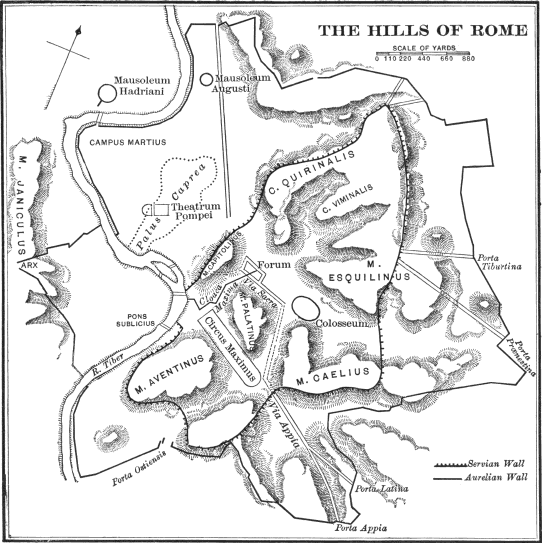
The original Latin city comprised only the Palatine and a small portion of the surrounding territory. The Etruscans inhabited the Caelian Hill, and extended toward the Esquiline. The Sabine town occupied the Quirinal, which was originally connected with the Capitoline, on which was the Sabine citadel, by a ridge sloping toward the Forum and the Campus Martius. Ancus Marcius added to the city the Aventine, and built a fortress on the Janiculum. Servius Tullius added the Viminal and Esquiline, and inclosed the seven hills with a line of fortifications, of which one portion is still traceable. The ridge connecting the Capitoline and Quirinal was a barrier which cut the town in two. The only means of communication between the two halves of the city, when its population had reached nearly two million inhabitants, were the narrow strip of land between the Capitoline and the river and a lane ten feet wide crossing the ridge. To relieve the pressure, this ridge was cut away by the Emperor Trajan, in whose Forum on the site of the excavations stands the well-known ‘Trajan’s Column,’ 140 feet high, ‘erected to show to posterity how high was the mountain leveled by the Emperor.’ The business portion of the modern city occupies the Campus Martius, its main artery, the famous ‘Corso,’ following the line of the ancient street shown on the plan. See Lanciani, Ancient Rome, p. 86.