XV VENICE IN THE FIFTEENTH CENTURY
Reading edition
As an epoch, if not precisely as a period of a hundred years, the fourteenth century in Venetian history closes with the war of Chioggia, as it began also before the year 1300 with the Closure of the Great Council. For the final defeat and ruin of the Genoese, Venice made the supreme heroic effort necessary to establish her greatness; thenceforth none questioned it, and with the attainment of her highest national aim ended the noblest page in her history.
The Venetians of the first period were at once brave and prudent; they were at times needlessly harsh in judging those whom they believed dangerous to the Republic, but they were sincere, and they found means to make other nations respect their country as they respected it and loved it themselves.
After Chioggia, Venice was both feared and admired, but it is not possible to feel much sympathy with her sumptuous social life, nor with a government that seems to have been for ever preoccupied with its search for secret enemies; nor, indeed, with its too docile working people, or its soldiers who so willingly obeyed the commands of the foreign condottieri under whom they were too often led to battle.
We look on her history and judge her by imaginary standards, which were never hers. We feel that at the end of the fourteenth century she entered upon a mistaken course in which she obstinately persevered to the end; we are sure that she should have been above any mere petty jealousy of her neighbours, and that she should have used all her strength in defence of her maritime trade and her colonies; we would have had her abide by the old law of 1274, which forbade a Venetian to own estates on the mainland of Italy; we consider that she was blinded to her true interests by all sorts of intrigues, and that she neglected her trade in order to put herself on the same war-footing as her adversaries, though she had not their natural aptitude for warfare; that she drained her treasury to pay grasping condottieri, and spent on futile campaigns the resources which had hitherto fed her commerce. All this we are to some extent justified in concluding, and upon those points we judge her, as we should strongly object to being judged.
Nevertheless, all this is but the criticism of speculative moralists and philosophers, a class of well-meaning persons whose influence in the world has never been large. Unhappily for philosophy and morality, they are but too easily answered by the sledge-hammer argument of success. In plain fact, Venice survived, and grew great, and was a power during four hundred years after she adopted her ultimate formula of existence, and in the end she died, not by the hand of the enemies at home or abroad whom she had successfully baffled for centuries, but of sheer old age and marasmal decline after a life of eleven hundred years, during which she was never at any time subject to a foreign power, or a foreign prince, was never once occupied by a foreign army—and was never bankrupt! Unfortunately for sentiment, no European nation, not ancient Rome herself, can point to such a past, and the suggestion that Venice might have done much better by acting much more sentimentally is utterly futile. It is a good deal as if, when the ‘oldest inhabitant’ of a village has just died after utterly beating all other records of longevity, some well-meaning old woman should say: ‘Ah, but he would have lived much longer if he had taken my advice.’
It is useless, I think, to inquire whether the complicated machinery of Venetian government would have worked with the same results, if any part of it had been altogether removed. No one of the many parts had been made arbitrarily, still less had any then been called into existence to afford lucrative posts for favourites, as has happened hundreds of times in the existence of other nations. The machinery had grown constantly, as more and more was required of it, but it had never stopped, nor had it ever been taken to pieces for repairs, like the British Constitution, for instance. It was a government of suspicion and precaution, which took it for granted that every man, from the Doge down, would do his worst, and provided against the worst that any man could do. This is true; but has any government ever thriven which reckoned on man’s virtues? The plain reason why all the many artificial communities founded by good men, from Buddha to Fourrier, or even Thomas Hughes, have been failures is that they have all reckoned on good motives in men, rather than on bad ones. Venice systematically expected the worst, and when she was disappointed it was to her own advantage. Christianity begins by telling us with energetic emphasis that we are all miserable sinners, and threatens us with torments which, if they could be brought before our eyes, would turn the hair of young men grey. Venice followed very much the same principle. Venice had the Pozzi; Christianity has Hell.
As for the manner in which Venice conducted her wars, by the aid of condottieri of reputation, she only followed the example of most of her neighbours. The practice had many advantages, one of which undoubtedly was that the prince, or the republic, was not bound to support an idle, restless, and ambitious general and his force of trained soldiers in times of peace. The professional fighter was sent for when needed, as one sends for the doctor. He made his bargain, beat the enemy if he could, was paid for the work, and went his way with his army in search of occupation elsewhere.
Of course, he might turn traitor at any moment, if it were to his advantage, and he was never inclined to annihilate an enemy to-day who might be his patron and employer to-morrow. The Italian noun ‘condottiero’ is derived from the word ‘condotta,’ which is not easily translatable into another language, but means a kind of articled engagement for a stipulated purpose. In modern times the municipal physician of each small commune is termed the ‘medico condotto,’ as it were the articled doctor who is bound to render certain services without charge, because he is paid by the town.
The rise of the condottieri was the result of the change in the manner of fighting which took place early in the Middle Ages, upon the introduction and development of armour. The first professional fighters were the aristocracy, who spent their time almost entirely in the daily practice of arms, and kept themselves in perfect training by constant exercise. To do this successfully they worked much harder than the peasants in the fields, who were their natural enemies, and who would have destroyed them altogether if they had not maintained their physical superiority by every means in their power. And this superiority they
RIO DE S. PANTALEONE
gradually supplemented by means of armour which by degrees reached such completeness as to make the man and his horse practically invulnerable, before the invention of gunpowder. A score of well-equipped and well-trained knights could cut to pieces ten times their number of men armed only with swords and shields. Moreover, the nobles did not hesitate to hang any rich plebeian who dared to wear steel.
The first soldiers of fortune were penniless nobles who owned nothing but their armour and horses, and often won wealth by fighting for any one who would employ them; and they insisted upon being treated with the deference due to their station. But little by little, as more fighters were thus employed, young men of unusual physical strength regularly went to work to train themselves for the profession, because it was a lucrative one, and was not at first very dangerous; for I repeat that before gunpowder men-at-arms were not easily hurt, and as for noble lineage, the employer cared nothing for that provided that the fighter knew his business. These fighters very naturally attached themselves by scores and by hundreds to any leader who had the reputation of gaining much booty, and of being generous in distributing it. I believe that there was very little good faith, and no trust at all, between the condottiero and his own band; on the contrary, I think the relation must have been very like that which exists on almost every merchant-vessel between the captain and his crew, and every man who has been to sea knows what that is. The best crew in the world have a way of regarding the captain as their natural enemy which is very surprising to a landsman; yet if they have confidence in his seamanship and navigation, and if he does not starve them, they will obey him with a zeal which to the uninitiated greenhorn looks like devotion, and they will even run great risks for him beyond what the law could require of them. He, on his side, has been before the mast himself and knows exactly what they think about him, and that if he allows them the slightest liberty or indulgence beyond what he and they know to be just, he will lose all control over them. In the study of the mediæval fighting bands and their relations to their leaders, an historian might learn a vast deal in the course of a six weeks’ voyage on a big modern sailing vessel.
It happened sometimes that after a very great victory the condottiero received extensive lands besides a large sum of money, and that he was formally adopted into the aristocracy of the country for which he had fought. In that case, he either disbanded his men and retired from the profession, or, if he was still ambitious, he entered upon a career of warfare and conquest on his own account. Francesco Sforza’s father began life as a peasant, and he himself ended as Duke of Milan, and left a great name which has descended to modern times.
The fifteenth century, as being the principal period of transition throughout Europe from ancient to modern warfare, was essentially the age of the condottieri, and many famous mercenary captains were employed by Venice; so many, indeed, that a review of their services would be almost a consecutive history of Venice’s relations with her neighbours during that time. There was Carmagnola and Gattamelata, and Francesco Sforza; there was Bartolommeo Colleoni, and Roberto Sanseverino, and there was even a Duke of Mantua. As Daru says, the Republic grew accustomed to keeping princes in her pay.
Even after the war of Chioggia was over, Venice was still involved in the long struggle with the Carrara of Padua which was to end with the almost total extermination of that family. Francesco Carrara had, indeed, signed the peace, like the Genoese and the King of Hungary. The Genoese power was broken for ever, and King Louis was far away and not anxious to renew a fruitless war now that his strongest allies were crippled; but Carrara had emerged from the contest practically unweakened, and Venice was not likely to forget that he had done everything in his power to further and abet the aims of Genoa.
1385.
There is no history more complicated and hard to bear in mind than that of the republics and principalities of northern Italy in the Middle Ages, as the crimes by which the despots kept their power were more tortuous than any committed before or since. In the events which led to the annexation of Padua by Venice two other states played a part, namely, the principality of Verona, held by an illegitimate descendant of the Scala family, who had incidentally murdered his own brother, the latter’s mistress and all their children; and the great dukedom of Milan, then ruled by Giovanni Galeazzo Visconti, who had, in the ordinary course of events, got rid of his brother Bernabò by poison, and kept a couple of nephews locked up in a dungeon.
Antonio della Scala was jealous of Carrara’s influence, and made a secret treaty with Venice, under which, and
THE CHURCH OF THE FRARI
for a consideration of twenty-five thousand florins monthly, he undertook the conquest of Padua, and the return of Treviso to the Republic. But he was badly beaten by Carrara, who succeeded in bribing two high officials in Venice, an avogador and a member of the Forty. These were, of course, discovered by the government and duly executed.
Rom. iii. 319, sqq.
1387.
Carrara, now fearing a regular war with Venice, sought the alliance of Milan, ostensibly against Verona, and Galeazzo at once saw a chance of profit for himself in granting the request. He had always hoped to make mischief between Padua and Verona, and it is said that after Scala’s defeat he had secretly offered help to both sides at the same time. He now agreed with Carrara to divide and share Scala’s principality of Verona. But when Scala was beaten and ruined, Galeazzo naturally refused to let Carrara have any part of the promised spoil.
Scala took refuge in Venice, where he received a pension, but it was not long before Galeazzo succeeded in having him poisoned; and almost at the same time Galeazzo made a secret treaty with Venice to rob Carrara of his principality. Venice introduced a clause into the agreement, which really showed genius. Lest Galeazzo Visconti should serve her as he had served Carrara, the Republic required that he should leave his dukedom in charge of Carlo Zeno while he prosecuted the war in person.
Carrara now turned to Venice for help against Visconti, pretending to know nothing of the secret alliance, and begging that the Republic would use her influence to make Galeazzo keep to the terms of his public treaty. This appeal was received with stony indifference. Carrara, who believed that both Venice and Visconti were actuated by motives of personal hatred against himself, resigned in favour of his son, Francesco the Younger, and retired to Treviso.
But his departure did not improve matters, and his son was soon obliged to surrender Padua to the allies, on condition of receiving a safe conduct for himself and his retinue to visit Pavia and return. This was given, and oath was taken on the Blessed Sacrament that it should be respected. He went to Milan, and was well received, and it appears that he acted the part of a man delighted with his treatment, and only anxious to be pleased and amused. It is almost needless to say that before long he was plotting against Visconti’s life, and that Visconti discovered the plan, and gave orders for his assassination. He fled to France with his young wife Taddea, but was pursued by Visconti’s emissaries, and embarked only just in time to save himself and her. She was soon to become a mother, and she suffered terribly from the rough sea. Carrara and she landed; she was placed upon an ass and he walked by her side, while the small vessel kept in sight of the shore. And so they proceeded, embarking again, and once more going ashore as a fresh gale began to blow. They came along the Riviera, well knowing that they were tracked by Visconti; once, at Torbio, they were warned by a friendly person not to enter the town, and they slept in a half-ruined church by the sea-shore. At Ventimiglia the little party excited the suspicions of the Podestà and Carrara was arrested, after having succeeded in placing his wife in safety on board the vessel, but was released again, because by good fortune the officer who arrested him had once served his father. So they went on, through countless adventures, sometimes disguised as German pilgrims, sometimes barely eluding Visconti’s search by hiding in bushes by the roadside; they even slept in a stable. They sought refuge in Florence and stayed there a while, went on to Bologna and were refused all assistance; and at last the fallen prince received offers to join the fighting band of John Hawkwood, the English condottiero. He almost reached Venice, and was within a stone’s throw of Padua, then went back to Florence, and was suddenly elevated to the dignity of Ambassador from the Florentines to the Duke of Bavaria, whose sister had been the wife of the murdered Bernabò Visconti, and the mother of the rightful but imprisoned heir to the dukedom of Milan.
It is not within the province of this work to narrate these wild adventures in detail. It is enough to say that the struggle between the several parties was carried on for years, with no scruple and little humanity. The policy of the different governments shifted continually; after allying herself with Visconti, Venice soon began to plot against him, judging that a ruined neighbour like Carrara would be safer than one too powerful, as Giovanni Galeazzo was growing to be; and so the fugitive couple was taken into favour again by the Republic. Although Visconti’s military governor in Padua, when Carrara came to take his own again, sent him word that a man must be a fool who, having left the house by the door, expected to return by the window, yet Carrara soon got the better of him by the help of Venice and the Duke of Bavaria.
What is most amazing in the history of the Italian principalities and republics is that any one of them should ever, under any circumstances, have believed in the promises made by any other. An open treaty was almost always supplemented by a secret one of a precisely contrary nature; oaths ratified upon the faith of the Blessed Sacrament were broken as lightly as lovers’ vows; the safe conduct given by a prince or a republic was generally the prelude to an assassination; and governments had not even that temporary regard for their obligations which is vulgarly described as honour among thieves. Writers of history have accustomed us too long to consider that these vices of mediæval Italian diplomacy were manifestations of the deepest craft and of the most profound subtlety, and we have been taught to look upon Macchiavelli as a master in the art of political dissimulation. Men of northern extraction who, by the accidents of birth, education, and long acquaintance, are thoroughly acquainted with the Latin character, cannot but smile at such a judgment. In all ages, Latins, and especially Italians, have deceived each other, but have rarely succeeded in deceiving us. The wiles of Cæsar Borgia would not have imposed upon an average English schoolboy. In her diplomatic relations with northern Europe, Italy has almost invariably been the victim of that profound duplicity which rests upon a carefully cultivated reputation for respecting the truth. It is the man whose word can generally be trusted who possesses the greatest power of deception when he chooses to perjure himself. It was not the complication of the Italian nature which produced the complicated state of Italian politics in the fifteenth and sixteenth centuries, but its extreme simplicity, which made Italian princes the easy victims of the most transparent deceptions.
1405. Padua taken from Carrara by the Venetians, Francesco Bassano; Ceiling of Sala dello Scrutinio.
1406. Rom. iv. 40.
On the other hand, after a long lapse of time, and in the presence of documents proceeding from opposite sources, it is now so hard to ascertain the simple truth, that the story of the younger Carrara is told in two quite opposite ways. The version I have given seems to be the more reasonable one; the other tells us that it was not Visconti, but Venice, that persecuted the young couple, and that it was not Venice, but Visconti, who in the end recalled them to Padua. Be that as it may, Carrara was once more in possession of his principality in 1392. It seems to me thoroughly in accordance with the policy of Venice to have thus installed him again at her very gates and under her protection, in order to crush him and his family the more effectually, as she soon afterwards did. Fourteen years later Venice had literally forced him to declare war against her, and had sent the invincible Carlo Zeno to command her armies; the inevitable result had followed, and Carrara himself with two of his sons were prisoners in the ducal palace. The three were condemned to death, and were strangled in prison.
The private execution of the noble prisoners of war was not acknowledged by the government, and the city was gravely informed that they had, all three, died of colds or coughs, vaguely described as catarrh. But the people were not deceived, and were certainly not displeased; and within twenty-four hours a triumphant song was bawled through the streets of Venice, of which the burden was ‘A dead man makes no war.’ The words have remained a proverb in Italy.
The elder Carrara, long a state prisoner in Milan, had been duly poisoned with ‘magical liquors’ by the five court physicians of Visconti in 1393. One of the younger Carrara’s younger sons died in Florence very soon after his father, but the fourth survived to be murdered in his turn nearly thirty years later.
I find in Smedley’s Sketches from Venetian History a very curious and interesting note with regard to him and to the disappearance of his race.
Smedley, I. chap. x. note.
The family name of Carrara, like that of the Scottish Macgregors, was proscribed. A branch of the House which still (1831) exists, or did exist not long ago, at Padua, was compelled to adopt the name of Pappa-fava, a sobriquet the origin of which has been traced as follows by Gataro. Marsilietto da Carrara, Signor of Padua for one short month before his assassination, in 1345, when a boy, was lodged, during a Pestilence which raged in the Capital, in a Monastery at Brondolo. ‘Now in all the great religious houses it is an ancient custom to have vegetable broth at dinner every day of the week. On Monday it is made of beans (fave), on Tuesday of haricots, on Wednesday of chick-peas, and so on. Marsilietto was so fond of beans that it always appeared a thousand years to him till the Monday came round, and, when it did, he devoured the beans with such delight as was a pleasure to behold. He was, therefore, nicknamed Pappa-fava (Bean-glutton) by the rest, and his descendants have retained the name.’
The threefold murder of the Carrara, for it was nothing else, must be regarded as the first result of the continental development of Venice after the war of Chioggia, a development which brought her into closer contact with a number of thoroughly unscrupulous princes and governments. If her misdeeds can be condoned at all, it must be upon that ground; but I find it impossible to agree with Mr. Hazlitt, the author of a recent valuable history entitled The Venetian Republic, in considering that, on the whole, Carrara had something like a fair trial, and deserved his fate. The whole body of evidence goes to show that, for his times, he was an exceptionally frank and courageous prince, and much of the so-called proof that was used against him in the end was obtained by the merciless application of torture. Mr. Hazlitt’s real love of Venice has, I think, prejudiced him too much in her favour in this instance, and his affectionate industry has discovered everything that can be said in her defence, without bestowing the same care on a fair statement of the other side. In a similar way, a little farther on, he speaks of the outrageous condemnation of Carlo Zeno to a year’s imprisonment as an act not unjustifiable, because it was proved that Zeno had actually received a small sum of money from Carrara; but Mr. Hazlitt passes over Zeno’s defence in silence. The invincible warrior admitted, indeed, that he had received the money, but his explanation was perfectly simple and honourable. He had lent the little sum to the prince when the latter had been an outcast, wandering through Italy with his young wife, and Carrara had repaid the money when he had regained Padua. Zeno was over seventy years of age at the time when he was condemned to a year’s imprisonment in a dungeon for this act of charity and its consequences; he was the bravest and truest Venetian of his times; he had saved his country from destruction, and had served her with the most perfect integrity under the most trying circumstances, and more than once in the face of her basest ingratitude; he reaped the reward which fell to the share of almost every distinguished Venetian, for he was feared by the government, hated by the fellow-nobles whom he had outstripped in honour, and condemned by men who were not worthy to loose the latchet of his shoes. And he was convicted on account of a paltry sum of three hundred ducats, lent to a wanderer in distress and duly returned—he, who had given thousands from his own resources to satisfy the demands of the sordid mercenaries whom Venice had employed in the war of Chioggia! In trying to make out that he was treated with justice, Mr. Hazlitt attempts to prove too much. Before quitting a point to which I shall not return, let me, however, testify to the value of Mr. Hazlitt’s work, and to the great and useful industry with which he has consulted and accurately quoted a number of authorities not only inaccessible to the ordinary reader, but rarely mentioned, and in some cases not at all, by such historians as Daru, Romanin, and even Sismondi.
The stern justice of former days degenerated into cold cruelty in the fifteenth century. When the Republic set a price on the heads of Carrara’s two youngest sons, after vainly attempting to get possession of their persons by diplomatic means, they were mere boys.
Rom. iv. 42.
When Zeno was called before the Council of Ten on the night of the twentieth of January 1406, the warrant for his examination authorised the use of torture, if it should seem necessary. But even the Ten hesitated at that. He admitted and explained the matter of the money lent and repaid; his explanations of his reasons for having received and talked with an envoy from Padua were as honourable as they were clear, and the Ten being mercifully inclined that night, did not proceed to stretch Venice’s greatest hero on the rack, but only condemned him to the Pozzi for a year, and to the perpetual loss of all offices he held.
He accepted the sentence without a murmur, and his frame of steel did not permanently suffer from the confinement, for he lived twelve years longer in perfect
PONTE FIORENZOLA
health, made a pilgrimage to Jerusalem, was once more in command of the troops of the Republic, defeated the Cypriotes, and died at last in the full possession of his faculties, leaving his name to undying glory, and the memory of his judges to eternal shame.
The Venetians had buried the elder and the younger Carrara with great magnificence, dressed in rich velvet, with their golden spurs on their heels and their swords by their sides. When Zeno died at last, it was necessary that his funeral should outshine at least the obsequies accorded to the murdered foes of the Republic. The Doge and the Senate attended, and the citizens followed him to his grave in their thousands; but it is good to read that what was left of him was borne to its last rest on the shoulders of brave seamen who had served with him, fought under him, and shed their blood with him. He lies in the church of Santa Maria della Celestia, where you may see his tomb to this day.
An age of transition is sure to be an age of contrasts. One may compare, for instance, the Doge Michel Steno with his successor, Tomaso Mocenigo, the extreme of extravagance with the extreme of economy, the increasing indebtedness of each department of the State with the excessive severity of the magistrates whose duty it was to watch suspected persons; and from the officials who ‘defended the faith’ one may turn to the wild band of noble youths who called themselves the ‘Compagnia della Calza,’ the ‘Hose Club,’ and whose chief occupation was to amuse and be amused.
The laws were full of contrasts, too. The Doge Michel Steno, the first of the fifteenth century, kept
Mutinelli, Commercio.
four hundred horses in his stables, and by way of adding absurdity to extravagance he dyed their coats yellow, according to the ridiculous custom of the times. Yet he was forbidden by law to blazon his coat-of-arms on the ducal palace, or, in fact, anywhere else, and he was not allowed to have himself addressed as ‘My Lord.’ The law required him to wear a mantle of royal ermine, and to provide his servants with two new liveries each year; yet he could be treated like a boy, and told to be silent and sit down in Council, as actually happened to him a few years after his election.
Armand Baschet, Archives.
The story is worth telling. I have spoken of the ‘Avogadori del Commun,’ who were officers of considerable importance and power, and not at first noble. They stood, in a manner, between private individuals and the State in matters of law, civil and criminal; partly in the position of a modern attorney-general, partly as representing the exchequer, but they had a right of interference in many other matters. Two of them were bound to be present at every Council, including that of the Ten, arrayed in long red robes, and they had power to suspend all judgments during three days in cases which, if not positively criminal, concerned the execution of laws and edicts. Though at first not nobles, and perhaps for that very reason, it had always been their business to act as a Heralds’ Office for the purpose of examining into all titles of nobility and claims for seats in the Grand Council.
Now it happened on the second of June in 1410 that a certain noble called Donato Michiel proposed the repeal of a law which had been approved six years earlier by the Great Council; the Avogadori opposed the motion, and accused the patrician of encroaching on their rights. But the Doge Steno, agreeing with the noble, lost his temper, and spoke sharply to the Avogadori. Now the ducal oath forbade the Doge to speak in defence of any one unless he could obtain permission to do so from four out of six of his counsellors. Three of the latter now tried to call him to order, but he would not listen to them. ‘Messer Doge,’ they then said bluntly, ‘let your Serenity sit down and be silent, and leave the Avogadori quite free to do their duty!’
Two other counsellors now took the Doge’s side, and he went on talking; whereupon the Avogadori imposed on him a fine and threatened to bring an action against him. Both parties grew more and more obstinate, and the quarrel lasted several days, until some intelligent persons discovered that the Doge had not broken his ducal oath, because the Avogadori had not yet formally made accusation against Donato Michiel, so that what the Doge had said had not been said in defence of any one, there being no legally accused person, but as a general statement of opinion; and in this way the affair was patched up without scandal.
Under the rule of Tomaso Mocenigo, Steno’s successor, the Republic seems to have recovered something of its pristine vigour, and the germs of internal corruption were retarded in their growth for a time. Mocenigo was as austere, as prudent, and as active as
LAND GATEWAY, PALAZZO FOSCARI
Steno had been extravagant, hot-tempered, and careless. Venice now finally obtained possession of Friuli and Dalmatia, which made her mistress of the Adriatic as far as Corfu.
Mocenigo was a man of iron will and inflexible principle. Nothing gives a clearer idea of his character than his own recapitulation of his nine years’ reign, when he lay dying of old age.
On his deathbed he assembled about him the principal officers of the Republic, and drew a clear picture of the condition of the country at the end of his administration, giving his hearers at the same time valuable advice as to the election of his successor, which they unfortunately did not follow. I quote the speech in full:—
My Lords, by the weakness in which I find myself, I know that I am near the end of my life; wherefore, since I owe great obligation to this my country, which has not only nourished and brought me up, but has also
Rom. iv. 93.
granted me as much pre-eminence and as many honours as can be conferred upon one of her citizens, and although I have always been devoted to my country with my life and with such poor means as fortune gave me, yet I know that by this I have not repaid even a small part of all the good which I have received; and being brought to a limit where I can do no more for my country, it is for my own satisfaction that I desired to assemble all of you here, that I might commend to you this Christian city and exhort you to love your neighbours, and to do justice, and to choose peace and preserve it, as I have endeavoured to do. In my time four millions of debts have been paid off, and there are other six millions owing, which debt was incurred for the wars of Padua, Vicenza, and Verona; we have paid every six months two instalments of the debts, and have paid all my officers and regiments. This our city now sends out in the way of business to different parts of the world ten millions of ducats’ worth yearly by ships and galleys, and the profit is not less than two million ducats a year. In this city there are three thousand vessels of one to two hundred ‘anfore’ (Venetian register of capacity) with seventeen thousand seamen; there are three hundred larger ships with eight thousand sailors. Every year there go to sea forty-five galleys with eleven thousand sailors, and there are three thousand ship’s carpenters and three thousand caulkers. There are three thousand weavers of silk and sixteen thousand weavers of cotton cloth; the houses are estimated to be worth seven millions and fifty thousand ducats. The rents are five hundred thousand ducats. There are one thousand noblemen whose income is from seven hundred to four thousand ducats. If you go on in this manner, you will increase from good to better, and you will be the masters of wealth and Christendom; every one will fear you. But beware, as you would be of fire, of taking what belongs to others and of waging unjust war, for God cannot endure those errors in princes. Every one knows that the war with the Turks has made you brave, and experienced of the sea; you have six generals fit to fight any great army, and for each of these you have sea-captains, slingers, officers, boatswains, mates, and rowers enough to man one hundred galleys; and in these years you have shown distinctly that the world considers you the leaders of Christianity. You have many men experienced in embassies and in the government of cities, who are accomplished orators. You have many doctors of divers sciences, and especially many lawyers, wherefore numerous foreigners come here for judgment of their differences, and abide by your verdicts. Your mint coins every year a million ducats of gold and two hundred thousand of silver; it also coins yearly eight hundred thousand ducats’ worth between ‘grossetti, mezzanini, and soldoni.’ Fifty thousand ducats of ‘grossetti’ go every year to Soria, and to the mainland, and other parts; of ‘mezzanini’ and ‘soldoni’ one hundred thousand ducats; the rest remains in the country (Venice). You know that the Florentines send us each year sixteen thousand pieces of cloth, which we make use of (in commerce) in Barbary, in Egypt, in Soria, in Cyprus, in Rhodes, in Roumania, in Candia, in the Morea, and in Istria, and every month the Florentines bring into this city seventy thousand ducats’ worth of all sorts of merchandise, which amounts to eight hundred and forty thousand ducats yearly and more; and they take back French woollens, Catalans, and crimson, and fine corded wool and silk, gold and silver thread and jewellery, with great advantage to the city. Therefore, be wise in governing such a State, and be careful to watch it and to see that it is not diminished by negligence. You must be very careful as to who is to succeed in my place, for by him the Republic may have much good and much evil. Many of you are inclined to Messer Marino Caravello, who is a worthy man, and deserves that honour for his worthy qualities. Messer Francesco Bembo is a good man, and the same is Messer Giacomo Trevisan; Messer Antonio Contarini, Messer Faustin Michiel, and Messer Alban Badoer, all these are wise and deserving. Many are inclined to Messer Francesco Foscari, and do not know that he is proud and untruthful; he has no principle in his affairs, he has an exaggerated disposition, he grasps at much and holds but little. If he be Doge you will always be at war; he who has ten thousand ducats will not be master of one thousand, he who has two houses will not be the master of one; you will spend gold and silver, reputation and honour, and where you are now the chiefs, you will be the slaves of your soldiers and men-at-arms and of their captains. I could not resist the desire to tell you this opinion of mine. God grant that you may elect the best man, and direct you, and preserve you in peace.
Mocenigo died on the fourth of April 1423.
In spite of his admonitions and of a considerable opposition, the electors chose Francesco Foscari to succeed him, and henceforth war with Milan became a certainty. It was on the occasion of his election that the last remnant of the people’s right of interference was done away with. Hitherto it had been customary to announce each election to the people, adding the words ‘if such be your pleasure.’ This time the High Chancellor, who, it will be remembered, was never a noble, inquired, with a smile, what would happen if the people answered that it was not their pleasure. The result was that the formula was never used again.
But the people were easily amused and let the nobles do as they pleased, even when, at a later date, the designation ‘Venetian Commonwealth’ was abandoned, and the word ‘Signoria’ was officially substituted in its place. This, literally translated, means ‘lordship,’ but it has long been a convenient custom to make an English word of it, as ‘Signory.’
Lazzari, Guida.
Some idea of the character of Francesco Foscari is given by the following anecdote. The Giustiniani family had built three palaces on the Grand Canal, one of which had been sold as a residence to the young Duke of Mantua, whom his brother, when dying, had commended to the protection of the Republic. Foscari could not endure the thought that the Giustiniani should still have two palaces finer than his only one, and when the government sold the third at auction in 1428, he bought it and raised it by building another story in order that it might outdo the others. It was then said to have three hundred and sixty-five windows, and it was valued at twenty thousand ducats, say, at fifteen thousand pounds sterling, which was a vast sum for those days.
Foscari’s name recalls dramatic memories, and, to tell the truth, it has frequently been taken in vain by poets and playwrights, and even by some chroniclers and historians. His son Jacopo was not the martyr he has been represented to be, nor was he himself the ‘Roman father’ of the play. I shall tell the true story—a terrible one enough, even in its accurate form—after briefly reviewing his reign.
The dying Mocenigo had not been altogether wrong in his predictions about Foscari, for before long the Republic was at war with Milan, as the ally of Florence, and was squandering money and men at a disastrous rate. Foscari undoubtedly belonged to the war party, yet in the true interests of his country he really controlled his own fiery nature for some time, and endeavoured to maintain a neutral position with regard to the quarrels of the Visconti with the Florentines, during which it was the constant aim of the latter to break up the alliance which was still in force between Milan and Venice.
Giovanni Galeazze was dead. His eldest son, Giovanni-Maria, had succeeded him, a maniac who is said to have fed his hounds on human flesh; and he had been dethroned by Facino Cane, and then massacred by the Milanese, as he richly deserved. His brother, Filippo-Maria, when Facino Cane died childless, promptly married the latter’s widow, the unhappy Beatrice da Tenda, in order to inherit something of Facino’s popularity and all of his vast estates. This being accomplished, and not caring for her company, as she was twice his age, he brought a false accusation against her, tortured her and sent her to the scaffold, while she protested her innocence. But this was only an incidental crime, and would doubtless have been forgotten with a hundred others but for the noble bearing of the unfortunate woman throughout the tragedy that ended her life. The historically important fact is that Filippo-Maria determined to recover every inch of the wide territory which had been ruled by his father, and that if he had accomplished his end, Venice would have been required to restore what she had taken from the Milanese.
Florence was at that time in one of her only too frequent phases of ill-luck, yet her hatred for the Visconti was such that she could not resist the temptation to fight Milan under all circumstances. She needed help, of course; above all, she needed money, and Venice was the richest nation in Europe. As has been seen, too, from Mocenigo’s dying speech, the two States were in close commercial relations. It was natural, therefore, that Florence should seek assistance of Venice; it was equally natural, according to the old traditions of Venice, that aid should be refused, unless it could be given profitably.
Foscari was for war, but was not able to influence the Senate in favour of the Florentines, to whom he had always been friendly. It was a stranger and a fugitive, a soldier of fortune of the highest physical
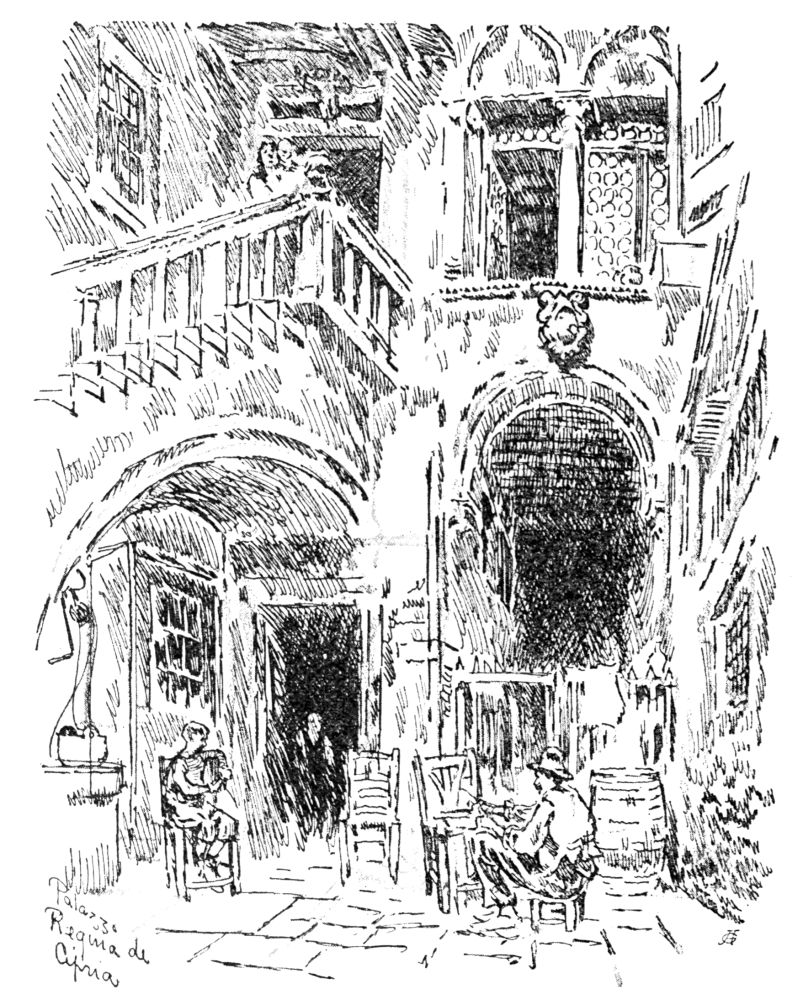
PALAZZO REGINA DI CIPRO
courage, of the lowest origin, and of no principles at all, who turned the scale—no less a personage than the famous condottiero Carmagnola.
Rom. iv. 106.
This remarkable man’s real name was Francesco Bossone, an appellation derived from the village in which he had been born of peasant parents. He had enlisted at an early age, and had attracted the attention and favour of Filippo-Maria Visconti, immediately after Facino Cane’s death, by almost catching Ettore Visconti, whom Filippo wished to murder. After this, Carmagnola’s advance to fortune was rapid and unchecked. In ten years we find him with the title of Count of Castelnuovo, as Filippo’s governor over Genoa, married to a widowed Antonia Visconti, who passed for a daughter of Giovanni Galeazzo; and so he prospered, till he had acquired such wealth that he deemed it safe to invest a part of it in foreign securities. As an especial favour, by a decree of the Great Council of Venice, he was allowed to buy bonds of the Venetian debt with his money, a privilege rarely granted to any foreigner. Before long he had cause to congratulate himself upon this piece of fortune, and upon his own caution, which had led directly to it.
1424.
Various explanations have been given of his disgrace with Filippo Visconti; it has been said that he lost the prince’s favour by the calumnies of people who envied him. Romanin says Filippo grew suspicious of him, because he was too successful and too popular with the troops, and that the envy of courtiers did the rest; that on being recalled from the governorship of Genoa he attempted in vain to obtain an audience of the Duke, and did all he could
1425.
to justify himself; but that, as he failed altogether, he withdrew to Piedmont, and did his best to incite Amadeus of Savoy against Filippo; that the latter then confiscated all his possessions, and arrested his wife and daughters, whom he held as hostages; and that, finally, Carmagnola went to Venice, and offered his services and those of eighty men-at-arms whom he had with him, the Republic being then on the eve of yielding to the entreaties of Florence and declaring war on Visconti.
The plain truth of all this seems to be that Carmagnola was an unprincipled scoundrel, who meant to be on the winning side whatever happened, and who, being very well informed, foresaw that a league was about to be made, with Venice at its head, which would be in a position to defy his old master. The latter, of course, tried to poison him by secret agents, who failed, were caught, and were duly tortured and hanged by the Venetian government, which took the diplomatic precaution of not mentioning the Duke of Milan in the case. There is a sameness about the crimes of the Visconti which makes them almost tiresome; Carmagnola was bolder and quite as profound, but the habit of superiority in actual fighting made him underestimate, in the end, the cool prudence of Venice and the many-sided duplicity of the Duke.
Venice accepted the adventurer’s offer, and soon afterwards placed him in command of her land army; and before long Mocenigo’s prediction was fulfilled, and the Republic was reduced to something like slavery under the iron hand of the captain she had hired. He, on his part, played a double game from the first, and made up his mind that if he must beat his old master, he would hurt him as little as he could in so doing, and would try to renew secret and friendly relations with him while acting as the Republic’s general.
It was about this time that the Doge Foscari made a speech in favour of the Florentine alliance, which was first published by Romanin. It bears the stamp of a genuine report, and much of it is in the Venetian dialect. Foscari argued that unless Venice would help Florence, the latter would shortly be annihilated by Visconti, who would then proceed at once to the destruction of Venice herself. He referred incidentally to a speech just made by Carmagnola, and assured the Republic that under such a general’s leadership there was nothing to fear, whereas there was great hope of extending the boundaries of the Republic. He wound up by saying that Visconti aspired to rule all Italy, despised reason, both human and divine, and was always taking other men’s property by fraud and deception; and Foscari called upon the Venetians to help in crushing a common enemy, for the perpetual peace of all Italy.
The speech is hot and warlike. Nevertheless Romanin, three pages farther on, declares that it is a great injustice to accuse Foscari of having promoted war, and complains that historians have made the Doge the scapegoat to bear the blame of all the wars in which Venice then became involved. But Romanin was not only an enthusiastic Venetian; he was also, to some extent, the apologist of the elder Foscari.
Sept. 15, 1426. Taking of Brescia, Aliense; Sala della Bussola, ducal palace.
The ratification of the league was announced at the end of January 1426, and Carmagnola’s definite commission dates from the nineteenth of February. He proceeded to besiege the fortresses of Brescia, allowed the Florentine general to plan the really astonishing entrenchments, looked on while the machinery of attack was set in motion, and departed to follow a long cure of baths at Abano, very much to the disgust of the Republic. He came back in leisurely fashion to the scene of action a few days before the two castles capitulated, in time to take credit for the whole affair, yet almost without having struck a blow at Visconti.
Meanwhile Francesco Bembo had transported another force up the Po in a flotilla of small vessels, and farther still up the river Adda, and had actually made a demonstration before Pavia, in the heart of Visconti’s dominions. The Duke having failed to poison Carmagnola, tried to burn down the Venetian arsenal by treachery, which was discovered, and his wretched agent was tortured to death in due form.
Pope Martin V., who was a Colonna, and therefore a Ghibelline—the only Ghibelline pope who ever reigned—was the one sovereign in Italy who still favoured Visconti, and he now intervened to make peace. A treaty was patched up by which the Duke lost a good deal of territory, and was bound to set at liberty the wife and daughters of Carmagnola. This was the peace of 1426, concluded on the thirtieth of December. Little more than a month later, on the fifth of February 1427, the Republic sent for Carmagnola again, for the Duke had simply refused to hand over the fortresses he was to yield by the treaty, and on the twenty-fourth of March Carmagnola and his wife made a sort of triumphal entry into the city.
Oct. 11, 1427. Victory of Carmagnola at Macalò, Franceso Bassano; ceiling, Hall of the Great Council.
In the campaign which followed, though for the most part pursuing his policy of inactivity, in spite of the protests of the Senate and the Doge, Carmagnola condescended to win a battle for Venice at Macalò, which it must be admitted, for his reputation, was a brilliant victory; and he soon asked leave to go and take more baths, as if the whole affair were perfectly indifferent to him. To this the Senate objected, but he was given all manner of rich compensation for his services, and came to Venice on leave. He was received with an ovation.
Bergamo surrenders to Carmagnola, Aliense; Sala della Bussola.
He had, indeed, been opposed to some of the greatest condottieri of the time, such as Francesco Sforza and Piccinino, and the Venetians seem to have valued him, because they were convinced that he could beat any opponent if he pleased, and only required gifts and flattery to rouse him to action. These were lavished on him, and a second peace with Visconti was concluded in April 1428, about fourteen months after the first. It was ratified and announced in May, and again Carmagnola entered Venice in triumph. He was now formally invested with the great feudal estate of Chiari.
As was to be expected, Visconti again failed to fulfil the conditions of the treaty, and within three years hostilities broke out again. To the amazement and mortification of the Venetian government, however, Carmagnola now resigned his commission, almost at the moment when he was to have taken command, and there is reason to believe that he was even then secretly negotiating with Visconti. But the Republic could not afford to lose such a man at such a moment; he was offered conditions which must have surpassed even his own tolerably large expectations. Not only was he to possess for himself and all his descendants the great estate of Chiari, with its rental, but another large feudal holding in the territory of Brescia was promised him on the same conditions; if all Lombardy were taken, he was promised the complete restitution of all the domains which Visconti had formerly bestowed upon him; all plunder and all prisoners of war were to be his, the Republic contracting to pay him a certain sum for each prisoner of importance whom he handed over to the government; as if this were not enough, he was to be crowned Duke of Milan if he could drive out Visconti.
While these astonishing offers were being made to him by Venice, he received more than one letter from the Duke, requesting him to act as an intermediary to make peace. This fact was, of course, soon known to the Venetian government, and we can hardly be surprised that the Venetians should not have liked the part which the Duke was thrusting upon a man who had betrayed him, and whom he should have considered as his worst enemy.
H. Brown, Ven. Studies, 165.
Mr. Horatio Brown has conjectured with great acumen that Visconti, who thoroughly understood the character of Carmagnola, as well as that of the Venetian government, chose the surest means of ruining the condottiero of whom he wished to be rid. Carmagnola, equally flattered by the Duke’s secret letters and by the overwhelming offers of the Republic, began to assume airs of superiority which could not but excite the suspicion of a government whereof suspicion itself was the very foundation and mainspring.
A series of discussions now began between the Senate and Visconti, in which Carmagnola was continually concerned, but it was soon the gossip of the city that the letters which he really sent to the Duke were by no means identical with the drafts of those which he showed the Senate for approbation. It is at least certain that, after war was declared, as was inevitable, Carmagnola showed neither decision nor energy when obliged to face Visconti’s army, and allowed himself to be beaten by Francesco Sforza, who was afterwards himself Duke of Milan. He showed all his old energy in Friuli in driving out the Hungarians, whom Visconti had induced to make a descent upon that territory, but he had no sooner come back to Brescia, for which Visconti himself was fighting, than his hesitation returned.
Smedley, in connection with what now happened, quotes the following remarkable passage from the twelfth chapter of Macchiavelli’s Principe: ‘Perceiving that Carmagnola had become cold in their service, they yet neither wished nor dared to dismiss him, from a fear of losing that which he had acquired for them; for their own security, therefore, they were compelled to put him to death.’
The condottiero now received a message from the Signory, requesting him ‘to give himself the trouble’ of coming to Venice to discuss a new plan of campaign. Completely taken off his guard, he at once left his camp and repaired to the capital, where he was met by eight nobles, who accompanied him to the ducal palace, telling him that the Doge expected him to dinner.
His own small escort was dismissed at the door, and he was ushered into a hall where he waited a few moments. Then came Leonardo Mocenigo and said that the Doge was indisposed, and begged that he would come again on the following day. Carmagnola left the room, followed by the eight nobles. In the courtyard he was about to take the direction which would have led him to the canal where he had left his boat, when the nobles suddenly came up with him and pointed towards the small porch under which was the outer entrance to the prisons.
‘This way, Sir Count,’ they said. ‘But that is not my way,’ he answered. ‘You are mistaken,’ they said, ‘this is the best way.’ At the same moment, certain gaolers appeared and pushed him through the door of the Pozzi. ‘I am lost!’ he cried, as he went in.
This was on the seventh of April. The manner of
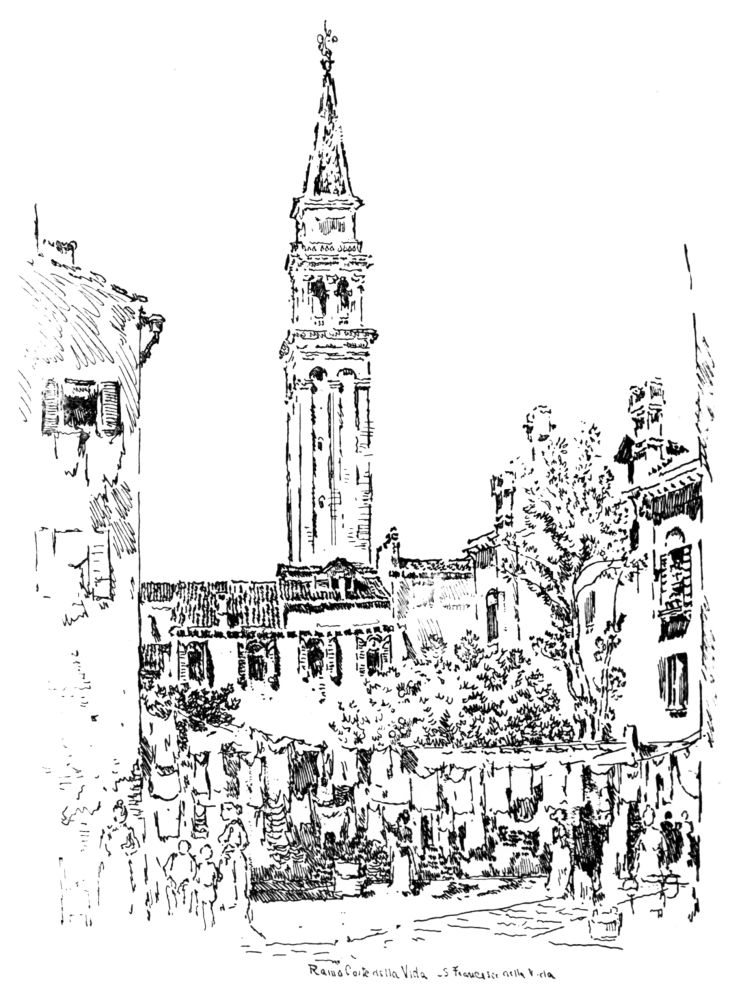
RAMO CORTE DELLA VIDA, S. FRANCESCO DELLA VIDA
the general’s arrest may be excused for its lack of dignity by the necessities of the situation. The man was most undoubtedly a traitor and a villain, but it would have been impossible to seize him in the midst of his own men-at-arms, and the most prudent manner of getting possession of his person was to draw him into an ambush. The wise and merciful fathers of the Republic would assuredly not have hesitated at much worse things; only a few days earlier they had offered twenty-five thousand ducats to a man called Muazzo, employed in Visconti’s household, to poison the Duke. The Republic had already fully adopted the progressive methods of its day.
Carmagnola’s trial occupied some time, and was conducted on the whole in a regular and legal manner. It began on the ninth of April, and on the eleventh the once all-powerful captain, to whom those who were now his judges had offered the dukedom of Milan, was put to the torture like any other criminal. On the fifth of May the Council of Ten gave its verdict as follows:—
Rom. iv. 160.
‘That this Count Francesco Carmagnola, a public traitor to our dominion, be led to-day, after nones, at the usual hour, with a gag in his mouth and with his hands tied behind his back, according to custom, between the two columns of the Square of Saint Mark’s, to the usual place of execution, and that his head be there struck off his shoulders, so that he die.’
The sentence goes on to direct that the Count’s widow should enjoy the interest of ten thousand ducats of the bonded debt, on condition that she should live in Treviso. Provision was also made for his unmarried daughters. As for the one who was affianced to
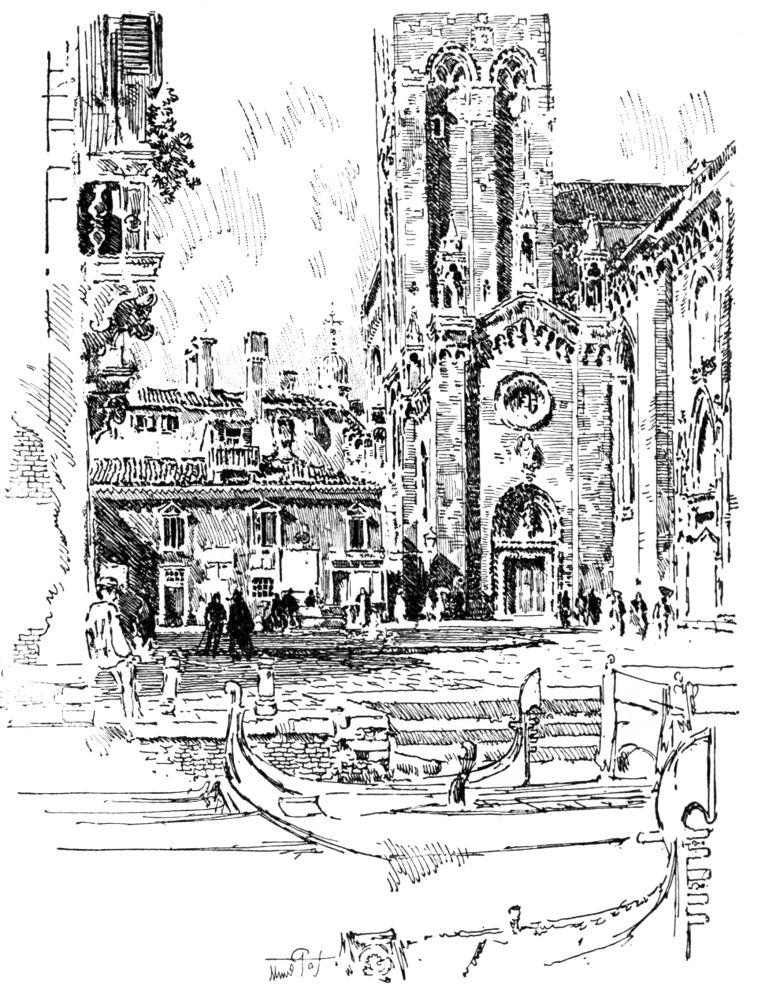
THE FRARI
Sigismondo Malatesta, since there was no divorce law by which he could sever an alliance which was odious, he adopted the simple expedient of murdering her as soon as he had married her and secured her dowry.
Rom. iv. 162, note 2.
Carmagnola’s body was dressed in crimson velvet, and on his severed head was placed the cap which still bears his name. The corpse was borne to the church of San Francesco della Vigna with twenty-four torches, but as it was about to be buried there, the capuchin monk who had received his last confession appeared in haste and said that the dead man had wished to be buried in the church of the Frari, and he was accordingly laid there, in the cloister. In Venice it was the custom that the clothes of executed persons should be given to the gaoler, not to the headsman; but in this case the Council of Ten decreed that the dress worn by Carmagnola should be handed over with his body to the monks of the church where he was buried, the gaoler receiving ten ducats as compensation.
His remains are now interred in Milan beside those of his wife Antonia in the greater church of Saint Francis. The historian Morosini, quoted by Romanin in a note, judged from his statue that he had the hard face, the cruel eye, and, generally, the unpleasant aspect which denote a man of dangerous character and stubborn purpose; and adds that he was a person of a keen wit, a tough constitution, and great courage, but capricious and of doubtful honesty.
Carmagnola’s wife was deeply implicated in his treachery, as is not surprising considering that she was known as the niece of Giovanni Galeazzo Visconti, and was believed by many to be his daughter. She and her children were required to remain in Venice some time
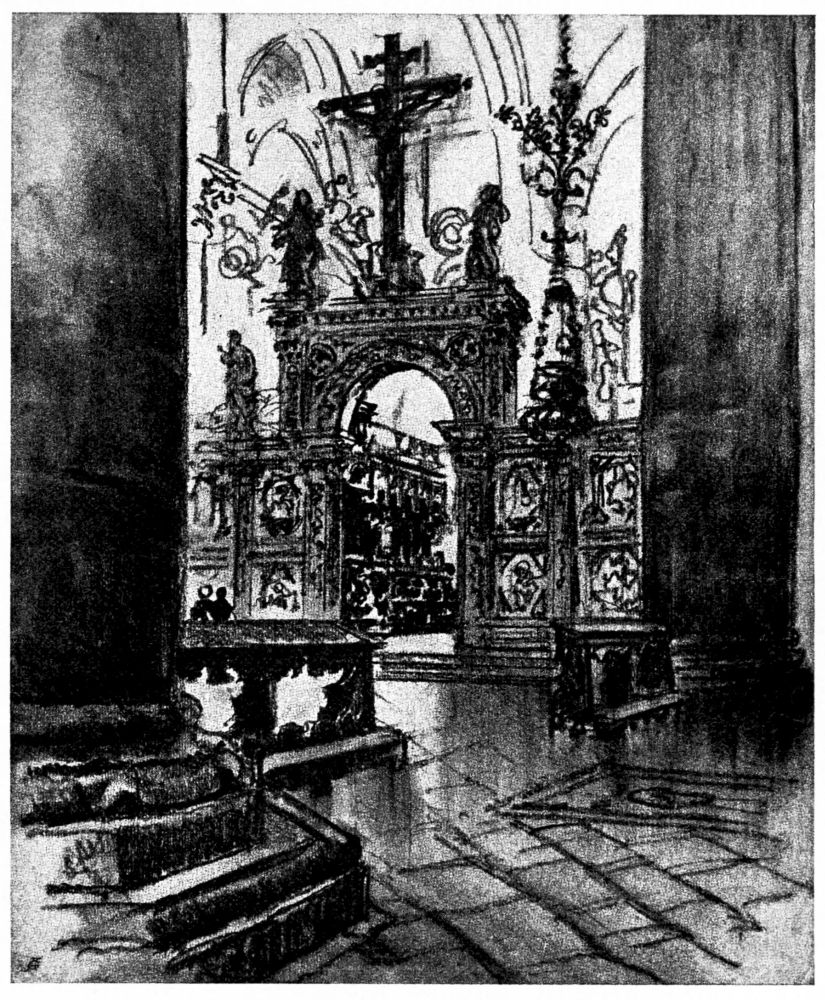
THE CHOIR SCREEN, FRARI
before proceeding to Treviso, and were detained in the convent of the Vergini, the same religious house which had served as a prison for two ladies of the Quirini family more than a century earlier. It was there that the Countess received the news of her husband’s execution, which was announced to her by one of the heads of the Council of Ten and an Avogador; and these officials at the same time demanded of her a list of her jewellery, assuring her that the Signory would forgive her misdeeds if she would only show a proper spirit of contrition. I find no account of the poor woman’s behaviour on this occasion; but as the sentence was executed only a few hours after it was passed, the news of her husband’s death on the scaffold was in all likelihood conveyed to her without any previous notice of his condemnation, and it was accompanied by a cold request for an inventory of her jewels, and a lecture on patience and repentance. Even the imagination of a novelist fails to guess what she must have felt as she listened to the grim men who had just condemned her husband and seen him die, and now wished to be told how many earrings and gold chains and brooches she had in her possession.
She afterwards really retired to Treviso with her daughters, and the Republic continued to pay her the promised allowance, till she one day escaped to Milan, whereby the obligations of the Venetian government were ended.
Whatever Visconti’s plans may have been when he secretly renewed his relations with Carmagnola, whether he intended to compass his ruin or not, it is certain that he bitterly resented his execution, and used every means, including the most inhuman tortures, to discover the names of those who had accused and condemned the condottiero. If he had succeeded he would no doubt have tried to poison them all.
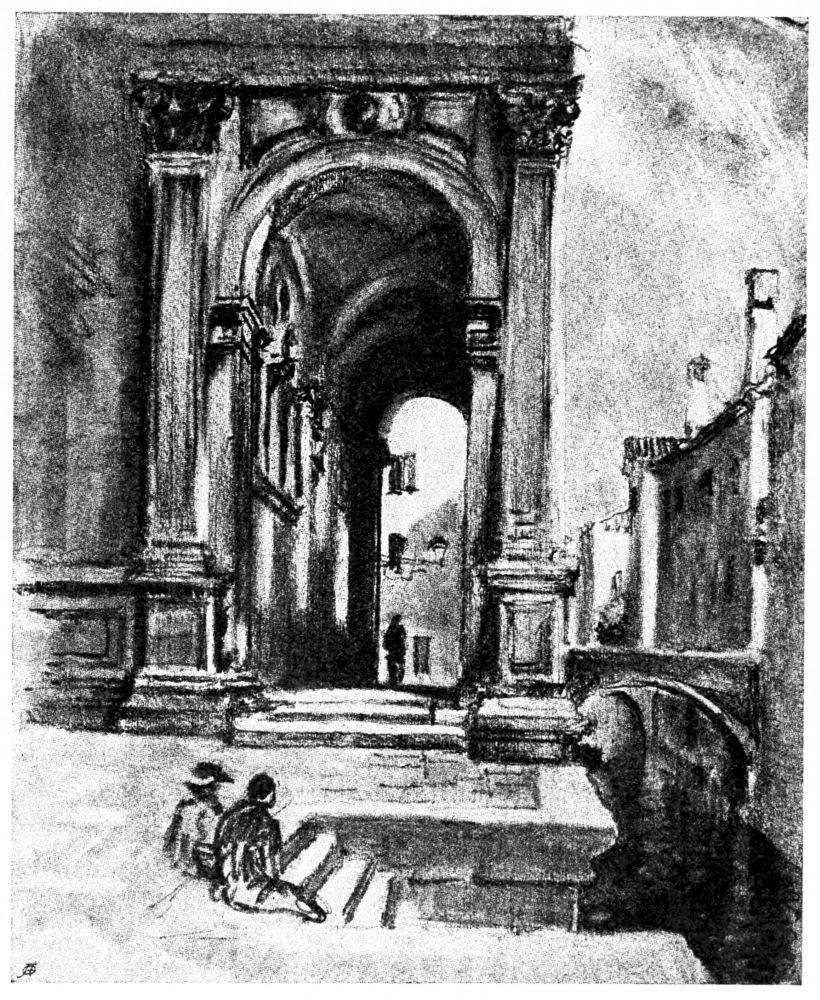
S. ROCCO
Not long after Carmagnola was imprisoned, Piccinino, one of Visconti’s generals, captured in a skirmish at Valtellina Giorgio Corner, a noble and very influential Venetian, who had acted as Provveditor to oversee Carmagnola’s doings in the field. He was taken to Monza, near Milan, and confined there in one of the prisons called ‘Forni,’ ‘ovens,’ compared with which the dreaded Pozzi seem to have been thought airy and luxurious quarters. He lived to write an account of what he suffered, and I shall give a literal translation of his words, not for the sake of inspiring horror, but because the document bears the unmistakable stamp of truth, and is one of very few of the kind which have come down to us.
Corner was first examined by Gaspare de Grossis, Doctor of Laws.
Rom. iv. 166, note.
I felt as if my soul were being torn out of me, when he said that I must speak the truth; and when I answered that I had told it he gave me a wrench of the rope, and had me drawn up and brought to him like dead, threatening me greatly, that he would have this truth; and seeing me like dead he went away, and I was let down into the ‘forno’ by a leathern belt, and was placed upon a mattress on the boards, and was given the yolk of an egg and a drink. This was my dinner, and I was not able to get my hand to my mouth in any way; so I lay that night and never could sleep. In the morning came he that watched me, and made fire, and gave me the yolks of two eggs, and with these I remained that day.
On the next Friday morning he came to me and had me bound and drawn up and taken to him, asking if I would tell the truth, and when I said I had told it, he said he wished to know who had told the Signory about the Count (Carmagnola) having an understanding with my Lord Duke. I said I knew no one who had made the accusation. Seeing that he could get nothing else, he had me fastened to the rope, and gave me a wrench of the rope that I thought I was dying. Seeing that he could get nothing more from me, he made me get up and had my arms set (they were dislocated by the torture), with even greater pain, and had me brought to him, and he spoke his mind (abusively) and went away. On the next Saturday in the evening he caused a bar to be placed on the floor in a hollow, and my feet were put under it and hammered upon with a wooden pin, so that I almost died of the pain. On the last day of December, which was Saint Sylvester’s day, there came to me the aforesaid Messer Gaspare, and with him came Lunardo di Lunardi, the inquisitor of Milan, at the hour of matins, and had me taken up. Let every one guess how my heart felt. I commended myself to God and went before them. Being before them Lunardo asked me if I knew him, and I said: No. And he answered me: Also I will not leave thee till I have so wrought that thou shalt know me; and saying: Thou hast refused to tell the truth to Messer Gaspare; the prince has sent me to know the truth of thee; thou hadst best tell it and get his good grace; but though thou wouldest not tell it, be quite sure that thou shalt nevertheless tell it, or thine arms shall be left hanging to the cord (torn from the body). And with other words, which I write not, for hearing this every one may fancy how my heart felt. I answered that I had told the truth to Messer Gaspare, and that he (Lunardo) ought to be sure of this, because if it had been my own son who had accused the Count Carmagnola I would say so rather than desire more torture, and all the more he should consider that I would do so if it were a stranger; and I said the like as to what concerned the other chief points (of the inquiry). Then Lunardo said to me: Thou wilt not name the real traitor; he had me undressed and fastened to the cord, etc.
On the second of January Corner was told that he was to be tortured again, and he addressed his tormentors as follows:—
Since this is your will, which will soon be done, I ask one thing of you as a grace, that since I am to lose this body so miserably, I may not lose my soul, and that I may confess and receive communion, in order that our Lord God may have mercy on this poor soul. Lunardo answered: I wish it may go to the house of the Devil. Hearing this cruel speech I answered that although fortune had given him power over the body, God had not given him power over the soul, and that I hoped, by His grace, that if I had good patience this should be my purgatory, for my innocence’ sake; and that He would receive my soul into His glory, and (I said): The more pain you inflict on this wretched body so much the more merit will He give me, and to Him I commend myself.
The unhappy man was kept in prison six years, and was supposed in Venice to be dead, but he succeeded in sending a message to his son. The Republic then sternly demanded of Visconti his release, and he returned to his home at last, deformed by torture, pale and emaciated, with a beard that descended to his belt. He lived just two months after that, prematurely broken by his horrible sufferings, and was followed to his grave by a vast concourse of the people. Romanin says that he was a nephew of the Doge Marco Corner, whose brave defence of his poverty and of his burgher wife, when he was a candidate, will be remembered. It is more likely that the Doge was the Provveditor’s great-uncle, as he died a very old man, more than seventy years before the death of the unfortunate Giorgio. It is possible, however, that Romanin may have meant that the latter was the Doge’s grandson, for in Italian there is but one word to signify ‘grandson’ or ‘nephew,’ though when the former meaning is intended it is usual to make it clear.
Portraits of Doge Francesco Foscari: one, attributed to G. Bellini, Museo Civico, Room XVI.; another, by Bartolommeo Bon, Camera degli Stucchi, ducal palace.
Foscari’s name is so closely associated in most persons’ memories with the tragedy of his worthless son, that we are apt to forget that his reign lasted a third of a century and covered one of the most important periods in Venetian history. It embraces most of the wars of the league, the rise and fall of Carmagnola, the end of the house of Visconti, and the foundation and elevation of the Sforza family; and, most important of all, the taking of Constantinople by the Turks.
Much sentimental nonsense has been written about the two Foscari, and even such a historian as Daru has had the courage to tell us that the Doge presided in the court which condemned his son, and that Jacopo received his sentence from the mouth of his own father. Not content with stating these impossibilities, Daru has actually described the scene, with many details, though it could not, under any circumstances, have taken place, since a special edict of the Council of Ten expressly forbade the Doge, or any member of his family, to be present at the trial.
Jacopo’s troubles began soon after his marriage in 1441 with Lucrezia, a daughter of Leonardo Contarini.
Rom. iv. 266 sqq., and Molmenti, Dogaressa, 250 sqq.
The wedding had been celebrated with great splendour, and the bride had been conducted home over a bridge especially built for the ceremony across the Grand Canal; there had been boat-races, a tournament in which the great Francesco Sforza himself took part, and there had been illuminations of the city and endless other festivities. The bridegroom is said to have been a very cultivated young man of great personal charm, a Greek scholar, a lover of poetry, and a collector of rare manuscripts; but of weak character, careless and extravagant. It really looks as if his fate had been the final consequence of some momentary lack of means wherewith to satisfy his luxurious tastes. Three years after his marriage he was accused before the Council of Ten of having received gifts from several important citizens in consideration of obtaining honorific or lucrative posts for them through his influence with his father. One of his servants and several other persons were examined under torture, and their evidence led to an order for his arrest. He had been informed of what was going on, however, and had already escaped.
The trial proceeded without him, and it was sufficiently proved that a box existed in the Doge’s house containing valuables which he had received. The law forbidding any member of the Doge’s family to receive any gifts whatsoever, under any circumstances, was most rigidly enforced in Venice, and Jacopo was justly sentenced to a temporary exile; he was known to be in Trieste, and a galley was ordered to proceed thither to convey him to Modon in the Peloponnesus, whence he was to journey at his own expense to Napoli di Romania, near Corinth, within one month; and while there he was to present himself to the governor every day, to sleep in the city every night, to keep no more than three servants, and to be treated in all respects as a private
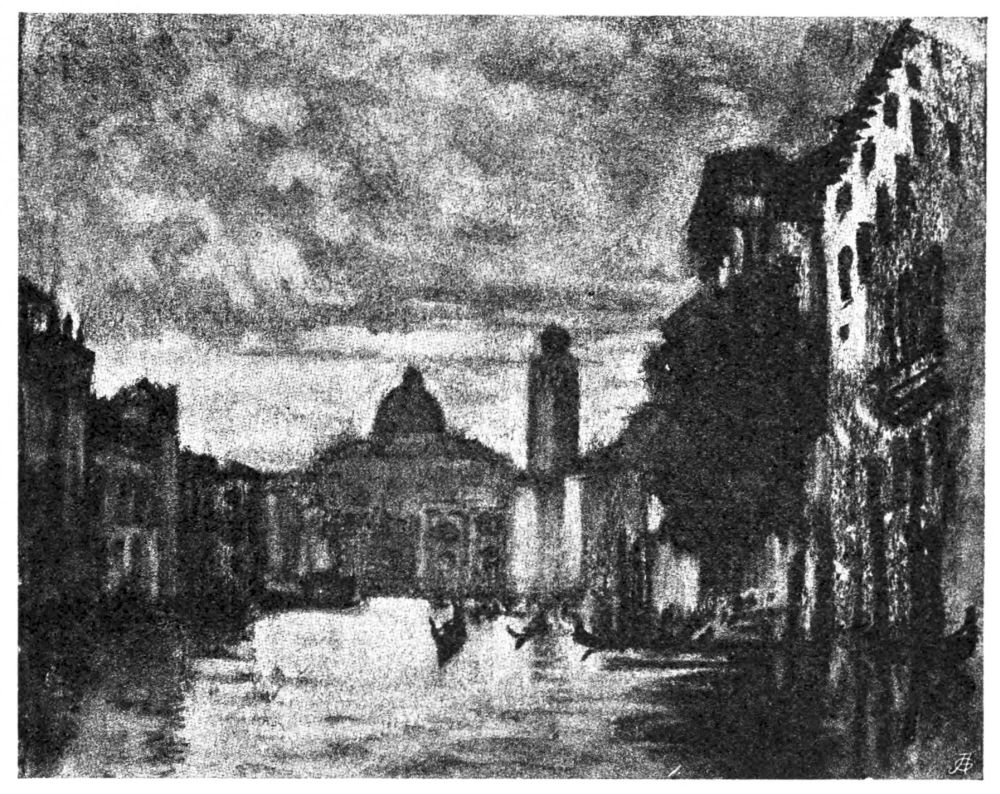
GRAND CANAL LOOKING TO CANARREGGIO
citizen. If he refused to go on board the galley a price was set on his capture; he was to be brought to Venice and beheaded between the columns. Several minor personages were at the same time sentenced to short terms of exile, and to the loss of any public offices they might be holding at the time.
The offence was patent, the trial was legal, and the condemnation was just; but Jacopo cared for none of these things, and altogether declining the invitation of the Ten to go on board the galley sent for him, he continued to live in Trieste as if nothing had happened. The Ten, on their side, were by no means anxious to incur the odium of decapitating the Doge’s son, as they had declared that they would do if he refused obedience, and they now begged the Doge himself to use his paternal influence with Jacopo, in order that they might not be driven to extremities; but as this measure also remained without any effect, the Council confirmed its sentence and confiscated Jacopo’s property. At any moment he might have been arrested, brought to Venice, and beheaded; but instead of this, a committee was named to examine into the circumstances. It was ascertained that Jacopo was in bad health; it was voted that this fact should be accepted as a sufficient excuse for his disobedience; and, by way of smoothing matters over, it was decreed that he should be exiled only to Treviso and the Trevisan district, almost within sight of Venice. Jacopo thought fit to submit to this mild decree, which was not modified, although it was soon afterwards discovered that he had received two thousand and forty ducats, with a quantity of silver plate, from Francesco Sforza. A year later the Doge presented a petition to the Council of Ten begging that, in consideration of his own old age, and of the fact that Jacopo, his wife, his children, and all their servants, suffered from malarious fever in the climate of Mestre, Jacopo might be allowed to return to Venice. This petition was actually granted, doubtless owing to the signal services rendered to the Republic by the old Doge during a reign which had already lasted twenty years.
Jacopo returned, and during the next three years nothing is known of his mode of life. It must be admitted that, so far, the Ten had acted with unusual clemency. They can hardly be blamed, however, for having watched Jacopo afterwards.
On the evening of the fifth of November 1450 an atrocious murder was committed, and the fact that the victim, the noble Ermolao Donato, had been one of the heads of the Ten during Jacopo’s trial, and that he was killed just after he had left the ducal palace, cast suspicion upon the younger Foscari. It was not until two months later that a formal accusation was laid against him and he was arrested. There was certainly strong evidence to prove the crime. Foscari had long made no secret about his hatred of the murdered man; a servant of Jacopo’s had been seen hanging about the palace as if waiting for some one just before Donato had come out; and a good many minor pieces of testimony were adduced.
There is not the slightest truth in the story that Jacopo Loredan ever held the Foscari family responsible for the death of his father, who was probably poisoned by Visconti, nor that he entered the crime as a debt in his ledger, and wrote ‘paid’ opposite the entry when the elder Foscari was deposed. Yet it is true that a sort of feud had long existed between the two families, that Pietro Loredan had been the unsuccessful candidate when Foscari had been elected, and that Jacopo Loredan now took an active part in the proceedings against Jacopo Foscari.
The trial was not in any way a secret one. The evidence was only circumstantial, and even under torture Jacopo confessed nothing. In modern England or America he would not have been tortured, but he would in all probability have been hanged for the murder. The Ten must have felt the difficulty in which they were placed, and they met it by condemning him to exile in Crete, not allowing his wife and children to accompany him. Foscari was then taken from the ducal palace and placed on board a ship, which conveyed him to his destination. He remained in Crete unmolested during five years.
1456.
Here, again, dramatists and writers of fiction have invented an extraordinary tale. It is narrated that Jacopo, being unable to bear the loneliness of exile, deliberately wrote a letter, in which he appealed for help, to Francesco Sforza, then Duke of Milan, intending that the missive should fall into the hands of the Ten, in order that the Council might have him brought back to Venice to be tried; and we are asked to believe that he risked the agonies of torture for the sake of once more seeing his own people. What actually happened seems to be that Jacopo had become intimate in his exile with certain Genoese, through whom he attempted to establish a correspondence with Mohammed II., the conqueror of Constantinople, in the hope that the Sultan would send a galley on which he might escape from Crete. If he had succeeded, the Turkish vessel would certainly not have brought him to Venetian waters.
Venice had suffered much in her commerce by the Mohammedan conquest; a number of her citizens had fought in the last defence of Constantinople, and some had been afterwards murdered in cold blood by the Sultan’s orders. An agreement had subsequently been reached, it is true, but the Ten could hardly be expected to look with leniency on a secret correspondence between the son of her Doge and the despot of the Osmanlis.
Jacopo Foscari was brought back to Venice and tried again. He now confessed everything immediately, without compulsion. The story of his having been horribly tortured during this second trial appears to be a pure invention, for in the records of the Council of Ten the fact that the cord was used is invariably stated on each occasion, and in this case there is no mention of any such matter. I refer the incredulous reader to Romanin’s fourth volume, in which abundant proof of this will be found, with the most minute reference to existing documents. Smedley wrote at a time when those papers had not been found, and confessed, moreover, to having largely used Daru.
Jacopo was condemned to return to Crete and to be confined there in prison during one year; he was told, however, that if he again wrote letters to foreign princes, he should end his life under lock and key.
He was allowed to see his family and his father once more, before his departure, and the aged Doge took leave of his only son with tears and deep emotion; but to Jacopo’s entreaties that the Doge would endeavour to procure his return, the old man could only answer, ‘Go, Jacopo, obey and ask no more.’
None the less, after his final departure, the Doge made every effort to obtain his pardon, and was seconded by several of the great patricians; but Jacopo died in January 1457, long before his year of imprisonment was out.
The blow completely broke down the Doge, who was now about eighty-four years of age; he became unable to attend to any affairs of State, and the Council of Ten, not unwillingly perhaps, but with a full understanding of the importance of such a step, determined to depose him and elect another Doge. At its best, the Council of Ten was a fairly just court; at its worst, it was the most unscrupulous, sordid, despotic, and yet cowardly body of men that ever called themselves a tribunal, until the French Revolutionaries beat all records of infamy in the name of the ‘rights of man’; but at no time did the Council ever show the smallest inclination to be sentimental; and it was very rarely generous, for generosity is probably one of the noble forms of sentiment. Francesco Foscari had reigned too long, and was now useless, even as the figure-head which the chief of a thoroughly constitutional and non-imperial state should be. The Council of Ten deposed him, and the Great Council elected another Doge in his place, Pasquale Malipieri.
The proposition presented by the heads of the Ten is extant, and is a masterpiece of sanctimonious cant, in which the Venetian State is spoken of as having originated in the infinite clemency of the divine Creator, and immense stress is laid on the administrative importance of the Doge’s office. The fact was that the oligarchy hated Foscari, and felt that the conduct of his son had brought great scandal on the Republic. A committee of the Council waited on him twice, and requested him to resign on the score of old age, but he refused to do so; the third time, the request became an order, and he was told to leave the ducal palace within eight days. The ducal ring was taken from his finger and hammered to pieces, as was done when a doge died.
He did not wait longer than necessary, and on the following day he left the palace, walking with a stick, but otherwise unaided. His brother Marco went with him, and proposed that they should go to their boat by the private and covered entrance, but the old man refused. ‘I will go down,’ he said, ‘by that staircase up which I came to be Doge.’
The last legend concerning him is that he died of a broken heart on hearing the great bell announce the election of his successor. He died three days later, on All Saints’ Day, and the new Doge was at mass when the news was brought to the church. Doubtless Foscari’s end was hastened by the painful emotions of the last few days, however, and there was a strong feeling in Venice against the Council of Ten for some time afterwards.
As usual, there was also an attempt to make amends by giving the dead man a magnificent funeral. This his widow proudly refused, saying that she was rich enough to give her husband a king’s funeral without aid from the State; nevertheless, his body was taken by order of the Signory and was laid out in state, arrayed in the ducal garments with all the insignia; and Malipieri, the new Doge, followed the bier to the Frari dressed as a simple senator, as if Foscari’s successor had not yet been elected.
Returning for a moment to the list of the condottieri who served Venice in the fifteenth century, it is time to say that Carmagnola was succeeded as general of the Venetian armies by the Duke of Mantua, who before long went over to the enemy with his men, his weapons, and his baggage. The next commander was one of his lieutenants, a certain Erasmo da Narni, famous under the nickname of ‘Gattamelata,’ or Honey-Cat.
Eroli, Erasmo Gattamelata.
Erasmo Gattamelata of Narni was the son of a baker in that town, and is said to have got his nickname from his soft and cat-like ways, ‘and for his speech, which was cautious and also sweet and suave as honey.’ As there are still families of the name in northern Italy who were never connected with his, I cannot see why we need assume that in his case it was a nickname at all. Such appellations are common in Italy, and it is probably only because he was such a distinguished condottiero that his has attracted so much attention. He began his fighting
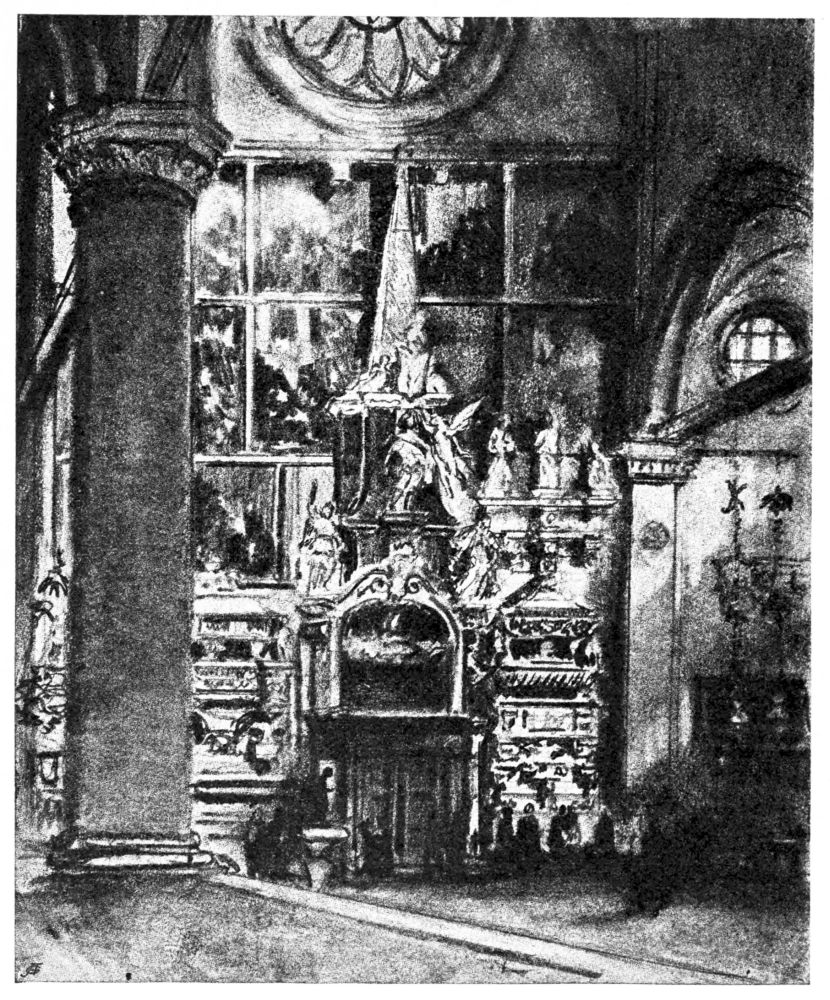
TOMBS IN THE FRARI
career when he was young, and Braccio made him commander of his cavalry. He served many employers, amongst others Martin V., the Colonna Pope, and he
1434.
found himself opposed in the field ‘both to Casa Braccio and Piccinino, and also to Stella, his old friends and leaders.’ He was sixty years of age when he entered the service of the Venetian Republic. He had a sworn brother in arms, like many fighters of that day, a certain Count Brandolini who was included in the agreement with Venice, which is given in full in the Marchese Eroli’s book. It begins:—
Gattamelata and Count Brandolini are engaged as leaders of four hundred lances with three horses to each lance, as is customary, and also of four hundred footmen. And after six months they shall have, besides what is above agreed, fifty lances more for their two sons under them.
For the use of these four hundred lances there shall be given them 60 ducats for each lance.... Over and above this they shall have a loan (an advance) on their personal security, of 2000 ducats, and further, they shall soon have, on account of what the Sovereign Pontiff owes them for their service, 10,000 ducats.
But Gattamelata and Count Brandolini shall produce for the aforesaid money, and for the performance of their promise, suitable sureties, having received which the Doge and the government will provide the money....
As regards the booty which the said Gattamelata and Brandolini and their band may collect in time of war, the custom of the tenth shall be observed.
It was customary for condottieri to pay a tribute called Saint Mark’s Fee, Onoranza di San Marco, to the Republic, which was a sort of income-tax on loot. War was a matter of business.
Lack of space prevents me from giving the agreement in full. It is very curious. Among other provisions is one forbidding the condottiero to present, for the roll call, the same charger or man ‘more than once or under more than one lance,’ a clause which gives an idea of the usual methods of cheating. All unimportant prisoners were their property as part of the booty; the important objects and persons, ‘cities, lands, fortresses and their munitions, ruling princes and their brothers or sons, and rebels and traitors,’ were to be handed over to Venice; but other condottieri and military commanders, if taken, were to be paid for by the Venetian government, if it chose to pay half their ransoms.
At the end of the campaign Gattamelata and his friend received in ‘noble and gentle fee’ the castle and lands of Valmarino, on condition that the population should continue to buy its salt from the Venetian Republic, and that the two feudal holders should pay the Republic a yearly tribute of ten pounds of wax at the feast of Saint Mark. Gattamelata bought out his friend’s share, and was inscribed in the Golden Book.
He and Sforza fought together against Piccinino and amongst other things took back Verona.
1439. Verona retaken by the Venetians, Giovanni Contarini; Sala delle Quattro Porte, ducal palace.
Gattamelata died of apoplexy not long after the end of that campaign, and was magnificently buried, in the presence of the Doge and the Signory. A picture representing his obsequies was painted by Mantegna, but his biographer, Marchese Eroli, writing in 1876, had not learned where it was, if it still existed, nor can I obtain any information on the subject.
The great Francesco Sforza was also during some time in the service of the Republic, but left it to marry Bianca Visconti with the prospect of succeeding to the Duchy, and he fought against Venice as bravely as he had lately fought under her standard. War was purely a matter of business with the condottieri, and so long as they fulfilled the conditions of each successive contract they undertook, no one ever blamed them for changing sides as often as was profitable. It was not even proper or customary to poison them for it, and in an age when political murder was as common as mere political calumny is now, the acts of Filippo-Maria Visconti were really looked on with disapproval by his fellow-scoundrels in power. It was considered that he went too far.
Rom. iv. 196.
Battle of Lake Garda, Tintorettto; ceiling, Hall of Great Council.
Astonishing things were done by the soldiers of that age. In the war with Milan, for instance, Venice at one time judged it necessary to get a small fleet into the Lake of Garda; and as the approaches by water were guarded by the Milanese, it was actually found possible to haul six galleys and twenty-five long-boats by means of oxen and capstans from the river Adige up the steep slope of the Monte Baldo and down to Torbole, where the vessels were launched into the lake—and promptly blockaded by the enemy.
In the same war Brescia successfully withstood a siege of no less than three years. It would take long to give even a slight idea of the feats of arms performed on both sides by hired troops, at a time when all Italy was on fire, and war was more or less continuous because the condottieri, who lived by it, were obliged to make it so or starve. The country was in a bad state; if the strong anywhere protected the weak, it was in order to enslave them more effectually, and the weak often revolted against the enforced protection they received.
Visconti died in 1447, leaving four wills, on the third of which Sforza founded those pretensions to the dukedom which he soon succeeded in establishing, though the Milanese declared that they would be a Republic, like Venice and Genoa. We smile at the futility of such a simple popular aspiration, in an age when soldiers were rulers and rulers were tyrants. The Milanese were obliged to employ Sforza to fight for them; he did so, routed the Venetians, forced them to a peace, and then entered into an alliance with them which gave them all the Cremasco, with Bergamo and Brescia, but landed him safely on the throne of Milan.
He had in him the stuff of a good prince, and he is said to have indulged dreams of uniting all Italy in a sort of federation to defend the country from foreign invasion.
But greater events were happening in the East, where the Byzantine Empire was at the last gasp of its existence. Even if Venice had thrown all her strength into opposing the Turks and protecting her Eastern commerce, instead of quarrelling with Milan, she
Smyrna taken by the Venetians, Paolo Veronese; Hall of the Great Council.
could not have retarded the fall of Constantinople by any long time. As it was, she sent but little help to the last of the emperors. The Byzantines had never been good fighters, and the tremendous fortifications of the city alone checked Mohammed’s army of one hundred and sixty thousand fanatics.
Constantinople was taken in 1453, and in the wild massacre of Christians that followed, many Venetians were butchered. The Republic is said to have lost property worth three hundred thousand ducats. Fifteen Venetian ships succeeded in escaping, with eight Genoese vessels. But the mere loss of money and valuables was nothing compared with that which must have followed if the commerce of Venice in the East had been altogether destroyed. There was much to overlook and forgive, it is true, if an agreement were to be reached with Mohammed the Conqueror. He had impaled a Venetian captain and beheaded thirty of his crew before the siege; he had decapitated the Venetian Bailo and his son in cold blood afterwards, a great number of Venetians had perished in the massacre, and twenty-nine nobles had been held for ransom; and in return for these injuries and insults, the Republic had not struck a blow. The exigencies of commerce were great.
Venice played a double part in what followed, making a show of rousing the Pope to preach a crusade on the one hand, and, on the other, quietly drawing up a treaty with the Sultan, by which the Republic was to pay tribute for her Eastern settlements, the slave-trade was to be allowed to continue in the
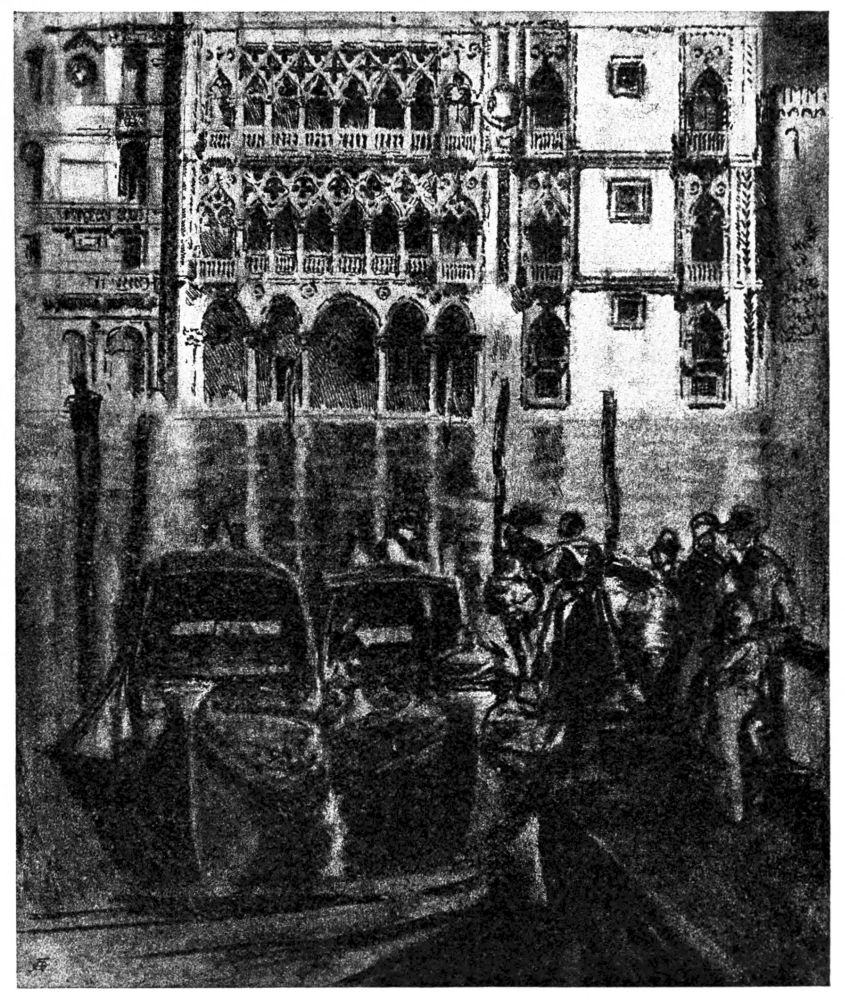
CA D’ORO
Black Sea, provided that only Christians, and not Mussulmans, were bought and sold, and the Sultan was to force the Genoese of Pera to pay what they owed the Venetians. The latter clause was, no doubt, a good stroke of business, and the treaty contained many others which proved that its end was sordidly commercial.
Two hundred and fifty years had passed since blind Enrico Dandolo had led the Venetians to the conquest of Constantinople. What they did then cannot be justified, it is true, but no man who has fighting blood in his veins can help admiring the magnificent courage that performed such a feat of arms. In the same way, I suppose that no one in whom the true commercial spirit is alive will withhold his admiration from a people who could forgive insult and forget injury so completely as those later Venetians did in 1454, for the sake of making money. It avails not to reflect that it was probably too late to stem the westward movement of the Turks; the man of heart will always feel that the richest nation in Europe might have done something to save Constantinople from her fate.
Pope Nicholas V. thought so, and expressed his disgust to the Senate through his legate, but the Venetian government answered him in one of those sanctimonious speeches which it knew so well how to frame on occasion, and advised the Pope to turn his attention towards pacifying and uniting all Christian princes in a general league against the common enemy, well knowing that no such attempt could succeed.
In spite of the treaty, however, the Venetians never did well in the East after that, and their old enemies the Genoese got the better of them in the trade of the Black Sea, for the Turks were by no means satisfied yet with what they had taken, and Venice was more or less engaged during the next twenty years in trying to protect her Mediterranean colonies.
She had suffered considerably in her fortunes, though her credit appeared inexhaustible. Romanin has unearthed some curious figures. He estimates the loss of property by the fall of Constantinople at three hundred thousand ducats, and says that there were a number of bad commercial failures in Venice in consequence, notably that of Andrea Priuli, for twenty-four thousand ducats. The aggregate estimated value of the houses in Venice diminished between 1425 and 1445 by thirteen thousand ducats, which does not seem very disastrous where the whole reached three hundred and sixty thousand; but the war with Milan alone cost seven million ducats in ten years, in 1428 the Venetian Chamber of Commerce owed nine millions, and Romanin adds that in 1440 the bonds of the public debt were only worth eighteen and a half per cent of their nominal value, a statement in which there seems to be some mistake, unless that extreme depression was merely momentary. There can be no doubt but that the acquisition of extensive territory by warfare, and the reckless extravagance which became only too common in Foscari’s brilliant reign, had led to a serious diminution of wealth and population, and had burdened the Republic with a debt from which she was never to free herself again.
An attempt was made by Pope Pius II. to send a crusade against the Turks, and as such an expedition, if it had resulted in the expulsion of the Turks, would have been much to the advantage of Venice, she lent her support readily. The Pope, however, died suddenly when he was about to bless the united fleet on its departure from Ancona, and the result was that the whole alliance broke up at once, and those who had composed it departed for their homes without delay.
In Italy itself there was constant war, useless to those who paid for it, and profitable only to the soldiers they employed. The command of the Venetian troops had now passed to the great condottiero Bartolommeo Colleoni, a man quite as brave and devoted to the Republic as Gattamelata had been, and for employing whom the other Italian states envied her. When his contract with Venice had been executed, the Florentines succeeded in engaging him; but the incredible rivalry amongst the divers Italian states to obtain his services at last led to a treaty by which it was agreed that he should be sent against the Turks at the joint expense of them all. Of course this was not carried out, and perhaps no one ever expected that it could be. Moreover, Colleoni did not live long, and dying at a comparatively early age, he left all his fortune to the Republic on condition that it should be used for a campaign against the Turks, and that a statue should be set up to himself in the Square of Saint Mark’s.