X THE DOGES IN THE EARLY PART OF THE FOURTEENTH CENTURY
Reading edition
Pietro Gradenigo reigned twenty-two years, during a very eventful period. In 1298 he had placed the aristocratic supremacy on a permanent basis, and a few months later he crushed the sedition of Marin Bocconio; eight years afterwards he put down the much more dangerous insurrection of Tiepolo and the Quirini; but he was less fortunate abroad than at home, and his foreign policy resulted in the wholesale excommunication of the Venetian people and government, as the direct consequence of the attempt to annex Ferrara, a step which had also led to the organisation of the Tiepolo conspiracy. When Gradenigo died the papal interdict was still in full force.
The forty-one patricians who were to elect his successor were duly chosen and shut up in the ducal palace, though not yet with any great precautions to prevent them from communicating with their friends. They understood well enough that the interests of the State required a Doge whose genuine piety should move the Pope to forgiveness; such a man was found in the senator Stefano Giustiniani, and in a short time the majority of votes was in his favour. He was not only a man of irreproachable life, but also a first-rate statesman, and he was personally well known and liked in Rome, where he had once resided as Venetian ambassador. The choice was a good one, but the patrician was too virtuous, or too wise, or both, to accept the supreme office at such a moment, foreseeing clearly that his conscience and reputation would be simultaneously at stake, and in such a way that to save the one would probably have been to imperil the other.
He had long nourished the hope of retiring from the world, and when he knew that he was elected he lost no time in carrying out his pious design. Instead of going from his house to the ducal palace, he disappeared within the doors of the monastery of Saint George, and on the same day put on the habit and took the obligations of a novice.
The stupefaction and embarrassment of the electors may be imagined; it was perhaps within the powers of the all-powerful government to drag Giustiniani from the refuge of his cell, and to place him by force upon
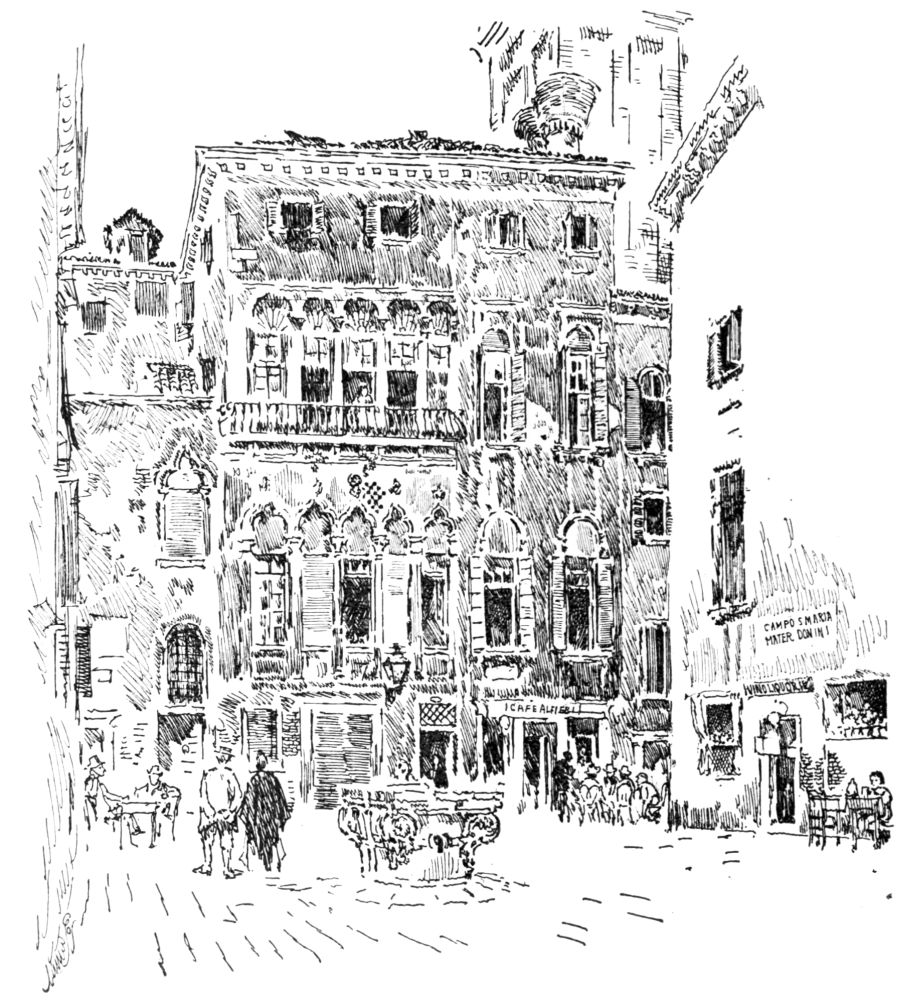
CAMPO S. MARIA
the ducal throne, but such a course would certainly not have improved the relations of the Republic with the Pope, a result which had been the sole object of the election. On the other hand, it seemed impossible even to agree upon the names of candidates, in order to proceed to an election. The electors fell into a state of apathy of which there is probably no example in history; they moved about in an objectless way, talking listlessly of anything that occurred to them; they even lingered at the open windows of the palace, to watch the people passing in the street.
Rom. iii. 83.
As they looked down, they saw an aged nobleman slowly walking toward the postern gate of the prisons, followed by a servant who carried a big sack of bread, so full that the loaves protruded from the open mouth. It was Marin Zorzi, a charitable and devout person, on his way to distribute food to the poor prisoners. He was the very man. Before he had left the prisons, he was elected Doge.
Unhappily this hasty choice did not improve matters. An old chronicler sums up in a few words the short reign that followed: Zorzi lived ten months, during which he never saw the sea calm nor the sun without clouds. All that remained to mark his reign was an asylum for poor children, the earliest foundation of the kind in the world.
In less than a year, therefore, another election took place, and as the experiment of looking out of the palace windows in the hope of seeing the right man pass in the street had been a failure, the electors were shut up, windows and balcony doors were closely sealed, and the forty-one were driven to look at each other. In a short time they elected Giovanni Soranzo by a considerable majority.
Rom. iii. 89, 103, and notes.
So far as I can ascertain, he was born in 1240, and was therefore about seventy-one years old in 1311; but the longevity of the Venetian nobles was always remarkable, and he was destined to reign seventeen years. He had rendered the Republic very eminent service on more than one occasion, and was a man of astounding activity. To mention only a few incidents of his busy life, in its later years, he had commanded a fleet of twenty-five galleys against the Genoese when already fifty-six years old, had taken possession of the port of Caffa and had defended it during a whole winter against the combined attacks of the Genoese and the Tartars, and had captured a goodly number of richly laden Genoese vessels. On his return to Venice he had been received with honours resembling those of a triumph, and had soon found himself in arms again, but on land this time, against Padua first, and then against Ferrara, which he had already governed as Podestà. When at last recalled to Venice he had occupied the important position of a procurator of Saint Mark, from which post he was elected Doge to succeed Marin Zorzi.
Soranzo was undeniably one of the most illustrious men elected to the Dogeship in the course of its existence of exactly eleven hundred years. It is enough to say that he reconciled the Republic with the Pope, and reconquered Dalmatia; and that, in spite of the vast sums of money which both these undertakings cost, he protected and developed Venetian manufacture and commerce so diligently as to increase the public wealth instead of diminishing it. It was during his reign that the weaving of silk stuffs in Venice reached a perfection hitherto undreamt of, surpassing, according to the taste of the day, the fabrics of the Levant and driving them out of the market. Under Soranzo the glass-works of Murano produced mirrors that outdid the very best that could be made in Germany, for clearness and brilliancy. At the same time, the Arsenal of Venice was greatly extended by the addition of new basins, windmills were set up all over the islands, many like improvements, then modern, were introduced, a general condition of ease and well-being extended through all classes, and the population increased more quickly than ever before. The State could count forty thousand men between the ages of twenty and sixty years who were able to bear arms. For a silver ducat a man could buy enough meat and flour to support him for a week, with as much wine as he needed, and wood to cook with and to warm him.
So Giovanni Soranzo reigned in success and plenty and honour to the very end of his long life. Yet in all those seventeen years he cannot have counted one day truly happy, and many must have been profoundly saddened by the knowledge of his own daughter’s sufferings in her captivity at the convent of the Vergini. Time and again she poured out her heart to him, in letters which he was not even allowed to answer without permission of his counsellors, and probably of the recently elected Council of Ten; and the old captain, whose commanding voice had been heard above many storms at sea, and many a fight on land, had to humble himself before the Power, and humbly beg a little sunshine, an hour’s liberty, for the daughter he adored.
They saw each other rarely enough for a long time. It was not till the great old man’s strength was breaking down beneath the weight of nearly ninety years that his daughter was allowed to leave her prison more frequently that she might tend him and cheer his declining days. He died in her arms in the end, on the last day of December in the year 1328, eighty-eight years old; and the unhappy woman must have found some small comfort in the universal grief that rose to meet her own. She went back to her cell; but the body of the great Doge was laid out in a hall of the palace, dressed in the mantle of state and the ducal cap. He was borne thence to Saint Mark’s, whither the Dogess had gone before with her ladies, and when the last requiem had been sung Giovanni Soranzo was laid in the chapel of the baptistery. His simple tomb bears the arms of his family and little else that tells of his glory, as all may see to this day.
The great bell had scarcely ceased to toll for him, when it rang out the summons to elect his successor, and the Council met to this end. But Soranzo’s reign had made changes, which, as they came gradually, were not noticed, but which were plain enough now that a new Doge was to be chosen. Prosperity had increased vastly, and with it luxury, and the magnificence of all that represented the Republic’s power. Soranzo had been very rich, but his successor might be poor. Soranzo had filled the ducal palace with his own plate, his own array of servants and footmen, and all his rich belongings. Ambassadors had come and gone, and had seen how the Doge lived; it might not be that they should come again, and find a poor man living under the same roof, dining off earthenware dishes and served by a few threadbare retainers. Venice had many faults, and Venice, as a city, loved money, but Venice, the Republic, was never sordid, nor miserly, nor mean. Before the Council elected the next Doge, a large provision was settled upon his office for ever; his salary was increased from four thousand ducats to five thousand two hundred, which is far more, considering the value of money, than the President of the United States receives to-day; the ducal palace was amply furnished with vessels of gold and silver; it was made a rule that the Doge was henceforth to keep five-and-twenty servants, neither more nor less, and that each should have two new liveries every year. In case the new sovereign should not have ready means at hand to defray the expenses of his coronation and of his change of domicile, it was decreed that a loan (for business was business) of three thousand lire should be placed at his disposal out of State funds; and, finally, a jeweller was ordered to make a very rich crown, which the Doge was to wear on great occasions, and which was to be in the keeping of the procurators of Saint Mark.
When Soranzo had been elected, an ancient custom still prevailed by which the population was allowed to joyously plunder the house of the new Doge of all it contained that was movable, precisely as the populace of Rome plundered the house of the cardinal who was elected Pope, until a much later date. This half-civilised practice was now forbidden in Venice under heavy penalties.
All this was agreed upon, set down and made law, before beginning the process of balloting by which the forty-one electors of the Doge were chosen.
Their choice fell upon Francesco Dandolo, the skilful diplomatist by whose efforts Clement V. had been induced to remove the excommunication of Venice, and the enthusiasm of the people on learning the result was in proportion to what they had suffered during the period of the interdict, not yet forgotten. The multitude moved with one will towards his dwelling, and were for carrying him in triumph to the ducal palace; but he strongly protested against any such show, though the throng pressed upon him on his way to Saint Mark’s. There he knelt before the high altar and received the investiture of his high dignity, and took the oath of fidelity before the headmen of the districts as representatives of the people of the city and of all the Venetian territory. Himself bearing the standard of Saint Mark in his right hand, he entered the ducal palace, ascended the great staircase—not yet the ‘Giants’ Staircase’ of our time—and on the highest step took oath to observe all the obligations contained in the ‘Ducal Promise.’ The senior member of his own Council made a solemn acknowledgment of this oath, and the people listened in breathless silence to Dandolo’s short but brilliant speech, breaking out in
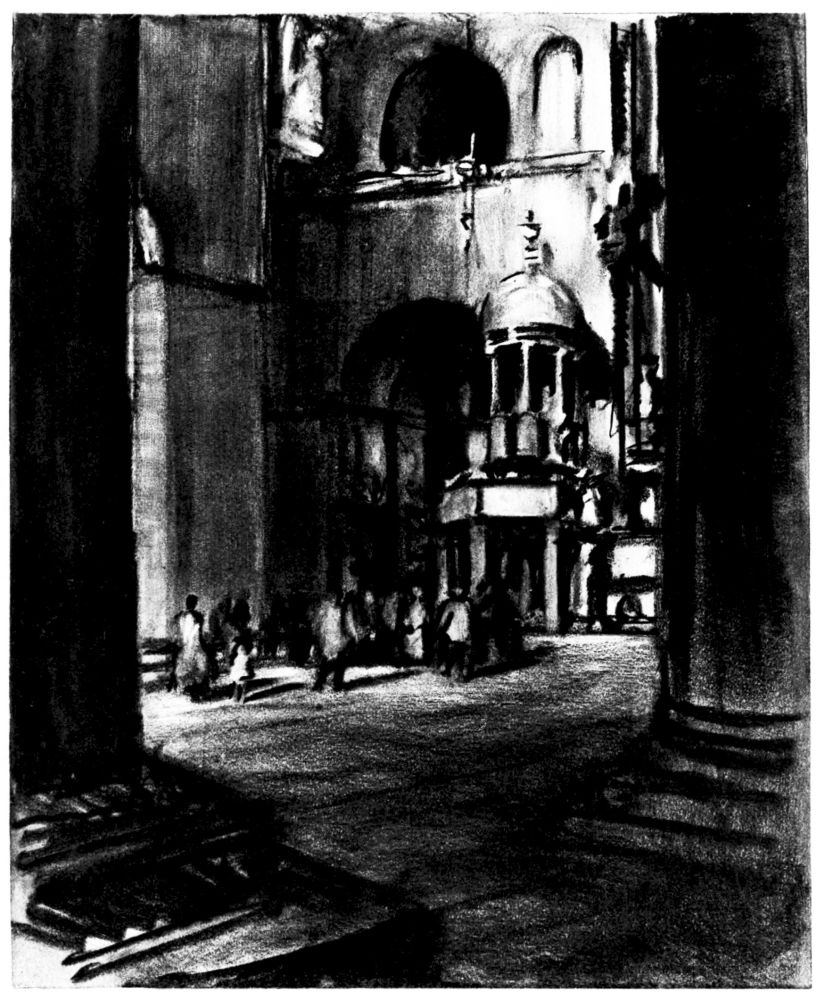
THE PULPIT, ST. MARK’S
renewed and yet more enthusiastic applause when he had finished.
Rom. iii. 109.
During the following days festivities were organised for the coronation of the Dogess, much more various and of longer duration than those which greeted her husband’s elevation to the throne. In older times, when the head of the Republic still possessed real power, his wife played no official part in State ceremonies. She lived as before, and the Doge could retire to her apartments and be in his home as if he were a private person, much as the modern Turk takes refuge in his harem. At most, the Dogess, as the first matron of the city, might outdo other patrician women in assisting public and private charities; but when the Doge’s personal authority was almost gone, and he was required, in a degree, to compensate its loss by a certain amount of display and ceremony, intended to please the people and impose upon the representatives of foreign powers, the presence and influence of a woman became temporarily necessary. The Dogess then received a court of her own, and was required to wear a special dress, and for her a complete ceremonial was devised, from which she could not withdraw herself without incurring the displeasure of her husband and of the State itself.
From the moment when the joyful multitude pressed to the doors of Dandolo’s palace, his wife remained within, according to the new laws of conduct laid down for her. Then came the High Chancellor, as representative of the people, and the Doge’s six counsellors, to present their congratulations and to ‘request’—or require—her strict observance of such clauses in the Ducal Promise as directly concerned herself. When these personages withdrew, she presented each with a magnificent gold-embroidered purse.
Molmenti, Dogaressa, 123.
Rom. iii. 109 sqq.
A few days later, when all was ready for the ceremony, they came to fetch her with the Bucentaur, and in her honour was renewed the spectacle which had been given half a century earlier for the wife of Lorenzo Tiepolo. The vast and splendid barge had but a few times its own length to move from Dandolo’s palace to the landing of the Piazzetta. An immense crowd was gathered there, from the borders of the canal to the door of the Basilica, a sufficient space being kept open in its midst for the display of the Dogess’s pageant.
The guilds of the arts and trades had been privileged to escort the wife of Lorenzo Tiepolo to the church: first the blacksmiths with flying banner; then the merchants of fur, dressed in their richest garments and most priceless sables, and wearing ermines fit for an emperor; the weavers next, singing at the top of their voices to the music of trumpets and cymbals, and bearing both silver cups and flagons full of wine. After the weavers the tailors came in the dress of their trade guild, white robes embroidered with red stars; and the wool-merchants bore olive branches in their hands and had crowns of olive leaves on their heads; also the makers of quilts and coverlets were crowned with gold beads, and wore on their shoulders white cloaks embroidered with fleur-de-lis; and there
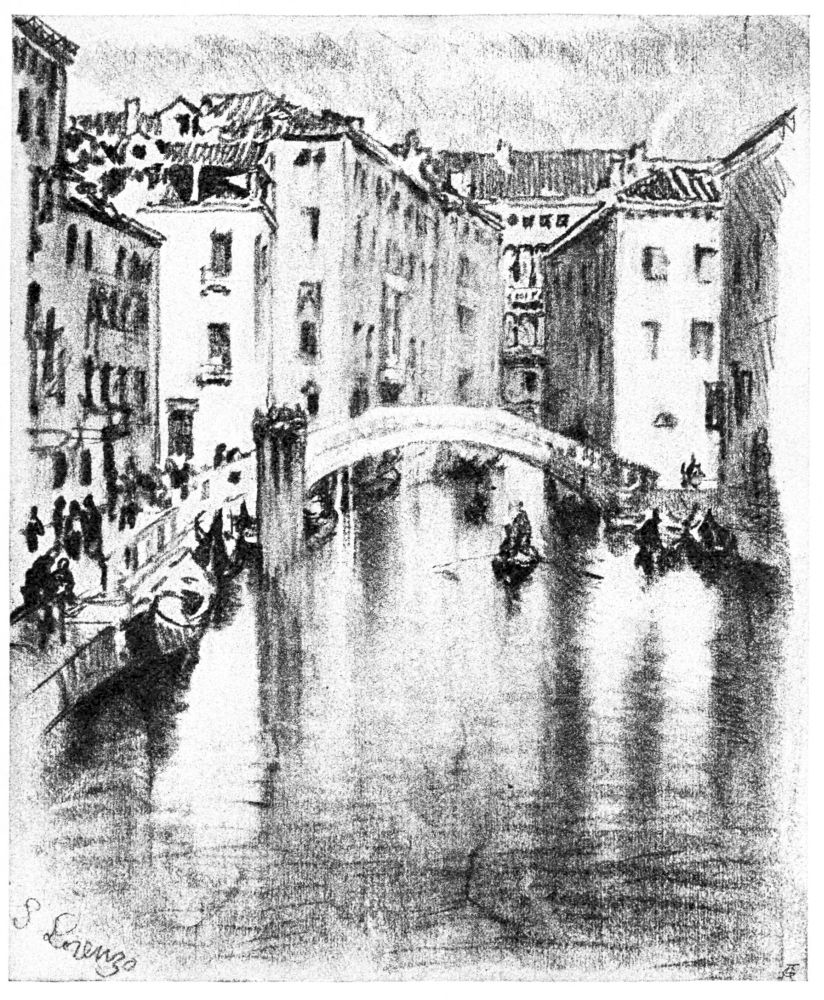
S. LORENZO
were the sellers of cloth of gold, and the shoemakers, the mercers, the pork-butchers, the glass-blowers, the jewellers and the barbers, all displaying the rich and fantastic costumes of their guilds in the great procession, a very splendid sight.
Thus escorted the Dogess entered Saint Mark’s, and knelt at the high altar, and before she went away she deposited thereon an offering of ten ducats. Then she was led to the throne-room of the palace and took her seat beneath a canopy beside her husband the Doge. The ceremony ended with a huge and sumptuous banquet, to which were invited all the heads of the guilds who had appeared in the procession.
Francesco Dandolo was a man of wit and of many resources. It is related, though without serious proof, that he had moved Clement V. to pity by appearing, as ambassador, in a penitent’s dress, and wearing an iron collar, weeping and moaning, and remaining prostrate at the pontiff’s feet. It has even been said that one or more of the cardinals kicked him as he lay there, called him a dog, and otherwise insulted him; but that he bore all patiently for his country’s sake. One authority explains, however, that the nickname of ‘dog,’ or ‘watch-dog,’ had been bestowed upon his family long before that time, as ‘Cane,’ dog, and ‘Mastino,’ mastiff, were actually used as baptismal names in the great family of Scala.
He reigned ten years, with fortune good and evil, but chiefly good. More than once, in his time, the safety of the State was gravely menaced, but all ended well, and the sum of his administration was a gain to Venice.
Since the beginning of the fourteenth century the
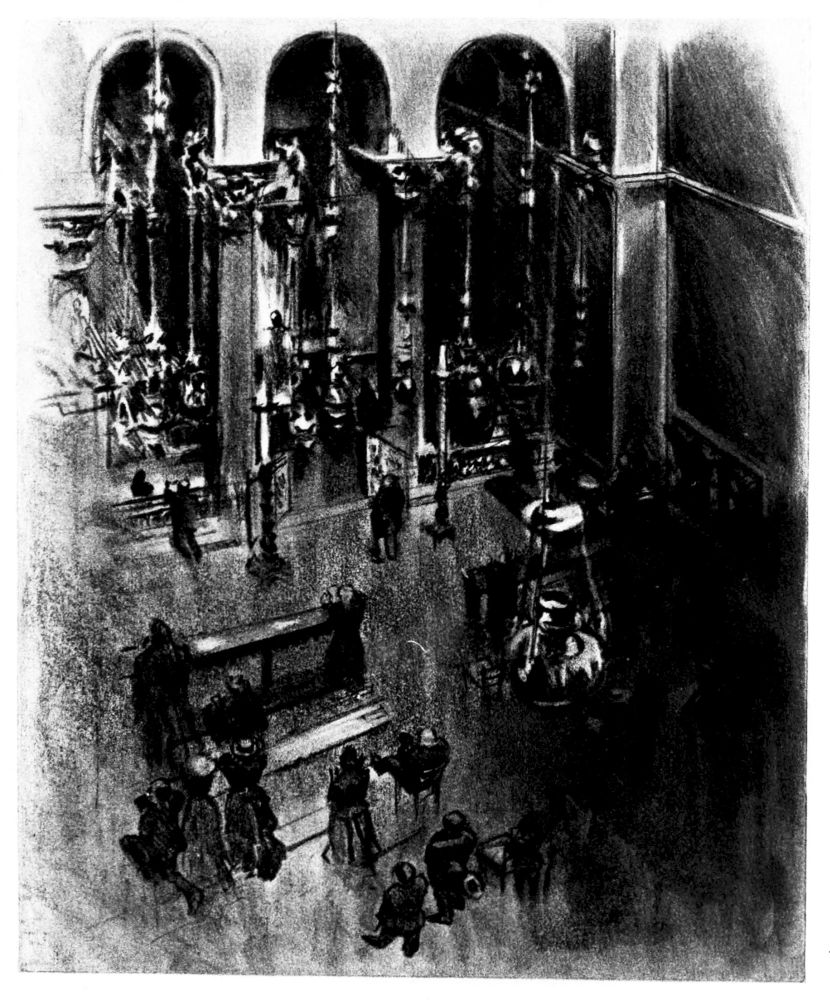
THE CHAPEL OF ST. MARK’S
Rom. iii. 115
city of Padua had been a prey to faction and internal strife. The aristocratic party fought for the family of the Scala, while the citizens and people were devoted to the house of Carrara. By turns the two families got the advantage and held the power, but the Carrara were really the stronger, for the Venetians helped them, on the ground that one of them, Jacopo, had married a daughter of the Doge Pietro Gradenigo.
At last Cane della Scala made a sort of alliance with his rivals, and having got the mastery in several other cities, installed Marsilio Carrara in Padua as his lieutenant and representative. Had Cane della Scala lived this might have worked well enough; on his unexpected death, his sons began to contrive how they should get rid of Marsilio; but they lacked skill and decision, and could neither conceal their intentions nor agree upon definite action. To make matters worse, one of them, Alberto della Scala, became madly enamoured of the wife of Albertino Carrara, and when every means failed to seduce her, took her to himself by brutal violence. After this outrage, the thirst for vengeance drove the Carrara further than mere ambition could have done.
The crimes of the Scala, no less than their miserable weakness in all political matters, had excited the profound resentment of Venice, of Florence, of Lucca, and of the Gonzaga and Este families; war was declared, and it was not long before the lords of Padua were reduced to extremities. Though they had always maintained a haughty bearing towards Venice, they now attempted a reconciliation, and chose as their intermediary Marsilio di Carrara, whom they believed to be a traitor to his own family and devoted to their interests, and for whom the Republic had always shown a certain partiality, appreciating him, no doubt, at his true value, and anticipating the time when he might be useful.
But Marsilio, like every other Carrara, dreamt only of revenge upon the Scala. At a great public spectacle he was seated by the Doge. ‘What will you give,’ he asked in a quick whisper, ‘to him who places Padua in your hands?’ ‘The city itself,’ answered Francesco Dandolo without the slightest hesitation. The unsigned treaty of betrayal was agreed upon in those few whispered words, and was executed to the letter and at once. Padua was taken by the Venetians and handed over to the Carrara under a sort of agreement from which each of the allies derived some advantage, and there was an exchange of high-flown speeches, amongst which that of the Venetian Loredano recommended the most serene Republic’s new favourites to behave with great goodness to her subjects, and to exhibit much gratitude towards her. On his side Marsilio begged that her ‘kind offices’ might be continued to him and his.
The consequences of this treaty were soon clear. Venice nominally gave Padua over to the Carrara in order to obtain the annexation of Treviso, which was much more important to her, and Alberto della Scala was not set at liberty till he had ceded the latter city to the Republic.
At the death of Francesco Dandolo, one naval battle lost to the Genoese represented Venice’s loss during the reign; her gain was an extension of territory of immense value; the whole result was to involve the Republic in intrigues which very nearly led to her destruction.
Muratori Scrip. xvii. 32.
At the very end of Dandolo’s reign, according to a strange story told by Gabaro., a half-comic, half-dramatic incident occurred which showed well enough that the ‘kind offices’ of the Republic and the ‘goodness’ of the Carrara were not destined to last for ever. Marsilio was dead and Ubertino Carrara held Padua as his successor. Before long he was denounced by certain Venetian senators as a traitor and a secret enemy to the Republic. The words were reported to him, and he resolved to make sure, at any hazard, that they should not be repeated. Incredible as it may seem, he caused the senators who had accused him to be seized by night in Venice itself, gagged and bound, and at once brought before him in Padua.
He threatened them at first with instant death, then allowed himself to be mollified by their entreaties, and finally dismissed them with a warning. If they ever raised their voices against him in the Senate again, or if they breathed one word of their nocturnal adventure, he would have them stabbed without mercy. They promised, and they kept their word; from that time forward no attack was made upon Ubertino Carrara in the Senate, the story of their forcible abduction remained a profound secret, which was not revealed until many years afterwards, when one of the Carrara’s henchmen, who had helped to carry off the senators, lay dying and confessed his share in the bold deed.
Rom. iii. 142.
Dandolo was succeeded by Bartolommeo Gradenigo, during whose reign there were constant relations between the Republic and England, the latter continually soliciting the aid of Venice against Philip VI. of France, who was helped by the Genoese. Gradenigo did not fail to express gratitude to King Edward III. for the thankful anticipation of an assistance which was never forthcoming, and took no steps to induce the Senate to listen to England’s tempting proposals. The king hoped to obtain from Venice forty ships of war, fully manned and equipped; but Venice either doubted his ability to pay, or was scared by the triumphant progress of the Turks in the Levant, which required her to act sentinel to Europe against the Mohammedan advance, and therefore to keep all her naval resources well in hand and ready for war; and, moreover, she was engaged in continual fighting in Candia (Crete), which was an unceasing drain upon her resources.
1346. Zara taken back from the Hungarians, Tintoretto; Sala dello Scrutinio.
At this critical time, when the position of Venice was by slow and sure degrees becoming one of great danger, the Doge died, and the great Andrea Dandolo was elected in his stead. Under the leadership of a less gifted and brave man, the ship of the Republic might well have foundered in the storm that broke over her. The King of Hungary disputed with Venice for Zara and the territory that belonged to it; the Genoese were exasperated in the highest degree by the commercial success of the Venetians in the East; the
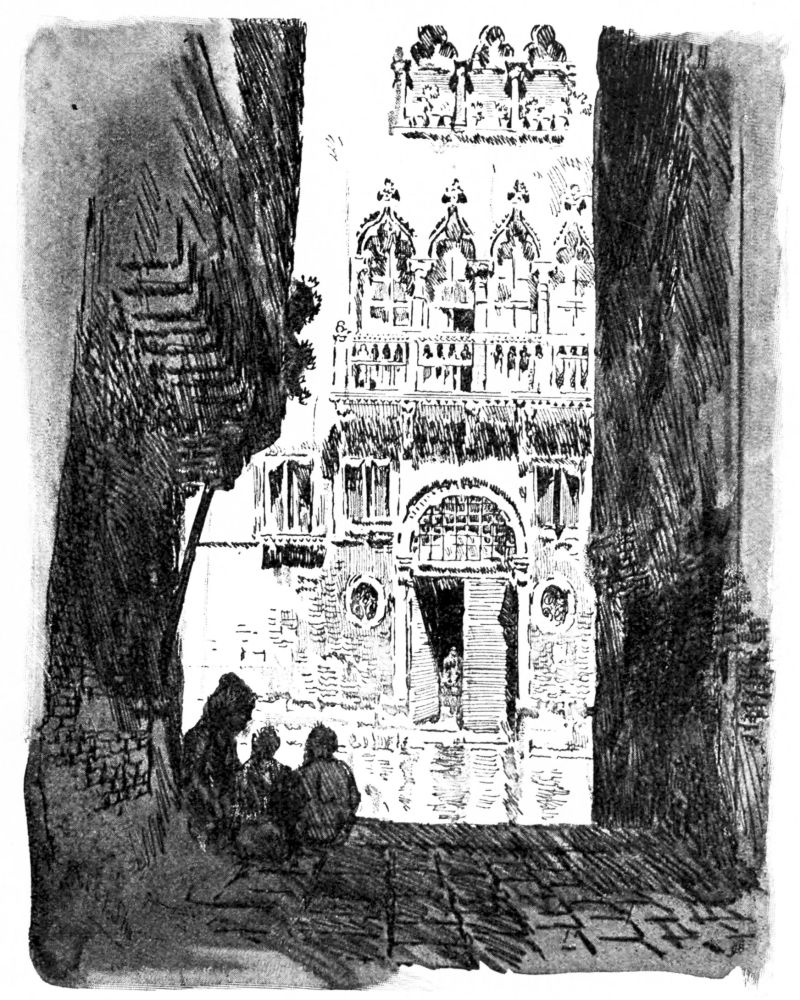
RIO S. STIN
Pope was angry with the Republic because its government would not make obligatory the payment of tithes to the bishops. These were but a few of the half-grown troubles that were rapidly growing to maturity when the plague broke out in 1348 and devastated Italy from Genoa in the north, where forty thousand persons died, to Sicilian Trapani, where not one soul survived the universal death. In six months Venice lost more than half her population.
Boccaccio has left a description of the pest in Florence which is the greatest masterpiece of the kind ever produced by a great writer’s pen; for his story fills us with horrow, with pity, with sadness, but never arouses our disgust. The sufferings of Venice in those same six months have found neither poet nor novelist to describe them, but her careful chroniclers have left us the details of the defence she made against the ravages of the sickness, and of the medicines used in the attempt to save life.
Rom. iii. 156.
As soon as the first cases of the plague had proved beyond doubt that it had crossed the lagoons and reached the city, the Council appointed three nobles, designated as ‘Wise Men of the Plague,’ with power to take all possible measures to stop the spreading of the contagion. Their first decree forbade the poor to expose the bodies of their dead in the street in order to obtain alms. A separate burial-place was marked out and consecrated for the free burial of the victims of the disease. The port was closed, and sentinels were placed all along the outer shore of the islands to hinder all outsiders from landing or from introducing suspicious merchandise.
A RAINY NIGHT, THE RIALTO
Cecchetti, Medicina.
A. Baschet, souvenirs.
Mutinelli, Less.
The physicians were at that time already organised in a guild of their own, and received from the State a modest yearly stipend of three hundred lire of ‘piccoli,’ about £50. They were now ordered to visit diligently both the hospitals and private houses, and a formal inquiry was made into the resources of the public apothecary, whose place was near the Rialto at the sign of the Golden Head. It was most important to ascertain whether there was a sufficient supply of ‘Teriaca,’ a medicine which, in the opinion of all Venetians, could not fail to cure the plague or any other sickness. The recipe for it, they believed, had come down from a Greek called Andromachos, and required a mixture of aromatic herbs, amber, and other ingredients, which were imported at great expense from distant Eastern countries. The State itself superintended the concoction of this universal panacea, lest its quality should in the least deteriorate, and lest the great reputation acquired for it throughout Europe should suffer. No stranger who could afford to buy it left Venice without taking at least a small supply, and so great were, or are, its virtues that it is made to this day, and sold at the same sign.
But, to the stupefaction of the three ‘Wise Men of the Plague,’ Teriaca would not cure the malady, and even the sensible precautions of quarantine which they had taken came too late to be of any use. The malady was raging, and ran its fearful course to the terrible end. Fifty noble families were completely destroyed, not leaving one of the name. It was only with difficulty that a meeting of the Great Council could be got together, and the Council of Forty was reduced to twenty members. In a few weeks Venice presented the aspect of a pestilent desert; and when at last the pest wore itself out, it was necessary to bring in from neighbouring provinces a great number of families, upon whom all those privileges were bestowed at once which were generally accorded only in consideration of some service to the Republic, or after a prolonged residence in Venetian territory.
The selection of the immigrants was conducted with the greatest prudence, and it may easily be believed that the great influx of new and energetic blood, of the same descent, was of vast benefit to the city and the Republic. It may even be asked whether, without this wholesome sifting and renewing of her people, Venice could have performed the prodigies of courage and endurance which not long afterwards turned the tide of the Chioggia war.
Andrea Dandolo did not long survive these events. Worn out with facing the storm, with fighting enemies by land and sea abroad, and pestilence at home, he died when barely fifty years of age, leaving to posterity the precious manuscript of his history, which has even now not been entirely published. His Chronicle is one of the richest sources of information for the history of the fourteenth century.
Dandolo was succeeded by Marino Faliero.
DOOR OF THE TREASURY, ST. MARK’S
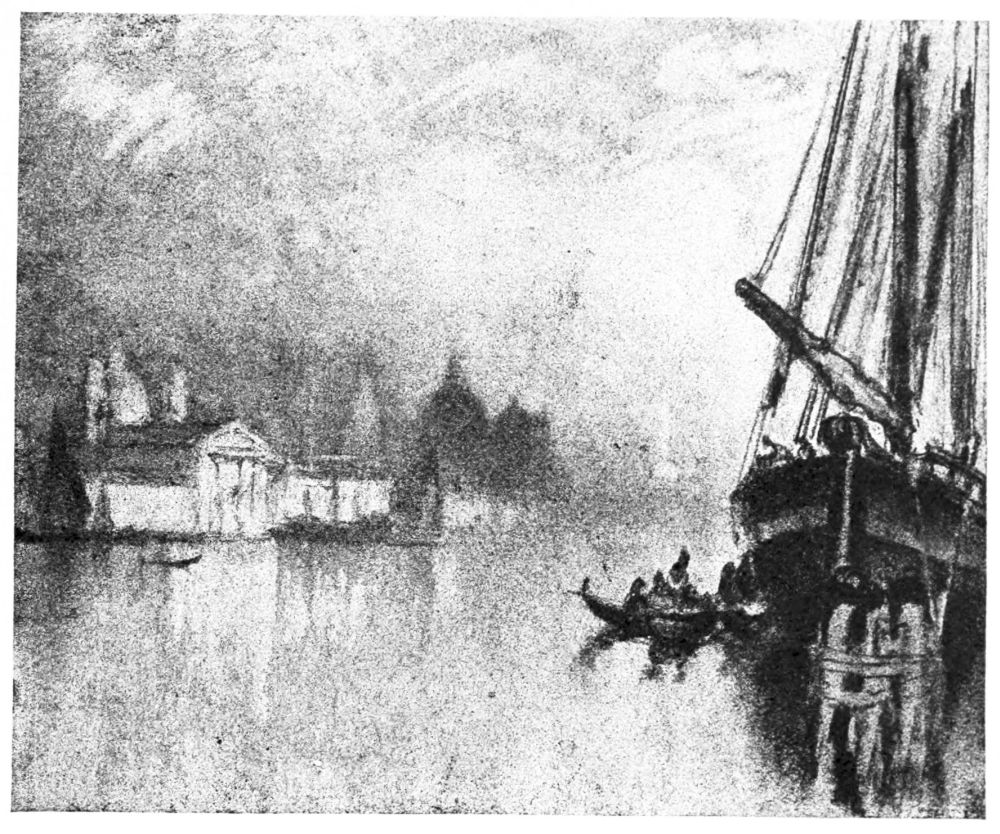
ZATTERE, THE MORNING MIST