VIII ON MANNERS AND CERTAIN CUSTOMS IN THE FOURTEENTH CENTURY
Reading edition
In the natural order of things it is now time to say a few words about the manners and customs of the Venetians in the fourteenth century. Owing to lack of documents the subject is by no means an easy one. An ideal history would be a careful account of the daily doings and habits of a nation, concisely told and not out of proportion with the greater events of which an account is due. Such a history would be a fascinating tale, though it might be an almost interminable one. As in an endless gallery, the writer would show his readers an unbroken series of pictures, and the mind would be led without surprise, but without a moment’s dulness or boredom, from the beginning to the end of a people’s career.
Unhappily no such method can ever be even attempted where the remote past is concerned. The men and women of those times lived their own daily lives, found them not always interesting, and passed away without leaving us a single true record of twenty-four hours in the life of a man or a woman. Yet how intensely interesting even one such record would be! How the weary historian, seeking for the simple details of some simple life six hundred years ago, longs to discover a Horace Walpole, a Madame de Sévigné, or most of all a Paston family, amongst the yellow and dusty archives! Something, however, may still be got together to give an idea of what the non-political, non-historical Venice was in the thirteenth and fourteenth centuries.
To begin with, though the Republic never showed much inclination to submit to any dictation from the popes, the Venetians were a practically religious people and extremely charitable. With the possible exceptions of Rome and Florence, no city of Italy possessed at that time so many hospices for the poor and hospitals for the sick; and considering the necessary limitations of all philanthropy at that early period, those institutions were managed and kept up with astonishing intelligence and care. I have no intention of compiling a catalogue of the buildings in which old people, invalids, widows, and pilgrims found a temporary or a permanent refuge, as the case might be; but it is worth while to notice here and there the sensitive delicacy with which charity was often exercised, and which seems so little in harmony with the nature of the more important historical events of the period.
Molmenti, Calli e Canali.
There is something very touching, for instance, in the origin of the Ca’ di Dio—literally, ‘The House of God,’ as the old building is called to this day. In the year 1272, one of those pious souls that feel the true and natural intuitions of charity came across that saddest sort of misery which exists here and there in the world, hiding itself as far as possible from every eye, and preferring actual starvation and death to the humiliation of asking alms. These poor people were ladies of good birth, reduced to a condition in which they positively had neither a crust to eat nor a place to lay their heads. The charitable person who found them here and there gathered them at first into a refuge with other poor women where they could at least live and die in peace, but, even in the simplicity of those days, he soon understood that it was moral torture for a starving patrician woman, or the widow of some high magistrate of the Republic, to share bed and board with the poor widows of sailors, fishermen, and artisans, and he created for them, out of sheer delicacy and kindness of heart, a separate refuge in the Ca’ di Dio, where they could enjoy something more than the illusion of a home, and where they were at least blessed with that privacy which is almost the first and last necessity of the well-born.
One is reminded of the rules of that Florentine Confraternity for the relief of the ‘poor who felt shame,’ a body to which Dante belonged. By those rules the brethren were bound to give assistance without lifting the hood that covered their faces, or giving their names, or in any way betraying their individuality, lest the poor person whom they helped should be in some degree humiliated. This really exquisite delicacy of feeling showed itself in the very midst of the worst and fiercest quarrels of Guelph and Ghibelline, and the rule of the Confraternity expressly commanded the brothers to help their foes as freely as their friends, and to be especially careful never to do anything which could humiliate an enemy in distress.
The chronicles of Florence say nothing of that, and if the Venetian historians mention the Ca’ di Dio at all, it is only in the most passing way. But the historical writers of both cities carefully record the murders, poisonings, and stabbings which brought disaster on their citizens. Should not a true history of civilisation sometimes count also the tears that charity has dried and the anguish she has helped to soothe? The chroniclers abound in accounts of the trials, the sentences, and the executions of the fourteenth century; they can scarcely spare a line to tell us how the Doge and many other devout persons heard mass daily at dawn and recited the Office for the Dead in Saint Mark’s. We
Galliccioli, vi. 150.
know with the utmost exactness the precise number of light ladies who were living in Venice just then: there were eleven thousand six hundred and fifty—a respectable, or rather a disreputable, number for a city of two hundred thousand inhabitants. The quarter of the Castelletto, which had originally been given over to them, no longer sufficed for their needs, and they lived very much where they pleased.
Bembo, Beneficenza.
We know these things, but few remember that at that very time a gentle beseeching voice was heard every evening in the streets and squares of Venice, crying out ‘Pity, pity!’ It was the voice of a poor monk slowly pursuing his way under the balconies of the great palaces, and through the narrower ways where the rich middle class had chosen its abode, for ever asking alms for the poor little children whom he found nightly thrust out, new-born, to die in the streets before morning, even as is done to this day in China. And though it was Venice that cast her children out to perish thus, yet Venice poured alms into the poor monk’s hands so abundantly that his labours prospered beyond his highest hopes. A lady of the Delfini family gave him no less than seventeen houses for his foundlings, and yet these were not enough; he appealed to the government for more room; and this same government, which seems in our view of its history to be for ever deep in politics, in commerce, and above all in spying upon its own citizens, answered Fra Pieruzzo della Pietà, as the monk was called, with a decree that has a very human and tender note in it. It was declared therein that the little foundlings should bring blessings and fortune to all honest people who would offer them a home; and whosoever adopted one of the children was thereby freely licensed to open a shop or to exchange a mean and vulgar occupation for one of the nobler arts. Besides this, the State settled upon
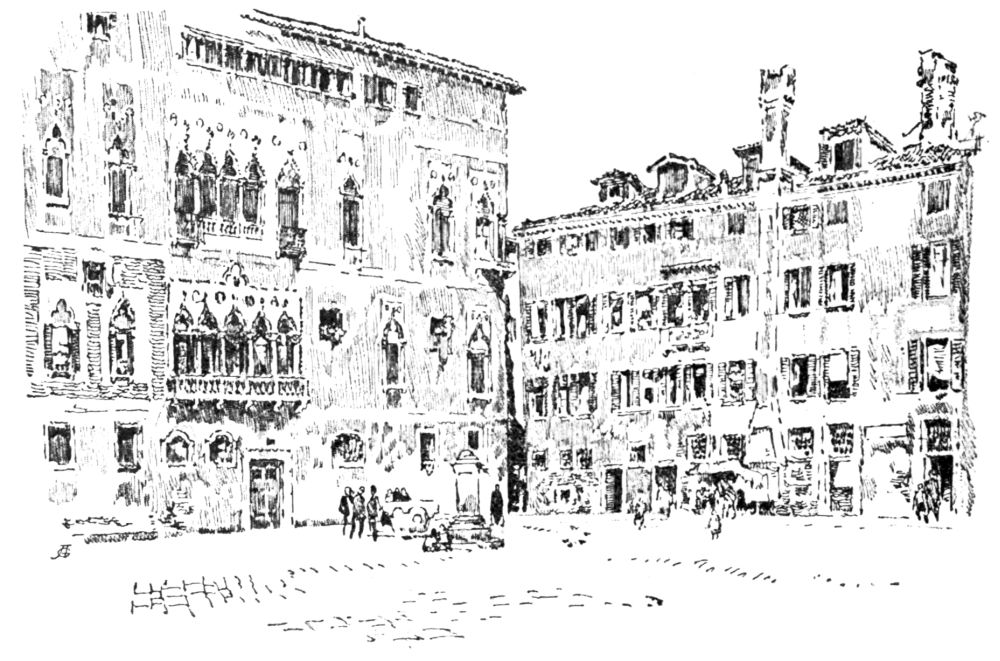
A CAMPO
the Hospice of the Pietà one-half of the fines imposed upon blasphemers, which amounted to a very large sum.
The religious spirit of Venice in the thirteenth century is reflected not only in the public charities of the times, but also in the legends that have come down to us, founded on some small original basis of truth, concrete or abstract. There is one in particular which it is impossible to overlook, though it has been told by many writers of all nations during many hundred years. I mean the story of the little Countess Tagliapietra.
Vita della Contessa Tagliapietra, Anonymous.
In the year 1288 a noble couple dwelt in their palace, not far from the home of Bajamonte Tiepolo, the great conspirator, in the central parish of Saint Agostino, which is one of those most cut up by the numberless lanes and canals which cross it in all directions. It pleased heaven to send a little girl child to Count Pier Nicola Tagliapietra and his wife Elena, one only, but she was of such exquisite beauty and rare loveliness of character that her parents esteemed themselves more blessed than those who could boast often stalwart sons. From her earliest years the child seemed destined to saintliness, and her chiefest pleasure was to follow her mother to church, for in the thirteenth century it had not yet become the custom to keep girls closely shut up at home from year’s end to year’s end.
The title of Countess was unheard of in Venice at that time, and yet every account of the legend assigns it to the little saint. Her favourite church was that of San Maurizio, and the little Countess seized every possible occasion for going there; sometimes she even went alone, for every one knew her, and she was perfectly safe in the streets; but in order to get there she was obliged to cross the canal in a boat—gondolas did not exist in that day. Now her father entertained ambitious projects for the marriage of his only daughter; and from having been at first merely surprised by her extreme devoutness, he now became seriously anxious for her future, and forbade the child to go to church except on feast-days and with her mother. She replied with quiet decision that he had no right to impose such a sacrifice upon her, and she continued going to San Maurizio every day. Her father did not wish to seem harsh or unkind, and he imagined that he could gain his end by simply forbidding the boatmen to take her across the canal. Having done so, and having doubtless enforced his wishes by giving the men money, Pier Nicola felt perfectly at ease, for he could not see that the girl had any chance of getting to San Maurizio without a boat.
On the following morning she went down to the ‘traghetto’ as usual, and called to one of the boatmen. One after the other they all refused to take her over, explaining that they were acting under her father’s orders. The little girl looked at them all sweetly with deep and innocent eyes; then, without the least hesitation, she took off her little apron, spread it upon the smooth water of the canal, and stepped upon it securely as if it had been the largest of the boats.
It not only carried her weight, but began to move of its own accord, and bore her swiftly across to the opposite bank; and when the boatmen and those who passed by saw what was done they raised a loud cry and praised God for the miracle they had seen, and it was noised abroad throughout all the city.
The first consequence seems to have been that a vast number of very eligible noble youths asked for the young saint in marriage, and her father had only to choose amongst so many brilliant matches the one best suited to his taste; but the child steadfastly refused matrimony, and declared that she would never live in the world. As she grew older it became harder and harder to sustain the struggle, and at the age of twenty she daily implored God to deliver her from this wicked world. And so, indeed, it pleased heaven, for she departed this life on the Feast of All Saints, in the year 1308. The whole city followed her to the grave, numberless wax candles were lit before her tomb, and no man dared to extinguish them. Is not the voice of the people the voice of God? The clergy would not interfere, and from the day of her death the little Countess received the title of Beata, and the church of San Vito, where she was buried, became the goal of constant pilgrimages. It was not until the sixteenth century that the Church interfered to put limits to a veneration which had degenerated to a superstition. It was no longer enough to invoke the prayers and aid of the blessed little Countess; it had become the custom to open her coffin at stated intervals, and mothers laid their infant children upon her bones to preserve them from the danger of drowning.
But now the sepulchre was sealed, the little Countess was officially admitted to be a saint, and those who should dare to profane her relics with any superstitious practice were threatened with immediate excommunication.
Another legend, of a slightly later date, has been gloriously handed down to us by the genius of Paris
Rom. iii. 143.
Bordone. On the fifteenth of February 1340 a terrific storm burst upon the lagoons, lashing the shallow water into foam and howling through the narrow canals and dark byways of the city. It was late at night when a poor fisherman, who had narrowly escaped destruction, ran in and began to moor his boat. He had not finished when three venerable old men, of majestic countenance, suddenly appeared out of the darkness and earnestly begged him to take them across the lagoon in the teeth of the gale. The fisherman hesitated, and was on the point of refusing a request which seemed most unreasonable; but there was something in the faces, in the manner, gestures, and tone of the three which imposed itself upon him in spite of himself. They entered the stern of the fishing boat, and he shoved off into the rough water, which was close at hand. The wind howled, the frail skiff rocked as if she would capsize, the salt spray blinded the poor man as he stood up and bent to his oars in the Italian fashion, but the presence of the three venerable strangers gave him superhuman strength to go on.
They were already far out upon the seething water when an appalling vision burst upon his sight. In the heart of a black squall a great barge full of fire came flying towards the city, and the fire was full of demons, and fiery fiends swung red-hot oars that hissed each time they dipped into the water. The poor fisherman gave himself up for lost and fell upon his knees, but behind him in the stern of the boat the three majestic passengers stood upright and made the sign of the cross with wide and potent gestures; and suddenly the fiery barge stood still as if she had struck a rock and was thrown into the air, and turning upside down fell with all her fiery crew hissing into the raging sea, and all was dark, and suddenly the storm subsided and the moon shone out between the clouds as on a summer’s night.
About 1340.
The fisherman gives the ring to the Doge Gradenigo, Paris Bordone; Accademia.
Then said the oldest of the three old men to the fisherman, ‘Take me to the island of Saint George, for there I dwell.’ And the fisherman put him ashore there. The second of the old men then said, ‘I am Saint Nicholas, take me over to the Lido.’ The fisherman set him ashore there, wondering at his own strength, for it is far. Then said the last, ‘I am Saint Mark, set me ashore at the Piazza.’ When they were there the fisherman fell upon his face before the saint, who raised him up and gave him his blessing, and, moreover, bade him go at once to the Doge, though it was late, and tell him what he had seen, and to prove that it was truth and not a dream the saint drew from his finger a ring and gave it to the fisherman as a token.
The legend has been too often told for me to dwell upon what followed, but it contrasts characteristically with the tale of the little Countess Tagliapietra, which is only forty years older, but which still retains that subtle perfume, that air of peace and light, which belong to the earlier Venetian legends. The story of the fisherman belongs already to those nightmare tales of terror which became so very common in Venice that in the sixteenth century all the popular tales represent devils and fiends struggling against the supernatural powers of saints. Last of all, even the saints and demons disappeared, and the degenerate eighteenth century expressed its love of fiction in a set of ghost stories as terrifying as any that the human imagination has ever evolved out of darkness.
Next to all that is connected with religion, that which would do the most to give a clear idea of the fourteenth century would be the study of women and their position at that time, but an almost total lack of documents makes this absolutely impossible. We can learn from old family papers and carefully preserved accounts what women were, and we may even to some extent reconstruct the frame of their outward existence; but the soul of it all escapes us. The story I have told of the little patrician girl alone stands out to give us some idea of what a spotless child’s thoughts could be in a city which was even then one of the most perverse in Europe. But of the many other Venetian ladies whom history mentions by name we know absolutely nothing, so far as their private lives are concerned. One dogess after another appears in magnificent garments; but we feel no more interest in them than if they were so many gorgeous wax figures, for no one has taken the trouble to tell us whether this one was beloved or that one hated; whether one was a woman of heart, or another proud, ambitious, and vain. In most cases we do not even know their ages. Why should any one care? Each one was ‘the dogess of her day,’ and that was enough; she was the companion and consort of the doge, but beyond that, in a state in which the supreme dignity was not hereditary, her value was purely decorative.
The fourteenth century was not remarkable for much luxury or feminine display. Among the most characteristic objects used in those times were the extraordinary clogs, with double heels and enormously high, on which women went about in order to keep their skirts out of the mud. For the streets and lanes were not even paved, and there seems to have been no great effort made to clean them. The principal scavengers seem to have been the little pigs of the monastery of Saint Anthony of Padua, which had an official right-of-way about the city, and devoured greedily whatever the good wives of Venice chose to throw into the streets when they cleaned out their kitchens. It will easily be understood that clogs might be useful in such a town. As another illustration of the times, here is a list of the exiguous outfit provided for a young lady of great family on her marriage in the year 1300: One bed, two down quilts, two pillows, four sheets, one coverlet, six silver spoons, one copper pail; one piece of scarlet stuff long enough to make a bodice, one skirt of the same material; one skirt of striped stuff, and one trimming for the said skirt of the price of nine soldi grossi; one skin of a fox; seven amber beads, one ornament made of pearls, an ornament of gold, a silver belt and some silver beads.
The display of jewellery on that occasion was certainly not magnificent, but the list of clothes leaves even more to be desired. The document explains further and determines precisely how the wedding is to be conducted, and what it is to cost the family of the bride. The bride, when she reaches Padua, is to receive twelve soldi grossi for her pocket money, a like sum to pay for the drums, and the same again for the cook; but only half as much for the duenna who is to accompany her, and who rejoices in the high-sounding name of Richadonor, ‘rich in honour’! Furthermore, forty soldi grossi were to be spent on beef, pork, poultry, biscuits, apples, birds, eggs, bread, torches, wax candles, and the hire of boats.
Living was certainly not dear in those days, and we have no means of calculating the value of the coins used, about which learned men have fruitlessly quarrelled for generations; we cannot by any means establish the value of such an outfit, but we can affirm most positively that the outfit itself bore no resemblance whatever to those provided two centuries later for brides of the very same family.
Galliccioli. vi. 18.
In this connection it is as well to say that the marriage customs of Venice had changed considerably during the thirteenth century. It had become altogether impossible to celebrate all marriages on the same day of the year in the same church, as was formerly done, and weddings now took place throughout the year in the different parishes.
An edict of the year 1255 recommends the publication of marriage bans in Venice, but very little attention was paid to this regulation, and clandestine
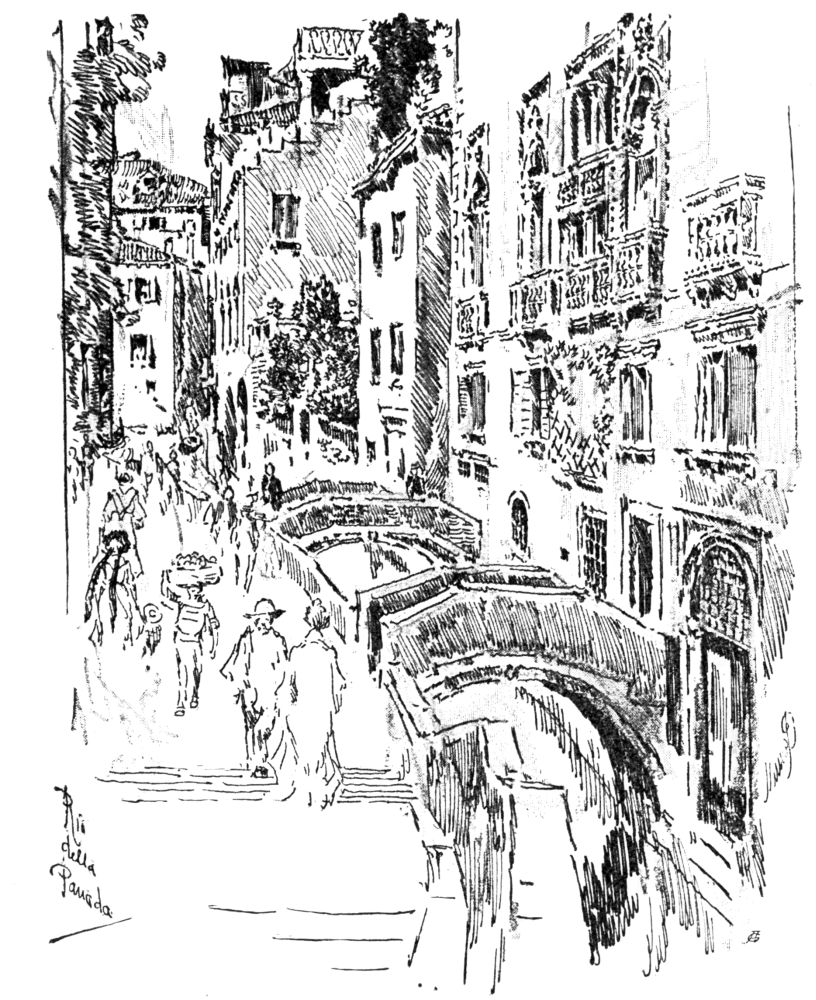
RIO DELLA PANADA
marriages became one of the great evils of the day. If, for instance, an unmarried woman of any condition found herself hopelessly in debt, she had only to marry in order to be safe from any legal action on the part of her creditors. It was so easy to get the ceremony performed, if one wished to keep the affair quiet, that it was not even necessary to go to church. A priest could be sent for to a private house, or even to an inn, the witnesses heard the necessary words pronounced, the priest blessed the couple, and the union was irrevocable.
The government took cognisance of the innumerable abuses which resulted from this manner of proceeding, and a law was passed which would have introduced a real reform if it had been rigorously enforced. But instead it was so completely overlooked and forgotten that the archives of the law-courts a century later teem with amusing anecdotes of such marriages. The following is a specimen taken from the case of a certain Dame Caterina of the parish of Saint Gervasio.
One evening, as this good lady was lingering on the threshold of her own door, a certain Pierin da Trento came by, selling brooms. Having greeted Dame Caterina, who appears to have been an acquaintance, the man said, ‘Good madam, I pray you find me out some handsome girl.’ Thereupon the good lady was immediately very angry, and loaded Pierin with the choicest epithets in the Venetian language, all of which are scrupulously quoted in the report of the case. Pierin, however, protested, ‘No, no, Dame Caterina, I did not mean what you think! I am asking you to find me a nice little wife to whom I will be a model husband.’ She answered, ‘Well, well, on my faith I will try and find one for you. Come back to-morrow.’ She immediately thought of a young girl called Maria who waited upon herself and her daughter. On the morrow the parties met in the house of Dame Caterina, and one Menego Moisè, who was there, asked, ‘Maria, does Pietro suit you as a husband according to the commandments of God and Holy Church?’ She answered, ‘Yes.’ So they took each other by the hand, and all the company sat down to table with great joy.
This was apparently all that was necessary to make a marriage binding. It is not even explicitly stated that the man Menego who asked the ritual question was a priest; but unless we suppose that something like common-law marriage was legal in Venice, we may take it for granted that he was.
Of course, in the absence of a divorce law, the chief object of such summary marriages was that they might be denied, and such cases led to some lively fencing between the civil and religious authorities.
In spite of these abuses, however, and in spite of the numerous regular and proper marriages that took place in the parish churches, the old custom of marrying wholesale on the thirty-first of January had not fallen wholly into disuse. I shall describe in another place the Feast of the Maries, instituted to recall the one which had been disturbed long ago by the Dalmatian pirates, and which was celebrated every year with the same mixture of simplicity, display, and jollity.
One might get married quietly, with closed doors and without sound of drum or trumpet, but it was quite impossible to be buried with the same simplicity and privacy. All the chroniclers of those times have left accounts of funerals, which remind one very strongly of the East, and even of ancient Egyptian and Assyrian rites. It was absolutely indispensable that a husband on the death of his wife, or a wife on the death of her husband, should exhibit in public the most extravagant grief. The bereaved widow or widower was expected to scream, to roll upon the ground, to tear out his or her hair by the handful, to howl and moan with scarcely a moment’s intermission.
When at last the friends of the dead came to carry away the body, the frenzied relict was always found stretched upon the threshold of the house, to prevent the funeral from passing, and had to be dragged out of the way by main force. The body having been carried out of the house at last, the whole family followed it to the parish church with screams and howls, and kept up the same terrific noise during the chanting of the whole funeral service. This insane custom was so deeply rooted amongst the people that centuries elapsed before the Church could put it down, and only threats of excommunication sufficed to prevent the unseemly interruption of the Office for the Dead. Those who have lived in the far East, and especially in India, are familiar with such sights. No one who has heard the lamentations of hired mourners at an Asiatic funeral is likely to forget the impression he received; but it is hard to understand such doings amongst the Venetians of the fourteenth century, and that the poor sometimes even went so far as to expose their dead in the streets during several days, in order to excite the compassion and solicit the alms of those who passed by.
Schupper, Manuale della Storia del Diritto.
It is quite certain that slavery was not only common but almost universal in Venice until the fifteenth century at least. The custom of keeping household slaves was indeed general throughout Italy in the Middle Ages, but it was nowhere so deep-rooted as in Venice. Church and State laboured in vain to put down the traffic and to discourage the purchase of slaves. In the year 960 the Doge Pier Candiano IV. threatened with very severe punishments all those who should either engage in or encourage the slave trade. And at the same time the patriarch declared himself as follows: ‘Moreover, we and our brother bishops will excommunicate all those who shall be proved guilty before the tribunals of the state; they shall be deprived of the sacrament of the Holy Eucharist; they shall not be allowed to enter any church; and if they do not repent, they shall burn everlastingly with Judas, who sold our Lord Jesus Christ.’
The civil and ecclesiastic authorities could not have expressed themselves in stronger language, but it is clear that their edicts could not be enforced, for slavery continued to flourish during four centuries after that time. We have not even the satisfaction of telling ourselves that it was at last put down by a noble impulse of humanity, since the most superficial examination proves to us that slavery did not begin to diminish in Venice until the general depravity of women had brought them down to the moral level of slaves. That very depravity was itself in great part produced by the presence of an immense number of Eastern female slaves, absolutely without any moral sense, and having no object whatever in life except to extract favours from their masters by making themselves the willing instruments of every passion and of every vice. They possessed many means of accomplishing this end, and in particular a great many of them claimed the secret knowledge of philtres, which would not only heal every malady, but which could instantly satisfy their masters’ thirst for love or revenge. They pretended, by means of incantations, to destroy by degrees the life of an enemy who could not be safely stabbed or otherwise violently put to death; and in a vast number of cases the victim actually died, if not by supernatural means, by subtle poisons administered to him by some slave of his own in collusion with the witch. Often, too, men and women went suddenly raving mad from poison thus secretly administered, and remained permanently insane. This crime was so common that it had a name of its own, and was called ‘Erbaria.’
Mutinelli, Costumi.
The whole of Venice was undermined by these slave intrigues. The Eastern woman possesses beyond all others the secret of secrecy. The thousands of them who lived in Venice were in communication with each other, helped each other, and could accomplish for their respective masters almost anything they desired. There was a certain number of male slaves also, who, though far less astute than the women, often rendered their owners great services, sometimes to their own destruction; for there are records of their having been imprisoned, tortured, and hanged instead of their masters, and sometimes with the latter, for having committed crimes of which their owners did not wish to take the responsibility.
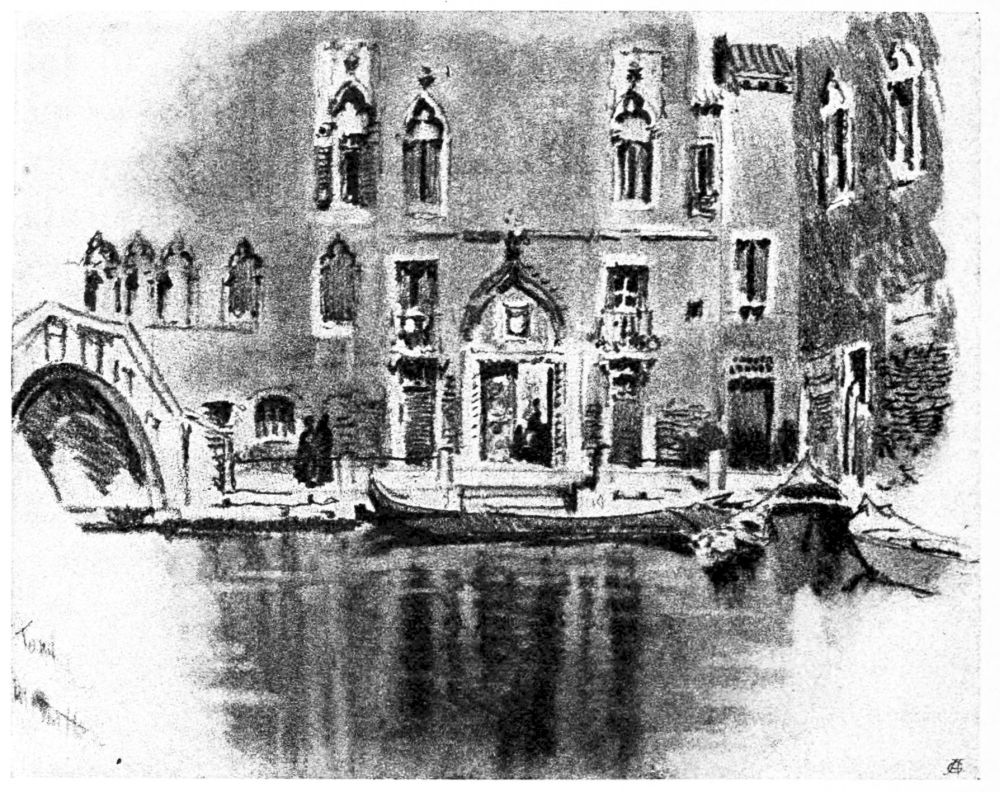
FONDAMENTA MARCOTTA