VII THE FOURTEENTH CENTURY IN VENICE
Reading edition
To the majority of people the fourteenth century in the history of Venice is memorable only for the great conspiracies which took place in that period, and which, even in the minds of cultivated Italians, seem to fill it completely, though only two, or at most three, are recorded, and the action of each in turn was of short duration. These three great conspiracies were those of Marino Faliero, of Tiepolo, who was at the head of a
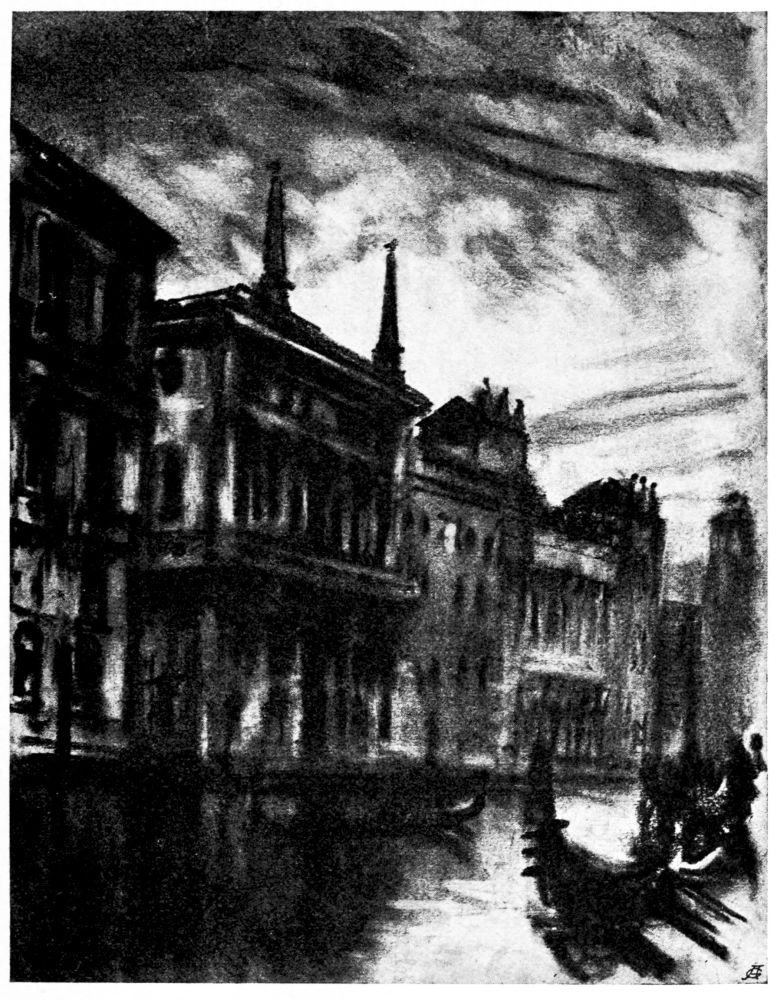
THE TIEPOLO PALACE
vast movement, and the third may be described as that of Marino Bocconio, whose history is not yet known in all its bearings. Bocconio, in lack of trustworthy details, has been crowned the martyr of the aristocracy; Tiepolo has been exalted as one who nobly and generously sacrificed the interests of his caste for the general good; as for Faliero, he is almost universally looked upon simply as the jealous husband of a young and beautiful wife. Thanks to the efforts of innumerable novelists and playwrights, these three figures represent to the average reader of history a synthetic picture of the whole century, and stand out gigantic, dark, and blood-stained against a gloomy background of barbarism, imploring pity or crying out for vengeance to all future ages.
The most striking pictures are not always the best portraits, as we all know, though we are often inclined to forget it. Most of us at one time or another have stood before a painting by Caravaggio or Gherardo delle Notti, in which men are seen in the act to move, half lighted by a flaring torch, and we have felt a strange and strong desire to know where they are supposed to be and whither they are supposed to be going. Our eyes search the black depths of the picture as if we were peering out into the darkness of a starless night, with an instinctive wish to distinguish some detail that may explain the figures in the foreground; and, failing to find anything, we turn away as from a vision seen in a bad dream. We shall not forget the strong features, the tremendous muscles, the mysterious anxious eyes, and when we think of them we shall still wonder where those men were, in a cavern or out of doors, in the crypt of a church or in the forest, and whether they were alone or were followed by a crowd in the darkness. Who saw them pass? Who heard their low and anxious voices? Upon what nameless errand were they bound?
I have often thought that impressions much like these are produced on most minds by the names Bocconio, Tiepolo, Faliero. Yet each of them, in true history, had his companions, his friends, his enemies; and if each stood alone as a type, yet all were the result of their own times, and every one of the three was in himself the cause of a separate train of events.
Hitherto the story of Venice has been that of her growth; she has risen from the waves in the clear breath of the northern Adriatic, at once gentle and full of life; she has grown up into the light, full of a sweetness of her own, but burning with youthful courage, and suddenly, in the period of which we now have to treat, she has changed from a child to a full-grown woman. Pursuing, or pursued by, the impression of her strong personality as a living creature rather than as the capital city of a great power and the scene of action in the lives of great men, we may compare her to a woman of divine beauty, yet almost tragically jealous of her own freedom, fierce to her enemies, dangerous to those who trust her, a loving mother to her children so long as they are obedient, but a ruthless and cruel queen towards her rebellious subjects. A woman, in short, possessing a sort of dual nature, aspiring to the dignity of being feared, yet moved by the desire of love; so unwilling to submit to the slightest influence of another that she would willingly despoil herself of all her riches and of every possession, and shed even the last drop of her blood, rather than forego the smallest shred of her proud independence.
It is true that the figures of the great conspirators are very prominent in the picture we evoke of those times; yet beside them stand great captains, law-givers, and artists, and the background is filled with a most interesting population devoted in turn to labour and pleasure, to commerce and to war, and full of the pride of a life of its own. The germs of corruption are already manifest, but they will not develop until a later time, when the beautiful lady, Venice, less young indeed, but imbued with a charm more subtle, descends to the slow enjoyment of the fruits of her victories, and loses herself in the intoxication of a perpetual carnival.
Historically speaking, the fourteenth century in Venice begins two or three years before 1300, since the year 1297 is separated from those which preceded it by a far greater distance than it is from the beginning of the fifteenth century, owing to the profound changes brought about in the government and life of the city by the closure of the Great Council.
The history of the century in which the Republic reached the culminating point of her strength and development begins quite naturally with a glance at this memorable law and its consequence. The famous measure which, officially at least, changed the already ancient commonwealth of Venice into a government which, though aristocratic, still proposed to be republican, was not the work of a day any more than it was the creation of any one doge. It was not a revolution, but rather the result of a slow, inevitable evolution, peaceful in character, of which the first beginnings can barely be traced, far back in history, in the struggles of rival factions of the aristocracy.
So far as factions are concerned, none but those of the nobles ever had any influence on Venetian history, for the parties that existed amongst the people never engaged in politics, and while they bore one another many a traditional grudge that had its origin in the early jealousies of the settlers, we never find them mixing in conspiracies against the government or breaking out in sedition and rioting. Even the mutual hatred of Niccolotti and Castellani disappeared completely as soon as the need of public defence called out the genuine patriotism of both.
In brief, the following is the story of the ‘Serrata,’ the closing of the Great Council for the exclusion of the people, a measure without parallel, except, perhaps, in the legislation of Rome.
Rom. ii. 90, 341.
According to a statute which regulated the election and the offices of the Great Council in 1172, and which was perhaps instituted in that year, the Council was composed of a variable number of members, originally four hundred and eighty, and never more than five hundred, who were elected every year without any distinction of class from the principal citizens, and undoubtedly, in the great majority, from the aristocracy.
The position it occupied in the Republic has, I think, no example elsewhere. In one shape or another it had always existed, and there was an aristocracy amongst the first fugitives from the mainland; from that time on, the nobles and the people, the tribunes and the artisans, had fought like comrades against the barbarians, as well as against the elements of nature. Like shipwrecked men of one country, speaking one language, they had been as brothers; the noble families had been the chief defenders of the new home, and its earliest law-givers, and they transmitted to their descendants a traditional influence which was rarely misused in earlier times. The people did not hate them, as the populace has always hated the aristocracy in agricultural countries; for agriculture, where the poor work on the estates of the rich, seems to degrade both alike, or at least to brutalise them, whereas men who till their own lands almost always grow in character and independence. In Venice, while the people looked up to the nobles as their intellectual and social betters, they did not cease for a long time to regard them as their allies and helpers.
The nobles, therefore, had taken the lead from the beginning, and they kept it without difficulty and almost without opposition; in politics the people effaced themselves, trusting to the ruling class to maintain the liberties of the maritime state abroad, both in the east and the west, and confident that the commerce and art of Venice would continue to develop under its influence. The nobles were ambitious, it is true, but they had nothing to gain by oppressing the people, for they were themselves the principal creators of the public wealth. They dominated the people,
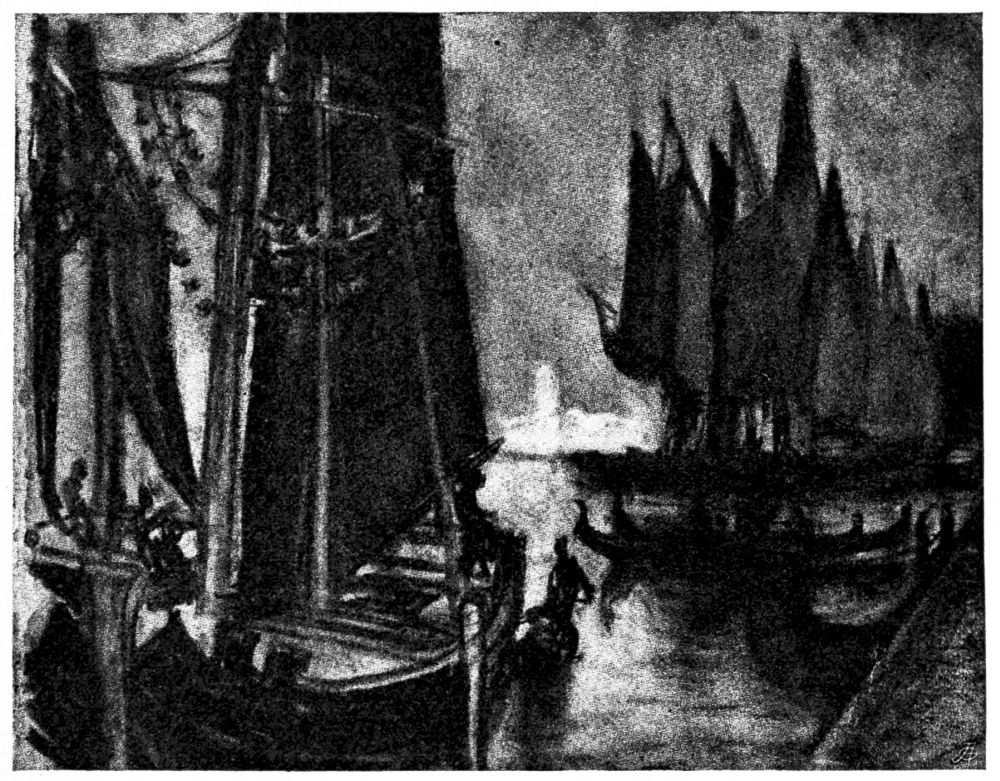
BOATS OFF THE PUBLIC GARDEN
which is quite another matter; until the fifteenth century they cannot fairly be said to have abused their power, and the privileges they kept for themselves involved the heaviest responsibilities. If they held control of the tribunals, yet were these as ready to try the nobles, and even the Doge himself, as to judge the poorest fishermen of the lagoons; and though the Doge could only be a noble, his head might fall under the axe of the common executioner, the lowest of the
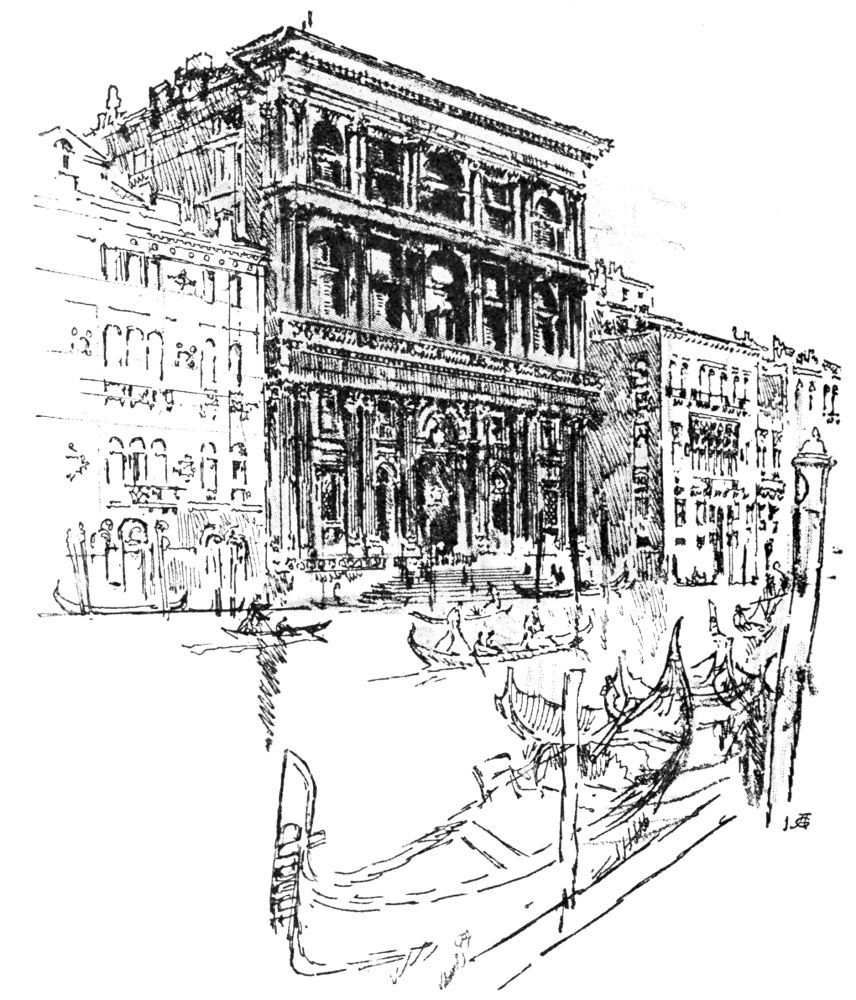
COURT OF APPEALS, GRAND CANAL
low. Unlike the aristocracies of other countries, that of Venice never claimed for itself exemption from justice.
These facts, which cannot be denied with truth, seem to me to show that the closure of the Great Council was not such a violation of the rights of man as it has often been represented to be. Soon after the middle of the thirteenth century, the nobles seem to have judged the times ripe for the great change, and a sort of preliminary weeding of the Council began.
Rom. ii. 342.
In 1277, apparently in order to lend dignity to an assembly performing such high duties, a measure was passed which rigidly excluded from the Council all persons who were not of legitimate birth. In 1286 the Council of Forty, in order to assure to the nobles a constant and legal supremacy, proposed to limit eligibility for their own number to the members of the Grand Council, and to those only whose fathers and paternal grandfathers had already sat there. This attempt failed, and the bill was rejected, principally owing to the opposition of the Doge, Giovanni Dandolo, who was an honest man, free from the prejudices and passions of caste, and who wished the aristocracy to maintain its position by sheer superiority of intelligence and judgment without any legalised privileges.
Mol. Dogaressa.
At that time, as has been shown in a separate chapter, the families of Partecipazio, Candiano, and Orseolo, and most of all the Tiepolo, had assumed the position of princes in the Republic. Each of them could boast of several doges, and all hoped to make the dignity hereditary for themselves. The Tiepolo cherished the most ambitious designs, and were always doing their best to win over the people. In 1289, on the death of Dandolo, the electors within the palace heard the populace under the windows acclaiming Jacopo Tiepolo. To have submitted to the people’s dictation would then have meant a step towards an hereditary monarchy, and the electors paid no attention to the cries from the street. Amongst the candidates was Pietro Gradenigo, a man who, though ambitious, was highly gifted and sincerely devoted to his country, and had always endeavoured to guide the Great Council towards an ideal aristocratic form of government which alone, in his judgment, could save the State from a selfish monarchy on the one hand and a feeble democracy on the other. The electors chose Pietro Gradenigo.
Rom. i. 344.
In 1296 he brought forward a measure which, it must be admitted, would have been an act of vengeance upon the people for attempting to proclaim Jacopo Tiepolo as Doge, and for receiving the announcement of Gradenigo’s regular election in silence and ill-concealed discontent. The Doge now proposed to reform the process of election, as had been contemplated by the bill of 1286, but at the first attempt the measure failed, owing to the determined opposition of the Tiepolo family and their friends, who formed themselves into a party, which they called conservative. It was brought forward again in the following year, however, and passed by a majority of votes. It restricted the right of eligibility at each annual election to those who had sat in the Great Council during one of the four preceding years, and it required that they should receive at least twelve votes from the Council of Forty which elected them. This was a successful stroke, for the Council of Forty consisted wholly of nobles, who would use their elective power altogether in accordance with Gradenigo’s intention.
In order not to rouse the opposition of the people by giving the law an absolute form, it was declared to be only provisional, and to be in force from one Saint Michael’s Day to the next, that being the date of the election.
A year passed. So great was the prestige of the aristocracy and its power, and so completely accustomed were the people to be guided by it and to be despoiled by it of their rights, that the resentment aroused by this so-called provisional law was not enough to prevent its becoming a lasting one, though its general form was still subject to possible variations.
Galliccioli, i. 330.
Grave dissensions, however, appeared in the caste of patricians. Gradenigo found himself opposed on the one hand by the Tiepolo faction, on the other by certain families which, although descended from the ancient tribunes of the island, and consequently of most ancient and respected race, were excluded from the Great Council, merely because they had not been represented in it during the last four years. It became necessary, therefore, to modify the law in the following manner:—
It was decreed that all who had sat in the Council themselves, and all who, though they had not had a place there themselves, could prove at least one ancestor a member of the Council since 1172, should be eligible for the Council, by the vote of the Forty. It is a remarkable fact that the word ‘nobles’ is not to be found in any of these decrees; but it was clearly useless to insist upon a mere word when the whole aristocracy, which had proposed and passed the law, was to profit by it. The nobles never lost sight of a possible danger to themselves in the resentment of the people.
Last of all, it was decreed that those who had never themselves sat in the Council, nor had any ancestors who had been members, should be considered as ‘eligible by grace.’ This was done in order to leave a shadow of hope to ambitious men of other classes, an idea that they might some day be admitted as ‘new men’ into an assembly which was shutting its gates for ever. As a matter of fact, in the beginning a limited number of councillors ‘by grace’ were created, and some were chosen for their own personal merits, or to quiet the ambition of certain turbulent citizens. In order to be admitted in this manner, it was necessary in the first place to receive twenty-five votes from the Forty, and the votes of five out of six of the Doge’s counsellors. A few years later, admission was made still more difficult by requiring thirty votes from the Forty, and it is likely that under this law very few ‘new men’ were ever elected. Venice was still far from the days when the first comer would be able to buy a seat in the Great Council at auction, in order that the proceeds might help to pay the interest on the public debt. The exclusion of illegitimate sons, which was already in force, was maintained, and it was further ordained that no one under twenty-five years of age should enter the Council. The latter measure, however, was soon followed by a palliative one. Each year, on the fourth of December, the feast of Saint Barbara, the Doge placed in an urn the names of all young nobles twenty years of age, who at twenty-five would have the right to a place in the Council, and thirty of these were drawn by lot, and received permission to be present at the assemblies of the Council from that day, but without the right of voting; this constituted a sort of novitiate in those duties to which, at the regular established age, the young men would be called. The process of admission was called ‘coming to the Barbarella.’
It appears to me that the last word contains a play on words; for it may mean ‘the little Barbara,’ the saint on whose feast the lots were drawn, or it may mean the down on the chin of a youth of twenty, ‘the little beard,’ for though an improperly formed diminutive, it is quite a possible one in dialect.
As may be imagined, the nobles showed the utmost haste and anxiety to prove their rights before the ‘avogadori,’ or counsel to the commonwealth, whose duty it was to decide upon them. In some cases there was evidence that an ancestor had sat in the Council at the end of the twelfth century, but it might be that there were no documents to prove it, and the most
Galliccioli, i. 331.
extraordinary means were resorted to, to persuade the judges of the truth of the assertion. Some families, in order to prove that they were nobles, which of course was the real object of the inquiry, adduced the fact that they possessed great quantities of arms in their houses. The number of persons who, without the slightest chance of proving their rights, inscribed their names on the books of the avogadori, beginning in 1315, was so great that it was found necessary to impose a fine upon those who had done so without any chance of establishing their claim, and all titles whatsoever were carefully examined before being allowed. It is almost needless to say that the families about whose right there was no doubt possible did their very best to exclude all the rest.
As soon as the first list of members by right, and members who were eligible, was made out, it was decreed that they required to be elected, if they had attained the age of twenty-five years, in order to sit at the Council. It appears that no matter what the precise number of the members under this category might be, a certain number were always elected from among the ‘eligibles,’ a fact which explains the changing number of councillors in each year. There is reason to believe that the assembly had never consisted of more than five hundred members before 1297, but that after the law passed in that year it reached (1340) the number of twelve hundred.
It is clear from all this that the measure known as the Closure of the Great Council did not consist so much in any regular elections yearly as in a close limitation of the class of candidates, and the fact that it was necessary that they should be elected by the Council of Forty; whereas in former times they were elected by the people, represented in their turn by one or two electors in each of the six regions of the city, or else by two electors from the regions on one side of the canal, and two from the regions on the other.
Little attention has been paid to the law of 1298, which at the time appeared to be of secondary importance, but which had close connection with the others that had been framed by the aristocracy. The law of 1298 established that no one should belong to the Forty who had not already sat in the Grand Council, or whose father or grandfather had not sat there. By this law each assembly was strictly dependent on the other, and the right to sit in the one, like the possibility of sitting in the other, became a privilege of noble birth.
The aristocracy had now completely got the upper hand, almost without a struggle, by skill, persuasion, and tact. Henceforth the history of Venice is that of the nobility, who had monopolised the power, and, with it, all responsibility. If Venice was great, healthy, and vigorous in the fourteenth century, she owed it to the nobles, who still treated the people generously and kindly. And later on, when the people allowed themselves to be intoxicated with the amusements provided them while their last rights were trodden under foot, the nobles were to blame. So they were, too, in the end, when the Lion of Saint Mark was torn down from its column in the Piazzetta and broken upon a soil no longer free. The people were not oppressed at any time, but they suffered what was morally worse, for they were systematically hypnotised into a state of utter indifference to real liberty.
The assemblage of so many nobles in the hall of the Great Council must have presented a splendid spectacle. It was rigidly required that all should wear the cloak, or toga, of violet cloth, with its wide sleeves and hood lined with warm fur in winter and with ermine in the milder seasons. Here and there a few red mantles made points of colour, those of the High Chancellor and of the avogadori of the commonwealth, though the latter appear to have worn only a red stole over the cloak of violet. There were black cloaks, too, and they marked the ecclesiastics who belonged to the Council, for until 1498 priests who proved that they were nobles were eligible like the other members of their family.
Rom. ii. 263.
When the Council was to meet, an official called the ‘comandatore,’ a sort of public crier, proclaimed the summons from a fragment of a porphyry column, which stood upside down on its capital at the corner of the Piazza of Saint Mark towards the ducal palace, and another issued the proclamation from the steps of the Rialto, these being the two most frequented points of the city; at the same time full notice was given of the offices which were to be distributed at the coming Council by the High Chancellor. At the appointed hour the cavaliers appeared in the neighbourhood of Saint Mark’s, spurring their comely mules; but it was forbidden to cross the Piazza itself, except on foot, because it was paved, so that the riders left their mules tied up to the elderbushes
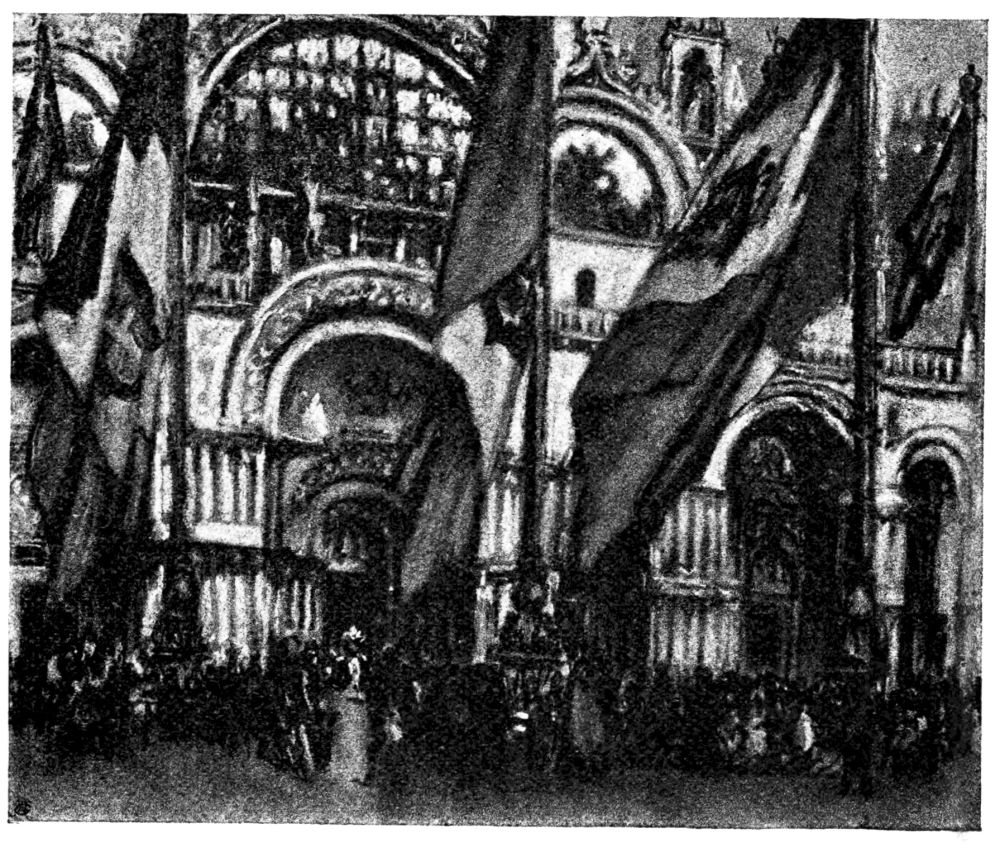
THE FLAGS FLYING IN THE PIAZZA
which formed a thick growth, exactly on the spot where now stands the Clock Tower at the entrance to the Merceria.
About 1356 the public crier’s office was abolished, his place being supplied by the ringing of a bell in the tower of Saint Mark, in the evening after vespers, when the Council was to meet on the following morning, and
Galliccioli, i. 245.
at the hour of tierce (half-way between dawn and noon), if it was to meet in the afternoon. At the time of assembling in council this bell was rung again, and the people nicknamed it the ‘trotter,’ because councillors who came late always
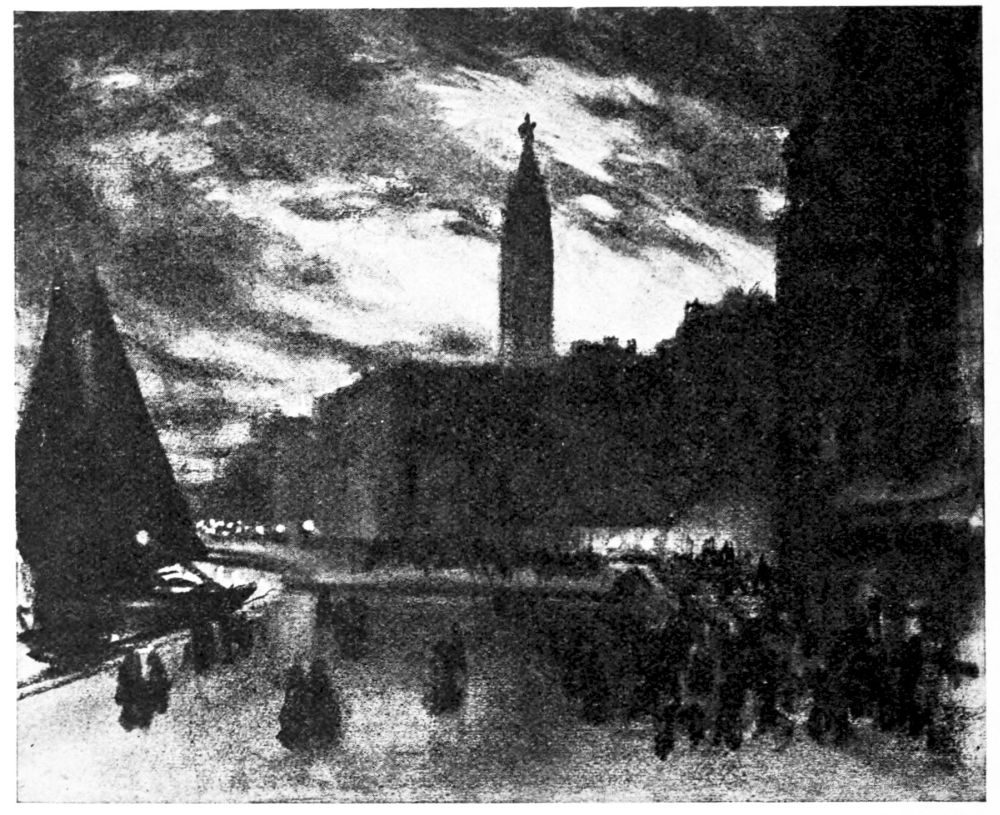
THE CAMPANILE
reached the entrance to the Piazza at a sharp trot before the last strokes had rung.
By this time the appearance of the Piazza and the Piazzetta had been considerably modified. The ‘Rivo Battario,’ which formerly ran through the length of the square, had been filled up; the little church of Saint Gemignano had been demolished, and the great
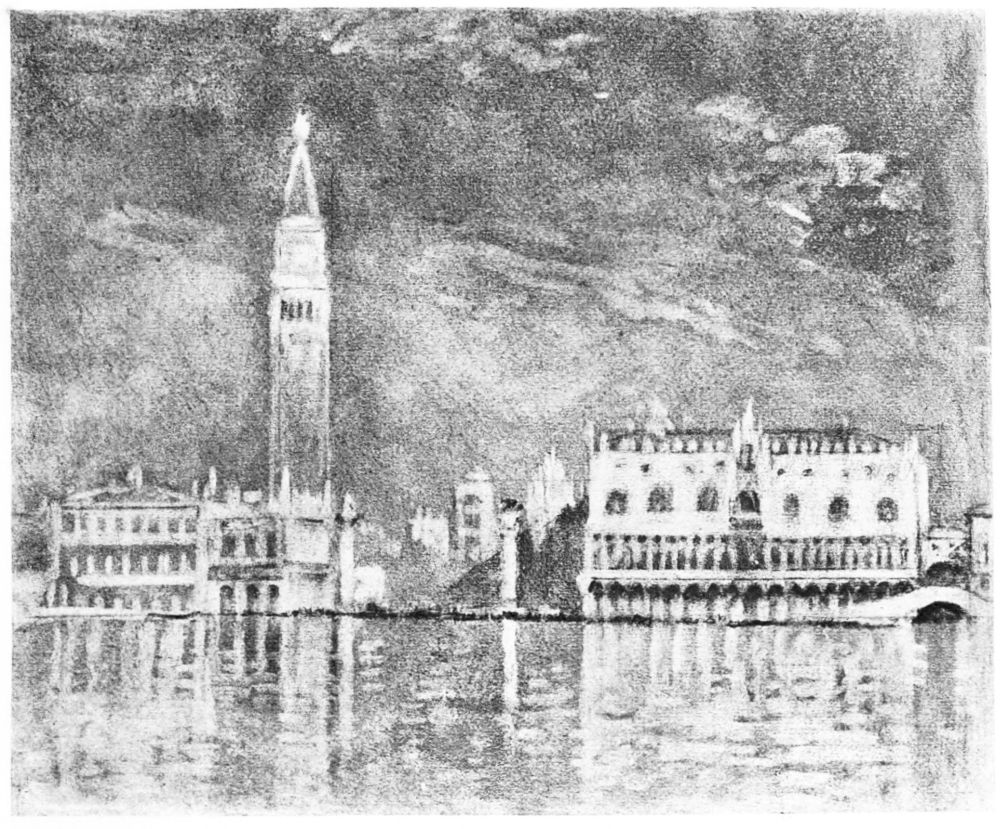
A WHITE MORNING FROM S. GEORGIO
The Campanile, 1903
Rom. ii. 361.
Campanile had been built. The nobles used to meet before the Council upon the old platform, which was turned into a convenient place for walking, and here also there was built a covered loggia, as a protection in bad weather. The first time that a young patrician came to the Council, either on his election by lot after the manner of the ‘Barbarella,’ or because he had reached his twenty-fifth birthday, a little ceremony took place on the platform or under the loggia, in which he was presented to his older colleagues, and a sort of civil bond began here between the man who was introduced and the person or persons who introduced him, which lasted through life, and received the general name of ‘sponsorship.’ I may remind the reader here that all bonds of sponsorship, called generally ‘comparatico’ throughout Italy, are under the special protection of Saint John the Baptist, and even now have an importance which foreigners find it hard to understand.
Before the meeting of the Council the throng on the platform was swelled by those who came to solicit the councillors on private matters of their own, or were seeking offices or dignities which it lay with the Great Council to bestow, such as judgeships and magistracies. The ‘private matters’ might include anything connected with taxation, money loans, laws in general, pardons, and even the public peace and national alliances.
A curious custom was connected with such interviews. Those who had favours to ask of the Great
Galliccioli, i. 355.
Mut. Costumi.
Council were accustomed to show their respect by taking the strip of cloth that hung down from their shoulder to the ground on the right side, and tying it or rolling it upon the arm, and this action was called ‘calar stola,’ and appears to have been the equivalent of the later custom by which the inferior takes off his hat to speak with his superior.
If any member of the Great Council had recently been bereaved of a near relation, it was upon the platform or under the loggia that he received the condolences of his peers, being himself wrapped in a black mantle with a train, of which the length diminished little by little as his time of mourning came to an end, until at last it was only a short black cloak; this in its turn was replaced by a simple leathern belt worn over the ordinary clothes instead of the usual girdle, which was made of velvet.
This meeting of the nobles in the Square was naturally the occasion for carrying on all sorts of intrigues; and in Venice, as in the early days of ancient Rome, the relations of client and patron played a large part in public affairs, and were productive of no small evil, especially in the creation of great numbers of minor offices merely for the purpose of satisfying the claims of dependents.
So the nobles loitered and talked between the Campanile and the two columns, one of red and the other of grey stone, which stand near the Grand Canal. These two columns, which had been brought
Lazzari, Guida.
Gall. i. 271.
to Venice from the archipelago in 1127, under the Doge Domenico Michiel, had been set up about fifty years later by the skill of a certain Lombard named Nicola Barattiere. A chronicler tells in Venetian dialect that this engineer went to the Signoria, asked for ropes, timber, and beams, and then set to work with eight men, and no more. He drove down piles for the foundations, and having completed these in seven days he set up the columns on the eighth by means of ropes and capstans. When he was asked what reward he wished for his work, he only requested that so long as Venice should exist his descendants should be enfranchised and be free to keep gaming-tables between the two columns he had set up—contrary to the law which forbade all games of chance in Venice—and he asked for a decent lodging for himself and a small stipend. It may be noted that his name, ‘Barattiere,’ means at once a money-changer and a dishonest gambler, and it may have been given to him as a nickname after the fact. At all events, his requests were granted, and he set up gaming establishments, with tables, between the columns for his own profit. At a later time this privilege became a monopoly of other speculators, and it only ceased to exist in 1529, nearly three hundred and fifty years later, when the destruction of all gaming-tables and booths, which marred the beauty of the Square, was commanded by the government.
This story recalls the action of Charles II., who, in order to reward certain Cavaliers who had sacrificed their fortunes in his interest, and finding himself insufficiently
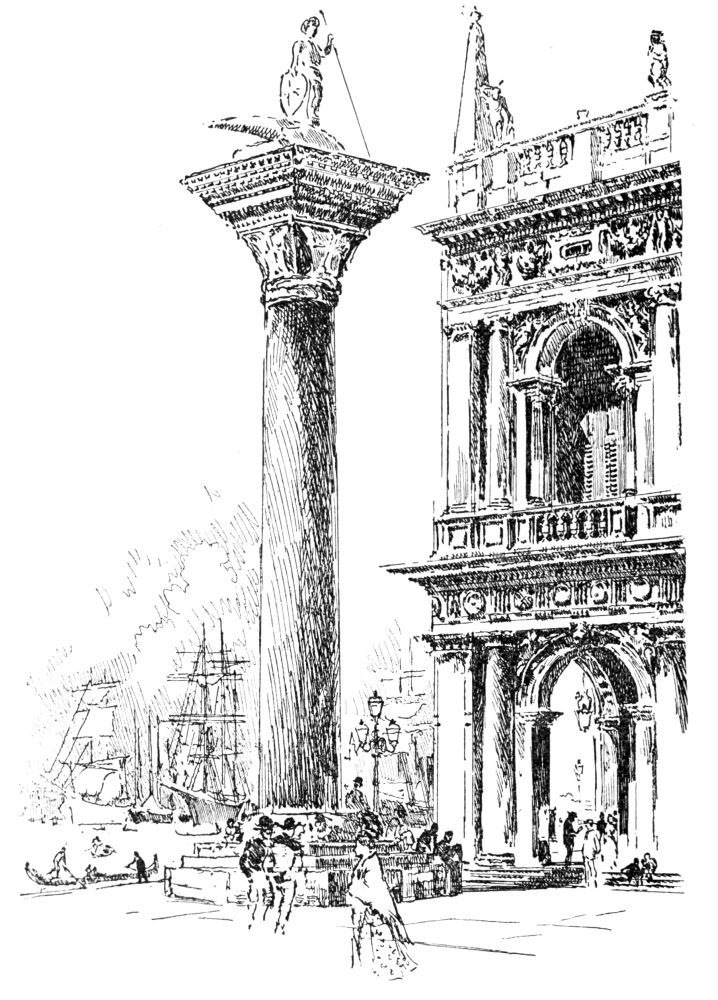
ST. THEODORE
ST. THEODORE
supplied with funds, conceded to a number of them the right to keep gambling-tables between the columns and under the arches of Covent Garden. These persons were known as ‘lottery Cavaliers.’
Dalmedico.
At the end of the thirteenth century the Lion of Saint Mark had been placed upon one of the two columns in the Piazzetta, while upon the other was set up the statue of Saint Theodore, the co-patron of the city; so that the common people of Venice, by way of expressing that a man was driven to the last extremity, used to say, ‘He is between Mark and Theodore.’ In connection with the column of Saint Mark it is worth while to quote the answer given not many years ago by a gondolier to a lady in regard to the emblem of Saint Mark. All the other winged lions visible in Venice hold an open book under their paw, and the book is placed in such a way that one may read the usual motto—‘Pax tibi, Marce.’ But though the book of the lion on the column is really open, it lies down, so that from below it appears to be shut; and the lady in question inquired of her gondolier what the cause of this difference might be. ‘It is because,’ replied the gondolier, ‘when a man got between these columns his account was closed’! The story shows how vividly the people still remember that the gallows were sometimes erected there. It seems strange, however, that the young patricians, while waiting for the first hour of the Council, should have patronised gaming-tables set up so close to the place of public execution, and it is now generally considered that executions originally took place between the red columns in the high first story of the ducal palace, overlooking the Square, and that the object of transferring them to the spot between the columns of the Piazzetta was to drive people away from gambling there.
After this brief glance at the development of the aristocracy and its legal institution as the ruling caste, it is necessary to consider the nature of that body which lay between it and the working people, and which included all well-to-do Venetian citizens in general.
Daru, i. 314.
For in Venice, as in most countries where the social equilibrium of large numbers of mankind is natural and not artificial, the population had long separated spontaneously into three classes. As long as the work of organising the new republic was going on the three fraternised, for the law granted no privilege to any one, and the men who imposed their opinions and their will upon the rest, without any sort of violence, were without doubt the most gifted members of the community. Nothing, as Daru justly observes, assured to the nobles, up to the end of the thirteenth century, any right not possessed by all the other citizens. Nevertheless, as he adds, the important office of High Chancellor had been especially reserved for non-nobles several years before the closing of the Great Council, which shows that custom, if not law, accorded other privileges to the descendants of the early tribunes.
It was not to be expected that after the final closure of the Great Council all the rest of the people should remain in a condition of thoroughly legal equality. There were, for instance, artists of great merit,
Rom. ix. 8.
magistrates whose families throughout many generations had commanded the general respect, and were by no means willing to be thus forced down to the level of the fishermen of the lagoons. The nobles considered that this high middle class constituted a danger to themselves by its wealth and solidarity, and special measures were taken to propitiate it. As early as 1298, and while the noble class was acquiring its legal existence, we find mention of the citizen class, and of the manner in which it was divided. To belong to it certain requisites became necessary; he who aspired to its privileges must have been born in Venice of parents properly married, and without any taint of criminality; he was to owe nothing to the State, to have been exact in the duties of standing guard, etc., and he was obliged to prove that during three generations none of his ascendants had followed any mechanical or vulgar trade.
A. Baschet, Archives, 133.
In the same way in which the so-called ‘Golden Book’ of the aristocracy was compiled little by little under the supervision of the avogadori of the commonwealth, who were themselves chosen from the citizen class, at least in the beginning, so also under their authority another book was begun, called the ‘Silver Book,’ in which were inscribed the names of citizens ‘de jure,’ afterwards called ‘original citizens.’ After the closure of the Great Council the office of High Chancellor continued to be strictly reserved to this class, as when the office itself had been created some years earlier. It was of a nature
A. Baschet, Archives, 138.
Mutinelli, Lessico.
to satisfy any reasonable and justifiable ambition. The High Chancellor was the head of the ducal chancery; he signed all public acts, all nominations to any important office, and was present at all the most secret meetings of the Councils, though only as a witness, and never with the right to vote. He was elected by the Great Council, and took office with a ceremony almost as solemn as that accorded to the Doge himself, and like the latter he held his position for life; he received a generous salary, and had precedence over all nobles, both in meetings and processions, both over the nobility of the Great Council and over the sons and brothers of the Doge, and was preceded only by the procurators of Saint Mark and by the six counsellors of the Doge. He wore the ducal purple with scarlet stockings, was forbidden to dress in black in public, and like the Doge he was privileged to wear his hat on all occasions. The form of address used to the head of the Republic was ‘Domino, Domino’; that used in addressing the Chancellor was ‘Domino,’ without repetition; whereas all other patricians were addressed as ‘Messer,’ the usual prefix to the names of knights throughout Italy.
When the High Chancellor died his funeral took place in Saint Mark’s with a pomp equal to that accorded to a dead doge.
Very valuable privileges were attached to the condition of a citizen ‘de jure’; all chancellors were taken from those included in the ‘Silver Book,’ so that in the course of time, in the fourteenth century, a special course of study was prescribed for young men destined for that career; and those who embraced it were
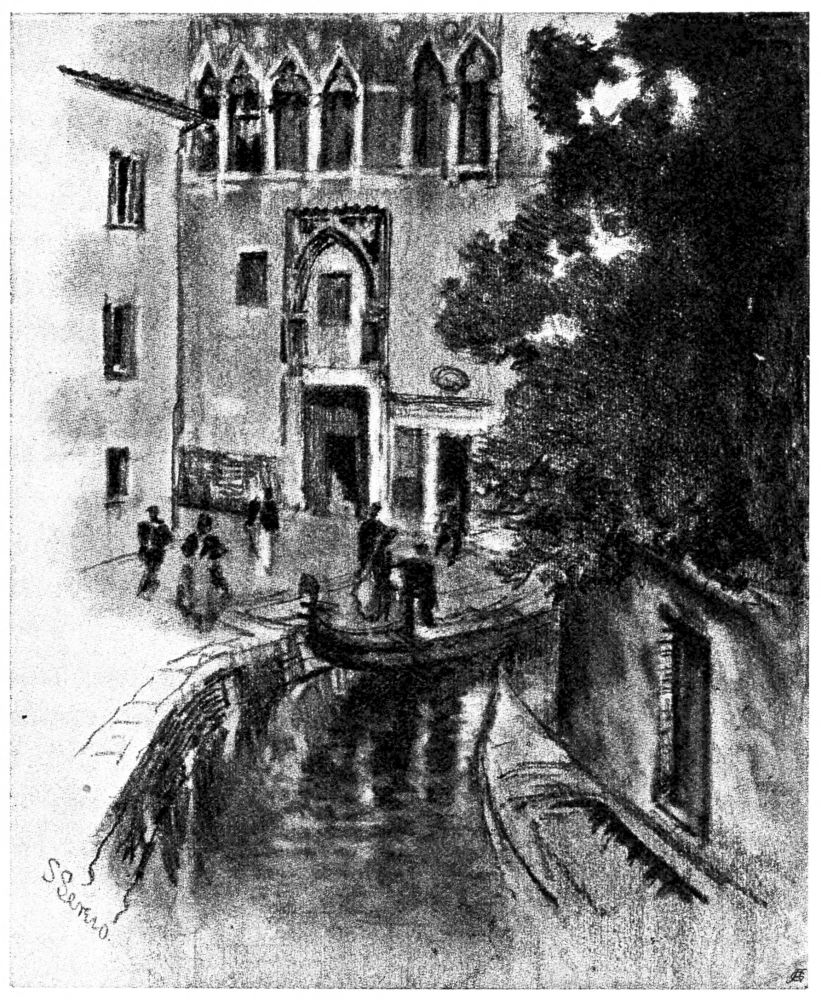
S. SEVERO
frequently sent to the smaller courts of Europe as ‘ministers resident,’ but not as ambassadors, and they could aspire to the highest commands in the army.
From all this it is clear that the position of the ‘original citizen’ class in Venice had a strong resemblance to that of the ‘magistrate’ class in France, for instance; and on the whole it had enough privileges to ensure its not being hostile to the nobility.
The art of glass-making contributed in such a degree to the wealth of Venice that glass-makers were regarded as benefactors of the State, and all the glass-makers of Murano were inscribed from their birth in the class of citizens ‘de jure.’ Another very wise measure of the Venetian government with regard to this intermediate class between the aristocracy and the people was the concession of its privileges to foreign persons of respectable origin established in Venice. It was only in the middle of the fourteenth century that citizenship ‘by grace’ was regularly admitted, and it was of two kinds: the one ‘de intus,’ and the other ‘de intus et de extra.’ The first conferred only a certain number of privileges, as that of engaging in commerce, and of holding some office of secondary importance in the public administration; the second conferred the full privileges enjoyed by the citizens ‘de jure,’ including those of sending vessels to sea under the flag of Saint Mark, and of carrying on business in the cities and ports where Venetian commerce was established, with the full rights of a Venetian.
Although it was only in 1450 that the law regularised the admission to citizenship, a number of admissions took place before the time of the foundation of the caste.
Molmenti, Vita Privata, 48.
The miserable conditions of navigation in the fourteenth century, and the depredations of pirates, caused many to request the privilege of navigating under the protection of the Venetian Republic. Those who asked this were generally noble and rich persons. For instance, in 1301 we find the favour asked by the Scrovegni of Padua, by Azzone, Marquis of Este and Ancona, in 1304 by the lords of Camino, mentioned by Dante, by Ludovico Gonzaga, lord of Mantua, and many others. Venice not infrequently offered the title of citizen, with all rights belonging to it, to persons who had exhibited special marks of talent in other parts of Italy; it was offered to Messer Ravagnino, a student of physical science in Belluno, and to Petrarch. It was frequently given to foreigners who had lived as long as twenty-five years in the city, and to others who had voluntarily submitted during a certain number of years to standing guard, paying taxes, and the like; and further, to those who, having married Venetian women of the citizen class, desired to fix their residence in the island of Rialto. Among the foreigners who were thus generally adopted, some of the most interesting in the fourteenth century were the inhabitants of Lucca, who between 1310 and 1340 fled before the tyranny of Castruccio Castracane. These were about thirty families, almost all of which had been in their own country spinners and weavers of silk, and they had brought a numerous retinue of weavers and spinners with them. The Venetians at once understood the advantage to be derived from this immigration of an
Galliccioli, ii. 274.
industrious people. Until then the richest stuffs had been imported from the East, but from this time forward Venice began to develop a new industry. The fugitive families were received not only with courtesy, but with something like enthusiasm. The Senate assigned them a quarter in the Calle della Bissa, between the square of the Rialto and the church of Saint John Chrysostom, allowing them to govern themselves with their own magistrates, on condition that they should teach their art to the Venetians. The same courtesies were extended in the case of German and Armenian colonies. The race of Venetian citizens in this way received a new element, with new prospects of life and industry, by the introduction of the best element that could possibly have come to Venice from without. The Jews, however, attempted in vain at the same time to obtain the same liberty of existence in Venice. After being barely tolerated during fifty years, and kept under the closest supervision, they were at the end of the fourteenth century ignominiously expelled from the city, and obliged to keep within the confines of Mestre. I have not been able to discover the date at which they were again allowed to reside within the city in the quarter which is still pointed out as theirs.
A singular circumstance, already noticed in passing, presents itself in connection with all the conspiracies of the fourteenth century. The people continually sided with the nobles who had deprived them of their power, and they outnumbered them and were superior to them in strength and moral force. They never lent any important help to any one who attempted to rouse rebellion against the existing civil order. It can hardly be supposed that this was the result of indolence, or of a lack of patriotism, since the Venetians were naturally very proud and extremely energetic. They seem to have considered themselves as bound to the aristocracy by the bond of gratitude, of common memories, and of common hopes; and while they led an existence of generous comfort and ease, it satisfied them to be joint possessors of a country which had grown glorious in Europe. They looked upon the Venetian nobility as the first in the world, and Molmenti says, with truth, that the surnames of certain great Venetian families not yet extinct existed before the names of even reigning families were known in the rest of Europe. Until quite modern times, the ‘people’ very rarely gave any trouble unless they were hungry.
Sagredo.
It has already been noticed here that in the other Italian republics the great houses had nothing in common with the people they ruled—neither their origin, nor their traditional points or view, nor even as a rule their interests; and more than once they showed themselves ready to sell their country to the highest bidder, regarding it as their adoptive rather than their real home, and the population as property that went with the fields.
But the nobles of Venice were true Venetians, and their ancestors had led those of their own people, by sheer superiority, before Venice had been founded; and the government of the islands had in reality been always aristocratic. The people had really never had much to say beyond confirming by a sort of acclamation the result of elections held by the nobles. The individual elected was sure to be one of the latter, chosen for his courage in war, or for his pious generosity in founding a church or a monastery in time of peace.
The Serrata only made a law of a practice which had existed a long time; and this sufficiently explains why the people did not rebel against it, accepting laws which only affected formalities, without in any way threatening the true sources of the Republic’s vitality. The nobles legally monopolised a power which they had always succeeded in reserving for themselves; but the State did not monopolise commerce, nor industry, except as regards the salt trade and shipbuilding, and in these occupations the workmen received such compensation that many of them grew rich.
Furthermore, the government supported all persons not able to work for themselves. Men and women who had reached an age at which heavy manual labour was no longer possible, but who were not helpless enough to do nothing, were licensed to sell vegetables and fruit in the public squares; but the State and the guilds supported regular asylums for the aged and infirm, for cripples, for widows, and for old sailors. Every one felt that the State could be relied upon, and no one feared to die of hunger.
The closing of the Great Council might affect the ambitious designs of a few men who had recently grown
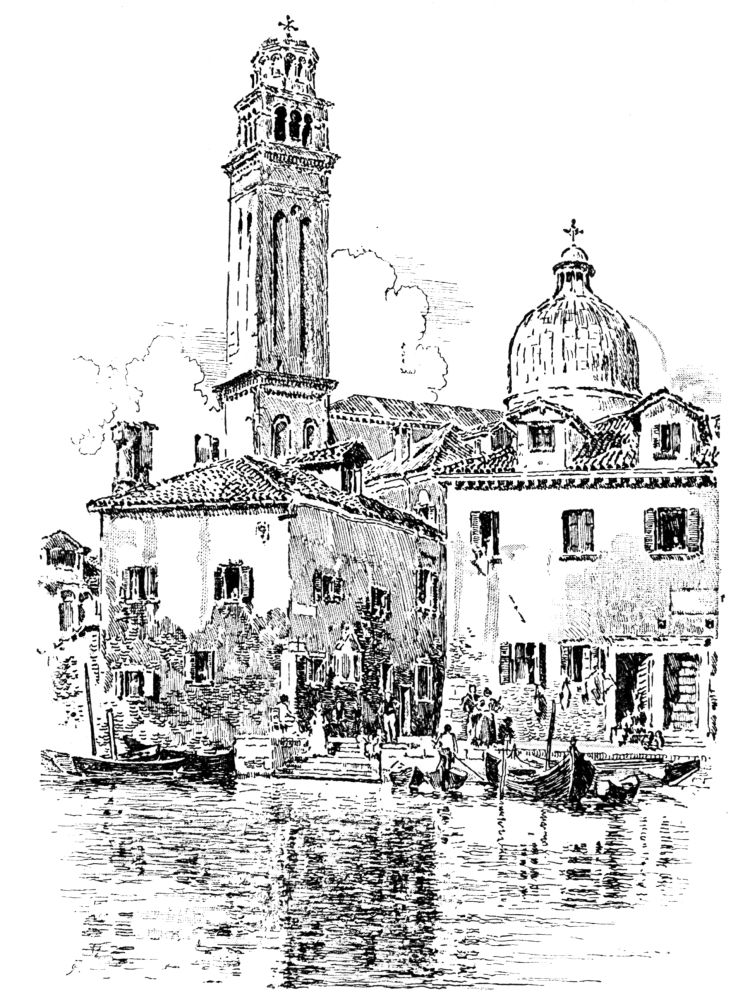
S. PIETRO IN CASTELLO
rich, and whose fathers had never sat there, but it could not possibly have any immediate effect on the lives of fishermen, seamen, salt-refiners, shipbuilders, and artisans to none of whom it had ever occurred that the Council was meant for them. When a conspirator made a pretext of vindicating the rights of the people, the people laughed at him, and the motive which in all other countries has been the mainstay of revolutionaries was found not to exist. The people of Venice were, on the whole, honest, contented, and happy, and both laws and traditions combined to preserve them in that enviable state; and the government itself provided wise alternations of work and rest, which greatly contributed to the same end. For every Venetian, whatever his condition might be, was expected to be a good sailor and a good soldier, and the regattas, public archery matches, and gymnastic exercises, which I shall presently describe, helped to make men both. In 1332 these competitions were made obligatory for all youths who had reached their eighteenth birthday. But another matter must be briefly explained before proceeding further.
In the story of the Venetian conspiracies no mention is ever found of the two famous factions, the Castellani and the Niccolotti, although the most bitter hatred was alive between them at the very time when Tiepolo was conspiring against Gradenigo. It is interesting to follow the rough and strong threads of those famous popular factions through the woof and web of Venetian history; and it is curious to find oneself convinced that they never did the slightest harm to the government of the Republic, for the reason that both of them loved their country sincerely.
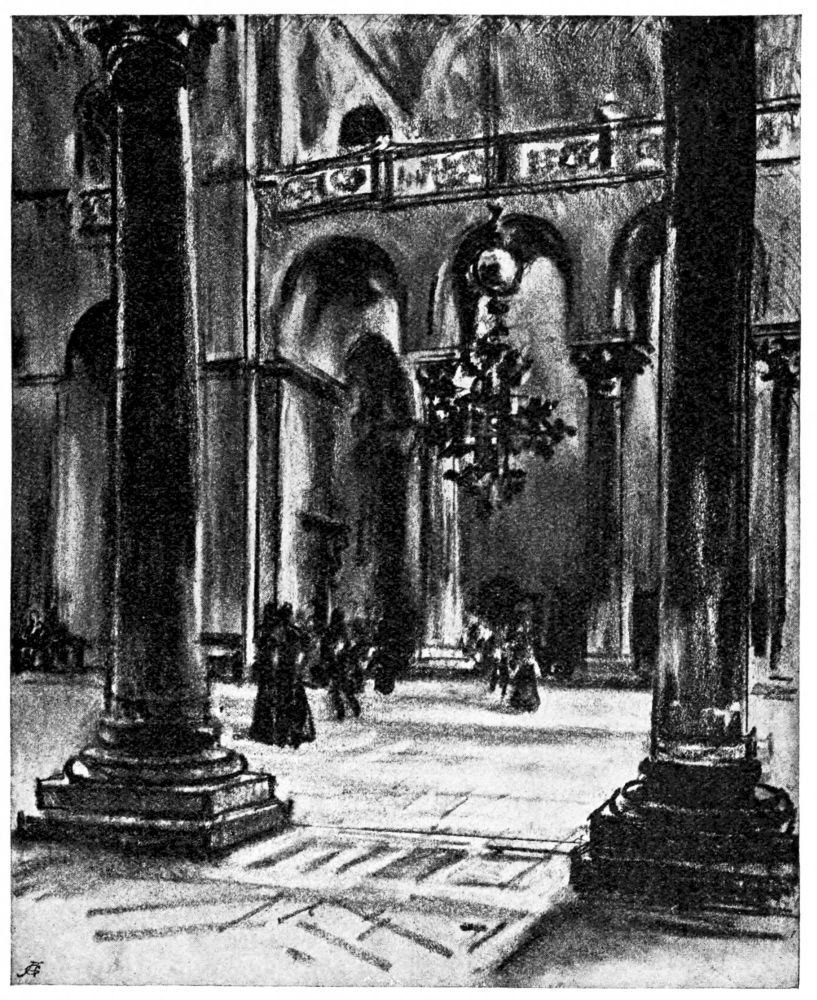
THE GREAT LAMP, ST. MARK’S
The reader may remember that in the days of Paulus Anafestus, the first Doge elected by the popular assembly, a violent dispute arose between the inhabitants of the islands of Heraclea and Jesolo, which turned into a pitched battle in the woods of Equilio, so that the stream which became the Canal Orfano was red with blood.
The former combatants, finding themselves shut up within the walls of one city, cherished their ancient grudges from generation to generation, and for more than five hundred years they gave vent to their hatred as best they could, keeping themselves divided, first as separate parties, then as separate wards, and finally both in wards and districts, according to the later divisions of the city; and fighting freely with one another whenever the public games brought them into conflict, under the names of Castellani and Cannaruoli, taken from the parts of Venice they inhabited—the one in the three districts of Castello, Saint Mark, and Dorsoduro, the other in those of Santa Croce, San Paolo, and Canarreggio at the other end of the city. They had continued their separate existence about three hundred years without, seriously disturbing the public peace, never intermarrying, never even entering the cathedral by the same door. But in the year 1307 a certain Ramberto Polo was the bishop of Castello, and the bishop of Castello was ex officio the bishop of Venice, and depended from the patriarch of Grado. Now this Ramberto attempted to exact certain tithes which his predecessor had considered it right to renounce. Five districts of Venice, and among them that of Saint Nicolas, refuse to pay these tithes. The bishop insisted, and in spite of the threats of the people, who had grown
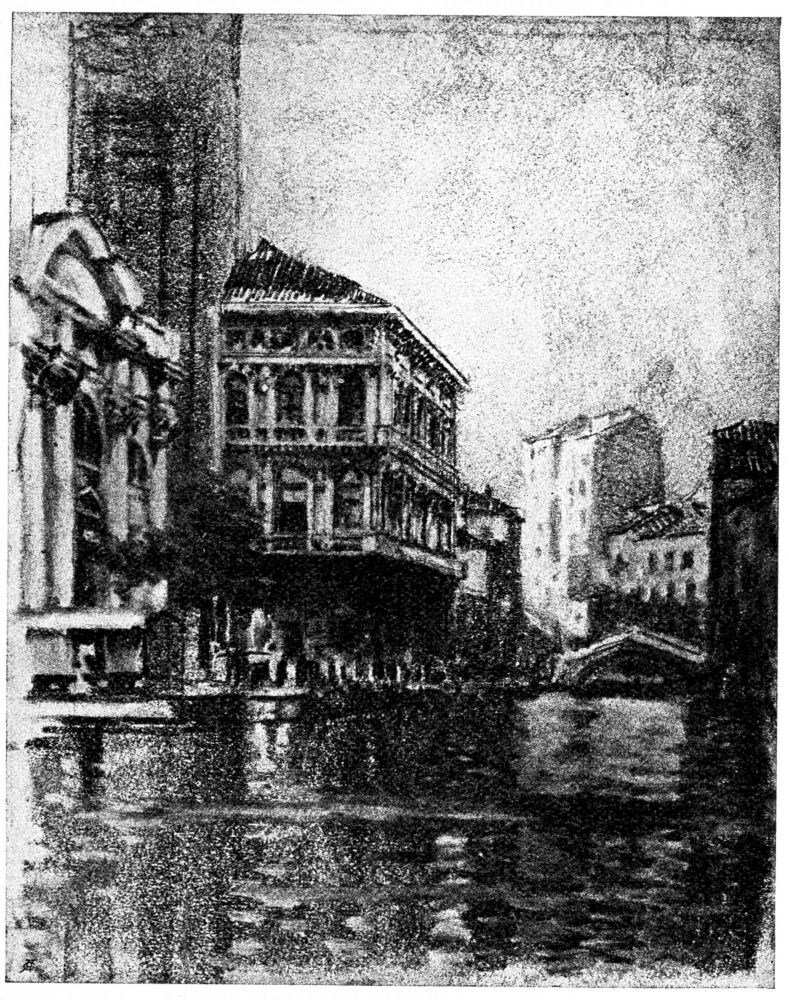
THE CANARREGGIO
riotous, he determined to visit the church of Saint Nicolas, situated in that quarter, and to go on foot. At the turn of the street, being accompanied only by a few persons, he was attacked and cruelly put to death. That part bears to this day the name of ‘Malcantone,’ the ‘Evil Corner.’ Those of the Castellani who were held responsible for this murder were promptly
THE HOUSE OF THE SPIRITS
excommunicated; and the others, who had submitted to the bishop, refused to hold any communication with them, or to have any interest in common with them, even after the removal of the interdict. The consequence was that, by way of spite, they now joined the party of the Cannaruoli, thus forming a numerous faction, which from that time forth was called that of the ‘Niccolotti,’ and maintained as its device the black banner and costume of the Cannaruoli, whereas the
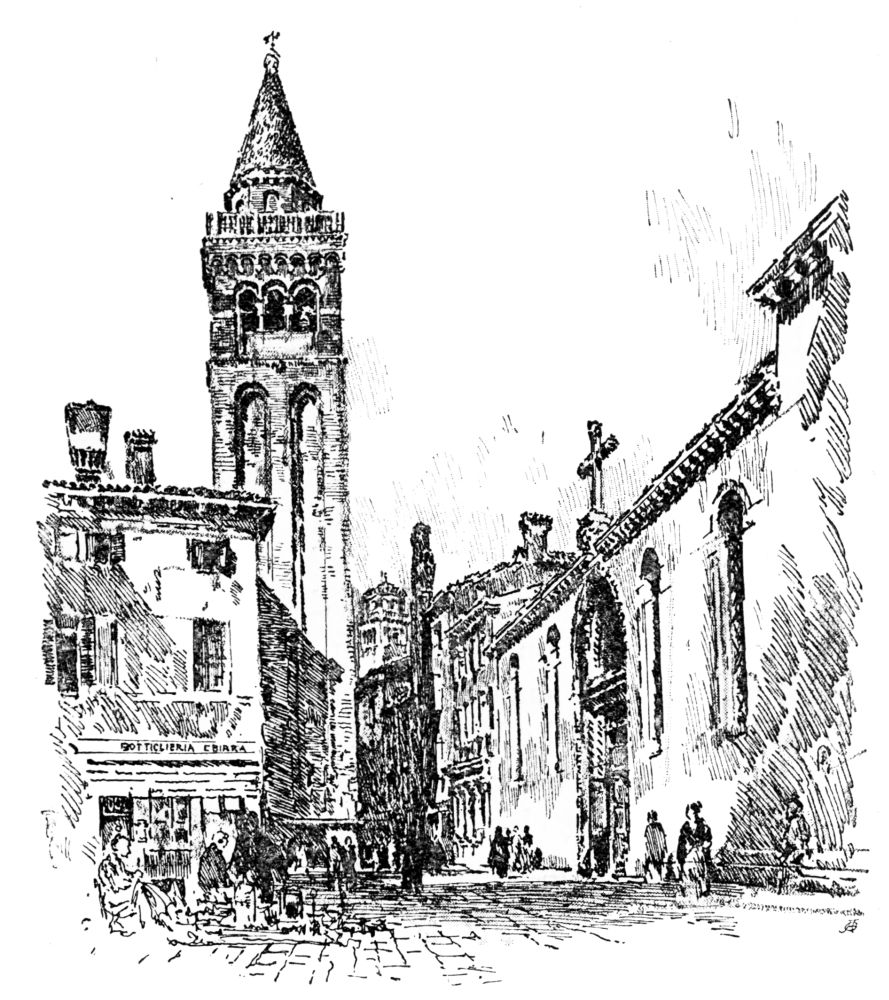
S. PAOLO
faction of the Castellani kept the red. The murderers repented and obtained pardon, but the new hatred, which had grown upon the old grudge, was relentless.
Mutinelli, Costumi.
Up to this time the custom of fighting only with reed-canes had been maintained by both sides; but having heard of the celebrated pugilistic encounters which were practised at Siena, they now determined to introduce a custom which offered such excellent opportunities for fighting. From September to Christmas regular encounters took place every Sunday upon the bridges, mostly built without parapets, where the two factions met, each endeavouring to knock and throw as many of their adversaries as possible into the canal. The bridge which was preferred for this form of exercise was that of Saint Barnabas, which soon got the name of ‘Ponte dei Pugni,’ the ‘Bridge of Fisticuffs.’ A less dangerous form of competition was also practised by the factions, under the name of ‘Forze d’ Ercole,’ literally the ‘Strength of Hercules.’ A platform was erected upon empty hogsheads, if the game was to be played on land; or on punts, if it was to be tried on the canal, as more usually happened; and upon this foundation the men built themselves up into a sort of human pyramid. The base was formed by a number of individuals standing close together, and linking themselves still more firmly by means of light joists which they held upon their shoulders; on these joists other men stood, and others again above them, until the pyramid came to its point in a small boy at the top. The prize belonged to that faction which could set up the highest pyramid in this way, and keep perfectly steady while the unenviable little boy at the apex performed acrobatic feats. This lad received the name of the ‘crest,’ as if the whole were a coat of arms.
The popular songs of that time exhibit the deep hatred that smouldered between these divisions of the people; and they have come down through the centuries to the Venice of to-day, with such little changes of speech as give new life to a thought without changing its substance.
Dalmedico.
The Castellani and Niccolotti, being constantly opposed to each other, systematically abused each other in verse during the days that preceded the encounters. Here is one from the side of the Niccolotti, for instance:—
O thou great Devil, Lord of Hell! Grant me this I ask of thee. I recommend to thee the Niccolotti! I pray thee carry all the Castellani off to hell! Give the winning flag to the Niccolotti.
The following is a fine example of party pride:—
When a Niccolotto is born, a god is born! When a Castellano is born, a brigand is born! When a Niccolotto is born, a count is born! When a Castellano is born, he turns out a gallows-builder!
And here is another:—
We are the Niccolotti, that is enough! We will march with the black scarf, and with the flower in our hat; and there are knife-wounds for the pigs of Castellani!
On the other hand, the Castellani sang as follows:—
Swine of ill-born Niccolotti, how can you expect the girls to love you? All night you wallow in the mud, you ill-born swine of Niccolotti.
The mud is that of the lagoons, the Niccolotti being fishermen.
In spite of this constant exchange of amenities, and in spite of their love of fighting each other, neither Bocconio nor Tiepolo nor Faliero ever got any advantage from the popular factions. I can recall no other case nor similar instance in history. They abused each other, but they all felt that they were sons of Saint Mark, a sentiment which strongly appears in another song of more generous type which was sung by the two factions together on occasions of common peril:—
Are we not all of one nation? Sons of Saint Mark, and of his state? May God preserve it, and make it grow, For all the good we have we get from Him!
Mutinelli, Less.
Cecchetti, Corte.
Sagredo.
The Niccolotti had a species of constitution; they had special customs of their own, and a head who was officially called their ‘gastaldo,’ but who by an old tradition bore the title of the ‘fisherman’s Doge’; and who on all public occasions arrayed himself in red like the High Chancellor, with wide skirts lined with fur in the winter, and, like the real Doge, wore red stockings and shoes of red morocco. He held so much to the right of wearing these red hose that he never appeared without them, even in ordinary life, and when fishing in his boat.
Little by little this chief of the people obtained the right to follow the Doge to the ‘Espousal of the Sea’ in a beautifully decorated boat towed by the Bucentaur; he was granted the privilege of dining with the Doge
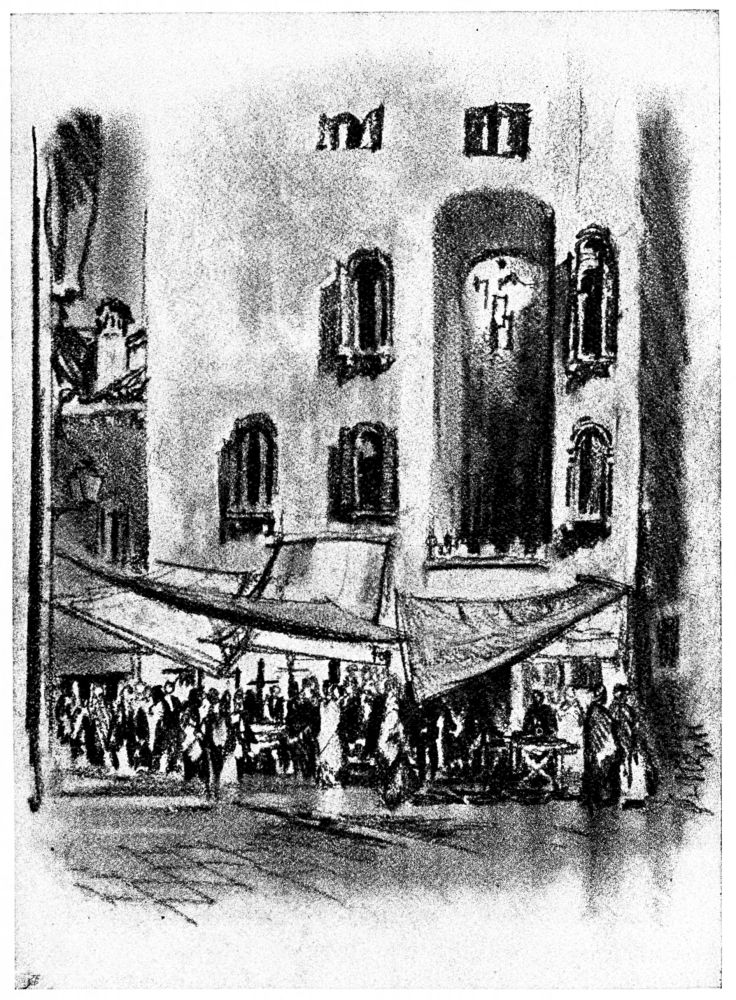
THE LITTLE FISH MARKET
on solemn occasions of the year, and he received the more material benefits of levying a duty on the fishing-boats of his district, and of keeping two counters for selling his fish, one at Saint Mark’s and the other at Rialto; for all the Niccolotti were fishermen by profession, and they were associated together by their common interests like members of one numerous family. These fishermen elected their head by a complicated system, in a solemn assembly held in the church of Saint Nicolas of the Mendicoli, in the presence of their parish priest and of the real Doge’s doorkeeper, who acted as ducal ambassador, and regularly presided over these assemblies in the name of the sovereign, in order to put down any disturbance which might arise out of differences of opinion between the voters. At a later time, instead of the porter, the Doge sent one of the secretaries of the Senate for this purpose. After the election was decided the Doge’s representative stood forth, carrying the standard of the Niccolotti, and the new ‘gastaldo’ knelt down before him, and received the flag with the following words of investiture: ‘I confide to you this standard in the name of the Most Serene Prince, in token that you are head and chief of the people of Saint Nicolas, Saint Raphael, etc.’
The bells of the church were then rung out; and on the following day, or within two or three days at the latest, the elected man, accompanied by the parish priests, and preceded by drums, trumpets, and one halberdier, who carried the standard with the image of Saint Nicolas, went to present himself to the Doge, in order to receive confirmation of his office. The Doge
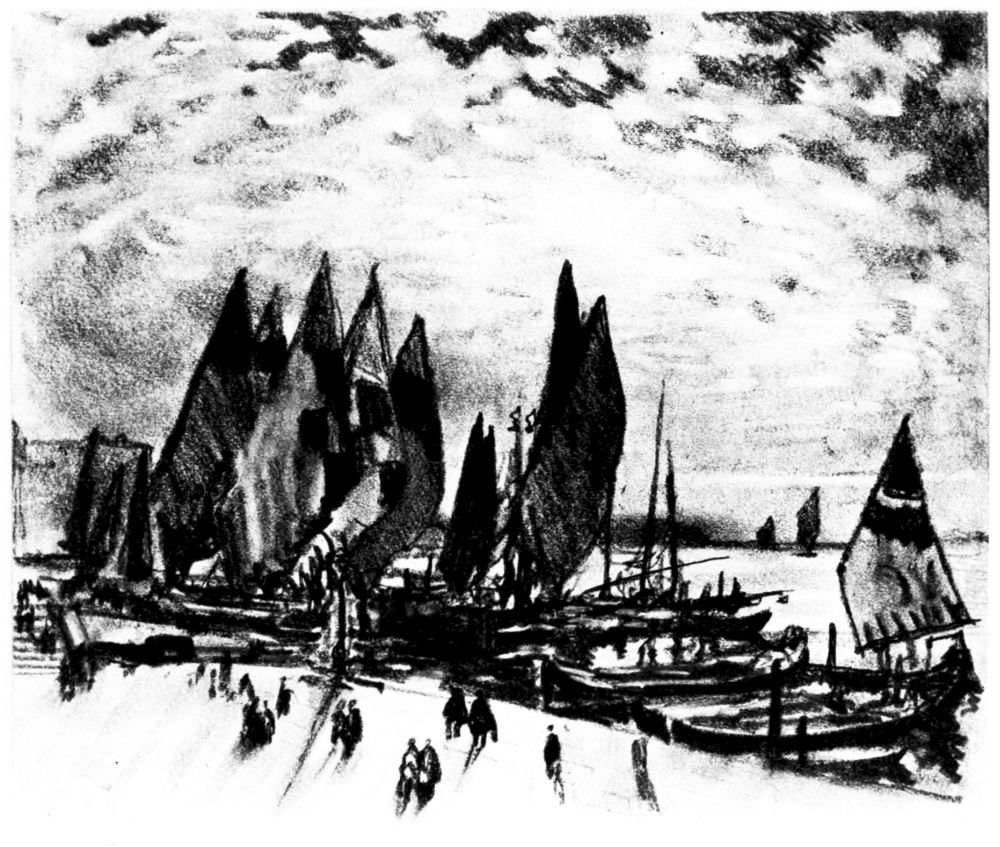
WHEN THE FISHING BOATS ARE IN
received him in one of the great halls, and exhorted him to be ‘a good father to that family (of the Niccolotti), and to be careful of the public dignity’; assuring him that if he did so the Doge himself would constantly be his protector, and assist him on every occasion. Then the head of the fishermen came near to the Doge, and knelt down before him and kissed his hand and the border of his mantle.
The chronicles are inclined to explain the conflicts between the two factions as the result of exaggerated rivalry in everything resembling public games. The latter were very common, as the government took every occasion to provide amusements for the people; and as Signor Molmenti justly says, ‘the extreme frequency of popular festivals in Venice might seem surprising, if one did not take into consideration the enormous energy continually expended in business and work, which brought with it the necessity of frequent interruptions and amusements.’ After all, there was a great deal of hard work connected with the Venetian manner of conducting such diversions. As early as the beginning of the fourteenth century, there were rowing matches of small boats and skiffs on all important occasions, and, moreover, races for vessels of fifty oars. These boats were a species of outrigger canoes, each capable of carrying fifty rowers, who stood to their oars. Similar boats, if they may be dignified by that name, were rowed by the Castellani and the Niccolotti, all wearing their red and black costumes or badges, and their emulation was shown as much in the manner of adorning their craft as in the
Mutinelli, Costumi.
race itself. These rowing matches became celebrated throughout the world, and first received the name of ‘regatta.’ The government encouraged them as being useful for a people that depended chiefly upon navigation for its livelihood, and offered large prizes to the winners. The first prize was a red purse full of gold; the second purse was green and filled with silver; the third blue, containing small change; the fourth was empty, and of a yellow colour, and the figure of a little pig was embroidered upon it, which denoted that the winner was to receive the live animal for his share.
The practice of shooting at the mark was also very popular in Venice, and as usual the government managed to derive advantage from it. All men were obliged to take part in it after the age of eighteen, nobles, citizens, and plebeians; and during the competition, a fact not overlooked by the wise administrators of the Republic, the young fisherman was in all respects the equal of the son or nephew of the Doge himself, and if he won a prize over him was practically his superior. The weapon most commonly used in those times was a cross-bow, which was made entirely of walnut until 1352, and after that was constructed of wood and steel. It was so cleverly made, we are told, that eight bolts could be shot from it in quick succession; this being accomplished in some way not clearly explained, by means of a wheel with eight cogs.
Bows and arrows were also used for shooting at the mark, the arrows being made in a place which received,
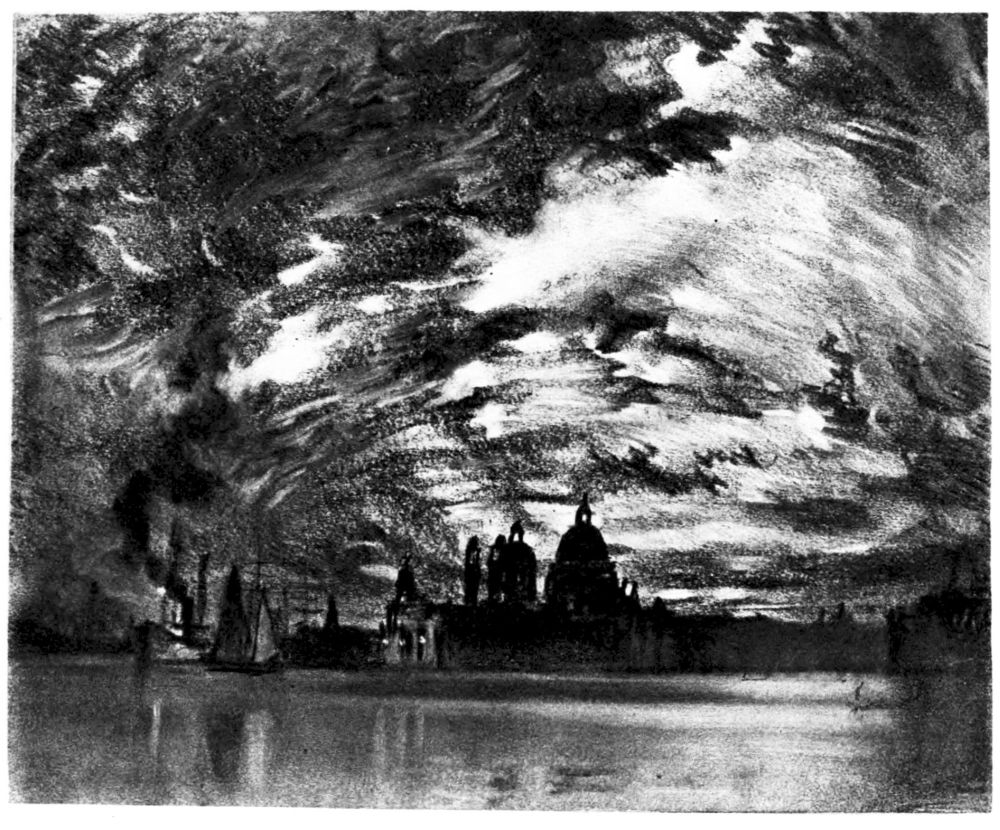
CLOUDS OF SUNSET
and still retains, the name of the ‘arrow manufactory,’ the Frezzeria. They were of pine or poplar, about thirty inches long, thicker at the point than at the butt, and provided with three feathers, like most of the arrows used in the Middle Ages.
Great magnificence was shown in these shooting matches, both in regard to the cross-bows and the quivers. We still have specimens of quivers of that period, made to hold from fifty to a hundred bolts, of red leather embossed under heavy pressure and carved with a sharp tool, being ornamented at the top with double lions of Saint Mark. The targets were set up at different points of the city, but the most famous was on the Lido. On the appointed days, boats manned by thirty oars were in readiness at the entrance to the Grand Canal, near the Piazzetta, and it was the rule that these were to be rowed only by competitors in the shooting. At twelve o’clock the heads of the ‘duodene,’ which seem to have been sub-districts, arrived with detachments of from ten to twelve men each, recruited in all classes of the city; they made their way to the scene of the competition, followed and encouraged by the multitudes that came to look on. Lots were drawn to determine the order in which the young men were to shoot. At the meeting held at Christmas, whoever hit the bull’s-eye first received ten yards of scarlet cloth; the second received six yards; the third won a cross-bow and quiver. At the meeting held in March, the prizes were of another stuff called ‘borsella’; and in May, a third kind of material was given, called ‘tintilana.’
Among other popular festivals of the Venetians, the free fair held at the Ascension was of great importance. Until 1357 this lasted eight days, but, after that, it was prolonged during a fortnight. It was at this time, as I have said elsewhere, that the famous function of the ‘Espousal of the Sea’ was held. During the fair, every kind of merchandise was allowed free entrance to the port and was sold in the Square of Saint Mark’s, in booths and on improvised counters, which gave that enormous space the air of a market. About the beginning of the fourteenth century it began to be the custom to wear masks during this period of mingled business and amusement. It is needless to say that the fair became a source of large wealth to the treasury, and an opportunity for making money for many, since at that time an immense number of foreigners came to Venice from all parts of the world. It has been estimated that at times as many as two hundred thousand strangers were present in the city for this occasion, which I shall hereafter take an opportunity of describing with more detail in the form it had acquired in a later age.
Cecchetti, Mercato.
Strangers who visit Venice often wonder idly whether there is any meaning in the half-cabalistic signs coarsely painted on the dyed sails of the fishing-boats that glide in towards evening, one after the other, and take their places for the night, like weary live things coming home to sleep. There shines the roughly-drawn presentment of a cock, apparently in an attitude of ecstasy before a rising sun that bears a strong resemblance to an omelet; and there a mystic beast that may be meant for a donkey, unless it stands for a grasshopper. You may wonder which, unless you ask of some superannuated old fisherman loitering on the quay at sunset with his pipe for company. But he will tell you that the cock and the rising sun are the hereditary emblems of all the descendants
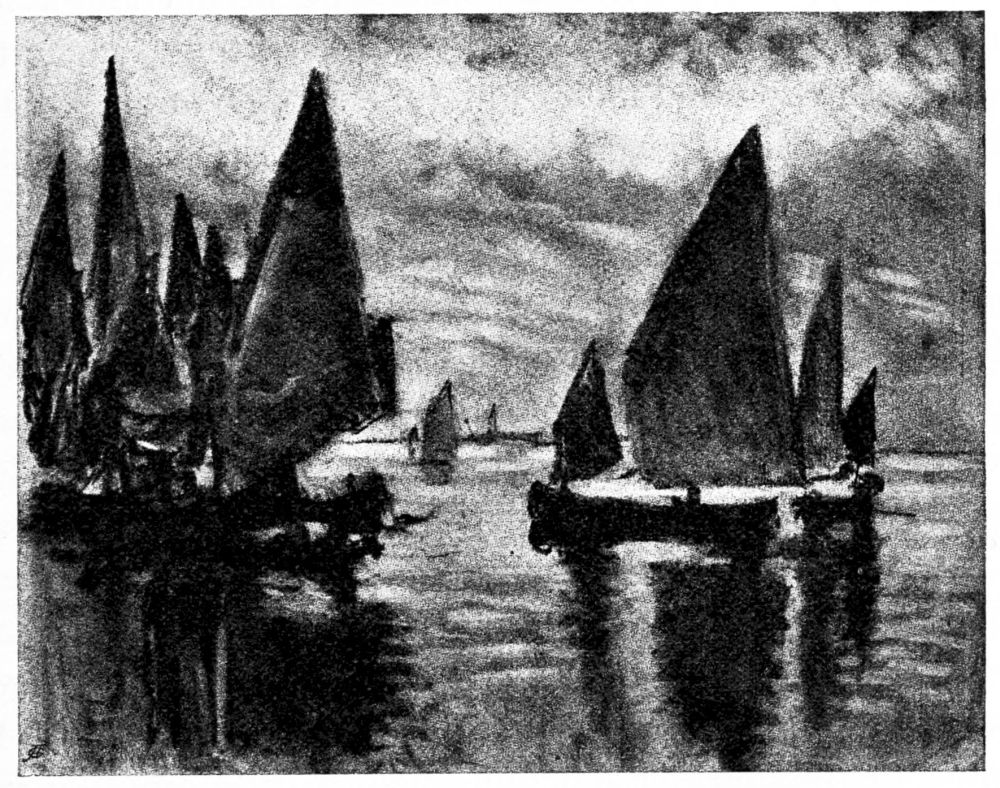
OFF THE PUBLIC GARDENS
of ancient Josaphat, a fisherman of Padua who adopted them long ago; and that the monster grasshopper-donkey is really a horse, and belongs to another family of fishers, the Cavallarin; and so on, through as many as you can point out. It is the heraldry of the fisher people, begun long ago by the Niccolotti and preserved religiously by their descendants to this present time; and though heraldry is ancient in Venice, there may be stone coats of arms on walls of time-worn palaces that look down upon the Grand Canal, less old than some of these rude ancestral bearings of the sea, that have been handed down from generation to generation through uncounted centuries.
Possibly, though no one would be bold enough to call it certain, the fishermen who were the Niccolotti formed the first and oldest guild in Venice; at all events the others bear a strong resemblance to theirs when we first hear of them.
Molmenti, Vita Privata.
Cecchetti, Corte.
Sagredo.
They grew up in Venice, as they did in Florence and other cities of Italy, close corporations of arts and trades, which were protected by the State, and assured many privileges to those who belonged to them, chief of which was a sort of monopoly of each branch of industry, which enriched the workmen without injuring the State. Under laws by which no new object could be sold except in properly authorised shops, there was no fear of foreign competition nor of home depression. Each guild was a little republic in itself, thriving in the heart of the great maritime Republic, occupied in administering its own affairs, and never making itself a source of anxiety to the government by meddling in politics.
It thus appears that on the whole the people not only entertained a sort of natural devotion and a feeling of gratitude towards the nobility, and lived a life of tranquillity and contentment, with plenty of holidays and public feasts, with ample means of earning a livelihood, and under such provisions of public charity as made anything like pauperism next to impossible; but also that their true strength consisted in the institution of the arts and guilds, which were recognised and protected by the laws. I have already said, in respect of the eleventh century, that each art existed like a small republic in the midst of the great one; and in the fourteenth century more than one hundred of these so-called arts had their individual constitutions. One of these constitutions contained a statute which forbade the members of the arts and guilds from doing anything which might interfere with or oppose the ordinances of the government, and most expressly forbade anything which could be looked upon as conspiracy. Each art had its own ‘gastaldo,’ or judge, and a certain number of elders, who ruled it according to its constitution, and as connecting links between their own tribunal, which might be called a family court, and the central government of the State. There were also three judges called ‘justiciaries,’ who were elected by the Great Council. It was morally impossible for any one to exercise even the simplest and humblest of these arts until he had been admitted by the council of the one in which he wished to work. It would have been as dangerous as to introduce into Venice any sort of merchandise that was already manufactured there, and by that means bring about competition between Venetian and foreign products. So far as the higher arts and trades were concerned, such as, for instance, glass-making, it was strictly forbidden to allow any workman to leave Venice who was in a position to take abroad the secrets of an industry of which it was intended to keep the monopoly at home.
Every sort of guild comprised many degrees and a number of officers, so that the liveliest competition went on between the members, the apprentice constantly striving to become a craftsman, while the craftsman thought of nothing but the moment at which he should be able to stand the test, which was a real examination, by which he might obtain a right to the title of ‘master,’ not only because the latter represented the highest degree to which he could aspire, but because it conferred upon the sons of whoever obtained it the right to become masters without being required to stand the test. The test examination for the ‘degree’ of master consisted in executing a difficult piece of work within a certain number of hours or days. For instance, a man became a master of mosaic paving when he could lay out and finish the pavement of a large room, so that not the smallest crack or crevice or flaw could be detected in it, and so that the level of the whole surface should nowhere vary by more than the thickness of a ducat.
In some of the arts apprentices were not admitted under the age of twelve; in others, such as shipbuilding, where the work was done in the open air, they could begin from the time when they were eight years old. Glass-workers were forbidden to make use of children’s labour in such work as grinding glass, or in any kind of occupation that could injure their health, such as tending the furnaces during the hot season.
The workmen of the arsenal also formed several guilds of a superior order, and had special rules, which I shall notice in another place, for the arsenal did not reach the height of its importance and activity till the sixteenth century.
Each corporation or guild elected its ‘gastaldo’ by a majority of votes, and his authority may be described as partaking of the paternal, and of that of a justice of the peace. When any conflict arose between two or more members of the guild he was appealed to, and his verdict was perfectly legal. In grave cases, where it became absolutely necessary to appeal to the public tribunals, the latter were bound to take into consideration the rules of the charter of that guild to which the parties belonged; those rules were called the mariegole,’ and no sentence was lawful which was in contradiction with them.
Within the guilds brotherhoods were formed, the aims of which were both religious and co-operative; and these took the name of ‘schools,’ which vied with each other in building churches and hospitals and in making pompous appearances in public during the religious or civil festivals. The number of artisans inscribed in a guild was not determined, but the number of brethren in each school was limited by its statutes. Each school was directed by a ‘gastaldo’ and a number of elders, who were generally the senior members of the guild from which it was derived. This council of management was to admonish with grave words any brother who led an immoral life, to punish blasphemers, and to be vigilant lest any of the brethren should play at games of chance, even dice being prohibited. The ‘gastaldo’ himself might be admonished by the elders, and required to perform ‘great and good’ penance, according to the terms of some of the charters. The brethren paid a tax of admission, and in many schools bound themselves to flagellation at Lent. A certain number of priests were admitted without any obligations, and from four to six physicians; both ‘doctors of physic,’ as they were then called, and ‘doctors of wounds,’ as surgeons were designated. No brethren were admitted under the age of sixteen years.
The brethren had a right to receive assistance from the schools in the form of money and of medicine, if they were ill, either at home or in the hospitals which were annexed to the abodes of some brotherhoods. We find it stated that in some cases the schools assisted a brother with a sum as large as three hundred of the ‘small lire,’ which was a very considerable sum for that time, being equal to about fifty pounds sterling. Among the advantages enjoyed by those who belonged to a school was that even when absent from the city they could claim succour from the brethren. The following words, translated from the statutes of the School of the Holy Apostles, framed in Venetian dialect of the thirteenth century, well express the general purpose of these institutions: ‘Let the brethren be twelve good and honest men, who for the love of our Lord Jesus Christ are to live holily, in peace and charity, without fraud, pride, or murmuring, having ever before their eyes the example of the apostles and the command of Christ, to wit, Love peace and charity, and love your neighbour as yourself.’
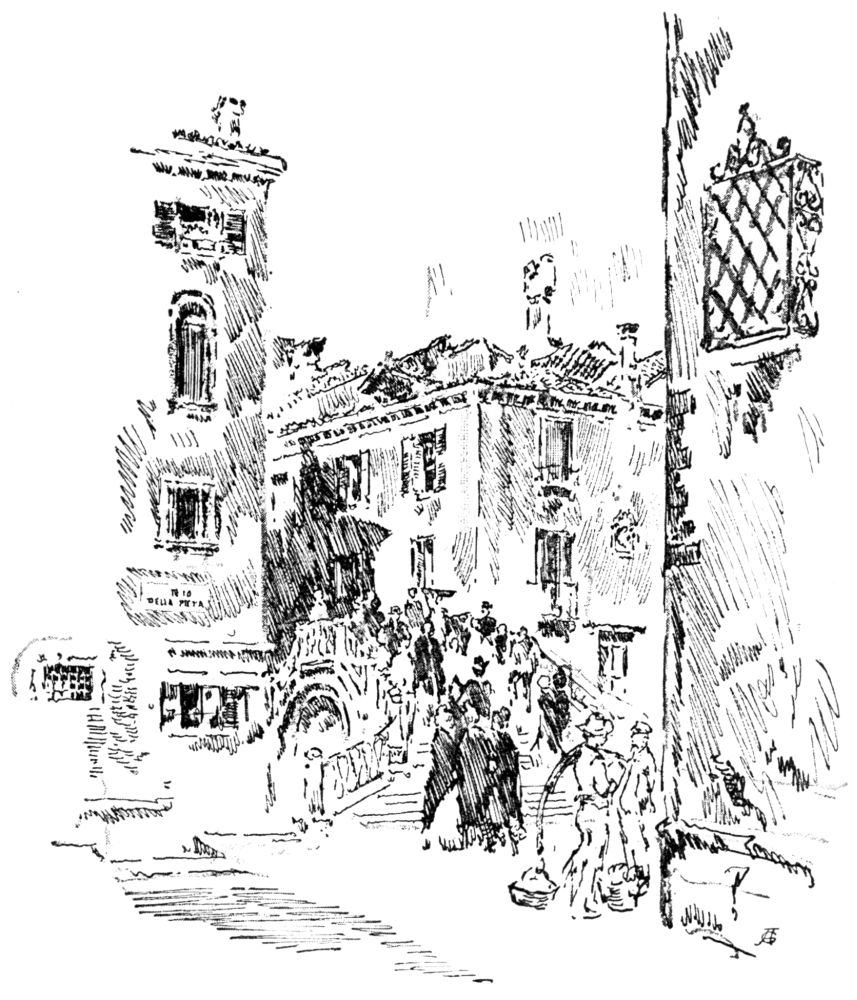
RIO DELLA PIETA
The worst of the misdeeds for which one of the brethren could be subjected to the dishonour of being expelled from the school was openly leading a bad life. The head of the brotherhood, upon the information of other brethren and by his own knowledge, then warned the culprit to correct his ways. ‘Let him be told to amend his life openly, for charity’s sake; and if it be amended within fifteen days, then praise be to God, and let him go in peace.’
It sometimes happened that a brother, of his own accord, rather than be expelled, wished to quit a school, in entering which he had perhaps experienced some difficulty. To this end the statutes of some schools laid down that he should pay a considerable fine, that in the presence of his companions he should be placed upon a bier, and that while the bells tolled as for a dead man he should be carried round the church. After the passage of this law such cases grew much less frequent.
In the end the schools became very rich institutions, for the members not only contributed money, but they and their families, and doubtless many members of the guilds, worked for nothing on their churches, their hospitals, and their asylums for the old. The competition between different schools was keen, and led to their beautifying their oratories and their places of meeting with magnificent works of art, so that almost all the great painters of Venice first acquired fame under their protection.
In the fourteenth century such men as Carpaccio and Bellini, and later, Titian, Veronese, and Tintoretto, were all humble brethren of the Guild of Painters and Varnishers, and they all, without exception, submitted in their schools to the authority of men who were very likely nothing better than house-painters by profession, though they were undoubtedly men of high morality and probably of considerable cultivation.
As for the treasure that accumulated in the name of the Guild, it was not only used for the sick and in aiding young artists, but it was also not unusual to give dowries to the daughters of poor brethren, and sometimes considerable sums were sent to members of the Guild whom some urgent matter detained abroad without sufficient means of livelihood.
Cecchetti, Corte.
It is a singular fact, mentioned only by Cecchetti, that a number of nobles, possibly in the hope of obtaining; influence over the guilds, but pretexting religious devotion, requested and were permitted to be inscribed as brethren. It appears that some of the brotherhoods attempted at the very first to defend themselves from this invasion, but were afterwards obliged to yield to the will of the Great Council, though they limited the number of nobles to be admitted so as to make it very small compared with that of the citizens. Later, however, in 1407, the Great Council, considering that this was a slight upon the aristocracy, required that all nobles should be admitted to the schools who wished it, provided that they were of good repute. But the nobility were not satisfied with this; they wished to join the schools and yet be exempt from the usual dues. A few of the guilds yielded, but we find among the papers of the school of Santa Maria della Val Verde, of the year 1320, that all nobles who joined it must submit to all the requirements of the statute, and that for them the admission fees should be even larger than for ordinary citizens—‘and let him be what he pleases,’ concludes the article of the statute with some disdain. In other statutes we find that nobles could be admitted for nothing, but that if they chose to pay something as conscience-money, of their own free will, their offering would not be refused. Another right that the nobles arrogated to themselves was that of refusing to submit to flagellation in Lent, and the only schools where this custom was kept up decided that the nobles, by way of compensation, should pay a considerable increase of dues, and that the same immunity should be accorded for nothing to all brethren over sixty years.
On the whole, the effect of the guilds was to keep alive in the people a sense of their own dignity, and to distract them from hankering after the offices of state, for which quite another education, different studies, and an altogether different point of view would have been required. For the equilibrium of a permanent state one prime condition is that people should soberly, consistently, and, if possible, intelligently, mind their own business.
In the fourteenth century Venice was unlike all other cities, both as regards her external and internal administration, and the singularly divers elements of which her strength was made up. In order to gain a clear idea of the city’s condition at that time, a word must be said concerning the numerous strangers who, though not taking up their abode permanently in the city, passed through it or came to it on their way to the East, and during the great fairs. I have spoken already of those who established themselves in Venice and who sometimes became citizens ‘de intus et de extra’; I speak now only of that constant stream of travellers, merchants, and men of business—Italians, Frenchmen, Germans, and Orientals—who came and stayed a few weeks, or even months, where people would now stay as many days, who transacted their business, bartered their merchandise, and made acquaintance with the city, visiting its monuments, its churches, and even its war-galleys in times of peace. Venice showed them the most unbounded courtesy, and frequently offered them the most magnificent hospitality. Their presence never created the least disorder, and the manner in which the government provided for their welfare is one of the most surprising things in the internal economy of the city.
Mut. Costumi.
When a stranger arrived in Venice and took up his lodging in one of the many inns, some of which, like the ‘Luna,’ the ‘Selvatico,’ and the ‘Leon Bianco,’ are still nourishing in our own time, and were famous in the fourteenth century, he found provided for him a tariff of prices, which protected him against any possible imposition on the part of the landlord; and he could hire a licensed guide to serve him lest he should lose his way in the streets, or be cheated in the shops. The authorities exercised a direct supervision over the rooms of the inns, requiring the most perfect cleanliness of beds and linen and blankets, and they forbade the crowding of strangers beyond a reasonable limit. For the sum of fourteen soldi horses were provided with sufficient oats, hay, and straw.
At times, when many strangers visited Venice, the population of the city was almost doubled; and as the inns could not suffice to receive such a number, the municipality placed at the disposal of visitors such empty houses as it owned, and allowed private citizens to let rooms to strangers; but severe penalties were imposed upon any who should venture to let lodgings without a proper licence, or who should in any way impose upon lodgers.
Pilgrims were received in hospices built for the purpose, and were there served with reverence by the most distinguished persons in Venice; and if they chanced to arrive at the time of any solemn festival they were invited to join in the procession, walking on the right of the patricians with wax torches.
Mut. Commercio.
There was a special court for deciding questions between strangers, or between strangers and Venetians; and it was the duty of this tribunal to punish citizens who wronged any foreigner, or, if the latter was proved to be the offender, to expel him from the city. Moreover, an express law of 1317 required that the judges should ‘gently instruct’ persons who did not present their passports in order, instead of sending them away roughly or imposing a fine for an irregularity arising from ignorance of the Venetian law.
When any very noble guest was in Venice, the State spared nothing that could make his visit memorable to him as a time of wonder and delight. The Duke of Austria never forgot the reception he met with, at a time when he had little expectation of being so hospitably treated, for the relations between the Duke and the Republic had been strained during some time past. One of the Duke’s great vassals, the lord of Sench, who was devoted to the king of Hungary, had stopped and imprisoned three Venetian senators when they were on their way to the Court of the Emperor Charles IV. to request, in the name of the Republic, the investiture of certain lands to which the king of Hungary laid claim. The Duke of Austria had at first tolerated this high-handed act, but had at last yielded to the reiterated instances of the Republic, delivered the prisoners, and sent word that he would bring them to Venice himself.
Though surprised, and a little uneasy at this proposal, the Council determined to receive him with lavish hospitality, and several senators were sent to Treviso with richly-adorned vessels to meet him. He embarked, accordingly, with the restored captives, thirty knights, and a train of two hundred young nobles and squires. Not far from Venice he was met by the Doge with the famous barge, the Bucentaur, and the two sovereigns met with every demonstration of friendship. The noble Austrians were lodged at the charge of the State in the Dandolo and Ziani palaces on the Grand Canal, and so magnificent were the entertainments offered them that the expenses of their visit—for Venice always knew precisely what she was spending—amounted to ten thousand ducats—say, seven or eight thousand pounds sterling, when money was worth three times what it is now.
My chronicler remarks that the money was well
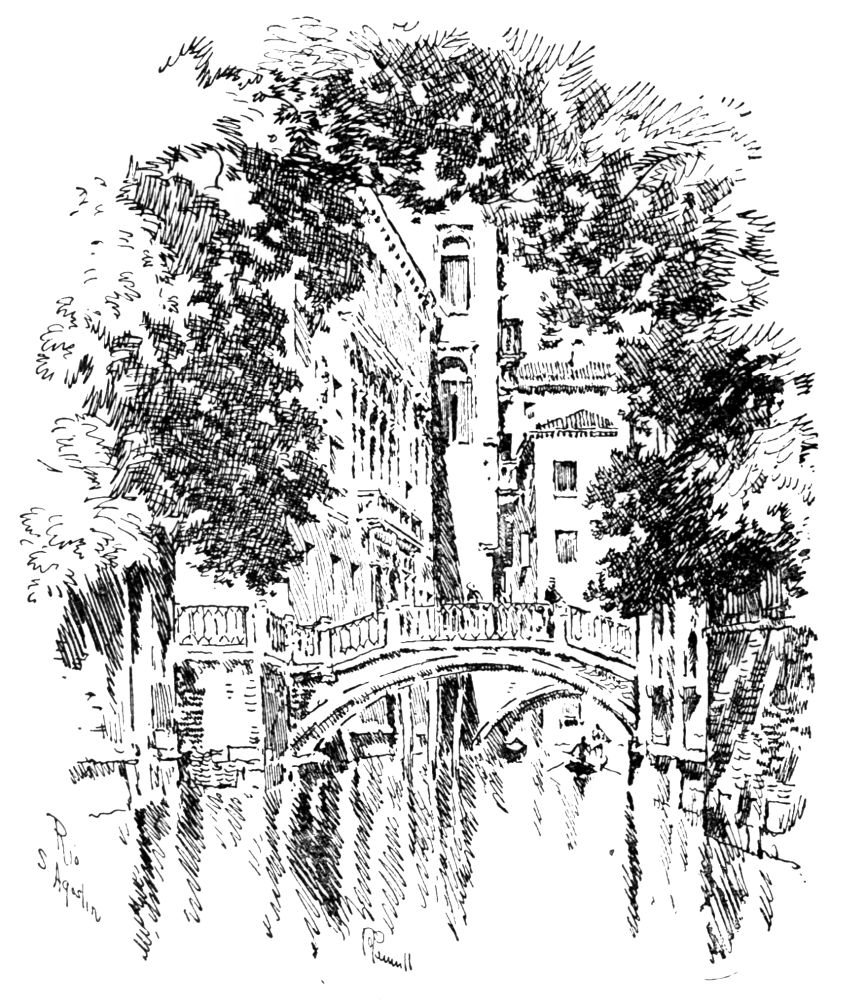
RIO S. AGOSTIN
invested, as the Duke was made a firm friend of the Republic, and himself proposed a treaty by which he abandoned his claims to Trieste for seventy-five thousand ducats—about fifty-six thousand pounds.
In the latter part of the fourteenth century Petrarch was received with a hospitality as open-handed, and much less interested. The great poet and famous ambassador was treated like a king; the palace of the Quattro Torri on the Grand Canal was fitted up for him and placed at his disposal for as long a time as he would stay in Venice, and at every public function or festivity he appeared on the right hand of the Doge.
Touched by such consideration, Petrarch bequeathed a part of his priceless library to the Republic, and Venice, on her side, refusing to be outdone in generosity, presented him as a gift with the palace in which he had been living.
The palace had originally belonged to the Molina family, and ultimately became a religious house under the Sisters of the Holy Sepulchre. As for the poet’s books, they came to a melancholy end. They are sometimes said to have been the beginning of the library of Saint Mark. The authority from which I quote says that amongst them were a manuscript of Homer, given to Petrarch by Nicolas Sigeros, ambassador of the Emperor of the East, a beautiful copy of Sophocles, a translation of the whole of the Iliad and of a part of the Odyssey, copied by Boccaccio himself, he having learned Greek from the translator, Leontio Pilato, an imperfect Quinctilian, and most of the works of Cicero transcribed by Petrarch himself. Such treasures would make even a modern millionaire look grave; yet it is said that when the celebrated Tomasini asked to be allowed to see the books towards the end of the seventeenth century, he found them stowed away in an attic under the roof of Saint Mark’s, ‘partly reduced to dust, partly petrified’—‘in saxa mutatos’—a phenomenon of which I never heard, and which I am at a loss to explain.
The tendency of Anglo-Saxons to extol and help conspiracy against every government but their own has led Englishmen to waste sympathy on Bocconio and Tiepolo, of whom it is now time to speak. The system of laws and government which became defined after the closure of the Great Council, though it already existed in great part so far as practice was concerned, was designed to check every impulse of personal political ambition in all classes of Venetians, beginning with the Doge himself. Indeed his life, both public and private, was so hampered and hedged in that his position at ordinary times seems to us far from enviable. Yet in spite of this, and it is a singular reflection, it was quite possible for a great man like Enrico Dandolo or Andrea Contarini to exercise tremendous personal influence at decisive moments and to perform acts of the highest heroism. Is there anything more heroic in all romantic history than the aged Dandolo kneeling to receive the cross of the crusader, and then leading a great allied host to one of the most astounding conquests ever recorded? Was ever a man more of a hero than old Contarini, swearing on his sword, when all seemed lost at Chioggia, that he would never go back to Venice till the enemy was beaten—and gloriously keeping his word? It seems to me that the heroism of both those men grows when one considers that if either of them had been even suspected of any personal interest or ambitious design he would have been ruthlessly put out of the way by the men who had elected him.
The whole system was created to make anything like self-aggrandisement impossible, and it worked so infallibly that during something near six hundred years not one attempt to break it down was successful; and when at last it fell, in its extreme old age, of weakness and corruption, it was not finally destroyed by any inherent defect except old age, when it was attacked by the greatest conqueror since Charlemagne.
It may not be possible to bring it under any philosophical theory, and it bore but a small resemblance to Plato’s ideal State; but it had the merit of being the most practical plan ever tested for maintaining the balance between public and private forces, public welfare and private wealth, national dignity and individual social importance. Of the three great conspiracies only one was the work of an ambitious aristocrat; another was a disappointed rich burgher’s ineffectual effort at revenge; the third was headed by the Doge himself, partly out of private resentment. None of them had any great chance of success, yet so great was the apprehension they created that they were the source and origin of all that terrible machinery of secret tribunals, spies, anonymous accusations, and private executions which darken the later history of Venice; a machinery which was almost always at work against the very nobles who had constructed it, who feared it, but who never even thought of doing away with it, though they could have voted it out of existence at any meeting of their council; a machinery which hardly affected the masses of the people at all, and which powerfully protected the merchant burghers, but at the mere mention of which the greatest noble became silent and looked grave.
Elsewhere in Italy the nobles of the twelfth, thirteenth, and fourteenth centuries, iron-clad, hard-riding, and hard-hitting, were the natural enemies of the people, whom they could kill like flies when they liked. In sea-girt Venice they wore no armour, the people mostly loved them, and the burghers needed their protection and shared in all the sources of their wealth. The nobles’ only possible enemies at home were among themselves.
Rom. iii. 5.
History has not left a very clear account of the conspiracy of Marin Bocconio against the aristocratic Republic in 1300. We know that he was a man who had a great following, chiefly on account of his immense wealth, and Romanin remarks that his intelligence was not equal to the arduous undertaking he had planned. We know that on the discovery of the plot he was taken, that he was first confined in the prison of the ducal palace, and afterwards hanged with ten of his principal accomplices between the two columns, probably those of the Piazzetta, and we have a list of those executed, showing that none of them were noble; but a few noble names appear among those of persons exiled as having been favourable to a revolution. Bocconio was certainly one of those malcontents who were not satisfied with the position and privileges of a
RIO JENA SECONDA
Venetian burgher, and he was desirous of opening himself a way into the Great Council by means of his fortune. The story that he knocked at the door of the council chamber with the hilt of his sword, and armed to the teeth, is an empty fable. He plotted, like the other conspirators, in the dark, and he was betrayed by an accomplice.
Rom. ii. 323.
The facts as well as the details of the conspiracy of the Tiepolo and the Quirini are better known, and it was this attempt at revolution which first gave the government of the Republic that suspicious and inquisitorial character which it never afterwards wholly lost. Mention has already been made of that popular movement in 1296, which attempted to seat upon the ducal throne Jacopo Tiepolo, son of the former Doge Lorenzo, a man distinguished in the career of arms, and who was therefore thought fit to take charge of affairs at the beginning of the great struggle with Genoa. It will be remembered that the government opposed the popular choice, partly in order not to yield an inch to the popular demand, but also, on the other hand, because it was already suspected that the Tiepolo family, which had previously given Venice two doges, was desirous of making that dignity hereditary.
The doge chosen by the government was Gradenigo, and against him the Tiepolo family and their friends, such as the Quirini, the Badoer, and the Doro, continued afterwards to nourish resentment, and showed themselves sternly opposed to the law of the closure of the Great Council, which they looked upon as the triumph of Gradenigo’s policy. The Tiepolo were very numerous, and so also were the Quirini. They possessed many houses, were provided with vast stores of arms, and had many servants and slaves. The two families were not united by friendship only, for Bajamonte Tiepolo had married a daughter of the Quirini. Her father, Marco, was of that branch which inhabited the palace situated on the island of Rialto, in a little square beyond the Ruga degli Speziali.
Both families belonged by right to the Great Council, and during its meetings they took advantage of the smallest incidents to give vent to their wrath against the Doge and his policy. Sometimes they raised such tumults during the sittings that the meetings had to be adjourned, and on the following days they fanned the embers of disturbance into flame in the public streets. The government showed its anxiety by renewing the prohibition to wear arms abroad, and the greatest vigilance was exercised by the ‘Lords of the Night,’ who were six magistrates, generally nobles, charged with the duty of superintendents of police in the city after dark, and were in command of the armed watch. Orders were issued that no one was to keep fire burning, except in barbers’ shops, after the ringing of the third hour of the night, i.e. three and a half hours after sunset. At that time the streets were only lighted by means of lamps that burned here and there before shrines set up by pious persons, but the government now greatly increased this illumination. In a word, every precaution was taken lest the discontent fostered by the great families should suddenly break out into open revolt.
One evening the brother of Marco Quirini, Pietro surnamed ‘Pizzagallo,’ was met in the street by Marco Morosini, one of the Lords of the Night, who was going his rounds. The magistrate’s suspicions were at once aroused; he stopped Quirini, and insisted upon searching him to see whether he were armed or not. Pietro Quirini, by way of showing his displeasure at what he considered an offence, promptly kicked Morosini off his feet, and left him lying on the ground. An action was of course brought against the offender, who was condemned to pay a heavy fine for his irascibility in thus gravely insulting an officer of the State. Nevertheless a number of similar incidents took place, for prudence was not among the virtues of the Quirini and Tiepolo families, and they appear to have given themselves infinite trouble in seeking occasions for disturbing the public peace. Nor was it difficult at that time to stir up the elements of discord, for Venice was involved in a disastrous war with the lords of Ferrara, a conflict which we must now briefly explain.
In the eleventh century, during the War of the Investitures, the Church under Gregory VII., Hildebrand, made common cause with the party of Italian independence against the German Empire, and was vigorously sustained by Matilda, Countess of Tuscany. She, on her side, naturally found allies among those powers which desired to obtain the goodwill of the Holy See. When the Countess wished to get back Ferrara, which she had lost some years previously, the Venetians lent their help, both with vessels and with armed forces; and in return they obtained many privileges for their commerce in the city of Ferrara, and, among others, that of placing there a ‘Visdomino,’ a sort of consul-general, to watch their interests.
Rom. ii. 19.
Rom. iii. 12.
It will be remembered that the Countess Matilda left all her vast estates to the Church. Ferrara, therefore, remained under the supremacy of the Holy See, and when the city was seized by the Ghibelline Salinguerra the Venetians drove him out, and the city came under the domination of the family of Este, with the consent of the Pope. By the end of the thirteenth century this family had already reached such a high position that the Marquis Azzo had married the daughter of Charles II., king of Naples. Venice remained on excellent terms with this Marquis Azzo, and constantly lent him assistance in his struggles with his neighbours who threatened his liberty. He, however, fell dangerously ill in the year 1307, and Venice, being well aware of the discord which was brewing between his sons, seized the opportunity of furthering her own interests. During his illness three Venetian envoys remained constantly at Ferrara on pretence of sending information regarding the health of the sick man, but in reality to watch the condition of affairs and the disposition of the people. The old prince died, and left a will so worded that one of his illegitimate sons, named Fresco, attempted to have his own son, Folco, proclaimed lord of Ferrara, and to this end asked help of Venice. Azzo’s two legitimate sons, Francesco and Aldobrandino, however, turned to the Pope and obtained his support, renewing their oaths of allegiance as feudatories of the Church.
Rom. iii. 20.
A hot contest now ensued, and Fresco, realising the weakness of his own cause, made over his rights, such as they were, to Venice. The troops of the Pope and of the Marquis Francesco now entered Ferrara, and the city was declared under the dominion of the Pope in 1308. But Venice protested, and refused to surrender the fortresses she had taken over from Fresco. It was in vain that the Pope attempted every means of conciliation. The Republic had long coveted Ferrara as a possession, and now refused to give up the part of the principality which she held, or her claim to the rest. The negotiations therefore came to grief, and ended in a solemn Bull of Excommunication against the Doge, his counsellors, all the citizens of Venice, and all persons whatsoever who had helped them; declaring, further, that Venice was dispossessed of all she held in the principality of Ferrara and elsewhere; all men were forbidden to engage in commerce with her; all men were permitted thenceforth to make slaves of Venetians—if they could; the wills of all Venetians were declared null and void; and all clergy were ordered to quit the Venetian territories ten days after the expiration of the thirty days which were allowed the Republic to consider whether she would repent or not.
Venice, however, obstinately resisted; and in this place it should be noted that the Venetians, though very devout, and always ready to decree new festivities in honour of their saints, besides being extremely generous in building churches and endowing religious institutions, continuously showed themselves averse to all intervention of the Church, where their political or material interests were concerned. Though they respected the clergy, the latter never had any privileges in Venice beyond those of ordinary citizens, and both priests and monks were constrained to mount guard at night, and to appear before civil tribunals in civil suits, like ordinary citizens.
Venice was still under the papal excommunication when the quarrel between the Quirini and the followers of the Doge Gradenigo had reached its climax, and when the anti-papal party, which we may fairly call the Ghibellines, and which had the support of the Doge, overcame the resistance of its opponents. Marco Quirini determined to take advantage of the discontent of the greater part of the citizens in order to set on foot an immense conspiracy. He was indeed the soul of this attempt, but his son-in-law, Bajamonte Tiepolo, was the visible mover in it, for he was beloved by the people, who called him the ‘Great Cavalier’; and he was inspired by a profound hatred of the person of the Doge, who, according to him, had usurped the dignity which had been conferred upon the Tiepolo by the will of the people.