XV VENICE IN THE FIFTEENTH CENTURY (continued 2)
Reading edition
Statue of Bartolommeo Colleoni, attributed to Verrocchio, Piazza SS. Giovanni e Paolo.
With amazing dishonesty and admirable indifference to his wishes, Venice used his money for a war against the Duke of Ferrara; and the monument, which must indeed be admitted to be one of the finest equestrian statues in existence, was placed m the little square of San Giovanni e Paolo.
In spite of the treaty with the Sultan, Venice was obliged to spend no less than twelve hundred thousand ducats in defending her possessions against the Turks during five years; and the Mussulmans crossed Dalmatia and appeared in Friuli, to the general consternation of Europe. It is said that at this time the only ally upon which Venice could count was the King of Persia, whose interest it was to check the progress of Turanian invasion. Every one knows that although the Persians are Mohammedans, they belong to a sect which entertains a profound aversion for that of the Turks.
One of the principal episodes in this somewhat desultory warfare was the siege of Scutari in Albania, to possess which the Conqueror was willing to sacrifice any number of men. The place itself was very strong, but contained only about two thousand and five hundred persons, between mercenaries, citizens, and women. The Sultan brought eighty thousand men against them, whom he divided into four watches, each of twenty thousand, and each under orders to fight during six hours out of the twenty-four. The assault upon the breach, which was soon made, was therefore continuous; yet the heroic Antonio da Lezze, by dividing his little force in a similar manner, succeeded in resisting the enemy during thirty-six hours, and the slaughter was so terrific that Mohammed determined to give up the attempt and to starve the town till it surrendered. He had lost over twenty-five thousand men.
Smedley, II. chap. xiii.
1478.
Smedley, quoting Sabellico, says that the continued storm of arrows discharged by the assailants during two days and a night was something almost indescribable; a wretched cat that tried to steal across an exposed roof was shot through by eleven arrows at once; in many places three and four arrows had struck in precisely the same spot, splitting one another in succession, and during several months after the Turks had withdrawn, the shafts they had shot supplied kitchens, baths, and ovens with firewood.
Rom. iv. 382.
The heroic little city held out against famine and artillery during eleven months, and when at last Venice had made peace with the Sultan on condition that the garrison should be allowed to leave the town with its arms and baggage, Antonio da Lezze marched out with four hundred and fifty men and one hundred and fifty women, all that was left of the little force which had successfully resisted the greatest conqueror of the age during the greater part of a year.
It is almost needless to say that the Republic treated the hero with her usual vile ingratitude, and that Da Lezze was imprisoned for a year and banished for ten because certain of the surviving inhabitants of Scutari accused him of having written to Venice that the town
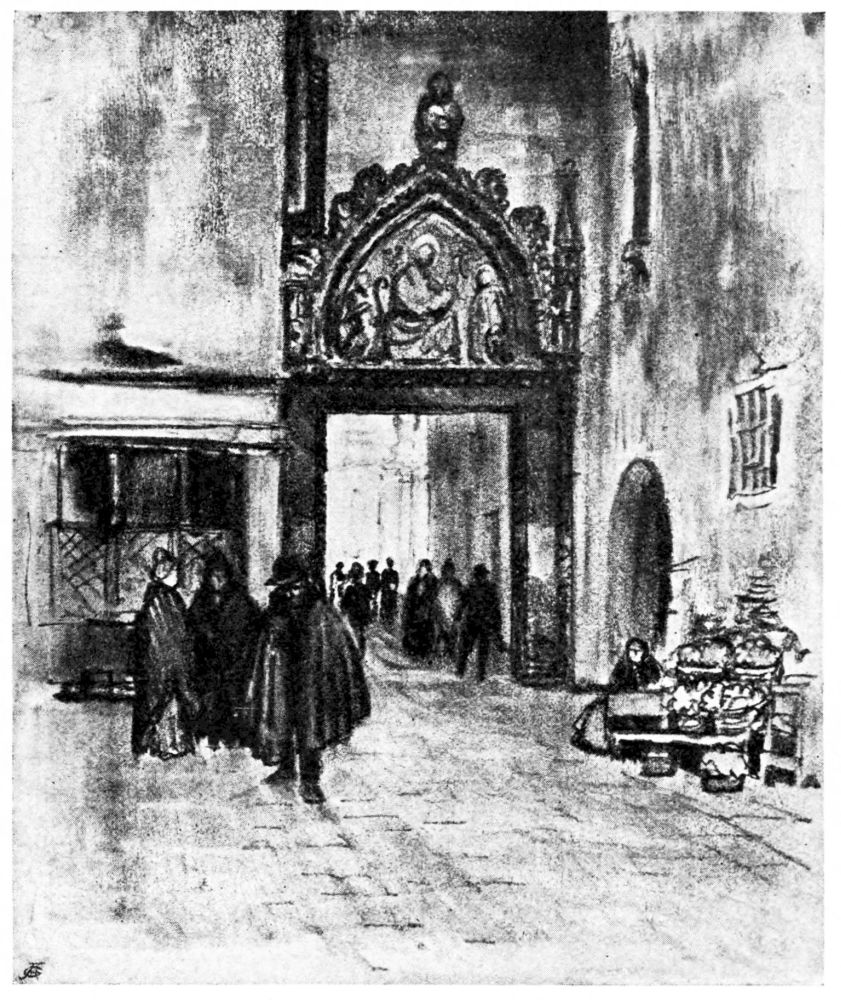
ENTRANCE TO S. ZACCHARIA
was short of provisions when there was still a considerable store.
The impulse of conquest which had led the Turks so far was now almost exhausted, and when Mohammed the Conqueror died, the moment would have been favourable for driving the Turks out of the Archipelago, especially as the throne of the
1483. Defence of Brescia, Tintoretto; Hall of Great Council.
Osmanlis was disputed by a number of claimants. But Venice was exhausted by her many struggles, and the sovereigns of other European states were only too ready to sacrifice the interests of Christianity at large to
1484. Taking of Gallipoli, Tintoretto; ceiling, Hall of Great Council.
their private ends. The result was that the Republic, finding herself alone, made another ignominious peace with the Turks. But even now she had no rest, for she was at war with the Duke of Ferrara, who enjoyed the protection of the Pope. The latter exhausted every diplomatic means to induce Venice to withdraw; but the only result was that the Republic recalled its ambassador from Rome. Sixtus IV. now excommunicated Venice, and attempted to send notice of
1484. Victory of Vittor Soranzo over the men of Este, Tintoretto; Hall of Great Council.
the excommunication by the political agent whom the Venetian ambassador had left in Rome. That official, however, declined to take the message, and the pope sent a special envoy, who was to present himself at the palace of the Patriarch. But the prelate succeeded in avoiding him by feigning illness, so that official notice
1484. Defeat of the Duke of Ferrara, Francesco Bassano; ceiling, Hall of Great Council.
of the interdict never reached the Signory, a result which delighted the Venetians and proportionally scandalised all other Catholics. Venice gave formal notice to the Emperor, the King of France, the King of England, the Duke of Burgundy, and the Duke of Austria, that she appealed against the excommunication to a future council, and meanwhile no further attention was paid to the interdict. It was, in fact, removed by the next Pope, Innocent VIII., who had no especial reason for maintaining it.
The Republic had to deal at this time with internal troubles as well as external difficulties. It happened that two men of the same name and family were successively elected to be doges, and that the house in question was one of those known as ‘the new.’ For the aristocracy divided itself into two classes, of which ‘the old’ included only the families of tribunitian descent, who considered themselves vastly superior to all the rest. Nevertheless, the younger houses succeeded in keeping the ducal honour to themselves for more than two hundred years. In 1450 sixteen of these families had solemnly sworn never to allow the election of any doge from amongst the elder houses, and sixty-eight years had already passed since one of the latter had been chosen. On the death of Marco Barbarigo it was noised abroad that the old houses were about to make a determined effort to recover the desired dignity. Agostino Barbarigo was elected with some difficulty, and it was quite clear that there were now two hostile factions in the Venetian government which were more occupied with their party spites than with what concerned the welfare of the Republic.
It was a period of contradictions in Venetian history, for while the State seemed to be often gaining territory it was frequently losing influence and undermining the sources of its own wealth; and, on the whole, the loss during the fifteenth century considerably exceeded the profit.
It was at this time that Venice accomplished that remarkable piece of juggling which ended in the annexation of Cyprus.
b. 1454, d. 1510. Smedley, II. chap. xiv.
1489.
Finding of the relic of the Cross in the Grand Canal, said to contain the portrait of Caterina Corner, crowned, by Gentile Bellini; Accademia, Room XV.
Caterina Corner, or Catharine Cornaro, as we are accustomed to call her, was the niece of a Venetian noble who lived in Cyprus, and she had married Jacques de Lusignan, an illegitimate son of the last king of the island. Less than two years after her marriage, when she was about to become a mother, her husband suddenly died, bequeathing his kingdom to the child that should be born. The infant that came into the world was a son indeed, but only lived a few months, and as Catharine’s husband had grasped the throne by driving out his half-sister, who was legitimate, his widow now had great difficulty in maintaining her position against the rightful heir, whose name was Charlotte, and who was married to the powerful Duke of Savoy. Catharine had no choice but to place herself under the protection of Venice, and the Republic, as usual when it undertook to help a friend in distress, began by hoisting its own flag on the citadel. With great skill the queen was gradually forced, in the course of fifteen years, into the position of resigning her little kingdom altogether into the hands of the Republic. In exchange she was to receive a considerable income and an estate at Asolo, where she could keep up the forms of a small court, still retaining her royal title. She was brought to Venice, and was received with the utmost pomp and display, and she retired quietly to Asolo, to spend the rest of her life in the society of the most distinguished philosophers and men of letters of the century.
Venice laid hands on all possible aspirants to the throne of Cyprus, men and boys, women and girls; the latter were consigned to convents, from which they were only allowed to go out occasionally with an escort. The young men were closely watched and their expenses defrayed by the Republic, and the boys were educated to be good Venetians.
So Venice got Cyprus, and for the sake of that little possession the Republic appears to have sacrificed the opportunity of helping Columbus to discover America. The fact has been denied, discussed, and asserted again by historians, but a document has been discovered by M. Urbain de Gheltof which, if genuine, puts an end to all doubt. That scholar has found in a private archive in Venice the copy of a letter to a Venetian noble written by Christopher Columbus from Palos, just before sailing to discover America. I translate the short document, in which the simple character of the Genoese explorer finds full expression:—
Very magnificent Sir—As your Republic did not think it was to its interest to accept my offers, and as all the hatred of enemies conspired to thwart me everywhere, I threw
Urbain de Gheltof, Letter of Christ. Col.
myself into the arms of the Lord my God. And He, by the intercession of His Saints, brought it about that the most clement King of Castile, in his generosity, should help me to carry out my plan of conquering a new world.
Thus, praise be to the Lord my God, I obtained command of vessels and men, and I am presently going to sail towards this yet unknown land which God inspires me to seek. I thank you for all your kindness to me, and beg you to pray for me.
Columbo Crist.
Written from Palos, August 1, 1492.
The Venetians may not have very deeply regretted their refusal to help the Genoese navigator, but they were made to suffer acutely by the Portuguese discovery of the route to India by the Cape of Good Hope. For Portugal now imported by sea direct to Lisbon the rich merchandise of the East, of which the Venetians had hitherto enjoyed a monopoly, but for the passage of which they paid heavy duties to the Sultan. The supremacy of Venetian navigation was over, and a more daring race of seamen ventured voyages in distant and unknown oceans whither they were not followed by the old-fashioned mariners of the Mediterranean. It was in vain that the Republic proposed to the Sultan Bajazet a commercial alliance by which both powers might have profited; the Turk could not understand that the ruin of Venetian trade must impoverish the whole Archipelago and Constantinople itself. Instead of an alliance, a renewal of hostilities ensued, in the course of which Lepanto fell into the hands of the Turks, either because the garrison was insufficient or because the Venetian admiral,
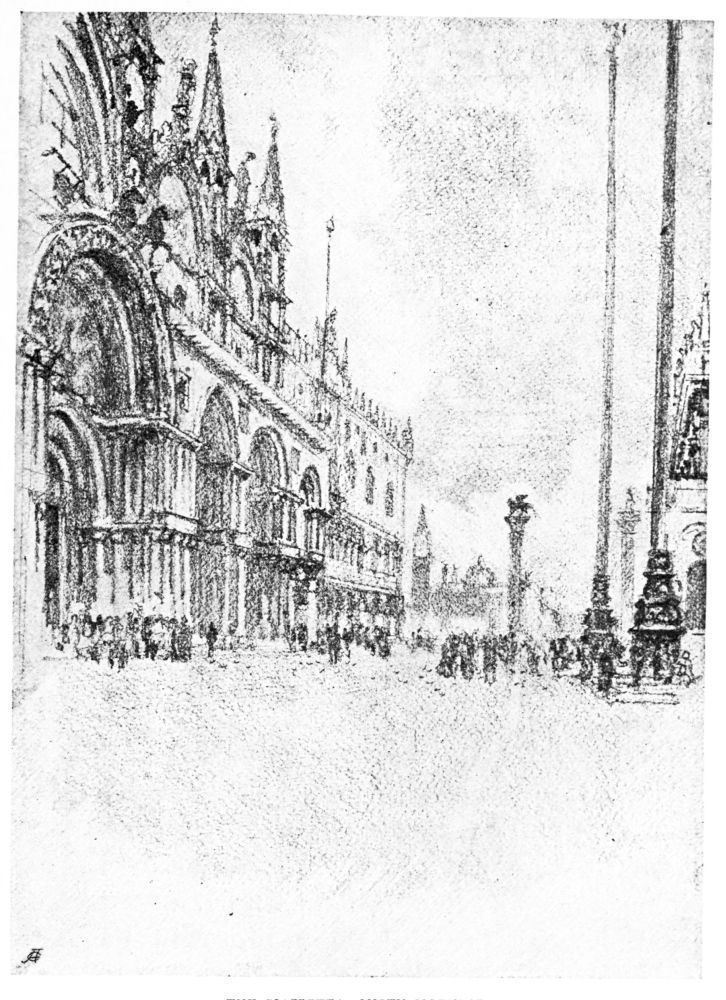
THE PIAZZETTA, MISTY MORNING
Grimani, was not equal to the service required of him.
Marin Sanudo, III. chap. iii. 105.
He shared the fate of almost all native-born Venetian commanders, and was brought home laden with chains so heavy that he could not have walked across the Piazzetta from the landing-place to his prison if he had not been held up by his son, who was a Cardinal. He was confined in one of the worst cells, surnamed ‘Forte,’ the Strong, and his sufferings were such, according to Sanudo, who kept his journal at the time, that the Cardinal appeared before the Signory one day to beg, as a favour, that his father might be executed rather than made to die by inches in his dungeon.
The people, as often happened, were quite of the opinion of their masters, that to be beaten in fight was a shameful crime, and a savage song about the unlucky Grimani was bawled in the streets—
Antonio Grimani, ruin of Christians, rebel of Venice! May you be eaten by dogs, By dogs and their pups, You and your sons, Antonio Grimani, ruin of Christians!
But it was of small use to torment the poor man and to make songs upon him. Venice was forced to make a commercial treaty with the Portuguese, to save herself from ruin.
Then came Charles VIII. of France and descended into Italy with fire and the sword, and Venice was drawn into new and disastrous Italian wars. So ended the fifteenth century.