VII THE FOURTEENTH CENTURY IN VENICE (continued 2)
Reading edition
Friends of the two great families began to meet in the Cà Grande, which was the palace of the Quirini. Marco made a speech, which to modern democrats might seem a model of justice and patriotism, in which he did not fail to prove that he was not impelled to take arms against the head of the Republic by any motive of personal grudge or private ambition, but that he was driven to extremities by the unwise policy of the government and the extremely unjust laws which were being promulgated to the destruction of the public liberties. A sort of report of this speech is still preserved in the library of Saint Mark.
Tiepolo, at once more frank and more persuasive, replied to the words of his father-in-law, explaining clearly that it was their joint design to give the Republic a doge acceptable to the people and capable of restoring to the latter their original and ancient rights. It is possible that the meeting might have determined to take arms openly at once, if old Jacopo, another of the Quirini, a man of wise counsel and of little personal ambition, had not replied to these first two speeches by attempting to persuade his hearers that they ought to desist from what was a criminal attempt, and from bringing about the calamities of bloodshed. This Jacopo was about to leave Venice as ambassador to Constantinople. The conspirators, who respected him, but had not the slightest intention of accepting his advice, pretended to yield, putting off the moment for action until after his departure. When he had left the city, they made every arrangement for carrying out their revolutionary plans at dawn on Sunday, June 14, 1310.
During the night the conspirators were to meet in the Cà Grande in small detachments. In the palace arms sufficient for all were hidden, with a flag upon which was inscribed the word ‘Liberty.’ Marco Quirini and his sons, Niccolò and Benedetto, were to go to Saint Mark’s by the Calle dei Fabbri and the Bridge dei Dai, with a number of armed men; the other conspirators were to enter the Piazza from the Merceria, under the leadership of Bajamonte. For some time past Badoero Badoer had been in Padua and its neighbourhood gathering a desperate band, and on the appointed day he and his men were to be ready at the palace of the Quirini. The plan was boldly conceived, and there was no small likelihood of its success. But one of the conspirators, a burgher named Marco Donà, lost courage at the last, or suffered himself to be seduced by promises of rich reward from the Doge, including his admission to the nobility. Early in the night he entered Gradenigo’s apartment, and revealed everything to him. The Doge did not lose his presence of mind for an instant, but gathered round him his counsellors, the Lords of the Night, the heads of the Forty, and all his friends; every man then quietly armed his servants, thereby gathering together a large number of defenders. At no great distance from the palace was the Arsenal, where there were a great number of artisans of every kind employed in the construction of ships, and these men, both from their intelligence and honesty, represented the pick of the Venetian lower class. They composed the bodyguard of the Doge, and had the right to assist at all public ceremonies, their chiefs having the privilege of entering the palace freely. These men slept in the shipyard by turns, and were always ready at the call of their ‘provveditori,’ who were three nobles elected at intervals of thirty-two months for the direction and administration of the
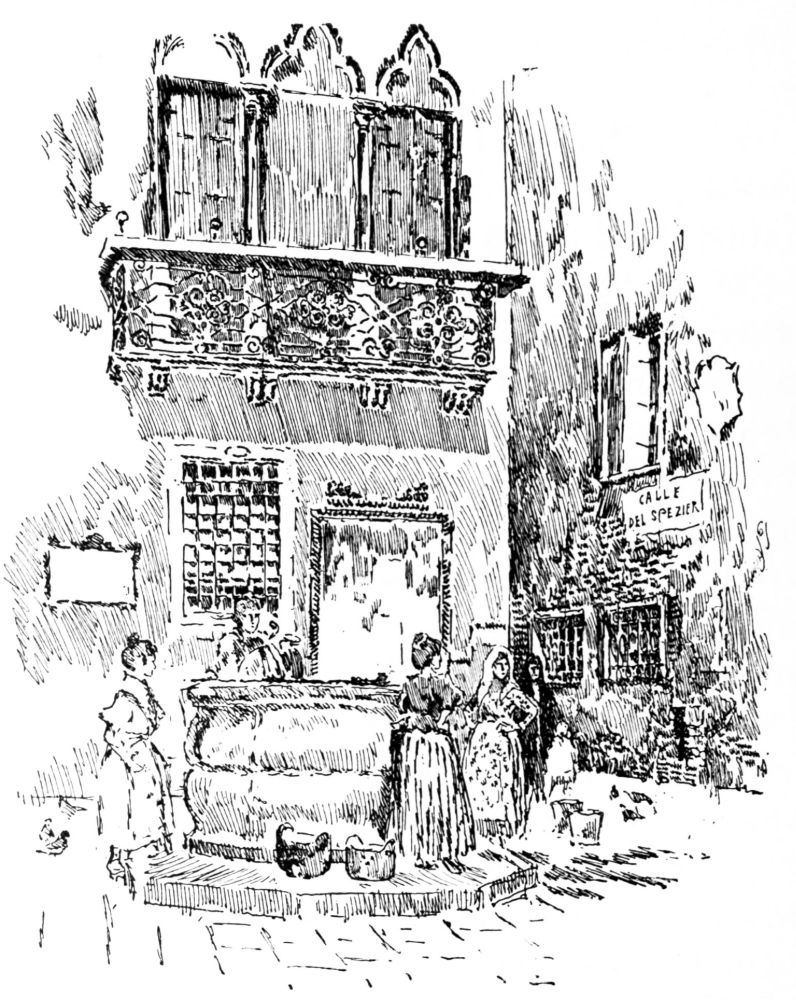
CALLE DEL SPEZIER
Arsenal. With such forces at his command, it is perhaps not surprising that the Doge was not intimidated by the conspiracy. As soon as he was assured of being defended by his servants and the workmen, he sent messages to the Mayors of Chioggia, Torcello, and Murano, with orders to arrest the conspirators who were to enter Venice under the guidance of Badoer. At the same time the members of the School of Charity and many of the guild of painters took arms to watch the entrance to the Piazza.
Meanwhile the conspirators made their way through a tempest of rain and wind to the Quirini palace, and arms were distributed to them; Badoer, however, did not come, and his absence was attributed by his friends to the storm. Without waiting for him they went out at dawn, during a terrific thunderstorm, crying ‘Death to the Doge Gradenigo!’ The Quirini, following the direction agreed upon, came out at Saint Mark’s by the Bridge dei Dai, which thereafter received the name of ‘Ponte del Malpasso’ (the Bridge of Evil Crossing). But instead of finding the Square deserted, as they had expected, they were assailed by a strong contingent of armed men. Marco and his son Benedetto were soon killed; the other son, Niccolò, was wounded, and he probably obtained on that day the surname of ‘the Lame,’ which he ever afterwards bore. The remaining conspirators now scattered, to meet again soon afterwards in the Square of Saint Luke, where they were again defeated by the guild of painters. Meanwhile Bajamonte was coming down towards Saint Mark’s from the Merceria, and in order to gather his followers together he halted at the knot of elder-trees, where it was the custom to tie up the horses of the councillors on the days of assembling. Here, by chance or by intention, a woman of the people, who lived in a little house overlooking the trees, dropped from her window a stone mortar, or the stone of a hand-mill, which killed Bajamonte’s standard-bearer. The banner inscribed with the word ‘Liberty’ was dashed to the ground, and Tiepolo’s men fell into such confusion that he had great difficulty in taking them back to the island of Rialto, burning behind him the bridge which connected the island with the rest of the city. A regular siege now followed, the insurgents defending themselves with the courage of despair; and they might even then have been victorious if Badoer had been able to reach Venice and to take the Doge’s forces in the flank, but Badoer, with a great number of his rebellious companions, had been taken and thrown into prison early in the morning, having been caught on his way to Venice by the Mayor of Chioggia, who was a Giustiniani. Tiepolo now held his own upon the island of Rialto, where he had entrenched himself; but the Doge, in order not to prolong the bloodshed of a conflict between citizens, wished to prevail by some gentler means, and promised all the rebels their lives, provided they would submit, throw down their arms, and quit the territory of the Republic. The negotiations were first attempted by some Milanese merchants, and then by Giovanni Soranzo, who, as the father-in-law of Niccolò Quirini, the latter having married his daughter Soranza, seemed to have a better chance of being heard; but it was in vain. Tiepolo continued to resist with mad obstinacy, and preferred anything rather than submission; until at last one of the counsellors of the Doge, a certain Filippo Belegno, succeeded in bringing about an understanding. Tiepolo consented to retire from the island of Rialto, and to go into an exile which was to last four years ‘in the Slavonic countries beyond the island of Zara,’ but not in any country that was hostile to Venice; his noble followers were also to be exiled during four years, and might reside in any part of Italy that was outside the Venetian territories, but not within the territories of Padua, Treviso, or Vicenza. They were informed that if they were found beyond the limits to which they were assigned they should pay for the indiscretion with their lives. By a decree of the Great Council their wives were ordered to follow them into exile, and were instructed to leave Venice within eight days. The other conspirators, i.e. the servants of the nobles, and those who were considered less responsible, were pardoned on condition that they would submit and lead quiet lives. Thus of all those who had taken part in the revolutionary movement, only Badoer and his friends were in the hands of justice on the evening of the fatal day. When, according to the custom of the times, they had confessed their crime under torture, Badoer was beheaded, and the rest were all hanged between the columns. One-third of the Quirini family property having been claimed by Giovanni, who had taken no part in the conspiracy, the remaining two-thirds of the Quirini palace on the Rialto were demolished, the share in the Cà Grande being allowed to stand which had been Giovanni’s; but lest it should remind posterity of the greatness of the family, the Republic bought out his third part and turned it into a place for raising and killing poultry.
It is a singular circumstance, but quite authentically recorded, that the government was just then without sufficient funds to pay Giovanni for his share in the house, and it was actually proposed to pawn the city’s silver trumpets, which were used in all public solemnities. The government, however, succeeded in raising the sum in a more dignified way.
Lazzari Guida, 171.
The house of Bajamonte Tiepolo, at Sant’ Agostino, was levelled to the ground, and on the spot a column recorded the traitor’s infamy. This space is still open and desolate in our own time, after a lapse of six hundred years.
The column was set up in 1314, and it bore the following inscription, which is one of the most ancient specimens of Venetian dialect. It is in the form of a rhymed quatrain: ‘This ground belonged to Bajamonte, and now for his infamous treachery it has been turned common, that all may look upon it now and ever, and be afraid.’
Cecchetti, Dubbii.
It is not long since writers of democratic tendency still attempted to make Tiepolo seem a martyr to liberty. The Provisional Government of Venice, on July 13, 1797, invited the citizens to restore to honour the memory of those heroes, born in times of tyranny, who had fallen victims to their own generous efforts, and much more in the same manner. It was proposed to set
Rom. iii. 39, note 2.
up a statue to Tiepolo, as well as to the proto-martyr, Marin Bocconio; but in the end, even the democratic government was obliged to concede that its hero had been nothing but a seditious egotist, and the name of Bajamonte has not lost the odium it deserves even to our own time; for in spite of his standard blazoned with the word ‘Liberty,’ he had really meant to seize the government of his country and to make the dogeship hereditary in his family. After the conspiracy the public feeling against the Tiepolo and Quirini families was so strong that those branches of the Tiepolo which had remained faithful to the republic changed their coats-of-arms. The innocent branches of the Quirini, however, resorted to an expedient which is quite unique in heraldry, so far as I know. In Italian ‘bono’ means ‘good’; the Quirini simply charged their coat with a capital B, to show how good they had been!
Marco Donà, the man who had revealed the plot, was rewarded by being admitted to the Great Council, and his name was inscribed in the ‘Golden Book,’ making the honour hereditary. The woman who had killed Bajamonte’s standard-bearer, and whose name was Rossi, on being asked what reward she would prefer, requested to be allowed to fly the standard of Saint Mark from her window on the day of Saint Vitus (June 15), and on the other solemn festivals of the year; and that neither she nor her descendants should ever be required to pay a higher rent for the house in which she lived, and which belonged to the patrimony
Fulin, Arch. Ven. (1876), and Soranza Soranzo.
Molmenti, Dogaressa.
of the Basilica of Saint Mark. There exists under date of the year 1468 the protest of a certain Rossi, her descendant, whose rent had been raised from fifteen ducats to twenty-eight. He won his case. The house is called in our own time the ‘House of the Miracle of the Mortar.’ It is in the Merceria, at the corner of the Calle del Cappello. The standard which Lucia Rossi used to display at her window is preserved in the Correr Museum.
The Rector of the guild of painters also received special honours, as well as the brethren of the Carità, who had lent armed assistance.
One might be surprised at the lenity with which the Republic judged the ringleaders of the Tiepolo-Quirini conspiracy; but it must not be forgotten that the conspirators, entrenched on the Rialto, were beyond the Doge’s power, and still threatened the safety of the city and of the Republic, which was no doubt glad to be rid of them at any price. Moreover, we have record of a pitiful episode, which shows that the Venetian government could be severe to cruelty without necessarily employing the executioner.
Among the nobles who went into exile beyond Zara after the affair at Rialto was Niccolò Quirini, Marco’s son, surnamed ‘the Lame.’ His wife, who was, as we have said, the daughter of Giovanni Soranzo, joined him in his exile. At the end of four years, says Molmenti, she felt an irresistible longing to see her family again, and asked permission to return home, but it was not granted to her. Her father, however, had been made Doge in 1311, and she began the journey, trusting to his influence. No sooner had she reached Venice than she was arrested and condemned to perpetual confinement in the convent of Sta. Maria delle Vergini, in one of the most distant districts of the city.
Galliccioli, vi. 58.
Giustina Renier Michiel, Origini ii. 73.
In connection with this story it should be noted that the convent in which she was imprisoned was not one of cloistered nuns. Until the end of the fifteenth century they bore the title of ‘canonesses’; they were under the government of an abbess, but took no solemn vows, wore no veils, and could even leave the convent and marry. The convent itself was under a sort of tutelage of the Doge. It had been founded and endowed at the beginning of the thirteenth century by the Doge Pietro Ziani, together with a church dedicated to the Virgin Mary, and became the common residence of many noble ladies, and of many noble girls who were educated there. The Doge conferred the investiture upon the abbess, according to the custom of those times, by means of a golden ring, and once a year he went to visit the convent. This was in the month of May; and after hearing mass the Doge went into the parlour, where the abbess received him, being dressed in a magnificent white mantle, with two veils upon her head, one white and the other black. She presented the Doge with a small bunch of flowers, set in a golden handle, for which the Doge expressed his thanks in a set form. The Doge Soranzo must have gone through this function many times while his own daughter was a prisoner in the nunnery, and not allowed to assist in the ceremony. The old building of the Vergini was destroyed by fire in 1375, but was restored with greater splendour than before as a place for educating noble Venetian girls.
It must not be supposed that the convent had barred windows, nor that there were gratings at the parlour door, from behind which the novice never returned again to the outer world. Gratings and bars and the strict cloister were not introduced into the rules of Italian nuns until much later, when the Church was obliged to check the grave abuses which had gradually crept into convent life. In the time of Soranza, and particularly in the convent of the Vergini, there was much freedom, and any reasonable excuse was admitted for allowing the canonesses to go out into the city; they not infrequently visited their relations, and even stopped with them in the country.
Soranza had been placed in custody in a little house that was built against the wall of the convent; its door had two different keys, one of which was given to the abbess, and the other to the housekeeper sister, so that the two were obliged to enter together, and while guarding their prisoner they watched each other. Soranza was allowed one woman servant, who was allowed to go out in order to wash linen, but she was warned that she would be condemned to a heavy fine if the smallest bit of writing were ever found upon her.
Four years Soranza languished uncomplaining in her narrow dwelling. Then she appealed to the Council of Ten for permission to walk in the convent garden. The Council allowed her this liberty for only four months. Fearing that it would not be continued to her she wrote again before the term expired, to beg that it might be extended, representing that she could not live without a little air; and the Council made the permission permanent.
At last it was known that Niccolò was dead, stabbed by an unknown hand, and Soranza was a widow; nevertheless, for the sake of the name she yet bore, the Republic still treated her as a prisoner. Amongst the archives of the Council of Ten are found more than sixty documents concerning her, and there are letters from her entreating to be allowed to visit her father, the Doge, at the ducal palace, or to go and take care of a sick friend. Sometimes she obtained what she asked, sometimes the most innocent indulgences were refused her, and it is clear that the Republic did not mean her to think that she could have anything otherwise than as a special favour.
When Soranza breathed her last in the little house that had been her prison, she had occupied it for twenty-five years. During the last ten years, however, the wife of Andreolo Quirini was confined with her.
She was not the last of those unhappy ladies who had been exiled with their husbands. In 1320 a man called Riccio arrived in Venice, bringing the head of Pietro Quirini who had been treacherously assassinated by an ‘unknown’ hand—possibly the hand of Riccio himself, who brought the victim’s head in order to claim his fee. Pietro left a widow, still young, who at once asked permission to come home to Venice. She was told plainly that if she had no children and expected none she might return, but that otherwise she must remain in exile ‘at the disposal of the Ten.’
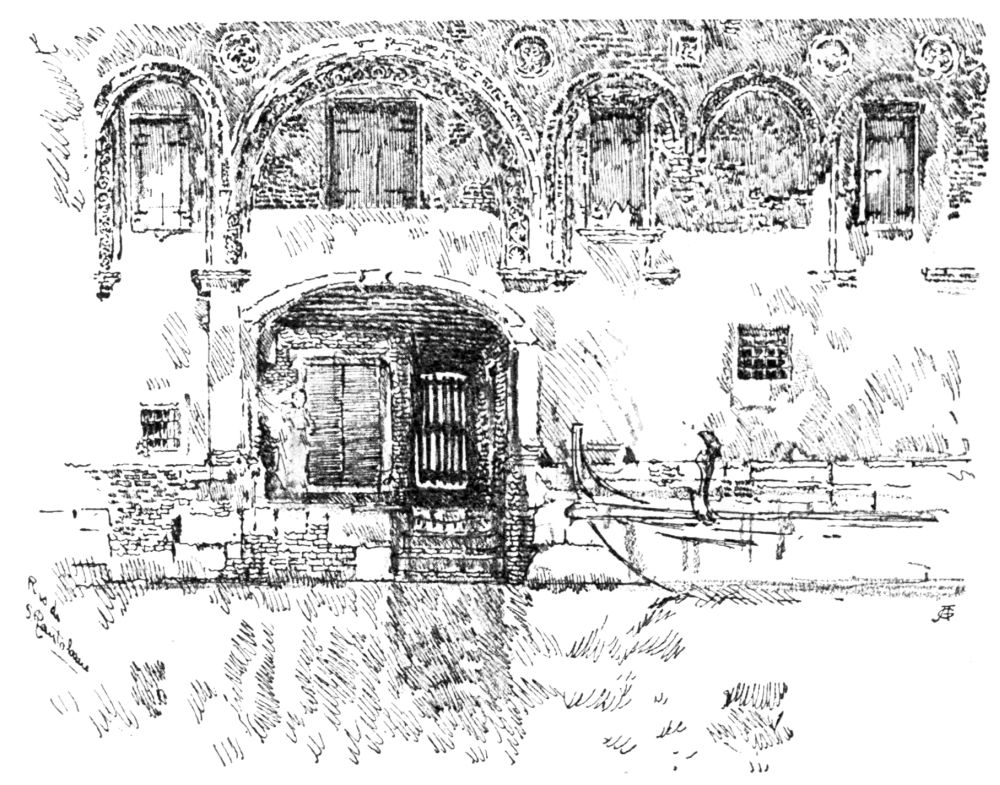
RIO DI S. PANTALEONE
In the following year another Niccolò Quirini died abroad, and his widow was allowed to return on condition of living in a convent, never to go out without permission of the Council of Ten. She had in Venice a devoted admirer, one Angelo Bembo, who obtained permission to have her placed in the convent of Santa Maria di Valverde, on the island of Mazzorbo, a lovely and retired spot, where seclusion would be more bearable than in the city. The young widow seems to have made good use of her stay there, for the papers in the archives of the Ten which concern her contain the information that she soon afterwards married her friend, and was allowed to return to the world. She had recovered all her liberty by the mere change of name.
As some justification for this excessive rigour on the part of the government, it should be remembered that the exiled Tiepolo and Quirini families had never ceased to plot against the Republic after their defeat, both in the countries where they were allowed to live and in Venice itself, by means of agents. A letter of the Council of Ten confers upon Federigo Dandolo and Marin Falier full powers to get rid of the obnoxious Bajamonte, in any way they might, for the good of the country. The note is dated in 1328. From that time forward his name was never pronounced in council, nor mentioned in any document; and it may be supposed that he, like Niccolò Quirini, came to his end, murdered by some emissary of the Republic. The fact that we find no allusion in the subsequent history of Marin Falier to the part he possibly played in that side tragedy is not evidence that he failed to carry out his instructions.
Armand Baschet, Archives, 514.
A careful examination of early documents seems to show that the Council of Ten existed before the Tiepolo-Quirini conspiracy, which is generally held to be the circumstance which called it into existence. It is certain, however,
Rom. iii. 39 sqq., 52.
that in earlier times the Council had not such great importance, and it was always more or less a temporary affair until the year 1335. Ten magistrates, who were called together, on the occasion of the conspiracy, to form a sort of court-martial, gave their judgments, but by no means in an arbitrary manner. They were elected for a period not much longer than three months, which was to expire on Saint Michael’s Day, September 29, a day always kept as a great festival in Venice. But when that date was reached, it appeared necessary to prolong the time of their power, as their task was not yet finished; for it consisted not only in punishing the guilty, but also in closely watching the immediate consequences of the conspiracy. The same extension was granted again and again, until the following year, when it was determined to establish the tribunal for a term of five years, appointing its members anew, however, on every successive Saint Michael’s Day. These five years being passed, a further decree prolonged the tribunal’s existence ten years more, and so on. Finally, in 1335, it was decreed to be permanent, under an extremely strict code of rules called the ‘Rite,’ well devised for a body which was to treat of the very important affairs that came before it. On election, every member of the Ten took an oath, which included the
A. Baschet, Archives, 531.
following clauses: ‘I, as one of the Council of Ten, do swear upon the holy Gospels of God to act for the advantage and honour of Venice; and in good faith and conscience to advise our Lord the Doge and his
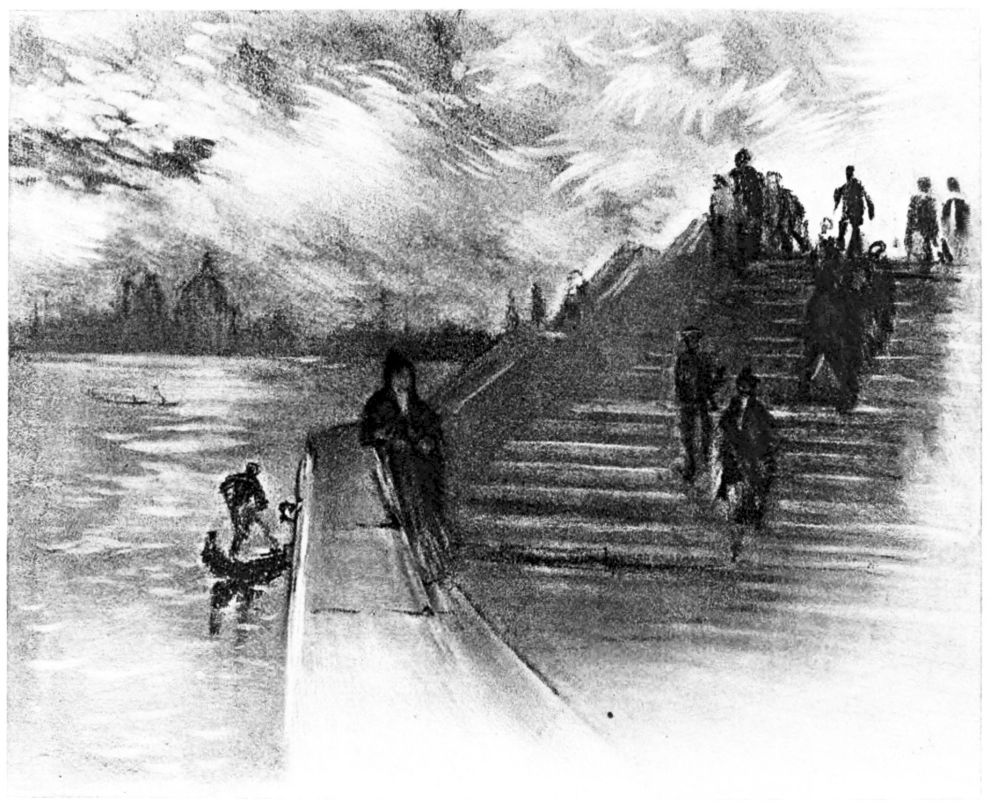
PONTE VENETA MARINA
counsellors such things as I shall believe useful to the honour and preservation of our country; and I swear to obey our Lord the Doge and to do what the heads of the Ten shall command me.... I bind myself to keep secret whatever is said or commanded to me, concerning all matters which may be proposed by the said Council, communicated or discussed in the sittings, and concerning any letters or reports which may be communicated to us, etc., etc.’
Rom. iii. 35 sqq.
The ordinary meetings of the Ten were held by day in the ducal palace; not in a room hung with black and feebly lighted, as some have written and believed, but in a hall appointed for that purpose by the Doge, until one should be properly furnished and decorated for the tribunal. Under extraordinary circumstances the Council also met by night. All sittings began with an invocation to the Holy Spirit. These sittings were never attended by the Ten only; from the time of the institution of the tribunal, the Doge and his counsellors, one avogador of the commonwealth and the High Chancellor, who, it should be remembered, was not a noble, were also obliged to be present. The imagination of posterity, amused by fantastic tales which have no historic basis, has lent this tribunal a character of mystery and arbitrary authority which it never possessed, as is proved by documents still in existence. In all trials, after the accusation had been read, the defence was heard immediately, and when the defendant was not able to conduct his own case, a law of 1443 allowed him to be represented by a
Rom. iii. 66, 68.
lawyer. The avogador put the following question to the Ten: ‘According to what has been read and said, is it your opinion that the accused should be condemned?’ Sometimes the following question was asked: ‘Is it your opinion that the accused, in consequence of what has been already heard, should be put to the torture, in order to obtain from him the whole truth, and further details; or that the court should proceed, as having already sufficient proof of his guilt?’ The Council of Ten could not impose fines; their sentences necessarily affected the body of the condemned person. When a vote had decided that the accused was convicted, each member of the Council could propose the punishment which he thought fit, but it was not usual to propose any more severe penalty than that asked for by the avogador. He was the first to make the proposition, then came the heads of the Ten, then the Doge’s counsellors, and last of all the Doge himself. Each proposal was balloted for, every member of the Council retaining the right to propose a diminution or commutation of the sentence, or to ask for a new trial.
We know that the Council of Ten had a fund for secret service, ever since the fourteenth century. It also possessed a small armoury.
It cannot be denied that on more than one occasion the execution of the verdicts of the Ten was performed quickly and in a secret manner; yet it does not appear that this was done because the sentence had been passed from any motive of private hatred or vengeance, but only because prudence required that the public should not be allowed to express an opinion on the matter. It may be remarked that in European countries the procedure nowadays is often similar in court-martials. If we take away the right of torture, the violet cloaks and hoods of the seven, and the red hoods of the three chiefs—in a word, if we erase from the picture the mediæval setting of the Council of Ten which looks theatrical to us, we may find that after all there is not such grave cause for accusing the famous Venetian tribunal of arbitrary cruelty. The proceedings of a military court-martial in our own times are often quite as secret and expeditious, and much more summary.
The manner in which the members of the Council were elected shows clearly enough that the abuse of authority was always feared on their part. In the year 1310 it was decreed that no two persons who were relatives might sit together in the Council, and that when a relative of any member was to be tried, that member should be excluded from the sitting. The members soon ceased to be elected on Saint Michael’s Day; and in order that greater prudence might be exercised in choosing them, they were elected one at a time at the meetings of the Great Council as each one’s term expired. Until 1356, when a place was to be filled, two candidates were proposed, and sometimes there were even three nominations. No member of the Council of Ten might receive gifts under pain of immediate death, nor was any salary attached to the office. At the end of their term they went back into private life, and were not protected in any way from such accusations as might be brought against them for their actions during their administration.
Rom. iii. 57.
Nearly fifty years after the date of the Tiepolo-Quirini conspiracy, August 9, 1356, a number of rules were introduced, to increase the severity with which the powers of the Council of Ten might be exercised, and at the same time to ensure justice in their dealings with criminal cases. It is amply proved by documents of the fourteenth century that in the majority of cases, though possibly in those which were considered of minor importance, there was neither mystery nor secrecy about the meetings of the Ten, and that, on the contrary, the door of their place of meeting was sometimes open to the public. No other meaning can be attached to the law of 1575, which was passed in order to limit the too great facility of ingress to the hall of their meetings, on the ground that the proceedings might be prejudiced by too much publicity, as they were constantly interrupted by the persons present, so that practically any one might watch the trials, as Romanin says, even in cases of the highest importance. There was never at any time the least tendency to diminish the legal character of the tribunal in order to confer upon it an arbitrary power, since it disposed of weapons so powerful as to place it above the need of intrigue. As has been said, although the Ten were all chosen from the nobility, the High Chancellor was present at the sittings, albeit he had no right of voting, and his presence alone sufficed to remind the councillors that the citizens, whose chief representative he was, were all witnesses of whatsoever the Ten accomplished. On the whole, M. Baschet is right in saying that the Council’s activity was chiefly exercised against the nobles themselves for the protection of the people.
Rom. iii. 54, note 3.
It undoubtedly disposed of great powers, and no one could expect a tribunal to be infallible in those times, or perhaps in any other; but though the Ten were no doubt sometimes guilty of grave mistakes, they were never at any time the instrument of a tyrannical government for oppressing the poor and innocent.
A. Baschet, Archives, 536. Rom. ii. 359.
They elected three heads every month, whose duty it was to conduct the affairs of the Council, to study the cases it was to try, and to see to the execution of its judgments. The Council had under its immediate control the executives of its justice, which consisted of a large force of police, controlled by six principal officers, and by the so-called ‘Missier Grande,’ who was the head of the whole body.
Rom. ii. 359.
The criminal and political prisons were under the special supervision of the Doge himself during the first half of the fourteenth century, and it was the duty or two or his counsellors to visit them once every month, and to make inquiry of the prisoners confined there concerning their wants and wishes. During the second half of the century this supervision and the duty of visiting became a part of the office of the heads of the Ten. I shall attempt to describe in passing the state of the prisons in which criminals and persons accused of grave crimes were confined in the fourteenth century, these only having been under the supervision of the Ten.
Rom. iii. 74.
Mutinelli, Less.
Rom. iii. 77.
In the first place, there were certain narrow but not unhealthy prisons in the tower which formerly existed at the east end of the ducal palace, and these were on the same floor as the hall where the Council of Ten met, and were called the ‘upper’ prisons. Accused persons were generally kept here during their trial. In 1321 an order was issued for the construction of the so-called ‘Lower’ prisons, which the common people afterwards called ‘pozzi,’ wells; and these were undoubtedly hideous and narrow cells, though probably not worse than those in use at that time in other countries. They are not below the level of the ground, or rather of the water, as novelists have described them; but the fact that criminals descended to them from the hall of the tribunal by means of a little staircase less than a yard wide, which soon became quite dark, and the sound of the lapping water outside, helped to give the prisoner the impression that he was being taken down alive into a tomb dug deep in the earth, although he was actually on the level of the courtyard. A small door in the wall of the courtyard was opened in 1407, in order that the family of Vittor Pisani might enter the prison when he was lying there ill, and it was afterwards closed at his expense. On the side of the canal was a
Rom. iii. 75.
corridor, little more than a yard wide, and faced with marble, through which escape was impossible. Upon this opened the doors of certain very small cells, marked with Roman numerals, in which, for some reason now impossible to explain, the ‘V’ was always turned upside down. The cells were completely lined with deal, but received air only from the dark corridor through an aperture in the door about eight inches square. The prisons on the other side, towards the harbour, had various names, among which we may mention that of ‘Mosina’ and ‘Liona’; then such names as ‘The Refreshing Joy,’ ‘The Vulcan,’ ‘The Strong,’ ‘The Lightless,’ and other similar epithets, probably suggested by the grim humour of the gaolers. Until 1357 the counsellors of the Doge went down into these places every month; and at that time the heads of the Ten inquired into the state of each individual prisoner, and gave an account thereof to the Doge and to the Council. There also the prisoner was allowed to speak, probably through the little aperture in the door, with his attorney, if he feared lest he should be unable to defend himself when called to justice. To this place came also at night the monk whose duty it was to comfort the last hours of such unfortunates as had received sentence of death, either by hanging between the columns of the Piazzetta, or, as frequently happened, at the place where the crime was committed, or in the cell, if the tribunal had decreed that the prisoner should be strangled. Sometimes, though more rarely, the sentence was this, ‘that to-night So-and-so be conducted to the Orfano Canal, with his hands tied behind his back and weights fastened to his body, and let him be drowned, and let him die.’
I shall have occasion to speak further of the prisons as they were in the sixteenth and eighteenth centuries.
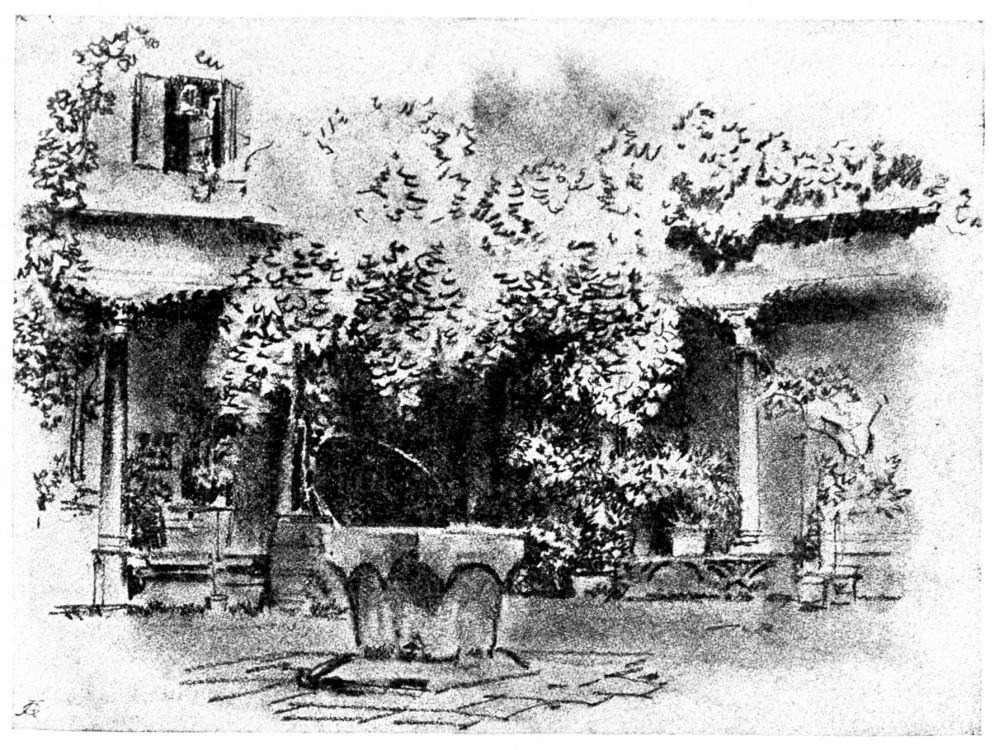
THE ABBAZZIA