XIV THE WAR OF CHIOGGIA
Reading edition
The long rivalry of Venice and Genoa has been sufficiently explained, and frequently alluded to in the previous pages. To give a connected account of the almost constant warfare waged between the two republics in Eastern and Mediterranean waters, from the Sea of Azov to Cape Corso, is beyond the scope and limits of the present work; for in order to understand the nature of the last tremendous struggle that took place at Chioggia, almost within sight of Venice, it is only necessary to recapitulate briefly those events which, during the latter half of the fourteenth century, led directly to the crisis—a crisis after which the vanquished aggressor retreated, definitely beaten and for ever humiliated.
At the outset I shall inform my readers that I have preferred the account given by Romanin to that of the more romantic Daru; for the latter evidently followed the older historian Sabellico, even into the regions of the fabulous, whereas Romanin writes largely upon the authority of Caroldo and of Stella, the latter a Genoese whose account of his countrymen’s disaster is above suspicion.
1345. Rom. iii. 152.
In the year 1345, a powerful Tartar chief named Zani Beg barbarously murdered certain Venetian and Genoese merchants established in the Crimea. For a short time this outrage united the two republics in a common desire for revenge, and they signed a treaty by which they mutually agreed to suspend all commercial relations with the Crimea—to ‘boycott’ the peninsula, as we should say. This was perhaps their only possible means of punishing Zani Beg for his wanton cruelty, since it is idle to suppose that two maritime nations could or would have carried war against a barbarian horde into the interior of such a country as the Crimea.
But the agreement had not been made with any sincere purpose, and before long the merchants of the two countries secretly resumed the trade, each trying to outwit the other. The result could not be doubtful; in 1350 the Genoese seized several Venetian ships with rich cargoes on the coast of Syria, and war broke out between the republics.
Rom. iii. 169.
The first two engagements, off Negroponte and on the Bosphorus, were disastrous to the Venetians, but the third, which took place off Lojera on the coast of Sardinia, resulted in an important victory for them; and the honour of the standard of Saint Mark would have been redeemed if Niccolò Pisani, the Venetian admiral, had not caused nearly five thousand prisoners of war to be drowned, a barbarity which accords ill with the man’s real courage, and would be incredible if it were not proved beyond the possibility of contradiction.
It was after this defeat that the Genoese Republic placed itself in the hands of Giovanni Visconti, Archbishop of Milan, the strongest of the Lombard princes. This extraordinary act was prompted solely by the desire of immediate revenge upon the Venetians, and Visconti was not slow to lend the required means for continuing the war, though he was cautious with regard to actual hostilities, and attempted a reconciliation by sending Petrarch as ambassador to Venice. The negotiations failed, however, and each republic sent out a new fleet; with extraordinary daring, Doria, the Genoese admiral, sailed up the Adriatic and ravaged Istria and Parenzo, threatening Venice itself, but retiring after inspiring something very like a panic. It was at this moment that the Doge Andrea Dandolo died, and that Marino Faliero was elected to succeed him.
On his side, Pisani, the Venetian commander, attempted no such undertaking. Deceived, doubtless, by Doria’s clever manœuvres, he sought him in the Archipelago, and thither Doria sailed, after his exploits in the Adriatic. The hostile fleets met off Modon, opposite Sapienza, and the engagement resulted in the
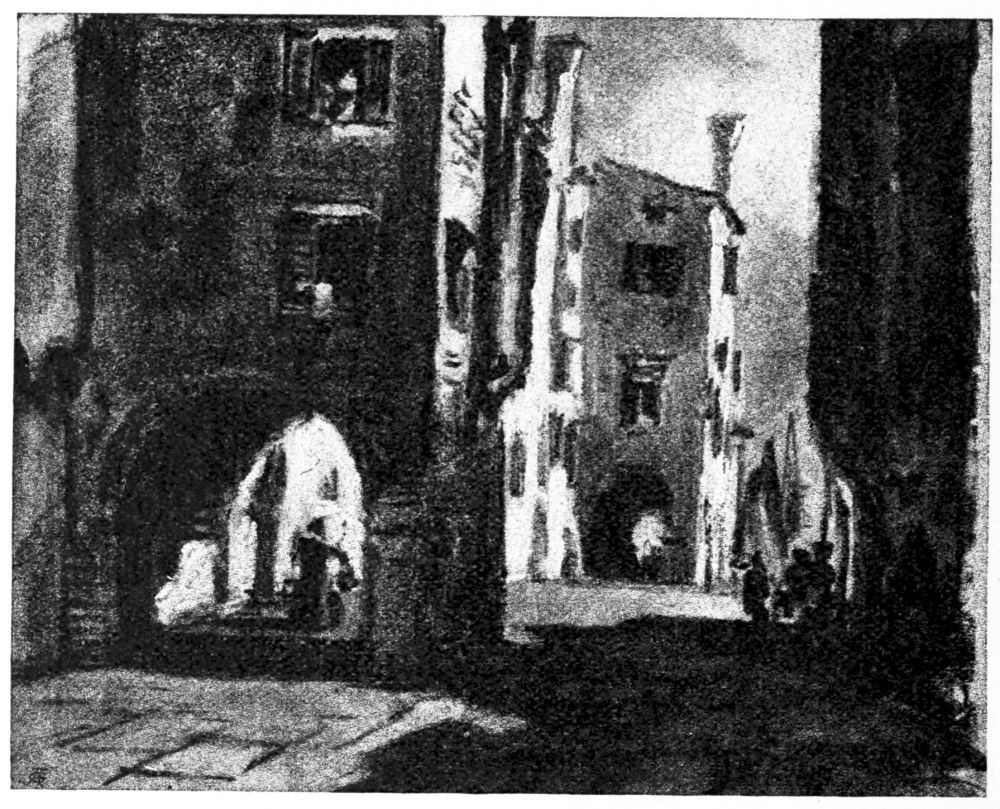
STREET IN CHIOCCIA
total defeat of the Venetians. Niccolò Pisani himself, six thousand other prisoners, and thirty galleys of war were carried off by Doria to Genoa; and it has been justly said that had he placed his prisoners in safety, manned his prizes, and sailed with them to Venice, the city must have fallen an easy prey to his attack.
By this disaster Venice was reduced to great straits, and while private citizens equipped men-of-war at their own cost, to help the country, the Republic appealed to Giovanni Visconti and obtained a four months’ truce.
The battle of Modon, or Sapienza, was fought on the third of November 1354; the truce was obtained soon afterwards, and on the sixteenth of April 1355 Marino Faliero was beheaded for treason.
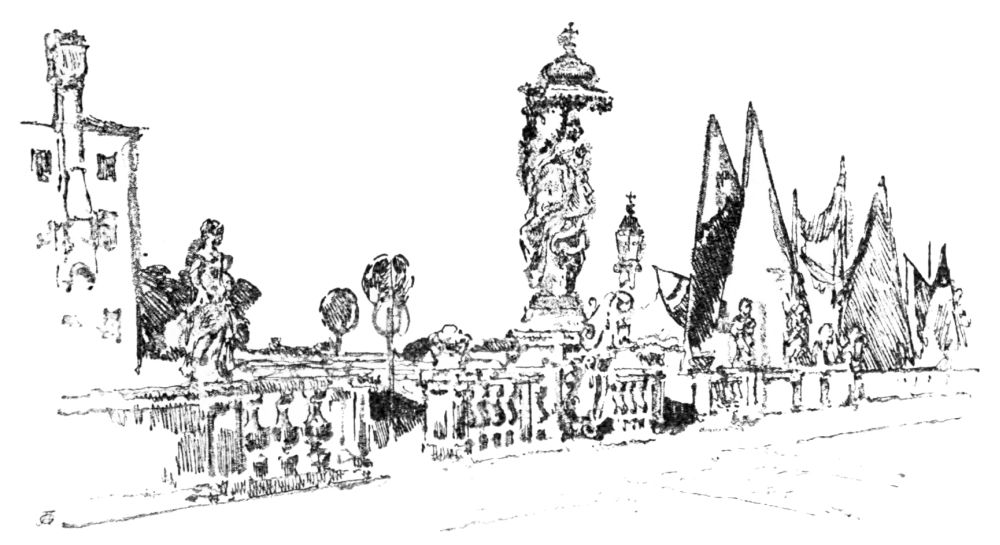
THE SHRINE AT CHIOGGIA
More than twenty years had elapsed and another and younger Pisani had reached maturity and eminence before the two republics again resumed the contest for the mastery of the sea. It would not, I think, be possible to accuse either of having been at any time more aggressive than the other had been, or was, without unfairness. There was an element of fate in the struggle; it was the inevitable contest for final superiority which takes place whenever two individuals, or two bodies of men, or two nations, are pitted against each other in the same pursuit under the same circumstances. The disastrous wars with Lewis of Hungary for the possession of Dalmatia, in which Venice became involved after the death of Faliero, the repeated revolts in Candia, and above all, the ravages of the plague, reduced the population and the wealth of Venice until, at last, she seemed an easy prey. Most assuredly the neutral powers that calmly watched the approach of the war which broke out in 1378 did not believe that Venice could come out of the trial still keeping her independence.
1378.
On the morning of the twenty-second of April in that year, a vast multitude thronged the square and the basilica of Saint Mark’s. Vittor Pisani was to receive his commission as commander-in-chief of the fleet at the steps of the high altar, to hear the solemn high mass, and then, kneeling before Andrea Contarini, he was to take from the Doge’s hands the great standard of the Republic.
The chief of the Republic spoke to him briefly in tones that rang through the hushed cathedral. ‘You are chosen by God,’ he said, ‘to defend the honour and the possessions of your country, and avenge the offences of those who would destroy the freedom which our fathers gave us. Into your hand we commend the flag that has ever been the terror of our enemies; see that you bring it back victorious and unstained.’
Vittor Pisani sailed out of the harbour with only
Rom. iii. 263.
fourteen vessels, intending to thwart any attempt on the part of Fieschi, the Genoese admiral, to enter the Adriatic. But the Genoese were still far away, delayed by contrary winds, and Pisani sailed round Italy to the Roman shore before he sighted the enemy’s fleet. The battle that followed was fought within sight of Anzio on the thirtieth of May 1378.
In a heavy south-westerly gale, which, as often happens in the Mediterranean, was accompanied by terrific thunderstorms, the Venetians bore down upon their opponents. They evidently had the advantage of being before the wind, while the Genoese must have been obliged to heave to in order to hold their own, a matter of no small difficulty for a war vessel of the fourteenth century. Yet in spite of their superior position at the time of the attack, four out of the fourteen Venetian galleys were so hopelessly separated from the rest as to be unable to join in the fight. Any seaman will at once understand that they must have run past the Genoese to the northward, and that they were then unable to beat back to the scene of action before night. On the other hand, one of the Genoese ships got aground on the dangerous lee shore and went to pieces.
The result of long and fierce fighting was a complete victory for the Venetians. They captured five of the enemy’s galleys and took Fieschi himself prisoner. He must have had gloomy forebodings when he was taken, remembering how Pisani’s terrible namesake had drowned five thousand prisoners of war after the battle of Lojera, or Cagliari. And the Venetian admiral doubtless remembered and hoped to atone
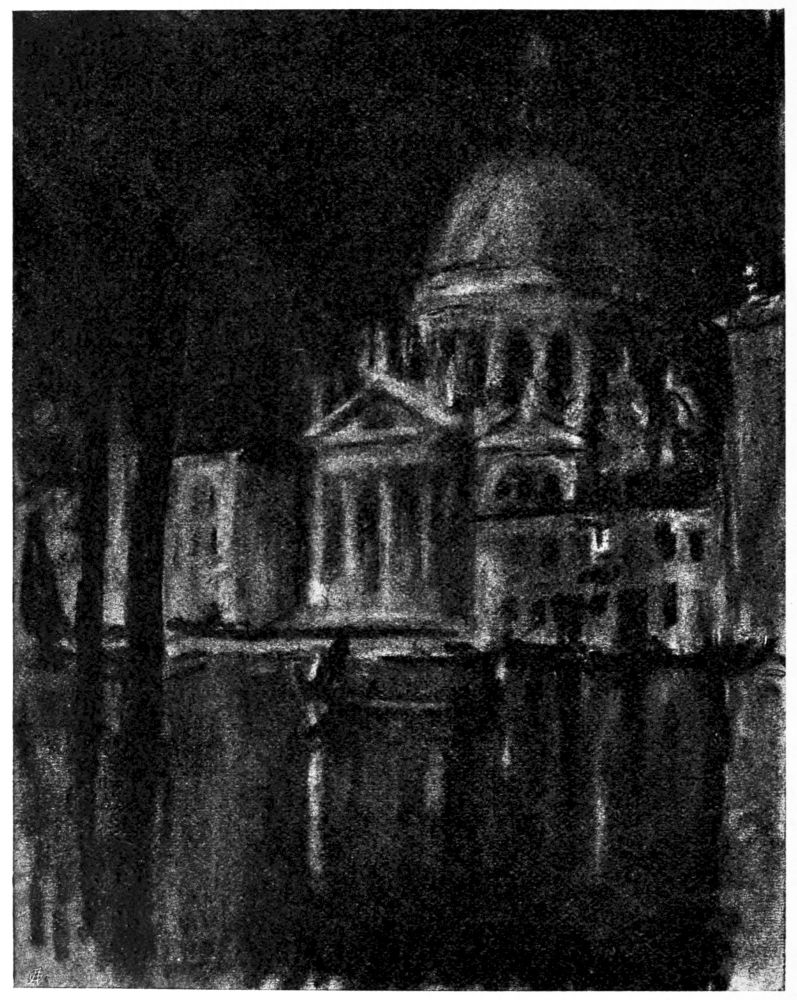
THE SALUTE, NIGHT
for that barbarous deed, for he treated his captives with every kindness; and even after they had reached Venice they were not confined in the prisons, but were merely shut up and guarded in vast warehouses, where they had plenty of air and were abundantly provided with necessaries. A committee of noblemen was deputed to take care of them, and to see that they lacked nothing. The ladies of Venice also organised themselves in a sort of sisterhood, for the purpose of ministering to the not over-great sufferings of the vanquished, and the noblest names of the Republic stand on the list of those charitable women. Anna Falier, Francesca Bragadin, Margherita Michiel, Marchesina Bembo, and several others are especially mentioned by the historians as ‘angels of goodness and devotion.’ All Venice sought to be forgiven by Europe for the horrors of Lojera.
Pisani had been far too prudent to push on to Genoa with a fleet which only counted nineteen sail, including his five prizes, and he deemed it wiser to return to the Adriatic and to harass the Genoese on the coast of Greece and Dalmatia, whence, under the protection of the King of Hungary, they constantly made piratical excursions against the Venetian merchantmen.
Storming of Cattaro, A. Vicentino; Sala dello Scrutinio. Rom. iii. 265.
After taking possession of several strong places, Pisani asked permission to return to Venice in order to rest his men and refit while waiting for the spring, but the Senate ordered him to continue cruising off Istria in case the Genoese should unexpectedly enter the Adriatic. There is no doubt but that this measure was prudent in itself, but, on the other hand, Pisani’s fleet was altogether in too bad a state to keep at sea through the winter, and in a more or less hostile neighbourhood. A sickness of some kind, not explained by the chroniclers, decimated the crews of his galleys, and he seems to have lacked suitable and sufficient provisions, as well as stores for repairing his rigging and sails. He obeyed the Senate’s orders, however, and he made his headquarters at Pola.
In February he was informed that he was confirmed in his charge of admiral of the fleet, but at the same time the Senate appointed him two advisers, or counsellors, following the true Venetian method of watching, and often hampering, the commander in the prosecution of the war. These ‘provveditori,’ as they were called, were the famous Carlo Zeno and a certain Michel Steno—whether the one who had precipitated the conspiracy of Marino Faliero twenty-four years earlier or not does not appear certain. At all events, he reached his post and remained with Pisani, but Zeno did not.
Later in the spring Pisani received a reinforcement of eleven galleys, sent him in order that he might be able to protect the Venetian vessels that regularly plied between Venice and Apulia to supply the Republic with corn.
While he was convoying a number of these vessels, a storm forced two of his galleys to take shelter in Ancona, where they were seized by the Genoese; but a few days later Pisani encountered the latter, beat them in a short engagement, and recaptured his ships. Scarcely had he got to anchor in the harbour of Pola, however, when twenty-five Genoese men-of-war hove in sight, under the command of Luciano Doria. Pisani could not reasonably hope to fight such a fleet with any chance of victory, and would have preferred to await the arrival of his reinforcements under Carlo Zeno, who was expected in a few days; but his officers clamoured for battle, and Michel Steno, the provveditor, even went so far as to hint that Pisani was a coward to stay in port. This was more than the admiral could bear, though he was the mildest and most long-suffering of brave men; and in the shortest possible time he got his fleet under way, calling upon all who loved Saint Mark to follow him.
I know not whether the wind gave him any advantage at first, as at Anzio, or whether the brilliant little victory he won was due to the fury of his attack. Be that as it may, he slew, or helped to slay, Luciano Doria with his own hands, and put the imposing Genoese fleet to flight.
But the enemy, in the absence of pursuit, soon rallied, and in a few hours inflicted upon Pisani a most disastrous defeat. He himself barely escaped with six galleys out of the nineteen or twenty that had composed his force. Poor in ships, as Venice was at that time, this was a blow that threatened her existence; for the Genoese now had nearly forty vessels, including the prizes recently taken, some of which were perhaps the very galleys they had lost to Pisani at Anzio.
How far Pisani’s misfortune was the result of the unwise advice he was obliged to submit to from Michel
Rom. iii. 268.
Steno, it is not easy to say; but he was certainly badly handicapped by the non-arrival of his other appointed counsellor, Carlo Zeno, with the promised reinforcements. The Senate took neither the one question nor the other into consideration, any more than it showed the slightest grateful recollection of his many former services to the Republic. He was hastily tried, convicted of having failed to do his duty, and sentenced to six months’ imprisonment, with the loss, during five years, of all emoluments he received from the State and of all public office for the same period. Venice always acted on the principle that no amount of success could condone one failure, and that defeat was next door to treason. Michel Steno fared somewhat better, for he was not actually imprisoned, but he and all the officers of the fleet were suspended from all public functions for a year.
These drastic measures did not improve the position of the Republic in that time of immediate danger. It was easy to consign Vittor Pisani to the pozzi, but it was quite another matter to replace him, especially in the absence of Carlo Zeno, the only other man of the same calibre upon whom Venice could count.
Pietro Doria had taken the place of Luciano, whom Pisani had killed in battle, and he worked his way steadily up the eastern coast, retaking one by one all the fortified places which Pisani had recently seized, until at last his fleet appeared off the Lido, literally within sight of Venice.
The consternation was indescribable, and it is more than likely that if Pietro Doria had boldly forced the entrance to the lagoons, the city would have fallen an easy prey. Indeed, the situation of the Republic seemed even then almost desperate, for while she was beaten at sea and assailed by the Genoese fleet, the Carrara had leagued themselves against her with the King of Hungary, and threatened her land boundaries on the north and west.
But it always happens in the history of nations, as it generally does in the private lives of individual men, that the last extremity of danger calls forth the true character of peoples, as of persons. It is then that the hero is a hero; it is then that the coward performs miracles of speed in flight.
Venice called out every man able to bear arms. A patrician, Leonardo Dandolo, was entrusted with the defence of the Lido; two others were charged with the protection of the basilica of Saint Mark’s and the adjoining square; another was made responsible for the quarter of the Rialto; and others again were told off to defend the outlying islands, Torcello, Murano, and Mazzorbo. Finally, Jacopo Cavalli, a foreign captain, was promised a very large recompense if he could perform the almost impossible feat of defending the Venetian territory on the mainland with four thousand horse, two thousand footmen, and a not inconsiderable number of bowmen.
The monastery of Saint Nicholas on the Lido was converted into a regular fortress. Three huge hulks, which I conjecture to have been old transports from
Rom. iii. 268.
the days of the crusades, were lashed together with triple chains, and sunk at the entrance to the lagoons. As far as possible all the male inhabitants of the city were armed, and were so organised as to be ready to fight whenever the great bell of Saint Mark’s should give the signal.
Meanwhile ambassadors were sent one after the other, and in haste, to the court of Hungary in the hope of detaching the King from his alliance with the lords of Padua, but they utterly failed to bring about the desired result; for both the Carrara and the Genoese spread abroad in Buda the report, by no means exaggerated, that Venice was at the last extremity, and must soon yield to her allied enemies; and the King, trusting to this welcome news, answered the Venetian ambassadors with such arrogance that they had no choice but to take their leave.
Rom. iii. 273.
The Genoese fleet lay at anchor off the Lido, and the only chance of safety seemed to lie in attacking it boldly, for as yet it consisted of no very large number of vessels. Six good Venetian ships of war, manned by picked men, would no doubt suffice, and these could still be produced. They were placed under the command of Taddeo Giustiniani, and they sailed out through the narrow channel that had been left navigable.
Now it chanced that on board of one of the Genoese galleys there was a certain man, a Venetian sailor, who had been taken prisoner with the galley commanded by Giovanni Soranzo when Vittor Pisani was defeated; and he was brave and loved his country, but his name has not come down to us. When he saw the Venetian ships making ready, inside the Lido, he managed to drop himself overboard, and he swam for his life towards the entrance; and as Giustiniani sailed out he
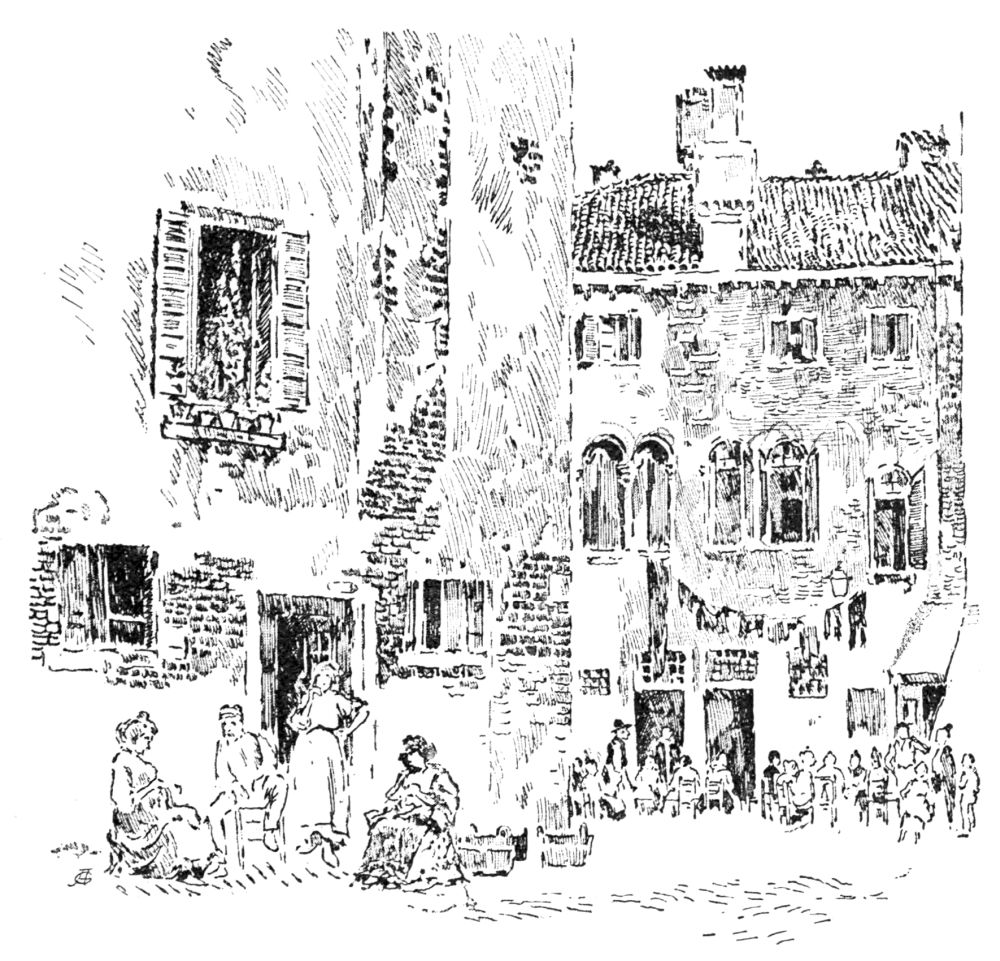
CALLE CASALLI
saw this man ahead swimming, and making desperate signals to the Venetians to bring to.
The commander recognised him as a Venetian either by his appearance or by his language, laid his topsail to the mast and took him aboard, to learn that the Genoese vessels before him were but the vanguard of a huge fleet which was itself at hand, and would soon be in sight. To engage was now out of the question, and could only end in the total loss of the six Venetian vessels; Giustiniani put about and re-entered the lagoons, to take the bad news to Venice.
The first fault committed by the Genoese was that, having surprised the city, they did not profit by their advantage and storm it at once, at a moment when at least half the population must have been paralysed with fear. Instead, they seem to have followed a consistent but mistaken plan; for they pillaged and laid waste the outlying islands one by one with the evident intention of destroying the city’s supplies, and of ultimately cutting off all communication between it and the mainland.
In the course of this more or less systematic operation they came before Malamocco on the sixth of August 1379; but here they met with a first check, for they perceived that the place was too strongly fortified to be rashly attacked, and they therefore sailed past it towards Chioggia, which was, and is, the most important strategic point of the lagoons.
Chioggia is close to the mainland, at the western extremity of the Venetian archipelago. The name belongs vaguely, in old maps, to the long island properly called Brondolo, on the western end of which is built the town of Brondolo; more particularly to the Port, or entrance between this island and the one called Palestrina, between which two the ‘Lupa,’ the Tower of the She-Wolf, rises out of the water; and especially to the small city of Chioggia. The latter is divided into two parts—the greater Chioggia, built on a
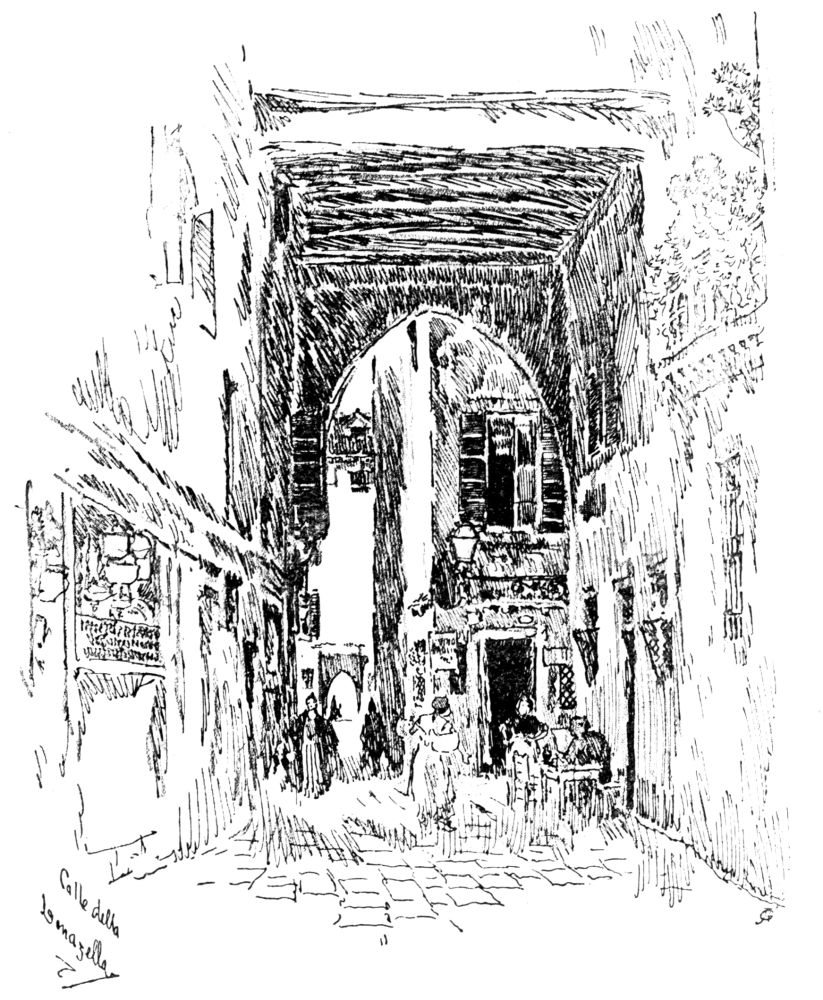
CALLE DELLA DONAZELLA
number of very small islets, and the lesser, which stands on the inside shore of the main island. There was a bridge between the two parts.
The entrance to the port of Chioggia being deep and safe, the Venetians had deepened also a natural channel, twenty-five miles long, which led thence through the shallow lagoons to Venice, and this was one of the best and safest approaches to the city from the outer sea, a fact which was well known to the Genoese, who looked upon Chioggia as the real key to the capital, and the name of the place has been given by all historians to the war that followed. It is almost needless to say that the extreme shallowness of the lagoons was a real defence against an enemy not well acquainted with the channels, which, as every one knows, are marked by tall timbers that project from six to fifteen feet above the water. To remove these was a first measure of defence.
Rom. iii. 274.
The most tremendous exertions were made by the Venetians to prepare themselves for an attack, which would almost certainly have been fatal to them if the Genoese had not put it off too long. Reinforcements were at once sent down to Pietro Emo, the Podestà of Chioggia, who anchored a large armed hulk in the channel, manning it with soldiers and supplying it with provisions to last some time.
The lesser Chioggia, on the shore of the island, was abandoned as not defensible, but the main town was very effectually fortified, and each little islet became a separate stronghold. On the side of the allies Carrara succeeded with great difficulty in conveying a considerable force of men from Padua down the old branch of the Brenta, which the Venetians had obstructed by sinking a hulk across it. Carrara is said to have dug a channel round this point in a single night. The allies had now about twenty-four thousand fighting men.
Rom. iii. 275.
Pisani had been beaten at Pola in May; it was on the sixth of August that the Genoese reconnoitred Malamocco and anchored off Chioggia harbour, and their attack upon Chioggia itself began on the eleventh. On that day the armed hulk which Emo had moored in the channel was captured and burned, and the Genoese fleet was able to enter the port and lie before the besieged town, while Carrara and the Paduans assailed it from the side of the lagoons in their light boats. Every day the united forces renewed their attack, and hour by hour they won their way into the strong little place, taking the bridges and fortifications one after another. By the fifteenth of the month, the bridge to Brondolo having been taken, it was clear to the Venetians that Chioggia was lost, and Dandolo considered how he might withdraw his force to Venice. It seemed only too certain that every man who could be saved alive would be needed for the defence of the capital, and it was still possible to escape across the shallows, where the Genoese could not follow in their ships and the Paduans did not know their way. The carnage had already been frightful. It is said that six thousand Venetians were slain, and that three thousand and five hundred were taken prisoners. Dandolo saved a large number in his retreat; but the heroic Pietro Emo refused to leave the town, and remained with fifty devoted men to fight to the very death within his own palace walls. The town was sacked forthwith, and much of it was burned; over what was left the standards of Genoa, of Carrara, and of Hungary were displayed where the banners of Saint Mark had floated for centuries, until that bloody day.
Chioggia fell as the sun went down, and the news reached Venice late that night. The city was all awake and in desperate anxiety, and when the truth was known, fear turned almost to panic. Women rushed frantically to the churches to confess and receive the sacraments, as if the Last Judgment of God were upon them. The men were at first silent, paralysed in absolute consternation; since Chioggia was gone, the Genoese might be upon Venice by morning.
But again they let the opportunity pass, and the Venetians were vouchsafed a breathing space, which might seem but enough to show them how desperate their situation really was. For Treviso was already besieged by Carrara’s troops when Chioggia fell, and the allies were closing in upon the city like a wall of iron.
The Doge Contarini displayed a coolness and a courage altogether heroic. The Republic had oppressed its chief by an intolerable system of spying and petty limitations that reduced his personality to a nonentity in ordinary times. It had forbidden him almost everything; but it had not forbidden him to die for his country. The example of one man could still revive the courage and sustain the calm of thousands. Venice was not lost, so long as that one true citizen remained alive.
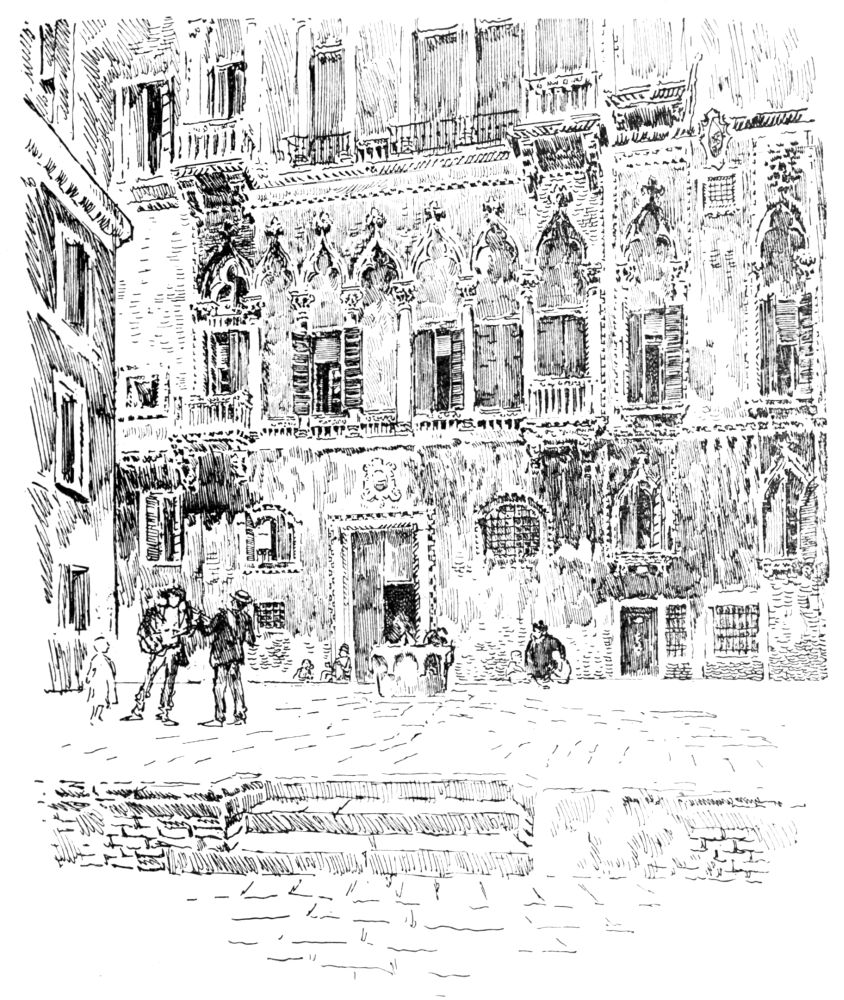
CAMPO S. BENEDETTO
The Doge and the Senators gave all their own treasure to the public fund, and imposed regular taxes on the citizens; they distributed the supplies of arms with great good judgment, and sent out scouts upon the lagoons in the lightest and swiftest skiffs, in order that no movement of the enemy should escape observation.
But the people murmured against the government, even in their constant terror; for Vittor Pisani was their idol, and he was still in prison.
It may have been the intention of the Genoese and their allies to starve Venice to a surrender; but I think it more likely that Doria’s procrastination was in accordance with his own character, and that it was in part due to the almost inevitable complications which arise where military command is not vested in one person, but is shared almost equally by a number of allied captains.
The very first and most pressing danger was past when Contarini called a general assembly of the people, on the thirteenth of September, by causing the great bell of Saint Mark’s to be rung. It was long since the summons had been heard, and the population answered it eagerly. The cathedral was soon thronged to suffocation by men of all ages and conditions, who listened in profound silence to the eloquent words of the senator Pietro Mocenigo. He spoke from a high balcony or pulpit, and his ringing voice was heard in the farthest corners of the great building.
He told his hearers that the time had come when they must think of the honour of their women, the lives of their young children, and the safety of their worldly goods; he said that whosoever lacked necessary food for himself and his family need only ask for what he needed at any patrician house—he should be treated as a friend, as a brother, the last crust of bread should be shared with him. That was all, save that he called upon all sensible men to speak, if they had any advice to give which would be for the public good and safety.
The impression made by this simple speech was profound, for the people owed the aristocracy no long-standing grudge as in other Italian cities. The nobles had neither ground them down, nor tormented them, nor dishonoured them, but had only taken the political power and, with it, the responsibilities of government. In the wars of Venice the nobles had shed their blood for their country much more abundantly, in proportion to their numbers, than the people themselves; and in peace, their suspicions, their spyings, and their eternal repression had been directed against each other, and never against the poor man. And now they reaped their reward; they stooped to call the poor man brother, and the mere words flattered him, and cheered him, and made a hero of him. Happy Venice, even in that dire extremity!
Then many rose up in the church and cried out that every ship in the arsenal that would float must be manned to attack the enemy rather than yield to starvation.
Mocenigo, the orator, being satisfied with this answer of the people, went on to the question of choosing a leader, and proposed Taddeo Giustiniani; but the multitude would none of him, and shouted for Vittor Pisani. Under him they would win or die, they cried as one man, and they would have no other.
To resist such a demand would have been madness, and for once the lordly Signory bowed before the plebeian will. The captain was forthwith led out of prison, and the crowd, frantic with joy at his release, carried him in triumph on their shoulders round the square of Saint Mark’s.
‘Long live Vittor Pisani!’ they shouted.
‘No,’ he cried, answering them in commanding tones. ‘Long live Saint Mark!’
Some obeyed him, and some would not, and the two cries mingled together, ‘Pisani, Saint Mark, Saint Mark, Vittor Pisani.’
Daru, ii. 217.
The historian Daru, whose passion for romance sometimes led him far, says that Pisani asked to be allowed to spend one more night in confinement, in order that he might prepare himself by prayer for performing his devotions the next morning, and that it was from the window of his prison that he rebuked the crowd for cheering him. Yet Daru himself, a few pages earlier, had just described the prisons of Venice in the fourteenth century as horrible dens which had neither light nor air except from a narrow corridor, adding that the most piercing screams could never be heard outside.
Men like Pisani have little need of acting or posing in order to increase their prestige, for it is enough that they should show themselves and brave men will follow them. The captain was taken from prison at once and, after saying a prayer in the basilica, went before the Doge.
The mutual position of the two men was a strange one. Contarini must have been well aware that Pisani’s condemnation had been utterly unjust; Pisani had suffered that condemnation without complaint, and well knew that the Doge had voted for it; both were brave and patriotic men, who believed devoutly in the system by which their own aristocracy repressed among its members any attempt at individualism, spied upon itself, and treated failure as a crime. Pisani, if the situation had been reversed, would have condemned Contarini as unhesitatingly as Contarini had condemned him. It was certainly against the theory of the Republic that he should be taken out of prison before he had expiated his defeat; but it was inevitable, and he was free.
Yet both men found something to say in these almost absurd circumstances, which was neither commonplace, nor undignified, nor merely complimentary.
Rom. iii. 278.
‘Your prudent and wise conduct,’ said the Doge, ‘will efface your misfortunes, and avenge not only any offence which you may have received yourself’—Pisani had been called a coward by the provveditor of the Republic—‘but also the injuries which our country has suffered at the hands of our enemies; you will therefore consider rather the favour done you now than the past disgrace in which you have been, and you will gladly seize this occasion of proving how unfounded those accusations were which were made against you, and how much you desire to earn in future the gratitude of our country.’
To this cleverly-worded and not wholly inane speech Pisani replied that he had altogether forgotten the past, and that he should find means, by the grace of God, to deserve the confidence placed in him.
Before he was allowed to depart he was informed that he was not to have sole command of the Venetian troops, since Taddeo Giustiniani had been entrusted with the defence on the side towards the Lido. Pisani bent his head and answered that he had at all times obeyed the orders of the Signory.
Rom. iii. 279.
But the people were less submissive to this schoolmaster justice; they would have Pisani, and no one but Pisani. Even the soldiers who came from the little island of Torcello protested. ‘Command us what you will,’ they said to him, ‘we will do whatever you order us, but it must be under your own eyes.’
So a deputation of the younger ones among them went to the ducal palace, carrying the banner of Torcello before them, and addressed the counsellors. ‘For the love of God,’ they said, ‘give us three galleys, which we will equip at our own cost, on condition that we be always, and everywhere, under the orders of Vittor Pisani.’
By way of answer they were ordered to go to the Lido and fight under Taddeo Giustiniani. ‘We will be cut into small pieces rather than fight under him,’ cried the men of Torcello, who were assembled in the square when the deputation brought them the answer of the Signory.
Rom. iii. 280.
The Venetians took up the cry, and again the government was obliged to yield. To paralyse the people’s enthusiasm at such a moment, to shake their confidence, to trample upon their wholesale sympathies, was to lose Venice herself. When it was known that Pisani was appointed commander-in-chief of all the forces, the enthusiasm of the city broke out in wild cheering for Saint Mark, for the Doge, for the government; all the men hastened to enroll themselves under his standard, and all the women brought whatever they possessed of value to the palace, both jewels and other objects; they even ripped the silver trimmings and embroideries from their clothes. Forty galleys which lay in the arsenal were fitted out in three days, and in the same time two-thirds of the crews necessary had been found.
The government promised great rewards to all who should distinguish themselves in the struggle. It was announced that thirty citizen families, whichever should contribute the most directly to the salvation of the Republic, should be inscribed in the Golden Book of the nobles; that all strangers who would take arms to defend Venice should be adopted as children by the State, and should enjoy all the privileges accorded to the original burghers; finally, the government promised to distribute five thousand ducats, or over thirty-seven hundred pounds sterling, to the poorer families of the city not belonging to the nobility. Having made these promises, the State, by its decree, proceeded to threaten vengeance against all who should desert the posts assigned to them, or attempt to leave Venice so long as it was menaced by the enemy.
When all was ready for the bold attempt the Senate took final measures for the disposition of the troops, as well as for the police of the city. In those quarters which were most exposed to an attack, as, for instance, that of the Niccolotti, the inhabitants were to be continually ready to fight at a moment’s notice; in the remaining quarters only one-third of the men were to remain at home as a garrison, while the rest placed themselves under the orders of Pisani at the front. A careful watch was kept upon all vagabonds, idlers, and other suspicious persons as long as the war lasted, lest any of them should enter into correspondence with the enemy’s fleet.
When we consider the condition of the Republic at this moment, it must seem little short of amazing that Venice should have survived at all. The territory of the State was reduced by the invasion of the allies to little more than the city itself; every outpost except the tower of the salt-works was in the hands of the enemy; a large fleet with a very strong force of men was in safe possession of Chioggia, the key to the lagoons; and all attempts at negotiating with the enemy had signally failed. The Republic had, indeed, gone so far as to send a suppliant embassy to her former vassal, Francesco Carrara; he was addressed with humility as ‘Powerful and magnificent lord,’ and a fair sheet of blank paper was laid before him on which he was requested to note with his own hand his own terms for peace, with the sole condition that Venice should still be considered independent; and the ambassadors had brought with them some Genoese prisoners whom
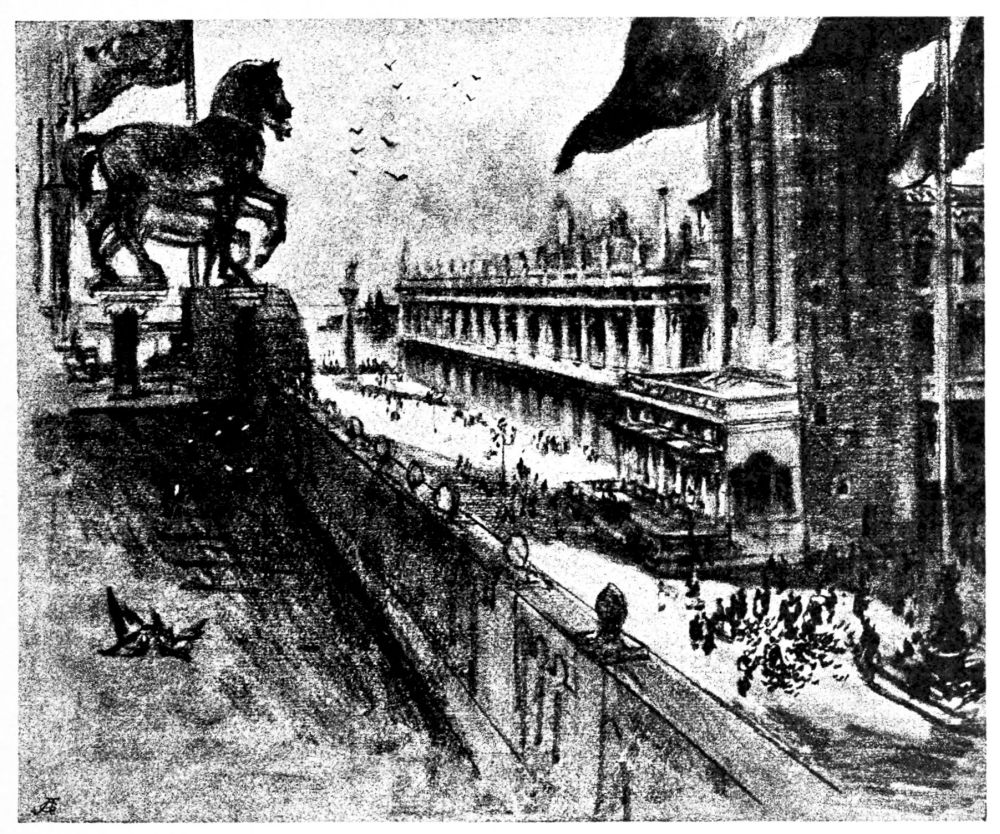
THE HORSES OVER THE GREAT DOOR, ST. MARK’S
they offered to return without ransom. But these humble proposals were haughtily refused, Carrara bade the suppliants to return and take their prisoners with them, threatening that he would ere long bridle the bronze horses of Saint Mark’s and keep them quiet for ever.
I have quoted this incident as it is given from Chinazzo’s chronicle in Smedley’s Sketches from Venetian History, and there seems no reason to doubt the authority of the Italian historian, whose work is to be found in Muratori.
Pisani had lost no time, while the allies were wasting theirs in useless reconnoitring and futile skirmishes. He had fortified the entrance of the Lido with temporary towers built in the short space of four days, he had sunk hulks in all the important channels, and had got ready a great number of small boats with which to convey his men across the shallow water. Moreover, as many among his troops had no experience of the oar, he had trained them as well as might be, in the short time, on the canal now known as the Giudecca. But he had kept his own plan a secret, and it does not appear that when the Venetians made their bold attack upon the allies they knew what their leader purposed. It was enough that he led them; they followed him, to do or die.
Andrea Contarini, eighty years of age, but still as brave as any youth in the host, would not suffer the expedition to go forth without him, and his example not only roused the enthusiasm of every fighting man, but was followed by a number of senators too old to bear arms. In the last extremity of danger Venice had one vast advantage against overwhelming odds, for her people were united to a man. Men gave not only themselves but all their fortunes to save their country, and for the first and, I believe, the last time in history, a commercial people forgave one another their commercial debts for the sake of the common safety. One individual burgher fitted out a galley at his own expense; another bound himself to support a thousand men throughout the war; all those who had anything to give gave it freely, and those who had nothing gave themselves.
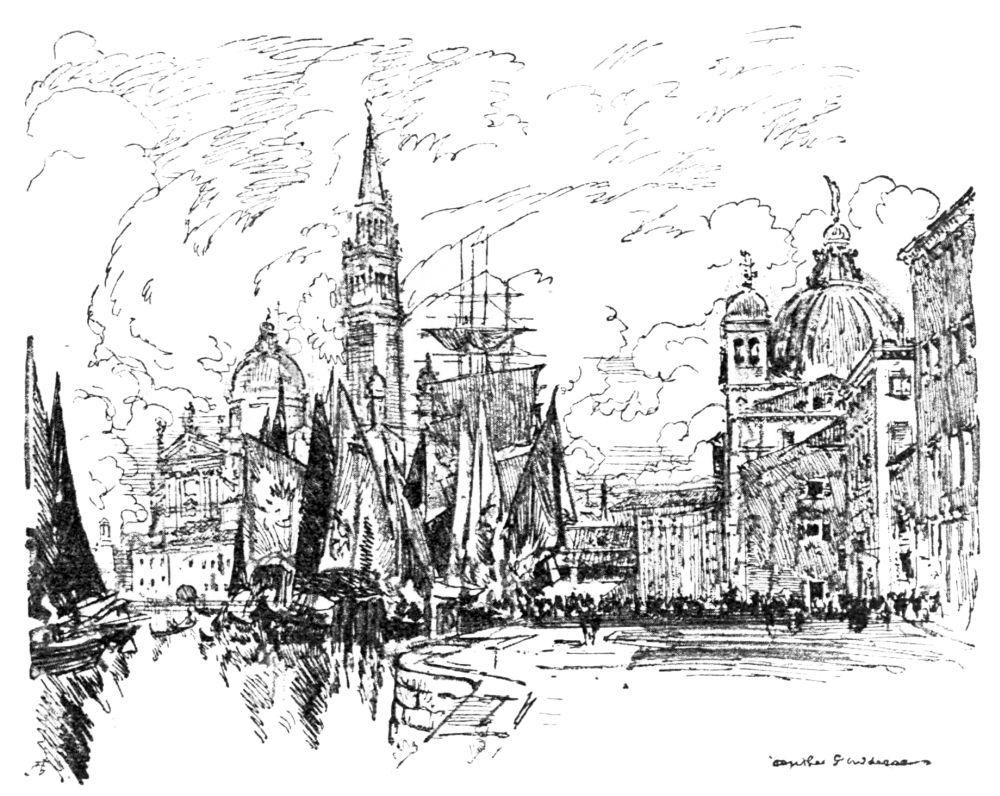
ON THE GIUDECCA
The offensive movement of the Venetians had been preceded by several successful skirmishes in October and November, the result of which had been that the Genoese had more or less abandoned operations for the winter, and had withdrawn their fleet into the safe harbour of Chioggia to await the spring, leaving only three galleys to cruise before the entrance in case a surprise should be attempted. They seem to have been as sure of taking Venice as if they had been anchored opposite the Piazzetta; and in accordance with the military practice of those days, they and their allies hibernated, apparently taking it for granted that the Venetians would do the same, and wait resignedly to be destroyed in warmer weather. They were rudely awakened from their secure dreams of victory and spoil.
1379. Rom. iii. 285.
The Venetian fleet stole out to sea on the evening of the twenty-first of December, consisting of thirty-four galleys, sixty smaller armed vessels, and hundreds of flat-bottomed boats. Pisani led the van, towing two heavy old hulks laden with stones. There is a disagreement of authorities as to the day of the month on which he left Venice, but all agree that the Venetians appeared off the Chioggia entrance and landed four thousand men on the point of Brondolo island at dawn on the following morning—no inconsiderable feat, though the night had been the longest of the year. The distance, on a modern admiralty chart, from the port of Lido to the Chioggia entrance, outside the islands, I find to be about thirteen nautical miles; by the canals within the lagoons it is considerably farther, but it is certain that Pisani went by the open sea.
The Genoese were taken by surprise. The three cruisers on duty as sentinels outside the port were not where they should have been, and we hear no more of
THE CITY IN THE SEAS
them; it almost looks as if, in their security, the invaders must have given up that last precaution.
In the face of a heavy fire and with the loss of one vessel, burned by the enemy, Pisani succeeded in sinking his hulks across the entrance. To the last the Genoese do not appear to have understood his intention, for they themselves, or their own fire, helped to sink the heavily-ballasted vessels, and it was not until all was over, and the barrier had been made insurmountable by heaping other material upon it, that they plainly saw what had happened. They were caught like mice in a trap, unless they could get their fleet out by some other way. The mouth of the Brenta river at Brondolo, two miles to the southward, still remained navigable, and Pisani proceeded to blockade it in the same way, though with far greater difficulty. Federico Cornaro was entrusted with the dangerous and difficult task, and accomplished it under a terrific fire, Pisani protecting him meanwhile from any attack from the Genoese vessels.
This being done, the enemy’s fleet was paralysed, and the result could only have been a matter of time, if Pisani had been in command of a regular force. Instead, his men were volunteers and raw recruits, capable of magnificent courage in a single engagement, as they had shown, and ready to shed their blood as they had given their treasure; but they were ill accustomed to exposure, to night work at sea in the depth of winter, to a hundred small daily sufferings to which a trained seaman is hardened and indifferent. Clearly, Pisani could not leave the scene of action, even for a day, and even if he had consented to such an act of folly, there was the old Doge, swearing upon the hilt of his sword never to return to Venice till the enemy was thoroughly beaten. Yet the volunteers of the people cared little for such an example, and threatened to go home to Venice in a body, leaving the Genoese to dig their way out if they could, and indifferent to the fact that if left to themselves they could certainly find means of reaching Venice within a few days, though they could not bring their fleet. They had been in real danger now, and they would waste no more time in idleness or futile skirmishing.
It was in vain that Pisani tried to cheer such a force by reminding them that Carlo Zeno, with a strong fleet manned by veteran seamen, was expected to return. The people knew well enough that he had been expected for months, and that there was no reason why he should appear providentially at the present juncture. It was the Christmas season; they had fought like lions, shut up their enemies, and momentarily averted extreme danger; for amateur soldiers this seemed enough, and they clamoured to be allowed to go back to their wives and children.
Like Columbus, Pisani saw himself on the very verge of losing the result of all his labour, for lack of a little more trust on the part of his men. To keep them by force was impossible, for they themselves were the male population of Venice, and for the time being they held good and evil in their hands. Even the senators and other nobles murmured at being obliged
RIO S. POLO
to keep at sea, and often under fire, because the Doge had rashly sworn a solemn oath to remain.
On the thirtieth of December Pisani was driven to such extremities as to be forced to promise that unless Carlo Zeno appeared in forty-eight hours the fleet should return to the Lido, in spite of the Doge and his vow. There was no reason at all why Zeno should be expected; it was a mere empty promise, but it gained time; something could still be done in two days and two nights.
He laboured and fought on, and the short limit of time expired with the dawn of New Year’s Day. Zeno had not come, and Pisani’s men would not stay another hour. By his promise he must let them go, and it needed not his wisdom to foresee that their defection meant the fall of Venice, the end of the Republic, the general destruction of the insensate population themselves with all they had. It was of little use to have been their idol for years and their victorious dictator for ten days, if they could not bear a little cold and a little hardship for his sake. The day rose wearily for Pisani.
Marble bust of Carlo Zeno, unknown artist; Museo Civico, Room XVI.
Then, from aloft, a sail was sighted. It was the sail of a galley. Another, and another, and another, all galleys unmistakably, they hove in sight above the horizon, eighteen in all. Hostile, or friendly? That was the question. Zeno, or destruction and the end? Then the banner of Saint Mark broke out from the peak of the foremost, and floated fair on the morning breeze. It was Zeno indeed.
And not only had the famous leader himself come at the one moment of all others when he was most needed, perhaps in his whole life; he came as a victor, bringing prizes and spoil of inestimable value. He had laid waste the Genoese coast, almost to the city itself; he had intercepted Genoese convoys of grain off Apulia, he had harassed the enemy’s commerce in the East, and he had captured, off Rhodes, a huge vessel of theirs with five hundred thousand pieces of gold.
All this he told the Doge on board the latter’s galley. He had been twice wounded and was not yet recovered, but nothing could diminish his energy nor damp his ardour; at his own request he was stationed at the post of greatest danger, opposite Brondolo, and though the Genoese made a supreme effort to destroy the barriers and get their ships out during a gale, in which some of Zeno’s ships dragged their anchors, he drove them triumphantly back into their prison, and blockaded them more securely than ever. In this action he was nearly killed again. An arrow pierced his throat when the gale had driven him under one of the Genoese forts. Lest he should bleed to death he would not pluck out the missile, but remained on deck to save his ship; till, stumbling in the dusk, he fell down an open hatch. He was lifted up senseless, the arrow was withdrawn, and he was half suffocated by his own blood; but his senses revived, and he had himself turned upon his face, so that the blood might run freely out and allow him to breathe. To such a man it seemed as if nothing short of sudden death outright could be fatal; he refused to leave his ship, and in a marvellously short space of time he was about his duty again as if nothing had happened.
Meanwhile Pisani pushed the siege and bombarded Chioggia. In his force there were numbers of German and English mercenaries, who came to blows and killed each other by the score; but an English captain named William Gold had authority enough to quell the disorder, and the regular fighting went on.
Rom. iii. 289.
Pisani continued to bombard Brondolo. The beginnings of artillery were unwieldy in the extreme, it being thought that the main object should be to throw a missile of great size and weight, even at long intervals, rather than to discharge much smaller ammunition with precise aim. One of Pisani’s mortars is said to have thrown a marble ball weighing two hundred pounds, and the smallest siege mortars projected masses of one hundred and forty pounds. To clean, load, and once fire one of these clumsy howitzers was often the work of a whole day; but if by any chance the shot took effect, the result was formidable. A single ball from Pisani’s great bombard knocked down the church tower of Brondolo with a considerable piece of the ramparts close by, burying Pietro Doria and his nephew under the ruins.
Rom. iii. 288.
The Venetians now held all the approaches to the lagoons from the sea; and by taking the port of Loredo at the mouth of the Adige, they cut off Brondolo and Chioggia from all communication with the Duke of Ferrara, who had hitherto sent supplies of provisions and reinforcements by that way. The time was not far distant when famine must begin to make itself felt among the besieged, and the Venetians redoubled their efforts.
Meanwhile, after the death of Doria, a bold man of original mind, Napoleone Grimaldi, took command of the Genoese. He soon saw that in the existing conditions Brondolo must fall, and that his fleet could never escape. It occurred to him that a canal could be dug straight through the island to the open sea, by which he could bring his ships out during the night, and immediately threaten Venice herself, before the Venetian fleet could return.
The work was begun, but the Venetians discovered it in time. Grimaldi had even then no less than thirteen thousand fighting men in Brondolo and Chioggia; the Venetians had barely eight thousand. They had appealed to the famous English condottiero John Hawkwood, whose engagement to fight for the Milanese had just expired; but he either thought the Venetians were playing a losing game, or else he found more lucrative employment elsewhere, for after promising his assistance he failed to come. Venice now called for volunteers, and all sorts and conditions of men appeared in answer to the call. Among them there was even a canon of Saint Mark’s, Giovanni Loredan, with four of his servants.
In the absence of any famous condottiero to take the command, the Signory condescended to appoint Carlo Zeno to the command of the land troops. He saw that if Grimaldi’s project was to be frustrated, Brondolo must be taken at once, and the whole Genoese force must be driven into Chioggia. He was as good a soldier as he was a sailor, and he did not fail. His practice in all warfare was to take every possible precaution before fighting at all, and then to engage with the most reckless and furious energy.
Deceived by Zeno’s manœuvres, the whole garrison of Brondolo was drawn out in the direction of ‘Little’ Chioggia. Seizing the opportune moment, Zeno then succeeded in throwing himself between Brondolo itself and its small army, at the very moment when the latter was attacked by Zeno’s soldiers of fortune. The whole body of Genoese fled in a panic towards the bridge of Chioggia, trampling upon each other, pursued and cut to pieces by Zeno. Under the weight of the fugitives the bridge broke, and hundreds were drowned in the canal, while the Venetians literally slew thousands within a quarter of a mile of the bridge head. That night a perfect suit of armour could be bought for a ducat—just fifteen shillings.
Brondolo was lost that day. And worse followed, for though the Genoese commander threatened to hang every fighting man who left Chioggia—if he could catch him—the garrison deserted in great numbers during the night, many of them being Paduans and subjects of Carrara, who had not far to go in order to reach their homes.
It was clear to Grimaldi that since this last defeat he could expect no further help except from Genoa itself; and, in fact, a fleet of twenty galleys had left that city almost a month before Brondolo had fallen. When this was known the Venetian soldiers clamoured
MOONLIGHT NIGHT, S. M. DELL’ ORTO
to be allowed to attack Chioggia, and drive out the Genoese before succour could reach them. But neither Pisani nor Zeno would hear of this, and bravely assumed the whole responsibility of a protracted siege, well knowing that Chioggia was a most dangerous place to attack, but that it must inevitably yield to famine at last. So the winter wore on and still the besiegers and the besieged faced each other, each side wondering, perhaps, how long the other would persist.
For Venice herself, accustomed as she was to draw all her supplies from a distance, was beginning to lack corn, and it at last became necessary to send Taddeo Giustiniani with a convoy of ships to Southern Italy in order to bring back wheat. On his return he was overtaken by the new Genoese fleet, beaten and taken prisoner, and soon afterwards the enemy appeared before Venice. The corn had already arrived in safety and all danger of famine was relieved, for Giustiniani had sent the laden ships on before him, protected by half his squadron; but its safety had cost him the other half and his own liberty.
The enemy’s new fleet was commanded by Maruffo, a man of action, who now did his best to tempt Pisani to a naval engagement; but the Venetian admiral stubbornly refused to be drawn into a fight, and pursued the siege of Chioggia with obstinate determination. It is clear that as the Genoese fleet could not possibly get inside the lagoons, and could do no damage from without, Pisani’s refusal to fight was equivalent to paralysing the new fleet; it was as useless, for a time, as if it had not existed. On the other hand, Pisani successfully intercepted more than eighty barges laden with food supplies which Carrara attempted to send to the beleaguered town, and Chioggia was approaching the last extremity of famine.
Rom. iii. 291.
The besieged then began to pull down some of the wooden houses of Chioggia in order to make rafts, with which they hoped to cross the shallow lagoon, and in some way to effect a junction with Maruffo’s fleet; but Pisani’s cannon sunk many of these rafts, or punts, and the remainder were either intercepted by Zeno or forced back to Chioggia.
Even the drinking water was now failing, and the besieged sent representatives to make terms with the Doge. For in spite of the murmurs of the elderly senators, who were obliged by mere decency to remain at the scene of action so long as the chief of the Republic refused to leave it, Contarini insisted upon abiding by his oath, to the very letter. He answered that there could be no terms at all: Chioggia must surrender unconditionally.
During two days longer the city held out, and in that short time secret agents attempted to sow sedition amongst the mercenaries in the service of Venice, and even tried to send letters to Carrara in order to concert a last desperate attempt for freedom; but the dissatisfaction of the condottieri was easily appeased by a promise of more money, and the messengers to Padua were caught. On the twenty-fourth of June Chioggia surrendered.
Then, from the lost town, came forth all that remained of the strong garrison, four thousand one hundred and seventy Genoese and two hundred Paduans, ghastly and emaciated, and more like moving corpses than living beings. At the same time, seventeen galleys were handed over to the Venetians, the war-worn remains of the great armada.
Triumphal return of Andrea Contarini, Paolo Veronese; Hall of the Great Council.
With the fall of Chioggia the war was over, and the Doge’s vow was fulfilled. He returned in triumph to Venice, and was met at San Clemente by the Bucentaur with his counsellors and the heads of the Quarantie, with a vast number of boats in which the population came out to greet their chief, and to gaze upon the captive Genoese galleys, which were towed in with their banners at half-mast. The promised largesses were distributed to the mercenary troops, and the English captain, William Gold, who had rendered services of great value, received for his share five hundred ducats, the equivalent in actual modern coin of three hundred and seventy-five pounds sterling, a very large sum in those days.
Maruffo continued to cruise in the Adriatic with an efficient fleet several months after the surrender of Chioggia, and Pisani was sent out against him. After recapturing Capodistria and ravaging the coasts of Dalmatia, the Venetian admiral came upon the enemy off Apulia. In the engagement that followed the Genoese were finally put to flight, but Pisani himself was mortally wounded. He was taken ashore at Manfredonia, and there ended his heroic life.
Statue of Vittor Pisani, Armoury of the Arsenal.
His body was brought back to Venice, where the news of his death had been received with universal grief; the Doge, the Senate, and the whole city attended his magnificent funeral, and he was buried in the church of Sant’ Antonio, where a statue was put up to him, which has since been removed to the principal hall of the Arsenal.
Pisani’s place was filled by Carlo Zeno, to whom belongs the honour of having finally ended the war by driving the enemy into the very harbour of Genoa. The struggle between the two republics had lasted for centuries, the war which ended it had been protracted through six and a half years, and there was much difficulty in agreeing upon articles of peace between Venice on the one hand, and on the other Genoa, King Louis of Hungary, and Francesco Carrara. At first sight, on reviewing this treaty, one might be tempted to suppose that Venice obtained no advantages actually equivalent to the immense sacrifices she had made during the war; but in reality this would be very far from the truth. Genoa had given even more, and had been altogether defeated in the end; her power was broken for ever, and her long rivalry with Venice was at an end, whereas the political importance of Venice continued to increase, and no one would have thought of questioning her right to be considered one of the great European powers.
As an example of what a devoted and patriotic people can and will do in defence of their liberties, the war of Chioggia stands high in the annals of the world; as a feat of generalship Pisani’s blockade of the Genoese fleet is perhaps unrivalled, and the military operation by which Carlo Zeno tempted the whole garrison of Brondolo out of that town in the morning, and drove it like a flock of sheep into Chioggia before sunset, is a feat of arms the like of which is not recorded of many captains.
Venice kept all her promises, though they had been made under the pressure of extreme necessity. Thirty families of burghers were chosen from amongst those that had made the greatest sacrifices for the public safety, and on the fifth of September the heads of the houses were solemnly invested with the right to sit in the Great Council, and with all the other privileges of nobility for themselves and their descendants for ever. They presented themselves before the Doge in the church of Saint Mark’s, each carrying a lighted torch of pure wax; when they had heard mass they went to the Doge’s palace to assist, from the windows, at a series of festivities and games. It is sad to record that a certain Leonardo dall’ Agnello, a merchant of grain and forage, who had literally given all he possessed for the war, died of grief because his name did not appear in the list of the newly enrolled.
The aged Doge Contarini survived exactly two years after his triumph, and went down to his grave in the full blaze of his final success, and of the country’s growing glory. Amongst those proposed as candidates to succeed him, Carlo Zeno was mentioned; but such a choice would have been contrary to all precedent and tradition, for it was thought that the election of the bravest captain of his day might be dangerous to the Republic; and, moreover, most of the patricians, whose advice during the war he had consistently declined to follow, were jealous of him, and predisposed against him. But the war with the Carrara was not yet really at an end, in spite of the treaty of peace, and there was still much for Zeno to do. The electors chose Michele Morosini to fill the ducal throne.
THE CARMINE