Objects in the Texas School Book Depository Building
Reading edition
A number of objects found in the Texas School Book Depository Building following the assassination were processed for latent fingerprints by the FBI—in some cases, after they had been processed by the Dallas police. These objects included the homemade wrapping paper bag found near the southeast corner window; the, C2766 rifle; three small cartons which were stacked near that window (which were marked “Box A,” “Box B,” and “Box C”),A10-111 and a fourth carton resting on the floor nearby (marked “Box D”);A10-112 the three 6.5-millimeter cartridge cases found near the window; and the cartridge found in the rifle. The results were as follows:
The paper bag.—The FBI developed a palmprint and a fingerprint on the paper bag by silver nitrate. These were compared with the fingerprints and palmprints of Lee Harvey Oswald taken by the Dallas police, and were found to have been made by the right palm and the left index finger of Lee Harvey Oswald.A10-113
The C2766 rifle.—The wood and metal of the rifle was absorbent, and not conducive to recording a good print.A10-114 However, the Dallas police developed by powder some faint ridge formations on the metal magazine housing in front of the trigger and also developed by powder and lifted a latent palmprint from the underside of the barrel.A10-115 The faint ridge formations were insufficient for purposes of effecting an identification,A10-116 but the latent palmprint was identified as the right palm of Lee Harvey Oswald.A10-117
The cartons.—Using the silver nitrate method, the FBI developed nine identifiable latent fingerprints and four identifiable latent palmprints on Box A,A10-118 seven identifiable fingerprints and two identifiable palmprints on Box B,A10-119 and two identifiable fingerprints and one identifiable palmprint on Box C.A10-120 One of the fingerprints on Box A was identified as the right index fingerprint of Lee Harvey Oswald,A10-121 and one of the palmprints on Box A was identified as the left palmprint of Lee Harvey Oswald.A10-122 All the remaining prints on Box A were the palmprints of R. L. Studebaker, a Dallas police officer, and Forest L. Lucy, an FBI clerk, who shipped the cartons from Dallas to the FBI Laboratory in Washington, D.C., and fingerprints of Detective Studebaker. All but one of the fingerprints on Box B belonged to Studebaker and Lucy and one palmprint was that of Studebaker. The fingerprints on Box C were those of Studebaker and Lucy and the palmprint was Studebaker’s.A10-123 One palmprint on Box B was unidentified.A10-124
The FBI developed two fingerprints on Box D by silver nitrate, and the Dallas police developed a palmprint on Box D by powder.A10-125 The fingerprints belonged to Lucy. The palmprint was identified as the right palmprint of Lee Harvey Oswald.A10-126 While the age of a print cannot be generally determined,A10-127 this palmprint must have been relatively fresh, because the carton was constructed of cardboard, an absorbent material, and if a long period had elapsed between the time the print was made and the time it was powdered, the perspiration would have been absorbed into the cardboard, and the print could not have been developed by powder.A10-128 Tests run by the FBI show that usually a latent impression on such cardboard cannot be developed by powder more than 24 hours after it is made.A10-129 Latona felt that the maximum age of the palmprint on Box D at the time of development (which was shortly after the assassination), would have been 3 days;A10-130 Mandella felt that the maximum time would have been a day and a half.A10-131
The three cartridge cases and the cartridge case found in the rifle.—No prints were developed on the cartridge found in the rifle or on the three expended cartridge cases.A10-132
QUESTIONED DOCUMENTS
Two experts gave testimony concerning questioned documents: Alwyn ColeA10-133 and James C. Cadigan.A10-134 Cole apprenticed as a questioned document examiner for 6 years, from 1929 to 1935, and has been examiner of questioned documents for the U.S. Treasury Department since then. Cadigan has been a questioned document examiner with the FBI for 23½ years, following a specialized course of training and instruction. Both have testified many times in Federal and States courts.A10-135 Their conclusions were identical, except as noted.
Both experts examined and testified on the following questioned documents: (1) The mail order to Klein’s Sporting Goods of Chicago, in response to which Klein’s sent the C2766 rifle; the accompanying money order; and the envelope in which the mail order and the money order were sent—all of which bore the name “A. Hidell” and the address “P.O. Box 2915, Dallas, Texas”;A10-136 (2) the mail order to Seaport Traders, Inc., of Los Angeles, bearing the same name and address, in response to which the Seaport Traders sent the V510210 revolver;A10-137 (3) part of an application for Post Office Box 2915, Dallas, Tex., opened October 9, 1962 and closed May 14, 1963, and two change-of-address orders relating to that box, dated October 10, 1962 and May 12, 1963—all signed “Lee H. Oswald,” and part of an application for Post Office Box 30061, New Orleans, La., naming “A. J. Hidell” as a party entitled to receive mail through the box, signed “L. H. Oswald”;A10-138 (4) a spurious selective service system notice of classification and a spurious certificate of service in the U.S. Marine Corps, found in Oswald’s wallet after his arrest, both in the name “Alek James Hidell”;A10-139 (5) a spurious smallpox vaccination certificate, found among Oswald’s belongings at his room at 1026 North Beckley, purportedly issued to Lee Oswald by “Dr. A. J. Hideel, P.O. Box 30016, New Orleans, La.”;A10-140 and (6) a card, found in Oswald’s wallet after his arrest, reading “Fair Play for Cuba Committee New Orleans Chapter,” dated “June 15, 1963,” bearing the name “L. H. Oswald” and the signature “Lee H. Oswald,” and signed “A. J. Hidell” as chapter president.A10-141 Cadigan also examined (7) the unsigned note, Commission Exhibit No. 1, written almost entirely in Russian, which Marina testified Oswald had left for her prior to his attempt on the life of General Walker;A10-142 and (8) the homemade paper bag found on the sixth floor of the Texas School Book Depository following the assassination.A10-143
General principles.A10-144—The area of questioned document examination encompasses many types of inquiries, the most familiar of which is the identification of handwriting. Handwriting identification is based upon the principle that every person’s handwriting is distinctive. As Cole testified:
Q. Mr. Cole, could you explain the basis on which you were able to make an identification of a questioned writing as being authored by the person who wrote a standard writing?
Mr. Cole. This is based upon the principle that every handwriting is distinctive, that since the mental and physical equipment for producing handwriting is different in every individual, each person produces his own distinctive writing habits. Of course, everyone learns to write in the beginning by an endeavor to repeat ideal letter forms but, practically no one is able to reproduce these forms exactly. Even though a person might have some initial success during the active period of instruction, he soon departs from these and develops his own habits. It may be said that habit in handwriting is that which makes handwriting possible. Habit is that which makes handwriting efficient. If it were not for the development of habit, one would be obliged to draw or sketch.
Some habit would be included even in those efforts. But the production of handwriting rapidly and fluently always involves a recording of personal writing habit. This has been confirmed by observation of a very large number of specimens over a long period of time, and it has further been demonstrated by, on my part, having a formal responsibility for rendering decisions about the identification of handwriting based upon an agreement of handwriting habit in situations where there would be a rigorous testing of the correctness of these decision by field investigators, for example, of the law-enforcement agencies, and a demonstration that these results were confirmed by other evidence.
This is the basis for identification of handwriting.A10-145
The same principles are generally applicable to hand printing,A10-146 and in the balance of this section the term “handwriting” will be used to refer to both cursive or script writing and hand printing.
Not every letter in a questioned handwriting can be used as the basis of an identification. Most people learn to write letters in a standard or “copybook” form: a handwriting is distinctive only insofar as it departs significantly from such forms.A10-147 Correspondingly, not every variation indicates nonidentification; no two acts are precisely alike and variations may be found within a single document. Like similarities, variations are significant only if they are distinctive.A10-148 Moreover, since any single distinctive characteristic may not be unique to one person, in order to make an identification the expert must find a sufficient number of corresponding distinctive characteristics and a general absence of distinctive differences.A10-149
The possibility that one person could imitate the handwriting of another and successfully deceive an expert document examiner is very remote. A forger leaves two types of clue. First, he can seldom perfectly simulate the letter forms of the victim; concentrating on the reproduction of one detail, he is likely not to see others. Thus, the forger may successfully imitate the general form of a letter, but get proportions or letter connections wrong. In addition, the forger draws rather than writes. Forged writing is therefore distinguished by defects in the quality of its line, such as tremor, waver, patching, retouching, noncontinuous lines, and pen lifts in awkward and unusual places.A10-150
To make a handwriting identification, the handwriting in the document under examination (the questioned document) is compared against the handwriting in documents known to have been prepared by a suspect (the known or standard documents). This is exemplified by Cole’s examination of Commission Exhibit No. 773, the photograph of the mail order for the rifle and the envelope in which it was sent:
Q. Now, Mr. Cole, returning to 773, the questioned document, can you tell the Commission how you formed the conclusion that it was prepared by the author of the standards, that is, what steps you followed in your examination and comparison, what things you considered, what instruments or equipment you used, and so forth?
Mr. Cole. I made first a careful study of the writing on Commission Exhibit 773 without reference to the standard writing, in an effort to determine whether or not this writing contained what I would regard as a basis for identification, contained a record of writing habit, and as that—as a result of that part of my examination, I concluded that this is a natural handwriting. By that I mean that it was made at a fair speed, that it doesn’t show any evidence of an unnatural movement, poor line quality, tremor, waver, retouching, or the like. I regard it as being made in a fluent and fairly rapid manner which would record the normal writing habits of the person who made it.
I then made a separate examination of the standards, of all of the standard writings, to determine whether that record gave a record of writing habit which could be used for identification purposes, and I concluded that it, too, was a natural handwriting and gave a good record of writing habit.
I then brought the standard writings together with the questioned writing for a detailed and orderly comparison, considering details of letter forms, proportion, pen pressure, letter connections, and other details of handwriting habit * * *.A10-151
The standards used by Cole and Cadigan consisted of a wide variety of documents known to be in the handwriting of Lee Harvey Oswald, including indorsements on his payroll checks, applications for employment, for a passport, for membership in the American Civil Liberties Union, and for a library card, and letters to the Immigration and Naturalization Service, the Marine Corps, the State Department, and the American Embassy in Russia.A10-152
The Mail Order for the C2766 Rifle, the Related Envelope, and the Money Order
The mail order and envelope for the C2766 rifle were photographed by Klein’s on microfilm, and then destroyed.A10-153 To identify the handwriting an enlarged photograph was made which showed the handwriting characteristics with sufficient clarity to form the basis of an identification.A10-154 Based on a comparison with the standards, the handwriting on the purchase order and the envelope were identified as Lee Harvey Oswald’s.A10-155 The money order, which was retained by the post office after having been cashed by Klein’s,A10-156 was also identified as being in Oswald’s handwriting.A10-157 These identifications were made on the basis of numerous characteristics in which the writing in both the questioned and standard documents departed from conventional letter forms.A10-158 For example, in the return address on the envelope, the left side of the “A” in “A. Hidell” was made by a downstroke followed by an upstroke which almost exactly traced the down-stroke, the “i” showed an elongation of the approach stroke and an exaggerated slant to the right, and the second “l” was somewhat larger than the first; the “B” in “Box” had an upper lobe smaller than the lower lobe; the “D” in “Dallas” exhibited a distinctive construction of the looped form at the top of a letter, and the “s” was flattened and forced over on its side; and the “x” in “Texas” was made in the form of a “u” with a cross bar. These characteristics were also present in the standards.A10-159 In addition, these items, as well as other questioned documents, resembled the standards in their use of certain erroneous combinations of capital and lowercase letters.A10-160 For example, in the mail order, “Texas” was printed with a capital “T,” “X,” “A,” and “S,” but a lowercase “e”; a similar mixture of capital and lowercase letters in “Texas” was found in the standards.A10-161
The writing on the purchase order and envelope showed no significant evidence of disguise (subject to the qualification that the use of hand printing on the mail order, rather than handwriting, may have been used for that purpose).A10-162 However, it is not unusual for a person using an alias not to disguise his writing. For example, Cole, who is document examiner for the Treasury Department, has frequently examined forgeries evidencing no attempt at disguise. A10-163
Mail Order for the V510210 Revolver
Based on a comparison with the standards, the handwriting on the mail orderA10-164 for the V510210 revolver was also identified as Lee Harvey Oswald’s.A10-165
Post Office Box Applications and Change-of-Address Card
A post office box application consists of three parts: The first contains directions for use. The second provides applicant’s name, address, signature space, box number, date of opening and closing. The third part provides instruction space concerning delivery of mail and names of persons entitled to use the box.A10-166 Under post office regulationsA10-167 the second part was retained by the Dallas Post Office for box 2915; it destroyed the third part after the box was closed. Based on the standards, the signature “Lee H. Oswald,” and other handwriting on the application, was identified as that of Lee Harvey Oswald.A10-168 The postal clerk appeared to have filled in the balance.A10-169
The Fort Worth and Dallas post offices retained two change-of-address orders signed “Lee H. Oswald”: One to “Postmaster, Fort Worth, Tex.,” dated October 10, 1962, to send mail to “Oswald, Lee H” at 2703 Mercedes Av., Fort Worth, Texas” and forward to “Box 2915, Dallas, Texas”; the other to “Postmaster, Dallas, Texas” dated May 12, 1963, requested mail for post office box 2915 be forwarded to “Lee Oswald” at “4907 Magazine St., New Orleans, La.”A10-170 Based on a comparison with the standards, the handwriting on these orders was identified as that of Lee Harvey Oswald.A10-171
The New Orleans post office retained the third part of the application for post office box 30061, New Orleans, La., dated June 11, 1963, and signed “L. H. Oswald.” A10-172 Inserted in the space for names of persons entitled to receive mail through the box were written the names “A. J. Hidell” and “Marina Oswald.” On the basis of a comparison with the standards, the writing and the signature on the card was identified as the handwriting of Lee Harvey Oswald.A10-173
The Spurious Selective Service System Notice of Classification and U.S. Marine Corps Certificate of Service
When Oswald was arrested he had in his possession a Selective Service System notice of classification and a certificate of service in the U.S. Marine Corps in the name of “Alek James Hidell,” and a Selective Service System notice of classification, a Selective Service System registration certificate, and a certificate of service in the U.S. Marine Corps in his own name.A10-174 (See Cadigan Exhibits Nos. 19 and 21, p. 573.) The Hidell cards where photographic counterfeits.A10-175 After Oswald’s arrest a group of retouched negatives were found in Mr. Paine’s garage at 2515 West Fifth Street, Irving, Tex.,A10-176 among which were retouched negatives of the Oswald cards.A10-177 A comparison of these retouched negatives with the Hidell and Oswald cards showed that the Hidell cards had been counterfeited by photographing the Oswald cards, retouching the resulting negatives, and producing photographic prints from the retouched negatives.
The Hidell Notice of Classification
Face side.—The face of the Hidell notice of classificationA10-178 was produced from the face of the Oswald notice of classificationA10-179 by a two-step process. First, the counterfeiter photographed the Oswald notice, making a basic intermediate negative.A10-180 He then opaqued out of this intermediate negative all of the information typed or handwritten onto the Oswald notice, including the name “Lee Harvey Oswald,” the selective service No., “41-114-39-532,” the signature of the official of the local board, and the mailing date. In addition, he made another intermediate negative of the lowermost third of the Oswald notice, which contained a printed legend setting forth various instructions relating to draft board procedures.A10-181 This negative reproduced the printed material exactly, but reduced it in size.A10-182 The two intermediate negatives were combined to produce a third negative, substantially identical to the basic intermediate negative except that, by virtue of the reduction in the size of the printed legend, a square space had been created in the lower left-hand corner.A10-183 The counterfeiter then made a photographic print of this third negative, which contained blanks wherever typed or handwritten material had appeared on the original Oswald notice and a new space in the lower left-hand corner. Finally, new material was inserted into the blanks on the Hidell notice where typed or handwritten material had appeared on the Oswald notice.A10-184 Thus the name “ALEK JAMES HIDELL,” the selective service No. “42-224-39-532,” and the mailing date “Feb. 5, 1962,” were typed into the appropriate blanks on the Hidell notice. Two typewriters were used in this typing, as shown by differences in the design of the typed figure “4,”A10-185 and by differences in the strength of the typed impression.A10-186 Probably the counterfeiter switched typewriters when he discovered that the ribbon of his first typewriter was not inked heavily enough to leave a clear impression (a problem which would have been aggravated by the fact that the glossy photographic paper used to make the Hidell notice did not provide a good surface for typewriting).A10-187 The face of the notice also bore many uninked indentations, which could only be made out under strong side lighting.A10-188 These indentations were apparently made with the typewriter set at stencil—that is, set so that the typewriter key struck the notice directly, rather than striking it through the inked typewriter ribbon.A10-189 This may have been done as a dry-run practice, to enable the counterfeiter to determine how to properly center and aline the inserted material.A10-190 A sidelight photograph showed that the names “ALEK,” “JAMES,” and “HIDELL” had each been typed in stencil at least twice before being typed in with the ribbon.A10-191 A capital letter “O” had been stenciled prior to one of the stenciled “ALEK’s.”A10-192 A serial number and a date of mailing had also been typed in stencil.A10-193
In addition to the typed material, a signature, “Alek J. Hidell,” was written in ink in the blank provided for the registrant’s signature, and another, somewhat illegible signature, apparently reading “Good Hoffer,” was written in ink in the blank provided for the signature of an official of the local board.A10-194 This name differed from the name written in ink on the Oswald notice, which appeared to consist of a first name beginning with an “E” or a “G” and the surname “Schiffen.”A10-195 However, the legibility of the name on the Oswald notice was also quite poor, and the counterfeiter might have been attempting to duplicate it. A possible reason for deleting the original name and substituting another is that if the name had not been deleted it would have been reproduced on the Hidell notice as a photographic reproduction, which would look less authentic than a pen-and-ink signature.A10-196
Based on a comparison with the handwriting in the standards, the signature “Alek J. Hidell” on the Hidell notice was identified as being in the handwriting of Lee Harvey Oswald.A10-197 The signature “Good Hoffer” could not be positively identified, being almost illegible; however, it was not inconsistent with Oswald’s handwriting.A10-198
To complete the face of the Hidell notice a picture of Lee Harvey Oswald was inserted into the space in the lower left-hand corner which had been created by reducing the size of the printed legend at the bottom.A10-199
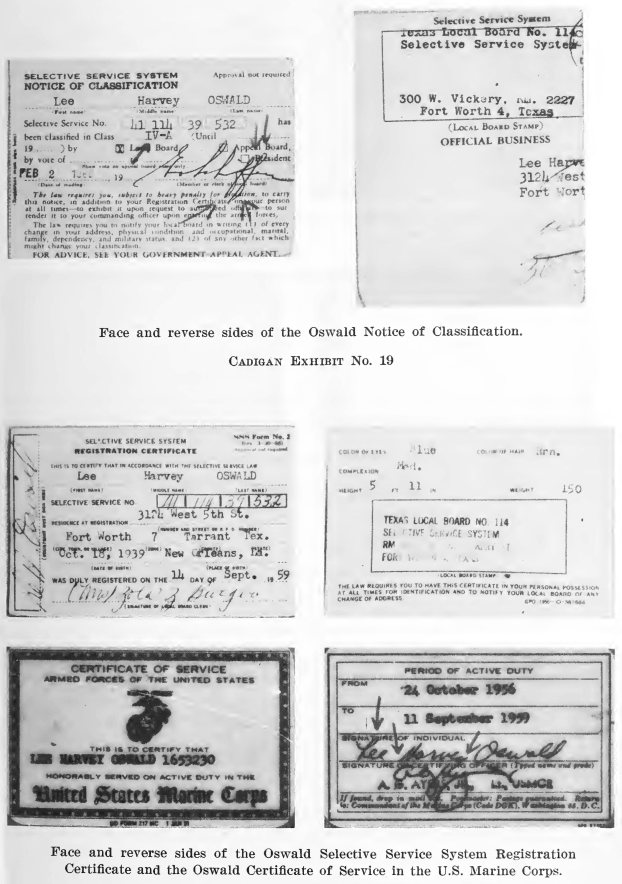
Cadigan Exhibit No. 19 Face and reverse sides of the Oswald Notice of Classification.
Cadigan Exhibit No. 21 Face and reverse sides of the Oswald Selective Service System Registration Certificate and the Oswald Certificate of Service in the U.S. Marine Corps.
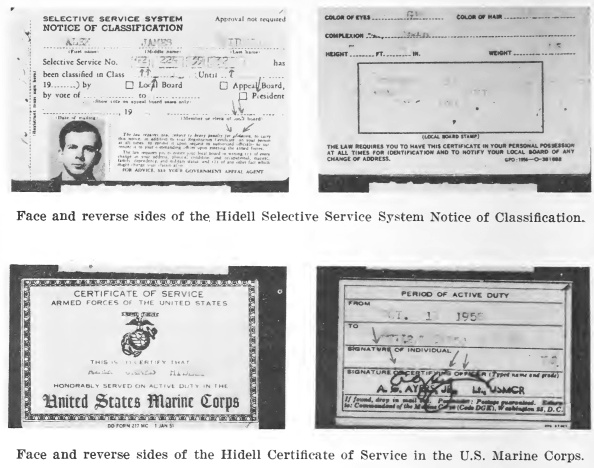
Cadigan Exhibits Nos. 15 and 16
Face and reverse sides of the Hidell Selective Service System Notice of Classification.
Face and reverse sides of the Hidell Certificate of Service in the U.S. Marine Corps.
In creating the face of the Hidell notice, the counterfeiter left traces which enabled the experts to link together the Hidell notice, the retouched negatives, and the Oswald notice. To retouch the negatives the counterfeiter simply painted a red opaque substance on one side of the negative over the material he wished to delete. When the negative was printed, the opaquing prevented light from passing through, so that the print showed blanks wherever the negative had been opaqued. However, the original material was still clearly visible on the negative itself.A10-200 In addition, at several points the typed or handwritten material in the Oswald notice had overlapped the printed material. For example, the signature of the official of the local board overlapped the letters “re” in the printed word “President,” “l” and “a” in the printed word “local,” and “viola” in the printed word “violation.” When this signature was opaqued out, the portions of the printed material which had been overlapped by the signature were either removed or mutilated. The consequent distortions were apparent on both the retouched negative and the Hidell notice itself. Similarly, the selective service number typed on the Oswald notice overlapped the margins of the boxes into which it was typed. Although the counterfeiter opaqued out the numerals themselves, the margins of the boxes remained thickened at the points where they had been overlapped by the numerals. These thickened margins were apparent on both the retouched negative and the Hidell notice.A10-201
Reverse side.—The reverse side of the Hidell notice, which was pasted back-to-back to the face, was actually a form of the reverse side of a Selective Service System registration certificate. Essentially, it was counterfeited the same way as the face of the notice: a photograph was made of the reverse side of the Oswald registration certificate, the material which had been typed or stamped on the Oswald registration certificate was opaqued out of the resulting negative, and a photographic print was made from the retouched negative. This is shown by the negative, in which the opaqued-out information is still visible, and by defects in the printed material on the Hidell notice at point where typed-in material had overlapped printed material on the Oswald registration certificate.A10-202
As the final step, new information was typed on the print in the blanks which resulted from the retouching operation.A10-203 Thus “GR” was substituted for “Blue” under color of eyes; “BROWN” was substituted for “Brn” under color of hair; “FAIR” was substituted for “Med.” under complexion; “5” [ft.] “9” [in.] was substituted for “5” [ft.] “11” [in.] under height; and “155” was substituted for “150” under weight. The name and address of the local board on the Oswald registration certificate were opaqued out, but substantially the same name and address were typed back onto the Hidell notice.A10-204 As in the signature of the local board official on the face of the notice, a possible reason for deleting the original draft board name and the address and substituting substantially similar material in its place is that if the original material had not been deleted it would have reproduced as a photographic reproduction, which would look much less authentic than typed-in material.A10-205
A limited number of typed uninked indentations are also present. Thus the indented letters “CT” appear before the letters “GR” (under color of eyes) and the indented letters “EY” follow “GR.” An indented “9” appears above the visible “9” for the inch figure of height, and an indented “i” appears before the weight, “155.” Much of the typed material on the reverse side of the Hidell notice was not very legible under ordinary lighting, since it was typed with a typewriter which left a very weakly inked impression.A10-206 In fact, it is difficult to tell whether some of the material, particularly the word “Brown” under color of hair, was put in by stencil or by ribbon.
The Hidell Certificate of Service
The face and reverse side of the Hidell certificate of service were produced from the face and reverse side of the Oswald certificate of serviceA10-207 by photographing the Oswald certificate, retouching the resulting negatives to eliminate typed and handwritten material, and making a photographic print from the retouched negative.A10-208 As in the case of the notice of classification, this is shown by the negative itself, in which the opaqued-out information is still visible, and by defects in the printed material on the Hidell certificate at points where handwritten material had crossed over printed material on the Oswald certificate. Thus, in the Oswald certificate the upper portion of the name “Lee” in Oswald’s signature crosses the letter “u” in the printed word “signature.” The consequent mutilation of the printed letter “u” can be seen on the Hidell certificate. Similarly, the ending stroke in the letter “y” in the name “Harvey” in Oswald’s signature crosses the letter “n” in the printed word “certifying.” This stroke was not removed at all, and can be seen as a stroke across the “n” in the Hidell certificate.A10-209 As the final step in producing the Hidell certificate, new material was typed into the blanks on the photographic print. On the face, the words “ALEK JAMES HIDELL” were typed into the blank where “LEE HARVEY OSWALD 1653230” had appeared. A sidelight photograph shows that these words had been typed in stencil at least twice before being typed in with the ribbon apparently to determine proper centering and alignment.A10-210 In producing the reverse side of the Hidell certificate, the signature “Lee Harvey Oswald,” and the dates “24 October 1956” and “11 September 1959,” showing the beginning and end of the period of active service, had been opaqued out. No signature was inserted into resulting blank signature space. However, just below the word “of” in the printed line “signature of individual,” there are two vertical indentations which fill about three-fourths of the height of the signature blank, and a diagonal indentation which slants from approximately the base of the left vertical to approximately the midpoint of the right vertical—the total effect being of a printed capital letter “H.” Also, just below the second and third “i’s” in the printed word “individual” are two more vertical indentations, which could be the vertical strokes of “d’s” or “l’s”—although the circular portion of the letter “d” is not present.A10-211 These indentations could have been made by any sharp instrument, such as a ballpoint pen which was not delivering ink, a stylus of the type used in preparing mimeograph forms, or even a toothpick.A10-212 The indentations are brought out rather clearly in a sidelight photograph, but can also be seen on the card itself if the card is held so that light strikes it at an angle.A10-213
Into the space for the beginning of active service was typed the date “OCT. 13 1958.” The space for the end of active service contains several light-impression and stencil typewriting operations. It was apparently intended to read “OCT. 12 1961,” but because of the lightness of the impression and the many stenciled characters, the date is barely legible.A10-214 Interestingly, one of the stenciled impressions in the blank for end of active service reads “24 October 1959,” as determined under a microscope, while a stenciled impression in the blank for beginning of active service reads “24 October 1957.”A10-215
The counterfeiting of the Hidell cards did not require great skill, but probably required an elementary knowledge of photography, particularly of the photographic techniques used in a printing plant.A10-216 A moderate amount of practice with the technique would be required—perhaps half a dozen attempts. Practicing retouching on the balance of the negatives found at the Paine garage would have been sufficient.A10-217 The retouching of the negatives could have been accomplished without any special equipment. However, the preparation of the negative, apart from retouching, would probably have required a very accurate camera, such as would be found in a photographic laboratory or printing plant.A10-218
The Vaccination Certificate
A government-printed form entitled “International Certificates of Vaccination or Revaccination against Smallpox”A10-219 was found among Oswald’s belongings at his room at 1026 Beckley Avenue, Dallas.A10-220 The form purported to certify that “LEE OSWALD” had been vaccinated against smallpox on “JUNE 8, 1963” by “DR. A.J. HIDEEL, P.O. BOX 30016, NEW ORLEANS, LA.” The card was signed “Lee H. Oswald” and “A. J. Hideel,” and the name and address “Lee H. Oswald, New Orleans, La.” were hand printed on the front of the card. All of this material, except the signatures and the hand printing, had been stamped onto the card. The Hideel name and address consisted of a three-line stamp—“DR. A. J. HIDEEL/P.O. BOX 30016/NEW ORLEANS, LA.” A circular, stamped, illegible impression resembling a seal appeared under a column entitled “Approved stamp.”A10-221
On the basis of a comparison with the standards, Cole identified all of the handwriting on the vaccination certificate, including the signature “A. J. Hideel,” as the writing of Lee Harvey Oswald.A10-222 Cadigan identified all of the writing as Oswald’s except for the “A. J. Hideel” signature, which in his opinion was too distorted to either identify or nonidentify as Oswald’s handwriting.A10-223 The stamped material on the certificate was compared with a rubber stamping kit which belonged to Oswald.A10-224 In this kit was a rubber stamp with three lines of print assembled: “L. H. OSWALD/4907 MAGAZINE ST/NEW ORLEANS, LA.”A10-225 Cole found a perfect agreement in measurement and design between the letters stamped on the certificate and the letters he examined from Oswald’s rubber stamping kit. However, he was unable to determine whether the characteristics of Oswald’s rubber stamping kit were distinctive, and therefore, while he concluded that Oswald’s rubber stamping kit could have made the rubber stamp impressions on the certificate, he was unable to say that it was the only kit which could have made the impressions.A10-226 On the basis of the comparison between the words “NEW ORLEANS, LA.” set up in the rubber stamp in Oswald’s kit, and the words “NEW ORLEANS, LA.” on the certificate, Cadigan concluded that these words had been stamped on the certificate with Oswald’s rubber stamp. However, he could draw no conclusion as to the remaining stamped material, which was not directly comparable to the remaining lines set up on Oswald’s rubber stamp.A10-227
On close examination, the circular impression resembling a seal consisted of the words “BRUSH IN CAN,” printed in reverse.A10-228 Apparently, the impression was made with the top of a container of solvent or cleaning fluid which bore these words in raised lettering. In the center of the impression was a mottled pattern which was similar to the blank areas on a date stamp found in Oswald’s rubber stamping kit.A10-229
The Fair Play for Cuba Committee Card
The Fair Play for Cuba Committee card had two signatures: “L. H. Oswald” and “A. J. Hidell.” Based on the standards, both Cole and Cadigan identified “L. H. Oswald” as the signature of Lee Harvey Oswald,A10-230 but both were unable to identify the “A. J. Hidell” signature.A10-231 Cadigan noted differences between the Hidell signature and Oswald’s handwriting, indicating the possibility that someone other than Oswald had authored the signature.A10-232 Cole believed that the signature was somewhat beyond Oswald’s abilities as a penman.A10-233 On the basis of a short English interlinear translation written by Marina Oswald, Cole felt that she might have been the author of the signature,A10-234 but the translation did not present enough of her handwriting to make possible a positive identification.A10-235 In subsequent testimony before the Commission, Marina stated that she was indeed the author of the Hidell signature on the card.A10-236 Cadigan confirmed this testimony by obtaining further samples of Marina Oswald’s handwriting and comparing these samples with the signature on the card.A10-237
The Unsigned Russian-Language Note
Cadigan’s examination confirmed Marina’s testimony that the handwriting in the unsigned note, Commission Exhibit No. 1, was that of Lee Harvey Oswald.A10-238 Since the note was written almost entirely in the Russian language, which uses the Cyrillic alphabet (as opposed to the Latin alphabet used in the English language), in making his examination Cadigan employed not only Oswald’s English language standards, but also letters written by Oswald in the Russian language.A10-239
The Homemade Wrapping Paper Bag
In the absence of watermarks or other distinctive characteristics, it is impossible to determine whether two samples of paper came from the same manufacturer.A10-240 The homemade paper bag found on the sixth floor of the Texas School Book Depository following the assassination was made out of heavy brown paper and glue-bearing brown paper tape, neither of which contained watermarks or other distinctive characteristics.A10-241 However, Cadigan compared the questioned paper and tape in the paper bag with known paper and tape samples obtained from the shipping department of the Texas School Book Depository on November 22, 1963, to see if the questioned items could have come from the shipping room.A10-242 The questioned and known items were examined visually by normal, incidental, and transmitted natural and electric light, and under ultraviolet light;A10-243 examined microscopically for surface, paper structure, color, and imperfections;A10-244 examined for their felting pattern, which is the pattern of light and dark areas caused by the manner in which the fibers become felted at the beginning stages of paper manufacture;A10-245 measured for thickness with a micrometer sensitive to one one-thousandth of an inch,A10-246 subjected to a fiber analysis to determine the type of fibers of which they were composed, and whether the fibers were bleached or unbleached;A10-247 and examined spectrographically to determine what metallic ions were present.A10-248 The questioned and known items were identical in all the properties measured by these tests.A10-249 (The width of the tape on the paper sack was 3 inches, while the width of the sample tape was 2.975, or twenty-five thousandths of an inch smaller; however, this was not a significant difference).A10-250 In contrast, a paper sample obtained from the Texas School Book Depository shipping room on December 1, 1963, was readily distinguishable from the questioned paper.A10-251
Examination of the tape revealed other significant factors indicating that it could have come from the Texas School Book Depository shipping room. There were several strips of tape on the bag.A10-252 All but two of the ends of these strips were irregularly torn; the remaining two ends had machine-cut edges. This indicated that the person who made the bag had drawn a long strip of tape from a dispensing machine and had torn it by hand into several smaller strips.A10-253 Confirmation that the tape had been drawn from a dispensing machine was supplied by the fact that a series of small markings in the form of half-inch lines ran down the center of the tape like ties on a railroad track. Such lines are made by a ridged wheel in a tape dispenser which is constructed so that when a hand lever is pulled, the wheel, which is connected to the lever, pulls the tape from its roll and dispenses it. Such dispensers are usually found only in commercial establishments. A dispenser of this type was located in the Texas School Book Depository shipping room. The length of the lines and the number of lines per inch on the tape from the paper bag was identical to the length of the lines and the number of lines per inch on the tape obtained from the dispenser in the Texas School Book Depository shipping room.A10-254
WOUND BALLISTICS EXPERIMENTS
Purpose of the Tests
During the course of the Commission’s inquiry, questions arose as to whether the wounds inflicted on President Kennedy and Governor Connally could have been caused by the Mannlicher-Carcano rifle found on the sixth floor of the Texas School Book Depository Building and Western Cartridge Co. bullets and fragments of the type found on the Governor’s stretcher and in the Presidential limousine. In analyzing the trajectory of the bullets after they struck their victims, further questions were posed on the bullet’s velocity and penetration power after exiting from the person who was initially struck. To answer these and related questions, the Commission requested that a series of tests be conducted on substances resembling the wounded portions of the bodies of President Kennedy and Governor Connally under conditions which simulated the events of the assassination.
The Testers and Their Qualifications
In response to the Commission’s request, an extensive series of tests were conducted by the Wound Ballistics Branch of the U.S. Army Chemical Research and Development Laboratories at Edgewood Arsenal, Md. Scientists working at that branch are engaged in full-time efforts to investigate the wound ballistics of missiles in order to test their effects on substances which simulate live human bodies.A10-255 The tests for the Commission were performed by Dr. Alfred G. Olivier under the general supervision of Dr. Arthur J. Dziemian with consultation from Dr. Frederick W. Light, Jr.A10-256 Dr. Olivier received his doctorate in veterinary medicine from the University of Pennsylvania in 1953. Since 1957 he has been engaged in research on wound ballistics at Edgewood Arsenal and is now chief of the Wound Ballistics Branch.A10-257 His supervisor, Dr. Dziemian, who is chief of the Biophysics Division at Edgewood Arsenal, holds a Ph. D. degree from Princeton in 1939, was a national research fellow in physiology at the University of Pennsylvania and was a fellow in anatomy at Johns Hopkins University Medical School.A10-258 Since 1947, Dr. Dziemian has been continuously engaged in wound ballistics work at Edgewood Arsenal.A10-259 In 1930, Dr. Light was awarded an M.D. degree from Johns Hopkins Medical School and in 1948 received his Ph. D. from the same institution.A10-260 After serving a residency in pathology, he worked as a pathologist until 1940 when he returned to Johns Hopkins University to study mathematics. Since 1951, Dr. Light has been engaged in the study of the pathology of wounding at Edgewood Arsenal.A10-261 All three of these distinquished scientists testified before the Commission.
General Testing Conditions
The Commission made available to the Edgewood Arsenal scientists all the relevant facts relating to the wounds which were inflicted on President Kennedy and Governor Connally including the autopsy report on the President, and the reports and X-rays from Parkland Hospital.A10-262 In addition, Drs. Olivier and Light had an opportunity to discuss in detail the Governor’s wounds with the Governor’s surgeons, Drs. Robert R. Shaw and Charles F. Gregory.A10-263 The Zapruder films of the assassination were viewed with Governor and Mrs. Connally to give the Edgewood scientists their version.A10-264 The Commission also provided the Edgewood scientists with all known data on the source of the shots, the rifle and bullets used, and the distances involved. For purposes of the experiments, the Commission turned over to the Edgewood testers the Mannlicher-Carcano rifle found on the sixth floor of the Depository Building.A10-265 From information provided by the Commission, the Edgewood scientists obtained Western bullets of the type used by the assassin.A10-266
Tests on Penetration Power and Bullet Stability
Comparisons were made of the penetrating power of Western bullets fired from the assassination rifle with other bullets.A10-267 From the Mannlicher-Carcano rifle, the Western bullet was fired through two gelatin blocks totaling 72½ centimeters in length.A10-268 As evidenced by Commission Exhibit No. 844, which is a photograph from a high-speed motion picture, the Western bullets passed through 1½ blocks in a straight line before their trajectory curved.A10-269 After coming out of the second gelatin block, a number of the bullets buried themselves in a mound of earth.A10-270
Under similar circumstances, a bullet described as the NATO round M-80 was fired from a M-14 rifle.A10-271 The penetrating power of the latter is depicted in Commission Exhibit No. 845 which shows that bullet possesses much less penetrating power with a quicker tumbling action. Those characteristics cause an early release of energy which brings the bullet to a stop at shorter distances.A10-272 A further test was made with a 257 Winchester Roberts soft-nosed hunting bullet as depicted in Commission Exhibit No. 846. That bullet became deformed almost immediately upon entering the block of gelatin and released its energy very rapidly.A10-273 From these tests, it was concluded that the Western bullet fired from the Mannlicher-Carcano had “terrific penetrating ability” and would retain substantial velocity after passing through objects such as the portions of the human body.A10-274
Tests Simulating President Kennedy’s Neck Wound
After reviewing the autopsy report on President Kennedy, the Edgewood scientists simulated the portion of the President’s neck through which the bullet passed. It was determined that the bullet traveled through 13½ to 14½ centimeters of tissue in the President’s neck.A10-275 That substance was simulated by constructing three blocks: one with a 20-percent gelatin composition, a second from one animal meat and a third from another animal meat.A10-276 Those substances duplicated as closely as possible the portion of the President’s neck through which the bullet passed.A10-277 At the time the tests were conducted, it was estimated that the President was struck at a range of approximately 180 feet, and the onsite tests which were conducted later at Dallas established that the President was shot through the neck at a range of 174.9 feet to 190.8 feet.A10-278 At a range of 180 feet, the Western bullets were fired from the assassination weapon, which has a muzzle velocity of approximately 2,160 feet per second, through those substances which were placed beside a break-type screen for measuring velocity.A10-279 The average entrance velocity at 180 feet was 1,904 feet per second.A10-280
To reconstruct the assassination situation as closely as possible both sides of the substances were covered with material and clipped animal skin to duplicate human skin.A10-281 The average exit velocity was 1,779 feet from the gelatin, 1,798 feet from the first animal meat and 1,772 feet from the second animal meat.A10-282 Commission Exhibit No. 847 depicts one of the animal meats compressed to 13½ to 14½ centimeters to approximate the President’s neck and Commission Exhibit No. 848 shows the analogous arrangement for the gelatin.A10-283 The photograph marked Commission Exhibit No. 849 shows the bullet passing through the gelatin in a straight line evidencing very stable characteristics.A10-284
Commission Exhibit No. 850 depicts the pieces of clipped animal skin placed on the points of entry and exit showing that the holes of entrance are round while the holes of exit are “a little more elongated.”A10-285 From these tests, it was concluded that the bullet lost little of its velocity in penetrating the President’s neck so that there would have been substantial impact on the interior of the Presidential limousine or anyone else struck by the exiting bullet. In addition, these tests indicated that the bullet had retained most of its stability in penetrating the President’s neck so that the exit hole would be only slightly different from the appearance of the entry hole.A10-286
Tests Simulating Governor Connally’s Chest Wounds
To most closely approximate the Governor’s chest injuries, the Edgewood scientists shot an animal with the assassination weapon using the Western bullets at a distance of 210 feet.A10-287 The onsite tests later determined that the Governor was wounded at a distance of 176.9 feet to 190.8 feet from the sixth-floor window at the southeast corner of the Depository Building.A10-288 The average striking velocity of 11 shots at 210 feet was 1,929 feet per second and the average exit velocity was 1,664 feet per second.A10-289
One of the shots produced an injury on the animal’s rib very similar to that inflicted on Governor Connally.A10-290 For purposes of comparison with the Governor’s wound, the Edgewood scientists studied the Parkland Hospital report and X-rays, and they also discussed these wounds with Dr. Shaw, the Governor’s chest surgeon.A10-291 The similar animal injury passed along the animal’s eighth left rib causing a fracture which removed a portion of the rib in a manner very similar to the wound sustained by the Governor.A10-292 The X-ray of that wound on the animal is reproduced as Commission Exhibit No. 852.A10-293 A comparison with the Governor’s chest wound, shown in X-ray marked as Commission Exhibit No. 681, shows the remarkable similarity between those two wounds.A10-294
The bullet which produced the wound depicted in Commission Exhibits Nos. 851 and 852 was marked as Commission Exhibit No. 853 and possessed characteristics very similar to the bullet marked as Commission Exhibit No. 399 found on Governor Connally’s stretcher and believed to have been the bullet which caused his chest wound.A10-295 Those bullets, identified as Commission Exhibits Nos. 399 and 853, were flattened in similar fashion.A10-296 In addition, the lead core was extruded from the rear in the same fashion on both bullets.A10-297 One noticeable difference was that the bullet identified as Commission Exhibit No. 853, which penetrated the animal, was somewhat more flat than Commission Exhibit No. 399 which indicated that Commission Exhibit No. 853 was probably traveling at somewhat greater speed than the bullet which penetrated the Governor’s chest.A10-298 After the bullet passed through the animal, it left an imprint on the velocity screen immediately behind the animal which was almost the length of the bullet indicating that the bullet was traveling sideways or end over end.A10-299 Taking into consideration the extra girth on the Governor, the reduction in the velocity of the bullet passing through his body was estimated at 400 feet.A10-300 The conclusions from the animal shots are significant when taken in conjunction with the experiments performed simulating the injuries to the Governor’s wrist.
Tests Simulating Governor Connally’s Wrist Wounds
Following procedures identical to those employed in simulating the chest wound, the wound ballistics experts from Edgewood Arsenal reproduced, as closely as possible, the Governor’s wrist wound. Again the scientists examined the reports and X-rays from Parkland Hospital and discussed the Governor’s wrist wound with the attending orthopedic surgeon, Dr. Charles F. Gregory.A10-301 Bone structures were then shot with Western bullets fired from the assassination weapon at a distance of 210 feet.A10-302 The most similar bone-structure shot was analyzed in testimony before the Commission. An X-ray designated as Commission Exhibit No. 854 and a photograph of that X-ray which appears as Commission Exhibit No. 855 show a fracture at a location which is very similar to the Governor’s wrist wound depicted in X-rays marked as Commission Exhibits Nos. 690 and 691.A10-303
The average striking velocity of the shots was 1,858 feet per second.A10-304 The average exit velocity was 1,786 feet per second for the 7 out of 10 shots from bone structures which could be measured.A10-305 These tests demonstrated that Governor Connally’s wrist was not struck by a pristine bullet, which is a missile that strikes an object before hitting anything else.A10-306 This conclusion was based on the following factors: (1) Greater damage was inflicted on the bone structure than that which was suffered by the Governor’s wrist;A10-307 and (2) the bone structure had a smaller entry wound and a larger exit wound which is characteristic of a pristine bullet as distinguished from the Governor’s wrist which had a larger wound of entry indicating a bullet which was tumbling with substantial reduction in velocity.A10-308 In addition, if the bullet found on the Governor’s stretcher (Commission Exhibit No. 399) inflicted the wound on the Governor’s wrist, then it could not have passed through the Governor’s wrist had it been a pristine bullet, for the nose would have been considerably flattened, as was the bullet which struck the bone structure, identified as Commission Exhibit No. 856.A10-309
Conclusions From Simulating the Neck, Chest, and Wrist Wounds
Both Drs. Olivier and Dziemian expressed the opinion that one bullet caused all the wounds on Governor Connally.A10-310 The wound to the Governor’s wrist was explained by circumstances where the bullet passed through the Governor’s chest, lost substantial velocity in doing so, tumbled through the wrist, and then slightly penetrated the Governor’s left thigh.A10-311 Thus, the results of the wound ballistics tests support the conclusions of Governor Connally’s doctors that all his wounds were caused by one bullet.A10-312
In addition, the wound ballistics tests indicated that it was most probable that the same bullet passed through the President’s neck and then proceeded to inflict all the wounds on the Governor. That conclusion was reached by Drs. Olivier and Dziemian based on the medical evidence on the wounds of the President and the Governor and the tests they performed.A10-313 It was their opinion that the wound on the Governor’s wrist would have been more extensive had the bullet which inflicted that injury merely passed through the Governor’s chest exiting at a velocity of approximately 1,500 feet per second. Thus, the Governor’s wrist wound indicated that the bullet passed through the President’s neck, began to yaw in the air between the President and the Governor, and then lost substantially more velocity than 400 feet per second in passing through the Governor’s chest.A10-314 A bullet which was yawing on entering into the Governor’s back would lose substantially more velocity in passing through his body than a pristine bullet.A10-315 In addition, the greater flattening of the bullet that struck the animal’s rib (Commission Exhibit No. 853) than the bullet which presumably struck the Governor’s rib (Commission Exhibit No. 399) indicates that the animal bullet was traveling at a greater velocity.A10-316 That suggests that the bullet which entered the Governor’s chest had already lost velocity by passing through the President’s neck.A10-317 Moreover, the large wound on the Governor’s back would be explained by a bullet which was yawing although that type of wound might also be accounted for by a tangential striking.A10-318
Dr. Frederick W. Light, Jr., the third of the wound ballistics experts, testified that the anatomical findings alone were insufficient for him to formulate a firm opinion on whether the same bullet did or did not pass through the President’s neck first before inflicting all the wounds on Governor Connally.A10-319 Based on the other circumstances, such as the relative positions in the automobile of the President and the Governor, Dr. Light concluded that it was probable that the same bullet traversed the President’s neck and inflicted all the wounds on Governor Connally.A10-320
Tests Simulating President Kennedy’s Head Wounds
Additional tests were performed on inert skulls filled with a 20 percent gelatin substance and then coated with additional gelatin to approximate the soft tissues overlying the skull.A10-321 The skull was then draped with simulated hair as depicted in Commission Exhibit No. 860.A10-322 Using the Mannlicher-Carcano rifle and the Western bullets, 10 shots were fired at the reconstructed skulls from a distance of 270 feet which was the estimated distance at the time those tests were conducted.A10-323 It was later determined through the onsite tests that President Kennedy was struck in the back of the head at a distance of 265.3 feet from the assassination weapon.A10-324
The general results of these tests were illustrated by the findings on one skull which was struck at a point most nearly approximating the wound of entry on President Kennedy’s head.A10-325 The whole skull, depicted in Commission Exhibit No. 860, was struck 2.9 centimeters to the right and almost horizontal to the occipital protuberance or slightly above it, which was virtually the precise point of entry on the President’s head as described by the autopsy surgeons.A10-326 That bullet blew out the right side of the reconstructed skull in a manner very similar to the head wounds of the President.A10-327 The consequences on that skull are depicted in Commission Exhibits Nos. 861 and 862, which illustrate the testimony of Dr. Alfred G. Olivier, who supervised the experiments.A10-328 Based on his review of the autopsy report, Dr. Olivier concluded that the damage to the reconstructed skull was very similar to the wound inflicted on the President.A10-329
Two fragments from the bullet which struck the test skull closely resembled the two fragments found in the front seat of the Presidential limousine. The fragment designated as Commission Exhibit No. 567 is a mutilated piece of lead and copper very similar to a mutilated piece of copper recovered from the bullet which struck the skull depicted in Commission Exhibit No. 860. The other fragment, designated as Commission Exhibit No. 569 which was found in the front seat of the Presidential limousine, is the copper end of the bullet.A10-330 Commission Exhibit No. 569 is very similar to a copper fragment of the end of the bullet which struck the test skull.A10-331 The fragments from the test bullet are designated as Commission Exhibit No. 857 and are depicted in a photograph identified as Commission Exhibit No. 858.A10-332 A group of small lead particles, recovered from the test bullet, are also very similar to the particles recovered under the left jump seat and in the President’s head. The particles from the test bullet are a part of Commission Exhibit No. 857 and are depicted in photograph designated as Commission Exhibit No. 859.A10-333 That skull was depicted as Commission Exhibit No. 862.A10-334
As a result of these tests, Dr. Olivier concluded that the Western bullet fired from the Mannlicher-Carcano rifle at a distance of 270 feet would make the same type of wound found on the President’s head.A10-335 Prior to the tests, Dr. Olivier had some doubt that such a stable bullet would cause a massive head wound like that inflicted on the President.A10-336 He had thought it more likely that such a striking bullet would make small entrance and exit holes.A10-337 The tests, however, showed that the bones of the skull were sufficient to deform the end of the bullet causing it to expend a great deal of energy and thereby blow out the side of the skull.A10-338 These tests further confirmed the autopsy surgeons’ opinions that the President’s head wound was not caused by a dumdum bullet.A10-339 Because of the test results, Dr. Olivier concluded that the fragments found on and under the front seat of the President’s car most probably came from the bullet which struck the President’s head.A10-340 It was further concluded that the damage done to Governor Connally’s wrist could not have resulted from a fragment from the bullet which struck President Kennedy’s head.A10-341
HAIRS AND FIBERS
Testimony on hairs and fibers was given by Paul M. StombaughA10-342 of the FBI. Stombaugh has been a specialist in hairs and fibers since 1960, when he began a 1-year period of specialized training in this field. He has made thousands of hair and fiber examinations, and has testified in Federal and State courts in approximately 28 States.A10-343 Stombaugh examined and gave testimony on the following objects: (1) The green and brown blanket found in the Paine’s garage, Commission Exhibit No. 140; (2) the homemade paper bag found on the sixth floor of the Texas School Book Depository following the assassination, Commission Exhibit No. 142; (3) the shirt worn by Oswald on November 22, 1963, Commission Exhibit No. 150; and (4) the C2766 rifle, Commission Exhibit No. 139.
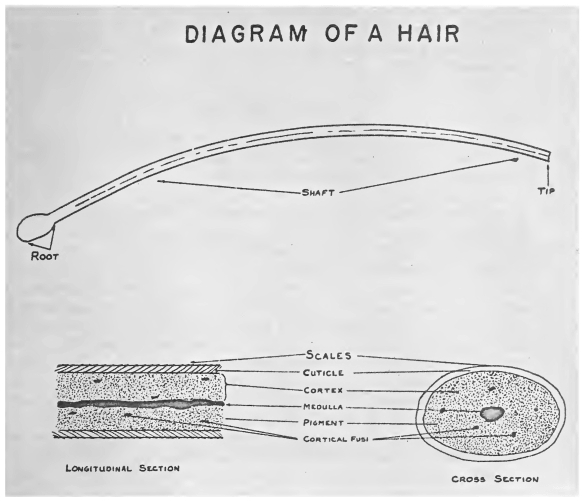
Commission Exhibit No. 666
DIAGRAM OF A HAIR
General Principles
Hairs.—As shown in Commission Exhibit No. 666 (p. 587), a hair consists of a central shaft of air cells, known as the medulla; a cortex containing pigment granules (which give the hair its color) and cortical fusi (air spaces); and a cuticle and an outer layer of scales. Unlike fingerprints, hairs are not unique. However, human hairs can be distinguished from animal hairs by various characteristics, including color, texture, length, medullary structure and shape, shape of pigment, root size, and scale size. In addition, hairs of the Caucasian, Negroid, and Mongoloid human races can be distinguished from each other by color, texture, size and degree of fluctuation of diameter, thickness of cuticle, shape and distribution of pigment, and shape of cross-section. Moreover, even though individual hairs are not unique, the expert usually can distinguish the hairs of different individuals. Thus, Stombaugh, who had made approximately 1,000 comparison examinations of Caucasian hairs and 500 comparison examinations of Negroid hairs, had never found a case in which he was unable to differentiate the hairs of two different Caucasian individuals, and had found only several cases in which he could not distinguish, with absolute certainty, between the hairs of two different Negroid individuals.A10-344
Fibers.—Like hairs, the various types of natural and artificial fibers can be distinguished from each other under the microscope. Like hairs too, individual fibers are not unique, but the expert usually can distinguish fibers from different fabrics. A major identifying characteristic of most fibers is color, and under the microscope many different shades of each color can be differentiated—for example, 50-100 shades of green or blue, and 25-30 shades of black. The microscopic appearance of three types of fibers—cotton, wool, and viscose—is illustrated in Commission Exhibit No. 665 (p. 589). Two of these, cotton and viscose, were the subject of testimony by Stombaugh. Cotton is a natural fiber. Under the microscope, it resembles a twisted soda straw, and the degree of twist is an additional identifying characteristic of cotton. Cotton may be mercerized or (more commonly) unmercerized. Viscose is an artificial fiber. A delustering agent is usually added to viscose to cut down its luster, and under the microscope this agent appears as millions of tiny spots on the outside of the fiber. The major identifying characteristics of viscose, apart from color, are diameter—hundreds of variations being possible—and size and distribution of delustering agent, if any.A10-345
The blanket.—Stombaugh received the blanket, Commission Exhibit No. 140, in the FBI Laboratory at 7:30 a.m., on November 23, 1963.A10-346 Examination showed that it was composed of brown and green fibers, of which approximately 1-2 percent were woolen, 20-35 percent were cotton, and the remainder were delustered viscose.A10-347 The viscose fibers in the blanket were of 10-15 different diameters, and also varied slightly in shade and in the size and distribution of the delustering agent. (The apparent cause of those variations was that the viscose in the blanket consisted of scrap viscose.)A10-348 The cotton also varied in shade, about seven to eight different shades of green cotton being present, but was uniform in twist.A10-349
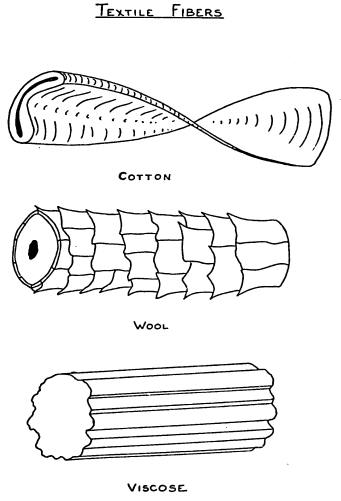
Commission Exhibit No. 665
Textile Fibers
Cotton
Wool
Viscose
When received by Stombaugh, the blanket was folded into approximately the shape of a narrow right triangle.A10-350 A safety pin was inserted in one end of the blanket, and also at this end, loosely wrapped around the blanket, was a string.A10-351 On the basis of creases in the blanket in this area it appeared that the string had been tied around the blanket rather tightly at one time while something was inside the blanket.A10-352 Other creases and folds were also present, as illustrated in Commission Exhibit No. 663.A10-353 Among these was a crease or hump approximately 10 inches long.A10-354 This crease must have been caused by a hard protruding object approximately 10 inches long which had been tightly wrapped in the blanket, causing the yarn to stretch so that the hump was present even when the object had been extracted.A10-355 The hump was approximately the same length and shape as the telescopic sight on the C2766 rifle, and its position with respect to the ends of the blanket was such (based on the manner in which the blanket was folded when Stombaugh received it) that had the rifle been in the blanket the telescopic sight could have made the hump.A10-356
The string wrapped around the blanket was made of ordinary white cotton.A10-357 It had been tied into a granny knot (a very common knot tied right over right, right over right) and the dangling ends had been further tied into a bow knot (the knot used on shoelaces).A10-358
After receiving the blanket, Stombaugh scraped it to remove the foreign textile fibers and hairs that were present.A10-359 He found numerous foreign textile fibers of various types and colors, and a number of limb, pubic, and head hairs, all of which had originated from persons of the Caucasian race, and had fallen out naturally, as was shown by the shape of their roots.A10-360 Several of the limb and pubic hairs matched samples of Oswald’s limb and pubic hairs obtained by the Dallas police in all observable characteristics, including certain relatively unusual characteristics.A10-361 For example, in both Oswald’s pubic hairs and some of the blanket pubic hairs, the color was a medium brown, which remained constant to the tip, where it changed to a very light brown and then became transparent, due to lack of color pigments; the diameters were identical, and rather narrow for pubic hairs; the hairs were very smooth, lacking the knobbiness characteristic of pubic hairs, and the upper two-thirds were extremely smooth for pubic hairs; the tips of the hairs were sharp, which is unusual for pubic hairs; the cuticle was very thin for pubic hairs; the scales displayed only a very small protrusion; the pigmentation was very fine, equally dispersed, and occasionally chained together, and displayed only very slight gapping; cortical fusi were for the most part absent; the medulla was either fairly continuous or completely absent; and the root area was rather clear of pigment, and contained only a fair amount of cortical fusi, which was unusual.A10-362 Similarly, in both Oswald’s limb hairs and some of the limb hairs from the blanket the color was light brown through its entire length; the diameter was very fine and did not noticeably fluctuate; the tips were very sharp, which is unusual; the scales were of medium size, with very slight protrusion; there was a very slight gapping of the pigmentation near the cuticle; there was an unusual amount of cortical fusi, equally distributed through the hair shaft; and the medulla was discontinuous, granular, very bulbous, and very uneven.A10-363
Other limb, pubic, and head hairs on the blanket did not come from Oswald.A10-364
The paper bag.—Stombaugh received the paper bag, Commission Exhibit No. 142, at 7:30 a.m. on November 23, 1963.A10-365 No foreign material was found on the outside of the bag except traces of fingerprint powder and several white cotton fibers, which were of no significance, since white cotton is the most common textile, and at any rate the fibers may have come from Stombaugh’s white cotton gloves.A10-366 Inside the bag were a tiny wood fragment which was too minute for comparison purposes, and may have come from the woodpulp from which the paper was made; a particle of a waxy substance, like candle wax; and a single brown delustered viscose fiber and several light-green cotton fibers.A10-367
The fibers found inside the bag were compared with brown viscose and green cotton fibers taken from the blanket. The brown viscose fiber found in the bag matched some of the brown viscose fibers from the blanket in all observable characteristics, i.e., shade, diameter, and size and distribution of delustering agent.A10-368 The green cotton fibers found in the bag were, like those from the blanket, of varying shades, but of a uniform twist. Each green cotton fiber from the bag matched some of the green cotton fibers from the blanket in all observable characteristics, i.e., shade and degree of twist. Like the blanket cotton fibers, the cotton fibers found in the bag were unmercerized.A10-369
The shirt.—Stombaugh received the shirt, Commission Exhibit No. 150, at 7:30 a.m. on November 23, 1963.A10-370 Examination showed that it was composed of gray-black, dark blue, and orange-yellow cotton fibers.A10-371 The orange-yellow and gray-black cotton fibers were of a uniform shade, and the dark-blue fibers were of three different shades.A10-372 All the fibers were mercerized and of substantially uniform degree of twist.A10-373
The C2766 rifle.—The rifle, Commission Exhibit No. 139, was received in the FBI Laboratory on the morning of November 23, 1963, and examined for foreign material at that time.A10-374 Stombaugh noticed immediately that the rifle had been dusted for fingerprints, “and at the time I noted to myself that I doubted very much if there would be any fibers adhering to the outside of this gun—I possibly might find some in a crevice some place—because when the latent fingerprint man dusted this gun, apparently in Dallas, they use a little brush to dust with they would have dusted any fibers off the gun at the same time * * *.”A10-375 In fact, most of the fibers Stombaugh found were either adhering to greasy, oily deposits or were jammed down into crevices, and were so dirty, old, and fragmented that he could not even determine what type of fibers they were.A10-376 However, Stombaugh found that a tiny tuft of fibers had caught on a jagged edge on the rifle’s metal butt plate where it met the end of the wooden stock, and had adhered to this edge, so that when the rifle had been dusted for fingerprints the brush had folded the tuft into a crevice between the butt plate and the stock, where it remained.A10-377 Stombaugh described these fibers as “fresh,”A10-378 by which he meant that “they were clean, they had good color to them, there was no grease on them and they were not fragmented.”A10-379 However, it was not possible to determine how long the fibers had been on the rifle, in the absence of information as to how frequently the rifle had been used.A10-380 Examination showed that the tuft was composed of six or seven orange-yellow, gray-black, and dark-blue cotton fibers. These fibers were compared with fibers from the shirt, Commission Exhibit No. 150, which was also composed of orange-yellow, gray-black, and dark-blue cotton fibers. The orange-yellow and gray-black tuft fibers matched the comparable shirt fibers in all observable characteristics, i.e., shade and twist. The three dark-blue fibers matched two of the three shades of the dark-blue shirt fibers, and also matched the dark-blue shirt fibers in degree of twist.A10-381 Based on these facts, Stombaugh concluded that the tuft of fibers found on the rifle “could easily” have come from the shirt, and that “there is no doubt in my mind that these fibers could have come from this shirt. There is no way, however, to eliminate the possibility of the fibers having come from another identical shirt.”A10-382
PHOTOGRAPHS
Two photographs of Lee Harvey Oswald holding a rifle were found among Oswald’s possessions in Mrs. Ruth Paine’s garage at 2515 West Fifth Street, Irving, Tex.A10-383 In one, Commission Exhibit No. 133-A, Oswald is holding the rifle generally in front of his body; in the other, Commission Exhibit No. 133-B, he is holding the rifle to his right. Also found at Mrs. Paine’s garage were a negative of 133-B and several photographs of the rear of General Walker’s house.A10-384 An Imperial reflex camera,A10-385 which Marina Oswald testified she used to take 133-A and 133-B, was subsequently produced by Robert Oswald, Lee Harvey Oswald’s brother.A10-386 Testimony concerning the photographs, the negative, and the camera was given by Lyndal D. Shaneyfelt of the FBI.A10-387 Shaneyfelt has been connected with photographic work since 1937. He has made 100-300 photographic examinations, and has testified frequently on the subject in court.A10-388
Photographs 133-A and 133-B.—The background and lighting in 133-A and 133-B are virtually identical; the only apparent difference between the two photographs is the pose. However, in 133-A the rifle is held in a position showing many more of its characteristics than are shown in 133-B.A10-389 In order to bring out the details in the rifle pictured in 133-A, Shaneyfelt rephotographed 133-A and prepared prints of varying densities from the new negative.A10-390 He also took two new photographs of the C2766 rifle itself: one shows the rifle in approximately the same position as the rifle pictured in 133-A. The other shows a man holding the rifle simulating the pose in 133-A.A10-391 Shaneyfelt compared the actual rifle, the photograph 133-A, his rephotographs of 133-A, and the two new photographs to determine whether the rifle pictured in 133-A was the C2766 rifle. He found it to be the same in all appearances, noted no differences, and found a notch in the stock of the C2766 which also appeared very faintly in 133-A. However, he did not find enough peculiarities to positively identify the rifle in 133-A as the C2766 rifle, as distinguished from other rifles of the same configuration.A10-392
The rifle’s position in 133-B is such that less of its characteristics were visible than in 133-A; essentially, 133-B shows only the bottom of the rifle. However, the characteristics of the rifle visible in 133-B are also similar to the observable characteristics of the C2766 rifle, except that while the C2766 rifle was equipped with a homemade leather sling when it was found after the assassination, the rifle in 133-B seems to be equipped with a homemade rope sling.A10-393 The portion of the sling visible in 133-A is too small to establish whether it is rope or leather, but it has the appearance of rope, and its configuration is consistent with the rope sling pictured in 133-B.A10-394
The negative.—Shaneyfelt’s examination of the negative, Commission Exhibit No. 749, showed that the photograph, 133-B, had been printed directly or indirectly from the negative. It was Shaneyfelt’s opinion that 133-B had been directly from the negative, but he could not absolutely eliminate the possibility of an internegative, that is, the possibility that a print had been produced from the negative 749, a photograph had been taken of that print, and 133-B had been produced from the new negative, rather than from the original negative.A10-395 “I think this is highly unlikely, because if this were the result of a copied negative, there would normally be evidence that I could detect, such as a loss of detail and imperfections that show up due to the added process.”A10-396 In any event, any “intermediate” print would have been virtually indistinguishable from 133-B, so that Shaneyfelt’s testimony conclusively established that either 133-B or a virtually indistinguishable print had been produced from the negative 749.
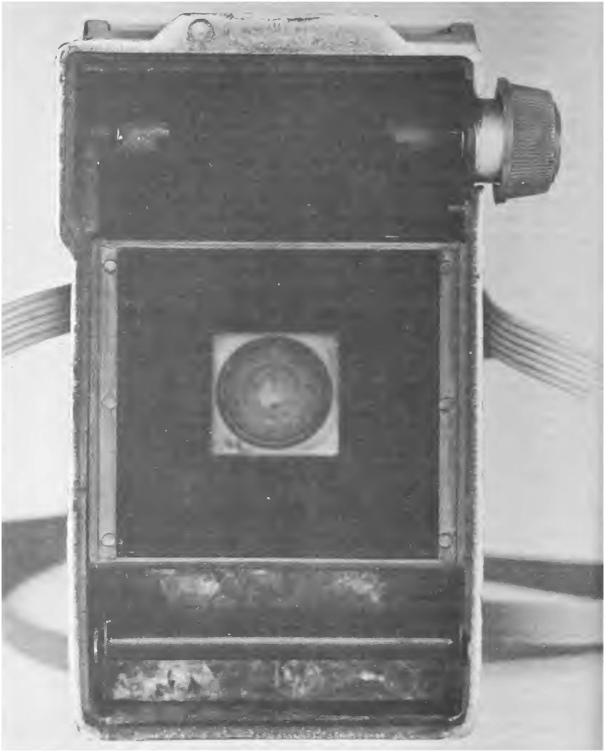
Commission Exhibit No. 751
Oswald’s Imperial Reflex camera, with the back removed to show the camera’s film-plane aperture.
The camera.—The Imperial camera, Commission Exhibit No. 750, was a relatively inexpensive, fixed-focus, one-shutter-speed, box-type camera, made in the United States.A10-397 Shaneyfelt compared this camera with the negative, Commission Exhibit No. 749, to determine whether this negative had been taken with the camera.A10-398 To make this determination, Shaneyfelt compared the margins of the image on Commission Exhibit No. 749 with the margins of the image on a negative he himself had taken with the camera. Microscopic examination shows that the margins of a negative’s image, although apparently straight, are actually irregular. The irregularities usually do not show on a finished print, because they are blocked out to give the print a neat border.A10-399 The cause of these irregularities can be best understood by examination of Commission Exhibit No. 751 (p. 594), a photograph of the Imperial camera with the back removed to show the camera’s film-plane aperture. When the camera’s shutter is opened, light exposes that portion of the film which is not blocked off by this aperture. The edges of the aperture, therefore, define the edges of the image which will appear on the developed negative. In effect, the edge of the image is a shadowgraph of the edge of the aperture. As Shaneyfelt testified:
* * * the basis of the examination was a close microscopic study of the negative made in the camera to study the shadowgraph that is made of the edge of the aperture.
As the film is placed across the aperture of the camera, and the shutter is opened, light comes through and exposes the film only in the opening within the edges. Where the film is out over the edges of the aperture it is not exposed, and your result is an exposed negative with a clear edge, and on the negative then, the edges of that exposure of the photograph, are actually shadowgraphs of the edges of the aperture.A10-400
The basis of the identification is that the microscopic characteristics of every film-plane aperture, like those of a rifle barrel, are distinctive, for much the same reason; that is, when the camera is manufactured, certain handwork is done which differs microscopically from camera to camera, and further differences accrue as the camera is used. As Shaneyfelt testified:
Q. Mr. Shaneyfelt, what is the basis of your statement, the theoretical basis of your statement, that every camera with this type of back aperture arrangement is unique in the characteristics of the shadowgraph it makes on the negative?
Mr. Shaneyfelt. It is because of the minute variations that even two cameras from the same mold will have. Additional handwork on cameras, or filing the edges where a little bit of plastic or a little bit of metal stays on, make individual characteristics apart from those that would be general characteristics on all of them from the same mold.
In addition, as the film moves across the camera and it is used for a considerable length of time, dirt and debris tend to accumulate a little—or if the aperture is painted, little lumps in the paint will make little bumps along that edge that would make that then individually different from every other camera.
Q. Is this similar then to toolmark identification?
Mr. Shaneyfelt. Very similar; yes.A10-401
Based on his examination of the shadowgraph on the negative, Commission Exhibit No. 749, Shaneyfelt determined that it had been taken with the Imperial camera.A10-402
Three edges of the shadowgraph of the film-plane aperture were also visible on one of the photographs of General Walker’s house, not having been blocked out in the making of the print. On the basis of these three margins, Shaneyfelt determined that this photograph had also been taken with Oswald’s Imperial Reflex camera. Shaneyfelt could not determine whether 133-A had been photographed with the Imperial camera, because the negative of 133-A had not been found, and the print itself did not show a shadowgraph area.A10-403
During his interrogations Oswald had been shown 133-A, and had claimed it was a composite—that the face in the picture was his, but the body was not.A10-404 Shaneyfelt examined 133-A and 133-B to determine if they were composite pictures. He concluded that they were not:
* * * it is my opinion that they are not composites. Again with very, very minor reservation, because I cannot entirely eliminate an extremely expert composite. I have examined many composite photographs, and there is always an inconsistency, either in lighting of the portion that is added, or the configuration indicating a different lens used for the part that was added to the original photograph, things many times that you can’t point to and say this is a characteristic, or that is a characteristic, but they have definite variations that are not consistent throughout the picture.
I found no such characteristics in this picture.
In addition, with a composite it is always necessary to make a print that you then make a pasteup of. In this instance paste the face in, and rephotograph it, and then retouch out the area where the head was cut out, which would leave a characteristic that would be retouched out on the negative and then that would be printed.
Normally, this retouching can be seen under magnification in the resulting composite—points can be seen where the edge of the head had been added and it hadn’t been entirely retouched out.
This can nearly always be detected under magnification. I found no such characteristics in these pictures.
Q. Did you use the technique of magnification in your analysis?
A. Yes.A10-405
Furthermore, the negative, Commission Exhibit No. 749, showed absolutely no doctoring or composition.A10-406 Since the negative was made in Oswald’s Imperial camera, Commission Exhibit No. 750, a composite of 133-B could have been made only by putting two pictures together and rephotographing them in the Imperial camera—all without leaving a discernible trace. This, to Shaneyfelt, was “in the realm of the impossible”:
In addition, in this instance regarding 133-B which I have just stated, I have identified as being photographed or exposed in the camera which is Exhibit 750, for this to be a composite, they would have had to make a picture of the background with an individual standing there, and then substitute the face, and retouch it and then possibly rephotograph it and retouch that negative, and make a print, and then photograph it with this camera, which is Commission Exhibit 750, in order to have this negative which we have identified with the camera, and is Commission Exhibit 749.
This to me is beyond reasonable doubt, it just doesn’t seem that it would be at all possible, in this particular photograph.A10-407
* * * * *
Q. You have the negative of this? [Referring to Exhibit 133B.]
A. We have the negative of 133B.
Q. You have the negative of 133B. That negative in itself shows no doctoring or composition at all?
A. It shows absolutely no doctoring or composition.
Q. So that the only composition that could have been made would have been in this process which you have described of picture on picture and negative and then photographing?
A. And then finally rephotographing with this camera.
Q. Rephotographing with this camera, this very camera?
A. That is correct, and this then, to me, becomes in the realm of the impossible.A10-408
Following the assassination, photographs similar to 133-A appeared in a number of newspapers and magazines.A10-409 At least some of these photographs, as reproduced, differed both from 133-A and from each other in minor details.A10-410 Shaneyfelt examined several of these reproductions and concluded that in each case the individual publisher had taken a reproduction of 133-A and retouched it in various ways, apparently for clarifying purposes, thus accounting for the differences between the reproductions and 133-A, and the differences between the reproductions themselves.A10-411 Subsequently one of the publishers involved submitted the original photographs which it had retouched. Shaneyfelt’s examination of this photograph confirmed his original conclusion.A10-412 The remaining publishers either confirmed that they had retouched the photographs they had used, or failed to contradict Shaneyfelt’s testimony after having been given an opportunity to do so.A10-413