Chapter VI · Investigation of Possible Conspiracy (continued 2)
Reading edition
In April of 1963, Oswald left Fort Worth for New Orleans, where he was later joined by his wife and daughter, and remained until his trip to Mexico City in late September and his subsequent return to the Dallas-Fort Worth area in early October of 1963.C6-324 With only minor exceptions,C6-325 there is no evidence that any member of the Russian-speaking community had further contact with Oswald or his family after April.C6-326 In New Orleans, Oswald made no attempt to make new Russian-speaking acquaintances for his wife and there is no evidence that he developed any friendships in that city.C6-327 Similarly, after the return from New Orleans, there seems to have been no communication between the Oswalds and this group until the evening of November 22, 1963, when the Dallas Police enlisted Ilya Mamantov to serve as an interpreter for them in their questioning of Marina Oswald.C6-328
George De Mohrenschildt and his wife, both of whom speak Russian as well as several other languages, however, did continue to see the Oswalds on occasion up to about the time Oswald went to New Orleans on April 24, 1963. De Mohrenschildt was apparently the only Russian-speaking person living in Dallas for whom Oswald had appreciable respect, and this seems to have been true even though De Mohrenschildt helped Marina Oswald leave her husband for a period in November of 1962.C6-329
In connection with the relations between Oswald and De Mohrenschildt, the Commission has considered testimony concerning an event which occurred shortly after Oswald shot at General Walker. The De Mohrenschildts came to Oswald’s apartment on Neely Street for the first time on the evening of April 13, 1963, apparently to bring an Easter gift for the Oswald child.C6-330 Mrs. De Mohrenschildt testified that while Marina Oswald was showing her the apartment, she saw a rifle with a scope in a closet. Mrs. De Mohrenschildt then told her husband, in the presence of the Oswalds, that there was a rifle in the closet.C6-331 Mrs. De Mohrenschildt testified that “George, of course, with his sense of humor—Walker was shot at a few days ago, within that time. He said, ‘Did you take a pot shot at Walker by any chance?’”C6-332 At that point, Mr. De Mohrenschildt testified, Oswald “sort of shriveled, you see, when I asked this question. * * * made a peculiar face * * * [and] changed the expression on his face” and remarked that he did targetshooting.C6-333 Marina Oswald testified that the De Mohrenschildts came to visit a few days after the Walker incident and that when De Mohrenschildt made his reference to Oswald’s possibly shooting at Walker, Oswald’s “face changed, * * * he almost became speechless.”C6-334 According to the De Mohrenschildts, Mr. De Mohrenschildt’s remark was intended as a joke, and he had no knowledge of Oswald’s involvement in the attack on Walker.C6-335 Nonetheless, the remark appears to have created an uncomfortable silence, and the De Mohrenschildts left “very soon afterwards.” They never saw either of the Oswalds again.C6-336 They left in a few days on a trip to New York City and did not return until after Oswald had gone to New Orleans.C6-337 A postcard from Oswald to De Mohrenschildt was apparently the only contact they had thereafter.C6-338 The De Mohrenschildts left in early June for Haiti on a business venture, and they were still residing there at the time they testified on April 23, 1964.C6-339
Extensive investigation has been conducted into the background of both De Mohrenschildts.C6-340 The investigation has revealed that George De Mohrenschildt is a highly individualistic person of varied interests. He was born in the Russian Ukraine in 1911 and fled Russia with his parents in 1921 during the civil disorder following the revolution. He was in a Polish cavalry military academy for 1½ years. Later he studied in Antwerp and attended the University of Liege from which he received a doctor’s degree in international commerce in 1928. Soon thereafter, he emigrated to the United States; he became a U.S. citizen in 1949.C6-341 De Mohrenschildt eventually became interested in oil exploration and production; he entered the University of Texas in 1944 and received a master’s degree in petroleum geology and petroleum engineering in 1945.C6-342 He has since become active as a petroleum engineer throughout the world.C6-343 In 1960, after the death of his son, he and his wife made an 8-month hike from the United States-Mexican border to Panama over primitive jungle trails. By happenstance they were in Guatemala City at the time of the Bay of Pigs invasion.C6-344 A lengthy film and complete written log was prepared by De Mohrenschildt and a report of the trip was made to the U.S. Government.C6-345 Upon arriving in Panama they journeyed to Haiti where De Mohrenschildt eventually became involved in a Government-oriented business venture in which he has been engaged continuously since June 1963 until the time of this report.C6-346
The members of the Dallas-Fort Worth Russian community and others have variously described De Mohrenschildt as eccentric, outspoken, and a strong believer in individual liberties and in the U.S. form of government, but also of the belief that some form of undemocratic government might be best for other peoples.C6-347 De Mohrenschildt frankly admits his provocative personality.C6-348
Jeanne De Mohrenschildt was born in Harbin, China, of White Russian parents. She left during the war with Japan, coming to New York in 1938 where she became a successful ladies dress and sportswear apparel designer. She married her present husband in 1959.C6-349
The Commission’s investigation has developed no signs of subversive or disloyal conduct on the part of either of the De Mohrenschildts. Neither the FBI, CIA, nor any witness contacted by the Commission has provided any information linking the De Mohrenschildts to subversive or extremist organizations.C6-350 Nor has there been any evidence linking them in any way with the assassination of President Kennedy.
The Commission has also considered closely the relations between the Oswalds and Michael and Ruth Paine of Irving, Tex. The Paines were not part of the Russian community which has been discussed above. Ruth Paine speaks Russian, however, and for this reason was invited to a party in February of 1963 at which she became acquainted with the Oswalds.C6-351 The host had met the Oswalds through the De Mohrenschildts.C6-352 Marina Oswald and Ruth Paine subsequently became quite friendly, and Mrs. Paine provided considerable assistance to the Oswalds.C6-353 Marina Oswald and her child resided with Ruth Paine for a little over 2 weeks while Oswald sought a job in New Orleans in late April and early May 1963.C6-354 In May, she transported Marina Oswald to New Orleans, paying all of the traveling and other expenses.C6-355 While the Oswalds were in New Orleans, the two women corresponded.C6-356 Mrs. Paine came to New Orleans in late September and took Marina Oswald and her child to her home in Irving.C6-357
Since Oswald left for Mexico City promptly after Mrs. Paine and his family departed New Orleans,C6-358 the Commission has considered whether Ruth Paine’s trip to New Orleans was undertaken to assist Oswald in this venture, but the evidence is clear that it was not. In her letters to Ruth Paine during the summer of 1963, Marina Oswald confided that she was having continuing difficulties with her husband, and Mrs. Paine urged Marina Oswald to live with her in Irving; the letters of the two women prior to Mrs. Paine’s arrival in New Orleans on September 20, 1963, however, contain no mention that Oswald was planning a trip to Mexico City or elsewhere.C6-359 In New Orleans, Mrs. Paine was told by Oswald that he planned to seek employment in Houston, or perhaps Philadelphia. Though Marina Oswald knew this to be false, she testified that she joined in this deception.C6-360 At no time during the entire weekend was Mexico City mentioned.C6-361 Corroboration for this testimony is found in a letter Mrs. Paine wrote her mother shortly after she and Marina Oswald had returned to Irving on September 24, in which she stated that Marina Oswald was again living with her temporarily and that Oswald was job-hunting.C6-362 When Oswald arrived at the Paine home on October 4, he continued his deception by telling Mrs. Paine, in his wife’s presence, that he had been unsuccessful in finding employment.C6-363 At Oswald’s request, Marina Oswald remained silent.C6-364
Marina Oswald lived with Ruth Paine through the birth of her second daughter on October 20, 1963, and until the assassination of President Kennedy.C6-365 During this period, Oswald obtained a room in Dallas and found employment in Dallas, but spent weekends with his family at the Paine home.C6-366 On November 1 and 5, Ruth Paine was interviewed by agents of the FBI who were investigating Oswald’s activities since his return from the Soviet Union, as set forth in greater detail in chapter VIII. She did not then know Oswald’s address in Dallas.C6-367 She was not asked for, nor did she volunteer, Oswald’s telephone number in Dallas, which she did know.C6-368 She advised the Bureau agent to whom she spoke of Oswald’s periodic weekend visits, and she informed him that Oswald was employed at the Texas School Book Depository Building.C6-369
On November 10, Ruth Paine discovered a draft of Oswald’s letter written the day before to the Soviet Embassy in Washington, in which he indicated that he had journeyed to Mexico City and conferred with a “comrade Kostine in the Embassy of the Soviet Union, Mexico City, Mexico.”C6-370 (This letter is discussed later in this chapter.) Mr. and Mrs. Paine testified that although they initially assumed the letter was a figment of Oswald’s imagination, the letter gave Mrs. Paine considerable misgivings.C6-371 She determined that if the FBI agents returned she would deliver to them the copy of a draft of the letter which, unknown to Oswald, she had made.C6-372 However, the agents did not return before the assassination.C6-373 On November 19, Mrs. Paine learned that Oswald was living in his Dallas rooming-house under an assumed name.C6-374 She did not report this to the FBI because, as she testified, she “had no occasion to see them, and * * * did not think it important enough to call them after that until the 23d of November.”C6-375
The Commission has thoroughly investigated the background of both Paines. Mrs. Paine was born Ruth Hyde in New York City on September 3, 1932. Her parents moved to Columbus, Ohio, in the late 1930’s.C6-376 They were divorced in 1961.C6-377 Ruth Paine graduated from Antioch College in 1955.C6-378 While in high school she first became interested in Quaker activities; she and her brother became Quakers in 1951.C6-379 In 1952, following completion of her sophomore year at Antioch College, she was a delegate to two Friends conferences in England.C6-380
At the time the Paines met in 1955, Mrs. Paine was active in the work of the Young Friends Committee of North America, which, with the cooperation of the Department of State, was making an effort to lessen the tensions between Soviet Russia and the United States by means of the stimulation of contacts and exchange of cultures between citizens of the two nations through “pen-pal” correspondence and exchanges of young Russians and Americans.C6-381 It was during this period that Mrs. Paine became interested in the Russian language.C6-382 Mrs. Paine participated in a Russian-American student exchange program sponsored by the Young Friends Committee of North America, and has participated in the “pen-pal” phase of the activities of the Young Friends Committee.C6-383 She has corresponded until recently with a schoolteacher in Russia.C6-384 Although her active interest in the Friends’ program for the lessening of East-West tensions ceased upon her marriage in December 1957, she has continued to hold to the tenets of the Quaker faith.C6-385
Michael Paine is the son of George Lyman Paine and Ruth Forbes Paine, now Ruth Forbes Young, wife of Arthur Young of Philadelphia, Pa.C6-386 His parents were divorced when he was 4 years of age. His father, George Lyman Paine, is an architect and resides in California.C6-387 Michael Paine testified that during his late grammar and early high school days his father participated actively in the Trotskyite faction of the Communist movement in the United States and that he attended some of those meetings.C6-388 He stated that his father, with whom he has had little contact throughout most of his life, has not influenced his political thinking. He said that he has visited his father four or five times in California since 1959, but their discussions did not include the subject of communism.C6-389 Since moving to Irving, Tex., in 1959, he has been a research engineer for Bell Helicopter Co. in Fort Worth.C6-390 Mr. Paine has security clearance for his work.C6-391 He has been a long-time member of the American Civil Liberties Union.C6-392 Though not in sympathy with rightist political aims, he has attended a few meetings of far-right organizations in Dallas for the purpose, he testified, of learning something about those organizations and because he “was interested in seeing more communication between the right and the left.”C6-393
The Commission has conducted a thorough investigation of the Paines’ finances and is satisfied that their income has been from legitimate and traceable sources, and that their expenditures were consistent with their income and for normal purposes. Although in the course of their relationship with the Oswalds, the Paines assumed expenses for such matters as food and transportation, with a value of approximately $500, they made no direct payments to, and received no moneys or valuables from, the Oswalds.C6-394
Although prior to November 22, Mrs. Paine had information relating to Oswald’s use of an alias in Dallas, his telephone number, and his correspondence with the Soviet Embassy, which she did not pass on to the FBI,C6-395 her failure to have come forward with this information must be viewed within the context of the information available to her at that time. There is no evidence to contradict her testimony that she did not then know about Oswald’s attack on General Walker, the presence of the rifle on the floor of her garage, Oswald’s ownership of a pistol, or the photographs of Oswald displaying the firearms.C6-396 She thus assumed that Oswald, though a difficult and disturbing personality, was not potentially violent, and that the FBI was cognizant of his past history and current activities.C6-397
Moreover, it is from Mrs. Paine herself that the Commission has learned that she possessed the information which she did have. Mrs. Paine was forthright with the agent of the FBI with whom she spoke in early November 1963, providing him with sufficient information to have located Oswald at his job if he had deemed it necessary to do so,C6-398 and her failure to have taken immediate steps to notify the Bureau of the additional information does not under the circumstances appear unusual. Throughout the Commission’s investigation, Ruth Paine has been completely cooperative, voluntarily producing all correspondence, memoranda, and other written communications in her possession that had passed between her and Marina Oswald both before and after November 22, 1963.C6-399 The Commission has had the benefit of Mrs. Paine’s 1963 date book and calendar and her address book and telephone notation book, in both of which appear many entries relating to her activities with the Oswalds.C6-400 Other material of a purely personal nature was also voluntarily made available.C6-401 The Commission has found nothing in the Paines’ background, activities, or finances which suggests disloyalty to the United States,C6-402 and it has concluded that Ruth and Michael Paine were not involved in any way with the assassination of President Kennedy.
A fuller narrative of the social contacts between the Oswalds and the various persons of the Dallas-Fort Worth community is incorporated in chapter VII and appendix XIII, and the testimony of all members of the group who testified before the Commission is included in the printed record which accompanies the report. The evidence establishes that the Oswalds’ contacts with these people were originated and maintained under normal and understandable circumstances. The files maintained by the FBI contain no information indicating that any of the persons in the Dallas-Fort Worth community with whom Oswald associated were affiliated with any Communist, Fascist, or other subversive organization.C6-403 During the course of this investigation, the Commission has found nothing which suggests the involvement of any member of the Russian-speaking community in Oswald’s preparations to assassinate President Kennedy.
Political Activities Upon Return to the United States
Upon his return from the Soviet Union, Oswald had dealings with the Communist Party, U.S.A., the Socialist Workers Party, and the Fair Play for Cuba Committee, and he also had minor contacts with at least two other organizations with political interests. For the purpose of determining whether Oswald received any advice, encouragement, or assistance from these organizations in planning or executing the assassination of President Kennedy, the Commission has conducted a full investigation of the nature and extent of Oswald’s relations with them. The Commission has also conducted an investigation to determine whether certain persons and organizations expressing hostility to President Kennedy prior to the assassination had any connection with Lee Harvey Oswald or with the shooting of the President.
Communist Party, U.S.A.; Socialist Workers Party.—In August of 1962, Oswald subscribed to the Worker, a publication of the Communist Party, U.S.A.C6-404 He also wrote the Communist Party to obtain pamphlets and other literature which, the evidence indicates, were sent to him as a matter of course.C6-405
Oswald also attempted to initiate other dealings with the Communist Party, U.S.A., but the organization was not especially responsive. From New Orleans, he informed the party of his activities in connection with the Fair Play for Cuba Committee, discussed below, submitting membership cards in his fictitious chapter to several party officials.C6-406 In a letter from Arnold S. Johnson, director of the information and lecture bureau of the party, Oswald was informed that although the Communist Party had no “organizational ties” with the committee, the party issued much literature which was “important for anybody who is concerned about developments in Cuba.”C6-407 In September 1963 Oswald inquired how he might contact the party when he relocated in the Baltimore-Washington area, as he said he planned to do in October, and Johnson suggested in a letter of September 19 that he “get in touch with us here [New York] and we will find some way of getting in touch with you in that city [Baltimore].”C6-408 However, Oswald had also written asking whether, “handicapped as it were, by * * * [his] past record,” he could “still * * * compete with antiprogressive forces, above ground or whether in your opinion * * * [he] should always remain in the background, i.e., underground,” and in the September 19 letter received the reply that “often it is advisable for some people to remain in the background, not underground.”C6-409
In a letter postmarked November 1, Oswald informed the party that he had moved to Dallas, and reported his attendance at a meeting at which General Walker had spoken, and at a meeting of the American Civil Liberties Union; he asked Johnson for the party’s “general view” of the latter organization and “to what degree, if any, [he] should attempt to highten its progressive tendencies.” According to Johnson, this letter was not received by the Communist Party until after the assassination.C6-410 At different times, Oswald also wrote the Worker and the Hall-Davis Defense Committee, enclosing samples of his photographic work and offering to assist in preparing posters; he was told that “his kind offer [was] most welcomed and from time to time we shall call on you,” but he was never asked for assistance.C6-411 The correspondence between Oswald and the Communist Party, and with all other organizations, is printed in the record accompanying this report.
When Oswald applied for a visa to enter Cuba during his trip to Mexico City, discussed below,C6-412 Senora Silvia Duran, the Cuban consular employee who dealt with Oswald, wrote on the application that Oswald said he was a member of the Communist Party and that he had “displayed documents in proof of his membership.”C6-413 When Oswald went to Mexico, he is believed to have carried his letters from the Soviet Embassy in Washington and from the Communist Party in the United States, his 1959 passport, which contained stamps showing that he had lived in Russia for 2½ years, his Russian work permit, his Russian marriage certificate, membership cards and newspaper clippings purporting to show his role in the Fair Play for Cuba Committee, and a prepared statement of his qualifications as a “Marxist.”C6-414 Because of the mass of papers Oswald did present showing his affinity for communism, some in the Russian language, which was foreign to Senora Duran, and because further investigation, discussed below, indicated that Oswald was not a member of the party, Senora Duran’s notation was probably inaccurate.
Upon his arrest after the assassination, Oswald attempted to contact John J. Abt, a New York attorney, to request Abt to represent him. Abt was not in New York at the time, and he was never reached in connection with representing Oswald. Abt has testified that he at no time had any dealings with Oswald and that prior to the assassination he had never heard of Lee Harvey Oswald.C6-415
After his return from the Soviet Union, Oswald also carried on a limited correspondence with the Socialist Workers Party. In October of 1962 he attempted to join the party, but his application was not accepted since there was then no chapter in the Dallas area.C6-416 Oswald also wrote the Socialist Workers Party offering his assistance in preparing posters. From this organization too he received the response that he might be called upon if needed. He was asked for further information about his photographic skills, which he does not appear to have ever provided.C6-417 Oswald did obtain literature from the Socialist Workers Party, however, and in December 1962 he entered a subscription to the affiliated publication, the Militant.C6-418 Apparently in March of 1963 Oswald wrote the party of his activities and submitted a clipping with his letter. In response, he was told that his name was being sent to the Young Socialist Alliance for further correspondence, but the files of the alliance apparently contain no reference to Oswald. Neither the letter nor the clipping which Oswald sent has been located.C6-419
Investigation by the Commission has produced no plausible evidence that Lee Harvey Oswald had any other significant contacts with the Communist Party, U.S.A., the Socialist Workers Party, or with any other extreme leftist political organization. The FBI and other Federal security agencies have made a study of their records and files and contacted numerous confidential informants of the agencies and have produced no such evidence.C6-420 The Commission has questioned persons who, as a group, knew Oswald during virtually every phase of his adult life, and from none of these came any indication that Oswald maintained a surreptitious relationship with any organization. Arnold S. Johnson, of the American Communist Party; James T. Tormey, executive secretary of the Hall-Davis Defense Committee; and Farrell Dobbs, secretary of the Socialist Workers Party, voluntarily appeared before the Commission and testified under oath that Oswald was not a member of these organizations and that a thorough search of their files had disclosed no records relating to Oswald other than those which they produced for the Commission.C6-421 The material that has been disclosed is in all cases consistent with other data in the possession of the Commission.
Socialist Labor Party.—Oswald also wrote to the Socialist Labor Party in New York in November 1962 requesting literature. Horace Twiford, a national committeeman at large for the party in the State of Texas, was informed by the New York headquarters in July 1963 of Oswald’s request, and on September 11, 1963, he did mail literature to Oswald at his old post office box in Dallas.C6-422 On his way to Mexico City in September 1963, Oswald attempted to contact Twiford at his home in Houston; Oswald spoke briefly with Twiford’s wife, identifying himself as a member of the Fair Play for Cuba Committee, but since Twiford was out of town at the time, Oswald was unable to speak with him.C6-423 Arnold Peterson, national secretary and treasurer of the Socialist Labor Party, has stated that a search of the records of the national headquarters reveals no record pertaining to Oswald; he explained that letters requesting literature are routinely destroyed.C6-424 The Socialist Party-Social Democratic Federation has also advised that a review of its records fails to reflect any information or correspondence pertaining to Oswald.C6-425
Fair Play for Cuba Committee.—During the period Oswald was in New Orleans, from the end of April to late September 1963, he was engaged in activity purportedly on behalf of the now defunct Fair Play for Cuba Committee (FPCC), an organization centered in New York which was highly critical of U.S. policy toward the Cuban Government under Fidel Castro. In May 1963, after having obtained literature from the FPCC,C6-426 Oswald applied for and was granted membership in the organization.C6-427 When applying for membership, Oswald wrote national headquarters that he had
* * * been thinking about renting a small office at my own expense for the purpose of forming a F.P.C.C. branch here in New Orleans.
Could you give me a charter?C6-428
With his membership card, Oswald apparently received a copy of the constitution and bylaws for FPCC chapters, and a letter, dated May 29, which read in part as follows (with spelling as in original):
It would be hard to concieve of a chapter with as few members as seem to exist in the New Orleans area. I have just gone through our files and find that Louisiana seams somewhat restricted for Fair Play activities. However, with what is there perhaps you could build a larger group if a few people would undertake the disciplined responsibility of concrete organizational work.
We certainly are not at all adverse to a very small Chapter but certainly would expect that there would be at least twice the amount needed to conduct a legal executive board for the Chapter. Should this be reasonable we could readily issue a charter for a New Orleans Chapter of FPCC. In fact, we would be very, very pleased to see this take place and would like to do everything possible to assist in bringing it about.
* * * * *
You must realize that you will come under tremendous pressures with any attempt to do FPCC work in that area and that you will not be able to operate in the manner which is conventional here in the north-east. Even most of our big city Chapters have been forced to Abandon the idea of operating an office in public. * * * Most Chapters have discovered that it is easier to operate semi-privately out of a home and maintain a P.O. Box for all mailings and public notices. (A P.O. Box is a must for any Chapter in the organization to guarnatee the continued contact with the national even if an individual should move or drop out.) We do have a serious and often violent opposition and this proceedure helps prevent many unnecessary incidents which frighten away prospective supporters. I definitely would not recommend an office, at least not one that will be easily identifyable to the lunatic fringe in your community. Certainly, I would not recommend that you engage in one at the very beginning but wait and see how you can operate in the community through several public experiences.C6-429
Thereafter Oswald informed national headquarters that he had opened post office box No. 30061, and that against its advice he had decided “to take an office from the very beginning”; he also submitted copies of a membership application form and a circular headed “Hands Off Cuba!” which he had had printed, and informed the headquarters that he intended to have membership cards for his chapter printed, which he subsequently did.C6-430 He wrote three further letters to the New York office to inform it of his continued activities.C6-431 In one he reported that he had been evicted from the office he claimed to have opened, so that he “worked out of a post office box and by useing street demonstrations and some circular work * * * sustained a great deal of interest but no new members.”C6-432
Oswald did distribute the handbills he had printed on at least three occasions.C6-433 Once, while doing so, he was arrested and fined for being involved in a disturbance with anti-Castro Cuban refugees,C6-434 one of whom he had previously met by presenting himself as hostile to Premier Castro in an apparent effort to gain information about anti-Castro organizations operating in New Orleans.C6-435 When arrested, he informed the police that his chapter had 35 members.C6-436 His activities received some attention in the New Orleans press, and he twice appeared on a local radio program representing himself as a spokesman for the Fair Play for Cuba Committee.C6-437 After his return to Dallas, he listed the FPCC as an organization authorized to receive mail at his post office box.C6-438
Despite these activities, the FPCC chapter which Oswald purportedly formed in New Orleans was entirely fictitious. Vincent T. Lee, formerly national director of the Fair Play for Cuba Committee, has testified that the New York office did not authorize the creation of a New Orleans chapter, nor did it provide Oswald with funds to support his activities there.C6-439 The national office did not write Oswald again after its letter of May 29. As discussed more fully in chapter VII, Oswald’s later letters to the national office purporting to inform it of his progress in New Orleans contained numerous exaggerations about the scope of his activities and the public reaction to them.C6-440 There is no evidence that Oswald ever opened an office as he claimed to have done. Although a pamphlet taken from him at the time of his arrest in New Orleans contains the rubber stamp imprint “FPCC, 544 CAMP ST., NEW ORLEANS, LA.,” investigation has indicated that neither the Fair Play for Cuba Committee nor Lee Harvey Oswald ever maintained an office at that address.C6-441 The handbills and other materials bearing the name of the Fair Play for Cuba Committee were printed commercially by Oswald without the approval of the national headquarters.C6-442 Oswald’s membership card in the “New Orleans chapter” of the committee carried the signature of “A. J. Hidell,” purportedly the president of the chapter, but there is no evidence that an “A. J. Hidell” existed and, as pointed out in chapter IV, there is conclusive evidence that the name was an alias which Oswald used on various occasions. Marina Oswald herself wrote the name “Hidell” on the membership card at her husband’s insistence.C6-443
No other member of the so-called New Orleans chapter of the committee has ever been found. The only occasion on which anyone other than Oswald was observed taking part in these activities was on August 9, 1963, when Oswald and two young men passed out leaflets urging “Hands Off Cuba!” on the streets of New Orleans. One of the two men, who was 16 years old at the time, has testified that Oswald approached him at the Louisiana State Employment Commission and offered him $2 for about an hour’s work. He accepted the offer but later, when he noticed that television cameras were being focused on him, he obtained his money and left. He testified that he had never seen Oswald before and never saw him again. The second individual has never been located; but according to the testimony of the youth who was found, he too seemed to be someone not previously connected with Oswald.C6-444 Finally, the FBI has advised the Commission that its information on undercover Cuban activities in the New Orleans area reveals no knowledge of Oswald before the assassination.C6-445
Right-wing groups hostile to President Kennedy.—The Commission also considered the possibility that there may have been a link between Oswald and certain groups which had bitterly denounced President Kennedy and his policies prior to the time of the President’s trip to Dallas. As discussed in chapter II, two provocative incidents took place concurrently with President Kennedy’s visit and a third but a month prior thereto. The incidents were (1) the demonstration against the Honorable Adlai E. Stevenson, U.S. Ambassador to the United Nations, in late October 1963, when he came to Dallas on United Nations Day; (2) the publication in the Dallas Morning News on November 22 of the full page, black-bordered paid advertisement entitled, “Welcome Mr. Kennedy”; and (3) the distribution of a throwaway handbill entitled “Wanted for Treason” throughout Dallas on November 20 and 21. Oswald was aware of the Stevenson incident; there is no evidence that he became aware of either the “Welcome Mr. Kennedy” advertisement or the “Wanted for Treason” handbill, though neither possibility can be precluded.
The only evidence of interest on Oswald’s part in rightist groups in Dallas was his alleged attendance at a rally at the Dallas Auditorium the evening preceding Ambassador Stevenson’s address on United Nations Day, October 24, 1963. On the evening of October 25, 1963, at the invitation of Michael Paine, Oswald attended a monthly meeting of the Dallas chapter of the American Civil Liberties Union in which he was later to seek membership.C6-446 During the course of the discussion at this meeting, a speaker mentioned Maj. Gen. Edwin A. Walker (Resigned, U.S. Army). Oswald arose in the midst of the meeting to remark that a “night or two nights before” he had attended a meeting at which General Walker had spoken in terms that led Oswald to assert that General Walker was both anti-Catholic and anti-Semitic.C6-447 General Walker testified that he had been the speaker at a rally the night before Ambassador Stevenson’s appearance, but that he did not know and had never heard of Oswald prior to the announcement of his name on radio and television on the afternoon of November 22.C6-448 Oswald confirmed his attendance at the U.S. Day rally in an undated letter he wrote to Arnold Johnson, director of the information and lecture bureau of the Communist Party, mailed November 1, 1963, in which he reported:
On October 23rd, I had attended a ultra-right meeting headed by General Edwin a. Walker, who lives in Dallas.
This meeting preceded by one day the attack on a. e. Stevenson at the United Nations Day meeting at which he spoke.
As you can see, political friction between ‘left’ and ‘right’ is very great here.C6-449
In the light of Oswald’s attack upon General Walker on the evening of April 10, 1963, discussed in chapter IV,C6-450 as well as Oswald’s known political views,C6-451 his asserted attendance at the political rally at which General Walker spoke may have been induced by many possible motives. However, there is no evidence that Oswald attended any other rightist meetings or was associated with any politically conservative organizations.
While the black-bordered “Welcome Mr. Kennedy” advertisement in the November 22 Dallas Morning News, which addressed a series of critical questions to the President, probably did not come to Oswald’s attention, it was of interest to the Commission because of its appearance on the day of the assassination and because of an allegation made before the Commission concerning the person whose name appeared as the chairman of the committee sponsoring the advertisement. The black-bordered advertisement was purported to be sponsored by “The American Fact-Finding Committee,” which was described as “An unaffiliated and nonpartisan group of citizens who wish truth.” Bernard Weissman was listed as “Chairman” and a post office box in Dallas was the only address. (See Commission Exhibit No. 1031, p. 294.)
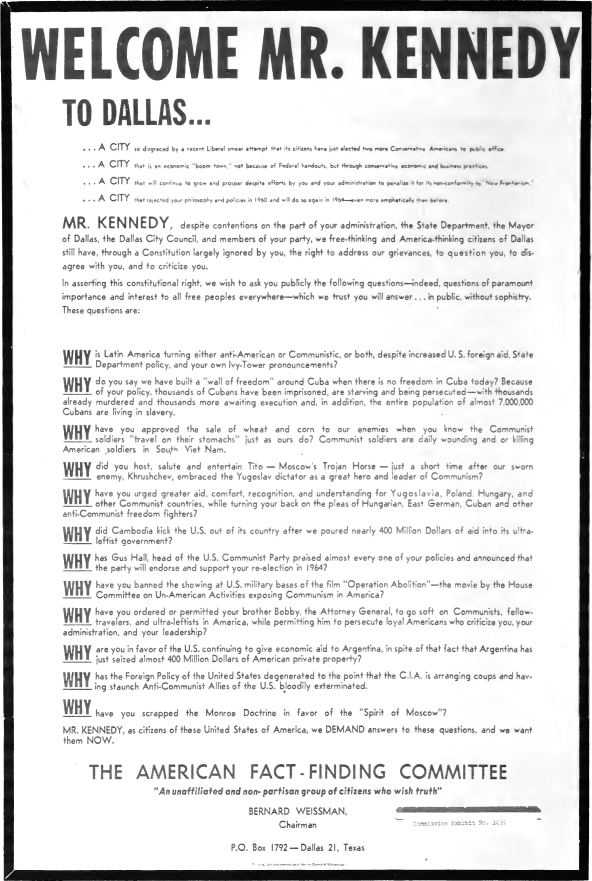
Commission Exhibit No. 1031
The Commission has conducted a full investigation into the genesis of this advertisement and the background of those responsible for it. Three of the four men chiefly responsible, Bernard W. Weissman, William B. Burley III, and Larrie H. Schmidt, had served together in the U.S. Army in Munich, Germany, in 1962. During that time they had with others devised plans to develop two conservative organizations, one political and the other business. The political entity was to be named Conservatism—USA, or CUSA, and the business entity was to be named American Business, or AMBUS.C6-452 While in Munich, according to Weissman, they attempted to develop in their “own minds * * * ways to build up various businesses that would support us and at the same time support our political activities.”C6-453 According to a subsequent letter from Schmidt to Weissman, “Cusa was founded for patriotic reasons rather than for personal gain—even though, as a side effect, Ambus was to have brought great return, as any business endeavor should.”C6-454 To establish their organizations, Weissman testified that they:
* * * had planned while in Munich that in order to accomplish our goals, to try to do it from scratch would be almost impossible, because it would be years before we could even get the funds to develop a powerful organization. So we had planned to infiltrate various rightwing organizations and by our own efforts become involved in the hierarchy of these various organizations and eventually get ourselves elected or appointed to various higher offices in these organizations, and by doing this bring in some of our own people, and eventually take over the leadership of these organizations, and at that time having our people in these various organizations, we would then, you might say, call a conference and have them unite, and while no one knew of the existence of CUSA aside from us, we would then bring them all together, unite them, and arrange to have it called CUSA.C6-455
Schmidt was the first to leave the service; settling in Dallas in October 1962, he became a life insurance salesman and quickly engaged in numerous political activities in pursuit of the objectives devised in Munich.C6-456 He became affiliated with several organizations and prepared various political writings.C6-457
Upon their release from the military, Weissman and Burley did not immediately move to Dallas, though repeatedly urged to do so by Schmidt.C6-458 On October 1, 1963, Schmidt wrote Weissman: “Adlai Stevenson is scheduled here on the 24th on UN Day. Kennedy is scheduled in Dallas on Nov. 24th. There are to be protests. All the big things are happening now—if we don’t get in right now we may as well forget it.”C6-459 The day of the Stevenson demonstration, Schmidt telephoned Weissman, again urging him to move to Dallas. Recalling that conversation with Schmidt, Weissman testified:
And he said, “If we are going to take advantage of the situation * * * you better hurry down here and take advantage of the publicity, and at least become known among these various right-wingers, because this is the chance we have been looking for to infiltrate some of these organizations and become known,” in other words, go along with the philosophy we had developed in Munich.C6-460
Five days later he wrote to Weissman and Burley to report that as the “only organizer of the demonstration to have publicly identified himself,” he had “become, overnight, a ‘fearless spokesman’ and ‘leader’ of the rightwing in Dallas. What I worked so hard for in one year—and nearly failed—finally came through one incident in one night!” He ended, “Politically, CUSA is set. It is now up to you to get Ambus going.”C6-461
Weissman and Burley accepted Schmidt’s prompting and traveled to Dallas, arriving on November 4, 1963.C6-462 Both obtained employment as carpet salesmen. At Schmidt’s solicitation they took steps to join the John Birch Society, and through Schmidt they met the fourth person involved in placing the November 22 advertisement, Joseph P. Grinnan, Dallas independent oil operator and a John Birch Society coordinator in the Dallas area.C6-463
Within a week to 10 days after Weissman and Burley had arrived in Dallas, the four men began to consider plans regarding President Kennedy’s planned visit to Dallas.C6-464 Weissman explained the reason for which it was decided that the ad should be placed:
* * * after the Stevenson incident, it was felt that a demonstration would be entirely out of order, because we didn’t want anything to happen in the way of physical violence to President Kennedy when he came to Dallas. But we thought that the conservatives in Dallas—I was told—were a pretty downtrodden lot after that, because they were being oppressed by the local liberals, because of the Stevenson incident. We felt we had to do something to build up the morale of the conservative element, in Dallas. So we hit upon the idea of the ad.C6-465
Weissman, Schmidt, and Grinnan worked on the text for the advertisement.C6-466 A pamphlet containing 50 questions critical of American policy was employed for this purpose, and was the source of the militant questions contained in the ad attacking President Kennedy’s administration.C6-467 Grinnan undertook to raise the $1,465 needed to pay for the ad.C6-468 He employed a typed draft of the advertisement to support his funds solicitation.C6-469 Grinnan raised the needed money from three wealthy Dallas businessmen: Edgar R. Crissey, Nelson Bunker Hunt, and H. R. Bright, some of whom in turn collected contributions from others.C6-470 At least one of the contributors would not make a contribution unless a question he suggested was inserted.C6-471 Weissman, believing that Schmidt, Grinnan, and the contributors were active members of the John Birch Society, and that Grinnan eventually took charge of the project, expressed the opinion that the advertisement was the creation of the John Birch Society,C6-472 though Schmidt and Grinnan have maintained that they were acting “solely as individuals.”C6-473
A fictitious sponsoring organization was invented out of whole cloth.C6-474 The name chosen for the supposed organization was The American Fact-Finding Committee.C6-475 This was “Solely a name,” Weissman testified; “* * * As a matter of fact, when I went to place the ad, I could not remember the name * * * I had to refer to a piece of paper for the name.”C6-476 Weissman’s own name was used on the ad in part to counter charges of anti-Semitism which had been leveled against conservative groups in Dallas.C6-477 Weissman conceived the idea of using a black border,C6-478 and testified he intended it to serve the function of stimulating reader attention.C6-479 Before accepting the advertisement, the Dallas Morning News apparently submitted it to its attorneys for their opinion as to whether its publication might subject them to liability.C6-480
Weissman testified that the advertisement drew 50 or 60 mailed responses.C6-481 He took them from the post office box early on Sunday morning, November 24.C6-482 He said that those postmarked before the attack on President Kennedy were “favorable” in tone;C6-483 those of later postmark were violently unfavorable, nasty, and threatening;C6-484 and, according to a report from Schmidt, those postmarked some weeks later were again of favorable tone.C6-485
The four promoters of the ad deny that they had any knowledge of or familiarity with Lee Harvey Oswald prior to November 22, or Jack Ruby prior to November 24.C6-486 Each has provided a statement of his role in connection with the placement of the November 22 advertisement and other matters, and investigation has revealed no deception. The Commission has found no evidence that any of these persons was connected with Oswald or Ruby, or was linked to a conspiracy to assassinate President Kennedy.
The advertisement, however, did give rise to one allegation concerning Bernard Weissman which required additional investigation. On March 4, 1964, Mark Lane, a New York attorney, testified before the Commission that an undisclosed informant had told him that Weissman had met with Jack Ruby and Patrolman J. D. Tippit at Ruby’s Carousel Club on November 14, 1963. Lane declined to state the name of his informant but said that he would attempt to obtain his informant’s permission to reveal his name.C6-487 On July 2, 1964, after repeated requests by the Commission that he disclose the name of his informant, Lane testified a second time concerning this matter, but declined to reveal the information, stating as his reason that he had promised the individual that his name would not be revealed without his permission.C6-488 Lane also made this allegation during a radio appearance, whereupon Weissman twice demanded that Lane reveal the name of the informant.C6-489 As of the date of this report Lane has failed to reveal the name of his informant and has offered no evidence to support his allegation. The Commission has investigated the allegation of a Weissman-Ruby-Tippit meeting and has found no evidence that such a meeting took place anywhere at any time. The investigation into this matter is discussed in a later section of this chapter dealing with possible conspiracies involving Jack Ruby.
A comparable incident was the appearance of the “Wanted for Treason” handbill on the streets of Dallas 1 to 2 days before President Kennedy’s arrival. These handbills bore a reproduction of a front and profile photograph of the President and set forth a series of inflammatory charges against him.C6-490 Efforts to locate the author and the lithography printer of the handbill at first met with evasive responsesC6-491 and refusals to furnish information.C6-492 Robert A. Surrey was eventually identified as the author of the handbill.C6-493 Surrey, a 38-year-old printing salesman employed by Johnson Printing Co. of Dallas, Tex., has been closely associated with General Walker for several years in his political and business activities.C6-494 He is president of American Eagle Publishing Co. of Dallas, in which he is a partner with General Walker.C6-495 Its office and address is the post office box of Johnson Printing Co. Its assets consist of cash and various printed materials composed chiefly of General Walker’s political and promotional literature,C6-496 all of which is stored at General Walker’s headquarters.C6-497
Surrey prepared the text for the handbill and apparently used Johnson Printing Co. facilities to set the type and print a proof.C6-498 Surrey induced Klause, a salesman employed by Lettercraft Printing Co. of Dallas,C6-499 whom Surrey had met when both were employed at Johnson Printing Co.,C6-500 to print the handbill “on the side.”C6-501 According to Klause, Surrey contacted him initially approximately 2 or 2½ weeks prior to November 22.C6-502 About a week prior to November 22, Surrey delivered to Klause two slick paper magazine prints of photographs of a front view and profile of President Kennedy,C6-503 together with the textual page proof.C6-504 Klause was unable to make the photographic negative of the prints needed to prepare the photographic printing plate,C6-505 so that he had this feature of the job done at a local shop.C6-506 Klause then arranged the halftone front and profile representations of President Kennedy at the top of the textual material he had received from Surrey so as to simulate a “man wanted” police placard. He then made a photographic printing plate of the picture.C6-507 During the night, he and his wife surreptitiously printed approximately 5,000 copies on Lettercraft Printing Co. offset printing equipment without the knowledge of his employers.C6-508 The next day he arranged with Surrey a meeting place, and delivered the handbills.C6-509 Klause’s charge for the printing of the handbills was, including expenses, $60.C6-510
At the outset of the investigation Klause stated to Federal agents that he did not know the name of his customer, whom he incorrectly described;C6-511 he did say, however, that the customer did not resemble either Oswald or Ruby.C6-512 Shortly before he appeared before the Commission, Klause disclosed Surrey’s identity.C6-513 He explained that no record of the transaction had been made because “he saw a chance to make a few dollars on the side.”C6-514
Klause’s testimony receives some corroboration from Bernard Weissman’s testimony that he saw a copy of one of the “Wanted for Treason” handbills on the floor of General Walker’s station wagon shortly after November 22.C6-515 Other details of the manner in which the handbills were printed have also been verified.C6-516 Moreover, Weissman testified that neither he nor any of his associates had anything to do with the handbill or were acquainted with Surrey, Klause, Lettercraft Printing Co., or Johnson Printing Co.C6-517 Klause and Surrey, as well as General Walker, testified that they were unacquainted with Lee Harvey Oswald and had not heard of him prior to the afternoon of November 22.C6-518 The Commission has found no evidence of any connection between those responsible for the handbill and Lee Harvey Oswald or the assassination.
Contacts With the Cuban and Soviet Embassies in Mexico City and the Soviet Embassy in Washington, D.C.
Eight weeks before the assassination, Oswald traveled to Mexico City where he visited both the Cuban and Soviet Embassies.D Oswald’s wife knew of this trip before he went,C6-519 but she denied such knowledge until she testified before the Commission.C6-520 The Commission undertook an intensive investigation to determine Oswald’s purpose and activities on this journey, with specific reference to reports that Oswald was an agent of the Cuban or Soviet Governments. As a result of its investigation, the Commission believes that it has been able to reconstruct and explain most of Oswald’s actions during this time. A detailed chronological account of this trip appears in appendix XIII.
Trip to Mexico.—Oswald was in Mexico from September 26, 1963, until October 3, 1963.C6-521 (See Commission Exhibits Nos. 2478, 2481, p. 300.) Marina Oswald testified that Oswald had told her that the purpose of the trip was to evade the American prohibition on travel to Cuba and to reach that country.C6-522 He cautioned her that the trip and its purpose were to be kept strictly secret.C6-523 She testified that he had earlier laid plans to reach Cuba by hijacking an airliner flying out of New Orleans, but she refused to cooperate and urged him to give it up, which he finally did.C6-524 Witnesses who spoke with Oswald while he was on a bus going to Mexico City also testified that Oswald told them he intended to reach Cuba by way of Mexico, and that he hoped to meet Fidel Castro after he arrived.C6-525 When Oswald spoke to the Cuban and Soviet consular officials in Mexico City, he represented that he intended to travel to the Soviet Union and requested an “in-transit” Cuban visa to permit him to enter Cuba on September 30 on the way to the Soviet Union. Marina Oswald has testified that these statements were deceptions designed to get him to Cuba.C6-526 Thus, although it is possible that Oswald intended to continue on to Russia from Cuba, the evidence makes it more likely that he intended to remain in Cuba.C6-527
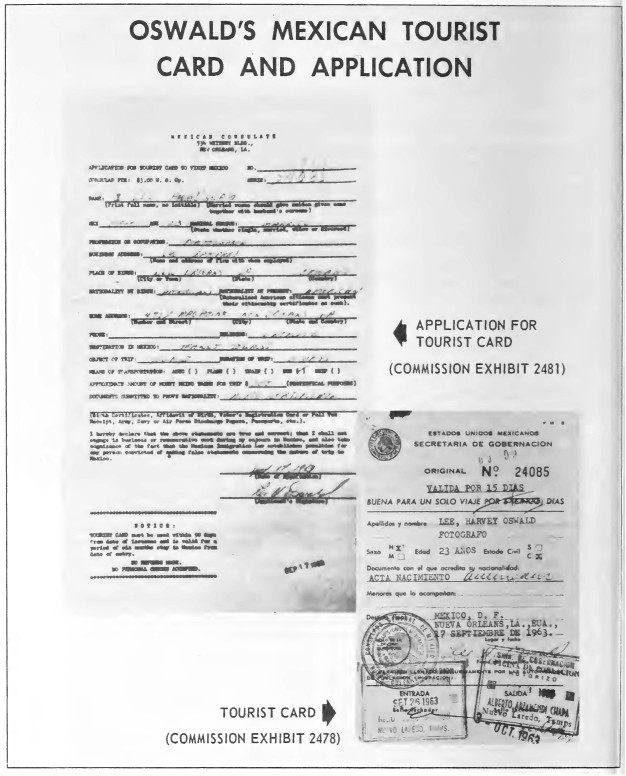
OSWALD’S MEXICAN TOURIST CARD AND APPLICATION
(COMMISSION EXHIBIT 2481) APPLICATION FOR TOURIST CARD
(COMMISSION EXHIBIT 2478) TOURIST CARD
Oswald departed from New Orleans probably about noon on September 25 and arrived in Mexico City at about 10 a.m. on September 27.C6-528 In Mexico City he embarked on a series of visits to the Soviet and Cuban Embassies, which occupied most of his time during the first 2 days of his visit. At the Cuban Embassy, he requested an “in-transit” visa to permit him to visit Cuba on his way to the Soviet Union.C6-529 Oswald was informed that he could not obtain a visa for entry into Cuba unless he first obtained a visa to enter the U.S.S.R.,C6-530 and the Soviet Embassy told him that he could not expect an answer on his application for a visa for the Soviet Union for about 4 months.C6-531 Oswald carried with him newspaper clippings, letters and various documents, some of them forged or containing false information, purporting to show that he was a “friend” of Cuba.C6-532 With these papers and his record of previous residence in the Soviet Union and marriage to a Soviet national, he tried to curry favor with both Embassies.C6-533 Indeed, his wife testified that in her opinion Oswald’s primary purpose in having engaged in Fair Play for Cuba Committee activities was to create a public record that he was a “friend” of Cuba.C6-534 He made himself especially unpopular at the Cuban Embassy by persisting in his demands that as a sympathizer in Cuban objectives he ought to be given a visa. This resulted in a sharp argument with the consul, Eusebio Azque.C6-535
By Saturday, September 28, 1963, Oswald had failed to obtain visas at both Embassies.C6-536 From Sunday, September 29, through Wednesday morning, October 2, when he left Mexico City on a bus bound for the United States, Oswald spent considerable time making his travel arrangements, sightseeing and checking again with the Soviet Embassy to learn whether anything had happened on his visa application.C6-537 Marina Oswald testified that when she first saw him after his return to the United States he was disappointed and discouraged at his failure to reach Cuba.C6-538
The general outlines of Oswald’s activities in Mexico, particularly the nature and extent of his contacts at the Cuban Embassy, were learned very early in the investigation. An important source of information relating to his business at the Cuban Embassy was Senora Silvia Tirado de Duran, a Mexican national employed in the visa section of the Cuban Embassy, who was questioned intensively by Mexican authorities soon after the assassination.C6-539 An excerpt from the report of the Mexican Government summarized the crucial portion of Senora Duran’s recollection of Oswald. In translation it reads as follows:
* * * she remembered * * * [that Lee Harvey Oswald] was the name of an American who had come to the Cuban Consulate to obtain a visa to travel to Cuba in transit to Russia, the latter part of September or the early part of October of this year, and in support of his application had shown his passport, in which it was noted that he had lived in that country for a period of three years; his labor card from the same country written in the Russian language; and letters in that same language. He had presented evidence that he was married to a Russian woman, and also that he was apparently the leader of an organization in the city of New Orleans called “Fair * * * [Play] for Cuba,” claiming that he should be accepted as a “friend” of the Cuban Revolution. Accordingly, the declarant, complying with her duties, took down all of the information and completed the appropriate application form; and the declarant, admittedly exceeding her responsibilities, informally telephoned the Russian consulate, with the intention of doing what she could to facilitate issuance of the Russian visa to Lee Harvey Oswald. However, they told her that there would be a delay of about four months in processing the case, which annoyed the applicant since, according to his statement, he was in a great hurry to obtain visas that would enable him to travel to Russia, insisting on his right to do so in view of his background and his loyalty and his activities in behalf of the Cuban movement. The declarant was unable to recall accurately whether or not the applicant told her he was a member of the Communist Party, but he did say that his wife * * * was then in New York City, and would follow him, * * * [Senora Duran stated] that when Oswald understood that it was not possible to give him a Cuban visa without his first having obtained the Russian visa, * * * he became very excited or angry, and accordingly, the affiant called Consul Ascue [sic], * * * [who] came out and began a heated discussion in English with Oswald, that concluded by Ascue telling him that “if it were up to him, he would not give him the visa,” and “a person of his type was harming the Cuban Revolution rather than helping it,” it being understood that in their conversation they were talking about the Russian Socialist Revolution and not the Cuban. Oswald maintained that he had two reasons for requesting that his visa be issued promptly, and they were: one, that his tourist permit in Mexico was about to expire; and the other, that he had to get to Russia as quickly as possible. Despite her annoyance, the declarant gave Oswald a paper * * * in which she put down her name, “Silvia Durán,” and the number of the telephone at the consulate, which is “11-28-47” and the visa application was processed anyway. It was sent to the Ministry of [Foreign] Relations of Cuba, from which a routine reply was received some fifteen to thirty days later, approving the visa, but on the condition that the Russian visa be obtained first, although she does not recall whether or not Oswald later telephoned her at the Consulate number that she gave him.C6-540
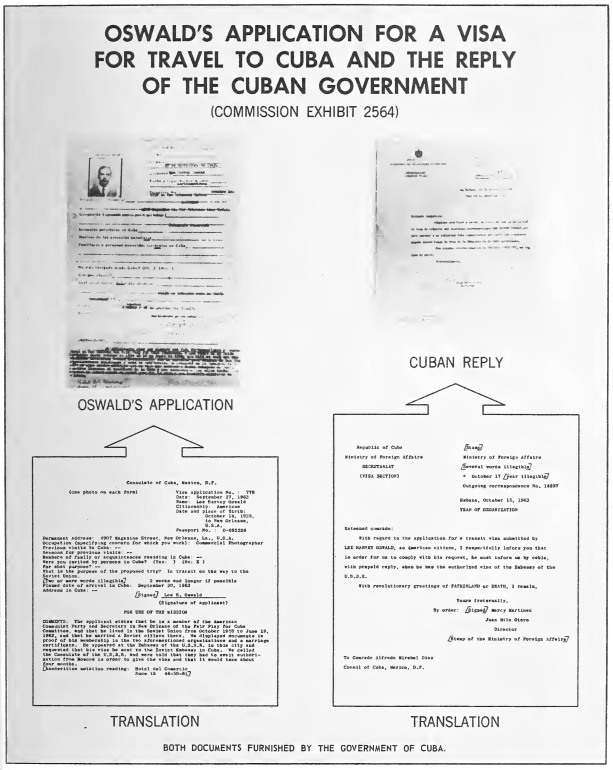
OSWALD’S APPLICATION FOR A VISA FOR TRAVEL TO CUBA AND THE REPLY OF THE CUBAN GOVERNMENT
(COMMISSION EXHIBIT 2564)
OSWALD’S APPLICATION ——> TRANSLATION
CUBAN REPLY ——> TRANSLATION
BOTH DOCUMENTS FURNISHED BY THE GOVERNMENT OF CUBA.
With the dates of Oswald’s entry into and departure from Mexico, which had been obtained from the records of the Mexican Immigration Service very shortly after the assassination, the Government of Mexico initiated a thorough investigation to uncover as much information as possible on Oswald’s trip.C6-541 Representatives of U.S. agencies worked in close liaison with the Mexican law enforcement authorities. The result of this investigative effort was to corroborate the statements of Senora Duran and to verify the essentials of Oswald’s activities in Mexico as outlined above.
Senora Duran is a well-educated native of Mexico, who was 26 years old at the time of her interrogation. She is married to Senor Horacio Duran Navarro, a 40-year-old industrial designer, and has a young child. Although Senora Duran denies being a member of the Communist Party or otherwise connected with it, both Durans have been active in far left political affairs in Mexico, believe in Marxist ideology, and sympathize with the government of Fidel Castro,C6-542 and Senor Duran has written articles for El Dia, a pro-Communist newspaper in Mexico City.C6-543 The Commission has reliable evidence from a confidential source that Senora Duran as well as other personnel at the Cuban Embassy were genuinely upset upon receiving news of President Kennedy’s death. Senora Duran’s statements were made to Mexican officials soon after the assassination,C6-544 and no significant inaccuracies in them have been detected. Documents fitting the description given by Senora Duran of the documents Oswald had shown her, plus a notation which she said she had given him, were found among his possessions after his arrest.C6-545
The Cuban Government was asked to document and confirm the essentials of Senora Duran’s testimony. Its response, which has been included in its entirety in this Report, included a summary statement of Oswald’s activities at the Cuban Embassy;C6-546 a photograph of the application for a visa he completed there,C6-547 and a photograph of the communication from Havana rejecting the application unless he could first present a Soviet visa.C6-548 (See Commission Exhibit No. 2564, p. 306.) The information on these documents concerning Oswald’s date of birth, American passport number and activities and statements at the Embassy is consistent with other information available to the Commission.C6-549 CIA experts have given their opinion that the handwriting on the visa application which purports to be Oswald’s is in fact his and that, although the handwritten notations on the bottom of the document are too brief and faint to permit a conclusive determination, they are probably Senora Duran’s.C6-550 The clothes which Oswald was wearing in the photograph which appears on the application appear to be the same as some of those found among his effects after the assassination, and the photograph itself appears to be from the same negative as a photograph found among his effects.C6-551 Nothing on any of the documents raises a suspicion that they might not be authentic.
By far the most important confirmation of Senora Duran’s testimony, however, has been supplied by confidential sources of extremely high reliability available to the United States in Mexico. The information from these sources establishes that her testimony was truthful and accurate in all material respects. The identities of these sources cannot be disclosed without destroying their future usefulness to the United States.
The investigation of the Commission has produced considerable testimonial and documentary evidence establishing the precise time of Oswald’s journey, his means of transportation, the hotel at which he stayed in Mexico City, and a restaurant at which he often ate. All known persons whom Oswald may have met while in Mexico, including passengers on the buses he rode,C6-552 and the employees and guests of the hotel where he stayed,C6-553 were interviewed. No credible witness has been located who saw Oswald with any unidentified person while in Mexico City; to the contrary, he was observed traveling alone to and from Mexico City,C6-554 at his hotel,C6-555 and at the nearby restaurant where he frequently ate.C6-556 A hotel guest stated that on one occasion he sat down at a table with Oswald at the restaurant because no empty table was available, but that neither spoke to the other because of the language barrier.C6-557 Two Australian girls who saw Oswald on the bus to Mexico City relate that he occupied a seat next to a man who has been identified as Albert Osborne, an elderly itinerant preacher.C6-558 Osborne denies that Oswald was beside him on the bus.C6-559 To the other passengers on the bus it appeared that Osborne and Oswald had not previously met,C6-560 and extensive investigation of Osborne has revealed no further contact between him and Oswald. Osborne’s responses to Federal investigators on matters unrelated to Oswald have proved inconsistent and unreliable, and, therefore, based on the contrary evidence and Osborne’s lack of reliability, the Commission has attached no credence to his denial that Oswald was beside him on the bus. Investigation of his background and activities, however, disclose no basis for suspecting him of any involvement in the assassination.C6-561
Investigation of the hotel at which Oswald stayed has failed to uncover any evidence that the hotel is unusual in any way that could relate to Oswald’s visit. It is not especially popular among Cubans, and there is no indication that it is used as a meeting place for extremist or revolutionary organizations.C6-562 Investigation of other guests of the hotel who were there when Oswald was has failed to uncover anything creating suspicion.C6-563 Oswald’s notebook which he carried with him to Mexico City contained the telephone number of the Cuban Airlines Office in Mexico City;C6-564 however, a Cuban visa is required by Mexican authorities before an individual may enplane for Cuba,C6-565 and a confidential check of the Cuban Airlines Office uncovered no evidence that Oswald visited their offices while in the city.C6-566
Allegations of conspiracy.—Literally dozens of allegations of a conspiratorial contact between Oswald and agents of the Cuban Government have been investigated by the Commission. Among the claims made were allegations that Oswald had made a previous trip to Mexico City in early September to receive money and orders for the assassination,C6-567 that he had been flown to a secret airfield somewhere in or near the Yucatan Peninsula,C6-568 that he might have made contacts in Mexico City with a Communist from the United States shortly before the assassination,C6-569 and that Oswald assassinated the President at the direction of a particular Cuban agent who met with him in the United States and paid him $7,000.C6-570 A letter was received from someone in Cuba alleging the writer had attended a meeting where the assassination had been discussed as part of a plan which would soon include the death of other non-Communist leaders in the Americas.C6-571 The charge was made in a Cuban expatriate publication that in a speech he delivered 5 days after the assassination, while he was under the influence of liquor, Fidel Castro made a slip of the tongue and said, “The first time Oswald was in Cuba,” thereby giving away the fact that Oswald had made one or more surreptitious trips to that country.C6-572
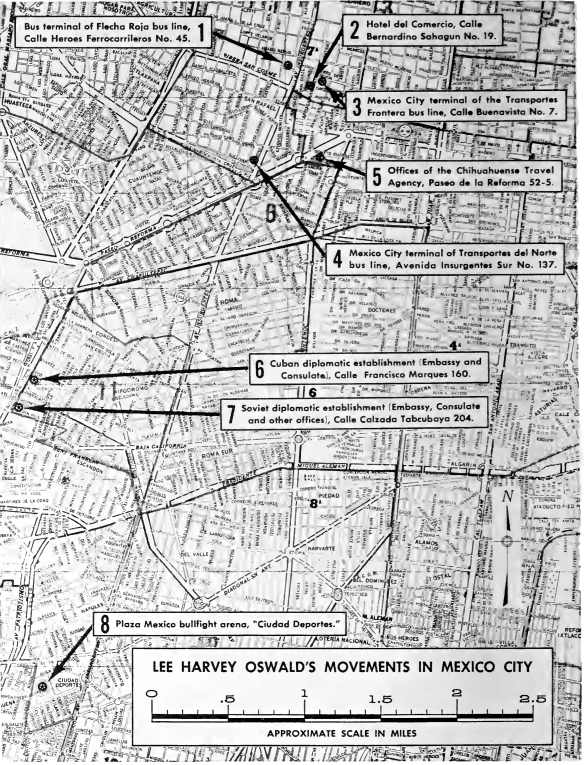
Commission Exhibit No. 1400
LEE HARVEY OSWALD’S MOVEMENTS IN MEXICO CITY
Some stories linked the assassination to anti-Castro groups who allegedly were engaged in obtaining illicit firearms in the United States, one such claim being that these groups killed the President as part of a bargain with some illicit organizations who would then supply them with firearms as payment.C6-573 Other rumors placed Oswald in Miami, Fla., at various times, allegedly in pro-Cuban activities there.C6-574 The assassination was claimed to have been carried out by Chinese Communists operating jointly with the Cubans.C6-575 Oswald was also alleged to have met with the Cuban Ambassador in a Mexico City restaurant and to have driven off in the Ambassador’s car for a private talk.C6-576 Castro himself, it was alleged, 2 days after the assassination called for the files relating to Oswald’s dealings with two members of the Cuban diplomatic mission in the Soviet Union; the inference drawn was that the “dealings” had occurred and had established a secret subversive relationship which continued through Oswald’s life.C6-577 Without exception, the rumors and allegations of a conspiratorial contact were shown to be without any factual basis, in some cases the product of mistaken identification.
Illustrative of the attention given to the most serious allegations is the case of “D,” a young Latin American secret agent who approached U.S. authorities in Mexico shortly after the assassination and declared that he saw Lee Harvey Oswald receiving $6,500 to kill the President. Among other details, “D” said that at about noon on September 18, waiting to conduct some business at the Cuban consulate, he saw a group of three persons conversing in a patio a few feet away. One was a tall, thin Negro with reddish hair, obviously dyed, who spoke rapidly in both Spanish and English, and another was a man he said was Lee Harvey Oswald. A tall Cuban joined the group momentarily and passed some currency to the Negro. The Negro then allegedly said to Oswald in English, “I want to kill the man.” Oswald replied, “You’re not man enough, I can do it.” The Negro then said in Spanish, “I can’t go with you, I have a lot to do.” Oswald replied, “The people are waiting for me back there.” The Negro then gave Oswald $6,500 in large-denomination American bills, saying, “This isn’t much.” After hearing this conversation, “D” said that he telephoned the American Embassy in Mexico City several times prior to the assassination in an attempt to report his belief that someone important in the United States was to be killed, but was finally told by someone at the Embassy to stop wasting his time.
“D” and his allegations were immediately subjected to intensive investigation. His former employment as an agent for a Latin American country was confirmed, although his superiors had no knowledge of his presence in Mexico or the assignment described by “D.” Four days after “D” first appeared the U.S. Government was informed by the Mexican authorities that “D” had admitted in writing that his whole narrative about Oswald was false. He said that he had never seen Oswald anyplace, and that he had not seen anybody paid money in the Cuban Embassy. He also admitted that he never tried to telephone the American Embassy in September and that his first call to the Embassy was after the assassination. “D” said that his motive in fabricating the story was to help get himself admitted into the United States so that he could there participate in action against Fidel Castro. He said that he hated Castro and hoped that the story he made up would be believed and would cause the United States to “take action” against him.
Still later, when questioned by American authorities, “D” claimed that he had been pressured into retracting his statement by the Mexican police and that the retraction, rather than his first statement, was false. A portion of the American questioning was carried on with the use of a polygraph machine, with the consent of “D.” When told that the machine indicated that he was probably lying, “D” said words to the effect that he “must be mistaken.” Investigation in the meantime had disclosed that the Embassy extension number “D” said he had called would not have given him the person he said he spoke to, and that no one at the Embassy—clerks, secretaries, or officers—had any recollection of his calls. In addition, Oswald spoke little, if any, Spanish. That he could have carried on the alleged conversation with the red-headed Negro in the Cuban Embassy, part of which was supposed to have been in Spanish, was therefore doubtful. “D” now said that he was uncertain as to the date when he saw “someone who looked like Oswald” at the Cuban Embassy, and upon reconsideration, he now thought it was on a Tuesday, September 17, rather than September 18. On September 17, however, Oswald visited the Louisiana State Unemployment Commission in New Orleans and also cashed a check from the Texas Employment Commission at the Winn-Dixie Store No. 1425 in New Orleans. On the basis of the retractions made by “D” when he heard the results of the polygraph examination, and on the basis of discrepancies which appeared in his story, it was concluded that “D” was lying.C6-578
The investigation of the Commission has thus produced no evidence that Oswald’s trip to Mexico was in any way connected with the assassination of President Kennedy, nor has it uncovered evidence that the Cuban Government had any involvement in the assassination. To the contrary, the Commission has been advised by the CIA and FBI that secret and reliable sources corroborate the statements of Senora Duran in all material respects, and that the Cuban Government had no relationship with Lee Harvey Oswald other than that described by Senora Duran. Secretary of State Rusk also testified that after the assassination “there was very considerable concern in Cuba as to whether they would be held responsible and what the effect of that might be on their own position and their own safety.”C6-579
Contacts with the Soviet Embassy in the United States.—Soon after the Oswalds reached the United States in June 1962 they wrote to the Soviet Embassy in Washington, D.C. Oswald requested information about subscriptions to Russian newspapers and magazines and ultimately did subscribe to several Russian journals. Soviet law required Marina Oswald, as a Soviet citizen living abroad, to remain in contact with her nation’s Embassy and to file various papers occasionally.C6-580 In 1963, after Oswald had experienced repeated employment difficulties, there were further letters when the Oswalds sought permission to return to the Soviet Union. The first such request was a letter written by Marina Oswald on February 17, 1963. She wrote that she wished to return to Russia but that her husband would stay in the United States because “he is an American by nationality.”C6-581 She was informed on March 8, 1963, that it would take from 5 to 6 months to process the application.C6-582 The Soviet Union made available to the Commission what purports to be the entire correspondence between the Oswalds and the Russian Embassy in the United States.C6-583 This material has been checked for codes and none has been detected.C6-584 With the possible exception of a letter which Oswald wrote to the Soviet Embassy after his return from Mexico City, discussed below, there is no material which gives any reason for suspicion. The implications of all of this correspondence for an understanding of Lee Harvey Oswald’s personality and motivation is discussed in the following chapter.
Oswald’s last letter to the Soviet Embassy in Washington, D.C., dated November 9, 1963, began by stating that it was written “to inform you of recent events since my meetings with Comrade Kostin in the Embassy of the Soviet Union, Mexico City, Mexico.”C6-585 The envelope bears a postmark which appears to be November 12, 1963.C6-586 Ruth Paine has testified that Oswald spent the weekend at her home working on the letter and that she observed one preliminary draft.C6-587 A piece of paper which was identified as one of these drafts was found among Oswald’s effects after the assassination. (See Commission Exhibits Nos. 15, 103, p. 311.) According to Marina Oswald, her husband retyped the envelope 10 times.C6-588
Information produced for the Commission by the CIA is to the effect that the person referred to in the letter as “comrade Kostin” was probably Valeriy Vladimirovich Kostikov, a member of the consular staff of the Soviet Union in Mexico City. He is also one of the KGB officers stationed at the Embassy.C6-589 It is standard Soviet procedure for KGB officers stationed in embassies and in consulates to carry on the normal duties of such a position in addition to the undercover activities.C6-590 The Commission has identified the Cuban consul referred to in Oswald’s letter as Senor Eusebio Azque (also “Ascue”), the man with whom Oswald argued at the Cuban Embassy, who was in fact replaced. The CIA advised the Commission:
We surmise that the references in Oswald’s 9 November letter to a man who had since been replaced must refer to Cuban Consul Eusebio Azque, who left Mexico for Cuba on permanent transfer on 18 November 1963, four days before the assassination. Azque had been in Mexico for 18 years and it was known as early as September 1963 that Azque was to be replaced. His replacement did arrive in September. Azque was scheduled to leave in October but did not leave until 18 November.
We do not know who might have told Oswald that Azque or any other Cuban had been or was to be replaced, but we speculate that Silvia Duran or some Soviet official might have mentioned it if Oswald complained about Azque’s altercation with him.C6-591
When asked to explain the letter, Marina Oswald was unable to add anything to an understanding of its contents.C6-592 Some light on its possible meaning can be shed by comparing it with the early draft. When the differences between the draft and the final document are studied, and especially when crossed-out words are taken into account, it becomes apparent that Oswald was intentionally beclouding the true state of affairs in order to make his trip to Mexico sound as mysterious and important as possible.
For example, the first sentence in the second paragraph of the letter reads, “I was unable to remain in Mexico indefinily because of my mexican visa restrictions which was for 15 days only.” The same sentence in the draft begins, before the words are crossed out, “I was unable to remain in Mexico City because I considered useless * * *” As already mentioned, the Commission has good evidence that Oswald’s trip to Mexico was indeed “useless” and that he returned to Texas with that conviction. The first draft, therefore, spoke the truth; but Oswald rewrote the sentence to imply that he had to leave because his visa was about to expire. This is false; Oswald’s tourist card still had a full week to run when he departed from Mexico on October 3.C6-593
The next sentence in the letter reads, “I could not take a chance on reqesting a new visa unless I used my real name, so I returned to the United States.” The fact is that he did use his real name for his tourist card, and in all dealings with the Cuban Embassy, the Russian Embassy and elsewhere. Oswald did use the name of “Lee” on the trip, but as indicated below, he did so only sporadically and probably as the result of a clerical error. In the opinion of the Commission, based upon its knowledge of Oswald, the letter constitutes no more than a clumsy effort to ingratiate himself with the Soviet Embassy.
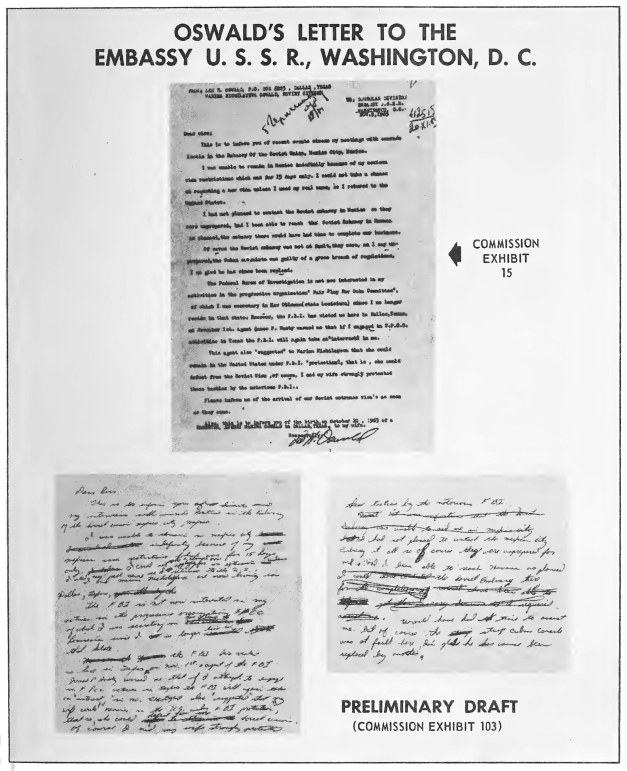
COMMISSION EXHIBIT 15 OSWALD’S LETTER TO THE EMBASSY U. S. S. R., WASHINGTON, D. C.
(COMMISSION EXHIBIT 103) PRELIMINARY DRAFT
Investigation of Other Activities
Oswald’s use of post office boxes and false names.—After his return from the Soviet Union, Lee Harvey Oswald is known to have received his mail at post office boxes and to have used different aliases on numerous occasions. Since either practice is susceptible of use for clandestine purposes, the Commission has directed attention to both for signs that Oswald at some point made undercover contact with other persons who might have been connected with the assassination.
Oswald is known to have opened three post office boxes during 1962 and 1963. On October 9, 1962, the same day that he arrived in Dallas from Fort Worth, and before establishing a residence there, he opened box No. 2915 at the Dallas General Post Office. This box was closed on May 14, 1963, shortly after Oswald had moved to New Orleans.C6-594 That portion of the post office box application listing the names of those persons other than the applicant entitled to receive mail at the box was discarded in accordance with postal regulations after the box was closed; hence, it is not known what names other than Oswald’s were listed on that form.C6-595 However, as discussed in chapter IV, Oswald is known to have received the assassination rifle under the name of A. Hidell and his Smith & Wesson revolver under the name of A. J. Hidell at that box.C6-596 On June 3, 1963, Oswald opened box No. 30061 at the Lafayette Square Substation in New Orleans. Marina Oswald and A. J. Hidell were listed as additional persons entitled to receive mail at this box.C6-597 Immediately before leaving for Mexico City in late September, Oswald submitted a request to forward his mail to the Paines’ address in Irving, and the box was closed on September 26.C6-598 On November 1, 1963, he opened box No. 6225 at the Dallas Post Office Terminal Annex. The Fair Play for Cuba Committee and the American Civil Liberties Union were listed as also being entitled to receive mail at this box.C6-599
Oswald’s use of post office boxes is consistent with other information known about him. His frequent changes of address and receipt of Communist and other political literature would appear to have provided Oswald reason to have rented postal boxes. These were the explanations for his use of the boxes which he provided Postal Inspector H. D. Holmes on November 24.C6-600 Moreover, on October 14, 1963, he had moved into a room on Beckley Avenue under the name of O. H. LeeC6-601 and it would have been extremely difficult for Oswald to have received his mail at that address without having disclosed his true name. The boxes cost Oswald only $1.50 or less per month.C6-602
Although the possibilities of investigation in this area are limited, there is no evidence that any of the three boxes was ever used for the surreptitious receipt of messages or was used by persons other than Oswald or his family. No unexplainable notes were found among Oswald’s possessions after his arrest. Oswald’s box on the day of the assassination, No. 6225, was kept under constant personal surveillance by postal inspectors from about 5 p.m. November 22 until midnight November 24. A modified surveillance was maintained thereafter. No one called for mail out of this box; indeed the only mail in the box was a Russian magazine addressed to Oswald. The single outstanding key was recovered from Oswald immediately after he was taken in custody.C6-603
In appraising the import of Oswald’s rental of post office boxes, it is significant that he was not secretive about their use. All three boxes were rented by Oswald using his true name.C6-604 His application for box No. 2915 showed his home address as that of Alexandra De Mohrenschildt (Taylor), whose husband had agreed to allow Oswald to use his address.C6-605 His application for the New Orleans box listed his address as 657 French Street; his aunt, Lillian Murret, lived at 757 French Street.C6-606 On the application for box No. 6225, Oswald gave an incorrect street number, though he did show Beckley Avenue, where he was then living.C6-607 He furnished the box numbers to his brother, to an employer, to Texas and New Orleans unemployment commissions, and to others.C6-608 Based on all the facts disclosed by its investigation, the Commission has attached no conspiratorial significance to Oswald’s rental of post office boxes.
Oswald’s use of aliases is also well established. In chapter IV, the evidence relating to his repeated use of the name “A. J. Hidell,” and close variants thereof, is set forth.C6-609 Because Oswald’s use of this pseudonym became known quickly after the assassination, investigations were conducted with regard to persons using the name Hidell or names similar to it. Subversive files, public carrier records, telegraph company records, banking and other commercial records, and other matters investigated and persons interviewed have been examined with regard to Oswald’s true name and his known alias.C6-610 No evidence has been produced that Oswald ever used the name Hidell as a means of making undercover contact with any person. Indeed, though Oswald did prepare a counterfeit selective service card and other identification using this name, he commonly used “Hidell” to represent persons other than himself, such as the president of his nonexistent Fair Play for Cuba Committee chapter, the doctor whose name appeared on his counterfeit international certificate of vaccination, and as references on his job applications.C6-611
Alwyn Cole, questioned document expert for the Treasury Department, testified that the false identification found on Oswald upon his arrest could have been produced by employing elementary techniques used in a photographic printing plant.C6-612 (See app. X, pp. 571-578.) Though to perform the necessary procedures would have been difficult without the use of expensive photographic equipment, such equipment and the needed film and photographic paper were available to Oswald when he was employed from October 1962 through early April 1963 at Jaggars-Chiles-Stovall, a commercial advertising photography firm in Dallas.C6-613 While so employed, Oswald is known to have become familiar with the mechanics of photographic enlargements, contraction, and image distortion that would have been necessary to produce his false identification, and to have used the facilities of his employer for some personal work.C6-614 Cole testified that the cards in Oswald’s wallet did not exhibit a great deal of skill, pointing out various errors that had been committed.C6-615 Oswald’s supervisor at Jaggars-Chiles-Stovall has stated that Oswald seemed unable to perform photographic work with precision, which was one of the main reasons for which he was ultimately discharged.C6-616 The retouched negatives used to make Oswald’s counterfeit certificate of service identification were found among Oswald’s personal effects after his arrest, as was a rubber stamping kit apparently employed to produce his spurious international certificate of vaccination.C6-617 There is strong evidence, therefore, that Oswald himself made the various pieces of counterfeit identification which he carried, and there is no reason to believe that he received assistance from any person in establishing his alias.
Oswald also used incorrect names other than Hidell, but these too appear unconnected with any form of conspiracy. Oswald’s last name appears as “Lee” in three places in connection with his trip to Mexico City, discussed above. His tourist card was typed by the Mexican consulate in New Orleans, “Lee, Harvey Oswald.”C6-618 However, the comma seems to have been a clerical error, since Oswald signed both the application and the card itself, “Lee H. Oswald.” Moreover, Oswald seems originally to have also printed his name, evenly spaced, as “Lee H Oswald,” but, noting that the form instructed him to “Print full name. No initials,” printed the remainder of his middle name after the “H.” The clerk who typed the card thus saw a space after “Lee,” followed by “Harvey Oswald” crowded together, and probably assumed that “Lee” was the applicant’s last name. (See Commission Exhibit 2481, p. 300.) The clerk who prepared Oswald’s bus reservation for his return trip wrote “H. O. Lee.” He stated that he did not remember the occasion, although he was sure from the handwriting and from other facts that he had dealt with Oswald. He surmised that he probably made out the reservation directly from the tourist card, since Oswald spoke no Spanish, and, seeing the comma, wrote the name “H. O. Lee.”C6-619 Oswald himself signed the register at the hotel in Mexico City as “Lee, Harvey Oswald,”C6-620 but since the error is identical to that on the tourist card and since he revealed the remainder of his name, “Harvey Oswald,” it is possible that Oswald inserted the comma to conform to the tourist card, or that the earlier mistake suggested a new pseudonym to Oswald which he decided to continue.
In any event, Oswald used his correct name in making reservations for the trip to Mexico City, in introducing himself to passengers on the bus, and in his dealings with the Cuban and Soviet Embassies.C6-621 When registering at the Beckley Avenue house in mid-October, Oswald perpetuated the pseudonym by giving his name as “O. H. Lee,”C6-622 though he had given his correct name to the owner of the previous roominghouse where he had rented a room after his return from Mexico City.C6-623 Investigations of the Commission have been conducted with regard to persons using the name “Lee,” and no evidence has been found that Oswald used this alias for the purpose of making any type of secret contacts.
Oswald is also known to have used the surname “Osborne” in ordering Fair Play for Cuba Committee handbills in May 1963.C6-624 He also used the false name D. F. Drittal as a certifying witness on the mail-order coupon with which he purchased his Smith & Wesson revolver.C6-625 He used the name Lt. J. Evans as a reference on an employment application in New Orleans.C6-626
Oswald’s repeated use of false names is probably not to be disassociated from his antisocial and criminal inclinations. No doubt he purchased his weapons under the name of Hidell in attempt to prevent their ownership from being traced. Oswald’s creation of false names and ficititious personalities is treated in the discussion of possible motives set forth in chapter VII. Whatever its significance in that respect may be, the Commission has found no indication that Oswald’s use of aliases was linked with any conspiracy with others.
Ownership of a second rifle.—The Commission has investigated a report that, during the first 2 weeks of November 1963, Oswald had a telescopic sight mounted and sighted on a rifle at a sporting goods store in Irving, Tex. The main evidence that Oswald had such work performed for him is an undated repair tag bearing the name “Oswald” from the Irving Sports Shop in Irving, Tex. On November 25, 1963, Dial D. Ryder, an employee of the Irving Sports Shop, presented this tag to agents of the FBI, claiming that the tag was in his handwriting. The undated tag indicated that three holes had been drilled in an unspecified type of rifle and a telescopic sight had been mounted on the rifle and boresighted.C6-627
As discussed in chapter IV, the telescopic sight on the C2766 Mannlicher-Carcano rifle was already mounted when shipped to Oswald, and both Ryder and his employer, Charles W. Greener, feel certain that they never did any work on this rifle.C6-628 If the repair tag actually represented a transaction involving Lee Harvey Oswald, therefore, it would mean that Oswald owned another rifle. Although this would not alter the evidence which establishes Oswald’s ownership of the rifle used to assassinate President Kennedy, the possession of a second rifle warranted investigation because it would indicate that a possibly important part of Oswald’s life had not been uncovered.
Since all of Oswald’s known transactions in connection with firearms after his return to the United States were undertaken under an assumed name,C6-629 it seems unlikely that if he did have repairs made at the sports shop he would have used his real name. Investigation has revealed that the authenticity of the repair tag bearing Oswald’s name is indeed subject to grave doubts. Ryder testified that he found the repair tag while cleaning his workbench on November 23, 1963.C6-630 However, Ryder spoke with Greener repeatedly during the period between November 22-28 and, sometime prior to November 25, he discussed with him the possibility that Oswald had been in the store. Neither he nor Greener could remember that he had been. But despite these conversations with Greener, it is significant that Ryder never called the repair tag to his employer’s attention. Greener did not learn about the tag until November 28, when he was called by TV reporters after the story had appeared in the Dallas Times-Herald.C6-631 The peculiarity of Ryder’s silence is compounded by the fact that, when speaking to the FBI on November 25, Ryder fixed the period during which the tag had been issued as November 1-14, 1963, yet, from his later testimony, it appears that he did so on the basis that it must have occurred when Greener was on vacation since Greener did not remember the transaction.C6-632 Moreover, the FBI had been directed to the Irving Sports Shop by anonymous telephone calls received by its Dallas office and by a local television station. The anonymous male who telephoned the Bureau attributed his information to an unidentified sack boy at a specified supermarket in Irving, but investigation has failed to verify this source.C6-633
Neither Ryder nor Greener claimed that Lee Harvey Oswald had ever been a customer in the Irving Sports Shop. Neither has any recollection of either Oswald or his Mannlicher-Carcano rifle, nor does either recall the transaction allegedly represented by the repair tag or the person for whom the repair was supposedly made.C6-634 Although Ryder stated to the FBI that he was “quite sure” that he had seen Oswald and that Oswald may have been in the store at one time, when shown a photograph of Oswald during his deposition, Ryder testified he knew the picture to be of Oswald, “as the pictures in the paper, but as far as seeing the guy personally, I don’t think I ever have.”C6-635
Subsequent events also reflect on Ryder’s credibility. In his deposition, Ryder emphatically denied that he talked to any reporters about this matter prior to the time a story about it appeared in the November 28, 1963, edition of the Dallas Times-Herald.C6-636 Earlier, however, he told an agent of the U.S. Secret Service that the newspaper had misquoted him.C6-637 Moreover, a reporter for the Dallas Times-Herald has testified that on November 28, 1963, he called Ryder at his home and obtained from him all of the details of the alleged transaction, and his story is supported by the testimony of a second reporter who overheard one end of the telephone conversation.C6-638 No other person by the name of Oswald in the Dallas-Fort Worth area has been found who had a rifle repaired at the Irving Sports Shop.C6-639
Possible corroboration for Ryder’s story is provided by two women, Mrs. Edith Whitworth, who operates the Furniture Mart, a furniture store located about 1½ blocks from the Irving Sports Shop, and Mrs. Gertrude Hunter, a friend of Mrs. Whitworth. They testified that in early November of 1963, a man who they later came to believe was Oswald drove up to the Furniture Mart in a two-tone blue and white 1957 Ford automobile, entered the store and asked about a part for a gun, presumably because of a sign that appeared in the building advertising a gunsmith shop that had formerly occupied part of the premises. When he found that he could not obtain the part, the man allegedly returned to his car and then came back into the store with a woman and two young children to look at furniture, remaining in the store for about 30 to 40 minutes.C6-640
Upon confronting Marina Oswald, both women identified her as the woman whom they had seen in the store on the occasion in question, although Mrs. Hunter could not identify a picture of Lee Harvey Oswald and Mrs. Whitworth identified some pictures of Oswald but not others. Mrs. Hunter purported to identify Marina Oswald by her eyes, and did not observe the fact that Marina Oswald had a front tooth missing at the time she supposedly saw her.C6-641 After a thorough inspection of the Furniture Mart, Marina Oswald testified that she had never been on the premises before.C6-642
The circumstances surrounding the testimony of the two women are helpful in evaluating the weight to be given to their testimony, and the extent to which they lend support to Ryder’s evidence. The women previously told newspaper reporters that the part for which the man was looking was a “plunger,” which the Commission has been advised is a colloquial term used to describe a firing pin.C6-643 This work was completely different from the work covered by Ryder’s repair tag, and the firing pin of the assassination weapon does not appear to have been recently replaced.C6-644 At the time of their depositions, neither woman was able to recall the type of work which the man wanted done.C6-645
Mrs. Whitworth related to the FBI that the man told her that the younger child with him was born on October 20, 1963, which was in fact Rachel Oswald’s birthday.C6-646 In her testimony before the Commission, however, Mrs. Whitworth could not state that the man had told her the child’s birthdate was October 20, 1963, and in fact expressed uncertainty about the birthday of her own grandchild, which she had previously used as a guide to remembering the birthdate of the younger child in the shop.C6-647 Mrs. Hunter thought that the man she and Mrs. Whitworth believed was Oswald drove the car to and from the store;C6-648 however, Lee Harvey Oswald apparently was not able to drive an automobile by himself and does not appear to have had access to a car.C6-649
The two women claimed that Oswald was in the Furniture Mart on a weekday, and in midafternoon. However, Oswald had reported to work at the Texas School Book Depository on the dates referred to by the women and there is no evidence that he left his job during business hours.C6-650 In addition, Ruth Paine has stated that she always accompanied Marina Oswald whenever Marina left the house with her children and that they never went to the Furniture Mart, either with or without Lee Harvey Oswald, at any time during October or November of 1963.C6-651 There is nothing to indicate that in November the Oswalds were interested in buying furniture.C6-652
Finally, investigation has produced reason to question the credibility of Mrs. Hunter as a witness. Mrs. Hunter stated that one of the reasons she remembers the description of the car in which Oswald supposedly drove to the furniture store was that she was awaiting the arrival of a friend from Houston, who drove a similar automobile.C6-653 However, the friend in Houston has advised that in November 1963, she never visited or planned to visit Dallas, and that she told no one that she intended to make such a trip. Moreover the friend added, according to the FBI interview report, that Mrs. Hunter has “a strange obsession for attempting to inject herself into any big event which comes to her attention” and that she “is likely to claim some personal knowledge of any major crime which receives much publicity.”C6-654 She concluded that “the entire family is aware of these ‘tall tales’ Mrs. Hunter tells and they normally pay no attention to her.”C6-655
Another allegation relating to the possible ownership of a second rifle by Oswald comes from Robert Adrian Taylor, a mechanic at a service station in Irving. Some 3 weeks after the assassination, Taylor reported to the FBI that he thought that, in March or April of 1963, a man he believed to be Oswald had been a passenger in an automobile that stopped at his station for repairs; since neither the driver nor the passenger had sufficient funds for the repair work, the person believed to be Oswald sold a U.S. Army rifle to Mr. Taylor, using the proceeds to pay for the repairs.C6-656 However, a second employee at the service station, who recalled the incident, believed that, despite a slight resemblance, the passenger was not Oswald.C6-657 Upon reflection, Taylor himself stated that he is very doubtful that the man was Oswald.C6-658
Rifle practice.—Several witnesses believed that in the weeks preceding the assassination, they observed a man resembling Oswald practicing with a rifle in the fields and wooded areas surrounding Dallas, and at rifle ranges in that area. Some witnesses claimed Oswald was alone, while others said he was accompanied by one or more other persons. In most instances, investigation has disclosed that there is no substantial basis for believing that the person reported by the various witnesses was Oswald.C6-659