Chapter VII · Lee Harvey Oswald: Background and Possible Motives (continued 2)
Reading edition
In another letter to V. T. Lee, dated August 17, 1963, Oswald wrote that he had appeared on Mr. William Stuckey’s 15-minute television program over WDSU-TV called “Latin American Focus” as a result of which he was “flooded with callers and invitations to debate’s ect. as well as people interested in joining the F.P.C.C. New Orleans branch.”C7-341 WDSU has no program of any kind called “Latin American Focus.”C7-342 Stuckey had a radio program called “Latin Listening Post,” on which Oswald was heard for less than 5 minutes on August 17, 1963.C7-343 It appears that Oswald had only one caller in response to all of his FPCC activities, an agent of Bringuier’s attempting to learn more about the true nature of the alleged FPCC “organization” in New Orleans.C7-344
Oswald’s statements suggest that he hoped to be flooded with callers and invitations to debate. This would have made him a real center of attention as he must have been when he first arrived in the Soviet Union and as he was to some extent when he returned to the United States. The limited notoriety that Oswald received as a result of the street fracas and in the subsequent radio debate was apparently not enough to satisfy him. He exaggerated in his letters to V. T. Lee in an apparent attempt to make himself and his activities appear far more important than they really were.
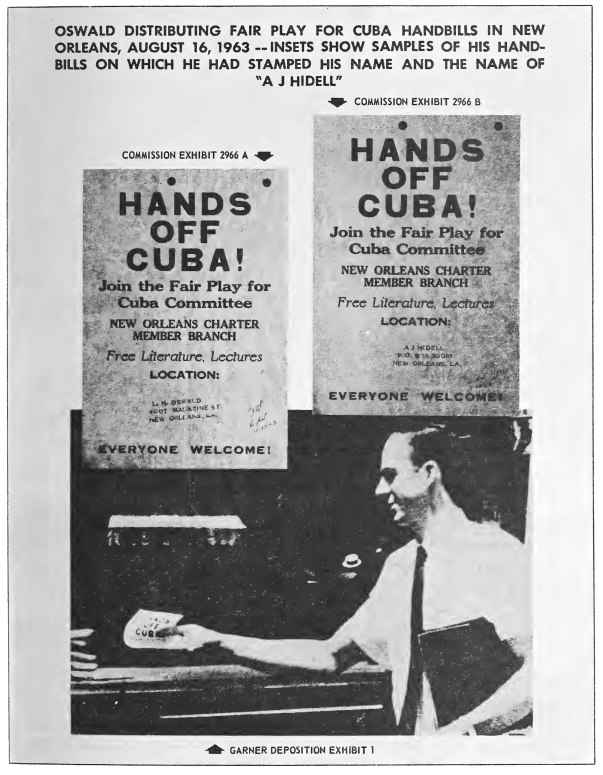
OSWALD DISTRIBUTING FAIR PLAY FOR CUBA HANDBILLS IN NEW ORLEANS, AUGUST 16, 1963—INSETS SHOW SAMPLES OF HIS HANDBILLS ON WHICH HE HAD STAMPED HIS NAME AND THE NAME OF “A J HIDELL”
COMMISSION EXHIBIT 2966 A
COMMISSION EXHIBIT 2966 B
GARNER DEPOSITION EXHIBIT 1
His attempt to express himself through his Fair Play for Cuba activities, however, was greatly impeded by the fact that the radio debate over WDSU on August 21, 1963, brought out the history of his defection to the Soviet Union.C7-345 The basic facts of the event were uncovered independently by William Stuckey, who arranged the debate, and Edward Butler, executive director of the Information Council of the Americas, who also appeared on the program.C7-346 Oswald was confronted with those facts at the beginning of the debate and was so thrown on the defensive by this that he was forced to state that Fair Play for Cuba was “not at all Communist controlled regardless of the fact that I had the experience of living in Russia.”C7-347
Stuckey testified that uncovering Oswald’s defection was very important:
I think that we finished him on that program. * * * because we had publicly linked the Fair Play for Cuba Committee with a fellow who had lived in Russia for 3 years and who was an admitted Marxist.
The interesting thing, or rather the danger involved, was the fact that Oswald seemed like such a nice, bright boy and was extremely believable before this. We thought the fellow could probably get quite a few members if he was really indeed serious about getting members. We figured after this broadcast of August 21, why, that was no longer possible.C7-348
In spite of the fact that Oswald had been surprised and was on the defensive throughout the debate, according to Stuckey: “Mr. Oswald handled himself very well, as usual.”C7-349 Stuckey thought Oswald “appeared to be a very logical, intelligent fellow,” and “was arrested by his cleancutness.”C7-350 He did not think Oswald looked like the “type” that he would have expected to find associating with a group such as the Fair Play for Cuba Committee.C7-351 Stuckey thought that Oswald acted very much as would a young attorney.C7-352
Following the disclosure of his defection, Oswald sought advice from the Communist Party, U.S.A., concerning his Fair Play for Cuba activity.C7-353 He had previously sent, apparently unsolicited, to the Party newspaper, the Worker, samples of his photographic work, offering to contribute that sort of service without charge.C7-354 The Worker replied: “Your kind offer is most welcomed and from time to time we shall call on you.”C7-355 He later wrote to another official of the Worker, seeking employment, and mentioning the praise he had received for submitting his photographic work.C7-356 He presented Arnold Johnson, Gus Hall, and Benjamin J. Davis honorary membership cards in his nonexistent New Orleans chapter of the Fair Play for Cuba Committee, and advised them of some of his activities on behalf of the organization.C7-357 Arnold Johnson, director of the information and lecture bureau of the Communist Party, U.S.A., replied stating:
It is good to know that movements in support of fair play for Cuba has developed in New Orleans as well as in other cities. We do not have any organizational ties with the Committee, and yet there is much material that we issue from time to time that is important for anybody who is concerned about developments in Cuba.C7-358
Marina Oswald said that such correspondence from people he considered important meant much to Oswald. After he had begun his Cuban activity in New Orleans “he received a letter from somebody in New York, some Communist—probably from New York—I am not sure from where—from some Communist leader and he was very happy, he felt that this was a great man that he had received the letter from.”C7-359 Since he seemed to feel that no one else understood his political views, the letter was of great value to him for it “was proof * * * that there were people who understood his activity.”C7-360
He anticipated that the full disclosure of his defection would hinder him in “the struggle for progress and freedom in the United States”C7-361 into which Oswald, in his own words, had “thrown” himself. He sought advice from the central committee of the Communist Party, U.S.A., in a letter dated August 28, 1963, about whether he could “continue to fight, handicapped as it were, by my past record * * * [and] compete with anti-progressive forces, above-ground or weather in your opion I should always remain in the background, i.e. underground.”C7-362 Stating that he had used his “position” with what he claimed to be the local branch of the Fair Play for Cuba Committee to “foster communist ideals,” Oswald wrote that he felt that he might have compromised the FPCC and expressed concern lest “Our opponents could use my background of residence in the U.S.S.R. against any cause which I join, by association, they could say the organization of which I am a member, is Russian controled, ect.”C7-363 In reply Arnold Johnson advised Oswald that, while as an American citizen he had a right to participate in such organizations as he wished, “there are a number of organizations, including possibly Fair Play, which are of a very broad character, and often it is advisable for some people to remain in the background, not underground.”C7-364
By August of 1963, after a short 3 months in New Orleans, the city in which he had been born and had lived most of his early life, Oswald had fallen on difficult times. He had not liked his job as a greaser of coffee processing machinery and he held it for only a little over 2 months.C7-365 He had not found another job. His wife was expecting their second child in October and there was concern about the cost which would be involved.C7-366 His brief foray on behalf of the Fair Play for Cuba Committee had failed to win any support. While he had drawn some attention to himself and had actually appeared on two radio programs, he had been attacked by Cuban exiles and arrested, an event which his wife thought upset him and as a result of which “he became less active, he cooled off a little.”C7-367 More seriously, the facts of his defection had become known, leaving him open to almost unanswerable attack by those who opposed his views. It would not have been possible to have followed Arnold Johnson’s advice to remain in the background, since there was no background to the New Orleans FPCC “organization,” which consisted solely of Oswald. Furthermore, he had apparently not received any letters from the national headquarters of FPCC since May 29, 1963,C7-368 even though he had written four detailed letters since that time to Mr. V. T. LeeC7-369 and had also kept the national headquarters informed of each of his changes of mailing address.C7-370 Those events no doubt had their effects on Oswald.
Interest in Cuba
By August of 1963, Oswald had for some time been considering the possibility of leaving the United States again. On June 24, 1963, he applied for a new passportC7-371 and in late June or early July he told his wife that he wanted to return to the Soviet Union with her. She said that he was extremely upset, very unhappy, and that he actually wept when he told her that.C7-372 He said that nothing kept him in the United States, that he would not lose anything if he returned to the Soviet Union, that he wanted to be with her and that it would be better to have less and not have to be concerned about tomorrow.C7-373
As a result of that conversation, Marina Oswald wrote the Soviet Embassy in Washington concerning a request she had first made on February 17, 1963, for permission for herself and June to return to the Soviet Union.C7-374 While that first request, made according to Marina Oswald at her husband’s insistence, specifically stated that Oswald was to remain in the United States, she wrote in her letter of July 1963, that “things are improving due to the fact that my husband expresses a sincere wish to return together with me to the USSR.”C7-375 Unknown to his wife, however, Oswald apparently enclosed a note with her letter of July in which he requested the Embassy to rush his wife’s entrance visa because of the impending birth of the second child but stated that: “As for my return entrance visa please consider it separtably.”C7-376
Thus, while Oswald’s real intentions, assuming that they were known to himself, are not clear, he may not have intended to go to the Soviet Union directly, if at all.C7-377 It appears that he really wanted to go to Cuba. In his wife’s words:
I only know that his basic desire was to get to Cuba by any means, and that all the rest of it was window dressing for that purpose.C7-378
Marina Oswald testified that her husband engaged in Fair Play for Cuba Committee activities “primarily for purposes of self-advertising. He wanted to be arrested. I think he wanted to get into the newspapers, so that he would be known.”C7-379 According to Marina Oswald, he thought that would help him when he got to Cuba.C7-380 He asked his wife to help him to hijack an airplane to get there, but gave up that scheme when she refused.C7-381
During this period Oswald may have practiced opening and closing the bolt on his rifle in a screened porch in his apartment.C7-382 In September he began to review Spanish.C7-383 He approved arrangements for his family to return to Irving, Tex., to live with Mrs. Ruth Paine.C7-384 On September 20, 1963, Mrs. Paine and her two children arrived in New Orleans from a trip to the East CoastC7-385 and left for Irving with Marina Oswald and June and most of the Oswalds’ effects 3 days later.C7-386 While Marina Oswald knew of her husband’s plan to go to Mexico and thence to Cuba if possible,C7-387 Mrs. Paine was told that Oswald was going to Houston and possibly to Philadelphia to look for work.C7-388
Oswald left for Mexico City on September 25, 1963, and arrived on September 27, 1963. He went almost directly to the Cuban Embassy and applied for a visa to Cuba in transit to Russia.C7-389 Representing himself as the head of the New Orleans branch of the “organization called ‘Fair Play for Cuba,’ he stated his desire that he should be accepted as a ‘friend’ of the Cuban Revolution.”C7-390 He apparently based his claim for a visa in transit to Russia on his previous residence, his work permit for that country, and several unidentified letters in the Russian language. The Cubans would not, however, give him a visa until he had received one from the Soviets, which involved a delay of several months. When faced with that situation Oswald became greatly agitated, and although he later unsuccessfully attempted to obtain a Soviet visa at the Soviet Embassy in Mexico City, he insisted that he was entitled to the Cuban visa because of his background, partisanship, and personal activities on behalf of the Cuban movement. He engaged in an angry argument with the consul who finally told him that “as far as he was concerned he would not give him a visa” and that “a person like him [Oswald] in place of aiding the Cuban Revolution, was doing it harm.”C7-391
Oswald must have been thoroughly disillusioned when he left Mexico City on October 2, 1963. In spite of his former residence in the Soviet Union and his Fair Play for Cuba Committee activities he had been rebuffed by the officials of both Cuba and the Soviet Union in Mexico City. Now there appeared to be no chance to get to Cuba, where he had thought he might find his communist ideal. The U.S. Government would not permit travel there and as far as the performance of the Cubans themselves was concerned, he was “disappointed at not being able to get to Cuba, and he didn’t have any great desire to do so any more because he had run into, as he himself said—into bureaucracy and red tape.”C7-392
Oswald’s attempt to go to Cuba was another act which expressed his hostility toward the United States and its institutions as well as a concomitant attachment to a country in which he must have thought were embodied the political principles to which he had been committed for so long. It should be noted that his interest in Cuba seems to have increased along with the sense of frustration which must have developed as he experienced successive failures in his jobs, in his political activity, and in his personal relationships. In retrospect his attempt to go to Cuba or return to the Soviet Union may well have been Oswald’s last escape hatch, his last gambit to extricate himself from the mediocrity and defeat which plagued him throughout most of his life.
Oswald’s activities with regard to Cuba raise serious questions as to how much he might have been motivated in the assassination by a desire to aid the Castro regime, which President Kennedy so outspokenly criticized. For example, the Dallas Times Herald of November 19, 1963, prominently reported President Kennedy as having “all but invited the Cuban people today to overthrow Fidel Castro’s Communist regime and promised prompt U.S. aid if they do.”C7-393 The Castro regime severely attacked President Kennedy in connection with the Bay of Pigs affair, the Cuban missile crisis, the ban on travel to Cuba, the economic embargo against that country, and the general policy of the United States with regard to Cuba. An examination of the Militant, to which Oswald subscribed,C7-394 for the 3-month period prior to the assassination reflects an extremely critical attitude toward President Kennedy and his administration concerning Cuban policy in general as well as on the issues of automation and civil rights, issues which appeared to concern Oswald a great deal.C7-395 The Militant also reflected a critical attitude toward President Kennedy’s attempts to reduce tensions between the United States and the Soviet Union. It also dealt with the fear of the Castro regime that such a policy might result in its abandonment by the Soviet Union.
The October 7, 1963, issue of the Militant reported Castro as saying Cuba could not accept a situation where at the same time the United States was trying to ease world tensions it also “was increasing its efforts to ‘tighten the noose’ around Cuba.”C7-396 Castro’s opposition to President Kennedy’s attempt to reduce world tensions was also reported in the October 1, 1963, issue of the Worker, to which Oswald also subscribed.C7-397 In this connection it should be noted that in speaking of the Worker, Oswald told Michael Paine, apparently in all seriousness, that “you could tell what they wanted you to do * * * by reading between the lines, reading the thing and doing a little reading between the lines.”C7-398
The general conflict of views between the United States and Cuba was, of course, reflected in other media to such an extent that there can be no doubt that Oswald was aware generally of the critical attitude that Castro expressed about President Kennedy. Oswald was asked during the New Orleans radio debate in which he engaged on August 21, 1963, whether or not he agreed with Castro that President Kennedy was a “ruffian and a thief.” He replied that he “would not agree with that particular wording.”C7-399 It should also be noted, however, that one witness testified that shortly before the assassination Oswald had expressed approval of President Kennedy’s active role in the area of civil rights.C7-400
Although Oswald could possibly have been motivated in part by his sympathy for the Castro government, it should be remembered that his wife testified that he was disappointed with his failure to get to Cuba and had lost his desire to do so because of the bureaucracy and red tape which he had encountered.C7-401 His unhappy experience with the Cuban consul seems thus to have reduced his enthusiasm for the Castro regime and his desire to go to Cuba.
While some of Castro’s more severe criticisms of President Kennedy might have led Oswald to believe that he would be well received in Cuba after he had assassinated the American President, it does not appear that he had any plans to go there. Oswald was carrying only $13.87 at the time of his arrest, although he had left, apparently by design, $170 in a wallet in his wife’s room in Irving.C7-402 If there was no conspiracy which would help him escape, the possibility of which has been considered in chapter VI, it is unlikely that a reasoning person would plan to attempt to travel from Dallas, Tex., to Cuba with $13.87 when considerably greater resources were available to him. The fact that Oswald left behind the funds which might have enabled him to reach Cuba suggests the absence of any plan to try to flee there and raises serious questions as to whether or not he ever expected to escape.
Possible Influence of Anti-Kennedy Sentiment in Dallas
It has been suggested that one of the motivating influences operating on Lee Oswald was the atmosphere in the city of Dallas, especially an atmosphere of extreme opposition to President Kennedy that was present in some parts of the Dallas community and which received publicity there prior to the assassination.C7-403 Some of that feeling was expressed in the incident involving then vice-presidential candidate Johnson during the 1960 campaign, in the treatment of Ambassador Adlai Stevenson late in October of 1963 and in the extreme anti-Kennedy newspaper advertisement and handbills that appeared in Dallas at the time of the President’s visit there.C7-404
The Commission has found no evidence that the extreme views expressed toward President Kennedy by some rightwing groups centered in Dallas or any other general atmosphere of hate or rightwing extremism which may have existed in the city of Dallas had any connection with Oswald’s actions on November 22, 1963. There is, of course, no way to judge what the effect of the general political ferment present in that city might have been, even though Oswald was aware of it. His awareness is shown by a letter that he wrote to Arnold Johnson of the Communist Party U.S.A., which Johnson said he did not receive until after the assassination. The letter said in part:
On October 23rd, I had attened a ultra-right meeting headed by General Edwin A. Walker, who lives in Dallas.
This meeting preceded by one day the attack on A. E. Stevenson at the United Nations Day meeting at which he spoke
As you can see, political friction between “left” and “right” is very great here.
Could you advise me as to the general view we have on the American Civil Liberties Union?C7-405
In any event, the Commission has been unable to find any credible evidence that Oswald had direct contact or association with any of the personalities or groups epitomizing or representing the so-called rightwing, even though he did, as he told Johnson, attend a meeting at which General Walker spoke to approximately 1,300 persons.C7-406 Oswald’s writings and his reading habits indicate that he had an extreme dislike of the rightwing, an attitude most clearly reflected by his attempt to shoot General Walker.
Relationship With Wife
The relations between Lee and Marina Oswald are of great importance in any attempt to understand Oswald’s possible motivation. During the period from Oswald’s return from Mexico to the assassination, he and his wife spent every weekend but one together at the Irving, Tex., home of Mrs. Ruth Paine, who was then separated from her husband. The sole exception was the weekend of November 16-17, 1963, the weekend before the assassination, when his wife asked Oswald not to come to Irving. During the week, Oswald lived in a roominghouse in Dallas, but he usually called his wife on the telephone twice a day.C7-407 She testified that after his return from Mexico Oswald “changed for the better. He began to treat me better. * * * He helped me more—although he always did help. But he was more attentive.”C7-408 Marina Oswald attributed that to their living apart and to the imminent birth of their second child. She testified that Oswald “was very happy” about the birth of the child.C7-409
While those considerations no doubt had an effect on Oswald’s attitude toward his family it would seem that the need for support and sympathy after his recent rebuffs in Mexico City might also have been important to him. It would not have been the first time that Oswald sought closer ties with his family in time of adversity.C7-410
His past relationships with his wife had been stormy, however, and it did not seem that she respected him very much. They had been married after a courtship of only about 6 weeks, a part of which Oswald spent in the hospital. Oswald’s diary reports that he married his wife shortly after his proposal of marriage to another girl had been rejected. He stated that the other girl rejected him partly because he was an American, a fact that he said she had exploited. He stated that “In spite of fact I married Marina to hurt Ella [the girl that had rejected him] I found myself in love with Marina.”C7-411 Many of the people with whom the Oswalds became acquainted after their arrival in the United States thought that Marina Oswald had married her husband primarily in the hope that she would be able to leave the Soviet Union. Marina Oswald has denied this.C7-412
Marina Oswald expressed one aspect of her husband’s attitude toward her when she testified that:
* * * Lee wanted me to go to Russia, and I told him that if he wanted me to go then that meant that he didn’t love me, and that in that case what was the idea of coming to the United States in the first place. Lee would say that it would be better for me if I went to Russia. I did not know why. I did not know what he had in mind. He said he loved me but that it would be better for me if I went to Russia, and what he had in mind I don’t know.C7-413
On the other hand, Oswald objected to the invitation that his wife had received to live with Mrs. Ruth Paine, which Mrs. Paine had made in part to give her an alternative to returning to the Soviet Union.C7-414 Marina Oswald wrote to Mrs. Paine that: “Many times he [Oswald] has recalled this matter to me and said that I am just waiting for an opportunity to hurt him. It has been the cause of many of our arguments.”C7-415 Oswald claimed that his wife preferred others to him.C7-416 He said this about members of the Russian-speaking group in the Dallas-Ft. Worth area, whom she said he tried to forbid her from seeing,C7-417 and also about Mrs. Paine.C7-418 He specifically made that claim when his wife refused to come to live with him in Dallas as he asked her to do on the evening of November 21, 1963.C7-419
The instability of their relations was probably a function of the personalities of both people. Oswald was overbearing in relations with his wife. He apparently attempted to be “the Commander” by dictating many of the details of their married life.C7-420 While Marina Oswald said that her husband wanted her to learn English,C7-421 he made no attempt to help her and there are other indications that he did not want her to learn that language. Oswald apparently wished to continue practicing his own Russian with her.C7-422 Lieutenant Martello of the New Orleans police testified that Oswald stated that he did not speak English in his family because he did not want them to become Americanized.C7-423 Marina Oswald’s inability to speak English also made it more difficult for her to have an independent existence in this country. Oswald struck his wife on occasion,C7-424 did not want her to drink, smoke or wear cosmeticsC7-425 and generally treated her with lack of respect in the presence of others.C7-426
The difficulties which Oswald’s problems would have caused him in any relationship were probably not reduced by his wife’s conduct. Katherine Ford, with whom Marina Oswald stayed during her separation from her husband in November of 1962, thought that Marina Oswald was immature in her thinking and partly responsible for the difficulties that the Oswalds were having at that time.C7-427 Mrs. Ford said that Marina Oswald admitted that she provoked Oswald on occasion.C7-428 There can be little doubt that some provocation existed. Oswald once struck his wife because of a letter which she wrote to a former boy friend in Russia. In the letter Marina Oswald stated that her husband had changed a great deal and that she was very lonely in the United States. She was “sorry that I had not married him [the Russian boy friend] instead, that it would have been much easier for me.”C7-429 The letter fell into Oswald’s hands when it was returned to his post office box because of insufficient postage, which apparently resulted from an increase in postal rates of which his wife had been unaware.C7-430 Oswald read the letter, but refused to believe that it was sincere, even though his wife insisted to him that it was. As a result Oswald struck her, as to which she testified: “Generally, I think that was right, for such things that is the right thing to do. There was some grounds for it.”C7-431
Although she denied it in some of her testimony before the Commission,C7-432 it appears that Marina Oswald also complained that her husband was not able to provide more material things for her.C7-433 On that issue George De Mohrenschildt, who was probably as close to the Oswalds as anyone else during their first stay in Dallas, said that:
She was annoying him all the time—“Why don’t you make some money?” * * * Poor guy was going out of his mind. * * *
We told her she should not annoy him—poor guy, he is doing his best, “Don’t annoy him so much.” * * *C7-434
The De Mohrenschildts also testified that “right in front” of Oswald Marina Oswald complained about Oswald’s inadequacy as a husband.C7-435 Mrs. Oswald told another of her friends that Oswald was very cold to her, that they very seldom had sexual relations and that Oswald “was not a man.”C7-436 She also told Mrs. Paine that she was not satisfied with her sexual relations with Oswald.C7-437
Marina Oswald also ridiculed her husband’s political views, thereby tearing down his view of his own importance. He was very much interested in autobiographical works of outstanding statesmen of the United States, to whom his wife thought he compared himself.C7-438 She said he was different from other people in “At least his imagination, his fantasy, which was quite unfounded, as to the fact that he was an outstanding man.”C7-439 She said that she “always tried to point out to him that he was a man like any others who were around us. But he simply could not understand that.”C7-440 Jeanne De Mohrenschildt, however, thought that Marina Oswald “said things that will hurt men’s pride.”C7-441 She said that if she ever spoke to her husband the way Marina Oswald spoke to her husband, “we would not last long.”C7-442 Mrs. De Mohrenschildt thought that Oswald, whom she compared to “a puppy dog that everybody kicked,”C7-443 had a lot of good qualities, in spite of the fact that “Nobody said anything good about him.”C7-444 She had “the impression that he was just pushed, pushed, pushed, and she [Marina Oswald] was probably nagging, nagging, nagging.”C7-445 She thought that he might not have become involved in the assassination if people had been kinder to him.C7-446
In spite of these difficulties, however, and in the face of the economic problems that were always with them, things apparently went quite smoothly from the time Oswald returned from Mexico until the weekend of November 16-17, 1963.C7-447 Mrs. Paine was planning a birthday party for one of her children on that weekend and her husband, Michael, was to be at the house. Marina Oswald said that she knew her husband did not like Michael Paine and so she asked him not to come out that weekend, even though he wanted to do so. She testified that she told him “that he shouldn’t come every week, that perhaps it is not convenient for Ruth that the whole family be there, live there.” She testified that he responded: “As you wish. If you don’t want me to come, I won’t.”C7-448 Ruth Paine testified that she heard Marina Oswald tell Oswald about the birthday party.C7-449
On Sunday, November 17, 1963, Ruth Paine and Marina Oswald decided to call OswaldC7-450 at the place where he was living, unbeknownst to them, under the name of O. H. Lee.C7-451 They asked for Lee Oswald who was not called to the telephone because he was known by the other name.C7-452 When Oswald called the next day his wife became very angry about his use of the alias.C7-453 He said that he used it because “he did not want his landlady to know his real name because she might read in the paper of the fact that he had been in Russia and that he had been questioned.”C7-454 Oswald also said that he did not want the FBI to know where he lived “Because their visits were not very pleasant for him and he thought that he loses jobs because the FBI visits the place of his employment.”C7-455 While the facts of his defection had become known in New Orleans as a result of his radio debate with Bringuier,C7-456 it would appear to be unlikely that his landlady in Dallas would see anything in the newspaper about his defection, unless he engaged in activities similar to those which had led to the disclosure of his defection in New Orleans. Furthermore, even though it appears that at times Oswald was really upset by visits of the FBI, it does not appear that he ever lost his job because of its activities, although he may well not have been aware of that fact.C7-457
While Oswald’s concern about the FBI had some basis in fact, in that FBI agents had interviewed him in the past and had renewed their interest to some extent after his Fair Play for Cuba Committee activities had become known, he exaggerated their concern for him. Marina Oswald thought he did so in order to emphasize his importance.C7-458 For example, in his letter of November 9, 1963, to the Soviet Embassy in Washington, he asked about the entrance visas for which he and his wife had previously applied. He absolved the Soviet Embassy in Mexico City of any blame for his difficulties there. He advised the Washington Embassy that the FBI was “not now” interested in his Fair Play for Cuba Committee activities, but noted that the FBI “has visited us here in Dallas, Texas, on November 1. Agent James P. Hasty warned me that if I engaged in F.P.C.C. activities in Texas the F.B.I. will again take an ‘interrest’ in me.”C7-459 Neither Hosty nor any other agent of the FBI spoke to Oswald on any subject from August 10, 1963, to the time of the assassination.C7-460 The claimed warning was one more of Oswald’s fabrications. Hosty had come to the Paine residence on November 1 and 5, 1963, but did not issue any such warning or suggest that Marina Oswald defect from the Soviet Union and remain in the United States under FBI protection, as Oswald went on to say.C7-461 In Oswald’s imagination “I and my wife strongly protested these tactics by the notorious F.B.I.”C7-462 In fact, his wife testified that she only said that she would prefer not to receive any more visits from the Bureau because of the “very exciting and disturbing effect” they had upon her husband,C7-463 who was not even present at that time.C7-464
The arguments he used to justify his use of the alias suggest that Oswald may have come to think that the whole world was becoming involved in an increasingly complex conspiracy against him. He may have felt he could never tell when the FBI was going to appear on the scene or who else was going to find out about his defection and use it against him as had been done in New Orleans.C7-465 On the other hand, the concern he expressed about the FBI may have been just another story to support the objective he sought in his letter.
Those arguments, however, were not persuasive to Marina Oswald, to whom “it was nothing terrible if people were to find out that he had been in Russia.”C7-466 She asked Oswald: “After all, when will all your foolishness come to an end? All of these comedies. First one thing and then another. And now this fictitious name.”C7-467 She said: “On Monday [November 18, 1963] he called several times, but after I hung up on him and didn’t want to talk to him he did not call again. He then arrived on Thursday [November 21, 1963].”C7-468
The events of that evening can best be appreciated through Marina Oswald’s testimony:
Q. Did your husband give any reason for coming home on Thursday?
A. He said that he was lonely because he hadn’t come the preceding weekend, and he wanted to make his peace with me.
Q. Did you say anything to him then?
A. He tried to talk to me but I would not answer him, and he was very upset.
Q. Were you upset with him?
A. I was angry, of course. He was not angry—he was upset. I was angry. He tried very hard to please me. He spent quite a bit of time putting away diapers and played with the children on the street.
Q. How did you indicate to him that you were angry with him?
A. By not talking to him.
Q. And how did he show that he was upset?
A. He was upset over the fact that I would not answer him. He tried to start a conversation with me several times, but I would not answer. And he said that he didn’t want me to be angry at him because this upsets him.
On that day, he suggested that we rent an apartment in Dallas. He said that he was tired of living alone and perhaps the reason for my being so angry was the fact that we were not living together. That if I want to he would rent an apartment in Dallas tomorrow—that he didn’t want me to remain with Ruth any longer, but wanted me to live with him in Dallas.
He repeated this not once but several times, but I refused. And he said that once again I was preferring my friends to him, and that I didn’t need him.
Q. What did you say to that?
A. I said it would be better if I remained with Ruth until the holidays, he would come, and we would all meet together. That this was better because while he was living alone and I stayed with Ruth, we were spending less money. And I told him to buy me a washing machine, because two children it became too difficult to wash by hand.
Q. What did he say to that?
A. He said he would buy me a washing machine.
Q. What did you say to that?
A. Thank you. That it would be better if he bought something for himself—that I would manage.C7-469
That night Oswald went to bed before his wife retired. She did not speak to him when she joined him there, although she thought that he was still awake. The next morning he left for work before anyone else arose.C7-470 For the first time he left his wedding ring in a cup on the dresser in his room.C7-471 He also left $170 in a wallet in one of the dresser drawers. He took with him $13.87C7-472 and the long brown package that Frazier and Mrs. Randle saw him carry and which he was to take to the School Book Depository.C7-473
The Unanswered Questions
No one will ever know what passed through Oswald’s mind during the week before November 22, 1963. Instead of returning to Irving on November 15 for his customary weekend visit, he remained in Dallas at his wife’s suggestion because of the birthday party. He had argued with her over the use of an alias and had not called her after that argument, although he usually telephoned once or twice a day. Then on Thursday morning, November 21, he asked Frazier for a ride to Irving that night, stating falsely that he wanted to pick up some curtain rods to put in an apartment.C7-474
He must have planned his attack at the very latest prior to Thursday morning when he spoke to Frazier. There is, of course, no way to determine the degree to which he was committed to his plan at that time. While there is no way to tell when he first began to think specifically of assassinating the President it should be noted that mention of the Trade Mart as the expected site of the Presidential luncheon appeared in The Dallas Times Herald on November 15, 1963.C7-475 The next day that paper announced the final approval of the Trade Mart as the luncheon site and stated that the motorcade “apparently will loop through the downtown area, probably on Main Street, en route from Dallas Love Field” on its way to the Trade Mart on Stemmons Freeway.C7-476 Anyone who was familiar with that area of Dallas would have known that the motorcade would probably pass the Texas School Book Depository to get from Main Street onto the Stemmons Freeway. That fact was made precisely clear in subsequent news stories on November 19, 20, and 22.C7-477
On November 15, 1963, the same day that his wife told him not to come to Irving, Oswald could have assumed that the Presidential motorcade would pass in front of his place of work. Whether he thought about assassinating the President over the weekend can never be known, but it is reasonably certain that over the weekend he did think about his wife’s request that he not come to Irving, which was prompted by the birthday party being held at the Paine home. Oswald had a highly exaggerated sense of his own importance, but he had failed at almost everything he had ever tried to do. He had great difficulty in establishing meaningful relations with other people. Except for his family he was completely alone. Even though he had searched—in the Marine Corps, in his ideal of communism, in the Soviet Union and in his attempt to get to Cuba—he had never found anything to which he felt he could really belong.
After he returned from his trip to Mexico where his application to go to Cuba had been sharply rejected, it must have appeared to him that he was unable to command even the attention of his family. He could not keep them with him in Dallas, where at least he could see his children whom, several witnesses testified, he seemed to love.C7-478 His family lived with Mrs. Paine, ostensibly because Oswald could not afford to keep an apartment in Dallas, but it was also, at least in part, because his wife did not want to live there with him.C7-479 Now it appeared that he was not welcome at the Paine home, where he had spent every previous weekend since his return from Mexico and his wife was once again calling into question his judgment, this time concerning his use of an alias.
The conversation on Monday, November 18, 1963, ended when Marina Oswald hung up and refused to talk to him. Although he may long before have decided on the course he was to follow and may have told his wife the things he did on the evening of November 21, 1963, merely to disarm her and to provide a justification of sorts, both she and Mrs. Paine thought he had come home to make up after the fight on Monday.C7-480 Thoughts of his personal difficulties must have been at least partly on his mind when he went to Irving on Thursday night and told his wife that he was lonely, that he wanted to make peace with her and bring his family to Dallas where they could live with him again.
The Commission does not believe that the relations between Oswald and his wife caused him to assassinate the President. It is unlikely that the motivation was that simple. The feelings of hostility and aggression which seem to have played such an important part in Oswald’s life were part of his character long before he met his wife and such a favorable opportunity to strike at a figure as great as the President would probably never have come to him again.
Oswald’s behavior after the assassination throws little light on his motives. The fact that he took so little money with him when he left Irving in the morning indicates that he did not expect to get very far from Dallas on his own and suggests the possibility, as did his note to his wife just prior to the attempt on General Walker, that he did not expect to escape at all. On the other hand, he could have traveled some distance with the money he did have and he did return to his room where he obtained his revolver. He then killed Patrolman Tippit when that police officer apparently tried to question him after he had left his roominghouse and he vigorously resisted arrest when he was finally apprehended in the Texas Theatre. Although it is not fully corroborated by others who were present, two officers have testified that at the time of his arrest Oswald said something to the effect that “it’s all over now.”C7-481
Oswald was overbearing and arrogant throughout much of the time between his arrest and his own death.C7-482 He consistently refused to admit involvement in the assassination or in the killing of Patrolman Tippit.C7-483 While he did become enraged at at least one point in his interrogation, the testimony of the officers present indicates that he handled himself with considerable composure during his questioning. He admitted nothing that would damage him but discussed other matters quite freely.C7-484 His denials under questioning, which have no probative value in view of the many readily demonstrable lies he told at that timeC7-485 and in the face of the overwhelming evidence against him which has been set forth above, only served to prolong the period during which he was the center of the attention of the entire world.
Conclusion
Many factors were undoubtedly involved in Oswald’s motivation for the assassination, and the Commission does not believe that it can ascribe to him any one motive or group of motives. It is apparent, however, that Oswald was moved by an overriding hostility to his environment. He does not appear to have been able to establish meaningful relationships with other people. He was perpetually discontented with the world around him. Long before the assassination he expressed his hatred for American society and acted in protest against it. Oswald’s search for what he conceived to be the perfect society was doomed from the start. He sought for himself a place in history—a role as the “great man” who would be recognized as having been in advance of his times. His commitment to Marxism and communism appears to have been another important factor in his motivation. He also had demonstrated a capacity to act decisively and without regard to the consequences when such action would further his aims of the moment. Out of these and the many other factors which may have molded the character of Lee Harvey Oswald there emerged a man capable of assassinating President Kennedy.