Chapter IV · The Assassin (continued 2)
Reading edition
When Oswald was apprehended, a bus transfer marked for the Lakewood-Marsalis route was found in his shirt pocket.C4-418 The transfer was dated “Fri. Nov. 22, ’63” and was punched in two places by the busdriver. On the basis of this punchmark, which was distinctive to each Dallas driver, the transfer was conclusively identified as having been issued by Cecil J. McWatters, a busdriver for the Dallas Transit Co.C4-419 On the basis of the date and time on the transfer, McWatters was able to testify that the transfer had been issued by him on a trip which passed a check point at St. Paul and Elm Streets at 12:36 p.m., November 22, 1963.C4-420
McWatters was sure that he left the checkpoint on time and he estimated that it took him 3 to 4 minutes to drive three blocks west from the checkpoint to Field Street, which he reached at about 12:40 p.m.C4-421 McWatters’ recollection is that he issued this transfer to a man who entered his bus just beyond Field Street, where a man beat on the front door of the bus, boarded it and paid his fare.C4-422 About two blocks later, a woman asked to get off to make a 1 o’clock train at Union Station and requested a transfer which she might use if she got through the traffic.
* * * So I gave her a transfer and opened the door and she was going out the gentleman I had picked up about two blocks [back] asked for a transfer and got off at the same place in the middle of the block where the lady did.
* * * It was the intersection near Lamar Street, it was near Poydras and Lamar Street.C4-423
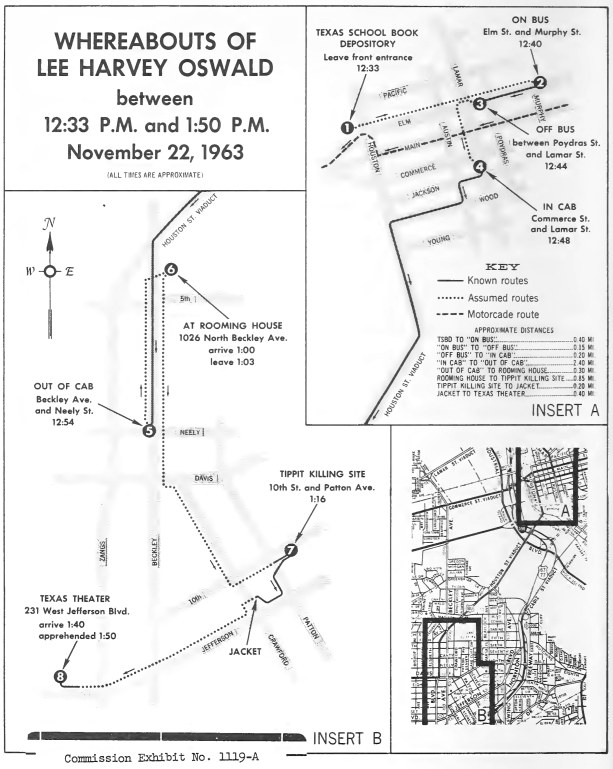
Commission Exhibit No. 1119-A
WHEREABOUTS OF LEE HARVEY OSWALD between 12:33 P.M. and 1:50 P.M. November 22, 1963 (ALL TIMES ARE APPROXIMATE)
The man was on the bus approximately 4 minutes.C4-424
At about 6:30 p.m. on the day of the assassination, McWatters viewed four men in a police lineup. He picked Oswald from the lineup as the man who had boarded the bus at the “lower end of town on Elm around Houston,” and who, during the ride south on Marsalis, had an argument with a woman passenger.C4-425 In his Commission testimony, McWatters said he had been in error and that a teenager named Milton Jones was the passenger he had in mind.C4-426 In a later interview, Jones confirmed that he had exchanged words with a woman passenger on the bus during the ride south on Marsalis.C4-427 McWatters also remembered that a man received a transfer at Lamar and Elm Streets and that a man in the lineup was about the size of this man.C4-428 However, McWatters’ recollection alone was too vague to be a basis for placing Oswald on the bus.
Riding on the bus was an elderly woman, Mary Bledsoe, who confirmed the mute evidence of the transfer. Oswald had rented a room from Mrs. Bledsoe about 6 weeks before, on October 7,C4-429 but she had asked him to leave at the end of a week. Mrs. Bledsoe told him “I am not going to rent to you any more.”C4-430 She testified, “I didn’t like his attitude. * * * There was just something about him I didn’t like or want him. * * * Just didn’t want him around me.” C4-431 On November 22, Mrs. Bledsoe came downtown to watch the Presidential motorcade. She boarded the Marsalis bus at St. Paul and Elm Streets to return home.C4-432 She testified further:
And, after we got past Akard, at Murphy—I figured it out. Let’s see. I don’t know for sure. Oswald got on. He looks like a maniac. His sleeve was out here. * * * His shirt was undone.
* * * * *
Was a hole in it, hole, and he was dirty, and I didn’t look at him. I didn’t want to know I even seen him * * *
* * * * *
* * * he looked so bad in his face, and his face was so distorted.
* * * * *
Hole in his sleeve right here.C4-433
As Mrs. Bledsoe said these words, she pointed to her right elbow.C4-434 When Oswald was arrested in the Texas Theatre, he was wearing a brown sport shirt with a hole in the right sleeve at the elbow.C4-435 Mrs. Bledsoe identified the shirt as the one Oswald was wearing and she stated she was certain that it was Oswald who boarded the bus.C4-436 Mrs. Bledsoe recalled that Oswald sat halfway to the rear of the bus which moved slowly and intermittently as traffic became heavy.C4-437 She heard a passing motorist tell the driver that the President had been shot.C4-438 People on the bus began talking about it. As the bus neared Lamar Street, Oswald left the bus and disappeared into the crowd.C4-439
The Marsalis bus which Oswald boarded traveled a route west on Elm, south on Houston, and southwest across the Houston viaduct to service the Oak Cliff area along Marsalis.C4-440 A Beckley bus which also served the Oak Cliff area, followed the same route as the Marsalis bus through downtown Dallas, except that it continued west on Elm, across Houston in front of the Depository Building, past the Triple Underpass into west Dallas, and south on Beckley.C4-441 Marsalis Street is seven blocks from Beckley.C4-442 Oswald lived at 1026 North Beckley.C4-443 He could not reach his roominghouse on the Marsalis bus, but the Beckley bus stopped across the street.C4-444 According to McWatters, the Beckley bus was behind the Marsalis bus, but he did not actually see it.C4-445 Both buses stopped within one block of the Depository Building. Instead of waiting there, Oswald apparently went as far away as he could and boarded the first Oak Cliff bus which came along rather than wait for one which stopped across the street from his roominghouse.
In a reconstruction of this bus trip, agents of the Secret Service and the FBI walked the seven blocks from the front entrance of the Depository Building to Murphy and Elm three times, averaging 6½ minutes for the three trips.C4-446 A bus moving through heavy traffic on Elm from Murphy to Lamar was timed at 4 minutes.C4-447 If Oswald left the Depository Building at 12:33 p.m., walked seven blocks directly to Murphy and Elm, and boarded a bus almost immediately, he would have boarded the bus at approximately 12:40 p.m. and left it at approximately 12:44 p.m. (See Commission Exhibit No. 1119-A, p. 158.)
Roger D. Craig, a deputy sheriff of Dallas County, claimed that about 15 minutes after the assassination he saw a man, whom he later identified as Oswald,C4-448 coming from the direction of the Depository Building and running down the hill north of Elm Street toward a light-colored Rambler station wagon, which was moving slowly along Elm toward the underpass.C4-449 The station wagon stopped to pick up the man and then drove off.C4-450 Craig testified that later in the afternoon he saw Oswald in the police interrogation room and told Captain Fritz that Oswald was the man he saw.C4-451 Craig also claimed that when Fritz pointed out to Oswald that Craig had identified him, Oswald rose from his chair, looked directly at Fritz, and said, “Everybody will know who I am now.”C4-452
The Commission could not accept important elements of Craig’s testimony. Captain Fritz stated that a deputy sheriff whom he could not identify did ask to see him that afternoon and told him a similar story to Craig’s.C4-453 Fritz did not bring him into his office to identify Oswald but turned him over to Lieutenant Baker for questioning. If Craig saw Oswald that afternoon, he saw him through the glass windows of the office. And neither Captain Fritz nor any other officer can remember that Oswald dramatically arose from his chair and said, “Everybody will know who I am now.”C4-454 If Oswald had made such a statement, Captain Fritz and others present would probably have remembered it. Craig may have seen a person enter a white Rambler station wagon 15 or 20 minutes after the shooting and travel west on Elm Street, but the Commission concluded that this man was not Lee Harvey Oswald, because of the overwhelming evidence that Oswald was far away from the building by that time.
The taxicab ride.—William Whaley, a taxicab driver, told his employer on Saturday morning, November 23, that he recognized Oswald from a newspaper photograph as a man whom he had driven to the Oak Cliff area the day before.C4-455 Notified of Whaley’s statement, the police brought him to the police station that afternoon. He was taken to the lineup room where, according to Whaley, five young teenagers, all handcuffed together, were displayed with Oswald.C4-456 He testified that Oswald looked older than the other boys.C4-457 The police asked him whether he could pick out his passenger from the lineup. Whaley picked Oswald. He said,
* * * you could have picked him out without identifying him by just listening to him because he was bawling out the policeman, telling them it wasn’t right to put him in line with these teenagers and all of that and they asked me which one and I told them. It was him all right, the same man.
* * * * *
He showed no respect for the policemen, he told them what he thought about them. They knew what they were doing and they were trying to railroad him and he wanted his lawyer.C4-458
Whaley believes that Oswald’s conduct did not aid him in his identification “because I knew he was the right one as soon as I saw him.”C4-459
Whaley’s memory of the lineup is inaccurate. There were four men altogether, not six men, in the lineup with Oswald.C4-460 Whaley said that Oswald was the man under No. 2.C4-461 Actually Oswald was under No. 3. Only two of the men in the lineup with Oswald were teenagers: John T. Horn, aged 18, was No. 1; David Knapp, aged 18, was No. 2; Lee Oswald was No. 3; and Daniel Lujan, aged 26, was No. 4.C4-462
When he first testified before the Commission, Whaley displayed a trip manifestC4-463 which showed a 12 o’clock trip from Travis Hotel to the Continental bus station, unloaded at 12:15 p.m., a 12:15 p.m. pickup at Continental to Greyhound, unloaded at 12:30 p.m., and a pickup from Greyhound (bus station) at 12:30 p.m., unloaded at 500 North Beckley at 12:45 p.m. Whaley testified that he did not keep an accurate time record of his trips but recorded them by the quarter hour, and that sometimes he made his entry right after a trip while at other times he waited to record three or four trips.C4-464 As he unloaded his Continental bus station passenger in front of Greyhound, he started to get out to buy a package of cigarettes.C4-465 He saw a man walking south on Lamar from Commerce. The man was dressed in faded blue color khaki work clothes, a brown shirt, and some kind of work jacket that almost matched his pants.C4-466 The man asked, “May I have the cab?”, and got into the front seat.C4-467 Whaley described the ensuing events as follows:
And about that time an old lady, I think she was an old lady, I don’t remember nothing but her sticking her head down past him in the door and said, “Driver, will you call me a cab down here?”
She had seen him get this cab and she wanted one, too, and he opened the door a little bit like he was going to get out and he said, “I will let you have this one,” and she says, “No, the driver can call me one.”
* * * * *
* * * I asked him where he wanted to go. And he said, “500 North Beckley.”
Well, I started up, I started to that address, and the police cars, the sirens was going, running crisscrossing everywhere, just a big uproar in that end of town and I said, “What the hell. I wonder what the hell is the uproar?”
And he never said anything. So I figured he was one of these people that don’t like to talk so I never said any more to him.
But when I got pretty close to 500 block at Neches and North Beckley which is the 500 block, he said, “This will do fine,” and I pulled over to the curb right there. He gave me a dollar bill, the trip was 95 cents. He gave me a dollar bill and didn’t say anything, just got out and closed the door and walked around the front of the cab over to the other side of the street [east side of the street]. Of course, the traffic was moving through there and I put it in gear and moved on, that is the last I saw of him.C4-468
Whaley was somewhat imprecise as to where he unloaded his passenger. He marked what he thought was the intersection of Neches and Beckley on a map of Dallas with a large “X.”C4-469 He said, “Yes, sir; that is right, because that is the 500 block of North Beckley.”C4-470 However, Neches and Beckley do not intersect. Neches is within one-half block of the roominghouse at 1026 North Beckley where Oswald was living. The 500 block of North Beckley is five blocks south of the roominghouse.C4-471
After a review of these inconsistencies in his testimony before the Commission, Whaley was interviewed again in Dallas. The route of the taxicab was retraced under the direction of Whaley.C4-472 He directed the driver of the car to a point 20 feet north of the northwest corner of the intersection of Beckley and Neely, the point at which he said his passenger alighted.C4-473 This was the 700 block of North Beckley.C4-474 The elapsed time of the reconstructed run from the Greyhound Bus Station to Neely and Beckley was 5 minutes and 30 seconds by stopwatch.C4-475 The walk from Beckley and Neely to 1026 North Beckley was timed by Commission counsel at 5 minutes and 45 seconds.C4-476
Whaley testified that Oswald was wearing either the gray zippered jacket or the heavy blue jacket.C4-477 He was in error, however. Oswald could not possibly have been wearing the blue jacket during the trip with Whaley, since it was found in the “domino” room of the Depository late in November.C4-478 Moreover, Mrs. Bledsoe saw Oswald in the bus without a jacket and wearing a shirt with a hole at the elbow.C4-479 On the other hand, Whaley identified Commission Exhibit No. 150 (the shirt taken from Oswald upon arrest) as the shirt his passenger was wearing.C4-480 He also stated he saw a silver identification bracelet on his passenger’s left wrist.C4-481 Oswald was wearing such a bracelet when he was arrested.C4-482
On November 22, Oswald told Captain Fritz that he rode a bus to a stop near his home and then walked to his roominghouse.C4-483 When queried the following morning concerning a bus transfer found in his possession at the time of his arrest, he admitted receiving it.C4-484 And when interrogated about a cab ride, Oswald also admitted that he left the slow-moving bus and took a cab to his roominghouse.C4-485
The Greyhound Bus Station at Lamar and Jackson Streets, where Oswald entered Whaley’s cab, is three to four short blocks south of Lamar and Elm.C4-486 If Oswald left the bus at 12:44 p.m. and walked directly to the terminal, he would have entered the cab at 12:47 or 12:48 p.m. If the cab ride was approximately 6 minutes, as was the reconstructed ride, he would have reached his destination at approximately 12:54 p.m. If he was discharged at Neely and Beckley and walked directly to his roominghouse, he would have arrived there about 12:59 to 1 p.m. From the 500 block of North Beckley, the walk would be a few minutes longer, but in either event he would have been in the roominghouse at about 1 p.m. This is the approximate time he entered the roominghouse, according to Earlene Roberts, the housekeeper there.C4-487 (See Commission Exhibit No. 1119-A, p. 158.)
Arrival and departure from roominghouse.—Earlene Roberts, housekeeper for Mrs. A.C. Johnson at 1026 North Beckley, knew Lee Harvey Oswald under the alias of O. H. Lee. She first saw him the day he rented a room at that address on October 14, 1963.C4-488 He signed his name as O. H. Lee on the roominghouse register.C4-489
Mrs. Roberts testified that on Thursday, November 21, Oswald did not come home. On Friday, November 22, about 1 p.m., he entered the house in unusual haste. She recalled that it was subsequent to the time the President had been shot. After a friend had called and told her, “President Kennedy has been shot,” she turned on the television. When Oswald came in she said, “Oh, you are in a hurry,” but Oswald did not respond. He hurried to his room and stayed no longer than 3 or 4 minutes. Oswald had entered the house in his shirt sleeves, but when he left, he was zipping up a jacket. Mrs. Roberts saw him a few seconds later standing near the bus stop in front of the house on the east side of Beckley.C4-490
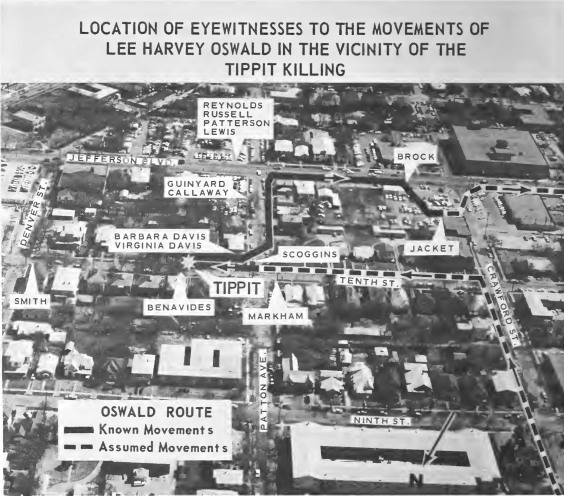
Commission Exhibit No. 1968
LOCATION OF EYEWITNESSES TO THE MOVEMENTS OF LEE HARVEY OSWALD IN THE VICINITY OF THE TIPPIT KILLING
Oswald was next seen about nine-tenths of a mile away at the southeast corner of 10th Street and Patton Avenue, moments before the Tippit shooting. (See Commission Exhibit No. 1119-A, p. 158.) If Oswald left his roominghouse shortly after 1 p.m. and walked at a brisk pace, he would have reached 10th and Patton shortly after 1:15 p.m.C4-491 Tippit’s murder was recorded on the police radio tape at about 1:16 p.m.C4-492
Description of Shooting
Patrolman J. D. Tippit joined the Dallas Police Department in July 1952.C4-493 He was described by Chief Curry as having the reputation of being “a very fine, dedicated officer.”C4-494 Tippit patroled district No. 78 in the Oak Cliff area of Dallas during daylight hours. He drove a police car painted distinctive colors with No. 10 prominently displayed on each side. Tippit rode alone, as only one man was normally assigned to a patrol car in residential areas during daylight shifts.C4-495
At about 12:44 p.m. on November 22, the radio dispatcher on channel 1 ordered all downtown patrol squads to report to Elm and Houston, code 3 (emergency).C4-496 At 12:45 p.m. the dispatcher ordered No. 78 (Tippit) to “move into central Oak Cliff area.”C4-497 At 12:54 p.m., Tippit reported that he was in the central Oak Cliff area at Lancaster and Eighth. The dispatcher ordered Tippit to be: “* * * at large for any emergency that comes in.”C4-498 According to Chief Curry, Tippit was free to patrol the central Oak Cliff area.C4-499 Tippit must have heard the description of the suspect wanted for the President’s shooting; it was broadcast over channel 1 at 12:45 p.m., again at 12:48 p.m., and again at 12:55 p.m.C4-500 The suspect was described as a “white male, approximately 30, slender build, height 5 foot 10 inches, weight 165 pounds.”C4-501 A similar description was given on channel 2 at 12:45 p.m.C4-502
At approximately 1:15 p.m., Tippit, who was cruising east on 10th Street, passed the intersection of 10th and Patton, about eight blocks from where he had reported at 12:54 p.m. About 100 feet past the intersection Tippit stopped a man walking east along the south side of Patton. (See Commission Exhibit No. 1968, p. 164.) The man’s general description was similar to the one broadcast over the police radio. Tippit stopped the man and called him to his car. He approached the car and apparently exchanged words with Tippit through the right front or vent window. Tippit got out and started to walk around the front of the car. As Tippit reached the left front wheel the man pulled out a revolver and fired several shots. Four bullets hit Tippit and killed him instantly. The gunman started back toward Patton Avenue, ejecting the empty cartridge cases before reloading with fresh bullets.
Eyewitnesses
At least 12 persons saw the man with the revolver in the vicinity of the Tippit crime scene at or immediately after the shooting. By the evening of November 22, five of them had identified Lee Harvey Oswald in police lineups as the man they saw. A sixth did so the next day. Three others subsequently identified Oswald from a photograph. Two witnesses testified that Oswald resembled the man they had seen. One witness felt he was too distant from the gunman to make a positive identification. (See Commission Exhibit No. 1968, p. 164.)
A taxi driver, William Scoggins, was eating lunch in his cab which was parked on Patton facing the southeast corner of 10th Street and Patton Avenue a few feet to the north.C4-503 A police car moving east on 10th at about 10 or 12 miles an hour passed in front of his cab. About 100 feet from the corner the police car pulled up alongside a man on the sidewalk. This man, dressed in a light-colored jacket, approached the car. Scoggins lost sight of him behind some shrubbery on the southeast corner lot, but he saw the policeman leave the car, heard three or four shots, and then saw the policeman fall. Scoggins hurriedly left his seat and hid behind the cab as the man came back toward the corner with gun in hand. The man cut across the yard through some bushes, passed within 12 feet of Scoggins, and ran south on Patton. Scoggins saw him and heard him mutter either “Poor damn cop” or “Poor dumb cop.”C4-504 The next day Scoggins viewed a lineup of four persons and identified Oswald as the man whom he had seen the day before at 10th and Patton.C4-505 In his testimony before the Commission, Scoggins stated that he thought he had seen a picture of Oswald in the newspapers prior to the lineup identification on Saturday. He had not seen Oswald on television and had not been shown any photographs of Oswald by the police.C4-506
Another witness, Domingo Benavides, was driving a pickup truck west on 10th Street. As he crossed the intersection a block east of 10th and Patton, he saw a policeman standing by the left door of the police car parked along the south side of 10th. Benavides saw a man standing at the right side of the parked police car. He then heard three shots and saw the policeman fall to the ground. By this time the pickup truck was across the street and about 25 feet from the police car. Benavides stopped and waited in the truck until the gunman ran to the corner. He saw him empty the gun and throw the shells into some bushes on the southeast corner lot.C4-507 It was Benavides, using Tippit’s car radio, who first reported the killing of Patrolman Tippit at about 1:16 p.m.: “We’ve had a shooting out here.”C4-508 He found two empty shells in the bushes and gave them to Patrolman J. M. Poe who arrived on the scene shortly after the shooting.C4-509 Benavides never saw Oswald after the arrest. When questioned by police officers on the evening of November 22, Benavides told them that he did not think that he could identify the man who fired the shots. As a result, they did not take him to the police station. He testified that the picture of Oswald which he saw later on television bore a resemblance to the man who shot Officer Tippit.C4-510
Just prior to the shooting, Mrs. Helen Markham, a waitress in downtown Dallas, was about to cross 10th Street at Patton. As she waited on the northwest corner of the intersection for traffic to pass,C4-511 she noticed a young man as he was “almost ready to get up on the curb”C4-512 at the southeast corner of the intersection, approximately 50 feet away. The man continued along 10th Street. Mrs. Markham saw a police car slowly approach the man from the rear and stop alongside of him. She saw the man come to the right window of the police car. As he talked, he leaned on the ledge of the right window with his arms. The man appeared to step back as the policeman “calmly opened the car door” and very slowly got out and walked toward the front of the car. The man pulled a gun. Mrs. Markham heard three shots and saw the policeman fall to the ground near the left front wheel. She raised her hands to her eyes as the man started to walk back toward Patton.C4-513 She peered through her fingers, lowered her hands, and saw the man doing something with his gun. “He was just fooling with it. I didn’t know what he was doing. I was afraid he was fixing to kill me.”C4-514 The man “in kind of a little trot” headed down Patton toward Jefferson Boulevard, a block away. Mrs. Markham then ran to Officer Tippit’s side and saw him lying in a pool of blood.C4-515
Helen Markham was screaming as she leaned over the body.C4-516 A few minutes later she described the gunman to a policeman.C4-517 Her description and that of other eyewitnesses led to the police broadcast at 1:22 p.m. describing the slayer as “about 30, 5’8”, black hair, slender.”C4-518 At about 4:30 p.m., Mrs. Markham, who had been greatly upset by her experience, was able to view a lineup of four men handcuffed together at the police station.C4-519 She identified Lee Harvey Oswald as the man who shot the policeman.C4-520 Detective L. C. Graves, who had been with Mrs. Markham before the lineup testified that she was “quite hysterical” and was “crying and upset.”C4-521 He said that Mrs. Markham started crying when Oswald walked into the lineup room.C4-522 In testimony before the Commission, Mrs. Markham confirmed her positive identification of Lee Harvey Oswald as the man she saw kill Officer Tippit.C4-523
In evaluating Mrs. Markham’s identification of Oswald, the Commission considered certain allegations that Mrs. Markham described the man who killed Patrolman Tippit as “short, a little on the heavy side,” and having “somewhat bushy” hair.C4-524 The Commission reviewed the transcript of a phone conversation in which Mrs. Markham is alleged to have provided such a description.C4-525 A review of the complete transcript has satisfied the Commission that Mrs. Markham strongly reaffirmed her positive identification of Oswald and denied having described the killer as short, stocky and having bushy hair. She stated that the man weighed about 150 pounds.C4-526 Although she used the words “a little bit bushy” to describe the gunman’s hair, the transcript establishes that she was referring to the uncombed state of his hair, a description fully supported by a photograph of Oswald taken at the time of his arrest. (See Pizzo Exhibit No. 453-C, p. 177.) Although in the phone conversation she described the man as “short,”C4-527 on November 22, within minutes of the shooting and before the lineup, Mrs. Markham described the man to the police as 5’8” tall.C4-528
During her testimony Mrs. Markham initially denied that she ever had the above phone conversation.C4-529 She has subsequently admitted the existence of the conversation and offered an explanation for her denial.C4-530 Addressing itself solely to the probative value of Mrs. Markham’s contemporaneous description of the gunman and her positive identification of Oswald at a police lineup, the Commission considers her testimony reliable. However, even in the absence of Mrs. Markham’s testimony, there is ample evidence to identify Oswald as the killer of Tippit.
Two young women, Barbara Jeanette Davis and Virginia Davis, were in an apartment of a multiple-unit house on the southeast corner of 10th and Patton when they heard the sound of gunfire and the screams of Helen Markham. They ran to the door in time to see a man with a revolver cut across their lawn and disappear around a corner of the house onto Patton.C4-531 Barbara Jeanette Davis assumed that he was emptying his gun as “he had it open and was shaking it.”C4-532 She immediately called the police. Later in the day each woman found an empty shell on the ground near the house. These two shells were delivered to the police.C4-533
On the evening of November 22, Barbara Jeanette and Virginia Davis viewed a group of four men in a lineup and each one picked Oswald as the man who crossed their lawn while emptying his pistol.C4-534 Barbara Jeanette Davis testified that no one had shown her a picture of Oswald before the identification and that she had not seen him on television. She was not sure whether she had seen his picture in a newspaper on the afternoon or evening of November 22 prior to the lineup.C4-535 Her reaction when she saw Oswald in the lineup was that “I was pretty sure it was the same man I saw. When they made him turn sideways, I was positive that was the one I seen.”C4-536 Similarly, Virginia Davis had not been shown pictures of anyone prior to the lineup and had not seen either television or the newspapers during the afternoon.C4-537 She identified Oswald, who was the No. 2 man in the lineup,C4-538 as the man she saw running with the gun: she testified, “I would say that was him for sure.”C4-539 Barbara Jeanette Davis and Virginia Davis were sitting alongside each other when they made their positive identifications of Oswald.C4-540 Each woman whispered Oswald’s number to the detective. Each testified that she was the first to make the identification.C4-541
William Arthur Smith was about a block east of 10th and Patton when he heard shots. He looked west on 10th and saw a man running to the west and a policeman falling to the ground. Smith failed to make himself known to the police on November 22. Several days later he reported what he had seen and was questioned by FBI agents.C4-542 Smith subsequently told a Commission staff member that he saw Oswald on television the night of the murder and thought that Oswald was the man he had seen running away from the shooting.C4-543 On television Oswald’s hair looked blond, whereas Smith remembered that the man who ran away had hair that was brown or brownish black. Later, the FBI showed Smith a picture of Oswald. In the picture the hair was brown.C4-544 According to his testimony, Smith told the FBI, “It looked more like him than it did on television.” He stated further that from “What I saw of him” the man looked like the man in the picture.C4-545
Two other important eyewitnesses to Oswald’s flight were Ted Callaway, manager of a used-car lot on the northeast corner of Patton Avenue and Jefferson Boulevard, and Sam Guinyard, a porter at the lot. They heard the sound of shots to the north of their lot.C4-546 Callaway heard five shots, and Guinyard three. Both ran to the sidewalk on the east side of Patton at a point about a half a block south of 10th. They saw a man coming south on Patton with a revolver held high in his right hand. According to Callaway, the man crossed to the west side of Patton.C4-547 From across the street Callaway yelled, “Hey, man, what the hell is going on?” He slowed down, halted, said something, and then kept on going to the corner, turned right, and continued west on Jefferson.C4-548 Guinyard claimed that the man ran down the east side of Patton and passed within 10 feet of him before crossing to the other side.C4-549 Guinyard and Callaway ran to 10th and Patton and found Tippit lying in the street beside his car.C4-550 Apparently he had reached for his gun; it lay beneath him outside of the holster. Callaway picked up the gun.C4-551 He and Scoggins attempted to chase down the gunman in Scoggin’s taxicab,C4-552 but he had disappeared. Early in the evening of November 22, Guinyard and Callaway viewed the same lineup of four men from which Mrs. Markham had earlier made her identification of Lee Harvey Oswald. Both men picked Oswald as the man who had run south on Patton with a gun in his hand.C4-553 Callaway told the Commission: “So they brought four men in. I stepped to the back of the room, so I could kind of see him from the same distance which I had seen him before. And when he came out I knew him.”C4-554 Guinyard said, “I told them that was him right there. I pointed him out right there.”C4-555 Both Callaway and Guinyard testified that they had not been shown any pictures by the police before the lineup.C4-556
The Dallas Police Department furnished the Commission with pictures of the men who appeared in the lineups with Oswald,C4-557 and the Commission has inquired into general lineup procedures used by the Dallas police as well as the specific procedures in the lineups involving Oswald.C4-558 The Commission is satisfied that the lineups were conducted fairly.
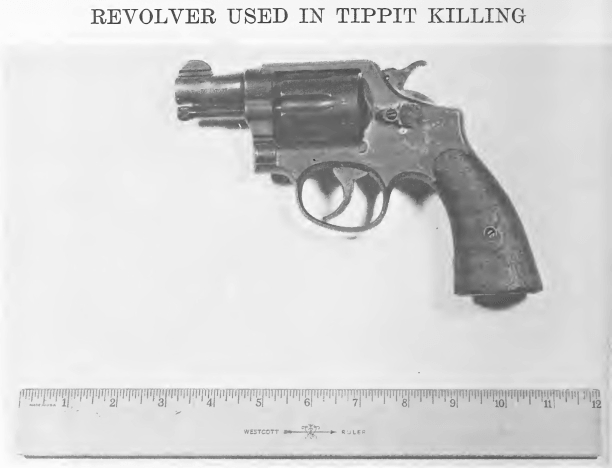
Commission Exhibit No. 143
REVOLVER USED IN TIPPIT KILLING
As Oswald ran south on Patton Avenue toward Jefferson Boulevard he was moving in the direction of a used-car lot located on the southeast corner of this intersection.C4-559 Four men—Warren Reynolds,C4-560 Harold Russell,C4-561 Pat Patterson,C4-562 and L. J. LewisC4-563—were on the lot at the time, and they saw a white male with a revolver in his hands running south on Patton. When the man reached Jefferson, he turned right and headed west. Reynolds and Patterson decided to follow him. When he reached a gasoline service station one block away he turned north and walked toward a parking area in the rear of the station. Neither Reynolds nor Patterson saw the man after he turned off Jefferson at the service station.C4-564 These four witnesses were interviewed by FBI agents 2 months after the shooting. Russell and Patterson were shown a picture of Oswald and they stated that Oswald was the man they saw on November 22, 1963. Russell confirmed this statement in a sworn affidavit for the Commission.C4-565 Patterson, when asked later to confirm his identification by affidavit said he did not recall having been shown the photograph. He was then shown two photographs of Oswald and he advised that Oswald was “unquestionably” the man he saw.C4-566 Reynolds did not make a positive identification when interviewed by the FBI, but he subsequently testified before a Commission staff member and, when shown two photographs of Oswald, stated that they were photographs of the man he saw.C4-567 L. J. Lewis said in an interview that because of the distance from which he observed the gunman he would hesitate to state whether the man was identical with Oswald.C4-568
Murder Weapon
When Oswald was arrested, he had in his possession a Smith & Wesson .38 Special caliber revolver, serial number V510210. (See Commission Exhibit No. 143, p. 170). Two of the arresting officers placed their initials on the weapon and a third inscribed his name. All three identified Exhibit No. 143 as the revolver taken from Oswald when he was arrested.C4-569 Four cartridge cases were found in the shrubbery on the corner of 10th and Patton by three of the eyewitnesses—Domingo Benavides, Barbara Jeanette Davis, and Virginia Davis.C4-570 It was the unanimous and unequivocal testimony of expert witnesses before the Commission that these used cartridge cases were fired from the revolver in Oswald’s possession to the exclusion of all other weapons. (See app. X, p. 559.)
Cortlandt Cunningham, of the Firearms Identification Unit of the FBI Laboratory, testified that he compared the four empty cartridge cases found near the scene of the shooting with a test cartridge fired from the weapon in Oswald’s possession when he was arrested. Cunningham declared that this weapon fired the four cartridges to the exclusion of all other weapons. Identification was effected through breech face marks and firing pin marks.C4-571 Robert A. Frazier and Charles Killion, other FBI firearms experts, independently examined the four cartridge cases and arrived at the same conclusion as Cunningham.C4-572 At the request of the Commission, Joseph D. Nicol, superintendent of the Illinois Bureau of Criminal Identification Investigation, also examined the four cartridge cases found near the site of the homicide and compared them with the test cartridge cases fired from the Smith & Wesson revolver taken from Oswald. He concluded that all of these cartridges were fired from the same weapon.C4-573
Cunningham compared four lead bullets recovered from the body of Patrolman Tippit with test bullets fired from Oswald’s revolver.C4-574 He explained that the bullets were slightly smaller than the barrel of the pistol which had fired them. This caused the bullets to have an erratic passage through the barrel and impressed upon the lead of the bullets inconsistent individual characteristics which made identification impossible. Consecutive bullets fired from the revolver by the FBI experts could not be identified as having been fired from that revolver.C4-575 (See app. X, p. 559.) Cunningham testified that all of the bullets were mutilated, one being useless for comparison purposes. All four bullets were fired from a weapon with five lands and grooves and a right twistC4-576 which were the rifling characteristics of the revolver taken from Oswald. He concluded, however, that he could not say whether the four bullets were fired from the revolver in Oswald’s possession.C4-577 “The only thing I can testify is they could have on the basis of the rifling characteristics—they could have been.”C4-578
Nicol differed with the FBI experts on one bullet taken from Tippit’s body. He declared that this bulletC4-579 was fired from the same weapon that fired the test bullets to the exclusion of all other weapons. But he agreed that because the other three bullets were mutilated, he could not determine if they had been fired from the same weapon as the test bullets.C4-580
The examination and testimony of the experts enabled the Commission to conclude that five shots may have been fired, even though only four bullets were recovered. Three of the bullets recovered from Tippit’s body were manufactured by Winchester-Western, and the fourth bullet by Remington-Peters, but only two of the four discarded cartridge cases found on the lawn at 10th Street and Patton Avenue were of Winchester-Western manufacture.C4-581 Therefore, one cartridge case of this type was not recovered. And though only one bullet of Remington-Peters manufacture was recovered, two empty cartridge cases of that make were retrieved. Therefore, either one bullet of Remington-Peters manufacture is missing or one used Remington-Peters cartridge case, which may have been in the revolver before the shooting, was discarded along with the others as Oswald left the scene. If a bullet is missing, five were fired. This corresponds with the observation and memory of Ted Callaway,C4-582 and possibly Warren Reynolds, but not with the other eyewitnesses who claim to have heard from two to four shots.
Ownership of Revolver
By checking certain importers and dealers after the assassination of President Kennedy and slaying of Officer Tippit, agents of the FBI determined that George Rose & Co. of Los Angeles was a major distributor of this type of revolver.C4-583 Records of Seaport Traders, Inc., a mail-order division of George Rose & Co., disclosed that on January 3, 1963, the company received from Empire Wholesale Sporting Goods, Ltd., Montreal, a shipment of 99 guns in one case. Among these guns was a .38 Special caliber Smith & Wesson revolver, serial No. V510210, the only revolver made by Smith & Wesson with this serial number.C4-584 When first manufactured, it had a 5-inch barrel. George Rose & Co. had the barrel shortened by a gunsmith to 2¼ inches.C4-585
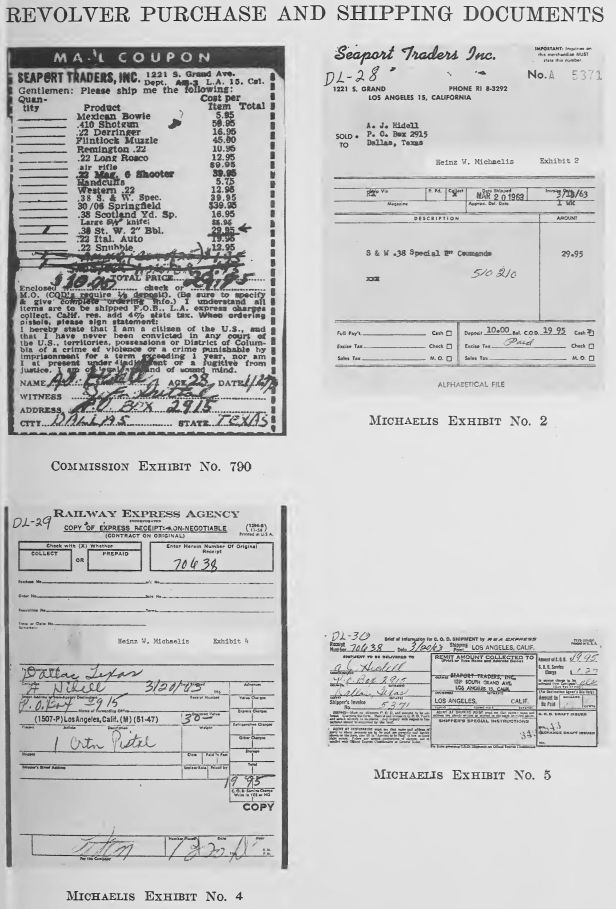
REVOLVER PURCHASE AND SHIPPING DOCUMENTS
Commission Exhibit No. 790
Michaelis Exhibit No. 2
Michaelis Exhibit No. 4
Michaelis Exhibit No. 5
Sometime after January 27, 1963, Seaport Traders, Inc., received through the mail a mail-order coupon for one “.38 St. W. 2” Bbl.,” cost $29.95. Ten dollars in cash was enclosed. The order was signed in ink by “A. J. Hidell, aged 28.”C4-586 (See Commission Exhibit No. 790, p. 173.) The date of the order was January 27 (no year shown), and the return address was Post Office Box 2915, Dallas, Tex. Also on the order form was an order, written in ink, for one box of ammunition and one holster, but a line was drawn through these items. The mail-order form had a line for the name of a witness to attest that the person ordering the gun was a U.S. citizen and had not been convicted of a felony. The name written in this space was D. F. Drittal.C4-587
Heinz W. Michaelis, office manager of both George Rose & Co., Inc., and Seaport Traders, Inc., identified records of Seaport Traders, Inc., which showed that a “.38 S and W Special two-inch Commando, serial number V510210” was shipped on March 20, 1963, to A. J. Hidell, Post Office Box 2915, Dallas, Tex. The invoice was prepared on March 13, 1963; the revolver was actually shipped on March 20 by Railway Express. The balance due on the purchase was $19.95. Michaelis furnished the shipping copy of the invoice, and the Railway Express Agency shipping documents, showing that $19.95, plus $1.27 shipping charge, had been collected from the consignee, Hidell.C4-588 (See Michaelis Exhibits Nos. 2, 4, 5, p. 173.)
Handwriting experts, Alwyn Cole of the Treasury Department and James C. Cadigan of the FBI, testified before the Commission that the writing on the coupon was Oswald’s. The signature of the witness, D. F. Drittal, who attested that the fictitious Hidell was an American citizen and had not been convicted of a felony, was also in Oswald’s handwriting.C4-589 Marina Oswald gave as her opinion that the mail-order coupon was in Oswald’s handwriting.C4-590 When shown the revolver, she stated that she recognized it as the one owned by her husband.C4-591 She also testified that this appeared to be the revolver seen in Oswald’s belt in the picture she took in late March or early April 1963 when the family was living on Neely Street in Dallas.C4-592 Police found an empty revolver holster when they searched Oswald’s room on Beckley Avenue after his arrest.C4-593 Marina Oswald testified that this was the holster which contained the revolver in the photographs taken on Neely Street.C4-594
Oswald’s Jacket
Approximately 15 minutes before the shooting of Tippit, Oswald was seen leaving his roominghouse.C4-595 He was wearing a zipper jacket which he had not been wearing moments before when he had arrived home.C4-596 When Oswald was arrested, he did not have a jacket.C4-597 Shortly after Tippit was slain, policemen found a light-colored zipper jacket along the route taken by the killer as he attempted to escape.C4-598 (See Commission Exhibit No. 1968, p. 164.)
At 1:22 p.m. the Dallas police radio described the man wanted for the murder of Tippit as “a white male about thirty, five foot eight inches, black hair, slender, wearing a white jacket, white shirt and dark slacks.”C4-599 According to Patrolman Poe this description came from Mrs. Markham and Mrs. Barbara Jeanette Davis.C4-600 Mrs. Markham told Poe that the man was a “white male, about 25, about five feet eight, brown hair, medium,” and wearing a “white jacket.” Mrs. Davis gave Poe the same general description: a “white male in his early twenties, around five foot seven inches or eight inches, about 145 pounds,” and wearing a white jacket.
As has been discussed previously, two witnesses, Warren Reynolds and B. M. Patterson, saw the gunman run toward the rear of a gasoline service station on Jefferson Boulevard. Mrs. Mary Brock, the wife of a mechanic who worked at the station, was there at the time and she saw a white male, “5 feet, 10 inches * * * wearing light clothing * * * a light-colored jacket” walk past her at a fast pace with his hands in his pocket. She last saw him in the parking lot directly behind the service station. When interviewed by FBI agents on January 21, 1964, she identified a picture of Oswald as being the same person she saw on November 22. She confirmed this interview by a sworn affidavit.C4-601
At 1:24 p.m., the police radio reported, “The suspect last seen running west on Jefferson from 400 East Jefferson.”C4-602 Police Capt. W. R. Westbrook and several other officers concentrated their search along Jefferson Boulevard.C4-603 Westbrook walked through the parking lot behind the service stationC4-604 and found a light-colored jacket lying under the rear of one of the cars.C4-605 Westbrook identified Commission Exhibit No. 162 as the light-colored jacket which he discovered underneath the automobile.C4-606
This jacket belonged to Lee Harvey Oswald. Marina Oswald stated that her husband owned only two jackets, one blue and the other gray.C4-607 The blue jacket was found in the Texas School Book DepositoryC4-608 and was identified by Marina Oswald as her husband’s.C4-609 Marina Oswald also identified Commission Exhibit No. 162, the jacket found by Captain Westbrook, as her husband’s second jacket.C4-610
The eyewitnesses vary in their identification of the jacket. Mrs. Earlene Roberts, the housekeeper at Oswald’s roominghouse and the last person known to have seen him before he reached 10th Street and Patton Avenue, said that she may have seen the gray zipper jacket but she was not certain. It seemed to her that the jacket Oswald wore was darker than Commission Exhibit No. 162.C4-611 Ted Callaway, who saw the gunman moments after the shooting, testified that Commission Exhibit No. 162 looked like the jacket he was wearing but “I thought it had a little more tan to it.”C4-612 Two other witnesses, Sam Guinyard and William Arthur Smith, testified that Commission Exhibit No. 162 was the jacket worn by the man they saw on November 22. Mrs. Markham and Barbara Davis thought that the jacket worn by the slayer of Tippit was darker than the jacket found by Westbrook.C4-613 Scoggins thought it was lighter.C4-614
There is no doubt, however, that Oswald was seen leaving his roominghouse at about 1 p.m. wearing a zipper jacket, that the man who killed Tippit was wearing a light-colored jacket, that he was seen running along Jefferson Boulevard, that a jacket was found under a car in a lot adjoining Jefferson Boulevard, that the jacket belonged to Lee Harvey Oswald, and that when he was arrested at approximately 1:50 p.m., he was in shirt sleeves. These facts warrant the finding that Lee Harvey Oswald disposed of his jacket as he fled from the scene of the Tippit killing.
Conclusion
The foregoing evidence establishes that (1) two eyewitnesses who heard the shots and saw the shooting of Dallas Police Patrolman J. D. Tippit and seven eyewitnesses who saw the flight of the gunman with revolver in hand positively identified Lee Harvey Oswald as the man they saw fire the shots or flee from the scene, (2) the cartridge cases found near the scene of the shooting were fired from the revolver in the possession of Oswald at the time of his arrest, to the exclusion of all other weapons, (3) the revolver in Oswald’s possession at the time of his arrest was purchased by and belonged to Oswald, and (4) Oswald’s jacket was found along the path of flight taken by the gunman as he fled from the scene of the killing. On the basis of this evidence the Commission concluded that Lee Harvey Oswald killed Dallas Police Patrolman J.D. Tippit.
OSWALD’S ARREST
The Texas Theatre is on the north side of Jefferson Boulevard, approximately eight blocks from the scene of the Tippit shooting and six blocks from where several witnesses last saw Oswald running west on Jefferson Boulevard.C4-615 (See Commission Exhibit No. 1968, p. 164.) Shortly after the Tippit murder, police sirens sounded along Jefferson Boulevard. One of the persons who heard the sirens was Johnny Calvin Brewer, manager of Hardy’s Shoestore, a few doors east of the Texas Theatre. Brewer knew from radio broadcasts that the President had been shot and that a patrolman had also been shot in Oak Cliff.C4-616 When he heard police sirens, he “looked up and saw the man enter the lobby,” a recessed area extending about 15 feet between the sidewalk and the front door of his store.C4-617 A police car made a U-turn, and as the sirens grew fainter, the man in the lobby “looked over his shoulder and turned around and walked up West Jefferson towards the theatre.”C4-618 The man wore a T-shirt beneath his outer shirt and he had no jacket.C4-619 Brewer said, “He just looked funny to me. * * * His hair was sort of messed up and looked like he had been running, and he looked scared, and he looked funny.”C4-620
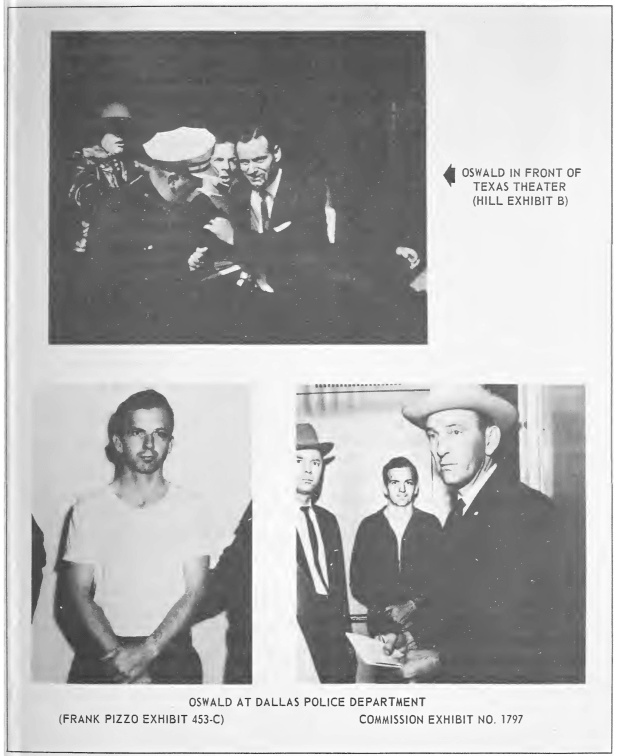
(HILL EXHIBIT B) OSWALD IN FRONT OF TEXAS THEATER
(FRANK PIZZO EXHIBIT 453-C) OSWALD AT DALLAS POLICE DEPARTMENT
COMMISSION EXHIBIT NO. 1797 OSWALD AT DALLAS POLICE DEPARTMENT
Mrs. Julia Postal, selling tickets at the box office of the Texas Theatre, heard police sirens and then saw a man as he “ducked into” the outer lobby space of the theatre near the ticket office.C4-621 Attracted by the sound of the sirens, Mrs. Postal stepped out of the box office and walked to the curb.C4-622 Shortly thereafter, Johnny Brewer, who had come from the nearby shoestore, asked Mrs. Postal whether the fellow that had ducked in had bought a ticket.C4-623 She said, “No; by golly, he didn’t,” and turned around, but the man was nowhere in sight.C4-624 Brewer told Mrs. Postal that he had seen the man ducking into his place of business and that he had followed him to the theatre.C4-625 She sent Brewer into the theatre to find the man and check the exits, told him about the assassination, and said “I don’t know if this is the man they want * * * but he is running from them for some reason.”C4-626 She then called the police.C4-627
At 1:45 p.m., the police radio stated, “Have information a suspect just went in the Texas Theatre on West Jefferson.”C4-628 Patrol cars bearing at least 15 officers converged on the Texas Theatre.C4-629 Patrolman M. N. McDonald, with Patrolmen R. Hawkins, T. A. Hutson, and C. T. Walker, entered the theatre from the rear.C4-630 Other policemen entered the front door and searched the balcony.C4-631 Detective Paul L. Bentley rushed to the balcony and told the projectionist to turn up the house lights.C4-632 Brewer met McDonald and the other policemen at the alley exit door, stepped out onto the stage with themC4-633 and pointed out the man who had come into the theatre without paying.C4-634 The man was Oswald. He was sitting alone in the rear of the main floor of the theatre near the right center aisle.C4-635 About six or seven people were seated on the theatre’s main floor and an equal number in the balcony.C4-636
McDonald first searched two men in the center of the main floor, about 10 rows from the front.C4-637 He walked out of the row up the right center aisle.C4-638 When he reached the row where the suspect was sitting, McDonald stopped abruptly and told the man to get on his feet.C4-639 Oswald rose from his seat, bringing up both hands.C4-640 As McDonald started to search Oswald’s waist for a gun, he heard him say, “Well, it’s all over now.”C4-641 Oswald then struck McDonald between the eyes with his left fist; with his right hand he drew a gun from his waist.C4-642 McDonald struck back with his right hand and grabbed the gun with his left hand.C4-643 They both fell into the seats.C4-644 Three other officers, moving toward the scuffle, grabbed Oswald from the front, rear and side.C4-645 As McDonald fell into the seat with his left hand on the gun, he felt something graze across his hand and heard what sounded like the snap of the hammer.C4-646 McDonald felt the pistol scratch his cheek as he wrenched it away from Oswald.C4-647 Detective Bob K. Carroll, who was standing beside McDonald, seized the gun from him.C4-648
The other officers who helped subdue Oswald corroborated McDonald in his testimony except that they did not hear Oswald say, “It’s all over now.” Deputy Sheriff Eddy R. Walthers recalled such a remark but he did not reach the scene of the struggle until Oswald had been knocked to the floor by McDonald and the others.C4-649 Some of the officers saw Oswald strike McDonald with his fist.C4-650 Most of them heard a click which they assumed to be a click of the hammer of the revolver.C4-651 Testimony of a firearms expert before the Commission established that the hammer of the revolver never touched the shell in the chamber.C4-652 Although the witnesses did not hear the sound of a misfire, they might have heard a snapping noise resulting from the police officer grabbing the cylinder of the revolver and pulling it away from Oswald while he was attempting to pull the trigger.C4-653 (See app. X, p. 560.)
Two patrons of the theatre and John Brewer testified regarding the arrest of Oswald, as did the various police officers who participated in the fight. George Jefferson Applin, Jr., confirmed that Oswald fought with four or five officers before he was handcuffed.C4-654 He added that one officer grabbed the muzzle of a shotgun, drew back, and hit Oswald with the butt end of the gun in the back.C4-655 No other theatre patron or officer has testified that Oswald was hit by a gun. Nor did Oswald ever complain that he was hit with a gun, or injured in the back. Deputy Sheriff Walthers brought a shotgun into the theatre but laid it on some seats before helping to subdue Oswald.C4-656 Officer Ray Hawkins said that there was no one near Oswald who had a shotgun and he saw no one strike Oswald in the back with a rifle butt or the butt of a gun.C4-657
John Gibson, another patron in the theatre, saw an officer grab Oswald, and he claims that he heard the click of a gun misfiring.C4-658 He saw no shotgun in the possession of any policeman near Oswald.C4-659 Johnny Brewer testified he saw Oswald pull the revolver and the officers struggle with him to take it away but that once he was subdued, no officer struck him.C4-660 He further stated that while fists were flying he heard one of the officers say “Kill the President, will you.”C4-661 It is unlikely that any of the police officers referred to Oswald as a suspect in the assassination. While the police radio had noted the similarity in description of the two suspects, the arresting officers were pursuing Oswald for the murder of Tippit.C4-662 As Oswald, handcuffed, was led from the theatre, he was, according to McDonald, “cursing a little bit and hollering police brutality.”C4-663 At 1:51 p.m., police car 2 reported by radio that it was on the way to headquarters with the suspect.C4-664
Captain Fritz returned to police headquarters from the Texas School Book Depository at 2:15 after a brief stop at the sheriff’s office.C4-665 When he entered the homicide and robbery bureau office, he saw two detectives standing there with Sgt. Gerald L. Hill, who had driven from the theatre with Oswald.C4-666 Hill testified that Fritz told the detective to get a search warrant, go to an address on Fifth Street in Irving, and pick up a man named Lee Oswald. When Hill asked why Oswald was wanted, Fritz replied, “Well, he was employed down at the Book Depository and he had not been present for a roll call of the employees.”C4-667 Hill said, “Captain, we will save you a trip * * * there he sits.”C4-668
STATEMENTS OF OSWALD DURING DETENTION
Oswald was questioned intermittently for approximately 12 hours between 2:30 p.m., on November 22, and 11 a.m., on November 24. Throughout this interrogation he denied that he had anything to do either with the assassination of President Kennedy or the murder of Patrolman Tippit. Captain Fritz of the homicide and robbery bureau did most of the questioning, but he kept no notes and there were no stenographic or tape recordings. Representatives of other law enforcement agencies were also present, including the FBI and the U.S. Secret Service. They occasionally participated in the questioning. The reports prepared by those present at these interviews are set forth in appendix XI. A full discussion of Oswald’s detention and interrogation is presented in chapter V of this report.
During the evening of November 22, the Dallas Police Department performed paraffin tests on Oswald’s hands and right cheek in an apparent effort to determine, by means of a scientific test, whether Oswald had recently fired a weapon. The results were positive for the hands and negative for the right cheek.C4-669 Expert testimony before the Commission was to the effect that the paraffin test was unreliableC4-670 in determining whether or not a person has fired a rifle or revolver.C4-671 The Commission has, therefore, placed no reliance on the paraffin tests administered by the Dallas police. (See app. X, pp. 561-562.)
Oswald provided little information during his questioning. Frequently, however, he was confronted with evidence which he could not explain, and he resorted to statements which are known to be lies.C4-672 While Oswald’s untrue statements during interrogation were not considered items of positive proof by the Commission, they had probative value in deciding the weight to be given to his denials that he assassinated President Kennedy and killed Patrolman Tippit. Since independent evidence revealed that Oswald repeatedly and blatantly lied to the police, the Commission gave little weight to his denials of guilt.
Denial of Rifle Ownership
From the outset, Oswald denied owning a rifle. On November 23, Fritz confronted Oswald with the evidence that he had purchased a rifle under the fictitious name of “Hidell.” Oswald said that this was not true. Oswald denied that he had a rifle wrapped up in a blanket in the Paine garage. Oswald also denied owning a rifle and said that since leaving the Marine Corps he had fired only a small bore .22 rifle.C4-673 On the afternoon of November 23, Officers H. M. Moore, R. S. Stovall, and G. F. Rose obtained a search warrant and examined Oswald’s effects in the Paine garage. They discovered two photographs, each showing Oswald with a rifle and a pistol.C4-674 These photographs were shown to Oswald on the evening of November 23 and again on the morning of the 24th. According to Fritz, Oswald sneered, saying that they were fake photographs, that he had been photographed a number of times the day before by the police, that they had superimposed upon the photographs a rifle and a revolver.C4-675 He told Fritz a number of times that the smaller photograph was either made from the larger, or the larger photograph was made from the smaller and that at the proper time he would show that the pictures were fakes. Fritz told him that the two small photographs were found in the Paine garage. At that point, Oswald refused to answer any further questions.C4-676 As previously indicated, Marina Oswald testified that she took the two pictures with her husband’s Imperial Reflex camera when they lived on Neely Street. Her testimony was fully supported by a photography expert who testified that in his opinion the pictures were not composites.C4-677
The Revolver
At the first interrogation, Oswald claimed that his only crime was carrying a gun and resisting arrest. When Captain Fritz asked him why he carried the revolver, he answered, “Well, you know about a pistol. I just carried it.”C4-678 He falsely alleged that he bought the revolver in Fort Worth,C4-679 when in fact he purchased it from a mail-order house in Los Angeles.C4-680
The Aliases “Hidell” and “O. H. Lee”
The arresting officers found a forged selective service card with a picture of Oswald and the name “Alek J. Hidell” in Oswald’s billfold.C4-681 On November 22 and 23, Oswald refused to tell Fritz why this card was in his possession,C4-682 or to answer any questions concerning the card.C4-683 On Sunday morning, November 24, Oswald denied that he knew A. J. Hidell. Captain Fritz produced the selective service card bearing the name “Alek J. Hidell.” Oswald became angry and said, “Now, I’ve told you all I’m going to tell you about that card in my billfold—you have the card yourself and you know as much about it as I do.”C4-684 At the last interrogation on November 24, Oswald admitted to Postal Inspector Holmes that he had rented post office box 2915, Dallas, but denied that he had received a package in this box addressed to Hidell. He also denied that he had received the rifle through this box.C4-685 Holmes reminded Oswald that A. J. Hidell was listed on post office box 30061, New Orleans, as one entitled to receive mail. Oswald replied, “I don’t know anything about that.”C4-686
When asked why he lived at his roominghouse under the name O. H. Lee, Oswald responded that the landlady simply made a mistake, because he told her that his name was Lee, meaning his first name.C4-687 An examination of the roominghouse register revealed that Oswald actually signed the name O. H. Lee.C4-688
The Curtain Rod Story
In concluding that Oswald was carrying a rifle in the paper bag on the morning of November 22, 1963, the Commission found that Oswald lied when he told Frazier that he was returning to Irving to obtain curtain rods. When asked about the curtain rod story, Oswald lied again. He denied that he had ever told Frazier that he wanted a ride to Irving to get curtain rods for an apartment.C4-689 He explained that a party for the Paine children had been planned for the weekend and he preferred not to be in the Paine house at that time; therefore, he made his weekly visit on Thursday night.C4-690 Actually, the party for one of the Paine’s children was the preceding weekend, when Marina Oswald suggested that Oswald remain in Dallas.C4-691 When told that Frazier and Mrs. Randle had seen him carrying a long heavy package, Oswald replied, “Well, they was mistaken. That must have been some other time he picked me up.”C4-692 In one interview, he told Fritz that the only sack he carried to work that day was a lunch sack which he kept on his lap during the ride from Irving to Dallas.C4-693 Frazier testified before the Commission that Oswald carried no lunch sack that day.C4-694
Actions During and After Shooting
During the first interrogation on November 22, Fritz asked Oswald to account for himself at the time the President was shot. Oswald told him that he ate lunch in the first-floor lunchroom and then went to the second floor for a Coke which he brought downstairs. He acknowledged the encounter with the police officer on the second floor. Oswald told Fritz that after lunch he went outside, talked with Foreman Bill Shelley for 5 or 10 minutes and then left for home. He said that he left work because Bill Shelley said that there would be no more work done that day in the building.C4-695 Shelley denied seeing Oswald after 12 noon or at any time after the shooting.C4-696 The next day, Oswald added to his story. He stated that at the time the President was shot he was having lunch with “Junior” but he did not give Junior’s last name.C4-697 The only employee at the Depository Building named “Junior” was James Jarman, Jr. Jarman testified that he ate his lunch on the first floor around 5 minutes to 12, and that he neither ate lunch with nor saw Oswald.C4-698 Jarman did talk to Oswald that morning:
* * * he asked me what were the people gathering around on the corner for and I told him that the President was supposed to pass that morning, and he asked me did I know which way he was coming, and I told him, yes, he probably come down Main and turn on Houston and then back again on Elm. Then he said, “Oh, I see,” and that was all.C4-699
PRIOR ATTEMPT TO KILL
The Attempt on the Life of Maj. Gen. Edwin A. Walker
At approximately 9 p.m., on April 10, 1963, in Dallas, Tex., Maj. Gen. Edwin A. Walker, an active and controversial figure on the American political scene since his resignation from the U.S. Army in 1961, narrowly escaped death when a rifle bullet fired from outside his home passed near his head as he was seated at his desk.C4-700 There were no eyewitnesses, although a 14-year-old boy in a neighboring house claimed that immediately after the shooting he saw two men, in separate cars, drive out of a church parking lot adjacent to Walker’s home.C4-701 A friend of Walker’s testified that two nights before the shooting he saw “two men around the house peeking in windows.”C4-702 General Walker gave this information to the police before the shooting, but it did not help solve the crime. Although the bullet was recovered from Walker’s house (see app. X, p. 562), in the absence of a weapon it was of little investigatory value. General Walker hired two investigators to determine whether a former employee might have been involved in the shooting.C4-703 Their results were negative. Until December 3, 1963, the Walker shooting remained unsolved.
The Commission evaluated the following evidence in considering whether Lee Harvey Oswald fired the shot which almost killed General Walker: (1) A note which Oswald left for his wife on the evening of the shooting, (2) photographs found among Oswald’s possessions after the assassination of President Kennedy, (3) firearm identification of the bullet found in Walker’s home, and (4) admissions and other statements made to Marina Oswald by Oswald concerning the shooting.
Note left by Oswald.—On December 2, 1963, Mrs. Ruth Paine turned over to the police some of the Oswalds’ belongings, including a Russian volume entitled “Book of Useful Advice.”C4-704 In this book was an undated note written in Russian. In translation, the note read as follows:
1. This is the key to the mailbox which is located in the main post office in the city on Ervay Street. This is the same street where the drugstore, in which you always waited is located. You will find the mailbox in the post office which is located 4 blocks from the drugstore on that street. I paid for the box last month so don’t worry about it.
2. Send the information as to what has happened to me to the Embassy and include newspaper clippings (should there be anything about me in the newspapers). I believe that the Embassy will come quickly to your assistance on learning everything.
3. I paid the house rent on the 2d so don’t worry about it.
4. Recently I also paid for water and gas.
5. The money from work will possibly be coming. The money will be sent to our post office box. Go to the bank and cash the check.
6. You can either throw out or give my clothing, etc. away. Do not keep these. However, I prefer that you hold on to my personal papers (military, civil, etc.).
7. Certain of my documents are in the small blue valise.
8. The address book can be found on my table in the study should need same.
9. We have friends here. The Red Cross also will help you. (Red Cross in English). [sic]
10. I left you as much money as I could, $60 on the second of the month. You and the baby [apparently] can live for another 2 months using $10 per week.
11. If I am alive and taken prisoner, the city jail is located at the end of the bridge through which we always passed on going to the city (right in the beginning of the city after crossing the bridge).C4-705
James C. Cadigan, FBI handwriting expert, testified that this note was written by Lee Harvey Oswald.C4-706
Prior to the Walker shooting on April 10, Oswald had been attending typing classes on Monday, Tuesday, and Thursday evenings. He had quit these classes at least a week before the shooting, which occurred on a Wednesday night.C4-707 According to Marina Oswald’s testimony, on the night of the Walker shooting, her husband left their apartment on Neely Street shortly after dinner. She thought he was attending a class or was “on his own business.”C4-708 When he failed to return by 10 or 10:30 p.m., Marina Oswald went to his room and discovered the note. She testified: “When he came back I asked him what had happened. He was very pale. I don’t remember the exact time, but it was very late. And he told me not to ask him any questions. He only told me he had shot at General Walker.”C4-709 Oswald told his wife that he did not know whether he had hit Walker; according to Marina Oswald when he learned on the radio and in the newspapers the next day that he had missed, he said that he “was very sorry that he had not hit him.”C4-710 Marina Oswald’s testimony was fully supported by the note itself which appeared to be the work of a man expecting to be killed, or imprisoned, or to disappear. The last paragraph directed her to the jail and the other paragraphs instructed her on the disposal of Oswald’s personal effects and the management of her affairs if he should not return.
It is clear that the note was written while the Oswalds were living in Dallas before they moved to New Orleans in the spring of 1963. The references to house rent and payments for water and gas indicated that the note was written when they were living in a rented apartment; therefore it could not have been written while Marina Oswald was living with the Paines. Moreover, the reference in paragraph 3 to paying “the house rent on the 2d” would be consistent with the period when the Oswalds were living on Neely Street since the apartment was rented on March 3, 1963. Oswald had paid the first month’s rent in advance on March 2, 1963, and the second month’s rent was paid on either April 2 or April 3.C4-711 The main post office “on Ervay Street” refers to the post office where Oswald rented box 2915 from October 9, 1962, to May 14, 1963.C4-712 Another statement which limits the time when it could have been written is the reference “you and the baby,” which would indicate that it was probably written before the birth of Oswald’s second child on October 20, 1963.
Oswald had apparently mistaken the county jail for the city jail. From Neely Street the Oswalds would have traveled downtown on the Beckley bus, across the Commerce Street viaduct and into downtown Dallas through the Triple Underpass.C4-713 Either the viaduct or the underpass might have been the “bridge” mentioned in the last paragraph of the note. The county jail is at the corner of Houston and Main Streets “right in the beginning of the city” after one travels through the underpass.
Photographs.—In her testimony before the Commission in February 1964, Marina Oswald stated that when Oswald returned home on the night of the Walker shooting, he told her that he had been planning the attempt for 2 months. He showed her a notebook 3 days later containing photographs of General Walker’s home and a map of the area where the house was located.C4-714 Although Oswald destroyed the notebook,C4-715 three photographs found among Oswald’s possessions after the assassination were identified by Marina Oswald as photographs of General Walker’s house.C4-716 Two of these photographs were taken from the rear of Walker’s house.C4-717 The Commission confirmed, by comparison with other photographs, that these were, indeed, photographs of the rear of Walker’s house.C4-718 An examination of the window at the rear of the house, the wall through which the bullet passed, and the fence behind the house indicated that the bullet was fired from a position near the point where one of the photographs was taken.C4-719
The third photograph identified by Marina Oswald depicts the entrance to General Walker’s driveway from a back alley.C4-720 Also seen in the picture is the fence on which Walker’s assailant apparently rested the rifle.C4-721 An examination of certain construction work appearing in the background of this photograph revealed that the picture was taken between March 8 and 12, 1963, and most probably on either March 9 or March 10.C4-722 Oswald purchased the money order for the rifle on March 12, the rifle was shipped on March 20,C4-723 and the shooting occurred on April 10. A photography expert with the FBI was able to determine that this picture was taken with the Imperial Reflex camera owned by Lee Harvey Oswald.C4-724 (See app. X, p. 596.)
A fourth photograph, showing a stretch of railroad tracks, was also identified by Marina Oswald as having been taken by her husband, presumably in connection with the Walker shooting.C4-725 Investigation determined that this photograph was taken approximately seven-tenths of a mile from Walker’s house.C4-726 Another photograph of railroad tracks found among Oswald’s possessions was not identified by his wife, but investigation revealed that it was taken from a point slightly less than half a mile from General Walker’s house.C4-727 Marina Oswald stated that when she asked her husband what he had done with the rifle, he replied that he had buried it in the ground or hidden it in some bushes and that he also mentioned a railroad track in this connection. She testified that several days later Oswald recovered his rifle and brought it back to their apartment.C4-728
Firearms identification.—In the room beyond the one in which General Walker was sitting on the night of the shooting the Dallas police recovered a badly mutilated bullet which had come to rest on a stack of paper.C4-729 The Dallas City-County Investigation Laboratory tried to determine the type of weapon which fired the bullet. The oral report was negative because of the battered condition of the bullet.C4-730 On November 30, 1963, the FBI requested the bullet for ballistics examination; the Dallas Police Department forwarded it on December 2, 1963.C4-731
Robert A. Frazier, an FBI ballistics identification expert, testified that he was “unable to reach a conclusion” as to whether or not the bullet recovered from Walker’s house had been fired from the rifle found on the sixth floor of the Texas School Book Depository Building. He concluded that “the general rifling characteristics of the rifle * * * are of the same type as those found on the bullet * * * and, further, on this basis * * * the bullet could have been fired from the rifle on the basis of its land and groove impressions.”C4-732 Frazier testified further that the FBI avoids the category of “probable” identification. Unless the missile or cartridge case can be identified as coming from a particular weapon to the exclusion of all others, the FBI refuses to draw any conclusion as to probability.C4-733 Frazier testified, however, that he found no microscopic characteristics or other evidence which would indicate that the bullet was not fired from the Mannlicher-Carcano rifle owned by Lee Harvey Oswald. It was a 6.5-millimeter bullet and, according to Frazier, “relatively few” types of rifles could produce the characteristics found on the bullet.C4-734
Joseph D. Nicol, superintendent of the Illinois Bureau of Criminal Identification and Investigation, conducted an independent examination of this bullet and concluded “that there is a fair probability” that the bullet was fired from the rifle used in the assassination of President Kennedy.C4-735 In explaining the difference between his policy and that of the FBI on the matter of probable identification, Nicol said:
I am aware of their position. This is not, I am sure, arrived at without careful consideration. However, to say that because one does not find sufficient marks for identification that it is a negative, I think is going overboard in the other direction. And for purposes of probative value, for whatever it might be worth, in the absence of very definite negative evidence, I think it is permissible to say that in an exhibit such as 573 there is enough on it to say that it could have come, and even perhaps a little stronger, to say that it probably came from this, without going so far as to say to the exclusion of all other guns. This I could not do.C4-736
Although the Commission recognizes that neither expert was able to state that the bullet which missed General Walker was fired from Oswald’s rifle to the exclusion of all others, this testimony was considered probative when combined with the other testimony linking Oswald to the shooting.
Additional corroborative evidence.—The admissions made to Marina Oswald by her husband are an important element in the evidence that Lee Harvey Oswald fired the shot at General Walker. As shown above, the note and the photographs of Walker’s house and of the nearby railroad tracks provide important corroboration for her account of the incident. Other details described by Marina Oswald coincide with facts developed independently of her statements. She testified that her husband had postponed his attempt to kill Walker until that Wednesday because he had heard that there was to be a gathering at the church next door to Walker’s house on that evening. He indicated that he wanted more people in the vicinity at the time of the attempt so that his arrival and departure would not attract great attention.C4-737 An official of this church told FBI agents that services are held every Wednesday at the church except during the month of August.C4-738 Marina Oswald also testified that her husband had used a bus to return home.C4-739 A study of the bus routes indicates that Oswald could have taken any one of several different buses to Walker’s house or to a point near the railroad tracks where he may have concealed the rifle.C4-740 It would have been possible for him to take different routes in approaching and leaving the scene of the shooting.
Conclusion.—Based on (1) the contents of the note which Oswald left for his wife on April 10, 1963, (2) the photographs found among Oswald’s possessions, (3) the testimony of firearms identification experts, and (4) the testimony of Marina Oswald, the Commission has concluded that Lee Harvey Oswald attempted to take the life of Maj. Gen. Edwin A. Walker (Resigned, U.S. Army) on April 10, 1963. The finding that Lee Harvey Oswald attempted to murder a public figure in April 1963 was considered of probative value in this investigation, although the Commission’s conclusion concerning the identity of the assassin was based on evidence independent of the finding that Oswald attempted to kill General Walker.
Richard M. Nixon Incident
Another alleged threat by Oswald against a public figure involved former Vice President Richard M. Nixon. In January 1964, Marina Oswald and her business manager, James Martin, told Robert Oswald, Lee Harvey Oswald’s brother, that Oswald had once threatened to shoot former Vice President Richard M. Nixon.C4-741 When Marina Oswald testified before the Commission on February 3-6, 1964, she had failed to mention the incident when she was asked whether Oswald had ever expressed any hostility toward any official of the United States.C4-742 The Commission first learned of this incident when Robert Oswald related it to FBI agents on February 19, 1964,C4-743 and to the Commission on February 21.C4-744
Marina Oswald appeared before the Commission again on June 11, 1964, and testified that a few days before her husband’s departure from Dallas to New Orleans on April 24, 1963, he finished reading a morning newspaper “* * * and put on a good suit. I saw that he took a pistol. I asked him where he was going, and why he was getting dressed. He answered ‘Nixon is coming. I want to go and have a look.’” He also said that he would use the pistol if the opportunity arose.C4-745 She reminded him that after the Walker shooting he had promised never to repeat such an act. Marina Oswald related the events which followed:
I called him into the bathroom and I closed the door and I wanted to prevent him and then I started to cry. And I told him that he shouldn’t do this, and that he had promised me.
* * * * *
I remember that I held him. We actually struggled for several minutes and then he quieted down.C4-746
She stated that it was not physical force which kept him from leaving the house. “I couldn’t keep him from going out if he really wanted to.”C4-747 After further questioning she stated that she might have been confused about shutting him in the bathroom, but that “there is no doubt that he got dressed and got a gun.”C4-748
Oswald’s revolver was shipped from Los Angeles on March 20, 1963,C4-749 and he left for New Orleans on April 24, 1963.C4-750 No edition of either Dallas newspaper during the period January 1, 1963, to May 15, 1963, mentioned any proposed visit by Mr. Nixon to Dallas.C4-751 Mr. Nixon advised the Commission that the only time he was in Dallas in 1963 was on November 20-21, 1963.C4-752 An investigation failed to reveal any invitation extended to Mr. Nixon during the period when Oswald’s threat reportedly occurred.C4-753 The Commission has concluded, therefore, that regardless of what Oswald may have said to his wife he was not actually planning to shoot Mr. Nixon at that time in Dallas.
On April 23, 1963, Vice President Lyndon B. Johnson was in Dallas for a visit which had been publicized in the Dallas newspapers throughout April.C4-754 The Commission asked Marina Oswald whether she might have misunderstood the object of her husband’s threat. She stated, “there is no question that in this incident it was a question of Mr. Nixon.”C4-755 When asked later whether it might have been Mr. Johnson, she said, “Yes, no. I am getting a little confused with so many questions. I was absolutely convinced it was Nixon and now after all these questions I wonder if I am right in my mind.”C4-756 She stated further that Oswald had only mentioned Nixon’s name once during the incident.C4-757 Marina Oswald might have misunderstood her husband. Mr. Johnson was the then Vice President and his visit took place on April 23d.C4-758 This was 1 day before Oswald left for New Orleans and Marina appeared certain that the Nixon incident “wasn’t the day before. Perhaps 3 days before.”C4-759
Marina Oswald speculated that the incident may have been unrelated to an actual threat. She said,
* * * It might have been that he was just trying to test me. He was the kind of person who could try and wound somebody in that way. Possibly he didn’t want to go out at all but was just doing this all as a sort of joke, not really as a joke but rather to simply wound me, to make me feel bad.C4-760
In the absence of other evidence that Oswald actually intended to shoot someone at this time, the Commission concluded that the incident, as described by Marina Oswald, was of no probative value in the Commission’s decision concerning the identity of the assassin of President Kennedy.
OSWALD’S RIFLE CAPABILITY
In deciding whether Lee Harvey Oswald fired the shots which killed President Kennedy and wounded Governor Connally, the Commission considered whether Oswald, using his own rifle, possessed the capability to hit his target with two out of three shots under the conditions described in chapter III. The Commission evaluated (1) the nature of the shots, (2) Oswald’s Marine training in marksmanship, (3) his experience and practice after leaving the Marine Corps, and (4) the accuracy of the weapon and the quality of the ammunition.
The Nature of the Shots
For a rifleman situated on the sixth floor of the Texas School Book Depository Building the shots were at a slow-moving target proceeding on a downgrade in virtually a straight line with the alinement of the assassin’s rifle, at a range of 177 to 266 feet.C4-761 An aerial photograph of Dealey Plaza shows that Elm Street runs at an angle so that the President would have been moving in an almost straight line away from the assassin’s rifle.C4-762 (See Commission Exhibit No. 876, p. 33.) In addition, the 3° downward slope of Elm Street was of assistance in eliminating at least some of the adjustment which is ordinarily required when a marksman must raise his rifle as a target moves farther away.C4-763
Four marksmanship experts testified before the Commission. Maj. Eugene D. Anderson, assistant head of the Marksmanship Branch of the U.S. Marine Corps, testified that the shots which struck the President in the neck and in the head were “not * * * particularly difficult.”C4-764 Robert A. Frazier, FBI expert in firearms identification and training, said:
From my own experience in shooting over the years, when you shoot at 175 feet or 260 feet, which is less than 100 yards, with a telescopic sight, you should not have any difficulty in hitting your target.
* * * * *
I mean it requires no training at all to shoot a weapon with a telescopic sight once you know that you must put the crosshairs on the target and that is all that is necessary.C4-765
Ronald Simmons, chief of the U.S. Army Infantry Weapons Evaluation Branch of the Ballistics Research Laboratory, said: “Well, in order to achieve three hits, it would not be required that a man be an exceptional shot. A proficient man with this weapon, yes.”C4-766
The effect of a four-power telescopic sight on the difficulty of these shots was considered in detail by M. Sgt. James A. Zahm, noncommissioned officer in charge of the Marksmanship Training Unit in the Weapons Training Battalion of the Marine Corps School at Quantico, Va.C4-767 Referring to a rifle with a four-power telescope, Sergeant Zahm said:
* * * this is the ideal type of weapon for moving targets * * *C4-768
* * * * *
* * * Using the scope, rapidly working a bolt and using the scope to relocate your target quickly and at the same time when you locate that target you identify it and the crosshairs are in close relationship to the point you want to shoot at, it just takes a minor move in aiming to bring the crosshairs to bear, and then it is a quick squeeze.C4-769
* * * * *
I consider it a real advantage, particularly at the range of 100 yards, in identifying your target. It allows you to see your target clearly, and it is still of a minimum amount of power that it doesn’t exaggerate your own body movements. It just is an aid in seeing in the fact that you only have the one element, the crosshair, in relation to the target as opposed to iron sights with aligning the sights and then aligning them on the target.C4-770
Characterizing the four-power scope as “a real aid, an extreme aid” in rapid fire shooting, Sergeant Zahm expressed the opinion that the shot which struck President Kennedy in the neck at 176.9 to 190.8 feet was “very easy” and the shot which struck the President in the head at a distance of 265.3 feet was “an easy shot.”C4-771 After viewing photographs depicting the alinement of Elm Street in relation to the Texas School Book Depository Building, Zahm stated further:
This is a definite advantage to the shooter, the vehicle moving directly away from him and the downgrade of the street, and he being in an elevated position made an almost stationary target while he was aiming in, very little movement if any.C4-772
Oswald’s Marine Training
In accordance with standard Marine procedures, Oswald received extensive training in marksmanship.C4-773 During the first week of an intensive 3-week training period he received instruction in sighting, aiming, and manipulation of the trigger.C4-774 He went through a series of exercises called dry firing where he assumed all positions which would later be used in the qualification course.C4-775 After familiarization with live ammunition in the .22 rifle and .22 pistol, Oswald, like all Marine recruits, received training on the rifle range at distances up to 500 yards, firing 50 rounds each day for five days.C4-776
Following that training, Oswald was tested in December of 1956, and obtained a score of 212, which was 2 points above the minimum for qualifications as a “sharpshooter” in a scale of marksman—sharpshooter—expert.C4-777 In May of 1959, on another range, Oswald scored 191, which was 1 point over the minimum for ranking as a “marksman.”C4-778 The Marine Corps records maintained on Oswald further show that he had fired and was familiar with the Browning Automatic rifle, .45 caliber pistol, and 12-gage riot gun.C4-779
Based on the general Marine Corps ratings, Lt. Col. A. G. Folsom, Jr., head, Records Branch, Personnel Department, Headquarters U.S. Marine Corps, evaluated the sharpshooter qualification as a “fairly good shot” and a low marksman rating as a “rather poor shot.”C4-780
When asked to explain the different scores achieved by Oswald on the two occasions when he fired for record, Major Anderson said:
* * * when he fired that [212] he had just completed a very intensive preliminary training period. He had the services of an experienced highly trained coach. He had high motivation. He had presumably a good to excellent rifle and good ammunition. We have nothing here to show under what conditions the B course was fired. It might well have been a bad day for firing the rifle—windy, rainy, dark. There is little probability that he had a good, expert coach, and he probably didn’t have as high a motivation because he was no longer in recruit training and under the care of the drill instructor. There is some possibility that the rifle he was firing might not have been as good a rifle as the rifle that he was firing in his A course firing, because [he] may well have carried this rifle for quite some time, and it got banged around in normal usage.C4-781
Major Anderson concluded:
I would say that as compared to other Marines receiving the same type of training, that Oswald was a good shot, somewhat better than or equal to—better than the average let us say. As compared to a civilian who had not received this intensive training, he would be considered as a good to excellent shot.C4-782
When Sergeant Zahm was asked whether Oswald’s Marine Corps training would have made it easier to operate a rifle with a four-power scope, he replied:
Based on that training, his basic knowledge in sight manipulation and trigger squeeze and what not, I would say that he would be capable of sighting that rifle in well, firing it, with 10 rounds.C4-783
After reviewing Oswald’s marksmanship scores, Sergeant Zahm concluded:
I would say in the Marine Corps he is a good shot, slightly above average, and as compared to the average male of his age throughout the civilian, throughout the United States, that he is an excellent shot.C4-784
Oswald’s Rifle Practice Outside the Marines
During one of his leaves from the Marines, Oswald hunted with his brother Robert, using a .22 caliber bolt-action rifle belonging either to Robert or Robert’s in-laws.C4-785 After he left the Marines and before departing for Russia, Oswald, his brother, and a third companion went hunting for squirrels and rabbits.C4-786 On that occasion Oswald again used a bolt-action .22 caliber rifle; and according to Robert, Lee Oswald exhibited an average amount of proficiency with that weapon.C4-787 While in Russia, Oswald obtained a hunting license, joined a hunting club and went hunting about six times, as discussed more fully in chapter VI.C4-788 Soon after Oswald returned from the Soviet Union he again went hunting with his brother, Robert, and used a borrowed .22 caliber bolt-action rifle.C4-789 After Oswald purchased the Mannlicher-Carcano rifle, he told his wife that he practiced with it.C4-790 Marina Oswald testified that on one occasion she saw him take the rifle, concealed in a raincoat, from the house on Neely Street. Oswald told her he was going to practice with it.C4-791 According to George De Mohrenschildt, Oswald said that he went target shooting with that rifle.C4-792
Marina Oswald testified that in New Orleans in May of 1963, she observed Oswald sitting with the rifle on their screened porch at night, sighting with the telescopic lens and operating the bolt.C4-793 Examination of the cartridge cases found on the sixth floor of the Depository Building established that they had been previously loaded and ejected from the assassination rifle, which would indicate that Oswald practiced operating the bolt.C4-794
Accuracy of Weapon
It will be recalled from the discussion in chapter III that the assassin in all probability hit two out of the three shots during the maximum time span of 4.8 to 5.6 seconds if the second shot missed, or, if either the first or third shots missed, the assassin fired the three shots during a minimum time span of 7.1 to 7.9 seconds.C4-795 A series of tests were performed to determine whether the weapon and ammunition used in the assassination were capable of firing the shots which were fired by the assassin on November 22, 1963. The ammunition used by the assassin was manufactured by Western Cartridge Co. of East Alton, Ill. In tests with the Mannlicher-Carcano C2766 rifle, over 100 rounds of this ammunition were fired by the FBI and the Infantry Weapons Evaluation Branch of the U.S. Army. There were no misfires.C4-796
In an effort to test the rifle under conditions which simulated those which prevailed during the assassination, the Infantry Weapons Evaluation Branch of the Ballistics Research Laboratory had expert riflemen fire the assassination weapon from a tower at three silhouette targets at distances of 175, 240, and 265 feet. The target at 265 feet was placed to the right of the 240-foot target which was in turn placed to the right of the closest silhouette.C4-797 Using the assassination rifle mounted with the telescopic sight, three marksmen, rated as master by the National Rifle Association, each fired two series of three shots. In the first series the firers required time spans of 4.6, 6.75, and 8.25 seconds respectively. On the second series they required 5.15, 6.45, and 7 seconds. None of the marksmen had any practice with the assassination weapon except for exercising the bolt for 2 or 3 minutes on a dry run. They had not even pulled the trigger because of concern about breaking the firing pin.C4-798
The marksmen took as much time as they wanted for the first target and all hit the target.C4-799 For the first four attempts, the firers missed the second shot by several inches.C4-800 The angle from the first to the second shot was greater than from the second to the third shot and required a movement in the basic firing position of the marksmen.C4-801 This angle was used in the test because the majority of the eyewitnesses to the assassination stated that there was a shorter interval between shots two and three than between shots one and two.C4-802 As has been shown in chapter III, if the three shots were fired within a period of from 4.8 to 5.6 seconds, the shots would have been evenly spaced and the assassin would not have incurred so sharp an angular movement.C4-803
Five of the six shots hit the third target where the angle of movement of the weapon was small.C4-804 On the basis of these results, Simmons testified that in his opinion the probability of hitting the targets at the relatively short range at which they were hit was very high.C4-805 Considering the various probabilities which may have prevailed during the actual assassination, the highest level of firing performance which would have been required of the assassin and the C2766 rifle would have been to fire three times and hit the target twice within a span of 4.8 to 5.6 seconds. In fact, one of the firers in the rapid fire test in firing his two series of three shots, hit the target twice within a span of 4.6 and 5.15 seconds. The others would have been able to reduce their times if they had been given the opportunity to become familiar with the movement of the bolt and the trigger pull.C4-806 Simmons testified that familiarity with the bolt could be achieved in dry practice and, as has been indicated above, Oswald engaged in such practice.C4-807 If the assassin missed either the first or third shot, he had a total of between 4.8 and 5.6 seconds between the two shots which hit and a total minimum time period of from 7.1 to 7.9 seconds for all three shots. All three of the firers in these tests were able to fire the rounds within the time period which would have been available to the assassin under those conditions.