Chapter VI · Investigation of Possible Conspiracy (continued 3)
Reading edition
One group of witnesses, however, believed that they observed Lee Harvey Oswald at the Sports Drome Rifle Range in Dallas at various times from September through November of 1963. In light of the number of witnesses, the similarity of the descriptions of the man they saw, and the type of weapon they thought the individual was shooting, there is reason to believe that these witnesses did see the same person at the firing range, although the testimony of none of these witnesses is fully consistent with the reported observations of the other witnesses.
The witnesses who claimed to have seen Oswald at the firing range had more than a passing notice of the person they observed. Malcolm H. Price, Jr., adjusted the scope on the individual’s rifle on one occasion;C6-660 Garland G. Slack had an altercation with the individual on another occasion because he was shooting at Slack’s target;C6-661 and Sterling C. Wood, who on a third date was present at the range with his father, Dr. Homer Wood, spoke with his father and very briefly with the man himself about the individual’s rifle.C6-662 All three of these persons, as well as Dr. Wood, expressed confidence that the man they saw was Oswald.C6-663 Two other persons believed they saw a person resembling Oswald firing a similar rifle at another range near Irving 2 days before the assassination.C6-664
Although the testimony of these witnesses was partially corroborated by other witnesses,C6-665 there was other evidence which prevented the Commission from reaching the conclusion that Lee Harvey Oswald was the person these witnesses saw. Others who were at the firing range remembered the same individual but, though noting a similarity to Oswald, did not believe that the man was Oswald;C6-666 others either were unable to state whether the man was Oswald or did not recall seeing anybody who they feel may have been Oswald.C6-667 Moreover, when interviewed on December 2, 1963, Slack recalled that the individual whom he saw had blond hair,C6-668 and on December 3, 1963, Price stated that on several occasions when he saw the individual, he was wearing a “Bulldogger Texas style” hat and had bubble gum or chewing tobacco in his cheek.C6-669 None of these characteristics match those known about Lee Harvey Oswald.
Moreover, the date on which Price adjusted the scope for the unknown person was September 28, 1963, but Oswald is known to have been in Mexico City at that time;C6-670 since a comparison of the events testified to by Price and Slack strongly suggests that they were describing the same man,C6-671 there is reason to believe that Slack was also describing a man other than Oswald. In addition, Slack believed he saw the same person at the rifle range on November 10C6-672 and there is persuasive evidence that on November 10, Oswald was at the Paine’s home in Irving and did not leave to go to the rifle range.C6-673 Finally, the man whom Price assisted on September 28 drove an old car, possibly a 1940 or 1941 Ford.C6-674 However, there is evidence that Oswald could not drive at that time, and there is no indication that Oswald ever had access to such a car.C6-675 Neither Oswald’s name nor any of his known aliases was found in the sign-in register maintained at the Sports Drome Rifle Range, though many customers did not sign this register.C6-676 The allegations pertaining to the companions who reportedly accompanied the man believed to be Oswald are also inconsistent among themselvesC6-677 and conform to no other credible information ascertained by the Commission. Several witnesses noticed a bearded man at the club when the person believed to be Oswald was there, although only one witness thought the two men were together;C6-678 the bearded gentleman was located, and he was not found to have any connection with Oswald.C6-679
It seems likely that the identification of Price, Slack, and the Woods was reinforced in their own minds by the belief that the man whom they saw was firing a rifle perhaps identical to Oswald’s Mannlicher-Carcano. The witnesses agreed that the man they observed was firing a Mauser-type bolt-action rifle with the ammunition clip immediately in front of the trigger action, and that a scope was mounted on the rifle.C6-680 These features are consistent with the rifle Oswald used for the assassination.C6-681 The witnesses agreed that the man had accurate aim with the rifle.C6-682
However, the evidence demonstrated that the weapon fired by the man they observed was different from the assassination rifle. The witnesses agreed that the barrel of the gun which the individual was firing had been shortened in the process of “sporterizing” the weapon.C6-683 In addition, Price and Slack recalled that certain pieces were missing from the top of the weapon,C6-684 and Dr. Wood and his son, and others, remembered that the weapon spouted flames when fired.C6-685 None of these characteristics correspond with Oswald’s Mannlicher-Carcano.C6-686 Price and Slack believed that the gun did not have a sling, but the assassination weapon did have one. Sterling Wood, on the other hand, recalled that the rifle which he saw had a sling.C6-687 Price also recalled that he examined the rifle briefly for some indication as to where it had been manufactured, but saw nothing, whereas the words “MADE ITALY” are marked on the top of Oswald’s Mannlicher-Carcano.C6-688
The scope on the rifle observed at the firing range does not appear to be the same as the one on the assassination weapon. Price remembered that the individual told him that his scope was Japanese, that he had paid $18 for it, and that he had it mounted in a gunshop in Cedar Hills, though apparently no such shop exists in that area.C6-689 The scope on the Mannlicher-Carcano was of Japanese origin but it was worth a little more than $7 and was already mounted when he received the rifle from a mail-order firm in Chicago.C6-690 Sterling Wood and Slack agreed that the scope had a somewhat different appearance from the scope on the assassination rifle.C6-691
Though the person believed to be Oswald retained his shell casings, presumably for reuse,C6-692 all casings recovered from areas where it is believed that Oswald may have practiced have been examined by the FBI Laboratory, and none has been found which was fired from Oswald’s rifle.C6-693 Finally, evidence discussed in chapter IV tends to prove that Oswald brought his rifle to Dallas from the home of the Paines in Irving on November 22, and there is no other evidence which indicates that he took the rifle or a package which might have contained the rifle out of the Paine’s garage, where it was stored, prior to that date.C6-694
Automobile demonstration.—The testimony of Albert Guy Bogard has been carefully evaluated because it suggests the possibility that Oswald might have been a proficient automobile driver and, during November 1963, might have been expecting funds with which to purchase a car. Bogard, formerly an automobile salesman with a Lincoln-Mercury firm in Dallas, testified that in the early afternoon of November 9, 1963, he attended a prospective customer who he believes was Lee Harvey Oswald. According to Bogard, the customer, after test driving an automobile over the Stemmons Freeway at 60 to 70 miles per hour, told Bogard that in several weeks he would have the money to make a purchase. Bogard asserted that the customer gave his name as “Lee Oswald,” which Bogard wrote on a business card. After Oswald’s name was mentioned on the radio on November 22, Bogard assertedly threw the card in a trash can, making the comment to coemployees that he supposed Oswald would no longer wish to buy a car.C6-695
Bogard’s testimony has received corroboration.C6-696 The assistant sales manager at the time, Frank Pizzo, and a second salesman, Eugene M. Wilson, stated that they recall an instance when the customer described by Bogard was in the showroom.C6-697 Another salesman, Oran Brown, recalled that Bogard asked him to assist the customer if he appeared during certain evenings when Bogard was away from the showroom. Brown stated that he too wrote down the customer’s name and both he and his wife remember the name “Oswald” as being on a paper in his possession before the assassination.C6-698
However, doubts exist about the accuracy of Bogard’s testimony. He, Pizzo, and Wilson differed on important details of what is supposed to have occurred when the customer was in the showroom. Whereas Bogard stated that the customer said he did not wish credit and wanted to purchase a car for cash,C6-699 Pizzo and Wilson both indicated that the man did attempt to purchase on credit.C6-700 According to Wilson, when the customer was told that he would be unable to purchase a car without a credit rating, substantial cash or a lengthy employment record, he stated sarcastically, “Maybe I’m going to have to go back to Russia to buy a car.”C6-701 While it is possible that Oswald would have made such a remark, the statement is not consistent with Bogard’s story. Indeed, Bogard has made no mention that the customer ever spoke with Wilson while he was in the showroom.C6-702 More important, on November 23, a search through the showroom’s refuse was made, but no paper bearing Oswald’s name was found.C6-703 The paper on which Brown reportedly wrote Oswald’s name also has never been located.C6-704
The assistant sales manager, Mr. Pizzo, who saw Bogard’s prospect on November 9 and shortly after the assassination felt that Oswald may have been this man, later examined pictures of Oswald and expressed serious doubts that the person with Bogard was in fact Oswald. While noting a resemblance, he did not believe that Oswald’s hairline matched that of the person who had been in the showroom on November 9.C6-705 Wilson has stated that Bogard’s customer was only about 5 feet tall.C6-706 Several persons who knew Oswald have testified that he was unable to drive,C6-707 although Mrs. Paine, who was giving Oswald driving lessons, stated that Oswald was showing some improvement by November.C6-708 Moreover, Oswald’s whereabouts on November 9, as testified to by Marina Oswald and Ruth Paine, would have made it impossible for him to have visited the automobile showroom as Mr. Bogard claims.C6-709
Alleged association with various Mexican or Cuban individuals.—The Commission has examined Oswald’s known or alleged contacts and activities in an effort to ascertain whether or not he was involved in any conspiracy may be seen in the investigation it conducted as a result of the testimony given by Mrs. Sylvia Odio. The Commission investigated her statements in connection with its consideration of the testimony of several witnesses suggesting that Oswald may have been seen in the company of unidentified persons of Cuban or Mexican background. Mrs. Odio was born in Havana in 1937 and remained in Cuba until 1960; it appears that both of her parents are political prisoners of the Castro regime. Mrs. Odio is a member of the Cuban Revolutionary Junta (JURE), an anti-Castro organization.C6-710 She testified that late in September 1963, three men came to her apartment in Dallas and asked her to help them prepare a letter soliciting funds for JURE activities. She claimed that the men, who exhibited personal familiarity with her imprisoned father, asked her if she were “working in the underground,” and she replied that she was not.C6-711 She testified that two of the men appeared to be Cubans, although they also had some characteristics that she associated with Mexicans. Those two men did not state their full names, but identified themselves only by their fictitious underground “war names.” Mrs. Odio remembered the name of one of the Cubans as “Leopoldo.”C6-712 The third man, an American, allegedly was introduced to Mrs. Odio as “Leon Oswald,” and she was told that he was very much interested in the Cuban cause.C6-713 Mrs. Odio said that the men told her that they had just come from New Orleans and that they were then about to leave on a trip.C6-714 Mrs. Odio testified that the next day Leopoldo called her on the telephone and told her that it was his idea to introduce the American into the underground “because he is great, he is kind of nuts.”C6-715 Leopoldo also said that the American had been in the Marine Corps and was an excellent shot, and that the American said the Cubans “don’t have any guts * * * because President Kennedy should have been assassinated after the Bay of Pigs, and some Cubans should have done that, because he was the one that was holding the freedom of Cuba actually.”C6-716
Although Mrs. Odio suggested doubts that the men were in fact members of JURE,C6-717 she was certain that the American who was introduced to her as Leon Oswald was Lee Harvey Oswald.C6-718 Her sister, who was in the apartment at the time of the visit by the three men, and who stated that she saw them briefly in the hallway when answering the door, also believed that the American was Lee Harvey Oswald.C6-719 By referring to the date on which she moved from her former apartment, October 1, 1963, Mrs. Odio fixed the date of the alleged visit on the Thursday or Friday immediately preceding that date, i.e., September 26 or 27. She was positive that the visit occurred prior to October 1.C6-720
During the course of its investigation, however, the Commission concluded that Oswald could not have been in Dallas on the evening of either September 26 or 27, 1963. It also developed considerable evidence that he was not in Dallas at any time between the beginning of September and October 3, 1963. On April 24, Oswald left Dallas for New Orleans, where he lived until his trip to Mexico City in late September and his subsequent return to Dallas. Oswald is known to have been in New Orleans as late as September 23, 1963, the date on which Mrs. Paine and Marina Oswald left New Orleans for Dallas.C6-721 Sometime between 4 p.m. on September 24 and 1 p.m. on September 25, Oswald cashed an unemployment compensation check at a store in New Orleans;C6-722 under normal procedures this check would not have reached Oswald’s postal box in New Orleans until at least 5 a.m. on September 25.C6-723 The store at which he cashed the check did not open until 8 a.m.C6-724 Therefore, it appeared that Oswald’s presence in New Orleans until sometime between 8 a.m. and 1 p.m. on September 25 was quite firmly established.
Although there is no firm evidence of the means by which Oswald traveled from New Orleans to Houston, on the first leg of his Mexico City trip, the Commission noted that a Continental Trailways bus leaving New Orleans at 12:30 p.m. on September 25 would have brought Oswald to Houston at 10:50 p.m. that evening.C6-725 His presence on this bus would be consistent with other evidence before the Commission.C6-726 There is strong evidence that on September 26, 1963, Oswald traveled on Continental Trailways bus No. 5133 which left Houston at 2:35 a.m. for Laredo, Tex. Bus company records disclose that one ticket from Houston to Laredo was sold during the night shift on September 25-26, and that such ticket was the only one of its kind sold in the period of September 24 through September 26. The agent who sold this ticket has stated that Oswald could have been the purchaser.C6-727 Two English passengers, Dr. and Mrs. John B. McFarland, testified that they saw Oswald riding alone on this bus shortly after they awoke at 6 a.m.C6-728 The bus was scheduled to arrive in Laredo at 1:20 p.m. on September 26, and Mexican immigration records show that Oswald in fact crossed the border at Laredo to Nuevo Laredo, Mexico, between 6 a.m. and 2 p.m. on that day.C6-729 Evidence set out in appendix XIII establishes that Oswald did not leave Mexico until October 3, and that he arrived in Dallas the same day.
The Commission noted that the only time not strictly accounted for during the period that Mrs. Odio thought Oswald might have visited her is the span between the morning of September 25 and 2:35 a.m. on September 26. The only public means of transportation by which Oswald could have traveled from New Orleans to Dallas in time to catch his bus from Houston to Laredo, would have been the airlines. Investigation disclosed no indication that he flew between these points.C6-730 Moreover, it did not seem probable that Oswald would speed from New Orleans, spend a short time talking to Sylvia Odio, and then travel from Dallas to Mexico City and back on the bus. Automobile travel in the time available, though perhaps possible, would have been difficult.C6-731 The Commission noted, however, that if Oswald had reached Dallas on the evening of September 25, he could have traveled by bus to Alice, Tex., and there caught the bus which had left Houston for Laredo at 2:35 a.m. on September 26, 1963.C6-732 Further investigation in that regard indicated, however, that no tickets were sold, during the period September 23-26, 1963 for travel from Dallas to Laredo or points beyond by the Dallas office of Continental Trailways, the only bus line on which Oswald could have made connections with the bus on which he was later seen. Furthermore, if Oswald had traveled from Dallas to Alice, he would not have reached the Houston to Laredo bus until after he was first reportedly observed on it by the McFarlands.C6-733 Oswald had also told passengers on the bus to Laredo that he had traveled from New Orleans by bus, and made no mention of an intervening trip to Dallas.C6-734 In addition, the Commission noted evidence that on the evening of September 25, 1963, Oswald made a telephone call to a party in Houston proposing to visit a resident of Houston that eveningC6-735 and the fact that such a call would appear to be inconsistent with Oswald’s having been in Dallas at the time. It thus appeared that the evidence was persuasive that Oswald was not in Dallas on September 25, and, therefore, that he was not in that city at the time Mrs. Odio said she saw him.
In spite of the fact that it appeared almost certain that Oswald could not have been in Dallas at the time Mrs. Odio thought he was, the Commission requested the FBI to conduct further investigation to determine the validity of Mrs. Odio’s testimony.C6-736 The Commission considered the problems raised by that testimony as important in view of the possibility it raised that Oswald may have had companions on his trip to Mexico.C6-737 The Commission specifically requested the FBI to attempt to locate and identify the two men who Mrs. Odio stated were with the man she thought was Oswald.C6-738 In an effort to do that the FBI located and interviewed Manuel Ray, a leader of JURE who confirmed that Mrs. Odio’s parents were political prisoners in Cuba, but stated that he did not know anything about the alleged Oswald visit.C6-739 The same was true of Rogelio Cisneros,C6-740 a former anti-Castro leader from Miami who had visited Mrs. Odio in June of 1962 in connection with certain anti-Castro activities.C6-741 Additional investigation was conducted in Dallas and in other cities in search of the visitors to Mrs. Odio’s apartment.C6-742 Mrs. Odio herself was reinterviewed.C6-743
On September 16, 1964, the FBI located Loran Eugene Hall in Johnsandale, Calif.C6-744 Hall has been identified as a participant in numerous anti-Castro activities.C6-745 He told the FBI that in September of 1963 he was in Dallas, soliciting aid in connection with anti-Castro activities. He said he had visited Mrs. Odio. He was accompanied by Lawrence Howard, a Mexican-American from East Los Angeles and one William Seymour from Arizona. He stated that Seymour is similar in appearance to Lee Harvey Oswald; he speaks only a few words of Spanish,C6-746 as Mrs. Odio had testified one of the men who visited her did.C6-747 While the FBI had not yet completed its investigation into this matter at the time the report went to press, the Commission has concluded that Lee Harvey Oswald was not at Mrs. Odio’s apartment in September of 1963.
The Commission has also noted the testimony of Evaristo Rodriguez, a bartender in the Habana Bar in New Orleans, to the effect that he saw Oswald in that bar in August of 1963 in the company of a Latin-appearing man.C6-748 Rodriguez’ description of the man accompanying the person he thought to be Oswald was similar in respects to the description given by Sylvia Odio since both testified that the man may have been of either Cuban or Mexican extraction, and had a slight bald spot on the forepart of his hairline.C6-749 Rodriguez’ identification of Oswald was uncorroborated except for the testimony of the owner of the bar, Orest Pena; according to Rodriguez, Pena was not in a position to observe the man he thought later to have been Oswald.C6-750 Although Pena has testified that he did observe the same person as did Rodriguez, and that this person was Oswald,C6-751 an FBI interview report indicated that a month earlier Pena had stated that he “could not at this time or at any time say whether or not the person was identical with Lee Harvey Oswald.”C6-752 Though when testifying, Pena identified photographs of Oswald, the FBI report also recorded that Pena “stated the only reason he was able to recognize Oswald was because he had seen Oswald’s picture in the news media so often after the assassination of President John F. Kennedy.”C6-753 When present at Pena’s bar, Oswald was supposed to have been intoxicated to the extent that he became ill,C6-754 which is inconsistent with other evidence that Oswald did not drink alcoholic beverages to excess.C6-755
The Commission has also noted the testimony of Dean Andrews, an attorney in New Orleans. Andrews stated that Oswald came to his office several times in the summer of 1963 to seek advice on a less than honorable discharge from the Armed Forces, the citizenship status of his wife and his own citizenship status. Andrews, who believed that he was contacted on November 23 to represent Oswald, testified that Oswald was always accompanied by a Mexican and was at times accompanied by apparent homosexuals.C6-756 Andrews was able to locate no records of any of Oswald’s alleged visits, and investigation has failed to locate the person who supposedly called Andrews on November 23, at a time when Andrews was under heavy sedation.C6-757 While one of Andrews’ employees felt that Oswald might have been at his office, his secretary has no recollection of Oswald being there.C6-758
Oswald Was Not an Agent for the U.S. Government
From the time of his release from the Marine Corps until the assassination, Lee Harvey Oswald dealt in various transactions with several agencies of the U.S. Government. Before departing the United States for the Soviet Union in 1959, he obtained an American passport, which he returned to the Embassy in Moscow in October 1959 when he attempted to renounce his U.S. citizenship. Thereafter, while in the Soviet Union, Oswald had numerous contacts with the American Embassy, both in person and through correspondence. Two years later, he applied for the return and renewal of his passport, which was granted him. His application concerning the admittance of his wife to this country was passed upon by the Immigration and Naturalization Service of the Department of Justice in addition to the State Department. And before returning to this country, he secured a loan from the State Department to help cover his transportation costs from Moscow to New York. These dealings with the Department of State and the Immigration and Naturalization Service have been reviewed earlier in this chapter and are considered in detail in appendix XV. After his return, Oswald was interviewed on three occasions by agents of the FBI, and Mrs. Paine was also questioned by the FBI about Oswald’s activities. Oswald obtained a second passport in June of 1963. And both the FBI and the CIA took note of his Fair Play for Cuba Committee activities in New Orleans and his appearance at the Soviet consulate in Mexico City. For reasons which will be discussed fully in chapter VIII, Oswald’s name was never given to the U.S. Secret Service.
These dealings have given rise to numerous rumors and allegations that Oswald may have been a paid informant or some type of undercover agent for a Federal agency, usually the FBI or the CIA. The Commission has fully explored whether Oswald had any official or unofficial relationship with any Federal agency beyond that already described.
Oswald’s mother, Mrs. Marguerite Oswald, testified before the Commission that she believes her son went to Russia and returned as an undercover agent for the U.S. Government.C6-759 Mrs. Oswald mentioned the belief that her son was an agent to a State Department representative whom she visited in January 1961, when she was trying to locate her son.C6-760 She had been interviewed earlier by FBI Agent John W. Fain, within some 6 months of Oswald’s departure for Russia, and did not at that time suggest such an explanation for Oswald’s departure.C6-761 Though provided the opportunity to present any material she considered pertinent, Mrs. Oswald was not able to give the Commission any reasonable basis for her speculation.C6-762 As discussed later in this chapter, the Commission has investigated Marguerite Oswald’s claim that an FBI agent showed her a picture of Jack Ruby after the assassination but before Lee Harvey Oswald had been killed; this allegation was inaccurate, since the picture was not of Ruby.
After the assassination it was reported that in 1962 Oswald had told Pauline Bates, a public stenographer in Fort Worth, Tex., that he had become a “secret agent” of the U.S. Government and that he was soon going back to Russia “for Washington.”C6-763 Mrs. Bates in her sworn testimony denied that Oswald ever told her anything to that effect.C6-764 She testified that she had stated “that when he first said that he went to Russia and had gotten a visa that I thought—it was just a thought—that maybe he was going over under the auspices of the State Department—as a student or something.”C6-765
In order to evaluate the nature of Oswald’s dealings with the Department of State and the Immigration and Naturalization Service, the Commission has obtained the complete files of both the Department and the Service pertaining to Lee Harvey Oswald. Officials who were directly involved in dealing with the Oswald case on these matters have testified before the Commission. A critical evaluation of the manner in which they were handled by these organizations is set forth in appendix XV. The record establishes that Oswald received no preferential treatment and that his case involved no impropriety on the part of any Government official.
Director John A. McCone and Deputy Director Richard Helms of the Central Intelligence Agency testified before the Commission that no one connected with the CIA had ever interviewed Oswald or communicated with him in any way.C6-766 In his supplementing affidavit, Director McCone stated unequivocally that Oswald was not an agent, employee, or informant of the CIA, that the Agency never communicated with him in any manner or furnished him any compensation, and that Oswald was never directly or indirectly associated with the CIA.C6-767 The Commission has had access to the full CIA file on Oswald which is entirely consistent with Director McCone’s statements.
The Director of the FBI, J. Edgar Hoover, Assistant to the Director Alan H. Belmont, FBI Agents John W. Fain and John L. Quigley, who interviewed Oswald, and FBI Agent James P. Hosty, Jr., who was in charge of his case at the time of the assassination, have also testified before the Commission. All declared, in substance, that Oswald was not an informant or agent of the FBI, that he did not act in any other capacity for the FBI, and that no attempt was made to recruit him in any capacity.C6-768 Director Hoover and each Bureau agent, who according to the FBI would have been responsible for or aware of any attempt to recruit Oswald as an informant, have also provided the Commission with sworn affidavits to this effect.C6-769 Director Hoover has sworn that he caused a search to be made of the records of the Bureau, and that the search discloses that Oswald “was never an informant of the FBI, and never assigned a symbol number in that capacity, and was never paid any amount of money by the FBI in any regard.”C6-770 This testimony is corroborated by the Commission’s independent review of the Bureau files dealing with the Oswald investigation.
The Commission also investigated the circumstances which led to the presence in Oswald’s address book of the name of Agent Hosty together with his office address, telephone number, and license number.C6-771 Hosty and Mrs. Paine testified that on November 1, 1963, Hosty left his name and phone number with Mrs. Paine so that she could advise Hosty when she learned where Oswald was living in Dallas.C6-772 Mrs. Paine and Marina Oswald have testified that Mrs. Paine handed Oswald the slip of paper on which Hosty had written this information.C6-773 In accordance with prior instructions from Oswald,C6-774 Marina Oswald noted Hosty’s license number which she gave to her husband.C6-775 The address of the Dallas office of the FBI could have been obtained from many public sources.
Thus, close scrutiny of the records of the Federal agencies involved and the testimony of the responsible officials of the U.S. Government establish that there was absolutely no type of informant or undercover relationship between an agency of the U.S. Government and Lee Harvey Oswald at any time.
Oswald’s Finances
In search of activities or payments demonstrating the receipt of unexplained funds, the Commission undertook a detailed study of Oswald’s receipts and expenditures starting with the date of his return from the Soviet Union on June 13, 1962, and continuing to the date of his arrest on November 22, 1963. In appendix XIV there appears a table listing Oswald’s estimated receipts and expenditures on a monthly basis during this period.
The Commission was assisted in this phase of the investigation by able investigators of the Internal Revenue Service of the Department of the Treasury and by agents of the FBI. The investigation extended far beyond interrogation of witnesses who appeared before the Commission. At banks in New Orleans, La.; Fort Worth, Dallas, Houston, and Laredo, Tex., inquiries were made for any record of a checking, savings, or loan accounts or a safe deposit box rented in the names of Lee Harvey Oswald, his known aliases, or members of his immediate family. In many cases a photograph of Oswald was exhibited to bank officials who were in a position to see a person in the safe deposit box area of their banks. No bank account or safe deposit boxes were located which could be identified with Oswald during this period of his life, although evidence was developed of a bank account which he had used prior to his trip to the Soviet Union in 1959. Telegraph companies were checked for the possibility of money orders that may have been sent to Oswald. All known locations where Oswald cashed checks which he received were queried as to the possibility of his having cashed other checks there. Further inquiries were made at Oswald’s places of employment, his residences and with local credit associations, hospitals, utility companies, State and local government offices, post offices, periodicals, newspapers, and employment agencies.C6-776
Marina Oswald testified that she knew of no sources of income Oswald other than his wages and his unemployment compensation.C6-777 No evidence of other cash income has been discovered. The Commission has found that the funds known to have been available to Oswald during the period June 13, 1962, through November 22, 1963, were sufficient to cover all of his known expenditures during this period. Including cash on hand of $63 when he arrived from the Soviet Union, the Oswalds received a total of $3,665.89 in cash from wages, unemployment compensation benefits, loans, and gifts from acquaintances. His cash disbursements during this period were estimated at $3,501.79, leaving a balance of $164.10. (See app. XIV.) This estimated balance is within $19 of the $183.87 in cash which was actually in Oswald’s possession at the time of his arrest, consisting of $13.87 on his person and $170 in his wallet left at the Paine house.C6-778
In computing Oswald’s expenditures, estimates were made for food, clothing, and incidental expenses. The incidental expenses included telephone calls, the cost of local newspapers, money order and check-cashing fees, postage, local transportation costs, personal care goods and services, and other such small items. All of these expenses, including food and clothing, were estimated at a slightly higher figure than would be normal for a family with the income of the Oswalds, and probably higher than the Oswalds actually spent on such items.C6-779 This was done in order to be certain that even if some of Oswald’s minor expenditures are not known, he had adequate funds to cover his known expenditures.
During the 17-month period preceding his death, Oswald’s pattern of living was consistent with his limited income. He lived with his family in furnished apartments whose cost, including utilities, ranged from about $60 to $75 per month.C6-780 Witnesses testified to his wife’s disappointment and complaints and to their own shock and misgivings about several of the apartments in which the Oswalds lived during the period.C6-781 Moreover, the Oswalds, particularly Marina, frequently lived with relatives and acquaintances at no cost. Oswald and his family lived with his brother Robert and then with Marguerite Oswald from June until sometime in August 1962.C6-782 As discussed previously, Marina Oswald lived with Elena Hall and spent a few nights at the Taylors’ house during October of 1962;C6-783 in November of that same year, Marina Oswald lived with two families.C6-784 When living away from his family Oswald rented rooms for $7 and $8 per week or stayed at the YMCA in Dallas where he paid $2.25 per day.C6-785 During late April and early May 1963, Oswald lived with relatives in New Orleans, while his wife lived with Ruth Paine in Irving, Tex.C6-786 From September 24, 1963, until November 22, Marina Oswald stayed with Ruth Paine, while Oswald lived in roominghouses in Dallas.C6-787 During the period Marina Oswald resided with others, neither she nor her husband made any contribution to her support.C6-788
The Oswalds owned no major household appliances, had no automobile, and resorted to dental and hospital clinics for medical care.C6-789 Acquaintances purchased baby furniture for them, and paid dental bills in one instance.C6-790 After his return to the United States, Oswald did not smoke or drink, and he discouraged his wife from doing so.C6-791 Oswald spent much of his time reading books which he obtained from the public library, and periodicals to which he subscribed.C6-792 He resided near his place of employment and used buses to travel to and from work.C6-793 When he visited his wife and the children on weekends in October and November 1963, he rode in a neighbor’s car, making no contribution for gasoline or other expenses.C6-794 Oswald’s personal wardrobe was also very modest. He customarily wore T-shirts, cheap slacks, well-worn sweaters, and well-used zipper jackets. Oswald owned one suit, of Russian make and purchase, poor fitting and of heavy fabric which, despite its unsuitability to the climates of Texas and Louisiana and his obvious discomfort, he wore on the few occasions that required dress.C6-795
Food for his family was extremely meager. Paul Gregory testified that during the 6 weeks that Marina Oswald tutored him he took the Oswalds shopping for food and groceries on a number of occasions and that he was “amazed at how little they bought.”C6-796 Their friends in the Dallas-Fort Worth area frequently brought them food and groceries.C6-797 Marina testified that her husband ate “very little.” He “never had breakfast. He just drank coffee and that is all. Not because he was trying to economize. Simply he never liked to eat.” She estimated that when he was living by himself in a roominghouse, he would spend “about a dollar, $1.30” for dinner and have a sandwich and soft drink for lunch.C6-798
The thrift which Oswald exercised in meeting his living expenses allowed him to accumulate sufficient funds to meet other expenses which he incurred after his return from the Soviet Union. From his return until January of 1963, Oswald repaid the $435.71 he had borrowed from the State Department for travel expenses from Moscow, and the $200 loan he had obtained from his brother Robert to fly from New York to Dallas upon his return to this country. He completed the retirement of the debt to his brother in October 1962.C6-799 His cash receipts from all sources from the day of his arrival in Fort Worth through October 1962 aggregated $719.94; it is estimated that he could have made the repayments to Robert and met his other known expenses and still have been left with savings of $122.06 at the end of the month. After making initial $10 monthly payments to the State Department, Oswald paid the Government $190 in December and $206 in January, thus liquidating that debt.C6-800 From his net earning of $805.96 from November through January plus his prior savings, Oswald could have made these payments to the State Department, met his other known expenses, and still have had a balance of $8.59 at the end of January 1963. In discussing the repayment of these debts, Marina Oswald testified: “Of course we did not live in luxury. We did not buy anything that was not absolutely needed, because Lee had to pay his debt to Robert and to the Government. But it was not particularly difficult.”C6-801
Included in the total figure for Oswald’s disbursements were $21.45 for the rifle used in the assassination and $31.22 for the revolver with which Oswald shot Officer Tippit. The major portion of the purchase price for these weapons was paid in March 1963, when Oswald had finished paying his debts, and the purchases were compatible with the total funds then available to him.C6-802 During May, June, and July of 1963, Oswald spent approximately $23 for circulars, application blanks, and membership cards for his one-man New Orleans chapter of the Fair Play for Cuba Committee.C6-803 In August he paid $2 to one and possibly two young men to assist in passing out circulars and then paid a $10 court fine after pleading guilty to a charge of disturbing the peace.C6-804 Although some of these expenses were incurred after Oswald lost his job on July 19, 1963, his wages during June and July, and his unemployment compensation thereafter, provided sufficient funds to enable him to finance these activities out of his own resources.C6-805
Although Oswald paid his own busfare to New Orleans on April 24, 1963, his wife and the baby were taken there, at no cost to Oswald, by Ruth Paine.C6-806 Similarly, Ruth Paine drove to New Orleans in September and brought Marina Oswald and the baby back to Irving, Tex.C6-807 Oswald’s uncle, Charles Murret, also paid for the short trip taken by Oswald and his family from New Orleans to Mobile, Ala., on July 27, 1963.C6-808 It is estimated that when Oswald left for Mexico City in September 1963, he had accumulated slightly over $200. Marina Oswald testified that when he left for Mexico City he had “a little over $100,” though she may not have taken into account the $33 unemployment compensation check which Oswald collected after her departure from New Orleans.C6-809 In any event, expenses in Mexico have been estimated as approximately $85, based on transportation costs of $50 and a hotel expense of about $1.28 per day. Oswald ate inexpensively and, allowing $15 for entertainment and miscellaneous items, it would appear that he had the funds available to finance the trip.C6-810
The Commission has considered the testimony of Leonard E. Hutchison, proprietor of Hutch’s Market in Irving, in connection with Oswald’s finances. Hutchison has testified that on a Friday during the first week in November, a man he believes to have been Lee Harvey Oswald attempted to cash a “two-party,” or personal check for $189, but that he refused to cash the check since his policy is to cash personal checks for no more than $25.C6-811 Oswald is not known to have received a check for this amount from any source.
On Friday, November 1, Oswald did cash a Texas Unemployment Commission check for $33 at another supermarket in Irving,C6-812 so that a possible explanation of Hutchison’s testimony is that he refused to cash this $33 check for Oswald and is simply in error as to the amount of the instrument. However, since the check cashed at the supermarket was issued by the State comptroller of Texas, it is not likely that Hutchison could have confused it with a personal check.
Examination of Hutchison’s testimony indicates that a more likely explanation is that Oswald was not in his store at all. Hutchison testified that the man who attempted to cash the check was a customer in his store on previous occasions; in particular, Hutchison recalled that the man, accompanied by a woman he believes was Marina Oswald and an elderly woman, were shopping in his store in October or November of 1963 on a night he feels certain was a Wednesday evening.C6-813 Oswald, however, is not known to have been in Irving on any Wednesday evening during this period.C6-814 Neither of the two checkers at the market recall such a visit by a person matching the description provided by Hutchison, and both Marina Oswald and Marguerite Oswald deny that they were ever in Hutchison’s store.C6-815 Hutchison further stated that the man made irregular calls at his grocery between 7:20 a.m. and 7:45 a.m. on weekday mornings, and always purchased cinnamon rolls and a full gallon of milk.C6-816 However, the evidence indicates that except for rare occasions Oswald was in Irving only on weekends; moreover, Buell Wesley Frazier, who drove Oswald to and from Irving on these occasions, testified that on Monday mornings he picked Oswald up at a point which is many blocks from Hutchison’s store and ordinarily by 7:20 a.m.C6-817 Hutchison also testified that Ruth Paine was an occasional customer in his store;C6-818 however, Mrs. Paine indicated that she was not in the store as often as Hutchison testified;C6-819 and her appearance is dissimilar to the description of the woman Hutchison stated was Mrs. Paine.C6-820 In light of the strong reasons for doubting the correctness of Hutchison’s testimony and the absence of any other sign that Oswald ever possessed a personal check for $189, the Commission was unable to conclude that he ever received such a check.
The Commission has also examined a report that, not long before the assassination, Oswald may have received unaccounted funds through money orders sent to him in Dallas. Five days after the assassination, C.A. Hamblen, early night manager for the Western Union Telegraph Co. in Dallas, told his superior that about 2 weeks earlier he remembered Oswald sending a telegram from the office to Washington, D.C., possibly to the Secretary of the Navy, and that the application was completed in an unusual form of hand printing.C6-821 The next day Hamblen told a magazine correspondent who was in the Western Union office on other business that he remembered seeing Oswald in the office on prior occasions collecting money orders for small amounts of money.C6-822 Soon thereafter Hamblen signed a statement relating to both the telegram and the money orders, and specifying two instances in which he had seen the person he believed to be Oswald in the office; in each instance the man had behaved disagreeably and one other Western Union employee had become involved in assisting him.C6-823
During his testimony, Hamblen did not recall with clarity the statements he had previously made, and was unable to state whether the person he reportedly had seen in the Western Union office was or was not Lee Harvey Oswald.C6-824 Investigation has disclosed that a second employee does recall one of the occurrences described by Hamblen, and believes that the money order in question was delivered “to someone at the YMCA”; however, he is unable to state whether or not the man involved was Oswald.C6-825 The employee referred to by Hamblen in connection with the second incident feels certain that the unusual episode described by Hamblen did not occur, and that she at no time observed Oswald in the Western Union office.C6-826
At the request of Federal investigators, officers of Western Union conducted a complete search of their records in Dallas and in other cities, for the period from June through November 1963, for money orders payable to Lee Harvey Oswald or his known aliases and for telegrams sent by Oswald or his known aliases. In addition, all money orders addressed to persons at the YMCA in Dallas during October and November 1963 were inspected, and all telegrams handled from November 1 through November 22 by the employee who Hamblen assertedly saw service Oswald were examined, as were all telegrams sent from Dallas to Washington during November. No indication of any such money order or telegram was found in any of these records.C6-827 Hamblen himself participated in this search, and was “unable * * * to pin down any of these telegrams or money orders that would indicate it was Oswald.”C6-828 Hamblen’s superiors have concluded “that this whole thing was a figment of Mr. Hamblen’s imagination,”C6-829 and the Commission accepts this assessment.
POSSIBLE CONSPIRACY INVOLVING JACK RUBY
Jack Ruby shot Lee Harvey Oswald at 11:21 a.m., on Sunday, November 24, 1963, shortly after Ruby entered the basement of the Dallas Police Department. Almost immediately, speculation arose that Ruby had acted on behalf of members of a conspiracy who had planned the killing of President Kennedy and wanted to silence Oswald. This section of chapter VI sets forth the Commission’s investigation into the possibility that Ruby, together with Oswald or with others, conspired to kill the President, or that Ruby, though not part of any such conspiracy, had accomplices in the slaying of Oswald. Presented first are the results of the Commission’s detailed inquiry into Ruby’s actions from November 21 to November 24. In addition, this section analyzes the numerous rumors and suspicions that Ruby and Oswald were acquainted and examines Ruby’s background and associations for evidence of any conspiratorial relationship or motive. A detailed life of Ruby is given in appendix XVI which provides supplemental information about Ruby and his associations.
Ruby’s Activities From November 21 to November 24, 1963
The Commission has attempted to reconstruct as precisely as possible the movements of Jack Ruby during the period November 21-November 24, 1963. It has done so on the premise that, if Jack Ruby were involved in a conspiracy, his activities and associations during this period would, in some way, have reflected the conspiratorial relationship. The Commission has not attempted to determine the time at which Ruby first decided to make his attack on Lee Harvey Oswald, nor does it purport to evaluate the psychiatric and related legal questions which have arisen from the assault upon Oswald. Ruby’s activities during this 3-day period have been scrutinized, however, for the insight they provide into whether the shooting of Oswald was grounded in any form of conspiracy.
The eve of the President’s visit.—On Thursday, November 21, Jack Ruby was attending to his usual duties as the proprietor of two Dallas night spots—the Carousel Club, a downtown nightclub featuring striptease dancers, and the Vegas Club, a rock-and-roll establishment in the Oaklawn section of Dallas. Both clubs opened for business each day in the early evening and continued 7 days a week until after midnight.C6-830 Ruby arrived at the Carousel Club at about 3 p.m. Thursday afternoon, as was his custom,C6-831 and remained long enough to chat with a friend and receive messages from Larry Crafard, a handyman and helper who lived at the Carousel.C6-832 Earlier in the day Ruby had visited with a young lady who was job hunting in Dallas,C6-833 paid his rent for the Carousel premises,C6-834 conferred about a peace bond he had been obliged to post as a result of a fight with one of his striptease dancers,C6-835 consulted with an attorney about problems he was having with Federal tax authorities,C6-836 distributed membership cards for the Carousel Club,C6-837 talked with Dallas County Assistant District Attorney William F. Alexander about insufficient fund checks which a friend had passed,C6-838 and submitted advertising copy for his nightclubs to the Dallas Morning News.C6-839
Ruby’s evening activities on Thursday, November 21, were a combination of business and pleasure. At approximately 7:30 p.m., he drove Larry Crafard to the Vegas Club which Crafard was overseeing because Ruby’s sister, Eva Grant, who normally managed the club, was convalescing from a recent illness.C6-840 Thereafter, Ruby returned to the Carousel Club and conversed for about an hour with Lawrence Meyers, a Chicago businessman.C6-841 Between 9:45 and 10:45 p.m., Ruby had dinner with Ralph Paul, his close friend and financial backer. While dining Ruby spoke briefly with a Dallas Morning News employee, Don Campbell, who suggested that they go to the Castaway Club, but Ruby declined.C6-842 Thereafter, Ruby returned to the Carousel Club where he acted as master of ceremonies for his show and peacefully ejected an unruly patron.C6-843 At about midnight Ruby rejoined Meyers at the Bon Vivant Room of the Dallas Cabana where they met Meyers’ brother and sister-in-law.C6-844 Neither Ralph Paul nor Lawrence Meyers recalled that Ruby mentioned the President’s trip to Dallas.C6-845 Leaving Meyers at the Cabana after a brief visit, Ruby returned to close the Carousel Club and obtain the night’s receipts.C6-846 He then went to the Vegas Club which he helped Larry Crafard close for the night;C6-847 and, as late as 2:30 a.m., Ruby was seen eating at a restaurant near the Vegas Club.C6-848
Friday morning at the Dallas Morning News.—Jack Ruby learned of the shooting of President Kennedy while in the second-floor advertising offices of the Dallas Morning News, five blocks from the Texas School Book Depository, where he had come Friday morning to place regular weekend advertisements for his two nightclubs.C6-849 On arriving at the newspaper building at about 11 or 11:30 a.m., he talked briefly with two newspaper employees concerning some diet pills he had recommended to them.C6-850 Ruby then went to the office of Morning News columnist, Tony Zoppi, where he states he obtained a brochure on his new master of ceremonies that he wanted to use in preparing copy for his advertisements.C6-851 Proceeding to the advertising department, he spoke with advertising employee Don Campbell from about noon until 12:25 p.m. when Campbell left the office.C6-852 In addition to the business at hand, much of the conversation concerned Ruby’s unhappiness over the financial condition of his clubs and his professed ability to handle the physical fights which arose in connection with the clubs.C6-853 According to Campbell, Ruby did not mention the Presidential motorcade nor did he display any unusual behavior.C6-854
About 10 minutes after the President had been shot but before word had spread to the second floor, John Newnam, an advertising department employee, observed Ruby sitting at the same spot where Campbell had left him. At that time Ruby had completed the advertisement, which he had apparently begun to compose when Campbell departed, and was reading a newspaper.C6-855 To Newnam, Ruby voiced criticism of the black-bordered advertisement entitled “Welcome, Mr. Kennedy” appearing in the morning paper and bearing the name of Bernard Weissman as the chairman of the committee sponsoring the advertisement.C6-856 (See Commission Exhibit No. 1031, p. 294.) According to Eva Grant, Ruby’s sister, he had telephoned her earlier in the morning to call her attention to the ad.C6-857 At about 12:45 p.m., an employee entered the office and announced that shots had been fired at the President. Newnam remembered that Ruby responded with a look of “stunned disbelief.”C6-858
Shortly afterward, according to Newnam, “confusion reigned” in the office as advertisers telephoned to cancel advertising they had placed for the weekend.C6-859 Ruby appears to have believed that some of those cancellations were motivated by the Weissman advertisement.C6-860 After Newnam accepted a few telephone calls, he and Ruby walked toward a room where other persons were watching television.C6-861 One of the newspaper employees recalled that Ruby then appeared “obviously shaken, and an ashen color—just very pale * * *”C6-862 showed little disposition to converse,C6-863 and sat for a while with a dazed expression in his eyes.C6-864
After a few minutes, Ruby placed telephone calls to Andrew Armstrong, his assistant at the Carousel Club, and to his sister, Mrs. Grant. He told Armstrong, “If anything happens we are going to close the club” and said he would see him in about 30 minutes.C6-865 During the call to his sister, Ruby again referred to the Weissman advertisement; at one point he put the telephone to Newnam’s ear, and Newnam heard Mrs. Grant exclaim, “My God, what do they want?” It was Newnam’s recollection that Ruby tried to calm her.C6-866
Ruby testified that after calling his sister he said, “John, I will have to leave Dallas.”C6-867 Ruby explained to the Commission:
I don’t know why I said that, but it is a funny reaction that you feel; the city is terribly let down by the tragedy that happened. And I said, “John, I am not opening up tonight.”
And I don’t know what else transpired. I know people were just heartbroken * * *.
I left the building and I went down and I got in my car and I couldn’t stop crying. * * * C6-868
Newnam estimated that Ruby departed from the Morning News at about 1:30 p.m., but other testimony indicated that Ruby may have left earlier.C6-869
Ruby’s alleged visit to Parkland Hospital.—The Commission has investigated claims that Jack Ruby was at Parkland Hospital at about 1:30 p.m., when a Presidential press secretary, Malcolm Kilduff, announced that President Kennedy was dead. Seth Kantor, a newspaperman who had previously met Ruby in Dallas, reported and later testified that Jack Ruby stopped him momentarily inside the main entrance to Parkland Hospital some time between 1:30 and 2 p.m., Friday, November 22, 1963.C6-870 The only other person besides Kantor who recalled seeing Ruby at the hospital did not make known her observation until April 1964, had never seen Ruby before, allegedly saw him only briefly then, had an obstructed view, and was uncertain of the time.C6-871 Ruby has firmly denied going to Parkland and has stated that he went to the Carousel Club upon leaving the Morning News.C6-872 Video tapes of the scene at Parkland do not show Ruby there, although Kantor can be seen.C6-873
Investigation has limited the period during which Kantor could have met Ruby at Parkland Hospital on Friday to a few minutes before and after 1:30 p.m. Telephone company records and the testimony of Andrew Armstrong established that Ruby arrived at the Carousel Club no later than 1:45 p.m. and probably a few minutes earlier.C6-874 Kantor was engaged in a long-distance telephone call to his Washington office from 1:02 p.m. until 1:27 p.m.C6-875 Kantor testified that, after completing that call, he immediately left the building from which he had been telephoning, traveled perhaps 100 yards, and entered the main entrance of the hospital. It was there, as he walked through a small doorway, that he believed he saw Jack Ruby, who, Kantor said, tugged at his coattails and asked, “Should I close my places for the next three nights, do you think?” Kantor recalled that he turned briefly to Ruby and proceeded to the press conference at which the President’s death was announced. Kantor was certain he encountered Ruby at Parkland but had doubts about the exact time and place.C6-876
Kantor probably did not see Ruby at Parkland Hospital in the few minutes before or after 1:30 p.m., the only time it would have been possible for Kantor to have done so. If Ruby immediately returned to the Carousel Club after Kantor saw him, it would have been necessary for him to have covered the distance from Parkland in approximately 10 or 15 minutes in order to have arrived at the club before 1:45 p.m., when a telephone call was placed at Ruby’s request to his entertainer, Karen Bennett Carlin.C6-877 At a normal driving speed under normal conditions the trip can be made in 9 or 10 minutes.C6-878 However, it is likely that congested traffic conditions on November 22 would have extended the driving time.C6-879 Even if Ruby had been able to drive from Parkland to the Carousel in 15 minutes, his presence at the Dallas Morning News until after 1 p.m., and at the Carousel prior to 1:45 p.m., would have made his visit at Parkland exceedingly brief. Since Ruby was observed at the Dallas Police Department during a 2 hour period after 11 p.m. on Friday,C6-880 when Kantor was also present, and since Kantor did not remember seeing Ruby there,C6-881 Kantor may have been mistaken about both the time and the place that he saw Ruby. When seeing Ruby, Kantor was preoccupied with the important event that a press conference represented. Both Ruby and Kantor were present at another important event, a press conference held about midnight, November 22, in the assembly room of the Dallas Police Department. It is conceivable that Kantor’s encounter with Ruby occurred at that time, perhaps near the small doorway there.C6-882
Ruby’s decision to close his clubs.—Upon arriving at the Carousel Club shortly before 1:45 p.m., Ruby instructed Andrew Armstrong, the Carousel’s bartender, to notify employees that the club would be closed that night.C6-883 During much of the next hour Ruby talked by telephone to several persons who were or had been especially close to him, and the remainder of the time he watched television and spoke with Armstrong and Larry Crafard about the assassination.C6-884 At 1:51 p.m., Ruby telephoned Ralph Paul in Arlington, Tex., to say that he was going to close his clubs. He urged Paul to do likewise with his drive-in restaurant.C6-885 Unable to reach Alice Nichols, a former girl friend, who was at lunch, Ruby telephoned his sister, Eileen Kaminsky, in Chicago.C6-886 Mrs. Kaminsky described her brother as completely unnerved and crying about President Kennedy’s death.C6-887 To Mrs. Nichols, whose return call caused Ruby to cut short his conversation with Mrs. Kaminsky, Ruby expressed shock over the assassination.C6-888 Although Mrs. Nichols had dated Ruby for nearly 11 years, she was surprised to hear from him on November 22 since they had not seen one another socially for some time.C6-889 Thereafter, Ruby telephoned at 2:37 p.m. to Alex Gruber, a boyhood friend from Chicago who was living in Los Angeles.C6-890 Gruber recalled that in their 3-minute conversation Ruby talked about a dog he had promised to send Gruber, a carwash business Gruber had considered starting, and the assassination.C6-891 Ruby apparently lost his self-control during the conversation and terminated it.C6-892 However, 2 minutes after that call ended, Ruby telephoned again to Ralph Paul.C6-893
Upon leaving the Carousel Club at about 3:15 p.m., Ruby drove to Eva Grant’s home but left soon after he arrived, to obtain some weekend food for his sister and himself.C6-894 He first returned to the Carousel Club and directed Larry Crafard to prepare a sign indicating that the club would be closed; however, Ruby instructed Crafard not to post the sign until later in the evening to avoid informing his competitors that he would be closed.C6-895 (See Commission Exhibit 2427, p. 339.) Before leaving the club, Ruby telephoned Mrs. Grant who reminded him to purchase food.C6-896 As a result he went to the Ritz Delicatessen, about two blocks from the Carousel Club, and bought a great quantity of cold cuts.C6-897
Ruby probably arrived a second time at his sister’s home close to 5:30 p.m. and remained for about 2 hours. He continued his rapid rate of telephone calls, ate sparingly, became ill, and attempted to get some rest.C6-898 While at the apartment, Ruby decided to close his clubs for 3 days. He testified that after talking to Don Saffran, a columnist for the Dallas Times-Herald:
I put the receiver down and talked to my sister, and I said, “Eva, what shall we do?”
And she said, “Jack, let’s close for the 3 days.” She said, “We don’t have anything anyway, but we owe it to—” (chokes up.)
So I called Don Saffran back immediately and I said, “Don, we decided to close for Friday, Saturday, and Sunday.”
And he said, “Okay.”C6-899
Ruby then telephoned the Dallas Morning News to cancel his advertisement and, when unable to do so, he changed his ad to read that his clubs would be closed for the weekend.C6-900 Ruby also telephoned Cecil Hamlin, a friend of many years. Sounding very “broken up,” he told Hamlin that he had closed the clubs since he thought most people would not be in the mood to visit them and that he felt concern for President Kennedy’s “kids.”C6-901 Thereafter he made two calls to ascertain when services at Temple Shearith Israel would be held.C6-902 He placed a second call to Alice Nichols to tell her of his intention to attend those servicesC6-903 and phoned Larry Crafard at the Carousel to ask whether he had received any messages.C6-904 Eva Grant testified:
When he was leaving, he looked pretty bad. This I remember. I can’t explain it to you. He looked too broken, a broken man already. He did make the remark, he said, “I never felt so bad in my life, even when Ma or Pa died.”
So I said, “Well, Pa was an old man. He was almost 89 years. * * *”C6-905
Friday evening.—Ruby is uncertain whether he went directly from his sister’s home to his apartment or possibly first to his club.C6-906 At least 5 witnesses recall seeing a man they believe was Ruby on the third floor of police headquarters at times they have estimated between 6 and 9 p.m.;C6-907 however, it is not clear that Ruby was present at the Police and Courts Building before 11 p.m. With respect to three of the witnesses, it is doubtful that the man observed was Ruby. Two of those persons had not known Ruby previously and described wearing apparel which differed both from Ruby’s known dress that night and from his known wardrobe.C6-908 The third, who viewed from the rear the person he believed was Ruby, said the man unsuccessfully attempted to enter the homicide office.C6-909 Of the police officers on duty near homicide at the time of the alleged event, only one remembered the episode, and he said the man in question definitely was not Ruby.C6-910 The remaining witnesses knew or talked with Ruby, and their testimony leaves little doubt that they did see him on the third floor at some point on Friday night; however the possibility remains that they observed Ruby later in the evening, when his presence is conclusively established.C6-911 Ruby has denied being at the police department Friday night before approximately 11:15 p.m.C6-912
In any event, Ruby eventually returned to his own apartment before 9 p.m. There he telephoned Ralph Paul but was unable to persuade Paul to join him at synagogue services.C6-913 Shortly after 9 p.m., Ruby called the Chicago home of his oldest brother, Hyman Rubenstein, and two of his sisters, Marion Carroll and Ann Volpert.C6-914 Hyman Rubenstein testified that, during the call, his brother was so disturbed about the situation in Dallas that he mentioned selling his business and returning to Chicago.C6-915 From his apartment, Ruby drove to Temple Shearith Israel, arriving near the end of a 2-hour service which had begun at 8 p.m.C6-916 Rabbi Hillel Silverman, who greeted him among the crowd leaving the servicesC6-917 was surprised that Ruby, who appeared depressed, mentioned only his sister’s recent illness and said nothing about the assassination.C6-918
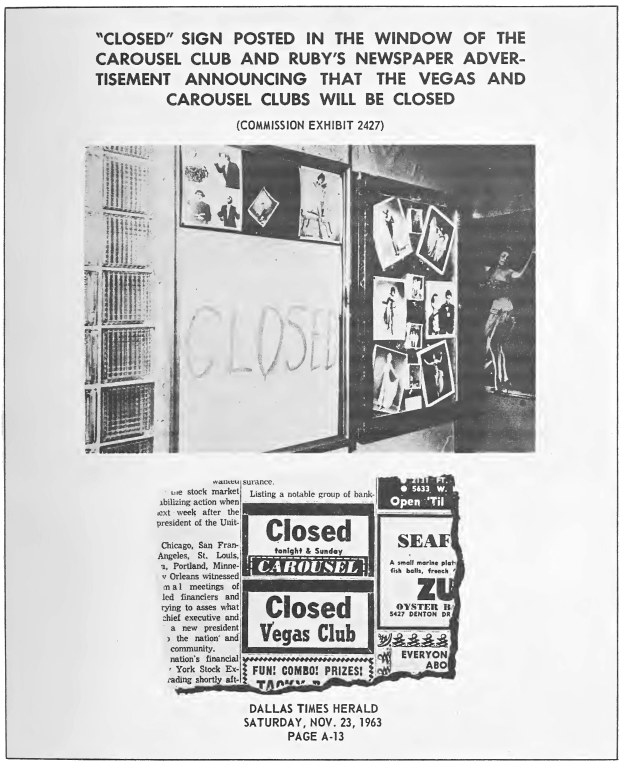
(COMMISSION EXHIBIT 2427)
“CLOSED” SIGN POSTED IN THE WINDOW OF THE CAROUSEL CLUB AND RUBY’S NEWSPAPER ADVERTISEMENT ANNOUNCING THAT THE VEGAS AND CAROUSEL CLUBS WILL BE CLOSED
DALLAS TIMES HERALD SATURDAY, NOV. 23, 1963 PAGE A-13
Ruby related that, after joining in the postservice refreshments,C6-919 he drove by some night clubs, noticing whether or not they had been closed as his were.C6-920 He testified that, as he drove toward town, a radio announcement that the Dallas police were working overtime prompted the thought that he might bring those at police headquarters something to eat.C6-921 At about 10:30 p.m., he stopped at a delicatessen near the Vegas Club and purchased 8 kosher sandwiches and 10 soft drinks.C6-922 From the delicatessen, he called the police department but was told that the officers had already eaten.C6-923 He said he then tried to offer the food to employees at radio station KLIF but failed in several attempts to obtain the private night line number to the station.C6-924 On three occasions between phone calls, Ruby spoke with a group of students whom he did not know, lamenting the President’s death, teasing one of the young men about being too young for his clubs, borrowing their copy of the Dallas Times Herald to see how his advertisements had been run, and stating that his clubs were the only ones that had closed because of the assassination. He also expressed the opinion, as he had earlier in the day, that the assassination would be harmful to the convention business in Dallas.C6-925 Upon leaving the delicatessen with his purchases, Ruby gave the counterman as a tip a card granting free admission to his clubs.C6-926 He drove downtown to the police station where he has said he hoped to find an employee from KLIF who could give him the “hot line” phone number for the radio station.C6-927
The third floor of police headquarters.—Ruby is known to have made his way, by about 11:30 p.m., to the third floor of the Dallas Police Department where reporters were congregated near the homicide bureau.C6-928 Newsman John Rutledge, one of those who may well have been mistaken as to time, gave the following description of his first encounter with Ruby at the police station:
I saw Jack and two out-of-state reporters, whom I did not know, leave the elevator door and proceed toward those television cameras, to go around the corner where Captain Fritz’s office was. Jack walked between them. These two out-of-state reporters had big press cards pinned on their coats, great big red ones, I think they said “President Kennedy’s Visit to Dallas—Press”, or something like that. And Jack didn’t have one, but the man on either side of him did. And they walked pretty rapidly from the elevator area past the policeman, and Jack was bent over like this—writing on a piece of paper, and talking to one of the reporters, and pointing to something on the piece of paper, he was kind of hunched over.C6-929
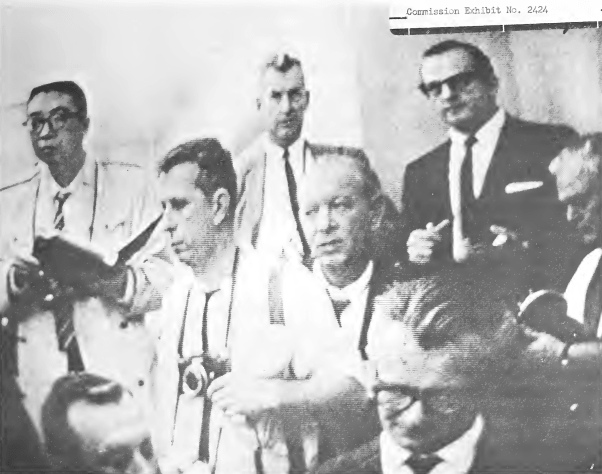
Commission Exhibit No. 2424
Jack Ruby at press conference in basement assembly room about midnight November 22, 1963. (Jack Ruby is the individual in the dark suit, back row, right-hand side, wearing horn-rimmed glasses.)
Detective Augustus M. Eberhardt, who also recalled that he first saw Ruby earlier in the evening, said Ruby carried a note pad and professed to be a translator for the Israeli press. He remembered Ruby’s remarking how unfortunate the assassination was for the city of Dallas and that it was “hard to realize that a complete nothing, a zero like that, could kill a man like President Kennedy * * *.”C6-930
Video tapes confirm Ruby’s statement that he was present on the third floor when Chief Jesse E. Curry and District Attorney Henry M. Wade announced that Oswald would be shown to the newsmen at a press conference in the basement.C6-931 Though he has said his original purpose was only to locate a KLIF employee, Ruby has stated that while at the police station he was “carried away with the excitement of history.”C6-932 He accompanied the newsmen to the basement to observe Oswald. His presence at the midnight news conference is established by television tapes and by at least 12 witnesses.C6-933 When Oswald arrived, Ruby, together with a number of newsmen, was standing atop a table on one side of the room.C6-934 (See Commission Exhibit No. 2424, p. 341.) Oswald was taken from the room after a brief appearance, and Ruby remained to hear reporters question District Attorney Wade. During the press conference, Wade stated that Oswald would probably be moved to the county jail at the beginning of the next week.C6-935 In answer to one question, Wade said that Oswald belonged to the “Free Cuba Committee.” A few reporters spoke up correcting Wade and among the voices was that of Jack Ruby.C6-936
Ruby later followed the district attorney out of the press conference, walked up to him and, according to Wade, said “Hi Henry * * * Don’t you know me? * * * I am Jack Ruby, I run the Vegas Club. * * *”C6-937 Ruby also introduced himself to Justice of the Peace David L. Johnston, shook his hand, gave Johnston a business card to the Carousel Club, and, upon learning Johnston’s official position, shook Johnston’s hand again.C6-938 After talking with Johnston, he gave another card to Icarus M. Pappas, a reporter for New York radio station WNEW.C6-939 From a representative of radio station KBOX in Dallas, Ruby obtained the “hot line” telephone number to KLIF.C6-940 He then called the station and told one of the employees that he would like to come up to distribute the sandwiches and cold drinks he had purchased.C6-941 Observing Pappas holding a telephone line open and attempting to get the attention of District Attorney Wade, Ruby directed Wade to Pappas, who proceeded to interview the district attorney.C6-942 Ruby then called KLIF a second time and offered to secure an interview with Wade; he next summoned Wade to his phone, whereupon KLIF recorded a telephone interview with the district attorney.C6-943 A few minutes later. Ruby encountered Russ Knight, a reporter from KLIF who had left the station for the police department at the beginning of Ruby’s second telephone call. Ruby directed Knight to Wade and waited a short distance away while the reporter conducted another interview with the district attorney.C6-944
At radio station KLIF.—When Ruby left police headquarters, he drove to radio station KLIF, arriving at approximately 1:45 a.m. and remaining for about 45 minutes.C6-945 After first distributing his sandwiches and soft drinks, Ruby settled in the newsroom for the 2 a.m. newscast in which he was credited with suggesting that Russ Knight ask District Attorney Wade whether or not Oswald was sane.C6-946 After the newscast, Ruby gave a Carousel card to one KLIF employee, although another did not recall that Ruby was promoting his club as he normally did.C6-947 When speaking with KLIF’s Danny Patrick McCurdy, Ruby mentioned that he was going to close his clubs for the weekend and that he would rather lose $1,200 or $1,500 than remain open at that time in the Nation’s history. McCurdy remembered that Ruby “looked rather pale to me as he was talking to me and he kept looking at the floor.”C6-948 To announcer Glen Duncan, Ruby expressed satisfaction that the evidence was mounting against Oswald. Duncan said that Ruby did not appear to be grieving but, instead, seemed pleased about the personal contact he had had with the investigation earlier in the evening.C6-949
Ruby left the radio station accompanied by Russ Knight. Engaging Knight in a short conversation, Ruby handed him a radio script entitled “Heroism” from a conservative radio program called “Life Line.” It was apparently one of the scripts that had come into Ruby’s hands a few weeks before at the Texas Products Show when Hunt Foods were including such scripts with samples of their products.C6-950 The script extolled the virtues of those who embark upon risky business ventures and stand firmly for causes they believe to be correct.C6-951 Ruby asked Knight’s views on the script and suggested that there was a group of “radicals” in Dallas which hated President Kennedy and that the owner of the radio station should editorialize against this group. Knight could not clearly determine whether Ruby had reference to persons who sponsored programs like “Life Line” or to those who held leftwing views.C6-952 Knight gained the impression that Ruby believed such persons, whoever they might be, were partially responsible for the assassination.C6-953
Early morning of November 23.—At about 2:30 a.m., Ruby entered his automobile and departed for the Dallas Times-Herald Building. En route, he stopped for about an hour to speak with Kay Helen Coleman, one of his dancers, and Harry Olsen, a member of the Dallas Police Department, who had hailed him from a parking garage at the corner of Jackson and Field Streets. The couple were crying and extremely upset over the assassination. At one point, according to Ruby, the police officer remarked that “they should cut this guy [Oswald] inch by inch into ribbons,” and the dancer said that “in England they would drag him through the streets and would have hung him.”C6-954 Although Ruby failed to mention this episode during his first two FBI interviews,C6-955 he later explained that his reason for failing to do so was that he did not “want to involve them in anything, because it was supposed to be a secret that he [the police officer] was going with this young lady.”C6-956 About 6 weeks after the assassination, Olsen left the Dallas Police Department and married Miss Coleman. Both Olsen and his wife testified that they were greatly upset during their lengthy conversation with Ruby early Saturday morning; but Mrs. Olsen denied and Olsen did not recall the remarks ascribed to them.C6-957 The Olsens claimed instead that Ruby had cursed Oswald.C6-958 Mrs. Olsen also mentioned that Ruby expressed sympathy for Mrs. Kennedy and her children.C6-959
From Jackson and Field Streets, Ruby drove to the Dallas Times-Herald, where he talked for about 15 minutes with composing room employee Roy Pryor, who had just finished a shift at 4 a.m. Ruby mentioned that he had seen Oswald earlier in the night, that he had corrected Henry Wade in connection with the Fair Play for Cuba Committee, and that he had set up a telephone interview with Wade. Pryor testified that Ruby explicitly stated to him that he believed he was in good favor with the district attorney.C6-960 Recalling that Ruby described Oswald as a “little weasel of a guy” and was emotionally concerned about the President’s wife and children, Pryor also was impressed by Ruby’s sorrowful mood and remembered that, as he talked, Ruby shook a newspaper to emphasize his concern over the assassination.C6-961
When Pryor left the composing room, Ruby remained and continued speaking with other employees, including Arthur Watherwax and the foreman, Clyde Gadash. Ruby, who often visited the Times-Herald at that early morning hour in connection with his ads, sought Watherwax’s views on his decision to close his clubs and indicated he was going to attempt to persuade other club owners to do likewise. Watherwax described Ruby as “pretty shaken up” about the assassination and at the same time “excited” that he had attended Oswald’s Friday night press conference.C6-962
While at the Times-Herald, Ruby displayed to the composing room employees a “twistboard” he had previously promised to Gadash.C6-963 The twistboard was an exercising device consisting of two pieces of hardened materials joined together by a lazy susan bearing so that one piece could remain stationary on the floor while a person stood atop it and swiveled to and fro.C6-964 Ruby had been trying to promote sales of the board in the weeks before President Kennedy was killed.C6-965 Considerable merriment developed when one of the women employees at the Times-Herald demonstrated the board, and Ruby himself, put on a demonstration for those assembled.C6-966 He later testified: “* * * not that I wanted to get in with the hilarity of frolicking, but he [Gadash] asked me to show him, and the other men gathered around.”C6-967 Gadash agreed that Ruby’s general mood was one of sorrow.C6-968
At about 4:30 a.m., Ruby drove from the Dallas Times-Herald to his apartment where he awakened his roommate George Senator.C6-969 During his visit in the composing room Ruby had expressed the view that the Weissman advertisement was an effort to discredit the Jews.C6-970 Senator testified that when Ruby returned to the apartment, he began to discuss the Weissman advertisement and also a signboard he had seen in Dallas urging that Chief Justice Earl Warren be impeached.C6-971 Shortly thereafter, Ruby telephoned Larry Crafard at the Carousel Club.C6-972 He told Crafard to meet him and Senator at the Nichols Garage adjacent to the Carousel Club and to bring a Polaroid camera kept in the club.C6-973 After Crafard joined Ruby and Senator, the three men drove to the “Impeach Earl Warren” sign near Hall Avenue and Central Expressway in Dallas. There Ruby instructed Crafard to take three photographs of the billboard. Believing that the sign and the Weissman newspaper ad might somehow be connected, Ruby noted on the back of an envelope a name and post office box number that appeared on the sign.C6-974 According to George Senator:
* * * when he was looking at the sign and taking pictures of it, and the newspaper ad, * * * this is where he really wanted to know the whys or why these things had to be out. He is trying to combine these two together, which I did hear him say, “This is the work of the John Birch Society or the Communist Party or maybe a combination of both.”C6-975
Pursuing a possible connection between the billboard and the newspaper advertisement, Ruby drove to the post office and asked a postal employee for the name of the man who had rented the box indicated on the billboard, but the employee said that he could not provide such information. Ruby inspected the box, however, and was upset to find it stuffed with mail.C6-976 The three men then drove to a coffeeshop where Ruby continued to discuss the two advertisements. After about 30 minutes, they left the coffeeshop. Crafard was taken to the Carousel Club; Ruby and Senator returned to their apartment,C6-977 and Ruby retired at about 6 a.m.C6-978
The morning and afternoon of November 23.—At 8 or 8:30 a.m. Crafard, who had been asked to feed Ruby’s dogs, telephoned Ruby at his apartment to inquire about food for the animals.C6-979 Ruby forgot that he had told Crafard he did not plan to go to bed and reprimanded Crafard for waking him.C6-980 A few hours thereafter Crafard assembled his few belongings, took from the Carousel cash register $5 of money due him from Ruby, left a receipt and thank-you note, and began hitchhiking to Michigan. Later that day, Andrew Armstrong found the note and telephoned Ruby.C6-981
Ruby apparently did not return to bed following Crafard’s call. During the morning hours, he watched a rabbi deliver on television a moving eulogy of President Kennedy.C6-982 According to Ruby, the rabbi:
went ahead and eulogized that here is a man that fought in every battle, went to every country, and had to come back to his own country to be shot in the back [starts crying] * * *. That created a tremendous emotional feeling for me, the way he said that. Prior to all the other times, I was carried away.C6-983
An employee from the Carousel Club who telephoned Ruby during the morning remembered that his “voice was shaking” when he spoke of the assassination.C6-984
Ruby has stated that, upon leaving his apartment some time between noon and 1:30 p.m., he drove to Dealey Plaza where a police officer, who noted Ruby’s solemnity, pointed out to him the window from which the rifleshots had been fired the day before.C6-985 Ruby related that he inspected the wreaths that had been placed in memory of the President and became filled with emotion while speaking with the police officer.C6-986 Ruby introduced himself to a reporter for radio station KRLD who was working inside a mobile news unit at the plaza; the newsman mentioned to Ruby that he had heard of Ruby’s help to KLIF in obtaining an interview with Henry Wade, and Ruby pointed out to the reporter that Capt. J. Will Fritz and Chief Curry were then in the vicinity. Thereafter, the newsman interviewed and photographed the officers.C6-987 Ruby said that he next drove home and returned downtown to Sol’s Turf Bar on Commerce Street.C6-988
The evidence indicated, however, that sometime after leaving Dealey Plaza, Ruby went to the Nichols Parking Garage adjacent to the Carousel Club, where he was seen by Garnett C. Hallmark, general manager of the garage, and Tom Brown, an attendant. Brown believed that at about 1:30 p.m. he heard Ruby mention Chief Curry’s name in a telephone conversation from the garage. Brown also recalled that, before finally departing, Ruby asked him to inform acquaintances whom he expected to stop by the garage that the Carousel would be closed.C6-989 Hallmark testified that Ruby drove into the garage at about 3 p.m., walked to the telephone, inquired whether or not a competing burlesque club would be closed that night, and told Hallmark that he (Ruby) was “acting like a reporter.”C6-990 Hallmark then heard Ruby address someone at the other end of the telephone as “Ken” and caught portions of a conversation concerning the transfer of Oswald.C6-991 Hallmark said Ruby never called Oswald by name but used the pronoun “he” and remarked to the recipient of the call, “you know I’ll be there.”C6-992
Ken Dowe, a KLIF announcer, to whom Ruby made at least two telephone calls within a short span of time Saturday afternoon, confirmed that he was probably the person to whom Hallmark and Brown overheard Ruby speaking. In one call to Dowe, Ruby asked whether the station knew when Oswald would be moved; and, in another, he stated he was going to attempt to locate Henry Wade.C6-993 After Ruby finished his calls, he walked onto Commerce Street, passed the Carousel Club, and returned a few minutes later to get his car.C6-994
Ruby’s comment that he was “acting like a reporter” and that he would be at the Oswald transfer suggests that Ruby may have spent part of Saturday afternoon shuttling back and forth from the Police and Courts Building to Dealey Plaza. Such activity would explain the fact that Tom Brown at the Nichols Garage believed he saw Ruby at 1:30 p.m. while Garnett Hallmark placed Ruby at the garage at 3 p.m. It would also explain Ken Dowe’s receiving two phone calls from Ruby. The testimony of five news reporters supports the possibility that Ruby was at the Police and Courts Building Saturday afternoon.C6-995 One stated that Ruby provided sandwiches for newsmen on duty there Saturday afternoon, although no news representative has mentioned personally receiving such sandwiches.C6-996 Another testified that he received a card to the Carousel Club from Ruby about 4 p.m. that day at the police station.C6-997 A third believed he saw Ruby enter an office in which Henry Wade was working, but no one else reported a similar event.C6-998 The remaining two witnesses mentioned no specific activities.C6-999 None of the persons who believed they saw Ruby at the police department on Saturday had known him previously, and no police officer has reported Ruby’s presence on that day. Ruby has not mentioned such a visit. The Commission, therefore, reached no firm conclusion as to whether or not Ruby visited the Dallas Police Department on Saturday.
Shortly after 3 p.m. Ruby went to Sol’s Turf Bar on Commerce Street where he remained for about 45 minutes. Ruby, a nondrinker, stated that he visited Sol’s for the purpose of talking with his accountant, who customarily prepared the bar’s payroll on Saturday afternoon. The accountant testified, however, that he saw Ruby only briefly and mentioned no business conversation with Ruby.C6-1000 Ruby was first noticed at the Turf Bar by jeweler Frank Bellochio, who, after seeing Ruby, began to berate the people of Dallas for the assassination.C6-1001 Ruby disagreed and, when Bellochio said he might close his jewelry business and leave Dallas, Ruby attempted to calm him, saying that there were many good citizens in Dallas.C6-1002 In response, Bellochio pointed to a copy of the Bernard Weissman advertisement.C6-1003 To Bellochio’s bewilderment, Ruby then said he believed that the advertisement was the work of a group attempting to create anti-Semitic feelings in Dallas and that he had learned from the Dallas Morning News that the ad had been paid for partly in cash.C6-1004 Ruby thereupon produced one of the photographs he had taken Saturday morning of the “Impeach Earl Warren” sign and excitedly began to rail against the sign as if he agreed with Bellochio’s original criticism of Dallas.C6-1005 He “seemed to be taking two sides—he wasn’t coherent,” Bellochio testified.C6-1006 When Bellochio saw Ruby’s photographs, which Bellochio thought supported his argument against Dallas, he walked to the front of the bar and showed them to Tom Apple, with whom he had been previously arguing. In Apple’s presence, Bellochio asked Ruby for one of the pictures but Ruby refused, mentioning that he regarded the pictures as a scoop.C6-1007 Bellochio testified: “I spoke to Tom and said a few more words to Tom, and Ruby was gone—never said ‘Goodbye’ or ‘I’ll be seeing you.’”C6-1008
Ruby may have left in order to telephone Stanley Kaufman, a friend and attorney who had represented him in civil matters.C6-1009 Kaufman testified that, at approximately 4 p.m., Ruby called him about the Bernard Weissman advertisement. According to Kaufman, “Jack was particularly impressed with the [black] border as being a tipoff of some sort—that this man knew the President was going to be assassinated * * *.”C6-1010 Ruby told Kaufman that he had tried to locate Weissman by going to the post office and said that he was attempting to be helpful to law enforcement authorities.C6-1011
Considerable confusion exists as to the place from which Ruby placed the call to Kaufman and as to his activities after leaving Sol’s Turf Bar. Eva Grant stated that the call was made from her apartment about 4 p.m.C6-1012 Ruby, however, believed it was made from the Turf Bar. He stated that from the Turf Bar he went to the Carousel and then home and has not provided additional details on his activities during the hours from about 4 to 9:30 p.m.C6-1013 Robert Larkin saw him downtown at about 6 p.m.C6-1014 and Andrew Armstrong testified that Ruby visited the Carousel Club between 6 and 7 p.m. and remained about an hour.C6-1015
At Eva Grant’s apartment Saturday evening.—Eva Grant believed that, for most of the period from 4 until 8 p.m., Ruby was at her apartment. Mrs. Grant testified that her brother was still disturbed about the Weissman advertisement when he arrived, showed her the photograph of the Warren sign, and recounted his argument with Bellochio about the city of Dallas. Still curious as to whether or not Weissman was Jewish, Mrs. Grant asked her brother whether he had been able to find the name Bernard Weissman in the Dallas city directory, and Ruby said he had not. Their doubts about Weissman’s existence having been confirmed, both began to speculate that the Weissman ad and the Warren sign were the work of either “Commies or the Birchers,” and were designed to discredit the Jews.C6-1016 Apparently in the midst of that conversation Ruby telephoned Russ Knight at KLIF and, according to Knight, asked who Earl Warren was.C6-1017
Mrs. Grant has testified that Ruby eventually retired to her bedroom where he made telephone calls and slept.C6-1018 About 8:30 p.m., Ruby telephoned to Thomas J. O’Grady, a friend and former Dallas police officer who had once worked for Ruby as a bouncer. To O’Grady, Ruby mentioned closing the Carousel Club, criticized his competitors for remaining open, and complained about the “Impeach Earl Warren” sign.C6-1019
Saturday evening at Ruby’s apartment.—By 9:30 p.m., Ruby had apparently returned to his apartment where he received a telephone call from one of his striptease dancers, Karen Bennett Carlin, who, together with her husband, had been driven from Fort Worth to Dallas that evening by another dancer, Nancy Powell.C6-1020 All three had stopped at the Colony Club, a burlesque nightclub which competed with the Carousel.C6-1021 Mrs. Carlin testified that, in need of money, she telephoned Ruby, asked whether the Carousel would be open that night, and requested part of her salary.C6-1022 According to Mrs. Carlin, Ruby became angry at the suggestion that the Carousel Club might be open for business but told her he would come to the Carousel in about an hour.C6-1023
Thereafter, in a depressed mood, Ruby telephoned his sister Eva Grant, who suggested he visit a friend.C6-1024 Possibly in response to that suggestion, Ruby called Lawrence Meyers, a friend from Chicago with whom he had visited two nights previously.C6-1025 Meyers testified that, during their telephone conversation, Ruby asked him what he thought of this “terrible thing,” Ruby then began to criticize his competitors, Abe and Barney Weinstein, for failing to close their clubs on Saturday night. In the course of his conversation about the Weinsteins and the assassination, Ruby said “I’ve got to do something about this.”C6-1026 Meyers initially understood that remark to refer to the Weinsteins. Upon reflection after Oswald was shot, Meyers was uncertain whether Ruby was referring to his competitors, or to the assassination of President Kennedy; for Ruby had also spoken at length about Mrs. Kennedy and had repeated “those poor people, those poor people.”C6-1027 At the conclusion of their conversation, Meyers declined Ruby’s invitation to join him for a cup of coffee but invited Ruby to join him at the motel. When Ruby also declined, the two agreed to meet for dinner the following evening.C6-1028
Meanwhile, Karen Carlin and her husband grew anxious over Ruby’s failure to appear with the money they had requested.C6-1029 After a substantial wait, they returned together to the Nichols Garage where Mr. Carlin telephoned to Ruby.C6-1030 Carlin testified that he told Ruby they needed money in order to return to Fort WorthC6-1031 although Nancy Powell testified that she drove the Carlins home that evening.C6-1032 Agreeing to advance a small sum, Ruby asked to speak to Mrs. Carlin, who claimed that Ruby told her that if she needed more money she should call him on Sunday.C6-1033 Thereafter, at Ruby’s request, garage attendant Huey Reeves gave Mrs. Carlin $5, and she signed with her stage name “Little Lynn” a receipt which Reeves time-stamped 10:33 p.m., November 23.C6-1034 (See Commission Exhibit No. 1476, p. 351.)
Inconsistent testimony was developed regarding Ruby’s activities during the next 45 minutes. Eva Grant testified that she did not see her brother on Saturday night after 8 p.m. and has denied calling Ralph Paul herself that night.C6-1035 Nonetheless, telephone company records revealed that at 10:44 p.m. a call was made to Ralph Paul’s Bull Pen Drive-In in Arlington, Tex., from Mrs. Grant’s apartment.C6-1036 It was the only call to Paul from her apartment on Friday or Saturday;C6-1037 she recalled her brother making such a call that weekend;C6-1038 and Ralph Paul has testified that Ruby telephoned him Saturday night from Eva Grant’s apartment and said he and his sister were there crying.C6-1039
Nineteen-year-old Wanda Helmick, a former waitress at the Bull Pen Drive-In, first reported in June, 1964 that some time during the evening she saw the cashier answer the Bull Pan’s pay telephone and heard her call out to Paul, “It is for you. It is Jack.”C6-1040 Mrs. Helmick claimed she overheard Paul, speaking on the telephone, mention something about a gun which, she understood from Paul’s conversation, the caller had in his possession. She said she also heard Paul exclaim “Are you crazy?”C6-1041 She provided no other details of the conversation. Mrs. Helmick claimed that on Sunday, November 24, after Oswald had been shot, she heard Paul repeat the substance of the call to other employees as she had related it and that Paul said Ruby was the caller.C6-1042 Ralph Paul denied the allegations of Mrs. Helmick.C6-1043 Both Paul and Mrs. Helmick agreed that Paul went home soon after the call, apparently about 11 p.m.C6-1044
Shortly after 11 p.m., Ruby arrived at the Nichols Garage where he repaid Huey Reeves and obtained the receipt Mrs. Carlin had signed.C6-1045 Outside the Carousel, Ruby exchanged greetings with Police Officer Harry Olsen and Kay Coleman, whom he had seen late the previous night.C6-1046 Going upstairs to the club, Ruby made a series of five brief long-distance phone calls, the first being to the Bull Pen Drive-In at 11:18 p.m. and lasting only 1 minute.C6-1047 Apparently unable to reach Paul there, Ruby telephoned Paul’s home in Arlington, Tex., for 3 minutes.C6-1048 A third call was placed at 11:36 p.m. for 2 minutes, again to Paul’s home.C6-1049 At 11:44 p.m. Ruby telephoned Breck Wall, a friend and entertainer who had gone to Galveston, Tex., when his show in Dallas suspended its performance out of respect to President Kennedy. The call lasted 2 minutes.C6-1050 Thereafter, Ruby immediately placed a 1-minute phone call to Paul’s home.C6-1051
Although Ruby has mentioned those calls, he has not provided details to the Commission; however, he has denied ever indicating to Paul or Wall that he was going to shoot Oswald and has said he did not consider such action until Sunday morning.C6-1052 Ralph Paul did not mention the late evening calls in his interview with FBI agents on November 24, 1963.C6-1053 Later Paul testified that Ruby called him from downtown to say that nobody was doing any business.C6-1054 Breck Wall testified that Ruby called him to determine whether or not the American Guild of Variety Artists (AGVA), which represented striptease dancers in Dallas, had met concerning a dispute Ruby was having with the union.C6-1055 Ruby’s major difference with AGVA during the preceding 2 weeks had involved what Ruby considered to be AGVA’s failure to enforce against his 2 competitors, Abe and Barney Weinstein, AGVA’s ban on “striptease contests” and performances by “amateurs.”C6-1056 As recently as Wednesday, November 20, Ruby had telephoned an AGVA representative in Chicago about that complaint and earlier in November he had unsuccessfully sought to obtain assistance from a San Francisco gambler and a Chicagoan reputed for his heavyhanded union activities.C6-1057 Wall testified that Ruby “was very upset the President was assassinated and he called Abe Weinstein or Bernie Weinstein * * * some names for staying open * * *.” Wall added, “he was very upset * * * that they did not have the decency to close on such a day and he thought out of respect they should close.”C6-1058
Ruby’s activities after midnight.—After completing the series of calls to Paul and Wall at 11:48 p.m., Ruby went to the Pago Club, about a 10-minute drive from the Carousel Club.C6-1059 He took a table near the middle of the club and, after ordering a Coke, asked the waitress in a disapproving tone, “Why are you open?”C6-1060 When Robert Norton, the club’s manager, joined Ruby a few minutes later he expressed to Ruby his concern as to whether or not it was proper to operate the Pago Club that evening. Ruby indicated that the Carousel was closed but did not criticize Norton for remaining open.C6-1061 Norton raised the topic of President Kennedy’s death and said, “[W]e couldn’t do enough to the person that [did] this sort of thing.” Norton added, however, that “Nobody has the right to take the life of another one.”C6-1062 Ruby expressed no strong opinion, and closed the conversation by saying he was going home because he was tired.C6-1063 Later, Ruby told the Commission: “he knew something was wrong with me in the certain mood I was in.”C6-1064
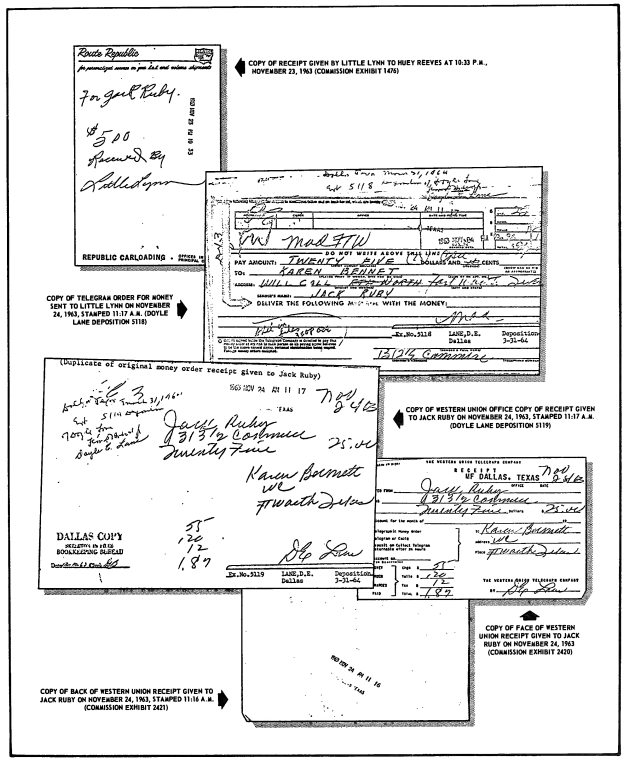
(COMMISSION EXHIBIT 1476) COPY OF RECEIPT GIVEN BY LITTLE LYNN TO HUEY REEVES AT 10:33 P.M., NOVEMBER 23, 1963
(DOYLE LANE DEPOSITION 5118) COPY OF TELEGRAM ORDER FOR MONEY SENT TO LITTLE LYNN ON NOVEMBER 24, 1963, STAMPED 11:17 A.M.
(DOYLE LANE DEPOSITION 5119) COPY OF WESTERN UNION OFFICE COPY OF RECEIPT GIVEN TO JACK RUBY ON NOVEMBER 24, 1963, STAMPED 11:17 A.M.