Chapter III · The Shots From the Texas School Book Depository (continued 2)
Reading edition
The physical and other evidence examined by the Commission compels the conclusion that at least two shots were fired. As discussed previously, the nearly whole bullet discovered at Parkland Hospital and the two larger fragments found in the Presidential automobile, which were identified as coming from the assassination rifle, came from at least two separate bullets and possibly from three.C3-336 The most convincing evidence relating to the number of shots was provided by the presence on the sixth floor of three spent cartridges which were demonstrated to have been fired by the same rifle that fired the bullets which caused the wounds. It is possible that the assassin carried an empty shell in the rifle and fired only two shots, with the witnesses hearing multiple noises made by the same shot. Soon after the three empty cartridges were found, officials at the scene decided that three shots were fired, and that conclusion was widely circulated by the press. The eyewitness testimony may be subconsciously colored by the extensive publicity given the conclusion that three shots were fired. Nevertheless, the preponderance of the evidence, in particular the three spent cartridges, led the Commission to conclude that there were three shots fired.
THE SHOT THAT MISSED
From the initial findings that (a) one shot passed through the President’s neck and then most probably passed through the Governor’s body, (b) a subsequent shot penetrated the President’s head, (c) no other shot struck any part of the automobile, and (d) three shots were fired, it follows that one shot probably missed the car and its occupants. The evidence is inconclusive as to whether it was the first, second, or third shot which missed.
The First Shot
If the first shot missed, the assassin perhaps missed in an effort to fire a hurried shot before the President passed under the oak tree, or possibly he fired as the President passed under the tree and the tree obstructed his view. The bullet might have struck a portion of the tree and been completely deflected. On the other hand, the greatest cause for doubt that the first shot missed is the improbability that the same marksman who twice hit a moving target would be so inaccurate on the first and closest of his shots as to miss completely, not only the target, but the large automobile.
Some support for the contention that the first shot missed is found in the statement of Secret Service Agent Glen A. Bennett, stationed in the right rear seat of the President’s followup car, who heard a sound like a firecracker as the motorcade proceeded down Elm Street. At that moment, Agent Bennett stated:
* * * I looked at the back of the President. I heard another firecracker noise and saw that shot hit the President about four inches down from the right shoulder. A second shot followed immediately and hit the right rear high of the President’s head.C3-337
Substantial weight may be given Bennett’s observations. Although his formal statement was dated November 23, 1963, his notes indicate that he recorded what he saw and heard at 5:30 p.m., November 22, 1963, on the airplane en route back to Washington, prior to the autopsy, when it was not yet known that the President had been hit in the back.C3-338 It is possible, of course, that Bennett did not observe the hole in the President’s back, which might have been there immediately after the first noise.
Governor Connally’s testimony supports the view that the first shot missed, because he stated that he heard a shot, turned slightly to his right, and, as he started to turn back toward his left, was struck by the second bullet.C3-339 He never saw the President during the shooting sequence, and it is entirely possible that he heard the missed shot and that both men were struck by the second bullet. Mrs. Connally testified that after the first shot she turned and saw the President’s hands moving toward his throat, as seen in the films at frame 225.C3-340 However, Mrs. Connally further stated that she thought her husband was hit immediately thereafter by the second bullet.C3-341 If the same bullet struck both the President and the Governor, it is entirely possible that she saw the President’s movements at the same time as she heard the second shot. Her testimony, therefore, does not preclude the possibility of the first shot having missed.
Other eyewitness testimony, however, supports the conclusion that the first of the shots fired hit the President. As discussed in chapter II, Special Agent Hill’s testimony indicates that the President was hit by the first shot and that the head injury was caused by a second shot which followed about 5 seconds later. James W. Altgens, a photographer in Dallas for the Associated Press, had stationed himself on Elm Street opposite the Depository to take pictures of the passing motorcade. Altgens took a widely circulated photograph which showed President Kennedy reacting to the first of the two shots which hit him. (See Commission Exhibit No. 900, p. 113.) According to Altgens, he snapped the picture “almost simultaneously” with a shot which he is confident was the first one fired.C3-342 Comparison of his photograph with the Zapruder film, however, revealed that Altgens took his picture at approximately the same moment as frame 255 of the movie, 30 to 45 frames (approximately 2 seconds) later than the point at which the President was shot in the neck.C3-343 (See Commission Exhibit No. 901, p. 114.) Another photographer, Phillip L. Willis, snapped a picture at a time which he also asserts was simultaneous with the first shot. Analysis of his photograph revealed that it was taken at approximately frame 210 of the Zapruder film, which was the approximate time of the shot that probably hit the President and the Governor. If Willis accurately recalled that there were no previous shots, this would be strong evidence that the first shot did not miss.C3-344
If the first shot did not miss, there must be an explanation for Governor Connally’s recollection that he was not hit by it. There was, conceivably, a delayed reaction between the time the bullet struck him and the time he realized that he was hit, despite the fact that the bullet struck a glancing blow to a rib and penetrated his wrist bone. The Governor did not even know that he had been struck in the wrist or in the thigh until he regained consciousness in the hospital the next day. Moreover, he testified that he did not hear what he thought was the second shot, although he did hear a subsequent shot which coincided with the shattering of the President’s head.C3-345 One possibility, therefore, would be a sequence in which the Governor heard the first shot, did not immediately feel the penetration of the bullet, then felt the delayed reaction of the impact on his back, later heard the shot which shattered the President’s head, and then lost consciousness without hearing a third shot which might have occurred later.
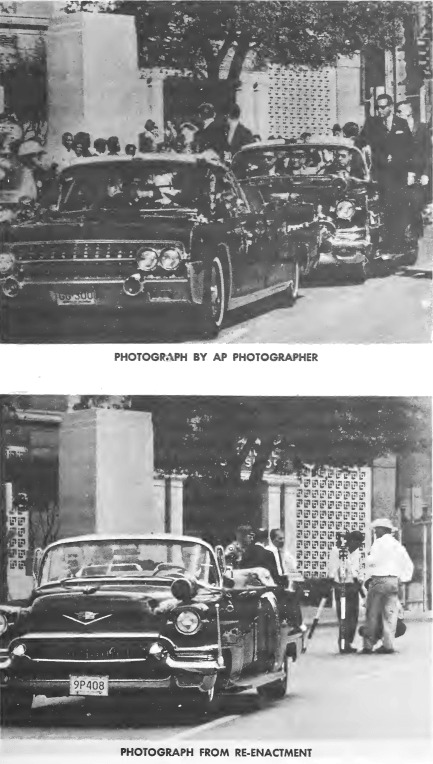
Commission Exhibit No. 900
PHOTOGRAPH BY AP PHOTOGRAPHER
PHOTOGRAPH FROM RE-ENACTMENT
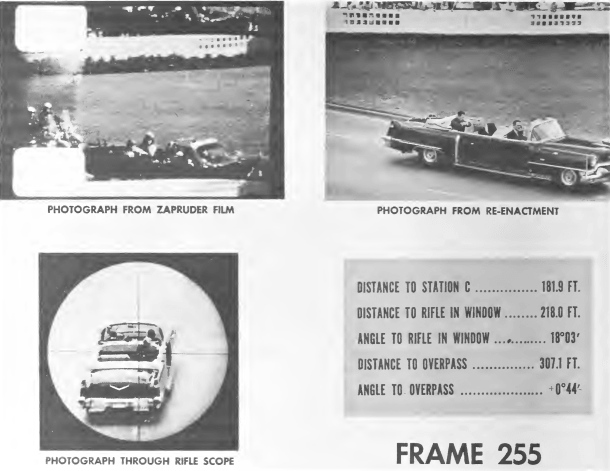
Commission Exhibit No. 901
PHOTOGRAPH FROM ZAPRUDER FILM
PHOTOGRAPH FROM RE-ENACTMENT
PHOTOGRAPH THROUGH RIFLE SCOPE
FRAME 255
The Second Shot
The possibility that the second shot missed is consistent with the elapsed time between the two shots that hit their mark. From the timing evidenced by the Zapruder films, there was an interval of from 4.8 to 5.6 seconds between the shot which struck President Kennedy’s neck (between frames 210 to 225) and the shot which struck his head at frame 313.C3-346 Since a minimum of 2.3 seconds must elapse between shots, a bullet could have been fired from the rifle and missed during this interval.C3-347 This possibility was buttressed by the testimony of witnesses who claimed that the shots were evenly spaced, since a second shot occurring within an interval of approximately 5 seconds would have to be almost exactly midway in this period. If Altgens’ recollection is correct that he snapped his picture at the same moment as he heard a shot, then it is possible that he heard a second shot which missed, since a shot fired 2.3 seconds before he took his picture at frame 255 could have hit the President at about frame 213.
On the other hand, a substantial majority of the witnesses stated that the shots were not evenly spaced. Most witnesses recalled that the second and third shots were bunched together, although some believed that it was the first and second which were bunched.C3-348 To the extent that reliance can be placed on recollection of witnesses as to the spacing of the shots, the testimony that the shots were not evenly spaced would militate against a second shot missing. Another factor arguing against the second shot missing is that the gunman would have been shooting at very near the minimum allowable time to have fired the three shots within 4.8 to 5.6 seconds, although it was entirely possible for him to have done so. (See ch. IV, pp. 188-194.)
The Third Shot
The last possibility, of course, is that it was the third shot which missed. This conclusion conforms most easily with the probability that the assassin would most likely have missed the farthest shot, particularly since there was an acceleration of the automobile after the shot which struck the President’s head. The limousine also changed direction by following the curve to the right, whereas previously it had been proceeding in almost a straight line with a rifle protruding from the sixth-floor window of the Depository Building.
One must consider, however, the testimony of the witnesses who described the head shot as the concluding event in the assassination sequence. Illustrative is the testimony of Associated Press photographer Altgens, who had an excellent vantage point near the President’s car. He recalled that the shot which hit the President’s head “was the last shot—that much I will say with a great degree of certainty.”C3-349 On the other hand, Emmett J. Hudson, the groundskeeper of Dealey Plaza, testified that from his position on Elm Street, midway between Houston Street and the Triple Underpass, he heard a third shot after the shot which hit the President in the head.C3-350 In addition, Mrs. Kennedy’s testimony indicated that neither the first nor the second shot missed. Immediately after the first noise she turned, because of the Governor’s yell, and saw her husband raise his hand to his forehead. Then the second shot struck the President’s head.C3-351
Some evidence suggested that a third shot may have entirely missed and hit the turf or street by the Triple Underpass. Royce G. Skelton, who watched the motorcade from the railroad bridge, testified that after two shots “the car came on down close to the Triple Underpass” and an additional shot “hit in the left front of the President’s car on the cement.”C3-352 Skelton thought that there had been a total of four shots, either the third or fourth of which hit in the vicinity of the underpass.C3-353 Dallas Patrolman J. W. Foster, who was also on the Triple Underpass, testified that a shot hit the turf near a manhole cover in the vicinity of the underpass.C3-354 Examination of this area, however, disclosed no indication that a bullet struck at the locations indicated by Skelton or Foster.C3-355
At a different location in Dealey Plaza, the evidence indicated that a bullet fragment did hit the street. James T. Tague, who got out of his car to watch the motorcade from a position between Commerce and Main Streets near the Triple Underpass, was hit on the cheek by an object during the shooting.C3-356 Within a few minutes Tague reported this to Deputy Sheriff Eddy R. Walthers, who was examining the area to see if any bullets had struck the turf.C3-357 Walthers immediately started to search where Tague had been standing and located a place on the south curb of Main Street where it appeared a bullet had hit the cement.C3-358 According to Tague, “There was a mark quite obviously that was a bullet, and it was very fresh.”C3-359 In Tague’s opinion, it was the second shot which caused the mark, since he thinks he heard the third shot after he was hit in the face.C3-360 This incident appears to have been recorded in the contemporaneous report of Dallas Patrolman L. L. Hill, who radioed in around 12:40 p.m.: “I have one guy that was possibly hit by a richochet from the bullet off the concrete.”C3-361 Scientific examination of the mark on the south curb of Main Street by FBI experts disclosed metal smears which, “were spectrographically determined to be essentially lead with a trace of antimony.”C3-362 The mark on the curb could have originated from the lead core of a bullet but the absence of copper precluded “the possibility that the mark on the curbing section was made by an unmutilated military full metal-jacketed bullet such as the bullet from Governor Connally’s stretcher.”C3-363
It is true that the noise of a subsequent shot might have been drowned out by the siren on the Secret Service followup car immediately after the head shot, or the dramatic effect of the head shot might have caused so much confusion that the memory of subsequent events was blurred. Nevertheless, the preponderance of the eyewitness testimony that the head shot was the final shot must be weighed in any determination as to whether it was the third shot that missed. Even if it were caused by a bullet fragment, the mark on the south curb of Main Street cannot be identified conclusively with any of the three shots fired. Under the circumstances it might have come from the bullet which hit the President’s head, or it might have been a product of the fragmentation of the missed shot upon hitting some other object in the area.C3-364 Since he did not observe any of the shots striking the President, Tague’s testimony that the second shot, rather than the third, caused the scratch on his cheek, does not assist in limiting the possibilities.
The wide range of possibilities and the existence of conflicting testimony, when coupled with the impossibility of scientific verification, precludes a conclusive finding by the Commission as to which shot missed.
TIME SPAN OF SHOTS
Witnesses at the assassination scene said that the shots were fired within a few seconds, with the general estimate being 5 to 6 seconds.C3-365 That approximation was most probably based on the earlier publicized reports that the first shot struck the President in the neck, the second wounded the Governor and the third shattered the President’s head, with the time span from the neck to the head shots on the President being approximately 5 seconds. As previously indicated, the time span between the shot entering the back of the President’s neck and the bullet which shattered his skull was 4.8 to 5.6 seconds. If the second shot missed, then 4.8 to 5.6 seconds was the total time span of the shots. If either the first or third shots missed, then a minimum of 2.3 seconds (necessary to operate the rifle) must be added to the time span of the shots which hit, giving a minimum time of 7.1 to 7.9 seconds for the three shots. If more than 2.3 seconds elapsed between a shot that missed and one that hit, then the time span would be correspondingly increased.
CONCLUSION
Based on the evidence analyzed in this chapter, the Commission has concluded that the shots which killed President Kennedy and wounded Governor Connally were fired from the sixth-floor window at the southeast corner of the Texas School Book Depository Building. Two bullets probably caused all the wounds suffered by President Kennedy and Governor Connally. Since the preponderance of the evidence indicated that three shots were fired, the Commission concluded that one shot probably missed the Presidential limousine and its occupants, and that the three shots were fired in a time period ranging from approximately 4.8 to in excess of 7 seconds.