Chapter VI · Investigation of Possible Conspiracy (continued 4)
Reading edition
(COMMISSION EXHIBIT 2420) COPY OF FACE OF WESTERN UNION RECEIPT GIVEN TO JACK RUBY ON NOVEMBER 24, 1963
(COMMISSION EXHIBIT 2421) COPY OF BACK OF WESTERN UNION RECEIPT GIVEN TO JACK RUBY ON NOVEMBER 24, 1963, STAMPED 11:16 A.M.
Ruby testified that he went home after speaking with Norton and went to bed about 1:30 a.m.C6-1065 By that time, George Senator claimed, he had retired for the night and did not remember Ruby’s return.C6-1066 Eva Grant testified that her brother telephoned her at about 12:45 a.m. to learn how she was feeling.C6-1067
Sunday morning.—Ruby’s activities on Sunday morning are the subject of conflicting testimony. George Senator believed that Ruby did not rise until 9 or 9:30 a.m.;C6-1068 both Ruby and Senator maintained that Ruby did not leave their apartment until shortly before 11:00 a.m., and two other witnesses have provided testimony which supports that account of Ruby’s whereabouts.C6-1069 On the other hand, three WBAP-TV television technicians—Warren Richey, John Smith, and Ira Walker—believed they saw Ruby near the Police and Courts Building at various times between 8 a.m. and 11 a.m.C6-1070 But there are substantial reasons to doubt the accuracy of their identifications. None had ever seen Ruby on a prior occasion. None looked for an extended period at the man believed to be Ruby,C6-1071 and all were occupied with their duties and had no reason to remember the man’s appearance until they saw Ruby’s picture on television.C6-1072
Smith, for one, was not entirely positive about his identification of Ruby as the man he saw;C6-1073 and Richey was looking down from atop a TV mobile unit when he observed on the sidewalk the man he believed was Ruby.C6-1074 In addition, Richey and Smith provided descriptions of Ruby which differ substantially from information about Ruby gathered from other sources. Smith described the man he saw as being an “unkempt person that possibly could have slept with his clothes on * * *.”C6-1075 Ruby was characteristically clean and well groomed.C6-1076 In fact, Senator testified that Ruby shaved and dressed before leaving their apartment that morning, and at the time Ruby shot Oswald he was dressed in a hat and business suit.C6-1077 Richey described Ruby as wearing a grayish overcoat,C6-1078 while investigation indicated that Ruby did not own an overcoat and was not wearing one at the time of the shooting.C6-1079 (See Pappas Deposition Exhibit No. 1, p. 356.) Although Walker’s identification of Ruby is the most positive, his certainty must be contrasted with the indefinite identification made by Smith, who had seen the man on one additional occasion.C6-1080 Both Smith and Walker saw a man resembling Ruby when the man, on two occasions, looked through the window of their mobile news unit and once asked whether Oswald had been transferred. Both saw only the man’s head, and Smith was closer to the window; yet Smith would not state positively that the man was Ruby.C6-1081 Finally, video tapes of scenes on Sunday morning near the NBC van show a man close to the Commerce Street entrance who might have been mistaken for Ruby.C6-1082
George Senator said that when he arose, before 9 a.m., he began to do his laundry in the basement of the apartment building while Ruby slept.C6-1083 During Senator’s absence, Ruby received a telephone call from his cleaning lady, Mrs. Elnora Pitts, who testified that she called sometime between 8:30 and 9 a.m. to learn whether Ruby wanted her to clean his apartment that day.C6-1084 Mrs. Pitts remembered that Ruby “sounded terrible strange to me.” She said that “there was something wrong with him the way he was talking to me.”C6-1085 Mrs. Pitts explained that, although she had regularly been cleaning Ruby’s apartment on Sundays, Ruby seemed not to comprehend who she was or the reason for her call and required her to repeat herself several times.C6-1086 As Senator returned to the apartment after the call, he was apparently mistaken for Ruby by a neighbor, Sidney Evans, Jr. Evans had never seen Ruby before but recalled observing a man resembling Ruby, clad in trousers and T-shirt, walk upstairs from the “washateria” in the basement of their building and enter Ruby’s suite with a load of laundry. Later in the morning, Malcolm Slaughter who shared an apartment with Evans, saw an individual, similarly clad, on the same floor as Ruby’s apartment.C6-1087 Senator stated that it was not Ruby’s custom to do his own washing and that Ruby did not do so that morning.C6-1088
While Senator was in the apartment, Ruby watched television, made himself coffee and scrambled eggs, and received, at 10:19 a.m., a telephone call from his entertainer, Karen Carlin.C6-1089 Mrs. Carlin testified that in her telephone conversation she asked Ruby for $25 inasmuch as her rent was delinquent and she needed groceries.C6-1090 She said that Ruby, who seemed upset, mentioned that he was going downtown anyway and that he would send the money from the Western Union office.C6-1091 According to George Senator, Ruby then probably took a half hour or more to bathe and dress.C6-1092
Supporting the accounts given by Mrs. Carlin and Mrs. Pitts of Ruby’s emotional state, Senator testified that during the morning Ruby:
* * * was even mumbling, which I didn’t understand. And right after breakfast he got dressed. Then after he got dressed he was pacing the floor from the living room to the bedroom, from the bedroom to the living room, and his lips were going. What he was jabbering I don’t know. But he was really pacing.C6-1093
Ruby has described to the Commission his own emotions of Sunday morning as follows:
* * * Sunday morning * * * [I] saw a letter to Caroline, two columns about a 16-inch area. Someone had written a letter to Caroline. The most heartbreaking letter. I don’t remember the contents. * * * alongside that letter on the same sheet of paper was a small comment in the newspaper that, I don’t know how it was stated, that Mrs. Kennedy may have to come back for the trial of Lee Harvey Oswald. * * *
I don’t know what bug got ahold of me. I don’t know what it is, but I am going to tell the truth word for word.
I am taking a pill called Preludin. It is a harmless pill, and it is very easy to get in the drugstore. It isn’t a highly prescribed pill. I use it for dieting.
I don’t partake of that much food. I think that was a stimulus to give me an emotional feeling that suddenly I felt, which was so stupid, that I wanted to show my love for our faith, being of the Jewish faith, and I never used the term and I don’t want to go into that—suddenly the feeling, the emotional feeling came within me that someone owed this debt to our beloved President to save her the ordeal of coming back. I don’t know why that came through my mind.C6-1094
(See Commission Exhibit No. 2426, p. 355.)
Sunday morning trip to police department.—Leaving his apartment a few minutes before 11 a.m., Ruby went to his automobile taking with him his dachshund, Sheba, and a portable radio.C6-1095 He placed in his pocket a revolver which he routinely carried in a bank moneybag in the trunk of his car.C6-1096 Listening to the radio, he drove downtown, according to his own testimony, by a route that took him past Dealey Plaza where he observed the scattered wreaths. Ruby related that he noted the crowd that had gathered outside the county jail and assumed that Oswald had already been transferred. However, when he passed the Main Street side of the Police and Courts Building, which is situated on the same block as the Western Union office, he also noted the crowd that was gathered outside that building.C6-1097 Normal driving time for the trip from his apartment would have been about 15 minutes, but Ruby’s possible haste and the slow movement of traffic through Dealey Plaza make a reliable estimate difficult.C6-1098
Ruby parked his car in a lot directly across the street from the Western Union office. He apparently placed his keys and billfold in the trunk of the car, then locked the trunk, which contained approximately $1,000 in cash, and placed the trunk key in the glove compartment of the car. He did not lock the car doors.C6-1099
With his revolver, more than $2,000 in cash, and no personal identification, Ruby walked from the parking lot across the street to the Western Union office where he filled out forms for sending $25 by telegraph to Karen Carlin.C6-1100 After waiting in line while one other Western Union customer completed her business,C6-1101 Ruby paid for the telegram and retained as a receipt one of three time-stamped documents which show that the transaction was completed at almost exactly 11:17 a.m., c.s.t.C6-1102 (See Commission Exhibits Nos. 1476, 2420, 2421; D. Lane Deposition Exhibits Nos. 5118, 5119, p. 351.) The Western Union clerk who accepted Ruby’s order recalls that Ruby promptly turned, walked out of the door onto Main Street, and proceeded in the direction of the police department one block away.C6-1103 The evidence set forth in chapter V indicates that Ruby entered the police basement through the auto ramp from Main Street and stood behind the front rank of newsmen and police officers who were crowded together at the base of the ramp awaiting the transfer of Oswald to the county jail.C6-1104 As Oswald emerged from a basement office at approximately 11:21 a.m., Ruby moved quickly forward and, without speaking,C6-1105 fired one fatal shot into Oswald’s abdomen before being subdued by a rush of police officers.C6-1106
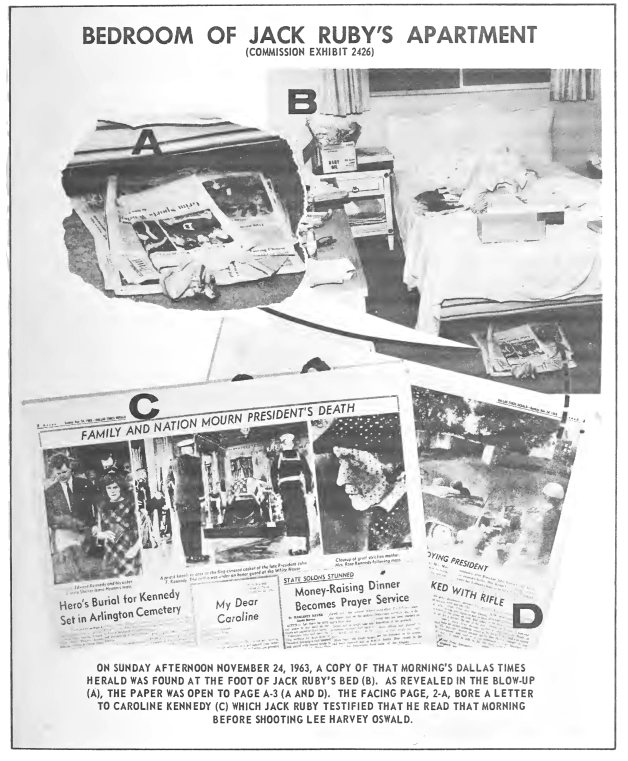
BEDROOM OF JACK RUBY’S APARTMENT
(COMMISSION EXHIBIT 2426)
ON SUNDAY AFTERNOON NOVEMBER 24, 1963, A COPY OF THAT MORNING’S DALLAS TIMES HERALD WAS FOUND AT THE FOOT OF JACK RUBY’S BED (B). AS REVEALED IN THE BLOW-UP (A), THE PAPER WAS OPEN TO PAGE A-3 (A AND D). THE FACING PAGE, 2-A, BORE A LETTER TO CAROLINE KENNEDY (C) WHICH JACK RUBY TESTIFIED THAT HE READ THAT MORNING BEFORE SHOOTING LEE HARVEY OSWALD.
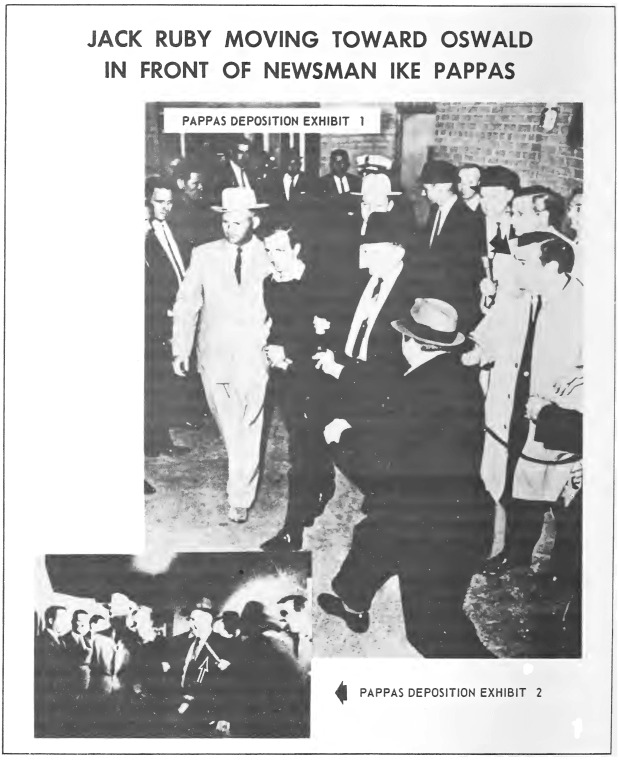
JACK RUBY MOVING TOWARD OSWALD IN FRONT OF NEWSMAN IKE PAPPAS
PAPPAS DEPOSITION EXHIBIT 1
PAPPAS DEPOSITION EXHIBIT 2
Evaluation of activities.—Examination of Ruby’s activities immediately preceding and following the death of President Kennedy revealed no sign of any conduct which suggests that he was involved in the assassination. Prior to the tragedy, Ruby’s activities were routine. Though persons who saw him between November 22 and 24 disagree as to whether or not he appeared more upset than others around him, his response to the assassination appears to have been one of genuine shock and grief. His indications of concern over the possible effects of the assassination upon his businesses seem consistent with other evidence of his character.C6-1107 During the course of the weekend, Ruby seems to have become obsessed with the possibility that the Impeach Earl Warren sign and the Bernard Weissman ad were somehow connected and related to the assassination. However, Ruby’s interest in these public notices was openly expressed and, as discussed below, the evidence reveals no connection between him and any political organization.
Examination of Larry Crafard’s sudden departure from Dallas shortly before noon on November 23 does not suggest that Ruby was involved in a conspiracy. To be sure, Crafard started hitchhiking to Michigan, where members of his family lived, with only $7 in his pocket.C6-1108 He made no attempt to communicate with law enforcement officials after Oswald’s death;C6-1109 and a relative in Michigan recalled that Crafard spoke very little of his association with Ruby.C6-1110 When finally located by the FBI 6 days later, he stated that he left Ruby’s employ because he did not wish to be subjected to further verbal abuse by Ruby and that he went north to see his sister, from whom he had not heard in some time.C6-1111
An investigation of Crafard’s unusual behavior confirms that his departure from Dallas was innocent. After Oswald was shot, FBI agents obtained from the Carousel Club an unmailed letter drafted by Crafard to a relative in Michigan at least a week before the assassination.C6-1112 The letter revealed that he was considering leaving Dallas at that time.C6-1113 On November 17, Crafard, who had been receiving only room, board, and incidental expenses, told Ruby he wanted to stop working for him; however, Crafard agreed to remain when Ruby promised a salary.C6-1114 Then on the morning of November 23, Ruby and Crafard had a minor altercation over the telephone.C6-1115 Although Crafard did not voluntarily make known to the authorities his associations with Ruby, he spoke freely and with verifiable accuracy when questioned. The automobile driver who provided Crafard his first ride from Dallas has been located; his statement generally conforms with Crafard’s story; and he did not recall any unusual or troubled behavior by Crafard during that ride.C6-1116
Although Crafard’s peremptory decision to leave Dallas might be unusual for most persons, such behavior does not appear to have been uncommon for him. His family residence had shifted frequently among California, Michigan, and Oregon.C6-1117 During his 22 years, he had earned his livelihood picking crops, working in carnivals, and taking other odd jobs throughout the country.C6-1118 According to his testimony, he had previously hitchhiked across the country with his then wife and two infant children.C6-1119 Against such a background, it is most probable that the factors motivating Crafard’s departure from Dallas on November 23 were dissatisfaction with his existence in Ruby’s employ, which he had never considered more than temporary, Ruby’s decision to close his clubs for 3 days, the argument on Saturday morning, and his own desire to see his relatives in Michigan. There is no evidence to suggest any connection between Crafard’s departure and the assassination of the President or the shooting of Oswald.
The allegations of Wanda Helmick raised speculation that Ruby’s Saturday night phone calls to Ralph Paul and Breck Wall might have concerned the shooting of Oswald, but investigation has found nothing to indicate that the calls had conspiratorial implications. Paul was a close friend, business associate, and adviser to Jack Ruby. Ruby normally kept in close telephone contact with Paul, who had a substantial sum of money committed to the Carousel Club.C6-1120 Paul explained that Ruby called him Saturday evening once to point out his ads, another time to say that nobody seemed to be doing any business in downtown Dallas, and a third time to relate that both he and his sister were crying over the assassination.C6-1121 Between two of those phone calls to Paul, Ruby telephoned to Galveston, Tex., to speak with Wall, a friend and former business associate who was an official of the American Guild of Variety Artists. Wall related that during that call Ruby criticized the Weinsteins for failing to close their clubs.
Having earlier made the same complaint to Lawrence Meyers to whom he mentioned a need “to do something about this” it would have been characteristic for Ruby to want to direct Breck Wall’s attention, as an AGVA official, to what he regarded as the Weinsteins’ improper conduct. The view that the calls to Wall and Paul could have had conspiratorial implications also is belied in large measure by the conduct of both men before and after the events of November 22-24. A check of long-distance telephone records reveals no suspicious activity by either man.C6-1122 Paul, in fact, is not known to have visited Dallas during the weekend of the assassination except to appear openly in an effort to arrange counsel for Ruby within a few hours of the attack on Oswald. Neither the FBI nor the CIA has been able to provide any information that Ralph Paul or Breck Wall ever engaged in any form of subversive activity.C6-1123
Moreover, Mrs. Helmick’s reliability is undermined by her failure to report her information to any investigative official until June 9, 1964.C6-1124 Although a sister-in-law confirms that Mrs. Helmick wrote her “something about a gun” shortly after the shooting,C6-1125 the only mention of any statement by Paul which was included in a letter written by Mrs. Helmick after the Ruby trial was that Paul believed Ruby was “not in his right mind.”C6-1126 No corroborating witness named by Mrs. Helmick has been found who remembers the conversations she mentioned.C6-1127 Both Ruby and Paul have denied that anything was said, as Mrs. Helmick suggests, about a gun or an intent to shoot Oswald, and Wall has stated that Ruby did not discuss such matters with him.C6-1128 Even if Mrs. Helmick is accurate the statements ascribed to Paul indicate only that he may have heard of a possible reference by Ruby to shooting Oswald. According to her, Paul’s response was to exclaim “Are you crazy?” But under no circumstances does the report of Mrs. Helmick or any other fact support a belief that Paul or Wall was involved in the shooting of Oswald.
The Commission has conducted an investigation of the telephone call Ruby received from Karen Carlin at 10:19 Sunday morning to determine whether that call was prearranged for the purpose of conveying information about the transfer of Oswald or to provide Ruby an excuse for being near the police department. The Commission has examined the records of long-distance telephone calls on Sunday morning for Jack Ruby,C6-1129 the Carlins,C6-1130 the Dallas police,C6-1131 and several other personsC6-1132 and has found no sign of any indirect communication to Ruby through Mr. or Mrs. Carlin. No other evidence showing any link between the Carlins and the shooting of Oswald has been developed.
Ruby and Oswald Were Not Acquainted
The possibility of a prior acquaintanceship between Ruby and Oswald has been suggested by some persons who viewed the shooting on television and believed that a look of recognition appeared on Oswald’s face as Ruby moved toward him in the jail basement. The Commission has examined the television tapes and movie films which were made as Oswald moved through the basement and has observed no facial expressions which can be interpreted as signifying recognition of Ruby by Oswald. It is doubtful even that Oswald could have seen Ruby sufficiently clearly to discern his identity since Oswald was walking from a dark corridor into “the flash from the many cameras” and the lights of TV cameramen which were “blinding.”C6-1133 In addition to such generalized suspicion, there have been numerous specific allegations that Oswald was seen in the company of Ruby prior to November 22, often at Ruby’s Carousel Club. All such allegations have been investigated, but the Commission has found none which merits credence. In all but a few instances where the Commission was able to trace the claim to its source, the person responsible for the report either denied making it or admitted that he had no basis for the original allegations.C6-1134 Frequently those responsible for the allegations have proved to be persons of erratic memory or dubious mental stability.C6-1135 In a few instances, the source of the story has remained unidentified, and no person has come forward to substantiate the rumor.C6-1136
The testimony of a few witnesses who claim to have seen Ruby with a person who they feel may have been Oswald warrants further comment. One such witness, Robert K. Patterson, a Dallas electronics salesman, has stated that on a date established from sales records as November 1, 1963, Ruby, accompanied by a man who resembled Oswald, purchased some equipment at his business establishment.C6-1137 However, Patterson did not claim positively that the man he saw was Oswald,C6-1138 and two of his associates who were also present at the time could not state that the man was Oswald.C6-1139 Other evidence indicates that Ruby’s companion was Larry Crafard. Crafard, who lived at the Carousel Club while working for Ruby from mid-October until November 23, 1963, stated that sometime in late October or early November he accompanied Ruby to an electronics store in connection with the purchase of electronics equipment.C6-1140 Ruth Paine testified that Crafard’s photograph bears a strong resemblance to Oswald; and employment records of the Texas School Book Depository show that Oswald worked a full day on November 1, 1963.C6-1141
William D. Crowe, Jr., a young nightclub master of ceremonies who had worked for Ruby on three occasions and had begun a 4- or 5-week engagement at the Carousel Club on November 11, 1963, was the first person who reported a possible association between Ruby and Oswald.C6-1142 While attempting to enter the Carousel Club on November 24, shortly after Oswald was shot, Crowe encountered two news media representatives who were gathering information on Jack Ruby.C6-1143 At that time, Crowe, who included a memory act in his repertoire,C6-1144 mentioned the “possibility” that he had seen Oswald at the Carousel Club.C6-1145 As a result he was asked to appear on television. In Crowe’s own words, the story “started snowballing.” He testified:
They built up the memory thing and they built up the bit of having seen Oswald there, and I never stated definitely, positively, and they said that I did, and all in all, what they had in the paper was hardly even close to what I told them.C6-1146
Crowe added that his memory act involved a limited system which did not, in fact, improve his memory and that his memory might not even be as good as that of the average person. When asked how certain he was that the man he saw was Oswald, Crowe testified: “* * * the face seemed familiar as some faces do, and I had associated him with a patron that I had seen in the club a week before. That was about it.”C6-1147
A possible explanation for Crowe’s belief that Oswald’s face seemed familiar was supplied by a freelance photographer, Eddie Rocco, who had taken pictures at the Carousel Club for Ruby at about the time Crowe was employed there. Rocco produced one of those photographs which depicted a man who might have been mistaken for Oswald by persons having no reason to remember the man at the time they saw him.C6-1148 When shown the Rocco photograph, Crowe said that there was as strong a possibility that the man he recalled seeing was the man in the photograph as there was that he was Oswald.C6-1149 Crowe’s uncertainty was further underscored by his failure initially to provide his information about Oswald to David Hoy, a news-media friend whom Crowe telephoned in Evansville, Ind., less than 20 minutes after Oswald was shot.C6-1150 By then the possible recognition had occurred to Crowe,C6-1151 and Hoy said he was quite surprised that Crowe had given the information first to other news representatives instead of telling him in that early conversation.C6-1152
After Crowe’s identification had been publicized, four other persons also reported seeing Oswald at the Carousel Club. One man said he saw Ruby and Oswald seated at a table together and recalled that the man resembling Oswald was addressed by a blond-haired waitress as “Bettit” or “Pettit.” The witness was unable to give any description of “Pettit” except that he was the man who had been shot by Ruby. He could not describe the inside of the Carousel and was unable to give a precise location for the club.C6-1153 Another witness, a resident of Tennessee, related seeing a man resembling Oswald at the Carousel Club on November 10.C6-1154 Ruth Paine has testified, however, that Oswald spent the entire holiday weekend of November 9, 10, and 11 at her home in Irving, Tex.C6-1155 Two of Ruby’s former employees, Karen Carlin and Billy Joe Willis, also believed they had seen a person who resembled Oswald. Willis believed he saw the man at the Carousel Club but did not think the man was Oswald.C6-1156 Mrs. Carlin likewise was not certain that the man was Oswald nor was she sure where she had seen him.C6-1157 Neither reported any connection between the man and Ruby. No other employees recalled seeing Oswald or a person resembling him at the Carousel Club.C6-1158
Wilbryn Waldon (Robert) Litchfield II also claimed to have seen at the Carousel Club a man resembling Oswald. Litchfield stated that during a visit to the Carousel Club in late October or early November 1963, he saw such a man enter Ruby’s office, apparently to confer with Ruby.C6-1159 Although there is substantial evidence that Litchfield did see Ruby at the Carousel Club about that time,C6-1160 there is strong reason to believe that Litchfield did not see Lee Harvey Oswald. Litchfield described the man he saw as having pockmarks on the right side of his chin;C6-1161 Oswald did not have such identifying marks.C6-1162 Moreover, the Commission has substantial doubts concerning Litchfield’s credibility. Although present at an FBI interview of another witness on November 29, Litchfield made no mention of his observation to public officials until December 2, 1963.C6-1163 Litchfield, who had twice been convicted for offenses involving forged checks,C6-1164 testified that he first recalled that Oswald resembled the visitor he saw at the Carousel Club while watching a television showing on Sunday morning, November 24, of the shooting by Ruby.C6-1165 At that time Litchfield was playing poker with three friends, and he testified that he promptly informed them of the resemblance he observed.C6-1166 However, none of the three poker companions remembered Litchfield’s making such a remark; and two added that Litchfield’s statements were often untrustworthy.C6-1167
With regard to all of the persons who claimed to have seen Ruby and Oswald together, it is significant that none had particular reason to pay close attention to either man, that substantial periods of time elapsed before the events they assertedly witnessed became meaningful, and that, unlike the eyewitnesses who claimed to have seen Oswald on November 22, none reported their observations soon after Oswald was arrested. In the course of its investigation, the Commission has encountered numerous clear mistakes of identification. For example, at least four persons, other than Crafard, are known to have been mistaken for Oswald.C6-1168 Other persons have been misidentified as Jack Ruby.C6-1169 Under all the available evidence there is no substantial likelihood that the person the various witnesses claimed to have seen with Ruby was in fact Oswald.
In addition to probing the reported evidence that Ruby and Oswald had been seen together, the Commission has examined other circumstances for signs that the two men were acquainted. From the time Oswald returned from Mexico, both he and Jack Ruby lived in the Oak Cliff section of Dallas, slightly more than a mile apart. Numerous neighbors of both Oswald and Ruby were interviewed, and none knew of any association between the two.C6-1170 Oswald’s work began at 8 each weekday morning and terminated at 4:45 each afternoon.C6-1171 Jack Ruby usually remained in his apartment until past 9 a.m. each day.C6-1172 Although both men worked in downtown Dallas, they normally traveled to their places of employment by different routes. Ruby owned an automobile, and the shortest route downtown from his home was via a freeway adjacent to his apartment.C6-1173 Oswald did not own a car and had, at best, a rudimentary ability to drive.C6-1174 From his roominghouses on North Beckley Avenue and on Marsalis Street, he normally took public transportation which did not bring him within six blocks of either Ruby’s apartment or his downtown nightclub, nor did Oswald’s route from the bus stop to home or work bring him near Ruby’s home or business.C6-1175 Persons at Oswald’s roominghouse testified that he regularly came home promptly after work and remained in his room.C6-1176 While in Dallas, he is not known to have visited any nightclub.C6-1177 Ruby was generally at the Carousel Club from 9 o’clock each evening until after 1 a.m.C6-1178 In a few instances, Ruby and Oswald patronized the same stores, but no indication has been found that they ever met at such stores.C6-1179 Ruby at one time frequented a restaurant where Oswald occasionally ate breakfast, but the times of their patronage were widely separated and restaurant employees knew of no acquaintance between Ruby and Oswald.C6-1180 Likewise, Ruby has held various memberships in the Dallas YMCA and Oswald lived there for brief periods; however, there is no indication that they were there at the same time.C6-1181
Both Ruby and Oswald maintained post office boxes at the terminal annex of the U.S. post office in Dallas, but there is no indication that those facts were more than coincidental. On November 1, 1963, Oswald rented box No. 6225, his third since October 1962.C6-1182 Oswald’s possible purpose has been discussed previously in this chapter. On November 7, 1963, Jack Ruby rented post office box No. 5475 because he hoped to receive mail responses to advertisements for the twistboard exercise device which he was then promoting.C6-1183 Although it is conceivable that Oswald and Ruby coincidentally encountered one another while checking their boxes, the different daily schedules of the two men render even this possibility unlikely. Moreover, Oswald’s withdrawn personality makes it improbable that the two would have spoken if their paths had crossed.
The Commission has also examined the known friends and acquaintances of Ruby and Oswald for evidence that the two were acquainted, but it has found very few possible links. One conceivable association was through John Carter, a boarder at 1026 North Beckley Avenue while Oswald lived there. Carter was friendly with Wanda Joyce Killam, who had known Jack Ruby since shortly after he moved to Dallas in 1947 and worked for him from July 1963 to early November 1963. Mrs. Killam, who volunteered the information about Carter’s residence during an interview with an agent of the FBI, has stated that she did not believe Carter ever visited the Carousel Club and that she did not think Carter knew Ruby.C6-1184 Carter stated that he had not heard of Ruby until Oswald was shot, had talked briefly with Oswald only once or twice, and had never heard Oswald mention Ruby or the Carousel Club.C6-1185 The Commission has no reason to disbelieve either Mrs. Killam or Mr. Carter.
A second possible link between Oswald and Ruby was through Earlene Roberts, the housekeeper at 1026 North Beckley Avenue. Bertha Cheek, the sister of Mrs. Roberts, is known to have visited Jack Ruby at the Carousel Club during the afternoon of November 18, 1963. Mrs. Cheek testified that she had met with Ruby and a person whom Ruby represented to be an interior decorator for the purpose of discussing the possibility of financially backing Ruby in a new nightclub which he planned to open. Mrs. Cheek said she had met Ruby only once, a few years before, and that she had not heard of Oswald until he shot President Kennedy.C6-1186 Mr. Frank Boerder, the decorator who was present at the November 18 meeting, confirmed the substance of the discussion reported by Mrs. Cheek,C6-1187 and other witnesses establish that Ruby was, in fact, seeking an associate for a new nightclub venture.C6-1188 There is no evidence that Jack Ruby ever associated with Earlene Roberts, nor is there any indication that Mrs. Cheek knew of Lee Harvey Oswald prior to November 22.C6-1189
Oswald’s trips to the home of Mrs. Ruth Paine at 2115 West Fifth Street in Irving, Tex., presented another possible link to Ruby. While Oswald’s family resided with Mrs. Paine, William F. Simmons, pianoplayer in the musical combo which worked at the Carousel Club from September 17, 1963, until November 21, 1963, lived at 2539 West Fifth Street, in Irving. Simmons has stated that his only relationship to Ruby was as an employee, that Ruby never visited him, that he did not know Oswald, and that he had never seen Oswald at the Carousel Club.C6-1190 Other persons in the neighborhood knew of no connection between Ruby and Oswald.C6-1191
The Commission has investigated rumors that Jack Ruby and Lee Harvey Oswald were both homosexuals and, thus, might have known each other in that respect. However, no evidence has been uncovered to support the rumors, the closest acquaintances of both men emphatically deny them,C6-1192 and Ruby’s nightclubs were not known to have been frequented by homosexuals.C6-1193
A final suggestion of a connection between Jack Ruby and Lee Harvey Oswald arises from the testimony of Oswald’s mother, Marguerite Oswald. When appearing before the Commission, Mrs. Oswald related that on November 23, 1963, before Ruby shot Oswald, FBI Agent Bardwell D. Odum showed her a picture of a man she believed was Jack Ruby, and asked whether the man shown was familiar to her. Odum had first attempted to see Marina Oswald, but Marguerite refused to allow Marina to be disturbed at that time.C6-1194 In the course of Marguerite’s testimony, the Commission asked the FBI for a copy of the photograph displayed by Odum to her. When Marguerite viewed the photograph provided the Commission, she stated that the picture was different from the one she saw in November, in part because the “top two corners” were cut differently and because the man depicted was not Jack Ruby.C6-1195
The Commission has investigated this matter and determined that Special Agent Odum did show a picture to Marguerite Oswald for possible identification but that the picture was not of Jack Ruby. On November 22 the CIA had provided the FBI with a photograph of a man who, it was thought at the time, might have been associated with Oswald. To prevent the viewer from determining precisely where the picture had been taken, FBI Agent Odum had trimmed the background from the photograph by making a series of straight cuts which reduced the picture to an irregular hexagonal shape.C6-1196 The picture which was displayed by the Commission to Marguerite Oswald was a copy of the same picture shown her by Agent Odum; however, in supplying a duplicate photograph for Commission use the FBI had cropped the background by cutting along the contours of the body of the man shown,C6-1197 resulting in a photograph without any background, unlike the first photograph Marguerite viewed on November 23. Affidavits obtained from the CIA and from the two FBI agents who trimmed the photographs established that the one shown to Mrs. Oswald before the Commission, though trimmed differently from the one shown her on November 23, was a copy of the same picture. Neither picture was of Jack Ruby.C6-1198 The original photograph had been taken by the CIA outside of the United States sometime between July 1, 1963, and November 22, 1963, during all of which time Ruby was within the country.C6-1199
Ruby’s Background and Associations
In addition to examining in detail Jack Ruby’s activities from November 21 to November 24 and his possible acquaintanceship with Lee Harvey Oswald, the Commission has considered whether or not Ruby had ties with individuals or groups that might have obviated the need for any direct contact near the time of the assassination. Study of Jack Ruby’s background, which is set out more fully in appendix XVI, leads to the firm conclusion that he had no such ties.
Business activities.—Ruby’s entire life is characteristic of a rigorously independent person. He moved from his family home soon after leaving high school at age 16, although a “family” residence has been maintained in Chicago throughout the years.C6-1200 Later, in 1947, he moved from Chicago to Dallas and maintained only sporadic contact with most of his family.C6-1201 For most of his working years and continuously since 1947, Jack Ruby was self-employed.C6-1202 Although he had partners from time to time, the partnerships were not lasting, and Ruby seems to have preferred to operate independently.
Ruby’s main sources of income were his two nightclubs—the Carousel Club and the Vegas Club—although he also frequently pursued a number of independent, short-lived business promotions. (Ruby’s business dealings are described in greater detail in app. XVI.) At the time of the assassination, the United States claimed approximately $44,000 in delinquent taxes, and he was in substantial debt to his brother Earl and to his friend Ralph Paul.C6-1203 However, there are no indications that Earl Ruby or Ralph Paul was exerting pressure for payment or that Ruby’s tax liabilities were not susceptible to an acceptable settlement. Ruby operated his clubs on a cash basis, usually carrying large amounts of cash on his person; thus there is no particular significance to the fact that approximately $3,000 in cash was found on his person and in his automobile when arrested. Nor do his meager financial records reflect any suspicious activities. He used his bank accounts only infrequently, with no unexplained large transactions; and no entries were made to Ruby’s safe-deposit boxes in over a year prior to the shooting of Oswald.C6-1204 There is no evidence that Ruby received any sums after his arrest except royalties from a syndicated newspaper article on his life and small contributions for his defense from friends, sympathizers, and family members.C6-1205
Ruby’s political activities.—Jack Ruby considered himself a Democrat, perhaps in part because his brother Hyman had been active in Democratic ward politics in Chicago.C6-1206 When Ruby was arrested, police officers found in his apartment, 10 political cards urging the election of the “Conservative Democratic slate,”C6-1207 but the Commission has found no evidence that Ruby had distributed that literature and he is not known ever to have campaigned for any political candidates.C6-1208 None of his friends or associates expressed any knowledge that he belonged to any groups interested in political issues, nor did they remember that he had discussed political problems except on rare occasions.C6-1209
As a young man, Ruby participated in attacks upon meetings of the German-American Bund in Chicago, but the assaults were the efforts of poolhall associates from his predominantly Jewish neighborhood rather than the work of any political group. His only other known activities which had any political flavor possessed stronger overtones of financial self-interest. In early 1942 he registered a copyright for a placard which displayed an American flag and bore the inscription “Remember Pearl Harbor.” The placard was never successfully promoted. At other times, he is reported to have attempted to sell busts of President Franklin D. Roosevelt.C6-1210 The rabbi of Ruby’s synagogue expressed the belief that Ruby was too unsophisticated to grasp or have a significant interest in any political creed.C6-1211 Although various views have been given concerning Ruby’s attitude toward President Kennedy prior to the assassination, the overwhelming number of witnesses reported that Ruby had considerable respect for the President, and there has been no report of any hostility toward him.C6-1212
There is also no reliable indication that Ruby was ever associated with any Communist or radical causes. Jack Ruby’s parents were born in Poland in the 1870’s and his father served in the Czarist Russian army from 1893-98. Though neither parent became a citizen after emigrating to the United States in the early 1900’s, the evidence indicates that neither Ruby nor his family maintained any ties with relatives in Europe.C6-1213 Jack Ruby has denied ever being connected with any Communist activities. The FBI has reported that, prior to the shooting of Oswald, its nationwide files contained no information of any subversive activities by Ruby.C6-1214 In addition, a Commission staff member has personally examined all subversive activities reports from the Dallas-Fort Worth office of the FBI for the year 1963 and has found no reports pertaining to Jack Ruby or any of his known acquaintances.C6-1215
The Commission has directed considerable attention to an allegation that Jack Ruby was connected with Communist Party activities in Muncie, Ind. On the day after Oswald’s death, a former resident of Muncie claimed that between 1943 and 1947 a Chicagoan resembling Ruby and known to him as Jack Rubenstein was in Muncie on three occasions and associated with persons who the witness suspected were Communists. The witness stated that the man resembling Ruby visited Muncie during these years as a guest of the son-in-law of a now-deceased jeweler for whom the witness worked.C6-1216 A second son-in-law of the jewelry store owner suggested that he may have known Ruby while the two resided in Chicago,C6-1217 but the son-in-law whom Ruby allegedly visited disclaimed any acquaintanceship with Ruby.C6-1218 Both sons-in-law denied any Communist activities and the Commission has found no contrary evidence other than the testimony of the witness.
On the first two occasions on which Ruby is alleged to have been in Muncie, military records show him to have been on active military duty in the South.C6-1219 The witness also said that the man he knew as Rubenstein owned or managed a nightclub when he met him, but the Commission has no reliable evidence that Jack Ruby ever owned or worked in any nightclubs when he lived in Chicago.C6-1220 The witness further stated that on one occasion he found the name of Jack Rubenstein, or perhaps a similar name, together with the names of others he believed were Communists, on a list which had been left in a room above the jewelry store after a meeting held there. The witness said he gave the list to his wife’s cousin, now deceased, who was then the chief of detectives in Muncie.C6-1221 However, neither the list nor a person identifiable as Jack Ruby has been located after a thorough search by the FBI of its own files and those of the Muncie Police Department, the Indiana State Police, and other agencies.C6-1222 The witness did not recall seeing Rubenstein in Muncie during the period of that meeting, and he had never heard Rubenstein say anything which would indicate he was a Communist.C6-1223
The FBI has interviewed all living persons who the witness stated were involved with Ruby in Communist activities in Muncie. One person named by the witness was known previously to have been involved in Communist Party activities, but subversive activities files have revealed no such activities for any of the others.C6-1224 The admitted former Communist denied knowing Ruby and stated that the jewelry store owner was not known to him as a Communist and that Communist meetings were never held above the store.C6-1225 All other Muncie residents named by the witness as possible associates of Ruby denied knowing Ruby.C6-1226 Similarly, fellow employees of the witness whom he did not claim were Communists knew of no Communist activities connected with the jewelry store owner or any visits of Jack Ruby, and FBI informants familiar with Communist activities in Indiana and Chicago did not know of any participation by Ruby.C6-1227 Finally, the witness testified that even though he believed as early as 1947 that all of the persons named by him were Communists he had never brought his information to the attention of any authority investigating such activities, except for providing the alleged list to his cousin.C6-1228 The Commission finds no basis for accepting the witness’s testimony.
The Commission has also investigated the possibility that Ruby was associated with ultraconservative political endeavors in Dallas. Upon his arrest, there were found in Ruby’s possession two radio scripts of a right-wing program promoted by H. L. Hunt, whose political views are highly conservative. Ruby had acquired the scripts a few weeks earlier at the Texas Products Show, where they were enclosed in bags of Hunt food products. Ruby is reported to have become enraged when he discovered the scripts, and threatened to send one to “Kennedy.”C6-1229 He is not known to have done anything with them prior to giving one to a radio announcer on Nevember 23; and on that day he seemed to confuse organizations of the extreme right with those of the far left.C6-1230 On November 21, Ruby drove Connie Trammel, a young college graduate whom he had met some months previously, to the office of Lamar Hunt, the son of H. L. Hunt, for a job interview. Although Ruby stated that he would like to meet Hunt, seemingly to establish a business connection, he did not enter Hunt’s office with her.C6-1231
An allegation that Ruby was a visitor at the home of Maj. Gen. Edwin A. Walker (Resigned, U.S. Army) appears totally unfounded. The allegation was made in late May 1964 to an agent of the U.S. Secret Service by William McEwan Duff. Duff, who was discharged from military service in June 1964 because of a fraudulent enlistment, disclaimed any knowledge of Ruby or Oswald when questioned by FBI agents in January 1964.C6-1232
Another allegation connecting Jack Ruby with right-wing activities was Mark Lane’s assertion, mentioned previously, that an unnamed informant told him of a meeting lasting more than 2 hours in the Carousel Club on November 14, 1963, between Jack Ruby, Patrolman J. D. Tippit, and Bernard Weissman.C6-1233 Although the name of Lane’s informant has never been revealed to the Commission, an investigation has been conducted in an effort to find corroboration for the claimed Tippit, Weissman, and Ruby meeting. No employee of the Carousel Club has any knowledge of the meeting described by Lane.C6-1234 Ruby and Weissman both deny that such a meeting occurred, and Officer Tippit’s widow has no knowledge that her late husband ever went to the Carousel Club.C6-1235
Some confusion has arisen, however, because early Friday afternoon, November 22, Ruby remarked that he knew the Tippit who had been shot by Oswald. Later Ruby stated that he did not know J. D. Tippit but that his reference was to G. M. Tippit, a member of the special services bureau of the Dallas Police Department who had visited Ruby establishments occasionally in the course of his official duties.C6-1236 Larry Crafard was unable to recognize photographs of J. D. Tippit and had no recollection of a Tippit, Weissman, and Ruby meeting at any time.C6-1237 However, uncertainty was introduced when Crafard identified a photograph of Bernard Weissman as resembling a man who had visited the Carousel Club and had been referred to by Ruby as “Weissman.”C6-1238 In a subsequent interview Crafard stated that he believed Weissman was a detective on the Dallas Police Department, that his first name may have been Johnny, and that he was in his late thirties or early forties.C6-1239 As set forth previously, Bernard Weissman was a 26-year-old New York carpet salesman. Crafard added “I could have my recollection of a Mr. Weissman mixed up with someone else”.C6-1240
Ruby’s conduct on November 22 and 23, 1963, corroborates his denial that he knew Bernard Weissman. Ruby expressed hostility to the November 22 full-page advertisement to many persons. To none did he give any indication that he was familiar with the person listed as responsible for the advertisement.C6-1241 His attempt on November 23 to trace the holder of the post office box shown on the “Impeach Earl Warren” sign and to locate Weissman’s name in a Dallas city directoryC6-1242 also tends to indicate that in fact he was not familiar with Weissman. Had he been involved in some type of unlawful activity with Weissman, it is highly unlikely that Ruby would have called attention to Weissman as he did.
Investigation has disclosed no evidence that Officer J. D. Tippit was acquainted with either Ruby or Oswald. Neither Tippit’s wife nor his close friends knew of such an acquaintanceship.C6-1243 Tippit was not known to frequent nightclubsC6-1244 and he had no reason during the course of his police duties to enter Ruby’s clubs.C6-1245 Although at the time of the assassination Tippit was working weekends in a Dallas restaurant owned by a member of the John Birch Society, the restaurant owner stated that he never discussed politics with Tippit.C6-1246 Persons close to Tippit related that Tippit rarely discussed political matters with any person and that he was a member of no political organization.C6-1247 Telephone records for the period following September 26, 1963, revealed no suspicious long-distance calls from the Tippit household.C6-1248
Tippit’s encounter with Oswald following the shooting of the President is indicative of no prior association between the two men. Police radio logs show that, as part of general directions issued to all officers immediately after the assassination, Tippit was specifically directed to patrol the Oak Cliff area where he came upon Oswald.C6-1249 His movement from the area which he had been patrolling into the central Oak Cliff area was also in conformity with the normal procedure of the Dallas Police Department for patrol cars to cover nearby districts when the patrol cars in that district became otherwise engaged, as occurred after the assassination.C6-1250 Oswald fit the general description, which, 15 minutes after the assassination, was broadcast to all police cars of a suspect described by a bystander who had seen Oswald in the sixth-floor window of the Texas School Book Depository.C6-1251 There is thus no basis for any inference that, in approaching Oswald, Tippit was acting other than in the line of police duty.
Allegations of Cuban activity.—No substantiation has been found for rumors linking Ruby with pro- or anti-Castro Cuban activities,C6-1252 except for one incident in January 1959 when Ruby made preliminary inquiries, as a middleman, concerning the possible sale to Cuba of some surplus jeeps located in Shreveport, La., and asked about the possible release of prisoners from a Cuban prison. No evidence has been developed that the project ever became more than a “possibility”. Ruby explained that in early 1959 United States sentiment toward Cuba was still favorable and that he was merely pursuing a money-making opportunity.C6-1253
During the period of the “jeep sale”, R. D. Matthews, a gambler and a “passing acquaintance” of Ruby, returned to Dallas from Havana where he had been living. In mid-1959, he returned to Cuba until mid-1960.C6-1254 On October 3, 1963, a telephone call was made from the Carousel Club to Matthews’ former wife in Shreveport.C6-1255 No evidence has been uncovered that Matthews was associated with the sale of jeeps or the release of prisoners or that he knew of Oswald prior to the assassination.C6-1256 Matthews’ ex-wife did not recall the phone call in October of 1963, and she asserted that she did not know Jack Ruby or anybody working for him.C6-1257
In September 1959, Ruby traveled to Havana as a guest of a close friend and known gambler, Lewis J. McWillie. Both Ruby and McWillie state the trip was purely social.C6-1258 In January 1961, McWillie left Cuba with strong feelings of hostility to the Castro regime. In early 1963, Ruby purchased a pistol which he shipped to McWillie in Nevada, but McWillie did not accept the package.C6-1259 The Commission has found no evidence that McWillie has engaged in any activities since leaving Cuba that are related to pro- or anti-Castro political movements or that he was involved in Ruby’s abortive jeep transaction.
The Commission has also received evidence that in April 1962, a telegram sent to Havana, Cuba, was charged to the business telephone of Earl Ruby, brother of Jack Ruby.C6-1260 Earl Ruby stated that he was unable to recall that telegram but testified that he had never traveled to Cuba nor had any dealings with persons in Cuba.C6-1261 Jack Ruby is not known to have visited his brother at that time, and during that period Earl and Jack did not maintain a close relationship.C6-1262 Earl Ruby is not known to have been involved in any subversive activities.C6-1263
Finally, examination of FBI information relative to Cuban groups in the Dallas-Fort Worth area for the year 1963 fails to disclose any person who might provide a link between Ruby and such groups.C6-1264 The Central Intelligence Agency has no information suggesting that Jack Ruby or any of his closest associates have been involved in any type of revolutionary or subversive Cuban activity.C6-1265
Possible underworld connections.—The Commission has investigated Ruby’s possible criminal activities, looking with particular concern for evidence that he engaged in illegal activities with members of the organized underworld or that, on his own, he was a promoter of illegal endeavors. The results of that investigation are more fully detailed in appendix XVI. Ruby was reared in a Chicago neighborhood where he became acquainted with local criminals and with persons who later became criminals. Throughout his life, Ruby’s friendships with persons of that character were limited largely to professional gamblers, although his night club businesses brought him in contact with persons who had been convicted of other offenses. There is no credible evidence that Ruby, himself, gambled on other than a social basis or that he had any unpaid gambling debts.C6-1266 He had never been charged with a felony prior to his attack on Oswald; his only encounters in Chicago stemmed from ticket scalping and the unauthorized sale of copyrighted music; and, in Dallas, his law violations, excluding traffic charges, resulted from the operation of his clubs or outbursts of temper.C6-1267 Ruby has disclaimed that he was associated with organized criminal activities, and law enforcement agencies have confirmed that denial.C6-1268
Investigation of George Senator.—In addition to examining Ruby’s own activities and background, the Commission has paid careful attention to the activities and background of George Senator, Ruby’s roommate and one of his closest friends in Dallas. Senator was interrogated by staff members over a 2-day period; he provided a detailed account of his own life and cooperated fully in all aspects of the Commission’s inquiry into the activities of Jack Ruby.
Senator was 50 years old at the time Ruby shot Oswald. He had been born September 4, 1913, in Gloversville, N.Y., and had received an eighth grade education. Upon leaving school, he worked in Gloversville and New York City until about age 25. For the next few years he worked in various restaurants and cafeterias in New York and Florida until enlisting in the Army in August 1941.C6-1269 After his honorable discharge in September 1945, Senator was employed for most of the next 13 years selling inexpensive dresses throughout the South and Southwest. In the course of that employment he moved to Dallas where he met Jack Ruby while visiting Ruby’s Vegas Club in about 1955 or 1956.C6-1270 Ruby was one of many who helped Senator when he encountered financial difficulties during the years 1958 to 1962. For a while in 1962, Ruby provided room and board in exchange for Senator’s help in his clubs and apartment. In August 1963, Senator was unable to maintain his own apartment alone following his roommate’s marriage. Ruby again offered to help and on November 1, 1963, Senator moved into Ruby’s apartment.C6-1271 The Commission has found no evidence that Senator ever engaged in any political activities.C6-1272
Against this background the Commission has evaluated Senator’s account of his own activities on November 22, 23, and 24. When questioned by Dallas and Federal authorities hours after the shooting of Oswald, Senator omitted mention of having accompanied Ruby to photograph the “Impeach Earl Warren” sign on Saturday morning. Senator stated to Commission staff members that in the interviews of November 24 he omitted the incident because of oversight.C6-1273 However, he spoke freely about it in his sworn testimony and no inaccuracies have been noted in that portion of his testimony. Senator also failed to mention to the Commission and to previous interrogators that, shortly after Ruby left their apartment Sunday morning, he called friends, Mr. and Mrs. William Downey, and offered to visit their apartment and make breakfast for them.C6-1274 Downey stated, in June 1964, that Senator said he was alone and that, after Downey declined the offer, Senator remarked that he would then go downtown for breakfast.C6-1275 When told of Downey’s account, Senator denied it and explained that the two were not friendly by the time Senator left Dallas about six weeks after the assassination.C6-1276
The Commission also experienced difficulty in ascertaining the activities of Senator on November 22 and 23. He was unable to account specifically for large segments of time when he was not with Ruby.C6-1277 And, as to places and people Senator says he visited on those days prior to the time Oswald was shot, the Commission has been unsuccessful in obtaining verification.C6-1278 Senator admitted that he had spent much of that time drinking but denied that he was intoxicated.C6-1279
It is difficult to know with complete certainty whether Senator had any foreknowledge of the shooting of Oswald. Ruby testified that at about 10:15 a.m. on Sunday morning, November 24, he said, in Senator’s presence, “If something happened to this person, that then Mrs. Kennedy won’t have to come back for the trial.”C6-1280 According to Ruby, this is the most explicit statement he made concerning Oswald that morning.C6-1281 Senator denies any knowledge of Ruby’s intentions.C6-1282
Senator’s general response to the shooting was not like that of a person seeking to conceal his guilt. Shortly before it was known that Ruby was the slayer of Oswald, Senator visited the Eatwell Restaurant in downtown Dallas. Upon being informed that Ruby was the attacker, Senator exclaimed, “My God,” in what appeared to be a genuinely surprised tone.C6-1283 He then ran to a telephone, returned to gulp down his coffee, and quickly departed.C6-1284 He drove promptly to the home of James Martin, an attorney and friend. Martin recalled that Senator’s concern was for his friend Ruby and not for himself.C6-1285 Martin and Senator drove to the Dallas Police Department where Senator voluntarily submitted himself to police questioning, and gave interviews to newspaper and television reporters.C6-1286 The Commission has concluded, on the basis of its investigation into Senator’s background, activities, and reaction to the shooting, that Senator did not aid or conspire with Jack Ruby in the killing of Oswald.
Ruby’s activities preceding President’s trip.—In addition to the broad investigation into Ruby’s background and associations, the Commission delved particularly into Ruby’s pattern of activities during the 2 months preceding President Kennedy’s visit to Dallas in order to determine whether there was unusual conduct which might be linked to the President’s forthcoming trip.
The Commission has been able to account specifically for Jack Ruby’s presence in Dallas on every day after September 26, 1963, except five—September 29, 30 and October 11, 14, and 24—and there is no evidence that he was out of the Dallas-Fort Worth area on those days.C6-1287 The report of one person who saw Ruby on September 28 indicates that Ruby probably remained in Dallas on September 29 and 30,C6-1288 when Oswald was in Mexico City. The Commission has looked for but has found no evidence that Ruby traveled to Mexico at that time.C6-1289 Both Ruby and Ralph Paul have stated that Ruby did not leave the Dallas-Fort Worth area during September, October, or November 1963.C6-1290
During October and November of 1963, Jack Ruby maintained his usual vigorous pace of business activities. In particular, he directed considerable attention to his two nightclubs and to other business promotions.C6-1291 During the final month before the Kennedy trip, his time was increasingly occupied with personnel problems at both his clubs. There is no indication that he devoted less than full attention to these matters or that he appeared preoccupied with other affairs. His acquaintances did feel that Ruby seemed depressed and concerned that his friends were deserting him.C6-1292 However, there were no signs of secretive conduct.
Scrutiny of Ruby’s activities during the several days preceding the President’s arrival in Dallas has revealed no indication of any unusual activity. Ruby is remembered to have discussed the President’s impending trip with only two persons and only briefly.C6-1293 Two newspapers containing a description of the expected motorcade routes through Dallas and Fort Worth were found in Ruby’s car at the time of this arrest. However, such papers circulated widely in Dallas, and Ruby’s car, like his apartment, was so cluttered with other newspapers, notebooks, brochures, cards, clothing, and personal itemsC6-1294 that there is no reason to attach any significance to the papers.
Aside from the results of the Commission’s investigation reported above, there are other reasons to doubt that Jack Ruby would have shot Oswald as he did if he had been involved in a conspiracy to carry out the assassination, or that he would have been delegated to perform the shooting of Oswald on behalf of others who were involved in the slaying of the President. By striking in the city jail, Ruby was certain to be apprehended. An attempt to silence Oswald by having Ruby kill him would have presented exceptionally grave dangers to any other persons involved in the scheme. If the attempt had failed, Oswald might have been moved to disclose his confederates to the authorities. If it succeeded, as it did, the additional killing might itself have produced a trail to them. Moreover, Ruby was regarded by most persons who knew him as moody and unstable—hardly one to have encouraged the confidence of persons involved in a sensitive conspiracy.C6-1295
Since his apprehension, Jack Ruby has provided the Federal authorities with several detailed accounts of his activities both preceding and following the assassination of President Kennedy. Ruby has shown no reluctance to answer any questions addressed to him. The accounts provided by Ruby are consistent with evidence available to the Commission from other sources.
These additional considerations are thus fully consistent with the results of the Commission’s investigation. Rumors of a connection between Ruby and Oswald have proved groundless, while examination of Ruby’s background and associations, his behavior prior to the assassination, and his activities during the November 22-24 weekend has yielded no evidence that Ruby conspired with anyone in planning or executing the killing of Lee Harvey Oswald. Whatever the legal culpability of Jack Ruby for his act of November 24, the evidence is persuasive that he acted independently in shooting Oswald.
CONCLUSION
Based upon the investigation reviewed in this chapter, the Commission concluded that there is no credible evidence that Lee Harvey Oswald was part of a conspiracy to assassinate President Kennedy. Examination of the facts of the assassination itself revealed no indication that Oswald was aided in the planning or execution of his scheme. Review of Oswald’s life and activities since 1959, although productive in illuminating the character of Lee Harvey Oswald (which is discussed in the next chapter), did not produce any meaningful evidence of a conspiracy. The Commission discovered no evidence that the Soviet Union or Cuba were involved in the assassination of President Kennedy. Nor did the Commission’s investigation of Jack Ruby produce any grounds for believing that Ruby’s killing of Oswald was part of a conspiracy. The conclusion that there is no evidence of a conspiracy was also reached independently by Dean Rusk, the Secretary of State; Robert S. McNamara, the Secretary of Defense; C. Douglas Dillon, the Secretary of the Treasury; Robert F. Kennedy, the Attorney General; J. Edgar Hoover, the Director of the FBI; John A. McCone, the Director of the CIA; and James J. Rowley, the Chief of the Secret Service, on the basis of the information available to each of them.C6-1296