TAHITI
Reading edition
When we rose in the early morning our ship had already passed the reef, and we were in the harbour of Papeete. There was the usual enchantment of the land, a light blue sky and a light blue sea; an air that felt colder than that of Samoa, whatever the thermometer might say; and when we had landed, a funny little town, stretched along the beach, under many tall and beautiful trees. From under their shade the outside blue was still more wonderful, and at the edge where the blue of sky and sea came together opposite us, the island of Moorea, all mountain, peaked and engrailed like some far distance of Titian’s landscapes, seemed swimming in the blue.
Near the quay neatly edged with stone steps, ships lay only a few rods off in the deep water, so that their yards ran into the boughs of the great trees. Further out, on a French man-of-war, the bugle marked the passing duty of the hour. Everything else was lazy, except the little horses driven by the kanakas. Natives moved easily about, no longer with the stride of the Samoans, which throws out the knees and feet, as if it were for the stage. People were lighter built, more efface; but there were pretty faces, many evidently those of half-breeds.
White men were there with the same contrasting look of fierceness and inquisitiveness marked in their faces; these now that we see less of them, look beaky and eager in contrast with the brown types that fill the larger part of our sight and acquaintance.
We were kindly received by the persons for whom we had introductions; and set about through various more or less shady streets marked French-wise on the corners: Rue des Beaux-Arts, Rue de la Cathédrale, etc.; first to a little restaurant, where I heard in an adjacent room, “Buvons, amis, buvons,” and the noise of fencing; then to hire furniture and buy household needs for the housekeeping we proposed to set up that very day, for there are no hotels. The evening was ended at the “Cercle,” where we played dominoes, to remind ourselves that we were in some outlying attachment of provincial France. By the next morning we were settled in a little cottage on the wonderful beach, that is shaded all along by worthy trees; we had engaged a cook, and Awoki was putting all to rights. As we walk back into the town there are French walls and yellow stuccoed houses for government purposes. A few officers in white and soldiers pass along.
A few scattered French ladies pass under the trees; so far as
STUDY OF SURF BREAKING ON OUTSIDE REEF. TAUTIRA, TAIARAPU, TAHITI
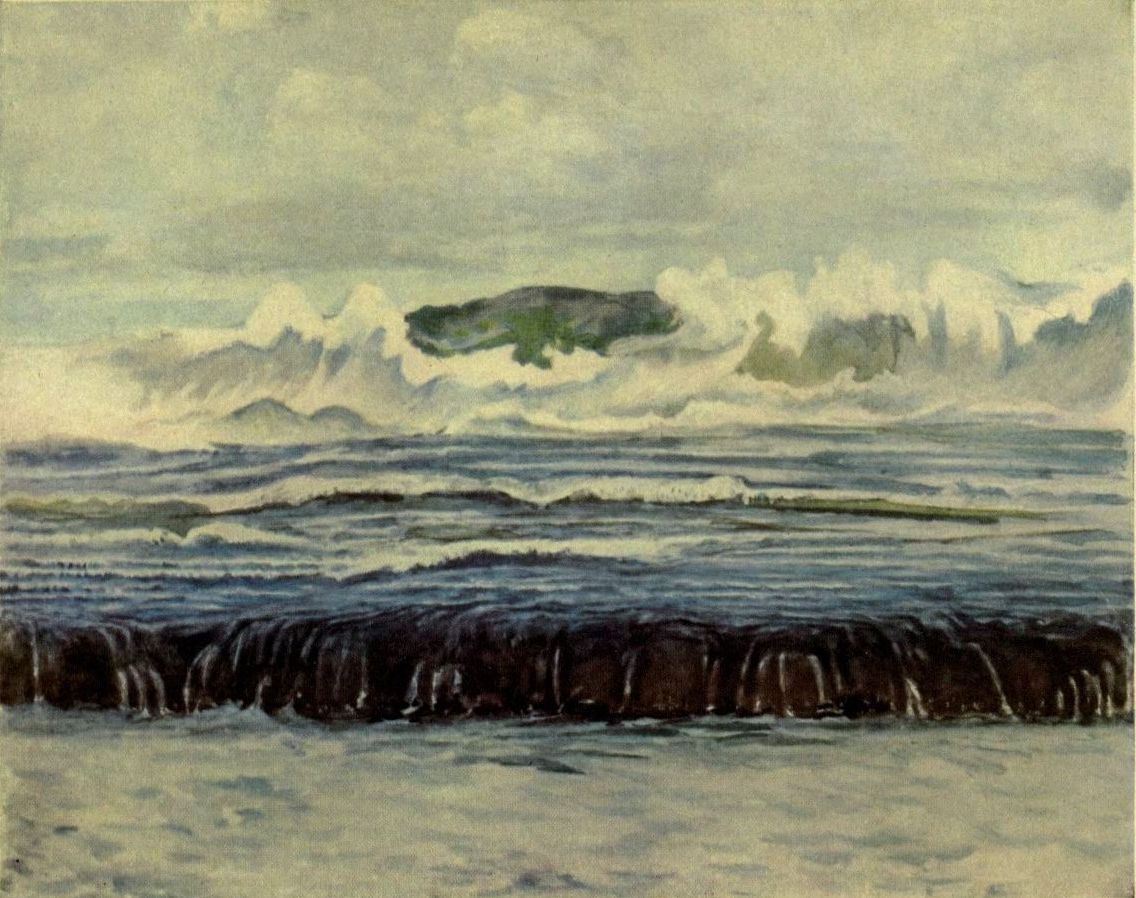
we can tell (because we have been long away) dressed in some correct French fashion; looking not at all incongruous, because already we feel that this is dreamland—that anybody in any guise is natural here, except a few Europeans, who meet the place halfway, and belong neither to where they came from, nor to the unreality of the place they are in. There is no noise, the street is the beach; the trappings of the artillery horses, and the scabbards of the sabres rattle in a profound silence, so great that I can distinctly count the pulsations of the water running from the fountain near us into the sea. The shapes and finish of the government buildings, their long spaces of enclosure, the moss upon them, remind us of the sleepiest towns of out-of-the-way bits of France.
The natives slip over the dust in bare feet, the waving draperies of the long gowns of the women seeming to add to the stealthy or undulating movement which carries them along. Many draw up under the arm some corner of this long, nightgowny dress that it may not trail, or let their arms swing loosely to the rhythm of their passing by.
Most of the native men wear loose jackets, sometimes shirts above the great loin-cloth which hangs down from the waist, and which is the same as the lava-lava of the Samoans, the sulu of the Fijians, and is here called the pareu.
Many of the women have garlands round their necks and
flowers behind their ears. Occasionally we hear sounds of singing that come back to us from some cross-street; and as I have ventured to look, I see in a little enclosure some women seated, and one standing before them, making some gestures, perhaps of a dance; and I grieve to say, looking as if they had begun their latest evening very early in the day. But this I have noticed from sheer inquisitiveness. I feel that in another hour or so I shall not care to look for anything, but shall sit quietly and let everything pass like the turn of a revolving panorama. In this state of mind, which represents the idleness of arrival, we meet at our Consul’s an agreeable young gentleman belonging to a family well known to us by name—the Branders; a family that represents—though mixed with European—the best blood of the islanders. They speak French and English with the various accents and manners that belong to those divisions of European society; they are well-connected over in Scotland. Do you remember the Branders of “Lorna Doone”? At home their ancestry goes back full forty generations. They are young and pleasant, and we forget how old we are in comparison. We call on their mother later, a charming woman, and on an aunt, Mrs. Atwater, who has a similar charm of manner, accent and expression; and on another aunt, the ex-Queen Marau; but she is away with her younger sister Manihinihi.
In the evening, with some remnant of energy, we walk still further than our house upon the beach, passing over the same roads that Stoddard wearily trod in his “South Sea Idyls.” We try to find, by the little river that ends our walk, on this side of the old French fort, the calaboose where Melville was shut up. There is no one to help us in our search; no one remembers anything. Buildings occupy the spaces of woodland that Melville saw about him. Nothing remains but the same charm of light and air which he, like all others, has tried to describe and to bring back home in words. But the beach is still as beautiful as if composed for Claude Lorraine. Great trees stand up within a few feet of the tideless sea. Where the shadows run in at times, canoes with outriggers are pulled up. People sit near the water’s edge, on the grass. Outside of all this shade, we see the island of Moorea further out than the far line of the reef, no longer blue, but glowing like a rose in the beginning of the twilight.
At night we hear girls passing before our little garden; we see them swinging together, with arms about the flowers of their necks. They sing—alas! not always soberly, and the wind brings the odour of the gardenias that cover their necks and heads.
In the night the silence becomes still greater around us, though we can hear at a distance the music of the band that plays in the square, which is the last amusement left to this dreary deserted village called a town. In the square, which is surrounded by many trees, through which one passes to hidden official buildings, native musicians play European music, apparently accommodated to their own ideas, but all in excellent time, so that one just realizes that somehow or other these airs must have been certain well-known ones. But nothing matters very much.
A few visitors walk about; native women sit in rows on the ground, apparently to sell flowers, which they have before them. People of distinction make visits to a few carriages drawn up under the trees. Occasionally, in the shadows or before the lights, in an uncertain manner, natives begin to dance to the accompaniment of the band. But it is all listless, apparently, at least to the sight, and just as drowsy as the day.
In the very early morning we drive to the end of the bay at Point Venus, to see the stones placed by Wilkes and subsequent French navigators, in order to test the growth of the coral outside. And we make a call on a retired French naval officer, who has been about here more or less since 1843, the time of Melville. We drive at first through back roads of no special character. We pass through a great avenue of trees over-arching, the pride of the town; we cross a river torrent, and the end of our road brings us along the sea, but far up, so that we look down over spaces of palm and indentations of small bays fringed with foam, all in the shade below us. On the sea outline, always the island of Moorea, and back on Tahiti, the great mountain, the Aorai, the edge apparently of a great central crater; a fantastic serrated peak called the “Diadem,” also an edge of the great chasm; and on either side along slopes that run to the sea, from the central heights, and recall the slopes of Hawaii. But all is green; even the eight thousand feet of the Aorai, which look blue and violet, melt into the green around us, so as to show that the same verdure passes unbroken, wherever there is a foothold, from the sea to the highest tops. This haze of green, so delicate as to be namable only by other colours, gives a look of sweetness to these high spaces, and makes them repeat, in tones of light, against the blue of the sky, chords of colour similar to those of the trees and the grass against the blue and the violet of the sea.
Nearer us the slopes are all broken up into knife edges of green velvet streaked right near us by clay, which in contrast seems almost like vermilion. So far the roads were good, though the slippery clay might be very different when the great rains came down; and as our driver forced his horses at a gallop near the edges of the cliffs hanging over the lovely pictures of the secluded trees and water, we felt that a more sandy, more prosaic road would better suit the South Sea habits of carriage travel.
All the trees were about us that we knew in Samoa; and many more rounded mango trees, with red fruit hanging on long stems, or lying green by the road. All this was to be seen with cool air full of life, and under a sky more like ours than the Samoan, but exquisitely blue and gay.
Little has been done by us, even of going about; Atamo has written many letters; I have tried to sketch a little from our verandah, in front of which, on the shore, grows a twisted purau, called fau in Samoa. Through its branches I see the sea and the reef, and the island of Moorea, in every tint of blue that keeps the light, even in the evening or in the afterglow, when the sunset lights up in yellow and purple the sky behind it. And yet there is a reminiscence in my mind of something not foreign to us, even at this moment, when the haze of light seems new, and the pale blue sea is spangled with little silver stars, as far as I can see distinctly.
We have called on the ex-King; and in the evening, at the club, I have seen him—a handsome, elderly man, somewhat broken and far from sober. He was playing with a certain
THE DIADEM MOUNTAIN. TAHITI
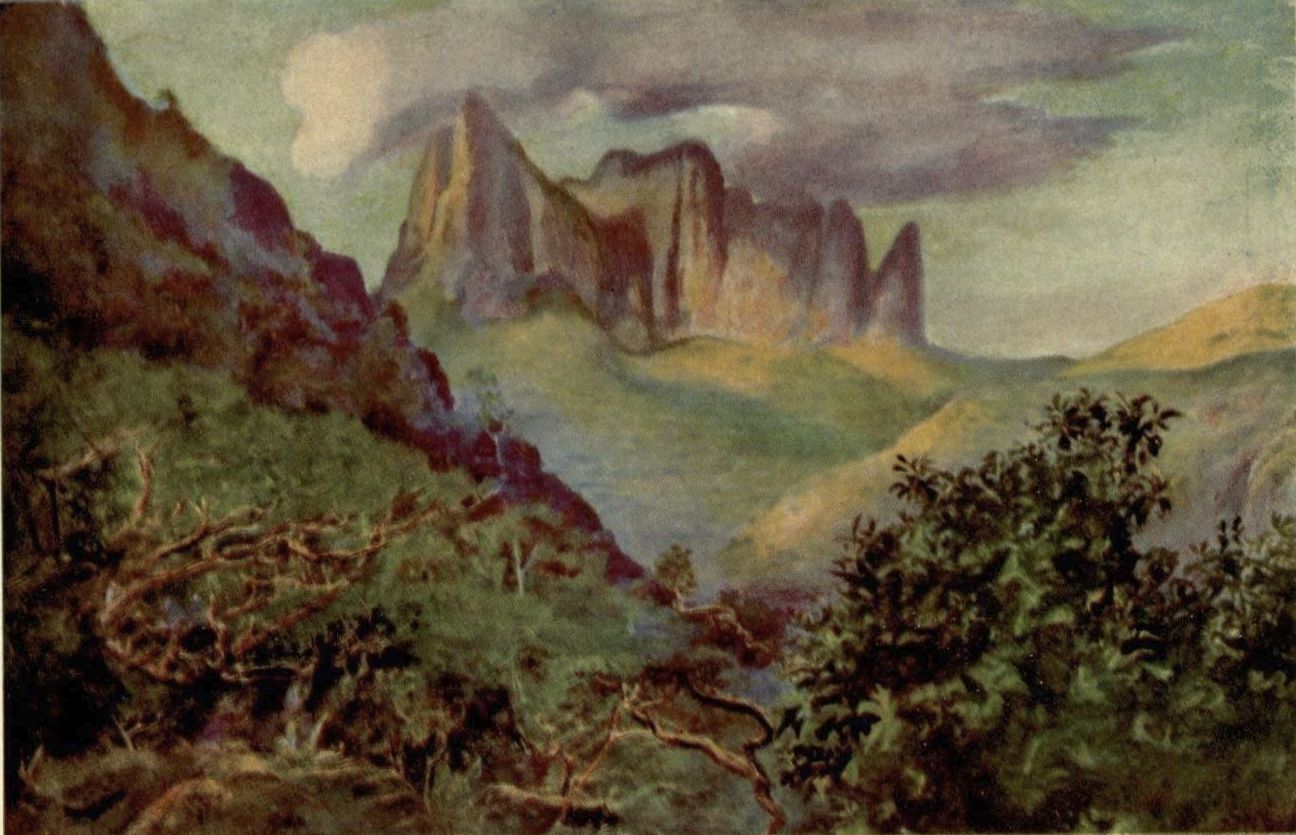
Keke, a black Senegambian in the French service, a prince of his own negro land, who speaks excellent French, and whom I surprised sitting on the sill of his house one evening (while we were taking a rainy walk). Keke wore in this retirement a pair of marvellous trousers, of a brilliant yellow, with red flamboyant pattern—something too fine for the ordinary out-of-door world. Many of the officials are coloured men from the French colonies, and so is the governor more or less. Of course the idea is infinitely respectable and humanitarian, as so many French things are, but I fear that the Republic is unwise in sending people whom the native here cannot look up to as he does to a white man.
Of course they are all French and have votes, as the natives here can have also; but whether it is for the real good of a population accustomed to dependence I am not so sure. There are many curious anomalies: our American friends of Samoa speak, with our natural way of looking at things correctly, of the preposterous way the French have of backing the Catholic missions and protecting their missionaries, even as we would. But here I find the Catholic mission dependent upon the gifts of the faithful, while the Protestant missions are supported by the French government, as the Protestant clergy would be in France.
The King, upon whom we called and whom we met at the club in affable mood, surrendered his rights to the French, a few years ago, under long pressure and with some advice from the missionaries. In exchange he received an annual income, and retained his honours and certain privileges. This end I suppose to have been inevitable. His mother, the famous Queen whose name was known to all sea-going people in that half of the globe, whose resistance to French pretensions had come, apparently, for a moment, near bringing France and England into a quarrel, had lived for many years under French authority, a government under the name of protectorate. Such, I suppose, must always be the end, as it has been everywhere that the English have been; as it has been in Fiji; as it will be to-morrow, probably, when King George of Tonga dies; as it will be in Hawaii, whenever the whites there determine to use their power. Nor is the line of the Pomaré, any more than that of the Hawaiian rulers, so connected with all antiquity as to be typical of what a Polynesian great chief might be to the people whom he rules. The Pomarés date only from the time of Cook. They were slowly wresting the power from the great family of the Tevas, by war and by that still more powerful means—marriage, which in the South Seas is the only full and legitimate source of authority.
You know from all that I have told you of Samoa that in Polynesia descent is the only real absolute aristocracy; there is no ruling except through blood. Hence the absurdity of the kingships that we have fostered or established, which in our own minds seemed quite legitimate, because they embodied the European ideas which belong to our ancestry. Hence the general discomfort and trouble that we have helped to foster. Hence also—and far worse—the breaking down, in reality, of all the bases upon which these old societies rested, the saving of which in part was the only hope remaining for the gradual education of the brown man for his keeping to ideas of order different from our own, it is true, but still involving the same original foundations. Hence the demoralization, the arbitrary “white laws,” always misunderstood, always bringing on the vices which they were meant to control; hence the end of the “brown” man by himself.
The missionaries’ good-will has never gone so far as to try to understand him as a being with the same rights to methods of thinking as we claim for ourselves. Part of this sad trouble is of course owing to the unfortunate moment which gave birth both to greater missionary enterprise, to a first acquaintance with these races, and to the disruption of authority in the West. Perhaps, indeed, it might then have required more comprehension than could be asked of any but the most exceptional mind to realize that what we call savagery was a mode of civilization. So must have been the European world when the civilization of antiquity broke down, and things of price went into the night of forgetfulness, along with the mistaken beliefs and superstitions that were joined to them. So here, where, as in all civilizations, religious views, manners, customs, superstitions were woven about every bit of life, the exterminating of anything that might seem pagan involved many habits, and some good ones, which necessarily, from their fundamental antiquity, had been protected by religious rites. Hence we brought on idleness and consequent vice; for idleness is as bad for the savage, whom we innocently suppose to be idle, because we do not understand how he busies himself, as it is for the worker in modern civilization. It is not the actual doing that is important, but such occupation as may determine a habit of useful or harmless attention, which prevents the suggestion of untried moral experiments.
Even tattooing was a matter which like any society duty involved attention, considerable self-abnegation and suffering, so as to suit the supposed requirement of civilization, and a recognition of some manly standard, however childish it might seem to us, even if it seems as absurd as some of our society standards might seem to the so-called savage.
These reflections came from reading a law of missionary civilization which I find in the records of the year 1822, in the neighbouring island of Huahine; in which a man or woman who shall mark with tattoo, if not clearly proved, shall be tried and punished, and made, for the man, to work on the road, for the woman, to make mats; in a proportion of which the only exact measure that I find is that for the man it is about the same as that for bigamy; for the woman just the same as adultery.
With the coming of the missionaries, with the coming of the white men traders, coincided the first attempts of the ambition of these Pomaré chieftains. They had already done a good deal for themselves before Cook left for the last time. He had seen Oberea, of whom I first spoke, a great person. When he left, her line of family was already on the decline; war and massacre had weakened it. Pomaré—the Pomaré of that day—with the support of the guns of the white men, established his final superiority, and becoming the great chief was solemnly crowned and oiled by the missionaries, like a new king of Scripture. And this man is the last of the line. His first great ancestor, Otu, just appears with the first discoverers’ records of the details of the ceremonials and etiquette belonging to high chieftainship, which are recorded in the first missionary accounts.
You may remember the picture painted by Robert Smirke, Royal Academician, where the high-priest of Tahiti cedes the district in which we now are to Captain Wilson of the missionary ship the Duff, for the missionaries. In the centre, with a background of palms and peaks, two young people—Pomaré, the son of Otu, and his queen—are represented on men’s shoulders. That was the old fashion of Tahiti, the great chief not being allowed to touch the land with his feet, lest it become his by touch.
Pomare Rex
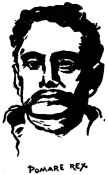
And therein also is shown the peculiar political arrangement by which the young chief took his father’s place when a child, and ruled, in appearance at least; for there in the picture alongside of the two young sovereigns, called kings by us, stand father and mother uncovered to the waist, out of respect to their child’s higher position. Otu and Iddeah, the dear lady whose notions about infanticide troubled the good missionaries to such an extent, but whose courtesy was willing to go so far as to promise that she “never would do it again,” when once she had done as she pleased. As I understand it, the Pomarés, then, pass away with the present King, but the great line whose place they took—the Tevas or their representatives—remain. In that line continues a descent from that Queen Oberea, whose figure, in another picture that I have referred to and which I beg you will look up in the volume containing Wallis’s discovery, is so charmingly made a type for an imaginary kingdom, like those of the operas and the tapestries of the eighteenth century, in which nothing is untouched by fancy but the muskets and grenadier caps and uniforms of Wallis and his men.
I have almost been tempted, as you see, to begin a sort of explanation of the history of the island; but I think that I can manage later to give you certain stories which will have the advantage of a more personal knowledge of acquaintance with what might be called the text, than these vague reminiscences of the books that I have read and which are nearer to you than they are to me. Meanwhile, let me tell you that last evening, at the club, His Majesty, who was in extreme good humour, singled us out, told us how he liked us, that he liked Americans, who themselves liked Tahitians, and that the French, who stood all about him, were all d—d—d——
This he said in English, in a proper reminiscence of nautical terms of reproach, and added blandly, “But I don’t understand English.”
He has a fine, aristocratic head, and must have been a very handsome man. He has for an adopted son one of the young gentlemen of the Branders, who will succeed to an empty honour; though there might perhaps yet be a part to fill, for the family that represents all that there has been far back and recently.
Next week we shall go into the country, further along the coast, and make a visit to the old lady who is the head of the house, grandmother of these young men, and who is the chiefess representing that great line of the Teva, alongside of which the Pomaré—the kings through the foreigner—are new people. Then I may write lengthily, or at least with some detail, about matters that I only see confusedly, but which must be curiously full of ancient, archaic history, however lost or eclipsed to-day.
I notice in my habits, now forming, as I write out my journal for you, a tendency to dream away into a manner of philosophizing which evidently has for its first beginning the appreciation of the remote forms of these savage civilizations; so that as I grow to understand them better, it is necessary for my individual happiness of thought to be able to consider the earlier ways of man as not unconnected with the present, and even to be willing to consider all foundations of society as passing methods suitable to the moment, and perhaps in the great future to vary as much from the present as the past is strangely different. The good missionary, who simply looked upon a good deal of this past as strangely resembling the antiquities of the Bible, consoled himself, and persuaded many of his brown brethren in the belief that they, at last, were the famous lost tribes, who still kept, in many ways and details, that very peculiar manner of life which the Bible sets out in many details.
One evening in Samoa, the great Baker, the former missionary and ruler of Tonga, finding me interested and credulous in regard to many superstitions which he described, and many facts quite as extraordinary that he vouched for, unfolded to me, as a regard of confidence, his firm belief that in these islands of the Pacific, Reuben, Simeon, Levi, Judah, Zebulon, Issachar, Dan, Gad, Asher, Naphtali, Ephraim, Manasseh and Benjamin had found a home. And if a man so worldly wise, such a producer of money, such a controller of weaker minds, dwelt in this view with satisfaction, as a relief from the sordid necessities of power, I think that a mere dreamer like myself can be excused for turning to more scientific and accurate arrangements of men’s history.
These words come to me more distinctly suggested by the place in which I am, not because I am thinking of the ancient ways that I touch, but because I remember how Melville passed from those records of exterior life and scenery to a dwelling within his mind—a following out of metaphysical ideas, and a scheming of possible evolution in the future of man.
Papara, April 7th.
This is a land where to live would have made you happy. Outdoors and in the water, and in no compulsory dress, would have been your usual way of passing a great part of the time. I thought of you while I looked this morning at the children playing in the water of the little river, or in the surf that rolls into it or along the shore. The girls, little wee things, swam in the stream near its mouth, where it is safe, and plunged in and out, and swam under water, their feet and backs showing within the light and dark of the currents; for the river has been very full, and the surf and tide have been heavy, so that the children take their turn with the current. The boys were out in the surf, on the border of which occasionally the girls played, edging sideways to it, and running back with swinging arms. The boys and one of the men plunged out with surf boards, ducking under or riding over the waves that did not suit them; then turning just before the wave that suited, they were carried along the shore leaning on their boards. The currents of the sea carried them past us looking on. Of course they knew all about them, and rough as the surf was, one of them had got past one of the lines of the breakers and tried fishing in some bottom both higher and less vexed. It was a pretty sight, the brown limbs and bodies all red in the sun and wet, coming out of the blue and white water like red flowers. The girls were yellower and more golden than the boys—less tanned I suppose.
They have been running about with less clothing, perhaps because the family is away. They left yesterday, and the daily life is the same. That is to say that only Tati and his family, including one of the boys whose holiday is prolonged, are here with us. The old lady (Hinaarii) the Queen (Marau), Miss Piri (pronounced Pri, short for Piritani, Britain), Miss Manihinihi, and the two young men all went off together; the ladies to spend some time at their house in Faaa, the most rustic, I believe, of their residences.
Pleasant as it is to talk with Tati or do nothing, I miss the ladies. The old chiefess is admirable, and is willing to talk to us of legends and stories with the utmost patience. I wish I had a portrait of her. She has a most characteristic and strong face, upon which at times comes a very sweet smile; as I saw yesterday, when she was asked which she preferred, Moorea, the island she comes from, or Tahiti, where her life has been mostly spent. “Tahiti!” she said decidedly, resuming in the inflection of her voice all the memories of a long life that has seen so much, and so much that is different and contradictory.
Queen Marau has been very affable and entertaining, telling us legends and stories; Miss Piri has been ailing, Miss Chiki, smiling. The women of the family are all extremely interesting, of various types, but each one with a charm of her own; from Marau’s strong face, fit for a queen, to Manihinihi’s bright cordial smile. And such beautiful voices as they have, and rich intonation! It is a remarkable family and a princely one. When you read the next few lines you will say that I am prejudiced about my own people, and anxious to have you admire them also; but I don’t care, I am glad to have such relations. For, a little before her departure, the old lady sent word that she wished to see us; and when we had come to sit beside her, she told us that she had decided to confer family names upon us, choosing the names which had given the power and which belonged to the ruling chief. Consequently Atamo takes the name of Tauraatua, Chief of Amo, meaning Bird Perch of God, and I of Teraaitua, Captain of that ilk, meaning Prince of the Deep. The old lady said all this with great sweetness and majesty, and we were greatly touched by the compliment.
This afternoon we went to see the little place which is Amo, and from which the Tevas were ruled. It is a small principality only fifteen fathoms long, and is at present all overrun with trees, orange and guava mostly. But not so long ago, as Tati remembers, it was as it had been before the little river changed its course and tore it up—a large paipai or stone platform, edged with stones carefully set, long ones above, others with oval ends nicely finished below (turtle heads they are called). Here lived Tauraatua, sixteen generations back, simply and frugally, refusing to change his habits with increased power, and contented with cheap fare. Here on the little platform he drank kava, with the river running by; and once, while lying under its influence (dead drunk, as it were), came near being surprised by the enemy. Some little while ago the tall cocoanut tree was still standing, which had served as a lookout and watch-tower against the enemy; and from which the watcher had descried the invader just in time to save the chief, and have him carried away like a precious parcel.
For Tati informs me that here kava was not the mild drink of the Samoan. It is apparently the same root to the sight, but whereas whole bowlfuls did not affect us, and whites are accustomed to it in Samoa, a glassful here, according to Tati, was and is a serious drink. Its charm lay apparently in the drowsiness and dreaminess it produced; people spoke of their having been dead under it, or of having seen things, as with opium or haschich (hemp), and to-day opium is killing the last of the Marquesans. It could be nothing more than to carry out more completely what seems to us fierce whites the meaning of these lands—to exist without effort, in indolence, and waiting for nothing to happen. The narcotic would condense it all, would bring a year of dreams into a something that could be felt like a single act, like an occurence that comes to you, instead of your making it, little by little, so that the beginning is forgotten at the very middle of the tale.
Such happiness was broken into by noise, and chiefs demanded, for their hours of kava influence, absolute silence about them; not even a cock might crow. One can understand the objection to it made here by the missionaries, which seen from our Samoan experience seemed useless and cruel. Another example of a momentary or local matter becoming built into a principle.
We went to see the new duchy; Adams took off an orange as a manner of investiture. I made an effort to see if I remembered it in a previous existence, but I did not. Tati remembered it, of course, and the place near by, all overgrown with great mango trees that have crowded over it, where his mother lived, and where the stone copings mark the base of the native house and a platform outside.
Later on Queen Marau told us of the trick by which the great Chief of Amo won influence, having claimed limits which were contested by powerful opponents. He left the decision to the great god Oro (whose temple, you know, was at Tautira), and where he was when a voice called from some unknown place and “gave him right.”
This is the story exactly as Queen Marau told it.
STORY OF THE LIMITS OF THE TEVAS
When Oro was Chief of Papara, Hurimaavehi of Vaieri was ruling over all this side (Mataeia). A woman brought about the overthrow of Vaieri and the headship of Papara.
Oro had a son whose friend, named Panee, was the father of a beautiful daughter, beautiful enough to attract the notice of all, as indeed it was the glory of the place to do. Hurimaavehi, having heard of her beauty, had her carried off at night, by men sent for the purpose. Her father, in his distress, not knowing what had befallen her, but guessing at it, sought her up to every limit. One day, while he was inquiring at the limit near Mataeia, he saw two men coming toward him.
“Where from?” said he.
“From Vaiari.”
“And how is Hurimaavehi, and all around him, and what new beauty have you in Vaiari?”
The two travellers answered. “If you talk of beauty, there is a wonder has sprung out there, and she belongs to Hurimaavehi.”
“She must be well treated?” inquired the old man suspiciously.
The two said, “No indeed! She has been passed down to the servants (Teutunarii), then sent to the dogs and the pigs and to the fish of the sea.”
So the father, like a madman, called out all manners of insult against Hurimaavehi; and he rushed away (like a madman) to the limits of the district of Vaiari, and meeting five people—Tite and four others (iatoais[13]) under Hurimaavehi, he killed them (“which,” says the teller of the story, “was a challenge”), and he gave his insults to be repeated by the travellers to the Chief Hurimaavehi. So that Hurimaavehi was incensed, and came right over to Papara with his people.
Now the girl’s father had told his friend, the son of Oro, that Hurimaavehi would be coming to attack, and why. And the son of Oro said, “Come with me”; and they went to his father Oro and told him, how Hurimaavehi was coming to kill them, and why.
Oro said to his son, “Hide under this marae” (the marae whose remains or rather whose place we saw at Amo), and to the other, “Do you go up this tree” (the famous cocoanut that served as a watch-tower), “and when he comes back attack and beat him.” He came with his men, they beat him, and Hurimaavehi ran off, with Oro and all his men after him, following on and taking possession of every limit, until he came to Teriitua. Then Teriitua said, “No further; this belongs to me.” (Hitiaa.)
Then the limit was decided, as the famous story tells.
This is the downfall of Vaiari and the rise of Papara.
And the girl, having served her purpose of introducing the war, steps out of the story.
The daughter of Panee, whose fame for beauty brought on this trouble to herself and subsequent enlargement of her people, was, as the story shows, known as a beauty far from home. Our brown ancestors admire beauty no less than other people; and looked upon it, as we do in many cases, as a good instrument, besides the credit to the family and the favour that goes with the possession of any social power. But you must always remember that our brown forefathers were eminently socialistic, or rather communistic, as their relatives all over the Pacific are still. Never forget this for a moment, whenever you think of them or read about them or any habits of theirs. We have developed from that point to a degree of individualism that can with difficulty understand what communism means. So that we are easily deluded and over-pleased, or horrified, when like views and systems are proposed in the western world for our descendants.
Now then, the family, in the case of a lovely brown maiden, would not only be her own family (as we call it directly), but spread further and back, in all sorts of relatives, and from that spread out to the village and the tribe; so that her beauty would be a credit to the whole place. Hence she would become a show-piece; and her immediate parents, with the good-will of the community, would guard her beauty, would feed her well and daintily, to make her smooth and fat; would keep her out of the sun that might darken her skin, fairer than that of others, if still brown to our snow-blinded eyes.
She would then occasionally be seen; and it was considered a proper and justifiable extravagance for even a lesser person to have a paipai, or stone exterior foundation to his house, upon which his fair child could be seen. And at certain intervals she would take her bath in public with others, and her physical charms be fairly judged. Nor must we think that all this is brutal—no more than with us to-day.
The girl was also judged by her manners, her courtesy and her modesty; for she thought no more of showing her legs than do our young women of showing their necks and bosoms and backs; and she had the same notion that they have that there are strict limits—even though hers might not be ours. You will remember, perhaps, in early accounts, the pretty description of women playing on the shore or in the water, at games of ball, as did Nausicaa in the days of Ulysses.
Many times have I heard allusions to the habit of keeping in one house a number of the girls together, beauties of the place. And if I remember right, it was to such a residence that the celebrated Turi contrived to pass, notwithstanding the difficulties put in his way—difficulties all the more interesting as mere delays; for the young women had heard of his exploits and expected as much of him. But then, if I remember also, he lived in those days when people, especially the heroes of tales, could be gifted with the power of changing their forms at will. And who could have guessed in the decrepit or leprous old man, pitied for his sorrows by the tender women, the gay Lothario heard of through all islands. Still less could he be discovered in the fish that was caught by the old women who supplied the women’s house with food. He it was who dug the great tunnel through the mountain, in order to approach his love without detection—her who was Ahupu Vahine of Taiarapu, of whom Stevenson, in the notes of his Ballads, says that he has not yet been able to find out who she was. Why! there is a whole “Chronique Scandaleuse” of that period of earliest history.
Oro then belonged to the younger Vaiari, and seized the power of the older branch.
Let us take up the story as he pursues his enemy into the territory of Teriitua, Chief of Hitiaa, who checked his advance, disputing, most naturally, the limits that were being conquered. So that they left the decision to the Gods, as I understand, upon Oro’s proposal.[14]
Upon a day appointed they met for the invocation; but Oro had determined to help himself that he might be helped; as many pious men have done and will do again. A friend of his, whom tradition names Aia, was concealed carefully in a hole or hollow place, near the disputed boundary. Teriitua’s call upon his gods, being met only by the silence of the woods, Oro called out, pointing out, I suppose, what he wished, “Is it here?” And his friend answered, “It is here.”
The cause of Oro won; a little, perhaps, because according to all tradition, he was a doughty warrior who intended to have his way.
We now belong to both the “Inner” and “Outer” Teva: Te Teva Iuta and Te Teva Itai, the whole eight, whose clans reached all down this side of the island, and into the next; for we have been adopted twice, both at Tautira, and here—into the two divisions.
The place has now for us an increased charm; a still more subtle influence envelops me when I think that this is the home of Amo and Oberea, who first met Wallis and Cook; and as I look from the violet beds of one of the princesses to the solemn hills of dark green crowned with cloud, I wonder if somewhere there may be the hidden tomb of Oberea, now my ancestress, the quiet familiar surroundings became solemn with this great reminder of the mountains and the ocean that faces them.
I listen now, with a curiously new interest, to the explanations of the meanings of landmarks and to their names full of associations for the Teva line. We have it explained to us that each chief had a marae, a temple associated with the sacredness of his name; and many rules concerning its foundation; and the places within it reserved to chiefs through heredity and heredity alone.
Each chief had also a moua or mountain; an Otu or cape or point of land; a Tahua or gathering-place, from which he ruled. Every point, says the island proverb, has a chief.
For the Teva the oldest marae was Farepua in Vaiari, from which, by taking a stone from it, Manutunu, the husband of the fair Hototu, mother of the first Teva, founded the marae of Punaauia for his son. (He called it so because of his uncle, who dead was rolled up like a fish—iia.)
From these two maraes, many maraes along the coast, and in Moorea took their origin and proved the family descent. The Moua of Papara was Tamaiti; its Outu was Monomano; its Tahua, Poreho; its marae, Tooarai. Our adopted mother’s name is Teriitere Itooarai, which you will remember is the name of the son of Oberea and Amo.
Taputuarai in the small district of Amo was the original marae of Papara, and from that Amo took the stones to build the marae of Tooarai on the point of Mahaiatea.
A poem traditional in the family gives expression to the value of these points—to the attachment to and desire to be near them again, in the mind of an exile, one of the Papara family. The family seems to have been represented by the Aromaiterai and the Teriterai, one of whom ruled in the absence of the other.
How far back this was composed, nor exactly how it happened that one brother, Aromaiterai, was banished, I do not know. One or other branch seems to have been always jealous of the other; but in this case one Aromaiterai was banished and forbidden to make himself known. He was sent into the peninsula to Mataoa, from which place he could see across the water the land of Papara and its hills and cape. The poem which he composed, and which is dear to the Tevas, revealed his identity:
LAMENT OF AROMAITERAI
From Mataoa I took to my own land Tianina, my mount Tearatapu, my valley Temaite, my “drove of pigs” on the Nioarahi.[15]
The dews have fallen on the mountain and they have spread my cloak.[16]Rains, clear away, that I may look at my home! Aue! Aue! the wall of my dear land! The two thrones of Mataoa[17] open their arms to me Temarii (or Amo).
No one will ever know how my heart yearns for my mount of Tamaiti.[18]
Could anything be finer than the rallying cry of the Tevas:
“Teva the wind and the rain!”
For a line running back to origins confused with the brute forces of the world; originating with divine creatures half animal—with the princes of double bodies, half fish, half man, what more poetic reminder of the intimacy with parental nature.
I sometimes think of our chiefess as being able to feel with Phaedra, that the encompassing world is full of her ancestry.[19]
And here the heroic line brought down through ages to the present day, brings back to my mind the tradition that the lines of the fabulous Homeric heroes were carried into the new Christian world as far as the days of St. Jerome. Nor was the suggestion of the thought of Phaedra, claiming kinship with the universe, so far from the echo of the name of Queen Marau, whose further name is Taaroa, the great first god whose relation to the world is given in the verses:
“He was; Taaroa was his name. He rested in the void. No land, no sky, No sea, no man, And he alone existing took the shape of the universe. “The pivots are Taaroa: The rocks, The smallest sands are Taaroa. Thus he called himself. “Taaroa is the light, He is the germ. He is the base, The strong who created the world: The great and holy world The shell of Taaroa. He moves it, he makes harmony.”
The records of the past are all in words handed down; and the absence of any outer form to antiquity makes me seek it all the more in the nature which surrounds me, in the imaginary presence of the people who lived within it.
One great disappointment awaited me: I had hoped to find some form in the great marae or temple built by Oberea, in her pride of place, which Cook speaks of as the principal building of the island, and describes as an imposing monument. We found it only a vast mass of loose coral stones, treacherous to the foot and retaining but a vague and unimpressive outline. Still it was upon the shore, by the beautiful sea, and the funereal aito or ironwood trees sacred to temples still grew upon it. Stewart, the planter who for a term of years was able to keep up a great estate, at the head of a company behind him, planned on a grand scale, and who then failed, was allowed to use the stones of the marae as a quarry for his roads and walls. Even before that time neglect and the destruction brought about by the enmities to the old paganism must have changed its shape and destroyed its outline. To-day it is impossible to recognize the form described by Cook. It was made, he says, of a series of steps rising in pyramid way, to a top layer ridged like a roof; and its long sides, which hollowed in slightly, were some two hundred and thirty feet in length. Now it is a sad ruin, shapeless and barbarous.
As I left it I remembered that Moerenhout, visiting here some sixty years ago, says that few natives except the great Chief Tati saw without superstitious fear the cutting down of the majestic trees which had witnessed for centuries the ceremonies of the forbidden worship, and had survived the decadence of the temples which they adorned. When he adds, the great trees had been cut down which shaded the marae further inland, specially sacred to the chiefs of Papara, which had been that of Tati himself and of his children, a rumour spread about the country that the water of the little river, the river that ran through our ancestral domain of Amo, had reddened, and blood had trickled from the trunks of the prostrate trees.
Last month, at Tautira, the absence of all vestiges of the great marae of the God Oro, was more impressive than the formless mass of stone associated with the name of Oberea. It is always a disappointment to notice how little this race has turned to the arts of form. I mean this race as I have seen it, in Samoa and in Tahiti. Elsewhere it may have done something, but here the form of music only has been reached—the earliest mode of expression. And though the Polynesian still shows good taste in colour and choice in arrangement, he seems to have taken but the very first steps in the adornment of surfaces or the arrangement of masses. It is possible that there is something strenuous and needing sustained effort in the plastic arts which these sensuous races, urged by no contrarieties to find some escape out of the present, were too indolent and contented to achieve.
I have made many notes that I shall string together as I best can; but I am ineffably lazy, and this is the place for me in the house of Tati. I sleep in the rooms where his great-uncle Tati, the great Chief, died: he who ruled here at the beginning of the new dispensation, who was a child in the days of the first discoverers, and who lived well into the fifties. He was saved from the massacre of the Papara family when a child, through some recognition of the behaviour of Manea the high priest when he saved the pride of Tetuanui in her contest with the pride of Oberea.
So that the revenge of Tetuanui spared this boy, who became an important man representing the great Teva house. But that was only after the son of Amo and Oberea had died by accident, leaving to the Pomaré Chief no equal rival; and after Tati’s brother Opufara had died in battle bravely defending the Pagan side against the Pomaré, helped by the rifles of the Christians.
Tati had apparently refused to avail himself of the offer of Pomaré, before his death, to appoint him regent, nor did he consent to our chiefess being made queen: for he seems in many ways to have asked for the best interests of his nation, and always with higher motives. There are interesting descriptions of his influence and of his dramatic eloquence, which Moerenhout compares to the action of Talma, the greatest of French actors. I read about him in Moerenhout’s volumes; I make sketches during the day, and talk to the Tati of this moment, enjoying the sound of his voice and his laugh, and the freedom of the children, and the movement of the servants.
There is one who is always hard at work doing everything, who is really Marau’s, a girl of good family, a sort of relation of mine now, and who is called Pupuri (if I catch it right), “Blonde”; and she is blond; her hair is absolutely gold, and when she has her back turned and her hair down you would suppose some foreign visitor from northernmost Europe. She is fair, a little red, like an Irish woman, with whitish lashes, and eyes that do not stand the light well.
Madame sits at one end of the piazza; the ladies flit in and out of their rooms and sometimes talk to us.
Next to our house, where some women have beds and others mats for sleeping, there are other houses for cooking, and for
YOUNG TAHITIAN GIRL
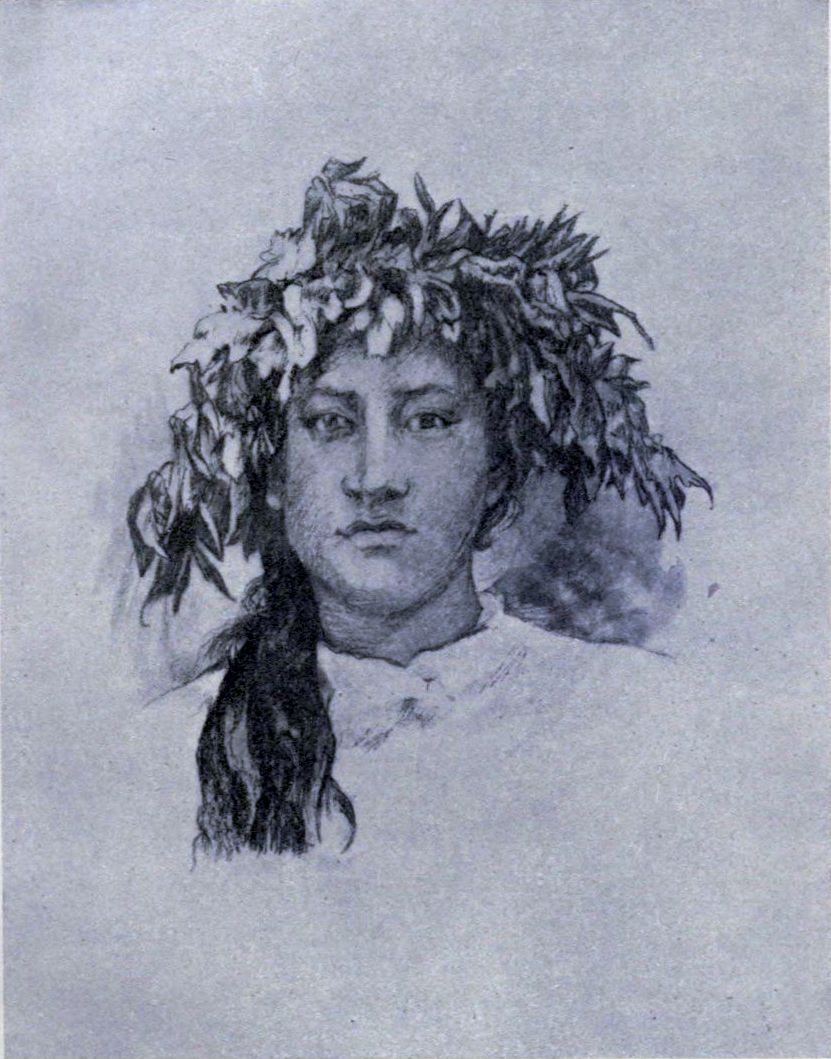
servants who are in reality dependents. Sometimes members of the family eat there, in native fashion, of native cooking, instead of coming to the table at which we sit on one end of the verandah. Near by is a little garden growing on what was once the enclosure of a house; and the little river runs rapidly a few yards off, hidden in part by trees; at which women go down to wash, and which men and boys cross to bathe, and in which splash the horses when they are washed in the morning. It is all delightful and rustic.
We are arranging with Tati about going to Moorea, the island opposite Tahiti, where we can be in the mountains that come right down to the water.
As the island makes a perfect triangle, the clustering together of its mountain peaks, seen from Papeete, used to look like some background of early Venetian pictures, inspired by the Dolomites that Titian knew when a boy. Tati has a plantation and house there to which we shall go; and the family are strong in the island, having antique rights and inheritances in different districts.
We shall stay only a few days here, and then sail or row across to the fantastic island that has made a distance of blue and gold to our days in Papeete, and behind which the sunsets used to sink in every variety of indescribable splendour or delicacy.
Papeete, May 22, 1891.
We did not leave by the steamer; by some curious chance unknown before, it was filled with passengers. It is true that it does not take a large number to fill it. We feared discomfort, and hurrying back from Moorea, we nevertheless lazily let it get away from the point on the coast to which it had gone for its cargo of oranges. Whether or no Tauraatua had already presented to his mind the alternative that opened to us I do not know, but we turned at once to a longer sea trip and a less probable one: to taking a little schooner that had just come from Raiatea, and getting its captain to carry us to Fiji. Thus we should also now be able to call at the leeward islands, Raiatea, Huahine, and Bora Bora, and leave, as it were, our cards. For it seems sad enough to give up the Marquesas; especially as every day we hear something in detail about them. Captain Hart tells us too that there is one Typee perhaps still alive; and gives me something of the story of a savage whose photograph is on the bookcase of his office—a gentleman whom Stevenson met, and a lover of human flesh. Indeed, the story goes, that once upon a time he had had thoughts of dining upon the captain—after a previous murder, of course. Now, to know a cannibal and perhaps to become his brother—for that would be a natural result of his acquaintance, as our relationship is just now in
PEAK OF MAUA ROA, ISLAND OF MOOREA, SOCIETY ISLANDS, TAHITI
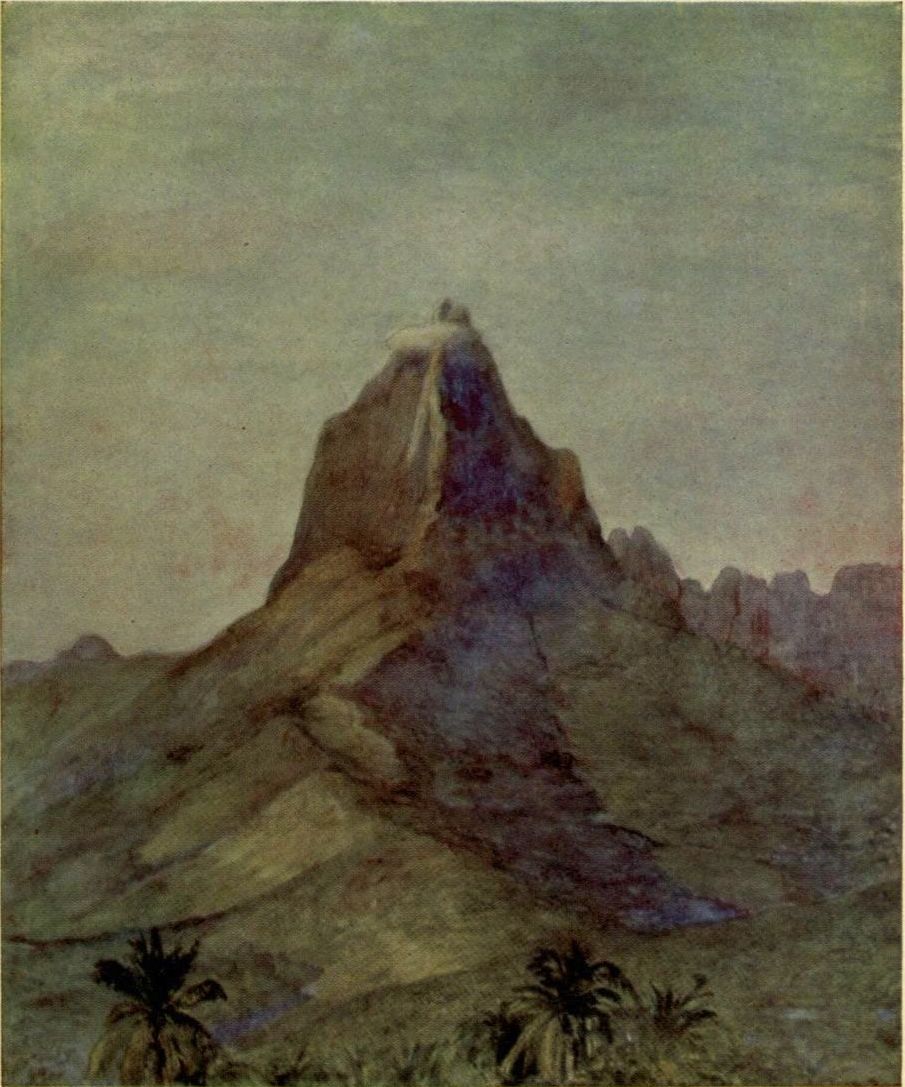
demand through these latitudes—is an awful temptation. Were there anything more to it—were there anything said that might lead one to believe that he or any other such might really become known and understood—perhaps might one think that the two weeks’ sail against the wind would not be too much sea to travel over for a result. But I can make out no such probability from any cross-questioning that I have been able to conduct; and the portrait of the indigène in question suggests a heavy, sullen brutality not at all romantic. I should not care to use him as a model for any picture of Typee, where the eating of man was apparently something like a duty or a necessity, not a mere gourmet liking for a certain richness of taste. No; we need, after all, more inducement than that one.
The portrait of the Queen is more of an invitation: there is something in her face and the impression we receive from “Prince” Stanislas Moanatini that warrants that we shall be well treated.
Still we are trying to get away in this other direction; that way at least the winds are in our favour, and two weeks’ sailing would see us in Fiji or near it; and then in a few weeks more we might be on our return homeward. For all considered, we must make up our minds either to let this thing go on, and drift about the South Seas, taking up the island groups one by one, as chance will have it, or we must make a stern choice and hold to that. And that choice points more and more to our saying good-bye to these eastern islands, and to determining that we have really seen Brown Polynesia, even if it be only in these three groups, and that the rest is a matter of detail. But it may not be so easy to leave by that little schooner or by any other.
There is a demand for small schooners—that is to say, they have to go around to the groups to pick up cargoes; and the one German firm whose boat runs near enough would like to put the screws on to the uttermost. More Germanico, even money is not enough—there must be no equality—and the last alternative so far has been the offer of a passage in a little boat, with other passengers, native women, and a full cargo; which means every available space filled (so that we would merely have our berths to lie in); and that passage to certain places first, and then afterward, when the schooner has discharged its cargo at leisure, to take us from the last point to Fiji. For these discomforts we should have to pay $2,700, within $300 of the value of the schooner. The other passengers would pay $15, which would be the average value. We offered $3,000 for the use of another schooner, having ascertained that she was unprofitable to the same owner; to which he answered by sending her off; and told us that upon conditions of a like nature we might have her by and by. The place develops curious sides of what is called business; and this may be an example. Fancy anywhere else a person offered the full value of a bit of non-productive property for a few weeks’ rent, and hesitating so as to couple difficult conditions with his leave. But I think our German will come short of his enormous profit: the steamer that brings cattle here from Auckland and carries back fruit will probably be our choice; it is only waiting three weeks more, and economizing several hundred dollars a week—never a cruel thing to endure.
And our stay is such an easy thing; it is only because neither of us has the future before him, but on the contrary, a considerable past filled with the habit of work, that we make the slightest effort to resist our contentment. The weather is such as people might travel far to seek: an equable warmth, a little coolness at night and in the morning, an evenness that makes a couple of degrees count for a great deal, plenty of moving air, a beautiful sea, a beautiful sky, and a beautiful distance at all hours of the day and even of the moonlit nights.
The Moorea lies in front of us, on half of the horizon; the little shipping blocks up part of the space; grass-covered quays are before us, shaded with trees under which pass groups of natives or straggling French soldiers and sailors, or the few residents that live this way. At times all is silent and solitary; at others carts roll noisily; horses, ridden wildly by native boys, canter past, or some schooner comes in and unloads almost in front of us. Great excitement comes upon us with these arrivals, far greater than with the arrival or departure of the war steamer that serves to carry about the Governor or officials on tours of inspection, and whose presence brings the sunset gun, saluted by the customary refrain of the clarion, and the eight o’clock gun with another blast, as if reporting that the discharge had struck.
Lately too we have been interested in the arrival of Narii Salmon in his boat from the Pomotus, bringing other members of the family. This impending arrival has brought several times to our verandah the two younger ladies of the family, to scan the distance with our glasses. Since the night when Narii ran in, passing the reef in the twilight, our beautiful new sisters have been less frequent. It was a pretty event, the arrival of the little boat, for which others had daily been mistaken; the settling of its identity by its marks; the recognition of its owner by its sailing bravely in through the pass in the dark; then the calls from the shore to know if it were he for sure, and who was on board; and the boats hurrying out and coming back, all in a silence so great that the slightest rustle of sail or cordage or steps on deck could be distinctly heard.
At times the only sound is the wavering fall of the little column of water that drips from the mouth of a fountain into the sea—to which we go for our supply of pure water. Its threads, thicker or thinner, with the pulsations of the headstream thousands of feet far back, or with the draught of the wind, make a corded silver fan against the blue sea during the day; in the night a line of tinted light.
These are fine days; but our first stay after our return from Moorea ran over a week of wet weather that kept all asoak, filled the house with damp and mould, and carried into and about it disagreeable things taking refuge in comparative dryness: the centipede that runs away, but bites if interfered with; the scorpion that lurks around dark corners, and scuttles off harmlessly enough, but looking like a child’s dream of a devil. The cockroach seems to rule over them, however, and to drive them away; and as the scorpion appears rarely in the house, and only in the verandah or outhouses, we have been lucky. Tauraatua has been bitten, but after a sharp pain like a cut, the matter has faded away. The memory is there, however, and I am glad of the changed weather. Our house, from whose verandah we look upon the sea across the road, and the reef near the horizon and Moorea swimming in light, is the historic consulate empty of the Consul, whose place we take, his duties only being filled by Captain Hart, the Vice-Consul.
Behind us, across the yard, is our dear old Chiefess’s home, where the Queen, Marau, and her sisters Piri and Manihinihi reside; so that we are near our new family, and we call in as often as our fears of intrusion may allow, or need of society, or freedom from so-called occupation. Tauraatua goes over more than I do; he has given up painting, and has returned to congenial and accustomed studies, by working at the genealogy of our new family, and helping to get it into written shape.
For the old lady, Hinaarii, has begun to open the registers of memory, and to correct and make clear things kept obscure, partly from purpose as defences, partly from kindly motives toward others; partly because it is written that memories must perish and the past continually fade and disappear, in part at least. Genealogy, you know, in the South Seas, indicates not only one’s standing but one’s rights to land. Nothing is ever sold, nothing alienated by any law; so that in one’s name and in the names of one’s relations are the title deeds of what one has. And now the French Government, in its anxiety to extend all benefits of civilization, and to make all its peoples equals has desired to have everything put into proper shape; and as in Samoa, so everybody here must put in his claim to the land, which thus will be duly recorded for good and all. For never again will be the time when a family might claim the fruit of a branch of a given tree. These genealogies, kept by hearsay, will be unfolded to the public, so far as needed, and claims settled; there will be no need of concealment, no fear that some side relation, in a little country, where such relationship must exist, will know enough to make out a tree of his own and come in with some claim. Everything conspires for getting some definite record just before the last veil closes over a past already dim enough. And Marau and Moetia are writing out songs and legends, and may be inspired, if their ardour can continue, to help to save something.
Some years ago King Kalakaua of Hawaii had wished to obtain the traditions and genealogies; but the old lady had never been favourable; so that we feel that at least we have done no harm to the family, at least in our western notions, since we may help to save its records.
It is a part of the charm of Tahiti that with it there is a history: that it has been the type of the oceanic island in story; that the names of Cook and Bougainville and Wallis and Bligh belong to it most especially; that from it have radiated other stories: the expeditions of the mutineers of the Bounty, and the missionary enterprises that have gone through the Pacific.
With its discovery begins the interest that awoke Europe by the apparent realization of man in his earliest life—a life that recalled at least the silver if not the golden age. Here men and women made a beautiful race, living free from the oppression of nature, and at first sight also free from the cruel and terrible superstitions of many savage tribes. I have known people who could recall the joyous impressions made upon them by these stories of new paradises, only just opened; and both Wallis’s and Bougainville’s short and official reports are bathed in a feeling of admiration, that takes no definite form, but refers both to the people and the place and the gentleness of the welcome.
That early figure of Purea (Oberea) the Queen, for whom Wallis shed tears in leaving, remains the type of the South Sea woman. With Cook she is also inseparably associated and the anger of the first missionaries with her only serves to complete and certify the character. One will always remember the imposing person who, after the terrors of the first mistaken struggle, approached Wallis with the dignity he describes, welcomed him and took care of him, even, as he says, to carrying him, since he was ill, in her arms, as if he were a child. One would like to go back in mind to the time, if it were possible to realize the thoughts that must have come upon Oberea and Amo her husband on this appearance of the great ship and the strange men—a floating island as they first thought it, which they attacked as a portent of ill. Something like this will be felt by our descendants when from some distant planet the first discoverers shall drop on earth. And so Amo and Oberea come in and out of the stories of the first discoverers, even until forty years after, when the missionaries of the Duff speak of the poor lady with harsh words and (1799-1800) no pity for her frailties.
Now Oberea (Purea) was our old Chiefess’s great-great-grand-aunt, as Amo was her great-great-grand-uncle; and now, with one remove further, she is ours by adoption.[20] (You must ever remember that we belong to Amo; that is the special name of place attached to ours.)
And everything that concerns the family of the Tevas interests us exceedingly. Does it not interest you also? This living connection with the indefinite archaic past, does it not bring back the freshness of early days, in which, reading of the voyages, our minds shaped pictures of what these places and their people were? Now for me it is a pleasure, half touching, half absurd, to look upon the queer pictures of the little place we lived in at the end of Uponohu Bay, as it is represented in the prints of Cook’s voyages, or the later one of the Duff; that place where Melville last lived during his last days on Moorea, as he tells in “Omoo”; and then to think of my own sketches, and the different eyes with which I must have seen it. In the same way, or a similar way, my impressions of to-day become confused and connected with these old printed records of the last century, until I seem to be treading the very turf that the first discoverers walked on, and to be shaded by the very trees.
I have been drawing and painting somewhat lately, so I have been able to take fewer notes than Tauraatua. He is working assiduously, partly because he is engaged in congenial work, partly to urge Marau to go on and write her memoirs, which would then go back to a record of her ancestors. I, on my part, could not do it so well; and I am busy at my drawings, trifling as they are. But I regret it, as I see less of our neighbours, all of whom have their various degrees of charm.
But I like to gather in without strict order these records and memories, even at the risk of Marau’s supposing that I am going to put into verse the extremely difficult poems she recites to us. This idea of hers is evidently a devilish suggestion of Tauraatua, who thereby shares the responsibility or throws
SUN COMING OVER MOUNTAIN, EARLY MORNING, UPONOHU
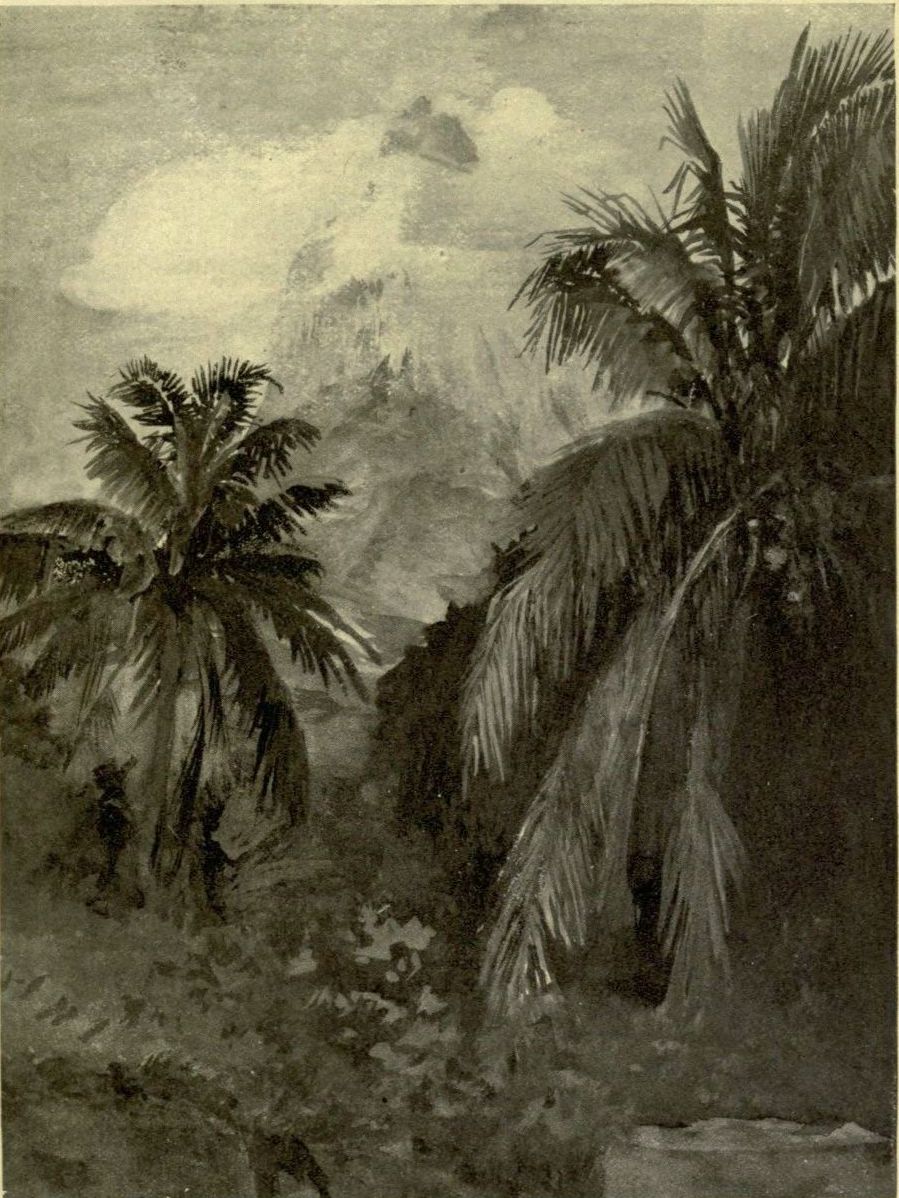
it off on me at will. Still I shall transcribe into prose some of the poems at least, to please you. They are woven into the story of the family and form part of its record, if one may say so; some of these form parts of methods of address, if one might so call it—that is to say, of the poems or words in order recited upon occasions of visiting, or that serve as tribe cries and slogans. So with the verses connected with the name of Tauraatua that are handed down. The explanations may (and do) embrouiller or confuse it; they did for me; but they make it all the more authentic, if I may so say, because all songs handed down and familiar must receive varying glosses. Where one sees, for instance, a love song, another sees a song of war. The Tauraatua of that far back day was enamoured of a fair maiden (her name was Maraeura) and lived with or near her. This poem, which is an appeal to him to return to duty or to home, or to wake him from a dream, is supposed to be the call of the bird messenger and his answer:
(To) Tauraatua that lives on the “Paepae” Roa (says) “euriri” the (bird) that has flown to the Rua roa: Papara is a land of heavy leaves that drag down the branches: Go to Teva, at Teva is thy home: to Papara that is attached to thee, thy golden land. The mount that rises before (thee) that is Mount Tamaiti. (“Outu”) The point that stands on the shore is Outo monomono: It is the (place of) the crowning of a king who makes sacred Teriitere of Tooarai.[21] (Teriitere is the chief’s name as ruling over Papara) (Answer) Then let me push away the golden leaves of the Rua roa That I may see the twin buds of Maraeura on the shore.[22]
Of this translation Tati made mincemeat one evening, describing as frivolous the feminine connection, and giving the whole a martial character. The few lines he changes I shall not give here in full; suffice it that he ends with this, which is fine enough:
“He is swifter (Tauraatau who is supposed to rush off) than the one who carries the fort.
“He is gone and he is past before even the morning star was up.
“The grass covering the Pare (Mapui-cliff) is trampled by Tauraatua.”
I shall not have time to reconcile the versions, but Moetia seems impressed with the possibility of getting these things translated; and if all will unite, even if two versions are made, the songs will at least be saved.
I have received from Marau two poems: one about a girl asked to wed an old chief, one in honour of Pomaré; but Adams has become more Teva than the Tevas, and will not note it.
And as a woman has come again into the story, as she has done often with the Tevas, for good and ill, let us go back to Oberea, the Teva princess whom Wallis first met, and met almost by chance, for she and her husband Amo were on a visit to the place where Wallis anchored and landed, and by this accident helped to displace later the centre of power, as has always happened where the white man has made his harbour.
Oberea was on a visit to Haapape, where is the anchorage of Matavai; its chief Tutaharii. Tutaha (in Wallis’s book) was connected with the Papara family to which Amo, Oberea’s husband, belonged (and stripped, as a sign of respect, in presence of Amo and his little son Teriitere).
The Tevas, whom Amo and Oberea represented, held the political supremacy of Tahiti. Their lands were further down the coast to the south than the districts which the first discoverers first knew, and separated from them by inimical chiefs, momentarily quiescent from fear and doubt. They were especially the Purionu and Teaharo, from whom the first discoverers received a great part of their information; then came, on the west coast, the little district of Faaa (or Tefanai Ahurai), from which came Oberea (Purea; her proper name, Tevahine Avioroha i Ahurai), the daughter of its chief, Teriivaetua.
Then came a large district known as the Oropaa, consisting of Paea, adjoining Papara, the chief place of the Tevas, and of Punavia, both these connected by family alliances with the Tevas.
The Tevas (and family) held after them, further to the south, the whole south of the main island, and the whole of that half island called Taiarapu, which joins the main island at the narrow Isthmus of Taravao. The east was divided into three districts, but had no common head. Hence the Tevas, usually well combined, with strong clan feelings that last until to-day, controlled all the south and west of the island and Taiarapu, or two thirds of the population, and had only themselves to blame when deprived of their ascendency.
The Tevas were divided, as they still are on the map to-day, into Inner and Outer Tevas; the Outer Tevas on Taiarapu (into which we were adopted by Ori), and the Inner Tevas on the main island (into which we were adopted by our good chiefess of Papara). These made the eight Tevas. Their origin, like that of all clans, is hidden in the night of legend, with the old myths of a semi-divine ancestor and an earthly mother.
And as the women were to play a great part in the history of the Tevas, it is but fair to begin, then, with that part of the life of Queen Hototu that made them.
THE ORIGIN OF THE TEVAS
This, the earliest of the traditions of the family, was told me at different times by Queen Marau.
At certain hours Tauraatua goes to the low cottage behind our house, that is open toward the King’s palace and the government house, but is entirely shut in by trees that fill the little garden, and which has a strange resemblance to many a little American home and is all the more wonderfully unreal. Then the Queen comes from some inner apartment and repeats the legends, poems and genealogies, and one or more of the sisters are often there and add comments or contradiction. During our absence the ladies are supposed to have prepared the material and to have arranged what documents they have, so that in many cases what little I shall quote will be the very words of our royal historian. Sometimes in early evening the Queen has walked down to the shore with her sister Manihinihi, and, sitting on the rocks under the lofty trees, answered my questions about these early ancestors. I can tell you the bald story. I cannot give you with it all that would have made any old story charming—the faces and forms of my instructors, their beautiful voices, the slight wash of the sea into which Manihinihi sometimes put her bare foot, the wonderful stillness, the slight rush of the surf far out on the reef, the light of the afterglow, the blue ocean far away, the mountains of ancestral Moorea lit up after sundown, the shadows of the big trees moving over the water, and on our side right above us the great heights of the Aorai appearing and disappearing behind the many coloured clouds. At such moments I could forget for the present the little meannesses introduced by us Europeans and feel as if I were back in the time when my name was Teraaitua.
They were my ancestors in fairyland of whom fairy stories were being told, and even the absurdities had the same charm of the stories of our nurseries which they so much resembled.
The great ancestress Hototu, from whom come all the Teva, was the first queen of Vaieri. She married Temanutunu,[23] the first king of Punaauia. All this is in the furthest of historical records, as you will see by what happened to this king and queen at the time when gods and men and animals were not divided as they are to-day, or when, as in the Greek stories, the gods took the shapes of men or beasts to come and go more easily in this lower world which they had begun to desert.
In the course of time this king left the island and made an
EDGE OF THE AORAI MOUNTAIN COVERED WITH CLOUD. MIDDAY, PAPEETE, TAHITI
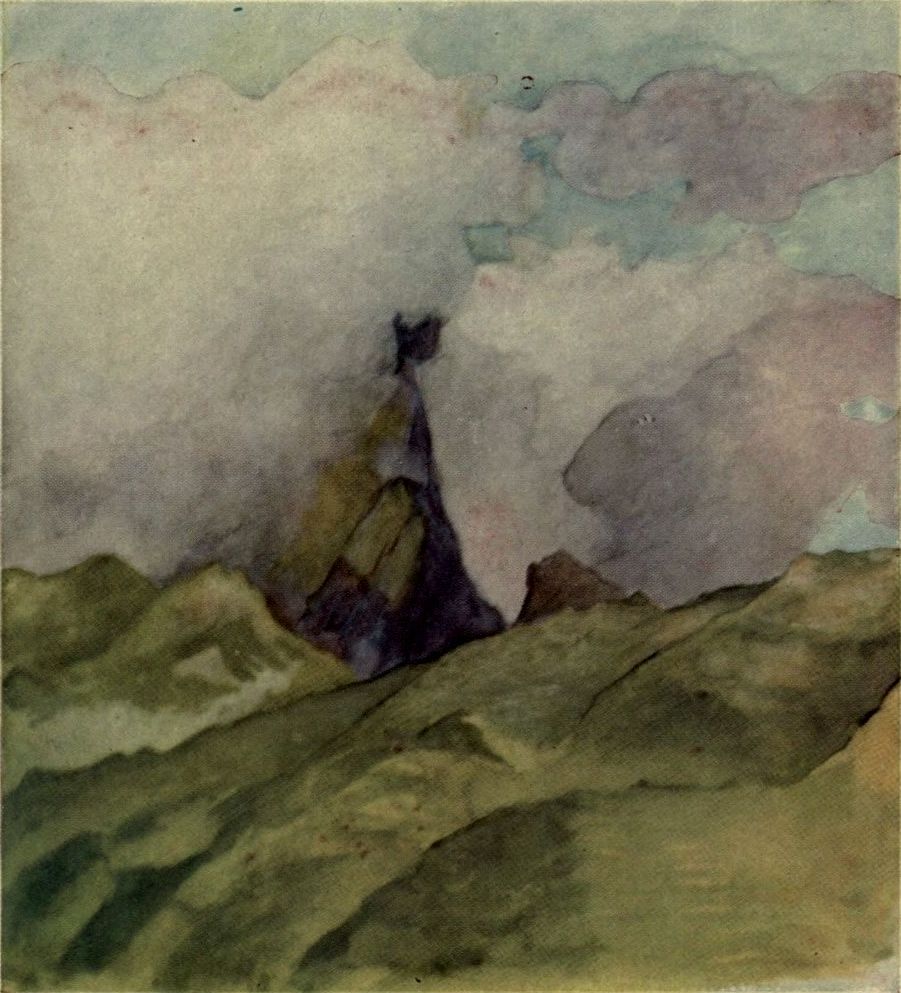
expedition to the far-away Paumotu (pr. Pomotu). It is said that he went to obtain the precious red feathers that have always had a mysterious value to South Sea Islanders, and that he meant them for the maro ura or royal red girdle of his son, for he had a son by Hototu who was named Terii te Moanarao. The investiture with the girdle, red or white, according to circumstances, has the same value as our form of crowning, and took place as a solemn occasion in the ancestral temple or marae of these islands of the South Sea, but the red girdle seemed even in some Samoan lore to have an ancient meaning of royalty; I remember Mataafa, the great chief, asking me why the English Consul wore the red silk sash which he probably affected in his dress as being of an agreeable colour.
While the king was far away in the pursuit of these red feathers to be gathered, perhaps, one by one, the queen Hototu travelled into the adjoining country of Papara, where we were the past month, and there she met in some way the mysterious personage, Paparuiia.[24] With this wonderful creature the queen was well pleased so that from them was born a son who later was called Teva, but this is anticipating.
This was the time as we have told you when men and animals and gods were mixed, and this great ancestor of the Tevas was evidently some form of god. The story came to an end in a sudden way. While the king was still away, his dog Pihoro returned, and finding the queen he ran up to her and fawned upon her to the jealous disgust of Tino iia, one half of whom said to the other, “she cares for that dog more than for me. See how he caresses her!”
So then he arose and departed in anger, telling her, however, that she would bear a son whom she should call Teva: that for this son he had built a temple at Mataua, and that there he should wear the maro tea, the white or yellow girdle, the chiefs of Punauia or Vaiari, who in this case were the king and queen, being the only ones that had the right to the maro ura, the red maro or girdle, for which you will remember that the king was hunting. Then he departed and was met by Temanutunu, the husband who had landed at Vairoa, and who entreated him to return. He refused just as the two Shark-princes, of whom I told you at Vaima, the little river that ran so clear near Taravao, refused another husband for a similar reason, saying that his wife was a woman too fond of dogs. “Vahine na te uri” (woman to the dogs). When I asked if he never came back, the queen, or was it Moetia, told me that since that day the man-fish had been seen many times.
The dog is however much connected with the Papara family, and his presence is occasionally felt. Tati the brother of the queen told some stories of him. One of these stories refers to what happened to Narii when a child. His mother had him with her at the occasion of the building of a bridge near Papara. There were many hundred people there. Tati was there with his two nurses according to custom, and Narii had also the two who had charge of him. At evening one of the nurses saw something like a dog run up a tree above them, and into the branches, and at the same time something waved from him like rags. Just then the child was drawn from the arms that held him, his mother’s, but something grasped him firmly, while a ball of fire rushed out above him and went on to the sea some quarter of a mile distant. So many people saw part of this, namely, the ball of fire that there was no doubt of it.
Nor must I forget to say that all about Papara there is a good deal in the way of ghosts or queer sights. For instance, just beyond the little enclosure of our hereditary Amo, where the little sluggish river runs in the woods beyond the ancient stone foundation, evergrown with trees, there are spaces where occasionally the figure of a man appears and disappears through the trees, and old rags of clothing flitter behind him. There last Saturday, while two men were at work, what at I don’t know, perhaps looking after vanilla, one of them looked up and saw on the face of the little cliff, a small hole, not noticed before, out of which at once stepped an old man dressed partly in an ancient manner, who dusted his clothing as he got erect and then disappeared. The two men went to the spot and found the hole. There was some talk of enlarging it and digging into it, but the discoverer objected so strongly, and has still kept up his objection so well that nothing more has happened.
The shark is connected with our cousin Ariie’s family at Tautira and has still power with them. Not so long ago Ariie’s mother came here worn out and dusty, having ridden instead of having been carried in her canoe as usual. She told the following story—she had intended to come but had declined to bring her daughter with her. Now her daughter is a believer in the shark, and she thereupon told her mother that she should not get off. Nothing would induce her to say more but the mother was rowed up inside the reef as we had been on the same course along the coast of Pueu. I don’t know exactly where it was, but somewhere in the evening the rowers complained that their path was obstructed by a large shark. The old lady ordered them to row on; as they did so she looked up from the bottom of the boat where she lay with her head wrapped up in the usual loin-cloth or pareu. She saw before them, an enormous shark, lying at right angles to the boat, partly out of the water, and all along his back a row of lights like lamps lit up the water. Unwillingly the men obeyed her orders to row on and struck the fish full on the side without making it move away, the boat running up on his back. Then she determined to return and when she got home, rebuked her daughter angrily, for she knew that it was her daughter who had done this, and rather than yield to her she had come the whole way with horses. Tati says the girl is known to have power that way and that she calls upon this protector when she is angry. Upon such occasions a special odour easily to be recognized as the smell of the shark fills the air. As far as I can see the shark is at least a cousinly god to us, somewhat of a relation and protector, and henceforth, I think as I suggested above, we ought to be safe from him at sea.
As in the story of the ancestress, Queen Hototu, so important and aristocratic, freedom could belong to women where descent and inheritance placed her above others. Daughters transferred to their children rank and title, and consequently property, and in fault of other heirs could become chief. The mother, therefore, of an heiress to a title was another chief even to her husband, and had privileges that he could not have; for instance, a seat in the family temple. All this she transmitted to her child.
The mother of our old chiefess was known by at least thirteen different names, each of which was a title, each of which conveyed land; so she was, for instance, Marama in Moorea and owned almost all the island; so she was Aromaiterai in Papara. This investiture would be received for a child, as child to a chief, would be carried to the family temple to be made sacred, as was done in this case, thirteen different temples having received the child, the mother of our chiefess. As in all Polynesia the Arii or chiefs were more or less sacred as was the ground upon which they rested; but that was only among their own connections. There the inferior chiefs, men or women, out of respect stripped themselves down to the waist. That is why Captain Wallis relates that Tutaha as well as Vairatoa, stripped in the presence of Amo, our ancestor, and his little son. Why exactly the wife of Vairatoa uncovered herself up to the waist when she presented cloth to Wallis, I have not been exactly able to find out, but Tati says it was probably from the same notion of very great respect.
So you see the connection of the marae with the chieftain’s power; a knowledge of maraes and of the origin and descent of families is intimately connected. Each family had its stone in the maraes where it claimed family worship.
The Teva’s original marae is said to be that of Opooa in the sacred island of Raiatea; but their own tradition makes it, as I have said, at Mataua, where the head of the Tevas wore the maro tea.
When Temanutunu, the husband of Hototu, mother of Teva, brought back the red feathers from the Pomotus, to be worn in marae by his son, he founded the temple or marae of Punaauia. Thus the story indicates that Vaiari and Papeari were the original centres, and Punauia and Papara chiefs wore the red or yellow girdle in right of descent from Vaiari. We must understand that power did not reside in the mere wearing of this girdle; it was only a symbol of the power of descent which represented alliances of families in a land where blood was everything, where a chiefess killed her child if not of high enough birth.
Do you remember, or have you read, in the “Voyage of the Duff,” the terrible time the missionaries had with “Iddeah,” the wife of the older Pomaré? It is almost a pity not to quote it in full; and if I had the “Voyage” by me I should do so. Like Oberea, she was more or less separated from her husband, and had, like the great Catherine or the great Elizabeth, a young favourite who went about with her everywhere, as the missionaries saw. He was of low blood; hence the necessity of putting the child to death; and as all this was openly understood, the missionaries undertook to persuade “Iddeah” (as the missionaries called her) to abandon the hereditary notion. Notwithstanding every exhortation, she declined to do so, and killed her child according to custom; though like a politic person, she promised not to do so again. And I have told you about the late Queen Pomaré and her affairs.
Hence again, everywhere the marae comes into the story of the islands; with it, of course, begins the families—no marae, no family—and with the building of the greatest marae of all, the one that Cook saw and described in its new importance, the power of the Tevas culminated and was broken forever. You know that we saw its ruins on the beach of Atimaono, and walked up the crumbling slopes of coral, with Pri and Winfred Brander, whose ancestors built the family temple.
The pride of the Tevas, the pride of Oberea, brought on the revenge of the offended. But that part of the story I must put off, and tell you some of those that go further back.
The Tevas were proud and domineering, but the family of Papara, of which was Amo, and where flourished Oberea his wife, were still more so; for Papara was the leader politically. Historically the chieftainesses of Vaiari and Punaauia, as we saw by the story of the origin of the Tevas, were older and of greater dignity; but it was the Chief of Papara who called out the Tevas, who presided over them, and who alone had the right to order human sacrifices for the clans.
There were, as you know, eight Tevas, inner and outer, the inner ones Papara, Atimaono, Mataiae, and Papeari; the four outer ones, the four districts of the peninsula of Taiarapu; Paea and Punaauia were tributary. The origin of this limitation, the origin of this power, goes back to some great and uncertain distance which I have not been able to ascertain, but it may be a thousand years back or not more than five or six hundred. That could perhaps be determined more closely by a more extended inquiry. At that time Papara was subject or tributary to Vaiari, and when Mataiea belonged to the Chief of Vaiari.
For this liberation of Papara, and placing it at the head of the Tevas, Oro, not the god, but a chief of that name, is the cause. He was a small chief within Papara. His father’s name was Tiaau; you will remember my speaking of him in connection with the little chiefery of Amo, to which Adams and I have succeeded; and you may remember the story of the chief and of his paepae[25] there, all grown over now, and of the cocoanut that served as a watch-tower. It all comes into the story, if told in detail.
There were thus battles and wars within the Tevas, and there is another story of Papara and our ancestors into which a woman comes again, and not only one woman but another. I leave it as I first wrote it down, though it suggests in itself much alteration and explanation. I shall call it:
THE STORY OF TAURUA OR THE LOAN OF A WIFE
Tavi ruled in Taiarapu, known for his wild generosity, and for the beauty of his wife, Taurua Paroto. To him Tuiterai of Papara sent messengers, begging the loan of his wife for the space of seven days. There may have been hesitation on the chief’s part, but his habits of giving prevailed, and Taurua came to Papara, to spend her seven days with Tuiterai. At the end of that term she was not returned to her lord, who sent messengers for her.
But Tuiterai refused. “I will not give her up,” he said, “I, Tuiterai of the six skies, her who has become to me like an ura to my eyes, rich ura brought from Raratoa—my dear gem! I have treasured her now, and I treasure her yet, as the uras of Faaa; and I shall not give her up now. No, I shall not give her—why should I give her up—I, Tuiterai, of the six skies; for she has become precious beyond the uras of Raratoa?” Thus the song preserves his refusal; so Tavi made war upon him, and Tuiterai was defeated and made prisoner, and was upon the point of being put to death. But he pleaded with his captors who had bound him, claiming that he should be taken to Tavi, and, if killed, then killed by him a chief. So that they carried him away in a canoe, all tied up, that he could neither move nor see; and his bonds increased the faintness caused by his wounds. But he pressed his captors to hurry, for fear that he should die by his cords; and he knew how far he had gone, for his fingers, touching the waters, recognized the “feeling of each river, as every skilful swimmer knows.” At length he was brought before Tavi, and set before him, along with Taurua.
But Tavi said to his men, “Why did you not kill him when you had caught him? It is not meet that I, a chief, should put him, a chief, to death.” And addressing Tuiterai he said, “It is you that have bound me with cords that bind my heart and make the skies gloomy, as if you had drawn them down and bound them over me. You have taken one who lay in my arms, and tied a knot between her and me, and you have broken the ropes that tied us together—her and me. Take her!”
So Tuiterai won Taurua.
But dark fate seems to have pursued the generous man, and later Tavi was defeated in war and fled to the Pomotu Islands, where he disappeared.
The war again came from Taurua the beautiful: she had a son by Tavi, a son called Tavi Hauroa, and Teritua also, and names had been given him from other places, as Taurua came from Hitiaa. For this child Tavi put a taboo (rahui) on his land, and tried to extend it further on, wherever he might claim. But Taaroa Manahune had married Tetuae-huri, the daughter of Vehiatua, and was expecting the birth of Teu.[26] “Your wife should eat pigs,” was said to Taaroa; so they eat the pigs, resisting the claim of Tavi, who being at Pai crossed at Tehaupo, and was beaten by Vehiatua. A part of the defeated returned from the Pomotu, and were granted the holding of Afaiti, under the boy Tavi Hauroa. But in an evil moment, he flew his kite over the marae of Fareupua, so that it was caught in the aito (ironwood—casuarina) trees; and at the instigation of Tunau, the high-priest, he was put to death. How and why? By whom? Was his companion also killed?
There would seem to be a moral to this tale, which would run this way: that generosity is a doubtful quality, and that it is wiser to take another man’s wife than to let go your own.
Some explanations I should have woven into this story for you, but I write almost directly from Marau’s recitation, and it was only afterward that I got from her some more details.
In reality, the right of Tavi to place a general taboo or rahui on Taiarapu generally was a very questionable one. It might have been merely a question of pride that made him insist upon it when his claim was weak. It was also, it would seem, a general desire in the other members of the clan to weaken its power or limit its range.
By making a general rahui or taboo, as we call it, the chief had everything that grew, everything that was made, everything that was caught, set aside for a time, for some particular use: to make further feasts or for the food or the property of an heir, for instance. Hence its frequency after the birth of a young prince or princess. Or it might have been that some great feasts or generosities had depleted, if I may so call it, the treasury. Later even, some of the missionaries in Catholic Islands have found it useful to preserve the plants, and allow them to increase so as to prevent the recurrence of a famine.