FIJI (continued 2)
Reading edition
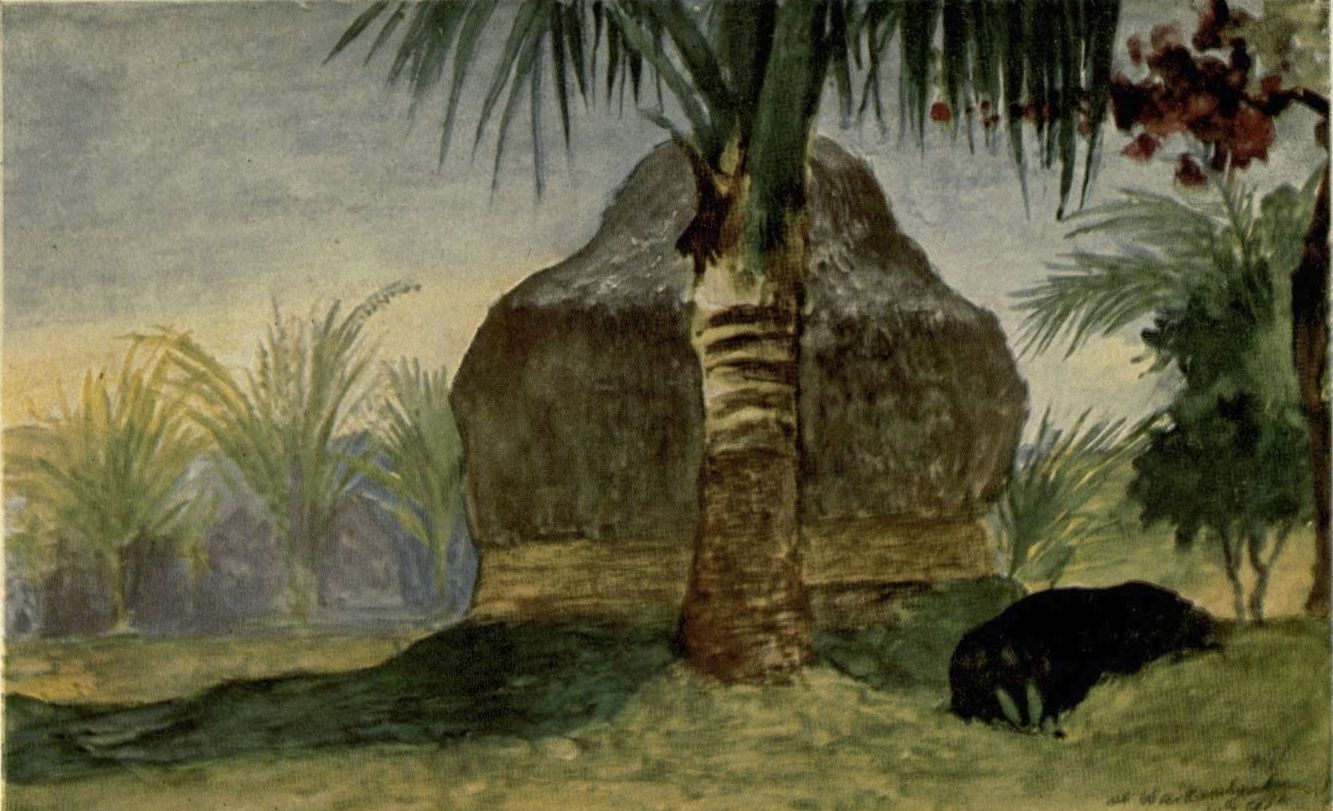
We crossed over rocks the path of the little torrent, now rolling between rocks, now filling stone pocket in its bed, or sleeping quietly between high wooded banks. The houses of the village were partly those of the mountain, the beehive; partly those of the coast with long ridge-pole, and built up on high mounds, covered with stones or grass. But the openings were the smallest I had seen—a big man in some cases might just have fitted in. One little one which I have sketched for you, and which was prettily placed by the side of the ditch, and with the adornment of a few trees, was exceedingly small and queerly bulged out in roof at once over its low reed walls. The thatch had been extraordinarily thick, projecting very far, and its edges were cut perpendicularly down so as to make a line with the wall, and you had a proportion of thickness of thatch greater than the wall or the roof. To all those roofings that were old, and which covered almost the entire houses, time had given a most delightful texture and tone, making them look as if covered with a most exquisite grey fur. The thatch of the new buildings was yellow and shaggy, giving the look entire of the reed: as the leaves are weathered off, the fine stem alone remains: the thing is exquisite as thatching, having an appearance of extreme finish.
The little house or mbure placed thus at the entrance of the village just gave place to two persons within—and Mr. Carew (magistrate and commissioner, who knows all about things, has been here twenty-three years and is a student of words and languages) says that such would have been a “devil” house formerly where the priest or prophet or wise man could reside alone and be applied to.
Here, he said, with the love they have for shutting things up, he could close his door easily, and be happy in the sweating heat of the night. The horror of draughts I can sympathize with here in the hills where the change from the 80° or 83° of day to the 52° of night makes the motion of air between narrow walls easily felt, but this night was not cold and with only one door in the house we felt the closeness. Outside the temperature was exquisite (somewhere about 68°), and the picture of our carriers encamped about the village and fires, that lit up themselves, the trees, the houses, and the opposite hills by fits and starts, kept me awake notwithstanding the very fatiguing day. We had been six hours on the walk with the rests included, and such a walk.
We bathed in the hollows on the rocks that night, and the next lovely morning, and then began our last march. The mass of the carriers had been dismissed; and I think that we were not more than fifty men or so: the road, a very wide one, began by running up hill as straight as might be, in Fijian fashion, as if to show that the natives were not afraid of mere steepness.
The walk was a hard one, and we had hesitated as to whether the river-bed would not be easier, as we had been advised; but
MOUNTAIN HUT OR HOUSE AT WAIKUMBUKUMBU, FIJI
after all a road is a road, even if it leads up the side of a house, and by noon, we had done all the worst of it. A beautiful sight opened before us, like a reminiscence of Hawaii: we had the mountains behind us and on either side, partly green, partly rose or golden. As usual, we were coming down a dividing ridge that ran into the plain; mountain edges framed the sides, far off stretched a fairy sea with points that framed it, and on one side a mountain with high perpendicular cliffs standing up against the distance. Everything swam in light; blue and violet filled the distance; a big plain, in which glittered a little water, spread from the blues to the green near us in gradations such as Turner loved: even the very stippling of the innumerable trees, so many of which were the pandamus (the lauhala of Hawaii), reminded me of him, as the scene recalled Hawaiian islands. Along the road thin lauhala—the fao of Samoa, the fara of Tahiti—growing every now and then and marking the distance, and again repeated everywhere in the blazing spread of green and yellow of the plains, grew not thick and full like those of Samoa and Tahiti, but strangely and queerly with outstretched arms and straggling foliage.
We loitered along the road at places where there were big trees and water. Halfway, Mr. Marriott, the magistrate, had sent a horse for me to ride, which convenience allowed me to look further and freely upon the landscape from this height; but we were some time on the road, some five hours at least, though it was but ten miles I suppose.
Vanuakula, July 10th.
We came down in the afternoon to Vanuakula, a neat little place reached after a long promenade under the hot sun, upon the road that ran on a dike in mangrove swamps. There we found news of the little steamer Clyde, and saw its Captain, Mr. Callaghan, and were told that at night we should get aboard so as to get off early in the morning for Ba, in such manner as to hit the tide without which we could not possibly enter the river to-morrow morning. So we waited for the rise of tide in a little village green square, and a pretty native house and saw a native dance of armed men (mekke) given as a mark of honour along with the food, and as a manner of presenting tappa of which an enormous quantity was given to the governor.
Each dancer, as we had seen before, carried upon him in long folds yards upon yards of the cloth, looped like a dress, caught around his shoulders perhaps, or only at his waist; sometimes folded stiffly far over his head, like the floating folds of drapery upon an archaic bas-relief; and after the dance he unwinds himself from the enormous entanglement, and adds it to the pile that our men gather together and fold up. This plunder the governor carries off: in true native fashion, he is but a conduit for gifts: when some chief or persons who have need to fill up gifts or do the proper thing, think it is time they come and beg for things, the whales’ teeth, or the tappa (native cloth) and receive them. As I think I said before, it is pleasant to see the governor keep up strictly every native custom that secures order and belongs properly to their official life. He is very strict about it, insisting upon every observance that his position requires and carrying all out.
While we waited, looking on at the dance, or afterward when the ladies of the village came in bringing gifts of food, having properly asked permission to do so; two Samoan women sat beside us. They had come from a neighbouring house to call; one was younger than the other, and looked with her hair “à la Chinoise,” her slanting eyes, and flattened nose, and wide lips, very much like certain musme of the Japanese inns and tea houses. This one had been Samoan way, married to some more or less white man, who had left, and she was now a grass widow. The other was, “faa Samoa,” married to some half-breed: and she of the slanting eyes noticed Awoki near us, and somehow or other took him in as a variety of Samoan.
Did he come from Africa or whence? and Japan had to be explained. But she said she was anxious to get back home, and that things here were leanga including the dance which we had been looking at, and the women and girls who were coming up in a long file much bedizened with velvet, cotton, paper cut into strips (of every shade imaginable), leaves around the waist, etc.; from her all dressed all over, to her who only wore long leafage about her hips. They were prettier than any we had seen: that is to say they were some of them not unpleasant; but only a few: and after all it is only the quite young who suggest anything more delicate than the men. Raiwalui, one of the governor’s boys is more feminine looking notwithstanding his strength and height than any Fijian woman I have yet seen. All this is so far as we have seen, and as I told you, so far the women and children get out of the way, not only because they always do so more or less, but also because of our men who have numbered at times several hundred, so that the women and children are crowded away in corners to leave houses empty for the visitors. But the Samoans looked like beauties alongside of their sisters of Fiji here, and sailed off with much superiority and conscious ease while the Fijian women had walked off in single file neither looking to right nor left, but keeping a downward look and following their leader.
Dinner we had outside on the mats, and just before the new moon sank we embarked in the dark upon the little river that was to take us to the sea and the steam launch. We were poled along for some few miles near mangrove trees whose roots hung above us, the wash from our water splashing in among their roots and trunks. Occasionally some more solid ground showed a few houses, or some clump of palms against the sky half clouded. Then a long row out to the ship, all dark, large masses of dark sea and dark sky, with the moon almost set, looking at us like a half-closed eye under the forehead of an enormous band of dark cloud.
The next morning at ten we steamed for Ba, ran out quite far, but in shallows inside the far reef, where at one place the beginnings of things could be seen, as upon the horizon, at sea apparently, a line of mangrove trees, widely spaced, dotted the sharp division of blue sea and blue sky. Still between them there was a little greenish band like water and really partly water, and to one side a little line was the reef on which they had begun to grow.
Inland, the long lines of the mountains look faintly tawny and blue; the swamp belt of mangroves surrounding the shore looked very low: we could discern, at places, the circles or elevations by which we had passed over the serrated edge of the mountains.
Then we ran into a river for some little while, the usual green bank, the trees, and the sugar-cane, and the mountains in the distance with here and there a strange pillar-like mountain or a perpendicular pile, to remind one of volcanic forms.
A number of figures clothed in white sat upon the green bank and watched the governor’s approach. When he landed they made the usual salutation headed by the roku or chief.
Nailaga, July 12th.
We walked into the village neatly laid out in squares, our first large place since we had left Suva: all quite uncivilized, but in native shape. We found a handsome native house, handsomely finished, with a fine tappa hanging, cutting off one end, and many mats. This was the house of the roku who had saluted the governor, a curious person—not a young man—with greyish hair cut short, short grey moustache, and a face looking not at all Polynesian—a very refined face—meaning one that was not in the least heavy—gentlemanly and wary, and with a peculiar indifference as if he went through his formalities without anxiety because they were the thing. He reminded me of some one at home, a little unpleasantly, for the gentleman was evidently not frank unless for his advantage, and he was old enough to have belonged to ancient cannibal days. He had a white shirt on with a turn-down collar, and a small blue scarf all which finished him; and his skin, not too dark, made still more the impression of a person who knew just how to do it. So it was also when later he gave the yangona or kava—and led the chant, so delicately and correctly, a little bored, looking to see if it were quite ready, so that he should have no more to wave his arms and hands in a fixed way to the song. Here was an Asiatic type—my simple Polynesian was no longer there.
Later on, when he came to arrange a bamboo rail for our more convenient getting up and down the slippery plank that served for entrance, he asked our permission: the house was no longer his since we were in it. Contrariwise to him, all his companions were rude looking, some, I regret to say, exceedingly hard looking. Most all at the yangona ceremony were stripped to the waist, and decorated with garlands, that emphasized more terribly some frightful countenances.
After that, the presentation of food and the great dance, like others we had seen but with many variations added, such as the moving in long files two together, or in files moving in two opposite directions, or in striking in order each other’s clubs, or in throwing arms and hands about in various ways resembling the attitudes of the famous siva.
All this was in the big square. On one side a great mass of women, girls, and children looked on, seated: along the road passed Indians coming and going from work: the women in their saris and dresses of light red and yellow.
Since that we have been very idle; have called on Mr. Marriott, and at a sugar plantation and lounged all Sunday—the twelfth—at which date I am writing to you. It has been cool at night, but only because of the draughts of the big house, with its three big doors. The temperature inside is just 70°.
Nanuku Coa, “Black Sand.”
We left Nailaga (in Ba) on Monday morning in lovely weather. The early hour after our breakfast was spent in some conversation between the governor and chiefs, while Atamo surveyed the scene from the top of the embankment on which the house is built, enjoying the pleasant shade in which we all were, thrown across the lawn by the great house. Then again we walked off to the river bank after the governor had restored to the Roku the great stick of office, which had been received on the governor’s arrival. This was about six or more feet long, with ivory top and grip place (made, however, in England).
The Clyde took us along for hours out on the Ba river, and along the coast back upon our way. We tried to descry the outlines of the heights which we had reached and descended. Peak behind peak stretched along, with the buttresses of hills sloping down, all on this side looking white or yellow or pinkish in the sun. The dry side of the island was faintly marked by the dryness of the colour, for which I regretted that I had no pastel or chalk colours to imitate the powdering glare of the sun on the great surfaces, streaked with descending bands of a shade unnamable by our categories of colour. But we knew that all this resemblance to a desert was only for the distance; nearer by, the places we had been in were green or yellow-green. There was of course dry, yellow grass and seeds, and violet of dried bracken—the grey-violet of the ferns such as we had seen even in wettest Hawaii, but wherever any hollow gave a chance, no matter how small, there things grew green. In the nearer hills drier green marked the hollows, and modelled the surfaces; and by the shore the heavy green of mangroves lined the edges.
Thambone, Monday 13th.
Late that afternoon we had turned several points, and came to a halt with want of depth of water opposite the place we were going to stop at. Here we landed in a more inconvenient way than usual. We were pulled out in the gig a little way, then carried on the shoulders of the men to a shifting sandbank on which we walked or sank, as the case might be; then again embarked on native backs that were rough with curling hair, and again reached a mud flat of considerable length, framed with mangrove trees, along which we walked to the shore; this was drier, not washed over by the tide daily as the former, upon which I saw growing green, as if never covered by salt water, the first shoots of the mangrove. Its seeds are heavy and float point downward until they stick in appropriate soil. The flat near the shore was all covered with an efflorescence of salt, and caked and broken up by exposure to the sun. Ratu Joni (Johnnie) Madraiwiwi, who had come to meet us, showed us the little pits or hollows for collecting salt water and making salt; for we had come to the dividing place of the South Seas. Here people have made salt, unlike the Polynesians of the Eastern Seas; here they have baked earth for pottery—here they have used the bow and arrow—in these ways more civilized than their half fellows, who in other ways seemed so much less savage than they. But here, as you know, the races mix: the black is all through here: and strangely enough with the black are all sorts of arts, and a higher sense of ornament and decoration and construction.
For all this I have my own theories, but this is not the place to ventilate them, even if I liked theories, and you know that I detest them—if taken seriously.
Africa—“nigger” land—was certainly pictured where we landed. There were big causeways leading to the village—ditches all about—ditches surrounded many of the houses; and especially the rather inferior one, but the best, to which we went. Visions of mosquitoes came up, fortunately not realized to the extent which we had feared.
We sat in the house while kava was being prepared and while the chant went on. I noticed how the beams of the roof were prettily ornamented with sennit, more than I should have expected from outside looks. Mr. Carew told me that people were brought from far and near to do this, who knew how, and that certain ones had certain patterns, that they could best do. (R. Joni did not quite agree to the fact of such a division of labour.)
The people here seemed rougher again, more like our mountain “devils,” and a queerer lot. They sat on the edge of the little ditch about the house, which on the other side was edged with enormous bushes of the Brugmantia Stramonium, whose long white flowers have in their manner of growing and shape something poisonous (according to my feelings)—as the plant has in reality. But the place had a general look of which the plants were not contradictory—the black dry mud, the little stream, if one can call it so, with patches of water ending in a ditch of caky mud, the withered grasses, the very low cocoanut trees all squatted together in a grove—the one solitary chunk of a peak cutting the long slope of hill to the north—the knowledge of the fact that here silly brutal-beastly heathenism was still rampant or rather creeping; that we would take prisoner this evening or to-morrow the hypocritical duffer who had been reviving it where we had seen the stupid little temple, to which he had allured women from hereabouts; all this seemed to hang together. This vicinity had been once, as the governor phrased it, the Rome of the “devil” worship and the place of revered places. Here probably then—for all their worship was an ancestor worship in reality—here was, therefore, the first landing of the people who gave the islands their character of Fijians, whether they were the first of all or whether they found others before them, who succumbed to them in some way or other. The good people here take remonstrance not too uneasily. Still certainly the next morning the governor gave them all a serious talk, and took great pains evidently to see that he was fully understood, as he sat talking with Mr. Carew and slowly and distinctly and with careful emphasis of voice and gesture spoke to the assembled representatives. Near him in a rather crushed attitude sat the gentleman who had been practising “devil” priestcraft—and he followed us on board, a sort of prisoner—that is to say, to answer to the charge of heathen practices at the next court, for which warrants had been made out. His punishment will be slight: three months’ imprisonment. The law is a native law, like many others, such as laws concerning adultery, that seemed to me rather excessively constructed; but there are no rules for laws that I know of, except that they should work. As some native said to Mr. Carew, “Well, if the man be not punished we shall beat him and perhaps kill him”—and it mattered not that he had not been guilty according to our view; he had been guilty according to theirs—viz.—his intentions had been discerned. But things are not everywhere the same in this regard. I recall a story I heard from Mr. Carew of a woman who had asked the punishment of some man because he had persuaded her one day to misbehave with him. She felt that something was wrong, and ought to be redressed anyhow.
Before this next morning’s episode, however, there was a dance in the later afternoon with much tappa, rolled around the performers, to be given afterward, and very long spears, and handsome weapons—and a very handsome show of attitudes. The smallness of the village place (rara) made the scene more of a picture, which I saw across the ditch framed in by the overhanging trees. In the evening there was talk before bed, though we were frightfully sleepy; I remember only a few things and indeed I repent me of having noted nothing of any previous talks I have listened to, for there is much to be learned always from desultory conversation, in the way of side lights and a sort of querying of one’s already formed notions. I learned, for instance, that the black gentleman who was restoring ancient superstition was a church member and communicant, though every one must have known more or less of his little ways, in a country where nothing can be hidden long. Two pretty stories were told of the lately prevalent belief (perhaps existing to-day) of the value of charms, in both of which young men, charmed by the priest against fire-arms, asked at once for a trial. In the first case, on a discharge a few feet off, the man hit “tumbled about the place an instant and died, being shot through the head.” The verdict was that the incantation had been conducted too rapidly, and that something had been forgotten, and the priest who had taken to his heels returned in safety. In the other, two youngsters, who were going to try the effect of the charm, in front of the chief’s (their father’s) house, were reproved by him. “I do not wish,” he said, “that one of my sons should die before my house; go and try it, if you like, at some armed station of the white man.”
The next day (Tuesday) we again proceeded on our way and with similar scenery about us, and in the late afternoon, we anchored off the place where Ratu Joni’s house is—on a hilly up-and-down place, to which swept down the spurs of the mountain, and which, close by, hung over the town apparently a high rock (Na Korotiki).
The frame of an old house on the beach made a curious little portico, or colonnade, in front of the path that led up to the Ratu’s house. There we spent that night and the following day. The house was one upon more European models—the eaves projecting so as to make a sort of verandah of the base or mound of the house, casements being fitted into the doors and filled with glass; there were a couple of tables with the books and odds and ends that we know of placed on them—chairs also, a luxury that is pleasant always after camping. R. Joni is a magistrate, speaks nice English, writes perfectly, and is just such a person as might seem to augur well for the future. He belongs not to this part of the country, but to Ba, and formerly, and not so far back, his family used to feed on this neighbourhood in more ways than one. His uncle was the great Thakombau (Cakobau), who became the greatest chief, if he was not always that, and who ended by making the country over to England: Thakombau himself, who died but recently, was more or less of a cannibal, certainly a terror; but he is so well known that I need not dilate upon a gentleman sufficiently put down in the books. He had, as I understood, hung R. Joni’s father, his own brother, in the public square many years ago with the belief that as hanging was a disgraceful mode of death with us, it might appear so to the natives. This notion was not a success. The natives who saw the scene applauded the behaviour and good fortune of a man, who, having to die, died publicly and formally in the public square “like a chief.” Ratu Joni had taught himself to read English; when a mere boy he was discovered by the governor reading a little book on Cook’s voyages, and since that, was helped and put forward until he has become this good sort of public officer.
Wednesday, July 15th.
There is hardly anything more to say of our last day, for the next was that of return: there was much idleness and looking at newspapers, etc., received there by Mr. Joski, who together with Mr. Berry had met us there by rendezvous, after their excursion of exploration down to the sea on leaving us. They had had a rough time of it. As it was, it was pleasant to meet them again, and our last days were gayer. Mr. Joski remained to make his way to the station whence we had drawn him three weeks before, Vunidawa. Mr. Carew was only to leave us within a few hours of Suva (on the Rewa). For after steaming along past cape and headland, in this closed sea, the long line of hills and mountains receding further back, as the lowlands of the Rewa came near, we came to a little headland and there took the boats, so as to make for the Rewa, get through it to its mouth, and there catch the steamer again, and thus avoid the tossing that she would have to undergo outside the reefs. Inside even there was much sway of waves, for the expanse is great enough to make a little sea.
The day was lovely. Beyond the blue sea, as if to be looked at, came up various islands of the group, clearly or faintly made out, stretching at intervals along the sea line, big or small, and sometimes sliding one behind the other.
It was a gay day—a cheerful end to our trip, which had just lasted three weeks; so that when we landed at Suva in the last twilight, just as the new moon lit up our path up the hill, the feeling of getting back to civilization was intensified by the ease of our return. For though all was not easy there was no real hardship—for no one can make rough climbing easy, even were it in Sussex or New York County—yet we had seen a part of the islands little visited, very much out of the way, and a former foothold of all that made Fiji a terror, the synonym of barbaric cruelty—the land of the Cannibal—the “Devil Country.”