SAMOA (continued 3)
Reading edition
AITUTAGATA. THE HEREDITARY ASSASSINS OF KING MALIETOA. SAPAPALI, SAVAII, SAMOA
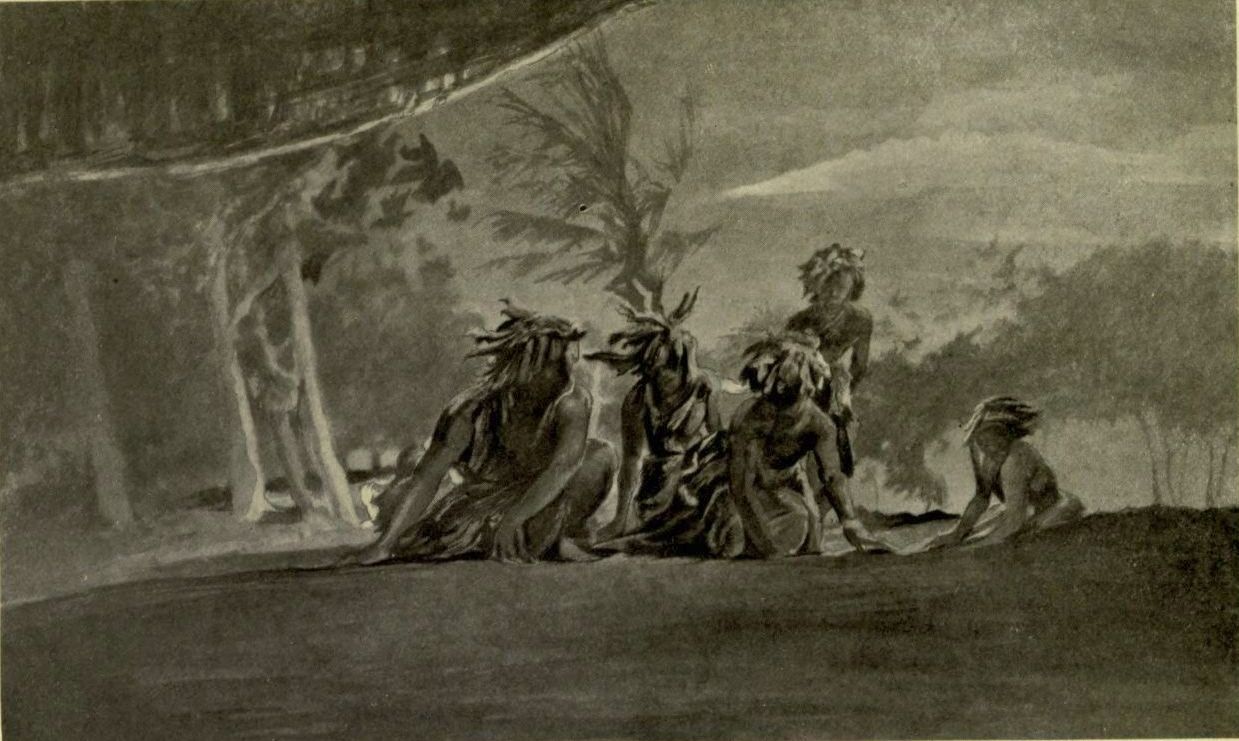
their motion. In and out of the little grove danced back and forth a crowd of armed men, who threw up their clubs and caught them again.
Right in the middle of the green before us, threading their path between the princess and her girls, crouching to the ground, crawled or ran, bending low, three men, all blackened, with green cinctures of leaves wound round their heads, and short tails of white bark hanging down out of their girdles. These were the king’s “murderers,” relics of a bygone time when savage chiefs, like European sovereigns, used licensed crime to rid themselves of enemies—or friends—against whom they could not wage open war.
These whom we saw were only on parade. All this served but to recall a former power and its historical descent. But the ancestors of these official murderers of hereditary ancestry had been actively employed. At the whispered word of the chief they tracked the destined victim, risking their lives in the attack, and plunged into him their peculiar weapon, the foto, the barb of the Sting Ray, which breaking in the wound and poisonous withal, meant inevitable death.
They were called, as I make out, Aitutagata (Devil people). The display lasted but a short time; hardly more than a few circlings by Aigā and her people, then on a sudden all seemed to come up about us, and the assemblage broke up into groups. Aigā bore with apparent confusion our compliments. She was anxious to get away.
There was something inextricably touching in the case of this bashful young person—indoctrinated with our ideas to some extent—apparently realizing how we looked upon the scene, how different her dress and actions from those of her white friends and sisters, and yet carrying it all out to suit her position of princess and hostess; what was due to us, and to the traditions of her race.
With evening came the need of change, and I wandered down to the unfinished church begun by the Malietoa, of whom I told you. The massive foundations of coral rock, against which the tide was washing, are finished, as well as part of the walls of the church. In front is a little island, planted with trees: to the left, at once rocks and high trees; on the right, the surf broke again in a little cove with houses and palm trees, standing high against the setting sun. Far off the point, the outline of Apolima, more than ever like a submerged volcano cone, and the long white line of the surf; and near me, almost under me, a dark moving space in the water, where the tide washed more uneasily, the submerged tomb of a woman called Siga (white), a former wife of Seumanu. There was something that made one dream, in this grave, now remembered, now forgotten, a reminder that all memory can
BUTTRESSES OF THE FIRST CHRISTIAN CHURCH AND TOMB OF SIGA IN THE REEF. SAPAPALI, SAMOA
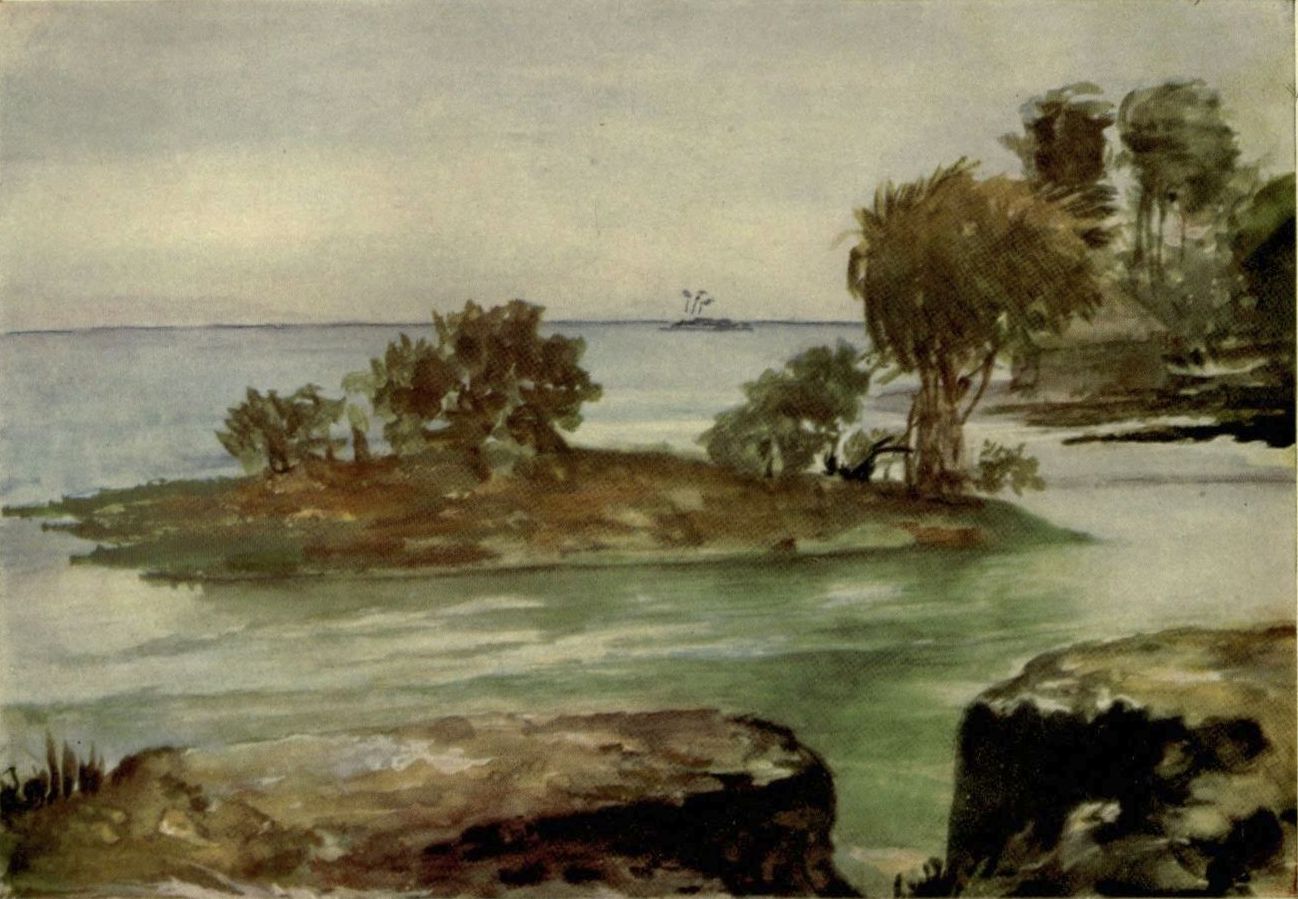
be but temporary, and that the real end is where all ends and is forgotten, and where, as the Spaniard says, “Dios empiezo.” I sat and sketched a little, seated on the great foundation. Children and women crowded around, and climbed up the space in front, where the great steps should have been, and filed all around the projecting edge that runs about the church. When I had done I rose, and turning the corner of the narrow ledge, found that I had made a group of frightened prisoners. Then I went to the deep pool near by, where the sea runs into the little fresh water, and was smiled at by the good-natured face, just being washed, of one of the murderers by inheritance, who had figured all blackened that afternoon, with green leaves and a white hanging tail. His wickedness was being washed off with his blacking: or rather, his wickedness was all archæological, kept up as a proof of the former dignity and power of the chief, and of the obedience of his men. For these people seem never to have been grossly wicked or cruel; as I told you, they were not cannibals or whatever they had that way, ages ago, was condemned as bad. They have even been unwilling to exterminate their enemies in their many wars: and when they could put an end to the German, in this last war, they stopped their killing the moment the enemy was beaten, as they imagined. An element of strong good nature seems to persist at the bottom of their character.
That evening we had a siva, like other sivas, which I am unable to describe, because I was so sleepy that my memory has not held over. I lurked in the dark, behind our hostess, who did not dance. Her missionary training and her position were against it, I suppose, but also, perhaps, she did not dance well, or as well as others. Afterward she lingered with us, in the late evening, as did the taupo who had danced. With them were her two girls, attendants, and one or two of the elder women, along with some of our men who acted as chorus. Then “quelque diable le poussant,” nothing would do for one of our own party but that he should tease and beg for a dance with more undressing. The older women seemed to enjoy the notion, which reminded them, perhaps, of old days when they were able to be naughty, and had performed all sorts of antics late at night, when the elders and the great people were gone to bed. So gradually, from one dance to another, we came to one in which the performers disrobe entirely for a moment, using some words that represent and lay claim to the same beauty which the Venus of Naples, she whom we call Venus Callipyge, attempts to look at, and certainly shows. But it was all innocent and childish—the taupo danced it, and the young girls accompanied her with one older woman—and Aigā laughed and was amused, but hid away behind us, ashamed. Then we made her dance for
PRACTISING THE SEATED DANCE AT NIGHT. SAMOA
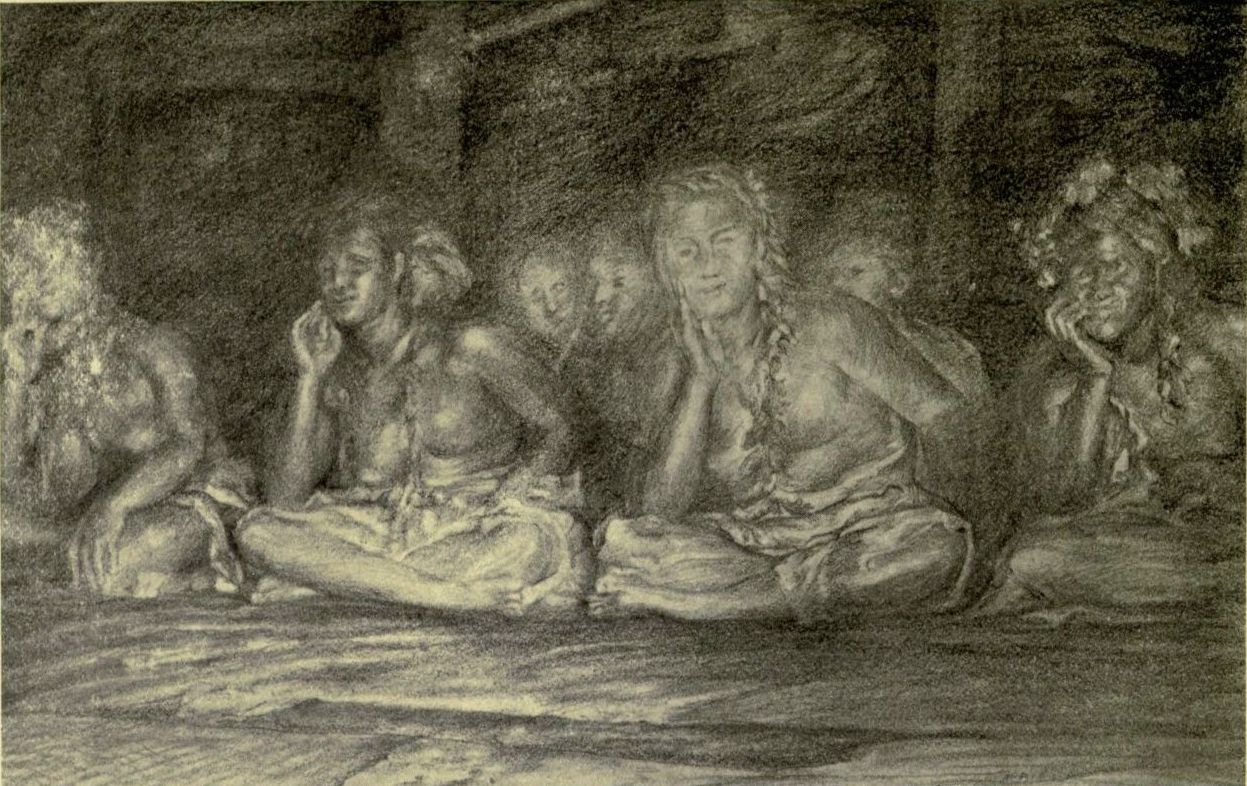
a moment the usual dance, I say we, but it was not I—and as she seemed to think that even that was dreadful enough—we parted with some discomfort. I foresaw trouble, but whether our fair friend was not as much annoyed by the relentless compliments paid to the beauty of others, is more than I can make out, being a man.
In the morning we trotted off a few miles, to this present place Sapotulafai, the headquarters of the great orator, and which is the great political centre. We had a great dinner, at which I sat next to the taupo of the adjacent village, a giantess, whose name is not insignificant, though people here are not apparently named, any more than are people anywhere else, by name to suit them. Charlie interpreted her name for me saying, “When you are on top of a cocoanut, and the wind blows hard, and you are afraid of falling off, that is Lilia.” You have seen a palm tree in a gale, and you can imagine the picturesqueness of this definition of fear, in the wild swinging of the waves of the branches.
We had a siva in the afternoon, when a young chief danced with the taupo of his village, to whom he is engaged: She gave him some occasional affectionate whacks of reproof at some remarks that distance did not make clear; and we had a great “talolo” with the speech of the great tulafale of Samoa, and then a return speech, which was listened to with some curiosity. Some devil inspired me to urge our representative speech-maker to discuss the severe and mistaken view of dancing taken up by the missionaries—I mean the brown clergy. They had done all sorts of good, but they were crowding too much out in their zeal, and the white missionaries were not so excessive—and so forth. And Adams had made a remark that seems to me a deep one. Something more is needed for these people of few occupations. If they are to live to-day they are destined to a putting aside of the excitement of their little wars, and they need some outlet in games that exercise them, and keep up their appreciation of physical life and excellence. Anyhow, these views were launched out at a risk, and in a few days, without a doubt, will have gone all around Samoa.
My own reason was a nearer one. It grieved me to think that Aigā should risk her church position, because she was polite according to Samoan etiquette, and that the other girls, who did the same, to wit, gave us dances, at the request of their fathers and superiors, should be placed between divided duties. This had been an oppression to the mind ever since we came; and perhaps after all, we may have done well.
In the evening, our own taupo, Faauli the daughter of the orator, gave us a siva; she danced, and danced well, and so did Lilia, the daughter of a great chief, a Catholic, and then we had the other taupo, who danced again with the young chief to whom she was engaged. His dance was certainly amusing to the imagination. The chorus was singing about himself, in his honour, and he performed the steps, if I may so express it. He and another with red girdles and black, furry loin-cloths, and red leaves in the hair, and red bead necklaces, danced with the taupo herself, dressed all in red and purple leaves. The dances were a dance of the hammer, and the dance of the cocoanut, and in the glitter of the palm-fire, the ballet of our fairy opera. And satiated with dances I have tried to be quiet and to sketch until now.
Oct. 30th.
We shall leave to-morrow. I feel tired, a little saddened; I suspect that sleeping on the floors at night, in draughts from the back-country, and wandering occasionally, in the midday, among the hot thickets, may have given me some little fever. The German manager of one of the plantations was telling me a little while ago that there was danger in this, though nothing like what he had seen in other countries. On that account, he had lifted the flooring of the houses, built for his men, Solomon or Marshall islanders, whose health was of course of importance to him, during their contract time. After all this care, they will be taken back, perhaps, to the wrong place, and I suppose, eaten by their fellows, if they happen to land on the wrong spot, or at some neighbouring village.
This afternoon we went to Sapapali, to take leave of Aigā who had been so kind to us, and who seemed almost hurt at our not remaining. We found her apparently sad and troubled, and I regretted that we had been accompanied by the other Taupos of our locality. Not that they were not kept in their places by the greater lady, for this rather timid and amiable person knows perfectly well how to speak to people who are socially below her, and nothing has interested me more than her various shades of inflection in addressing others. But something has evidently annoyed her, whether the break with the church on account of the siva, or her girls having been indiscreet, or her having made some mistake that I do not exactly understand. She was much teased by one of us about some “tendresse de cœur,” and that may have annoyed her. And the praise given to her little girls, and an attempt to get them away from her control may not have been pleasant. When I had seen the rest of the company pass by my sketching place, and I knew that the visit was over, I went back alone to her house and found her among her girls prostrate and in tears. But she came out to me, so as to be alone, and she spoke as if we should misjudge her from Sunday-school views and not understand that her parade at the head of her warriors, all undressed, was an official duty to us. And then bade me sweetly good-bye—and but a moment ago my curtain mats have been pushed aside by a messenger who has come all this way at night to bring me flowers from her.
So that I am not in cause: I leave it to you to read. I feel almost as if what I were writing to you were indiscreet enough. Remember that there is little privacy here, and that the houses are half open, so that one may almost rush in. In fact, were it not for the complication of human nature, I cannot see how there could be any privacy. There is privacy somehow or other, but not in our way. Outside the house there may be ways of saying things, inside and out there are dictionaries of signs, but they all have the most wonderful way of hearing, and there are always eyes everywhere. I have remarked that since I have cultivated the habit of sitting on the ground, I see more of everything, and I seem to be able to watch more easily. But, as I said, privacy is relative: nothing has struck me as more Samoan than an elopement which I almost witnessed. The young woman ran away with some young man, along the beach, in the presence of hundreds of people who, it is true, were not exactly watching her. She was just as publicly caught and brought back, cuffed sufficiently and scolded by her older sister, and I see her occasionally, in a neighbour’s house, looking not so repentant as on the first afternoon of her punishment. As I said, I am tired and sad—and I wish you good-night across the ocean and land.
At Home in Vaiala, Nov. 4th.
The end of our malaga was not so pleasant. When we left Sapotulafai last week, I was ill and fevered, and suffered quite a little during our long trip of fourteen hours at sea. We had to row it. There was no wind, and our men, never over-energetic, had been up all night in the last enjoyment of social delights. Once indeed, Seu scornfully took an oar, but even with that, twelve good hours’ rowing is not bad work, and we got back in the evening at eight, having left Savaii at six o’clock in the morning. The light and colour were as usual: even with fever I could occasionally see how beautiful all was, but I managed to sleep, and do not remember anything in particular, unless it be the long-continued song of the men rowing——
“Lelei. Apoli-ma! O-le-e—O-le-e!”
Vaiala in Upolu, Nov. 13th.
Yesterday, on Faatulia’s invitation, we rode over to the Papa-seea, the Sliding Rock: only a little distance, some hour and a half from where we are, so that by eight o’clock or so we were out in the rain, mounted on the horses seared up with difficulty for the early start. Mine was a horse owned by the boy Poki, who is an owner of horses—he has now three, and his food for them is given by the village common. His still more youthful friend, Sopo, hired his horse to Atamo and somebody else fitted out Awoki and Charley who went with us. Samau, the tulafale, and another of our crew were to go ahead and carry some European food and our painting and photographing kit. As we passed along the beach, which is, as you know, the street of Apia, we met Meli Hamilton and Faatulia and Fanua, and little Meli Meredith, all mounted. Gathering them together, under rather a gentle rain, we turned toward the woods behind the town and cantered over a dyke, through a mangrove swamp, where formerly must have been some coral inlet; then past some villages, a few huts, and then into the forest. This is no description to you, but perhaps I can interest you by letting you understand that the delicate form of the great novelist, Mr. Stevenson, passes up or down this road, of necessity, on his way to his Spanish Castle in the mountains. So that when he begins to write South Sea stories, and is obliged to use local colour, you shall probably admire some beautiful description of all or part of the road.
In the woods we overtook our men, and dear Fagalo and Sué, whose bare legs were paddling in the rain. A little path led through woods all overgrown, in a narrow zigzag, over fallen trunks and under branches beneath which we bent. The light fell through green high up, upon green all around us; innumerable small trees and bushes, and occasionally great trees whose trunks ended in high buttresses of rooting sharp and thin, as if the trunk had been ravined. These are the trees which in the old story-books of travel were supposed to furnish a ready-made planking. Over all grew lianas and vines whose great long stems hung in the air above us, or low enough to be pushed aside as we rode. Notwithstanding the several varieties of growth—the Samoan wild orange with double leaf and prickly stem, whose fruit was used in old times as a soap to wash with, or the Fuafua, with broad leaves—the effect was not unlike the appearance of our own forests, had it not been for the lianas, and the occasional sheafs of wild banana that swung against our horses’ heads. For an hour we went along in a scattered file, the sunlight occasionally dropping in upon the great stillness around us. Rarely a bird sung. Once we heard the running of a river. Then we came to a stopping place; all got off; the girls
THE BOY SOPO. SAMOA
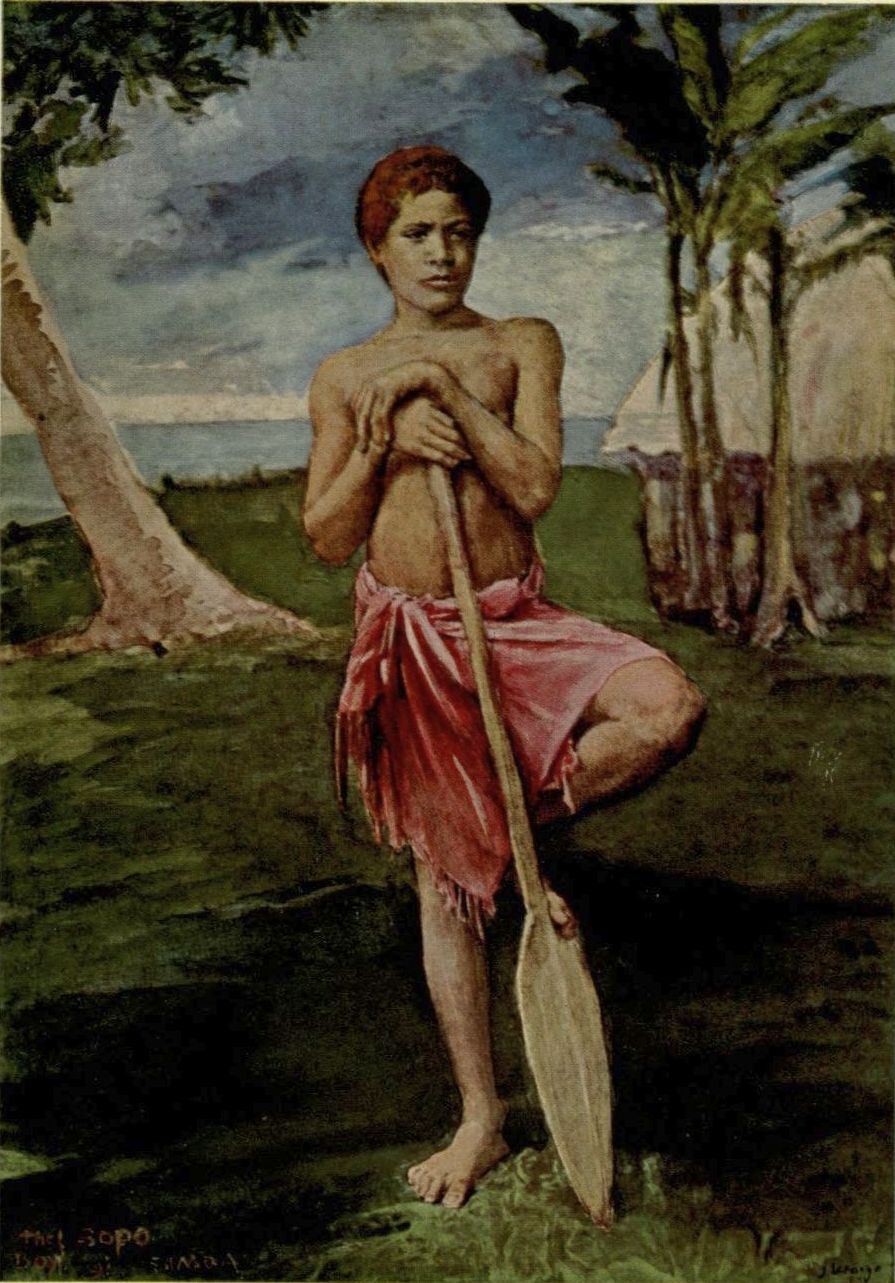
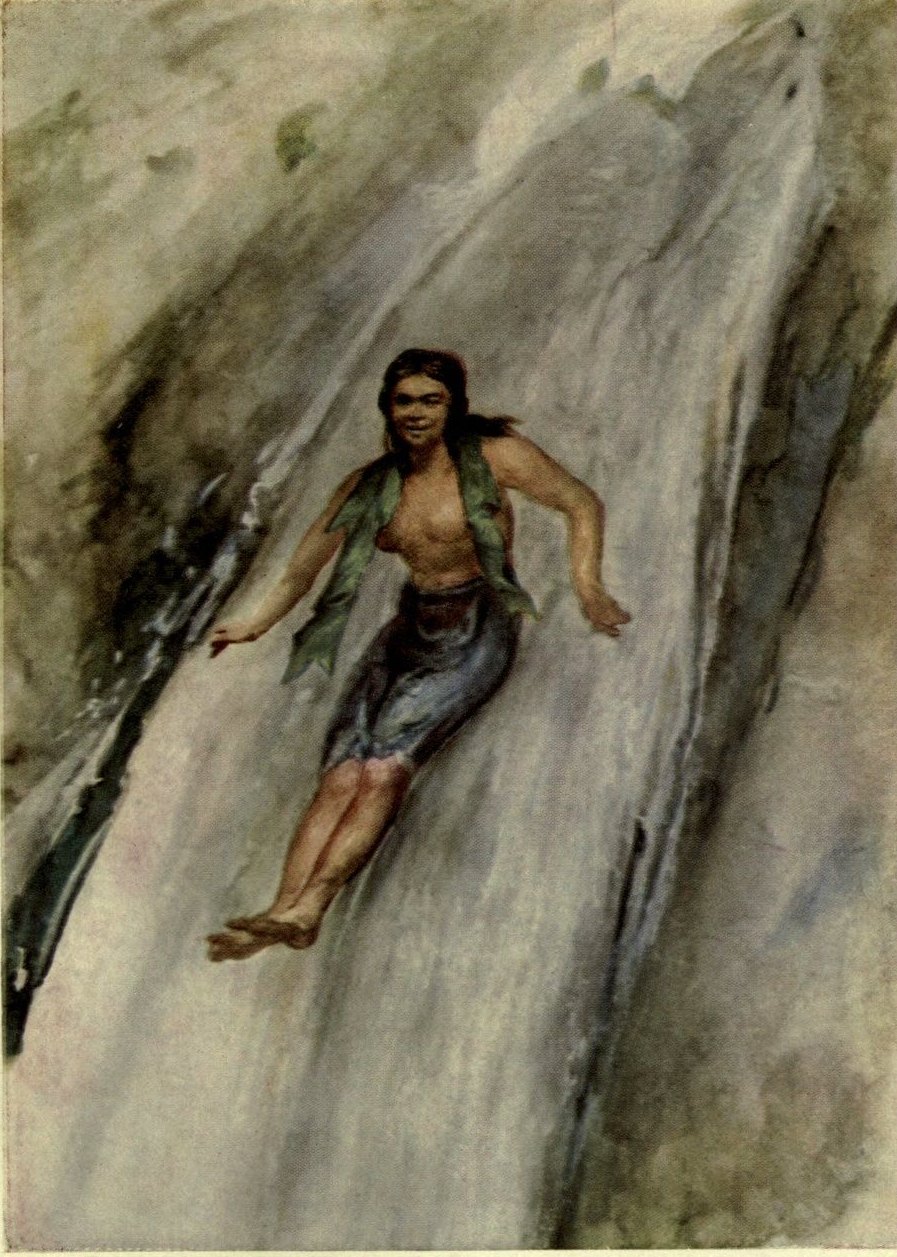
skilfully ungirthing and unsaddling their horses, and tying them up to the branches with long ropes. Over the trees that sloped down below us, we could now see the harbour of Apia, from one end to the other, and we kindled a fire of dead wood, to show the anxious friends at our end of the bay that we had arrived. There are three waterfalls in this little opening to which our narrow path had led us, and it leads no further and nowhere else. Of the three falls, each divided from the others by wide platforms of rock, the upper one is low and does not count. It is the second and the third that are “slipping rocks.” The water rushes over them in one or many falls, according to the season, and in some of the channels the surface has become so slippery with moss that all one has to do is to sit and be whirled into the pool below. We had just begun to look down into the little hollow, edged on one side by a high rock upon which ferns and vines and green bananas find a scanty foothold, when Fagalo, throwing off her upper covering, seated herself on the edge of the current, and in an instant had slipped off. And a laugh from below echoed above as she rose from the pool and swam to the shore. By the time that we had clambered down to meet her, she had come up and rushed down again followed by Sué. The sight was charming: the pretty girls, with arms thrown out and bodies straight for balance, their wet clothes driven tightly to the hips in the rush of the water, had a look of gold against the gray that brought up Clarence King’s phrase about Hawaii and the “old-gold girls that tumbled down waterfalls.” In the plunge and the white foam, the yellow limbs did indeed look like goldfish in a blue-green pool. Further down there is a small rush of water into a little hollow in the rock; the two girls in their play filled it easily, like mermaids in too small a tank. Then we had lunch on banana leaves, to which our wet friends contributed the shrimps that they had caught, accidently as it were, and without thinking, in these moments of “abandon.” We had also a mess of palolo looking like very dark green spinach, darker than the green leaves in which it was wrapped. Adams insisted that this dish tasted quite like “foie gras,” which he also said was quite as nasty a preparation.
To explain what palolo is I should have told you of a little expedition we made one morning last week, just on the return from our malaga. But I was ill and had suffered too much from native food to write any more upon similar subjects. Even all my liking for Meli Hamilton and my admiration for the fullness and redness of her lips, and for the gleam of her teeth, could scarcely reconcile me to the wriggling of the great tree worms through which she crunched so gayly and healthily at our last great Samoan dinner.
THE PAPA-SEEA, OR SLIDING ROCK. FAGALO SLIDING WATERFALL. VAIALA, SAMOA
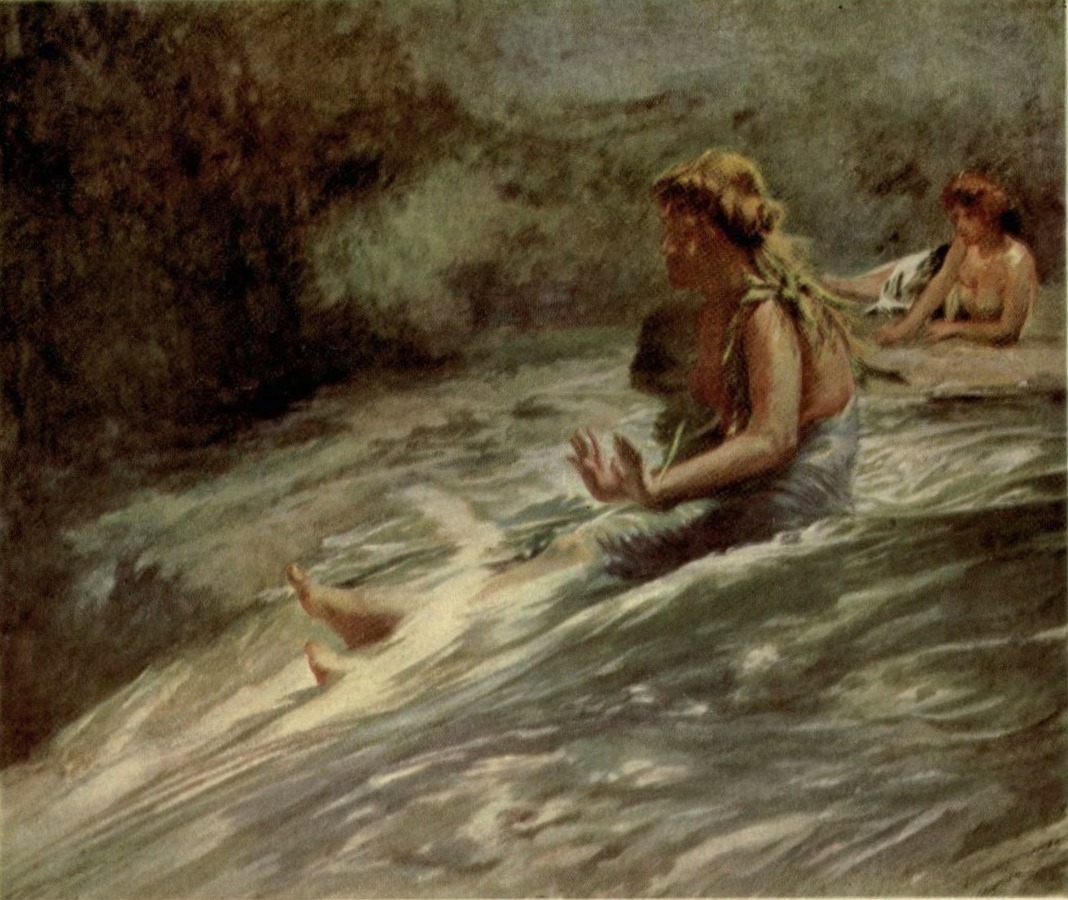
At the waterfall, after our lunch, our men had theirs, and they sat with heads all wrapped about with leaves, while the rain came down upon them; for if there is anything that a Samoan detests it is getting his hair wet. The rest of him does not matter. Meanwhile we smoked under our umbrellas, pretty Meli Meredith half under mine, and Meli Hamilton under a big banana leaf. For most of the others rain did not matter. They had either gone into the water or were preparing to do so by sitting quietly in the current. Otaota had prepared for the slide, and was stretched out in the run of the waterfall that now swept over, now left uncovered her extended limbs; for she leaned out upon one elbow, and dipped a hand in the water, scattering it upon the other girls in a lazy way. Otaota was “missionary” that day, and would not uncover the lovely torso about which I have told you so much. Then the sun came out in a lingering, gentle way, as if it dripped down from the sky, and with it all the girls went over; Fanua and Meli Meredith and Otaota. And as we looked down upon them, they swam over and hid behind the branchings of the vines like so many nymphs of streams, their faces and arms glancing like gold out of the green. Near them one of our men made a deep red in the water by contrast. And now Awoki, with much hesitation, prepared, put on the native lavalava, and tried his luck. Yellow he is to us, but he looked white and pallid among all those browns and reds.
The whole thing was catching, and had we stayed longer we too should have been over, though Adams said that just then our dignity forbade it. But our feeling of dignity had been helped by Meli Hamilton’s telling us that the last time she had gone over the fall, she had struck badly against a rock, and so had her companion, the navy officer; so that with the rain beginning again, horses were bridled and saddled, and we all started for a wet ride in the wet woods, down the slippery path which we had to take in single file. Fagalo rode with Charley, on Sopo’s little nag, and the last thing I saw of Otaota was her bare legs over the back of Awoki’s horse; he sat behind, his arms around her, gallantly protecting all that remained of her with his little waterproof. And we came home tired and wet, but having spent a pleasant childlike day with grown-up children.
PALOLO
Vaiala in Upolu, Nov. 14th.
I broke off yesterday telling you about palolo. I think my words ended by telling you that even all my liking and admiration for Meli Hamilton would scarcely reconcile me to the wriggling of the great tree worms which she crunched at our
GIRL SLIDING DOWN WATERFALL. BANANA LEAF AROUND HER BODY. SAMOA
last Samoan dinner. Mrs. Lieutenant Parker became very white as she saw her and I handed her rapidly something or other, brandy or whiskey, to help the occasion.
Palolo has no such horrors. For it we have not had far to go. Only just out into the reefs before us, when, in the early morning before the dawn, we rowed out a few yards to find a concourse of people, in boats and canoes, scooping up with eager hands thin hairlike worms that swarmed in the water within the special hollows of the coral reef.
We were more or less ready for the appearance of these little creatures who, on a certain day of the year and the moon, appear suddenly with the dawn and disappear with the sunrise until another year. We were expecting this arrival, which never fails. As I said, it is looked for ahead; it has its own laws; the scientific ones fail because we have calculated by our dates, instituted for other reasons than the life of the palolo. Our Samoan friends are in the secret. We white people compute that the palolo is due at dead low water in the night of the third quarter of the moon nearest the first of November, but that reckoning involves Solar and Lunar months, as I intimated.
Our good friends here have been whispering to us and telling us that this was to happen and they know how to be prepared for it. Certain plants, certain shrubs blossom; and then you know that the time of the palolo’s month is drawing near. There are signs in the heavens, and the moon helps. It is, I think, in its third quarter that the event takes place. Somebody with us, perhaps several people (because our village contains important and learned people) mark time during the year by counting pebbles, and green feathers, and leaves, up to such and such a day, so that, at a certain moment, our friends can tell us that the palolo is due next morning.
The third year one has to count a different number of days, but the creatures down below in the coral know exactly to the minute. The night is watched through, our people are all ready, are warned at the proper moment. People from far away are also ready. Our friends have found each one some proper hole which may be more or less lucky later. We watched the dawn coming upon us, lighting the breakers on the edge of the reef. When the breakers withdraw it is slack tide and we watch, and our friends watch, more intently than we can, the absolute calm of the water. Then, of a sudden, somebody calls out, “the palolo is there!” or something like it, and then this empty water is full of long lines of what seems to be worms, which you scoop up, not so anxiously as those who care.
A short time, an hour they say but it seemed to me shorter, the sun is up over the edge and the worm is gone until next year.
It is nothing but something like the thinnest of little seaweed a few inches long, and you have to accept as a fact that this wriggling mass is made up of worms.
I wish I could fairly describe the place and scene but you can make it up for yourself. The scene is one of busy struggle. It is a matter of food, it is true, also a festival of amusement apart from the picnic side. Very interesting was the eagerness shown in the catching, by the few white girls born here, whom I watched. They paddled about, jumped out with bare feet on to the jagged coral like any Polynesian, but with that seriousness and ferocity of our race, so different from the easy good-natured suppleness of the brown skins who seem to be part of the nature around them.
The dark transparent water inside the reefs, the rosy colouring of the dawn, the splendour of the sunrise which is at length over land and water, would have been beautiful enough even without this animation of human element. But I have not dared taste the palolo even as made up yesterday with cocoanut milk. I have come to the point of a revolt against almost all of the food, from cocoanut milk to live fish and slugs.
Vaiala in Upolu, Sunday, Nov. 23, 1890.
The end of the last week has been filled with festivity. Seu has been giving a great feast, and this has been a very serious matter. We have seen other feasts before, but none so successful and so great. The presents given to Seu and Faatulia, or rather to Vao, their little daughter, in whose name the feast was given, were larger in number than we had yet heard of. Among vast quantities of other things were hecatombs of pigs—in prose fact, three hundred and twenty-five—over two thousand rolls of tappa, and several dozen of “fine mats.” All the neighbouring houses were in requisition for the guests, who kept coming from various quarters during the whole week, and especially from Savaii, where is the stronghold of Faatulia’s family. Faatulia wore the anxious look of the hostess on her kindly face, and Seu looked worried, a thing I should have thought impossible. But as I go on you will see how serious it all is, however gratifying it may be to pride of position. The house of Seu was charmingly decorated with tappa, even to the floor, so as to remind me, but I own, more pleasantly, of our most æsthetic studios. In others, there were few European visitors, and more packing of Samoans. In one other especially, I think loaned by the King, a collection of taupos from various localities filled the space by the posts, so as to make the hut look like a basket of flowers. Far in the central penumbra, two female giants sat all decorated, and around them the backs and waists of the others looked like a garden of dahlias and brown skin. For some were “faa Samoa”—others were more or less “papalagi” foreigners. In that case, however, their waist coverings were amusing. Some had corselets of leaves lapping over like Etruscan or Greek plate armour. Others had coloured netting, others had tappa cut out with various openings, like some heathen dream of “insertions” (I think women call it so). One girl had a corselet of cut paper of many colours, making her look like a flower-bed, her oiling giving to the paper a look of leafage. There were dresses of the usual variety and in one case a large number of flower petals caught up one by one in the locks of the hair. In another the whole hair had been filled with little light blue bits of paper cut like petals. Mind you, all this was beautiful, funny as it was, and upon the green grass background, made, as I said, a basket of flowers. The brown skins that were not covered glowed like fruit. In perfect taste, for even garlands are gawky compared to the ineffable logic that the human frame carries with it, one good girl had no covering to her body, and this savage from the farther back country had a face that looked like the Italians’. In the shadow, playing with a bambino, she made a madonna. The reason of it came to me suddenly—her hair was down upon the forehead in the two large folds that we associate with the Italian way, and a great look of seriousness was added to the disdainful kindness of the face. Behind her head the hair was full, in a mass whose colour was blond with liming, and made a great capital for the column of her torso seen with arms hidden in front. Of her I have made some studies, and posed her for photographs, and later, on the next night, she gave us a siva in our own house; Adams and I having duly called upon her, as if we were young men, with five loaves of bread, and two tins of salmon, as is the proper thing for youthful admirers like ourselves.
Around this beehive of yellow and black were assembled matrons and children and boys, waiting for the later food, of which they as relatives would have the larger part.
Far off, in another part of the grounds, Lima, known as John Adams, presided over the food; and in front of him a vast mass of pigs and bananas and taro, etc., etc., littered the ground. John told us about it in a high-pitched voice, with an accent that brought back indefinable associations. Whom did I know of the old school with such perfect intonation in English, and a diction that implied the gentleman by accepted tradition? Could it have been some old officer of the navy—could it have been some far-back Englishman or antique Southerner? But John, even in his exterior manner, brought back all the feeling that we do not speak English as well to-day as once was done, and that our refinement of manner and accent has disappeared.
The feast had begun; under long stretches of tappa supported by poles, guests were assembled around the tables of banana leaf, while we wandered about, made prudent by former disasters in diet. It was pleasant to see the triumphant carrying of great pigs by the young men, garlanded and cinctured: the platforms of sugar-cane and taro disposed in a show, as if growing in some impossible yet graceful way—the taro like grapes on a vine.
Then we wandered back to our taupos in their home. They were feasting in a circle around the banana trays. Two men were hewing the pigs into segments, with the swish so well described by my Chinese philosopher, Chuang Tseu, in his chapter of the “Rising Clouds”—if that be the one. Two older women stalked about amid the food, who caught these chunks of meat and tossed them to the taupos. Occasionally they varied this by assorted lots of taro or cooked food. Do not suppose by this that these vigorous maidens were bolting their food. No, all this was Samoan and communistic; no one lives for himself here, but for the lot. These good girls were hard at work, passing all this to old women with baskets, and two young people who sat on the edge of the hut with feet outside, impatiently urged them. “Wait,” they said, “wait; our turn in a moment,” and amid laughter and chattering and long reproofs of the old women, the food came to them in turn. I suppose the taupos managed to get something, but if they did, they deserved it for the work they had in passing the food away. This is Samoa—where a gift is shared or given away. When we called later on one of the taupos, as I told you, and carried our little gifts, half of them were at once given to the owners of the house, and the other half to some chief who happened to be present. All this as a matter of course, with fair counting, as in a commercial firm. Even the cigar accepted by the fair one, passed in a few seconds to her nearest neighbour. Some one was telling me yesterday, of having given a cigar a few days ago to a Samoan, who had just bitten it, when another passing asked for it. Thereupon it was handed away, as a matter of course. “Why did you give that?” the white man said.
“Because he asked,” said the Samoan.
“But is there no further reason?”
“Yes; I might some day want a cigar, and if he had one, I should ask.” The community of friends and relatives is a sort of bank where you deposit and draw as you may need. So for Seu’s food: almost all is given to him. It is given out, sent away if people are not there; a procession of people carrying things from the feast, filed along all the afternoon.
After the feast, a siva in the open air, where Fanua danced. The crowd was full all about her and her assistants, girls and men. The occasion was a notable one. Two white missionaries with their wives were present, and the siva was danced before them. Henceforward the excommunication will be difficult, unless the native preachers insist upon having their own way. But we shall have been present at this great event. I spoke to one of the missionaries for a moment, a rather interesting man, who talked a little about his hopes for the Samoans, their conservatism, and their not being emotional, however excitable they might appear to be, so that things once impressed upon them had a fair chance of thriving.
And thereupon we proceeded (those of us who were tired) to get away—not without, however, looking once more at another siva getting under way, with some of the many taupos and their male assistant dancers, to see them oil. Some one ran around offering the liquid, which was poured full upon everything, dress and person. And being introduced, I shook the oily palms of some of the girls and of one splendid chief—who might have been drier. Then, later, Adams and I called on our taupo friend, whose home we proposed to drop into next week in our travels, and who is visiting near us. We arranged with Meli Hamilton as our tulafale for a siva in our own house. There at night the taupo came, in the pouring rain, and I sat in my own comfortable chair, with Mrs. Parker next to me, and felt at home; for in the shadow I could close my eyes or look on while the figures danced in shadow or in light.
The next day we were summoned again to Seu’s feast. A siva would be danced for us papalagi who had been too crowded the day before. So that we went to see the comedy, which began seriously enough. We sat a while in Seumanu’s house, filled with friends and relatives, while a woman, an ex-taupo, carefully unfolded the presents of “fine mats,” saying what they were for, and from whom, and occasionally something of their history. For the “fine mat” is the great possession—the heirloom, the old silver, the jewels of the Samoan. And one tattered piece that was held up for show, sewed together, its trimming of feathers all gone, and full of holes, was looked at with respect; it had been royal. Around these mats cluster romance and story—war and quarrels—and the idea of the palladium, the insignia of power. The mat has been given at marriage and at birth, and has been worn on great occasions—it has witnessed those scenes, and besides carries money value. Its very stains tell stories of those events in life. So that Seu’s thirty odd mats were quite an affair, exclusive of the pile of two thousand pieces of tappa. As soon as the mats had been counted over, and admired, and a polite discussion arose, our hostess insisting that it must be a bore for us to look over all this, the polite guests insisting that nothing could be more entertaining.
Then John Adams (Lima), in his fine old-fashioned voice and way, cried out that if we wished, a siva was getting ready in the next house, and as our adviser whispered to us that we had better be away, for that now the real work had begun. It was for Seu and Faatulia and the family group to decide as to who should be the people to whom all these gifts were to be made over. A few they might keep, but the mass must go. Every giver had a right to something, if possible finer than his gift: and here was a ploy, as Sir Walter says. Everything must be according to dignity and family and precedence, and everything that society means everywhere. Think of the heart-burnings, jealousies, affronts, etc., that hung in the balance. Many a time in Samoa, war has begun by some error in such adjustments. No wonder that we were better out of the way. Even to-day, we are told that several days more, a whole week, will be consumed in these weighty questions, and Seu is to wear his look of worry for days.
Adams and I sat on branches: I, on the right, Adams, on the left of her Majesty the Queen, while a siva of two pretty children, little taupos, daughters of a chief of Savaii, and of two young men, went on before us in the sweet light, half sunlight and half rain. These two little girls, Selu’s daughter and her little friend, the daughter of a chief of Iva, gave us an infantile imitation, while another chief played buffoon, to give them courage and protect them from serious attention. And this time Fanua sat behind us, and looked on, alongside of many young girls and women whom we have learned to know a little.
Up to this time, the terrible ordeal of decision of presents must have gone on, and will not be through until late next week, when we hope to get Seumanu on another malaga; but this time at our own pleasure, and with the hope of making sketches and studies with more leisure, and with a better knowledge, for as you know, he who runs finds it difficult to read, and there is nothing that I abhor more than the carrying of the studio sight into other visions.
Only the poet is free, whether he be painter or writer, for with him subjects are only excuses, and as Fromentin has put it so perfectly, Delacroix’s three months of Morocco contain all that has been said and will be said of the east and south of the Mediterranean. But we cannot all be great people like Delacroix, nor great painters like him, nor perhaps was he at all aware in early life of his always having achieved. But he tried probably, to be exact and faithful, as any one of us might do.
The weather is again beautiful; to-day is all blue and triumphant; indeed, the sky is bluer than it was, although the grass is yellower, and in the afternoon late, the clouds of the horizon are radiant in violet and rose. Fanua has come up to see me, with the Queen’s little daughter all clad in pink, who has been living in Fiji, and talks English quite well, and says like a child, that she likes Fiji better than Samoa. Service at the little church opposite is just over, where Fanua has been, and where I have heard the voice of Otaota’s father preaching. He has called upon me, apparently interested in questioning about the Mormons, who have sent missionaries here, and whose wives often canter past, against the blue background of the sea. Otaota’s father is not a little proud of his preaching, which indeed sounds well out of the church windows, and he asks me why I don’t come in to listen more closely. His parishioners sit on mats, and I sometimes lend some of mine to stray visitors, especially to members of our crew. The men sit on one side, the women on the other: and files of women, especially, walk along with mats under their arms or over their heads, or held in front of them; and occasionally a child is carried outside on the hip.
There is a small post near by, upon which is a small bell, and a ladder to get to it, all under a tree, and some young girl or boy rings the clapper with great zeal. I have made a sketch of one of them who accidently set about a missionary work, without putting on her tiputa, to cover her bosom, and who was worried as I sketched her, between the propriety of carrying out her “missionary work” and her want of missionary propriety.
Fanua has left, after sending for the child of a neighbour and caressing it during part of our supposed conversation. They say that she is thinking of marrying, and certainly she will make a nice wife and mother if one can judge by looking at her. Is there anything sweeter than a woman caressing a child? and how fond these Samoans are of children. They swarm about as free as birds, rarely checked; the owner of our house, the chief Magogi, looks more good-natured and smiling than ever, when after his fishing, and leaving a fish with us, he parades about with his child in his arms. Like a woman, he even carries him when he is attending to something else. And Tofae is as gentle to little George (the son of the late English Consul, and of Tāelē) whom he has adopted, as if he were a mother. When he and other chiefs, in the afternoon, sit about on the grass, far interspersed, some ten or twenty feet from each other, in Samoan fashion, little George creeps up and nestles against him, making with him the only group in the big circle.
Fanua has gone, and from Mataafa’s house begins a hymn. I recognize the ancient sound of the Ave Maria Stella (for Mataafa is a Catholic)—another version of the Vallis Lachrymarum that Otaota’s father was urging on his people an hour ago: “It is morning and you dance—but night is coming and then——” The Samoan smile is proof against anything—but Mataafa is grave and somewhat sad, and must take things on a scale far different. The mournful dignity of his position—a king is always a king, and he has been a real one—of highest birth and greatest capacity—must always oppress him. And he has no future, I fear, for his holding power might be against the interests of Germany, to which England will always accede as a bargain, and to which we will yield, for we don’t care, and we are not yet aware of our enormous strength, to be used for ill or for good, and we sell it willingly for anything.
The former German ruler here knew all about it, for the Germans have every power of measuring us, and he said to our representative:
“You are really weak—like all Republicans—always at the mercy of little home events, and any one of you will trade for some personal advantage. You can have no policy, that any one of you in politics would not break through, to play a trick on the political adversary; and then you have no fleet nor army, to show to others what you could do. Before you can make up your mind to anything we shall have taken Samoa for ourselves.”
God willed it otherwise, but the German had measured us, at least as we are to-day.
The moon is almost full, and comes up in the night, while the sun is still lighting the sky with pink. Around her a single cloud is greenish white, while the entire sky is suffused with rose. The breakers are rosy white; the sea is of a daylight blue, the furthest distance is lit up, and a rose-coloured cloud hangs on the horizon far below the moon, while her wake cuts in silver across the sunlit sea and surf.
The western sky is all afire, and against it, when the eye is protected, the shadows of the moonlight fall with extreme clearness and precision. The beauty is ineffable; a little sarcasm comes up into my mind—a reminiscence of the theatre, of a too perfect arrangement, in which the machinist has combined too much together, the sun and the moon both equally splendid—night together with day. I am sure that no one would believe it if painted, and most would know it was incorrect. This disturbs my peace—but only a little. The good that comes from seeing through our teachers, is that at length we have no more use for them, and the remainder of life is more economical. And indeed, the world about me here seems to say, “See with how little we can be rich!”
Another Samoan Malaga, Nov. 30th. Fagaloa Bay, on the N. E. side of Upolu.
We are on another malaga. I have not quite recovered from illness, so that the trip is not all enjoyment, and I write to you in some dejection and with an effort. We are going around the island, some hundred miles, in our two boats; our own managed by Samau, the tulafale, as coxswain, with four men to carry provisions, etc., and plenty of luggage and food for all of us; and Seumanu’s boat with ten rowers. We left the day before yesterday, in the early dove-coloured morning, all grey with partial rain, the mountains covered at top, and low down in the gorges, the mist and smoke from villages rising up in straight lines that looked like enormous waterfalls. Our first landing was at Falefä, where a river falls over wide rocks in its way to the sea, not so differently from other pretty waterfalls, except that it makes a broad spread of water that joins the sea, so that from some points one might imagine that the ocean runs in to meet it.
And then behind the frame of the wide fall and its bordering trees, one sees the mountains of the dim interior. There we rested at midday, and I lay on the mats, ill and tired, while Charley explained to the young woman of the house, wife of the native teacher, the meaning of a large sheet of the spring fashions of this year, which she had pinned up, with many other pictures from newspapers, upon the screen that divided the house. Her husband was away, attending the great meeting or Fono at Malua, the missionary school, where the toleration or rejection of the siva has been, or is being discussed. I am told now that the native clergy have held their own; and that though not reproving their white brethren, they have not quite concurred in a full freedom of toleration, but have arranged some middle term by which the question will be always limited to individual cases.
Later in the afternoon I sketched at the waterfall, in that curious silence filled with the sustained sound of rushing water, that belongs to such places, within which a faint, sharper thrill was the gliding of the surf upon the beach behind it. The place was shaded in its own shade, thrown over it by the hills that enclose and make it. Here and there, the sun caught the roll of the water, and the distant valley and mountains behind it were all floating in hot light and moisture that came down in great gusts with wafts of heat.
In the evening we came into this beautiful bay with high mountains on either side, and fringes of lower land. The bay, as its name indicates, is a very long one, running far inland. The site we are in is charming, the great mountains right behind us, and from their lower sides, long waterfalls creep down the cliffs and glisten through the top branches of the palms. Around us all is covered with trees. I have lounged and slept as much as possible. Atamo has begun to paddle a canoe, taking out the taupo with him. She has been very nice to us, doing her best with food, and seeing us to bed, and being in early to see us get up, and doing her duty generally and pleasantly. And she has given us sivas. We had met her before at Seu’s feast; we felt mutual good will, so that she was prepared. Her devotion to Atamo is great, and as I said, she has done her best by our food, which we managed this time with Awoki’s help. Through her eyes we saw one evening the resemblance of the light carried on the reef by the phantom of the lady who appears when night fishing goes on. You may remember, how she (as do others of the dead, or certain spirits perhaps—they are all confused in the Polynesian mind) fishes silently in the crowd of the canoes, or alongside of some single occupant—and then suddenly, when detected or suspected, disappears with the dawn that clears all our doubts away. Of this apparition some here say that she has her own canoe apart, just out of reach—some say that she walks on the water—but when she is followed, she makes for the shore, then is lost in the trees, and soon her lantern is seen going far up into the trackless mountain. There no one likes to follow at night. The dark for the Polynesian has terrors uncertain, natural enough, for the dark here is uncanny, and when plunged in its terrors the brown man does not like to add a definite influence or a name of ill omen. The belief in what might be called a lower supernatural is still strong: Christianity does well enough for the great needs, but something else is wanted for the smaller fears and dangers—the things about us at every moment; and it has interested us to draw out the small beliefs of this unimaginative and very practical race, who on one side are so much christianized. I wish that I could recall for you the scene in which we heard this story. The hollow silence between the mountain in the night—the water dark before us between darker trees. The dark shadows of the mountains, across the bay—the long glistening line of reflected starlight rolled up with a splash upon the beach that broke the quiet shiver of the palms. And then the one light, far out on the reef which caught the look of our maiden and drew the legend from her. I regret so much that my constant fatigue prevents my noting some of all this for you, and that I give you, too, no better description of what I see. The place is well worth some talk—even if it were nothing but a memorandum of the pretty talolo, or presentation of food, in which two or three dozen girls brought up the presents of taro and fruit, and threw them before us, filing out of the green trees, and disappearing again within them.
Ulutogia (part of Aliipata) Dec. 2d.
We are at a charming place in the town of Aliipata, which seems to stretch indefinitely for miles along the shore. We have had two invitations to stop; one from Mataafa, and one from Tofae, who both have their connections here, but we have pushed further on, and are now at the house of a chief, whose name is Sagapolu, as I make it out.
Before us, to sea, over a great spread of blue, are two blue cones, little spots that belong to Tutuila. Near us are rocky islands—two of them outside of our reef. We came in on the blue swell that hid everything, and then pulled hard over the boiling of the surf, in the charm that covers danger. The morning was lovely on the water, and we raced with our other boats. We had said good-bye to our friends in Fagaloa, who the night before had given us a siva, not a prolonged one, well done by the girls, and accompanied curiously by the two-year-old daughter of the chief, who followed seriously the performance, and beat time or caught up with the gestures of the older people. Nothing could be stranger, and a more complete proof of the siva’s being a natural expression. No one noticed the child as anything extraordinary, except by an occasional smile. Our crew was asked to perform, and the villagers and the taupo gave the preference, and she was right, to our men. The girls always seem anxious to see the men’s dances; a compliment not always returned by the men. The rising of the moon saw us to bed, and we tried to sleep late, fearing the hard day that has just passed over us.
Here, so far, all has been as usual. The house is far from others, all in the open, with palm trees some way off. At one end of the room is a reading desk, and the ruined walls of the church near by, explain that this house is used as a temporary chapel. At the other end, is a table covered with costly mats, upon which are flowers in glass bottles, and there are two big settles and two big chairs, covered with shaggy white mats made from the fibres of the fao tree; all this furniture upon beautiful sleeping mats.
We have had a complimentary speech from the tulafale, the old chief, who is thin and emaciated and extremely dignified, and has given us kava; and I have learned that Seumanu has a kava name of Tauamamanu Vao (fighting with beasts of the field), when kava is called out for him; the taupo has come in to make it, and Samau of our boat, and Tamaseu of Seumanu’s, both tulafales, have come in to share it. There has been a spread of Samoan fare, apparently good, but I feel prudent and have taken little kava, and have been only a beholder of the feast.
The taupo, who is very young, is very silent, even when Atamo says that he is writing home about her.
They are sitting together, he absolutely immersed in his writing, a feat of which he is always capable apparently, and she is wiping her face on a new silk scarf of blue and red which he has given her, so that it has already caught the shine of the cocoanut oil.
Another little girl has singled me out, and has come to make friends, but I can only give her lollipops, that are handed away almost immediately, like my biscuit, to the smaller children. I have invited my fate, for I smiled at this beginning of taupodom, when she came in, almost closing her eyes from anxiety, to put a Samoan pillow for me on the pile of sleeping mats that had been spread for us to take a nap. Seu is having his back punched by an elderly lady, and peace and the flies reign over all. Here is a curious fact; one would think that with their habits of sitting and lying about, these people would remain in position, but it is only when they are sleeping very soundly that one can find them steady, unless it be a Tulafale officiating, or a chief sitting for dignity. The foot that does not press the ground is simply waggled interminably. Try it for part of a minute and see how difficult it is; and then you will realize that people who can move the foot for ten or twelve hours a day, may be able to dance when sitting, with an ease that only a juggler knows about his fingers.
Meanwhile, the sky is blue, with innumerable white clouds;—the sun smiles down on the banana grove behind us, and in front of it a little veil of light drops shows that it is raining overhead. The smoke from the house near us bends down lazily over the roofs, and Seu’s tulafale and one of our men, are beating a tune on the two great war drums. Lali is the name of the beating of a tune. One two, two—two, and so on, weird enough and rather tiresome. Such are the intervals of their naps, for they have had three hours of solid rowing this morning, and they need rest. At this moment the old chief comes in and talks about the music—praising the accentuation. These drums are near his house, say some twenty feet off, and are very large; gigantic troughs of old wood.
Then he calls across space for his daughter to make kava again; this is the third time within just three hours, but this time the kava will be chewed and not grated, as Atamo has asked for it.
Meanwhile a discussion on the name of the daughter: it is Mo Niu Fataia, if I get it right; it does not matter. Her name represents the fact that a place called Fataia, which we passed yesterday, has wild cocoanuts growing upon it that roll useless into the sea: hence her name. “The plenty of cocoanuts, of Fataia, that you don’t get.” It is this little word Mo that means “plenty that you don’t get.” Niu is cocoanut. You will notice all through, so far, how often names for people are arbitrary and accidental. Otaota, the beautiful daughter of the missionary person, is called Rubbish. Fagalo, who slipped the waterfall, is Forgetful, and so on. We have Smell Smoke Namuasua (or Cook-house, as Samasoni translated it) in our boat’s crew. In the early traditions, such and such an early divine heroine names her children by things that occur at their birth. One, I remember of “Carpenter’s Tools Rattling in a Basket.” The Bible is dipped into at random for names, and yesterday I talked to young Miss Kisa, which sounds like Kiss Her, but is Kish “who killed Saul.” (My taupo’s statement, the usual Bible may run otherwise.) I cannot make out whether good luck follows these sortes biblical.
At this very moment I see coming to me a young lady who wears a black mat and a mop of yellow hair and nothing else, not even a collar. She is late, having been at church. She is the official taupo, the other one only taking a momentary place, and she is the daughter of the chief, and has brought presents of rings and of tappa; and her name is Faatoe, which means all agree, “Leave something in the basket” (when all are helping themselves), and I think this is a very fair addition to our stock of names.
All this time the others to whom she is added are getting the kava ready carefully, gravely, chewing the root to extract its juice. There is a big row of kava people or attendants—all pensive; one man, two taupos, another man of ours, a little girl, and another of our men—no—there are a few others who are around the corner so that I can’t see them.
Then I went for a long walk on the seashore. The sun was setting; only toward Apolima was the sky at all clear. Over one of the islands to the north, cloud and mist threatening immediate rain, made a large veil that hung far up and melted its violet lace over the island. The sea was of the fairy green that the inside of the reef takes in rain, spotted with violet where the coral lay. With me walked on one side my little girl, her upper garment fluttering, her young, long brown arms and legs glistening in the sun. She smiled at me for all talk, for English she knew not. On the other side, a hunch-backed dwarf, Japhet by name, with yellowed crispy hair, naked to the waist, a garland of red fruit hanging down on him, to meet the blue drapery about his loins—his bare legs and tattooed thighs glistening also in the light. Their company meant kindness and the habit of accompanying a chief—and they were kindly certainly, and meant to please and serve. Neither you nor I could have invented a more curious combination, and one of which I should like to have either a drawing or a photograph, that it may serve for the ends of my life. If instead of me and my linen helmet, and trousers kept up by a sash we had had one of the Spaniards, who ages ago, perhaps, landed in the unknown neighbouring island of the Gente Hermosa, the “Beautiful People”—some bearded man with butgonett, and velvet hose and jerkin, the picture might have been that of a knight-errant in fairyland. Such a faraway image it made to me, as I looked down either way to the earnest face of the dwarf framed in the fruits of his garland, or the politely anxious eyes and moving bosom of the young virgin of the village, as we stalked on almost abreast, in the silence, making threefold tracks of very different shapes in the smooth wet beach; until the rain broke down, and then I ran back, supported and clung to by my improbable companions.
As the day closes it is still raining. A sort of glow is in the grey of the rain, so that it reddens all the shadows among the trees. Far off toward Tutuila there is high up a great opening where the sky is as of an apple-green that has been washed with the lavender of the rain clouds: big cumulous clouds round out, made gold by the sunset.
The light fades away, and all becomes blurred except always the cumulus in the distant green sky. The lamps are lit and we turn to dinner.
In the evening afterward we got to talking about the legends and superstitions, and we were for a long time merely getting about it. There had been a promise to have something written out for us of old verses, and then songs were sung, ordered from a number of girls.
These were mostly poems concerning the son of the old chief, who died in the last war, and about whom, says Maua, he is always thinking. I watched his face and sketched it while he sat and listened. He is as striking as an Arab chief, with the orbital bones projecting like a camel’s from out of his face, so as to make a great line of light or dark around the looking part of the visage. His head recedes far up, and his long beard drops on his thin chest. This death of his son has affected him more and more, so as to make him slightly insane.
Maua says that he was once “the baddest man in all Samoa,” and that he was the greatest dancer, and that he had invented many dances, and that he might be tempted to-day to dance, if only we could find some person to accompany him with songs to suit. I think that Maua is wrong, for the chief has become missionary, and is quite absorbed in that sort of thing. As I was saying, he has a splendid, fanatic, Arab head; and so the evening has closed with the old chief’s listening to these memories of his son. I am frightfully tired with listening to the legends struggled for. Perhaps a verse or so of some of the songs might be worth saving out of this wreck of dreaminess. It was a pure, complimentary, Samoan idea, poetic only perhaps because we cannot help translating the feeling as well as the words; it was about a chief the singer sang—a young and handsome chief—and she said how natural it was for the girls to wish for the hero’s notice, “for the very winds that blew belonged to him, coming as they did from his ancestral island that lies to windward.” But our friends are not poetic, I feel sure. They are intensely practical and full of common sense; they make poetry for me. And they are restful—and I—am sleepy, as I said before.
Wednesday Afternoon.
This morning, while it was raining, the old chief talked of the spirits that once ruled. We are told that the chief believes yet in these ideas, but I cannot make it out distinctly, neither one way nor the other. He is missionary now, and as we take his portrait, wishes to hold the prayer-book in his hand. But he tells me there are people who control the spirits (devils, our interpreter and we have called them—aitu) and that they predict things and recover property, bringing evil upon him who has erred until he acknowledges. And this power is not given to any man by inheritance, it cannot fall upon a plebeian, neither the son nor nephew of chief or priest, if indeed there were priests, for this he denies. He says that his people prayed, making oblations to the deities of the village and of the household, and that when these were collected together, they were eaten by them, which, he says, means by those who collected—not the priests, but the family or those attached to the chief, who thought it time for such offerings. And these were given to the bush, if it were for the bird divinity; to the sea, if the divinity was the cuttlefish. His was the cuttlefish, and his family did not eat it. All this, of course, you know more or less of; what I say is of no value except insomuch that I heard it myself. To know all here would require to be master of the language, not to be confined by missionary ideas, nor to be connected with such—and after all that, to have a very receptive, a very acute, and a very truthful mind. There are such people in the world, but you or I do not find them usually writing books, and judging questions for others. These soundings of the savage mind are Atamo’s properly; he is patient beyond belief; he asks over and over again the same questions in different shapes and ways of different and many people, and keeps all wired on some string of previous study in similar lines. But everywhere one comes right against some secret apparently, something that cannot be well disentangled from annoyance to the questioned one. For instance, in the question of genealogy, Seumanu told us that had he been interrogated some years ago in such a direction he should have struck the questioner down on the spot. Still we have hope, and if any one can manage it, Atamo will. Web after web I have seen him weave around interpreter and explainer, to get to some point looked for, which may connect with something we have already acquired. As many time as the spider is brushed away, so many times he returns.
This morning talk of the world of bad spirits that do harm to man suggested to me an opening toward a side I had never read of or heard of. Were there spirits that did good as well as spirits that did harm? There I had a door for home history. Yes, there were such, and no further than here: his son had had such a spirit, who went about with him and looked after him, protected him from harm (apparently from woman a good deal; and took, in such cases—as even with us—the shape of some other woman). Sometimes this protection would be sudden; when he was in the way of harm, a good spirit would appear and drive away those that might harm him, and would sometimes lead him personally away—prevent him—as the old word goes. And all knew that he was so protected; the spirit had been seen and would only disappear when suspected. Otherwise, any one might take the same for mortal man or woman—as in Homeric story, where Nestor speaks and acts, but it is Athens all the same. And had this spirit, or such a spirit, invariably an action only for good? Certainly—and nothing had ever contradicted such a view. And yet—only once, the good spirit had killed a man, but it was for protection always, as a guardian. Then, of course, I could ask no further. As you see, analogies keep coming up, our ideas easily dropping into theirs, and informing them—probably.
And had these spirits and others been apparently existing out of the world of humanity?
The dead became spirits and fought anew the old battles, with a knowledge of the present; as when a chief aitu, known by name, some weeks ago refused to participate in a spirit war urged on by a feminine spirit. “No,” he said, “I have been missionary, but if I am attacked I can defend myself. Go on with your war; if you are successful you do not need me; if you are pursued too far, and into my territory, I shall be here.”
Nene is the name of this male aitu who has “joined the church.” ... And the dead killed at sea turn into fish, into turtles, into sea-life. Now how to clear these from the original spirits existing of themselves? There was one, Tangaloa, who, our friend said, might be supposed to be a distorted vision of the true God. But that you know as well as I.
Here the talk drifted away to a question that, as you see, naturally connects. Were offerings made to spirits as being ancestors? Were offerings made to ancestors? No; of that they were sure—not even if Hawaii was different. And they did not care if the black pig meant anything in Oahu—to them (and the white teeth shone) it was only good to eat. If it crossed them in war excursions, it was only good to kill, but the bird and the cuttlefish, they were not to be hurt; and the bird might mean a good deal to them as it gave them omens by its flight—according to its favourable direction or the reverse, or by its cry. But they had, above all, a great divine omen, the rainbow—which presided over all. When for the people here it was bent over Tutuila, then things were against them; if it stood against them they were not to go into the war, but wait. It, however, it went with them, its end turned toward the enemy, then they were protected by it, and had victory promised them.
We passed the morning in such talk. Then we sailed out to the little island of Nuu Tele opposite, an old crater, and waited a while, while Atamo explored it, thinking to find out matters which might affect present theories. He found raised beaches, stratified, and shells and pebbles in the rock, so that it was mud once, and forced up and not submerged, all to the greater confusion and defeat of Mr. Darwin. But as these triumphs are out of my line of momentary record, I have only to say that I found in the little savage girl-wife of our momentary host the type of little Sifa of Tutuila, which had almost been lost to us. The usual Samoan face is heavy and not wild, suggests good nature and practical views; poetry is not in them but from them. It is we who put it there, because their bodies mean to us possibilities of expression which we associate with intentions that have not yet been developed in them. Nerves they have not; it is only occasionally that one recognizes any permanent tendency to emotion, often by some trifle that is not always pleasant, as in the sadder face of some dwarf or joker, or as in our host’s face, over which great sorrow has passed—or perhaps again in such a “chevalier” as Mataafa, whose character is rare the world over.
Our day passed pleasantly, and as I write, the other end of the room is filled with all these good people lying in a jumble together; Maua and the taupo who is pulling at him and lying on him in part; another girl’s head under hers, while all their feet run up on the posts. Others yet, lying flat, continue the circle, singing together, and sometimes, without rising, beating a siva movement on their own breasts or on each other’s. Four of our men, of the biggest, sit far away in the dark, with crossed legs, upright, immovable, like Egyptian statues: or, as
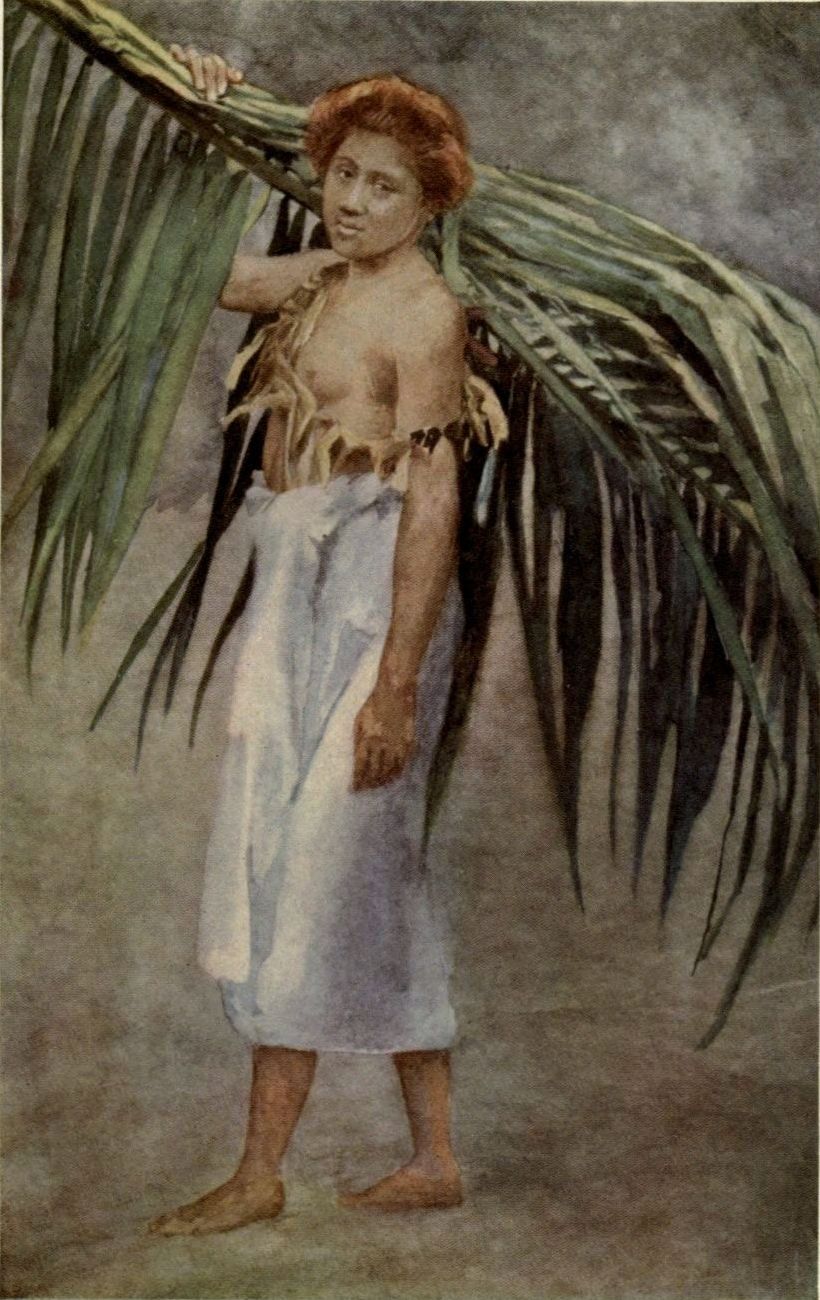
SAMOAN GIRL CARRYING PALM BRANCH
I close my letter, like sphinxes, have bent down to the ground from their hips, all lost in the dark, with large heads and shoulders and outstretched arms.
Lepa, Thursday, Dec. 4th.
We were out to sea, in the sun and rain, between nine and eleven o’clock, and passed the two islands, large blocks of green and brown on the green and blue water. We came here first, pulling through the reef, straight to the enormous beach, where our eyes were at once charmed by the theatrical, or should I say geological absurdity which divided it, cutting it right down from the steep hills behind, to the water’s edge. This was a little waterfall of three cascades tumbling over some small rocks projecting far across the beach, so that the water had, as it were, a stone conduit upon which it was carried from the mountain to the sea. It was an absolute set piece, quite practicable, and if ever I have to design for scenery, here is a little natural object all ready to hand. The copy could be supplied with real water, just as this one is, and the palm trees growing upon it would conceal the machinery as they do here, only—if ever I do it, I shall be told that it is unnatural—just as it looks here. Why does the water run on knife edges, instead of taking the easier lines of depth, and tearing up the sand for a bed? I might explain how, for Atamo is full of geology, and it is not as mysterious, of course, as it looks. But I give it up, and content myself with sketching the little girl between the posts opposite me.
We are in the faletele (guest-house) quite near the water. Some thirty feet off from us cocoanuts hang over the beach and the sea. Right behind us are rocks upon which is perched a new and handsome Samoan house, half-hidden in the green of trees. A promontory, finished by a little island with palms, cuts off the further end of that long beach which is divided by the cascade with its rocks and palms. Toward us, on one side, falls the column of water, which ploughs a little canal into the sea. There our men are bathing, standing up under the falling water, and later I shall be there too. The other end of our bay, near us, rounds away behind trees, and a mound, upon which is a fishing hut under palms. In our house the central beams that support the roof, come together like a V. All the posts and beams are decorated with flowers and leaves, and in the centre, near the great branching post, stands a table covered with siapu (bark cloth) and with flowers in pots, as on an altar, say a Buddhist table altar. Some of our men are dragging up the boats, but I am too lazy to turn to see them place them under the shelter of the cocoanuts. The taupo, is looking at me while I am writing, or at Atamo similarly occupied. She is bored, but I can’t help it. I could not entertain her if anything depended upon it. It ought to be cool, but the beach sends up hot waves of air, and my taupo’s cocoanut oil melts into it languidly. The name of the place is “A Break Between Waves,” and the name of the taupo’s brother, that heavy youngster, who is talking to Seu at the boats, is Break Love. There is a connection that I feel, but you had better make it out yourself. If the chief is heavy, the taupo is clever, and makes herself agreeable. Her sister helps her in every attempt. They are not as dignified as one can remember, and perhaps had we kept to another line of travel, and visited higher types of aristocracy, it might have been different. But they are easily amused and talk much, and are great beggars—and gently, are willing in the same way to marry us, one of them proposing to marry us both herself, and even asking at the last moment, “Are you going away? I thought you would have married me this morning.” All this is joke, with perhaps a look to possibilities: for do I not remember how two little taupos very missionary, far back in Savaii, changed their little easy manners to seriousness, and almost aggressiveness, when some madcap hinted that we were on a wife-hunt, and had come all this way for it. Those two little pieces would not allow the liberties of five minutes before, nor would they let me go without having catechised me seriously as to these chances—to which they were willing to submit; but they wished beforehand to know whether there was anything in it.
We had a siva at night, in which our young lady figured with the great grenadier’s cap that looks so savage and soldierly, and which is really becoming, the heavy faces growing gentle and refined under this heavy contrast. But it is painful to wear, being bound on tight, and how our taupo could stand it for three hours, as she did, I know not. She danced and sat down alongside of us alternately for nearly four mortal hours. Through all the dances there was a great display of pantomime, mostly comic, made none the less by the gravity of some of the performers who acted in reality as a dancing chorus; so that right through the crowd of delirious young men and women passed in and out a fine old Roman senator—I cannot better define him, who never smiled and who wore his drapery as do the antique statues, and whose mind evidently saw other meanings in the steps than did the other dancers. I could almost have wished that there had been some meaning in this accident, some deep, deep thought in this tragedy woven into the cloth of the fun, but I believe that it was merely the pleasure taken by the old man in feeling that his limbs were as vigorous and as supple as long ago. And we went to bed, the entire company remaining alive and interested for several hours after our succumbing to sleep. I could hear late in the night Charley and the taupo crunching sugar-cane and whispering while Charley, during the whole evening, had lain sound asleep. But sitting up late in the moonlight is Samoan. Before I fell asleep, my mind went over some of the historical developments of the theatre. I have certainly been instructed that at the beginning complete realistic performance is impossible. And yet I had been listening to a play in which every possible combination of a fin de siècle manner of looking at things had been slowly and elaborately combined. Was it then that this society in which I am now living, savage as it seems to us, is really a very modified form of an ancient structure of life? Or did these good people, when they sailed from the dim Havaiki, bring already, in their habits of mind, modified trainings of earlier civilization? Any similar views would please me, but I should be better pleased to consider that the rules have not been accurately defined and that we don’t yet really know enough about it.
This story of nothing I conclude to-day at Falealili, as we get further on. We were overwhelmed with gifts at parting, so much so as to make us feel as if perhaps the only fair thing would be to marry one of the girls, as an adequate return. Then with the return gifts we might have run away.
A wife brings mats usually, and gives much support, as is well known by one young gentleman I hear of, a captain of some schooner, who has wives in different places. Each of them in turn supports him when he appears, and as long as his visits are regular, and there is no preponderance or excess or skimping in his remainings, everything goes well, and there seem to be no jealousies. In fact, I think that the having to provide would be a great reducer of those sentiments that flourish most where there is idleness and pampering. Let us say that the subject is too complicated, for I feel already as if I had carried over too much of this letter into the next one. I am concluding now twenty-four hours later, at Falealili, while waiting for letters, and appearing to listen to the complimentary speeches of a tulafale who rejoices in the name of “Tuiloma, King of Rome.” He has a good deal of style, but not enough for such a name, while the chief of Lepa, who drops in to explain his reasons for being absent during our visit, has a fine head and makes a pretty good picture. He has fought against Seu, and they talk over old times. I am told that he fought well, and he looks martial, as I have tried to hint above. Otherwise there is nothing to speak of, at least for me, for I am miserable. It is very hot, and I feel the want of air. I have tried to sketch two little girls making wreaths near by, and they have been driven away to let some tulafale come in and make the ordinary speeches, to which Seu listens with his usual impassive manner. If he is bored no one would know it. Much laughter goes on after the ceremonies. But nothing can restore the little girls. One is a half-breed—very light, her already fair hair bleached with Samoan liming, and she has grey eyes and a very Samoan face. Her father is dead and she lives absolutely like a Samoan. I follow her movements, trying to detect some differences in this little creature, whose fate might have been just as much the other way. All that I can notice is that while I sketch she moves less than the others, and is content with fewer gestures. The fluidity of the pure brown blood is not quite there. I have told you, I suppose, often enough, how difficult it is to catch them in a drawing, unless they are asleep. I have never been able to get a whole minute for any position. Seu sometimes remains quiet for a few minutes, and some of the greater people or men of character are disposed to be steady. But usually it is perpetual movement skilfully disguised under an appearance of quiet. The half-breed was, as I said, more quiet and steady than her darker companions: our little half-breed Charley—sometimes referred to by the old joke of Charley Yow, the Boy Fiend—who serves as interpreter and boy-of-all-work, being a boy, is still more restless than any of our boys. He will lie asleep absolutely as if dead, but if awake he must wriggle. He bends over in true Samoan way, but as he has neither Samoan grace nor strength, I half expect to see him put his head between his legs, dog-fashion, so as to be able to take a convenient look up his back. He plays with his toes and rubs his fingers meditatively, with the European side of his mind, on the rims of our glasses and saucers. Even the rainwater gets a taste of cocoanut oil when he has been about. Yet he is clearly “Faá Samoa,” and lazy as he is and pleased at playing with his fingers on a string tied round his nose, or trying the edge of a knife, he is serviceable as a Samoan. When we put him to the task of interpreting a little Samoan poem a few days ago, he showed an unwilling capacity of mind not unlike what I could remember of schooldays when we had to put Chaucer into modern English, and when we bent all our energy into avoidance. The future of the half-breed is an interesting question here, but too much for my present dreaming.
December 6th.
Later, last evening, during which I was absolutely idle like Charley, and unlike Charley, because I was not well, we had a sort of abbreviated domestic siva. We were politely asked if we should like one, and as politely we explained that we were determined to go to bed early, but that we should dislike to interfere, and would look on as long as we were not too sleepy. The little daughter of the tulafale, herself the tulafale (spokeswoman) of the chief’s daughter, who is the taupo, explained to us that being “Misionali,” she could not figure in it nor be present, and if she were Misionali I think she did as well. The siva was sung sotto voce, and danced softly by three or four women, probably with reference to not disturbing while we looked on—in some curious confusion of meaning. The taupo, who is very stolid, with the expression of a judge of the Supreme Court, danced with nothing on but her tipuka or upper garment, put about her waist, so that the hole through which the head is put in this variety of “poncho” exposed the least polite parts of her back. And as I referred to her gravity of expression, or want of expression, by an allusion to the expressionless look of a judge on the bench, I might slip in here a pretty anecedote of the bright little daughter of one of our celebrities, from whom you will see that she inherits. Last winter her father gave her a chance to see the cabinet officers together, and on her return she was asked, “Well, were they nice?”
“Not nice, but funny!” she said.
Well, so with the dance; and danced by the virgin of the village and her chaperon it had a curious side. And it was funny enough, with the fun underscored and interlined and underlined, as it were, by verbal comment. Apparently the true dances that are not played are innocent as well as beautiful, but when the drama comes in, the dance follows the usual history of the drama.
This is a great missionary centre, and to-morrow will be Sunday, a day on which we shall have to rest because the people here are sabbatarians of a very strict kind, and do not approve of travelling on the Sabbath. Our men tell us things of the habits of travelling; they are all, Seu’s men and ours, except our two tulafales, whose behaviour is all that one could ask for, young gentlemen whose glory consists in the constant and sometimes successful assault of feminine virtue. As they explain it, they would be laughed at at home, if they could boast of no conquests during the trip; but owing to this being an “European malaga,” because we are European, they are on relative good behaviour; so that they lead in prayer and sing hymns, and are in other matters quite good boys. I have no doubt also that besides the fact that Saturday night and Sunday will give them plenty of feminine society, they also do not think that it’s quite the proper thing to travel on Sunday.
So you see that one can go far and see the same thing, and that, as I told you in Japan, the world is fairly round. Expressions vary, but the meaning is the same.
TWO TAUPOS DANCING A “GAME OF BALL.” SAMOA
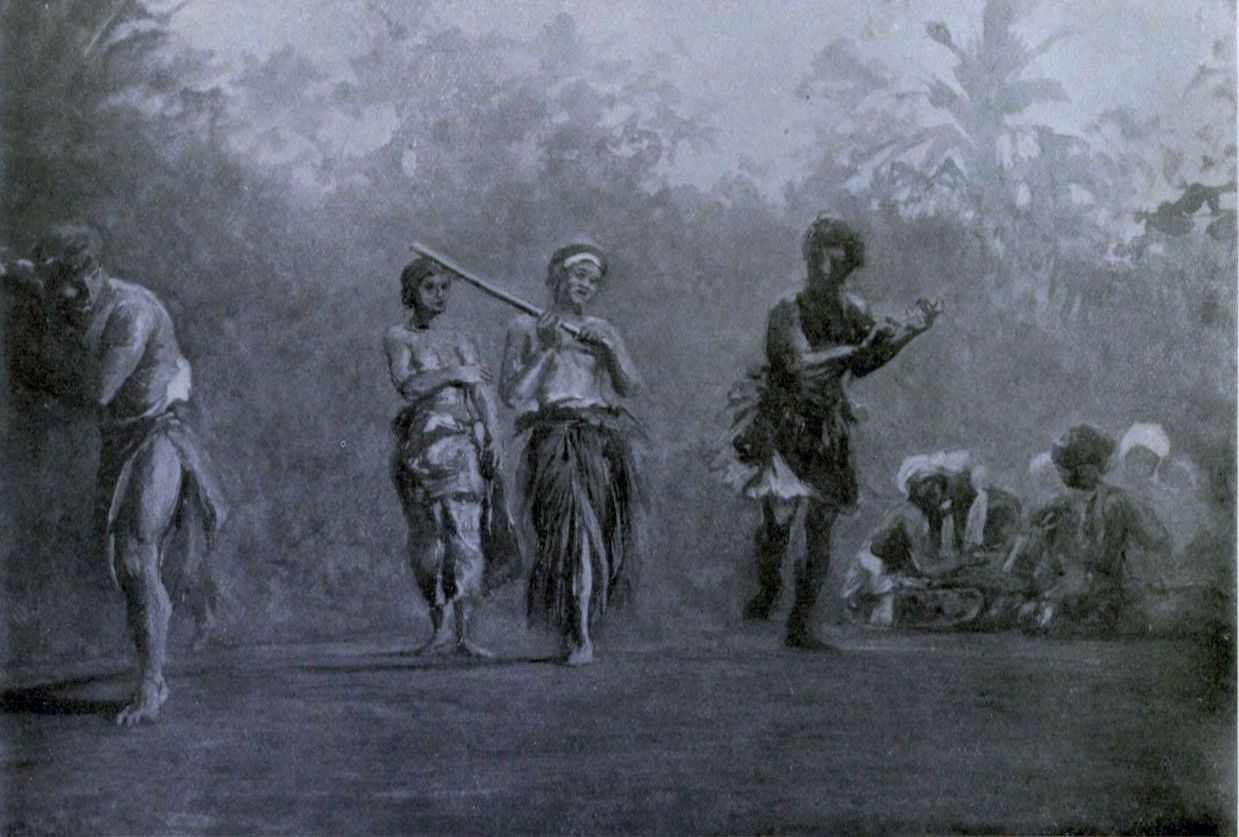
I am writing now from the next station called Vao Vai, “Between Waters,” a queer little place looking like some African possibility. Little houses are bunched together near a little river close by us, and in front of us, seen through trees, far out, is a little island full of palms, which the taupo tells me, is used as a resort for sick people who go out to get fresher air. She herself explains that we shall have no siva because they are sad for the loss of a young man, a half-brother of hers, brother of the taupo whose dance and dress I described above, and who was the taupo of the preceding village. Our good girl is missionary besides, which will secure us the greater rest from sivas. Her brother’s death was explained to us last night. He had gone over to Malua, where is the theological school, on a trip, with only one attendant, and fell ill and died here on his return, having, they assured me, been beaten to death by devils. So he said himself before death, and in proof of it, his body was sore. Moreover, just before his death, he ran out into the woods, in the dark. But being caught by the leg, by some tulafale or person of importance, and asked who he was, he gave his father’s name, thus proving beyond a doubt that he was possessed by his father’s ghost, I have not yet been able to get the connection between his father’s spirit and those who beat the son to death. But that may turn up yet, for the subject is in everybody’s mouth. I ought, perhaps, to add that the young chief had had a cold before, with inflictions of pneumonia, and had been somewhat relieved by medicine from the Catholic priest at some adjoining station, but the devils were too much for him.
To this little hut, looking out toward the enormous space of the sea, nothing growing in front of us but two half-cut-down bread-fruit trees, on the line of the horizon and the little island just outside of the reef, and the long line of breakers extending right and left and as far as one can see—have just come your letters carried to me across the mountains, in a great rain. I have been in some anxiety for them, for I had had only partial news since September 5th, which was three months ago. Newspapers have also come from San Francisco and from Auckland, giving telegraphic news as far as November 17th, from San Francisco to November 6th; so that our evening is full of incident. There has been a political change through the elections at home that alters the positions of persons, and gives one a sort of feeling that all is not Samoan peace. And the financial news affects us with doubt as to long delays, for drafts on the Barings, or on any one, indeed, will not be quite as easy to use in these little communities. So that this event is a turning point to me out of the world, as well as to the great people in it. To increase the resemblance to home, where
FROM OUR HUT AT VAO-VAI, SAMOA
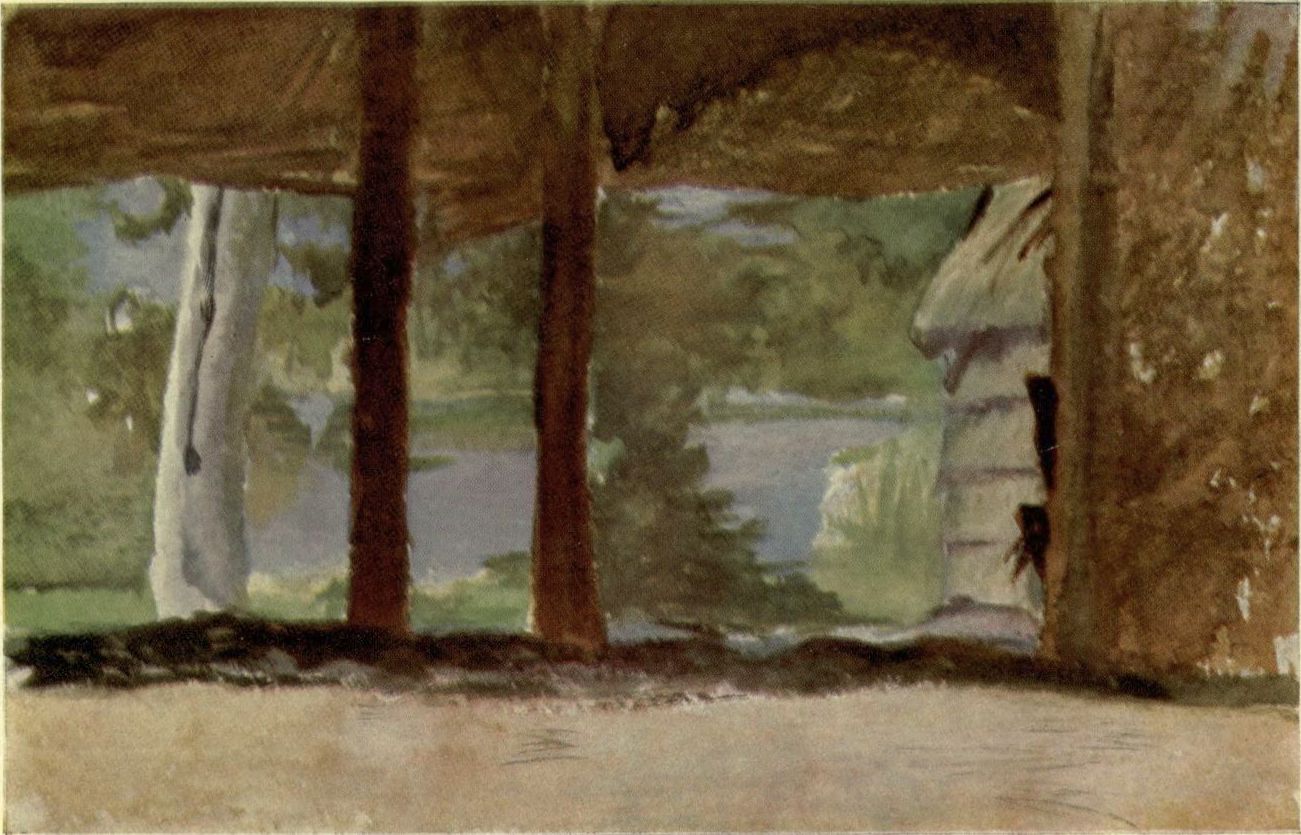
little habitual matters accompany great ones, we find in this little far out-of-the-way place fresh butter for the first time in many months, and milk. So that with Awoki’s cooking, we interrupt for this evening and to-morrow morning, the course of our Samoan food. It is amusing to notice what importance this event has assumed, and to realize that to-morrow, Sunday, will be so much more pleasant for this little change.
Sunday.
This morning I watched from behind my mosquito-bar, where I was pretending to sleep, the procession of people going to church for the second time. I had been waked at dawn by the little bell, which sounded like a steamboat call for all aboard. Against the background of the sea filed continuously the parishoners, grown people and children, most of the women with the hats that belong to their idea of church. But among them were some women with “fine mats” around their waists, that contrasted with the queer European headdress apparently made only for this and similar markets. These contrasting individuals were, I was told, the watchers upon the dead man of whom I spoke, he who was killed by devils in the woods. These fine mats were their guerdon—for he was a chief’s son. Had he been the chief, my informant said, mourning would have been general; the people would have had half their hair cut, and this would be done perforce to such as neglected it. With this information I woke up officially, just as I saw our men filing away to church. Later they came back to ask for canned salmon for their girls. Nothing has occurred. I have sketched most of the time. Atamo has been over to see the little islands, for the pleasure of paddling in a canoe. The taupo did not go, whether from missionary sabbatical feeling, or whether she was afraid, or whether the men would not let her, for they said that a woman did not know how to take care of a boat over a surf; rather an ungallant way of looking at it, for the women we have known, pretty generally paddled about well enough inside the reef. Our little taupo, who was very nice and quiet, spent most of the evening playing with the men. I have spent the day in intellectual idleness, as I told you, as the place is very small, being half surrounded by a little river, and crowded with small houses. I have moralized in a depressed way, and in this direction: would we at home, if things were clean enough about us to deceive us, find it amusing to sit in an Irish shanty, as we do now in this one? We should have pigs about and occasional dogs, and kind, ugly old women and some politics. And the resemblance grows more and more as I look at it from the dirty point of view. Things are thrown out of doors to the pigs, who are so convenient to put things into you wish to get rid of, as Mrs. Bell used to say. And the ducks wander about everywhere, and I watch the way the pigs eat cocoanuts, etc.