SAMOA (continued 2)
Reading edition
The missionaries were Wesleyans, or, rather, men of the London Missionary Society. The form seems to have suited the Samoans. It was a service in which every one took part. There was preaching and eloquence and oratory, and to a certain extent the community was invited into the church—not allowed to enter into the church as a favour. So that notwithstanding their fondness for externals, the Catholic service gives them less of their old, natural, ancestral habits by centring everything in the ministrations of the priest, and by cutting off all chance of any members of the congregation becoming themselves orators, deacons or preachers, and leading in turn themselves. The chiefs also would hesitate in a choice of humiliations; the missionary, white at first and now a native obtaining a position of equal and sometimes superior influence, and that without any civil preparation for the same—indeed with less fitness from the relative isolation of his days of study. Later on I may explain to you more fully how absolutely the chief is the pivot of all social good. He has been for indefinite ages the cause of all action; he has been personally superior both in body and mind. The entire aristocracy is a real one, the only one I know of. It is impossible to enter into it, though one may be born into it. With our ideas of more or less Germanic origin we suppose a ruler gifted with the power of bestowing part of his value upon certain men lower than himself, and actually making such people essentially different. A Polynesian knows no such metaphysical subtlety. The actual blood of physical descent is essential to supremacy, except in a most vicarious and momentary manner, or as by marriage so that the children may become entitled to whatever the sum of the blood of parents represents. With them an heir to aristocratic privileges or power or influence or prestige represents nothing more than the arithmetical sum of his father’s and mother’s blood. I have had lately a Sunday afternoon visit all to myself, from a charming little girl who is the daughter and sole child of the king; a nice little girl with pretty little royal ways, who explains to me that she does not like things here so well as she did where she was taught English, where she had been at school, in the British colony of Fiji. There she was a king’s daughter, and any English ideas around her would be more flattering to her consequence than even the kindly feeling of the subjects of her father. For her mother is not of equal blood, besides being a foreigner. The great chief Malietoa Laupepa, whom we have made a king, cannot make his wife, according to Polynesian ideas, any more than what she was before he married her; and the little daughter has only in her veins the royal blood on one side, and a certain respectability on the other. To the true Polynesian mind, such a one of her cousins, of less high descent on the father’s side, may be of higher descent on the mother’s, and the sum of those descents may be very much greater than the sum of the descents of the daughter of Malietoa Laupepa. Hence it requires a great stretch of loyalty to look at such a little person with the veneration that the Polynesian feels for “chiefy” origin; and you can understand what a disastrous and bloody muddle we have made it for them when we have told them that the word king represented anything that they had themselves or could have. With them Rex nascitur non fit.
All this has been explained by the supposition of two different races, one of which, that of the chiefs, had subdued the other. There is no such tradition, however, and no apparent reasons to explain the enormous superiority of the aristocratic lines except the simple physical ones of choice in breeding and of better food and less suffering, continued for centuries and centuries. Even at a distance a chief can be distinguished by his size and his gait, and a successful collection at some political entertainment brings back the dream of lines in the Homeric catalogues of heroes. Great size of limb, great height, consequent strength and weight, a haughty bearing, a manner of standing, a manner of throwing his legs out in walking, like the step of a splendid animal, a habit of sitting upright—all these points tell the chief.[7]
Upon these superior beings, then, brought up to command, considered as sacred by themselves and by all below them, devolved perpetually the duty of deciding everything that was to be done. Even in a detail so minute to our minds as that of a day for fishing, the chief decided, and does yet, what the community should do. The good fortune of all was dependent upon his wise choice. As the chief has often explained to us, when the women began to talk too much, and fix their minds upon harmful gossip, a healthy diversion was that of ordering them to make the native cloth—an absorbing process. With all the refinement of political leaders, excuses would be found for such an enforcement of industry: the occasion of some visit to be made or received, when every one entitled to it should appear with many changes of dress; when the visitor or the visited should receive presents of beautiful cloth. Let me say how elsewhere, in another group of islands, the earlier missionary interfered and broke up the industry of women, without evil intention, making them idle, and opening thereby the gate to ruin. In Polynesian life, as I am trying to explain, things were intimately connected. There were religious forms or words—or shall I rather say, forms and words of good omen?—accompanying all ordinary human action. Had the missionaries realized this perfectly, they might almost have interfered with the savages’ breathing; but they fastened on the pagan forms connected with the making of cloth, and the women gave it up, and bought cotton from the white man, and paid for it the Lord knows how.
The chief, then, sent the young men to fish and the women to work, when it was needed both for physical and moral good. War, of course, they always had, as a last resource, just like the great politicians of Europe. The constant interference, involuntary very often, very often most kindly meant, of the missionary or the clergyman, diminished this influence of the chief—an unwritten, uncodified power, properly an influence, something that when once gone has to be born again.[8]
And the brown clergyman, continuing the authority of the white one, has something further, less pure, a feeling of ambition, a desire to assert himself against former superiors; and he is perhaps still more a dissolvent of the body politic into which he was born.
I see no picture about me more interesting than the moral one of my next neighbour, the great Mataafa. To see the devout Christian, the man who has tried to put aside the small things that tie us down, struggle with the antique prejudices—necessary ones—of a Polynesian nobleman, is a touching spectacle. When a young missionary rides up to his door, while all others gently come up to it, and those who pass move far away, out of respect; and then when the confident youth, full of his station as a religious teacher, speaks to the great chief from his saddle, Mataafa’s face is a study. Over the sensitive countenance, which looks partly like that of a warrior, partly like that of a bishop or church guardian, comes a wave of surprise and disgust, promptly repelled, as the higher view of forgiveness and respect for holy office comes to his relief.
But Mataafa is not only a chief of chiefs, he is a gentleman among gentlemen. My companion, difficult to please, says, “La Farge, at last we have met a gentleman.”
His is a sad fate: to have done all for Samoa; to have beaten the Germans and wearied them out; to have been elected king by almost unanimous consent, including that of the present King, who wished him to reign; then to be abandoned by us; and to feel his great intellectual superiority and yet to be idle and useless when things are going wrong. And more than all, however supported by the general feeling to-day, if he moves to establish his claims, the three foreign nations who decide Samoa’s future, not for her good, but for their comfort or advantage, will certainly have to combine and crush him.
He is a hero of tragedy—a reminder of the Middle Ages, when a man could live a religious life and a political one.
And his adversaries among the natives are among our friends; and we like them also, though there is none to admire like Mataafa standing out for an idea for the legitimacy of right.
For all the soft Communism of which I spoke, the chiefs were the stiffening, and are so still in as far as the new ideas, or rather want of ideas, do not affect their real authority.
As I tried to explain, these are chiefs, lesser or greater, hereditary, essential; nothing can replace them, no commoner come into their position or a similar one. Alongside of them an European monarch is a half-caste or a parvenu. When, as you will see, we, that is to say the English and Americans, made one of them a king, we made a thing unknown before, unthinkable in reality among their social machinery.
For however true it is that the chief is so by birth, by authority of nature, you know that in Samoa he is also elective. A council of chiefs of his own race determine whether or no he shall “bear the name.” For smaller chiefs, their own names; for certain great ones, such a name as Aana or Malietoa.
With these names goes the power over certain places large or small, but each having a traditional value. Should a chief of sufficient blood have all these five names (and he cannot get them without such natural inheritance and the name may remain empty), should he have all five names, then he is of necessity king, that is to say, chief of chiefs. But if he have only three, then imagine the confusion made in the true Samoan mind by our making him king.
Mataafa has held more names than any other, and would no doubt be to-day elected king by the majority of the Samoans; and absolute agreement would probably always be impossible. But though the treaty between Germany, England, and the United States, as promulgated in the Island, decided that the Samoans should elect their king, and thereby Mataafa would be the man; yet a secret arrangement, or what is prettily called a protocol, not published to the Samoans, decided that Mataafa especially and alone should not be allowed. He was the only man who had successfully defended Samoan independence as far as it could be, by word and by action; he had fought the Germans and defeated them, and that was the reason.
According to American ideas Mataafa would be the only proper person, but Germany and England have arranged for some time back all matters of influence and policy; and whatever we have wished, or might have wished, we have always been obliged to vote over against them, and must continue to do so.
But the German cause is such a bad one, so foul at the origin, and so brutally helped on, that it has been impossible for Great Britain to ignore justice absolutely, and we have done something in the cause of humanity and so far served God.
Money can have no feeling; political ambition only what may help; and the cause of all this trouble which has made this little island known to the entire world is the hope of saving some money badly invested.
A great Hamburg firm with a French name, the Godeffroys, had some years ago established itself in most islands of the Pacific; it was the great firm—the German firm. But as often happens, speculations in other matters, or Russian-Westphalian securities broke the great man, the former friend of Bismarck, and when a German company, known as “The German Company,” succeeded to his assets in the South Seas, they found the greater part of them sunk in the Hares-plantations of the firm in the Islands of Samoa.
Everywhere else there was no hope, but here if sales could be proved valid, if by any means the present labour system of black imported savages from other islands could be replaced by a system of “peonage,” for the natives, if taxes could be placed upon the community which can only be taxed by making the industrious support the idle, if in fact, the firm could control the islands, money might again be made and perhaps the millions sunk be made to pay or fully recovered. Elsewhere in islands where French or English ruled, it was so much the worse for the adventurous if things went wrong, and there are cotton plantations and sugar plantations, which have gone to pieces as it became impossible to keep them up, industries and speculations which first started into life with our war.
From early days political or state reasons were carefully kept together with business ones; the political representative of Germany would be also the manager of the firm, so that if one kind of reasoning did not work, then another might. Anything became constructive insult or opposition to the Empire of Germany—even a sort of lèse majesté or suspicion of treason. Business and the navy supported each other, and on a small scale the story of the “John Company of India” was repeated, with the same cruelties and atrocities more easily noticed because of foreigners being there, because of our modern institutions of the press and the telegram.
AN ACCOUNT OF RESIDENCE AT VAIALA
Our friends Seumanu and Faatulia tell us, with much emotion, how Malietoa, now the king, wept with them when he went off a half voluntary prisoner of the Germans, hoping that by his sufferings his country would be spared bloodshed; and that in some way or other the Europeans would desist from their grasping demands. Then Mataafa headed the resistance which two years ago saved his race from the extermination threatened by the Germans; made him among his own people the equal of his hereditary claims; and entitled him to the name given him by Admiral Kimberly, that of the Washington of Samoa. To fight German discipline, and German ironclads, with naked followers bound together with the loosest ideas of allegiance, seems a story out of a dream, and certainly would have come to a disastrous end had we not interfered. The Berlin Conference in which we acted restored Malietoa to his home and his power practically, but in theory made him dependent on the choice of the Samoans, which choice the conference guaranteed. That is to say, those were the words of the treaty on which Mataafa stood. But both English and Germans agreed that a man who had defeated the Germans should not be elected, whether he was chosen by the country or not.
This secret protocol is a disgraceful result of the indifference of our representatives to the good name of the United States, and to what is more atrocious yet in my mind—a want of comprehension of the value of the United States and of its enormous power. One must go abroad and far away to realize that whenever we wish we are one of the main powers of the world. It is on our sleeping that grasping nations like England and Germany depend.
Mataafa has probably been aware of the secret protocol which excluded him from competition as king, a protocol, as I have said, made exclusively to please the Germans, by the very weak person whom we detailed to the Berlin Conference. To repeat, we made a treaty which would give the Samoans the right to elect their so-called king or head chief, and now we break its lawful meaning by providing that the one man who would have most suffrages, and who represented the highest claims of legitimacy, should be exempted if elected.
When Malietoa, brought back by the Germans, worn out in body through his sufferings in a cruel detention, landed again in Samoa, he was received by Mataafa. Remember that they are blood relations, and that when one failed, the other had taken up his cause and won. They embraced each other, and were left alone by their attendants. It is said that Malietoa urged upon Mataafa to retain the power, Mataafa declining. Some compromise was effected, the terms of which are not known, but which meant that Malietoa should go on reigning without Mataafa’s abandoning any claims. Now Mataafa is in a sort of retirement, living in a manner extremely difficult for us to understand, were it not that he resumes in his person all the ideas that a South Sea man can have regarding the proper chief of chiefs. Remember that he is tui, which is nearly what we call a king, of the great districts of Atua and Aana, which have prescriptive rights of election; and he has himself the name of Malietoa—what we would call the title given him by the very district of Malie from which the Malietoa derives his name: and that this was given to him when there was no one to bear this historic burden. Here he is, living in the further end of the village, only a few feet from our own hut, which as you know is loaned to us, we suppose by Magogi the chief, though this is not very distinct. Of course in Samoan way we shall present to him, or to somebody, gifts equivalent to the use of the house, to the dignity of Magogi, and to our own essential dignity of American chiefs.
To my western mind the situation is very curious. Mataafa is already in a mild opposition which at any moment may become extremely serious. He must know the intentions of the three powers, and cannot, as I understand, forego his claims. Here he resides under the apparent protection of the chiefs of the village, our friend Tofae, and his brother Patu, the great warrior, who are I think necessarily partisans of Malietoa; and who would make war upon him in case of a break. But outwardly the greatest reverence attends him. One feels it in the air. At this end of the village, separated from the other by many trees, there is always quiet. The children never make any noise; even the very animals seem to understand that they must not come near. The few disturbances are those of Mataafa’s own men when they do any chores in the outside huts reserved for practical purposes, so as to keep all housekeeping away from the residence. The giggling girls are quieter; every one’s voice is lowered: on the road that passes at a little distance from the great chief people edge away toward the further bushes in the quietest and most homely manner. There is the perpetual recognition of a king’s presence. Mataafa goes out very little. He trudges out to early mass, along the same exact path; has services at home, and every evening the hymns are sung within his hut. He goes out early in the morning to do work, like everybody else, in his little patch of taro planting, and returns after this gentle exercise, naked to the waist, like any other common mortal. His goings out are apparently few; though I seem to see certain special visitors drop in of an evening. Sometimes, as you know, he calls upon us, and this was his first—shall I say command or visiting-card?
(Envelope)
Ia Lasusuuga Alii Amelika Nasei maliu mai nei
Oi le fale o Tofae
(Autograph letter) Vaiala
Oketopa, 11 1890 iala susuuga Alii Amelika
Aliie ale nei lau tusi ia te ou lua ia ou lua faamolemole oute manao e fia fesi la fai ma oulua susuuga fe oute alu atu ilou lua maoto fe lua te maliu mai i lau Fale alou taofi lea efaasilasila atu is ou lua susuuga.
Ona pau lea ia Saifua.
O au M J Mataafa
[Translation]
Vaiala, Oct. 11, 1890.
To the Distinguished Chiefs of America O Chiefs
This my letter to you both. Will you please my wish to meet your Honours? Shall I go to your residence, or will you come to my house? This it is my wish to let your Honours know. This is all. May you live.
I am M. J. Mataafa (Malietoa Josefo Mataafa)
In return for our call the great chief has called many times upon us. He apologizes almost for his position of something sacred, for his being obliged to drink out of his own cup, for instance, and, as I told you, has yielded very slowly to the investigations of Atamo[9] concerning the rights of law, of property, of kinship, which must at first have appeared to him irrelevant and indiscreet. Even Seumanu, with whom we are so familiar that we threaten to take away his name occasionally (Samoan legal deposition from office), even Seumanu was obliged to say once, “Years ago I would have killed a man who asked me that question!” I believe it was some inquiry as to his exact descent and consequent claims from his grandmother. But one of these visits of Mataafa brought about a meeting with Stevenson which I had thought might not take place for some time. It is always difficult for those of us who have the cosmopolitan instinct to realize how fundamental are the views of the Britisher. Mr. Stevenson had been explaining to us a difficulty I could hardly appreciate, and that was the question of whether he should call on Mataafa or wait until Mataafa called on him. I know how that would be settled in England. No one would expect the Queen or the Prince of Wales to call first, even though they cannot have for themselves the sense of dignity and sacredness which must envelop Mataafa. The Queen is the head of the church and defender of the faith; but she is not so by blood, whether there be a church or not. It is this peculiar element of something sacred, as it were of the son of a demigod, the natural intermediary between this world and the next, which is gently latent in the original idea of the aristocracy of these people. Even to Roman Paula, the spiritual daughter of St. Jerome, it must have been something beyond our ken to be a descendant of, let us say, Agamemnon or Achilles or other sons of demigods. In this state of mind Mr. Stevenson came in upon us during one of Mataafa’s visits, and succumbed at once to the delicate courtesy of the great chief. He managed so prettily to express his knowledge of Stevenson’s distinction, of his being a writer of stories, and a wish to know him limited by the difficulties of his position.
Meanwhile, I say, Mataafa bides his time. He waits patiently, en évidence, but doing nothing. This will irritate his enemies, but I seem to see that for him there can be no more legal course. As long as he does nothing, and makes only a mute appeal to justice, he is entirely in the right. He is not supposed to accede to the protocol which excluded him. I think I understand somewhat of the absurdly complicated position which his friends or his enemies hold—position based on hereditary rights; long internecine wars; ancient privileges of small places which have rights of election, but which are too weak to enforce them; and, above all, on both sides questions of complicated descent. Even if I were correct, and made no mistakes, which could hardly be, I would not dare to go into a lengthy explanation of the claims on both sides.
One great enmity Mataafa has: more intense than that of the Germans, because partly unconscious and founded on the worst passion of humanity—theological hatred. That enmity is the dislike of the foreign Protestant missionary, who moreover is absolutely English in his ideas, his wishes, his intentions, and has a perpetual political bias. Mataafa is a Catholic, like many of the chiefs. Naturally he has Catholic advisers, and some of them may be—though I don’t know it for sure—tainted by the same politico-religious ideas as their opponents. They probably supply the great chief with information of what the great outside world would do in his favour; opinions based on their wishes, and not on the meanness of mankind, which is the only logical basis of politics.
As a proof of the atrocities to which the religious mind can consent, listen to this charming detail. It belongs to a time when I was no longer in Samoa. I have mentioned in my other journals and letters the names of the Rev. Mr. Claxton of the London Missionary Society; and I can add to what I said that was pleasant that he seemed to be the usual gentle clergyman, with side-whiskers, and sufficiently modern, and that he spoke very nicely, as I thought, of the religious state of the Samoans, and evinced a sense of a certain steadfastness of theirs, which distinguishes them from many of the other varieties of South Sea people. Mr. Claxton also pleased us by recognizing the Samoan dances as not being sinful, by being present at one of them, with Mrs. Claxton. You know that poor Faatulia was excommunicated for attending the Fourth of July dance, which was of course attended by the wives or daughters or aunts of the English or American consuls. The action of our reverend friend was all the more graceful because the dance was in honour of Faatulia’s niece, if I remember. Mrs. Claxton also we hear all sorts of nice things about. She is “Misi Talatoni,” and Meli Hamilton gets a great deal of fun out of her, pretending that we admire her dress much more than Meli’s. Never would you suspect these gentle associations connected with the ideas of mediæval assassination. But in August, our Consul, coming down to Australia, and meeting us on the way to Java, told me the following story because he wished me to take a hand myself. Mataafa’s habits were, as might be expected from his character, particularly steady as belonging to a war chief, a king, and a devout churchman. He went to mass every day, by the same path, and did not flinch or change his track when the Germans fired at him. Somehow or other, as happens to generals and to people who make a good mark, he was never hit. On this peculiarity of Mataafa’s was based a proposition made by the Rev. Mr. Claxton to the Consul. There was now absolute peace; and Mataafa and myself, or you would have a perfect right to walk along the road to church without being fired at. But German discipline has characteristics quite as distinct as Mataafa’s. Might it not be possible, if any German marines were landed by chance, to place some sentries on Mataafa’s road, presumably if he went to evening service? He would suspect no harm, and even if he did, would not move from his path. The German sentinel would by duty be obliged to fire, and consequently no one would be to blame, and Mataafa would be out of the way. This the reverend clergyman thought could be managed. What Consul Sewall wished of me was that I should warn a friend of Mataafa’s, Father Gavet, who lived somewhere along the coast, but whose long acquaintance with Samoan manners would find some way of avoiding the possibility of this little incident. I wrote to Father Gavet, who answered me, at some distance of time, of course, that the plot was understood; for, as Mataafa said to me, “There are no secrets in Samoa,” and the friends of Mataafa had taken necessary precautions. I never heard anything more about it, but I believe that the Reverend Claxton has been withdrawn.
Of course as long as the waters are so disturbed, each party may hope to fish for their advantage; that is to say, the German for politico-commercial reasons, and the English for the same; and this all the more that the English government recognizes what is called spheres of influence, and that it is inclined to concede to Germany such an influence here, even if its representatives be not officially ordered to do so. We, who do not recognize these spheres of influence, are, however, prone to assist all Protestant missionary tendencies, right or wrong. Votes are votes. Besides, not only do we not recognize spheres of influence, but we are uncertain of any political tradition, and we are easily handled by England, to whom we are still intellectually subject. We are also more or less out of the game. We have no Heligoland or Hinterland in Africa, to trade off against influence in Samoa or New Guinea. We are still in the dark as to our fortune; we don’t know the importance of the Pacific Ocean to us, nor the immensity of future eastern trade. As the Germans here impertinently remark, we would trade an empire against the votes of a town in New Jersey, or the honour of dining with a countess.
Brandés, the German dictator, that is to say the German official who controlled Samoa for a time, representing both Germany and Samoa, said of us: “A nation, which in all decisions of foreign policy must take into its councils the senate and sixty million of people, can never have a foreign policy worthy of the name.” We might easily withdraw, even temporarily; then for the protection of German property, German forces could be landed in Samoa, the imperial flag be hoisted, and whoever would dare to haul it down? Bismarck, acting through his son Herbert, has apparently well arranged our agreements so that events might turn easily that way. On Mataafa these conditions hinge. As he acts, or is kept from acting, the possible possession of this key of the Pacific will be determined.
And yet the Pacific is our natural property. Our great coast borders it for a quarter of the world. We must either give up Hawaii, which will inevitably then go over to England, or take it willingly, if we need to keep the passage open to eastern Asia, the future battleground of commerce.
You can see how reasonable it is then that Mataafa should take an interest in us as Americans, and hold on to a hope that we might, however faintly, help the cause of his people, and keep them, as he says, from slavery. Moreover, as his men it was who rescued our sailors in the great calamity of 1889, even though they also rescued the Germans, with whom they were at war, he feels that kindness of obligation which comes to those who have tried to benefit others.
All this is politics, and you are probably, like the United States, more or less indifferent to anything that has not the name that you are accustomed to. To me, on the contrary, my real and absorbing delight is the sense of looking at the world in a little nutshell, and of seeing everything reduced to such a small scale, and to so few people, that I can take, as it were, my first lessons in history. I don’t know that I should put it all into the form that Mr. Stevenson uses, in which I do not quite agree with him: that here, at length, we were free from the pressure of Roman civilization. I own of course, that all comes to us through Rome, and that the dago has had the making of us. The words which I use of course imply that. I can’t talk of politics, of civilization, of culture, of education, of chivalry, of any of the aspirations of the western world, without using the words implanted with the ideas in our barbarous ancestors; but before the culture and development of Rome was a something which had some analogies to what I see here. I am continually thinking how it may have been with my most remote ancestry, whenever I understand any better the ideas and habits of our good people here. As also they have passed from some still earlier or more remote stages, their ideas are easier to understand than those for instance of the Australian or even of the Fijian. A tendency to the commonplace, to a certain evening up of ideas, seems to belong to them, and makes them easier to understand because in so far they are not unlike us. They dislike excesses in thinking, and too logical extensions of what might be called political ideas. About all this social difference of organization, I have written to you, I should say continually. I must have given you most of the details, even if I have not made a summary of the form of early civilization.
I am troubled also at writing about things and ideas, and using words which have grown out of things and ideas extremely different and often contradictory. As the Christian terminology, the very language of the Gospels, was perforce made up of pagan forms and terms, so to-day, I shall have to describe what might be called pagan forms and ideas in a terminology now influenced by Christianity, and saturated with problems connected with it, so that probably Greek or Latin would be more natural, though even they, you know, are read by us with a bias that their authors never dreamed of.
But as long as I do not write, it is pleasant to see the ideas without words, and perhaps descriptions may not have been the worst way to give them.
A MALAGA IN SEUMANU’S BOAT
25th Oct., 1890.
Malanga, written malaga, is a trip, a voyage where one puts up with friends, etc.; one of the fundamental social institutions of Samoa.
WHAT SEUMANU’s BOAT WAS
“Secretary of the Navy to the Secretary of State. Acknowledging assistance by natives of Samoa.
“Navy Department, “Washington, D. C., April 27, 1889.
“Sir: In a report dated Apia, Samoa, March 26, 1889, from Rear-Admiral L. H. Kimberly, U. S. Navy, commanding the United States naval force on the Pacific Station, the Navy Department is informed that invaluable assistance was rendered by certain natives of Apia, during the storm of Saturday, the 16th March.
“Rear-Admiral Kimberly calls particular attention to Seumanu Tafa, chief of Apia, who was the first to man a boat and go to the Trenton after she struck the reef, and who also rendered material aid in directing the natives engaged in taking our people and public property on shore on the 17th and 18th.
“Special recommendation also is given to the men composing the boat’s crew, as follows: Muniaga, Anapu, son of Seumanu, Taupau, chief of Manono, Mose, Fuapopo, Tete, Pita, Ionia, Apiti, Auvaa, Alo, Tepa.
“The Department has the honour to request that you will express to the authorities of Samoa, through the proper channels its high sense of the courage and self devotion of Chief Seumanu and his fellow countrymen, in their risking their lives to rescue the shipwrecked officers and crew of the Trenton from their position of peril and distress; and that you will, at the same time, inform them of its intention to send to the Chief Seumanu in accordance with the recommendation of Rear-Admiral Kimberly, and as a mark of its appreciation, a double-banked whaleboat, with its fittings, and to reward suitably the men composing his crew, for their brave and disinterested service. I have the honour to be, sir, very respectfully, your obedient servant,
“B. F. Tracy, “Secretary of the Navy.
“The Secretary of State.”
The accompanying extract tells you the story of the boat in which we are making a malaga to some of the places near us—to the northwest end of our island of Upolu, to this little Manono, with an old reputation for war; to the ancient sunken volcano crater of Apolima; and to Savaii, the big island important in politics, and important in name, and important in history.[10]
Seumanu takes us along in his boat, and as it were under his protection, a convenience certainly, but also perhaps not an unencumbered blessing, for there will certainly be a colour of politics in our trip. All the more that our own boat goes along also with our own rowers, and the consular flag, for the Consul is with us, and is in (I fear) for many speeches which he will have to acknowledge, and we shall suffer all the more. For already there has been much speech-making; the tulafales, the village orators, and occasionally rulers, or balances of power with the chiefs, and who as far as I can make out keep this place by inheritance—the tulafales have been in force. Seu has repeated their speeches ahead of them in a grumbling way, evidently not quite pleased. Perhaps the paucity of gifts in this poor little place helps to annoy him, and yet we gave them short notices of our coming and we are many to provide for, over twenty-five in all; or perhaps, nay certainly, their political complexion is not of the right shade and he remembers too well that they were but figure-heads in the last war, not withstanding their military renown. What annoys him as a chief “qui se respecte,” gives us infinite pleasure. All comes down to the small scale that befits the place and its rusticity. It is rustic, as I need not assure you, but it has also a look of make-believe that gives it a look of landscape gardening—the look of a fit place wherein to give a small operetta in the open air.
The village is on a small promontory, beyond which juts the outline of some rocks crowned by a chief’s tomb that is shadowed by trees. The water within the bay reef is of a marvellous green-blue, whether it rains or whether it shines, and not far off, perhaps only a mile or so, Upolu is blue or violet or black or grey in mist; and the sea outside always makes some colour contrast with the sea inside the reef. The village is just high enough upon the shore to conceal the actors on the beach, except where in two or three places the clean sand sweeps down under the trees or next to heavy rocks, so as to allow the tenor and the diva of my supposed opera, to go down and throw out a great song. This is striking enough in the day but in the evening afterglow or the shine of moonlight, themselves apparently made on purpose, it is deceptive; people step down little rocks on coming out of small huts, a few real canoes are placed under the trees whose outline in the shade has been arranged by nature in rivalry of art.
Subsidiary pictures painted by a Greater Rembrandt with centres of light and prismatic gradations of gloom fill the cottages placed on the little elevations, and only a few people gracefully move about—just enough in number: and all with a classic action that comes of not frequenting foreigners. Snatches of song, and cadences come alternately from different corners or from under trees, and as I said all this is lit with a mysterious glow.
Besides, in the day there have been few people; some little girls only in our guest-home and the chief who with his whitened hair, strong jaw, and sloping forehead has a fair look of the “Father of our Country.”
In the presentation of food, a necessary ceremony, only a dozen men have appeared, nobodies in particular: and before them has capered a naked being in green leaves, as to his hips and head, who has danced with his back toward us, keeping the line in order, and who looks at a distance like the Faun of the Greek play in the Pompeian pictures. Then they have all rushed forth and cast down their small presents, taro and bread-fruit and cocoanuts, in palm baskets and as suddenly disappeared; while the tulafale, an old gentleman of the old school, making, according to old fashion, a great curve of pace that shook out his stiff bark cloth drapery, has slipped out and taken his place, leaning on a staff, his official fly-flapper balanced on his shoulders. These people of importance, and one I think of great dignity, have squatted down on the grass, and another has seated himself on the great war drum under the bread-fruit trees. Then a long speech has been made, with praise of us and of our country that has rescued Samoa, and thanks to God and prayers for our good health, etc., etc., all in a clear voice, not loud at all, just enough to reach us, no more; and with a Samoan accent upon the end of each phrase where some important word is skilfully placed.
All this we listen to and witness from our little house, whose posts are garlanded with great bunches of red hibiscus flowers and white gardenia and many leaves, and the effect is partly that of some living fresco in imitation of the antique, partly that of an opera in the open air. But if this is real, then the modern painted pictures of open-air life with the nude and with drapery are false. Our French and English and German brethren do not know what it is.
Apart from the light and its peculiar clearness, Delacroix alone, and sometimes Millet, have understood it; and no one of the regular schools of to-day. Back of these, of course, all the classics are recalled from Watteau and Rubens and the Spaniards to the furthest Greek.
So that the little episode that worries Seumanu is full of fun and of charm and of instruction to us. Its scale is so small that we can grasp it. There are but half a dozen actors, and a small set scene. In front of us, sitting so close to our house, on its pebble slope, that his figure is cut partly off, sits one of the crew, who, when all is over, and the speech has been duly acknowledged by Seu as our spokesman, will count over the presents, and in a loud voice will announce their number and their origin: So many cocoanuts from so and so—so many chickens from so and so—etc.
Two mornings ago we left Vaiala, and rowed westward within the reefs, along the north coast of our island of Upolu, off which, within a couple of miles, lies the little Manono from which I write. Twice we stopped in this enemy’s country, that is to say, among adherents of the former king or head chief set up by the Germans. There was all the charm that belongs to the near coasting of land in smooth waters: the rise and fall of the great green reflections in the blue satin of the sea inside of the reef; the sharp blue outside of the white line of reef all iridescent with the breaking of the surf; the patches of coral, white or yellow or purple, wavering below the crystal swell, so transparent as to recall the texture of uncut topaz or amethyst; the shoals of brilliant fish, blue and gold-green, as bright and flickering as tropical hummingbirds; the contrast of great shadows upon the mountain, black with an inkiness that I have never seen elsewhere; the fringes of golden or green palms upon the shores, sometimes inviting, sometimes dreary. And our rowers in their brightest waist cloths, with great backs and arms and legs, red and glistening in the sun that wet them even as much as the cocoanut oil with which they were anointed. And when tired with sitting, they lie stretched out and confidently rest against the giant Seumanu’s great thigh and hip, while he occasionally patted his sleepy weaker brother, La Taēlē.
Still, beauty of nature, and plenty of soft air do not prevent fatigue, even if they soothe it, and I was glad when in the afternoon we had reached Leulumoenga—our final halt—a village type of Samoa, spread all over the sandy flat of the back beach, and half hidden in trees. As we came up the shelving beach, children and women came down to meet us, and watched us curiously. Among them, in their new dignity of fresh tattooing, a few youngsters eyed us from further off, moving little owing to the pain of the continued operations—haggard and fevered looking, and brushing away nervously, with bunches of leaves or fly-flaps, the insects that increased their nervousness. For tattooing is no pleasant matter. The entire surface from hip to knee is punctured with fine needlework. The patient stands what he can, rests awhile and recovers from his fevered condition; then submits again, until slowly he has received the full share. Nor does he shirk it—it is his usual entry into manhood; without it the girls are doubtful about him, and he is somewhat looked down upon. The present king, brought up by missionaries, and accepting many of their prejudices, had not been tattooed in his youth.
During the few hours of our stopping we returned the call of Father Gavet, one of the French missionaries, and saw his new church that is to replace an older one destroyed by the great hurricane. It is of coral cement, like most South Sea churches, a beautiful material when it blackens with time. I hope they will transfer some of the old carvings from the earlier church; which, made by early converts, have a faint look of good barbaric art—so good—oh, so good—compared to what the good missionaries get from those centres of civilization called Paris, London and Berlin!
In the latest afternoon, with coolness and rays of heat and light, we rowed further along the coast to Satapuala, where we were to rest in the great guest-house, under the protection of the chief’s sister, the taupo.[11] It was all like little Nua on a great scale, and with more elaborate preparations. We had soft mats to lie upon and later more again to be beds. Nor did our hostess abandon us until the last moment, when we were apparently satisfied with our lair, and according to far-off western habits had officially “retired.”
Her decoration of the guest-house, for which she duly apologized as poor and unworthy of our visit, was really beautiful. Palm branches all green and fresh and glistening covered the entire roof and its supports, even the great curved posts of the centre being wrapped in the great leaves, which curved with new lines around the simpler circle of the big tree trunks. Here and there great bunches of white gardenia and of the red hibiscus were fastened into the folds and interstices of the leaves and stems.
At night when her brother, the young chief, a famous dancer, had arrived, the dream of Robinson Crusoe which had begun enveloping me in the afterglow, as I wandered about in the sandy spaces among the palms and bread-fruit, became more and more complete. The dances were all pictures of savage life. There were dances of the hammer and of gathering the cocoanuts by climbing, and then breaking them; and of the war canoes, with the urging of the steersman and the anxious paddling of the crew; and a dance of the Bath, in which the woman splashed water over her pursuer, as she moved with great stretching of arms as of swimming. The beating of time on the mats gave, in its precision of cadence and the sharpness of its sound, an illusion that seemed to make real the great blows struck by the dancers, whose muscles played in an ebb and tide, under the brilliant light of the cocoanut fire made in the pit near the centre post.
In these and in others our hostess scarcely took part. Most of the time she sat by us—a tall and big chiefess, elegant at a distance, grave and disdainful—but we were in an enemy’s country and the slight scorn seemed quite refined. Still more becoming to an evening with Robinson Crusoe’s friends were the costumes worn in the wild dances: the great girdles of purple and green and red leaves, the red fruit of the necklaces, the silver shells of red flower in the hair of the women; the fierce military headdresses of the men; the bark-cloth drapery moving in stiff folds, and more than all the oiled limbs and bodies glancing against that wild background of green leaves (spotted with red and white), whose reflections glittered like molten silver as they turned around posts and central pillars. Outside, the moonlight was of milky whiteness increased by the whiteness of the sandy beach mixed with a firm white clay. Upon this the sea made a faint wash of no colour, in which floated our white boats and the reflections of the silvery clouds that deepened all the sky to seaward outside of the white reef.
Late in the evening of our arrival we crossed over the little village green, which is studded with houses and groups of trees, each house, each mass of foliage set apart, either high on some mound to which steps may lead, or upon a slightly swelling rise, as if in some park, some pleasure garden where all had been thought of and gradually arranged. And so, I suppose, it has been here in all the centuries that have been spent in moulding this littlest village into a shape to suit its people, their needs, their comforts or their likings. And that must be partly the cause of the recall of artistic success and perfection in this rustic scene. All has taken as much time
SWIMMING DANCE, SAMOA
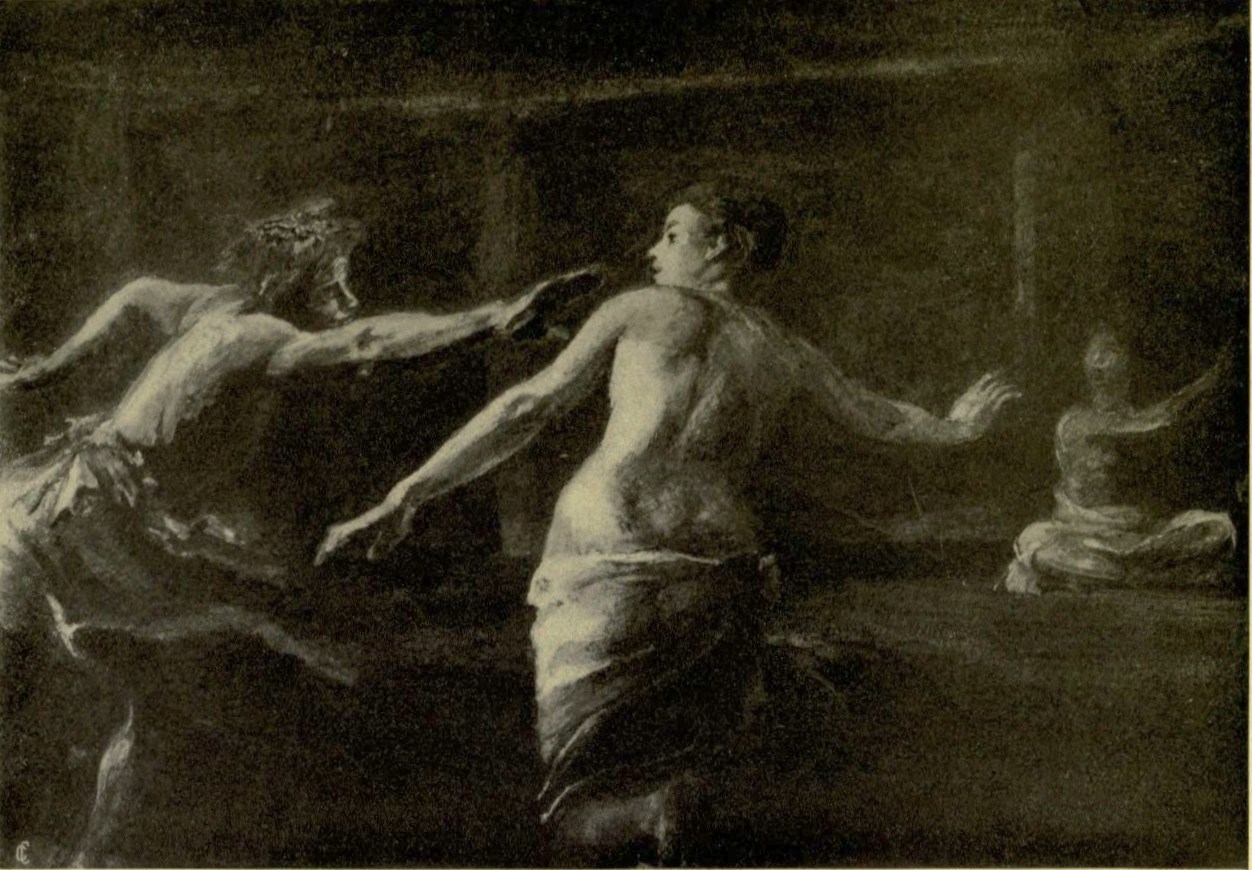
and attention as the most complicated European mass of buildings, be they cathedrals or palaces—only the art has little shape but what nature gives it. All the more has nature caressed and embellished and favoured this elemental, unconscious attempt of man.
In the end of the long twilight, with the rose colour still floating in the upper sky, the little place looked more coquettishly refined than ever. Here and there the lights within the huts, often rising and falling in intensity with the blaze of the cocoanut fire, modelled the steps outside or the posts, touched trees and branches far away or near, and made pictures of family groups within, garlanded and flower adorned.
The larger house to which we went was adorned with flowers and all lit up. More people were crowded in it than the little village contained; for the island had sent visitors and performers for the dances which were to entertain us. I shall not describe them. But they were of course interesting, not only for what one liked but for what one did not like, and for our being with others who looked on. The spectators are inevitably part of yourself, as of the show, and in so far, the very way in which I looked on was a new charm.
There was among the dancers a young chief, serious as an Indian prince, who danced gymnastics, and ended with primitive buffoonery that seemed to delight his hearers. At the other end of the scale was a hunchback dwarf, who played realistic scenes so well as to be repulsive. But all this was a lesson. I shall certainly see all about me, in this form of civilization necessitating health and strength, or their appearance, a great line drawn between those who suffer or are weak, and those who are not—a visible line. As yet there is no place for my hunchback’s intelligence, except this buffoonery.
Later we left the dancers and wandered in wide moonlit paths among banana trees. There we came across our young chief looking now as if such a person never could have so demeaned himself, even from political reasons.
We exchanged alofas and compliments, and he placed his garlands in sympathy around my neck. He is a beauty, and his father is one of the tallest and biggest, as was his sister, who was once taupo.
This morning I have wandered with Seumanu for a few miles, to show ourselves. We pass other villages where we are greeted, and where at one time our yesterday’s friend, the old tulafale, canters out of his house in a circle, according to ancient fashion.
We see a great war canoe under its shed, and the remains of a high wall that encircles the island and was an old protection in war.
Much should I like to remain, but we shall have to go at once, for—as I feared—we are not here really for pleasure, but we are entangled in the quasi-necessary political advantages of being seen where there is “influence.” But this, I feel, is the kind of place I want to see—out of the way—out of use—where usages linger, and where the landscape is influenced by man so as to become a frame; as it was in little Nua on the island of Tutuila where we first landed upon our first morning in the South Seas.
For a thousand years, probably two thousand, perhaps three—for an indefinite period—these people of this smallest island have lived here and modified nature, while its agencies have as steadily and gently covered again their work. So that everything is natural, and everywhere one is vaguely conscious of man. Hence, of any place that I have seen, this is the nearest to the idyllic pastoral; it is not so beautiful as it is complete.
Iva in Savaii, Oct. 26, ’90.
I am writing in early afternoon, a hot afternoon, after a morning at sea. Opposite me in the circular Samoan house are a couple of persons of importance, a local governor, some four or five chiefs, all ranged against the pillars of the building, as I too am leaning against one. Seumanu and some of our acquaintances are to one side; opposite me, a grave young girl is moving her hands in the great kava bowl from which she hands the strainer of bark filaments to a reddened haired young man whose head flames in the sun outside, against the background of green banana leaves. Next her a big fellow keeps grating more kava; and another fills the big bowl with water, making big red spaces in the reflection of the sunlight, that streams in on that side. Small parcels of presents of food have been brought in and lie about on their side. Much kava has already been drunk and more is being prepared as more and more chiefs come in. Everything except the picture before me is in shade. Conversation, probably politics, is going on slowly, in the usual low tones, with an occasional high-voiced interjection from some less important member. The village orator, with his fly-brush over his shoulder, has long ago made his lengthy speech of welcome, and as we are told to do as we please I write to you, in the interval of watching the faces of the men, or the circular movement of the girl’s hands dipping in the big bowl, or running around its wide rim, when she wipes it, before passing the strainer to be squeezed out. The orator watches me suspiciously occasionally, but there is general confidence and peace, that we much need, for the heat is great and our sea trip was rough and hot. As I write, I hear my name La Faelé called out, and the kava bearer comes to me with the usual swing. But I fear the kava, and merely accept the bowl and return it undrunk according to form. Then many of the circle disappear—to church—the bell is ringing and little children half-naked, small creatures toddling along are already in the doorway; apparently all the neighbourhood are beginning to file toward it gravely, most of the women with hats that do not become them. Even a little girl-child, with nothing but a band around her little fat waist for a drapery, steps along with difficulty, a big hat on her head. This is Sunday conventionality: all the congregation are dressed, even the half-naked chiefs, who had left us, reappear from their huts, with white jackets, and pass on gravely in the procession at a distance. And the Sunday hymns add to the drowsiness of the Sunday afternoon.
This morning when we left the little island of Manono, some five or six miles away, people were going to church but to a different call from that of this absurd little bell. A big war drum, a long cylinder of tree cut lengthwise, was beaten in the oldest, most primitive manner, some way as ancient as man himself. A man bent down over this big wooden trough, that lay like an old log in the grass, and beat it from the inside, with one of the big hard stones that lay in it. The sound was unearthly, I ought to say uncanny, and nothing more savage, more a type of the war of the savage could be imagined; and it seemed fitting that this war usage, turned now to the call of Divine Peace, should still remain in the warlike little island, once the petty tyrant of the little group. Right alongside, near the great wall built for war, whose remains surround the island, marks of destruction recalled the exploits of the German warship Adler, that now lies stranded by the great hurricane, in Apia harbour, and whose crew were saved in part by the people they were killing, and especially by the brave giant, in whose boat we have been travelling. Indeed, there was an element of comedy quite Polynesian, even if atrocious, in the danger the Samoan rescuers ran of being fired at from the beach while they saved their enemies in the sea. But we made the first part of our trip to-day, in a native boat, for Seumanu’s was rather too fine, and too heavy to be risked in the entering of the curious harbour that we first made. This was Apolima, “the open hand”—a small, very small island about a mile out from Manono; the upper part of a submerged volcano cone, broken down on one side, so that there is an entrance. We soon reached the great wall of soft brown rock, which crowned with cocoanut palms and half covered with vegetation opens suddenly, leaving a small passage through rocks, just wide enough for our boat, skilfully paddled in the great blue wave that swung us in. Then jumping out, half of our men caught the side of the boat, to prevent our being dragged back by the returning swell, and we were pushed and dragged around a corner inside of the rocks. The tide was low and we were carried ashore on the men’s backs, through coral rocks that spotted the floor of the small lagoon inside.
The place was just what you might imagine; a little amphitheatre of green, the high reddish rocks standing on each side at the entrance, and between them, a great bank of rock, over which the surf broke so as to hide the little break through which we had come.
As we looked, three great palms stood up against this distance, planted on the higher ground that is all green, and leaning toward the sea as is their (loving) habit. Huts stood about with bread-fruit trees, and further back we were led to a little pool that supplied the place with scant water. Further back yet, the slope was all covered with trees, and after walking a little way, slipping along the greasy banks, and walking up the sloping timber notched with cuts to make stairs, and returning by another that made a level bridge across an empty channel, I sat down to wait for Mr. Sewall, who had walked up to the ridge, and I had time to make a sketch. All this took us a little more than a couple of hours while Seumanu’s boat was beating outside, in a fair N. E. wind. At last we were paddled out in the great wave that washed in and out, and with the swing that belongs to the balancing of a boat in a narrow tide-way. And we kept in the dance until we reached Seumanu’s boat, invisible for some minutes behind the blue waves. Then we ran alongside, and we scrambled in, exchanging good-byes—tofa—with the chief of the lost hand, who had taken us thus far. Within the next hour Seumanu’s boat had come to the outer reef off Savaii, in front of the landing of Iva. But there we had to wait at anchor. The water was too low inside the reef, so that we remained in the thin blue-green tide, that seemed to show everything in it, until a smaller boat came out to us, with Selu, the chief, and we were taken in. We landed among black rocks, within a few feet of a little scanty road, and clambering over a stile of rocks, at some part of the long black fence of stones in front of us, we found a village, which spread higher up and far back behind the trees, with spaces between houses; banana, palm and bread-fruit trees, dispersed as if for ornament or making little patches of plantation. There was a big church of the usual formless kind, not as handsome as the thatched ones with circular ends, that are certainly the types one would prefer. And so we walked up to the house, where we were to listen to speeches and the Consul to make one. Since I have begun to write, all has become more quiet, and I shall merely use my afternoon to make a few notes; we shall sleep in another house belonging to the Governor and be near, I think, to the chief, whose name is or was Selu, for lately he tells me that he has had the name of Anai given him, and we try to make out together just how near these changes come to the forms of the Western world. This is not a title properly, but as it were a name embodying rights that go to descent; for these men with titles apparently elective are noblemen who form an aristocracy of government and are usually to be distinguished externally by their size or manner as well as by little symbols or expressions of superiority. Anai tells me that of the many chiefs here, whom we have seen or will see, he and another, alone are the “political” superiors, as he expresses it; that is to say, he goes on, that they alone talk in public about such matters (I suppose in the way of decision), and that others would be checked if moving. Thus, that to him and to his mate alone the making of war, or as he expresses it, the allowing the “shedding of blood” is devolved. This chief is a most interesting and sympathetic person, speaking English very well, though apparently a little wanting in practice, with a pleasant, handsome face, resembling some Japanese types, interested in missionary matters, a strict church member, and showing much interest in foreign matters throughout the world; we talked of the civil war, and of the prospects of the republic in France, and of the universal “striking” now going on, as we might anywhere; and I am sure that Anai was “posted” to a later date than we, for the Consul had handed to him the files of the Herald for the last few months, while we had almost entirely abstained from that indigestive form of reading. Anai has explained to us that this being Sunday we shall have no reception, but that to-morrow there will be a formal reception, called talolo, and giving of presents, and that there will be dances. So that we shall spend this evening quietly, with a bath in the pool of fresh water, that is open to the sea, and try to rest.
On Savaii, Oct. 30, 1890.
We are settled here for an uncertain time, perhaps three days. This is the political capital of Samoa, and we are occupying the house of the great orator of the islands, important by his influence, though not so great a chief as several others by descent or by control, or even by physical superiority, that great proof of eminence in communities like these, where the chiefs seem to have reserved for themselves a size and weight that recall the idea of heroic days. Certainly the first time that I saw a well-chosen dozen together, as I did two days ago at our last resting place, all sitting spaced out, as if for a decoration on a frieze, silent and indifferent, or speaking occasionally without raising their voices, with heavy arms resting on great thighs, and with the movement of neck and shoulders of men conscious of importance, the recall of Homeric story made me ask myself which one might be Ajax, and which the other, and if such a one might do for Agamemnon. Fine too, as some of the heads were, they were only relatively important, as with the Greek statues that we have, and that we know quite well and intimately, even though their heads be missing. The whole body has had an external meaning, has been used as ours is no longer, to express a feeling or to maintain a reserve which we only look for in a face.
And as I am writing, while the household is enjoying its evening relaxation and preparing for the night, everything about me repeats to me this theme of all being done with the whole body. About an hour ago prayers were said and all sat around while the regular form was repeated, and then our young hostess prayed an extempore prayer commending us all to the care of God. Some words I can catch, but the intonation is sufficient. It is a prayer cadenced as well as the most consummate of clergymen could manage, and repeated without the slightest hesitation. Then she stretched herself out, with her head on the Samoan pillow, and talked with some young male acquaintance outside the hut whose head just appears over the barrier that runs between the pillars, for our house is placed higher than usual. She talked with Adams who is lying by her, and occasionally she criticises the game that is going on near her at that end of the house. I have only followed the little things happening by fits and starts, as I have made some sketches and have been writing letters, but I make out that the household is playing some game in which some motion or gesture has to be duplicated or matched, and that the beaten side, for there are two rows of players, is to dance as a forfeit. I say that this is the household, I mean that I take it for granted, though I see that one of our boatmen is among them, and that a couple of children have dropped in. The duenna of our young lady is also there. Sometimes I see her and sometimes I do not, but I know she is there on watch. But a siva has been organized slowly, a household unofficial siva, begun in little patches—somebody humming something and several beating hands. Tunes or songs are taken up and discarded, and sometimes a man, sometimes a woman, stands up to sketch some motions. At last they appear to have got under way, and I see them swing and dance, with little clothing and much clapping of hands, at the other end of the house. And everybody joins in: even the children beat time and take up the words—and the two elder women are the most enthusiastic and full of energy. Occasionally a burst of laughter salutes what I take to be a mistake or some wild caper that seems funny to them. Faauli, at last, after having pretended to sleep or to talk, so as to appear to herself to have done something, sits up and takes more interest. By and by she sketches out some steps in an indolent manner—soon she begins in earnest, and with one of the performers goes through an energetic dance, slipping her upper clothing for greater ease. The clapping and beating time comes fast and furious from every one, and laughter and small shrieks replace the gentle monotone and seriousness of the evening prayer. At last she sits down suddenly, her face rather overcast: (her name means “Black Cloud that Comes up Suddenly”). She has hurt her foot apparently, for turning round to see why all has stopped, I see her bent over and looking at a toe. Note that she does this as easily as a baby with us—her face comes down on her foot raised halfway to meet it. As I come up, she shows me that she has torn off the larger part of a nail, and is paring off the remainder evenly against the exposed surface of flesh. I offer her scissors which she uses with indifference, as we might cut off superfluous hair; and apparently more from politeness and obedience than from necessity, she accepts my court-plaster. Then being properly mended, she sits down to play cards while I resume my writing. Now here has been something that explains some sides of these good people; an absence of nervousness and insensibility to pain—for to most of us such a small accident would have been very painful and sickening. Before this the dance had been merely an outlet for action, as natural and unpremeditated as any other motion. The entire body has been called into play: from the ends of the fingers to the toes of the feet, all the exterior muscles have been playing gently for some two hours, with almost every person present, whether they sat or stood. This constant gentle exercise must go far toward giving the smooth even fullness that marks them. And meanwhile, too, they have decorated themselves; some one has brought out garlands, and they have been worn: flowers have been put in the hair, as if to mark that this is not work but play.
And now that all is quiet, I shall try to resume my itinerary, and recall small matters that are fading away, and becoming so confused from repetition that it requires an effort for me to distinguish this siva from that siva, and to remember what taupo it was who danced well, and what one it was who danced ill.
I was writing last in Iva, on our first day there, Sunday. It is now Thursday night.
Monday morning at Iva we were up early, before the sunrise, waked by the red glow of the dawn that calls one up easily from the hard bed of double mats laid on the floor of small stones. Every one was up, people were moving about, probably most had had their early bath, for they were returning with wet clothes, or with their garments spread over them like a veil. So that we scrambled over the stone wall that seems so anomalous and unreasonable here. But they not only divide village from village, but also prevent the straying of that roaming property, the pig, that wanders about the village and the forest also, picking up everything of course. To see a pig picking out the flesh of the cocoanut has been one of the small amusements of this afternoon, and last night, besides the invariable dog, pigs came into our house and snuffled at the faces of Charlie and Awoki, who lay outside of the mosquito netting. The path over the fences brought us to the bathing pool opening to the sea on one side only, where among black rocks the fresh water runs up to meet the tide, filling in the pool. There we went in and swam about, watched by many of the smaller villagers, girls and boys who were curious about the manners of the white people. And I was able to admire the skill, though unable to rival it, with which the native bathers draped themselves as they rose from the water, so that man or woman was clothed as he or she stepped on shore.
By the time we returned, our mosquito nettings had been put aside, the mats swept out, and Awoki was bringing us the tea and brown bread, which, with such native food as we liked, made our meals. Fish there was and yam and taro, and some preparations of cocoanut. And there were cocoanuts for their milk for which I do not care, but there was no water yet, the water in the two pools near the sea, edged with black stones, being blackish until the change of tide should leave the spring to fill up by itself.
Then our host came in and told us that we might rest that morning: that in the afternoon there would be a reception, a sort of review or “fantasia,” and presents of food would be given and speeches made, and songs and dances, the whole apparently included under the general title of the talolo which was to be given us. So we waited peacefully; I sketched the girls in the neighbouring house, who were at work making the wreaths, the garlands, the complicated flower girdles that should be worn later in the day, and perhaps at night, for there were murmurs of a night siva. But I knew that our host was a church member, and that the siva is not encouraged, neither the siva, “fa Samoa,” Samoan way, the Samoan siva, nor the siva of the Europeans, which we call round dancing; for had not Faatulia, the wife of our leader, Seumanu, been threatened with excommunication for dancing in her innocence in European ways at the Consul’s Fourth of July ball. Meanwhile my models across the way in the shadow posed badly: they were always moving, or they came across the way to see what we
SOLDIERS BRINGING PRESENTS OF FOOD IN MILITARY ORDER. IVA, IN SAVAII, SAMOA
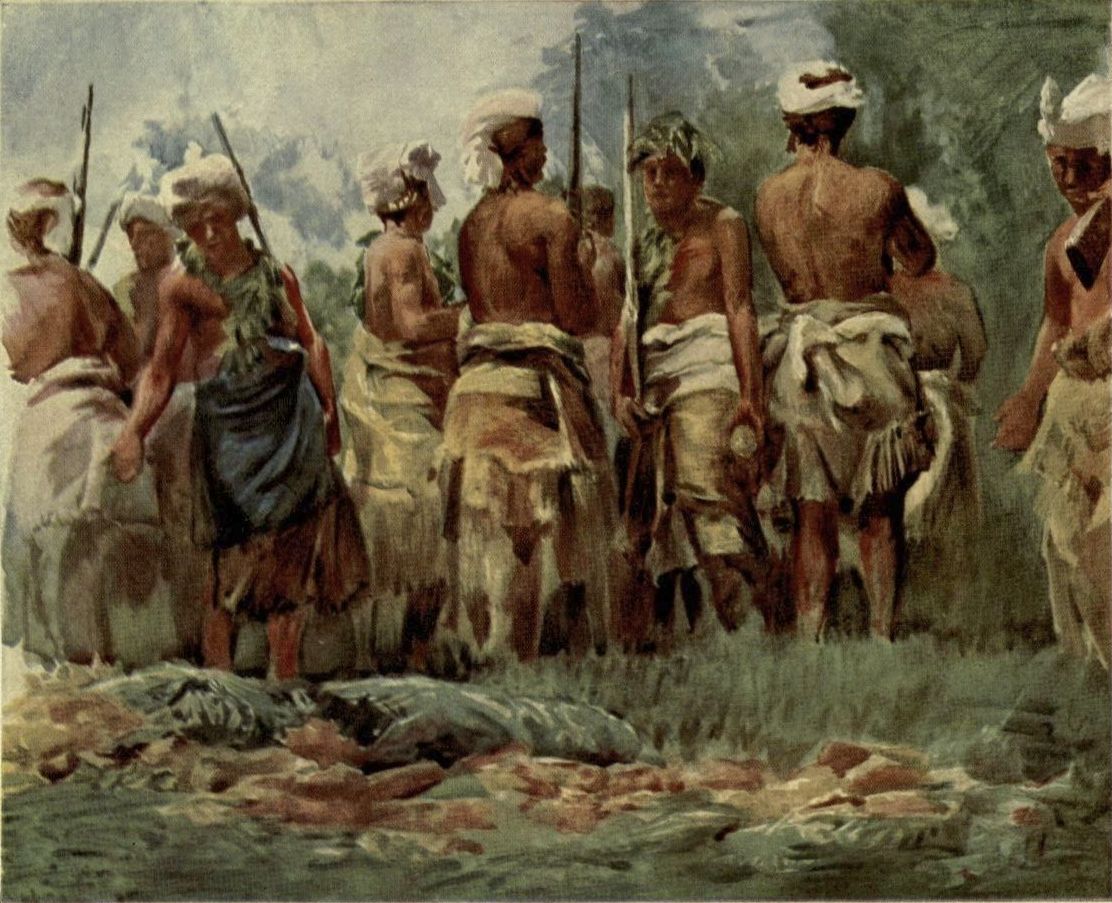
were at. For somebody would stop in and look at us, and go give the news—a little pile of small boys and girls, three rows deep, sat respectfully under the bread-fruit trees watching us. But somehow or other the morning wore away, and by two o’clock we were told that all was ready, and that we had better come to the house chosen for us to occupy during the ceremony. Meanwhile, behind the trees that closed in the sight (for the village was placed, if I may so describe it, in an irregular open grove of many kinds of trees), we had seen for the last hour or so, dressed-up figures moving about; men with large green garlands, and green cinctures around their waists stiffened out and made larger by great folds of new bark-cloth, or by the fine wearing mats which are the most precious possession of the Samoan: some of them with guns carried with pride, for these were men who had been victorious and had beaten off the bullying German.
And now we took our places in the circular house which looked like a pavilion, and which stood on the east of the large open space near the church. Opposite us perhaps some two hundred feet or more was another house, and others spread to right and left, leaving a large space ending on one side near the church, whose white façade had written on it its name, Lupeanoa, Noah’s Dove—enclosed by a little clump of trees to the left, where we could see figures moving with great swaying of leaf girdles and waist-mats—and the occasional beat of a war-drum came from further back.
We were seated, all facing toward the open space, the next house filled with women and children: Seumanu and our host and other people of importance near us, and the rest of the house packed, but not too closely, behind us. Out on the grass and near trees people sat, mostly women. Others moved slowly to take their places, showing some vestiges of yesterday’s Sunday in their hats and long gowns.
Then rushed across them a man all blacked, with a high white turban bound to his head, with green strips of leaves, a few leaves for a girdle, and waving a paddle. This was a friend of Seu’s—a funny man and joker, with a hand maimed or deformed—the deformed in such communities take things gayly and are jokers. He shrieked out things that caused shouts of laughter, and repeated “Alofa Atamo!” From behind the church came out a mass of warriors, with banana leaves in their hair, and wearing girdles of the long green leaves of the ti: their backs were streaked with white lines following the spine and the ribs, and their faces and bodies were blacked. They carried their rifles high and discharged them into the air, then cantered past and away. Again the buffoon and again the warriors.
Meanwhile in the distance, in the opening of trees, we could
TAUPO AND ATTENDANTS DANCING IN OPEN AIR. IVA, IN SAVAII, SAMOA
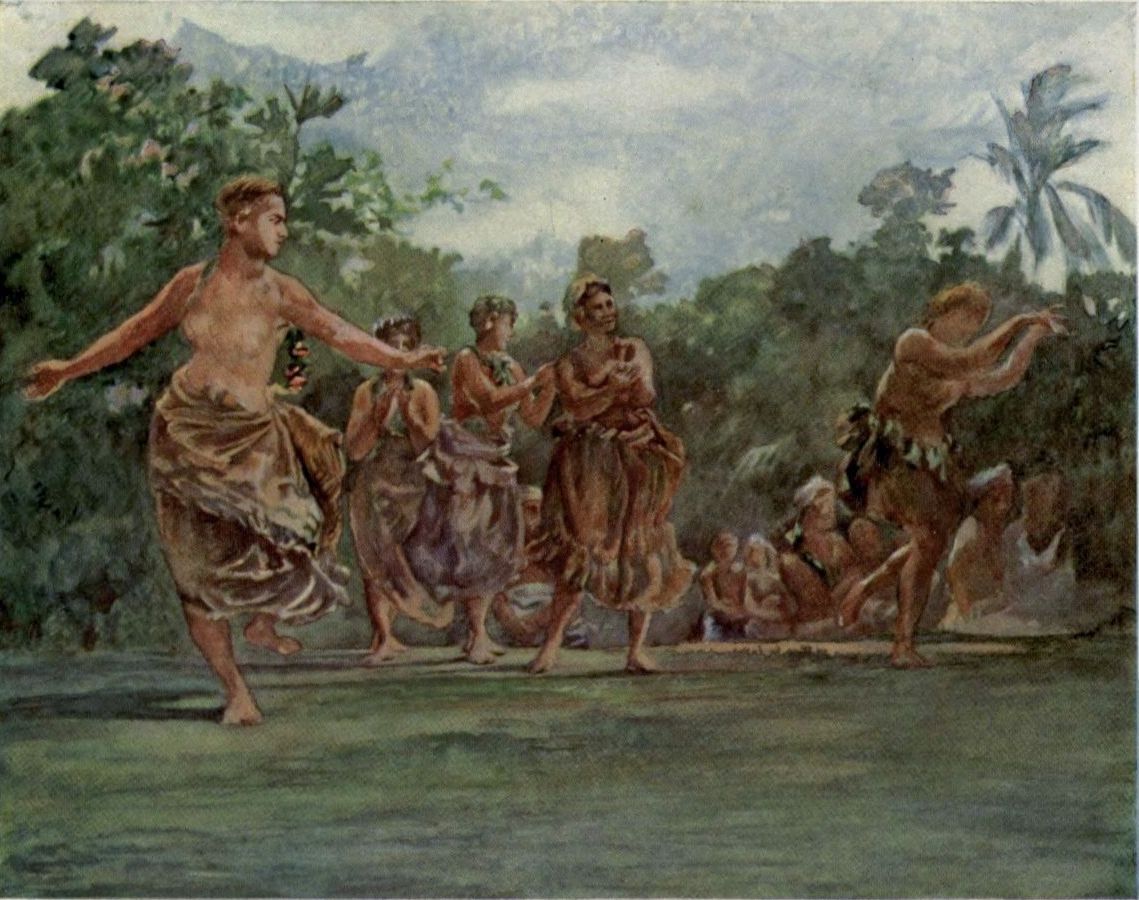
see other warriors: behind them the drum and the little fife made a curious war music, and a peculiar shout and call with a short cadence came from the men. Unconcernedly a girl moved across the opening in front, intent on something else, and a hunch-backed dwarf, with enormous wide shoulders and long legs edged with green leaves, came to us and shouted “alofa!” Then six warriors again emerged from the grove, swinging their clubs, and marched back leaving the green space before us empty and silent.
Slowly now, moving step by step, the mass of people behind the trees came out, so that they could be seen. In front of the men and of the music a girl, with black, shaggy waist garment, like thin fur, with long red necklaces of beads, and flowers in her hair, danced slowly to the tune, crossing and uncrossing her feet in a hopping step, and swinging with both hands a slight club in front of her, as a drum major might move his stick. Slowly she advanced, escorted by two men clad in mats and garlands, upon whose heads stood out a mass of yellow hair, like the cap of a grenadier, supported by circles of shells around the forehead. They also kept time to the music, but did not repeat the girl’s monotonous step that made the central point of interest to which the eye always returned.
This girl was the taupo, the virgin of the village, dancing and marching in her official place at the head of the warriors—like Taillefer, the Norman minstrel who began the battle of Hastings. When she had moved slowly a few yards, one could see that behind in the crowd there were two other girls representing other villages, who also repeated these movements, while some of the men danced and others stepped slowly with crossed arms, holding their clubs and muskets. And the virgin danced forward and passed, and then up the slope toward us, followed by the other girls, and all saluted us; when the whole assembly in the field came up suddenly and threw down before us leaf baskets containing taro and yams, and cooked things wrapped up in leaves, and fish, and a number of little sucking pigs, with hind legs tied, that struggled up and down in the heaps of leaves. As each person threw his load down he stalked away gravely and took a seat somewhere in the distance. All became silent. I could see the taupos moving off with that peculiar walk of the dancer who is resting. A warrior with high white turban of bark cloth sat down against a tree near us, without looking to the right or left, his gun against his shoulder, and smoked gravely, while a girl, his daughter perhaps, leaned affectionately against him. Meanwhile the sucking pigs had been escaping with hind-legs tied, and every now and then Charlie pulled them back into place.
PRESENTATION OF GIFTS OF FOOD AT IVA, IN SAVAII, SAMOA
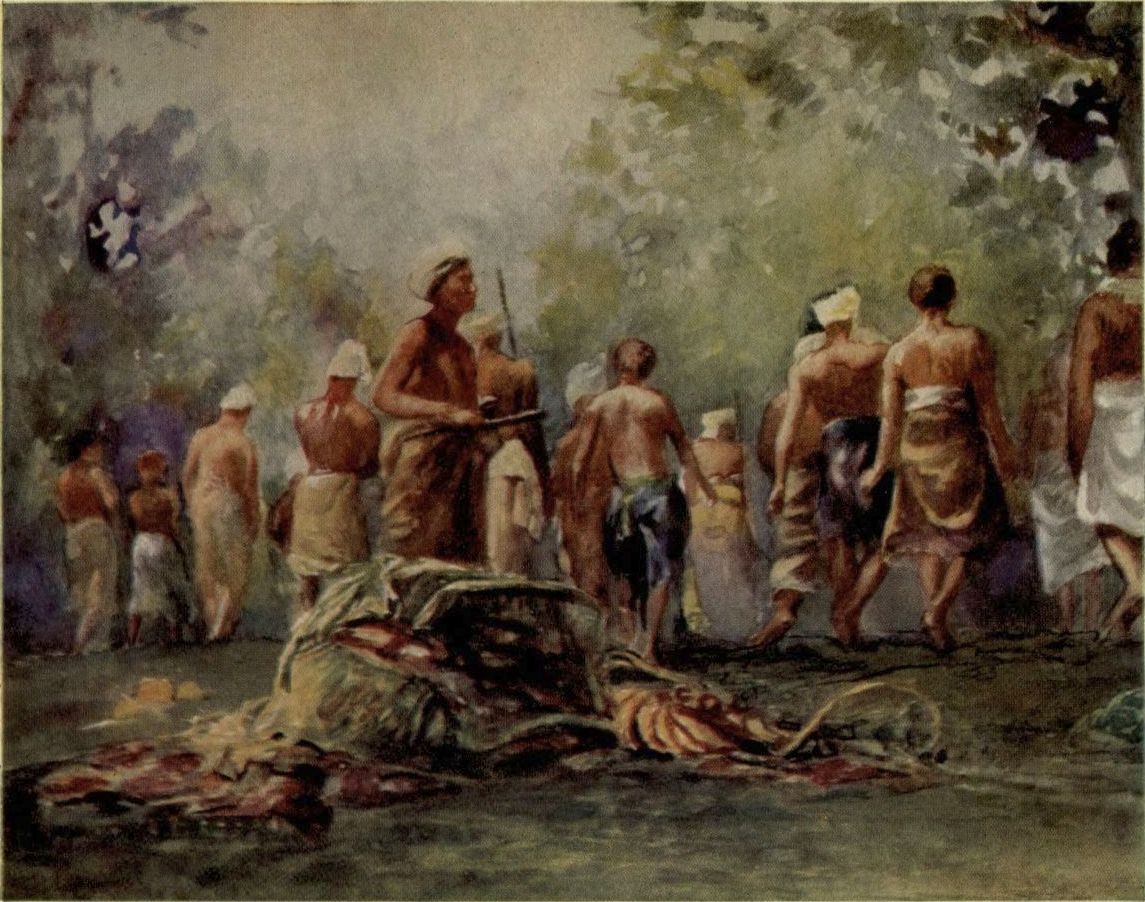
Then rose the orator, the tulafale, from the centre of the three rows of men now seated opposite to us, across the green space, and from two hundred feet away, addressed us slowly as he leaned upon his stick, and seemed not to raise his voice beyond what was absolute necessity. But the cadence always rose in the last words, so that the effect to the ear was of a distinct, emphatic assertion. Then he added, “This is all,” and sat down, apparently inattentive and indifferent. Our turn came next. Anai, the chief, translated to us the usual speech of great gratitude to America for having saved them from slavery and from the Germans, and compliments to us all, with prayers to God to have us in his holy keeping. Then a few things were suggested between us, and our political man said what was necessary, and alas, even more: for how can the United States promise anything—that may depend on sugar—or an election, or at any rate is merely a matter of barter? Anai stepped out from the house and repeated all this in Samoan, speaking also quite gently, with little raising of the voice. Nobody seemed to listen, nobody to care, but this was only apparent. All heard and had listened.
Then our own men, who had been hidden somewhere, sprang upon the presents and sorted them: one of them stood up and called them out: so much of this, so much of that, to give full acknowledgment for liberality. Then another spring, and all was carried away, even to the struggling, sucking pigs that could not be made to understand.
Momentary peace settled over everything, and we had begun to ask questions and to sketch, when we were told that now we should have a siva, that several villages would appear in it by their performers, as they had appeared in the military display. Men came up garlanded and cinctured in flowers and leaves, and sat down in double rows before us, some turning toward us, others away. Out of their number first one, then others arose and sat down again in order, fronting us, and the siva began; six handsome young men, singing and swaying about upon their hips, to a chant for which time was beaten behind them.
The sun was setting; tired out and amused we walked back in the crowd, stopping to exchange alofas with belated warriors who showed us their guns and occasional wounds, which with the Samoan idea of a joke they pretended had been caused by running against wire fences.
We had seen for the first time a pageantry of savage war, in a soft light, in the most peaceful and idyllic of landscapes, so that it was hard to realize again that this was not all a theatre scene, a fête champêtre—a play in the open air. There was nothing to contradict this unreality but the marks of ugly gashes on the arms and chests of the men and the
SOUTH SEA SEATED DANCE AT NIGHT, SAMOA
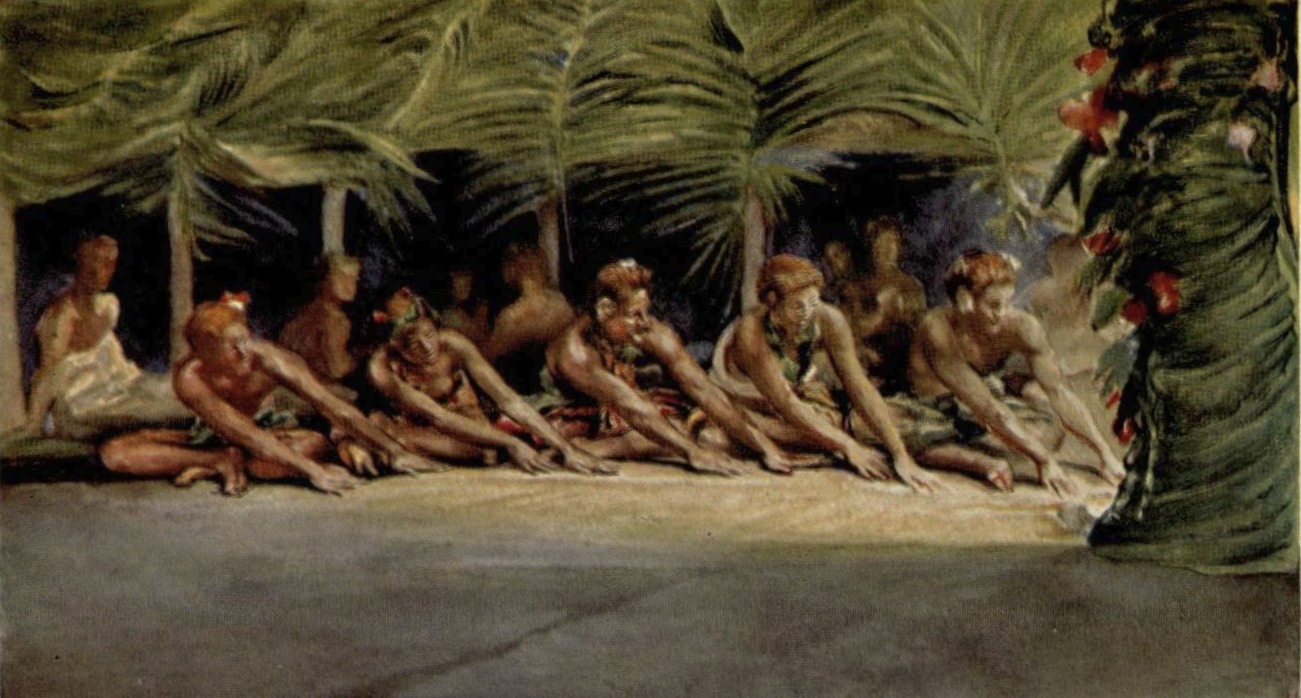
recall of the savage melody, which was undeniably a war song, requiring no explanation as to its meaning.
In the house we ate our meal spread out on banana leaves, two of the taupos coming in to help us by breaking the taro and yams, and tearing the fish and fowls. Then while wishing for nothing but bed and rest, and closed eyes, we were told that there would be a night siva in our honour, and that other taupos would figure in it. There was nothing to do but yield, and with each a taupo to accompany us, we went back to the house that we had occupied in the afternoon. It was already half filled with people, occupying one side of it. I sat down against an outside post, alongside of my taupo, next to whom Seumanu reclined at length with another girl, an old acquaintance, near him, and I tried to keep awake while the siva went on enthusiastically. At times I would start with some new figure or more picturesque effect, or when fresh fuel was added to the cocoanut fire that fit the scene within. Along the posts of the exterior sat chiefs watching the dance: behind them outside, a crowd of people in the moonlight, and many heads of youngsters. Occasionally a chief would say, “Some one a cigarette or a light,” and a boy darted into the house through the dancers, plunged for the light, and returned with it to the great man who had asked.
When the taupos, big and good natured, had danced, we drowsily asked them to sit alongside of us, while the siva of the men went on. Between two, as I became more and more sleepy, I was fortunate in finding comfort and support from my first neighbour, against whose big shoulder I reclined, my arm supported upon the weight of her knees—all mine might have been thrown upon her massive form without apparent inconvenience. A gentle tap now and then, and a gentle alofa told me that I was all right, and could go to sleep while making believe to look on. But the girls, drowsy as they were, were appreciative of the men’s dances, and so was Seu, who called out over and over again, mālie (bravo) as if he had not seen thousands of sivas, which now, having become “missionary,” he does not attend. I knew that I was interested in the intervals of sleep, but all has faded into a sort of disconnected dream. I can only remember getting out into the bright moonlight, and that it made a silver haze outside during the dances. We had been obliged toward midnight to make a speech, with thanks, protesting the fatigue of travel as an excuse for not remaining. The Samoans will sit up all night, especially in their favourite moonlight: they can sleep during the day, and apparently always do so. Around our house, until we had blown out the light, and even for some time after, rows of people sat watching us in the light of the moon: the people sauntered about, or sat in the shade of the trees, with sharp-edged leaves that made the scene look, as usual, like the stage-setting of a fairy opera.
The next morning we were to leave for the next important place, Sapapali, the home of the Malietoa, the princes who have been for a long time the principal chiefs of these islands, and who are now represented by the present king. This is a rude definition; as I have told you elsewhere, the question of chiefhood and sovereignty here is one not easily represented or defined by our words. At Sapapali, the ancestral home, we should be received by Aigā, the King’s niece, and consequently a young person of the highest rank, indeed, I suppose the greatest lady of the land. With us this would be the Queen or the Royal Princess, or the heir to the throne. But here blood and descent are all and in the direct line. This young person was next to Malietoa as being of sufficient blood.
Our arrival was to happen about noon, so that, as in Samoan phrase, it was only about half an hour’s walk, we were to leave punctually at ten o’clock. Early rising took us again to the black pool surrounded by high trees, where two of us bathed, watched and escorted by two little damsels with whom the other one of us flirted. I myself was too much occupied with the difficult question of keeping on, while swimming, the fathom of cloth they call lavalava; and afterward of adjusting it in the water, after swimming for it when it had floated away, and then on coming out, receiving dry cloth with one hand and putting off the wet one. But I found out how one begins in the corner. Later in the morning it had grown hot, as we left pretty Iva, and made our way through broad or narrow roads, to Sapapali. The old difficulty again amused me; we could not walk in proper Samoan order; sometimes one of us, sometimes another was in front, while properly, all of us chiefs should have led, and the attendants followed at respectful distances. So that again Awoki would canter on in front of the chiefs: meanwhile Anai told us things of local information, pointing out where the road narrowed, the place where had stood in older times, a famous tree, a cocoanut. Among its branches the Malietoa, who first became converted later to Christianity, used to conceal himself and lasso or noose such pretty taupos or maidens as passing might strike his fancy. One of these had been the grandmother of the young lady whom we were going to visit. While the party talked the scandal over I remained a while by a deep well near the shore, and watched a handsome Samoan ride his horse barebacked to the water, to the sand and distant trees of a little promontory.
When I hurried forward, the party had gone far ahead, and had arrived before me. I crossed the rocky bed of a dry river, upon whose edge stood houses, and going up the hill before me, came upon a high open space with trees far scattered, and several large black tombs made of stones piled together in regular rectangular form; and in the centre of the green a house high-placed which instinct told me was the guest-house, our destination. Part of the mat curtains were down opposite the central posts: I entered by the open side, and saw Adams and the Consul seated next to a young woman in half European dress (that is to say with a corsage); and on the other side of her Seumanu and Anai. I entered and sat down with some hesitation next to the Consul, and after being presented to her ladyship looked about me. Opposite, the posts of the pretty house all adorned with flowers had each a chief, as a sort of sitting caryatid or buttress. And they were big and splendid; that was the Greek frieze of which I was telling you. Between each massive figure, of Ajax and Nestor and Ulysses and Agamemnon, appeared from time to time some little boy, whose small person made them look more ample, as the boys or angels of Michael Angelo’s Sistine Chapel make sibyls and prophets look more colossal by comparison. Then kava was brought in and made solemnly, when in stepped a woman and sat herself beside the kava attendant who dried the wisp. A moment later, and her presence was explained. She, it appears, had the hereditary right to “divide the kava,” and had come to claim it. When the heavy clapping of hands announced that the drink was ready, she called out the name of Aigā, to whom the first bowl was presented as to the greatest personage. Then to one of the guests, then to the next relative of the Malietoa, then to a guest, then to a chief, and so on, contrariwise to what we had seen before, where we as guests were helped first. You see we were at court, in the presence of royalty.
When the ceremonies were over, we chatted with Aigā, who spoke English, and whose amiability pleased me. She was embarrassed and shy, and struggled like some girl, unaccustomed to society, to say some proper things. But the grace of her diffidence was all the greater when one noticed the security of position indicated by her voice when speaking in a low distinct tone to others. At length we rose and adjourned to the neighbouring house, where the feast had been set forth. This we were allowed to dispense with under plea of a late breakfast, but for form’s sake we looked at each separate thing, spread out in a long line of Samoan good fare, on green banana leaves that stretched across the house. Then we papalagi, (foreigners), returned to a Western soup kindly prepared by Aigā, and our own bread and tea, and sardines, in which fare Aigā joined, and talked to us and we to her, all stretched at full length upon the mats.
Then our lady disappeared with some little show of embarrassment, and had I known how much it cost her, I should have sympathized with her sooner in the annoyance of her having to prepare her toilette for the great official reception (talolo), which was to be the next function of the afternoon—the nearest house was the scene of the dressing of herself and her maidens. Through the dropped mats of the openings, girls and women kept plunging in and out, carrying in dress mats, and beads and garlands of flowers, and entangled, complicated cinctures and belts of fruits and flowers, and woven bark—and bringing out the news of how the dresses looked to the loungers sitting at a distance outside. And once I saw carried in a fierce, cruel headgear that our lady was to wear; the great helmet of blond hair, set with sparkling mirrors and tall filaments, to be bound tight with silvery shells around an aching head.
Then we went out to sit and wait on the other side of our guest-house, in the shade toward the sea, while long shadows covered the great space, and the sun itself became veiled and lit the scene with a tempered light more like that of our northern summer. One might almost have imagined an afternoon in some favoured, more poetic point in our coast at home, say Newport on some exceptional evening. The great mālie spread out further than the reserved ground of any of our residences, and its edge dropped suddenly to the sea before us. Once or twice a thatched house stood on the verge of this rolling green, all carefully smoothed and weeded like a lawn. To the left and right were small groves like the wings of a theatre. Far off to one side curved the bay, with palm trees stepping gradually into the sunlight. The sea was blue and green before us, and faintly shining; far off in the haze of sunlight were Upolu and Apolima—spots of blue. Nothing broke this space to the furthest dim horizon, except where on the edge of the cliffs stood one hut through which shone the colour of the sea and the foliage of the tree overshadowing it.
Then our party came up and sat about us on the slope of the grass about the house, and from the groves about us came the sounds of the drum-beat and the call of war music. From behind the house, in a great circle, ran out in a sort of dance, our hostess in full gala costume: naked to the waist, kilted with costly mats held on by flower girdles—on her head the great military cap. She held a little toy club in her hand; on either side, with heavier strides, two of the giants, her attendant chiefs, dressed and undressed in the same way, repeated her movements. Some thirty paces behind her, two of her maidens followed these leaders, turning round in a great circle of dance, spreading out their arms, and the wide folds of their waist-cloths, and the lines of their garlands were flung out by