FIJI
Reading edition
Suva, Wednesday, June 17th.
Yesterday we arrived as expected, and have been since that, reposing in the calm that can never so pleasantly come upon one as after an uncomfortable sea voyage. The steamer, unknown to the island, unawaited, must have appeared to bring some important news: perhaps something in the nature of a disturbance or trouble in some of the places connected with this one politically; perhaps in Rarotonga that we had left, where the new English order is but recent. But if such was the case we knew nothing of it, and waited quietly on board in the beautiful little harbour; looked at the lines of mountains on one side of the amphitheatre, edge upon edge of blue; upon the reef’s haze of white light; and on the other side, upon the little town stretched out on low land, but prettily connected with the distance, and high land by little hills picturesquely balanced and arranged, with trees and houses and some native buildings; and then along the beach, the usual shops and trade buildings, more British than anything we had yet seen.
Each of the five spots we have disembarked at has had a distinct character, more distinct now that we compare them, and nothing could be further, in its small way, from the other small way of Tahiti: ancient, provincial, French, sad and charming as the setting of some opera-comique that I have never seen, but should have liked to invent. Here everything was brisk and clear and promising, as if typical of the promise of something, while Papeete of Tahiti held the remains of some former system of government and business.
Little schooners with sails set were anchored in the harbour; a three-masted ship and H. R. M. S. Cordelia gave importance to the scene. Steam launches plied about. On the wharf, East Indian coolies, turbaned and draped, were grouped with their women in great white draperies or in bold colours, all yellow and all green, or in one case with a violet sari edged with light blue, and a gown of dark blue edged with the same; all these gracious folds thrown out in great masses when they moved, so that even far as we were one could see the movement of the limbs. There are now, I was told when I asked, some seven thousand of the East Indian people in these islands; for the Fijians are Polynesians and work little. So that as elsewhere, the growth of sugar or cotton, or in fact anything requiring continuous care and some exertion, cannot be carried on without the outsider—East Indians, Chinese, Japanese, or Melanesian from other islands.
CHIEFS IN WAR DRESS AND PAINT. “DEVIL” COUNTRY. VITI LEVU, FIJI
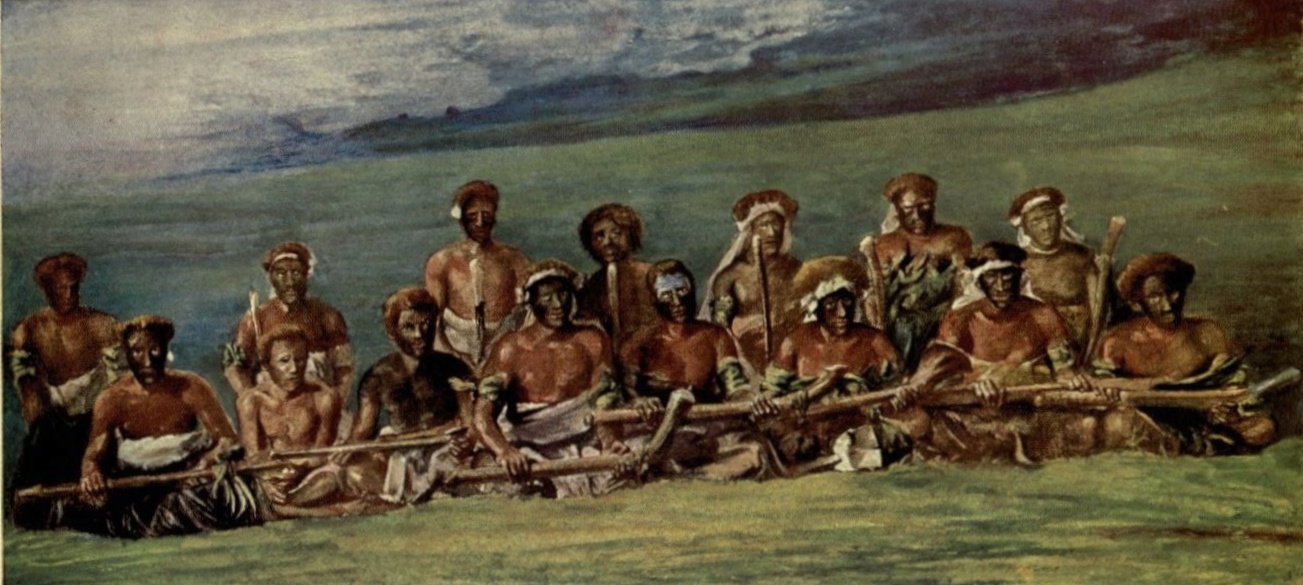
The first Fijians came up to us almost at once in the boat of the pilot; dark chocolate figures with great shocks of hair standing out, yellowed with lime as in Samoa. They resembled our Samoan friends more than any we have seen yet, notwithstanding great differences. There was a certain likeness—something in the expression and in the make of the face; only so far as these few hours give me, the look is browner.
They seem more military, more masculine; all this impression intensified by our reminiscences of Tahiti just left behind us, where the healthy good humour of Samoa seemed to fade into sadness and into a refinement that appeared feminine. Fine strapping fellows in red sulus (sulu is the same as the lava-lava of Samoa or pareu of Tahiti—the loin drapery), and red-edged, white sleeveless shirts, pulled the Governor’s gig that came out to fetch us. After landing and being driven up to the Governor’s house, we found a sentinel draped with the sulu, and naked to the waist, with a straight sword and belt and his musket, pacing in front of the verandah. I believe it was owing to his great shock of yellow hair, like a grenadier’s cap, that he looked completely dressed and most decidedly a soldierly figure. He or another is now walking up and down in front of me as I write, and at night, at the relief watch, I know by the deep voices that he is still there, and that I can sleep safely, as safely as if he were not there—and all the more that his gun is empty. The servants also about the house, probably the same men, wait upon us with this simple splendour; and hand out the dishes with outstretched arm, “from the shoulder,” and keep up, for me, a military look.
The Governor, Sir John Thurston, has kindly invited us to take up quarters with him. Lady Thurston and the family are away, so that we are but few people in the long, rambling building. It is beautifully placed on a slight height, at the edge of the town, and faces the bay and the long line of mountains of the opposite side. There are large grounds with grassy roads, and the beginnings of a large garden which the Governor is setting out with great success. From it already he has been able to supply plants of the finest Trinidad cocoa, which I see growing in little tubs of bamboo, which when again set out will simply rot away and leave the plant acclimated. However, I do not purpose to make out a list. What might interest you is that the garden follows a line of moats, once belonging to a fortified town which was here, so that it has quite a look of meaning in its picturesqueness. This is the first recognizable trace that we have yet seen of the fortified place protected by ditches. We have seen walls built up in places for forts, or arrangements of timbers and stones of a momentary character, such as those in Samoa; but here the laying out of the lines seems to have been determined with some engineering intelligence, and the space covered implies ground convenient enough for residence. However, we shall see later, we hope, something more of such remains, and understand them better. Meanwhile we are at peace: no more war has been noticed than the cricket match and lawn tennis games that we saw yesterday afternoon. We have about us decidedly, protection, and something that I have not had for a little while, some young Britishers. There is something very soothing to me about them, when I like them at all. In fact, if this continues, we shall feel as if we had simply reëntered “civilization” and be completely spoiled. The conversation of Sir John is very interesting and instructive; for he is not an amateur in his line, though by the by, he photographs very prettily.
Suva, Sunday, June 21st.
On Thursday afternoon we accompanied Sir John on a little trip up the big river Rewa which lies to the east from here. This steam launch carried us over the shallow bar, inside the reef into the broad river which has a rapid current, owing to the tide that runs up far enough for the breakwater to reach some twenty-five miles. The river has also a considerable incline, but the statement made us without guarantees, seemed excessive—fifty feet in those twenty-five miles. The land was low on either side, a great delta, and only occasionally could we see the mountains and hills in the distance. The banks were high, cut by the river, and knobby at spots where the harder clay remaining from the washings made little lumps or eminences. At first we met the mangrove swamps, then by and by banana and cocoanut, and visible here and there bread-fruit outlines against the sky. Then there was not water enough, though the launch draws but one foot, and even with that little had touched at the bar; so that we landed and walked a little way to Rewa the village or town that we were bound for. A pretty little clayey road, like a causeway, better than any in Samoa; plantations and houses from place to place; natives under the trees turned out for the great event of the Governor’s visit; here and there in shady corners groups of young men, putting on the final touches of the decorations in which they were to appear later: red and black paint, great bunches of tappa about them and girdles of black fao, as in Samoa, and titis of white streamers and of many plants. Then we came to a sort of stockade, the compound of the chief, and stepped over his gate, as usual, some stakes planted in the ground, waist high, with a stepping one outside; not in our white ideas a dignified mode of entrance. Inside a pretty arrangement of trees and buildings, with that usual charm that I have wearied you with, of looking as if arranged for effect, while most probably placed merely for most convenience; like that picturesqueness which accompanies our old farms and which seems opposed to most modern things with us. We turned around the main house, and sat down upon mats spread out in front of the river; passing first through two little groups of natives and led by the chief, to whom we were introduced in turn after the captain of the Cordelia. Then a chief or personage of importance addressed the messenger or herald of the Governor, who sat in front of us on the grass, profiled against the river, and with certain forms, presented to him some whale’s teeth tied together, upon which, apparently, everything was to depend. They were accepted, both these gentlemen curled up on the ground and the officer sidled up in what I suppose is due form. Then after a very short speech of the briefest kind, we were led to the big house for kava and we entered on one side, walking up the long plank—and passed through doors of heavy timber, ornamented with sennit in patterns and found a big room covered with many mats, soft and bed-like to the foot. There we sat at the upper end, a little raised and on more mats. At the other end of the one long room were the notables. The chief sat on one side near us; as guests we had his place. Between the two groups a long rope with ends of clustered shells was then laid at right angles to us. This was to mark the division, said my informant, and to enable any one who came late to find his due place. At one end of the rope the Governor’s herald in jacket and yappa sulu, at the other, the young men making the kava (here called yangona), in an enormous bowl. Meanwhile certain persons chanted something, with much swaying and pointing of hands and various gestures, like a rather solemn siva. Among the singers was the next important chief, who led the chant. The singing was the usual Polynesian cadence, stopping abruptly; and after several chants, between which, silence reigned, kava had become ready and was applauded and then poured out. For the first time since Mataafa’s visit I saw the use of the Great Chief’s Cup. The Governor’s herald handed him his own cup, into which the kava bearer poured a part. Then upon the Governor’s drinking and throwing down his bowl, a groan of approval came from the crowd before us. The same for the English Captain (Grenville); the same for Tauraatua and myself—who had the honour of drinking out of the “chiefy” bowl. For others the larger, common bowl was filled; an advantage or not, as one might like to have more or less of the stuff—which on the whole I think I like: that is to say, that one gets accustomed to it, and that it has a clean taste and seems to brace one a little. But evidently the kava here and in Samoa is not the kava of Tahiti, described by Tati, so powerful that such a drink as our little bowl of yesterday held, would have stupefied us surely. That ceremony over, a short speech was made, very different from the long orations of the Samoan tulafale. It was answered by the herald and the meeting was over. Then we walked out of the chief’s compound to the open space, where a dance was to be given. We sat under a canopy of mats, comfortably out of the sunlight that filled the open space edged on one side, between trees, by a long building quite high, with many doorways, all high up in the wall windows. This is a guest house, divided by posts into partitions that serve for each party of travellers. As they arrive they take up such a division for their use. Between it and the next is a narrower one occupied by a hearth, serving the parties on both sides with the economical fire that all other people than white people make. There, when they are settled the village sends them the necessary food.
Outside of this big building sat a crowd of many women, while only one woman sat near us, probably some relative of the chiefs who were near us. To the right, in a long halfcircle, a mass of children, most of them nude to the waist, beneath and in front of a little bunch of trees. Then when all was quiet, in trooped the chorus, who sat down in front of us in a confused circle, added to on the edges by occasional late comers. A few were nude and adorned with leaves. Many of them held in their hands bamboo sticks cut to different lengths and of differing sizes. These struck upon the ground gave a series of sounds according to their length and thickness—a most primitive music and a most impressive one. Had we heard this in surroundings untouched by the European, we should no doubt have felt more keenly the extreme archaic rudeness of the method. With this was mingled the chant of the others, the usual Polynesian chant. At length, to our left, having come up behind us, appeared a mass of men, armed with clubs, ten abreast and about fifteen in file; an orderly phalanx, keeping step to the music with that marvellous accuracy that everywhere indicates the Polynesian sensitiveness to time in sound. They scarcely advanced, merely moving in place, first upon one foot, then upon another, until some change in the music started them off briskly toward the other end of the arena. The big yellow masses of their hair stood out like grenadiers’ caps, and around their heads. Dragging to the ground almost, were long veils or strips of white tappa, looking like bridal veils. White flowers were fastened in the hair; great armlets of leaves about the upper arms; collars of beads and hanging circles of breastplate, with great titis (Samoan name for the ornamental
MEKKE-MEKKE. A STORY DANCE. THE MUSICIANS AT REVA, FIJI
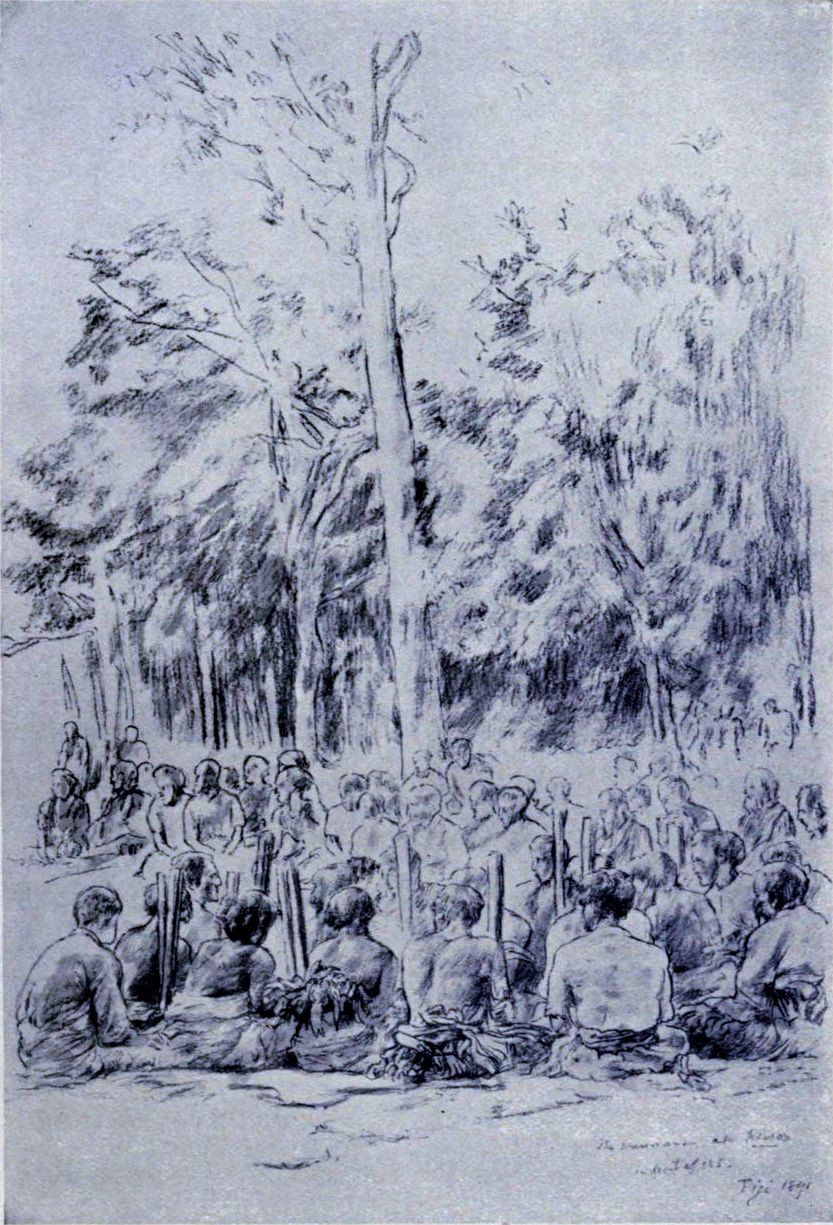
girdle) of white and green, stuck out or swung about them. They wore usually dark black waist hangings like the black fao mats of Samoa; though here and there black tappa served for the drapery, and was gathered about their waists in enormous folds: in general a great “symphony of black and white,” with strong accents here and there of faces, necks and hands painted with velvety black of soot. When they had marched to the other end of the open space they began their dances, keeping time with extreme care, but making motions of attack and defence all together. Then breaking their order, the centre took one line of attitudes and movements, and the flanks another, even to crouching low down and waiting while the centre advanced and came back. It was a splendid, warlike, barbarous spectacle, our first sight of a complete military dance; for the Samoan that we had seen was more the representation of a real advance of barbarian warriors. To this succeeded other dances of like kind, as our first dancers belonging to the place, were succeeded by others belonging to adjacent districts.
The leader of the first corps came up to us, threw down his club before the Governor, and sat down beside us panting and perspiring. He was a big handsome man, redolent with cocoanut oil, the son of one of the chiefs, and had once on a time been at school in Sydney, where he had learned other weaknesses besides those that come from education. Next to him in front of us, as usual, sat the Governor’s “herald” (native name Matafamea) representative of an office hereditary in certain families; and took charge of the applause, calling aloud “Vinaka!” which means good; to which the Governor sometimes added, “Vinaka sala,” very good. And it was very good. Not only did we have club dances, but also dances with spears, extremely long spears, made to shake and tremble like the “long shadow casting spear” of the Iliads; while sometimes the warriors stood all motionless, crouched or poised, or leaning with the other arm upon their clubs. Finally the last cohort came down in a mass, the front rank waving great fans and bending to the right and left, while the main body of the men brandished their spears above them. To add to the confusion of sight of the looker-on many had their faces painted not only in black but in vivid red, so that one would feel that a certain surprise and astonishment might well attend their appearance and attack. Things of the kind taken by themselves seem useless, but seen in real use, the motives that have brought them about unfold, and one can see for instance how the painting of the face makes a mask behind which the intentions or purposes lie concealed and in ambush. When all this was over the crowd melted away, and we walked back to the chief’s
THE DANCE OF WAR. FIJI
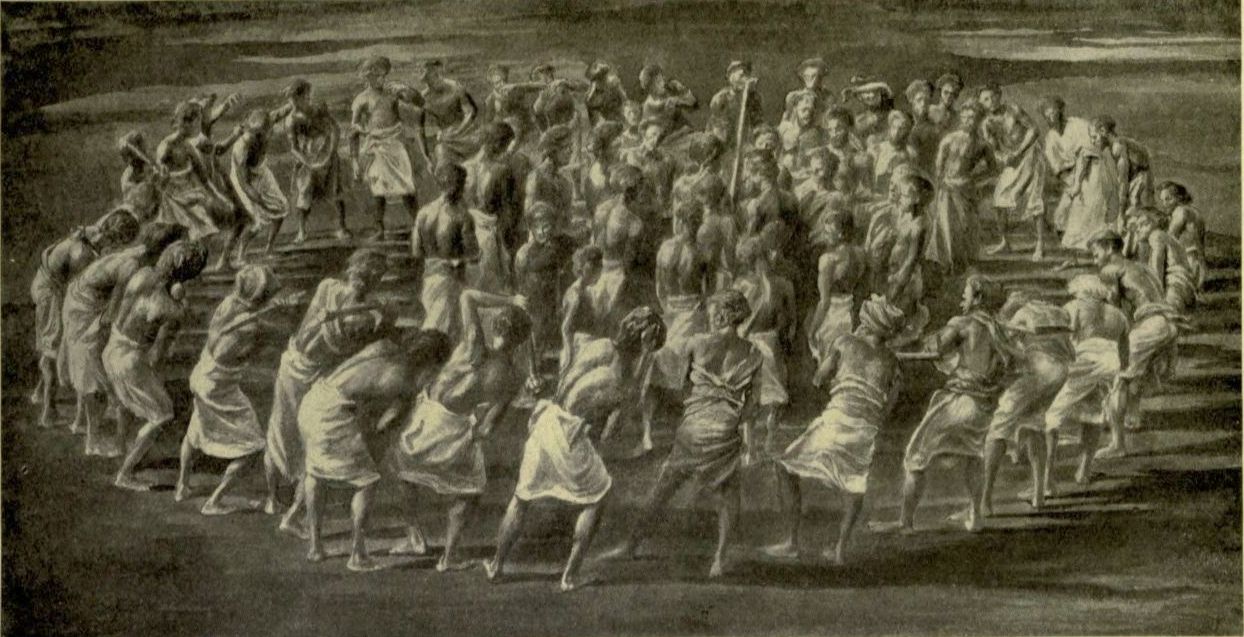
house, stopping, some of us, for a moment at a less important one to see what it was like; slipping up and down on the polished wood of the drawbridge, and resting on the raised daïs at one end, filled with grass and covered with soft mats, where the owner slept. Behind us on the wall was a lithograph in colour, framed—the Madonna of Raphael’s—the good man probably a Catholic. Otherwise less fine, the house was as the other. Some one of the party wasted some time in asking for a dance of the women, which we did not obtain, and so we were late on our arrival; and as we sat down on the mats outside, near the Governor and the captain, we found that the ceremony of presentation of food had gone on for some time, and that we were only in at the end. But we saw the herald divide it, somewhat as in Samoa. It would as we understood, go back to the village that gave it—the big hog not cooked enough, and the great basket of taro.
We lounged until evening in what we might call the garden, right upon the river. Here and there a few trees growing up against the leafy walls—for their sides were all covered with leaves that melt into the grass thatch above—or standing apart; below one of them was a large smooth slab of stone, brought from before an old heathen temple, to make a pleasant seat. It looked like Japan, just such a little place as would have been arranged with infinite art, with just so many trees, and with such a stone to appear as if accidental and yet to contradict a little. The river before us was very broad; on the other side a perpendicular bank not high, perhaps like ours, some four or five feet at the most, covered with the appearance of an uninterrupted mass of trees, though perhaps at places there were open spots like ours. Canoes moved across bringing back visitors; as the night came on big fish rose out of the water with a splash. There was a long white sunset, and then we had dinner on the mats, and after talk and lounging there we walked outside a little and then turned in for sleep on the mats, under blankets and mosquito nets; for it was cool, or felt so, and yet the mosquito hummed.
In the morning I wandered out at dawn, and walked up and down the little space with the Governor, who told me humorous stories of wild adventures, mostly with reporters. The Governor’s conversation is charming, full of information, and with a great enjoyment of fun. The few stories he had told us were like little comedies, and I regret that his position and duties, as they, increase, will probably prevent such a man from giving any record of his experiences and his views in the South Seas.
As the day came up our party turned out of doors; attempts at photography were made. Some chiefs came up to speak to the Governor; one he presented to me, a cheery old gentleman
JOLI BUTI—TEACHER. FIJI
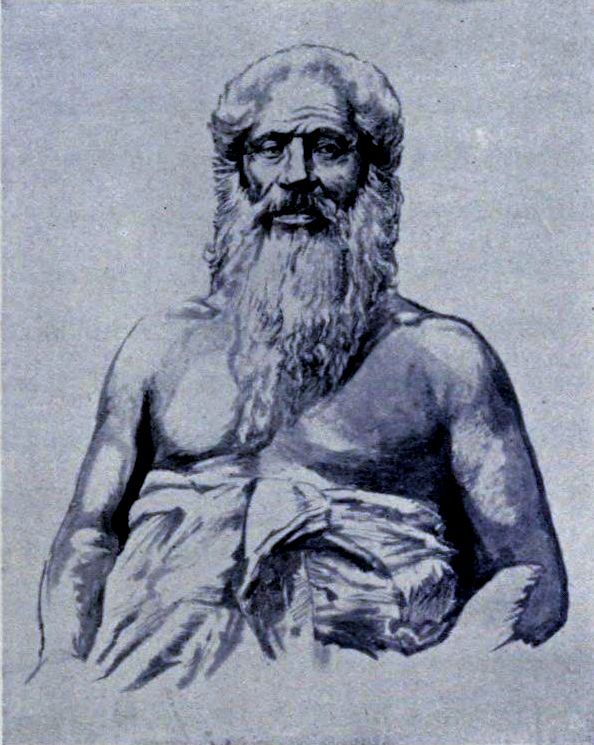
of grey beard, strikingly European at first sight, who laughed at the little joke that we were come to take him to America, like so-and-so who went and never came back.
Another steam launch drawing less water had come for us to take us to the Navuini plantation (sugar) only some six miles in a straight line from us, but further with the curving of the rivers. While we were breakfasting cheerfully on the mats it had run aground and would not be off until a change of tide in the afternoon. So that our boats were called, and stepping down a little copper-lined ship’s ladder delicately grafted into the bank, we were in the boats and had a long hot row to the plantation. There we rested, going up to a high verandah in one of the residences from which there was a view of the delta of the river, and we could look toward the gradual passage of the land into hills and then into mountains.
I felt too tired to follow through the rows of the plantations interesting as they undoubtedly are, because I have some previous idea of the thing. I should have been more interested if I could have seen some of the native sugar plantations which we passed, the existence of which at all seems to me a remarkable thing: the first sign so far in the South Seas of any work not absolutely easy, undertaken by natives. One of them was near our point of departure, and was across the river from the owners or holders; for as was explained to me, it was a family, not an individual, as you know, in the idea of society and property that exists here; in the same way that we have seen elsewhere in the South Seas. There is the family, in so far different from our communistic ideas; then the families that are sprung from a common traceable near root, over them, headed by the heads of families, the greater chief representing the ensemble of families of like origin or who have control; and so on to the highest. As connected with this, the Governor was illustrating the interdependence in some such way; putting ourselves back to an indefinite time, an arbitrary moment when things were unchanged; let us suppose that the head of a village is moved by complaints that some one of his own little association of families has misbehaved. There is no trouble in such a case; all authority is given, and proper punishment meted out directly, if such be necessary. But let us suppose that it is some fellow of a neighbouring village who has killed the straying pigs of our village, or who hangs too closely about some girl of ours—why our chief, however disposed to break his head, must wait to see that such a disposal of the outside offender would not displease the chief who had equal authority over both places. So that he takes a present, the famous whale’s tooth, such as that we saw offered yesterday to the Governor, at the beginning of all conversation; and presenting it, he makes a story of the case, and of what he himself would like to do about it. If the present is rejected, the matter is left as it was. But it may be that it is accepted, and the superior chief may approve and not interfere, or he may approve (annuit), and yet protect the offenders indirectly, so that they should not be hurt—nay, so that they might come off victorious and the attacker be humbled and diminished. Or he might say: “The case is grave; I understand what you want; let me think a little over it;” then he himself approach the still higher ruler and consult him. So that the responsibility was shifted away as far as convenient.
THE STORY OF THE FISH-HOOK WAR
But this fairly is politics, and we were talking of property, and perhaps it is better to give you an ancient anecdote that was told at breakfast with great vivacity by Sir John. It is the story of the famous “Fish-hook War.” Let us suppose three brothers or relatives, each with a district, or village perhaps, under him—people well-to-do, with property and women. Let us label them—(for their names would only trouble us and entangle me)—A., B., C. Now somehow or other a story got out that A. had become possessed, in some way or other, of a wonderful fish-hook, something quite extraordinary in every way and “hors ligne.” Exactly how it was I don’t know, but B. felt that if it were so good he should like to have it himself, and most naturally, according to the communistic ideas of the South Seas, he went over to A. and asked him to give him his fish-hook. A. thought awhile, and then answered that he would be most happy (South Sea way), but that unfortunately he had only a little while ago (South Sea way), given it to D. or E. or F. as the case may be. Now B. knew that this was a lie, but I suppose he smiled politely, or in a sickly way, and went off wroth at heart. Some time after, whether taking a whale’s tooth or not, I don’t know, for I am not yet posted in the use of the implement, A. called on C. and said to him: “I don’t like the way followed by our brother B. in his behaviour to us. He has been persecuting me about a fish-hook, that he might have left alone, and he seems to wish to grasp everything. I think that we ought to give him a thrashing.”
C. agreed: they notified B. that on such a day, say Thursday next, they would proceed to attack him, kill his pigs, ravish his women, burn his houses, and generally make an end of him; and that he had better put up his war palings at once. Of course, South Sea way, he was to be informed of the hour and place of the duel. B. did so, but he was thrashed, his houses were burned, his pigs killed and eaten, his women ravished; and he himself had to take to the wild bush, where for a couple of years he remained. Then the others thought that after all he was a brother, and had been punished enough, and they called him back and helped him to rebuild his houses and started him in life again. Again, South Sea way, all the property they had was in common and disaster to one was disaster to all. But B. after a little while went to A. and said to him: “Of course you might take offence at my having asked you for your fish-hook. It is not for me to decide now, and all that is over; but I don’t see that C. should have behaved as he did. He had no complaint against me, and I think he behaved meanly. Now he is lording it all along. Why not do to him as you did to me?”
“All right,” said A. So again A. and B. notified C. that his pigs should be attacked, his houses burned, his women ravished, etc., etc., and to get his palisade ready for an attack at an appointed time. Sure enough, down they came on him, and chased him out and drove him into the bush. But after a few months they repented and remembered his brotherhood, and recalling him rebuilt his houses and set him up again in business.
And things went smoothly for a time, but C. one day thought it over, and going to B. unbosomed himself thus: “It is all right that you should have walked into me, but what had I done to A.? Nothing whatever. He might have had a grudge against you who troubled him about the possession of the fish-hook, but what could he have against one who had helped him always. He is grown over-proud and powerful. Why should we not bring him to a reasonable level, and perhaps after all get the fish-hook?” So they agreed and sent him the usual summons to prepare for devastation; but also let him know that if he would merely get out in time after putting up his war fence, and make no resistance, no further harm would be done him than to kill his pigs and burn down his houses; but that he must take absolutely nothing away; all must remain just as it was. So A. consented, and went into the bush, and the other two came down and made devastation. And in a few days they called A. back and said to him: “Well, now things are fairly square, we may allow you to come back; and we will help you to rebuild your houses. We can’t give you back your pigs, they are eaten—but, oh, where is your fish-hook?”
Then A. became shamefaced and said to them: “It is too bad, but the fact is there never was any fish-hook. I was drunk one day, and in a boasting fit I invented the owning of a wonderful fish-hook. That is all there is to it.” So that, made wiser by fate, they remembered their general brotherhood, and put up with the nonexistence of the unfortunate fish-hook.
This is a good story of Polynesian war, such as seemed to keep all these good people going, gave them excitement, work to do, provided against unnecessary increase, and yet seems rather to have kept up their numbers, now diminishing apparently everywhere in all islands. It may be that when, as in Tahiti, there may come up the possibility of lawsuits over land claims, the fierce activity of war shall be transferred to the pursuit of rights in courts, as the bloodthirstiness of the Norseman still persists in the “process ifs” Norman-French.
But here they have not yet come to that. No arbitrary professional and scientific ideas, such as aid the French, have yet taken hold. The poor Tahitian, elevated to the dignity of being the equal of a Frenchman, pays for it the penalty of having to record his titles to land by methods new to him. These titles, if not claimed within some European space of time, are to lapse, so that he rushes now into court, with a terrible array of verbal testimony, claiming all he possibly can, and sure to be contradicted or to find his land counter-claimed by some neighbour, jealous of letting any dormant right, however doubtful, pass away forever. Poor Pomaré V, the late king who abdicated in favour of the French, as Thakombau did here, in favour of the English, was claiming (as I may have told you) when we were there, in Tahiti, two months ago, all sorts of land presented officially to his first ancestors and ancestress, as great chief, or as what we now call king; somewhat as Adams and I were placed in possession of our little district so many fathoms long. Against him the battle may not be difficult; as he has resigned his kingship, the titles go back to the first owners, who gave it to a ruler, not to a person. But meanwhile in the court records and notices of trials his name is scattered upon every page.
Here things have not yet come to that. Old ideas that are inherent in the Polynesian way of thinking are not roughly put aside; and I must say that I personally have a sense of coming to a place where my mind does not go through the rack of seeing misapplied laws and rules break up everything, for the risk of possibly doing some good, with the certainty of much harm. For, after all, what are titles of ownership? There is the excellent story of the New Zealand chief, who pressed with impatience to start his claim and make it short, answered promptly, “I eat the former owner”—a brief summary of many ownerships everywhere. Or of the others who proved their claim to land by showing that from far back they hunted rats there. (You will remember that in Samoa rat-hunting was a dignified and “chiefy” sport.)
The lali, the heathen war drum that at the Governor’s house calls us to our meals, has a story about it in this line of thought: Years back Sir John ascended the highest peak in Fiji, some five thousand feet or more high. And having toiled up and being enveloped in cloud and mist, instead of taking refuge in caves, as did his companions, he sat down upon a little hillock, over which was spread his waterproof, and waited for the sunlight that was to show the land below through the rifts in the clouds. Some time afterward one of the magistrates had come to ask about the ownership of one side of the mountain, and was assured by the men of—such and such a place, that it was theirs, a claim contradicted by those on the other side. But the first party insisted, saying, “Years ago our people buried their war drum on top of the mountain. There it is yet.” And true enough, though the spokesman had not been there since childhood, the little mound or hillock was caused by the burial of the drum. So that this piece of evidence was duly recorded by being sent to the Governor; and the evidence is daily produced for us with the beating of it to call to meals.
I have wandered far away from our course upon the river Rewa. There is nothing more to it; we had a pleasant time. There were several officers of the Cordelia along with us. They had been in Samoa and knew our good friends of Apia; Seumanu and Faatulia and the girls, and old Tofae, and they agreed with us in liking them. They were in for photography also, at least the captain; and generally I enjoyed the pleasure that I have often had in meeting Britishers. The captain was full of things he had seen and been amused by. The ship had just returned from Tonga, where it had taken Sir John, and I was told about details connected with church life there: the most important feature in many islands, that makes, for instance, Raiatea and Huahaine and Bora-Bora, our neighbour islands of Tahiti, curious survivals of an arbitrary code of behaviour.
There are too many to repeat; and all that I have is disjointed, but you know the fancy I have for believing that a few anecdotes help to give an explanation—and you would tire less of them than of my own disquisitions. Whether it be so now or not I don’t know, but formerly the great church in Tonga at Nukalofa (I suppose) was so ordered as to promote the cause of European dress and also of European trade. The different doors gave access to people according to their costumes. Consequently distinct places were given to those who owned hats and who wore them over shirts and trousers. By another door, to other seats, entered the hatless owners of shirts and trousers. And lastly, the lowest place of all and separate entrance was for those who even with shirts wore only the lava-lava. In contravention of all this, the Governor, our Sir John, and the English officers accompanying him on some hot Sunday, turned up coatless, with only shirts and trousers, and I hope restored the native mind to a healthier turn.
TONGA GIRL WITH FAN
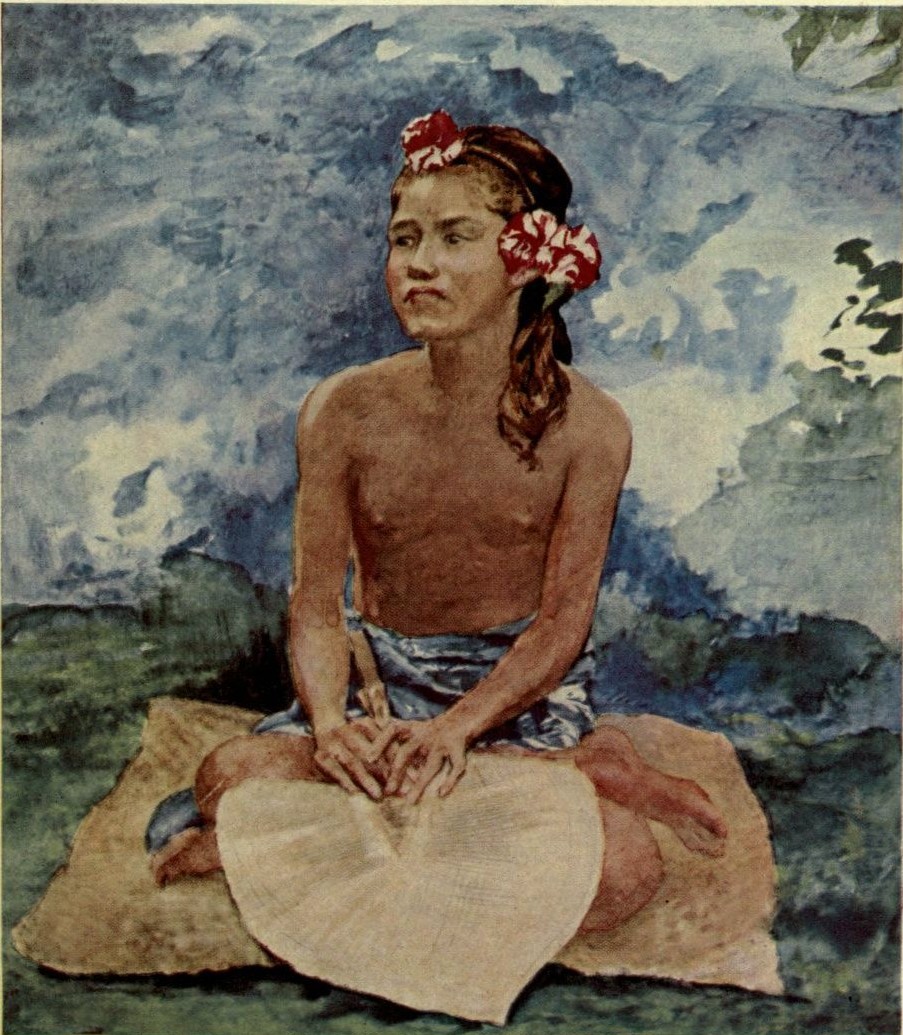
Some way back the natives contributed largely to donations for the missionary society, and I have heard that as much as $30,000 has been sent repeatedly away from this little island and its small population. The Polynesian, in this, like every one else at bottom is on the surface also a vain creature, incited to display and show off; which perhaps explains a great many of his apparent atrocities, perhaps even a good deal of his cannibalism. So that these people have been spurred into giving at church as a special mode of distinction. Again I am reminded by my conscience that I have heard of such things amongst us. But I must go on with them: giving, as a mode of generosity, has been prevalent among them, fostered by everything that we can think of—and especially by the fact that a chief, as head of a community, is nothing but a conduit for property. Some may stick if the conduit is very rough, but to give and give much and all has seemed to me from my first days a Polynesian brand. Was I not telling you last month, or some way back in those lovely days of laziness in Tahiti, how Tavi, the over-generous, gave his wife to Terriere of Papara, through whom we trace our Polynesian descent. Well, with giving in such ways goes show; a silent giver gets no credit and no power thereby; and most do not like the strict Gospel teaching, so what is a man to do who planks out his dollars in church? Any man with twenty-five cents in copper gets more out of it than he does—crash go the copper coins into the plate, while the one silver piece slips in edgeways. To remedy such a state of things, the proper person brings his money in the largest bulk, and if perchance during the week had not had the occasion to get change, he finds in the sacred building itself a corner where his large piece can be exchanged for small; so that in all the pride of justification, he can roll the coppers into the plate, and even perhaps brim it over, and send the pennies whirling along the floor.
With many such comparisons of observations we beguiled the time. The steam launch met us on our return, and we sailed again over the bar, just in time for the tide, for we were bumped in the crossing, though the launch only draws a foot. And now we are resting again, enjoying the delightful coolness; for though the thermometer does not quite bear me out at times, it has been cool all the time, except of course when one is in the sun. But the thermometer has gone down to 66 at night, and keeps up pretty steadily to a range between 70 and 76; and though I have suffered from sciatica on board ship, I am getting over it.
In this civilized life we are looking forward to a trip, at the end of this week, into the mountains, accompanying the Governor, who is going to “prospect” for the site of a sanitarium high up. Strange to say, no one seems to think of it in the other places we have seen. How easy it would be in Tahiti, for instance, to go for a change up to some of the great heights; and such openings into inland places makes things generally quieter and more orderly.
The thing is vague in my mind, only I fear that we shall be several weeks in carrying it out, and certainly it will be a rough undertaking. Then too, how shall we manage to be just in time for the steamer to Sydney, and then how will the arrival of that steamer dovetail with the departure of the steamer that is to take us to Singapore?
But to quote from a letter of King George of Tonga to Sir John, worth citing because it is a type of the semi-religious phraseology we have seen all through the Pacific, bestowed upon us or upon others:
“When the first man fell from the former state of good he received from God, there came upon our hearts pain and doubtings and strife and divisions among ourselves, in regard to unforseen things that may happen in the future.
But it is with God alone to restore happiness.”
George Tubou’s words convey everything necessary, and I shall report to you when things have been shaped. Meanwhile “Salaam,” as the little Indian boys said to me at the sugar plantation—“Salaam, Sahib,” the first sounds that indicate that we are about turning toward home, and that India is the next stage.
AN EXPEDITION INTO THE MOUNTAINS OF VITI LEVU
Vunidawa, Viti Levu. Sunday, June 27, 1891.
We reached Viria on our first evening out, having made the journey in boats as far as the sugar mill of Namosi, drawn along smoothly, as if on skates, by a little steam launch, upon which was also part of our contingent; for even at the beginning we were many: the Governor and his secretary, Mr. Spence, and Mr. Berry, for surveying and the A. N. C. (armed native constabulary), and the Governor’s servants, and Awoki, and the Governor’s herald the Mata Ni Fenua (eyes of the land), and certain others, and soon Mr. Carew the magistrate on the Rewa, and so on.
It was the same river scenery, mangrove swamps washed by the river, and by the tide which influences the stream for some forty miles or more—steep banks cut by the water to an edge, and covered with grass, sugar-cane, banana—occasional but rarer—cocoanuts and so on.
Later on as we came nearer to the end of the day’s trip, as the banks grew higher and more hillocky, they became more and more cut up by ravinings and small cuttings which were sometimes wet, with rivulets or bayous, sometimes dry, and often so close and narrow as to make but little clefts in the stone and earth. Across them, over them; rounding their edges or filling them, grew the trees, sometimes small, sometimes of great height. All this repeated everywhere made a continuous set of little pictures of broken lights and forms—through all the course of the river.
In a small way nothing could be more picturesque. At places where the bank had sloped and made some little flats, men and women were collected, bathing or washing clothes: many of them East Indians, women clothed in the flowing garments, of bright or “entire” colours looking in their favourite yellow, like great birds; occasionally running along the shore beach, their drapery swelling behind them, impeding and showing the motion of the limbs, and recalling the correctness of the drawings and paintings of Delacroix, who alone, so far, had made the Oriental that he saw, look like anything else than a geographical or artistic curiosity. When I think that a few weeks sufficed to store his mind with all that he had done or implied in this way, I return to my admiration for his work, which sometimes for a man of the eighties of this century looks too much like the doings of a man of the thirties.
Once along a high bank near some station (government station), a row of constabulary stood up and then sat down in a row, respectfully on a platform of the bank, to do honour to the Kovana—the Governor.
Late in the afternoon we turned at one of the confluents and reached our destination for the night. A high sandy beach all broken over with footsteps, looking like a Nile embankment—many natives sitting about on it—then disembarkment and a little walk through some sugar-cane and banana, on a little raised road, and we came to a native town or village, inside of a deep ditch of circumvallation, filled with trees, and inside of a big waste space, the house we were to occupy, alongside of a few others. The same method of entrance—the trunk of a tree made into a plank with the natural curve, with notches and holes occasionally in the wood, as the tree has grown. This wooden path led quite high up, and some eight feet or so to the base running around the house—the yavu or permanent base, which is allowed to remain when the house is dismantled by time or by man.
The house, the usual one with the walls covered with leaves. In one place a ti branch in full bloom of yellow-red, projecting from its side as if it grew there (a decoration for our coming). The doorposts of trunk of tree-fern, all dark grey and corrugated, looking like stone; and above the doors a false lintel, engaged in the wall and smaller than the door, looking like a round bulging stone (as if so cut by a pre-Romanseque architect); the cutting of the chisel admirably indicated, but in reality nothing but a bunch of grey dried leaves, so brushed together that they suggested the grain of stone under the chisel.
In front of the door, or rather at its edges, engaged in the platform, shells disposed in a pattern, and the same disposed in a half circle in front of the stairway plank deeply sunk in the earth, so that only their ridges were visible. All this exquisite good taste in spite of the repeated assertion, which may be true, that these good people are not at all sensitive to æsthetic feelings.
The interior as usual: yellow cane in patterns on the walls, and dark columns of tree-fern, and rafters covered with sennit. Soft mats on the floor were made softer with leaves thickly strewn under them.
Here there was a presentation of whale’s teeth, of kava and of food; and here the Governor listened to reports of the place, and talked to the mbulis (prounounced bulis) (local chiefs of a certain degree), and later listened to some petitioner of a neighbouring place, who in the twilight had come to him while standing out in the open; and had squatted down and mumbled and whispered, and offered some written petition. Then we ate and slept and in the morning, walked along the outside upper base, and looked upon the hazy scene—then bathed in the river while the mist still floated above the tallest trees.
When the sun was well up our party divided, three of us going by canoe, and the Governor and officials and retinue walking or riding on.
Here then we parted, A. & T. taking the canoe, while the Governor and the magistrates went on foot and horse by land, to Vunidawa. There was a little thatched awning upon the canoe’s deck, large enough for three to manage to stretch under. Six men, three at each end, poled or paddled in the canoe as the water was deep or shallow; while one man, in this case I think a sergeant of the “armed native constabulary” (A. N. C.), stood on the outrigger, or sat about and took charge.
The low roof prevented one’s seeing much of the shores, for to sit up was to have one’s view absolutely excluded. But all the more important became the little details of vision, the beauties of line and colour that one sees everywhere in the movement or the rest of water, its breaks upon shore or upon rocks, the reflections that it carries with it, and the near banks or little distant escapes of vision, all framed within the cane posts of the sun shelter. It was all much the same as the day before, but the shores became bolder, the breaks greater. Rapids rushed around us, and our men poled hard against the force of the water. We passed or were left behind by the other boats carrying the enormous luggage and accumulation of provisions for such a party. The profiles of the men in the other boats stood up in contradictory curves and lines against the shadows and fights of the distance, or the darkness and glistening of the water. They shouted and called and got all the fun and excitement out of the hard work that could be had. As the slopes increased and the river-bed showed more gravel and boulders in large patches, the talk and chatter of the men reminded me of former days in Japan, up in the high lands and by the rivers that run there on great gravel beds.
At every step this impression of reminiscence increases and must increase, as it occurred to me on the very first morning of arrival, upon seeing the many small hills and mounds fringed with trees, behind which came down great slopes of distance; even an occasional waterfall was there to remind me. The heat was great, the silence also, even though the men shouted; for occasionally we heard nothing but the movement of the poles and the ripple of the water. A hawk would flutter off from some tree. Dragon-flies lighted on the deck or upon one’s outstretched legs. A spider, folding up like a pair of scissors, so as to look all long instead of circular, began to build its web, for there were flies; and all little things became of interest by the time we had reached our first halt. We were helped up some very high banks of red clay, partly covered with green bushes and trees, and found ourselves at the entrance of a pretty little place, with plants and trees neatly set out, for colour spots. We lunched most comfortably in a native house.
With this break we began again our river course, the rapids increasing, and the difference between the shoal water and the pools becoming more evident. Occasionally a large spot of river greened or darkened into what was depth. In such we longed to bathe, when the moment of halting would arrive, or before departure, but in none such of these did we swim. Indeed, little by little, one felt the influence of the assurance that sharks visited these deep holes, and that to some fifty miles or more up these rivers there was a possible danger. The shape of the river banks, the marks on the shore, the thickness of the dry parts of the river, the size of its boulders and pebbles, the manner in which the tongues of conglomerate that ran along with the river-bank were cut down, the sudden cuttings and hollows and ravines of the bank, all showed what a mass of water, in wet seasons and years, must pour down these rivers. Then when the tides are high and the waters give access, great sharks come up and bide their time in the deep pools. No year passes but that some natives are attacked. Here then the smaller ones remain when the river runs lower, and change their colour and become fresh-water sharks, and sometimes when small are harmless; but the impression of danger is there. I am told that they are seen far up, and that even as far as we shall get on Monday night, they are occasional.
We landed in the afternoon at Vunidawa, some thirteen miles by land from our morning’s stay; again coming up high red clay banks, of a beautiful slope most charmingly set out and arranged, upon which stands the “station.” I was told that the arrangement of cuts and breaks and ditches was all modern or recent, but that at one place there were the remains of the old cut or moat on the upper hillside. But the place had a fortified look—one looked down from high banks (below and around which ran paths) upon a hollow centre in which stood native houses and great trees. In the distance, mountains across the river; toward the west, one great streaked mass, with an outline vaguely like the Aorai of Tahiti, the smaller ridges in front of it showing high precipices that looked violet in the dawn, with occasional shiny white spots; all else with a faint haze of green, except where far off, further to the west, a pointed peak looked blue. Along the bight of the curved river a line of cocoanuts stood near the high banks. Further on one could discern to-morrow’s road, that disappeared behind a turn of the river, and up the edges of the intermediate hills in the distance yellow patches and markings modelled the slopes of the first uplands.
Sunday.
All next day we rested. The sitting-room of the pretty native house was decorated with native tappa (masi) of many patterns. Books and magazines were upon the tables and shelves of cane. The Governor and the resident magistrate, Mr. Joski, whose house this was, received reports from the mbulis (chiefs) of the neighbourhood, while sitting out in the evening on the green slope of the garden.
We left again Monday morning for the first beginnings of mountain country and more inland manners. Our party again divided. Atamo and myself and the momentarily ill Awoki took to the water and again went up stream. The weather was exquisite, the draught of the river just cooled the heat. Constant animation and struggle on the part of the boatmen for the rapids became more and more frequent. Half the time, with the strength of the current and the shallowness of the water, four of the six men plunged in and pulled and tugged at the boat, pulling it through the boiling water, lifting their legs high, one after another for stepping over the boulders, every muscle strained with effort, the poles bending against the rocky bottom. Occasionally the man who stood at bow or stern, upon the little vantage nook of the thickness of the canoe, would be slung off by a swerving of the current, and his own stretching far away to the side, and would retain some place from which he could join us. The other boats passed us or were left behind. We saw them far off on the slopes of the torrents, lifting shining poles against the shadow of the banks. Sometimes the water swept over and our own little planking was wet with it. As the rapids increased so did the spread of the stones and boulders of the remainder of the river. We rested once for midday meal. Then in the afternoon we landed and walked a little way along a causeway road to a little village on a bluff, where the wide river turned. Then passing through many houses and turning around a deep moat, filled with bananas and other greenery, we came upon the edge of the little hill. Here stood a house of a different type, more like the type of the mountains; a very high, dark, thatched roof, more than twice the height of the wall together with the stone base, or mound embedded with stones, called yavu, out of it grew bunches of the red ti. This mound embedded with stones is kept and has its name; the house on top will be built and rebuilt.
At one corner a great palm tree rose above the high roof. From the little plateau, planted with occasional trees and rising steep from the river, a sloping and curved path led down between water and village, separated from the latter by the deep moat filled with trees, and coming at length to sharp earthern steps (if one can so call anything as rude) that took us to the river end, to our bath in shallow water, the edge of the deep pool under the cliff. Far back behind us spread the river-bed with the stream between, and in the distance behind the hills a line or shoulder of mountain streaked perpendicularly with great shiny patches of rock. In this house we spent the night. It was inside, like all those we have yet seen, charmingly finished with patterns of fastening on the reeds of the walls, and sennit decorations on beams and lintels and posts. A rude representation of a cow or bull had been worked into the roof.
The next day we began our walk, leaving the canoes for good; and after a few hours over clay ground and some rocky streams, we came to a wide space of the river; across which we were carried in rough litters made of bamboo tied together, then, walking up a clay bank between trees, came upon the little village around which the river curves. This was Navuna.
Here the view was confined to our huts and those of our neighbours. Behind us a plantation of bananas; visible partly around the corner of a neighbouring house, a great tree shading the centre of the rara, the village place, where in the morning the Governor and the two magistrates interviewed the representatives of this place and of others. I could make out fairly well that a certain court of reproof was going on; for all through these places was something which explained itself a little further along.
Nasogo, July 3rd.
The midday saw us off from Navuna, and through similar scenery to a little village on the edge of a river running far below it. The village is Navu (n) (di Waiwaivule) in the district of Boboutho.
Now we began to be helped by being carried in the litters provided us by Mr. Joski; for crossing and recrossing streams, it was perhaps as easy a way as being carried pick-a-back. But where it was both a triumph and an excitement was when we were lifted up the steep sides of the gorges; then the looking back or forward, and seeing below one’s feet the toiling carriers of the other litters, swaying to and fro with their burden; and behind them again the long file of what was getting to be an enormous retinue. For a background the distant mountains, or the bottom of the gorge, black shingle and rushing water, or shallow pools reflecting the green above. But prettier than all was some passage along the stream; the men in the water; the mass of the party sometimes in the water near us, or disappearing around picturesque frames of corner rocks, over shingles and boulders; and reflected all about us the entire picture—the distant mountains and rocks in sun and mist, the near rocks covered with green, or with purple and grey of conglomerate; and the song of the rapids ahead in a black and white streak counting against the trembling green.
But when we walked then much did we regret our litters. To the native our good path was for the most part on the dry river-bed, and lengthily and wearily we picked a precarious footing over innumerable pebbles and stones and boulders; sometimes thinking that the walk was easier on the big ones, because one went from one to another; sometimes on the smaller and more rolling ones, because one got several under one’s slipping foot. But my neighbours always helped me: sometimes Lingani, one of the Governor’s men, or one of the “Army,” as we called them (the armed constabulary), or some mbuli who accompanied the escort, or some newly accidental neighbour; so that all went well enough, and we reached our night’s destination without the sprained ankle that had discomfited Mr. Spence early in the trip.
All is a little hazy to me up to where we are now. I remember the look down the ravine and up the other river. I remember that huts began to be more peaked or more like
EDGE OF VILLAGE OF NASOGO IN MOUNTAIN OF THE NORTHEAST OF VITI LEVU, FIJI
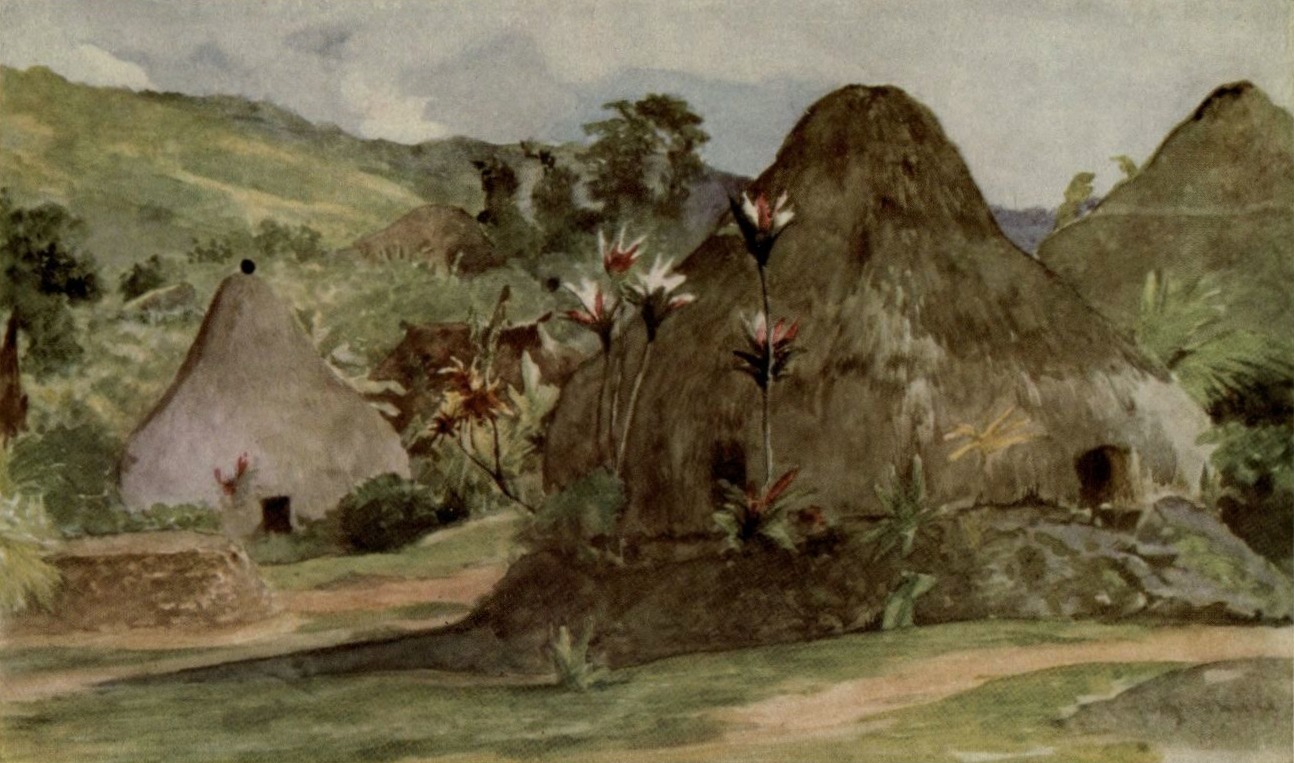
beehives. I remember one which had been fitted up as a heathen temple or devil house, and from whose roof many strings hung down—as conductors, one may say of influences. There had been a basket attached to one of them, which the Governor cut down. I remember, of course, but one running into the other, presentations of whales’ teeth and food, and tappa, and dances (mekke mekke), with or without the dancers being wrapped in the enormous folds of cloth, that afterward were unwound with more or less difficulty, to be piled up high as a man’s height into great masses of presents. (And by the by, though all that is extinct to-day, some thirty or forty years ago a return to this old manner of making gifts of tappa came near to bringing on a civil war in Tahiti.) The Tahitian custom referred to came up again some while after Queen Pomaré (Aimata) was on the throne, her brother Pomaré III having died quite young, and leaving her, who had not been trained entirely by missionaries, exposed to the passing influences that come up with new conditions. At some time or other she capriciously desired that upon certain occasions she should be received in Tahiti (on her arrival, I think, from Eimeo—Moorea—but that is unimportant) in the old way. Among other customs would have been that of presenting her with tappas offered by a number of young women, who, having danced before her all swathed in this native cloth, should then gradually be unwound, and having nothing upon them, continue the dance to an end. This was part of the thing, and I only remember this detail. It was then that Tati of Papara, the grandfather of our old chiefess, came to the front, and in a most remarkable manner, both by threatening armed opposition, and by the use of an eloquence worthy of the greatest examples, broke down the will of the Queen and the plotting of her then advisers. It is thus greatly to Tati that peace and the final quiet prevailing of Christianity was due.
As to Aimata, or Queen Pomaré, that she remained more or less of a pagan at least for a long time, the fact or report that she destroyed two of her children (probably base born) is in the direction of a testimony. Of course the meaning of the word Christian is variable according to time and place and especially according to date, so that the geographical and historical limit of the meaning should never be insisted upon in too set a manner.
The next day’s tramp brought us here, but apart from certain geological facts in which Adams was enormously interested—for example, the superposition of the conglomerate upon everything else, and the finding of shells in the softish rock at this height—all was pretty much the same.
Our present place is very charming, reminding me of the last. It is at a corner again, with the river turning round one side of it, and the stream up which we came on the other. Between them a bluff covered with trees, the space of the bed of the river mostly filled with boulders and gravel and rocks, though we roll the rapids, or slide the quiet waters; a great rock just facing the village, as an advance buttress of the mountain behind it, which melts tier upon tier into an entanglement of foliage; and the town or village itself, built on a succession of terraces, all worked over and planted, and edged with walls that seem part of the natural structure; here and there, even right in the village, a boulder black or grey, almost of the colour of the thatch of neighbouring houses, and protected, shaded, encompassed with trees or high decorative plants as they usually are. As always everywhere apparently, the projection of any tongue of land makes itself into a knife edge; so that the idea of a ditch or moat would be suggested to the savage engineer by the very make of the land. Therefore from each side the slopes go down, and below you see tops of trees, banana, palm or what not, and tops of huts staged down.[28]
Then where the land rises again on the slopes, big boulders stand up, reminding you again of the thatched roofs; and far away on heights are places where villages stood, and where some years ago these very savages were attacked and driven off.
For all these parts of the country were once a stronghold of the more savage tribes; if not the more powerful, who sometimes came down and attacked the lower places. And all through here some of the gentlemen who were with us had gone, when the time had come to make an end of it, destroying the towns and reducing the wild people to forced peace. Occasionally I overheard these reminiscences, which do not date so many years ago—fifteen or sixteen, I think. The Governor had headed or accompanied expeditions, and one or more of our companions had been on such attacks, after having suffered the loss of a number of relatives and friends. But all that is over now; only, as in all mountain countries, there is a sort of regrowing of that bad seed, such as we saw in this recurrence of the old devil worship.
Here we saw of course again more ceremonies and presentations of food, the latter becoming a serious necessity with the great number of men accompanying us. The Governor is not only a representative of the Queen, he is as such the chief of chiefs, and most wisely his policy, whether or not it has been the policy of his predecessors, has insisted upon this point. Every ceremonial of observance, everything that would belong to the native ruler, is encouraged and kept up. Not only such natural observances must exercise an indefinable prestige on the native mind, but they also must allow, in what is a personal government, the use of an apparatus of control exactly suited to the native mind: thus any subordinate chief can be reprimanded, talked to and put in his place in such a way, that he feels it from ancestral habit; he can be removed or set aside. A man serving out a sentence can be kept a prisoner behind the paling of a bamboo house that he could break through as easily as he can see through it.
With time, as the natives change, the laws and ordinances that they have made themselves, for most things, that have seemed good to them and which are not contrary to the absolute essentials of English law, have been left, and will change as they change, and may fit themselves to an unknown future.
This will explain the naturally sensible reason for which the Governor differed with some of the Catholic missionaries, or rather their bishop, about which things I have heard, if not complainingly, at least with suggestion of arbitrariness from one or two good old Samoan priests. For instance, it is a great chief’s privilege and marks him that he should be “tama’d” to in passing—that is what marks him, and establishes his position in the hierarchy of rule.
But there is no reason why a bishop should claim it; even if in old days the confusion with regard to power of sacredness, of respect, and worship had always existed here as it has been all through the world. So also the case of the missionaries objecting to the chief receiving the first fruits of the land, often symbolized nowadays by a mere few pieces of some growth, because long ago it bore a religious as well as civil meaning. I fear me that our old friends, the Jesuits of China, were the only very wise men that served as missionaries, so that they alone never went by their personal whims or measured matters by their own fast rule.
But this is far off from my natural path of mere record of what happens or what I see. For some things at least the sketches will help you. I may succeed in making some note of the cheerful clearness of colour and tone all about me, though of course I can only make a choice. If I give you the day, then the veiled charms of morning or of evening, the enveloping of distances in misty colour, must remain unattempted of record. Or if I try the haze of the beginning or end of day, then I shall not have anything for you of the lightness and gayety of the brighter hours. But the sketches will give you the shape of the houses. You will sympathize with the inconvenience of getting in or out, in the dark or wet weather, excellent as it must have been as a device for protection against too sudden intrusion of doubtful friends.
We wait one whole day: then we enter the mountains for good, and pass over them to make our way to the coast which will be a matter of four days or so. It may be warmer higher up, as there may be more cloud; so far it has been cool at night, the thermometer going down as low as 56.
In Camp in the Bush. Saturday night, July 4th.
We left Nasogo (pronounced Nasongo) early this morning in the mist; going down into the river-bed, among the boulders, and crossing the stream several times: the same river that rushed down around the little point or promontory of Nasombo—a streak of black or blue or green or white, among the black stones spread out between the rocky bluffs. Then we attacked the mountain and the forest—stumbling and slipping over rocks and moss, and matted tree roots. The path had been somewhat cleared for us here and there, but it was hard travelling through the wildwood; all damp above and below with the continuous moisture. In this desert of leaves and tree trunks, the passages of former torrents served for paths. Over us were quite high tall trees, but between their upper branches and the mossy wet earth spread a broken canopy of tall ferns, and lianas and the branches of smaller trees and plants. Here and there a great fern connected with the tree fern, but unlike it, spread or lifted long fronds like canes some twenty feet in length. Upon every tree hung innumerable mosses and parasites. Below, all over, a tangle of ferns; beautiful as ferns are, though you know that I care little for them; I am even so unworthy, that the prospects of rare orchids does not stir my blood; I would give them all for roses, violets or for apple trees or the cherry. I am essentially and absolutely European in these things, and retreat behind my rights as an artist to have preferences and keep to my instincts. But for you who love such things, I can say that there were many rare plants; a creeping lily, for instance, and innumerable ferns.
The fatigue of the ascent became greater: we halted at noon on a little open space above a high precipice, from which we could look back at the whole course of the river sunk far into the mountains and curving in the far distance around the amphitheatre, stands on its little bluff the village of Nasogo which we had left in the morning some four hours before. Beyond it the river ran, a black thread in the dark grey shingle, below the big bluff, and around the little promontory by which we had bathed for two days. Then we had lunch and Sir John on this Fourth of July proposed the health of the President—and drank to that of Mr. Harrison. Then the “Armed Native Constabulary” gave a salute of six guns which echoed far away down the valley and into the grass country that we hope to reach to-morrow perhaps. No doubt there will be stories afloat that we have been attacked. We were then some 2,300 feet up—the thermometer indicated 62°.
Later, as I was very tired, I was carried in the rough palanquin of boughs down the steep hills—the path so narrow that much ingenuity and noise and discussion was expended by my carriers to pass through the trees: fortunately the conveyance was elastic and could be sloped any way. In fact at times I stood up or sloped back so as to have to catch on, but I fell asleep and the men carefully moved along the hanging branches and lianas so that they should not strike me. Almost everything that came down merely hung in an elastic way. Rarely did a big tree stretch over the path. The last thing that I saw before closing my eyes was the file of our party beneath me: Their heads just visible between my feet; the “Native Constabulary” in their uniform of bushy yellow hair, and blue shirts, and red sulus worn like sashes.
The little British flag had been stowed away to prevent it striking, and I missed its flutter or dazzle in the green. One of my big black attendants was hanging upon a small sapling dragging it down from the path and dropping far below afterward. The noise of the axes of the scouts sounded in advance and started the parrots cawing in response; the sun broke upon us and so I fell asleep in the more grateful warmth.
We reached the place chosen for camping in the early afternoon after another couple of hours’ march. Our halt was upon a little bluff right on the line of march—where trees had been cut down, and huts and sheds built for us, and where already many of our people were resting. Here had come the women sent in the morning by the other road, if one can call it so—the bed of the stream. They were to carry food for our people—for we had by this time some two hundred men along—many really of use, carrying boxes and trunks and provisions, all distributed, so that every little while I could notice in the long procession, the man with the frying pan—the man with the governor’s chair and so forth. But there were also amateurs who carried a club, or a little packet of food done up in a leaf, or an odd umbrella for one of us—or like the last page in the “Chanson de Malbrouck,” “Et l’autre ne portait rien.” Some were so called prisoners—viz., men condemned to labour for a time—and I was much amused at the story of three of them who were encamped in a long shed alongside of the magistrate (Mr. Carew) who had brought them as servants. They were all three in it owing to the eternal cause—“la femme”—who in Fiji seems to be “teterrima causa”. In fact, as there are not women enough to go around, it was not astonishing to hear that one great influence of the recent heathen revival in this wild region of cannibals was the hope of the young men, that if there were rows and trouble, some stray women might fall to their share. This evening I wandered out along the sheds and saw a good many—not more agreeable to look at than those I had seen before and certainly far uglier than the average ugly men. One youngster, another “prisoner” was preparing to oil himself, surrounded by a little group of female admirers, reversing apparently the fact of there being few women for the men.
We warmed ourselves at the fires, for, though the temperature was about the same, all was wet and damp, the firewood all covered with green moss. Our little hut was a fairly good one, made of wild banana, and the interstices filled up, or rather covered up with the great leaves of the wild ginger.
July 5th.
The night was rainy and all was damp in the morning, when after prayers we started again into the wet woods. The cry of the parrots like a wild flapping of voices had been the first sound of early dawn. Then the camp had begun to move with chattering and laughter; people filed along all the morning.
When our time came, I had again the use of the loose palanquin in which I was taken for the first two miles down the deep side of the mountain. It was interesting to look up at the trees above, and to notice how much more of the vegetation grew in the air above than in the earth below.
Every tree was covered with plants, mosses, creepers; the vines and lianas that hung about were themselves covered with smaller growths. Perpendiculars of gigantic vines hung, though they looked as if they held themselves up, but the least pushing of our party would send great spaces of green trembling far off. The branches that were in my way were loose and swinging, and rarely did we meet so low down the branches of a solid tree. High up through the great loops and festoons and upright stretches of the creepers, or here and there the great leaves of the wild ginger, the light was delicately stencilled with the pattern of the leaves of the great ferns. But high as everything seemed above head in the trembling wall of green our occasional passing of some mighty trunk of the da kua tree, whose branches began far up above everything, made still smaller the caravan passing below. Upon the branches and curves of the great trees, in every nook of protection they could afford, flourished other small forests of air plants, ferns and creepers for whose support the great oak-like limbs of this giant of the pines seemed to spread. Lifted high in relation to the plunge beneath, I spent half the time in looking at the details of this upper picture, unseizable otherwise in our rapid marching—but after our rest in mid-journey I preferred the tramp, and walked on with the others, slipping and sliding up and down, until we reached camp (after five hours’ walk) on a little open space. Just before this we had passed through a little park-like country all different from the sharp edges, ascents and descents of our usual travelling—the grass grew high, trees dotted the swellings here and there, the sun kept all dry so that it was hard to believe that only a few feet behind lay the eternally wet forest. In the tall grass grew orchids like lilies, orchids large and small of the fagus variety. Butterflies and moths flitted about. The open country smiled after the sadness of the woods. Our resting place was not quite so open, but yet it had a similar appearance. It had evidently once been inhabited—there had been taro patches at one extremity of the open space. Here again, as throughout what we had seen of Fiji, the inhabitants had been chased away from their holdings in the perpetual wars. Indeed only twelve or fifteen years ago these good people here were cannibals and liable to be eaten if they did not eat others. The advantages of their present lot in this way were referred to in the sermon of the native preacher who had accompanied us, for this was Sunday and we had prayers in the morning and service and sermon in the afternoon. Of course I get all this at second hand, or even further; but the good man took also occasion to lecture his travelling flock, a flock as I understand, not his natural audience, upon the folly of returning to devil worship, of which there had been cases in this part of the country, as I have mentioned, I think, and pointed out to them that it was only an agitation brought up by people who wished to kindle trouble for their peculiar ends, as, for instance, that in the scarcity of women, some of them might fall to the share of fomenters of trouble, in case of any upsetting of things, however momentary—for there are fewer women than men, as I think I was telling you.
Here the desolateness of this open space (with our pretty and comfortable temporary huts it is true), but still indicating a once large population, brought up this question of the relation of the women in connection with agricultural work. They appear “sat upon” and not joyful and free as in other islands that we have seen. But of course appearances are only for us; they are certainly kept away and take a secondary position. But then of course they have to be put away from the mass of our men who are beginning to number heavily. Mr. Joski says that we are as many as four hundred. These women, who look so saddened, did a great deal of the heavy work, if not all—a matter which seems unnecessary at first, as the men used to idle and fight, but perhaps it might be worth while to look at the matter from inside and see how things must have stood in old times.
In the morning, when, as to-day, the mist hung over all the valley, over every point that could be cultivated or was so—when the little village alone above would be lighted up distinctly, it would have been impossible for the warriors to plunge into these shadows to look to these plantations, offering themselves as an easy prey to any ambuscade or attacking party. No; the right thing, of course, was to wait until the sun rose far enough. Meanwhile skirmishers looked about and travelled through the neighbourhood, armed against any foe. When they were satisfied that there was no immediate danger the women and children could go out and work in the fields or attend to anything necessary, while the men were about, ready to protect them in case of danger; certainly, this was to the woman’s advantage; had she, when travelling or going about, shared with the man the carrying of weights, how easily would they both have fallen a prey to the enemy. No, she would naturally have said, “you go before with your lance and club and see that the path is clear; I follow with the food.” All this is a picture of what was once, and here no more than elsewhere, except that here things were upon such a scale that there was no chance for anything but this perpetual war. By such considerations the past of all nations comes back.
July 6th.
People of the neighbouring district came here to do homage to the governor and present food and they added still more to the number, filling the neighbouring hollows and moving about in and out of the lovely little brook all shaded by trees, in which we bathed in cold water, for the temperature remained pretty steadily the same, in the neighbourhood of 63° to 68°.
In the morning we left Ngalawana, and made a short and desperate plunge through the woods in the hollow to the N. W. and up the mountainside. It was raining and had rained, and anything more slippery than the road over which all these hundred of people had been travelling I cannot think of. The steepness was bad enough, and one could have rolled down if one had a good start; but some of the paths might have been “tobogganed” over. The bare feet of the natives managed it well enough, though with much slipping. And their ideas of direction of a road are peculiar, the straighter the better and across country; so that recently about the very roads that are in consideration, they say to the governor that of course they will make him his roads to travel on as it suits him, following easy paths, but that he must not expect
FIJIAN BOY
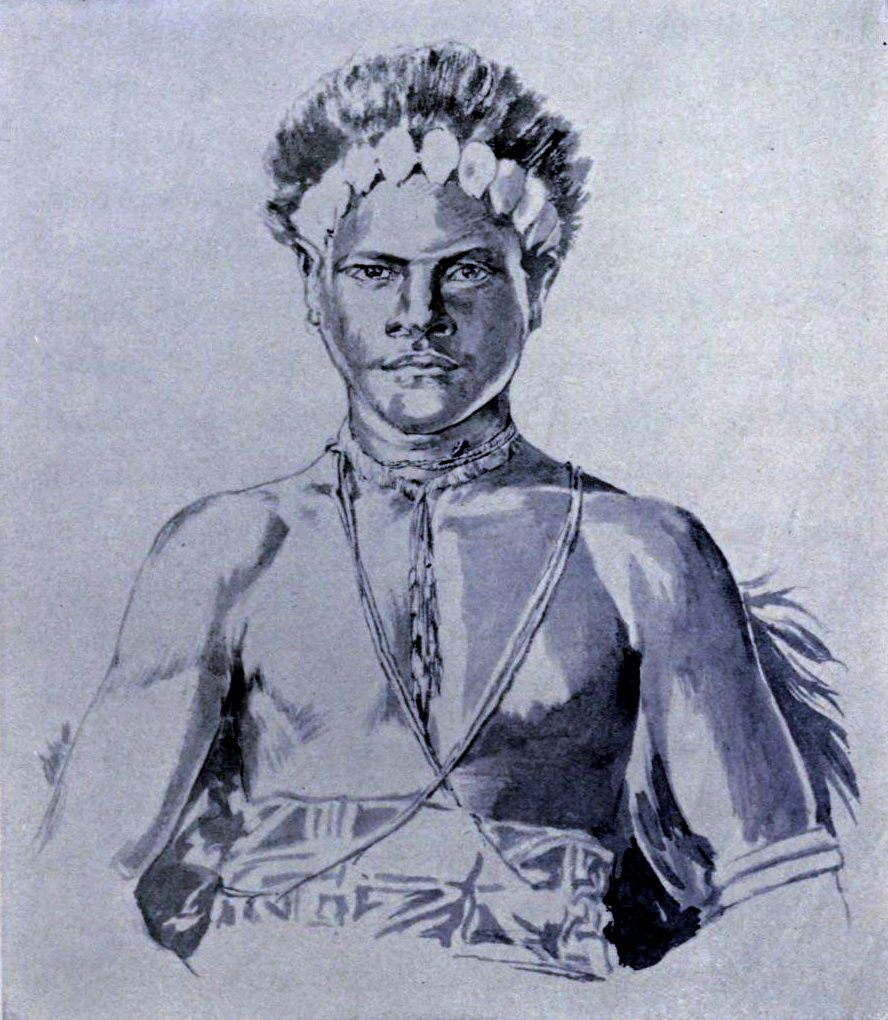
that they will use them. Still easy ways are great persuaders, and notwithstanding this conservatism, the new roads in other parts are travelled over by the now converted heathen.
We arrived at length at a little village on a spur or ridge in a large valley where we are to rest for a few days—the first village, small as it is, since Nasogo. Here the governor was waited on by two deputations who presented whales’ teeth and food and who were received in the usual way by the Mata ni Vanua (the herald) and the other attendants with the usual voices of ah! wui! wui!—wu—u! wooe—wooe! and so forth, making everything look more and more African as we go along; for all the way through in these mountain tribes, the negro colour and look, and woolly hair on head and shoulders and legs, and I am sorry to add the smell, marks how far we are from our smooth brown Polynesians.
In the evening all was bathed in the afterglow; pigeons called in the trees; through the air that seemed thickened with the light-green, long-tailed parrots sailed slowly, with an occasional flap of wings.
Matakula, July 7th.
We are resting here to-day; while the governor explores the neighbourhood for the purposes of his establishment of a sanitarium. We are not so high on the present ridge as he would desire: only 2,200 feet while it might be possible to find a plateau or wide ridge as high as 3,000. It is much warmer than before and dry at least. The night was cool—as low as 54°. The day is warm. I rose early, with the cries of the parrots in the wooded hill behind us; looked at the mist in lakes about us, out of which stepped the high trees and the mountains in the distance—even the dark conical huts of the little village built along the ridge at whose extreme end we are, were still wisped with moisture. The sun rose slowly behind the mountains, bathing everything in mildly pale varieties of wet colour—and all was lit long before the sun came over the hill behind us, and poured heat and dry light upon the scene.
We have been doing nothing: sitting out under umbrellas—then under a mock grove which the men suddenly made for us, digging up neighbouring trees and tree ferns and planting them around us in the soft soil.
For this they used the digging sticks they had, merely heavy bits of wood with pointed ends, in some cases turned up at the sides. We are here in primitive country: the boys of the village brought the water in bamboo joints this morning: the huts are of a peculiar hay-mow character—the features of the people, as I said before, are remarkably “African,” though often the colour is of a rich brown—but more usually a
STUDY OF HUTS AT END OF VILLAGE. MATAKULA, FIJI
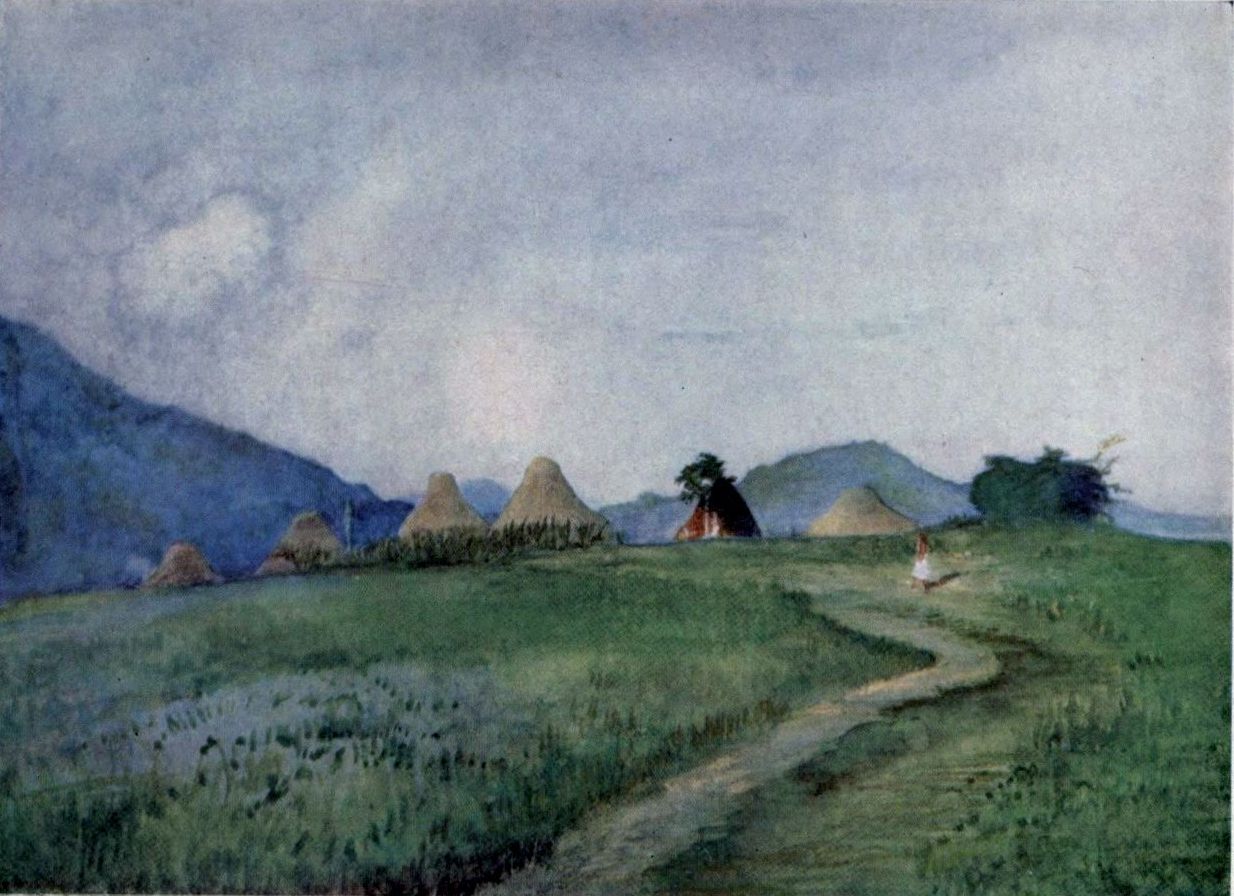
chocolate, that is negroish, is the type of colour, passing to a blackish grey. Most of the old people here have been cannibals; and fifteen years ago all this part was then still dangerous: on some attacks of theirs, upon the coast people and upon the whites, two of whom were eaten, war was made upon the villagers in this direction; their villages burned, and their people driven out and divided among other places. Some of the gentlemen with us talked at night of those days and of the fighting. If I have more time, I shall try to join together some memoranda or to jot them down as they come up.
At night, when there is no rush for bed, around a fire in the open the talk goes on, always interesting and rich in anecdote, and it is only a pity that we are not more acquainted with the places and people and past story: it is like looking at an embroidery that has no foundation.
But last night a story reminded me of the dream of Pomaré Vahine, told us by the old lady, Hinarii, in Tahiti, which I sent you, I believe. This is not a record of the pagan underworld, as that was, but one of a new Christianity, and as such makes a curious “pendant.” It is one of the late things reported about, and a source of comment and of influence. It appears that the wife of one of the principal people of some neighbouring place—perhaps a mbuli, but I was very sleepy when I heard it, and details are misty—appeared to be dead, was duly watched and prayed over—and then suddenly she called out aloud; when naturally enough, the entire assemblage scampered out of the house: at length the husband took courage and came up near the house, and heard his wife call out “Mbuli Mandrae” (I don’t remember the right name, let us call him so) “is that you?” “Yes”—“Well then I must tell you what I have seen.” So to those who returned, the good woman said that after death she found herself on the path, and crying, to find the road to Heaven. The road forked: at the one fork were a number of men dressed in white—at the other a number in black, and when she expressed a wish to go the road to Heaven, the white men passed her on, tossing her as it were from one to the other, until she reached a great gate which was made of looking-glass or mirror. There she knocked, but was told that she must go to one side, where a scribe asked who she was and what she wanted. She wished to get into Heaven. So her book was consulted, and she was asked if she was free from sin. “Yes” she replied—“I have been faithful to my husband.” (Sin with these good people is of one kind.) “No indeed,” said the judge, “do you not remember one mid-day when so—and so——” The poor woman admitted her fault and was immediately handed from one white being to another, until she reached the fatal corner, when the black-clad people tossed her along as rapidly, until
RATU MANDRAE—FIJIAN CHIEF
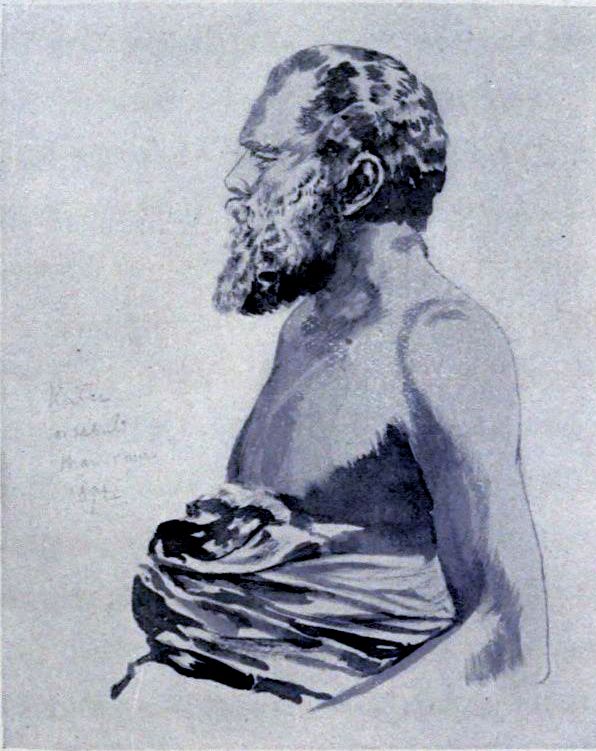
she saw a large lake of fire in which were swimming, people who were shrieking out of the seething liquid, and then dropped in again with cries of agony—around the pits hung ropes from which many were suspended and dipped into the liquid fire. “See,” said some one—“that empty one is yours, but you have until next Thursday to return to your home and warn your people of what is in wait for the sinner.” So the good woman had returned, and, having warned them true to her appointment, died for good on the Thursday. The impression has been great.
July 8th.
In the morning, after the night-rain and fog, the hills and the dry country below our little narrow level were grey in mist, slowly dispelled by the sun that tossed it irregularly into the air. Before sunrise, in the dawn, the distant mountains, the higher hilltops and the uppermost trees near us rose from out of a lake of white cloud; with the coming of the sun, things became less distinct, until again, just as the sun passed over the little rocky mountain behind us, the fog lay again level in hollows while the last wisps of water blew around us, dimming this or that hut of the village of which we were part. The parrots chattered again. The doves cooed in the forest a few yards off, and in the line of the hills behind, a curious bark in the distance was the voice of another variety of dove. Two or three times that morning, and again during the day, we heard the gun of our “hunter.”
This was to be our last bad day of walking and we made a good show at it. We were to drop some seven hundred feet perhaps a thousand during the day, down the other side to get toward the sea; and this in the wet wood, over clay and roots, or over wet clay and wet stones when we should be on the open mountainside. The forest was as usual; occasionally the trunks of large da kua trees stood up like separate columns in the green. In one case this great cylinder was up to some fifty feet all reddish and bright with loss of bark. It had been cut off to this height by the natives, who use climbing sticks to reach far enough, in pursuit of an edible grub in the rotten bark.
The trail left the woods after a time and descended the mountainside covered with reeds that flowed away from us as we passed. This was the toughest of the path; slippery with black mud and red clay, the slippery fallen leaves giving a better hold, and only seen when trodden into; this uncertain way down a steep grade upon which occasionally we slide as easier than slipping, was the most fatiguing pull I have ever made. Once or twice to my amusement, the dog of Mr. Carews, young and inexperienced in such travel, seated himself
BEGINNING OF VILLAGE—DAWN. MATAKULA, FIJI
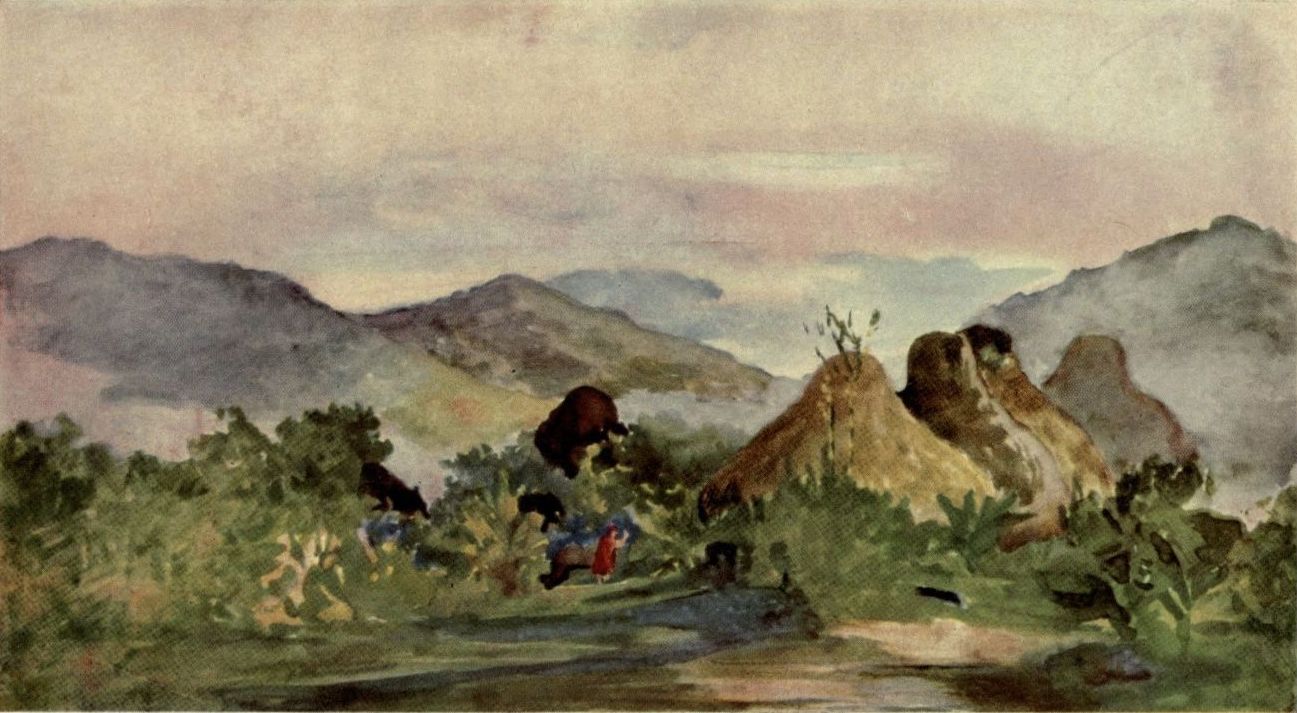
on his hind quarters and pushed himself down on his forepaws. The bare feet of our native companions and their powerful legs carried them along with relative ease, and when they helped me, I was carried along for a little while at a great rate; slipping of course, but balanced and getting on as if on skates.
We were often on the edge of the precipice and at length stopped at a little open spot, where on some black rocks that edge it, we stopped for a time and looked upon the deep valley, whose opposite side was different in character from what we had travelled in. We were now on the dry side of the island (a relative term), and the look of the opposite mountain was like that of the hills of Hawaii, or of Tahiti; a curious golden grey-green, intensified wherever the innumerable hollows gave protection and greater damp to trees and bushes.
We were on the slope of a tongue or ridge between two valleys, but it was only quite late that the clouds lifted enough from the tops of hills to let us catch a view of the valley we were going to, of the course of the brilliant little river and further off, of high points of blue that enclosed the sea.
Meanwhile we halted for lunch at a little level park-like space, and walked to its edge with the hope that the clouds would break, but there was nothing but a mass of white vapour in front of us that filled the valleys, rose above us, and broke against the crests that we had left, or beat around, leaving blue sky above us in deceiving patches. There, while we rested, the shikari brought in, with doves, two long-tailed parrots, the one green with green and yellow breast, the other blue and red and green; the latter feeds on fruits and is not obnoxious to the natives; the green is more predaceous of their gardens. This was my first sight of the killed parrots and with the soft grey of the doves they made a brilliant and gay mat upon the green grass.
I picked out a few feathers to send to you with this, wishing that I could also send the impression of the scene, with all these groups of browns and blacks about us, and the cloudy landscape above.
Later in the afternoon, after having waited for a sight of the great view in vain, we dropped down again through the same terrible woods, and reached in the early evening the little village of Waikumbukumbu, the last of the mountain villages, whence we should find a made road to the coast. The name Waikumbukumbu means seething waters, and describes with exaggeration the look of the little gorge in which its site is chosen.