SAMOA
Reading edition
Off the island of Tutuila, on Board the Cutter Carrying Mail, Tuesday, Oct. 7, 1890 (Samoan Time).
The morning looked rainy with the contrary northwest wind that we had carried with us below the equator, when the shape of the little cutter that was to take us showed between the outstanding rocks of the coast of Tutuila. As the big steamer slowed up, a few native boats came out to meet it, manned with men paddling and singing in concert, some of them crowned with leaves, and wearing garlands about their necks, their naked bodies and arms making an indescribable red colour against the blue of the sea, which was as deep under this cloudy sky, but not so brilliant as under yesterday’s sun. They came on board, some plunging right into the sea on their way to the companion ladder, bringing fruit and curiosities for sale. But our time had come; and we could only give a glance at the splendid nakedness of the savages adorned by fine tattooing that looked like silk, and with waist drapery of brilliant patterns. We dropped into the dancing boat that waited for us and scrambled into the little cutter or schooner some thirty feet long, not very skilfully managed, that was to
FAYAWAY SAILS HER BOAT. SAMOA
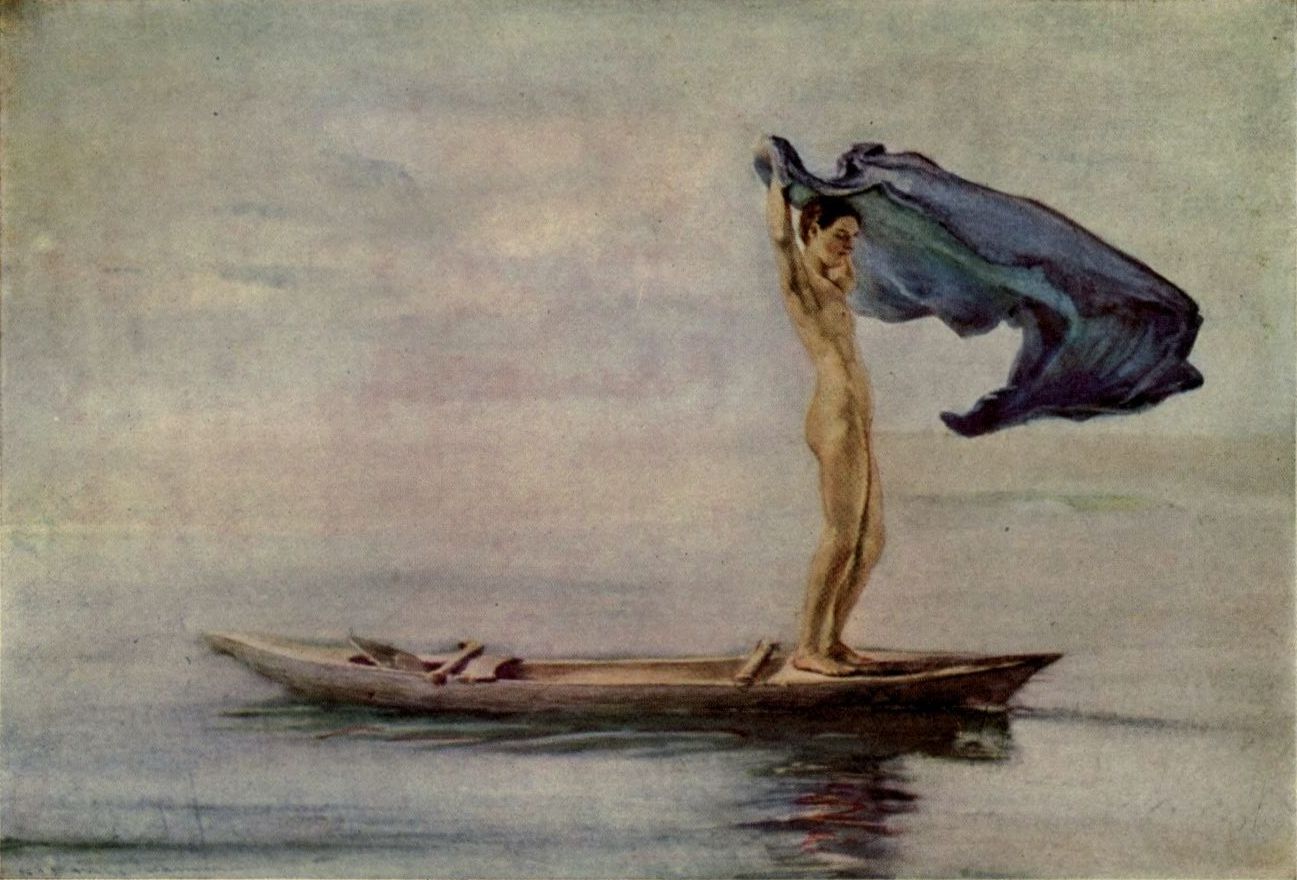
take us sixty miles against the wind to Apia. A few minutes, and the steamer was far away; and we saw the boats of the savages make a red fringe of men on the waves that outlined the horizon—a new and strange sensation, a realizing of the old pictures in books of travel and the child traditions of Robinson Crusoe.
Our crew was made up of the captain, a brown man from other and far-away islands, and two blacks, former cannibals from Solomon Islands, with gentle faces and manners, and rings of ivory in their noses. Our captain spoke of hurry, and used strange words not clear to understand in his curious lingo; but after an hour or so of heavy rain he announced his intention to beat in again and wait for some change of wind. And so we ran into a little harbour high with mountains, all wooded as if with green plumage, cornered by a high rock standing far out, on which stood out, like great feathers, a few cocoa-palms. Palms fringed the shore with shade. A blue-green sea ran into a thin line of breakers—like one of the places we have always read of in “Robinson Crusoe” and similar travellers: “A little cove with the surf running in, and a great swell on the shore.” Our cutter was anchored; then, as we declined to remain on board, either in the rain or in the impossible little cabin about eight feet long, we were taken into the boat, which was skilfully piloted through an opening in the inside reef; and, the surf being high, we were carried to shore on the backs of two handsome fellows whose canoe had come alongside. We walked up to the church, a curious long, low building behind the cocoa-palms; all empty, with thatched roofs and walls of coral cement; the doorway open, with two stones to block out casual straying pigs, I suppose. Inside I saw a long wooden trough, blocked out of a tree. I did not know that this was the old war-drum of pagan times, now used for the Christian bell.
Behind the church, a few yards off, was our destination—a Samoan “grass-house,” the guest-house of the village, as I know now. It was thatched with sugar-cane leaves, was elliptical, with a turtle-backed roof, supported by pillars all around, and by three central pillars that were connected by curved beams, from which hung cocoanut cups and water-bottles, or which supported rolls of painted bark cloth. The pebble floor showed at places not covered with the mats, as well as near the centre pillars, where a fire still smoked. Most of the screens of matting, which make the only wall between the pillars, were down, making a gentle shade, in which one woman was sleeping; another, on the opposite side to us, her back turned and naked to the waist, was working at large folds of bark cloth. The women rose from this occupation, and offered their hands, saying, “alofa!”[1] A younger woman was lying sick, her wrapped-up head on the Samoan pillow of a long bamboo, supported at either end, so as to free it from the ground.
With the same “alofa” came an elegant young creature, perhaps some sixteen years old, wearing a gay waist drapery of flowered pattern, red, yellow, and purple—with a loose upper garment or chemise of red and violet—open at the sides. Then another, short and strong, with heavy but handsome arms and legs, and with bleared eyes. And we sat down on the mats, the girls cross-legged, and looked at each other while the captain talked, I know not what of.
As I changed my seat and sat near the entrance with my back against the pillars, which is the Samoan fashion, though I did not know it, another tall creature entered, and giving us her hand with the “alofa” sat down against another pillar—also the proper dignified Samoan way. We did not notice her much; she was quieter, less pretty than the pretty one, with a longer face, a nose more curved at the end, a longer upper lip, and more quietly dressed in the same way. Then entered another with a disk-shaped face, her hair all plastered white with the coral lime they use to redden the hair, and dressed as the others, with the same bare arms and legs. She was heavy and strong below, and less developed above, with the same splendid walk and swing, the same beauty of the setting of the head on the neck.
And we drank cocoanut milk, while kava was being prepared for us in an enchantment of movement and gesture, that I had just begun to feel, as if these people had cultivated art in movement and personal gesture, because they had no other plastic expression.
The movements of the two girls preparing the stuff would have made Carmencita’s swaying appear conventional; so, perhaps, angels and divinities, when they helped mortals in the kitchen and household. As the uglier girl scraped the root into the four-legged wooden bowl set between the two, in front of us, and before the central pillars, she moved her hand and body to a rhythm distinctly timed; and when her exquisite companion took it up, and, wetting the scraped root from double cocoanut shells, that hung behind her, moved her arms around in the bowl and wiped its rim, and frothed the mass with a long wisp of leafy filaments, she tossed the wet bunch to her companion, as if finishing some long cadence of a music that we could not hear, too slow to be played or sung, too long for anything but the muscles of the body to render. And she who received it, squeezed it out with a gesture fine enough for Mrs. Siddons or Mademoiselle Georges. I use these names of the stage, of which I have no fixed idea; those that I have seen could never have given, even in inspired moments of passion, such a sinuous long line to arm and hand. Then in a similar repetition of conventional attitudes the cups were presented to us, one after the other, with a great under-sweep of the full-stretched arm, and we drank the curious drink, which leaves the taste filled with an aroma not unlike the general aromatic odour of all around us, of flowers and of shrubs. For all was clean and dry about us, house and surroundings and crowded people, at least to the senses that smell.
In the slow hypnotism produced by mutual curiosity, by gazing with attention all centred on movement, while pretending to notice all the social matters as they went on about us, I could not disentangle myself from the girl who had bewitched us; and as she sat clasping her elbows, with her legs crossed in her lap, like the images of Japanese Kwannon and of Indian goddesses, I tried to copy a few lines. But the original ones flowed out again like water, before I could fix them. My model was conscious of the attention she called up, and from that moment her eyes always met ours, with a flirting smile, half of encouragement, half of shyness.
And now the tall girl that sat beside me, with the quiet face and unquiet eyebrows, put out her hand languidly to reach for my sketch-book. She was the “virgin of the village”—doubly important by being the old chief’s daughter, and elected to this representative position, which entails, at least, the inconvenience of her being always watched, guided, and intimately investigated by the matrons appointed thereto. The lines of my sketch, that would have puzzled the ordinary amateur, were clear to her: “See,” she said, “here is Sifá, clasping her elbows, but her face is not made. Draw me,” and she moved away the hanging mats that obscured the light. The sketch I made was bad, representing to my mind a European with strange features. I don’t know what she thought of it, but she recognized the chemise with ruffles on edges, that covered her shoulders, and made the motion of lifting it away, which I was slow to understand. Her eyebrows moved with some question for which I had no English in my mind. At last the word misonari? as she looked toward Adams, explained what was meant; I said “no,” and looked approval. She rose, passed into the shade, and sat again before me, her upper garment replaced by a long, heavy garland of leaves and the aromatic square-sided fruit of the pandanus, that partly covered her firm young breast, and lay in her lap against the folds of the bent waist. But my drawing was scarcely better for all this, and I gave it to her, with the feeling that what made it bad for me, its resemblance to a European, might give it value for her. All the time the temptation was strong to treat this child of another civilization as a little princess. She had the slow manner, the slightly disdainful look, the appearance of knowing the value of her sayings and doings that make our necessary ideal of responsibility. What though the Princess puffed at my pipe, meanwhile having secured a cigar, less cared for, behind her pretty ear; what though she pressed two long, slender fingers against her lips, and spat through them, according to some native elegance, she knew that she was a personage and never was familiar, even when she pressed my arm and shoulder, and said, “alofa oi,” “I like you.” Her forehead was high and gently sloping, her eyebrows thin and movable, the eye looked gently and firmly and directly; the nose was a little curved at the heavy end, the upper lip a little long (and pulling on the pipe, if she used it, would lengthen it later yet more), the neck and back of the head had the same beauty of line and setting that I had seen in Hawaii, and her shoulders, and breast, and strong, lithe arms would have delighted a sculptor. She wore her hair gathered up by a European comb, and in front a forelock reddened to the tone of her face, with the coral lime they used. Her legs were strong and fine and her feet only as large as one could expect, with the soles hardened by use over stones and coral.
But she was not the pretty one; her sister, Sifá, was that. The charm of the older one, “the virgin of the village,” was in this incomparable savage dignity, that gave a formality to our visit. What to us was an amusement was to her evidently one of the necessities of hospitality, while Sifá could not move about or look without a ripple of laughter that undulated through her entire person. Occasionally, however, our “chiefess” looked at me with a gentle smile, and said “alofa!” and by and by, after showing me that she could write, and doing so in my album, (where she dated her inscription Oketopa, our October), she gave me a ring with her name Uatea—or Watea as she wrote it. She partook of lunch, eating after us (along with the captain who appeared again on time), and she refused to taste of some apples we had until we had some of her own fruit, all I suppose according to some proprieties well defined. Then Sifá, her sister, met with a little adventure in unpacking our food for us. The captain of the steamer had given us a block of ice on our leaving, telling us that it was the last we should see in this part of the world, and that it might comfort us during our long, hot sail under the tropical sun. In unrolling it, and taking it up, Sifá dropped it with a cry of “afi!”—“fire!” and for a few moments we struggled in an unknown tongue to explain what it might be. But I took it for granted that she must have had some Bible explanation of the places where the Bible comes from—that is to say, England and Scotland; hence about winter and bad weather, and perhaps snow and ice.
While the family arranged for their meal we took a walk, “now and again,” as our captain expressed it—almost all the words he knew. We walked across what appeared to be the village green—a space of grass neatly cared for—edged by huts and trees, the palms thickening in the distance and hiding the sudden and close slope of the mountain right above us. Bread-fruit trees were planted here and there near the houses, the large leaves making a heavy green pattern against the innumerable shades of green, the spotted trunks were dark; even the cocoanut trees were only white by the sea. We passed a tomb, of a moundlike shape, one lengthened cube placed upon another, and the upper surfaces sloping to an edge like some of the early sarcophagi or Italian tombs—a shape as simple and elegant as one could wish in such an ideal landscape. I shall have to find out if this most typical shape has originated with them, or has come from some foreign influence. However that may be, it made another classical note. Had Ulysses in his wanderings left some companion here, some such monument might have well marked the tomb of a Greek. There it was, all covered with lichen; and another newer one, made also of coral mortar, still white, near trees, and by former homes, in this little shady “agora.” As we passed into the path that seemed to run up the hill, young men went by with wreaths on their heads, draped to the waist, like the statues of the gods of the family of Jove; their wide shoulders and strong, smooth arms, and long back-muscles or great pectorals shining like red bronze. All this strength was smooth; the muscles of the younger men softened and passed into one another as in the modelling of a Greek statue. As with the girls we had just left, no rudeness of hair marred the ruddy surfaces, recalling all the more the ideal statues. Occasionally the hair reddened or whitened, and the drapery of the native bark cloth, of a brown ochre colour, not unlike the flesh, recalled still more the look of a Greek clay image with its colour and gilding broken by time. Never in any case was there a bit of colour that might rightly be called barbaric; the patterns might be European, but no one could have chosen them better, for use with great surfaces of flesh. If all this does not tell you that there was no nakedness—that we only had the nude before us—I shall not have given you these details properly. Evidently all was according to order and custom; the proportion of covering, the manner of catching the drapery, and the arrangement of folds according to some meaning well defined by ancient usage.
Children played about in the open space; they were then at a game of marbles; when we returned, this had turned to some kind of blind-man’s-buff; there was no roughness, only a good deal of soft laughter; one youngster, draped to the chest like a Greek orator, too big for the children, too young for the men, leaned upon a long staff and looked on gravely, exactly like the figures on the Greek vases, or the frieze of the Parthenon.
We walked along into the forest, in the silence of noonday, but the abruptness and slipperiness of the path as it rose rapidly to walls of wet rock, stopped our feet. From the intricate tangle of green, we saw the amethyst sea, and the white line of sounding surf cutting through the sloping pillars of the cocoanuts, that made a mall along the shore; and over on the other side of the narrow harbour, the great high green wall of the mountain, warm in the sun, and its fringe of cocoanut grove, and the few huts hidden within it, all softened below by the haze blown up from the breakers. All made a picture, not too large to be taken in at a glance; the reality of the pictures of savage lands, in our school books, filled in with infinite details. From dark interiors of huts, as we returned, came gentle greetings of “alofa.” Awoki, our Japanese servant, had remained with our hosts, had been fed with bread-fruit and cocoanut milk, and was busy writing out, under the direction of the black mate, certain names and words of the language; for the mate could be understood, while the captain
had only one certain phrase, “now and again” with which he punctuated everything loudly, so that I could barely understand him. The mate had his own punctuation of frightful oaths and damnatory epithets, evidently mere adornments of speech, for he was most gentle, a kindly and good-natured cannibal, contrariwise to the surly captain; so that I was glad that he had ventured up from the cutter. The girls had taken kindly to the other brown skin, my servant, and were busy helping him make up his list of words, whose sounds he wrote in Japanese, to my later confusion, when he passed his dictionary to me. (Yet curiously enough, in this first half day, we learned full a hundred words—almost all that I have retained.) So we sat down and rested; the flies, attracted by the bread-fruit, and occasional mosquitoes hovered about the openings; ants crawled about on us—my princess had occasionally on her feet a black bunch of flies, which she brushed away slowly—evidently she did not feel them much—their skins are hard—“now and again,” as the captain might say, a woman passed the openings of the hut, bare to the waist, holding a child against her hip. Soon one of the girls, tired of cross-leggedness, stretched her feet politely under a mat, pulled up for the purpose (for it is not polite to sit otherwise than cross-legged).
The older women slept on the Samoan pillows at the further side, closed in by palm curtains. All but one—who had worked all the time, her great brown back turned toward us—engaged in smoothing and finishing a piece of what we white men call tappa. “Siapu” I think they call it—the inner bark of the paper mulberry, hammered out with a mallet, which in so many of the islands has been long their cloth. She never stirred from her work; as long as the light held, I saw before me this upright form, strong as a man’s, smooth and round, and the quiet motion of the arms in the shadow, made deeper by the sunlight on our side. Later, another shower made us shut down more curtains, but we were safe and comfortable, protected from sun and rain alike, in this most comfortable and airy housing. Then Sifá began beating her thighs and moving her shoulders coquettishly to her humming of a tune, and I thought that I recognized the siva, the seated dance of the Samoans, about which I had been told in Hawaii. Such a graceful creature could do nothing that was not a picture, but there was a promise of something more, so that we applauded and said lelei, “beautiful,” with the hope of a full performance.
But the Princess said nothing; she smoked more and more, as every one joined her, so that I foresaw that our small supply of cigars and tobacco was doomed, especially as other damsels entered, and made more ravages; girls more or less good looking, mostly heavier, one of them called “Tuvale,” who knew bits and parcels of English such as pilisi du na iti mi, pilisi esikusi mi, “Please do not eat me,” “Please excuse me.” And one of the largest, leaning affectionately against my shoulder, absorbed my silk handkerchief, and tied it around her neck—saying to me, in her language, “Look how pretty it is!” Our matches and match-boxes had long ago disappeared—most little things had left my pockets, but had been replaced. In every way my fair and strong companions seemed inclined to dispute an apparent preference for Uatea and Sifá. Good-natured girls all (but one—the thief of handerchiefs—who seemed to me jealous)—and we were certainly beamed upon, as I never expect to be again. More rain outside brought on the evening, as we took our last meal; the “chiefess” and the captain, who again appeared sullenly out of the dark, eating after us; the captain now, with an apology to us, appeared naked to the waist, a big heavy mass of bronze, covered below with a gorgeous drapery of purple, and yellow, and red. We lay more and more at ease, stretched out, the girls prone, and occasionally giving one of us an affectionate pat; all but Uatea who still preserved her usual reserve, and even tried hard to substitute another ring for the one she had given me—as if her name on it was too much for a first acquaintance. And occasionally in following her face, the only one that seemed capable of complicated ideas, I asked myself whether she was asking herself what equivalents her hospitality would receive: for instinct told me that through her our gifts or our payments should be made; even if it were all to go to others according to barbaric custom. So seeing her rather laden with things, and having had one experience of the excellence of a white silk handkerchief, I offered her another, and wrote her name in the corner, to see her thank me in her usual condescending way, and then toss it over to the old woman who appeared occasionally—to my mind, her adviser and guardian, for from time to time, “now and again,” she crept up, between us, like a chaperon or duenna, to see that all was proper.
Then many of our girls disappeared with Sifá, whom we missed at the moment and asked for over and over again. A light was brought and set down upon the matting. Uatea slipped out between the hanging screens and the pillar behind me, and slipped back again, rid of her upper garment with a sort of poncho or strip of cloth with opening for head, patterned in lozenges of black, white, and red, that hung down her back and chest, leaving arms and shoulders bare, and the sides of her body, so that as she bent, the soft line that joins the breast to the underarm, showed under the heavy folds. Then, in came our missing pet, Sifá, with Tuvále and two others, into the penumbra of the lamp. They were naked to the waist; over their tucked-up drapery hung brilliant leaf-strips of light green, streaked with red; a few leaves girdled the ankle; around Sifá’s neck, over her beautiful bosom, hung a long, narrow garland of leaves, and on the others garlands of red fruit or long rows of beads interlaced: every head was wreathed with green and red leaves, and all and everything, leaves, brown flesh, glistened with perfumed oil. From the small focus of the lamp, the light struck on the surface of the leaves as upon some delicate fairy tinsel, and upon the forms of the girls as if upon red bronze waxed. But no bronze has ever been movable, and the perpetual ripple of light over every fold, muscle, and dimple was the most complete theatrical lighting I have ever seen. Even in the dark, streaks of light lit up the forms and revealed every delicacy of motion.
So those lovers of form, the Greeks, must have looked, anointed and crowned with garlands, and the so-called dance that we saw might not have been misplaced far back in some classical antiquity. The girls sat in a row before us, grave and collected, their beautiful legs curled upon the lap as in East
SIFÁ DANCING THE SITTING SIVA
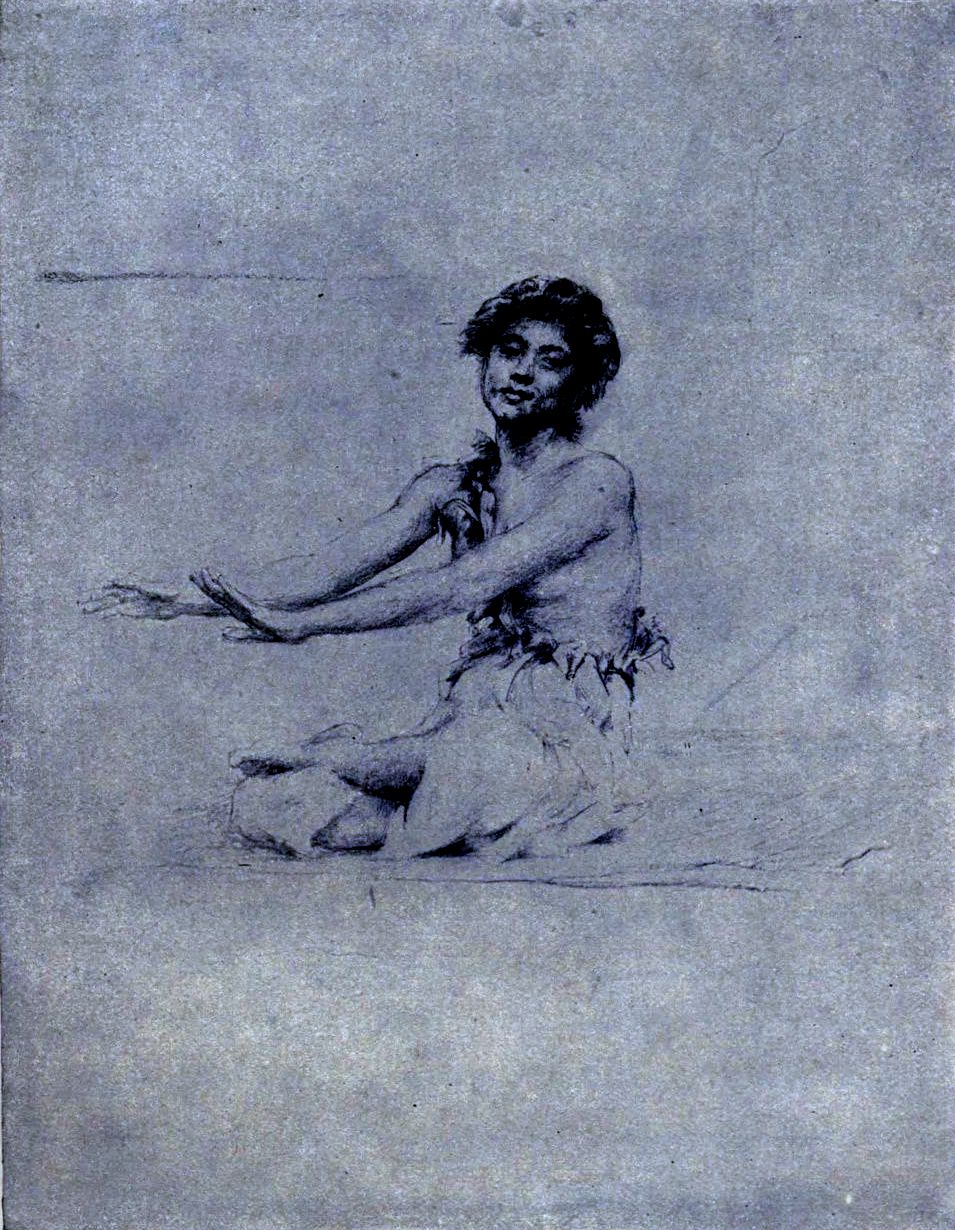
Indian sculptures; and Sifá began a curious chant. As all sang with her together, they moved their arms in various ways to the cadence and in explanation of the song; and with the arms, now the waist and shoulders, now the entire body, even to the feet, rising apparently upon the thighs to the time of the music. Indeed, Sifá spoke with her whole tremulous body undulating to the fingers—all in a rhythm, as the sea runs up and down on the beach, and is never at rest, but seems to obey one general line of curve. So she, and the others, turned to one side and stretched out their arms, or crossed them, and passed them under the armpit and pressed each other’s shoulders, and lifted fingers in some sort of tale, and made gestures evident of meaning, or obscure, and swayed and turned; and, most beautiful of all, stretched out long arms upon the mats, as if swimming upon their sides, while all the time the slender waist swayed, and the legs and thighs followed the rhythm through their muscles, without being displaced.
I cannot describe it any better; of what use is it to say that it was beautiful, and extraordinary, and that no motion of a western dancer but would seem stiff beside such an ownership of the body? Merely as motion, it must have been beautiful, for the fourth woman was old and not beautiful, but she melted into the others, so that one only saw, as it were, the lovely form of Sifá repeated by poorer reflections of her motion in lesser light.
Meanwhile Uatea sat to one side of them, near me, and in front, one leg stretched out, the other tucked under, beating time with a stick, disdainful of it all, as poorly done, perhaps incorrectly, “lelei,” “beautiful,” I said—“leanga,” she replied, with a curl of her lip, hardly looking at the girls. Perhaps she should have led in person, as the official maiden—and I still felt that something was not right. The girls rose and came to sit beside us, while Uatea disappeared in the darkness, behind the three masts crossed with curved beams, that supported the centre of the roof. These, with the shining, polished cocoanut bottles, filled with water, that hung from the beams, and the rolls of mats and bark cloth which were placed upon them as upon shelves, had served as a background or scenery to our theatre. Along all the edges of the big house, in the darkness, were other visitors, and guests, small children, boys and girls, neighbours, and even the two gentle blackies, from Cannibal and Head Hunting isles, with white rings in their noses, that made our crew. But I saw none of the splendid young men, who, crowned with garlands, girdled with leaves like the Fauns and Sylvans of the Greek play, had startled me over and over again, during the day, with a great wonder that no one had told me of a rustic Greece still alive somewhere, and still to be looked at. So that the old statues and frescoes were no conventionality—and the
THE FLUTE PLAYER. SAMOA
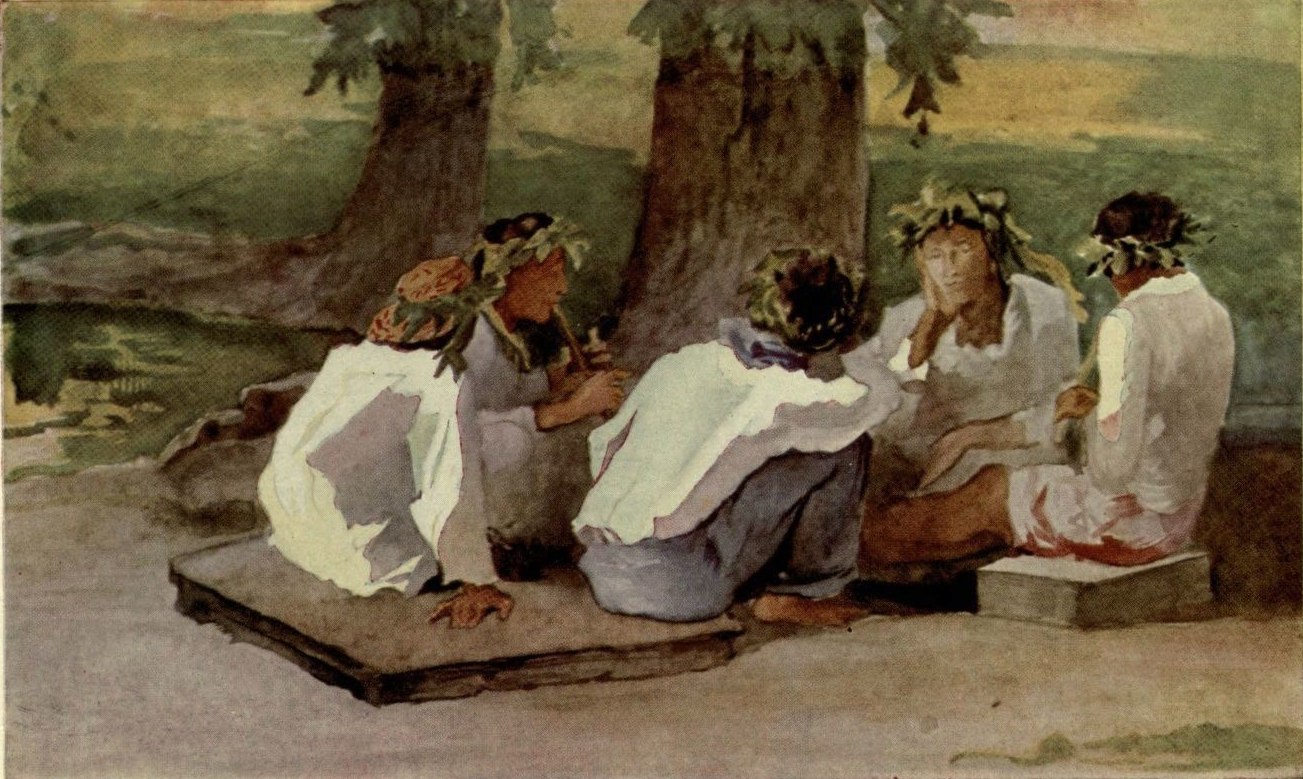
sailor, the missionary, and the beachcomber, were witnesses of things that they did not see, because they had not read. And if one reads, does he care to-day? Had I only known, years ago. Even now, when it is too late, the memory of all that beauty which we call Greece, the one beauty which is to outlast all that is alive, comes over me like a wave of mist, softening and putting far away into fairyland all that I have been looking at. From out of the darkness, as if from out of the shade of antiquity, Uatea stepped out before us, naked to the waist, crowned with leafage, garlands around her hips, a long staff like a sceptre in her hand, and danced some heroic dance, against another girl, smaller than she, as her adversary; it looked a mimicry of combat; the tall form, the commanding gestures, the disdainful virginity of the village Diana, challenging her companion to battle; something as beautiful and more heroic than the Bacchanals that are enrolled on the Greek vases. The girl was in her true element and meaning, more than she could have been in the previous sivá dance; only an occasional touching of the knees together detracted from the beauty of the movements. I could scarcely notice the other dancer, nor the third one, an old woman (who represented, apparently, a suppliant), for fear of losing a parcel of a picture that I shall never see again, certainly never with such freshness of impression.
And when Uatea reappeared, clad again, and puffed at my pipe before passing it to me, she much less disdainfully assured me that all her dancing was leanga (bad). And she softened a little, and seemed distressed about our quarrel about her ring, taking off all her rings and throwing them away to her guardian matron, perhaps for fear of being reproved for giving too much for too little, for we had given as yet but little—only cigars, tobacco, and trifles; and I asked myself whether the dramatic artist was counting up her possible gains, as others do. Meanwhile, the other girls lay close to us, in the confidence of good-nature; all anxious to make the best impression, a curious example of the wilful charming of woman—and Sifá talked and smiled, and moved, or rather floated, in her place like a maiden siren flirting. Many confidences were exchanged without either side understanding one word said. Each girl wrote something in Awoki’s note-book, or helped our making a dictionary. Sifá even summing up figures to prove her possession of the three R’s, a confusing addition of accomplishments to the dancing and conventionalities we had seen. But I am told that all read and write, with no book but the Bible. Then between the curtains of mats Uatea disappeared contrary to what I supposed etiquette, but, of course, I knew nothing. The others bade us good-night, not without begging one of us to share their hut, and we slipped out into the dark, while the mats were arranged for our rest. The storm clouds still covered the sky—only a few stems of the cocoanut glistened, and the white bar of the surf made a hard line in the shadow. Some vague, light forms were those of sitters beneath the trees whispering, or talking low, for all through our day there had been no voices raised except our own, or the surly growl of the captain—or the chant that had accompanied the dances; all other talk had been soft and flowing, with low voices, almost inaudible to us when distant, adding again to the peace and softening charm.
We lay down on the mats with our heads toward the centrepost; a large mosquito bar of thin bark cloth, big enough for a small room, was let down upon us, the light of the lamp shining through it, and draped in my Japanese kimono, I fell asleep, in spite of the few mosquitoes imprisoned with us. No noise from the rest of the house had arisen, all was still; we were as much isolated as if we had been in a built-up room. Late or early, I think I heard the snore of the captain, but all is empty in my mind until I recollect feeling the morning light and saw some shadows pass. As I stepped out, I saw Sifá move out, stretching her arms, as she moved toward a little path. Then issued the captain, with a formidable yawn, and looked at the sky for presages of weather, and took the same little path, I suppose toward the bathing pool, or spring, or rivulet of fresh water, that might be in the hollow.
And there came up to the house Uatea, the “Chiefess,” looking just the same, and appeared to understand that we were for a bath, as she made the motions of washing her chest. We went to the sea, finding no good place for a bath—it was evidently far off—and I take it that they bathe in fresh water—the luxury of hot climates. For they all seemed to be extremely clean and neat, from the men whom I had first seen at sea, to the girls with limbs rubbed with cocoanut-oil and smelling of the aromatic fruit (the pandanus) that their garlands were made of. Our bath was not a full success—we dared not go out into the surf that rolled turbid waves upon the deep, black volcanic sand of the beach; but the water was warm and soothing, and as I began putting on my clothes, a tall girl of the preceding night came up and sat down beside me on the rock, with an evident seeking for an interview. Notwithstanding my unaccustomed embarrassment, I managed to make out that she was uncertain and perplexed as to the legality of her capture of my handkerchief the night before, and though I told her to keep it, she was still doubtful. Uatea had had one; was she to have the same as Uatea? At last she left me, reassured—I had no more interest—and I saw her go along the shore passing far off the better bathing
UATEA DANCING THE SITTING SIVA
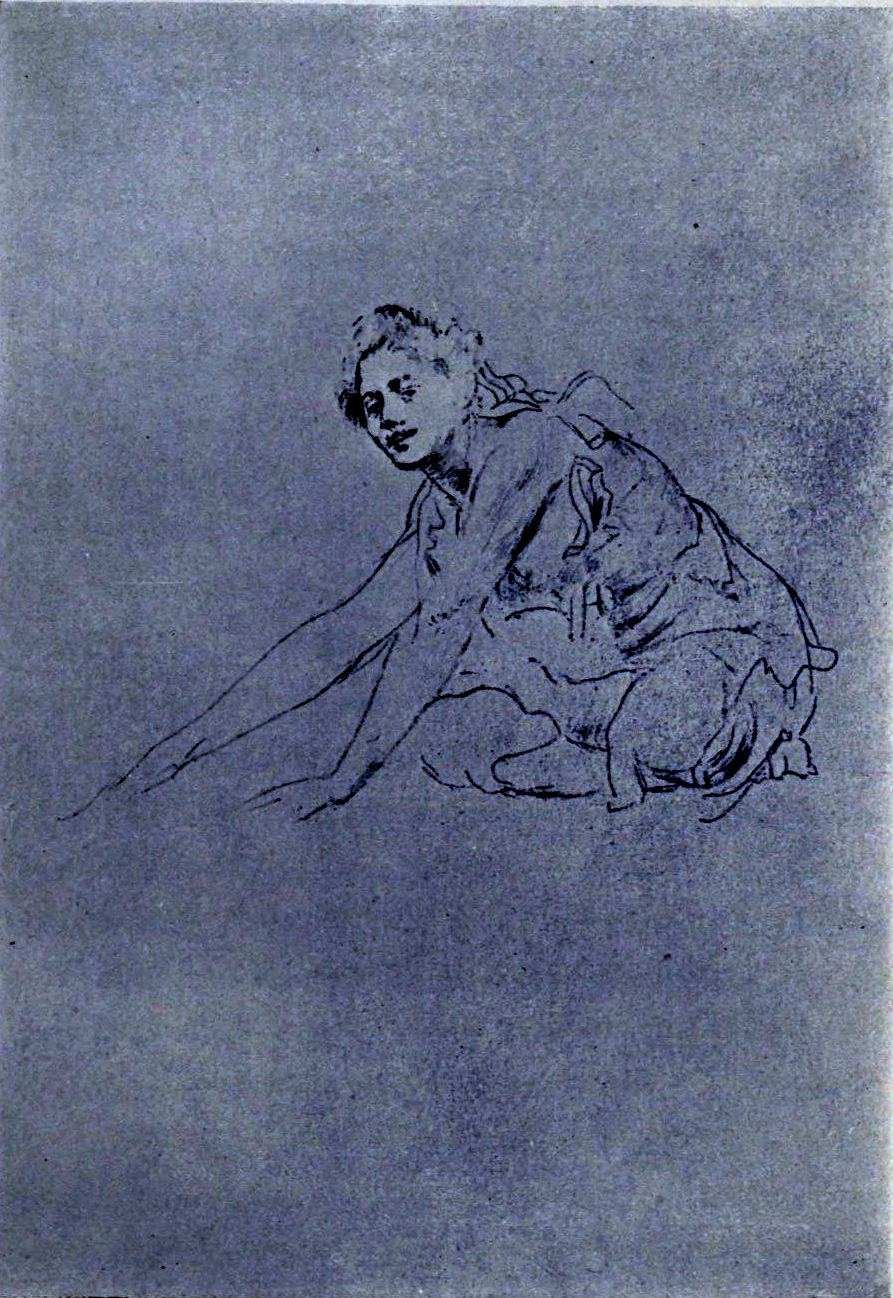
spot of fresh water, and then disappearing behind distant palms. Breakfast was ready when we reappeared; after us Uatea ate and drank our tea, and wondered at our use of “tea-balls.” The captain explained that there might be wind enough “now and again,” and that any moment ought to see us off. Sifá and Tuvále gathered about Adams; I smoked my last cigar, for all with our other tobacco were gone—while Uatea asked coldly what I had done with the ring she gave me, as it was no longer on my finger. More and more she withdrew into herself, more and more the “Chiefess” looked as if expecting or anxious or troubled, as to whether an equivalent would be serious enough. But we gave the largest sum that the captain dared to hint at—anything would have seemed cheap. The night before I could understand the throwing of jewels; of money, of any reward to express thankful admiration. The “Chiefess” extended a languid hand—her eyebrows rose, a short “f’tai” dropped, as if obligatory from her lips—(the proper form I knew already was “faafe’tai”)—she gave us her hand with a frigid “alofa,” and with Sifá and Tuvále lingering, we walked to our boat. Long after we had set sail we could see them wave their drapery as good-bye. Far off, along the beach, from the hut of the tall girl-thief, my own handkerchief was waved—but even with the glass I saw no more of Uatea.
Peace to thee, O soul of the “virgin of the village,” if I have made thee but a thrifty prima donna, or like the King Solomon of Djami, the Persian poet, caring only for realities that pay—it is the part of those born to be rulers.
And now we had pulled out of the breakers, through the narrowest of openings, and were on board the little schooner; the great blue sapphire waves lifted us and sank us, and came up against the blue horizon, or against the tall green cliffs; and once more we saw, in the hollow of the sea, or lifted against the sky, the native boat pushed on by rhythmic paddles, making a red line of naked men against the blue of the sea or the blue of the sky. We have been four hours and a half beating out of this little cove, and have just rounded the isolated rock of the cape, of which I send you a sketch. If I could only send you the colour!—blue and green—a little red and black in the rocks—the white and violet haze of the surf; all as if elementary, but in a tone that no painter has yet attempted, and that no painter that I know of would be sure of; the blue and green that belongs to the classics; that is painted in lines of Homer; that Titian guessed at, once, under a darker sky; and far off the long sway and cadence of the surf like the movement of ancient verse—the music of the Odyssey. We are off some little village on the shore; the boat has gone to get other passengers, while I try to finish this account of our first day on land in the South Seas, and to make it live for you by long accumulation of detail. If, through it all, you can gather my impression, can see something of an old beauty, always known, in these new pictures, you will understand why the Greek Homer is in my mind; all Greece, the poetry of form and colour that comes from her, as well as her habits; just as the Samoan youngster who rose shining from the sea to meet us, all brown and red, with a red hibiscus fastened in his hair by a grass knot as beautiful as any carved ornament, was the Bacchus of Tintoretto’s picture, making offering to Ariadne. The good people of the steamer may not have seen it, nor the big white English girl who bought some trifle from him—but it is all here for me—and there will soon come a day when even for those who care, it will be no more; when nowhere on earth or at sea will there be any living proof that Greek art is not all the invention of the poet—the mere refuge of the artist in his disdain of the ugly in life. What I have just seen is already to me almost a dream. So I turn to my Japanese, Awoki, and ask him—“It was like the studio, Awoki, was it not? but all fine; no need of posing?” And Awoki says “Yes,” whether he understands me or not, and I think of you and of the enclosed studio life that tries to make a little momentary visitation of this reality.
The fitness and close relation of all I have seen makes a something like what we strive to get through art, and my mind turns toward the old question, “How does what we call art begin?” These people make little; the house, the elementary patches upon their bark cloth, the choice of a fine form for tombs, is all the art that is exterior of themselves and of their movements, into which last they have put the feeling for completeness and relation, that makes the love of art.
Is it necessary for going further that some one should be born, to whom, gradually, an unwillingness to assume the responsibility of action, which the ruler and the priest take willingly, should grow into a dislike of the injustice of power, and a distrust of the truthfulness of creeds, so that he must make a world for himself, unstained and free from guilt or guile? I have begun to imagine for myself some such soul, born in early communities, who might have lived long ago anywhere and have been the hero of some such primitive obscure conflict; but I can see tossing on blue waves, the boat that brings from the shore our new companions, Lieutenant Parker and Consul-General Sewall, who have been on a visit to the harbour of Pango Pango—and in a few minutes they and their white coats will be aboard.
You will by this time wish to know how we are living. We are settled definitely, for headquarters, at Vaiala, a little way from Apia, from which a little river separates our part of the land. Further on, another small river closes out the territory, and separates us from Apia.
The small river that separates us from the beginnings of the village capital, Apia, is spanned by a little bridge—little because consisting of a few planks, and a handrail to one side, but otherwise a very long gangway. This I believe is kept in repair by the municipality of Apia, and is probably the cause of much discussion in the way of spending money. Occasionally it is washed away, and then we swim our horses across, to the discomfort of my best yellow boots, which I feel are a distinctive mark in my visits to people in Apia. At times the municipality provides a ferry-boat. This so far has been manned by one of those convicts who are puzzles in South Sea economics. He had been taken away from some other chores of supposed hard work. After the first day of ferrying, which was productive of various small trips, this criminal had fallen back on the customs of his country, and on that essential communism which is the basis of their actions and of much of their thinking. He had a hut erected for him, so as to rest in the shade, and there he spent most of his time consuming bananas or accidental gifts of food, and courted and caressed by village maidens, who adorned him with flowers and anointed him with cocoanut oil. Meanwhile the smaller and less important members of his family did the work of ferrying in the sun. It was all the same, he was vicariously being punished. This is the keynote of all I shall ever tell you here. There is the tendency to let not only property remain undivided, but also injury or gain. A little anecdote told me by a clergyman, who had it from a friend in Fiji, where things are still more so, gives this intellectual position. The Fiji clergyman had been shocked at a horror perpetrated by some of his parishioners. The dog of some person in a neighbouring village had been killed; some of the aggrieved had sallied forth, and meeting some person who belonged to the village guilty of holding the dog murderer, had thereupon incontinently killed him. An “old hand,” that is to say, a white man conversant with South Sea habits, explained to the clergyman the naturalness of the deed. He said—forgive the vernacular—“See here; if Jim and me gets into a fight, and Jim plunks me in the head, I don’t wait till I can get in a blow at Jim’s head: I hit him where I can.” One community had lost a dog and the other had lost a man. This is a dreadful example of the idea, and I almost regret introducing it into my description of this idyllic passage of my life. But we are on the road to Apia, which, like all white men’s places in such countries, has a taint of brutality remaining from the day of the beachcomber.
It is an orderly little place strung along what might be called a street or two, the main one of which is on the beach, and goes by that name. There are stores, a few hotels and drinking places, warehouses and residences of the consuls, and further on native residences, etc. There are churches too, and a Catholic cathedral of somewhat imposing dimensions; but the churches are those of an ugly village, and no longer have that natural look of the church by our own village of Vaiala, for instance, which has really a character not contradictory to its surroundings.
Further back and right and left all is Samoan and native. We are just by the shore, here fringed with trees and palms, and only some six feet above the inland sea of the reef that spreads right and left before us. In the few great storms that have come upon us in the night, it was not difficult to imagine the beating of the rain against the door of our sleeping house to be the first splashing of some great waves passing over with the roar of the surf outside.
From under the shadows of trees, I see canoes pass close to the shore, visible at intervals between the trees that border it; they seem, like all that happens about us, part of a theatre scene: red bodies glisten in white or coloured drapery, adorned by flowers and leafage; and songs are carried along with the stroke of the paddles, as in an ideal opera. Blue sea outside; green inside.
The little village stretches along a very short distance, apparently not made of more than a couple of dozen of huts or Samoan houses, with a double village green, here and there planted with trees and broken into and backed on the shore side by plantations of bananas.
Further back the mysterious “bush,” into which I have not yet wandered. Just outside, near the shore, and with a little garden, the Consul has built a new and commodious southern house, with enormous verandas, dropped like a piece of Europe among the native forms; there we breakfast and dine; while in the village a few yards off we have borrowed a large, comfortable hut,[2] in which we spend the day, receiving visitors, writing, or painting,[3] and at night we occupy a little building of our own European kind, with just place for our two rooms and beds. It is next to Tofae, the chief’s hut; so that we are both physically and morally under Tofae’s protection. This we insist upon; we are no strangers gadding about, we are chiefs on a visit, and we appeal to the care of our fellows responsible for us. So that doors and trunks and boxes are all open; every one is free to inspect and responsible to the
BOY IN CANOE PASSING IN FRONT OF OUR HOUSE. VAIALA, SAMOA
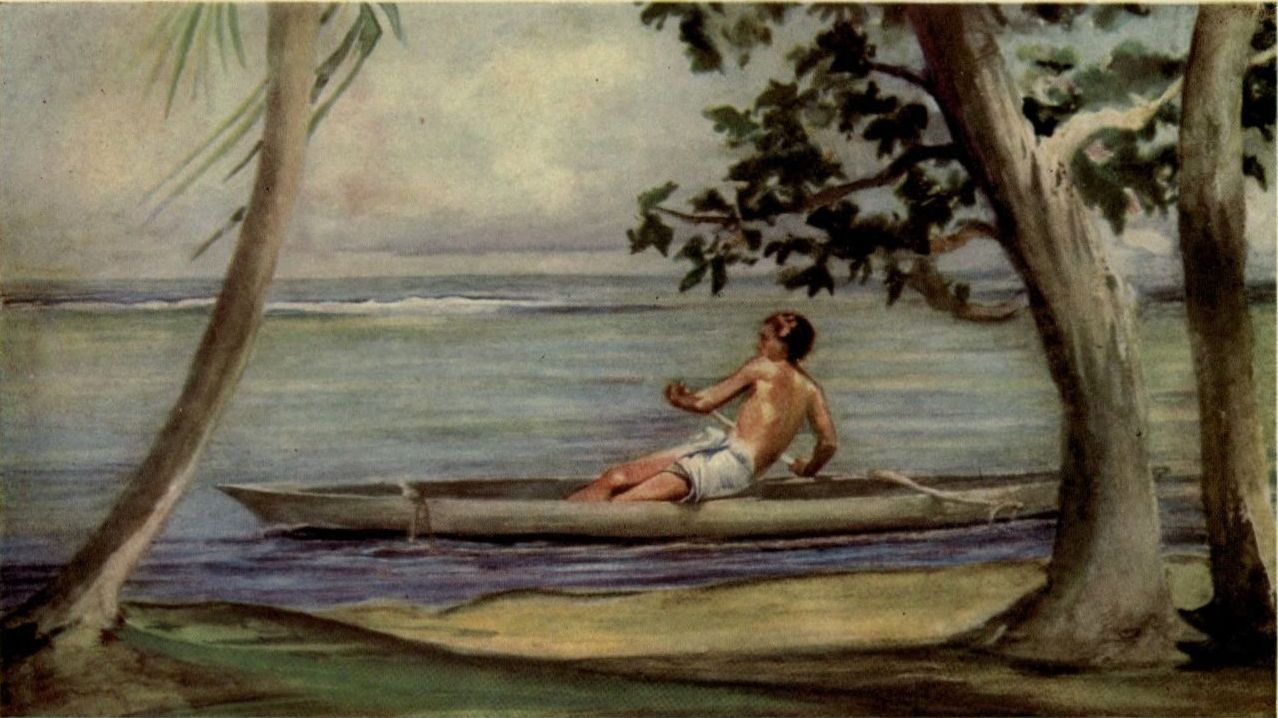
chief. Even very lately, when the criminal—the prisoner condemned for stealing the consular flag halyards—who is imprisoned by being detained within the half mile of the village, and who is under Tofae’s wardship—even when this confirmed bad man is found looking through all my property, from sketch-books to night pajamas, I feel quite safe that nothing will be missed through him. Only two silk handerchiefs have disappeared since I have been on the island, and I can’t be sure whether they were lost here or in some of our long trips by sea and land. But Tofae takes the fact to heart, and will, I know, make me some present many times more valuable, to wipe out this possible blot upon the escutcheon.
At the earliest dawn there is motion in the village that I do not hear. The soft grass, cleanly trimmed, which covers all the village space, brings no echo from bare feet. But from the very first morning on the small verandah, no bigger than a large table, I hear a patter of feet that wakens me. If I look out, one or more of the girls of the village, our nearest neighbours, is seated there in a corner, ready to bid good morning, and looking occasionally into the open window, to see if I am still abed! Sometimes their shadows, as they pass, break the half light which keeps me in a doze.
When I rise I have to get accustomed to the mild curiosity that inquires after my mode of dressing. Still, as days go on, I become less the fashion, and can go out to my bath, in my Japanese gown, without stepping over a côterie of gentle maidens. If I get up with the dawn, that slowly lights up the great spaces above the trees, I can see first some figures pushing back the mats that form the only walls of the surrounding huts, stretching their arms, then perhaps, in their simplest wraps, fading away in the uncertain light! They are going to the obligatory bath; not to the salt water in front of us, which they do not look upon as cleansing, but to pools back in the bush, or the little river further off.
With the first half-sleepy motion begins the weeding around the huts, a perpetual task carried on at all odd times. For among these savages, so far as they are not spoiled by the European, the lawn and greenery about the village are tended with extreme care. Many a time, in places that are far away and more strictly barbarous, I have been reminded of the neatest Newport lawns. This is one of the unexpected charms, one of the many things that give everything a look difficult to explain, a look of elegance in the wildness. But we must remember that these good people have always been here, that from immemorial time they have tended what seems to us accidental nature; culture and care and the tropical wild growths are constantly interchanged. That is the South Sea note.
Later on I see some of the men return from their short hour’s work at their wet patches of the taro plant, which, with the bread-fruit, represents the staples of bread and cereals both. In this kindly nature, such culture is no more than a gentle exercise. I see even the great Mataafa, the rival of the King Malietoa, and the greatest personage of all islands, returning from his daily task like any commoner, often stripped to the waist, wearing nothing but the wrap along the loins and legs, which they call the lava-lava.
After our morning coffee, made of the island bean whenever we are fortunate enough to get it, for we find it better than any brought from Java, we adjourn with the first heat of the early morning to our big Samoan hut. This is next to Mataafa’s, in the centre of the village. By this time most of our neighbours have begun to rest, and will keep steadily quiet for a large part of the day; unless they visit, or unless some special duty calls.
If we are very early, we may still find in our Samoan hut our pretty friend Fangalo, who lives with our neighbours nearer Apia, and whose simple task it is to place flowers about the tables upon which we write or paint, or upon the shelf that connects the great centre posts of the hut, where hang the cocoanut water bottles, and are placed the rolls of native cloth, or extra mats for softer resting.
Taēlē, which means bath, the gentle sister of our landlord, if I can so call him, has already seen that everything is in order, and all the mats that cover the pebble floor are properly disposed. Taēlē wishes good morning, and leaves fruit as presents and hangs the great branches of yellow or green bananas. She stays but little, even when pressed, though she is curious as to why we write so much and what we mean in general. She does not quite approve of us; we ask strange questions: we are not preachers—we are seen writing on Sundays: we are not looking for wives. We may be aitu—spirits in disguise.
Taēlē’s sweet face is always sad—exceptionally so here where good nature marks most young faces. In that she is not Samoan nor properly Polynesian. But she has gone through much. She was the Samoan wife of the former British consul, Churchward, who left her with her little boy when he was promoted to other appointments. Not that she would have gone with him, I think: the Polynesian rarely understands living anywhere else than in his islands—his own island makes the world. Here Taēlē sits on some rock-edge by the water, and looks out to the far-off sea. I see her so almost every evening.
According to true Polynesian habits, the little child has been adopted by our chief, Tofae, who is devoted to him and allows him great liberties. So that Taēlē has no practical trouble about little George, who lives Samoan way, and, a son of chiefs by birth and adoption, bullies the less important babies.
The other girls, who come in often to see us, and who are occasionally encouraged by little amenities and presents, are not at all sad. Otaota, the daughter of the preacher, who is himself of sacred descent, if I may so explain it, is not even over-bashful, to the great scandal of Taēlē, who is nothing if not Sunday school. She is willing to pose for her portrait without her upper wraps, though she is no longer the exquisite brown statue that she must have been two years ago. But Otaota is a young woman of the world, and who knows?—perhaps these strangers may be serious in their attentions.
Important people, of course, come in to see us, but more frequently in the afternoon. Of chiefs there are many about us, and Patu, Tofae’s brother, is a great chief and has been a great warrior; so that I am not surprised at his curious resemblance to General Sherman.
From all these good people my companion, and I also in a small way, obtain slowly, by driblets, the explanation of what they really are. Slowly they unfold the extraordinary differences which make their ways always misfit ours! Their social words have really no equivalent in ours; their ideas remain a puzzle to whomsoever insists upon our having a common basis to start from.
I have forgotten to describe what the Samoan hut, called the Samoan house, is like. Ours is a handsome one, not exactly the finest, but still very well built. Its plan is a long oval. Its length is not far from fifty feet; its greatest height something like twenty. It is set upon a foundation of stones, and its flooring of fine pebbles is only raised a few inches above the ground, which slopes in all directions from it. It is made of a series of high posts placed at considerable distances from each other, in the shape of an ellipse. They are connected at the top by a series of double beams, which receive great rafters running from every set of posts to the peaked centre. These rafters are connected by other great rafters and tie beams. At the centre they are supported by two or more great pillars, which at intervals are braced together. Beside these pillars, in the direction of each end of the house, are two holes in the ground; made to receive the cocoanut fire used for lighting, or for the slight warmth that is occasionally needed. Walls there are none in the true Samoan house. Mats of the cocoanut leaf hang from the cross-beams, between the posts, to the floor, or rather to the edge of large stones that make a sort of rim to the building, and serve to steady the posts and keep off the wash of the rain. In certain very elegant buildings some of these openings, instead of being filled with these movable mats that are pulled up or down for protection from light or rain, are enclosed by a fine wattling. It is a manner of limiting the numbers of entrances, which otherwise, you see, would be a little everywhere.
In such a residence as that of Mataafa, a great man, a sovereign prince and sacred personage, no one would think of entering otherwise than at some defined place.
For the furniture of our residence and that of other people, mats of different degrees of fineness are spread upon the small fine pebbles that make the floor. If we want great elegance and great comfort, we put on more and finer mats. Some of the furniture lies about; some of it consists in the Samoan pillow, a long bamboo, supported at the ends by four little sticks. There are also boxes in which clothes are put away. There are large rolls of native cloth called tappa. Some of it is made up into curtains to be used as screens and partitions. Sometimes, but not in our hut, these curtains are made into indoor tents for keeping off the mosquitoes, and, otherwise, increasing privacy. All these things are stowed away among the rafters, or upon the sticks curved like tusks, which project beyond the centre posts and serve to brace them.
For our European habits we have two tables and three chairs. Most of the day when we are idle we sit on the mats with our guests. But working is better done at the accustomed table.
Toward noontime we hear violent and savage shouts, and see through the square opening of the lifted mats three or four brown savages, with big girdles of green leaves and crowns of verdure, come running and dancing to us from Mataafa’s house, which is only a few yards away. They carry a big wooden bowl, partly filled with crushed cocoanut and arrowroot, and some big bread-fruits. They sit down on the edge of our outside stones, and proceed to break the bread-fruit, steaming hot, with great force and violence, holding it by the stem, pounding it and mashing it into the cocoanut milk. This quivering pudding, palusami, is then neatly dropped upon banana leaves, made into little packages, and tendered to us with the respects of Mataafa. Sometimes we eat, sometimes we distribute to more Samoan-minded people; but for the first few times it is very nice. I like it better than the raw fish and salt water, which is pleasant also occasionally, though apparently more suited to the habits of that ancestral totem, the shark. But tastes and habits differ, and the Samoan language, extraordinarily rich in words that describe physical sensations, has a special word for that state of weakness and languor wherein such a dish as raw fish is all that the invalid can tolerate.
Mataafa sometimes calls at this hour, sometimes a little earlier, on his return from church, if it be a holy day: for Mataafa is very strict in religious duty. But usually he has chosen the afternoon. He speaks no English, and we have varying interpreters; but still, owing in part to his kindness and courtesy, we have learned a great deal from him. He is not so easily questioned as an inferior might be. When Tofae’s tall daughter is called in hurriedly to help out, because we have not had sufficient warning (Tofae’s daughter, who fears no man, whose neck carries her head as a column does a capital), she interprets with extreme respect and reticence, as it were, “by your leave,” bending her head, looking only sidewise at the great chief, holding her breath when she speaks to him, and almost whispering. Every phrase is prefaced with “The King says,” all of which gives us the measure of proper respect, but does not hasten the conversation.
Mataafa is not interested in facts as mere curiosities. I doubt if he would approve of my interest in most things, if he could guess it. Information with regard to the world abroad he cares for only as it affects Samoa—that is to say, in conversation with us. He would like to know that we have some messages of advantage to his country. It has taken a long time to make him sympathize with our questionings about Samoan ways and manners and their origins, which involve, of course, history and social law. And yet if he could appreciate it, in that way we get at an understanding of what he is, and of the difficulties that beset him!
With such talk, much desultoriness, sketching, writing, smoking, and eating of bananas, a length of which hangs from a beam above, the heat of the afternoon passes away. The shadows begin to fall across the malae or village green. The villagers come out and wander about socially, attend to little matters, or sit here and there in favourite corners. Weeding goes on with the more orderly housewives, who keep an eye meanwhile upon the children wandering about. A good many domestic interests receive attention. Sometimes, under the bananas and orange trees behind my house, I see hair-dressing, a serious and difficult operation. The pleasure of the Samoans in turning their beautiful black hair to brown or yellow or auburn, necessitates a peculiar process which is also extremely curious to the eye. For this they use coral lime, plastered upon the hair and remaining there a couple of days or more; so that they go about with white hair, like people of the last century.
Tofae’s daughter is charming, with her hair all of this silver-grey and big crimson flowers in it. It sets out a certain nobility of feature, and is, like powder, aristocratic in its very nature. The rather heavy faces become either stronger or more refined. Each young man has some female who especially understands just how to fashion his hair into certain curls and twists, which are retained during a week or so; for the operation answers all the purposes of curling besides, and of cleaning absolutely. When this application is brushed away the curls will remain; but meanwhile, as he sits with his head bent way down and the lady lathering it, he has that woebegone, submissive look that we see in the barber shop.
Our good people are passionately fond of adorning their persons with flowers and leafage: flowers about the waist, flowers about the neck, flowers and leaves in the hair. Every little while I see rearrangements which make, as it were, a form of conversation. The steps of my house offer a convenient seat for just the proper number of persons. So that as soon as the shade comes down, some girl is seated there with some youngster, and they rearrange each other’s flowers. A flower behind the ear means a “going of courting” or readiness that way.
In little separate houses the cooking for the evening meal begins. This separation of the household work from the residence or living apartments is a little elegance and refinement which does a great deal to keep up the charm and holiday look of life about us. When, however, great meals are to be prepared, I hear considerable noise on the outskirts of the village, the chasing of hens, whose eggs, by the by, are, as you may imagine, difficult to obtain, as the hens have the surrounding tropical scenery of the bush to lay in. Owing to the scurry after the hens, the only place that seemed safe to them was my apartment; and my open trunks were very good places to look into for possible eggs.
The cooking of any importance, as you probably know, is a method of baking in the earth: stones heated by fire, in a trench upon which leaves are placed, and then the food, wrapped in more leaves, is placed upon them and covered up with twigs, branches and earth. After a skilfully prolonged residence in the earth, the mound is opened, and the food is found cooked. With fish the results are certainly excellent; but vegetables and meats are often a little raw.
It seems marvellous that the brown Polynesian, apparently a member of the great “Aryan” race, intelligent, often adventurous, has never been willing, when his race was pure, to invent such a thing as a pot to hold hot water, even when clay was all about him. He knew that in far-off islands, from which occasionally came invaders or returning adventurers, there was such a thing as pottery; yet he preferred, as he does to-day, to import a few specimens, rather than spend a few moments in starting this, to us, necessary beginning of what
MATAAFA’S COOK HOUSE. FROM OUR HUT AT VAIALA, SAMOA
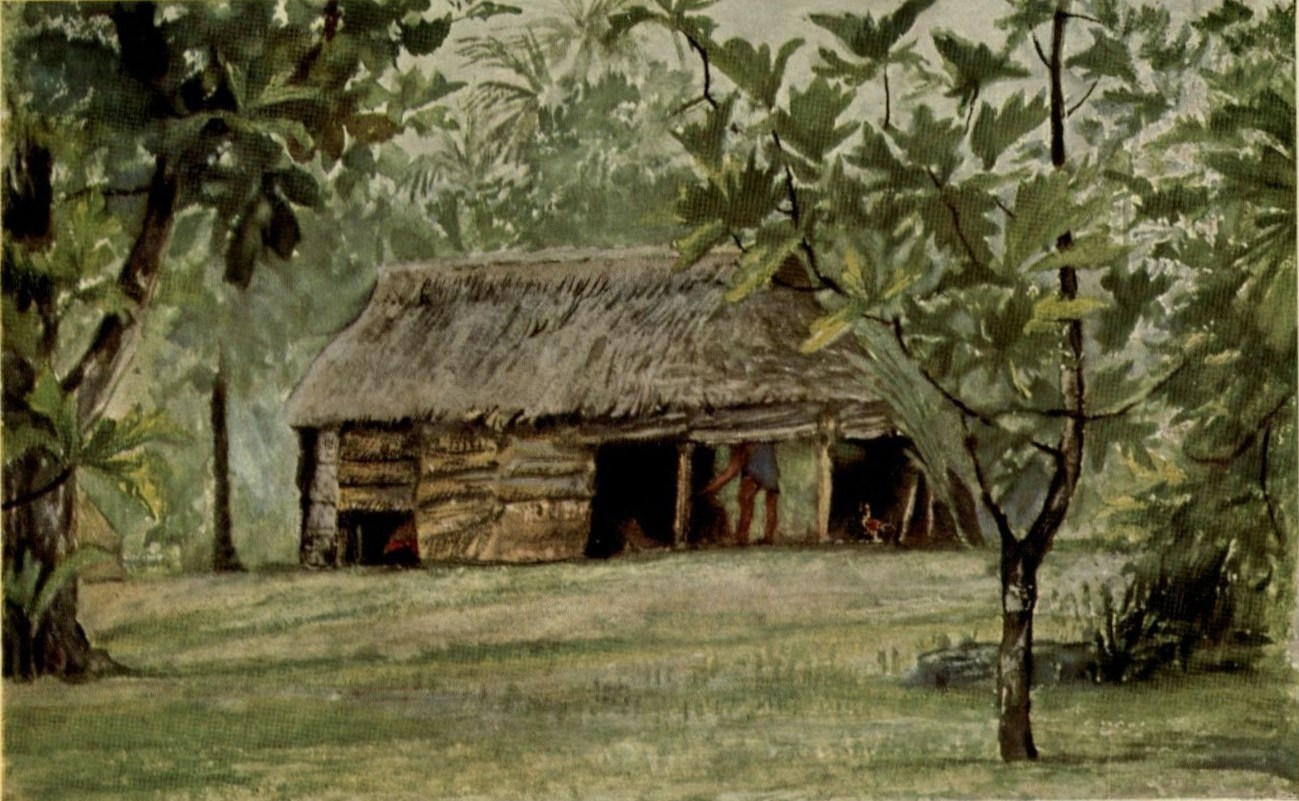
scientific men call the passage from savagery to barbaric life. You will remember that with us one of the present definitions of the savage is that he does not make pottery, nor know the bow and arrow. Well: the higher Polynesian never used pottery, and used the bow and arrow, one of the most deadly of weapons, only to shoot for amusement at the forest rat. This violation of certain rules of the game of science is one of the most amusing fragments of contradiction that one meets. When we came to other islands, where there is a mixture of what we deem a lower race—the Papuan, negro or black, we find pottery, the use of the bow, intelligent fortification in war. And the beginnings of decorative art are shown by a keener sense of colour and contrast of form. The high Polynesian, who invariably invaded and defeated the mixed race superior to him in these important details, and brought back the “stuff” has lived with a sort of classic severity. Precedent is everything; new patterns of ornament come in most slowly, and there is an apparent indifference to the picturesque. But owing to this conservation such a Bœotian set of islands as Samoa gives to the artist—the man who remembers the beauty of classical representations, the only fit recall of what he has seen in the Greek sculpture, the Pompeiian fresco and the vases of antiquity.
The rather countrified good taste of these people leads them to simple methods of dress and adornment, and to keeping the same unchangeable except by small variations. There is nothing nearer to the drapery of the Greek statue than the Samoan wrap of cloth or of tappa, which is merely a long rectangle wrapped about the body, either as high as the chest, like the cloak of the Greek orator, or merely around the waist and thighs, always carefully arranged in special sets of folds which designate both the sex and the social position of the wearer; with this the wreaths and flower and leaf girdles and the anointed body, which belong to our vague conception of the Greek and Roman past. There is little more for war time; a great barbarous head-dress of hair, and occasionally some neck ornament of wild beasts’ teeth.
In draperies such as I have described, in the shady afternoon, the chiefs sit about the lawn of the village the malae or green in places which I suppose are reserved to them by habit. They sit far apart; one of the Samoan characteristics being the habit and the skill of conversing distinctly without raising the voice, and of so speaking as to be heard far off. The hereditary orators, the tulafales, who made speeches to us in our wanderings, at the receptions given to us by the villagers, invariably chose to speak at great distances. A couple of hundred feet in the open air seemed to them a fair average. Their voices were never raised above a certain modulation. In fact one imagined that the next word would not be heard. But a peculiar inflection for each sentence wherein the most important points are placed at the end, seemed to force the sound upwards as the phrase dragged on. Seumanu our Apia chief who acted as our tulafale, when we travelled, liked to repeat “sotto voce” what the other tulafale was sure to say.
Our chiefs often drank their kava in these afternoon conversations. Sometimes, but very rarely, it was made by the girls. Usually any young men of the village, of refined dress and manners, were called upon to serve. I have a vague recollection—though I may have heard it of some other island, and may be confusing facts—that the ancient custom allowed any man who wished his kava made to call upon the first young woman who passed, no matter how high her rank might be; this of course to be at his peril, like all society privileges. But however it may be, almost invariably our own kava, that is to say the kava to which we were treated, was made by the women.
You will remember that this was one of the very first of South Sea habits that we came across on our very first day, in that other island of Tutuila.
Kava, more properly ava, is the universal drink of all Polynesia. Abolished by the missionary in many places, it still persists here. Kava is a drink made by adding water to the crushed and pressed root of a plant of the pepper family, the Piper Methysticum, which has a narcotic power. Here in this nest of civilization the root is grated upon an ordinary tin grater, before being put in the large, four-legged wooden bowl, from which it is to be ladled in cocoanut cups, after water has been properly added, and with a strainer of bark fibres, the filaments and splinters have been removed.
But in certain far-away places, we have had the pleasure of drinking it in the ancient and orthodox way preferred by all epicures. According to this more aboriginal method, the kava root was chewed to a mass of woody pulp, instead of being grated. Young ladies of great personal delicacy were chosen for this purpose; but, there must have been many occasions when one had not time to be fastidious. I cannot say that I have noticed any advantage in the older form, and I am glad that all about us it seems to be forgotten.
The entire preparation and serving of the drink makes a ceremonial form; most absolute in detail and of hereditary and ancestral accuracy.[4] It belongs to all receptions, and is the manner of showing the distinctions of rank and precedence.
The gestures of the girls when they move their hands around in the water of the bowl, so as to extract the essence of the root, are regulated by long established custom, and are beautiful as the movements of a dance. The handing of the strainer to another attendant, and her swinging it out to cleanse it, make another series of most ravishing pictures. Finally the third attendant sweeps an arm down with an empty bowl, and, curving the wrist inward, brings it full to the most honoured guest, and to the others in turn. With each handing the name of the guest is announced.
Mataafa sometimes gives us kava, and occasionally has done us the honour to come and drink it in our own hut. In that case he has his own bowl, a most intimate and personal property, from which no one else must drink; and with all courtesy he apologizes to us for this necessity of position. For as he explains guardedly he is in some sense sacred—having been a form of the divine. And he is the most religious of men in our meanings.
In one princely place that we visited, in Savii, we found a lady who occupied by ancestry the position of “kava divider”; that is to say that it was her duty and privilege to determine the sequence in presenting the cup according to dignity. And she appeared without warning and claimed the right.
From this circle of the chiefs drinking kava on the green, even the children know enough to keep away. Even the young man who hands the cups is careful in his walk not to appear to turn his back to any one of the chiefs. Respect for the chief is the basis of everything. It is probably the foundation of their extreme courtesy, only broken by natural exuberance, impatience, or simplicity. The chief was sacred, even in war. It was a terrible thing for a commoner of the enemy to kill him. In legends of Tahiti there are tales of how men deliberated whether they were of high enough birth to take the life of a vanquished chieftain. The very language indicates this division between class of the chief and everything else outside. For the chief and everything relating to him there is a special language. The chief’s head, the chief’s body and all its parts, the chief’s food, all that he does, his feelings, his possessions, his dog, his wife and her actions, even when she breaks the Seventh Commandment, have special names. In many instances the common name of a thing is changed for another when that thing is spoken of in his presence. In some cases the particular grade of his rank is indicated by the word used; so that you speak of a tulafale’s eating as tausami; of a chief’s eating as taumafa; of such a chief as Mataafa’s eating as taute. But it would not be polite of a chief to use these words with reference to himself.
When passers-by draw toward the end of our village and reach the highway in front of Mataafa’s hut, they keep to the further side of the path, leaving as large a space as it is possible to make, out of respect for the privileges of the chief of chiefs.
On all the fringes of the village, however, the children play quiet games. Our spaces are too restricted for the young men to have their games; but further down they collect at times to play, by throwing a stick so as to make it touch the ground and skim along to the goal. So with us there is very little. Occasionally some of the boys gallop wildly up and down the beach; but there are very few horses in this immediate neighbourhood at which we are not displeased, however beautiful the sight may be, because they ride the horses too young, and push them beyond their strength.
As the evening comes on the sun goes down rapidly, and the afterglow, the most beautiful moment of the South Sea day, begins its long continuance. The girls gather together or sit with the young men, either on the grass or on little raised benches under trees, or very late again on still smaller benches, holding at the most two people, which they ingeniously fit between the divergent stems of the cocoanuts. This half siesta, half conversazione, is carried on as long as there is light, and if there be moonlight, through any number of hours that may escape the darkness disliked by the Polynesian.
Our little friend Taēlē leaves her hut and sits far apart in her accustomed place, all alone, immovable, looking toward the sea, thinking perhaps; but how do I know?
Some of the little children, the little girls especially, repeat in a small way the native songs and the native dance the siva. Sometimes a bigger girl sketches out some steps for them; but we are extremely proper in our village, and the siva, of which the Samoan is passionately fond, is not looked upon with favour by the missionary or the brown members of the church. However, we succeed now and then in getting girls and young men from the neighbourhood, or passing villagers and travellers, to favour us with this entertainment. The siva dances about which I wrote you at length, upon the day of my arrival, are yet to us always novel. By and by I suppose that they will be, like everything else, accepted by us as an ordinary form of social dissipation. But it is certainly worth coming all this way, even to see one of them. The beautiful rhythm of song and movement, the accuracy of time kept, the evidently absorbing delight of the performers, who become more and more insatiate, until one wonders that they are not exhausted by such gymnastics, the pictorial disposition of the scene, usually at night or in dark places, the dancers dressed in flowers and leaves in contrasts and harmonies of colour that are nature’s own, with bodies and limbs glistening with oil, the spectators all absorbed, and as Robinson Crusoeish as the spectacle itself—all these things are the siva. If I do not refrain and cut short at once, I shall become entangled in trying to give you word pictures that are utterly inadequate. I feel, too, that the drawings and paintings I have made are so stupid from their freezing into attitudes the beauties that are made of sequence. These beauties do not touch the missionary. The invariable objection to amusement, to dissipation, to that weakening of purpose which our indulgences bring, make this natural of course, and we can understand it. But these kindly natives need, I think, every possible excuse for innocent occupation. There is so little for them to do to-day, and we feel that by lending our countenance to the siva we are rescuing both the native and the missionary from a false position. The condemnation of the dance had gone from the white missionary to his brown brother, the local Polynesian clergyman or deacon; and when we arrived we learned that even our excellent Sunday-school, church-keeping friend, Faatulia, the wife of the chief Seumanu, himself also a most excellent and worthy member of the church, had been excommunicated for having danced a European cotillion at the Fourth of July ball given by our American Consul. The revulsion is beginning, and we are glad to help in forwarding it.
We could scarcely have sivas of our own—that is to say that our village could not give them properly. They should be under the direction of the right social leader, and we have no taupo. The taupo is a young woman elected by the village for the purpose of directing all social amenities in which women can take part. It is for her to receive the guests, to know who they are and what courtesies should be extended to them; to provide for their food and lodging. If they are great people like ourselves, for their being attended, for their having all small comforts of bath and soft mats and tappa, for their being talked to and sung to and danced to. She is invariably chosen of good descent, and she is beautiful if fate allows it, but she must be a lady above all. She must also be a virgin, and be continually protected, escorted, watched, investigated, by one or many duennas, who never for a single instant lose sight of her. Her position in that way is a trying one. Contrary to all feminine instincts, she is rarely allowed to have her own way in the adornment of her person. Her expert attendants insist upon having a voice in dressing her on all show occasions; notwithstanding, it seemed to me that I recognized in each individual taupo a something that had escaped the levelling influence of so much interest taken in her attire. Remember that she dances in front of the warriors in battle.
SAMOAN COURTSHIP. FAASE, THE TAUPO OR OFFICIAL VIRGIN AND HER DUENNA WAIT MODESTLY FOR THE APPROACH OF A YOUNG CHIEF
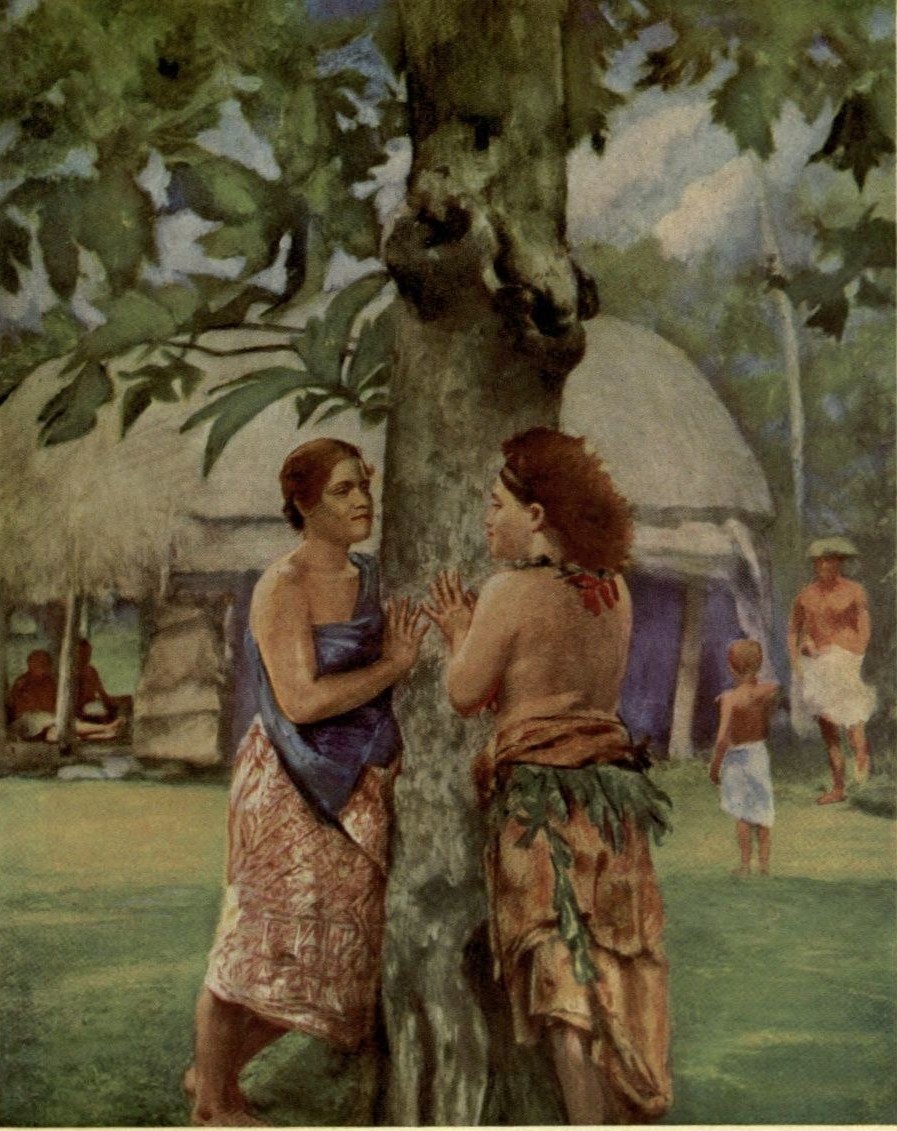
When the time comes, the village that has chosen her, also chooses her husband, and makes her gifts, as a dowry. Sometimes, and this is one of the terrors of the situation, the village is very hard to please, and rejects offers which the taupo might perhaps have accepted if a less important and freer agent. She can always escape by bolting, and marry as she pleases, thereby forfeiting her position and the respect of well-thinking people. A match not well thought of by society is as much deplored here as in our very best circles. Marriage, apparently lightly entered into, is a very serious matter. Rank, position, is only transmitted by blood; and a mésalliance in Samoa entails consequences still more disastrous than in the court life of Germany. Perhaps my South Sea Islander is not sentimental. He is simple and natural, but he looks at everything in a practical way, and his ideas, having always been the same, enable him to keep this natural simplicity without any protest in favour of that freedom that brings on love tragedies.
As the day draws to its last close in the fairy colouring of the long afterglow, people come back to their evening meal—a regular hour and moment, here where divisions of time seem so uncared for that no older man or woman could accurately know their age; unless they date from some well-known event recorded by the foreigner.
(In other places people have told me, it was so many bread-fruit seasons ago; it was when such a ship was here.)
Magongi, the owner of our hut, returning from his fishing, drops a fish or two at our posts, according to Samoan etiquette and in honour to guests and chiefs like ourselves. Faces are turned from gazing at the sea, toward the houses where meals are getting ready. The young people give up their seats on the little platforms, or “lookouts” by the sea, and the lover confides his courtship, in Polynesian way, to others to continue for him.
This evening, as every evening, with the last afterglow, in each hut of the village, with the lighting of fire or lamp, comes the sound of the evening prayer before meal. In pagan days, with the lighting of the evening fire (meant for light), in the hollow basin scooped out in the centre of the hut, after a libation to the gods outside, thrown out between the posts, the Samoan prayed a prayer like this:
“Sail by, O Gods! and let us be: Ye unknown Gods, who haunt the sea.”
When I hear the sound of the evening hymn, fixed and certain like all their habits, I recall this prayer, so full of the future that has come upon these dwellers in islands, and has brought with our faith and our ideas—the latter certainly misunderstood—a slow extinction of their past and of their very existence. For in all Polynesia, though arrested now for a time, there has been within the hundred years from discovery a fading away. As the Tahitian song says:
“The coral will grow and man must perish.”
I have been telling of the influence of missionaries upon old customs, such as dances. Let me say something further.
I want to note that it was easier to get the Samoans to accept any form of Christian worship because their religion was simpler than that of the other islands. They were free from a great many horrors—the belief in the necessity of human sacrifice. They hated cannibalism. Their heavier nature had never led them to such immorality as tempted other South Sea Islanders, who thereby resemble us more.
Then the missionaries came to them so late—at the end of the thirties—that the Samoans had already been able to learn about this religion that fixed everything—this desirable law called Lotu, which was to settle everything for them, and make everything straight. (Lotu[5] also means church, Lotu Tonga, the Tongan Church, etc.) So that within the very shortest possible time the missionaries succeeded in converting them, in fact, were waited for and expected, one might say, by the next chance ship. The terrible reputation of savageness of these islanders, owing to their having murdered La Peyrouse’s men in Tutuila, on first acquaintance, so guarded them that even so far back as 1836, and later, very little was known of them—they were carefully avoided. But certain outcasts, escaped convicts, terrors of the sea, had come among them, and had even begun to instruct them to expect this law of Good. It is one of the most touching, as well as one of the most atrocious, of small facts. Old Samasone was telling us the stories of these old times: how some stranded ruffian, unable to return to white lands, had felt obliged, upon being questioned, to assert his value and knowledge by some imitation that might not later conflict with the outside facts. Some brutal, drunken, murderous wretch would choose, some day, to simulate a Sunday, and sing obscene or brutal forecastle songs, all the same to those who did not understand a word, as representing the church service of song which he described.
Samasone, whose American name is Hamilton, and who has been here for the third of a century, tells us lengthily and in detail such stories, and gives us long accounts of Samoan manners, in the same way that might be his if he were still in native New England. And when I shut my eyes, I can fancy myself sitting on the edge of some Newport wharf, and listening to Captain Jim or Captain Sam, discoursing wisely, with infinite detail.
Fifty years have passed since those things, paralleled more or less elsewhere in the South Seas; and now from the hut of Mataafa, the great chief, which is next to mine, with the sunset, comes the Angelus, sung by the people yet nearer to nature than Millet’s peasants. I hear also the Ave Maria Stella; the cry of the exiled sons of Eve for help in this vale of tears, for whether Catholic like Mataafa, or Protestant like my good neighbour Tofae, they are all very Christian. Indeed, my other neighbour is a preacher, an eloquent one, like a true Samoan, a race where eloquence is hereditary in families. I hear him thundering on Sundays against the Babylonians, and all the bad people of Scripture.
They are all steeped in a knowledge of the words of the Bible. In any serious conversation, in political discussion, we hear the well-known types of character referred to, and all the analogies pushed to the furthest extreme.[6] The rather light-minded girls whom we have about us amuse themselves on Sunday with capping verses from the Bible. The young men of our boat crew, whose moral views on many subjects would bring a blush to the cheek of the most hardened clubman, are fond of leading in prayer, are learned in hymnology, and are apt to be fairly strict sabbatarians. Here and elsewhere, in many other islands, it is often very difficult on Sunday to obtain the use of a boat, the only vehicle possible. Remember that I am, and shall be for a long time, writing from islands, where all life is along the shore, where only occasionally are there roads, or what we would call roads; where there are few horses, somtimes none at all; where the natural road is over the beach, when it is uninterrupted by rock and cliffs, and where the boat can take you quietly along inside of the reef. But as I shall make it out clearly later, the Polynesian likes to have things settled one way or the other, as all sensible people do.
And then the Bible—I am not speaking of the New Testament—is so near them; they read so often their own story in the life of Israel of many centuries back. They are not separated from a civilization of that form by such and so many changes as our ancestors’ minds have passed through. Their habit of life must even be said to antedate the biblical. They do not have to make excuses for the conduct of God’s chosen people. They can take all as it is written. They need not suppose some error in the account of the witch of Endor. In such a valley, buried under trees, or behind that headland where the palms toss in the roar of the trades, dwells some woman, wiser and more powerful in the solitude and in the night than we judge her by day. She can tell what things are happening elsewhere; what things are likely to come. She brings in the dead by the hand. She tells of what the dead are now doing, of their wars and their struggles in the empty outside world. What she revealed some nights ago, to a chosen few who say they were present, is murmured about the villages, and makes a feature of conversation not unlike society news. I have listened at night, in out-of-the-way places, among preachers and people of confirmed Bible piety, to the last reports from the spirit world: to the news of war there; to the tale of great fights which had occurred on such a day of the moon, when the battleground of the reef was strewn with the corpses of the dead already dead to us. And I remember once hearing how some spirit ruling over a part of our island had declined to enter into war because he had not been attacked, and his religious principles, which were Christian, confined him to the defensive. Perhaps all these things meant more to my good friends than they did to me, curious as I was to find in these reports some traits of their character, some manner of theirs of looking at the things of this world. I believe that to them these agitations of the outside world were presages of coming danger, of trouble to their earthly lives; that they saw omens of victory because the spirits of such and such possible ancestors had triumphed. But no doubt, in some way not understood by me, all these vague stories confirmed them in certain directions, or made them hesitate. At any rate, it kept the land peopled with fears. It makes the terror of the forest more vivid and more reasonable. The po—the dark, the night—is impressive to the Polynesian; the brave man may have all the fear of the little boy. And I own that I have never seen a nature which at night assumed more mystery, a more threatening quiet. The vegetation never rests. The plants are always growing. The sighing of the palms so deceptively like rain; the glitter of the great leaves of the banana, striking one against the other, with a half metallic clink; the fall of dead branches; the sudden drop of the cocoanut or the bread-fruit; the perpetual draught, carrying indefinite sounds from the untrodden interior; the echo of the surf from the reef, against the high mountains; the splash of the water on the shore; the flight of the “flying fox” in the branches; the ghostlike step of the barefooted passerby; the impossibility of the eye carrying far throught angles of tropical foliage—all these things make the night—the po, not a cessation of impressions, but a new mystery.
With such a landscape about me, I was ready to believe that handsome young men belated in the passages of the mountains had been met by the female spirit, whether her name be Sau Mai Afi or not, whose sudden love is death; and that the same being could be a man when the night traveller was a woman and beautiful. Had not the brother of one of our virgin friends been assailed by devils, in some adventurous night voyage, and had he not returned half crazed, and beaten in such a way that he had never recovered? All this had happened while we were there; we might have found him alive had we come a few weeks earlier.
And in the night-fishing how often do the dead, continuing their habits, fish on the reefs alongside of the living. They are silent, and their canoes keep apart, but they may silently step from one canoe to another, only to be known by the chill and anxiety that goes with them. I have seen with my own eyes, far out on the reef, the solitary torch pointed out to me as that of the dead. Often, when suspected, the spirit occupant of a canoe has made for shore and disappeared, incessu patuit dea, and has been assuredly recognized by the track of her torch through the mountains, where no living man goes. That certainly must have been our spirit disastrous to young men.
All these sides of common belief, or what perhaps we might call superstition, were shown to us little by little. On the outside our good friends believe roughly as we do, and all this that I am talking about is what remains attached to Christianity, or more properly, never disentangled from it. And I should suppose that it must have been difficult for the missionaries to expel these survivals of the past, in the same way that the old Church found it impossible, in certain corners of Europe, to wipe out the belief in fairies—the “little men,” the “good folk,” the “wee folk,” the “good neighbours”; the sacredness and influence of places. And here the practical mind of the savage, in its first reaction, after having received a set form of worship and faith as a great relief, would argue that the written Law, the Book, countenances most of the things they cared for in their older worship. A very few years after the first christianization which began in the Society Islands, sects were formed, based upon the Bible, or using it as an excuse, with all the security of any theological difference. I have a vague feeling that many of my brown friends think that the Christian, even the missionary, does not carry out properly his belief, and that they themselves are nearer to the letter as well as to the spirit. If the missionaries have let loose among them the famous question of the lost tribes, I have no doubt that many of them must be imbued with the certainty of that descent. Many of their practices are so much like those of the early Jews, that, according to old-fashioned ways of historical criticism, an uninterrupted tradition might be argued. In fact, I am quite sure that many of the missionaries have so reasoned, and implanted among them a great feeling of confidence. And the Polynesian, having a perfectly healthy mind, likes to have everything settled. Anything more like the typical respectable Englishman I have never met. With the brown man one sees the natural healthy desire of having the questions of religion, of politics, of society, all settled on the same basis; there is such a thing as good form, and that settles it. After the first start, the islanders were much troubled at finding that there were many ways of looking at things, and that religion might be right and manners bad: that the wife of the missionary, who insisted on poke bonnets, was not dressing according to the most aristocratic forms of her own land. And when they find that their written religion does not provide for all their little wants, it must be very natural to supply the smaller ones, which are the everyday ones, with some of the older forms more fitted for individual and temporal advantages. It must be a comfort to many of them to know that the flight of certain birds indicates what they had better do to-morrow; that the coming of certain fish may mean, nay does mean—some change in family history; and they may still prefer to treat respectfully the animals and plants that were associated with their origins—what we might roughly call, their totem. The shark has been respected or the bread-fruit, or the owl; and in certain cases certain mysterious powers and sanctities might follow the line of descent, though concealed from the public, more especially the white men. Of this, I ought perhaps to say that I am confident; and that the powers would be recognized in certain people even when, as I have seen it, they belong to opposing Christian sects.