SAMOA (continued 4)
Reading edition
The chief and the others, the tulafales, have made speeches and drunk kava over and over again, all day, in an unofficial manner. And I am so sleepy, so sleepy that I almost fell off my chair, for I have a chair or camp stool—during evening prayers.
December 8th. Saagapu.
Anagapu is the name of the chief.
We are a little further along the coast, having passed through a dangerous reef, and waiting for a better tide, which we shall have to-morrow. The village is large, laid out handsomely in length, a little tedious in its regularity, well planted with trees, and with swamps behind and on the two sides that confine it. We have had the longest tulafale talk that I have ever suffered from, and I am prostrated with weariness and with sultriness of the air. We had feared heavy rain and looked with anxiety at two great water-spouts circling in the hills as we sailed along. There is an arrangement of mountains just behind us, probably some ancient crater, that looked as if it must be always in a boil of rain. There is nothing to do, fatigued as I am, but to go to sleep, and try to brighten up for a siva that I foresee. The people are many. There are lots of children, and girls who strut about careless of their lava-lavas, for this is a place unfrequented by foreigners and by the elegant people of Apia. I see two blacks, or Solomon islanders, dressed in lava-lavas in the Samoan way, who have taken refuge here, having escaped from the German plantation further on, which we hope to reach to-morrow evening. The chief tells me that they are quiet and well-behaved, and that they go to school like the others about them. All these blacks work harder than the Polynesians, and even their anxiety of look, as they come with hesitation toward us has a sort of possibility of action that I do not find in the browns of a similar class. I need not have suffered so much from the conventional speeches. Our host, on my waking from an attempt at sleep, stretches himself against the post nearest to me, and breaks out in most vernacular English, stating that he has been a little everywhere, and has been away from home for some twenty years. He has been as far as New York, which he says is not a good place for a sailor; in China many times, in Japan, in India, in France, in England, etc. He has conversed with the American Indians and states that he can understand their “lingo,” as he names it, from its similarity to the Pacific tongues spoken by the Polynesian. He has theories on these subjects, and believes
TULAFALES SPEECH MAKING. VAO-VAI, SAMOA
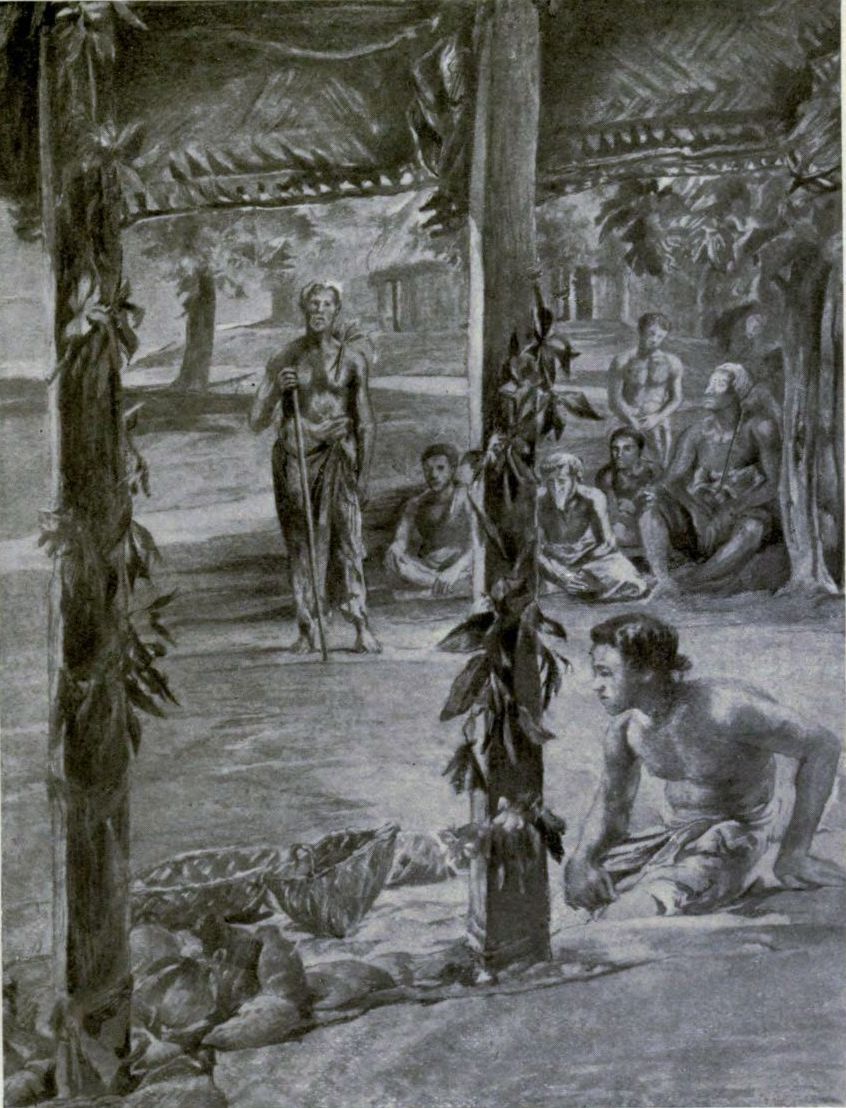
that there is a connection of race between the Hawaiians and the Samoans and Tahitians, and he extends it to the Malays in the west, and the American Indians in the east. And as I listen to him, I keep thinking that the story of the entire Pacific is probably the only explanation of the Polynesian. I should like to hear more, but personages of importance again come in and more talk of the society kind recurs. Later we are asked if we wish a siva. We hesitate for every reason. First, we hear rumours of a siva being prepared for us further back in some place already passed, owing to some letters of Tofae that announced us. Secondly, we are not impressed by our taupo, who besides want of beauty has also a discontented look which in some grotesque way reminds me of modern English high-art pictures—something grumpy. Then I have made up my mind to have a good sleep if possible; so that we say yes, if only the siva can be in another house; then we add that if we are too tired we propose to leave. We find, as usual, our boat crew extremely interested in the subject and in the performers, and the neat little house where we go in the dark is absolutely filled with spectators. A place has been set apart for us, filled by our two camp stools, and we are in time. The performers are full of anxiety to begin, and suddenly enters our taupo. In the dim light her sullenness looks like calm, her big headdress covers enough of her face to make the lines look delicate; and she comes in with a sort of hop of assurance, and throws herself down an entirely different person. She has authority and grace, and the “I don’t know what” that belongs to any one completely sure of a good professional standard. And she smiles with excitement, her smile widening with the cocoanut oil upon her face. And so the siva was full of fire, and danced in splendid time. Then we were able to leave and managed to get a good night’s rest. The floor when it is well covered with mats makes an excellent bed, and when one is sure and protected from mosquitoes everything else fades easily into sleep. In the morning we had a short talk with our host, who complained that he could not get away again to his wanderings. Samoa might be a good place enough, but he was bored. He had to submit, however, to the head of the family, who refused to give him leave. The old man, as he called him, using our phrase, kept him confined to his chiefdom. Family authority was thus vested in his uncle, our friend Seu, who had the name, and though the chief’s authority was his own for his chiefdom, outside of that the head of the family was master. This was the Roman law in its integrity; our chief personally was as a son, and only free when exercising a function. Even were he required to leave and come to his uncle in Apia, he should have to do so, just as he was bound not to go off as a sailor again.
TAUPO DANCING THE STANDING SIVA. SAMOA
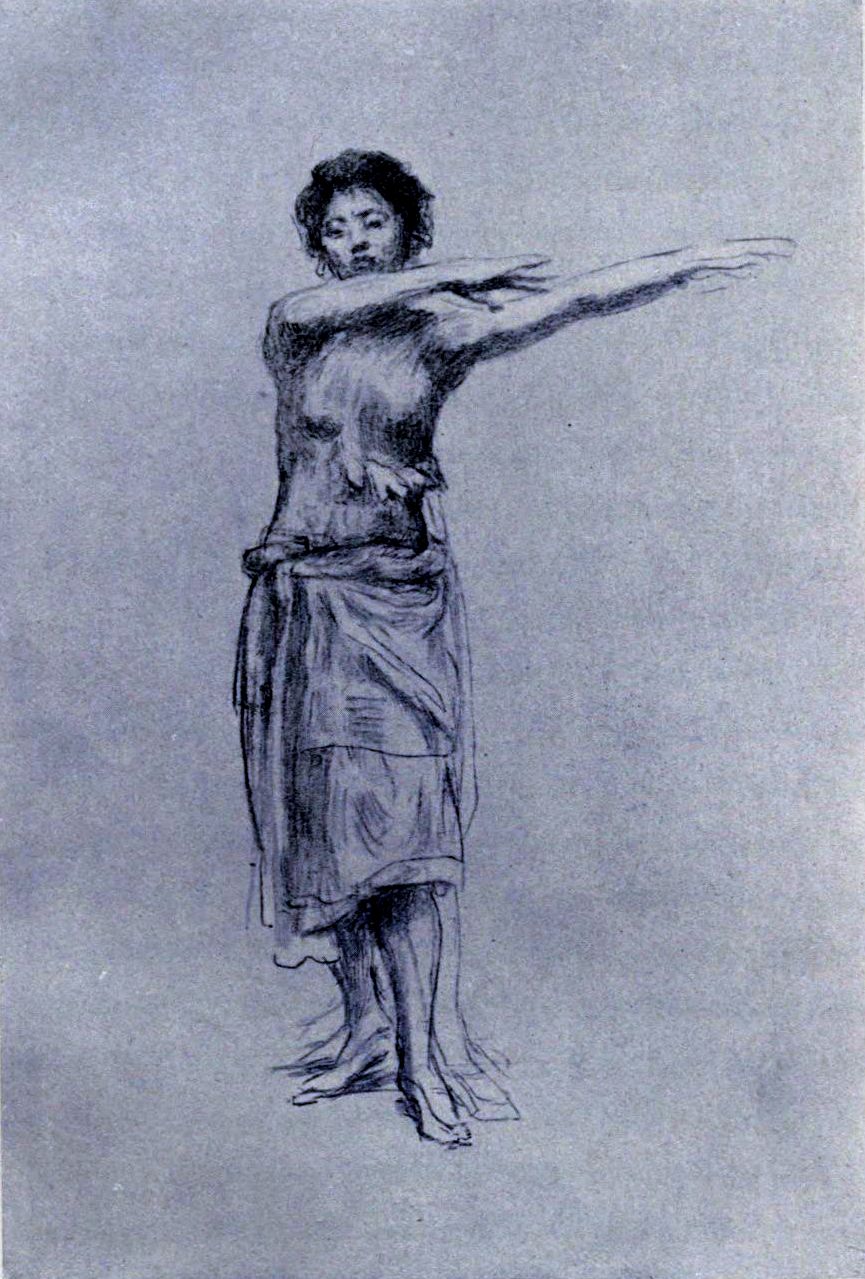
Our conversation was interrupted by loud shouts, and the sound of much trampling—and then by shrill cries of women and of children, apparently in derision, for there was much laughter. A girl was running away under the fire of sarcasm, and dodging from one house to another, which she would again leave, probably from finding more trouble inside. And we were connected with it. One of our crew had been too much taken with the charms of one of the siva dancers, or she had felt his eloquence too deeply. She had run off with him after the dance, and he had made promises; among others she believed that he would take her with him in our boat, and there she was on time—ready to go—only to find that it could not be—and that he must have known it. In fact, the women kept repeating to her that she must have lost her senses, that she must be an impertinent fool to think of sitting in a boat with such high chiefs. Siamau, our man, was slightly downcast, but not too much so—he was still a conqueror, but the poor girl was—well—she was to be pitied. Her trial and humiliation lasted all the time that we remained, and I was glad when we pulled away. The tide served us, and the wind, and we made a long pull to the place where I am now writing, Satapuala, only some twenty-five miles from home.
Satapuala was as we had seen it before, on our last malaga; but its young chief, whose dancing I had hoped to see again, was away—to visit Tamasese, the former king set up by the Germans—at the other end of the island—at Lufilufi, which we had passed without calling, in our anxiety to remain outside of the war of politics.
The guest-house was decorated as before, with palm branches on ceilings and posts and central pillars, and flowers everywhere—a most beautiful greenhouse. And the big taupo, the sister of the chief, was there, as amiable and dignified as before. In the evening she danced again, this time without the support of her brother. She did not seem as good a dancer. I noticed, however, that more than any one else, she used her hands and fingers to carry out the motion, and that she finished, as it were, the movements begun more rudely and vigorously by the men. She had the same enchanting style and manner, and even at the end, when a standing dance was given more outrageous than ever, she retained, with her smile, a look of not knowing what it was all about, that was as good form as I suppose an official virgin could assume in such a plight.
That was the end. I take it, that as Maua said, this being an European malaga, things were made more formal and mitigated on our account.
We are waiting for the tide with which we shall row straight to Apia, in about five hours—over the well-known sea.
Evening.
We rowed back in true Samoan way, our rowers making a show of pulling and singing a great deal, with an energy that had been better thrown into the oars. In fact, they danced a siva of return. The worst and laziest of the lot, an amiable fellow with a persistent smile always on his face, actually rose and fell on his seat with excitement. The other boat, our own, with Samau and our own four men, kept up well with our ten rowers. On boards placed to let them squat Samoan way, under the awning, sat a chief we had taken with us, who wore a great white turban and kept fingering his beard, and a young woman, a cousin of Seu’s—so that they looked Oriental enough. In Seu’s boat, Tamaseu, the tulafale, the strokeoar, alone rowed vigorously, though the oldest and least strong. He gave out the chant and pulled to it, while Seumanu, standing in the bow, guided us over the shallow water, and Atamo steered. As we turned round the last point, in the light of the sunset, we crossed a large boat manned and paddled by girls, all of them dressed in red, with green garlands around their heads, and for a figurehead a little girl sitting upon the bows, her crossed legs hanging over in front. Two black figures in the stern were the nuns of the convent to which the girls belonged, and they were all returning from a holiday. It was a pretty sight—nothing is more beautiful than the united movement of paddles and of heads thrown back in chanting, for of course some hymn carried them on, undistinguishable for us from a pagan tune.
December 24th.
Nothing new, except social and political news: the excitement at the Chief Justice’s coming, and the innumerable Samoan reports thereupon; and Fanua’s engagement to an Australian business man, and her marriage for the last of the year. There are many “cancans” thereupon the question of marriage in due form, or of a Samoan marriage which does not bind the white man who leaves, being much discussed. It was even proposed that she should marry first some Samoan—why exactly would be too complicated to explain.
Meanwhile I am trying to work a little and recover from the dissipation of the malaga. The days have drifted along, and here we are upon Christmas, the weather very hot, and not recalling what you have at home except by contrast.
Yesterday we had a great storm, the wind blowing the tortured branches of the palm in great gestures against the sky. Few were out except the boys, who played cricket all day in the rain, and conveniently dropped their clothes. At night, the rooms were filled near the lamps with small flies that crusted them, and covered the tables in thousands, so that we could neither work nor read. Through the crevice of doors and windows a fine dust was blown, the broken fragments of dead vegetation. We are only six feet above the sea, and during the night the dash of rain against our wall sounded in my dreams like the lashing of the surf. In the morning the flies that had lain in heaps of thousands had disappeared. I saw the last carried away by the laggards of an army of ants, which had pounced upon them during the night or early dawn.
I have been watching some three girls and a boy who have been sitting or playing about near me. Strictly speaking, only one, a grown-up girl, has been sitting. The others have placed themselves occasionally on the high bench to which the neighbourhood resort at night for a lazy stretch and infinite talk. But these children were never quiet, for the two hours I watched them. Most of the time has been taken up by wrestling. The boy, who is the smallest, was at first thrown by the girls, but as they taught him, he managed to keep his own fairly—until the elder girl was enlisted in the sport, and kept throwing him and the others, according to rule, for she carefully showed them the proper grip and some first movements. All this is a type of the manner by which constant exercise rounds them out, and I could not but appreciate how the little girl (of eight perhaps), when she was not wrestling herself, danced up and down continuously, in an involuntary impatience at having nothing to do in the way of siva.
Vaiala, Near Apia. Upolu, Dec. 25, ’90.
This is Christmas Day. I am seventeen hours, I think, ahead of you in that fact; so that at this moment you are only running about for the presents and the Christmas tree, but I cannot wait for you. It is such a Christmas as they have here; they call it Kilimasi, and do not quite make the joy and fuss over it that we do, having been christianized by the Wesleyans. And I have not told you the whole truth; when the missionaries came, they miscalculated the time, so that in many islands they run a day ahead, not having dared to acknowledge a mistake that might have imperilled their other teachings, for Christianity was inextricably entangled with cotton goods, gunpowder, etc.
So you see, these people were like ourselves, and could not separate one kind of truth from another, a deficiency which must have troubled you in New York, as it does me both in New York and elsewhere.
But it is legally Christmas to-day, as I began to say, and a holiday, which I can only distinguish from other days, because there seem to be fewer people idling and lying about. The convict also is not at work, he who labours near us, weeding and cutting down twigs, when he is not sitting and talking to his admirers, who decorate him with flowers and make wreaths for him.
But even this would not be an infallible guide, for the day before yesterday the wife of the very chief who had brought this man before the consuls for punishment (he had stolen the consular flag halyards—why, no one knows), and who had pined in court for thirty lashes and six months’ imprisonment—which were not given—the wife of the chief, I say, came to ask us, as great chiefs ourselves, if we thought that the consuls would let the prisoner have a few days off for fishing. And we strongly urged her to ask for it, as a reasonable request—at least, in the comic opera. The other convict, who is a great fraud, has been occupied in ferrying people over the main river (the bridge having gone down in the last storm, and we people who wear trousers and petticoats not liking to wade over). But he also is variable as an index, for he usually employs a small boy of his tribe to do the work, while he lies in a little hut that he has built, and sleeps or eats, crowned with flowers, like a jubilator. I was telling Mr. Stevenson of these details, upon his last call, and he interrupted a description of the tyrannical conduct of the French in Tahiti and the Marquesas, by the story of a visit he had paid to the prisons there with the inspector. There was no one in the prison for men:
“Monsieur,” explained the gendarme, “c’est jour de fête, et j’ai cru bien faire de les envoyer à la campagne.” Visit then to the women’s prison. “Mais où sont vos bonnes femmes? Monsieur, je ne sais pas au juste, mais, je crois, qu’elles sont en visite.”
He tells me that though French rule is of course wrong in principle, therein differing from English or German, the gendarmes are a good lot, whom it is a privilege to know. I have run on into this because I have been thinking while writing of my having told you that I intended to go to the Marquesas and see Typee.
I am slowly drifting that way, but my enthusiasm is dashed somewhat by what I hear. I am told that there are scarcely any more Typeeans—and they are clothed to-day, as indeed, I fear, are most islanders who are handsome, except the good people here, who still preserve the real decencies to some extent.
And that is why I am lingering here, as I see for the first time, and probably for the last, a rustic and Bœotian antiquity, and if I live to paint subjects of the “nude,” and “drapery,” I shall know how they look in reality. As I write in our Samoan house, which is only raised a few inches from the ground, I see passing against the background of sea, figures which at a little distance and in shifting light are nearer to the little terra cottas that you like than anything one could find elsewhere. Young men naked to the waist, with large draperies folded like the Greek orator’s mantle, garlanded, with flowers in their hair, pass and repass, or lie upon the grass. Young women—and alas! old women—more covered, though occasionally draped like the men, or with girdles of leaves, walk about, carrying leaf-made baskets or cocoanut water-bottles—or they sit and lounge with the young men. An old man, with his drapery partly over one shoulder has just stalked past, holding a long staff that he puts out to full arm’s length—for they use their limbs with a great spread and roundness of action. Four girls of different ages (from eighteen to eight) have been wrestling under the trees, practising some grip—and have been teaching a boy how it is done. A friendly hunch-backed dwarf has called to pay a Christmas visit, and to get a friendly nap. Like the girls, he wears nothing but a dark-blue drapery around his waist, and a great garland of fruit and flowers that hangs about his neck. His hair has been dressed and curled in Samoan fashion—that is to say, it has been stiffened into shape with coral lime (which, when washed off, has reddened it) so that he has the hair of a blonde on his dark head. Japeta, as he is called (Japhet), who by the by is rather “missionary,” but believes in witches and devils, and has lived in the woods—and is really very intelligent—is certainly more handsome in this way of costume than if he were to dress in the fashion of Sixth Avenue—or even of Fifth Avenue—for he is of a chief’s family. It is true that he has powerful arms and legs that would look well anywhere else than here, where their dancing and jumping and their mode of sitting seems to have influenced the size of the lower limbs, and to have given a roundness to the entire body, that reminds one again of the Greek statues and terra cottas. For the girl form passes into the young man’s and his to the older without break. Their dances do a great deal for this result. They all dance a little from the very earliest age. Last night, as I walked home, I found a crowd of little mites practising the figures of the sitting dance, in which the entire body is moved, from the ends of the fingers to the tips of the toes. And beautiful they are, these dances. If only I could paint them—but that is almost impossible; some of the gestures could be given, but not the rhythm. And they “sit” badly to a painter, and, notwithstanding their idleness, are rarely quiet. Sketching is formidable. They will jump up to see what you have been doing and everybody troops all
FAGALO AND SUE, WRESTLING. VAIALA, SAMOA
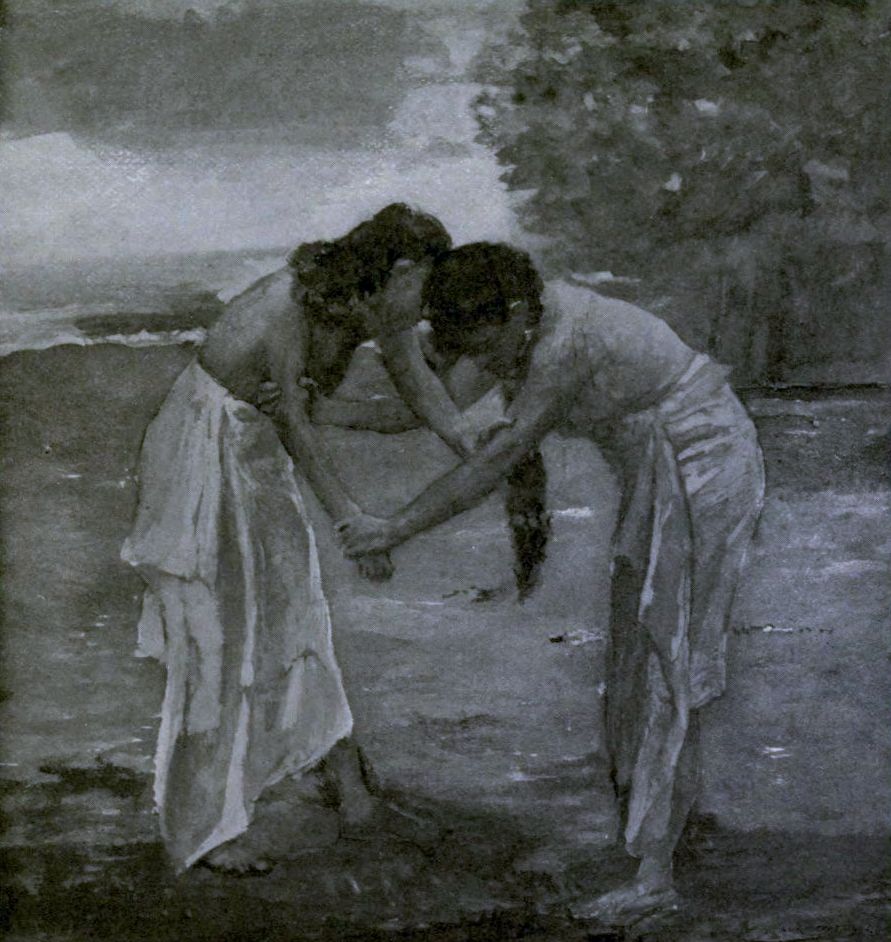
around. Still, I have sent and shall send some sketches home.
One of their dancers has just passed—an official dancer—the official “virgin” of the next “village,” but one whose duty it is to entertain guests, and see to their comfort, and dance for them, as also in war to go out dancing with the combatants, as you will see in some of my sketches. She was crowned with flowers, and had a garland around her waist, one around her neck, and her waist was stiffened out triumphantly by the folds of fine thin mats, worn as drapery. Behind her (for she is of rank), at a far, respectful distance, has passed, also her attendant, an old woman, who is responsible for her, and a tall, big fellow, also an attendant, with a great drapery, also of yellow mats, fastened by a narrow girdle of white bark cloth. We know her very well, and did she not abuse her prerogative of anointment with cocoanut oil, I should see more of her.
I have wandered away from my intention of wishing you a Merry Christmas and a Happy New Year; our Christmas is a hot one (86 to-day), but yesterday was cold and stormy, and the thermometer went down to 78 degrees for a time. The wind blew the palms into all sorts of distressed shapes, and sent amid a deluge of rain so much fine dust of broken foliage through the crevices of our doors as to remind me of Tenth Street in sultry summer, when they are building.
I wrote to you from the steamer in the first days of October. Since that I have learned that my letter was long delayed. The letters are given to the small cutter or schooner, manned by natives, that meets the steamer, so as to bring letters here. Then she has to beat out for the upgoing steamer to San Francisco to give letters to her. It so happened (and, alas, I know all about it, for I was there), that the schooner was three days at sea, owing to calms, so that she could not return in time, and my letter which was aboard with me was delayed a whole month. It was a queer, an uncomfortable, but a startling experience, this being dropped into the boat—for we landed once and saw things in an, informal way, tasted the sensations of all this faraway rustic classicality with minds unprepared. We spent our first day and night with native hospitality in a little out-of-the-way village, and saw, abbreviated, all the innumerable pictures that I have had leisure to watch since then: The dances and the kava-drinking and the village life, and the boats; all preceded by our putting into “the little cove with a queer swell running on the beach,” just as in the old story books; and twenty-four hours of calm in a small sailboat under the tropical heat was also a new experience.
So this is why my last letter was so delayed. I did not know of it until long after. Should I get as far as the Marquesas, I shall write to you again, and tell you if anything be left of Typee, but I fear that that is all over. Still, I hear reports of some private cannibalism to which the benighted French object, so that there may still be hopes. But I am told also, as I said before, that they wear European clothing and that is worse than any immoral diet.
There are no Gérômes here and little French in the figures. Of the moderns, Millet and Delacroix alone give the look of the nude alive and out of the studio. Also the Venetians and the older men are not out of the facts. And, praise be to the Maker of all (art included), I have not seen any black except at night—and even then, “si peu, si peu.” Rembrandt would be happy here, especially in the evenings, when the cocoanut fire—that is so bright as to look bright in the day—makes a centre of light strong enough to turn the brown skins to silver and to gold, and then passes by every gradation of the prism into nameless depths that black paint will never give. My dear old painters, even to Van Eyck and Memling, how well they “carry” over the globe!
I should write to you about Stevenson, but I suppose that you can hear more directly through his letters to his friend. We have seen something of him and have been pleased. He is hard at work, so that visiting him is not a favour to him, even though he may like it, as reminding him of that real world of civilization which he thinks he has left for good.
Nor have I written to you about politics, that are really impressive here, for we have saved these people from a hell of slavery under the Germans. A little gentleness on their part, and they would have had the islands—for these people are gentle enough, and desire rule, but, as they said, “death would be better”—and fortunately we interfered.
I am impressed here, as I have been before, by the force that America could have for good, and by the careful calculation on the part of those who know us best, the Germans and English, upon our weakness of action and irresponsibility, and our not knowing our enormous power.
The Pacific should be ours, and it must be.
Vaiala, Jan. 19th.
This afternoon another little incident of everyday life brings up again my wish that I could set all this world about me to the music of a comic opera—a great siva. If only I could understand all that they say, and yet see it as people do who do not understand so that for them the ways of other races seem perpetually funny to the eye. What a charming subject I have now for a third act—or perhaps might I bring it into the first one—or should we perhaps make it an interlude, with the siva ballet interspersed? Perhaps, after all, it makes a little opera bouffé for itself.
This afternoon, as I was telling you, I noticed some agitation on and about the malae, and around Tofae’s house, which is next to mine. This annoyed me exceedingly. Siva,[12] our first pet from Tutuila, had come to Apia on a visit, and the little silly darling had stumbled upon Awoki and claimed him with all the enthusiasm these people have for him, for his small size, his good nature, and his brown skin.
Our servants and dependents are the only ones who get the truest affection and good-will; we are too far up and too white, and cannot play. I have no doubt that notwithstanding the kindly offers we have had, Atamo especially, from maidens who were looking out for an establishment—I have no doubt, I say, that in their gentle minds was some confusion, some wish for rank and position, and that their real hearts went out to those with us like my little Japanese attendant. Indeed did not Faauli, the taupo of Sapotulafai, the daughter of the great tulafale, intimate that she wished to keep Awoki with her, and did she not say that if he tried to run off she would put him in her father’s jail until we were out of sight and out of reach? Well, Siva recognized and claimed Awoki, and so we obtained her again. I made her sit for me, and found, to my great pride and delight, that I had never been mistaken, and that her rustic movements in the dance were finer far than those of the girls of the great places. We had seen the best first, and had known it. Siva was ill at ease here; she knew that she was considered provincial, or as Charley explains, “the Apia girls think that these Tutuila girls are fools.” The same little ways, the same condescension, the same disdainful or inquiring look, that we see used elsewhere, were given by the maidens of our place to the little stranger. And this afternoon, when I had got her out of the way to our house, to try to get a photograph of her with my hawk-eye camera, that never works, I was disgusted at seeing the surrounding green covered with people. The younger ones singled out Siva at once, and with the sincerity of purpose that belongs to youth, said to her what they thought; that her dress was this or that, that her hair was quite wrongly cut, like a goat’s, they said, literally, with many such amenities. All this Siva bore as maidens with us would bear, with a distant air and an occasional smile of pity. She was a sort of relative of Tofae’s, being herself a chief’s daughter, and could not, I suppose, be absolutely extinguished.
But the crowd increased very much between us and Tofae’s house, and twice I had been obliged to single out some offender and drive him off with a threatened stick, when something dawned upon me; these people were really coming to Tofae: no vain curiosity had led them to surround us and sit about the grave of Tofae’s father, and fill the greensward between it and the posts of his house. Something was about to take place there. Tofae was seriously taking counsel with some others, and suddenly the crowd poured around his house, the privileged ones entering it, and one little bunch of old women slowly, lingeringly stepping in between its posts.
So that I asked, relieved from my own trouble, what was it all about. This was the story: set it to music yourself and Atamo shall write the libretto. Within the fold of the chief has lately been dwelling a maiden thought to be frail, or at least of a stuff not so stern as some others. Perhaps she may have been there in exile for some slight misdemeanour, and her people may have deemed it good for her to live for a time under Tofae. For me she had little charm, if I do not mistake the young lady and confuse her with another young person who has also had refuge there, having bolted from her unpleasant husband and spending some weeks in temporary viduity.
One of our young gallants, and I am both proud and ashamed to acknowledge, one of our own crew, is a great admirer of female beauty, and fixed upon this maiden as one he should like to win, even if he had to persuade her to run away with him, for as far as I know he is married, and had never intended to set up a rival establishment in legal form. Nothing here in Samoa can be hidden for any length of time, so that a more moral place in its way it would be hard to find. To pay court in the evening supposes a certain surrounding of many young people, and often the presence of many older ones, and our young man’s wishes were understood by others than this best girl. So that, most meanly, some of the old women began to prejudice the girl’s mind against this passionate and handsome youth, and instead of opposing her, which might have defeated their object, they began to tell little tales about his past, probably exaggerated, as they went on accumulating. And as he found the girl still resisting he determined upon a straightforward course in his manly bosom, and complained to the chief, asking that these libellers be punished. And the chief listened, as was right, and summoned the old ladies before his tribunal to make good what they said, or forever after hold their peace. And here they were, come to be judged, while friends and witnesses and neighbours circumfused them, anxious about the outcome.
“Well,” I said to Charley, “and what will happen? You have heard it all.”
“They have been telling bad things of him, and Tofae will punish them. He will fine them and fine them high, perhaps as much as ten dollars,” answered righteous Charley, feeling, as we all did, for the virtuous cause. And then I withdrew, not only because I wished to go to Sivá, but I wished also to meditate upon the principles of eternal justice now about to be vindicated by Tofae. When the old women are silenced and put to naught, shall our young man be strengthened in his suit? And will the young lady triumphantly elope with him? All these contingencies of events might appear spoiled if I inquired too far, so that I have left it all alone, and I withdraw. The subject is too pretty as it stands, and, as I said before, only requires to be set to music.
Vaiala, Jan. 27, 1891.
We are nearer to the cannibal here in Samoa than you would believe at first; far away as we are from cannibal or “devil” countries, we have in the hired labourers of the German plantation a wilder set of savages than would seem from their usual behaviour and the steady work urged out of them by their German masters. You must not forget that these little black men, often so gentle and sweetly smiling, whom we see about at work—in that constant exceptions to all around us—are not absolutely converted by being taken from their cannibal native lands to work for the white man in Samoa. The smile of their white teeth, repeated by the ivory bars or rings in their noses, conceals, like the gentleness of children, depths of useless cruelty.
The timidity of behaviour of such as I had seen and described to you, who had escaped from the plantations and were in hiding among distant Samoan villages, protected by the gentler brown race from recapture and return to what after all is slavery, is not a permanent index of character. When they have escaped, and have lived in the bush a life of bare chance, finding scanty food, continually tracked and hunted by their masters, often denounced by the Samoans, who do not trust them, they turn both to ancient, ferocious habits, and to the superstitions and fears which belonged to their life at home.
They are always suspected of cannibalism; and the event which has made us all more or less miserable is considered as quite a possible thing, and likely to occur again. News came to us suddenly, out at Vaiala, that Faatulia, the wife of our friend Seumanu, the chief of Apia, had learned a dreadful thing. Her brother, some weeks ago, had sailed from the little island of Manono, and had neither returned there nor arrived anywhere. His boat was found upturned, and he was missing. The story told to Faatulia came from some of the black labourers, or else from some of those who had escaped out of slavery. Or else it came in the Samoan way, so that, though you know there is a story, it does not require to be fathered by any human tongue. “There are no secrets kept in Samoa,” says Mataafa; “they are always being told.”
This is what she learned: Her brother, in the last storm, had been driven out of his course; his canoe had been overturned, and he had barely saved his life by swimming. On reaching land in great distress, he had found in the bush a hut, occupied by runaway blacks, and had asked for shelter. He had slept, but fever had taken hold of him, and for some while he was unconscious. Thereupon came up the dread temptation to the black man. Here was that menace of superstitious harm coming from the presence of a sick man, who might die and injure them by bringing the spirit which kills, into their forlorn abode.
Here was food too, if they killed him. Perhaps—I say it with doubt, because I have but confused notions of the exact superstitions belonging to any one of the races I have not met—but the man killed and eaten is not so dangerous in the other world as the man who dies a natural death.
At any rate, the story went on to say that the blacks killed Faatulia’s brother in his sleep, ate him, buried the bones, and knew nothing when inquiries were made. But somehow or other, suspicion excited by something done or said made the friends of the missing man dig and find remains which, at the time we heard the story, were being brought down to Faatulia, for identification.
And now how shall they know? The German firm will send their physician, and the American ship will send hers, and the question will assume a political meaning.
It was a sad thing to make our last call on Faatulia, and know that while she talked to us she was trying to forget the ugly thing lying behind the hangings of the hut.
Seumanu was undisturbed as usual, and bade us good-bye with all the coolness of a tulafale.
That same afternoon, January 27th, we looked for the last time upon the royal face of our neighbour Mataafa, while he told us again to tell Americans that Samoans owed their lives to the United States.
Then I used up my last daylight in painting a study of Maua, one of the boat’s crew, who endured it in a fidgety way that he took for patience. He was cold, for every hanging mat had to be opened, to give a little light on the dark afternoon, under the big roof of our hut.
And again in the morning I worked upon the sketch until the boatmen came up to tell me that the last moment was come. Maua flushed pink with joy, over his whole naked
MAUA. STUDY OF ONE OF OUR BOAT CREW. APIA, SAMOA
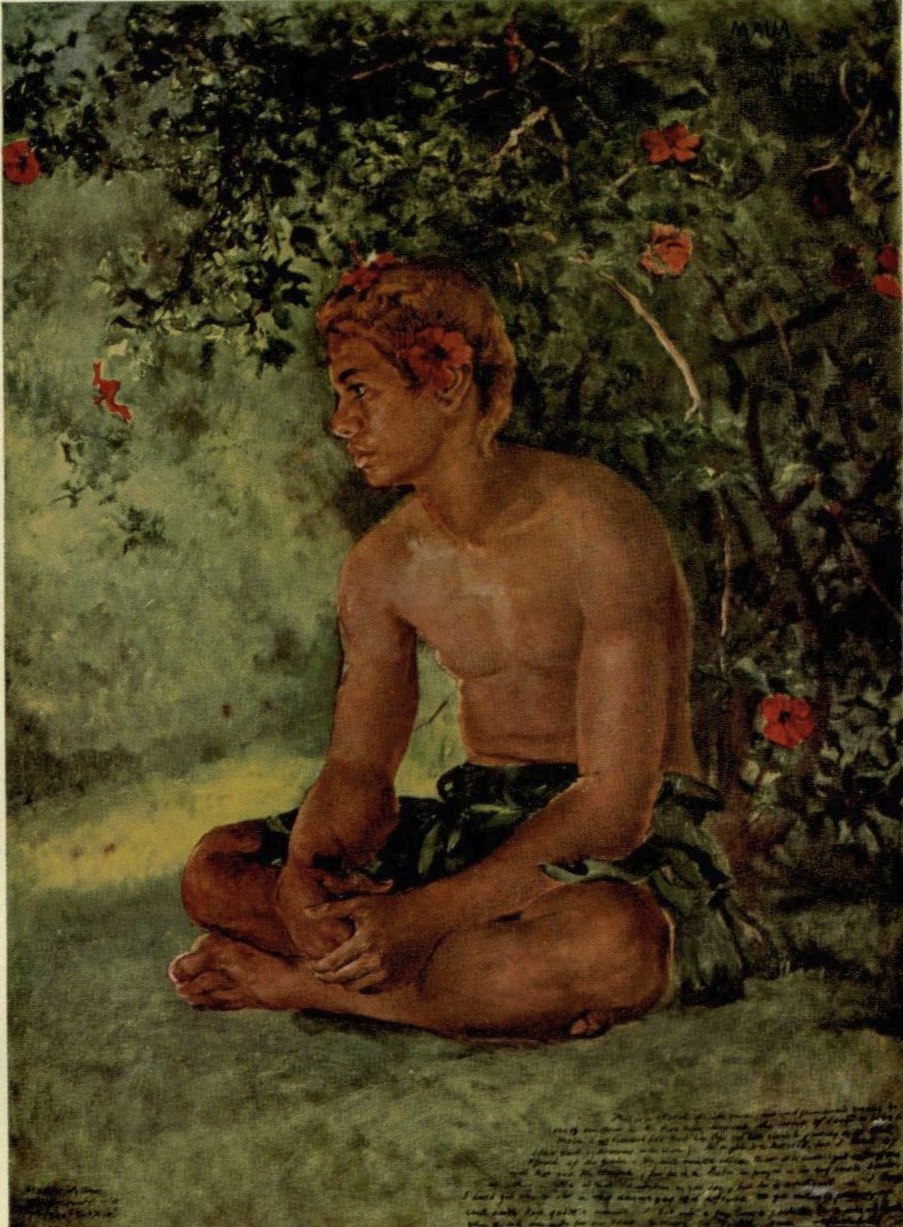
body, when I told him that I had done. The children on the village green (malae) came to say something and to offer little presents of shells and sea beans.
The steamer was whistling for me outside the reef—Atamo was on board—— But I could not be left behind—too valuable a passenger.
I bequeathed my best cocoanut oil to Siakumo and the other girls, said good-bye to Tofae, our chief, and promised, if I returned, to come back under his wing. Samau, our boatswain, carried me on his back, into the boat, and patted my legs, as a respectful and silent good-bye.
The grey water inside the reef was smooth and quiet. For the last time our Samoan crew pulled close to the shore, to exchange tofas (farewells) with Meli and her girls; and we went on board, where the sheep from Australia were still huddled on the quarter-deck due to Tahiti later. In the afternoon the island, wreathed in clouds, was already melting away behind us.