Page 97 VI.
Reading edition
THE PLANETS, AS SEEN FROM SPACE.
"He hangeth the earth upon nothing."—Job xxvi. 7.
Page 98 "Let a power be delegated to a finite spirit equal to the projection of the most ponderous planet in its orbit, and, from an exhaustless magazine, let this spirit select his grand central orb. Let him with puissant arm locate it in space, and, obedient to his mandate, there let it remain forever fixed. He proceeds to select his planetary globes, which he is now required to marshal in their appropriate order of distance from the sun. Heed well this distribution; for should a single globe be misplaced, the divine harmony is destroyed forever. Let us admit that finite intelligence may at length determine the order of combination; the mighty host is arrayed in order. These worlds, like fiery coursers, stand waiting the command to fly. But, mighty spirit, heed well the grand step, ponder well the direction in which thou wilt launch each wailing world; weigh well the mighty impulse soon to be given, for out of the myriads of directions, and the myriads of impulsive forces, there comes but a single combination that will secure the perpetuity of your complex scheme. In vain does the bewildered finite spirit attempt to fathom this mighty depth. In vain does it seek to resolve the stupendous problem. It turns away, and while endued with omnipotent power, exclaims, 'Give to me infinite wisdom, or relieve me from the impossible task!'"-0. M. MITCHEL, LL. D.
Page 99 VI.
THE PLANETS, AS SEEN FROM SPACE
If we were to go out into space a few millions of miles from either pole of the sun, and were endowed with wonderful keenness of vision, we should perceive certain facts, viz: That space is frightfully dark except when we look directly at some luminous body. There is no air to bend the light out of its course, no clouds or other objects to reflect it in a thousand directions. Every star is a brilliant point, even in perpetual sunshine. The cold is frightful beyond the endurance of our bodies. There is no sound of voice in the absence of air, and conversation by means of vocal organs being impossible, it must be carried on by means of mind communication. We see below an unrevolving point on the sun that marks its pole. Ranged round in order are the various planets, each with its axis pointing in very nearly the same direction. All planets, except possibly Venus, and all moons except those of Uranus and Neptune, present their equators to the sun. The direction of orbital and axial revolution seen from above the North Pole would be opposite to that of the hands of a watch.
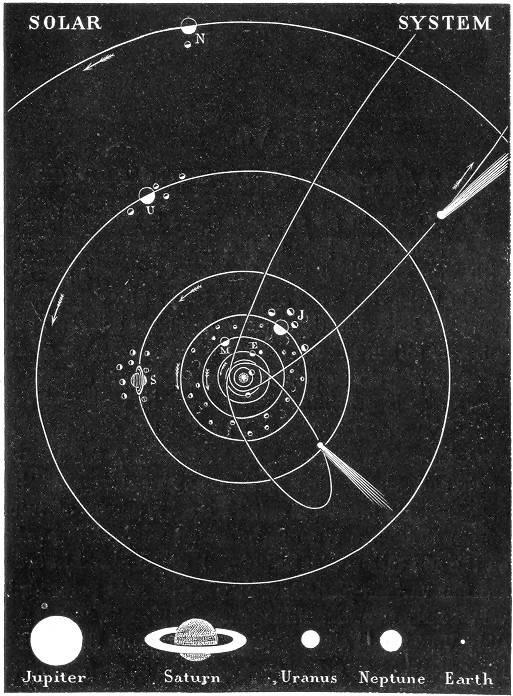
The speed of this orbital revolution must be proportioned to the distance from the sun. The attraction of the sun varies inversely as the square of the distance. Page 100 Fig. 38.—Orbits and Comparative Sizes of the Planets. It holds a planet with a certain power; one twice as far off, with one-fourth that power. This attraction must be counterbalanced by centrifugal force; great force from great speed when attraction is great, and small from less Page 101 speed when attractive power is diminished by distance. Hence Mercury must go 29.5 miles per second—seventy times as fast as a rifle-ball that goes two-fifths of a mile in a second—or be drawn into the sun; while Neptune, seventy-five times as far off, and hence attracted only 1/5626 as much, must be slowed down to 3.4 miles a second to prevent its flying away from the feebler attraction of the sun. The orbital velocity of the various planets in miles per second is as follows:
Mercury 29.55 Jupiter 8.06
Venus 21.61 Saturn 5.95
Earth 18.38 Uranus 4.20
Mars 14.99 Neptune 3.36
Hence, while the earth makes one revolution in its year, Mercury has made over four revolutions, or passed through four years; the slower Neptune has made only 1/164 of one revolution.
The time of axial revolution which determines the length of the day varies with different planets. The periods of the four planets nearest the sun vary only half an hour from that of the earth, while the enormous bodies of Jupiter and Saturn revolve in ten and ten and a quarter hours respectively. This high rate of speed, and its resultant, centrifugal force, has aided in preventing these bodies from becoming as dense as they would otherwise be—Jupiter being only 0.24 as dense as the earth, and Saturn only 0.13. This extremely rapid revolution produces a great flattening at the poles. If Jupiter should rotate four times more rapidly than it does, it could not be held together compactly. As it is, the polar diameter is five thousand miles less than the equatorial: the difference in diameters produced by the Page 102 same cause on the earth, owing to the slower motion and smaller mass, being only twenty-six miles. The effect of this will be more specifically treated hereafter.
The difference in the size of the planets is very noticeable. If we represent the sun by a gilded globe two feet in diameter, we must represent Vulcan and Mercury by mustard-seeds; Venus, by a pea; Earth, by another; Mars, by one-half the size; Asteroids, by the motes in a sunbeam; Jupiter, by a small-sized orange; Saturn, by a smaller one; Uranus, by a cherry; and Neptune, by one a little larger.
Apply the principle that attraction is in proportion to the mass, and a man who weighs one hundred and fifty pounds on the earth weighs three hundred and ninety-six on Jupiter, and only fifty-eight on Mars; while on the Asteroids he could play with bowlders for marbles, hurl hills like Milton's angels, leap into the fifth-story windows with ease, tumble over precipices without harm, and go around the little worlds in seven jumps.
The seasons of a planet are caused by the inclination of its axis to the plane of its orbit. In Fig. 39 the rotating earth is seen at A, with its northern pole turning in constant sunlight, and its southern pole in constant darkness; everywhere south of the equator is more darkness than day, and hence winter. Passing on to B, the world is seen illuminated equally on each side of the equator. Every place has its twelve hours' darkness and light at each revolution. But at C—the axis of the earth always preserving the same direction—the northern pole is shrouded in continual gloom. Every place Page 103 Fig. 39.—Orbit of Earth, showing Parallelism of Axis and Seasons. Page 105 north of the equator gets more darkness than light, and hence winter.
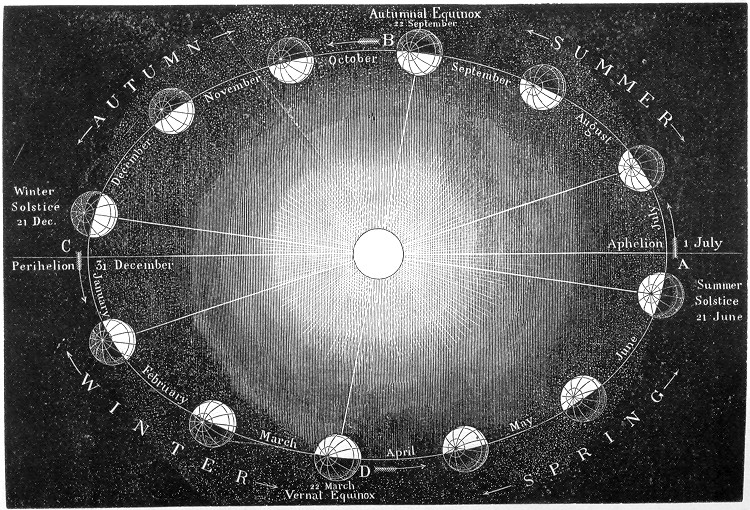
The varying inclination of the axes of the different planets gives a wonderful variety to their seasons. The sun is always nearly over the equator of Jupiter, and every place has nearly its five hours day and five hours night. The seasons of Earth, Mars, and Saturn are so much alike, except in length, that no comment is necessary. The ice-fields at either pole of Mars are observed to enlarge and contract, according as it is winter or summer there. Saturn's seasons are each seven and a half years long. The alternate darkness and light at the poles is fifteen years long.
But the seasons of Venus present the greatest anomaly, if its assigned inclination of axis (75°) can be relied on as correct, which is doubtful. Its tropic zone extends nearly to the pole, and at the same time the winter at the other pole reaches the equator. The short period of this planet causes it to present the south pole to the sun only one hundred and twelve days after it has been scorching the one at the north. This gives two winters, springs, summers, and autumns to the equator in two hundred and twenty-five days.
If each whirling world should leave behind it a trail of light to mark its orbit, and our perceptions of form were sufficiently acute, we should see that these curves of light are not exact circles, but a little flattened into an ellipse, with the sun always in one of the foci. Hence each planet is nearer to the sun at one part of its orbit than another; that point is called the perihelion, and the farthest point aphelion. This eccentricity of orbit, or distance of the sun from the centre, is very small. Page 106 In the case of Venus it is only .007 of the whole, and in no instance is it more than .2, viz., that of Mercury. This makes the sun appear twice as large, bright, and hot as seen and felt on Mercury at its perihelion than at its aphelion. The earth is 3,236,000 miles nearer to the sun in our winter than summer. Hence the summer in the southern hemisphere is more intolerable than in the northern. But this eccentricity is steadily diminishing at a uniform rate, by reason of the perturbing influence of the other planets. In the case of some other planets it is steadily increasing, and, if it were to go on a sufficient time, might cause frightful extremes of temperature; but Lalande has shown that there are limits at which it is said, "Thus far shalt thou go, and no farther." Then a compensative diminution will follow.
Conceive a large globe, to represent the sun, floating in a round pond. The axis will be inclined 7-1/2° to the surface of the water, one side of the equator be 7-1/2° below the surface, and the other side the same distance above. Let the half-submerged earth sail around the sun in an appropriate orbit. The surface of the water will be the plane of the orbit, and the water that reaches out to the shore, where the stars would be set, will be the plane of the ecliptic. It is the plane of the earth's orbit extended to the stars.
The orbits of all the planets do not lie in the same plane, but are differently inclined to the plane of the ecliptic, or the plane of the earth's orbit. Going out from the sun's equator, so as to see all the orbits of the planets on the edge, we should see them inclined to that of the earth, as in Fig. 40.
If the earth, and Saturn, and Pallas were lying in Page 107 the same direction from the sun, and the outer bodies were to start in a direct line for the sun, they would not collide with the earth Fig. 40.—Inclination of the Planes of Orbits. on their way; but Saturn would pass 4,000,000 and Pallas 50,000,000 miles over our heads. From this same cause we do not see Venus and Mercury make a transit across the disk of the sun at every revolution.
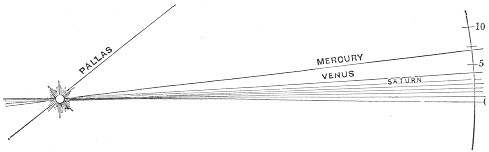
Fig. 41.—Inclination of Orbits of Venus and Earth. Nodal Line, D B.
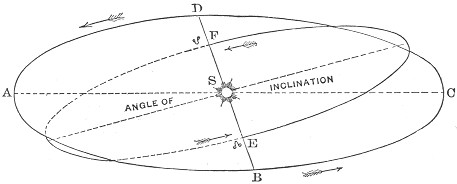
Fig. 41 shows a view of the orbits of the earth and Venus seen not from the edge but from a position somewhat above. The point E, where Venus crosses the plane of the earth's orbit, is called the ascending node. If the earth were at B when Venus is at E, Venus would be seen on the disk of the sun, making a transit. The same would be true if the earth were at D, and Venus at the descending node F.
This general view of the flying spheres is full of interest. Page 108 While quivering themselves with thunderous noises, all is silent about them; earthquakes may be struggling on their surfaces, but there is no hint of contention in the quiet of space. They are too distant from one another to exchange signals, except, perhaps, the fleet of asteroids that sail the azure between Mars and Jupiter. Some of these come near together, continuing to fill each other's sky for days with brightness, then one gradually draws ahead. They have all phases for each other—crescent, half, full, and gibbous. These hundreds of bodies fill the realm where they are with inexhaustible variety. Beyond are vast spaces—cold, dark, void of matter, but full of power. Occasionally a little spark of light looms up rapidly into a world so huge that a thousand of our earths could not occupy its vast bulk. It swings its four or eight moons with perfect skill and infinite strength; but they go by and leave the silence unbroken, the darkness unlighted for years. Nevertheless, every part of space is full of power. Nowhere in its wide orbit can a world find a place; at no time in its eons of flight can it find an instant when the sun does not hold it in safety and life.
The Outlook from the Earth.
If we come in from our wanderings in space and take an outlook from the earth, we shall observe certain movements, easily interpreted now that we know the system, but nearly inexplicable to men who naturally supposed that the earth was the largest, most stable, and central body in the universe.
We see, first of all, sun, moon, and stars rise in the east, mount the heavens, and set in the west. As I Page 109 revolve in my pivoted study-chair, and see all sides of the room—library, maps, photographs, telescope, and windows—I have no suspicion that it is the room that whirls; but looking out of a car-window in a depot at another car, one cannot tell which is moving, whether it be his car or the other. In regard to the world, we have come to feel its whirl. We have noticed the pyramids of Egypt lifted to hide the sun; the mountains of Hymettus hurled down, so as to disclose the moon that was behind them to the watchers on the Acropolis; and the mighty mountains of Moab removed to reveal the stars of the east. Train the telescope on any star; it must be moved frequently, or the world will roll the instrument away from the object. Suspend a cannon-ball by a fine wire at the equator; set it vibrating north and south, and it swings all day in precisely the same direction. But suspend it directly over the north pole, and set it swinging toward Washington; in six hours after it is swinging toward Rome, in Italy; in twelve hours, toward Siam, in Asia; in nineteen hours, toward the Sandwich Islands; and in twenty-four, toward Washington again, not because it has changed the plane of its vibration, but because the earth has whirled beneath it, and the torsion of the wire has not been sufficient to compel the plane of the original direction to change with the turning of the earth. The law of inertia keeps it moving in the same direction. The same experimental proof of revolution is shown in a proportional degree at any point between the pole and the equator.
But the watchers on the Acropolis do not get turned over so as to see the moon at the same time every night. Page 110 We turn down our eastern horizon, but we do not find fair Luna at the same moment we did the night before. We are obliged to roll on for some thirty to fifty minutes longer before we find the moon. It must be going in the same direction, and it takes us longer to get round to it than if if it were always in the same spot; so we notice a star near the moon one night—it is 13° west of the moon the next night. The moon is going around the earth from west to east, and if it goes 13° in one day, it will take a little more than twenty-seven days to go the entire circle of 360°.
Fig. 42.—Showing the Sun's Movement among the Stars.
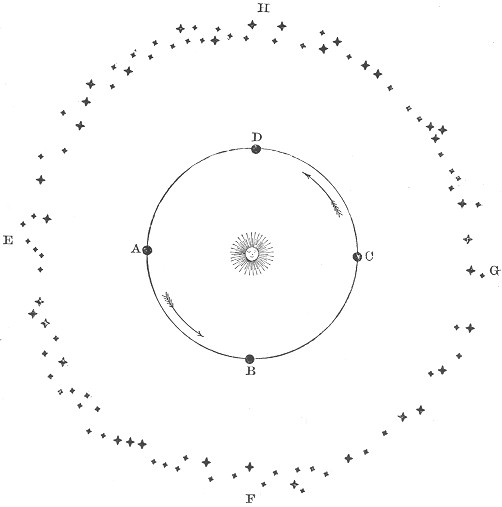
Page 111 In our outlook we soon observe that we do not by our revolution come to see the same stars rise at the same hour every night. Orion and the Pleiades, our familiar friends in the winter heavens, are gone from the summer sky. Have they fled, or are we turned from them? This is easily understood from Fig. 42.
When the observer on the earth at A looks into the midnight sky he sees the stars at E; but as the earth passes on to B, he sees those stars at E three minutes sooner every night; and at midnight the stars at F are over his head. Thus in a year, by going around the sun, we have every star of the celestial dome in our midnight sky. We see also how the sun appears among the successive constellations. When we are at A, we see the sun among the stars at G; but as we move toward B, the sun appears to move toward H. If we had observed the sun rise on the 20th of August, 1876, we should have seen it rise a little before Regulus, and a little south of it, in such a relation as circle 1 is to the star in Fig. Fig. 43. 43. By sunset the earth had moved enough to make the sun appear to be at circle 2, and by the next morning at circle 3, at which time Regulus would rise before the sun. Thus the earth's motion seems to make the sun traverse a regular circle among the stars once a year: but it is not the sun that moves.

There are certain stars that have such irregular, uncertain, vagarious ways that they were called vagabonds, or planets, by the early astronomers. Here is the path of Jupiter in the year 1866 (Fig. 44). These bodies go forward for awhile, then stop, start aside, then retrograde, Page 112 and go on again. Some are never seen far from the sun, and others in all parts of the ecliptic.
Fig. 44.

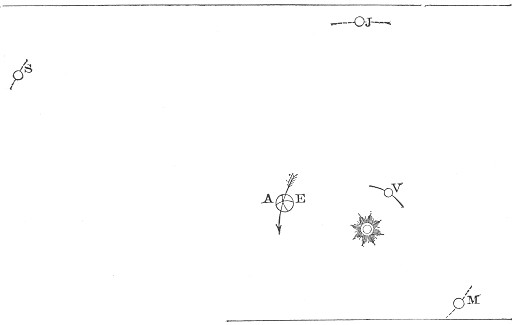
First see them as they stand to-day, as in Fig. 45. The observer stands on the earth at A. It has rolled over so far that he cannot see the sun; it has set. But Venus is still in sight; Jupiter is 45° behind Venus, and Saturn is seen 90° farther east. When A has rolled a little farther, if he is awake, he will see Mars before he sees the sun; or, in common language, Venus will set after, and Mars rise before the sun. All these bodies at near and far distances seem set in the starry dome, as the different stars seem in Fig. 42, p. 110.
Fig. 45. Showing Position of Planets.
The mysterious movements of advance and retreat are rendered intelligible by Fig. 46. The planet Mercury is at A, and, seen from the earth, B is located at a, Page 113 on the background of the stars it seems to be among. It remains apparently stationary at a for some time, because approaching the earth in nearly a straight line. Passing D to C, it appears to retrograde among the stars to c; remains apparently stationary for some time, then, in passing from C to E and A, appears to pass back among the stars to a. The progress of the earth, meanwhile, although it greatly retards the apparent motion from A to C, greatly hastens it from C to A.
Fig. 46.—Apparent Movements of an Inferior Planet.
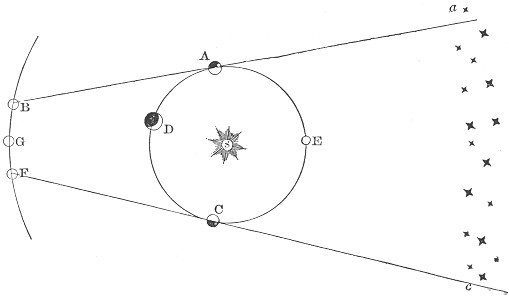
It is also apparent that Mercury and Venus, seen from the earth, can never appear far from the sun. They must be just behind the sun as evening stars, or just before it as heralds of the morning. Venus is never more than 47° from the sun, and Mercury never more than 30°; indeed, it keeps so near the sun that very few people have ever seen the brilliant sparkler. Observe how much larger the planet appears near the earth in conjunction at D than in opposition at E. Observe also what phases it must present, and how transits sometimes take place.
Page 114 The movement of a superior planet, one whose orbit is exterior to the earth, is clear from Fig. 47. When the earth is at A and Mars at B, it will appear among the stars at C. When the earth is at D, Mars having moved more slowly to E, will have retrograded to F. It remains there while the earth passes on, in a line nearly straight, from Mars to G; then, as the earth begins to curve around the sun, Mars will appear to retraverse the distance from F to C, and beyond. The farther the superior planet is from the earth the less will be the retrograde movement.
Fig. 47.—Illustrating Movements of a Superior Planet.
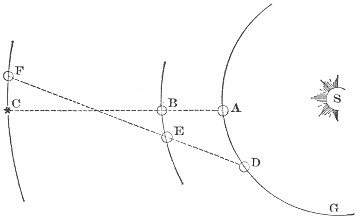
The reader should draw the orbits in proportion, and, remembering the relative speed of each planet, note the movement of each in different parts of their orbits.
To account for these most simple movements, the earlier astronomers invented the most complex and impossible machinery. They thought the earth the centre, and that the sun, moon, and stars were carried about it, as stoves around a person to warm him. They thought these strange movements of the planets were accomplished by mounting them on subsidiary eccentric wheels in the revolving crystal sphere. All that was Page 115 needed to give them a right conception was a sinking of their world and themselves to an appropriate proportion, and an enlargement of their vision, to take in from an exalted stand-point a view of the simplicity of the perfect plan.
EXPERIMENTS.
Fix a rod, or tube, or telescope pointing at a star in the cast or west, and the earth's revolution will be apparent in a moment, turning the tube away from the star. Point it at stars about the north pole, and those on one side will be found going in an opposite direction from those on the other, and very much slower than those about the equator. Anyone can try the pendulum experiment who has access to some lofty place from which to suspend the ball. It was tried in Bunker Hill Monument a few years ago, and is to be tried in Paris, in the summer of 1879, with a seven-hundred-pound pendulum and a suspending wire seventy yards long. The advance and retrograde movements of planets can be illustrated by two persons walking around a centre and noticing the place where the person appears projected on the wall beyond.
PROCESSION OF STARS AND SOULS.
"I stood upon the open casement, And looked upon the night, And saw the westward-going stars Pass slowly out of sight.
"Slowly the bright procession Went down the gleaming arch, And my soul discerned the music Of the long triumphal march;
"Till the great celestial army, Stretching far beyond the poles, Became the eternal symbol Of the mighty march of souls.
Page 116 "Onward, forever onward, Red Mars led on his clan; And the moon, like a mailèd maiden, Was riding in the van.
"And some were bright in beauty, And some were faint and small, But these might be, in their great heights, The noblest of them all.
"Downward, forever downward, Behind earth's dusky shore, They passed into the unknown night— They passed, and were no more.
"No more! Oh, say not so! And downward is not just; For the sight is weak and the sense is dim That looks through heated dust.
"The stars and the mailèd moon, Though they seem to fall and die, Still sweep in their embattled lines An endless reach of sky.
"And though the hills of Death May hide the bright array, The marshalled brotherhood of souls Still keeps its onward way.
"Upward, forever upward, I see their march sublime, And hear the glorious music Of the conquerors of Time.
"And long let me remember That the palest fainting one May to diviner vision be A bright and blazing sun."
THOMAS BUCHANAN READ.