Page 269 SUMMARY OF LATEST DISCOVERIES AND CONCLUSIONS.
Reading edition
Movements on the Sun.—The discovery and measurement of the up-rush, down-rush, and whirl of currents about the sunspots, also of the determination of the velocity of rotation by means of the spectroscope, as described (page 53), is one of the most delicate and difficult achievements of modern science.
Movement of Stars in Line of Sight (page 51).—The following table shows this movement of stars, so far as at present known:
APROACHING. RECEDING.
Map. Name. Rate per sec. Map. Name. Rate per sec.
Fig. 71 Arcturus 55 miles Fig. 69 Sirius 20 miles
" 71 Vega 50 " Fr'piece Betelguese 22 "
" 73 α Cygni 39 " " Rigel 15 "
" 69 Pollux 49 " Fig. 69 Castor 25 "
" 67 Dubhe 46 " " 67 Regulus 15 "
Sun's Appearance.—This was formerly supposed to be an even, regular, dazzling brightness, except where the spots appeared. But the sun's surface is now known to be mottled with what are called rice grains or willow leaves. But the rice grains are as large as the continent of America. The spaces between are called pores. They constitute an innumerable number of small spots. This appearance of the general surface is well portrayed in the cut on page 92.
Close Relation between Sun and Earth.-Men always knew that the earth received light from the sun. They subsequently discovered that the earth was momentarily held by the power Page 270 of gravitation. But it is a recent discovery that the light is one of the principal agents in chemical changes, in molecular grouping and world-building, thus making all kinds of life possible (p. 30-36). The close connection of the sun and the earth will be still farther shown in the relation of sun-spots and auroras. One of the most significant instances is related on page 19, when the earth felt the fall of bolides upon the sun. Members of the body no more answer to the heart than the planets do to the sun.
Hydrogen Flames.—It has been demonstrated that the sun flames 200,000 miles high are hydrogen in a state of flaming incandescence (page 85).
Sun's Distance.—The former estimate, 95,513,794 miles, has been reduced by nearly one-thirtieth. Lockyer has stated it as low as 89,895,000 miles, and Proctor, in "Encyclopædia Britannica," at 91,430,000 miles, but discovered errors show that these estimates are too small. Newcomb gives 92,400,000 as within 200,000 miles of the correct distance. The data for a new determination of this distance, obtained from the transit of Venus, December 8th, 1874, have not yet been deciphered; a fact that shows the difficulty and laboriousness of the work. Meanwhile it begins to be evident that observations of the transit of Venus do not afford the best basis for the most perfect determination of the sun's distance.
Since the earth's distance is our astronomical unit of measure, it follows that all other distances will be changed, when expressed in miles, by this ascertained change of the value of the standard.
Oxygen in the Sun.—In 1877 Professor Draper announced the discovery of oxygen lines in the spectrum of the sun. The discovery was doubted, and the methods used were criticised by Lockyer and others, but later and more delicate experiments substantiate Professor Draper's claim to the discovery. The elements known to exist in the sun are salt, iron, hydrogen, Page 271 magnesium, barium, copper, zinc, cromium, and nickel. Some elements in the sun are scarcely, if at all, discoverable on the earth, and some on the earth not yet discernible in the sun.
Substance of Stars.—Aldebaran (Frontispiece) shows salt, magnesium, hydrogen, calcium, iron, bismuth, tellurium, antimony, and mercury. Some of the sun's metals do not appear. Stars differ in their very substance, and will, no doubt, introduce new elements to us unknown before.
The theory that all nebulæ are very distant clusters of stars is utterly disproved by the clearest proof that some of them are only incandescent gases of one or two kinds.
Discoveries of New Bodies.—Vulcan, the planet nearest the sun (page 138). The two satellites of Mars were discovered by Mr. Hall, U. S. Naval Observatory, August 11th, 1877 (page 161). "The outer one is called Diemas; the inner, Phobus.
Sir William Herschel thought he discovered six satellites of Uranus. The existence of four of them has been disproved by the researches of men with larger telescopes. Two new ones, however, were discovered by Mr. Lassell in 1846.
Saturn's Rings are proved to be in a state of fluidity and contraction (page 171).
Meteors and Comets.—The orbits of over one hundred swarms of meteoric bodies are fixed: their relation to, and in some cases indentity with, comets determined. Some comets are proved to be masses of great weight and solidity (page 133).
Aerolites.-Some have a texture like our lowest strata of rocks. There is a geology of stars and meteors as well as of the earth. M. Meunier has just received the Lalande Medal from the Paris Academy for his treatise showing that, so far as our present knowledge can determine, some of these meteors once belonged to a globe developed in true geological epochs, and which has been separated into fragments by agencies with which we are not acquainted.
Fig. 82.—Horizontal Pendulum.
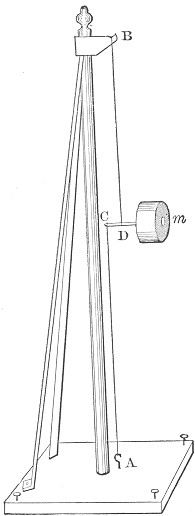
The Horizontal Pendulum.—This delicate instrument is Page 272 represented in Fig. 82. It consists of an upright standard, strongly braced; a weight, m, suspended by the hair-spring of a watch, B D, and held in a horizontal position by another watch-spring, A C. The weight is deflected from side to side by the slightest influence. The least change in the level of a base thirty-nine inches long that could be detected by a spirit-level is 0".1 of an arc—equal to raising one end 1/2068 of an inch. But the pendulum detects a raising of one end 1/36000000 of an inch. To observe the movements of the pendulum, it is kept in a dark room, and a ray of light is directed to the mirror, m, and thence reflected upon a screen. Thus the least movement may be enormously magnified, and read and measured by the moving spot on the screen. It has been discovered that when the sun rises it has sufficient attraction to incline this instrument to the east; when it sets, to incline it to the west. The same is true of the moon. When either is exactly overhead or underfoot, of course there is no deflection. The mean deflection caused by the moon at rising or setting is 0".0174; by the sun, 0".008. Great results are expected from this instrument hardly known as yet: among others, whether gravitation acts instantly or consumes time in coming from the sun. This will be shown by the time of the change of the pendulum from east to west when the sun reaches the zenith, and vice versa when it crosses the nadir. The sun will be best studied without light, in the quiet and darkness of some deep mine.
Page 273 Light of Unseen Stars.—From careful examination, it appears that three-fourths of the light on a fine starlight night comes from stars that cannot be discerned by the naked eye. The whole amount of star light is about one-eightieth of that of the full moon.
Lateral Movements of Stars, page 226-28.
Future Discoveries—A Trans-Neptunian Planet.—Professor Asaph Hall says: "It is known to me that at least two American astronomers, armed with powerful telescopes, have been searching quite recently for a trans-Neptunian planet. These searches have been caused by the fact that Professor Newcomb's tables of Uranus and Neptune already begin to differ from observation. But are we to infer from these errors of the planetary tables the existence of a trans-Neptunian planet? It is possible that such a planet may exist, but the probability is, I think, that the differences are caused by errors in the theories of these planets. * * * A few years ago the remark was frequently made that the labors of astronomers on the solar system were finished, and that henceforth they could turn their whole attention to sidereal astronomy. But to-day we have the lunar theory in a very discouraging condition, and the theories of Mercury, Jupiter, Saturn, Uranus, and Neptune all in need of revision; unless, indeed, Leverrier's theories of the last two planets shall stand the test of observation. But, after all, such a condition of things is only the natural result of long and accurate series of observations, which make evident the small inequalities in the motions, and bring to light the errors of theory."
Future discoveries will mostly reveal the laws and conditions of the higher and finer forces. Already Professor Loomis telegraphs twenty miles without wire, by the electric currents between mountains. We begin to use electricity for light, and feel after it for a motor. Comets and Auroras show its presence between worlds, and in the interstellar spaces. Let another Newton arise.