Page 75 V.
Reading edition
THE SUN.
"And God made two great lights; the greater light to rule the day, and the lesser light to rule the night: he made the stars also."—Gen. i. 16.
Page 76 "It is perceived that the sun of the world, with all its essence, which is heat and light, flows into every tree, and into every shrub and flower, and into every stone, mean as well as precious; and that every object takes its portion from this common influx, and that the sun does not divide its light and heat, and dispense a part to this and a part to that. It is similar with the sun of heaven, from which the Divine love proceeds as heat, and the Divine wisdom as light; these two flow into human minds, as the heat and light of the sun of the world into bodies, and vivify them according to the quality of the minds, each of which takes from the common influx as much as is necessary."—SWEDENBORG.
Page 77 V.
THE SUN.
Suppose we had stood on the dome of Boston Statehouse November 9th, 1872, on the night of the great conflagration, and seen the fire break out; seen the engines dash through the streets, tracking their path by their sparks; seen the fire encompass a whole block, leap the streets on every side, surge like the billows of a storm-swept sea; seen great masses of inflammable gas rise like dark clouds from an explosion, then take fire in the air, and, cut off from the fire below, float like argosies of flame in space. Suppose we had felt the wind that came surging from all points of the compass to fan that conflagration till it was light enough a mile away to see to read the finest print, hot enough to decompose the torrents of water that were dashed on it, making new fuel to feed the flame. Suppose we had seen this spreading fire seize on the whole city, extend to its environs, and, feeding itself on the very soil, lick up Worcester with its tongues of flame—Albany, New York, Chicago, St. Louis, Cincinnati—and crossing the plains swifter than a prairie fire, making each peak of the Rocky Mountains hold up aloft a separate torch of flame, and the Sierras whiter with heat than they ever were with snow, the waters of the Pacific resolve into their constituent elements of oxygen and hydrogen, and Page 78 burn with unquenchable fire! We withdraw into the air, and see below a world on fire. All the prisoned powers have burst into intensest activity. Quiet breezes have become furious tempests. Look around this flaming globe—on fire above, below, around—there is nothing but fire. Let it roll beneath us till Boston comes round again. No ember has yet cooled, no spire of flame has shortened, no surging cloud has been quieted. Not only are the mountains still in flame, but other ranges burst up out of the seething sea. There is no place of rest, no place not tossing with raging flame! Yet all this is only a feeble figure of the great burning sun. It is but the merest hint, a million times too insignificant.
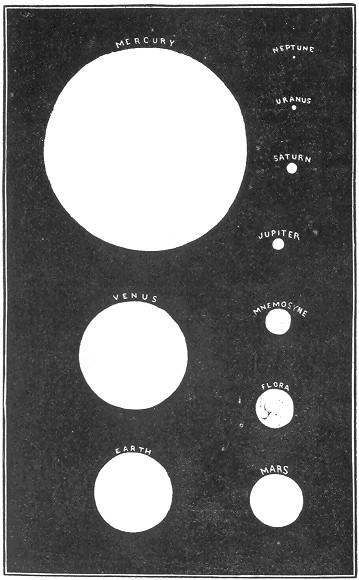
The sun appears small and quiet to us because we are so far away. Seen from the various planets, the relative size of the sun appears as in Fig. 30. Looked for from some of the stars about us, the sun could not be seen at all. Indeed, seen from the earth, it is not always the same size, because the distance is not always the same. If we represent the size of the sun by one thousand on the 23d of September or 21st of March, it would be represented by nine hundred and sixty-seven on the 1st of July, and by one thousand and thirty-four on the 1st of January.
We sometimes speak of the sun as having a diameter of 860,000 miles. We mean that that is the extent of the body as soon by the eye. But that is a small part of its real diameter. So we say the earth has an equatorial diameter of 7925-1/2 miles, and a polar one of 7899. But the air is as much a part of the earth as the rocks are. The electric currents are as much a part of the Page 79 earth as the ores and mountains they traverse. What the diameter of the earth is, including these, no man can tell. We used to say the air extended forty-five miles, but we now know that it reaches vastly farther. So of the sun, we might almost say that its diameter Fig. 30.—Relative Size of Sun as seen from Different Planets. is infinite, for its light and heat reach beyond our measurement. Its living, throbbing heart sends out pulsations, keeping all space full of its tides of living light.
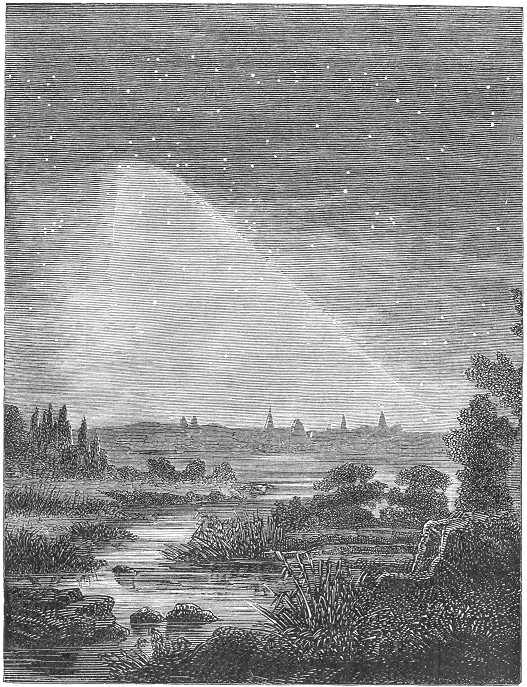
Page 80 Fig. 31.—Zodiacal Light.
We might say with evident truth that the far-off planets are a part of the sun, since the space they traverse is filled with the power of that controlling king; not only with light, but also with gravitating power.
But come to more ponderable matters. If we look Page 81 into our western sky soon after sunset, on a clear, moonless night in March or April, we shall see a dim, soft light, somewhat like the milky-way, often reaching, well defined, to the Pleiades. It is wedge-shaped, inclined to the south, and the smallest star can easily be seen through it. Mairan and Cassini affirm that they have seen sudden sparkles and movements of light in it. All our best tests show the spectrum of this light to be continuous, and therefore reflected; which indicates that it is a ring of small masses of meteoric matter surrounding the sun, revolving with it and reflecting its light. One bit of stone as large as the end of one's thumb, in a cubic mile, would be enough to reflect what light we see looking through millions of miles of it. Perhaps an eye sufficiently keen and far away would see the sun surrounded by a luminous disk, as Saturn is with his rings. As it extends beyond the earth's orbit, if this be measured as a part of the sun, its diameter would be about 200,000,000 miles.
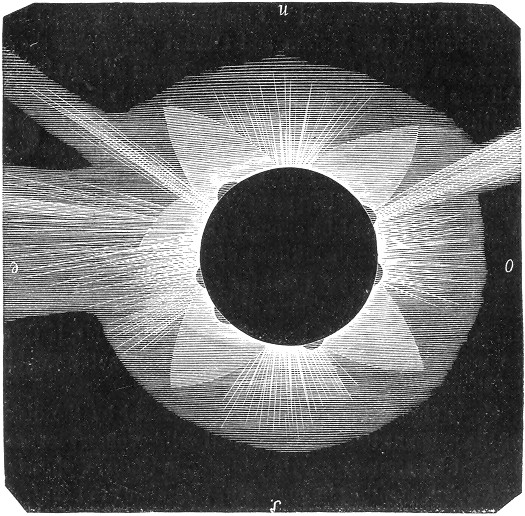
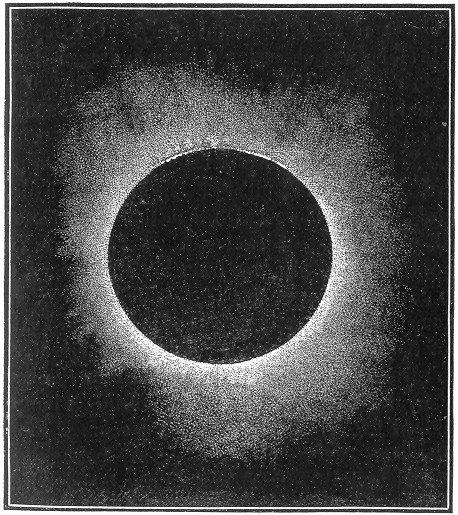
Come closer. When the sun is covered by the disk of the moon at the instant of total eclipse, observers are startled by strange swaying luminous banners, ghostly and weird, shooting in changeful play about the central darkness (Fig. 32). These form the corona. Men have usually been too much moved to describe them, and have always been incapable of drawing them in the short minute or two of their continuance. But in 1878 men travelled eight thousand miles, coming and returning, in order that they might note the three minutes of total eclipse in Colorado. Each man had his work assigned to him, and he was drilled to attend to that and nothing else. Improved instruments were put into his Page 82 hands, so that the sun was made to do his own drawing and give his own picture at consecutive instants. Fig. 33 is a copy of a photograph of the corona of 1878, by Mr. Henry Draper. It showed much less changeability that year than common, it being very near the time of least sun-spot. The previous picture was taken near the time of maximum sun-spot.
Fig. 32.—The Corona in 1858, Brazil.
It was then settled that the corona consists of reflected light, sent to us from dust particles or meteoroids swirling in the vast seas, giving new densities and Page 83 rarities, and hence this changeful light. Whether they are there by constant projection, and fall again to the sun, or are held by electric influence, or by force of orbital revolution, we do not know. That the corona cannot be in any sense an atmosphere of any continuous gas, is seen from the fact that the comet of 1843, passing within 93,000 miles of the body of the sun, was not burned out of existence as a comet, nor in any perceptible degree retarded in its motion. If the sun's diameter is to include the corona, it will be from 1,260,000 to 1,460,000 miles.
Fig. 33.—The Corolla in 1878, Colorado.
Page 84 Come closer still. At the instant of the totality of the eclipse red flames of most fantastic shape play along the edge of the moon's disk. They can be seen at any time by the use of a proper telescope with a spectroscope attached. I have seen them with great distinctness and brilliancy with the excellent eleven-inch telescope of the Wesleyan University. A description of their appearance is best given in the language of Professor Young, of Princeton College, who has made these flames the object of most successful study. On September 7th, 1871, he was observing a large hydrogen cloud by the sun's edge. This cloud was about 100,000 miles long, and its upper side was some 50,000 miles above the sun's surface, the lower side some 15,000 miles. The whole had the appearance of being supported on pillars of fire, these seeming pillars being in reality hydrogen jets brighter and more active than the substance of the cloud. At half-past twelve, when Professor Young chanced to be called away from his observatory, there were no indications of any approaching change, except that one of the connecting stems of the southern extremity of the cloud had grown considerably brighter and more curiously bent to one side; and near the base of another, at the northern end, a little brilliant lump had developed itself, shaped much like a summer thunderhead.
But when Professor Young returned, about half an hour later, he found that a very wonderful change had taken place, and that a very remarkable process was actually in progress. "The whole thing had been literally blown to shreds," he says, "by some inconceivable uprush from beneath. In place of the quiet cloud I had Page 85 Fig. 34.—Solar Prominences of Flaming Hydrogen. Page 87 left, the air—if I may use the expression—was filled with the flying débris, a mass of detached vertical fusi-form fragments, each from ten to thirty seconds (i. e., from four thousand five hundred to thirteen thousand five hundred miles) long, by two or three seconds (nine hundred to thirteen hundred and fifty miles) wide—brighter, and closer together where the pillars had formerly stood, and rapidly ascending. When I looked, some of them had already reached a height of nearly four minutes (100,000 miles); and while I watched them they arose with a motion almost perceptible to the eye, until, in ten minutes, the uppermost were more than 200,000 miles above the solar surface. This was ascertained by careful measurements, the mean of three closely accordant determinations giving 210,000 miles as the extreme altitude attained. I am particular in the statement, because, so far as I know, chromatospheric matter (red hydrogen in this case) has never before been observed at any altitude exceeding five minutes, or 135,000 miles. The velocity of ascent, also—one hundred and sixty-seven miles per second—is considerably greater than anything hitherto recorded. * * * As the filaments arose, they gradually faded away like a dissolving cloud, and at a quarter past one only a few filmy wisps, with some brighter streamers low down near the chromatosphere, remained to mark the place. But in the mean while the little 'thunder-head' before alluded to had grown and developed wonderfully into a mass of rolling and ever-changing flame, to speak according to appearances. First, it was crowded down, as it were, along the solar surface; later, it arose almost pyramidally 50,000 miles in height; then Page 88 its summit was drawn down into long filaments and threads, which were most curiously rolled backward and forward, like the volutes of an Ionic capital, and finally faded away, and by half-past two had vanished like the other. The whole phenomenon suggested most forcibly the idea of an explosion under the great prominence, acting mainly upward, but also in all directions outward; and then, after an interval, followed by a corresponding in-rush."
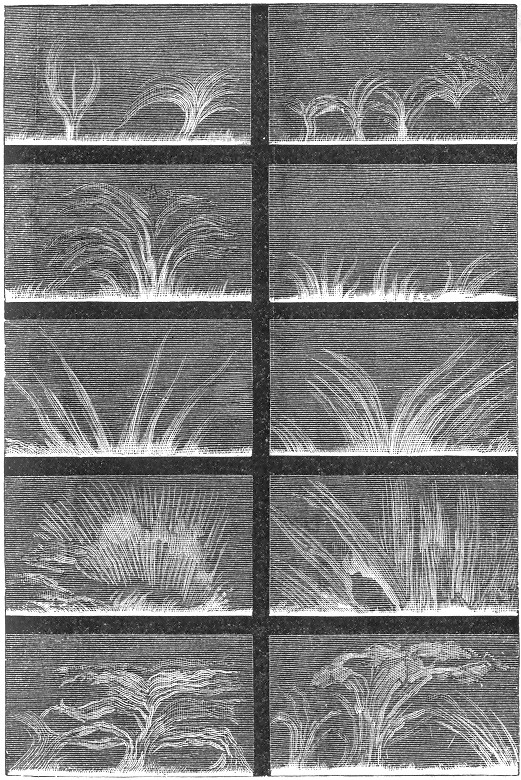
No language can convey nor mind conceive an idea of the fierce commotion we here contemplate. If we call these movements hurricanes, we must remember that what we use as a figure moves but one hundred miles an hour, while these move one hundred miles a second. Such storms of fire on earth, "coming down upon us from the north, would, in thirty seconds after they had crossed the St. Lawrence, be in the Gulf of Mexico, carrying with them the whole surface of the continent in a mass not simply of ruins but of glowing vapor, in which the vapors arising from the dissolution of the materials composing the cities of Boston, New York, and Chicago would be mixed in a single indistinguishable cloud." In the presence of these evident visions of an actual body in furious flame, we need hesitate no longer in accepting as true the words of St. Peter of the time "in which the [atmospheric] heavens shall pass away with a great noise, and the elements shall melt with fervent heat; the earth also, and the works that are therein, shall be burned up."
This region of discontinuous flame below the corona is called the chromosphere. Hydrogen is the principal material of its upper part; iron, magnesium, and other Page 89 metals, some of them as yet unknown on earth, but having a record in the spectrum, in the denser parts below. If these fierce fires are a part of the Sun, as they assuredly are, its diameter would be from 1,060,000 to 1,260,000 miles.
Let us approach even nearer. We see a clearly recognized even disk, of equal dimensions in every direction. This is the photosphere. We here reach some definitely measurable data for estimating its visible size. We already know its distance. Its disk subtends an angle of 32' 12".6, or a little more than half a degree. Three hundred and sixty such suns, laid side by side, would span the celestial arch from east to west with a half circle of light. Two lines drawn from our earth at the angle mentioned would be 860,000 miles apart at the distance of 92,500,000 miles. This, then, is the diameter of the visible and measurable part of the sun. It would require one hundred and eight globes like the earth in a line to measure the sun's diameter, and three hundred and thirty-nine, to be strung like the beads of a necklace, to encircle his waist. The sun has a volume equal to 1,245,000 earths, but being only one-quarter as dense, it has a mass of only 326,800 earths. It has seven hundred times the mass of all the planets, asteroids, and satellites put together. Thus it is able to control them all by its greater power of attraction.
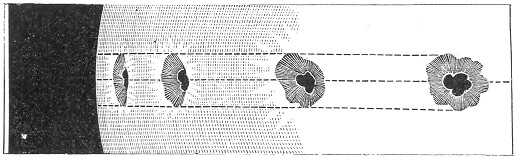
Concerning the condition of the surface of the sun many opinions are held. That it is hot beyond all estimate is indubitable. Whether solid or gaseous we are not sure. Opinions differ: some incline to the first theory, others to the second; some deem the sun composed of solid particles, floating in gas so condensed Page 90 by pressure and attraction as to shine like a solid. It has no sensible changes of general level, but has prodigious activity in spots. These spots have been the objects of earnest and almost hourly study on the part of such men as Secchi, Lockyer, Faye, Young, and others, for years. But it is a long way off to study an object. No telescope brings it nearer than 200,000 miles. Theory after theory has been advanced, each one satisfactory in some points, none in all. The facts about the spots are these: They are most abundant on the two sides of the equator. They are gregarious, depressed below the surface, of vast extent, black in the centre, usually surrounded by a region of partial darkness, beyond which is excessive light. They have motion of their own over the surface—motion rotating about an axis, upward and downward about the edges. They change their apparent shape as the sun carries them across its disk by axial revolution, being narrow as they present their edges to us, and rounder as we look perpendicularly into them (Fig. 35).
Fig. 35.—Change in Spots as rotated across the Disk, showing Cavities.
These spots are also very variable in number, sometimes there being none for nearly two hundred days, and again whole years during which the sun is never without them. The period from minimum to maximum Page 91 of spots is about eleven years. We might look for them again and again in vain this year (1878). They will be most numerous in 1882 and 1893. The cause of this periodicity was inferred to be the near approach of the enormous planet Jupiter, causing disturbance by its attraction. But the periods do not correspond, and the cause is the result of some law of solar action to us as yet unknown.
These spots may be seen with almost any telescope, the eye being protected by deeply colored glasses.
Until within one hundred years they were supposed to be islands of scoriæ floating in the sea of molten matter. But they were depressed below the surface, and showed a notch when on the edge. Wilson originated and Herschel developed the theory that the sun's real body was dark, cool, and habitable, and that the photosphere was a luminous stratum at a distance from the real body, with openings showing the dark spots below. Such a sun would have cooled off in a week, but would previously have annihilated all life below.
The solar spots being most abundant on the two sides of the equator, indicates their cyclonic character; the centre of a cyclone is rarefied, and therefore colder, and cold on the sun is darkness. M. Faye says: "Like our cyclones, they are descending, as I have proved by a special study of these terrestrial phenomena. They carry down into the depths of the solar mass the cooler materials of the upper layers, formed principally of hydrogen, and thus produce in their centre a decided extinction of light and heat as long as the gyratory movement continues. Finally, the hydrogen set free at the base of the whirlpool becomes reheated at this Page 92 great depth, and rises up tumultuously around the whirlpool, forming irregular jets, which appear above the chromosphere. These jets constitute the protuberances. The whirlpools of the sun, like those on the earth, are of all dimensions, from the scarcely visible pores to the enormous spots which we see from time to time. They have, like those of the earth, a marked tendency, first to increase and then to break up, and thus form a row of spots extending along the same parallel."
Fig. 36.—Solar spot, by Langley.
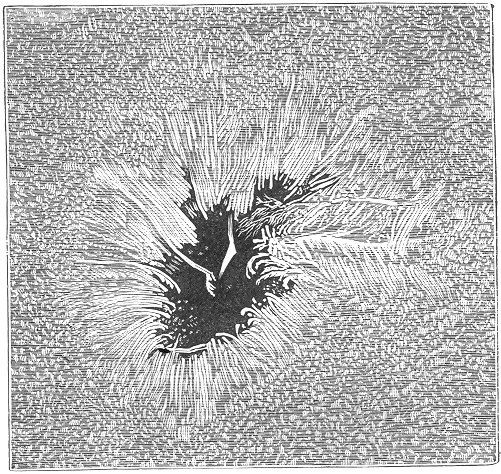
A spot of 20,000 miles diameter is quite small; there was one 14,816 miles across, visible to the naked eye for a week in 1843. This particular sun-spot somewhat Page 93 helped the Millerites. On the day of the eclipse, in 1858, a spot over 107,000 miles in extent was clearly seen. In such vast tempests, if there were ships built as large as the whole earth, they would be tossed like autumn leaves in an ocean storm.
The revolution of the sun carries a spot across its face in about fourteen days. After a lapse of as much more time, they often reappear on the other side, changed but recognizable. They often break ont or disappear under the eye of the observer. They divide like a piece of ice dropped on a frozen pond, the pieces sliding off in every direction, or combine like separate floes driven together into a pack. Sometimes a spot will last for more than two hundred days, recognizable through six or eight revolutions. Sometimes a spot will last only half an hour.
The velocities indicated by these movements are incredible. An up-rush and down-rush at the sides has been measured of twenty miles a second; a side-rush or whirl, of one hundred and twenty miles a second. These tempests rage from a few days to half a year, traversing regions so wide that our Indian Ocean, the realm of storms, is too small to be used for comparison; then, as they cease, the advancing sides of the spots approach each other at the rate of 20,000 miles an hour; they strike together, and the rising spray of fire leaps thousands of miles into space. It falls again into the incandescent surge, rolls over mountains as the sea over pebbles, and all this for eon after eon without sign of exhaustion or diminution. All these swift succeeding Himalayas of fire, where one hundred worlds could be buried, do not usually prevent the sun's appearing to our far-off eyes as a perfect sphere.
Page 94 What the Sun does for us.
To what end does this enormous power, this central source of power, exist? That it could keep all these gigantic forces within itself could not be expected. It is in a system where every atom is made to affect every other atom, and every world to influence every other. The Author of all lives only to do good, to send rain on the just and unjust, to cause his sun to rise on the evil and the good, and to give his spirit, like a perpetually widening river, to every man to profit withal.
The sun reaches his unrelaxing hand of gravitation to every other world at every instant. The tendency of every world is to fly off in a straight line. This tendency must be momentarily curbed, and the planet held in its true curve about the sun. These giant worlds must be perfectly handled. Their speed, amounting to seventy times as fast as that of a rifle-ball, must be managed. Each and every world may be said to be lifted momentarily and swung perpetually at arm's-length by the power of the sun.
The sun warms us. It would convey but a small idea of the truth to state how many hundreds of millions of cubic miles of ice could be hailed at the sun every second without affecting its heat; but, if any one has any curiosity to know, it is 287,200,000 cubic miles of ice per second.
We journey through space which has a temperature of 200° below zero; but we live, as it were, in a conservatory, in the midst of perpetual winter. We are roofed over by the air that treasures the heat, floored under by strata both absorptive and retentive of heat, Page 95 and between the earth and air violets grow and grains ripen. The sun has a strange chemical power. It kisses the cold earth, and it blushes with flowers and matures the fruit and grain. We are feeble creatures, and the sun gives us force. By it the light winds move one-eighth of a mile an hour, the storm fifty miles, the hurricane one hundred. The force is as the square of the velocity. It is by means of the sun that the merchant's white-sailed ships are blown safely home. So the sun carries off the miasma of the marsh, the pollution of cities, and then sends the winds to wash and cleanse themselves in the sea-spray. The water-falls of the earth turn machinery, and make Lowells and Manchesters possible, because the sun lifted all that water to the hills.
Intermingled with these currents of air are the currents of electric power, all derived from the sun. These have shown their swiftness and willingness to serve man. The sun's constant force displayed on the earth is equal to 543,000,000,000 engines of 400-horse power each, working day and night; and yet the earth receives only 1/21500000000 part of the whole force of the sun.
Besides all this, the sun, with provident care, has made and given to us coal. This omnipotent worker has stored away in past ages an inexhaustible reservoir of his power which man may easily mine and direct, thus releasing himself from absorbing toil.
EXPERIMENTS.
Any one may see the spots on the sun who has a spy-glass. Darken the room and put the glass through an opening toward the sun, as shown in Fig. 37. The eye-piece should be drawn out about half an inch beyond Page 96 its usual focusing for distant objects. The farther it is drawn, the nearer must we hold the screen for a perfect image.
By holding a paper near the eye-piece, the proper direction of the instrument may be discovered without injury to the eyes. By this means the sun can be studied from day to day, and its spots or the transits of Mercury and Venus shown to any number of spectators.
Fig. 37.—Holding Telescope to see the Sun's Spots.

First covering the eyes with very dark or smoked glasses, erect a disk of pasteboard four inches in diameter between you and the sun; close one eye; stand near it, and the whole sun is obscured. Withdraw from it till the sun's rays just shoot over the edge of the disk on every side. Measure the distance from the eye to the disk. You will be able to determine the distance of the sun by the rule of three: thus, as four inches is to 860,000 miles, so is distance from eye to disk to distance from disk to the sun. Take such measurements at sunrise, noon, and sunset, and see the apparently differing sizes due to refraction.