Page 55 IV.
Reading edition
CELESTIAL MEASUREMENTS.
"Who hath measured the waters in the hollow of his hand, and meted out heaven with the span? Mine hand also hath laid the foundation of the earth, and my right hand hath spanned the heavens."—Isa. xl. 12; xlviii. 13.
Page 56 "Go to yon tower, where busy science plies Her vast antennæ, feeling thro' the skies; That little vernier, on whose slender lines The midnight taper trembles as it shines, A silent index, tracks the planets' march In all their wanderings thro' the ethereal arch, Tells through the mist where dazzled Mercury burns, And marks the spot where Uranus returns.
"So, till by wrong or negligence effaced, The living index which thy Maker traced Repeats the line each starry virtue draws Through the wide circuit of creation's laws; Still tracks unchanged the everlasting ray Where the dark shadows of temptation stray; But, once defaced, forgets the orbs of light, And leaves thee wandering o'er the expanse of night." OLIVER WENDELL HOLMES.
Page 57 IV.
CELESTIAL MEASUREMENTS.
We know that astronomy has what are called practical uses. If a ship had been driven by Euroclydon ten times fourteen days and nights without sun or star appearing, a moment's glance into the heavens from the heaving deck, by a very slightly educated sailor, would tell within one hundred yards where he was, and determine the distance and way to the nearest port. We know that, in all final and exact surveying, positions must be fixed by the stars. Earth's landmarks are uncertain and easily removed; those which we get from the heavens are stable and exact.
In 1878 the United States steam-ship Enterprise was sent to survey the Amazon. Every night a "star party" went ashore to fix the exact latitude and longitude by observations of the stars. Our real landmarks are not the pillars we rear, but the stars millions of miles away. All our standards of time are taken from the stars; every railway train runs by their time to avoid collision; by them all factories start and stop. Indeed, we are ruled by the stars even more than the old astrologers imagined.
Man's finest mechanism, highest thought, and broadest exercise of the creative faculty have been inspired by astronomy. No other instruments approximate in delicacy those which explore the heavens; no other Page 58 system of thought can draw such vast and certain conclusions from its premises. "Too low they build who build beneath the stars;" we should lay our foundations in the skies, and then build upward.
We have been placed on the outside of this earth, instead of the inside, in order that we may look abroad. We are carried about, through unappreciable distance, at the inconceivable velocity of one thousand miles a minute, to give us different points of vision. The earth, on its softly-spinning axle, never jars enough to unnest a bird or wake a child; hence the foundations of our observatories are firm, and our measurements exact. Whoever studies astronomy, under proper guidance and in the right spirit, grows in thought and feeling, and becomes more appreciative of the Creator.
Celestial Movements.
Let it not be supposed that a mastery of mathematics and a finished education are necessary to understand the results of astronomical research. It took at first the highest power of mind to make the discoveries that are now laid at the feet of the lowliest. It took sublime faith, courage, and the results of ages of experience in navigation, to enable Columbus to discover that path to the New World which now any little boat can follow. Ages of experience and genius are stored up in a locomotive, but quite an unlettered man can drive it. It is the work of genius to render difficult matters plain, abstruse thoughts clear.
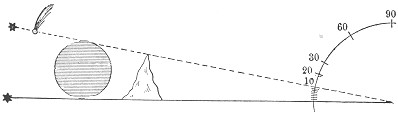
A brief explanation of a few terms will make the principles of world inspection easily understood. Imagine a perfect circle thirty feet in diameter—that is, create Page 59 one (Fig. 19). Draw through it a diameter horizontally, another Fig. 19. perpendicularly. The angles made by the intersecting lines are each said to be ninety degrees, marked thus °. The arc of a circle included between any two of the lines is also 90°. Every circle, great or small, is divided into these 360°. If the sun rose in the east and came to the zenith at noon, it would have passed 90°. When it set in the west it would have traversed half the circle, or 180°. In Fig. 20 the angle of the lines measured on the graduated arc is 10°. The mountain is 10° high, the world 10° in diameter, the comet moves 10° a day, the stars are 10° apart. The height of the mountain, the diameter of the world, the velocity of the comet, and the distance between the stars, depend on the distance of each from the point of sight. Every degree is divided into 60 minutes (marked '), and every minute into 60 seconds (marked ").
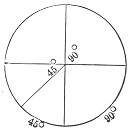
Fig. 20.—Illustration of Angles.
Imagine yourself inside a perfect sphere one hundred feet in diameter, with the interior surface above, around, and below studded with fixed bright points like stars. The familiar constellations of night might be blazoned there in due proportion.
If this star-sprent sphere were made to revolve once in twenty-four hours, all the stars would successively Page 60 pass in review. How easily we could measure distances between stars, from a certain fixed meridian, or the equator! How easily we could tell when any particular star would culminate! It is as easy to take all these measurements when our earthly observatory is steadily revolved within the sphere of circumambient stars. Stars can be mapped as readily as the streets of a great city. Looking down on it in the night, one could trace the lines of lighted streets, and judge something of its extent and regularity. But the few lamps of evening would suggest little of the greatness of the public buildings, the magnificent enterprise and commerce of its citizens, or the intelligence of its scholars. Looking up to the lamps of the celestial city, one can judge something of its extent and regularity; but they suggest little of the magnificence of the many mansions.
Stars are reckoned as so many degrees, minutes, and seconds from each other, from the zenith, or from a given meridian, or from the equator. Thus the stars called the Pointers, in the Great Bear, are 5° apart; the nearest one is 29° from the Pole Star, which is 39° 56' 29" above the horizon at Philadelphia. In going to England you creep up toward the north end of the earth, till the Pole Star is 54° high. It stays near its place among the stars continually,
"Of whose true-fixed and resting quality There is no fellow in the firmament."
How to Measure.
Suppose a telescope, fixed to a mural circle, to revolve on an axis, as in Fig. 21; point it horizontally at a star; Page 61 turn it up perpendicular to another star. Of course the two stars are 90° apart, and the graduated scale, which is attached to the outer edge of the circle, shows a revolution of a quarter circle, or 90°, But a perfect accuracy of measurement must be sought; for to mistake the breadth of a hair, seen at the distance of one hundred and twenty-five feet, would cause an error of 3,000,000 miles at the distance of the sun, and immensely more at the distance of the stars. The correction of an inaccuracy of no greater magnitude than that has reduced our estimate of the distance of our sun 3,000,000 miles.
Fig. 21.—Mural Circle.
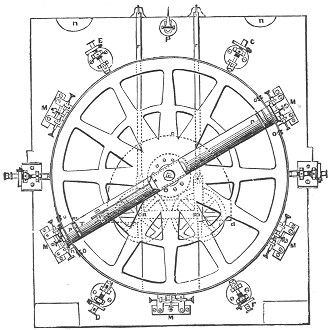
Consider the nicety of the work. Suppose the graduated scale to be thirty feet in circumference. Divided into 360°, each would be one inch long. Divide each degree into 60', each one is 1/60 of an inch long. It takes good eyesight to discern it. But each minute must be Page 62 divided into 60", and these must not only be noted, but even tenths and hundredths of seconds must be discerned. Of course they are not seen by the naked eye; some mechanical contrivance must be called in to assist. A watch loses two minutes a week, and hence is unreliable. It is taken to a watch-maker that every single second may be quickened 1/20160 part of itself. Now 1/20000 part of a second would be a small interval of time to measure, but it must be under control. If the temperature of a summer morning rises ten or twenty degrees we scarcely notice it; but the magnetic tastimeter measures 1/5000 of a degree.
Come to earthly matters. In 1874, after nearly twenty-eight years' work, the State of Massachusetts opened a tunnel nearly five miles long through the Hoosac Mountains. In the early part of the work the engineers sunk a shaft near the middle 1028 feet deep. Then the question to be settled was where to go so as to meet the approaching excavations from the east and west. A compass could not be relied on under a mountain. The line must be mechanically fixed. A little divergence at the starting-point would become so great, miles away, that the excavations might pass each other without meeting; the grade must also rise toward the central shaft, and fall in working away from it; but the lines were fixed with such infinitesimal accuracy that, when the one going west from the eastern portal and the one going east from the shaft met in the heart of the mountain, the western line was only one-eighth of an inch too high, and three-sixteenths of an inch too far north. To reach this perfect result they had to triangulate from the eastern portal to distant mountain Page 63 peaks, and thence down the valley to the central shaft, and thus fix the direction of the proposed line across the mouth of the shaft. Plumb-lines were then dropped one thousand and twenty-eight feet, and thus the line at the bottom was fixed.
Three attempts were made—in 1867, 1870, and 1872—to fix the exact time-distance between Greenwich and Washington. These three separate efforts do not differ one-tenth of a second. Such demonstrable results on earth greatly increase our confidence in similar measurements in the skies.
A scale is frequently affixed to a pocket-rule, by which we can easily measure one-hundredth of an inch (Fig. 22). The upper and Fig. 22. lower line is divided into tenths of an inch. Observe the slanting line at the right hand. It leans from the perpendicular one-tenth of an inch, as shown by noticing where it reaches the top line. When it reaches the second horizontal line it has left the perpendicular one-tenth of that tenth—that is, one-hundredth. The intersection marks 99/100 of an inch from one end, and one-hundredth from the other.
When division-lines, on measures of great nicety, get too fine to be read by the eye, we use the microscope. By its means we are able to count 112,000 lines ruled on a glass plate within an inch. The smallest object that can be seen by a keen eye makes an angle of 40", but by putting six microscopes on the scale of the telescope on the mural circle, we are able to reach an exactness of 0".1, or 1/3600 of an inch. This instrument is used to measure the declination of stars, or angular Page 64 distance north or south of the equator. Thus a star's place in two directions is exactly fixed. When the telescope is mounted on two pillars instead of the face of a wall, it is called a transit instrument. This is used to determine the time of transit of a star over the meridian, and if the transit instrument is provided with a graduated circle it can also be used for the same purposes as the mural circle. Man's capacity to measure exactly is indicated in his ascertainment of the length of waves of light. It is easy to measure the three hundred feet distance between the crests of storm-waves in the wide Atlantic; easy to measure the different wave-lengths of the different tones of musical sounds. So men measure the lengths of the undulations of light. The shortest is of the violet light, 154.84 ten-millionths of an inch. By the horizontal pendulum Professor Root has made 1/36000000 of an inch apparent.
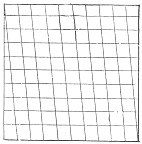
The next elements of accuracy must be perfect time and perfect notation of time. As has been said, we get our time from the stars. Thus the infinite and heavenly dominates the finite and earthly. Clocks are set to the invariable sidereal time. Sidereal noon is when we have turned ourselves under the point where the sun crosses the equator in March, called the vernal equinox. Sidereal clocks are figured to indicate twenty-four hours in a day: they tick exact seconds. To map stars we wish to know the exact second when they cross the meridian, or the north and south line in the celestial dome above us. The telescope (Fig. 21, p. 61) swings exactly north and south. In its focus a set of fine threads of spider-lines is placed (Fig. 23). The telescope is set just high enough, so that by the rolling over of the earth Page 65 the star will come into the field just above the horizontal thread. Fig. 23.—Transit of a Star noted. The observer notes the exact second and tenth of a second when the star reaches each vertical thread in the instrument, adds together the times and divides by five to get the average, and the exact time is reached.
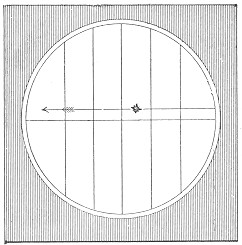
But man is not reliable enough to observe and record with sufficient accuracy. Some, in their excitement, anticipate its positive passage, and some cannot get their slow mental machinery in motion till after it has made the transit. Moreover, men fall into a habit of estimating some numbers of tenths of a second oftener than others. It will be found that a given observer will say three tenths or seven tenths oftener than four or eight. He is falling into ruts, and not trustworthy. General O. M. Mitchel, who had been director of the Cincinnati Observatory, once told one of his staff-officers that he was late at an appointment. "Only a few minutes," said the officer, apologetically. "Sir," said the general, "where I have been accustomed to work, hundredths of a second are too important to be neglected." And it is to the rare genius of this astronomer, and to others, that we owe the mechanical accuracy that we now attain. The clock is made to mark its seconds on paper wrapped around a revolving cylinder. Under the observer's fingers is an electric key. This he can touch at the instant of the transit of the star Page 66 over each wire, and thus put his observation on the same line between the seconds dotted by the clock. Of course these distances can be measured to minute fractional parts of a second.
But it has been found that it takes an appreciable time for every observer to get a thing into his head and out of his finger-ends, and it takes some observers longer than others. A dozen men, seeing an electric spark, are liable to bring down their recording marks in a dozen different places on the revolving paper. Hence the time that it takes for each man to get a thing into his head and out of his fingers is ascertained. This time is called his personal equation, and is subtracted from all of his observations in order to get at the true time; so willing are men to be exact about material matters. Can it be thought that moral and spiritual matters have no precision? Thus distances east or west from any given star or meridian are secured; those north and south from the equator or the zenith are as easily fixed, and thus we make such accurate maps of the heavens that any movements in the far-off stars—so far that it may take centuries to render the swiftest movements appreciable—may at length be recognized and accounted for.
Fig. 24.
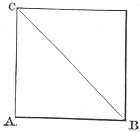
Fig. 25.—Measuring Distances.
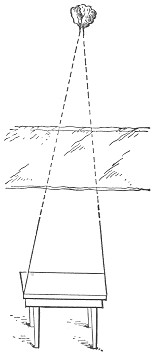
We now come to a little study of the modes of measuring distances. Create a perfect square (Fig. 24); draw a diagonal line. The square angles are 90°, the divided angles give two of 45° each. Now the base A B is equal to the perpendicular A C. Now any point—C, where a perpendicular, A C, and a diagonal, B C, meet—will be Page 67 as far from A as B is. It makes no difference if a river flows between A and C, and we cannot go over it; we can measure its distance as easily as if we could. Set a table four feet by eight out-doors (Fig. 25); so arrange it that, looking along one end, the line of sight just strikes a tree the other side of the river. Go to the other end, and, looking toward the tree, you find the line of sight to the tree falls an inch from the end of the table on the farther side. The lines, therefore, approach each other one inch in every four feet, and will come together at a tree three hundred and eighty-four feet away.
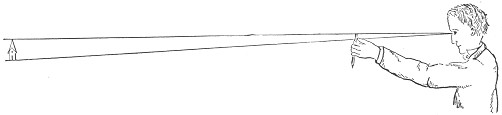
The next process is to measure the height or magnitude of objects at an ascertained distance. Put two pins in a stick half an inch apart (Fig. 26). Hold it up two feet from the eye, and let the upper pin fall in line with your eye and the top of a distant church steeple, and the lower pin in line with the bottom of the church and your eye. If the church is three-fourths of a mile away, it must be eighty-two feet high; if a mile away, it must be one hundred and ten feet high. For if two lines spread Page 68 one-half an inch going two feet, in going four feet they will spread an inch, and in going a mile, or five thousand two hundred and eighty feet, they will spread out one-fourth as many inches, viz., thirteen hundred and twenty—that is, one hundred and ten feet. Of course these are not exact methods of measurement, and would not be correct to a hair at one hundred and twenty-five feet, but they perfectly illustrate the true methods of measurement.
Fig. 26.—Measuring Elevations.
Imagine a base line ten inches long. At each end erect a perpendicular line. If they are carried to infinity they will never meet: will be forever ten inches apart. But at the distance of a foot from the base line incline one line toward the other 63/10000000 of an inch, and the lines will come together at a distance of three hundred miles. That new angle differs from the former right angle almost infinitesimally, but it may be measured. Its value is about three-tenths of a second. If we lengthen the base line from ten inches to all the miles we can command, of course the point of meeting will be proportionally more distant. The angle made by the lines where they come together will be obviously the same as the angle of divergence from a right angle at this end. That angle is called the parallax of any body, and is the angle that would be made by two lines coming from that body to the two ends of any conventional base, as the semi-diameter of the earth. That that angle would vary according to the various distances is easily seen by Fig. 27.
Let O P be the base. This would subtend a greater angle seen from star A than from star B. Let B be far enough away, and O P would become invisible, and B Page 69 would have no parallax for that base. Thus the moon has a parallax of 57" with the semi-equatorial diameter of the earth for a base. And the sun has a parallax 8".85 on the same base. It is not necessary to confine ourselves to right angles in these measurements, for the same principles hold true in any angles. Now, suppose two observers Fig. 27. on the equator should look at the moon at the same instant. One is on the top of Cotopaxi, on the west coast of South America, and one on the west coast of Africa. They are 90° apart—half the earth's diameter between them. The one on Cotopaxi sees it exactly overhead, at an angle of 90° with the earth's diameter. The one on the coast of Africa sees its angle with the same line to be 89° 59' 3"—that is, its parallax is 57". Try the same experiment on the sun farther away, as is seen in Fig. 27, and its smaller parallax is found to be only 8".85.
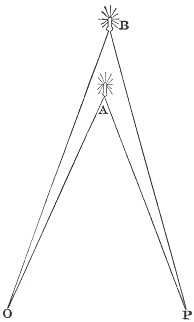
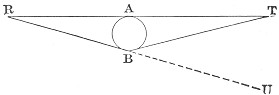
It is not necessary for two observers to actually station themselves at two distant parts of the earth in order to determine a parallax. If an observer could go from one end of the base-line to the other, he could determine both angles. Every observer is actually carried along through space by two motions: one is that of the earth's revolution of one thousand miles an hour around the axis; and the other is the movement of the earth around the sun of one thousand miles in a minute. Hence we can have the diameter not only of Page 70 the earth (eight thousand miles) for a base-line, but the diameter of the earth's orbit (184,000,000 miles), or any part of it, for such a base. Two observers at the ends of the earth's diameter, looking at a star at the same instant, would find that it made the same angle at both ends; it has no parallax on so short a base. We must seek a longer one. Observe a certain star on the 21st of March; then let us traverse the realms of space for six months, at one thousand miles a minute. We come round in our orbit to a point opposite where we were six months ago, with 184,000,000 of miles between the points. Now, with this for a base-line, measure the angles of the same stars: it is the same angle. Sitting in my study here, I glance out of the window and discern separate bricks, in houses five hundred feet away, with my unaided eye; they subtend a discernible angle. But one thousand feet away I cannot distinguish individual bricks; their width, being only two inches, does not subtend an angle apprehensible to my vision. So at these distant stars the earth's enormous orbit, if lying like a blazing ring in space, with the world set on its edge like a pearl, and the sun blazing like a diamond in the centre, would all shrink to a mere point. Not quite to a point from the nearest stars, or we should never be able to measure the distance of any of them. Professor Airy says that our orbit, seen from the nearest star, would be the same as a circle six-tenths of an inch in diameter seen at the distance of a mile: it would all be hidden by a thread one-twenty-fifth of an inch in diameter, held six hundred and fifty feet from the eye. If a straight line could be drawn from a star, Sirius in the east to the star Vega in the west, touching our Page 71 earth's orbit on one side, as T R A (Fig. 28), and a line were Fig. 28. to be drawn six months later from the same stars, touching our earth's orbit on the other side, as R B T, such a line would not diverge sufficiently from a straight line for us to detect its divergence. Numerous vain attempts had been made, up to the year 1835, to detect and measure the angle of parallax by which we could rescue some one or more of the stars from the inconceivable depths of space, and ascertain their distance from us. We are ever impelled to triumph over what is declared to be unconquerable. There are peaks in the Alps no man has ever climbed. They are assaulted every year by men zealous of more worlds to conquer. So these greater heights of the heavens have been assaulted, till some ambitious spirits have outsoared even imagination by the certainties of mathematics.
It is obvious that if one star were three times as far from us as another, the nearer one would seem to be displaced by our movement in our orbit three times as much as the other; so, by comparing one star with another, we reach a ground of judgment. The ascertainment of longitude at sea by means of the moon affords a good illustration. Along the track where the moon sails, nine bright stars, four planets, and the sun have been selected. The nautical almanacs give the distance of the moon from these successive stars every hour in the night for three years in advance. The sailor can measure the distance at any time by his sextant. Looking from the world at D (Fig. 29), the distance of the moon and Page 72 star is A E, which is given in the almanac. Looking from C, the distance is only B E, which enables even the uneducated sailor to find the distance, C D, on the earth, or his distance from Greenwich.
Fig. 29.—Mode of Ascertaining Longitude.

So, by comparisons of the near and far stars, the approximate distance of a few of them has been determined. The nearest one is the brightest star in the Centaur, never visible in our northern latitudes, which has a parallax of about one second. The next nearest is No. 61 in the Swan, or 61 Cygni, having a parallax of 0".34. Approximate measurements have been made on Sirius, Capella, the Pole Star, etc., about eighteen in all. The distances are immense: only the swiftest agents can traverse them. If our earth were suddenly to dissolve its allegiance to the king of day, and attempt a flight to the North Star, and should maintain its flight of one thousand miles a minute, it would flyaway toward Polaris for thousands upon thousands of years, till a million years had passed away, before it reached that northern dome of the distant sky, and gave its new allegiance to another sun. The sun it had left behind it would gradually diminish till it was small as Arcturus, then small as could be discerned by the naked eye, until at last it would finally fade out in utter darkness long before the new sun was reached. Light can traverse the distance around our earth eight times in one second. It comes in eight minutes from the sun, but it takes three and a quarter years to come from Alpha Page 73 Centauri, seven and a quarter years from 61 Cygni, and forty-five years from the Polar Star.
Sometimes it happens that men steer along a lee shore, dependent for direction on Polaris, that light-house in the sky. Sometimes it has happened that men have traversed great swamps by night when that star was the light-housse of freedom. In either case the exigency of life and liberty was provided for forty-five years before by a Providence that is divine.
We do not attempt to name in miles these enormous distances; we must seek another yard-stick. Our astronomical unit and standard of measurement is the distance of the earth from the sun—92,500,000 miles. This is the golden reed with which we measure the celestial city. Thus, by laying down our astronomical unit 226,000 times, we measure to Alpha Centauri, more than twenty millions of millions of miles. Doubtless other suns are as far from Alpha Centauri and each other as that is from ours.
Stars are not near or far according to their brightness. 61 Cygni is a telescopic star, while Sirius, the brightest star in the heavens, is twice as far away from us. One star differs from another star in intrinsic glory.
The highest testimonies to the accuracy of these celestial observations are found in the perfect predictions of eclipses, transits of planets over the sun, occultation of stars by the moon, and those statements of the Nautical Almanac that enable the sailor to know exactly where he is on the pathless ocean by the telling of the stars: "On the trackless ocean this book is the mariner's trusted friend and counsellor; daily and nightly its revelations bring safety to ships in all parts of the Page 74 world. It is something more than a mere book; it is an ever-present manifestation of the order and harmony of the universe."
Another example of this wonderful accuracy is found in tracing the asteroids. Within 200,000,000 or 300,000,000 miles from the sun, the one hundred and ninety-two minute bodies that have been already discovered move in paths very nearly the same—indeed two of them traverse the same orbit, being one hundred and eighty degrees apart;—they look alike, yet the eye of man in a few observations so determines the curve of each orbit, that one is never mistaken for another. But astronomy has higher uses than fixing time, establishing landmarks, and guiding the sailor. It greatly quickens and enlarges thought, excites a desire to know, leads to the utmost exactness, and ministers to adoration and love of the Maker of the innumerable suns.