Page 15 II.
Reading edition
CREATIVE PROGRESS.
"And God said, Let there be light, and there was light."—Genesis i., 3.
"God is light."—1 John, i. 5.
Page 16 "Hail! holy light, offspring of Heaven first born, Or of the eternal, co-eternal beam, May I express thee unblamed? since God is light, And never but in unapproached light Dwelt from eternity, dwelt then in thee, Bright effluence of bright essence increate." MILTON.
"A million torches lighted by Thy hand Wander unwearied through the blue abyss: They own Thy power, accomplish Thy command, All gay with life, all eloquent with bliss. What shall we call them? Piles of crystal light— A glorious company of golden streams— Lamps of celestial ether burning bright— Suns lighting systems with their joyous beams? But 'Thou to these art as the noon to night." DERZHAVIN, trans. by BOWRING.
Page 17 II.
CREATIVE PROGRESS.
Worlds would be very imperfect and useless when simply endowed with attraction and inertia, if no time were allowed for these forces to work out their legitimate results. We want something more than swirling seas of attracted gases, something more than compacted rocks. We look for soil, verdure, a paradise of beauty, animal life, and immortal minds. Let us go on with the process.
Light is the child of force, and the child, like its father, is full of power. We dowered our created world with but a single quality—a force of attraction. It not only had attraction for its own material substance, but sent out an all-pervasive attraction into space. By the force of condensation it flamed like a sun, and not only lighted its own substance, but it filled all space with the luminous outgoings of its power. A world may be limited, but its influence cannot; its body may have bounds, but its soul is infinite. Everywhere is its manifestation as real, power as effective, presence as actual, as at the central point. He that studies ponderable bodies alone is not studying the universe, only its skeleton. Skeletons are somewhat interesting in themselves, but far more so when covered with flesh, flushed with beauty, and inspired with soul. The universe has bones, Page 18 flesh, beauty, soul, and all is one. It can be understood only by a study of all its parts, and by tracing effect to cause.
But how can condensation cause light? Power cannot be quiet. The mighty locomotive trembles with its own energy. A smitten piece of iron has all its infinitesimal atoms set in vehement commotion; they surge back and forth among themselves, like the waves of a storm-blown lake. Heat is a mode of motion. A heated body commences a vigorous vibration among its particles, and communicates these vibrations to the surrounding air and ether. When these vibrations reach 396,000,000,000,000 per second, the human eye, fitted to be affected by that number, discerns the emitted undulations, and the object seems to glow with a dull red light; becoming hotter, the vibrations increase in rapidity. When they reach 765,000,000,000,000 per second the color becomes violet, and the eye can observe them no farther. Between these numbers are those of different rapidities, which affect the eye—as orange, yellow, green, blue, indigo, in an almost infinite number of shades—according to the sensitiveness of the eye.
We now see how our dark immensity of attractive atoms can become luminous. A force of compression results in vibrations within, communicated to the ether, discerned by the eye. Illustrations are numerous. If we suddenly push a piston into a cylinder of brass, the force produces heat enough to set fire to an inflammable substance within. Strike a half-inch cube of iron a moderate blow and it becomes warm; a sufficient blow, and its vibrations become quick enough to be seen—it is red-hot. Attach a thermometer to an extended Page 19 arm of a whirling wheel; drive it against the air five hundred feet per second, the mercury rises 16°. The earth goes 98,000 feet per second, or one thousand miles a minute. If it come to an aerolite or mass of metallic rock, or even a cloudlet of gas, standing still in space, its contact with our air evolves 600,000° of heat. And when the meteor comes toward the world twenty-six miles a second, the heat would become proportionally greater if the meteor could abide it, and not be consumed in fervent heat. It vanishes almost as soon as seen. If there were meteoric masses enough lying in our path, our sky would blaze with myriads of flashes of light. Enough have been seen to enable a person to read by them at night. If a sufficient number were present, we should miss their individual flashes as they blend their separate fires in one sea of insufferable glory. The sun is 1,300,000 times as large as our planet; its attraction proportionally greater; the aerolites more numerous; and hence an infinite hail of stones, small masses and little worlds, makes ceaseless trails of light, whose individuality is lost in one dazzling sea of glory.
On the 1st day of September, 1859, two astronomers, independently of each other, saw a sudden brightening on the surface of the sun. Probably two large meteoric masses were travelling side by side at two or three hundred miles per second, and striking the sun's atmosphere, suddenly blazed into light bright enough to be seen on the intolerable light of the photosphere as a background. The earth responded to this new cause of brilliance and heat in the sun. Vivid auroras appeared, not only at the north and south poles, but even where such spectacles are seldom seen. The electro-magnetic Page 20 disturbances were more distinctly marked. "In many places the telegraphic wires struck work. In Washington and Philadelphia the electric signalmen received severe electric shocks; at a station in Norway the telegraphic apparatus was set fire to; and at Boston a flame of fire followed the pen of Bain's electric telegraph." There is the best of reason for believing that a continuous succession of such bodies might have gone far toward rendering the earth uncomfortable as a place of residence.
Of course, the same result of heat and light would follow from compression, if a body had the power of contraction in itself. We endowed every particle of our gas, myriads of miles in extent, with an attraction for every other particle. It immediately compressed itself into a light-giving body, which flamed out through the interstellar spaces, flushing all the celestial regions with exuberant light.
But heat exerts a repellent force among particles, and soon an equilibrium is reached, for there comes a time when the contracting body can contract no farther. But heat and light radiate away into cold space, then contraction goes on evolving more light, and so the suns flame on through the millions of years unquenched. It is estimated that the contraction of our sun, from filling immensity of space to its present size, could not afford heat enough to last more than 18,000,000 years, and that its contraction from its present density (that of a swamp) to such rock as that of which our earth is composed, could supply heat enough for 17,000,000 years longer. But the far-seeing mind of man knows a time must come when the present force of attraction Page 21 shall have produced all the heat it can, and a new force of attraction must be added, or the sun itself will become cold as a cinder, dead as a burned-out char.
Since light and heat are the product of such enormous cosmic forces, they must partake of their nature, and be force. So they are. The sun has long arms, and they are full of unconquerable strength ninety-two millions, or any other number of millions, of miles away. All this light and heat comes through space that is 200° below zero, through utter darkness, and appears only on the earth. So the gas is darkness in the underground pipes, but light at the burner. So the electric power is unfelt by the cable in the bosom of the deep, but is expressive of thought and feeling at the end. Having found the cause of light, we will commence a study of its qualities and powers.
Light is the astronomer's necessity. When the sublime word was uttered, "Let there be light!" the study of astronomy was made possible. Man can gather but little of it with his eye; so he takes a lens twenty-six inches in diameter, and bends all the light that passes through it to a focus, then magnifies the image and takes it into his eye. Or he takes a mirror, six feet in diameter, so hollowed in the middle as to reflect all the rays falling upon it to one point, and makes this larger eye fill his own with light. By this larger light-gathering he discerns things for which the light falling on his pupil one-fifth of an inch in diameter would not be sufficient. We never have seen any sun or stars; we have only seen the light that left them fifty minutes or years ago, more or less. Light is the aërial sprite that carries our measuring-rods across the infinite Page 22 spaces; light spreads out the history of that far-off beginning; brings us the measure of stars a thousand times brighter than our sun; takes up into itself evidences of the very constitutional elements of the far-off suns, and spreads them at our feet. It is of such capacity that the Divine nature, looking for an expression of its own omnipotence, omniscience, and power of revelation, was content to say, "God is Light." We shall need all our delicacy of analysis and measurement when we seek to determine the activities of matter so fine and near to spirit as light.
Fig. 4.—Velocity of Light measured by Eclipses of Jupiter's Moons.
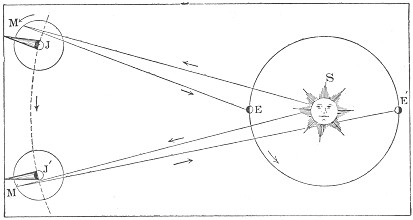
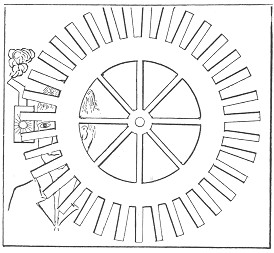
We first seek the velocity of light. In Fig. 4 the earth is 92,500,000 miles from the sun at E; Jupiter is 480,000,000 miles from the sun at J. It has four moons: the inner one goes around the central body in forty-two hours, and is eclipsed at every revolution. The light that went out from the sun to M ceases to be reflected back to the earth by the intervention of the planet Jupiter. We know to a second when these eclipses take place, and they can be seen with a small telescope. But when the earth is on the opposite side of the sun Page 23 from Jupiter, at E', these eclipses at J' take place sixteen and a half minutes too late. What is the reason? Is the celestial chronometry getting deranged? No, indeed; these great worlds swing never an inch out of place, nor a second out of time. By going to the other side of the sun the earth is 184,000,000 miles farther from Jupiter, and the light that brings the intelligence of that eclipse consumes the extra time in going over the extra distance. Divide one by the other and we get the velocity, 185,000 miles Fig. 5.—Measuring the Velocity of Light. per second. That is probably correct to within a thousand miles. Methods of measurement by the toothed wheel of Fizeau confirm this result. Suppose the wheel, Fig. 5, to have one thousand teeth, making five revolutions to the second. Five thousand flashes of light each second will dart out. Let each flash travel nine miles to a mirror and return. If it goes that distance in 1/10000 of a second, or at the rate of 180,000 miles a second, the next tooth will have arrived before the eye, and each returning ray be cut off. Hasten the revolutions a little, and the next notch will then admit the ray, on its return, that went out of each previous notch: the eighteen miles having been traversed meanwhile. The method of measuring by means of a revolving mirror, used by Faucault, is held to be even more accurate.
When we take instantaneous photographs by the exposure Page 24 of the sensitive plate 1/20000 part of a second, a stream of light nine miles long dashes in upon the plate in that very brief period of time.
The highest velocity we can give a rifle-ball is 2000 feet a second, the next second it is only 1500 feet, and soon it comes to rest. We cannot compact force enough behind a bit of lead to keep it flying. But light flies unweariedly and without diminution of speed. When it has come from the sun in eight minutes, Alpha Centauri in three years, Polaris in forty-five years, other stars in one thousand, its wings are in nowise fatigued, nor is the rapidity of its flight slackened in the least.
It is not the transactions of to-day that we read in the heavens, but it is history, some of it older than the time of Adam. Those stars may have been smitten out of existence decades of centuries ago, but their poured-out light is yet flooding the heavens.
It goes both ways at once in the same place, without interference. We see the light reflected from the new moon to the earth; reflected back from the house-tops, fields, and waters of earth, to the moon again, and from the moon to us once more—three times in opposite directions, in the same place, without interference, and thus we see "the old moon in the arms of the new."
Constitution of Light.
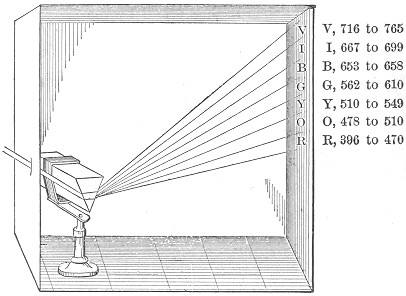
Light was once supposed to be corpuscular, or consisting of transmitted particles. It is now known to be the result of undulations in ether. Reference has been made to the minuteness of these undulations. Their velocity is equally wonderful. Put a prism of glass into a ray of light coming into a dark room, and it is Page 25 instantly turned out of its course, some parts more and some less, according to the number of vibrations, and appears as the seven colors on different parts of the screen. Fig. 6 shows the arrangement of colors, and the number of millions of millions of vibrations per second of each. But the different divisions we call colors are Fig. 6.—White Light resolved into Colors. not colors in themselves at all, but simply a different number of vibrations. Color is all in the eye. Violet has in different places from 716 to 765,000,000,000,000 of vibrations per second; red has, in different places, from 396 to 470,000,000,000,000 vibrations per second. None of these in any sense are color, but affect the eye differently, and we call these different effects color. They are simply various velocities of vibration. An object, like one kind of stripe in our flag, which absorbs all kinds of vibrations except those between 396 and 470,000,000,000,000, and reflects those, appears red to us. The field for the stars absorbs and destroys all but those vibrations numbering about 653,000,000,000,000 of vibrations Page 26 per second. A color is a constant creation. Light makes momentary color in the flag. Drake might have written, in the continuous present as well as in the past,
"Freedom mingles with its gorgeous dyes The milky baldrick of the skies, And stripes its pore celestial white With streakings of the morning light."
Every little pansy, tender as fancy, pearled with evanescent dew, fresh as a new creation of sunbeams, has power to suppress in one part of its petals all vibrations we call red, in another those we call yellow, and purple, and reflect each of these in other parts of the same tender petal. "Pansies are for thoughts," even more thoughts than poor Ophelia knew. An evening cloud that is dense enough to absorb all the faster and weaker vibrations, leaving only the stronger to come through, will be said to be red; because the vibrations that produce the impression we have so named are the only ones that have vigor enough to get through. It is like an army charging upon a fortress. Under the deadly fire and fearful obstructions six-sevenths go down, but one-seventh comes through with the glory of victory upon its face.
Light comes in undulations to the eye, as tones of sound to the ear. Must not light also sing? The lowest tone we can hear is made by 16.5 vibrations of air per second; the highest, so shrill and "fine that nothing lives 'twixt it and silence," is made by 38,000 vibrations per second. Between these extremes lie eleven octaves; C of the G clef having 258-7/8 vibrations to the second, and its octave above 517-1/2. Not that sound vibrations cease Page 27 at 38,000, but our organs are not fitted to hear beyond those limitations. If our ears were delicate enough, we could hear even up to the almost infinite vibrations of light. In one of those semi-inspirations we find in Shakspeare's works, he says—
"There's not the smallest orb which thou beholdest, But in his motion like an angel sings, Still quiring to the young-eyed cherubim. Such harmony is in immortal souls; But, whilst this muddy vesture of decay Doth grossly close it in, we cannot hear it."
And that older poetry which is always highest truth says, "The morning stars sing together." We misconstrued another passage which we could not understand, and did not dare translate as it was written, till science crept up to a perception of the truth that had been standing there for ages, waiting a mind that could take it in. Now we read as it is written—"Thou makest the out-goings of the morning and evening to sing." Were our senses fine enough, we could hear the separate keynote of every individual star. Stars differ in glory and in power, and so in the volume and pitch of their song. Were our hearing sensitive enough, we could hear not only the separate key-notes but the infinite swelling harmony of these myriad stars of the sky, as they pour their mighty tide of united anthems in the ear of God:
"In reason's ear they all rejoice, And utter forth a glorious voice. Forever singing, as they shine, The hand that made us is divine."
This music is not monotonous. Stars draw near each other, and make a light that is unapproachable by mortals; Page 28 then the music swells beyond our ability to endure. They recede far away, making a light so dim that the music dies away, so near to silence that only spirits can perceive it. No wonder God rejoices in his works. They pour into his ear one ceaseless tide of rapturous song.
Our senses are limited—we have only five, but there is room for many more. Some time we shall be taken out of "this muddy vesture of decay," no longer see the universe through crevices of our prison-house, but shall range through wider fields, explore deeper mysteries, and discover new worlds, hints of which have never yet been blown across the wide Atlantic that rolls between them and men abiding in the flesh.
Chemistry of Suns revealed by Light.
When we examine the assemblage of colors spread from the white ray of sunlight, we do not find red simple red, yellow yellow, etc., but there is a vast number of fine microscopic lines of various lengths, parallel—here near together, there far apart, always the same number and the same relative distance, when the same light and prism are used. What new alphabets to new realms of knowledge are these! Remember, that what we call colors are only various numbers of vibrations of ether. Remember, that every little group in the infinite variety of these vibrations may be affected differently from every other group. One number of these is bent by the prism to where we see what we call the violet, another number to the place we call red. All of the vibrations are destroyed when they strike a surface we call black. A part of them are destroyed when they Page 29 strike a substance we call colored. The rest are reflected, and give the impression of color. In one place on the flag of our nation all vibrations are destroyed except the red; in another, all but the blue. Perhaps on that other gorgeous flag, not of our country but of our sun, the flag we call the solar spectrum, all vibrations are destroyed where these dark lines appear. Perhaps this effect is not produced by the surface upon which the rays fall, but by some specific substance in the sun. This is just the truth. Light passing through vapor of sodium has the vibrations that would fall on two narrow lines in the yellow utterly destroyed, leaving two black spaces. Light passing through vapor of burning iron has some four hundred numbers or kinds of vibrations destroyed, leaving that number of black lines; but if the salt or iron be glowing gas, in the source of the light itself the same lines are bright instead of dark.
Thus we have brought to our doors a readable record of the very substances composing every world hot enough to shine by its own light. Thus, while our flag means all we have of liberty, free as the winds that kiss it, and bright as the stars that shine in it, the flag of the sun means all that it is in constituent elements, all that it is in condition.
We find in our sun many substances known to exist in the earth, and some that we had not discovered when the sun wrote their names, or rather made their mark, in the spectrum. Thus, also, we find that Betelguese and Algol are without any perceivable indications of hydrogen, and Sirius has it in abundance. What a sense of acquaintanceship it gives us to look up and recognize Page 30 the stars whose very substance we know! If we were transported thither, or beyond, we should not be altogether strangers in an unknown realm.
But the stars differ in their constituent elements; every ray that flashes from them bears in its very being proofs of what they are. Hence the eye of Omniscience, seeing a ray of light anywhere in the universe, though gone from its source a thousand years, would be able to tell from what orb it originally came.
Creative Force of Light.
Just above the color vibrations of the unbraided sunbeam, above the violet, which is the highest number our eyes can detect, is a chemical force; it works the changes on the glass plate in photography; it transfigures the dark, cold soil into woody fibre, green leaf, downy rose petals, luscious fruit, and far pervasive odor; it flushes the wide acres of the prairie with grass and flowers, fills the valleys with trees, and covers the hills with corn, a single blade of which all the power of man could not make.
This power is also fit and able to survive. The engineer Stephenson once asked Dr. Buckland, "What is the power that drives that train?" pointing to one thundering by. "Well, I suppose it is one of your big engines." "But what drives the engine?" "Oh, very likely a canny Newcastle driver." "No, sir," said the engineer, "it is sunshine." The doctor was too dull to take it in. Let us see if we can trace such an evident effect to that distant cause. Ages ago the warm sunshine, falling on the scarcely lifted hills of Pennsylvania, caused the reedy vegetation to grow along the banks of Page 31 shallow seas, accumulated vast amounts of this vegetation, sunk it beneath the sea, roofed it over with sand, compacted the sand into rock, and changed this vegetable matter—the products of the sunshine—into coal; and when it was ready, lifted it once more, all garnered for the use of men, roofed over with mighty mountains. We mine the coal, bring out the heat, raise the steam, drive the train, so that in the ultimate analyses it is sunshine that drives the train. These great beds of coal are nothing but condensed sunshine—the sun's great force, through ages gone, preserved for our use to-day. And it is so full of force that a piece of coal that will weigh three pounds (as big as a large pair of fists) has as much power in it as the average man puts into a day's work. Three tons of coal will pump as much water or shovel as much sand as the average man will pump or shovel in a lifetime; so that if a man proposes to do nothing but work with his muscles, he had better dig three tons of coal and set that to do his work and then die, because his work will be better done, and without any cost for the maintenance of the doer.
Come down below the color vibrations, and we shall find that those which are too infrequent to be visible, manifest as heat. Naturally there will be as many different kinds of heat as tints of color, because there is as great a range of numbers of vibration. It is our privilege to sift them apart and sort them over, and find what kinds are best adapted to our various uses.
Take an electric lamp, giving a strong beam of light and heat, and with a plano-convex lens gather it into a single beam and direct it upon a thermometer, twenty feet away, that is made of glass and filled with air. The Page 32 expansion or contraction of this air will indicate the varying amounts of heat. Watch your air-thermometer, on which the beam of heat is pouring, for the result. There is none. And yet there is a strong current of heat there. Put another kind of test of heat beyond it and it appears; coat the air-thermometer with a bit of black cloth, and that will absorb heat and reveal it. But why not at first? Because the glass lens stops all the heat that can affect glass. The twenty feet of air absorbs all the heat that affects air, and no kind of heat is left to affect an instrument made of glass and air; but there are kinds of heat enough to affect instruments made of other things.
A very strong current of heat may be sent right through the heart of a block of ice without melting the ice at all or cooling off the heat in the least. It is done in this way: Send the beam of heat through water in a glass trough, and this absorbs all the heat that can affect water or ice, getting itself hot, and leaving all other kinds of heat to go through the ice beyond; and appropriate tests show that as much heat comes out on the other side as goes in on this side, and it does not melt the ice at all. Gunpowder may be exploded by heat sent through ice. Dr. Kane, years ago, made this experiment. He was coming down from the north, and fell in with some Esquimaux, whom he was anxious to conciliate. He said to the old wizard of the tribe, "I am a wizard; I can bring the sun down out of the heavens with a piece of ice." That was a good, deal to say in a country where there was so little sun. "So," he writes, "I took my hatchet, chipped a small piece of ice into the form of a double-convex lens, Page 33 smoothed it with my warm hands, held it up to the sun, and, as the old man was blind, I kindly burned a blister on the back of his hand to show him I could do it."
These are simple illustrations of the various kinds of heat. The best furnace or stove ever invented consumes fifteen times as much fuel to produce a given amount of heat as the furnace in our bodies consumes to produce a similar amount. We lay in our supplies of carbon at the breakfast, dinner, and supper table, and keep ourselves warm by economically burning it with the oxygen we breathe.
Heat associated with light has very different qualities from that which is not. Sunlight melts ice in the middle, bottom, and top at once. Ice in the spring-time is honey-combed throughout. A piece of ice set in the summer sunshine crumbles into separate crystals. Dark heat only melts the surface.
Nearly all the heat of the sun passes through glass without hinderance; but take heat from white-hot platinum and only seventy-six per cent. of it goes through glass, twenty-four per cent. being so constituted that it cannot pass with facility. Of heat from copper at 752° only six per cent. can go through glass, the other ninety-four per cent. being absorbed by it.
The heat of the sun beam goes through glass without Page 34 any hinderance whatever. It streams into the room as freely as if there were no glass there. But what if the furnace or stove heat went through glass with equal facility? We might as well try to heat our rooms with the window-panes all out, and the blast of winter sweeping through them.
The heat of the sun, by its intense vibrations, comes to the earth dowered with a power which pierces the miles of our atmosphere, but if our air were as pervious to the heat of the earth, this heat would flyaway every night, and our temperature would go down to 200° below zero. This heat comes with the light, and then, dissociated from it, the number of its vibrations lessened, it is robbed of its power to get away, and remains to work its beneficent ends for our good.
Worlds that are so distant as to receive only 1/1000 of the heat we enjoy, may have atmospheres that retain it all. Indeed it is probable that Mars, that receives but one-quarter as much heat as the earth, has a temperature as high as ours. The poet drew on his imagination when he wrote:
"Who there inhabit must have other powers, Juices, and veins, and sense and life than ours; One moment's cold like theirs would pierce the bone, Freeze the heart's-blood, and turn us all to stone."
The power that journeys along the celestial spaces in the flashing sunshine is beyond our comprehension. It accomplishes with ease what man strives in vain to do with all his strength. At West Point there are some links of a chain that was stretched across the river to prevent British ships from ascending; these links were made of two-and-a-quarter-inch iron. A powerful locomotive might tug in vain at one of them and not stretch it the thousandth part of an inch. But the heat of a single gas-burner, that glows with the preserved sunlight of other ages, when suitably applied to the link, stretches it with ease; such enormous power has a little heat. There is a certain iron bridge across the Thames at London, resting on arches. The warm sunshine, acting Page 35 upon the iron, stations its particles farther and farther apart. Since the bottom cannot give way the arches must rise in the middle. As they become longer they lift the whole bridge, and all the thundering locomotives and miles of goods-trains cannot bring that bridge down again until the power of the sunshine has been withdrawn. There is Bunker Hill Monument, thirty-two feet square at the base, with an elevation of two hundred and twenty feet. The sunshine of every summer's day takes hold of that mighty pile of granite with its aërial fingers, lengthens the side affected, and bends the whole great mass as easily as one would bend a whipstock. A few years ago we hung a plummet from the top of this monument to the bottom. At 9 A.M. it began to move toward the west; at noon it swung round toward the north; in the afternoon it went east of where it first was, and in the night it settled back to its original place.
The sunshine says to the sea, held in the grasp of gravitation, "Rise from your bed! Let millions of tons of water fly on the wings of the viewless air, hundreds of miles to the distant mountains, and pour there those millions of tons that shall refresh a whole continent, and shall gather in rivers fitted to bear the commerce and the navies of nations." Gravitation says, "I will hold every particle of this ocean as near the centre of the earth as I can." Sunshine speaks with its word of power, and says, "Up and away!" And in the wreathing mists of morning these myriads of tons rise in the air, flyaway hundreds of miles, and supply all the Niagaras, Mississippis and Amazons of earth. The sun says to the earth, wrapped in the mantle of winter, Page 36 "Bloom again;" and the snows melt, the ice retires, and vegetation breaks forth, birds sing, and spring is about us.
Thus it is evident that every force is constitutionally arranged to be overcome by a higher, and all by the highest. Gravitation of earth naturally and legitimately yields to the power of the sun's heat, and then the waters fly into the clouds. It as naturally and legitimately yields to the power of mind, and the waters of the Red Sea are divided and stand "upright as an heap." Water naturally bursts into flame when a bit of potassium is thrown into it, and as naturally when Elijah calls the right kind of fire from above. What seems a miracle, and in contravention of law, is only the constitutional exercise of higher force over forces organized to be swayed. If law were perfectly rigid, there could be but one force; but many grades exist from cohesion to mind and spirit. The highest forces are meant to have victory, and thus give the highest order and perfectness.
Across the astronomic spaces reach all these powers, making creation a perpetual process rather than a single act. It almost seems as if light, in its varied capacities, were the embodiment of God's creative power; as if, having said, "Let there be light," he need do nothing else, but allow it to carry forward the creative processes to the end of time. It was Newton, one of the earliest and most acute investigators in this study of light, who said, "I seem to have wandered on the shore of Truth's great ocean, and to have gathered a few pebbles more beautiful than common; but the vast ocean itself rolls before me undiscovered and unexplored."
Page 37 EXPERIMENTS WITH LIGHT.
A light set in a room is seen from every place; hence light streams in every possible direction. If put in the centre of a hollow sphere, every point of the surface will be equally illumined. If put in a sphere of twice the diameter, the same light will fall on all the larger surface. The surfaces of spheres are as the squares of their diameters; hence, in the larger sphere the surface is illumined only one-quarter as much as the smaller. The same is true of large and small rooms. In Fig. 7 it is apparent that the light that falls on the first square is spread, at twice the distance, over the second square, which is four times as large, and at three times the distance over nine times the surface. The varying amount of light received by each planet is also shown in fractions above each world, the amount received by the earth being 1.
Fig. 7.
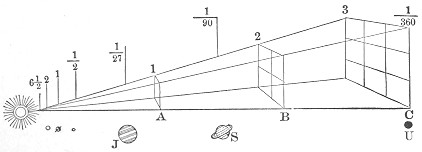
Fig. 8.—Measuring Intensities of Light.
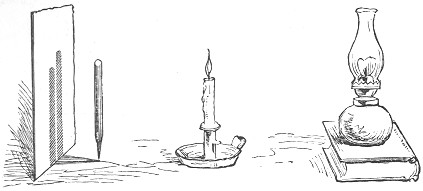
The intensity of light is easily measured. Let two lights of different brightness, as in Fig. 8, cast shadows on the same screen. Arrange them as to distance so that both shadows shall be equally dark. Let them fall side by side, and study them carefully. Measure the respective distances. Suppose one is twenty inches, the other forty. Light varies as the square Page 38 of the distance: the square of 20 is 400, of 40 is 1600. Divide 1600 by 400, and the result is that one light is four times as bright as the other.
Fig. 9.—Reflection and Diffusion of Light.
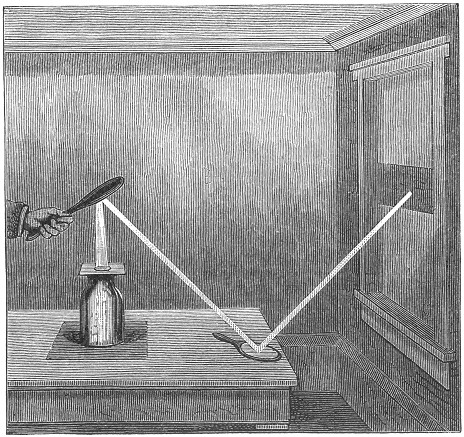
Light can be handled, directed, and bent, as well as iron bars. Darken a room and admit a beam of sunlight through a shutter, or a ray of lamp-light through the key-hole. If there is dust in the room it will be observed that light goes in straight lines. Because of this men are able to arrange houses and trees in rows, the hunter aims his rifle correctly, and the astronomer projects straight lines to infinity. Take a hand-mirror, or better, a piece of glass coated on one side with black varnish, and you can send your ray anywhere. By using two mirrors, or having an assistant and using several, you can cause a ray of light to turn as many corners as you please. I once saw Mr. Tyndall send a ray into a glass jar filled with smoke (Fig. 9). Admitting a slender ray through a small hole in a card over the mouth, one ray appeared; removing the cover, the whole jar was luminous; as the smoke disappeared in spots cavities of darkness appeared. Turn the same ray into a tumbler of water, it becomes Page 39 faintly visible; stir into it a teaspoonful of milk, then turn in the ray of sunlight, and it glows like a lamp, illuminating the whole room. These experiments show how the straight rays of the sun are diffused in every direction over the earth.
Set a small light near one edge of a mirror; then, by putting the eye near the opposite edge, you see almost as many flames as you please from the multiplied reflections. How can this be accounted for?
Into your beam of sunlight, admitted through a half-inch hole, put the mirror at an oblique angle; you can arrange it so as to throw half a dozen bright spots on the opposite wall.
Fig. 10.—Manifold Reflections.
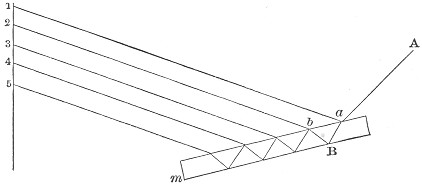
In Fig. 10 the sunbeam enters at A, and, striking the mirror m at a, is partly reflected to 1 on the wall, and partly enters the glass, passes through to the silvered back at B, and is totally reflected to b, where it again divides, some of it going to the wall at 2, and the rest, continuing to make the same reflections and divisions, causes spots 3, 4, 5, etc. The brightest spot is at No.2, because the silvered glass at B is the best reflector and has the most light.
When the discovery of the moons of Mars was announced in 1877, it was also widely published that they could be seen by a mirror. Of course this is impossible. The point of light mistaken for the moon in this secondary reflection was caused by holding the mirror in an oblique position.
Take a small piece of mirror, say an inch in surface, and putting under it three little pellets of wax, putty, or clay, set it on the wrist, with one of the pellets on the pulse. Hold the mirror steadily in the beam of light, and the frequency and prominence of each pulse-beat will be indicated by the tossing spot of light on the wall. If the operator becomes excited the fact will be evident to all observers.
Fig. 11.
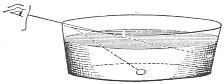
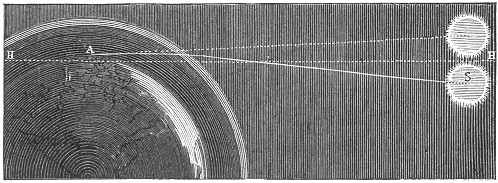
Place a coin in a basin (Fig. 11), and set it so that the rim will conceal the coin from the eye. Pour in water, and the coin will appear Page 40 to rise into sight. When light passes from a medium of one density to a medium of another, its direction is changed. Thus a stick in water seems bent. Ships below the horizon are sometimes seen above, because of the different density of the layers of air.
Thus light coming from the interstellar spaces, and entering our atmosphere, is bent down more and more by its increasing density. The effect is greatest when the sun or star is near the horizon, none at all in the zenith. This brings the object into view before it is risen. Allowance for this displacement is made in all delicate astronomical observations.
Fig. 12.—Atmospherical Refraction.
Notice on the floor the shadow of the window-frames. The glass of almost every window is so bent as to turn the sunlight aside enough to obliterate some of the shadows or increase their thickness.
DECOMPOSITION OF LIGHT.
Admit the sunbeam through a slit one inch long and one-twentieth of an inch wide. Pass it through a prism. Either purchase one or make it of three plain pieces of glass one and a half inch wide by six inches long, fastened together in triangular shape—fasten the edges with hot wax and fill it with water; then on a screen or wall you will have the colors of the rainbow, not merely seven but seventy, if your eyes are sharp enough.
Take a bit of red paper that matches the red color of the spectrum. Move it along the line of colors toward the violet. In the orange it is dark, in the yellow darker, in the green and all beyond, black. That is because there are no more red rays to be reflected by it. So a green object is true to its color only in the green rays, and black elsewhere. All these colors may be recombined by a second prism into white light.