Page 41 III.
Reading edition
ASTRONOMICAL INSTRUMENTS.
"The eyes of the Lord are in every place."—Proverbs xv. 3.
Page 42 "Man, having one kind of an eye given him by his Maker, proceeds to construct two other kinds. He makes one that magnifies invisible objects thousands of times, so that a dull razor-edge appears as thick as three fingers, until the amazing beauty of color and form in infinitesimal objects is entrancingly apparent, and he knows that God's care of least things is infinite. Then he makes the other kind four or six feet in diameter, and penetrates the immensities of space thousands of times beyond where his natural eye can pierce, until he sees that God's immensities of worlds are infinite also."—BISHOP FOSTER.
Page 43 III.
THE TELESCOPE.
Frequent allusion has been made in the previous chapter to discovered results. It is necessary to understand more clearly the process by which such results have been obtained. Some astronomical instruments are of the simplest character, some most delicate and complex. When a man smokes a piece of glass, in order to see an eclipse of the sun, he makes a simple instrument. Ferguson, lying on his back and slipping beads on a string at a certain distance above his eye, measured the relative distances of the stars. The use of more complex instruments commenced when Galileo applied the telescope to the heavens. He cannot be said to have invented the telescope, but he certainly constructed his own without a pattern, and used it to good purpose. It consists of a lens, O B (Fig. 13), which acts as a multiple prism to bend all the rays to one point at R. Place the eye there, and it receives as much light as if it were as large as the lens O B. The rays, however, are convergent, and the point difficult to Page 44 find. Hence there is placed at R a concave lens, passing through which the rays emerge in parallel lines, and are received by the eye. Opera-glasses are made upon precisely this principle to-day, because they can be made conveniently short.
Fig. 13.—Refracting Telescope.

If, instead of a concave lens at R, converting the converging rays into parallel ones, we place a convex or magnifying lens, the minute image is enlarged as much as an object seems diminished when the telescope is reversed. This is the grand principle of the refracting telescope. Difficulties innumerable arise as we attempt to enlarge the instruments. These have been overcome, one after another, until it is now felt that the best modern telescope, with an object lens of twenty-six inches, has fully reached the limit of optical power.
The Reflecting Telescope.
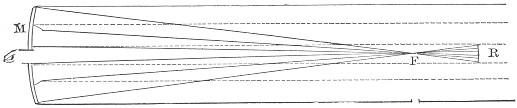
This is the only kind of instrument differing radically from the refracting one already described. It receives the light in a concave mirror, M (Fig. 14), which reflects it to the focus F, producing the same result as the lens of the refracting telescope. Here a mirror may be placed obliquely, reflecting the image at right angles to the eye, outside the tube, in which case it is called the Newtonian telescope; or a mirror at R may be placed perpendicularly, and send the rays through Page 45 an opening in the mirror at M. This form is called the Gregorian telescope. Or the mirror M may be slightly inclined to the coming rays, so as to bring the point F entirely outside the tube, in which case it is called the Herschelian telescope. In either case the image may be magnified, as in the refracting telescope.
Fig. 14.—Reflecting Telescope.
Reflecting telescopes are made of all sizes, up to the Cyclopean eye of the one constructed by Lord Rosse, which is six feet in diameter. The form of instrument to be preferred depends on the use to which it is to be put. The loss of light in passing through glass lenses is about two-tenths. The loss by reflection is often one-half. In view of this peculiarity and many others, it is held that a twenty-six-inch refractor is fully equal to any six-foot reflector.
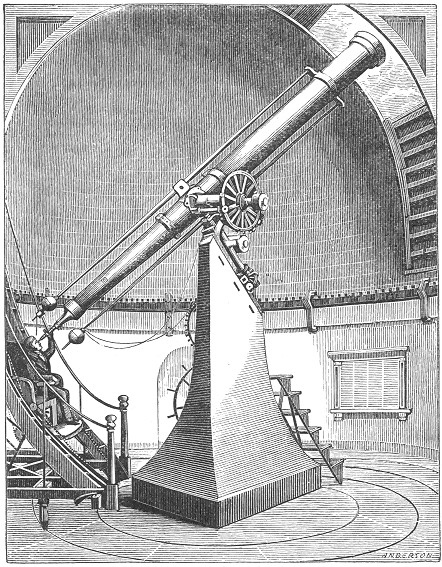
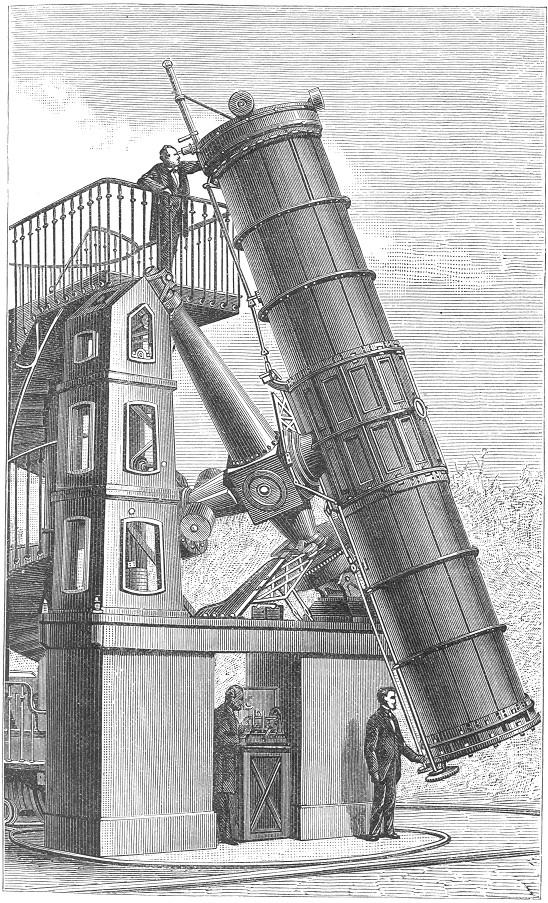
The mounting of large telescopes demands the highest engineering ability. The whole instrument, with its vast weight of a twenty-six-inch glass lens, with its accompanying tube and appurtenances, must be pointed as nicely as a rifle, and held as steadily as the axis of the globe. To give it the required steadiness, the foundation on which it is placed is sunk deep in the earth, far from rail or other roads, and no part of the observatory is allowed to touch this support. When a star is once found, the earth swiftly rotates the telescope away from it, and it passes out of the field. To avoid this, clock-work is so arranged that the great telescope follows the star by the hour, if required. It will take a star at its eastern rising, and hold it constantly in view while it climbs to the meridian and sinks in the west (Fig. 15). The reflector demands still more difficult engineering. That of Lord Rosse has a metallic mirror Page 46 weighing six tons, a tube forty feet long, which, with its appurtenances, weighs seven tons more. It moves between two walls only 10° east and west. The new Paris reflector (Fig. 16) has a much wider range of movement.
Fig. 15.—Cambridge Equatorial.
The Spectroscope.
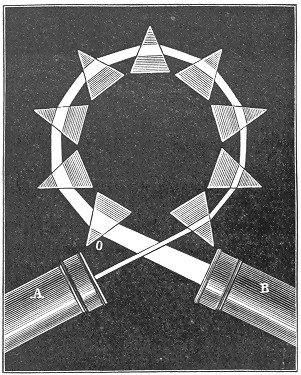
A spectrum is a collection of the colors which are dispersed by a prism from any given light. If it is sunlight, it is a solar spectrum; if the source of light is a Page 47 Fig. 16.—New Paris Reflector. Page 49 star, candle, glowing metal, or gas, it is the spectrum of a star, candle, glowing metal, or gas. An instrument to see these spectra is called a spectroscope. Considering the infinite variety of light, and its easy modification and absorption, we should expect an immense number of spectra. A mere prism disperses the light so imperfectly that different orders of vibrations, perceived as colors, are mingled. No eye can tell where one commences or ends. Such a spectrum is said to be impure. What we want is that each point in the spectrum should be made of rays of the same number of vibrations. As we can let only a small beam of light pass through the prism, in studying celestial objects with a telescope and spectroscope we must, in Fig. 17.—Spectroscope, with Battery of Prisms. every instance, contract the aperture of the instrument until we get only a small beam of light. In order to have the colors thoroughly dispersed, the best instruments pass the beam of light through a series of prisms called a battery, each one spreading farther the colors which the previous ones had spread. In Fig. 17 the ray is seen entering through the telescope A, which renders the rays parallel, and passing Page 50 through the prisms out to telescope B, where the spectrum can be examined on the retina of the eye for a screen. In order to still farther disperse the rays, some batteries receive the ray from the last prism at O upon an oblique mirror, send it up a little to another, which delivers it again to the prism to make its journey back again through them all, and come out to be examined just above where it entered the first prism.
Attached to the examining telescope is a diamond-ruled scale of glass, enabling us to fix the position of any line with great exactness.
Fig. 18.—Spectra of glowing Hydrogen and the Sun.
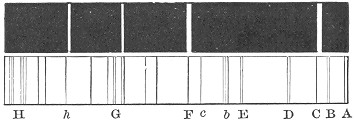
In Fig. 18 is seen, in the lower part, a spectrum of the sun, with about a score of its thousands of lines made evident. In the upper part is seen the spectrum of bright lines given by glowing hydrogen gas. These lines are given by no other known gas; they are its autograph. It is readily observed that they precisely correspond with certain dark lines in the solar spectrum. Hence we easily know that a glowing gas gives the same bright lines that it absorbs from the light of another source passing through it—that is, glowing gas gives out the same rays of light that it absorbs when it is not glowing.
The subject becomes clearer by a study of the chromolithic plate. No. 1 represents the solar spectrum, with a few of its lines on an accurately graduated scale. Page 51 No.3 shows the bright line of glowing sodium, and, corresponding to a dark line in the solar spectrum, shows the presence of salt in that body. No. 2 shows that potassium has some violet rays, but not all; and there being no dark line to correspond in the solar spectrum, we infer its absence from the sun. No.6 shows the numerous lines and bands of barium—several red, orange, yellow, and four are very bright green ones. The lines given by any volatilized substances are always in the same place on the scale.
A patient study of these signs of substances reveals, richer results than a study of the cuniform characters engraved on Assyrian slabs; for one is the handwriting of men, the other the handwriting of God.
One of the most difficult and delicate problems solved by the spectroscope is the approach or departure of a light-giving body in the line of sight. Stand before a locomotive a mile away, you cannot tell whether it approaches or recedes, yet it will dash by in a minute. How can the movements of the stars be comprehended when they are at such an immeasurable distance?
It can best be illustrated by music. The note C of the G clef is made by two hundred and fifty-seven vibrations of air per second. Twice as many vibrations per second would give us the note C an octave above. Sound travels at the rate of three hundred and sixty-four yards per second. If the source of these two hundred and fifty-seven vibrations could approach us at three hundred and sixty-four yards per second, it is obvious that twice as many waves would be put into a given space, and we should hear the upper C when only waves enough were made for the lower C. The same Page 52 result would appear if we carried our ear toward the sound fast enough to take up twice as many valves as though we stood still. This is apparent to every observer in a railway train. The whistle of an approaching locomotive gives one tone; it passes, and we instantly detect another. Let two trains, running at a speed of thirty-six yards a second, approach each other. Let the whistle of one sound the note E, three hundred and twenty-three vibrations per second. It will be heard on the other as the note G, three hundred and eighty-eight vibrations per second; for the speed of each train crowds the vibrations into one-tenth less room, adding 32+ vibrations per second, making three hundred and eighty-eight in all. The trains pass. The vibrations are put into one-tenth more space by the whistle making them, and the other train allows only nine-tenths of what there are to overtake the ear. Each subtracts 32+ vibrations from three hundred and twenty-three, leaving only two hundred and fifty-eight, which is the note C. Yet the note E was constantly uttered.
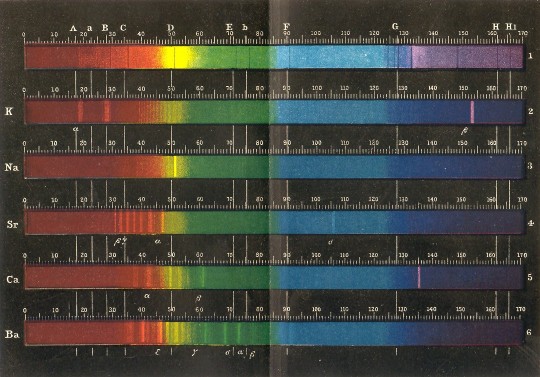
1. Solar Spectrum. 3. Spectrum of Sodium. 5. Spectrum of Calcium.
2. Spectrum of Potassium. 4. Spectrum of Strontium. 6. Spectrum of Barium.
If a source of light approach or depart, it will have a similar effect on the light waves. How shall we detect it? If a star approach us, it puts a greater number of waves into an inch, and shortens their length. If it recedes, it increases the length of the wave—puts a less number into an inch. If a body giving only the number of vibrations we call green were to approach sufficiently fast, it would crowd in vibrations enough to appear what we call blue, indigo, or even violet, according to its speed. If it receded sufficiently fast, it would leave behind it only vibrations enough to fill up the Page 53 space with what we call yellow, orange, or red, according to its speed; yet it would be green, and green only, all the time. But how detect the change? If red waves are shortened they become orange in color; and from below the red other rays, too far apart to be seen by the eye, being shortened, become visible as red, and we cannot know that anything has taken place. So, if a star recedes fast enough, violet vibrations being lengthened become indigo; and from above the violet other rays, too short to be seen, become lengthened into visible violet, and we can detect no movement of the colors. The dark lines of the spectrum are the cutting out of rays of definite wave-lengths. If the color spectrum moves away, they move with it, and away from their proper place in the ordinary spectrum. If, then, we find them toward the red end, the star is receding; if toward the violet end, it is approaching. Turn the instrument on the centre of the sun. The dark lines take their appropriate place, and are recognized on the ruled scale. Turn it on one edge, that is approaching us one and a quarter miles a second by the revolution of the sun on its axis, the spectral lines move toward the violet end; turn the spectroscope toward the other edge of the sun, it is receding from us one and a quarter miles a second by reason of the axial revolution, and the spectral lines move toward the red end. Turn it near the spots, and it reveals the mighty up-rush in one place and the down-rush in another of one hundred miles a second. We speak of it as an easy matter, but it is a problem of the greatest delicacy, almost defying the mind of man to read the movements of matter.
It should be recognized that Professor Young, of Page 54 Princeton, is the most successful operator in this recent realm of science. He already proposes to correct the former estimate of the sun's axial revolutions, derived from observing its spots, by the surer process of observing accelerated and retarded light.
Within a very few years this wonderful instrument, the spectroscope, has made amazing discoveries. In chemistry it reveals substances never known before; in analysis it is delicate to the detection of the millionth of a grain. It is the most deft handmaid of chemistry, the arts, of medical science, and astronomy. It tells the chemical constitution of the sun, the movements taking place, the nature of comets, and nebulæ. By the spectroscope we know that the atmospheres of Venus and Mars are like our own; that those of Jupiter and Saturn are very unlike; it tells us which stars approach and which recede, and just how one star differeth from another in glory and substance.
In the near future we shall have the brilliant and diversely colored flowers of the sky as well classified into orders and species as are the flowers of the earth.