Page 1 I.
Reading edition
CREATIVE PROCESSES.
"In the beginning God created the heaven and the earth. And the earth was without form, and void; and darkness was upon the face of the deep."—Genesis i. 1, 2.
Page 2 "Not to the domes, where crumbling arch and column Attest the feebleness of mortal hand, But to that fane, most catholic and solemn, Which God hath planned,— To that cathedral, boundless as our wonder, Whose quenchless lamps the sun and stars supply; Its choir the winds and waves, its organ thunder, Its dome the sky." H. W. LONGFELLOW.
"The heavens are a point from the pen of His perfection; The world is a rose-bud from the bower of His beauty; The sun is a spark from the light of His wisdom; And the sky a bubble on the sea of His power." SIR W. JONES.
Page 3 RECREATIONS IN ASTRONOMY.
I.
CREATIVE PROCESSES.
During all the ages there has been one bright and glittering page of loftiest wisdom unrolled before the eye of man. That this page may be read in every part, man's whole world turns him before it. This motion apparently changes the eternally stable stars into a moving panorama, but it is only so in appearance. The sky is a vast, immovable dial-plate of "that clock whose pendulum ticks ages instead of seconds," and whose time is eternity. The moon moves among the illuminated figures, traversing the dial quickly, like a second-hand, once a month. The sun, like a minute-hand, goes over the dial once a year. Various planets stand for hour-hands, moving over the dial in various periods reaching up to one hundred and sixty-four years; while the earth, like a ship of exploration, sails the infinite azure, bearing the observers to different points where they may investigate the infinite problems of this mighty machinery.
This dial not only shows present movements, but it keeps the history of uncounted ages past ready to be Page 4 read backward in proper order; and it has glorious volumes of prophecy, revealing the far-off future to any man who is able to look thereon, break the seals, and read the record. Glowing stars are the alphabet of this lofty page. They combine to form words. Meteors, rainbows, auroras, shifting groups of stars, make pictures vast and significant as the armies, angels, and falling stars in the Revelation of St. John—changing and progressive pictures of infinite wisdom and power.
Men have not yet advanced as far as those who saw the pictures John describes, and hence the panorama is not understood. That continuous speech that day after day uttereth is not heard; the knowledge that night after night showeth is not seen; and the invisible things of God from the creation of the world, even his eternal power and Godhead, clearly discoverable from things that are made, are not apprehended.
The greatest triumphs of men's minds have been in astronomy—and ever must be. We have not learned its alphabet yet. We read only easy lessons, with as many mistakes as happy guesses. But in time we shall know all the letters, become familiar with the combinations, be apt at their interpretation, and will read with facility the lessons of wisdom and power that are written on the earth, blazoned in the skies, and pictured by the flowers below and the rainbows above.
In order to know how worlds move and develop, we must create them; we must go back to their beginning, give their endowment of forces, and study the laws of their unfolding. This we can easily do by that faculty wherein man is likest his Father, a creative imagination. God creates and embodies; we create, but Page 5 it remains in thought only. But the creation is as bright, strong, clear, enduring, and real, as if it were embodied. Every one of us would make worlds enough to crush us, if we could embody as well as create. Our ambition would outrun our wisdom. Let us come into the high and ecstatic frame of mind which Shakspeare calls frenzy, in the exigencies of his verse, when
"The poet's eye, in a fine frenzy rolling, Doth glance from heaven to earth, from earth to heaven; And, as imagination bodies forth The forms of things unknown, the poet's pen Turns them to shapes, and gives to airy nothing A local habitation and a name."
In the supremacy of our creative imagination let us make empty space, in order that we may therein build up a new universe. Let us wave the wand of our power, so that all created things disappear. There is no world under our feet, no radiant clouds, no blazing sun, no silver moon, nor twinkling stars. We look up, there is no light; down, through immeasurable abysses, there is no form; all about, and there is no sound or sign of being—nothing save utter silence, utter darkness. It cannot be endured. Creation is a necessity of mind—even of the Divine mind.
We will now, by imagination, create a monster world, every atom of which shall be dowered with the single power of attraction. Every particle shall reach out its friendly hand, and there shall be a drawing together of every particle in existence. The laws governing this attraction shall be two. When these particles are associated together, the attraction shall be in proportion to the mass. A given mass will pull twice Page 6 as much as one of half the size, because there is twice as much to pull. And a given mass will be pulled twice as much as one half as large, because there is twice as much to be pulled. A man who weighed one hundred and fifty pounds on the earth might weigh a ton and a half on a body as large as the sun. That shall be one law of attraction; and the other shall be that masses attract inversely as the square of distances between them. Absence shall affect friendships that have a material basis. If a body like the earth pulls a man one hundred and fifty pounds at the surface, or four thousand miles from the centre, it will pull the same man one-fourth as much at twice the distance, one-sixteenth as much at four times the distance. That is, he will weigh by a spring balance thirty-seven and a half pounds at eight thousand miles from the centre, and nine pounds six ounces at sixteen thousand miles from the centre, and he will weigh or be pulled by the earth 1/24 of a pound at the distance of the moon. But the moon would be large enough and near enough to pull twenty-four pounds on the same man, so the earth could not draw him away. Thus the two laws of attraction of gravitation are—1, Gravity is proportioned to the quantity of matter; and 2, The force of gravity varies inversely as the square of the distance from the centre of the attracting body.
The original form of matter is gas. Almost as I write comes the announcement that Mr. Lockyer has proved that all the so-called primary elements of matter are only so many different sized molecules of one original substance—hydrogen. Whether that is true or not, let us now create all the hydrogen we can Page 7 imagine, either in differently sized masses or in combination with other substances. There it is! We cannot measure its bulk; we cannot fly around it in any recordable eons of time. It has boundaries, to be sure, for we are finite, but we cannot measure them. Let it alone, now; leave it to itself. What follows? It is dowered simply with attraction. The vast mass begins to shrink, the outer portions are drawn inward. They rush and swirl in vast cyclones, thousands of miles in extent. The centre grows compact, heat is evolved by impact, as will be explained in Chapter II. Dull red light begins to look like coming dawn. Centuries go by; contraction goes on; light blazes in insufferable brightness; tornadoes, whirlpools, and tempests scarcely signify anything as applied to such tumultuous tossing.
There hangs the only world in existence; it hangs in empty space. It has no tendency to rise; none to fall; none to move at all in any direction. It seethes and, flames, and holds itself together by attractive power, and that is all the force with which we have endowed it.
Leave it there alone, and withdraw millions of miles into space: it looks smaller and smaller. We lose sight of those distinctive spires of flame, those terrible movements. It only gives an even effulgence, a steady unflickering light. Turn one quarter round. Still we see our world, but it is at one side.
Now in front, in the utter darkness, suddenly create another world of the same size, and at the same distance from you. There they stand—two huge, lone bodies, in empty space. But we created them dowered with attraction. Each instantly feels the drawing influence of the other. They are mutually attractive, and begin to Page 8 move toward each other. They hasten along an undeviating straight line. Their speed quickens at every mile. The attraction increases every moment. They fly swift as thought. They dash their flaming, seething foreheads together.
And now we have one world again. It is twice as large as before, that is all the difference. There is no variety, neither any motion; just simple flame, and nothing to be warmed thereby. Are our creative powers exhausted by this effort?
Fig. 1.—Orbit A D, resulting from attraction, A C, and projectile force, A B.
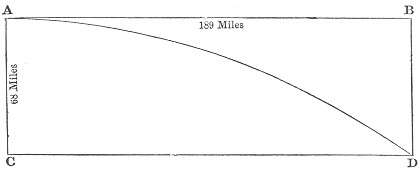
No, we will create another world, and add another power to it that shall keep them apart. That power shall be what is called the force of inertia, which is literally no power at all; it is an inability to originate or change motion. If a body is at rest, inertia is that quality by which it will forever remain so, unless acted upon by some force from without; and if a body is in motion, it will continue on at the same speed, in a straight line, forever, unless it is quickened, retarded, or turned from its path by some other force. Suppose our newly created sun is 860,000 miles in diameter. Go away 92,500,000 miles and create an earth eight thousand miles in diameter. It instantly feels the attractive power of the sun drawing it to itself sixty-eight Page 9 miles a second. Now, just as it starts, give this earth a push in a line at right angles with line of fall to the sun, that shall send it one hundred and eighty-nine miles a second. It obeys both forces. The result is that the world moves constantly forward at the same speed by its inertia from that first push, and attraction momentarily draws it from its straight line, so that the new world circles round the other to the starting-point. Continuing under the operation of both forces, the worlds can never come together or fly apart.
They circle about each other as long as these forces endure; for the first world does not stand still and the second do all the going; both revolve around the centre of gravity common to both. In case the worlds are equal in mass, they will both take the same orbit around a central stationary point, midway between the two. In case their mass be as one to eighty-one, as in the case of the earth and the moon, the centre of gravity around which both turn will be 1/81 of the distance from the earth's centre to the moon's centre. This brings the central point around which both worlds swing just inside the surface of the earth. It is like an apple attached by a string, and swung around the hand; the hand moves a little, the apple very much.
Thus the problem of two revolving bodies is readily comprehended. The two bodies lie in easy beds, and swing obedient to constant forces. When another body, however, is introduced, with its varying attraction, first on one and then on the other, complications are introduced that only the most masterly minds can follow. Introduce a dozen or a million bodies, and complications arise that only Omniscience can unravel.
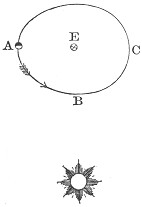
Let the hand swing an apple by an elastic cord. When the apple falls toward the earth it feels another force besides that derived from the hand, which greatly lengthens the elastic cord. To tear it away from the earth's attraction, and make it rise, requires additional force, and hence the string is lengthened; but when it passes over the hand the earth attracts it downward, and the string is very much shortened: so the moon, held by an elastic cord, swings around the earth. From its extreme distance from the earth, at A, Fig. 2, it rushes with increasing speed nearly a quarter of a Page 10 Fig. 2. million of miles toward the sun, feeling its attraction increase with every mile until it reaches B; then it is retarded in its speed, by the same attraction, as it climbs back its quarter of a million of miles away from the sun, in defiance of its power, to C. All the while the invisible elastic force of the earth is unweariedly maintained; and though the moon's distances vary over a range of 31,355 miles, the moon is always in a determinable place. A simple revolution of one world about another in a circular orbit would be a problem of easy solution. It would always be at the same distance from its centre, and going with the same velocity. But there are over sixty causes that interfere with such a simple orbit in the case of the moon, all of which causes and their disturbances must be considered in calculating such a simple matter as an eclipse, or predicting the moon's place as the sailors guide. One of the most puzzling of the irregularities Page 11 of our night-wandering orb has just been explained by Professor Hansen, of Gotha, as a curious result of the attraction of Venus.
Take a single instance of the perturbations of Jupiter and Saturn which can be rendered evident. The times of orbital revolution of Saturn and Jupiter are nearly as five to two. Suppose the orbits of Fig. 3.—Changes of orbit by mutual attraction. the planets to be, as in Fig. 3, both ellipses, but not necessarily equally distant in all parts. The planets are as near as possible at 1, 1. Drawn toward each other by mutual attraction, Jupiter's orbit bends outward, and Saturn's becomes more nearly straight, as shown by the dotted lines. A partial correction of this difficulty immediately follows. As Jupiter moves on ahead of Saturn it is held back—retarded in its orbit by that body; and Saturn is hastened in its orbit by the attraction of Jupiter. Now greater speed means a straighter orbit. A rifle-ball flies nearer in a straight line than a thrown stone. A greater velocity given to a whirled ball pulls the elastic cord far enough to give the ball a larger orbit. Hence, being hastened, Saturn stretches out nearer its proper orbit, and, retarded, Jupiter approaches the smaller curve that is its true orbit.
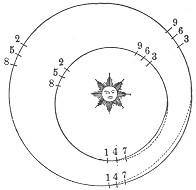
But if they were always to meet at this point, as they would if Jupiter made two revolutions to Saturn's one, it would be disastrous. In reality, when Saturn has gone around two-thirds of its orbit to 2, Jupiter will have gone once and two-thirds around and overtaken Page 12 Saturn; and they will be near again, be drawn together, hastened, and retarded, as before; their next conjunction would be at 3, 3, etc.
Now, if they always made their conjunction at points equally distant, or at thirds of their orbits, it would cause a series of increasing deviations; for Jupiter would be constantly swelling his orbit at three points, and Saturn increasingly contracting his orbit at the same points. Disaster would be easily foretold. But as their times of orbital revolutions are not exactly in the ratio of five and two, their points of conjunction slowly travel around the orbit, till, in a period of nine hundred years, the starting-point is again reached, and the perturbations have mutually corrected one another.
For example, the total attractive effect of one planet on the other for 450 years is to quicken its speed. The effect for the next 450 years is to retard. The place of Saturn, when all the retardations have accumulated for 450 years, is one degree behind what it is computed if they are not considered; and 450 years later it will be one degree before its computed place—a perturbation of two degrees. When a bullet is a little heavier or ragged on one side, it will constantly swerve in that direction. The spiral groove in the rifle, of one turn in forty-five feet, turns the disturbing weight or raggedness from side to side—makes one error correct another, and so the ball flies straight to the bull's-eye. So the place of Jupiter and Saturn, though further complicated by four moons in the case of Jupiter, and eight in the case of Saturn, and also by perturbations caused by other planets, can be calculated with exceeding nicety.
The difficulties would be greatly increased if the orbits Page 13 of Saturn and Jupiter, instead of being 400,000,000 miles apart, were interlaced. Yet there are the orbits of one hundred and ninety-two asteroids so interlaced that, if they were made of wire, no one could be lifted without raising the whole net-work of them. Nevertheless, all these swift chariots of the sky race along the course of their intermingling tracks as securely as if they were each guided by an intelligent mind. They are guided by an intelligent mind and an almighty arm.
Still more complicated is the question of the mutual attractions of all the planets. Lagrange has been able to show, by a mathematical genius that seems little short of omniscience in his single department of knowledge, that there is a discovered system of oscillations, affecting the entire planetary system, the periods of which are immensely long. The number of these oscillations is equal to that of all the planets, and their periods range from 50,000 to 2,000,000 years,
Looking into the open page of the starry heavens we see double stars, the constituent parts of which must revolve around a centre common to them both, or rush to a common ruin. Eagerly we look to see if they revolve, and beholding them in the very act, we conclude, not groundlessly, that the same great law of gravitation holds good in distant stellar spaces, and that there the same sufficient mind plans, and the same sufficient power directs and controls all movements in harmony and security.
When we come to the perturbations caused by the mutual attractions of the sun, nine planets, twenty moons, one hundred and ninety-two asteroids, millions Page 14 of comets, and innumerable meteoric bodies swarming in space, and when we add to all these, that belong to one solar system, the attractions of all the systems of the other suns that sparkle on a brilliant winter night, we are compelled to say, "As high as the heavens are above the earth, so high above our thoughts and ways must be the thoughts and ways of Him who comprehends and directs them all."