SCENE VI. STITCH-GNAWER AND LITTLE TROTTER.
Reading edition
Gnawer. Well, what do you say to all this, my little pupil?
Trotter. I say you are a sorcerer. As to the will of the late Mr. Michonnet, what has become of it? have you hidden it?
Gnawer. I inherit my father’s love of books and curious documents. He was a learned rat, having devoured some of the oldest and dryest works in his master’s library. It will not surprise you, therefore, to learn that this morning I gratified my natural taste, and at the same time served my young friends, by breakfasting off the will of the deceased Michonnet. Thus, thanks to my timely aid, a lawsuit—one of the greatest evils of this lying age—has been nipped in the bud, and a wedding concluded. You see, my dear pupil, that notwithstanding our miserable condition, we, if we do not neglect our opportunity, can render the greatest service to humanity. But what ails you that you caress your tail so pensively?
Trotter. Oh, I was only thinking that we would neglect our opportunities were we not present after the wedding breakfast. There will be no end of good things going.
Gnawer. Very good. You have wisely abandoned the idea of suicide?
Trotter. I should rather think I have. The world has many traps; but it has also its tit bits of old cheese, for which sudden death would spoil one’s appetite.
Gnawer. These are sage reflections, but pray bear in mind the lesson of the lost will. The destruction of this instrument, so small in itself, happily turned the tide of events for generations to come. The wise householder sets his foot on the spark that would have consumed his whole substance. The loving heart crushes the first cruel word that would wreck his happiness. The mariner marks the little cloud on the horizon, furls his sails, and his trusty bark rides out the tempest. Your humble servant has gnawed through the lines by which an unworthy father left an inheritance of misery to his children.
THE SUFFERINGS OF A BEETLE.
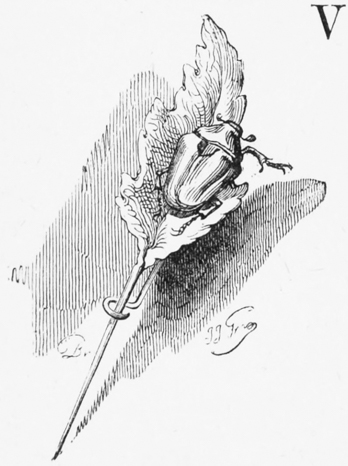
IOLET, who is the most amiable and sensible dove in the world, wore, the other day, a very pretty pin in her collar. A lettered antiquarian owl told her it was perfectly charming.
“Indeed,” said Violet, “it is a present from my godmother, and represents an insect on a peony leaf. By means of this talisman common sense is secured, enabling one to see all things in their true light, not through the illusive medium of passion.”
The owl approached to examine the jewel, but the dove, perceiving that her white neck against which it rested interfered with his minute inspection, took it off and gave it to him.
“I will return it to-morrow,” said the bird of night. “During my nocturnal studies the insect may disclose its history, then will I know the secret of your wisdom and beauty.”
As soon as the owl reached home, seeking the retirement of his study, he placed the pin on the table. Directly he had done so, the beetle walked about on the leaf. The insect was green, and its whole demeanour spoke of a worthy and candid nature. Passing a polished foot over its eyes, stretching out first one wing then the other, it directed its pointed proboscis to the owl, and with a mingled air of modesty and intelligence proceeded to relate its story in the following words:—
“I was born on the banks of the Seine, in a garden named after a temple of the goddess Isis. My parents had been consigned to their last resting-place by weevils, when I woke to the consciousness of existence beneath the shade of a Mimosa pigra, the sensitive idler, whose juice was my first aliment. The wife of an excellent gardener had taken me in, but while she was absent at market I expanded my wings and flew away. My companions were simply beasts, so I found my sweetest associates in wild flowers, and poppies became my special favourites. I was already well grown, and amused myself by looking for bushy roses, and chasing the busy bees who stopped for a moment to joke with me. Alas! these joyous days passed like a dream. A craving for the unknown gradually forced itself upon me and rendered my simple habits contemptible. I at length decided to raise the veil of the future, and have my fortune told by a weird capricorn beetle who passed for a soothsayer, and who spent her days in a lonely part of the garden.
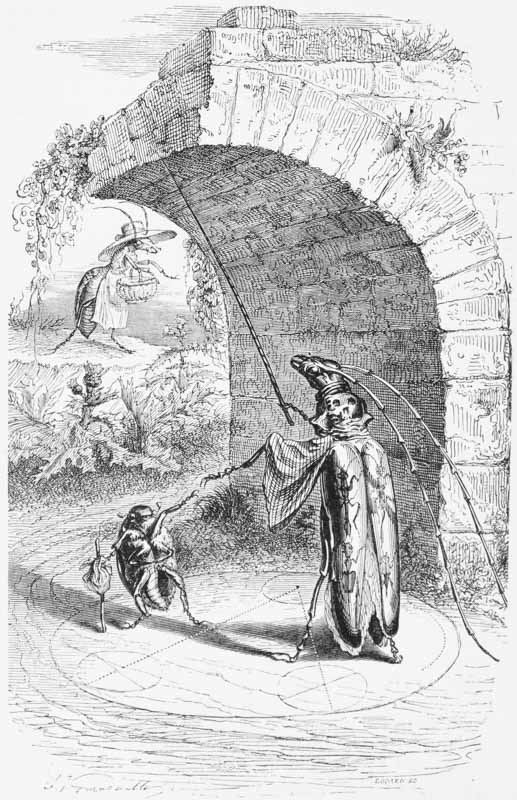
“She wore a long robe covered with cabalistic signs. Setting out for her cave, the crone received me graciously, and after describing certain mystic circles with her horns, she examined my foot, saying, ‘Thou art one of a noble line. The horns of thy forefathers have been proudly exalted, and as woefully depressed by fate. Whence comest thou to this lonely place? I had deemed thy race long extinct, had I not seen thee. The armour of thy ancestors can alone be found in the collections of entomologists. Happiness may never be thine!’
“ ‘Now then, old woman,’ I said, ‘my ancestors are dead and no manner of good to me. Tell me, once for all, am I likely to play an important part in the world, or am I not? I feel fit for anything.’
“ ‘Hear him, ye powers invisible!’ cried the witch. ‘Thou wouldst willingly be a Don Juan! consent to drink the nectar of the gods! feast with the immortals, and cancel the debt of thine imprudence by suffering the tortures of Tantalus. Like Prometheus, thou wouldst steal the celestial fire at the risk of being torn by vultures. Alas! thou wilt need no prompting to find misery enough and to spare. I will endow thee with the vile instinct of common sense, remove the mask from all that glitters and is not gold; dissolve the fair form of things, and reveal the ghastly skeletons they conceal.’
“I left this cave and its hideous old witch, feeling discomfited by her strange prognostics. For all that, I still burned with the desire to cast myself into the garden of Isis, where thousands of insects swarmed, rejoicing in its intoxicating air. One day, while taking a morning walk through a kitchen-garden, I fell in with a rhinoceros beetle meditating beneath the shade of a lettuce. Trusting to his wisdom, I humbly besought him to favour me with some of those flowery and precious counsels which Mentor bestowed upon Telemachus.
“ ‘It will afford me the greatest pleasure in life,’ he replied. ‘Your appearance recalls some famous old pictures in Lord Diamond’s collection. You evidently come of a brilliant line of beetles. Do you see the bloom of luxury in yonder garden? Your horns and credentials will at once gain you an introduction there into our set—the finest society in the world. The life will be new to you, but the jargon is easy. You must make some polite contortions before the mistress of the house, and when you have listened attentively to all the current nonsense of the day, you will be regaled with a little hot water, after which you can amuse yourself with the dragon-flies. Take care to listen patiently to all the unkind things whispered about intimate friends. You are not required to make remarks. Judicious silence will better establish your claims to sentiment, poetic feeling, and profundity, than any remarks you could hope to offer. Your acquirements will be gauged by your power of appreciating the wit or wisdom of those who address you. Above all, be careful to whom you give your heart, as you are almost certain to be deceived. These will make up the list of your pleasures, while your duties will be light and easily performed. Five or six times a year military dress must be worn and tactics studied, when you shall be required to obey implicitly the orders of the hornets.’
“ ‘Five or six times!’ I exclaimed. ‘What a frightful task!’
“ ‘The country requires it. Go now and enjoy your privileges. You are warned.’
“This gloomy picture of my prospective joys and privileges would have scared any beetle less green and less intrepid than myself. The impetuosity of youth carried me on, and I looked upon the rhinoceros as an old croaker, who had seen too much of the world and of this particular garden.
“ ‘Come with me,’ said he at last, ‘society waits our appearance.’
“I formed a close intimacy with a May bug, who one day said, ‘I shall take you to the theatre, and other places of amusement, where we may spend a pleasant evening.’
“My new friend asked if I was a lover of music. ‘Yes,’ I replied; ‘in the garden of my nativity we had some very fine tom-tits.’
“ ‘We have something much better than that to offer you. I shall introduce you to the Academy, where we shall listen to the sublime in art.’
“My companion, before entering, readjusted his feelers and collar. He then procured tickets from a wood-louse stationed at the entrance of a large acanthus flower. The concert-hall was filled by one of the most brilliant assemblages of the season. Certain well-known members of the insect aristocracy thronged the private boxes, gazing around with that air of superfine insolence which freezes the muscles of the face into an expression of languid-icy indifference. Slender-waisted wasps and dragon-flies formed charming groups; while a crowd of restless fleas filled the upper gallery. Flies in solemn black—as if mourning for the frivolity of the hour—were seated in the pit, patiently waiting to regale their ears with the music.
“ ‘This gathering,’ I said, ‘conveys a pleasing impression to my mind. It is astonishing to see youth and beauty so thoroughly engrossed with the prospect of listening to good music.’
“ ‘Do not deceive yourself, my friend,’ replied the May bug. ‘It is not the art of the musician that is the chief attraction. These are, most of them, slaves of fashion, who know little and care less about music. Chut! here is the first harvest-fly about to open the concert with her celebrated song.’
“The singer, decked in resplendent wings, sang something thoroughly dramatic. Her notes, sometimes loud, sometimes low, deep, high, long, short, were hurled into the hall in a manner so utterly perplexing that I whispered to my friend, ‘Do you think she is all right?’
“ ‘Right?’ he replied. ‘My uninitiated friend, you are listening to a prima donna, the finest soprano on the stage. The rendering of the cantata is sublime. Mark the modulations of the voice, the syncopation of the passages, the—so to speak—rhythmical delivery, the volume of sound filling every corner of the room, the’——
“ ‘But after all,’ said I, interrupting him, ‘as a mere display of the variety of sounds contained in the voice, the performance is perhaps very fine, yet I would rather listen to the heart-song of a linnet than all the throat-melodies of the world.’
“ ‘Believe me, you must be mistaken,’ said the Bug. ‘She is a universal favourite; and, moreover, anything so popular must be in itself good.’
“The fly was followed by a band of a hundred cathedral crickets who intoned a chorus. They seemed to be so nervously affected each one about his notes that the fall of the curtain afforded me great relief.
“The interval was filled by the evolutions of a grasshopper ballet corps, who exercised their feet and legs quite as much as the others had their lungs. It seems—so my companion says—they express in their gestures and steps many of the most subtle feelings of the heart. As for myself, I failed to perceive anything beyond the rather indecent gambols of a band of immodestly-dressed female grasshoppers. The display, although utterly devoid of the refinement which each male member of the assembly claimed as his special attribute, seemed to afford unmixed delight. To tell the truth, I myself was beginning to take some interest in the spectacle, when the whole band disappeared, and the din of instruments began louder than ever. Oh my poor head! how it ached! I was compelled to seek the fresh air.
“ ‘Is this what you promised me?’ I said to the May-bug. ‘I asked for songs, and in place of them you have taken me to listen to a troop of liberated fiends, who play all manner of tricks with divine harmony! Take me, I pray you, where one may listen to music unaccompanied by swords, torches, and operatic tinsel.’
“ ‘Come, then,’ said my friend, ‘we will go to a place where music is heard in all its purity. There you will be enchanted by the rich voice of a trumpeter beetle of world-wide fame.’
“We winged our way to a fine red tulip that marked the entrance of the hall. As soon as we had seated ourselves, the trumpeter appeared and sang the finest air in a masterpiece. This time I was delighted; his rich deep voice reminded one of the boom of distant thunder, the roll of the sea, or the noise of a steam-power mill. The song was short, and followed by the croaking chorus of miserable crickets. The contrast was so marked as to be revolting. Here my friend explained that each musical star is always attended by a constellation of minor luminaries, whose feeble light is borrowed from the centre round which they revolve. Theatrical managers profit by their study of natural phenomena. They say, ‘As there is only one sun in heaven gladdening the earth, so in the theatre we should have one star at a time, so managed as to make the most of its refulgence.’ Two stars cannot be allowed to cross each other’s track on the stage. Such an irregularity would result in the total eclipse of the one, and in theatrical chaos.
“ ‘Come, let us go elsewhere. Like a boy with sweets, I have kept the best to the last. You must tighten the drum of your ear, adjust your sense of hearing to its finest pitch, in order to appreciate the delicate strains that should touch your heart.’
“ ‘I hope,’ I replied, ‘to tune my tympanum so as to gather up the finest chords.’
“ ‘I am by no means certain about that,’ said my Mentor. ‘Even I myself, who am thoroughly initiated, lose some of the finest phrases. One must know by a sort of intuition how to discover the sentiments of the composer, just as a gourmet selects the carp’s tongue, while a vulgar person polishes the bones. Wherein do you think consists the charm of instrumental music?’
“ ‘In the selection of a choice melody,’ I replied, ‘and the happy association of such harmony as shall lend it force and beauty; just as in a picture the true artist so marshals his lights and colours as to give power of expression to his composition.’
“ ‘You are quite wrong,’ said he; ‘such notions are at least a century old. Nowadays the charm of music consists in the agility of the performer’s hands, in the shaggy vegetable-looking growth of the insect who manipulates the sonorous tool. It is undeniable that the harmony and sweetness of instrumental music lies in the nervous appearance of the animal who wakes the articulation of his instrument, in the colour of his skin, roll of his eyes, and the curious manner in which he curves his spine round the violoncello. We are about to listen to one of those profound artists who give a mystic, and at the same time lucid, rendering of the vague harmony that breathes in the moods and passions of life.’
“ ‘Oh, bother!’ I said, ‘such fine affairs will be far beyond my dull comprehension. No matter, lead on, my curiosity exceeds my discretion.’
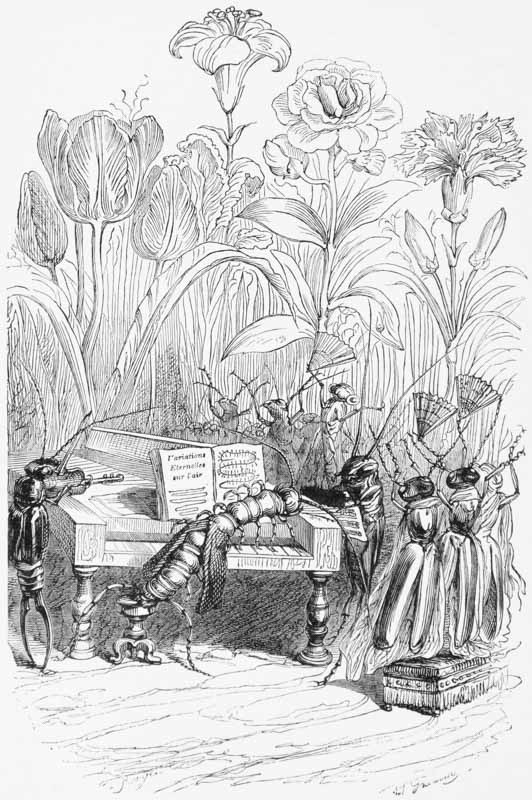
“May-bug introduced me into the open calyx of a Datura fastuosa, richly decorated for an instrumental concert, to which one could only gain admittance by paying a very high price. The assembly was even more brilliant than that of the Academy. A number of insects were ranged round an instrument with a very long tail, from which were to be drawn prodigies of harmony by the feet of a famous centipede.
“After waiting two hours the artists at last arrived; the Centipede seated himself before his instrument, and looking calmly round at all present, a profound silence was at once established. The piece opened with a succession of thunder peals rolling on from the lowest to the highest notes on the board. The performer then addressed himself, though I thought regretfully, to some of the medium keys, after which commenced a vague slow adagio of an undistinguishable measure, rendered still more confusing by graces of manipulation. The air was poor, but what matters the poorness of the stuff when it is so covered with embroidering as to become invisible? This was only a prelude to give a foretaste of the piece. As there were many thunderings and preliminary canterings over the keys—reminding one of a horse getting into form for a great leap—I fancied that something grand would follow; yet it was quite the contrary. The dark foreboding cloud of the introduction cleared away, and was succeeded by a popular ballet-tune, a brisk lively air, which seemed to dance gaily over the green turf.
“This spurious air, which had sprung up like a jack-in-the-box, had been danced to for at least ten years; one had had enough of it in every possible form, but the audience seemed to recognise in the air a delightful old friend.
“At the close of this inspired theme and its endless chain of varieties the performer played the tune with one foot on the base keys, while the remaining ninety-nine feet were producing a furious running accompaniment on the treble, ascending and descending in interminable runs of demi-semiquavers.
“These were repeated over and over to the infinitely growing delight of the assembly. All at once the clamour ceased and the virtuoso counted time with the treble, like the slow tolling of the bell of doom that seemed to say, ‘Tremble! tremble! thy death is at hand!’ The artist-executioner then seized the doomed air as a Turk would a Christian, tore off its limbs one by one, cut up its simple face, twisted its fingers, and dashed its common metre into the splinters of six-eight time. Here, in a frenzy of rage, he tossed the disjointed members on to the hot anvil of his key-board and pounded them into dust, blinding and stifling one’s senses.
“The Centipede continued to hammer louder and louder, faster and faster, keeping the dust of the pulverised air floating in a tempest around, and his audience in a tumult of excitement. The measure was left to look out for itself amid the din and confusion. The insects, seized with the contagion of the musical slaughter, kept time with the fluctuating measure until their bodies shook as if with palsy.
“Composedly retiring within myself, I escaped the excitement, while the piece concluded with prolonged banging of chords, by which one discovered the true genius of the Centipede.
“ ‘Oh, the power of music!’ said a moth to her neighbour. ‘My soul has been wafted to the luminous spheres of the firmament, ah me!’ and she fainted away. Another exclaimed, ‘How wonderful! In these few minutes I have climbed to the last rung of the ladder of passion, love, jealousy, despair, fury—I have experienced all these in the twinkling of an eye. For pity’s sake, some air—open a window!’ ‘Oh!’ cried a third, ‘I have become the slave of harmony. Why can it not leave my imagination to slumber in peace? I have seen white ants devouring their young; bees stinging each other; mosquitoes drawing blood from stones; centipedes committing suicide; charming butterflies metamorphosed into death’s-head moths.’
“ ‘Alas!’ said an old Cantharis, ‘what delight, what bliss to possess such genius! This centipede is truly wonderful! wonderful!!’
“I turned towards a large gadfly who appeared to have some common sense, and inquired timidly if it were not my ignorance which rendered me unable to appreciate the marvels which are being applauded.
“ ‘Imprudent fellow!’ replied he, drawing me into a corner. ‘If you were heard letting fall such remarks you would be torn to pieces by the Cantharis. You had better go with the herd; say it’s no end of soul-stirring, you know, and all that kind of thing. It is fashion, my boy. The Centipede is all the rage.’
“ ‘Thanks for your warning, but is one compelled to come and listen to these torments of h-harmony?’
“ ‘No, not exactly compelled, and yet we cannot escape it. It’s supposed to be the correct thing to do.’
“The emotion had now subsided, and we had to listen to a distinguished earwig violinist, who followed so closely in the strain of his predecessor that I will dismiss him without further comment.
“Before leaving the hall I was introduced to the Centipede, and congratulated him on his power over his instrument. The fellow turned away indignantly, saying, ‘You take me, then, for a sort of musical machine. A day is coming in which I shall prove to the universe that my own compositions are alone worthy of my genius as a performer. Good-evening, Mr. Beetle.’ A slight touch of vanity this, but the faintest trace of it! Ugh!
“The May-bug approached me with a triumphant air, ‘I told you we should have a splendid evening.’
“ ‘So very splendid,’ I replied, ‘I should like at once to sleep off its effect.’
“Next day my guide led me to understand that it was expedient to go and visit some death’s-head moths who view nature from their own ideal standpoint and endeavour to imitate its forms and colours.
“The majority of these unfortunates had nothing more left than mere stumps of their once ample wings; they had lost them in ambitious flight while yet too young. The first moth we visited spoke very highly of his craft.
“ ‘Nothing good can ever be achieved,’ he said, ‘without art, and there is no art without its rules. The precepts of the masters must be followed. No composition can possibly be worth the canvas on which it is painted unless it will bear the tests of law. To produce a good picture, it is necessary to select from nature’s storehouse; but to select only such elements as are pleasing to the eye and taste, and to reject all that are offensive. I have striven to carry out and embody all the rules of art in the composition I am about to show you.’
“The Moth then unveiled a large canvas, representing a battle of the animalcules, seen by the microscope in a drop of water. He could not have hit upon a happier subject to display not alone his knowledge of art, but of the fierce passions which characterise even the lowest living organisms. The distinct genera and species were treated with masterly skill. The complicities of structure in the Rotifera lent force and dignity to the action; while the breadth of expression in some of the mouths, the dangerous attitude of the heads, the curves of the tails and antennæ, all contributed to render this one of the most striking productions of modern art.
“In the next studio we visited, the Moth had met with an accident; he had singed his wings by venturing too near his light (candle-light). For all that, we found him a most enthusiastic limner, who discoursed like a lunatic on the subtle fire of genius. His speciality was portrait-painting, about which he had his own notions.
“ ‘It is necessary,’ he said, ‘in order to idealise the subject, to carefully study the habits of plant life, and impart something of its grace and tenderness to the outlines of the insect who is sitting for a portrait. It is wonderful to observe the effect produced by peculiar habits of life, and most necessary for the artist to note their influences in the treatment of a subject. One requires to make one’s self master of the life and thoughts of the sitter, so as to give a poetic rendering to his idiosyncrasy. Thus the low-life vulgar habits of a patron which impress their stamp on his physiognomy must be studiously concealed beneath a virtuous mask of paint and outline. In this way we depict what the insect under happier influences might have been, in place of what he really is.’
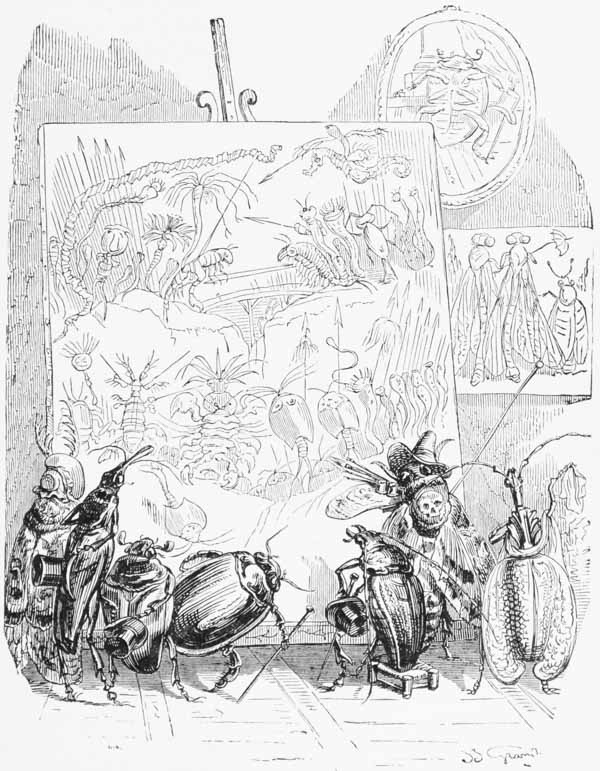
“ ‘In other words,’ I said, ‘you portray your client as the insect God made him before he himself wrecked the fair image by giving himself up to the works of the devil. In this way I suppose you serve God and Mammon at the same time. After all, truth is truth, whether on canvas or in conversation, and it seems to me that you prostitute your sublime art by handing down painted lies to posterity.’ We had to leave this studio, as the new light I had thrown on this moth’s studies singed his wings afresh.
“My Mentor next led me to a brilliant group of the Coccus cacti, or cochineal insects, from the forests of the ‘Far East,’ who were awkwardly colouring dead leaves.
“ ‘Strangers,’ said one of them, ‘there has been only one great epoch for the fine arts.’
“I was about to suggest that there had been four great epochs, and to concede that one of the four had perhaps been the greatest of all.
“ ‘The ancients!’
“ ‘That will do,’ said one of the painters. ‘The ancients were children, chrysalides groping in darkness.’
“ ‘Perhaps you deem the Augustine epoch the greatest?’
“ ‘The age of Augustus! What of that? We know nothing about it.’
“ ‘Perhaps, then, the period of the Renaissance?’
“ ‘The Renaissance! A period of beggarly decadence!’
“ ‘Ah, then, to revive signifies to decline.’
“ ‘Decidedly; so far as the Renaissance goes.’
“ ‘The only period remaining is the seventeenth century.’ My voice was here stifled by groans.
“ ‘Who is this Coleopterous? Have you lived in a hole? Learn, Sir Beetle, that which is known and sanctioned now-a-days we utterly condemn and ignore, while all that is obscure, lost in the dust of oblivion, we bring to light and restore with the varnish of our enthusiasm. Depend upon it, there has never been but one really grand epoch, which lasted twenty years and three months. This was in the twelfth century, during the time of Averroes. The Saracens brought art to the highest pitch of perfection.’
“ ‘Let us leave these driveling fools,’ I whispered to my companion.
“ ‘Willingly.’
“Our next flight was across the garden to a spot I had never seen before. Its name was taken from an ancient causeway on which it had been erected. We entered a rich tulip where a number of insects were assembled.
“ ‘Here you see,’ said my companion, ‘the whole entomological race—peacock-butterflies, admirals, generals, princes, counts, satyrs, even Vulcan and Argus.’ You are aware the beetles are descended from an Egyptian race of insects accustomed to translate hieroglyphics of the physiognomy, and thus read the secrets of the heart.
“I therefore understood at a glance that all the females of this vast assembly were ranged in a ring for no better purpose than criticising each other’s appearance and dress. They were indeed, without a single exception, secretly employed in picking each other’s robes, jewels, and looks to pieces. The males stood at some distance. I remarked to my friend that this chosen society appeared to me dull and miserable. Not wishing to judge hastily, I determined to listen to the conversation.
“A group of sporting spiders were wholly engrossed with talk about hunting, dining, and betting, and how their blandishments had done for some gay thoughtless flies who had been decoyed into their chambers in pursuit of pleasure, and rewarded with death. Two fine females were whispering behind their fans. I slipped quietly up to them to listen. Imagine my surprise when I heard them using the slang of the lowest vermin living.
“Their chief theme was the best means of draining their husbands’ purses to enable them to pursue their selfish pleasure, while I found out that their devoted partners were nearly driven to despair to make ends meet. My horns stood up on my head with horror. Addressing my companion, I said, ‘Is this what you call the pleasures of the world? In the modest field where I was born, it was not so. When a simple insect puts on her best dress, she wears her sweetest smiles all for her fond husband.’
“ ‘Well,’ said my Mentor, ‘what can one do? Fashion is king here, and he is a hard task-master. All these are his slaves in every detail of life, dress, and language.’
“ ‘But,’ I said, ‘if one thinks only of personal adornment, putting on one’s back all one’s worldly possessions, how fares the household?’
“ ‘The household!’ replied he; ‘who ever thinks of that? Domestic bliss belonged to our grandmothers.’
“ ‘And the budget? those two famous ends of the year which it is so important to join together decently.’
“ ‘That does not matter either to you or to me.’
“Two rather unsightly insects were putting their heads together in a corner. ‘Who are those two creatures?’ I inquired.
“ ‘They are ant-lions of finance. Their habits are droll. They meet together in the morning in a temple consecrated to their operations. There they plan how best they may undermine the finest structures of their neighbours. Their form of worship is perhaps the most dangerous in the world, as they sacrifice many victims, simple and innocent ones. When one of these ant-lions has done a good day’s work, sucked the life’s blood from some widow or orphan, he is the pleasantest evening companion imaginable. That bejewelled female with the dirty diamond-ringed neck and fingers is one of their wives.’
“I soon left the husbands to talk over their pitfalls, and listened to the gossip of their wives.
“ ‘My dear friend,’ said one of them, ‘you have a musical cousin always about you of whom we may talk undisturbed.’
“ ‘Bah! we do not get on; he grumbles so if I eat sweets while rendering sonatas or quatuors of Haydn or Mozart.’
“The sad counsels of the old Rhinoceros came to my mind, and I began to understand that he had been at least truthful. My reflections were here interrupted by an altercation between two insects. The questions discussed were taken up by all the others. I afterwards learned the nature of the questions, and the decisions were the following:—
“1st, Green tea is more destructive to the nerves than black tea.
“2d, Self-love is the motive of all action in insects.
“3d, The hill of St. Denis is about as steep as that of Clichy.
“4th, It is cheaper to live in France than in England.
“5th, It is better to be rich than poor.
“6th, Friendship is a sentiment weaker than love.
“This last question was given up as insoluble at the request of the ephemera present. An Alpine hermit made a note of it, so as to be able to meditate on the subject at leisure in the solitude of his cell. I then, taking my friend by the arm, inquired, ‘Is there no spot in this large garden where one could find an insect that would converse without pretending to be interesting?’
“ ‘Yes,’ he replied, scratching his pate with an air of embarrassment; ‘follow me.’
“We flew away into the dark night, but my guide made so many circuits that I perceived he was quite at a loss where to go.
“ ‘I do not think,’ he said, ‘it would be worth while to take you into that vast swamp where one lives in isolation like a water-rat. Let us cross the river. On its bank yonder are lilies to whom I might introduce you. They live in peace and silence, fearing to defile themselves by unkind sentiments.’
“ ‘Is there any gaiety there?’
“ ‘In the land of lilies one is sadder than elsewhere, but the reason of that is too long to enter upon here.’
“Tired of these flights, I profited by the darkness to leave my companion. A bright star, as if by chance, directed me to the third floor of a climbing rose, and there at last I found the object of my search, a good honest family of lady-birds established in a simple and commodious dwelling. Most amiable creatures, living without show or ostentation. Our conversation was animated by a genial gaiety, and we sat down to a simple supper. My place was between two hostesses who proved most agreeable companions.”
Here the Beetle relapsed into silence.
“Mr. Beetle,” said the Owl, “I feel certain your history does not end here.”
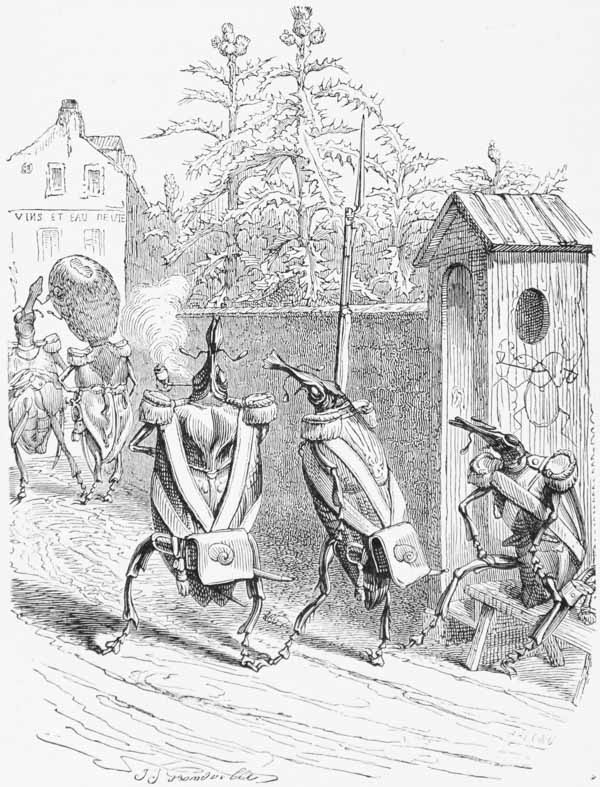
“That is true, Mr. Philosopher,” said the insect; “I had reserved a portion. From the happy moment that separated me from my Mentor I have only once felt pain. A certain day, at a certain hour, I was summoned to put on my military dress and mount guard at a place pointed out to me. I had to obey under pain of death, in common with many other insects of peace, who were compelled to imitate wasps and hornets in order to secure the safety of the country, which was in no real danger. After a day and a night of this warlike parade, I again obtained my liberty. I had caught cold and toothache, but seeing a poppy on my way, I plunged into it and swallowed some opium, which brought on profound sleep. At last I was roused by the voice of a magpie, who had seized me round the waist with his iron beak. He was an old collector, and, more than that, a sorcerer. ‘Here,’ said my captor, ‘I have found a pretty beetle, which I shall place in the middle of a peony leaf, and give to my godchild as a jewel and talisman to protect her against the sway of fashion.’
“I permitted myself to be placed on the leaf and attached to the dove Violet’s neck, where I have determined to remain, as the situation suits me, and I hope to make her lucky.”
“Sir,” said the Owl, “it seems to me that you are studiously concealing the most interesting part of your narrative. A beetle of your wide experience cannot have passed through the world without some love adventures. I strongly suspect you fell in love with your lady-bird hostess. Pray allay my curiosity.”
The little green Beetle hereupon bestowed one searching look upon the Owl, and drawing in his legs and horns, lapsed into silence, simulating death so cleverly that his interrogator became alarmed. The Owl put on his spectacles to examine the insect more closely. He then saw for the first time that it was an emerald mounted on an enamelled leaf. The sun beginning to appear, he became drowsy, and pulling his hood over his eyes, fell into a profound sleep.
Awaking at last, he discovered that the story of the green Beetle was but a dream, and returning the pin to Violet, he recounted the history of the transformed jewel as if it had been his own invention.
A FOX IN A TRAP.
HE following story was found among the papers of a distinguished “Orang-Outan” member of the Academies:—
“No, decidedly not!” I cried; “it shall never be said that I chose for the hero of my tale a cowardly, sneaking, voracious brute, whose name has become synonymous with cunning, hypocrisy, and knavery—a fox, in fact.”
“You are wrong,” replied one whose presence I had overlooked.
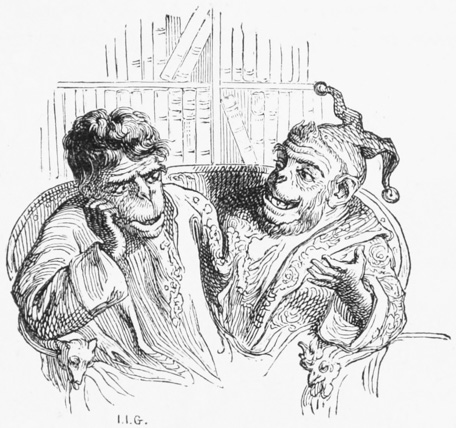
I must tell you that my lonely hours had been beguiled by a creature of a species hitherto undescribed by the naturalist, who performed slight services, and was at that moment engaged in arranging the books in my library. The reader will no doubt be surprised to learn that an orang-outan—literally, man of the woods or wilds—possessed a library. His astonishment will be still greater when he is informed that the chief works in my collection were penned by philosophic apes, and that most of them contain elaborate disquisitions on the descent of apes from the human species. This by the way.
Perhaps the dependant who addressed me would be called a “familiar spirit.” Although spirits are not totally unknown, I am unacquainted with those of the familiar type; I will therefore, with your leave, name this one Breloque.
“You are wrong,” he repeated.
“Why?” I indignantly inquired. “Will your love of paradox tempt you to defend the cursed, corrupted race?”
“I think,” replied Breloque, leaning on the table with an air of arrogance most ludicrous to behold, “that bad reputations, as well as good ones, are sometimes usurped, and that the species in question, or at least one example with whom I became acquainted, is the victim of an error of this sort.”
“So then,” I said, “you are speaking from personal experience?”
“Quite so, sir; and were it not that I fear wasting your precious moments, I would try and convince you of your error.”
“I am willing to listen, but what will the result be?”
“Nothing.”
“That is satisfactory. Sit down in this arm-chair, and should I go to sleep, do not stop, I pray you, as that would awake me.”
After taking a pinch of snuff from my box, Breloque, nothing loath, commenced thus:—
“You are fully aware, sir, that notwithstanding the affection which attaches me to your person, I have never submitted to the slavery that would have been distasteful to both. I have my leisure hours, when I think of many things; just as you have yours, when you think of nothing. Oh, I have many ways of passing my time. Have you ever been out fishing with the line?”
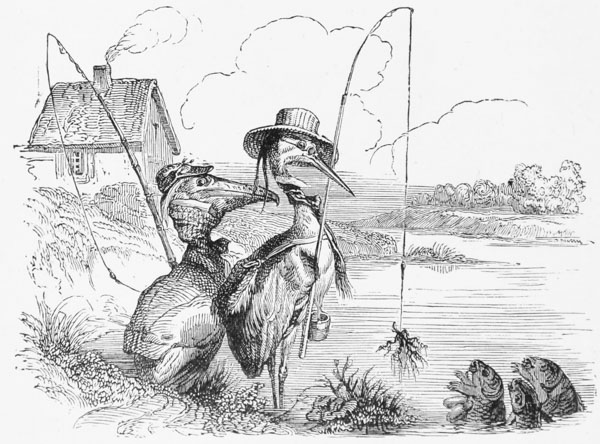
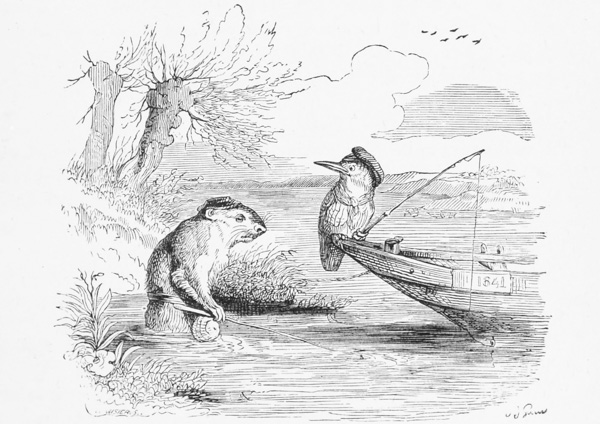
“Yes,” I replied; “that is to say, I often used to go in a costume expressly suited to fishing, and sit from sunrise to sunset on the borders of a stream. I had a superb rod mounted with silver, like an Oriental weapon, but without its danger. Alas! I have passed many sweet hours, and made many bad verses, but I never caught a single fish.”
“Angling, sir, appeals to the imagination in your case, and has nothing to do with the happiness of the true angler. Few persons are so framed as to appreciate the charms of which you speak. Your mind, filled with dreamy, vague hope, follows the soft motion of the transparent water, marks and profits by the events of the insect world that clouds its clear face. To the fisher of poetic mind the capture of one of the silver dwellers in the stream can only bring regret, remorse.”
I made a sign of assent.
“Yet,” he continued, “few persons regard the sport in this light.”
“That is true,” I replied.
Breloque, unaccustomed to find one entering so fully into his views, felt flattered.
“Sir,” he said in a tone marked by perfect self-satisfaction, “I have thought deeply on subjects most profound, and I feel convinced, if the world would only give me a fair hearing, I could earn a wide reputation—nor would it be a borrowed one.”
“Apropos of borrowed fame, let us hear the history of your fox. You abuse the privilege granted by thus trifling with my patience.”
“Ah, sir, you misjudge me. This is only a subtle, roundabout way of leading your mind up to the theme. I am now all for you, and will only permit myself to put one question—What do you think of butterfly-catching?”
“Wretch!” I exclaimed, “am I here to discuss the fortunes of all created things before the one which occupies me? You forget the hatred that fills my breast, the mask of hypocrisy which the fox craftily assumes to attract tender chickens, lambs, doves, and his thousand victims.”
“What calumnies!” replied Breloque. “I hope to avenge the fox of all his enemies by proving that in love he is stupid, unselfish, and tender-hearted. For the moment I have the honour of returning to the butterfly-hunt.”
I made an impatient gesture, to which he replied with such a look of supplication that I was completely disarmed. Besides, I had the imprudence to let him see that the exciting pastime interested me.
Breloque satisfied, took a second pinch of snuff, and half lay down in his arm-chair.
“I am happy, sir,” he said, “to see you take delight in the truly worthy pleasures of life. Can you point out a being more to be envied or recommended to the consideration of his fellow-creatures than the one we encounter early in the morning, joyous and breathless, beating the long grass with his stick? In his button-hole hung a bit of cork armed with long pins used to spike—without pain—his lovely victims. He soothes himself with the notion that these little insects, brought by the zephyrs, cannot suffer pain, as they never utter a complaint. For my part, I think the butterflies rather enjoy the prospect of being dried like mummies, and displayed in choice collections. But we are off the line of our subject.”
“You are right for once,” I said.
“I shall return to it. As speaking in general terms pains you, I will talk of my own experiences in the field. One day, when carried away by the ardour of the hunt. It is altogether different from fishing, of which we were just talking.”
I rose to go, but he quietly made me resume my seat.
“Do not be impatient. I only spoke of fishing as a comparison, for you to note the difference. Fishing with bait requires the most perfect rest, while the hunt, on the contrary, demands activity.”
“You have fairly caught me and pinned me down,” I replied, laughing.
“That is a cruel remark; but I shall now be careful to stick to my narrative. You are as capricious as the gay butterfly I was engaged in pursuing. He was a marvellous Apollon in the mountains of Franche Compté. I stopped quite out of breath in a little glade into which he had led me, thinking he would profit by this moment to escape; but, either from sheer insolence or frolic, he alighted on a long stem of grass, which bent under his weight, seeming to set me at defiance. Collecting all my energy, I determined to surprise him. I approached with stealthy steps, my eyes riveted on him, my legs strained in an attitude as uncomfortable as it was undignified, my heart swelling with an emotion more easily imagined than described. At this moment a horrid cock crowed lustily, and away flew my coveted prize. Inconsolable, I down upon a stone and expended my remaining breath in heaping invective on the head of my musical enemy, menacing him with every kind of death, and I own, to my horror, even mentioning a poisoned pill. I was delighting in guilty preparations to carry my threats into effect, when a paw was placed on my arm, and I beheld two soft eyes looking into mine, those of a young fox, sir, of charming form. All his externals were in his favour, betokening a loyal noble character. Although you yourself are against his species, I somehow contracted a liking for the fox before me. This modest animal heard my menaces against the cock.
“ ‘Do not give way to passion, sir,’ he said in such a sad tone that I was moved even to tears. ‘She would die of grief.’
“I did not quite understand. ‘Who do you mean?’ I inquired.
“ ‘Cocotte!’ he replied with sweet simplicity.
“I felt still in the dark; yet conjectured it was some love story. I have always been passionately fond of romance, and you?”
“That depends entirely on circumstances.”
“Say at once you detest love tales. However, you must resign yourself to hearing this one.”
“I should name my objections at once, were I not afraid of wounding your feelings, so I prefer bravely taking my part and listening to your story; ennui does not kill.”
“So it is said, yet I have known people who have almost succumbed to ennui. But to return to the fox.
“ ‘Sir,’ I said, ‘you interest me deeply. You seem unhappy. Can I serve you in any way?’
“ ‘Thank you,’ he replied, ‘my grief must remain unalleviated. No one has the power to make her return my love.’
“ ‘Cocotte?’ I said quietly.
“ ‘Cocotte,’ he replied, sighing.
“The greatest service one can render a disconsolate lover, next to destroying him, is to listen to him. He is happy while recounting his troubles. Knowing the truth of this, I asked and obtained his confidence.
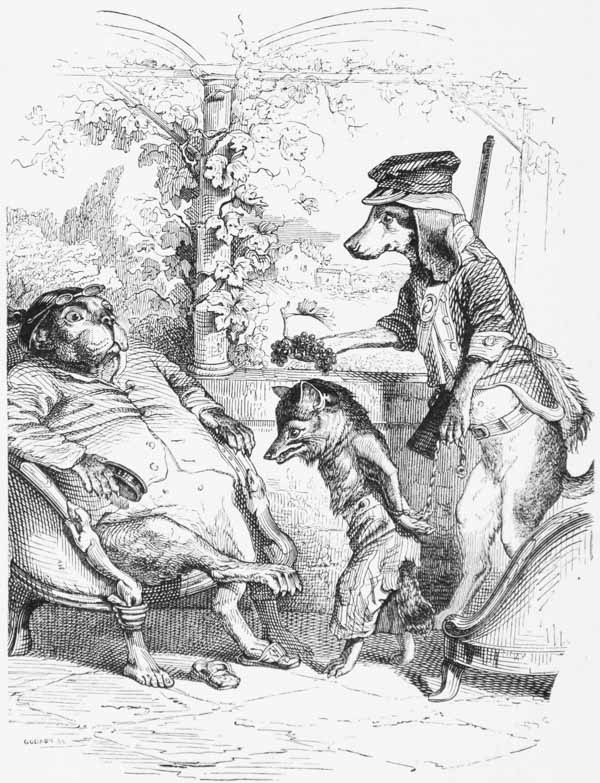
“ ‘Sir,’ said this interesting quadruped, ‘since you wish me to relate some of the incidents of my life, I must go back several years, as my misfortunes commenced with my birth. I owe my introduction into life to one of the choicest foxes of the time. For all that, I am happy to say I inherit almost nothing of the subtle nature of my parents. My utter abhorrence of their ways inspired me with tastes opposed to the interest of my family. A large dog with whom I became acquainted taught me to befriend the weak and helpless. Many hours have I spent, not only listening to his counsel, but observing how careful he was to put his virtuous maxims into practice. He won my gratitude by saving my life. A country steward caught me in his master’s vineyard beneath a vine, where I had taken shelter from the heat of the sun, after quenching my thirst with a grape. I was ignominiously arrested and brought before the proprietor, a “justice of the peace,” whose fierce aspect did not calm my fears. But this powerful, superb animal proved most kind; he forgave me, admitted me to his table, where, in addition to more substantial fare, I was fed on the precepts of virtue and morality. To him I owe the sensibility of my heart, the culture of my mind, and even the pleasure of being able to relate my experience in intelligible language. Numerous griefs and wrongs chequered my existence up to the fatal hour when, like Romeo, I gave my heart to a creature from whom our family feuds seemed to have parted me for ever. Less fortunate than Romeo, I was not loved in return.’
“ ‘Who,’ I said, ‘is the fair charmer so insensible to your love? Who is the lover preferred before you?’
“ ‘The charming one,’ he replied with humility, ‘is a hen, and my rival a cock.’
“I was confounded. ‘Sir,’ at last I said to him, ‘do not for an instant attribute my remarks to our newly-formed friendship. I for one have always looked with scorn and contempt on individuals of this vain type. What more stupidly pretentious, what more ridiculous than a cock, whose stiff strut of pride causes him to stumble in his sublimest moods? The unbridled pomp and vanity of the cock renders him the meanest and most ridiculous of birds.’
“ ‘There are many hens, sir, who are not of your opinion,’ said my young friend, sighing. ‘Alas! the love of Cocotte is a proof of the value of a picturesque physique coupled with bold assurance. I hoped that my boundless devotion would one day be rewarded by her love. I had spiritualised an attachment which generally displays itself in a rather material fashion when the fox woos the hen. But happy love knows no pity! Cocotte saw me suffer without remorse. My rival enjoyed my troubles, for in the game of insolence and fatuity he has no rival. My friends scorned and abandoned me, and, to crown all, my noble protector ended his days in an honourable retreat. Alone now, I would feel wretched but for the memory of this fatal passion, which has still its inexplicable charm. I am bound to Cocotte, and to the end of my days must defend her against my fellows, and wear the chains she has coiled around me. I would die happy if only I could prove to her that I am not unworthy of her pity! You are so indulgent, sir, I venture to think that the circumstances which introduced me to Cocotte may not be indifferent to you. I first beheld her during a blood conventicle held last summer, at which I unwillingly assisted. It was through my father’s influence that I was admitted. I was detested by my friends, and could take no part in eating feathered creatures like the one I loved. A number of my relations had agreed among themselves to seize a farmyard during the absence of the master and dogs. You may descry the house not far from here. The most careful preparations, such as would make your hair stand on end—(pardon me, I did not notice your wig)—were made for a general slaughter of the dwellers in the yard. In spite of my tender heart I lent myself with a rather good grace to aid in carrying out their schemes. It may have been with some touch of pride more worthy of men than foxes, I felt prepared to prove, dreamer as I was, that in the hour of danger I could be trusted. The plot, the memory of which makes me shudder, did not seem at all odious at the time. At last, under cover of night, we made a triumphant entry into the ill-defended yard. Our victims were asleep—hens go to roost early. One only remained watching—that was Cocotte. The first glance of her fair form floored me—to make use of a vulgar phrase. Here I was, a fox in love. I breathed soft words to the night air; she listened to me as one accustomed to homage. I retired to devise some means of saving her. Do not fail to note that my love began in an unselfish thought. This is so rare as to be worthy of special remark. When I approached the bloodthirsty foxes, I advised them to begin decently and in order by devouring the eggs. My proposal was adopted by a large majority. Thus gaining time to reflect, I had decided on nothing when I had to mount guard; the thought then flashed across my mind that a false alarm would save my darling, I at once cried, “Flee who may!” Most of the robbers were already laden with spoil, some had nothing, yet they fled, all of them, leaving me master of the field. The cock awoke, and discovering that his harem had been invaded, crowed lustily, compelling me to retreat. I kept watch over that farmyard for many days, but could never win a kind look from Cocotte, who, although frequently beaten by her unfaithful lord, seemed daily to grow fonder of his society. Nevertheless, I would not have tried to gain her love by unveiling the character of my rival, and depriving her of her dearest illusions.’
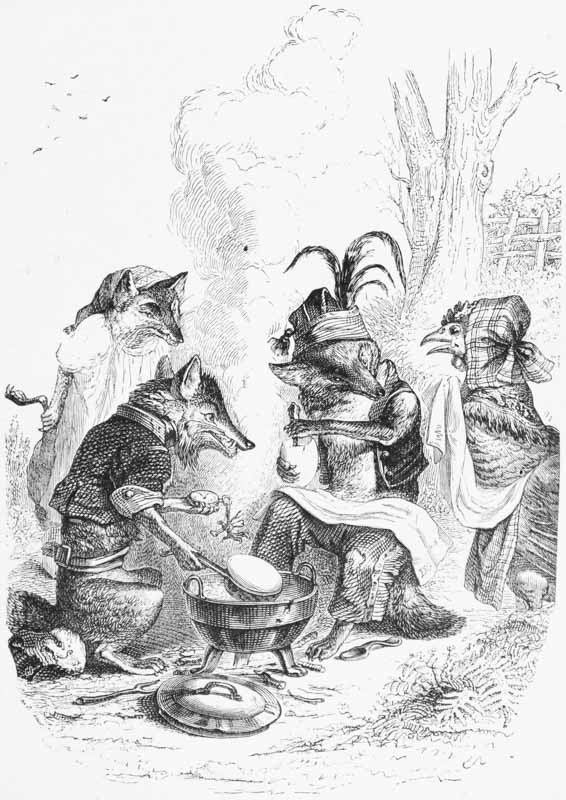
“ ‘The image of my old instructor often rises before me, and I feel, while he raised me out of my own level by education, he rendered me more unhappy than the most ignorant and besotted of my kind. What more can I say? the incidents of an unrequited love are so few that I am surprised at the brevity of my tale when recalling the misery of my life. Now, I shall leave you, the sun is going down; think of me, sir, when you hear it said that foxes are wicked. Do not forget that you have met a kindly-disposed, sensitive, and therefore miserable fox.’ ”
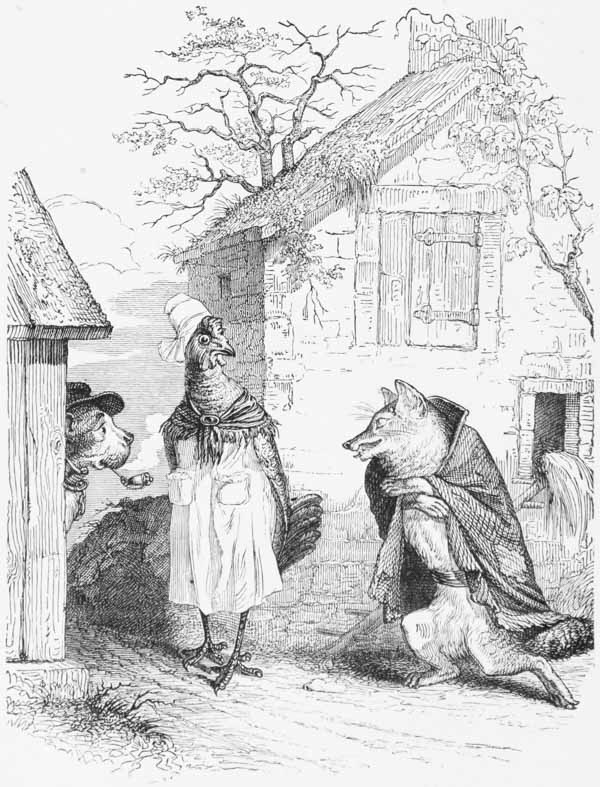
“Is that all?” I said.
“Of course,” replied Breloque, “unless the interest you feel in my story prompts you to inquire what became of the different personages.”
“Interest never prompts me to do anything,” I replied; “I like everything to be in its proper place. It is therefore better to know what the characters are now doing, than to risk meeting them in places where they are least expected.”
“The fox,” continued Breloque, “came across our common enemy. One day venturing to carry off Cocotte, he was shot by the farmer, who hung his tail up as a trophy.”
“What became of the cock?”
“Listen; he is crowing, the cowardly, stupid, selfish rascal!”
“Have you not for the fox the same hatred I have for the cock?”
“Do not deceive yourself; the fox was the craftiest rogue you ever met. Had he succeeded in deluding the farmer as he deceived you, his thirst would have been slaked with the blood of Cocotte. He would have proved as benevolent as a Bashi-Bazouk in Bulgaria.”
“I don’t doubt that,” said Breloque, “but I am sorry for it.”
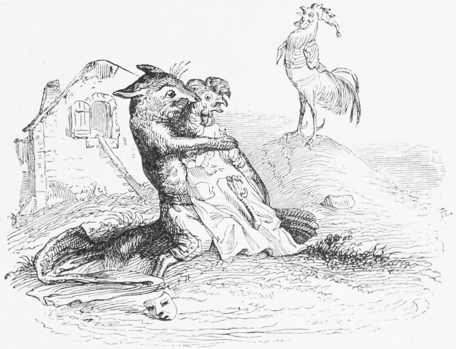
TEXT-BOOK FOR THE GUIDANCE OF ANIMALS STUDYING FOR HONOURS.
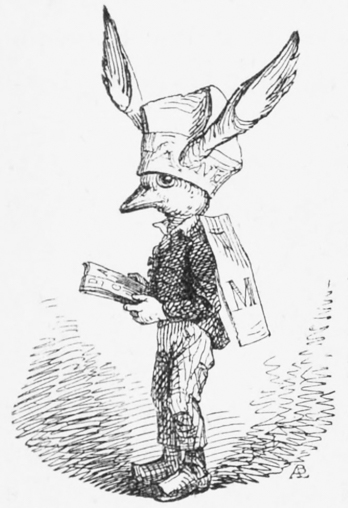
MR. EDITOR,—DONKEYS have long felt the need of asserting their rights before the tribunal of animals, and putting down the injustice which has made them the living types of stupidity.
If skill is wanting in the writer of this manuscript, courage is not. Moreover, let me conjure the silent sage to examine himself in order to find out the secret of his success in society, and ten chances to one he will admit that it all comes of his being an ass. Without donkeys in political circles, majorities would never be obtained, so that an ass may pass as a type of those governed.
But my intention is not to talk politics. I only wish to prove that we have many more opportunities, were they rightly used, of securing honours than fall to the lot of highly gifted and cultured creatures.
My master was a simple schoolmaster in the environs of Paris. He was a good teacher, and a thoroughly miserable character. We had this peculiarity in common, if we had our choice, we would have decided to live well and do nothing. This characteristic, common both to asses and men, is vulgarly called ambition, at the same time I think it is only the spontaneous growth of modern society. I myself had opened a class, and taught in a manner which excited my master’s jealousy, although he acknowledged himself struck by the results of my method.
“Why is it,” he one day said to me, “that the children of men take so much longer to learn to read, write, and become useful members of society, than young donkeys do to learn how to earn a living? How is it that asses have so profited by all that their fathers knew before them, that their education is, so to speak, born in them? So it is, indeed, with every species of animal excepting the human. Why is man not born with his mind and faculties fully developed?”
Although my master was quite ignorant of natural history, he imagined that these questions in themselves were so thoroughly scientific and posing as to entitle him to a place under the Minister of Public Instruction, where he might extend his valuable reflections at the expense of the State.
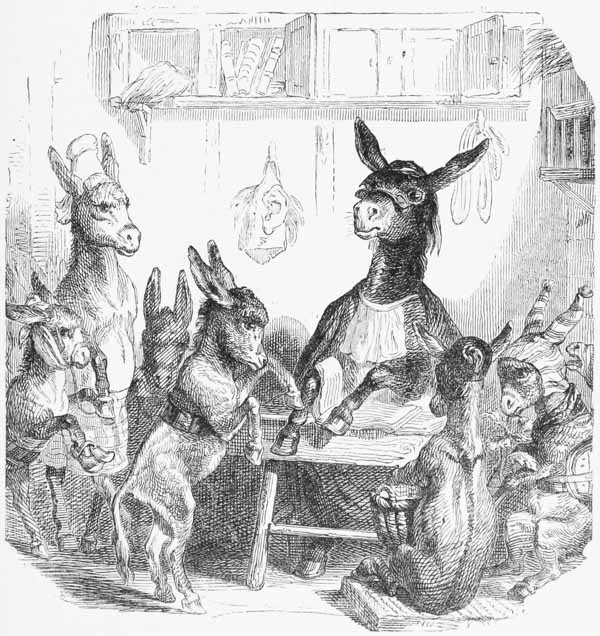
We entered Paris by the Fabourg St. Mareian. When we reached the elevated ground near the Barrier d’Italie, in full view of the metropolis, we each delivered an oration in our own way.
“Tell me, O Sacred Shrine wherein the budget is cooked, when will the signature of some parvenu professor obtain for me food, raiment, and shelter, the cross of the Legion of Honour, and a chair of no matter what, no matter where, &c.?
“Believe me, I should say so much good of every one that no harm could be breathed against me.
“Tell me how shall I reach the Minister and convince him of my fitness to wear my country’s honours.”
I followed my master’s eloquent appeal.
“O charming Jardin des Plantes, where animals are so well fed, will you never open to me your stables of twenty feet square? your Swiss valleys thirty yards wide? Shall I ever be one of those happy animals who roll on the clover of the budget, or stalled beneath graceful trellis-work bearing the superscription, ‘An African donkey, presented by So-and-so, captain of a ship, &c.?’ ”
After saluting the city of acrobats and fortune-tellers, we entered the noxious defiles of a celebrated fabourg famed for leather and science. At last we found shelter in a wretched inn crowded with Savoyards with their marmots, Italians with their monkeys, Avergnats with their dogs, Parisians with their white mice, harpers with their stringless harps, and husky-voiced songsters. My master had with him six francs, the only barrier between us and suicide. The inn called The Mercy is one of these philanthropic establishments where one may sleep for a penny a night, and enjoy a meal for fourpence halfpenny. It also boasts a stable, where all sorts of animals may be lodged promiscuously. My master naturally placed me there.
Marmus, such was my master’s name, could not avoid contemplating the throng of depraved beasts to which I was added. A monkey in marquis furbelows, plumed head-dress, and gold waistband; quick as gunpowder, was flirting with a military hero of popular burlesque; an old rabbit, well up in his exercises; an intelligent poodle of modern dramatic fame spoke of the capriciousness of the public to an old ape seated on his troubadour’s hat; a group of grey mice were admiring a cat taught to respect canaries, and engaged in conversation with a marmot.
“Confound these creatures!” exclaimed my master; “I thought I had discovered a new science, that of comparing instincts, now I am cruelly undeceived by this stableful of beasts, who are all of them the same as men!”
“Ah, sir,” said a shaggy-looking young man, “you desire to gain a reputation for learning, and yet you pause at trifles. Know, ambitious one, that in order to succeed you must allow your external appearance to indicate the height of your aspirations. The traveller who seeks to make his way into a terra incognita must not encumber himself with baggage. Our great explorers were men who wore an expression of resolute earnestness, and carried an umbrella and a tooth-pick. They penetrated to the heart of savagedom, and brought back to civilisation a wayworn exterior and the power of discoursing on the perils of their journeys.”
“To what great genius have I the honour of speaking?”
“A poor fellow who has tried everything, and lost everything except his enormous appetite, and who, while waiting for something to turn up, lives by selling newspapers, and lodges here. Who are you, pray?”
“A resigned elementary teacher, who naturally does not know much, but who has asked himself this question, ‘Why is it that animals possess à priori the special science of their lives called instinct, while man learns nothing without extraordinary toil?’ ”
“Because science is in its infancy!” exclaimed the adventurer. “Have you ever studied ‘Puss in Boots’?”
“I used to tell it to my pupils when they had been good.”
“Well, my dear sir, it points the line of conduct for all to follow who wish to succeed. What did the cat do? He told every one that his master possessed lands; he was believed. Do you understand that it is enough to make known that one is, one has, one intends to have? What does it matter, if you have nothing, if others believe that you have all?”
“But ‘væ soli!’ says the Scripture. In fact, in politics, as in love, two are better than one. You have invented Instinctology, and you shall have a chair of Comparative Instinct; you shall be the great modern sage, and I shall announce it to the whole world—to Europe, to Paris, to the Minister, to his secretary, his clerks and supernumeraries. Mahomet became a prophet, not because he was gifted with prophetic inspiration, but because his followers proclaimed him prophet.”
“I am quite willing to become a great savant,” said my master resignedly, “but I shall be asked to explain my theories.”
“What! would it be a science if you could explain it?”
“Yet a point to start from will be necessary.”
“Yes,” replied the young journalist, “we ought to have some animal that would upset all the theories of our learned men. Baron Cerceau, for example, has devoted his life to placing animals in absolute divisions. That is his plan, but now other great naturalists are knocking down all the strongholds of the Baron. Let us take part in the war of words and hypothetical ideas. According to us, instinct will be the leading feature in animals, by which alone, according to the degree of instinct, they must be classified. Now, although instinct will submit to infinite modifications, it is nevertheless still one in its essence, and nothing can prove the unity of all things better than this. We shall thus say there is only one animal, as there is only one instinct, the instinct which characterises all animal organisations. The, so to speak, appropriation of the element of life which circumstances change without affecting the principle. We come in with a new science opposed to the Baron, and in favour of the new school of philosophy which advocates zoological unity. We shall no doubt sell our discoveries in a good market; our opponents must buy us up.”
“Well,” said Marmus, “science has no conscience. But shall I have no need of my donkey?”
“What! have you a donkey?” exclaimed the adventurer; “we are saved!! We shall turn him into an extraordinary zebra, and puzzle the whole learned world by some singularity which shall derange their most cherished conclusions. Savants live by nomenclature, let us reverse it; they will be alarmed, they will capitulate, they will try to gain us over, and, like so many who have gone before, we may be gained over at our own price. There are in this house mountebanks who hold wonderful secrets, men having dwarfs, bearded women, and a host of monstrosities. A few politenesses will win us the means of concocting revolutionary matter such as shall astonish the world of science.”
To what science was I to become a prey? During the night several transversal incisions were made in my skin, after my coat had been clipped. To these a gipsy vagrant applied some strong liquor, and a few days afterwards I became celebrated. In the papers Parisians read as follows:—
“One of our most courageous travellers, Adam Marmus, after passing through the central wilds of Africa, has at last returned, bringing with him from the Mountains of the Moon a Zebra so peculiar as to derange the fundamental principles of naturalists who advocate a system of merciless division, not even admitting that the horse, in its wild state, was ever found with a black coat. The singular yellow bands of the new Zebra are most puzzling, and can only be explained by the learned Marmus in the work he is about to give to the world. This work, the result of many years’ toil and observation, will be devoted to an elucidation of Comparative Instinct, a science discovered by the illustrious author and traveller. The Zebra, the only trophy of a journey unparalleled in the annals of discovery, walks like a giraffe. Thus it is proved beyond doubt that instinct modifies the forms and the attributes of animals, which are also greatly affected by geographical position. From these hitherto unknown facts the zoologists will be enabled to lay a new foundation of truth upon which to raise the fabric of natural history. Adam Marmus has consented to make known his discoveries in a course of public lectures.”
All the papers repeated this audacious fable. While all Paris was occupied with the new science, Marmus and his friend took up their quarters in a respectable hotel in the Rue de Tournon, where I was carefully kept in a stable under lock and key. All the learned societies sent delegates, who could not disguise the anxiety caused by this blow to the doctrine of the great Baron. If the forms and attributes of animals changed with their abodes, science was upset! The genius who dared to maintain that life accommodated itself to all should certainly be upheld. The only distinctions now existing between animals could be understood by all.
Natural science was worse than useless; the Oyster, the Lion, the Zoophyte, and man all belonged to the same stock, and were only modified by the simplicity or complicity of their organs. Saltenbeck the Belgian, Vos-man-Betten, Sir Fairnight, Gobtonswell, the learned Sottenbach, Craneberg, the beloved disciples of the French professor, were ranged against the Baron and his nomenclature. Never had a more irritating fact been thrown between two belligerent parties. Behind the Baron were the academicians, the university men, legions of professors, and the government, lending their support to a theory, the only one in harmony with Scripture.
Marmus and his friend remained firm. To the questions of academicians they replied by bare facts, avoiding the exposition of their doctrine. One professor, when leaving, said to them—
“Gentlemen, the opinion which you hold is without doubt directed against the convictions of our most reliable men of science, and in favour of the new schism of zoological unity. The system, in the interest of science, ought not to be brought to light.”
“Say, rather, in the interest of scientific men,” said Marmus.
“Be it so,” replied the professor; “it must be nipped in the bud, for after all, gentlemen, it is Pantheism.”
“You think so?” said the journalist. “How can one admit the existence of material molecular force which renders matter independent of the Creator.”
“Why should not the Creator have ordered that everything should be subject to, and dependent upon, one universal law?” said Marmus.
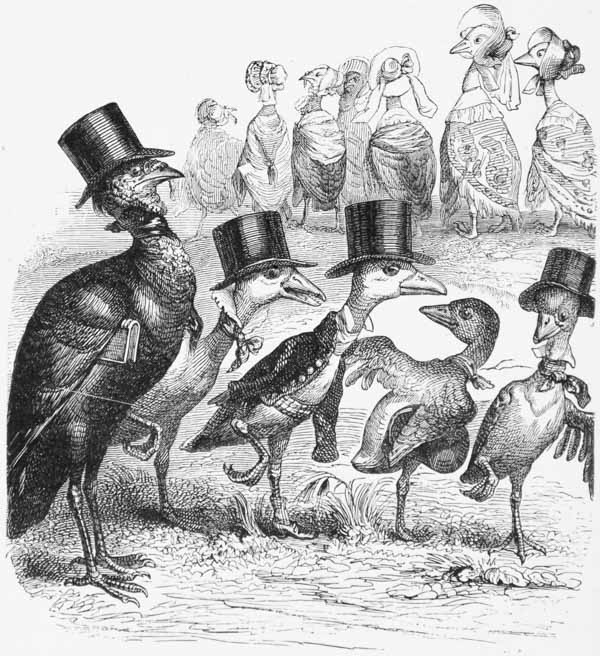
“You see,” said his friend in a whisper to the professor, “he is as profound as Newton. Why do you not present him to the Minister of Public Instruction?”
“I shall do so at once,” rejoined the professor, happy to make himself master of the owner of the Zebra. “Perhaps the minister would be pleased to see our curious animal before any one else, and you will of course accompany him.”
“I thank you.”
“He would then be able to appreciate the service which such a journey has rendered to science,” continued our friend. “Mr. Marmus has not visited the Mountains of the Moon for nothing. You shall see this for yourself; the animal walks like a giraffe. As to the yellow bands, they are caused by the temperature, which was found to be several degrees Fahrenheit, and many degrees Reaumur.”
“Perhaps it is your intention to engage in public instruction?”
“Splendid career!” cried the journalist starting.
“I do not allude to the profession of noodles, which consists in taking the students out for an airing, and neglecting them at home; but to teaching at the Athenæum, which leads to nothing, save to securing a professorship and pupils, which pave the way to all sorts of good things. We will talk of that again. All this took place early in the nineteenth century, when ministers felt the need of making themselves popular.”
The partizans of zoological unity learned that a minister was about to inspect the precious Zebra, and fearing intrigue, the worthy disciples of our great opponent flocked to see the illustrious Marmus. My masters obstinately refused to exhibit me, as I had not acquired my giraffe step, and the chemical application to my Zebra bands had not yet completed the illusion. A young disciple discoursed on the new discovery with eloquence and force, and my cunning masters profited by his learning.”
“Our Zebra,” said the journalist, “carries conviction to the most incredulous.”
“Zebra,” said Marmus. “It is no longer a Zebra, but a fact which engenders a new science.”
“Your science,” responded the unitariste, “strengthens the ground taken up by Sir J. Fairnight on the subject of Spanish, Scotch, and Swiss sheep, who eat more or less, according to the sort of herbage in pasture lands.”
“But,” exclaimed our friend, “the products, are they not also different in different latitudes and under different atmospheric conditions. Our Zebra explains why butter is white in the Brie in Normandy, and the butter and cheese yellow in Neufchâtel and Meaux.”
“You have placed your finger on the point of greatest vitality,” cried the enthusiastic disciple; “little facts solve great problems. The question of cheese bears a subtle affinity to the greater questions of zoological form and comparative instinct. Instinct is the entire animal, just as thought is man concentrated. If instinct is modified and changed according to the latitude in which it is developed, it is clear that it must be the same with the Zoon, with the exterior living form. There is but one principle of instinct.”
“One for all beings,” said Marmus.
“Then,” continued the disciple, “nomenclatures are all very well for us to indicate the different degrees of instinct, but they no longer constitute a science.”
“This, sir,” said the journalist, “is death to the Mollusks, the Articulata, the Radiata, Mammifera, Cirropedia, Acephala, and Crustacea. In fact, it breaks down all the strongholds of natural history, and simplifies everything so thoroughly as to destroy accepted science.
“Believe me,” said the disciple, “men of science will defend their position. There will be much ink spilt and pens spoiled in the contest, to say nothing of the reams of paper that will be destroyed in keeping the wounds open. Poor naturalists! No, they will hardly allow a single genius to wrest from their hands the labours of so many lives.”
“We shall be as much calumniated as your great philosopher himself. Ah! Fontenelle was right. When we have secured truth, let us close our fists tightly over it.”
“Shall you be afraid, gentlemen?” said the disciple; “shall you be traitors to the sacred cause of the animals?”
“No, sir,” cried Marmus, “I shall never abandon the science to which I have devoted the best days of my life; and to prove my sincerity we must conjointly edit the history of the Zebra.”
“We are saved,” exclaimed Marmus, when the disciple had gone.
Soon after, the ablest pupil of the great philosopher drew up a notice of the Zebra. Under the name of Marmus he launched out boldly, and formed the new science. This pamphlet enabled us at once to enter into the enjoyable phase of celebrity. My master and his friend were overwhelmed with invitations to dinners, dances, receptions, morning and evening parties. They were proclaimed learned and illustrious everywhere. They indeed had too many supporters, ever for a moment to doubt their being geniuses of the highest order. A copy of the work by Marmus was sent to the Baron. The Academy of Science then found the affair so grave that not a member dared give his opinion.”
“We must see, we must wait,” they said. Sathenbeck, the learned Belgian, is coming by express, Vas-man-Bitten from Holland, and the illustrious Fabricus Gobtouswell are on their way to see the Zebra. The young and ardent disciple of zoological unity was engaged on a memoir which contained terrible conclusions, directed against the Baron’s dogmas. Already a party was forming to promote unity applied to botany. The illustrious professors, Condolle and Mirbel, hesitated out of consideration for the authority of the Baron.
I was now ready for inspection. My mountebank artist, in addition to finishing my bands, had furnished me with a cow’s tail, while my yellow stripes gave me the appearance of an animated Austrian sentry-box.
“It is astonishing,” said the minister, as he gazed upon my coat for the first time.
“Astonishing!” echoed the professor; “but, thank goodness, not inexplicable.”
“I am puzzled,” said the minister, “how best to reconcile this new discovery with all our preconceived notions of zoology.”
“A most difficult problem,” suggested Marmus.
“It seems strange,” said the great man, “that this African Zebra should live in the temperature of the Rue de Tournon.”
This was treading on delicate ground, but my master was equal to the occasion, although on hearing the remark I began to walk like an ass.
“Yes,” replied Marmus, “I hope he may live until my lectures are over.”
“You are a clever fellow, but bear in mind that your new and popular science must be moulded to fit in with the doctrines of the worthy Baron. Perhaps it would lend dignity to your cause were you represented by a pupil.”
Here the Baron entered, and overhearing the remark, said:—
“Ah, sir, I have a pupil of great promise, who repeats admirably what he is taught. We call this sort of man a vulgariser.”
“And we,” said the journalist, “call him a parrot. Those men render real service to science as they talk it down to the level of the popular mind.”
“Well, that is settled,” said Marmus, taking the Baron’s hand; “let us pull together.”
The minister said: “Marmus, you deserve, and shall receive, the substantial reward of genius in such honour and support as your country has to bestow.”
The Geographical Society, jealously wishing to imitate the government, offered to defray the entire cost of the journey to the Mountains of the Moon, which offer was ultimately carried into effect. These timely aids came in opportunely as my master had been burning the financial candle at both ends.
The journalist was placed as librarian in the Jardin des Plantes, and abused the opportunity which leisure afforded him by running down my master and his science. Nevertheless Marmus coined a wide reputation out of the base metal of the parrot’s jargon, and sustained his hard-earned fame by discreet and modest silence. He was elected professor of something somewhere, and would no doubt have filled the post honourably had a time and place ever been named when he would be required to fill a chair.
As for myself, I was bought for the London Zoological Gardens, where change of climate and kind treatment rendered me the wonder of the world, as I gradually changed from a strange Zebra to a domesticated Cockney ass.
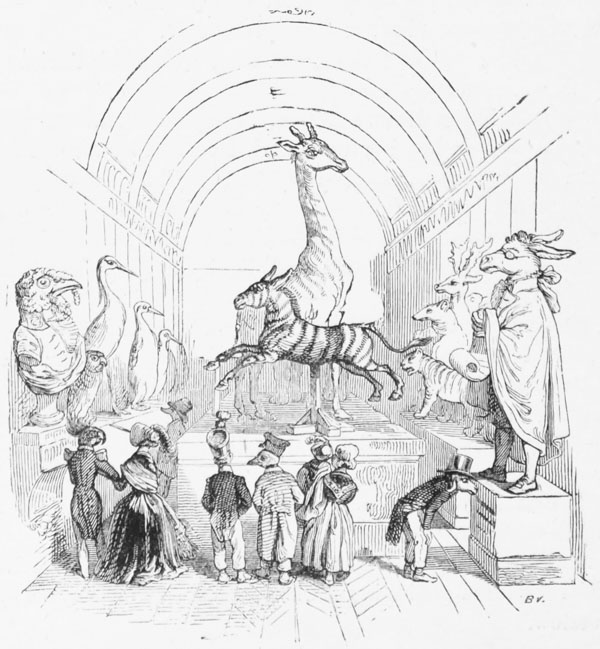
THE INCONSISTENCIES OF A GREYHOUND.
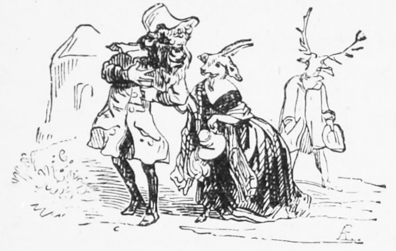
THE theatre has always had a peculiar charm for me, and yet there are few persons who have greater reason to hold it in utter abhorrence, for it was there at about nine o’clock one evening that I first beheld my husband. As you may well suppose every detail of our meeting is indelibly fixed in my mind. I have indeed many grave reasons for not forgetting it. In all frankness, I wish to accuse no one, but I was never meant for married life. Elegant, attractive, fitted only to revel in the pleasures of the world, and feast on the joys of a great life, space, luxury, brilliancy, were necessary to me. I was born to be a duchess, and married—O heavens! the first clarionet player at the Dogs’ theatre. It was a serious joke! Was it not? It has moved me to laughter times without number. Yes! he really played the clarionet every evening from eight to eleven, the easy parts too, at least, he told me so. I daresay it was not true for I never found that he played false to me.
During the day he was second trombone to the parish of dogs, and above all, his greatest ambition was a hat in the National Guards.
These details may seem grotesque. Pray forgive me if they are, as I only wish to discharge my duty.
One evening when I was at the theatre, I noticed between the acts a big burly dog in the orchestra wearing spectacles, a cap, and blowing his nose in a checked cotton handkerchief. He made so much noise that all heads were turned towards him. Had any one said that that creature would be my future husband I should not have replied. I should have treated the remark with silent contempt. Yet under the most embarrassing circumstances, with all eyes turned upon him, and amid a peal of laughter my future spouse slowly and carefully folded his handkerchief, looking at the company over his spectacles, at the same time changing the mouthpiece of his instrument with a calmness perfectly charming to behold. This singular proof of sang-froid caused me to turn my eye-glass upon him. He no doubt remarked this movement, for he immediately took off his cap, adjusted the short hair on his big head, replaced his spectacles, settled his tie, and pulled down his waistcoat. There is no monster, however ugly, who would not do the same, in his position. His eye which caught mine seemed to me most brilliant.
There was as little doubt of his ugliness as of his strange emotion. I was young, silly and coquettish, so it amused me to be looked at like this. The chief mounted his throne and the music commenced anew. The fat clarionet player cast a last glance at me, and then pulled himself together for work. He had started a trifle behind-hand, and galloped over his part to make up for lost time—turning over two pages at once, and running up and down with his big fingers on his unfortunate pipe, producing the most hideous snortings imaginable—the conductor, red as a peony flower, called to him in the midst of the noise menacing him with his bow. His neighbours pushed him, trod on his toes, hooted him, and showered invectives on his head, but he calmly pursued his notes, no doubt blowing through his pipe a hurricane of rage. Knowing I was the sole cause of the delirium I felt flattered; I pitied and loved him! After about a quarter of an hour he stopped, and placing his clarionet between his legs, proceeded to rub his round head with his cotton handkerchief.
On leaving the play, at about half-past eleven, it rained slightly, and on passing the stage entrance we were nearly knocked down by an individual wearing a white hairy hat. I can still see him coming out of the door and bearing down upon us—I say us, because my mother was with me; I had not yet ventured to the theatre alone.
“Ladies,” cried the Bull-dog, “you have, I daresay, already guessed that the white hat shelters the clarionet. Ladies, stop for heaven’s sake!”
“Why? how? How dare you accost us in this manner; stand on one side, sir, stand on one side!” said my mother with a lofty air.
Before such a show of nobility the musician stammered, only taking off his hat. “It rains, ladies, and you have no umbrella, deign to accept mine.”
My mother who has always been careful, feared water quite as much as she did fire, and accordingly was fain to accept this umbrella, never dreaming that it would lead me to the altar of Hymen.
I purposely refrain from dwelling on details as uninteresting to the reader as they are irritating to myself. The bold musician taking advantage of the introduction afforded by an unlucky shower of rain had paid us several visits, when at last my mother said to me,
“Eliza, tell me frankly, what do you think of him?”
“Who, mamma?” I said inquiringly; “the musician?”
“Yes, little rogue, the clarionet, the young Bull-dog who wants your hand. You know quite well I am speaking of him.”
“But, mamma, I find him so horribly ugly.”
“So do I, my dear; but you have not answered my question.”
“Oh! ah! well! he is vulgar, grotesque, and is as disagreeable as the rain.”
“Quite so,” said my mother; “but again that is not the point. Does he please you when viewed as a sober, steady, desirable husband?”
“I won’t say he does not,” and I burst into tears.
“Come, no nonsense,” said my mother; “I know you would like to be married, and this Bull-dog has many advantages. His double position as clarionet and trombone to the parish secures for him a comfortable living. What more can one require of a husband? I think, my child, that physical beauty and grace are only fleeting, besides you yourself have beauty enough and to spare to adorn a whole family. It is by the intelligent union of opposite natures that conjugal felicity is best secured. Well, that being so, it becomes a positive advantage for you to acquire a thoroughly ugly husband, a heavy, taciturn, serious, hard-working husband, who is certain to be a model of economy and affection.”
I saw at a glance that my mother was right, and gave my consent. Had it all to be done over again, I think now I should do exactly as I did then. A sure, steady husband is a great prize in life. It is always good to have bread on the shelf, and one must be very stupid indeed not to be able to get little luxuries.
I therefore said: “Let us marry!”
Do not human beings say: “Let us take our degree; it will be the making of us.”
To say my honeymoon was long and delightful, or that I discovered a hitherto unknown mine of devotion and romance beneath the hard crust of my husband’s unsightly exterior, would be simply fiction. It is much nearer the mark to say at once that the coarse nature of my spouse soon revealed itself in all its odiousness. His every look, every movement, wounded my refined susceptibility. He rose at daybreak, and awoke me with the snorting of his clarionet, which he played with that degree of obstinacy and labour which belongs to mediocrity.
“Softly, my dear, softly; I tell you it would be better so,” I would say.
He strove with all his might to modulate the notes, but for all that his tenderest passages made everything tremble. I even shook with rage! What irritated me most was that his instrument monopolised his whole attention.
“Won’t you take a walk? have a little fresh air?” I would say to him. “You must feel tired, dear.”
I could have beaten him. When we walked out together he used to stop and gossip at all the street corners, turning up all sorts of filthy heaps. Oh, how he made me suffer; he was born to be a butcher’s dog. How many times has he not left me to pick up a bone, or quarrel with some inoffensive dog? His loud laugh and vulgar conversation with ill-conditioned curs, and . . .
I began to hate him; he bothered me, irritated me beyond measure. I own he would have cut himself in quarters to make our home happy, and he worked like a slave. But, alas! money can never compensate for a badly-assorted match. Little by little I withdrew myself from his company, and took to loitering about alone. I frequented a public garden, the resort of the aristocratic world, where every one was seen to advantage. My delight knew no bounds when I discovered that I was much noticed. I had found my own set at last.
One day I remember walking along a shady alley when I heard a voice whisper, “Oh, madam, how happy would he be who, in the midst of the crowd, could attract your attention.” These words, so respectfully uttered, and so full of a something, a sort of passionate earnestness, pleased me immensely. I turned and beheld a well-dressed, beautiful insect flying near me. His manner was so graceful and his flight so fashionable, that I at once perceived he had moved in the higher circles of the air-istocracy; besides, he seemed to me to know his value, and to account himself a very fine fellow indeed.
“Ah, Greyhound!” he said, “how beautiful you are. What a fine head you have—a true type of the classic. Your feet would hardly soil a lily-leaf. Your silky dress, too, is so simple; yet it is enough to set off such charms as yours.”
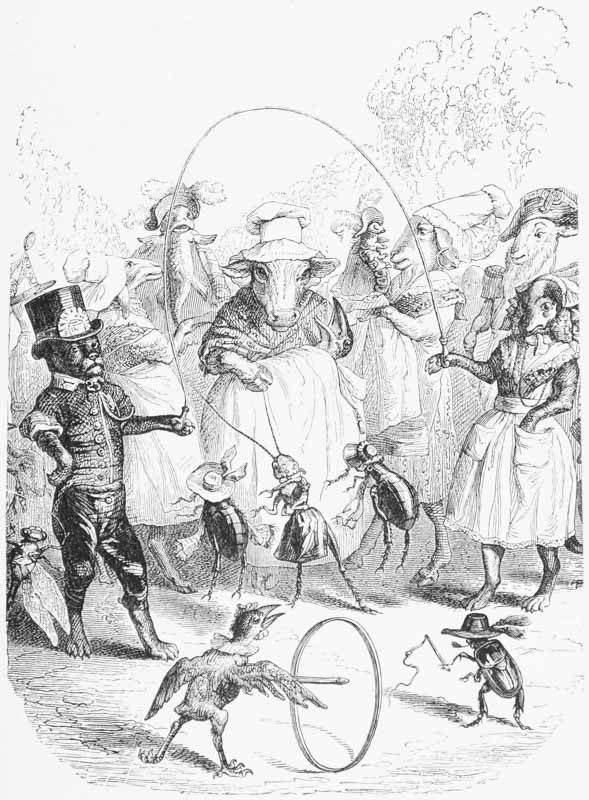
I quickened my pace, trembling at the audacity of this polished flatterer. Still he followed, and his voice vibrated in my ear like delicious music. He had evidently no ordinary appreciation of the beautiful.
“You are married, sweet one?” he added.
I could not resist the temptation of fancying that my fetters were broken, so I replied gaily, “No, I am a widow, sir!”
I saw no harm in this flirtation. What danger was there, after all, in the fact that an insect thought me pretty, and expressed his admiration? It cannot be too well impressed, upon all whom it may concern, that beauty must be appreciated; the public gaze is the sun, which warms it into bloom, and sustains its vitality; cold indifference first mars, and then destroys it. Our coquetry simply expresses a natural craving for being seen, a thoroughly honest and respectable ambition. I had no shade of guilty intention, or exaggerated pride; it was only the consciousness of a tribute, paid daily by the sun to the flower which opens to display its charms to the heavenly gaze. I looked upon this tribute of the world as my right. To prove that I was the most virtuous greyhound in Paris, I felt intoxicated by the words of my new admirer.
“Your eyes are terribly bright,” said my husband on my return home. He was polishing a bone in a corner of our kennel—where he had picked it up, I do not know—“your voice is sweeter than usual.”
“To please you, my eyes must grow dim and my voice husky,” I replied.
Nothing is more galling than these simple remarks some people are always making, and asking why you detest them. My spouse was growing more and more distasteful to me. The trouble he takes to please me is most annoying. I hate to profit by his ridiculous labour, to eat his bread; all the time thinking that I owe it to the infernal clarionet he plays so badly. His irritating temper is killing me, his unutterable calm and absolute self-control compel me to shut up within myself all my bad temper, my indignation, my scorn! This sort of thing is perfectly frightful when one is nervous.
Life became a burden, and the polished insect soon found it out, for he followed me about with his dreamy, delicious buzzing.
“Greyhound, you are unhappy! you are suffering! I feel it, I see it. Grief ought not to touch a heart so tender,” he said in tones so pathetic, that I looked upon him as a deliverer.
“Care will line your forehead and tarnish your beauty!”
I shuddered. What he said was, alas! too true, anxiety would certainly rob me of my charms, clog my steps, and veil my eyes. His words kindled my wrath against my husband, who would surely bring this grief upon me.
“Well,” pursued the insect, “why not amuse yourself, come with me into the woods. Go on in front, and I shall follow, so that I may admire you, and drive away your gloom with my songs. Come, let us fly from the city-throng, and fill our breasts with the pure air of the fields.”
I was choking; air I must have, air at any price. “To-morrow at such an hour, be at such a place, and we shall go out together.”
It must not be thought, that by granting a rendezvous to this insect, I yielded to foolish sentiment. I simply did it to oblige him, because he rendered justice to my charms, and spoke ceaselessly about me.
When I reached home that evening, I suppose my face must have expressed more than usual disgust, for my musician stood looking at me for several minutes without uttering a single word, and then two large tears rolled down his cheeks; he was grotesque. Nothing is more dreadful than an ugly animal, who adds to his ugliness the horrors of grief. I expected a scene and reproaches, my heart swelled within me, as I said to myself, “Let him but speak, get angry, curse me; I will do the same, and oppose anger to anger. Passion is like a storm, when it has burst and is over, it refreshes the earth. I began to sing snatches of songs, like little bits of forked lightning, to bring about the crisis. But he did nothing, and said nothing, two or three times he sniffed badly, and carefully placing his clarionet in its dirty case, put on his cap, and said—
“Good night, my dear, I am going to the theatre.”
What did these tears mean; did he think that he was odious to me? He did not seem jealous; how could he be so? was I not the most irreproachable, and, at the same time, most miserable of wives? Oh, if I had only something to break, scratch, or bite! How he does make me suffer!
Next day at the appointed hour, we met at our rendezvous. My fine companion, who had been impatiently waiting for me, exclaimed, “How beautiful you are! let us start for the woods.”
“Yes,” I replied, quite flattered, “I am ready.”
So off we started. Although my mind was made up, a certain foreboding of evil troubled me. I could not throw it off. It occurred to me that I had gone too far, and was approaching the edge of a volcano.
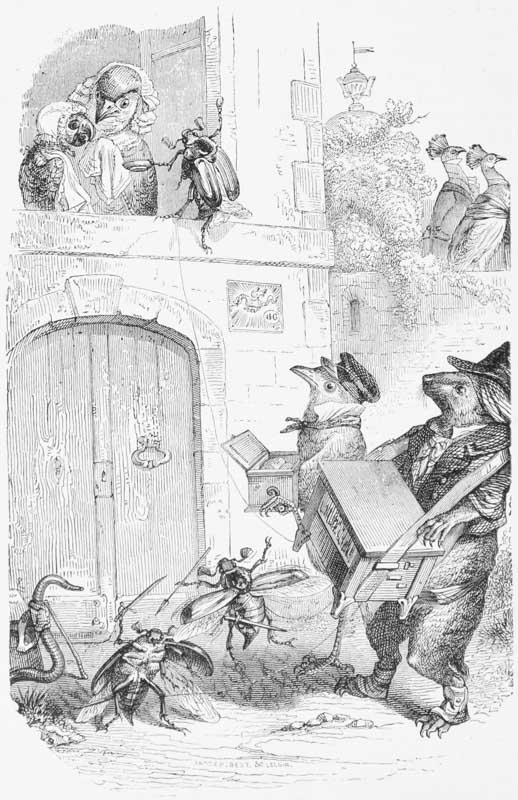
“What is the matter, dear?” said the insect.
“Do you not see those ambulating musicians over there at that window?”
“Yes; they are showing performing Beetles to the inmates of the house. It seems to me they have to work hard for a living.”
“Doubtless, but I am afraid, they look so strange. Please let us go some round-about way; I am trembling.”
We followed a street to the left, and continued our course, yet I felt uneasy. It was a presentiment, for that day I had one of the most disagreeable meetings imaginable. We were just emerging from the suburbs when I descried in a corner an obscure mass, which turned out to be one of those performing Bears who figure at fairs and markets. He was making a Tortoise go through all sorts of wonderful exercises. Nothing was more natural than to meet this Bear, and yet I shivered all over. As my fears seemed unfounded, we continued to advance, and came close to the performer. The keen eye of this monster shot forth fire, and he sprang forward to bar my way.
“What are you doing here, madam?” he exclaimed, crossing his arms.
“Pray what does it matter to you what madam is doing here?” said my protector. “On my honour you are a bold fellow. Who are you, I pray? Speak! Who are you?”
“Who am I?” he breathed heavily. “I am the husband of this lady.”
Saying which, he threw off the bearskin disguise, and revealed the clarionet, the musician, the Bull dog, my husband, in fact, pale as death and a prey to horrible passion. He was frightful; although, to tell the truth, I liked him better excited, furious, grinding his teeth with rage, than calm and resigned, with tears in his eyes. He was really not so ugly as usual. Unfortunately the picture was spoilt by the cap which he kept on his head. That was a fault not to be pardoned. Readers of the opposite sex will hardly understand how it is that no detail escapes us.
“Madam,” said my husband gravely.
This was another defect of his, to be grave! It was evident that he had prepared a speech, and weighed its effects. The insect hidden behind my ear said in a low voice: “What! is it possible, my queen of beauty, that you are married to this brute?”
I blushed to the tip of my nose.
“Madam,” continued my master. “Mada”—
Here he sneezed in the most comical manner. Perhaps a hair of the bearskin had got lodged in his nose. I laughed loudly, and quite as involuntarily as he had sneezed.
“Madam, follow me,” continued my husband, quite losing his head. “This is too much; follow me!”
“I advise him not to touch you,” said my protector, still hiding behind my ear; “as I really think I should not be responsible for my actions. I feel savage!”
He had not time to finish his sentence. My husband, as quick as lightning, seized him as he was flying, and mutilated him horribly. I do not know what followed. I became mad, and by a violent effort disengaged myself from my husband’s paws, and jumping over his head, started off. I soon turned to look back, and saw the Bull-dog struggling with the police, making desperate efforts to get free, but the bearskin got entangled about his feet, and paralysed his movements, and at last he was carried off prisoner, followed by a jeering crowd.
So, I reflected, I am free; and pursued my way. The pure bracing air and deep blue of the sky had lost their charm. My breast was filled with indignation. I felt humiliated by this absurd jealousy, this scandalous outburst at once comic and tragic. The comic element annoyed me most. This prosaic clarionet appearing all at once upon the scene to dispel the dream of my life—can he ever be forgiven? After wandering about till I was giddy, I bent my steps homeward, and on entering found the place empty. It seemed to me I had lost something or some one. In truth, the deserted kennel filled me with strange longings for my poor husband. One gets used even to ugly, awkward things. If camels were at one fell swoop deprived of their humps, they would feel strange without them.
At this moment a letter was handed to me, ornamented with an imposing seal. It was an invitation from the authorities to be present at my husband’s examination. The disguise in which he had been found, as well as a weapon discovered in his shoe, told badly against him.
Next day after breakfast—I had risen very late—and after finishing my toilet set out for prison to cheer my husband. It proved a great trial to my nerves. I passed through damp, dark corridors, enormous keys grating in horrible locks; heavy doors barred with iron were opened, and I entered a place crowded by miserable, ill-conditioned, dirty, repulsive animals.
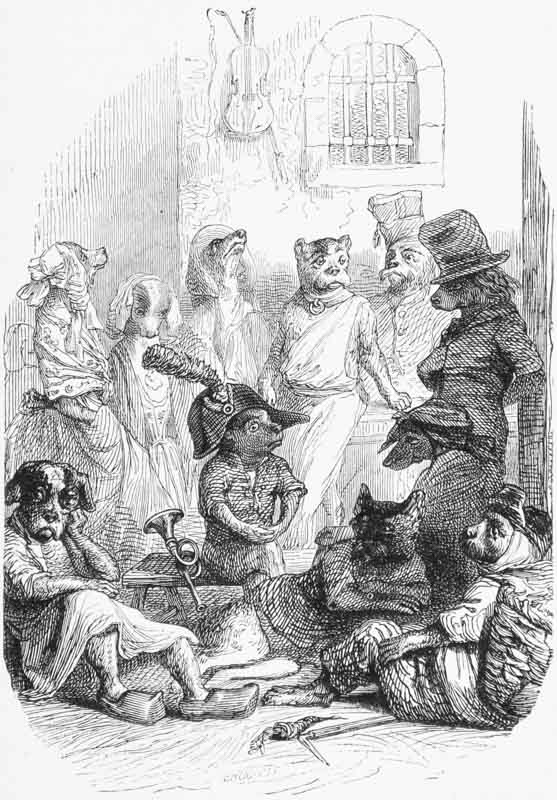
Picking my steps into the midst of this filthy den, afraid to breathe the vitiated air, I beheld my husband seated in a corner. Expecting reproaches and a tragic scene, I held myself in readiness to stand my ground. But contrary to my expectations he lay down at my feet and sobbed, begging my forgiveness.
I was quite touched—although the scene afforded amusement to the other prisoners—and resolved to do my best to obtain his release. I am naturally tender-hearted, too much so indeed. It was most proper on his part, that he owned his faults and ugliness, and rendered homage to my beauty.
I went at once to the presiding judge, who, viewing me over his spectacles, was astonished at my attractive appearance. He was clever, amiable, and leisurely, so that the trial of my husband lasted a long time.
Now is the moment when I must own a strange fact, and let in the light on a hitherto dark recess in my heart. Hardly was my Bull-dog incarcerated than my hatred of him changed to affection. He was no longer there for me to grumble at, and every time my eyes caught his clarionet in the corner they filled with tears. I was almost frightened at the power this morally and physically imperfect creature had over me, and the place he had filled in my life. His comical face, his cap, even his silence were wanting. I never knew where to vent my bad temper, which at times made me feel fit to burst. I tried to distract my attention, fearing lest my health should give way, but it was of no avail. I hardly dare to say it, I loved my Bull-dog, the jealous clarionet, I loved him! For all that, consideration for my feelings prevented me repeating my visit to the noxious prison which caused me a dreadful attack of neuralgia.