SCENE VI. STITCH-GNAWER AND LITTLE TROTTER. (continued 2)
Reading edition
Thanks to my keeping him out of sight, his image became idealised in my imagination. In my dreams he appeared clothed in charms not his own. The news of his release was such a shock to my nerves that I nearly fainted. I rejoiced in his freedom. Soon after he arrived, but oh dear, how ugly he was! His coat was dirty, and his whole being steeped in an odour most offensive. A block of ice had fallen on my heart.
“My Greyhound! my wife! my darling!” he cried, running to meet me.
“Good morning, my friend,” I replied, averting my nose. I had no courage to say more, my dreams had vanished.
All this passed long ago. Now my indignation brings the smile to my lips. Nothing more. I have learned to make the most of my bargain. If I made a mistake, and married a clarionet in place of a first-class tenor, I determined not to die of grief, but rather to be as brave as beautiful, and devote myself to cultivating all that was good in my Bull-dog. He has left off wearing his cap, and positively plays better; his walk is improved, and, by the dim light of the lamp, his profile is marked by a certain character.
“How pretty you are, little heartless one,” he sometimes says. I reply in the same tone, “How ugly you are, my fat jealous one.”
TOPAZ THE PORTRAIT-PAINTER.
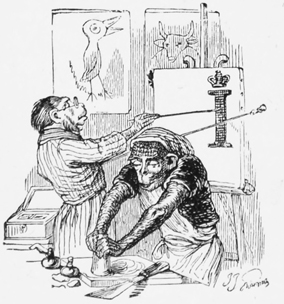
AM his heir, I was his confidant, so that no one can better relate his history than myself.
———
Born in a virgin forest in Brazil—where his mother rocked him on interlacing boughs—when quite young he was caught by Indian hunters and sold at Rio, with a collection of parrots, paroquets, humming-birds, and buffalo-skins. He was brought to Havre in a ship, where he became the pet of the sailors, who, in addition to teaching him to handle the ropes, made him acquainted with all manner of tricks. His sea-life was so full of fun and frolic, that he would never have regretted quitting his forest home had he not left the warm sunshine behind.
The captain of the ship, who had read “Voltaire,” called him Topaz, after Rustan’s good valet, because he had a bare, yellow face. Before arriving in port, Topaz had received an education similar to that of his fellow countryman on the barge, Vert-Vert, who shocked the nuns by his manner. That of Topaz was also decidedly briny, as was quite natural from his nautical experience. Once in France, he might easily have passed for a second Lazarelle de Tormes, or another Gil Blas, if one cared to name all the masters under which he studied up to the time of full-grown Monkeyhood.
Suffice it to say, that as a youth he lodged in an elegant boudoir in the rue Neuve-Saint-Georges, where he was the delight of a charming personage, who finished his education by treating him as a spoilt child. He led an easy life, and was happier than a prince. In an unlucky hour he bit the nose of a respectable old dotard called the Count, the protector of his fair mistress. This liberty so incensed the old gentleman, he at once declared that the lady must choose between him and the beast, one of the two must leave the house.
The tyranny of a rich, old husband prevailed, and Topaz was secretly sent to the studio of a young artist, to whom the lady had been sitting for her portrait.
This event, simple in itself, opened up for him a new career. Seated on a wooden form in place of a silken couch, eating crusts of stale bread and drinking plain water instead of orange syrup, Topaz was brought to well-doing by misery, the great teacher of morality and virtue, when it does not sink the sufferer deeper into the slough of debauchery and vice. Having nothing better to do, Topaz reflected on his precarious, dependent position, and his mind was filled with a longing for liberty, labour, and glory. He felt he had come to the critical point of his life, when it was necessary for him to choose a profession. No career seemed to offer the same freedom and boundless prospects as that followed by the successful artist. This became a settled conviction in his mind, and, like Pareja the slave of Velasquez, he set himself to picking up the secrets of the limner’s art, and might be seen daily perched on the top of the easel, watching each mixture of colour, and each stroke of the brush. As soon as his master’s back was turned, he descended, and going over the work with a light hand, and a second coat of colours, retired one or two paces to admire the effect. During such moments he might be heard muttering between his teeth, the words used by Corregio, and later by the crowd of youthful geniuses with which Paris is inundated: Ed io anche son pittore. One day, when his vanity caused him to forget his usual prudence, the master caught him at work. He had entered his studio elated with joy, having received a commission to paint a cartoon of the Deluge, for a church at Boulogne-sur-Mer, where it rains all the year round. Nothing renders one so generous as self-satisfaction; instead, therefore, of taking the mahl-stick and beating his disciple, “In good faith,” he said, like a second Velasquez, “since you wish to be an artist, I give you your liberty, and, instead of my servant, I make you my pupil.”
Here Topaz became an historical pilferer; he arranged his hair like the powdered wig of a country priest, caught together the straggling hairs of his beard into a point, put on a high-peaked hat, dressed himself in a tight-fitting coat over which the ruffle of his shirt fell in folds, and, in short, tried to look as much as possible like a portrait of Van Dyck. Thus attired, with his portfolio under his arm, and colour-box in hand, he began to frequent the schools. But, alas! like so many apprentice artists, who are men with all their faculties fully developed, Topaz followed the empty dreams of his ambition, rather than the teaching of common sense. It was not long before he found this out. When the works of his master were not available, he had to begin with the bare canvas, and unaided lay in outline, form, light, shadow, and colour; when, in fact, instead of imitation, originality and talent were required, then, alas! good-bye to the visions of Topaz. It was no good his working, perspiring, worrying, knocking his head, tearing his beard. Pegasus, always restive, refused to carry him to the Helicon of fortune and renown. In plain English, he did nothing worth the materials wasted in its production: masters and pupils urged him to choose some other means of making a living.
“Be a mason, or a shoemaker; your talent lies more in the direction of trade!” It was in truth a pity that Topaz—full-grown ape as he was—should have been the slave of his narrow pride and vanity. That he should have aspired to fill a grand, generous, imposing, humanlike roll. I have often heard him say he would follow the example of the men of the Middle Ages, study medicine among the Arabs; and then return to teach it to the Christians. His foolish ambition was to transmit, from cultured men to apes, the knowledge of art, and, by idealising his fellows in portraiture, to place them on the level of the Lords of Creation. His chagrin was as profound as his project had been visionary. Wounded by the dreadful fall his vanity had sustained, sulky, ashamed, discontented with the world and with himself, Topaz, losing his sleep, appetite, and vivacity, fell into a languishing illness which threatened his life. Happily he had no physician, Nature fought out the battle for herself, and won.
About this time Daguerre, a scenic artist, completed the discovery which has rendered his name famous. He made an important step in science by fixing the photographic image, so that objects, animate and inanimate, might be caught on a silver plate. Thus photography became the handmaid of science and art. I had just made the acquaintance of a musical genius—human—to whom nature had refused both voice and ear; he sang out of tune, danced out of time, and for all that, was passionately fond of music. He had masters for the piano, flute, hunting-horn, and accordion. He tried the different methods of Wilhem, Paston, Cheve, and Jocotot. None of them answered, he could neither produce time nor harmony; what did he do in order to satisfy his taste? He bought a barrel-organ and took his money’s worth out of it, by turning the handle night and day. He certainly had the wrist of a musician.
It was a similar expedient which brought back Topaz to life, with its hopes of fame, fortune, and apostolic insignia. The Jesuits and Turks say the end justifies the means, so, acting on this philosophic saying, Topaz adroitly stole a purse from a rich financier who was sleeping in his master’s studio, while the latter was trying to paint his portrait. With this treasure he bought his barrel-organ, a photographic camera, and learning how to use it, he all at once became artist, painter, and man of science.
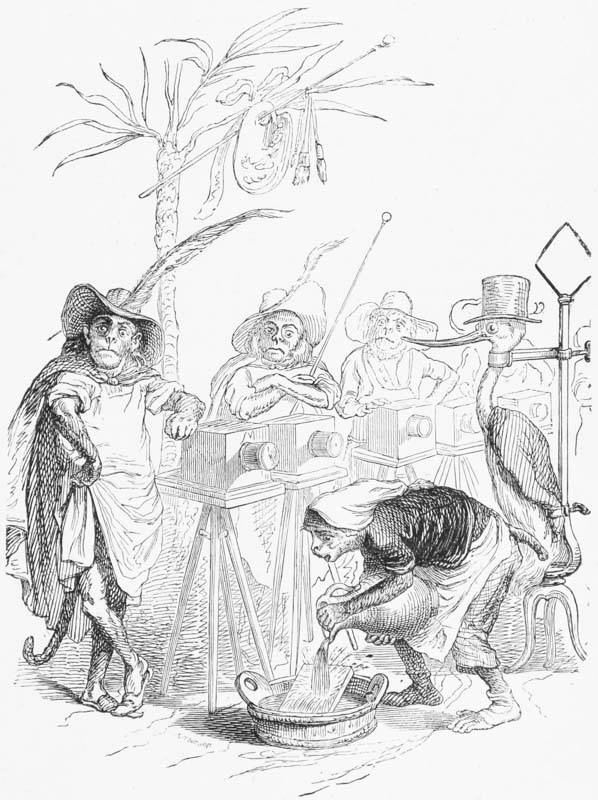
This talent acquired, added to a brace of fine names, he felt already half way towards reaching the coveted goal. To realise his hopes, he took his passage at Havre in a ship about to cross the Atlantic, and after a prosperous voyage, again set foot on the shore where, only a few years before, he had embarked for France. What a change had come over his position. From Monkey-boy he had become Monkey-man. In place of a prisoner of war he had become free, and above all, from an ignorant brute—the condition in which Nature sent him into the world—he had developed into a sort of civilised ape. His heart beat fast as he landed on his native soil. It was sweet to visit familiar scenes, after so long an absence. Without losing so much time as I take to write, he started off, camera on back, to seek the grand solitudes of his infancy, where he hoped to become the pioneer of progress. In his secret heart—he owned it to me—there was still the burning desire for fame. He hoped to create a sensation, to be regarded as more than a common beast to enjoy the victory he would so easily win, over the natives of the country, by his title of Illustrious Traveller, backed by his knowledge and his wonderful machine. These were his true sentiments, but he cherished the delusion that he was impelled onwards by the irresistible force which urges forward the predestined ones—the leaders of mankind—to play their part in the world. Arrived at the scene of his birth, without even looking up his friends and relatives, Topaz pitched his camp in a vast glade, a sort of public common which Nature had reserved in the forest. There, aided by a black-faced Sapajo called Ebony, after the other servant of Rustan, who became his slave after the manner of men, who find in colour a sufficient reason for drawing the line which separates master from slave, Topaz set up an elegant hut of branches beneath an ample shade of banana leaves, and above his door he placed a signboard, bearing the fable, “Topaz, painter after the Parisian fashion;” and on the door itself, in smaller letters, “Entrance to the Studio.” After sending a number of magpies to announce his arrival, to all the country round, he opened his shop.
In order to place his services within the reach of all—as no currency had ever yet been instituted—Topaz adopted the ancient custom of receiving payment in kind. A hundred nuts, a bunch of bananas, six cocoa-nuts, and twenty sugar-canes, was the price of a portrait. As the inhabitants of the Brazilian forest were still in the golden age, they knew nothing whatever about property, heritage, or the rights of mine and thine. They knew that the earth and its fruits were free to all, and that a good living might be picked off the trees, and an indifferent living off the ground. Topaz had many difficulties to contend against; by no means the least was the fact that no one is great in his own country, and especially among his own friends. The first visits he received were from monkeys, a quick and curious, but also a very spiteful, race.
Hardly had they seen the camera in action before they set to work to make spurious imitations of the dark box. Instead of admiring, honouring, and recompensing their brother for his toil in bringing this art-treasure to their country, they strove to discover his secret, and reap the profits of his labour. Here, then, was our artist at war with counterfeiters. Happily it was not a simple case of reprinting an English book in Germany or America. The apes might puzzle their brains, and toil with their four feet, and even combine one with the other—amongst them, as elsewhere, one can easily find accomplices to carry out a bad scheme,—all they could do, was to make a box and cover like the camera and focusing cloth of Topaz; but they had neither lens nor chemicals. After many trials and as many failures, they became furious, and planned the ruin of Topaz; thus proving the truth of the saying, “One must look for enemies among one’s fellow-countrymen, friends, and relations; even in one’s own house”—
“Araña; quien te araño Otra araña como yo.”
But no matter, merit makes its own way in defiance of envy and hatred, and finds its true level like oil that rises to the surface of water. It so happened that a personage of importance, an animal of weight, a Boar in fact, passing through the glade and seeing the signboard, paused to reflect. It seemed to this Boar that one need not of necessity be a quack or charlatan, because one comes from a distance, or because one offers something new and startling; also that a wise, moderate, impartial spirit always takes the trouble to examine things before condemning them. Another and much more private reason tempted the thoughtful Boar to test the stranger’s talent; for side by side with the great actions of life there is frequently some petty, contemptible secret, and personal motive which, as it were, supplies the mainspring of action. This little motive is always studiously concealed, even from its owner’s view, like the mainspring of a watch in its shining case. But the little spring, true to its work, marks the time on the dial, the hour, minute, and second, which heralds the birth of all that is noble, and all that is mean in life. This applies with kindred force to the instinct of brutes, and aspirations of men.
Our Boar was a lineal descendant of the companion of Ulysses who, touched by the wand of Circé, is supposed to have addressed his captain thus—
“How am I changed? My beauty as a boar I’ll prove,
How knowest thou, one form is worst, another best?
Grace and good breeding are in my form express’d,
At least it has been said so by those who know.”
He was a trifle foppish and very much in love. It was to make a gift to his betrothed he wished for a portrait.
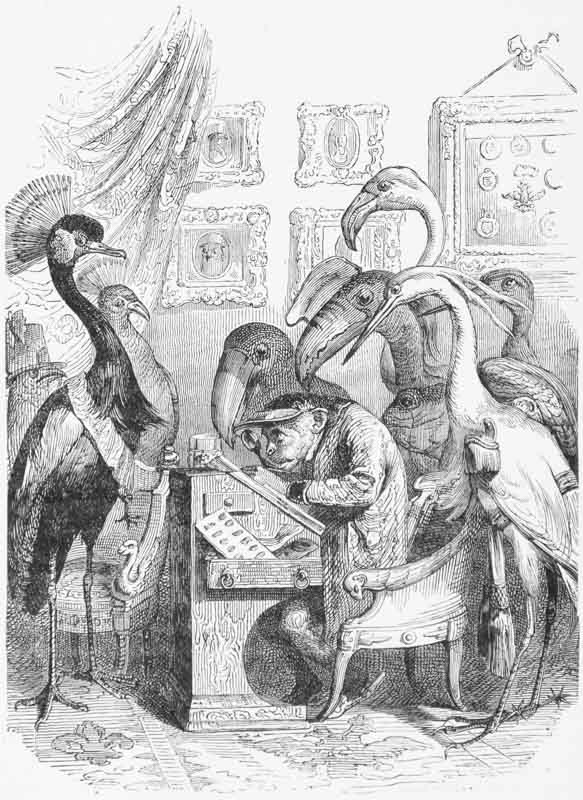
Entering the studio he paid down double the usual price, as this Boar was the most liberal member of his government. He then seated himself solidly down in his appointed place where his steadiness and unconcern rendered him a capital subject for the camera. Topaz on his part exercised all his skill in posing, lighting, and photographing. The portrait was a perfect gem, his lordship was delighted. The little image seemed to reduce his bulk in every way, while the silvery grey of the metallic plate replaced with advantage the sombre monotony of his dark coat. It was a most agreeable surprise, and fast as his bulk and dignity would permit him, he hastened to present the picture to his idol. The loved one was in rapture, and by a peculiar feminine instinct she first suspended the miniature round her neck, then, as instinctively, called together her relatives and friends to form an admiring circle around her lover’s portrait. Thanks to her enthusiasm, before the day was over, all the animal inhabitants for miles round were appraised of the marvellous talent of Topaz, who soon became quite the rage. His cabin was visited at all hours of the day, the camera was never for a moment idle. As for Sapajo he had more than enough to do in preparing the plates for every new comer. With the exception of the apes there was not a single creature in earth, air, or water, who had not sat for a likeness to the famous Topaz.
One of his chief patrons was a Royal bird, the sovereign of a winged principality, who arrived surrounded by a brilliant staff of general officers and aide-de-camps. The artist was greatly annoyed by the remarks of a group of obsequious courtiers who bent over the desk alternately praising the prince, and criticising the portraits. The finished work, nevertheless, afforded satisfaction to the potentate who, proud of his tufted crown and brilliant feathers, gazed fondly down upon his image.
His conduct was quite different from that of the Boar. Although the king was accompanied by a splendid pea-hen, his wife by morganatic marriage, he himself retained the portrait, and, like Narcissus, before the fountain, fell in love with his own image. Happy are they who love themselves. They need not fear coldness, or disdain. They can feel no grief of absence, or pangs of jealousy. If the sayings of human philosophers are true, love is only a form of self-esteem which leaves its habitual abode, seeking to extend its dominion over the passions of another.
To return to Topaz, he touched up his portraits to suit the taste and vanity of his customers. In this, it must be owned, he did not always succeed. Some of his clients were all beak, and had no focus in them; others could not sit steady for a second, the result was, they figured on the plate with two heads, and a group of hands like Vishnu, the heathen god. They jerked their tails at some fatal moment, rendering them invisible in the photograph. Pelicans thought their beaks too long. Cockatoos complained of the shortness of theirs. Goats said their beards had been tampered with. Boars held that their eyes were too piercing. Squirrels wanted action. Chameleons changing colour; while the donkey thought his portrait incomplete without the sound of his mellifluous voice. Most comical of all—the owl, who had shut his eyes to the sun, maintained that he was represented stone-blind, thus destroying his chief attraction. In the laboratory of Topaz, as in the painter’s studio, might be seen constantly in attendance a troop of young lions, the sons of the aristocracy, who came to loiter away their leisure. They prided themselves in being judges of art, called all the muscles of the face by their anatomical names; and spoke of graceful sweeps, handling of the brush, tooling, modelling, breadth of expression, &c., &c. Under pretext of enjoying the society of the artist, they twitted and laughed at his clients. To the crow, if he showed face at the entrance with his glossy black coat, and gouty, magisterial step, they cried in chorus—
“Oh! good morning, Mr. Crow, come in, nothing shows up so well as a good, black coat.” Then they gently reminded him of his adventure with the fox and the stolen cheese.
One day a good fellow, a duck, left his reeds and swamps, and came with much ado to the studio, desirous of seeing his image to greater perfection than in his native stream. As soon as he appeared, one of the clique approached and taking off his cap, said—
“Ah, sir, you must be a great observer, you constantly move from side to side. What is the news?”
No one escaped their sarcasm; many were offended, many more lost their temper, and as for Topaz, he lost some of his best customers. But he really could not afford to offend the lions, as they belonged to good families, and were careful to flatter his vanity; besides, they were by no means bad fellows, when in their generous moods.
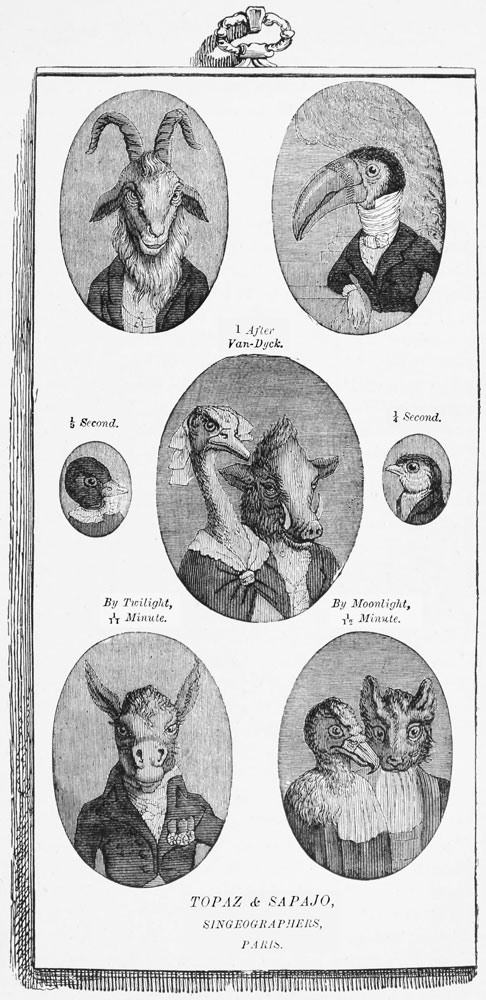
In spite of these petty troubles and annoyances—who is exempt from them in this world?—Topaz filled his barns; and his fame increased, keeping pace with his fortune. He perceived that the time had arrived for him to fill a larger field. His own industry had secured for him riches and honour, but the dream of his life was yet unfulfilled. Why should he not embrace the golden opportunity, and become a great teacher, a benefactor of his kind? His fame had reached the ears of a distant potentate, an Elephant-sovereign whose territory was somewhere—no matter where—it had never found its way into any map; no civilised being had ever set foot on his soil. This Elephant sent an embassy to the Parisian painter, charged with the mission of bringing Topaz to his court. He was an elephantine Francis I., calling to his presence another Léonardo da Vinci. His brilliant offers were at once accepted. This is how absolute monarchs proceed in their caprices, Topaz was promised, besides a considerable share of the native produce, the title of Cacique, and the ribbon of the ivory tooth. The artist set off mounted on a horse, and followed by a mule, bearing his faithful Sapajo and his precious machine. He at length arrived without accident at the court of the Sultan Poussal. Topaz was at once introduced to his Royal Highness, by the usual Minister of Rites and Ceremonies. The artist prostrated himself before the potentate, who gracefully raised him with the point of his proboscis, and allowed him to kiss one of his enormous feet, the same foot which later—but I must not anticipate events. His Massive Majesty was in such a ferment of impatient curiosity, that before taking any rest or refreshment, Topaz was requested to unpack his box and set to work without delay. He accordingly prepared his instrument, heated his drugs, and selected his finest plate for the royal image. The plate was small, but it was necessary that the entire elephant should figure on its surface.
“Good,” said Topaz, “since it is a miniature His Majesty requires, I am certain he will be delighted with the result” (Topaz recalled his early experience with the Boar).
He placed the king as far as possible from the camera so as to diminish his image and fill the plate, after which he conducted his operations with the nicest care. All the courtiers awaited the result with anxiety as profound as if it were the casting of a statue. The sun was scorching. After a few minutes the artist took up the plate lightly, and triumphantly presented it to the gaze of His Majesty; hardly had the king cast his eyes upon it, when he burst into a loud laugh, and without knowing why, all the courtiers joined in the royal hilarity. It was like an Olympian scene.
“What is this?” roared the Elephant as soon as he could speak. “That is the portrait of a rat, and you presume to say it is me? You are joking, my friend” (the laughter still continued), “why,” continued the king after silence had been restored, his tone getting gradually more and more severe, “it is owing to my great size and strength that I have been chosen king. Were I to exhibit this miserable portrait to my subjects they would imagine I was an insect, a weak, hardly perceptible, creature, only fit to be dethroned and crushed. The interest of the State, sir, forbids my taking this course,” saying which, he hurled the plate at the artist, who bowed down to the ground, not so much from humility as to escape a shock that would have been fatal to him. “I should have tested the truth of the stories so freely circulated about you.”
The king and his ministers were becoming furious.
“Ugh! you are one of the hawkers of inventions and secrets, one of those innovators we have heard so much of, who prowl about seeking what good old institution they can devour; fellows who would bring down our constitution, and heaven itself about our ears, with their infernal machines. Bah!”
Here the mighty king stepped over the still prostrate body of the artist, and approaching the innocent machine—in his eyes big with the darkest plots ever brewed in the heart of a State—full of a no less legitimate wrath than Don Quixote, when breaking the marionettes of Master Peter, he raised his formidable foot, and crushed the camera to atoms.
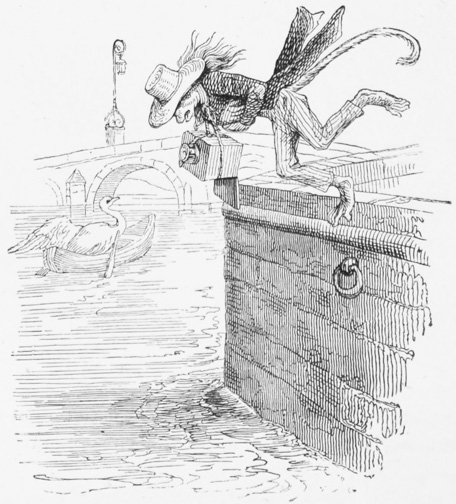
Adieu fortune, honour, fame, civilisation! Adieu art! adieu artist! At the sound of the smashing which announced his doom, Topaz sprang to his feet, and starting off like a man, ended his sorrows in the waters of the Amazon.
He who became his heir and confidant was Ebony, the poor black Sapajo, who came over to Europe and studied at one of the universities, in order to qualify himself to write this history.

In which the political reasons for the visit of Prince Leo shall be fully discussed.
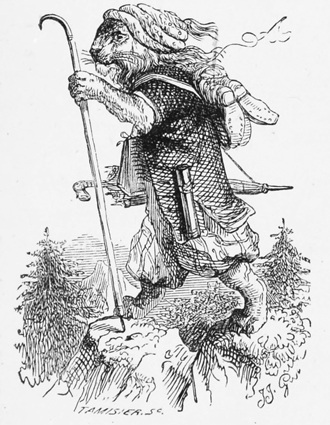
AT the foot of the Atlas, on its desert side, there reigns an old Lion. Much of his youth was spent in travelling. He had visited the Mountains of the Moon, lived in Barbary, Timbuctoo, in the land of the Hottentots, among the republicans of Tangier, and among Troglodytes. From his universal benevolence he acquired the name of Cosmopolite, or friend of all the world. Once on the throne, it became his policy to justify the jurisprudence of the lions; carrying this beautiful axiom into practice—“To take is to learn.” He passed for one of the most erudite monarchs of his time, and, strange as it may seem, he utterly detested letters and learning. “They muddle still more what was muddled before.” This was a saying in which he took peculiar delight.
It was all very well; his subjects, nevertheless, were possessed by an insane craving for progress and knowledge. Claws appeared menacing him on all points. The popular displeasure poisoned even the members of the Cosmopolite’s family who began to murmur. They complained bitterly of his habit of shutting himself up with a griffin, and counting his treasure without permitting a single eye to rest upon the heap.
This Lion spoke much, but acted little. Apes, perched on trees, took to expounding most dangerous political and social doctrines; tigers and leopards demanded a fair division of the revenue, as indeed, in most commonwealths, the question of meat and bones divided the masses.
On various occasions the old Lion had to resort to severe measures to quell the public discontent. He employed troops of savage dogs and hyenas to act as spies, but they demanded a high price for their service. Too old to fight, the Cosmopolite was desirous of ending his days peacefully—as he said, in Leonine language—“to die in his den.” Thus his difficulties and the instability of his throne set him to scheming.
When the young princes became troublesome he stopped their allowance of food, wisely reflecting that there is nothing like an empty stomach for sharpening instinct, and sending the young lions to seek food abroad. At last, finding Liona in a state of hopeless agitation, he hit upon a very advanced policy for an animal of his age, viewed by diplomatists as the natural development of the tricks which rendered his youth famous.
One evening while surrounded by his family, it is recorded that the king yawned several times. In the annals of a less enlightened State this important fact might have been overlooked. He then uttered these memorable words: “I feel age and infirmity creeping on apace. I am weary of rolling the stone called royal power. My mane has grown grey in the service of my country; I have spent my strength, my genius, and my fortune; and what, my children, is the result? Simply nothing! nothing, save discontent! I ought to lavish bones and honours on my supporters. Should I succeed in this, it would hardly stifle the national discontent. Every one is complaining, I alone am satisfied; but, alas! infirmity gains upon me so surely, that I have resolved to abdicate in favour of my children. You are young, you have energy and cunning; get rid of the leaders of popular discontent by sending them to victory, to death!” Here the venerable potentate, recalling his youth, growled a national hymn, and ended by urging his tender-hearted sons to “sharpen their claws, and bristle their manes.”
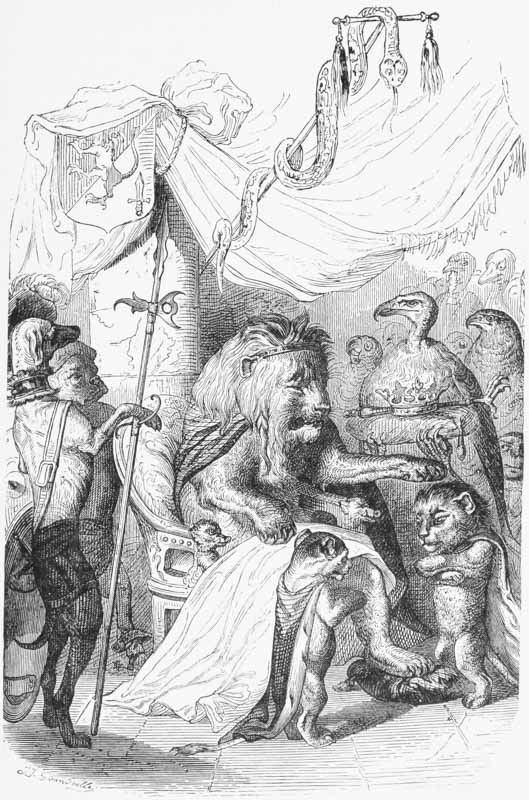
“Father,” said the heir-apparent, “if you are really disposed to yield to the national will, I will own to you that the lions from all parts of Africa, furious at the far niente of your Majesty, were about to take up arms against the State.”
“Ah, my fine fellow,” thought the king, “you are attacked by the malady of royal princes, and would wish for nothing better than my abdication. I shall teach you a lesson.”
“Prince,” replied the Cosmopolite in a roar, “one no longer reigns by glory, but by cunning. I will convince you of this by placing you in harness.”
As soon as the news flashed through Africa, it created a great sensation. Never before, in the annals of history, had a Lion of the desert been known to abdicate; some had been dethroned by usurpers, never had a king of beasts voluntarily left the throne. The event was therefore viewed with some apprehension, as it had no precedent.
Next morning at daybreak, the Grand Dog Commander of the Life Guards appeared in his gay costume, fully armed, and around him the guard ranged in battle-array. The king occupied the throne, surmounted by the royal arms representing a chimera pursued by a poignard. Then, before all the birds composing his court, the great Griffin brought the sceptre and crown to the king who addressed the young lions in these words, first giving them his benediction—the only thing he cared to bestow, as he judiciously guarded his treasures—“Children, I yield you my crown for a few days; please the people, if you can, but do not fail to report progress.” Then turning to the court, he said in a voice of thunder, “Obey my son, he has my instructions!”
As soon as the heir was seated on the throne, he was supported by a band of young, ardent, ambitious followers, whose pretentious doctrines led to the dismissal of the ancient counsellors of the crown. Each one desired to sell his advice, so that the number of places fell far short of the number of place-hunters. Many were turned back, fired with hatred and jealousy which they poured forth to the masses in eloquent harangues, stirring up the mud of popular corruption. Tumults arose; schemes for the destruction of the young tyrant were everywhere secretly discussed; and the youthful sovereign was privately informed that his power was built over a mine of political petroleum and social nitro-glycerine. Alarmed, he at last sought the counsel of his father who, cunning old rogue, was busy stirring up the slough of popular disorder and discontent. The people clamoured for the reinstatement of the venerable Cosmopolite, who, yielding to the pressure, again received the sceptre from the hands of his son who was thus completely outwitted by his crafty parent. The worthy king, moved no doubt by parental love, determined to rid himself of his dutiful heir by sending him on a foreign mission. If men have their Eastern question to settle, the lions also find matters no less pressing to draw their attention to Europe, where their names, their position, and habits of conquest, have so long been usurped. Besides, by instituting international complications, the Cosmopolite succeeded in engaging the attention of his people, and securing the tranquillity of the State. Accordingly, the heir-apparent, accompanied by a Tiger in ordinary, was sent to Paris on a diplomatic mission.
We subjoin the official despatches of the prince and his secretary.
FIRST DESPATCH.
“SIRE,—As soon as your august son had crossed the Atlas Mountains, he was warmly received by a discharge of loaded muskets presented by the French outposts. We at once understood this to be a graceful mark of the homage due to rank. The government officials hastened to secure him, and even placed at his disposal a carriage decked with bars of solid iron. The prince was constrained to admire the conveyance as one of the triumphs of modern civilisation. We were fed with viands the most delicate, and so far, can only speak in praise of the manners of France. My master and your slave were conveyed on board ship and taken to Paris, where we were lodged, at the expense of the state, in a delicious abode called the King’s Garden. The people flocked to see us in such crowds that our staff of men attendants had to put up strong iron rails to protect our royal master from the vulgar throng. Our arrival was most fortunate, as we found an unusually large gathering of ambassadors from the animals of all nations collected in the garden. In a neighbouring palace I perceived Prince Beanokoff, a white Bear from the other side of the ocean, who had visited Paris on behalf of his government, and who informed me that we were the dupes of France, that the lions of Paris dreading the result of our embassy had shut us up; made us prisoners!
“ ‘How can we find these so-called lions of Paris,’ I inquired—Your Majesty will appreciate the action I have taken, in order to uphold your high reputation for boldness and fair dealing—This Bear, seeming to divine my thoughts, replied, that ‘Parisian lions dwell in regions where asphalt forms the pavement; where the choicest veneers and varnishes of civilisation are produced, and guarded by spirits called the municipal authorities. Go straight on, and when you reach the quarter St. Georges, you will find them abounding.’
“ ‘You ought to congratulate yourself, Prince Beanokoff, to find that your name and northern characteristics are not burlesqued in this capital.’
“ ‘Pardon me, the Beanokoffs are no more exempt from the evil than are the lions of Leona.’
“ ‘Dear Prince Beanokoff, what possible advantage can man derive from imitating our attributes?’
“ ‘Ah! you have a great deal to learn. Why, look around at the pictorial representations of all sorts of animals that figure on the scutcheons of the nobility. There you will find that the proudest families claim us as their ancestors.’
“Wishing to make myself fully acquainted with the policy of the north, I said to him, ‘I suppose, my dear Prince, you have already represented the matter in a proper light to your government?’
“ ‘The Bears’ cabinet is above dealing with such drivelling questions. They are more suited to the capacity of the lower animals, to Lions!’
“ ‘Do you pretend, old iceberg, to ignore the fact that my master is the king of beasts?’
“The barbarian remained silent and looked so insulting that with one bound I broke the bars of my prison, his Highness, your son, followed my example, and I was about to avenge the insult when the Prince judiciously interfered, saying, ‘We must for the present avoid conflict with the northern powers, our mission is yet unfulfilled.’
“As this occurred during the night, under cover of darkness, we made our way into the Boulevards, where at day-break we heard the passing workmen exclaim, ‘Oh, what heads! would any one believe they were not real animals?’ ”
SECOND DESPATCH.
Prince Leo in Paris during the carnival, His Highness’s opinion of what he saw.
“YOUR son, with his usual discernment, perceived that we had gained our liberty just as the carnival was at its height, and thus might come and go without danger. We felt excessively embarrassed, not knowing the manners, the usages, or the language of the people. Our anxiety was relieved in the following manner:—
“Interrupted by severe cold.”
Prince Leo’s first letter to his father, the King.
“MY DEAR AUGUST FATHER,—When I left the palace, you, with true paternal affection, bestowed almost nothing on me save your blessing. Without undervaluing that inestimable gift, I am bound to say I can raise hardly anything on it among the miserable money-lenders of this city. My dignity must be maintained on something more closely resembling coin than a father’s benediction. Paris is unlike the desert; everything here is bought and sold. I could even find a ready market for my skin, if I could only get on without it. To eat is expensive, and to starve, inconvenient.
“Conducted by an elegant Dog, we made our way along the Boulevards where, owing to our likeness to men, we almost escaped notice. At the same time we kept a sharp look-out for the Parisiens they call lions. This Dog, who knew Paris perfectly, consented to become our guide and interpreter. We were thus enabled like our adversaries to pass for men in the disguise of brutes. Had you known, sire, what Paris really is, you would never have troubled me with a mission. I often fear being compelled to sacrifice my dignity in order to satisfy you. On reaching the Boulevard des Italiens it became necessary for me to follow the fashion and smoke a cigar, which caused me to sneeze so violently as to create a sensation. A popular writer passing, remarked, ‘These young fellows are well up in their parts!’
“ ‘The question is about to be settled, I said to my Tiger.’
“ ‘Rather,’ suggested the Dog, ‘let it remain for a time like the Eastern question—diplomatic, vague, doubtful, open! It will pay better in the end.’
“This Dog, Sire, is constantly affording the most astounding proofs of his intelligence. It will therefore hardly surprise you, to learn that he belongs to a celebrated administration, situated in the Rue de Jerusalem, devoted to the guidance of strangers in France.
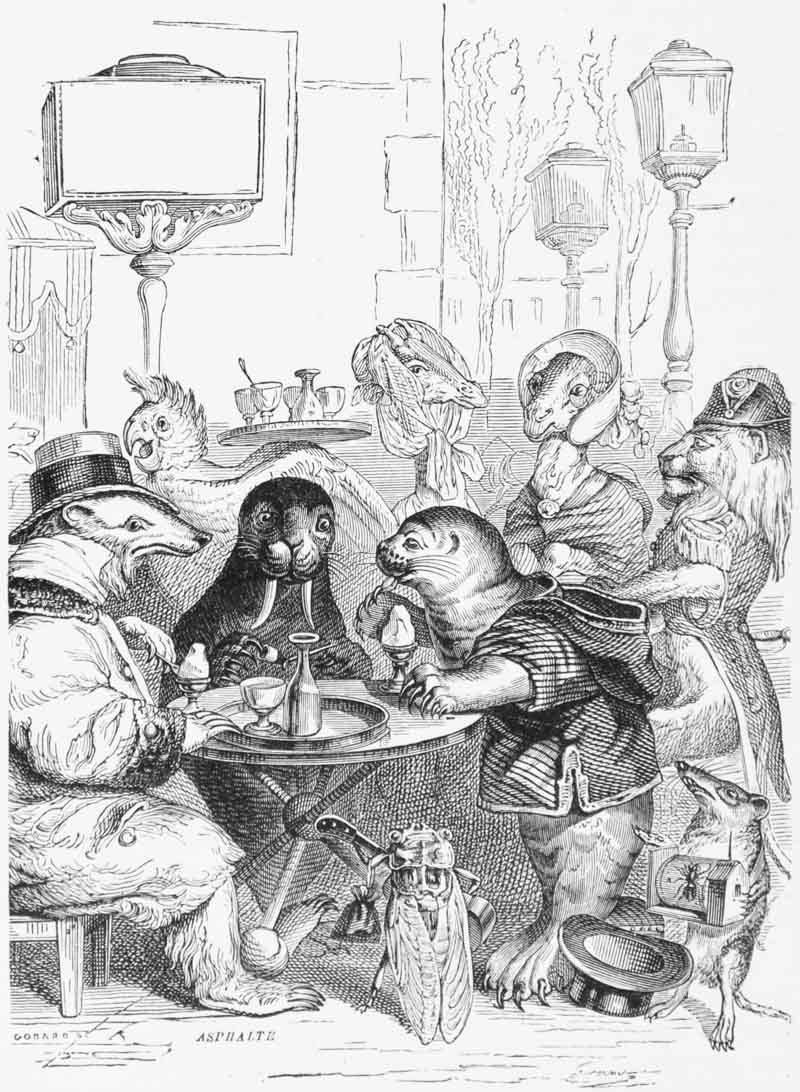
“He led us, as I have just said, to the Boulevard des Italiens, where, as indeed all over this large town, Nature’s share is very small. There are trees, but such trees. Instead of pure air, smoke; instead of rain, dust; so that the leaves are bronzed, and the trees are mere sticks, supporting a tuft like the crown of leaves on the brows of the bronze heroes of France. There is nothing grand in Paris; everything is small, and the cooking is execrable! I entered a café for breakfast, and asked for a horse, but the waiter seemed so astonished that we profited by his surprise, took him round the corner and devoured him. The Dog cautioned us not to make this a rule, as it might be misunderstood. He nevertheless accepted a bone which he polished with manifest joy.
“Our guide rather likes talking politics, and his conversation is not without its fruit. I have picked up wonderful scraps of knowledge from him. On my return to Leona no tumult shall disturb me, as I have discovered the best mode of governing the world. The chief in Paris does not rule; the business of governing and collecting the revenue is entrusted to a body of senators. Some of whom are descended from sheep, foxes, and donkeys, but the title of statesmen has made them lions. When any important question has to be settled, they all speak in turn, without paying the slightest attention to the views of their predecessors. One discusses the Eastern question, after some member who has exhausted himself on the subject of cod-fishing. When they have all done talking, it is not unfrequently discovered that the wise ones have carried through some important measure, while the donkeys have been braying to their heart’s content.
“I noticed a sculpture in the palace, wherein you were represented struggling with the revolutionary serpent, a work infinitely superior to any of the statues of men by which it was surrounded. Many of these poor devils are represented with long dinner-napkins over their left arms, just like waiters; others, with pots on their heads. Such a contrast proves our superiority over men, whose imagination delights in building stones one upon the other, and cutting on their surface the finest flowers and forms of Nature.
“My Dog informed me that he would take us to a place where we would behold lions, lynxes, panthers, and Paris birds of night.
“ ‘Why,’ I inquired, ‘does a lynx live in such a country?’
“ ‘The lynx,’ replied the Dog, ‘is accustomed to appropriating. He plunges into American funds; he hazards the most daring actions in broad day and darts into concealment. His cunning consists in always having his mouth open, and strangely enough, doves, his chief food, are drawn into it.’
“ ‘How is that?’
“ ‘He has cleverly written some word on his tongue which attracts the doves.’
“ ‘What is the word?’
“ ‘I ought rather to say words. First, there is the word profit; when that has gone it is replaced by dividend; after dividend comes reserve, or interest. The doves are always caught.’
“ ‘Why so?’
“ ‘Ah! we are in a land where men have such a low opinion of each other, that the most foolish is certain to find another more foolish still—some one simple enough to believe that a slip of printed paper is a mine of gold. Human governments cannot be held altogether blameless, as they have too frequently misled the people by their paper. The operation is called “founding public credit.” When it happens that the credit exceeds the public credulity, all is lost.’
“Sire, credit does not yet exist in Africa. We might occupy the malcontents there by getting them to found a bank. My détaché—I can hardly call my Dog an attaché—took me to a public café, and, by the way, explained many of the faults and frailties of beasts. At this famed resort there were a number of the animals we had been looking for. Thus the question is being cleared up little by little. Just imagine, my dear father, a Parisian lion is a young man who wears patent-leather boots worth about two pounds, a hat of equal value, as he has nothing better to protect in his head than in his feet; a coat of six pounds, a waistcoat of two pounds, trousers, three pounds, gloves, five shillings, tie, one pound; add to these rags about one hundred pounds for jewellery and fine linen, and you obtain a total of about one hundred and sixteen pounds, five shillings. This sum distributed as above, renders a man so proud that he at once usurps our name. With one hundred and sixteen pounds, five shillings, and, say, nine-pence for pocket money, one rises far above the common herd of animals of intellect and culture, and obtains universal admiration. If one can only lay one’s claws on that sum, one is handsome, brilliant. One may look with scorn upon the unfortunate poet, orator, man of science, whose attire is humble and cheap. You may indeed be what you like; if you do not wear the harness of the authorised maker, of the regulation cut and cost, you are certain to be neglected. A little varnish on your boots, and the other etceteras make up the roaring lion of society. Alas, Sire, I fear the same varnish and veneer conceals the hollowness of human vanity. Tear it off, and nothing remains.
“ ‘My lord!’ said my détaché, seeing my astonishment on beholding this frippery, ‘it is not every one who knows how to wear these fine things. There is a manner, and here, in this country, everything resolves itself into a question of manners.’
“I sincerely wish I had stayed at home!”
THIRD DESPATCH.
“SIRE,—At the ball, Musard, His Highness, came face to face with a Parisian lion. Contrary to all dramatic rules, instead of throwing himself into the prince’s arms, as a real lion would have done, the Parisian counterfeit almost fainted, but plucking up courage he had recourse to cunning, and by this talent, common to all low animals, wriggled out of the situation.
“ ‘Sir,’ said your son, ‘how is it you take our name?’
“ ‘Son of the desert,’ replied the child of Paris in a humble tone, ‘I have the honour of observing that you call yourselves lions. We have adopted your name.’
“ ‘But,’ said His Highness, ‘what right have you, any more than a rat, to assume our name?’
“ ‘The truth is we are like yourself, flesh eaters, only we eat our flesh cooked, you eat yours raw. Do you wear rings?’
“ ‘That is not the question.’
“ ‘Well then,’ continued the Parisian fraud, ‘let us reason, and clear the matter up. Do you use four different brushes; one for the hair, another for the hands, a third for the nails, and a fourth for the skin? Have you nail scissors, moustache scissors? Seven different sorts of perfume? Do you pay a man so much a month for trimming your corns? Perhaps you do not know what a chiropodist is. You have no corns, and yet you ask me why we are called lions. I will tell you why. We mount horses, write romances, exaggerate the fashions, strut about, and are the best fellows in the world. You are happy having no tailor’s bill to pay.’
“ ‘No,’ said the prince of the desert.
“ ‘Well then, what is there in common between us? Do you know how to drive a tilbury?’
“ ‘No.’
“ ‘Thus you see the strong points in our character are quite different from yours. Do you play whist, or frequent the Jockey Club?’
“ ‘No,’ said the prince.
“ ‘Well, your Highness, with us whist and the club are everything.’
“This polite nonsense became so aggravating that His Highness replied—
“ ‘Do you, sir, deny that you had me shut up?’
“ ‘I had not the power to shut you up. It was the government. I am not the government.’
“ ‘Why did the government impose on His Highness?’ I inquired.
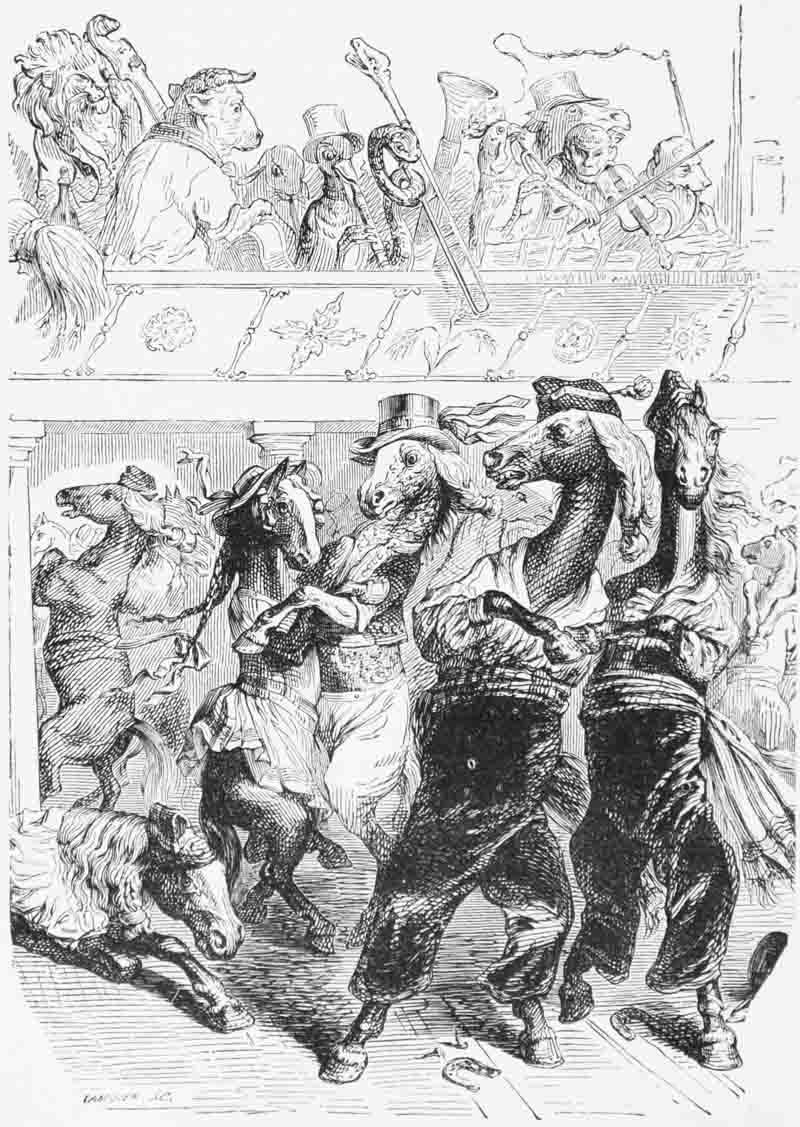
“ ‘Exactly,’ replied the Parisian. ‘Why? hem! the government takes no notice of popular whys and wherefores, it has its own political reasons for action, which are never divulged.’
“On hearing this, the prince was so utterly astounded that he fell on all fours. The Parisian lion, profiting by the prince’s blind rage, saluted His Highness, turned a pirouette, and escaped.
“Your august son, deeming it wise to leave men alone to enjoy their illusions—the gilded toys, the pomp and tinsel, the borrowed names and nameless follies which make up the happiness and misery of their existence—prepared to quit Paris. A few days later one read in the ‘Semiphone’ of Marseilles—
“ ‘Prince Leo passed here yesterday en route for Toulon, where he embarked for Africa. The news of his father’s death is assigned as the reason of his sudden departure.’
“Tardy justice too often yields its tribute to greatness after death. This trustworthy organ even gave a picture of the consternation which your Majesty’s untimely end spread through Leona. ‘The agitation is so great, that a general rising is feared, and a massacre of the ancient enemies of the crown. It is asserted that the Dog, the prince’s guide and interpreter, was present when His Highness received the fatal news, and bestowed the following advice, so characteristic of the utter demoralisation of the dogs of Paris: Prince Leo, if you cannot save all, save the treasury!’ ”
ADVENTURES OF A BUTTERFLY.
RELATED BY HER GOVERNESS.
Her infancy.—Youth.—Sentimental Journal.—From Paris to Baden.—Her wanderings, marriage, and death.
EDITORIAL PREFACE.
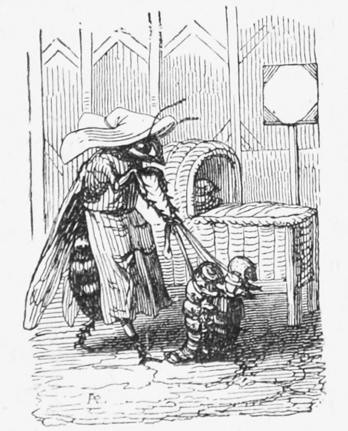
IN studying the manners and customs of the insect world, naturalists have brought to light many most curious and interesting facts. In the case of the three genders of Hymenoptera, each gender performs its allotted functions with a degree of care, tenderness, and precision that mimics the complex organisation of human society.
The neuter Hymenoptera are the working members of the insect world, and enjoy a greater share of life than either the males or females of their kind, outliving, indeed, two or three successive generations. In His infinite wisdom, God has denied them the power of reproduction, and at the same time entrusted to them the care and rearing of the young. Nothing in nature is without design. The neuter Hymenoptera bring up the orphan larvæ of their relatives who invariably die after giving birth to their young. It falls to the lot of the neuters to provide food for the larvæ who, thus deprived of the care of their parents, find in the neuter Hymenoptera the nurses who, with the most tender solicitude, take the place of sisters of mercy among men. Our correspondents’ account of the life of a Butterfly will embody some interesting facts relative to the habits of this beautiful family.
EDITORS.
“DEAR SIRS,—Had I been requested to write down my personal experiences I should have declined the task, as it seems to me impossible to write an honest history of one’s own career. The following biographical sketch is the fruit of moments stolen from the active hours of a busy life. I stand alone in the world, and shall never know the happiness of being either a father or a mother; I belong to the great family of neuter Hymenoptera. Feeling the misery of a solitary life, you will not be surprised to learn that I consented to become a tutor. An aristocratic Butterfly who lived near Paris in the woods of Belle Vue, had once saved my life, and as a token of gratitude I consented to become the foster-parent of the child he would never live to see. The egg was carefully deposited in the calyx of a flower, and hatched by a ray of sunlight the day after the parent’s death. It pained me to see the youth begin life by an act of ingratitude. He left the flower that had found a place for him in her heart without saying a word. His early education was most trying to one’s temper; he was as capricious as the wind, and of unheard-of thoughtlessness. But thoughtless characters are ignorant of the harm they do, and as a rule, are not unpopular. I loved the little orphan, although he had all the faults of a poor caterpillar. My instruction, advice, and guidance seemed to be thrown away upon him. Full of vivacity and light-heartedness, he embraced every opportunity of following the bent of his own reckless will. If I left him for an instant, on my return I never found him in the same place. He would venture to climb almost inaccessible plants, and risk his neck along the edges of leaves that hung over a yawning precipice. I remember being called away on important business, at a time when his sixteen legs would hardly carry him. On my return, I in vain searched for my charge, until at last I found him up a tree whose topmost branch he had reached, at the peril of his life.
“He was scarcely out of his babyhood when his vivacity suddenly left him. It seemed to me that my counsels were beginning to bear fruit, but I was soon undeceived. What I had mistaken for signs of repentance was the chrysalis malady, common to the young. He remained from fifteen to twenty days without moving a muscle; apparently asleep.
“ ‘What do you feel like?’ I asked him from time to time. ‘What is the matter, my poor child?’
“ ‘Nothing,’ he replied in a husky voice. ‘Nothing, my good tutor. I cannot move about, and yet feel sensations of life and motion all over me. I am weary, weary, do not talk to me! Keep quiet, do not stir!’
“He became quite unrecognisable; his body swollen and of a yellow hue, like a faded leaf. This latent life so much resembled death, that I despaired of saving him; when one day, warmed by a splendid sun, he gradually awoke. Never was transformation more startling, more complete; he had lost his worm-like mould, and rose from his shell like a disembodied spirit, glorious in prismatic hues. Four azure wings, as if by enchantment, had been placed upon his shoulders, feelers curved gracefully above his head, while six dainty legs peeped out beneath his velvet coat. His eyes, bright as gems, sparkling with the boundless prospect his new attributes had brought with them, he shook his wings and rose lightly in the air.
“I followed him as fast as my worn wings would carry me. Never was a course more erratic. Never flight more impetuous. It seemed as though the earth belonged to him, and all its flowers were designed for his pleasure; as though all created things, edged with the roseate light of his new being, were made to minister to his joy. He seemed to have risen from the grave to flit through a paradise all his own.
“Soon weary of caprice, fields and flowers lost their enchanting lustre, and ennui crept on apace. Against this evil, riches, health, the joys of liberty, all the pleasures of nature, were powerless. He alighted, choosing the plant of Homer and Plato, the daffodil, only to leave it for the lichen of bare rocks, where, folding his wings he remained the prey of discontent and satiety.
“More than once, dreading his desperate mood, I hid away the dark poisonous leaves of the belladona and hemlock.
“One evening he came in a state of great agitation, and confided to me that he had met in his wanderings a most amiable Butterfly who had just arrived from distant lands, bringing tidings of the wonders of the world.
“A craving for exploration had seized upon him. ‘I must either die or travel,’ said he.
“ ‘Do not die,’ I replied; ‘self-inflicted death is only fit for the sneak and coward. Let us travel!’
“My words filled him with new life; he spread his wings, and we started for Baden.
“It is impossible to describe his joy at our departure, his delighted ecstasy. He was full of young life, its hopes and aspirations. As for myself, grief had enfeebled my wings, so that I found it hard to follow him. We only stopped at Chateau Thierry, the birthplace of La Fontaine, not far from the vaunted borders of the Marne.
“Shall I tell you the true cause of our stoppage? He caught sight of a humble Violet in the corner of a wood.
“ ‘Who could help loving you, little Violet,’ he exclaimed, ‘with your face so sweet and dewy? If you only knew how charmingly honest you look, decked with your border of little green leaves, you would then understand my love. Be kind, consent to become my dear sister. See how calm I remain when near you! How I love these sheltering trees, the peaceful freshness, and the sacred perfume you breathe around. How modestly you hide your beauty in this delicious shade. Love me! love me in return, and make life happy!’
“ ‘Be a poor flower like me,’ replied the Violet, ‘and I will love you; and when winter comes, when the snow covers the ground, and the wind whistles through the leafless trees, I will hide you under my leaves, and together we will forget the cold that spreads death around. Fold your wings, and promise to be always faithful.’
“ ‘Always?’ he repeated, ‘that is too long. Besides, there is no winter!’ and he flew away.
“ ‘Don’t grieve,’ I said to the Violet, ‘you have escaped misery.’
“Our way lay over wheat-fields, forests, towns, villages, and the sad plain of Champagne. Not far from Metz, attracted by a sweet smell, he exclaimed, ‘The gardens watered by these clear springs must indeed be beautiful!’ Here he winged his way to a single Rose, growing on the banks of the Moselle.
“ ‘Beautiful Rose,’ he murmured, ‘never has the sun shone on a flower more lovely. I have travelled far, suffer me to rest on one of your leaves.’
“ ‘Stay!’ replied the Rose, ‘presumptuous flatterer, do not approach me!’
“Nothing daunted he touched a branch and retreated, exclaiming, ‘You have pricked me!’ and he showed his wounded wing. ‘I no longer love wild roses, they are cruel, devoid of heart. Let us fly, to be happy is to be unfaithful!’
“Not far from the Rose he saw a Lily whose form charmed him. While its stateliness, purity, and cold, aristocratic bearing, filled him with mingled fear and admiration.
“ ‘I do not dare to love you,’ he said in his most respectful voice, ‘for I am nothing more than a Butterfly, and I fear even to disturb the air you have glorified by your presence.’
“ ‘Be spotless, pure, and unchangeable,’ replied the Lily, ‘and I will befriend you.’
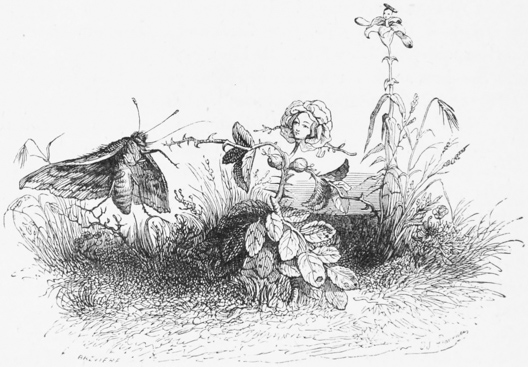
“ ‘Never change! In this world few Butterflies are sincere.’ He really could not promise. A puff of wind carried him away to the silvery banks of the Rhine. I soon joined him.
“ ‘Follow me,’ he was addressing a Daisy, ‘follow me, and I will love you for your simplicity. Let us cross the Rhine and go to Baden. You will enjoy brilliant concerts, routs, dances, gay palaces, and the great mountains you can descry on the distant horizon. Leave these tame banks and shine as the queen of flowers in the smiling country yonder.’
“ ‘No,’ replied the virtuous Daisy. ‘No! I love my native land, my sisters around me, and the mother earth that nourishes me. Here I must stay, must live and die. Do not tempt me to do wrong. The reason why Daisies are loved, is because they are the emblems of constancy. I cannot follow you, but you can remain with me, far from the noise of the world of which you speak. I will love you. Believe me, happiness is within the reach of all who are true and contented. What flower will love you better than I? Here, come, count my petals. Do not forget a single one, and you will find that I love you, and that I am not loved in return.’
“He hesitated an instant, and the eye of the tender flower dilated with hope. ‘What are my wings made for?’ he said, and left the ground.
“ ‘I shall die,’ said the Daisy, bending low.
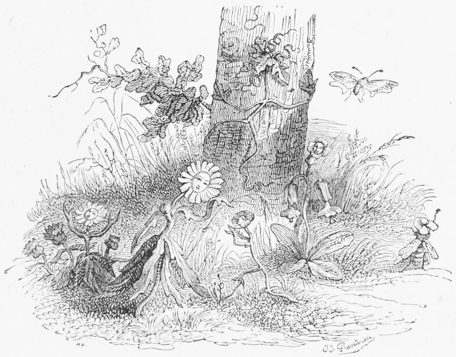
“ ‘Nay,’ I replied, ‘thy grief will pass away.’
“A tiny Forget-me-not whispered, ‘Daisy queen! you have our love, our admiration! Why break our harmony? Why cast your pure heart away on a worthless Butterfly, whose flight and fancy follow every breath of wind, who is as swift to change his loves as evil tidings to fly abroad.’
“Following my young scapegrace, I observed him dart down towards a stream as if fired by a sudden resolution to end his days. ‘Good heavens!’ I cried, ‘what has he done?’ as, descending to the water, I beheld nothing but the floating leaves on its surface. Shall I own it? my blood froze with terror and apprehension. Fool that I was, he was enjoying the joke all the while through a tuft of reeds. ‘Come, my tutor, come. I have found her at last.’ He was dancing like a lunatic round a bulrush. My temper was sorely tried; I nearly swore on observing this fresh token of folly.
“The young rogue continued: ‘She is no flower this time; a real treasure, a daughter of the air, winged like an angel, and jewelled like a queen.’
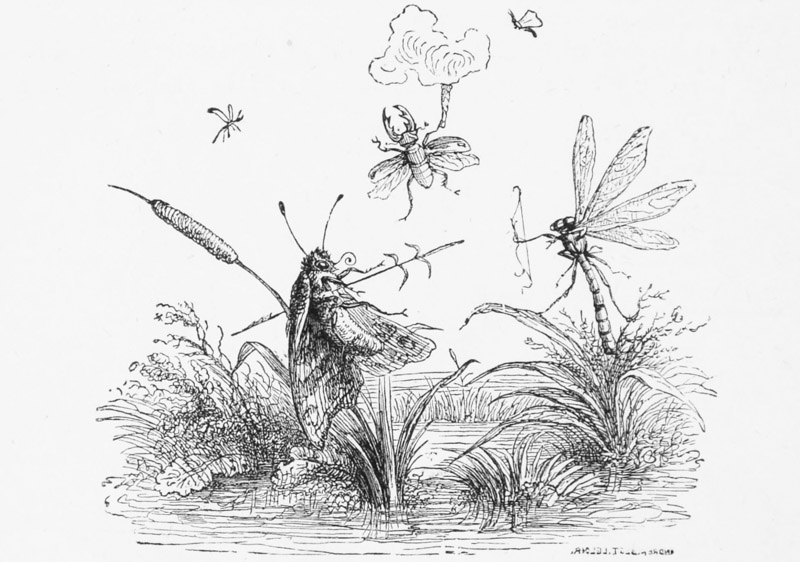
“I then perceived at the top of the reed, softly swaying in the wind, a graceful Dragon-fly of many colours.
“ ‘Allow me to present my betrothed,’ continued my pupil.
“ ‘What? Already!’ I exclaimed.
“ ‘Yes,’ said the Fly. ‘Our shadows have grown, and these flowers have closed, since we became acquainted. I seem to have known and loved my charmer all my days.’
“Soon setting out for Baden, they gratified every caprice, arranged their wedding, and issued formal invitations to the gayest of the gay among the insect aristocracy. It was a civil marriage, advertised with all the pomp of a royal union, and attended by the cream of the native and foreign nobility. Certain clauses in the marriage code, touching the obedience and constancy of the wedded pair, gave offence to the lady, as she deemed them superfluous; she, however, modestly kept her views on these subjects to herself. The ceremony was so imposing that I employed a spider to make a sketch of the scene.
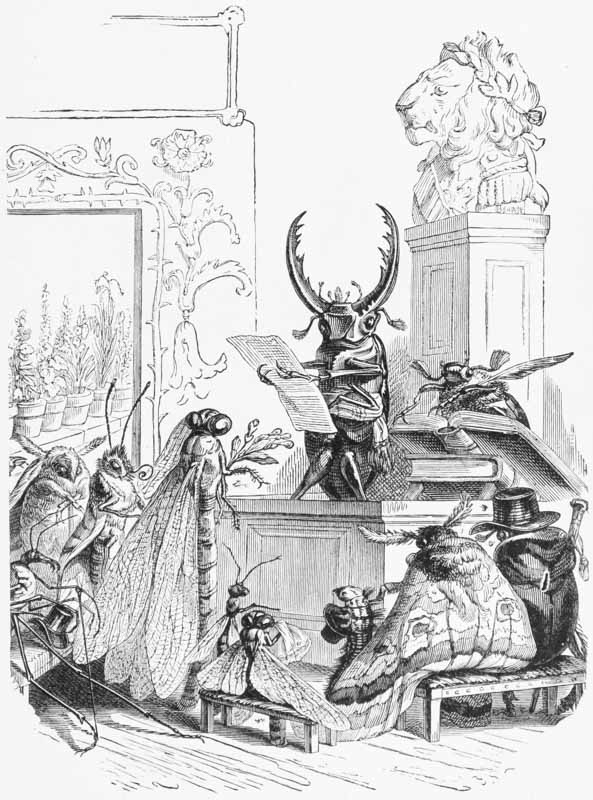
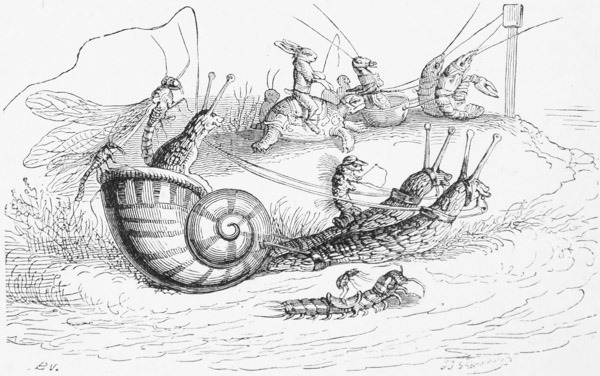
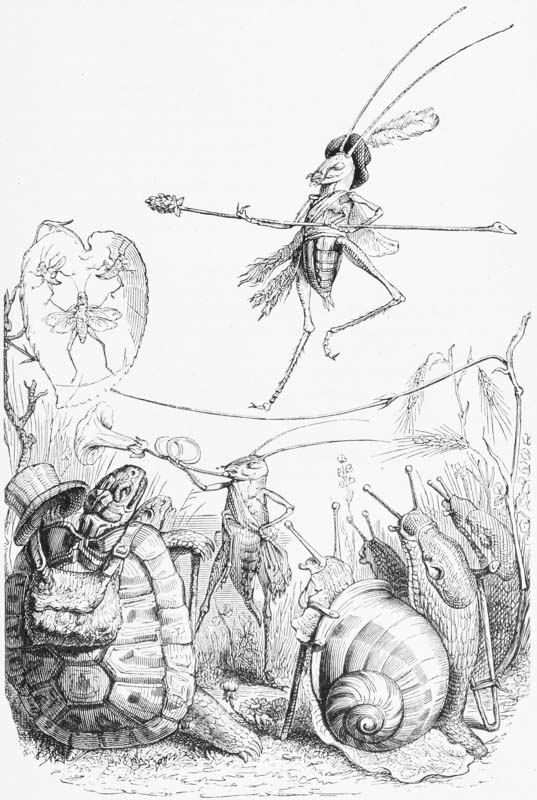
“The wedding was followed by rejoicing, feasting, and gaiety. Pleasure parties thronged the ruts in the fields, making their way onward to congratulate the happy pair. The Snail drove over in her carriage, while the Hare mounted his thorough-bred Tortoise, and the Ant his Centiped, to pay their formal visits. Even the rustics held high holiday, and thronged to witness the marvellous performances of a troop of acrobats on the verge of a corn-field. Here, a Grasshopper displayed wonderful dexterity in dancing with and without a pole on a horizontal stem of grass; and a showman cricket was blowing a blast of music through the corolla of a tricoloured convolvulus.
“A ball had been arranged, for which great preparations were made. A large Glow-worm, aided by a staff of Fire-flies, was charged with the illumination. The Glow-worm produced the central light, while his assistants, the Fire-flies, stood around the open cups of flowers with such marvellous effect, that every one thought a fairy had passed that way. The golden stems of astragalus were of such dazzling brightness that even the Butterflies could hardly bear its light; while many nocturnal insects retired, without being able to congratulate the married couple. Some remained from sheer politeness, veiling their eyes with their velvet wings.
“When the bride appeared, the whole assembly burst into transports of admiration. She was certainly a georgeously-dressed, charming-looking creature. She never rested for a second, but kept up with the music and dance. ‘Waltzing much too frequently’ said an old neuter, ‘with a magnificent cousin in the Guards.’ Her husband, my pupil, was the heart and soul of the party; he was everywhere, dancing and conversing.
“The orchestra, led by a humble Bee, a clever pupil of Da Costa, performed admirably a number of new waltzes and field-flower dances. Towards midnight the Signora Cavelleta, dressed in rather a transparent costume, danced a satarelle, which was only moderately successful. The ball was then interrupted by a grand vocal and instrumental concert, in which figured a number of celebrated artists who had followed the fine weather to Baden. A young Cricket played a solo on the violin, which Paganini had also executed just before his death.
“A Grasshopper, who had created a furore at Milan, the classic land of grasshoppers, sang a song of her own composition with great effect. Others followed, rendering some of the finest music of modern times in a manner unsurpassed. At the close of the concert a supper, ingeniously prepared from the juice of jessamine, myrtle, and orange blossom, was served in pretty little blue and rose-coloured bells. This delicious repast was prepared by a Bee, whose secret even the most renowned makers of bon-bons would have been glad to know.
“At one o’clock dancing recommenced with renewed vigour. The fête was at its height. Half an hour later strange rumours arose. It was whispered that the husband, in a transport of rage and jealousy, was searching everywhere for his missing wife. Some friends, with the intention, no doubt, of reassuring him, said she had danced constantly with her handsome, dashing cousin, and was seen to elope with him.
“ ‘Ah! the false one!’ cried the poor, despairing husband; ‘I will be revenged!’
“I pitied his despair, and coaxed him away from the scene, at once so gay and so tragic. ‘You have sown,’ I said, ‘and you have reaped. It is now not a question of cursing life, but of bearing it.’
“We left Baden that night, and, contrary to my expectation, my pupil never recovered the humiliating shock his own folly had brought upon him, by ‘marrying in haste, and repenting at leisure.’ True to his weak nature, easily attracted by glitter and flare, he at last flung himself into a lamp at Strasbourg, and perished with a comforting belief in the doctrine of transmigration of Buddha and Pythagoras.
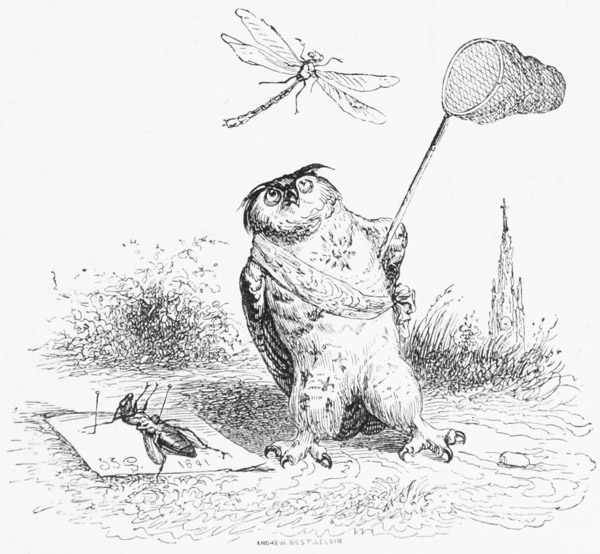
The fate of the runaway Dragon-fly is a warning to weak wives. She and her admirer were caught in the net of a princely bird, and pinned down on a board, in a museum, two days after their elopement.
THE MISFORTUNES OF A CROCODILE.
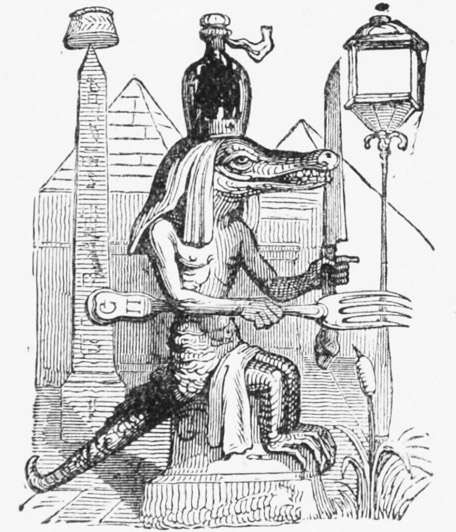
YOU see in me, gentlemen, a very unfortunate animal. Under the circumstances, I think I am justified in maintaining that no reptile has the same reason to complain. Judge for yourselves! What do I ask? Simply to be left alone to eat, digest, sleep, and warm my thick coat in the sun. If other animals are foolish enough to display their restless activity, and wear themselves out, in order to earn a miserable living, that is their business, not mine. I await my prey quietly, in a manner becoming the descendant of the illustrious Crocodiles worshipped by the Egyptians. Faithful to my aristocratic origin, I detest anything more intellectual than a good dinner, and the full enjoyment of the senses. Why will men pester me with their schemes for the extension of my mud bank by warfare, or harass me with their brand new measures for pacific financial reform? My privacy is perpetually invaded; I have hardly an hour I can call my own.
One bright summer morning my history began, like the first part of a novel, all perfume and roses, steeped in the social tranquillity which precedes the storms and heart-breakings of closing volumes.
The primary event of this important history was the breaking of my egg, which led to my taking bearings. Daylight for the first time fell upon my young life, casting its shadow across the desert covered with sphinxes and pyramids. The great Nile lay unexplored at my feet—a glorious expanse of turbid water, edged with corn-fields, and swollen by the tears of slaves. On its bosom reposed the lovely Isle of Raondah, with its alleys of sycamore and orange groves. Without pausing—as a historian ought to do—to admire this sublime spectacle, I advanced towards the stream, and commenced my gastronomic career by swallowing a passing fish. There still remained on the sand about a score of eggs similar to the one I had left. Have they been dissected by Otters and Ichneumons? or have they burst into life? No matter; free Crocodiles have no family ties.
For ten years I lived by fishing and capturing stray birds and unhappy dogs that mistook me for a mud bank. Arrived at this mature age, it occurred to me that philosophic reflection would aid digestion. I therefore reflected after a fashion common in the world. Nature has loaded me with her rarest gifts, charm of face, elegance of figure, and great capacity of stomach. Let me think how I may wisely use her gifts.
I belong to horizontal life, and must abandon myself to indolence. I have four rows of sharp teeth, I shall therefore eat others and endeavour to escape being eaten myself. I shall cultivate the art of enjoyment, and adopt the morals of good living—whatever they may be—and shun marriage. Why should I saddle myself with a wife to share my prey, when I myself can eat the whole, or with a pack of ungrateful children?
Such were my thoughts about the future, and all the Saurians in the great river could not shake my resolution to remain single. Only once I thought I was seriously in love with a young Crocodile of about sixty summers. Her laughing mouth seemed as wide as the entrance to the pyramid of Cheops, her little, green eyes were shaded by eyelids, yellow as the waters of the Nile in flood. Her skin, hard and rough, was adorned with green spots. Yet I resisted her blandishments and severed the ties that menaced our lives.
For many years I contented myself with the flesh of quadrupeds and fish of the stream, never daring to follow the example of my ancestors and declare war on man. One day, however, the Sheriff of Rahmanich passing near my haunt, I drew him under the water before his attendants had time to turn their heads. He proved as tender a morsel as any dignitary ought to be who is paid for doing nothing.
How many high and mighty men there are who could thus be spared for my supper! From this time forth I became a man-eater; men are tender, and besides they are our natural foes. It was not long before I acquired amongst my fellows a high reputation for audacity and sybaritism. I became the king of their feasts, and presided at many banquets.
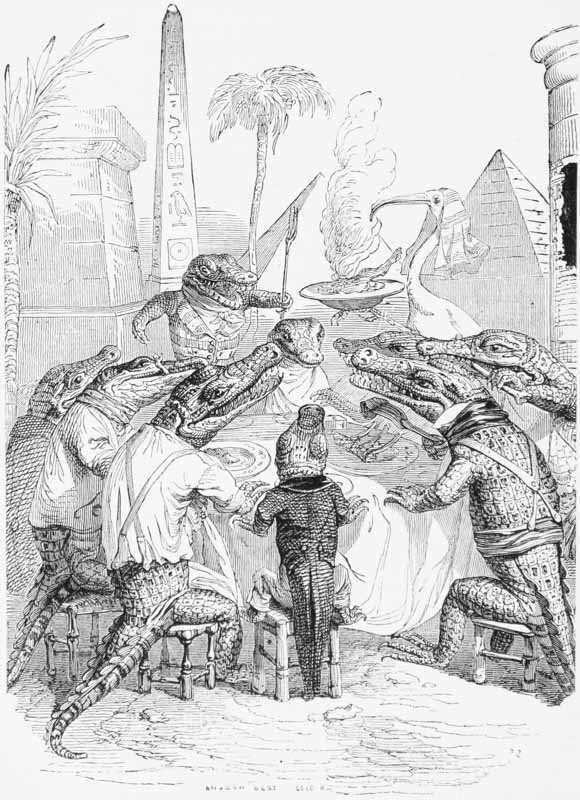
The banks of the Nile often witnessed our convivial meetings, and echoed with the sound of our songs.
About the beginning of the moon of Baby-el-Alonel, the year of Higera 1213, otherwise 3d Thermidor, year VII., otherwise 21st July 1798, I happened to be reposing on a bed of reeds, and was awakened by a strange noise. Clouds of dust rose round the village of Embabeh. Two great armies were advancing to close in battle. On the one side the Arabs, the Mamelouks with breastplates of gold, the Keayas and the Beys mounted on superb horses. The other was a foreign army, made up of soldiers wearing black felt hats with red feathers, blue or rather dirty white uniforms and trousers. The commander was a slight, short, thin man. I pitied the human beings who were led by such a weak creature, hardly a mouthful for a Crocodile.
The little man uttered a few words, at the same time pointing to the pyramids, after which the cannonade began, the guns belched forth their fire and shot, while shells whistled and exploded among the Crocodiles, laying some of them low. That was a fatal day, the turning point in my history. The invaders carried off a gigantic column, placed it on board ship and transported it to one of the finest cities in Europe. The inscriptions on this stone have never been deciphered; I am told the meaning runs thus:—
“Worship good living,
Let your belly be your god.
Selfishness is a virtue
When practised voluntarily.
You must never take the obelisk
By force or by consent,
Two millions must you pay
If you take it unjustly.”
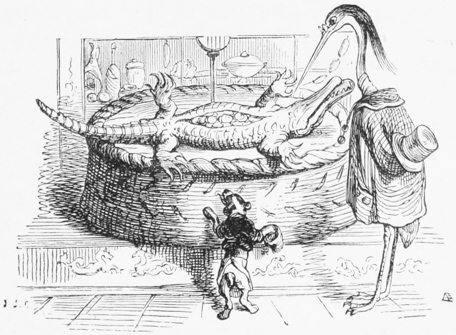
Some of the new comers took it into their heads to hunt and shoot our noble selves. I was captured, but not killed, and became a prisoner at the disposal of man, and was conveyed to El-Kahiret—which the infidels call Cairo—and there provisionally lodged at the consulate. The tumult of war was as nothing compared to the clamour of disputants discussing the Eastern question in this house. Fighting was carried on with the sharpest weapon known—the human tongue. They squabbled from dusky dewy morn till eve. It was truly unfortunate that no free Crocodile was there to end the disputes by devouring Consul, swords, tongues and all. Had I been free, this useful office should have been performed and that speedily. My sailor captor, judging me unfit for a museum, handed me over to an adventurer. On our arrival at Havre—oh misery! my jaws were paralysed with cold. I was placed in a huge tub and exposed to the vulgar gaze of the crowd. The showman stood at the door of his hut bawling out this terrible fiction, “Walk in, ladies and gentlemen, now is the time when this interesting reptile is about to feed!”
He pronounced these words in a tone so delusive that I instinctively opened my jaws, to receive, what? nothing!
The traitor fearing to put my strength on an equality with my ferocity subjected me to systematic starvation.
An old money-lender, who had advanced a sum to my master, delivered me from this slavery by seizing the menagerie of which I was the chief ornament—all the other animals were stuffed. Two days later he handed me over, instead of money, to a man he was piously engaged in ruining. I was placed in a large pond near the sea, where my new owner possessed a villa. I gathered from the servants—internal enemies, as yet happily unknown amongst the Saurians—that my master was a young man of forty-five years, a distinguished gastronomist, the possessor of twenty-five thousand pounds a year—indulgent tradesmen allowing him to spend two hundred thousand pounds.
He had remained a bachelor, wisely viewing marriage as the closing scene in the comedy of life. The only thing remarkable about him was his stomach, of which he was very proud, “I have made it what it is,” he would say, “it cost me a good bit, but I have not lost my money. Nature intended me to be thin and dry, but, thanks to an intelligent regimen, in spite of Nature I have acquired this honourable embonpoint.” The cheapest dinner of this truly great man, cost him at least fifty francs. He used to say with great feeling, “only fools die of hunger.”
One summer evening, after dinner, my master visited me with a numerous company of guests, some of whom found my countenance most prepossessing; others thought me hideous, and all agreed that I bore a strong resemblance to their host.
“Why do you delight in rearing such a monster?” said an old toothless man, who in truth, himself merited this insulting appellation. “Were I in your place, I should have him killed and sent to the kitchen. I have been told that crocodile’s flesh is very much sought after by certain African and Cochin Chinese tribes.”
“Upon my honour,” said my patron, “your idea is original; notwithstanding his resemblance to me, I will sacrifice him to your palates. Cook, to-morrow you will make a crocodile pie with Egyptian onions.” All the parasites clapped their hands, the cook bowed, and I disappeared to the bottom of my pond. After a terrible night, the first rays of the morning sun revealed the cook sharpening an enormous knife. He approached me, followed by two assistants who unlocked my chain and beat me with a stick about the head. I was lost, had not a sudden noise attracted the attention of my executioners. I beheld my master struggling with four unknown bull-dog-looking men, who had just arrived from Paris. One of them held a watch in his hand. Five o’clock had just struck, when I heard the words “En route for Clichy.” A carriage appeared, and without pausing to make further notes, profiting by the excitement, I left my pond and gained the sea.
After many perils, I at last reached my native shore, where I found civilisation and M. de Lesseps were turning everything upside down. Should this rage continue for steam traffic, cutting canals, negotiating loans, and generally playing the mischief with all our ancient institutions, what will become of Crocodiles? Who knows, before long the Nile may be found to flow back to its source—wherever that may be—and the world itself, propelled by steam, may make its way to the sun, or take its enchanted inhabitants on a tour through space.
Progress is most annoying to a conservative Crocodile!
THE FUNERAL ORATION OF A SILKWORM.
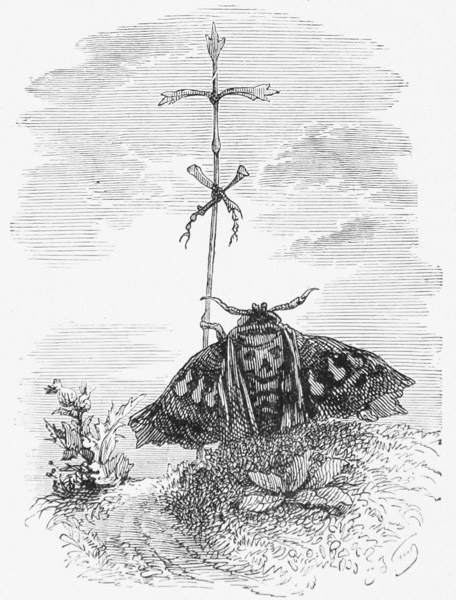
THE sun, having done his day’s work of shining right well, suddenly and wearily retired to rest. The last notes of the birds’ song of praise were still lingering in the echoes of the woods, and the earth, wrapping herself in her dark mantle, was preparing for repose. The death’s-head Moth giving the signal of departure, the little cortége set out on the march for the purple heath. Field-spiders, whose work consisted in clearing the road, preceded the corpse which was surrounded by beetles, in black, carrying the bier of mulberry leaf. These were followed by tail-bearing mutes, next came the Ants, and lastly the Grubs. When at some little distance from the sacred mulberry tree, around which were assembled the relatives of the deceased, the Cardinal Pyrochre gave orders that the hymn of the dead should be intoned by the choir of Scarabs, and afterwards sung by Bees and Crickets.
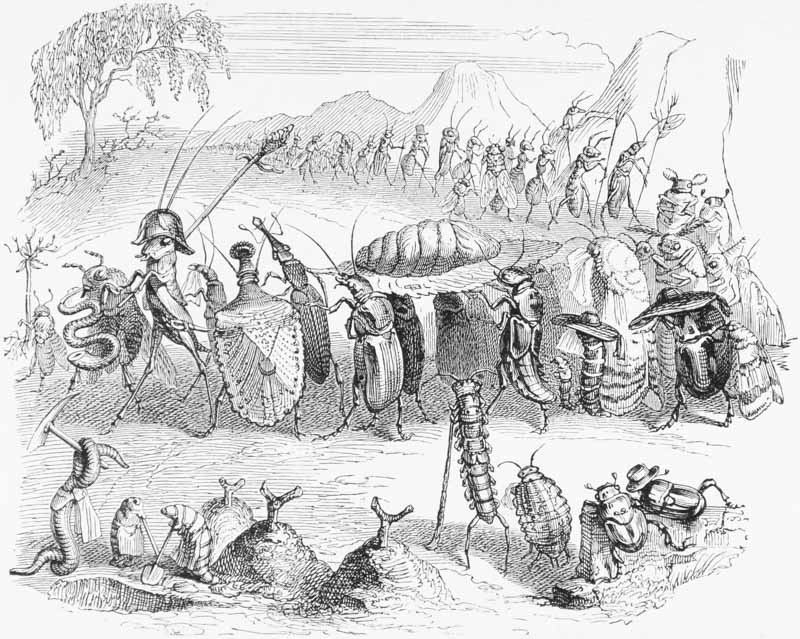
At intervals, when the harmony ceased, one could hear deep sighs and sobs, bearing evidence of the universal grief caused by the loss of the humble insect, whose remains were being borne to their last resting-place. The procession at length reached the cemetery on the heath, where the sextons were still bending over the new dug grave. Sighs and sobs were hushed in that profound silence which betokens the deepest sorrow. But when the bearers had laid the body in the tomb, and the yawning earth closed over it, the air was rent with a piteous wail, for the mourners had seen the last of a true friend.
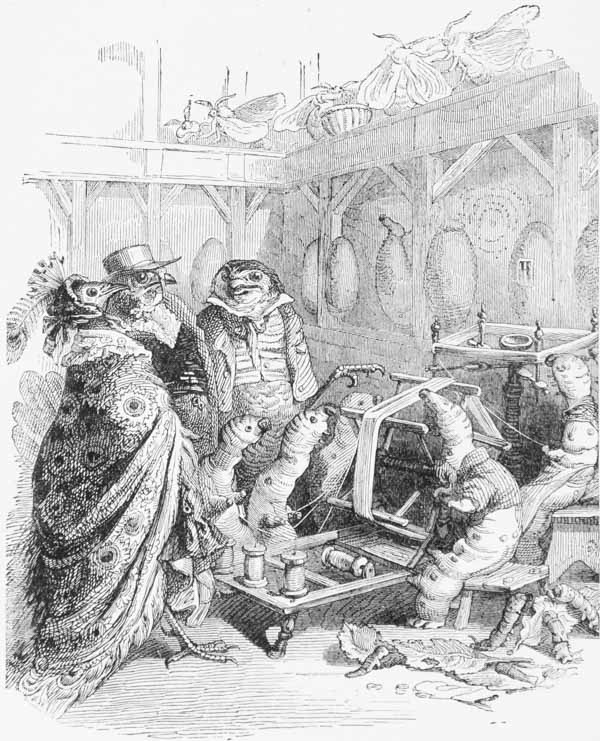
An insect, robed in black, advanced to the grave-mound, saying: “Why this outburst of bitter grief? Why weep for one who has been delivered from the trial and burden of life. Yet,” he added, “weep on, for he who lies there can feel no pang of sorrow; no tears, no loving tones, can wake a responsive throb in his cold breast, nor bring him back to his earthly home!” They would not be comforted.
“Brothers,” said another, advancing in turn, “it is at the birth of a silkworm one ought rather to mourn. His life was one of ceaseless toil. By leaving this earth he has left his misery behind; neither joy nor sorrow can follow him beyond the grave. I tell you simple truth; this is no time for hypocrisy. Why should worms mourn this event? Death has no terrors for us!” They still wept.
One of the mourners said with faltering voice: “Brother, we know that there is a beginning, and alas! an end, to everything, and that all must die; we know, too, the sorrows of our life, the labour of gathering our food leaf by leaf; we know the toil that transforms a mulberry leaf into a shining silken robe; we know the dangers that beset our lives; and the doom of the silken shroud that at last imprisons and blights the dreams of our young lives; we know that to die is to cease to toil, death being the end of the silken thread which began with our birth—we know all this; but, oh, we know, too, that we loved our brother, and who can console us for so great a loss?”
“We loved him! we loved him!” cried the mourners.
“I wept like you,” said the Cardinal, “for our brother who is gone; yet, when I meet death face to face in the silkworm, my heart expands. ‘Go to the other world,’ I say, the better world; there the gates will open for the good, both high and low; there you will rejoin your lost loved ones in a land where flowers breathe an eternal fragrance; where the mulberries bordering the glassy streams are ever green. Ah, brothers, tell them to wait for us there, for to die is to be born to a better life!”
With these words the weeping ceased. The moon broke out, silvering the heath with a chaste glory.
The good insect added: “Go back to your homes; our brother has no longer need of you.”
Each of the mourners, after placing a flower on the grave, left the scene, feeling comforted.

DEAR READER,
We are now halfway on our journey, and feel confident that you will place confidence in us as your guides during the second part of our expedition. Be assured of this, while we lead you into the unknown regions of the animal kingdom, we are prepared to shield you from the dangers of contact with its uncivilised or purely savage races. At the same time, your well-known craving for all that is marvellous has been fully considered, and shall be duly gratified.
Our correspondents have sharpened their wits and pens, and are impatient to lay open a perfect mine of treasure.
Good evening, dear friends. Go home, bar your doors well! One never knows what may happen. The calmest nights are frequently the harbingers of storms. Sleep with one eye open. At any rate, sleep well. Pleasant dreams!
THE MONKEY, PAROQUET, AND COCK,
Editors in Chief.

JARDIN DES PLANTES, PARIS.
IN preparing the second part of our work for press, we were about to discharge the sacred duty of congratulating ourselves upon having laid the solid foundation of the animal constitution, when our pen was arrested by rumours of sedition and conspiracy. Dark clouds have been observed on the horizon; but our astronomers—creatures of true instinct—by their forewarnings, have hitherto enabled us to weather the worst storms, while at the same time, they have greatly increased our store of knowledge by clearing up some obscure points of siderology. They have further invented the seasons, and assured us that days and nights shall succeed each other as long as the observatory is properly endowed. They have decreed that the sun shall be free to all who pay the constitutional rates for the maintenance of paupers, of police, and of the state.
The wide experience and sagacity of these creatures have led them to investigate various natural phenomena, which they do not understand, nevertheless, with the innate modesty of votaries of science, they have compelled nature to bend to their conclusions and have accordingly arrived at certain incontestable facts.
The following communication has just been received from the observatory:
“We have discovered the true cause of alarm. Unless we are mistaken, the clouds that obscure the political horizon consist of swarms of flies and other winged insects—whose political opinions change with the wind—all of them armed to the teeth and tips of their tails.
“This rising is the result of social decomposition among the masses, and a breeze of false doctrine which threatens the glorious fabric of the animal constitution, founded by our first assembly.
“Conspiracy broods over the land. For all that, as the swarms have never been known to pursue any definite policy, we hope to be enabled to contradict the news, which to-day we announce as certain.—In any case: Caveant consules! do not slumber.”
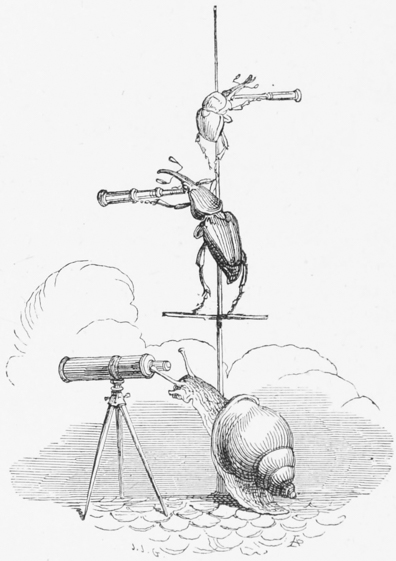
No, we will not sleep; and as we have great faith in the wisdom of our brothers. Since anarchy watches, we shall watch with and against her.
As a first measure, to maintain order, we propose to issue a daily bulletin of events, which will, at any rate, supply material for gossip to the various members of our league.
EXTRACT FROM THE “DAILY MONITEUR” OF THE ANIMALS.
Our worst fears are confirmed. Grave disorders of a seditious character have broken out. A band of rioters, numbering about three thousand, have detached themselves from the army, with the avowed intention of exciting the animal kingdom to revolt. Sword in hand, or sting in tail, they clamour for what they are pleased to term “general reform.” This band is led by a notorious Wasp, famed for his poison and the purity of his principles. In vain have a number of venerable flies striven to calm the popular tumult. Their words have been misunderstood. Happen what may, we are prepared to tide over the storm, and to defeat these odious attempts to uproot the constitution. “Troubles,” said Montesquieu, “build up empires.”
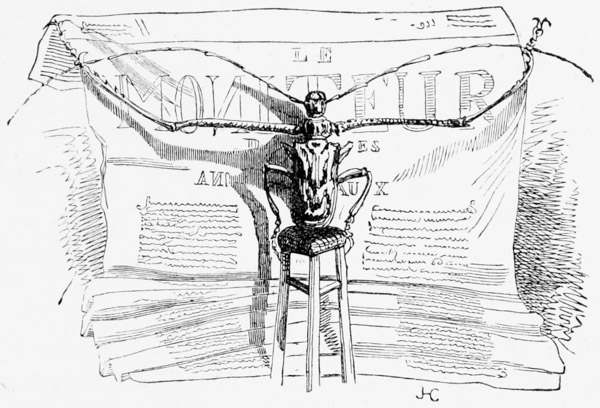
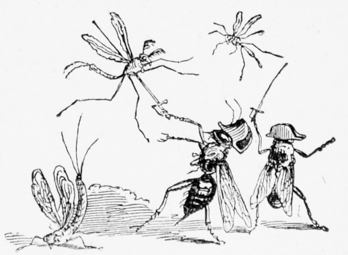
The captain of our winged guards, Lord Humble Bee, has not succeeded in dispersing the rioters; he thought—and rightly—that it would be advisable to withdraw before shedding blood, contenting himself by cutting off the food supplies and hemming in the insurgents, who, after a few hours, would thus be compelled to capitulate or starve. The humanity of this noble leader is worthy of all praise.
The insurgents are throwing up barricades of grass and dried twigs, and are prepared, it is said, to sustain a regular siege. The field they occupy is at least eighteen inches wide by ten inches long.
The most contradictory rumours are spread abroad. Some of the rebels accuse us of indirectly stirring up revolt. “Tyrants of the deepest dye,” said one, “maintain their power by setting their subjects one against the other, so that in their petty strife they may overlook the defects of government.” What can we say of such absurdities. If the rulers of states had nothing to fear save the unity of the people, they would sleep on downy pillows!
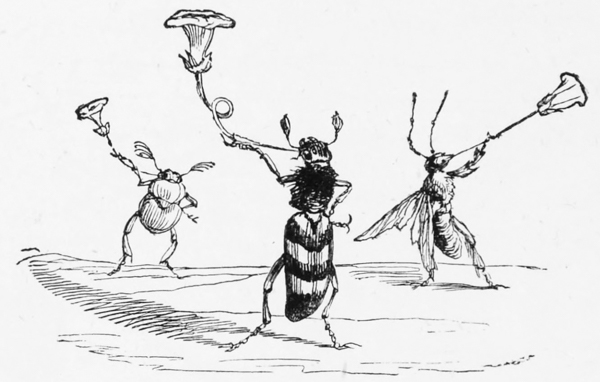
It is reported that the disaffected flies are everywhere rousing the nation. One of them the Clarion, a clever musician, has composed a war march entitled, “The Roll Call of the Flies.” We can now hear the tones of this impious music floating over Paris. It is wafted from a thousand instruments at the Pantheon, the Val de Grace, the tour Saint Jacques la Boucherie, the Salpîtrière, the Père Lachaise, where the emissaries have been stationed by the leaders of the movement.
A number of prisoners have been arrested, but they refuse to disclose their principles.
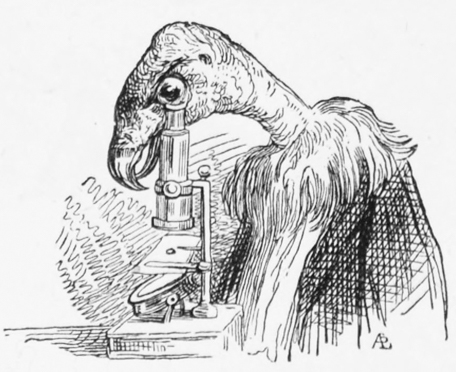
EXAMINING THE FLY’S HEAD.
“We are of snow-white purity!” say they. “Why should such innocents be arrested? Take our heads!”
“Your heads! what can we do with a fly’s head? Nevertheless we will consider this proposition.”
The pretensions of the rebels are now known, “the common good” serves them as a pretext for personal ambition and private hatred. Revolution means nothing more than the relinquishing of our posts to others who are not so well qualified to fill them. If we refuse to yield to their demands—as we intend to do—we are doomed, so they say. Our posts and emoluments will be sold with our lives! We owe this as a tribute to the animal kingdom.
For what are we reproached? Have we been unjust, or partial? Have we not followed our programme and printed all contributions without preference, or selection, blindly as every just editor ought to do? We are over head and ears in paper, knee deep in ink; we have burned the midnight oil, endeavoured to please everybody, entertained foes in the guise of friends, and in short, succeeded so well in our various duties as to secure the envy and hatred of an ungrateful rebel.
The chief of the insurrection is a Scarab! the Scarab Hercules! This is no doubt a very fine name for a leader. Have you made the acquaintance of this Scarab? We for our part might scorn the attacks of such a grovelling fellow, did we not know that the bite or sting of the meanest of God’s creatures is always most venomous and destructive.
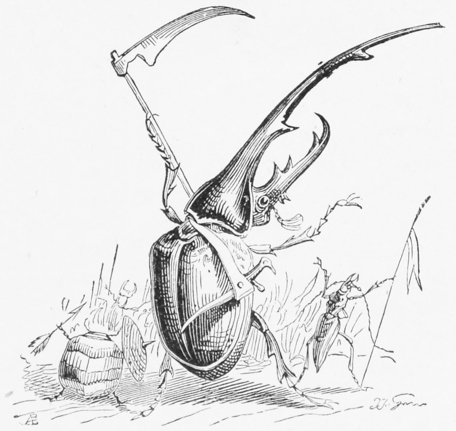
“We have therefore pleasure unalloyed in issuing the following order:—
1st. A price is placed upon the head of the Scarab Hercules; a suitable reward will be paid to any one who will bring him dead or alive (we would prefer him dead).
2d. Measures will be immediately taken to raise a large body of troops; a force of nine hundred thousand flies fully equipped to fight the rebels in the field or in the air.
3rd. The commissioners of police are required to carry one or more lengths of rope as their means will permit.
4th. All honest subjects are required to remain at home, go to bed early, get up late, and to see or hear nothing. Such a line of conduct will prove to the rioters that their projects find no favour among slumbering citizens.
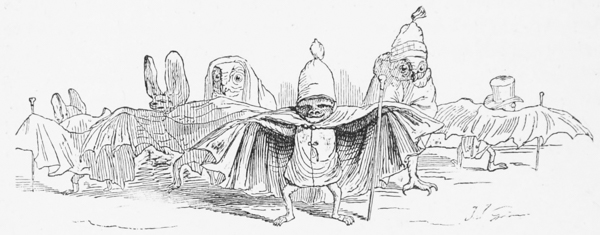
5th. Animals found in pairs, or in groups, shall be cooked, or dispersed by force. This notice concerns Ostriches, Ducks, gregarious and socially-disposed animals.
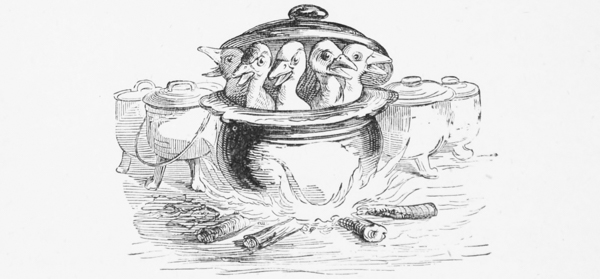
A Kite was sent to us bearing a flag of truce. We deigned to receive and listen to him. He said, “You, sirs, have spoken and managed affairs after your own fashion; now listen, we must each one have our turn. Over there, we number thirty three million free subjects, God’s creatures, and every one as ambitious as yourselves to make a stir in the world; to write and speak fearlessly, Equality is our divine right!”
“What is a right?” inquired an old Crow whose acquaintance the reader has already made, “summum jus, summa injuria! If you must all write, the folios of the whole world would not be sufficient to contain the manuscript, not even if each one restricted himself, not to his history, nor to a page, line, word, letter, or even a comma.”
This judicious refutation was deemed simply absurd, and the foolish Kite replied by asking another question. “That is enough! who endowed you with your power of reckoning? Has the God of Scarabs not made earth, sky, light, trees, and even leaves, that every one who has an equal stake, may have an equal share in all created things?”
O folly! the victory of such reasonable kites and scarabs is certain. Go back to your camp.
Alas! civil war is making its way into the most peaceful valleys. The spirit of revolt has spread from the insects to the birds, and even to the quadrupeds. Alarm is everywhere abroad. The doors of the cages have to be kept shut, a proceeding most galling to those animals who sit outside watching their neighbours. Let the peacefully disposed take courage, the geese are still guarding the capital.
The insurgents have replied to the articles of our journal, in a paper they have established, called “The Guardian of Freedom;” or, “Review of Animal Reform.”
Yesterday, the friends of liberty assembled in the Hall of Natural History, where stuffed animals are preserved.
This preliminary meeting was held at a late hour. One by one the members assembled, and silently exchanging tokens of recognition, seated themselves in the galleries opposite their preserved ancestors. The stillness was such, that one could hardly distinguish the dead from the living. The Elephant, Bear, Buffalo, Bison, and the Eagle all arrived at the same moment, as if drawn thither by some power supernatural. But who can deny that love of liberty moves mountains, and at once explains the presence of these noble beasts.
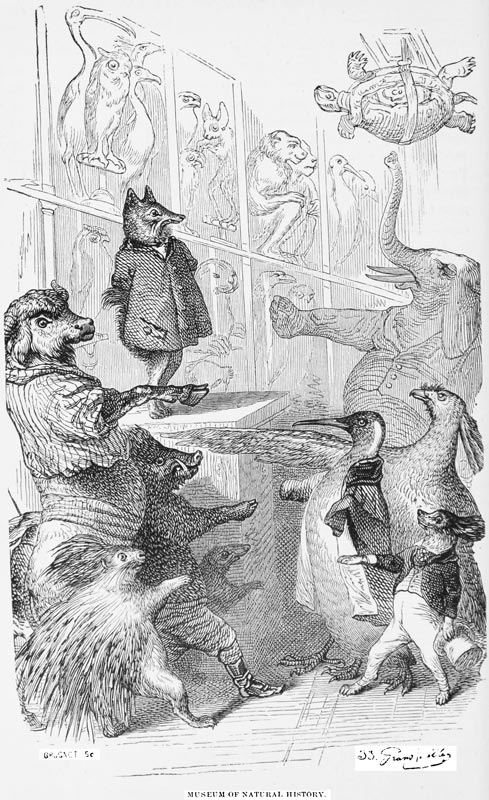
“Brothers,” said an orator at last, “we have remained silent, and yet we know full well the cause of our meeting. Fellow elephants, apes, birds, and beasts! I crave your forbearance—(cheers)—while I point out to you the only true elements of reform. (Loud applause.) Our proceedings last year have let us in for a rather bad thing; the animals elected to edit our proceedings, and to conduct the affairs of our kingdom, have tampered with our liberty. Visit their chambers—there you shall behold histories without number, rejected and shelved; shelved to suit the editor’s caprices! (Cheers.) Many of the pages thus consigned to oblivion, are very mirrors of light and liberty that would have shed a glorious lustre over the ages. Ah! I see, in the cultured faces around, the lineaments of all that is noble and patriotic in the land! I hear in those deep drawn sighs, harrowing tales of genius neglected and suppressed by the jealousy of those who are set over us! (Thunders of applause.) I read the sentiments of true hearts, roused by oppression, in the fervour of your wagging tails and glorious gnashing of incisors! Brothers, let calm and tranquil sagacity resume its throne in your breasts, which are torn with righteous indignation! Listen—words must express pent-up thoughts! I must speak! you must act!! The course we are pursuing is leading us to ruin! What has the publication of our history done for us? For us? nay, not for us; for the few—the select favoured ones whose stories have appeared in its pages. What has it done for us? simply nothing. In these pages the wrongs of all, high and low, should find a place. Has it been so? I ask you. (Shouts of ‘No! no! no! down with the editors!’) Down with them! the tyrants!! they have abused the power we placed in their hands! served their friends, and calmly said, ‘All is well.’ What has come of it all? Has our world ceased to be a vale of tears? Have our homes been happier? Our prospects brighter? Has our fame been spread abroad? (‘The stag, elk, and calf, No! no!!’) Brothers, since that memorable night, when the first outcry for liberty and reform was hailed by the acclamations of the whole world, our rights and liberties have been systematically betrayed. We have been sold! sold!! sold to men!! (‘True, true! they sold us,!’) sold to men!!! But let us leave these inferior animals alone, they are not our worst enemies. Our leaders have betrayed us for a caress from their keepers, or a miserable subsidy of nuts and crusts. Whither shall we direct our steps? shall it be back to our narrow prisons, or lonely desert wastes? (All the animals, ‘Alas! alas!’) Will the clouds be our canopy and the earth our pillow? I tell you, friends, we shall all of us die in irons. (In chorus, ‘O misery, misery!’)”
The orator, turning towards the remains of countless generations of animals, continued—
“Remains of our illustrious ancestors, you who once lived and breathed. Miserable mummies! ghosts of all that is beautiful in our vitality and action. Did you voluntarily relinquish the care of the creator to play your part in this ghastly mimicry of life? Were we created to be stuffed and preserved in cases, side by side with the poor works of man, in place of returning to your parent earth after fulfilling your destinies? Brothers, let us escape from men and the doom that awaits us. The way to liberty may be narrow and well-guarded; it is our only way! we must follow it, force the passes, water them with our blood, and gain the glorious grassy plains and wooded vales of freedom!”
If one may credit the report of this pompous oration, the effect it produced was perfectly marvellous. We need only notice one point in this wicked dithyrambic. You say, Mr. Bison, the speaker, that we have sold you—you are right we have sold you! and what is more we are proud of it! No less than 20,000 copies. Could you have done so much? You owe us your thanks for raising your market value.
The dean of the Jardin des Plantes—a venerable Buffalo—whose personal character we esteem, replied thus to his cousin the Bison:—
“My children, I am the oldest slave in this garden, and have the sad honour of being your dean. Of my early days I have but a dim recollection, indeed I can only recall the days of my freedom. Sweet days they were, and in spite of my twenty odd years of bondage the young blood comes back to my heart as I reflect on the prospect of renewed liberty. (Cheers.) I speak of your liberty, my children, not of my own, for my eyes will close in death long before the dawn of that glorious day. Slave I have lived, and slave I shall die. (Shouts of ‘Long live the Buffalo.’) My good friends,” replied the speaker, “it is not in your power to add an hour to my life. It is not the selfish freedom of one, or of many, but of all that we must seek. I therefore beseech you to remain united. (Murmurs of dissent.) My children, do not plunge into the misery of civil strife. Do not cavil over the mean rags of power. When you have changed your one-eyed house for a blind mock, what benefit will the change confer? Think of the misery you may bring upon the poor and helpless ones, and how that a little power, more or less, vested in the hands of my hearers can never effect the good of all.”