Chapter V
Reading edition
Return to the fields.—The worthlessness of men and other animals.—A Cock, accustomed to the ring, provokes our hero.—Duel with pistols.
“I SOON reached a wood, and felt my chest expand with the pure air. It was so long since I beheld the full extent of the sky, that I seemed to look upon it for the first time. The moonlight was bright, and the night-breeze laden with a banquet of fresh odours that it had caught up about the fields and hedgerows. Endowed by nature with an acute sense of smell, nothing could be more delicious to a weary Hare than the fresh fragrance of grass and thyme. Each breath I inhaled filled me with the fond memories of my childhood, which passed into my dreams as I slept in the open air. Early next morning I was roused by the clang of steel. Two gentlemen were fighting with swords, and appeared to me determined to kill each other; however, when they were tired of fencing, they walked off quietly arm-in-arm. Other combatants followed, but not one fell, and no blood was spilt in these affairs of honour, after nights of gambling and debauchery.
“Journeying onward until within sight of a village, I fell in with a Cock. As I had been cooped up in a town, and seen nothing but men and women for so long, this bird interested me greatly. He was a fine fellow, high on his legs, and carried his head as if he could not bend his neck. He had quite a martial bearing, reminding one of a French soldier.
“ ‘By my comb!’ he exclaimed, ‘I hope you will know me again. I never came across a Hare with such a stock of assurance.’
“ ‘What!’ I replied, ‘may I not admire your fine proportions. I have been so long in Paris, I have quite forgotten the grandeur of nature.’
“Would you believe it? Although my answer was so soft and simple, yet the fellow was offended, crowed like to split my ears, and cried, ‘I am the Cock of the village, and it shall never be said that a miserable Hare can insult me with impunity.’
“ ‘You astonish me,’ I continued, ‘I never intended to insult you.’
“ ‘I have nothing to do with your intentions. Every insult ought to be wiped out with blood. I am rather badly off for a fight, and I shall have much pleasure in giving you a lesson in good manners. Choose your arms.’
“ ‘I would rather die than fight. Let me pass—I am going to Rambouillet to rejoin some old friends.’
“ ‘Fight you must, else I will put a ball through you. Here are an Ox and a Dog, who will serve as seconds. Follow me, and do not attempt to escape.’
“What could I do? flight was impossible—I obeyed. Then addressing the seconds, I said, ‘Sirs, this Cock is a professed duellist. Will you stand by and see me assassinated? I have never fought, and my blood will be on your heads.’
“ ‘Bah!’ said the Dog, ‘that is a trifle. Everything must have a beginning. Your simple candour interests me. I will stand by you. Now that I am certain of you, it concerns my honour that you should fight.’
“ ‘You are extremely polite, and I am touched with your goodness; but I would rather deny myself the pleasure of having you witness my death.’
“ ‘Hear him, my dear Ox,’ cried my adversary. ‘In what times do we live? Has it positively come to this, that cowardice, impudence, and low-bred nature are to triumph over all that is chivalrous and noble in the world?’
“The pitiless Ox bellowed with rage. The Dog, taking me aside, said in a soothing tone, ‘It makes little odds in the end how one dies; and between us two, I don’t half like this Cock. Believe me, I heartily wish you success. Were I a sporting Dog, you might doubt my sincerity, but I have settled down to a country life, that would be quiet were it not for the early crowing of your foe, who permits no one in the village to sleep after daybreak.’
“ ‘I shall never be able to get through it,’ I replied, half dead.
“ ‘You have the choice of weapons. Choose pistols, and I will load them.’
“ ‘In the name of all that is canine and good,’ I said, ‘try and arrange this affair.’
“ ‘Come, make haste,’ cried the Cock. ‘Enter this copse! One of us will never leave it!’ he added.
“At these words I felt a cold chill run through me. As a last resource, I reminded the Ox and Dog of the law against duelling.
“ ‘Those laws are made by cowards,’ they replied.
“I endeavoured to work upon the tenderest feelings of my adversary’s nature by inquiring what would become of his poor hens should he fall. All was in vain. Twenty-five paces were marked off; the pistols were loaded, and we took our places.
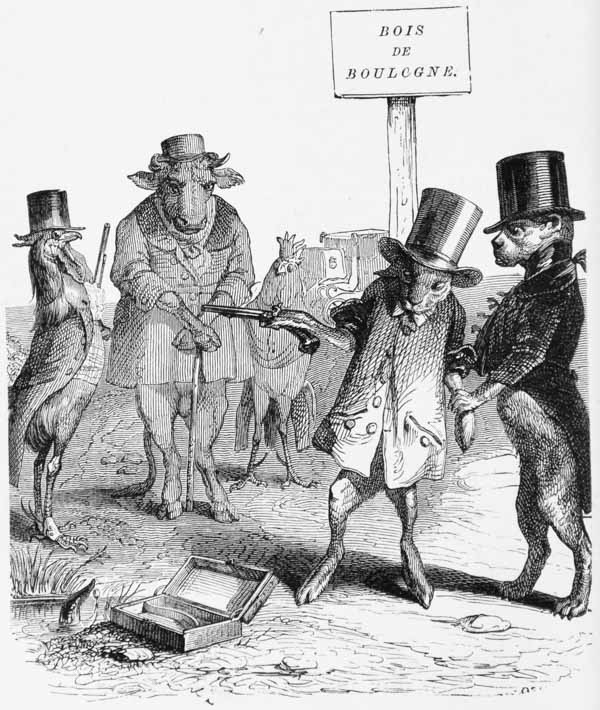
“ ‘Are you used to this arm?’ said the Dog.
“ ‘Alas! yes; but I have neither aimed at nor wounded any one.’ As good luck would have it, I had to fire first.
“ ‘Take good aim,’ said the Dog, ‘I detest this fellow.’
“ ‘Why on earth, then, don’t you take my place? Are you still at enmity with me,’ I said to my foe. ‘Let us kiss and forget all.’
“ ‘Fire!’ he replied, cursing fearfully.
“This roused me. The Ox retired and gave the signal; I pressed the trigger, and we both fell—I, from emotion, and the Cock from the ball that pierced his heart.”
“ ‘Hurrah!’ cried the Dog.
“ ‘Silence, gentlemen,’ I said, ‘this is no time for rejoicing.’ But he was a jolly dog, and light-hearted.
“ ‘Bravo!’ said the Ox, ‘you have rendered a public service. I shall be glad if you will dine with me this evening. The grass is particularly tender in this neighbourhood.’
“I declined the invitation and said, ‘May the blood of this miserable bully be upon your heads. Gentlemen, good morning.’
“My journey to Rambouillet was, as you may be certain, a sad one. It was long before the dread image of my dead enemy vanished from my eyes. The freshness and beauty of nature at last acted as a balm to my spirits; and ere I reached the forest, with all its souvenirs of my youth, my troubles were forgotten. Some months after my return, I had the pleasure of becoming a father, and soon after a grandfather. You know the rest, my dear children, so now you are at liberty.” At these words his audience awoke.
“Since my return, my dear Magpie, I have had leisure for reflection, and have come to the conclusion that true happiness is not to be found in this world. If it does exist at all, it is most difficult to attain, and the most fleeting possession of our animal nature. Philosophic men without number have wasted their lives in vainly attempting to discover some clue to the mystery, and all to no purpose. Some of them would fain have us believe that they had nearly created a heaven for themselves where self-love had only set up its own image as its god. Other men demand happiness of heaven as if it were a debt owed them by its Divine Ruler, and probably the wisest section settle down to enjoy the pleasures which life undoubtedly affords, and to make the best of ‘the ills that flesh is heir to.’
“I believe, on the whole, that our lives, although they have their disadvantages, are pleasanter than the lives of men, for this reason. The present is to us everything. We live for to-day. Men live for to-morrow. The to-morrow that is to be brimful of joy. Alas! thus human hope is carried on through all the days of life; but the joy is never realised, and the hope goes with men beyond the grave.”
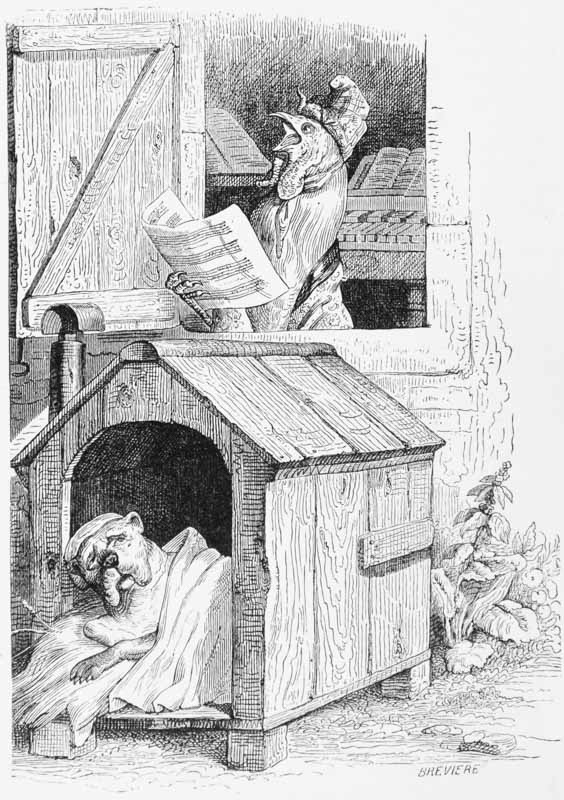
THE FLIGHT OF A PARISIAN BIRD IN SEARCH OF BETTER GOVERNMENT.
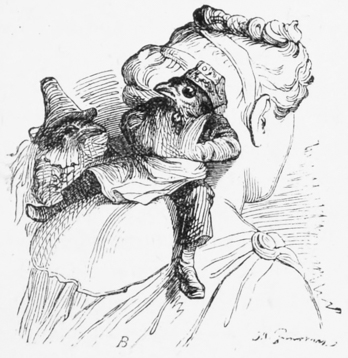
PARISIAN Sparrows have long been recognised as the boldest of the feathered tribe. Thoroughly French, they have their follies, and their virtues to atone for them; but above all, they have been for many generations objects of envy to the birds of foreign climes. This latter reflection is sufficient to account for all the calumnies heaped upon them by their enemies. They who dwell amid the splendour of the capital, are a happy tribe. As for myself I am one of the number of distinguished metropolitan birds. Of a naturally gay disposition, an unusually liberal education has lent gravity to my appearance. I have been fed on crumbs of philosophy; having built my nest in the spout of an illustrious writer’s dwelling. Thence I fly to the windows of the Tuileries, and compare the anxieties of the palace and the fading grandeur of kings, with the immortal roses, budding in the simple abode of my master, which will one day wreathe his brow with an undying glory.
By picking up the crumbs that have fallen from this great man’s table, I myself have become illustrious among the birds of my feather, who, after mature deliberation, have appointed me to select the form of government calculated to promote the welfare of sparrows. The task implied is a difficult one, as my constituents never remain long on one perch, chattering incessantly when their liberty is threatened, and fighting among themselves almost without cause.
The birds of Paris, ever on the wing, have many of them settled down to thinking, and are now giving their attention to such subjects as religion, morality, and philosophy.
Before residing in the spout—in the Rue de Rivoli—I made my escape from a cage in which I had been imprisoned for two years. Every time I felt thirsty, I had to draw water to amuse my master, one of those bearded animals who would have us believe they are the lords of creation. As soon as I regained my liberty, I related my sad story to some friends in the Faubourg St. Antoine, who treated me with great kindness. It was then, for the first time, I observed the habits of the bird-world, and discovered that the joy of life does not consist in simply eating and drinking. I was led to believe that even the life of the sparrow has higher ends, and to form convictions which have added greatly to my fame.
Many a time have I sat on the head of one of the statues of the Palais Royal, where I might be seen with my plumes ruffled, my head between my shoulders, and, with one eye closed on the world, reflecting on our rights, our duties, and our future. Grave questions forced themselves upon me. Where do sparrows come from? Where do they go to? Why can’t they weep? Why don’t they form themselves into societies like crows? Why don’t French sparrows settle everything by arbitration, since they enjoy such a sublime language?
Great changes were taking place around; houses were supplanting gardens, and depriving birds of the insects and grubs found in the shrubs and soil. The result, as might have been expected, was to draw the line still more markedly between the rich and poor, and to set up “caste” as it exists among certain types of the human race. The sparrows in the densely-populated quarters were reduced to living on offal, while the aristocracy fed daintily, and perched as near heaven as the trees of the Champs d’Elysées would allow them.
This defective constitution could not last long; one half of the feathered tribe chirping joyously in the fulness of their stomachs, surrounded by superb families, and the other half brawling and clamouring for filthy refuse. The latter, driven to desperation, determined indeed to use, if need be, their horny beaks to improve their social condition.
With this laudable object in view, a deputation waited on a bird who had lived in the Faubourg St. Antoine, and assisted at the taking of the Bastille. This bird was appointed to the command of the sufferers, who organised themselves into a body, each one feeling the necessity of implicit obedience.
Judge of the surprise of the Parisians who beheld thousands of small birds ranged on the roofs of the houses in the Rue de Rivoli; the right wing towards the Hôtel de Ville, the left on the Madeleine, and the centre on the Tuileries. The aristocratic birds, seized with panic-fear at sight of this demonstration, and dreading the loss of their power and position, despatched a fledgling of their number to address the rioters in these words:—“Is it not well that we should reason together and not fight?”
The rioters turned their eyes upon me. Ah! that was one of the proudest moments of my life: I was elected by my fellow-citizens to draw up a charter to conciliate all, and settle differences among the most renowned sparrows in the world, sparrows who for a moment were divided on the question “how to live,” the eternal backbone of political discussions.
Those birds in possession of the enchanting abodes of the capital, had they any absolute right to their property? Why and how had caste become established? Could it last? Were perfect equality established among Parisian sparrows, what form would the new government assume? Such were the questions asked by both parties. “But,” said the hedge-Sparrows, “the earth and all its riches should be equally divided.” “That is an error,” said the privileged ones; “we live in a city, and are subject to the restraints, as well as to the refinement, of society; whereas you in your condition enjoy greater freedom, and ought to content yourselves with the hedgerows and fields, and all that satisfies untutored nature.”
Thereupon a general twittering threatened to lead to hostilities, but the popular tumult with sparrows, as with man, is the labour-pangs of national deliverance, and brings forth good. A proposition was carried, to send an intelligent bird to examine the different forms of government. I had the honour of being selected for the post, and at once started on my mission. What would one not sacrifice for his country? To tell the truth, the position was one which conferred both dignity and emolument. Let me now lay the report of my travels as an humble offering on the altar of my country.
THE ANTS’ FORM OF GOVERNMENT.
After traversing the sea, not without difficulty and danger, and experiencing many of those adventures which take the place of genuine information in modern books of travel, I arrived at an island called Old Frivolity. Why it should be termed old I could never make out, as it is said that the world was created all at once. A Carrion-Crow, whom I met, pointed out the government of the ants as a suitable model, so you may understand how eager I was to study their system, and discover their secrets. On my way I fell in with scores of ants travelling for pleasure. They were all of them black and glossy, as if newly varnished, but utterly devoid of individuality, being all alike. After, indeed, one has seen a single ant, one knows all the others. They travel coated with a liquid which keeps them clean. Should one meet an ant in his mountains, on the water, or in his city-dwelling, his get-up is irreproachable. Care is even bestowed on the cleanliness of his feet and mandibles. This affectation of outward purity lowered them in my estimation. I inquired of the first ant I met, “What would happen to you were you for an instant to forget your careful habits?” He made no answer; I discovered, indeed, that they never exchange a word with any one to whom they have not been formally introduced. I fell in with an intelligent Coralline of the Polynesian Ocean, who informed me that she had been arrested by the fishes when engaged in raising the coral-foundation on which a new continent was to repose. She mentioned a curious fact relating to the government of the ants, namely, that they confer the right upon their subjects to annex all new lands as soon as they appear above sea-level. I now found out that Old Frivolity was so named to distinguish it from New Coral-reef Island. I may mention in passing, that these are private confidences, and caution my noble constituents not to abuse them.
As soon as I set foot on the island, I was assailed by a troop of strange animals—government servants—charged with introducing you to the pleasures of freedom, by preventing you carrying certain contraband objects you had set your heart upon. They surrounded me, compelled me to open my beak in order that they might look down my throat in case I should be carrying prohibited wares inland. As I proved to be empty, I was permitted to make my way to the seat of the government, whose liberty had been so lauded by my friend the Crow.
Nothing surprised me more than the extraordinary activity of the people. Everywhere were ants coming and going; loading and unloading provisions. Palaces and warehouses were being built; the earth, indeed, was yielding up all its finest materials to aid them in the construction of their edifices. Workmen were boring underground, making tunnels to relieve the traffic on the surface of the island. So much taken up, indeed, was every one with his own business, that my presence was not noticed. On all sides, ships were leaving laden with ants for the colonies, or with merchandise destined for foreign shores; vessels were crowding into the ports, bearing produce from distant parts of the world; messages were flashing from agents abroad, telling merchants of the abundance of products that might almost be had for the lifting. So clever are these ants in everything connected with commerce, that whenever they receive a message, they send off their vessels, laden with cheap wares which they sell to weak races at the highest market prices. Some semi-savage nations assert that the strong drink the ants export is too potent, and that the narcotic they extract from a certain plant, which is watered by the sweat of a servile race, affords a powerful stimulant to national decay,—is, in fact, a physical and moral poison. To this, diplomatists reply that the trade is lucrative, that there is a demand for the narcotic, and that so long as the demand lasts the ants must supply it at their own price. There are those among them who abhor this traffic, and condemn it as a moral slave-trade, in so far as the effect of the narcotic on its consumers is to render them its bondsmen for life. These ants, curiously enough, profess the Christian religion, and send propagandists to all parts of the world. For all that, I soon found out that many of them are idolaters, worshipping gods made of gold by themselves, and set up in shrines called banks; other idols, called “consolidated funds,” railway stocks, and generally sound investments, yield their owners a temporal good, and enable them to “live in clover.” Other idols, again, when sunk in foreign loans and spurious companies, rebel and bring down all sorts of calamities on the widows and orphans of the most industrious ants of the island. There are those among them, whose avocation it is to make these images out of clay with such attractive ingenuity that, when set up to public gaze, worshippers flock to the shrines and take their glitter for pure gold; these gods are for “raising the wind,” but they sometimes bring down a storm and are overthrown, crushing in their fall thousands of poor devotees.
In the midst of the general activity I noticed some winged ants; and, singling out one, inquired of the guard, “Who is that ant standing unemployed while all the others are labouring?”
“Oh,” he replied, “that is a noble lord. We have many such as he, patricians of our empire.”
“What is a patrician?” I asked.
“They are the glory of the land,—fellows with four wings who fly about in the sun, and are at their wits’ end to know how to pass the time most pleasantly.”
“Can you yourself ever hope to become a patrician if you work hard?”
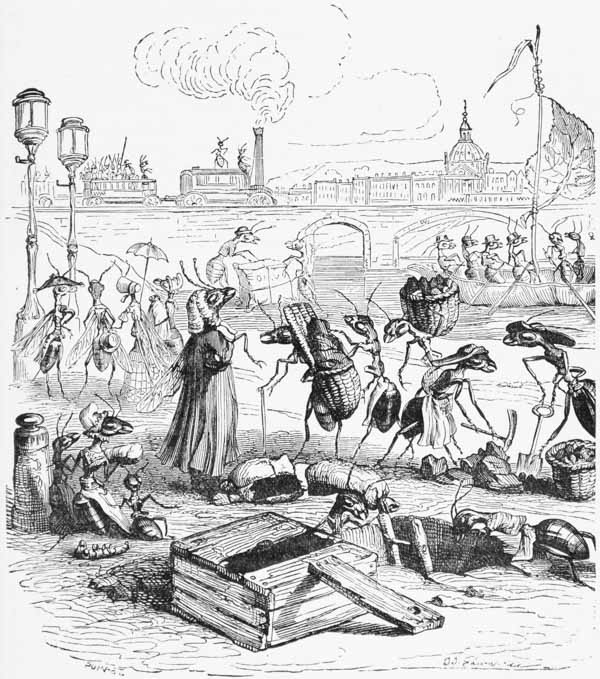
“Well, no; not exactly. The wings of patricians are natural; they run in the families, so to speak. But artificial wings may be ingrafted by the sword of the sovereign for distinguished service; these, however, are never strong enough to enable the wearer to soar clear of his plebeian fellows into the high heaven of aristocracy. I must tell you that some of the four-winged order are almost indispensable to the state; they nurse the national honour, and plan our campaigns.”
The noble ant who had caused my inquiries was coming towards us. The common ants made way for him; these working ants of the lower order are extremely poor, possessing absolutely nothing. The patricians, on the other hand, are rich, having palaces in the ant-hills, and parks, where flies are reared for their food and sport.
The ants display the tenderest regard for their offspring; and to the care bestowed upon the training of the young they attribute their national greatness. It is astonishing to see the neuters watching over the young. In place of sending—as some of our Parisian sparrows do—their callow-brood to be nursed by birds of prey, they themselves tend the orphans. They, indeed, live for them, sheltering them from the cold winds that sweep their island, watching for the fitful gleams of sunshine to lead them out. These ant-neuters watch with pride the growth of the young lives, and the development of the instinct for war and conquest in the young brood; not alone the conquest of lands and races, but the mastery over the elements of nature that informs them how to brave the worst storms, and build their wonderful ant-hills. These nurses, although tender-hearted, are proud, and will unflinchingly buckle the swords on to their favourites, and send them away to fight for fame, or die for their country. From the point of view of a philosophical French sparrow, all this seemed to me strangely conflicting, and on the whole a sign of defective national character. At this moment the patrician ascended one of the city fortifications and said a few words to his subordinates, who at once dispersed through the ant-hill; and in less time than I take to write I noticed detachments issuing from the stronghold, and embarking on straw, leaves, and bits of wood. I soon learned that news of a defeat had arrived from abroad, and they were sending out reinforcements. During the preparations, I overheard the following conversation between two officers:—
“Have you heard the news, my lord, of the massacre of the innocents by the savages of Pulo Anto?”
“Yes; we shall have to annex the territory of these painted devils, and teach them the usages of civilisation.”
“I suppose it must be so; our fellows will have some rough work in the jungle, and the expedition to punish a handful of barbarians will cost no end of money, and some good lives.”
“As pioneers of progress, we must be prepared to sacrifice something for the common good, and our men are in want of active service. Besides, Pulo Anto is a rich island, and will yield a good revenue.”
This last remark was very much to the point, so conclusive, indeed, as to satisfactorily terminate the dialogue. Will it pay? is the final question which settles all the transactions of this military and mercantile race. I imagined that the noble lord spoke of the “common good” in the sarcastic tone peculiar to his nation. This phrase meant the immediate benefit of the Ant kingdom, and the ultimate disappearance from the face of the earth of a weak neighbour. The ants carry the process of civilising a savage nation to such a degree of refinement, that the subliming and re-subliming influences of contact gradually cause the destruction of the dross of savagedom and the annihilation of race. It seemed to me that what the ants happen to like they look upon as their own, and make it their own if it suits their convenience. They extend their empire, and carry warfare and commerce into the ant-hills of their weaker neighbours. They wax stronger and richer year by year, while the nations with which they trade, many of them, grow weaker and poorer.
I remarked to an officer that the aggressive policy of his government was much to be reprobated.
“Well,” he replied, “there may be truth in what you say, but we must obey the popular voice, open new fields for our commerce, and keep our army and navy employed.”
“You, sir, call this fulfilling a divine mission; a foreign war is a sort of god-send to keep the fighting ants employed. You go on the principle of the surgeon who cuts up his patients to keep his hand in, and his purse full. Such work ought to be left to the butcher.”
“Oh no; you labour under a great mistake. I own we do something in the way of vivisection, just as would the skilful surgeon to increase his knowledge, and enable him to heal the festering sores of humanity. When we find pig-headed ants or deaths-head moths”——
“What are pig-headed ants?”
“A species of insect devoid alike of reason and all the nobler qualities which we ourselves possess. I say, when we find them, it becomes our duty to use strong measures to raise their condition, or remove them out of our way.”
“Just as a physician who fails to effect a cure would feel justified in killing his patient?”
“Again, sir, you misapprehend my meaning. It is the custom of Parisian sparrows, when they clamour for liberty, equality, and fraternity, to kill each other, in order to purify the government. Having no real grievances at home, we find it convenient to redress our wrongs and seek for sweets abroad. Thus we preserve our independence, and confer a benefit on the world at large. My time is precious—good morning!”
My noble constituents will readily understand how I stood petrified at the audacity of this fighting ant, who stoutly maintained that might alone was right, and that his corrupt form of government ought, forsooth, to be set up as a model.
I had it in my mind to tell him that the chief successes of his foreign policy were effected by the subtile diplomacy of maintaining intestine divisions in foreign states. In this way the time of their enemies is fully occupied, and their strength weakened.
But he retreated before superior force, well knowing that his arguments must be crushed by the criticism of a Philosophical French Sparrow.
I afterwards learned that the officer had retired to his property in the country, “there,” as the ants would say, “to practise those virtues God has imposed upon our race.”
The only good points about the government of Old Frivolity lie in the protection extended to the meanest subjects, and the way they manage the working neuters, in making them pull together to effect great ends. This latter would prove a great element of danger were it introduced among ingenious Parisian sparrows.
I started much impressed with a sense of the perfection of this oligarchy, and the boldness of its selfish measures, and left regretting that in governments, as in individuals, close scrutiny reveals many defects.
MONARCHY OF THE BEES.
Profiting by what I had seen in the Ants’ empire, I resolved in future to observe more closely the habits of the tribes, before trusting myself to princes or nobles. On reaching this new dominion I stumbled against a bee bearing a bowl of honey.
“Alas!” he exclaimed, “I am lost.”
“Why?” I asked.
“Do you not see I have spilt the queen’s soup, happily the cup-bearer, the Duchess of Violets, will attend to her immediate wants. I should die of grief if I thought my faults would not be repaired.”
“How came you to worship your queen so devoutly? I come from a country where kings and queens and all such human institutions are held in light esteem.”
“Human!” cried the Bee; “know, bold Sparrow, that our queen and our government are divine institutions. Our queen rules by divine prerogative. Without her wise rule we could not exist as a hive. She unceasingly occupies herself with our affairs. We are careful to feed her, as we are born into the world to adore, serve, and defend her. She has her sons and daughters for whom we rear private palaces. The latter are, too frequently, wedded to hungry, petty princes, who thus claim our service and support.”
“Who is this remarkable queen?”
“She is,” said the Bee, “Tithymalia XVII., a woman endowed with rare wisdom; she can scent a storm afar off, and is careful to lay in stores for severe winters. It is said also that she has treasures in foreign lands.”
Here a young foreign prince came forward, and cautiously inquired if we thought any of the young ladies of royal blood likely to want a husband.
“Prince,” said the working Bee, “have you not heard of the ceremonies and preparations for departure? If you wish to court any daughter of Tithymalia you had better make haste. You are well enough in your appearance, although you could do with a new coat.”
I beheld a splendid spectacle. One of the princesses was about to be married. The pageant on which I gazed must have a powerful effect on the vulgar imagination, and wed the people to the memories and superstitions which are about the only links uniting the higher with the lower orders of society.
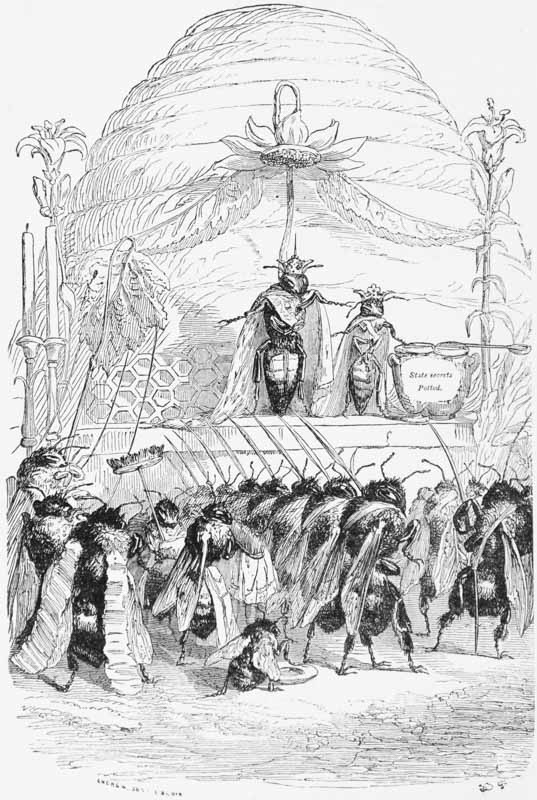
Eight drummers in yellow and black jackets left the old city called Sadrach—from the name of the first Bee who preached social order; these were followed by fifty musicians, all of them so brilliant that one might have said they were living gems. Next came the bodyguards armed with terrible stings. They were two hundred strong. Each battalion was headed by a captain, wearing on his breast the order of Sadrach—a small star of beeswax. Behind them came the queen’s dusters, headed by the grand duster, then the grand tooth-pick-bearer, cup-bearer, eight little cup-bearers, and the mistress of the Royal House, with twelve train-bearers, and lastly, the young queen, beautiful in her maidenly grace, her true modesty. The wings which shone with great splendour had never yet served for flight. The queen-mother accompanied her, robed in velvet, aglow with diamond-dust. Musicians followed humming a hymn of praise composed for the occasion. After the band came twelve other old drones, who seemed to me to be a sort of national clergy. They were all alike one to the other, and buzzed uniformly and monotonously. About ten or twelve thousand bees marched from the hive, upon the edge of which stood Tithymalia, and addressed these memorable words to the multitude:—
“It is always with a new pleasure that I witness your flight, as it secures the tranquillity of my people, and that”——She was here interrupted by an old drone who was afraid of the queen using unparliamentary language—at least so I thought. Her Majesty continued—“I am certain that, trained by our habits of thrift and industry, you will serve God and spread the glory of His name on the earth which He has so enriched with honey-yielding flowers. May you never forget the honour due to your queen, and to the sacred principles of our government. Think that without loyalty there is anarchy, that obedience is the virtue of good bees, that the strength of the state depends upon your fidelity. Know that to die for your queen and the church is to give life to your land. I give you my daughter Thalabath as queen. Love her well!”
This eloquent speech was followed by loud buzzing.
As soon as the young people had left with the queen, the poor prince I had noticed buzzed around them, saying, “Oh most noble Tithymalia, unkind fate has bereft me of the power of making honey, but I am versed in economics, so if you have another daughter with a modest dowry, I”——
“Do you know, prince,” said the grand mistress of the Royal House “that with us the queen’s husband is always unfortunate. He is looked upon as a sort of necessary evil, and treated accordingly. We do not suffer him to meddle with the government, or live beyond a certain age.”
But the queen heard his voice and said, “I will befriend you, you can serve me; you have a true heart, you shall wed my daughter, and lend your pious aid to the work of our kingdom.”
This cunning prince, one of no mean power, had fallen in love with one of the fair princesses.
There is one remark I have to make which has nothing to do with government, and that is, that love is the same everywhere. Here was a fellow who had winged his flight from a foreign land to bask in the sunshine of his true love, follow her from flower to flower, sip the nectar from the same cups; to worship even her shadow as it flitted across the pale lily, or kiss her footprints on the dew-spangled rose. Ah me! these thoughts send a tide of fond memories throbbing through my old heart. There is one thing certain, on my return, I must have a commission appointed to inquire into the nature of this passion among men and bees.
My constituents will be pleased to learn that my fame gained me a reception in the palace. I had despatched a bee to inform Her Majesty that a stranger of distinction from Paris desired to be presented to her.
Before being led into the audience-chamber, several magnificent bees examined me to make certain that I carried no dangerous odour or foreign matter about my person to soil the palace. Soon the old queen came and placed herself on a peach blossom. “Great Queen,” I said, “you see before you a member of the Order of Philosophical Sparrows, an ambassador sent to study the governments and organisation of the animal kingdoms.”
“Great ambassador, wisest of birds, my life would be a dull one were it not for the cares of government and the events that compel me to seek retirement twice every year. Do not call me Queen or Majesty, address me simply as Princess, if you wish to please me.”
“Princess,” I replied, “it seems to me that the machine you call the people excludes all liberty. Your workers do always the same thing, and you live, I see, according to the Egyptian customs.”
“That is true; but order is the highest public virtue. Order is our motto, and we practise it, while, if men strive to follow our example, they content themselves with stamping the motto on the buttons of their national guards. Our monarchy is order, and order is absolute.”
“Order is to your profit, Princess. The bees on your civil list are all workers, and only think of you.”
“What else would you have? I am the State; without me the State would perish. In other realms order is freely canvassed, and each one follows it according to his own idea, and as there are as many orders as opinions, constant disorder prevails. Here one lives happily, because the order is always the same. It is much better that these intelligent bees should have a queen instead of hundreds of nobles as in the Ants’ kingdom. The Bee world has so many times felt the danger of innovation, that it no longer seeks for radical change.”
“It is unfortunate,” I said, “that well-being can only be obtained by a cruel division of castes. My bird’s instinct revolts at the notion of such inequality.”
“Adieu,” said the queen; “may God enlighten you! From God proceeds instinct; let us obey Him. If it were possible that equality should be proclaimed, should it not be first among us whose duties serve a great end. Our affections are ruled by laws the most mathematical. But for all that, the hive and our various occupations can only be maintained by our wise system of government.”
“For whom do you make your honey? for man!” said I. “Oh, liberty!”
“It is true that I am not free,” said the queen; “I am even more bound than my subjects. Leave my State, Parisian Philosopher, else you may yet turn some weak heads.”
“Some strong heads,” I replied. But she flew away. When the queen was gone, I scratched my head, and made a peculiar sort of Flea fall out of it. Being a perfectly cosmopolitan bird, I was about to enter into conversation with this bloodthirsty intruder, but he had leaped for dear life. Gaining confidence, he returned and said:—
“O Philosopher of Paris, I am only a poor Flea, who has made a long journey on the back of a Wolf. I have listened with profound interest to your remarks, and felt honoured while I sat upon your learned pate. If you desire to find a government modelled on your own principles, go through Germany, cross Poland, and make your way to Ukraine, where you will find, in the administration of the Wolves, the noble independence you require, and which you pointed out to that old twaddler of a queen. The Wolf, Sir Bird, is the most harshly-judged-of animals. Naturalists quite ignore his purely republican principles, for he devours those of them who may cross his path; but he cannot kill a bird, so you may safely trust yourself to his hospitality, and perch on the back of the proudest of them.”
THE WOLVES’ REPUBLIC.
Parisian Sparrows, birds of every clime, animals of the whole world, and ye petrified relics of antediluvian reptiles and monsters, admiration would seize on you as it did on me, could you behold the noble Wolves’ Republic—the only one in which hunger is conquered—This is what elevates the animal spirits.
When I reached the magnificent steppes which stretch from the Ukraine to Tartary, the weather was already cold, and I felt convinced that the privileges of the subjects must be great to compensate for living in such a land.
I was met by a Wolf on guard. “Wolf,” I said, “the cold is chilling my blood. I shall die; and let me tell you, my death will be a loss to the world at large. I am a traveller of renown!”
“Get upon my back,” said the Wolf.
“Pardon me, citizen, I prefer to cultivate your acquaintance afar off. Perchance you wish to whet your appetite with such a dainty morsel as a Parisian Sparrow.”
“What manner of good would you do me, stranger? Should I eat you, I should be neither more nor less hungry. You are evidently a studious Sparrow. You have burned the midnight oil, and offered up every drop of your blood on the shrine of science or literature. Skin, bone, and feathers. Ugh! you would only trouble me in my empty stomach, and there study out at leisure the various odds and ends of my organisation. No, no! get up; give my mouth a wide berth; sit on my tail, if you like the fur.”
Concealing my dread of his hungry fangs, I perched lightly on the tail, where I was not unfrequently disturbed by the tremor of his emotions.
Fellow Sparrows, the tail of a beast of prey is the safest perch, and it affords a true index of the play of passion in the brute.
“What are you doing here?” I said, to renew the conversation.
“Well,” said he, “we are awaiting some visitors at yonder castle, and intend to devour them, horses, coachmen, and all.” Here the tail whisked so briskly that I had difficulty in keeping my feet.
“That would be an extraordinary proceeding. Men, to be sure, are our foes, and you, no doubt, perform a useful function in keeping down their numbers. As they are Russians, you won’t eat their heads,” said I.
“Why?”
“It is said they have none.”
“What a pity! That will be a loss to us, but that won’t be the only one.”
“How so?”
“Alas!” said the Wolf, “many of ours will fall in the attack, but it will be in our country’s cause. There are only six men, a few horses, and some provisions. Too few! too few! They won’t serve for a meal to the right wing of our army. Bird, believe me, we are nearly famished!”
He turned and showed his fangs so hungrily that I almost fainted with fright. “We have had nothing to eat.”
“Nothing,” I said, “not even a Russian?”
“No; not even a Tartar. Those rogues of Tartars scent us two miles off.”
“Well, then, how do you manage?”
“The young and strong among us are bound to fight on an empty stomach. She-wolves, cubs, and veterans must feed first.”
“That is a fine point in the character of your Republic.”
“Fine!” he said; “why, it is only fair. We know no distinction other than that of age and sex; all are equal.”
“Why,” said I, “how can that be?”
“Because we are all of us the same in the sight of God.”
“And yet you are only a sentinel.”
“Yes, it is my turn to be on guard.”
“But, General,” said I—here the fellow pricked up his ears, and seemed immensely pleased with even the shadow of distinction carried in a name—“to-morrow it may be your turn to command.”
“Exactly, that’s how we square. Your intelligence, Sir Sparrow, does your nation credit. It is something like this. When in danger we meet together, and elect a leader, who, after the peril is passed, falls again into the ranks.”
“Under what peculiar circumstances do you meet?”
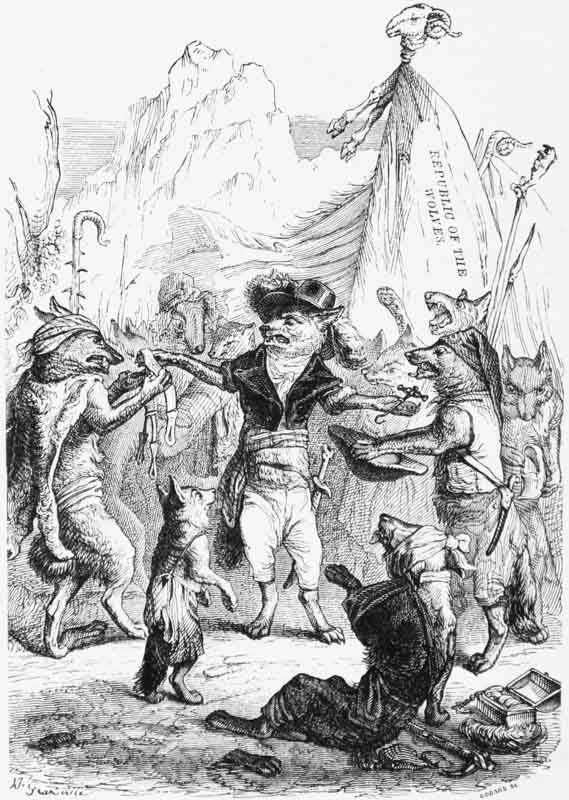
“When there is, say, a famine, to forage for the common good. In time of great distress we share and share alike. But do you know we are driven to the direst straits, when, as frequently happens, the snow lies ten feet deep on the ground; when the houses are covered, and no food is to be had for months. Strange! our stomachs grow smaller and we crowd together for warmth. We pull together wonderfully. Since the Republic was formed, the wolves have abstained from devouring or destroying each other. This ought to make men blush. The wolves are each and every one sovereign. They govern themselves.”
“Do you know, General, that men say sovereigns are wolves, and prey upon their people? You will have no need of punishment in your land.”
“Yes, we have; when a wolf commits a crime he is punished. Should he not scent his game in time, or fail to secure it, he is beaten. But he never loses caste on that account.”
“I have heard tell that some of your wolves in office are secretly ravenous, devouring the substance of the country, and given to dividing the good things of government among their friends.”
“Hush! Gently, please. These are matters of which we do not speak. The natural tendency of wolves is to feed on carrion, and when the body politic becomes corrupt, they perform the healthful function of licking the sores. It is only wolf-nature to seek such office and profit by it. One good feature in the Republic is, that a wolf is free to hunt down his own game, and when required, he may rely on the community.”
“This is indeed excellent,” I replied, “to live and govern one’s self. You have indeed solved a great problem.” Yet I thought to myself that the Parisian Sparrows will not be simple enough to adopt such a system.
“Hurrah!” cried my friend, whisking me from his tail into the air. All at once from a thousand to twelve hundred wolves with superb fur, and agility wonderful to behold, arrived on the scene. I saw two carriages drawn by horses, and defended by masters and servants. In spite of the sword-blows that fell on all sides, and the wheels that crushed the assailants, the wolves fixing their fangs into the horses soon overpowered the caravans. The prey was portioned out. One skin fell to the sentinel, who devoured it greedily. Other valiant wolves were allotted the coats and buttons, and soon only six human skulls remained that proved far too thick and hard for the profane fangs of the destroyers. The corpses of the slain wolves were respected and became the objects of a strange usage. Hungry wolves lay concealed beneath them until such time as a flock of birds of prey had settled on them. These they deftly caught and devoured. This was a touching example of thrift, recalling the various modes by which men take a profit out of their dead. I am told they set up tombstones over them, as baits for the world’s applause. A man will inscribe on the stone which covers the remains of some poor wife sentiments of deep regret and undying affection, while his carnal eyes are bent on some pretty bird fluttering over him and sympathising with his grief.
One thing struck me about the Republic, and that was the seemingly perfect equality of the people which arose, not so much from the nature of their government, as from the fact that by nature they are endowed with equal strength and instinct. The failure of human Republics arises out of the unequal intellectual and physical capacities of men. A more perfect system of education and a higher moral code, strictly observed by all, may one day bring man and man to the same level. Hereditary defects of character will then disappear, and all men will regain something of the perfect image of the God that created them. In the Wolves’ Republic the weak ones go to the wall, die off, as the struggle for existence is severe, so severe indeed that only the strong survive. The young wolf is educated in warfare and suffering. Indolence and want of pluck are punished by starvation, as all must work, and it becomes a habit to toil, and to toil ungrudgingly. Ah me! I almost despair of the task of reforming a country spoilt by luxury. Parisian birds, some of you are daintily fed on grubs and grain in golden cages, others, alas, have to pick up a precarious living on the streets. How shall we raise the poor to the level of the rich? Raise them from their lowly perch and place them in palaces? The wolves obey each other quite as heartily as the bees obey their queen, or the ants their laws. Liberty makes duty a slave. The ants are fettered by habit, and so are the bees. The Wolves’ Republic possesses many advantages, for if one must be a slave to anything, it is better to obey public reason than to become the votary of pleasure, or the football of fate.
I must own, whether to my shame or glory, as I approached Paris my admiration for wolfish freedom gradually diminished in the presence of refinement; and while I thought of the priceless boon of a cultivated mind, the proud Republic of the Wolves no longer satisfied me. Is it not, after all, a sad condition, to live on rapine alone? If the equality of wolves is one of the sublimest triumphs of animal instinct, the war they wage against man, birds of prey, and horses, is a violation of animal right.
The rude virtues of a Republic thus constituted depend alone on war. Is it possible that the best form of government can be sustained by ceaseless warfare, by continuing to push one’s conquests into the territory of weaker, simpler, and perchance more virtuous foes? This, my philosophic companions, is the policy of the great country of the wolves. Better rather to die of hunger, while we, by our self-denial, add a single green leaf to the laurel-crown that decks the brows of our country. We are placed here on God’s earth, not to destroy, but to build up His glorious works. Take this to heart, ye visionaries who seek to establish the edifice of peace on a foundation of vice and blood. However humble our lot, let us rather—like the coral insects who, by their toil, build up the loveliest islands of the world—seek to do our duty in our allotted spheres, that we may leave behind us an unsullied fame.
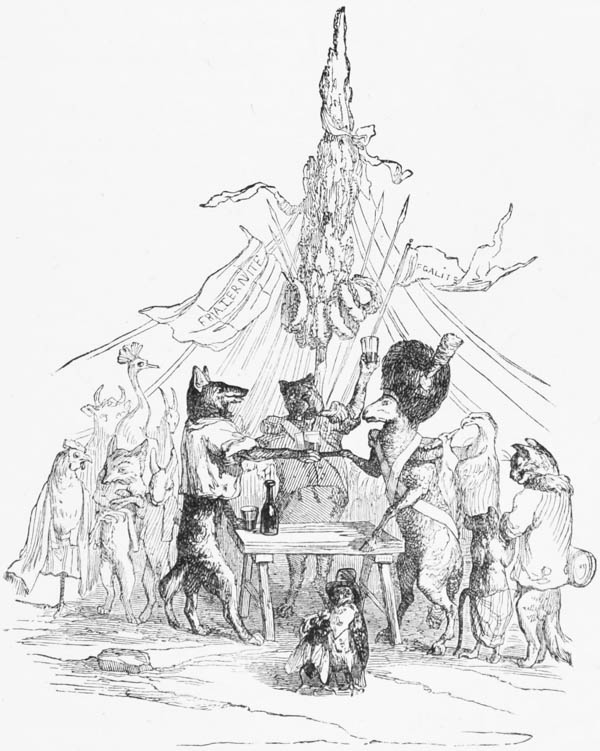
LIFE AND PHILOSOPHICAL OPINIONS OF A PENGUIN.
“Must one seek for happiness?” I inquired of the Hare. “Search,” replied he, but with fear and trembling.—The Anonymous Bird.
I.
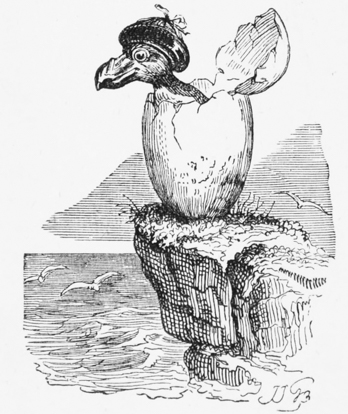
HAD I not been born in the extreme South, beneath the rays of a burning sun, which helped to liberate me from my shell, and was quite as much to me as the brave Penguin which abandoned me to fate, I might have proved a happier bird; but being, as I said, hatched under a tropic sun rather than a lucky star, I became an unhappy bird. I had a hard struggle to get into the world, as my shell was an uncommonly thick one. When at last I had found my way into the light, I stood for some time gazing at my prison with feelings not unmingled with surprise at the event which had introduced me to freedom. One, of course, has only a confused remembrance of those early days, and can hardly be expected to give a full account of the sudden change implied in birth. I have heard it said that men when they are born—some of them—smile blandly on the prospects that life presents to them; while others, and they the majority, begin life with a wail of regret, the prophetic note of a sorrowful existence.
Be that as it may, I remember, as soon as I was able to reflect, thinking how uncomfortable I must have felt, doubled up in a shell too contracted to admit of motion. The change was truly appalling. There lay the shell, to me a world which I had first filled and then broken, to find myself a mean tenant of immeasurable space. The prospect puzzled and hardly pleased me; I had exchanged my little egg for one boundless in its infinity. Far from being modest, on finding myself in the world my first notion was that all I saw belonged to me, and that the sole purpose of the earth was to contribute to my support.
Forgive the infantile pride of a poor Penguin, who, as the years rolled on, has been taught humility. As soon as I discovered the use of my eyes, I found myself alone in what proved to be the hollow of a great rock overlooking the sea. The rocks, the stones, the water; a boundless horizon around, immensity, indeed, and myself, in the midst of it all, nothing more than an atom! I vainly inquired, “Why is the universe so large?” and the echo from my empty shell answered “Why?” The question had been asked before, and, as I afterwards learned, had never been more conclusively answered. A little world, quite a small one, filled by those alone who are devoted to each other’s welfare, would have been more to my liking than this great gulf in which all seems lost, and hopeless confusion reigns,—in which there is space enough and to spare, not only for those creatures who detest each other, but for nations whose conflicting interests cause endless strife, and allow full scope to the play of crime and passion. Penguins in general, and you my personal friends, would not a world framed for ourselves have been better? a world with one low mountain bathed in sunlight,—a tiny, leafy plain bordering the sea, carpeted with flowers, and shaded by fruit-bearing trees, in which a score of social birds might build their nests—birds decked with gay plumage and bursting with song, unlike the poor Penguin whose lines you are now reading?
These are vain imaginings, there is no such paradise for Penguins or any other creatures. There are fields and flowers, foliages and fruit-bearing trees, birds with bright plumage, and others with song; but, alas! the wide world shares their charms—flowers here and fruit there, all so scattered and dispersed as to minister alone to the sport and pleasure of mankind. Yes, man alone has the power of making nature his slave, of bringing all these elements together, of rendering his mansions musical with the nightingale, his lawns gay with flowers, and his orchards glorious with varied fruits.
Again I crave pardon, dear reader. The habit of dwelling alone has rendered me gloomy, and I forget myself, forget that I have no right to forget my humble lot and obscure destiny.
II.
I ought to say that my early isolation and ignorance tempted me to brood over the unattainable. Nevertheless, I claim credit for self-denial in pruning my introduction, as I might have dived deep into the miseries of solitude—the solitude of my early days. The theme was a prolific one, which I should not have allowed thus to escape. It is so soothing to complain; so comforting, indeed, as to pass for real happiness.
I had not been alive a day before I learned what heat and cold were. The sun disappeared, leaving my rock as cold as an iceberg. Having nothing to do, I began to move, and felt about my shoulders something I conceived must be intended for use. Stretching forth these little arms or wings with which Nature had endowed me (she has lived too long on her reputation of being a good mother, loving equally all her children), after prolonged efforts I at last succeeded in rolling from the top of my rock. Thus my first experience in life was, as you see, a fall, which I speedily resented by digging my beak into the unsympathetic soil. This only increased my pain, and led to reflection. “It is evident,” I said, “one ought to be careful about one’s first step in life, and to reflect well before moving.” I then inwardly pondered over my destiny as a Penguin, not that I had the faintest pretension to philosophy, only when one is forced to live, and one is not accustomed to do so, one must find out some rules of life.
“What is good?”
“What is evil?”
“What is life?”
“What is a Penguin?”
Before I could solve these questions, my eyelids closed in sleep.
III.
Hunger rudely awoke me! Forgetting my resolutions, strange as it may seem, I did not wait to inquire, “What is hunger?” but immediately proceeded to satisfy the craving by eating some shell-fish that were yawning before me. I ought to have first indulged in a dissertation on the possible danger of following this ancient custom. My inexperience was punished, for by dint of eating too fast, I was nearly choked. I have no notion how I learned to eat, to drink, to walk, and move to right or left, measure distances with my eye, to know that all one sees is not one’s own; to come down and ascend, to swim, to fish, to sleep standing, to content myself with little or nothing, &c. It is sufficient to say that each and all of those studies caused me countless troubles, fabulous misadventures, and unheard-of trials.
IV.
What are our duties in the world? What will ultimately become of Penguins? Where do we go to after death? Why were some birds created without feathers, some fish without fins, or animals without feet?
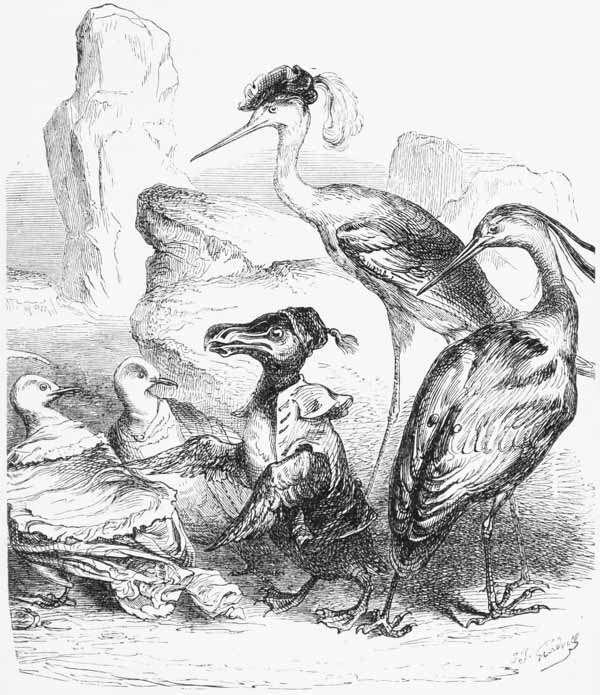
My worldly experience often tempted me to wish to return to my egg. One day, after profound reflection, I fell asleep, and during my repose heard a noise, which was neither that of the waves nor any sound to which I was accustomed. “Wake up!” said the active part of my being, that which never seems to slumber, and is ever on the alert like a guardian angel to ward off danger. “Wake up, and you will behold something to rouse your curiosity.” “Certainly not,” said that other most excellent part of ourselves which requires sleep. “I am not curious, and have no desire to see anything. I have already seen too much.” Still the other insisted, and I continued: “It would be wrong to break my slumber for anything spurious; besides you deceive me, the sound has gone. It is a dream; let me sleep! let me sleep!” I really wished to sleep, stubbornly closed my eyes as best I might, and folded and fondled myself to repose with all those little cares common to sleepers. But, alas! all was of no avail; I woke up. What shall I come to? I, who vainly thought myself the most considerable creature living, the only bird in creation. I sank into utter insignificance before the sight that met my gaze. There, before me, I beheld at least a dozen most charming creatures, some with expanded wings floating in mid-air, others diving into the waves, and again rising to display their snow-white plumage in the morning sun. Surely, I thought, these are the inhabitants of a happier and more perfect world. Had they descended from the sun or moon? What unknown caprice had brought them to my rock? They were endowed with a sublime mastery over the elements, skimming the waves as if to laugh at their fury, resting for an instant on the solid earth, and, as if disdaining its support, again cleaving the air with their glorious wings. So wrapt was I in admiring the grace and perfection of their movements, that jealousy never clouded my mind. At last, carried away by the ardour of youth, and the emotion with which the beautiful fills the breast, I rushed into their midst, exclaiming: “Celestial birds, fairies of the air!” Here I had to pause for want of breath.
“A Penguin!” cried one of them.
“A Penguin!” repeated the whole band; and as they all laughed on seeing me, I concluded that my presence gave them pleasure, and so I boldly introduced myself in the following words:—“Ladies and gentlemen, you are right, I am a Penguin, and you are the fairest forms I have gazed upon since the hour I left my shell. I am proud of your acquaintance, and should like to join in your sport.”
“Penguin,” said my lady friend who had first addressed me, and who appeared to be the queen, but who, I afterwards learned, was only a laughing Gull. “You do not know what you are asking, you may, however, profit by experience. It shall never be said that such an elegant Penguin received a denial.” She then gave me a flip with her wing which sent me reeling into the midst of the group, another did the same, and they all followed suit, flipping me about, first to one side, then to another. This was sport!
As soon as I could get the words out, I shouted, “Stop! you are killing me.”
“Bah!” said they, “we are only beginning, hah! hah! Keep him warm. Keep the ball rolling.” The sport began anew, and with such vigour that I soon fell to the ground thoroughly humbled and exhausted. The Gull who had first called me Penguin, and who had taken the lead in maltreating me, noticing my prostration, reproached herself for her conduct.
“Forgive us, my poor Penguin. You do not seem to relish our rollicking style, yet it is our nature, so pray do not blame us if you are hurt.” She then came forward and bent over me with such a tender look, that, in spite of what she had just done, she seemed for the moment perfectly beautiful and good.
But pity often comes of self-love, and is nothing more than regret for harshness. What I mistook for the dawn of affection was only sorrow for having done wrong. Thus, as soon as she saw me comforted, away she flew with her companions.
This sudden flight so startled me, that it was impossible to find a single word or gesture to prevent it, and again I was alone. From that moment solitude seemed insupportable.
IV.
To tell the truth, I was blindly in love, and savage at having done nothing to win a bride so beautiful. Why did I not exercise my blandishments? While pondering these things I wandered to the edge of a pool of water. It was placid and clear, reflecting only the blue heaven, until, bending down to dip and cool my fevered beak, I beheld my own image, and nearly choked as the picture of my unsightly proportions flashed on my mind. I left the mirror, and soon by reason of vanity forgot what manner of bird I was. Sleepless nights and miserable days became my portion. Eagerly I listened to the whisperings of the wind, thinking that I heard the gentle sound of that lovely spirit of the air descending to soothe my troubled heart. Vain thought! she never came, and worse luck, my appetite had gone with her. My only solace was the sea. There was something in the mournful voice of its waves, as they broke on the great rocks, that soothed me in my saddest hours. There was something in its immeasurable depth typical of the grief which overwhelmed me.
The reader may feel inclined to smile at my vulgar and unpoetic proportions, nevertheless, let me remind him that God has so framed the world, that in the rudest and most unlikely forms among men and beasts repose the sublimest attributes. Thus human genius is seldom found mated with bodies of herculean type. So the sentiment of a love-sick Penguin can never be estimated by the appearance of its too solid body.
V.
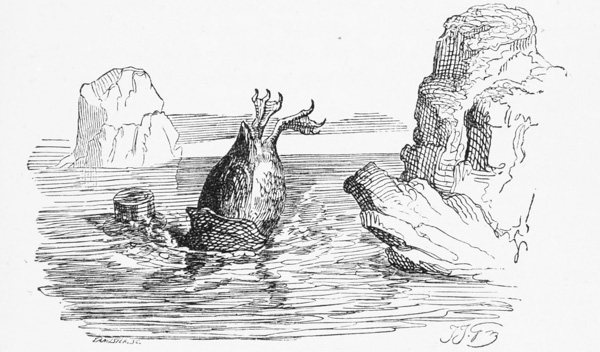
“Suspense becomes intolerable, I can no longer bear it,” I said, and cast myself into the sea to drown my sorrow in its mournful waves.
VI.
Unfortunately, I discovered how to swim, so my history does not end here.
VII.
When I rose to the surface—one always rises two or three times before drowning—yielding to my passion for soliloquies, I inquired what right had I thus to seek to destroy myself; if the world would not be just one Penguin worse off, had I met my end, &c. My soliloquy was long. I was drifting many leagues straight ahead; now and again diving with the dire resolve of going to the bottom and remaining there. But for some reason I always found myself coming to the surface, and, to tell the truth, the air seemed all the more refreshing after each dip. Just as my seventh attempt at suicide had miscarried, I rose to find myself side by side with a creature whose simple unaffectedness won my heart at first sight.
“What were you after below there, Mr. Penguin? and where are you going?” he inquired, bowing profoundly.
“I hardly know,” I replied.
“Well,” said he, “suppose we go together.”
I willingly agreed, and on the way related my misfortunes to him. When I had finished, he asked me if I had formed any plans for the future. “No,” I said, “not any, still I have half a mind to travel in search of my lady-love, the Gull.”
“How came you to love a Gull? You look a large solid bird enough. Why don’t you devote your affections to one of your own decent stay-at-home kind? Depend upon it, the Gull, could you wed her, would only bring grief. She is puffed out with feathers, and ever on the wing; she would soon desert you for one of her own kind.”
This seemed severe, and I replied testily, “There’s no accounting either for tastes or for love. It came upon me like a sunbeam from heaven.”
“From heaven!” said my companion. “Lovers’ language! A strong light, this light of love; and it has left a shadow of pitchy darkness somewhere, has it not?”
“Ah! sir,” I said, “you look dejected. My story, perchance, stirred up old memories.” He said nothing, but wrapped in profound melancholy ascended a rock left dry by the tide, and I followed. There was such an air of profundity about him that I inquired what he was thinking about.
“Nothing,” he replied.
“But who are you, whose silence is so eloquent?”
“I am of the Palmiped family, and my name is Fool.”
“You, Fool!” I cried. “Come!”
“Yes,” he replied, “I am so named in the world from my habit of minding other people’s affairs and neglecting my own; so sinking myself, what can I do for you? Listen, my friend,” said this sublime bird; “not far from here is an island called the ‘Isle of Penguins.’ It is only inhabited by birds of your tribe. They are all of them equally ugly; go there, and who knows, you may even be thought handsome.”
“Am I then so unsightly?” said I.
“Yes,” he said, “you are as unlike the gull as the grub is unlike the butterfly.”
VIII.
During our voyage, encountering a severe storm, we rode it tranquilly on the breast of the billows, while great ships, freighted with the wealth of the world, were wrecked and lost before our eyes. It was pitiful to hear the shrieks of the perishing sounding above the tempest, men and women who had braved the dangers of the deep, some to seek happier climes, others, the riches they were doomed never to enjoy.
At last through many dangers we reached the shores of the “Happy Island.”
“Let us pause here,” said my sage companion, “and note the native mode of seeking what I hold to be a myth—earthly happiness.”
Shaking ourselves dry, my friend, who had studied geography, elevated his beak, and casting his eye along its line, took our position from the sun. The result was curious and instructive to navigators, and even to mankind generally, not to mention birds. According to our calculations, we had been availing ourselves of every slant of wind to push ahead, and, strange to say, reached land a hundred miles astern of the point we started from. Had we been men, pioneers of civilisation, gifted with a sublime belief in our own powers, we should have no doubt proved to our own satisfaction that we had made unheard-of progress. Men and mules, without knowing it, go as often backwards as forwards.
My friend here remarked that the island was unknown, had never, in fact, found its place in any map. Our observations, therefore, cannot fail to prove useful.
“Let us go inland. If you don’t object?”
“With all my heart;” and in my youthful ardour was about to kiss the happy soil.
“There, calm yourself,” said the Sage. “This is neither Peru nor the Penguins’ Paradise. The name alone misleads you. This land, ‘Happy Island,’ is so named because its inhabitants (all of them) inherit a furious desire for happiness, not because they are happy; they spend their lives chasing a phantom, and when it seems nearest, they are swallowed up in the grave. These islanders cannot be brought to understand that wrong must exist, and that happiness may be obtained by redressing wrongs and grievances, and that the most one can do is to snatch moments of bliss from one’s days and years of toil and sorrow. I have heard that men, after trying all sorts of new-fashioned receipts for happiness, fall back on the oldest plans, imagining they have discovered in them a new panacea for all earthly woes.
“These curious islanders make self their god. They make it a rule each one to seek his own personal gratification, this plan is most ancient: love, sympathy, self-sacrifice, devotion, virtue, duty, are with them nothing more than words whose meaning has been long forgotten. Another rule is to avoid doing anything that will in any way mar one’s enjoyment, or spoil one’s ease. It will be seen that only the rich among them are able to carry out their principles to the full extent. Let us note how they manage affairs. Do you see the mansion over there? is it not beautiful? In it the disciples of pleasure carry on their amusements. Let us look in; we may learn something. Over the doorway we read in Latin, ‘Here we are, four hundred of us, all happy’; followed by a text from their sacred classics, ‘Neutralise the influence of parents upon children, and all will go well.’ ”
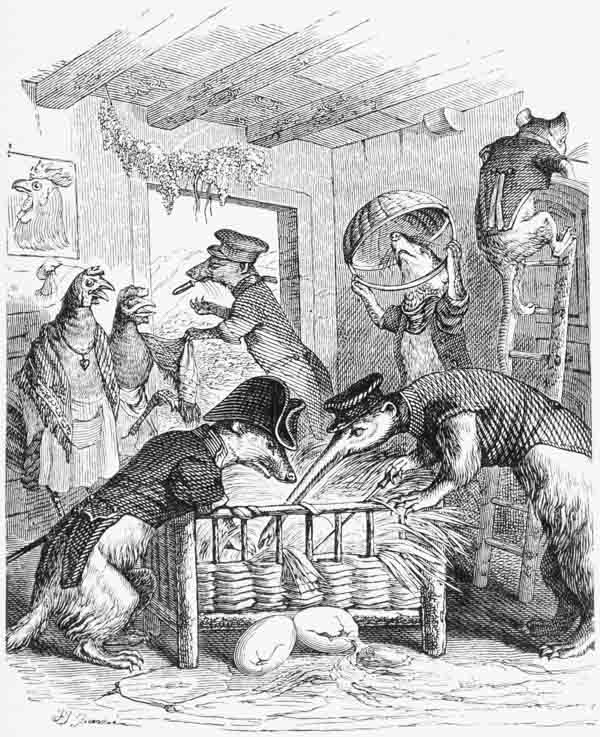
In the first room we came across a charming illustration of the text—a number of showily-dressed, attractive-looking mothers, who refused to sit on their eggs. Some of them had strolled into the garden to spend their time more usefully in flirting with dangerous-looking male friends. Somehow the poor little ones were hatched. “You unwelcome rubbish!” said the mothers; “now that we have had all the trouble of bringing you into the world, some one must nurse you—we are otherwise engaged. We will return and spoil you later on, if we think of it.” Guardians are found. A Weasel displayed the deepest interest in the eggs, an Adder watched them tenderly as they were about to break, while Wolves feasted on the young to keep them out of harm’s way.
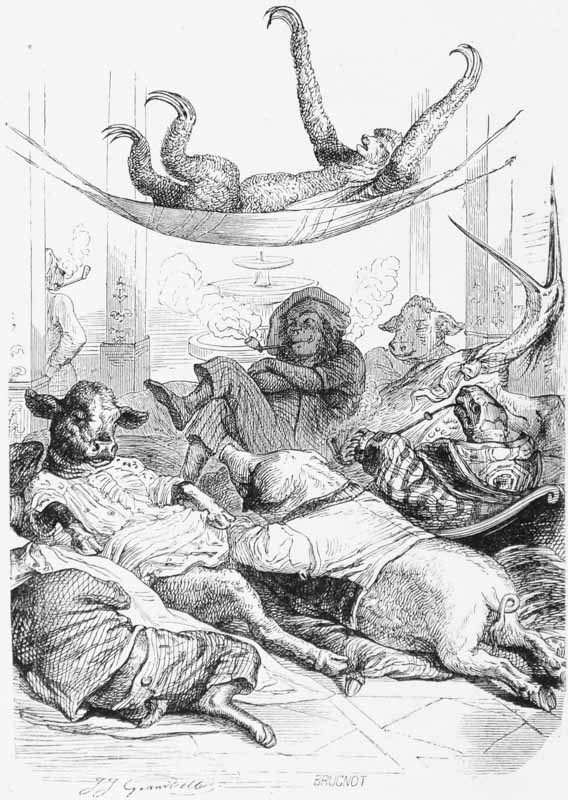
By far the most telling scene was met with in the schoolroom. There we saw bloated-looking Boars prosecuting their studies by lying on their bellies, or rolling over on their backs. Oxen, that had abandoned the plough, and Camels striving to make their neighbours carry their humps.
Those who were not asleep were yawning, or going to yawn, or had yawned. All of them seemed profoundly dull. Near the centre sat a Monkey nursing his knee, who, with his head thrown back, seemed to be absorbed in his reflections.
“Sir,” I said, addressing him, “are these dejected-looking creatures around you happy?”
“I fear not,” was his reply; “although their sole pursuit is happiness, some of them are miserable enough. As for myself, I feel supremely uncomfortable on this confounded stool, but as governor I must keep awake.”
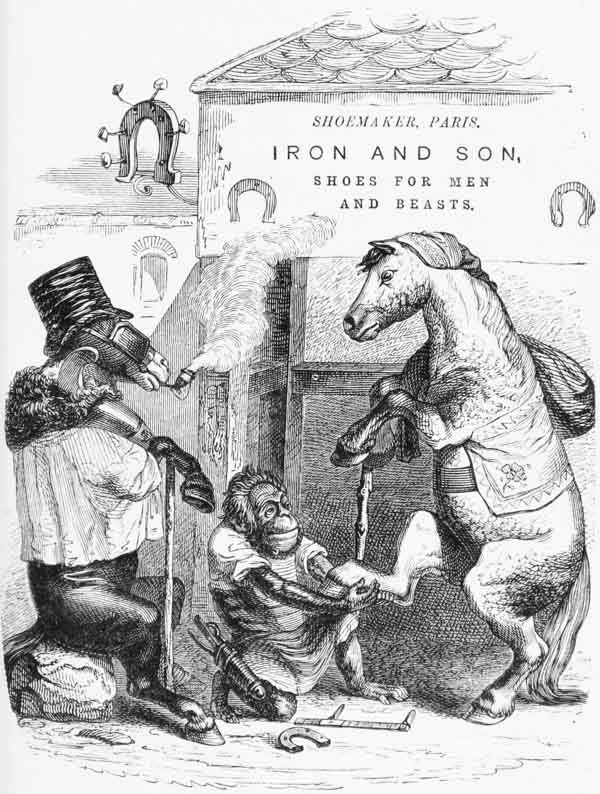
On our way we passed in front of the shop of a blacksmith, who was fitting a pair of carpet slippers to a tender-footed horse. Suddenly I said to my travelling companion, “I have had quite enough of this ‘Happy Island,’ let us continue our voyage.”
IX. PENGUIN ISLAND.
Two days later we reached Penguin Island. “What does that mean?” I said, on perceiving some two hundred individuals of my kind ranged as if in battle-array along the shore. “Are these troops intended to do us honour, or to prevent our landing?”
“Fear nothing,” said my friend, “these Penguins are our friends. It is the custom of their country to parade the shores in flocks.”
We were received with much kindness, and conducted with great ceremony towards an old Sphemiscus, the King of the island. This good King was seated on a stone, which served as a throne, and surrounded by his subjects, who seemed to be all known to him.
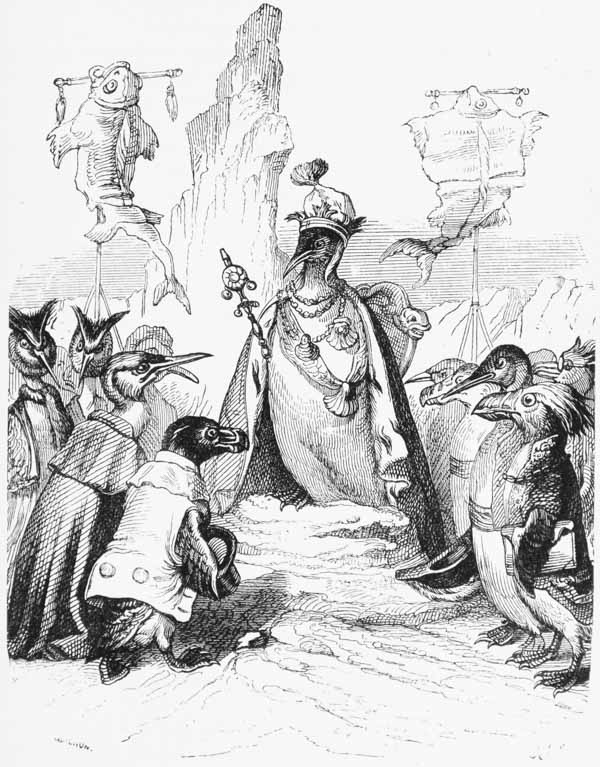
“Illustrious strangers,” he exclaimed, as soon as he perceived us approaching, “we are delighted to make your acquaintance,” and as the crowd around him barred our way, he continued: “My children, range yourselves on one side, and allow the strangers to pass.” The ladies stood on his right, and the gentlemen on his left. “You, sirs, are welcome to enjoy the freedom of our kingdom.”
I ventured to say, “Sire, your renown is the talk of the whole world, and the hope of seeing you alone sustained us through the perils of our journey.”
“Good!” whispered my friend; “you are a courtly liar for one so young; but be careful, else you may die a diplomatist.”
My speech so pleased the King, that he cast off his Phrygian cap, descended from his perch, and clasped me to his breast, saying, “You are, for one so young, a bird most fair and honest. Remain with me to aid me in my old age.”
“Noble sir,” I replied, “your knowledge of Penguin character is truly worthy of your fame. I will gladly accept your generous offer, trusting that my youth and inexperience may excuse my many shortcomings.”
“Stay, are you married?”
“No, your Majesty, I am a bachelor.”
“He is a bachelor!” cried the King, turning towards the ladies, who at once, and for the first time, overwhelmed me with their fond gaze.
“A bachelor! a bachelor!” cried a chorus of voices, “what a dreadful creature!”
“Hush!” said the King, “we have cured worse maladies. There is my daughter.”
“But, Sire,” I protested, “my heart is lost to another.”
“The remark is worthy of your modesty. You shall wed my daughter; the notion suits me; it is a question of privilege, not of heart.”
I so little expected this proposal, that I remained mute with amazement.
“He who says nothing, consents,” said the King. Before I had time to decide, my eyes met those of the princess. It was but for a moment. The god of love had kindled a perfect conflagration in her breast. Everything was arranged before I could say no, so engrossed was I with my own reflections. That momentary glance had evidently sealed my fate. So far as one’s after-life is concerned, it had more effect in neutralising my happiness than if I had, from my earliest infancy, set myself the task of inventing the best means of blighting my peace.
“Well,” said the monarch, “look at your future wife. Are you not delighted? too happy to find words to express your joy? Is she not lovely?” The poor old potentate looked tenderly on his daughter, and with tears in his eyes, continued—“You cannot know what I am offering, she is a good child, a good child! and will make a dear wife. Not a single subject in my realm boasts smaller eyes, yellower beak, rounder form, or larger feet. She is indeed beautiful!”
The wedding was arranged, and we were married in great state. My wife’s father paid all the expenses; for in Penguin land kings as well as subjects have enough to marry and dower their daughters. This was how I became the King’s son, and how foolish marriages are made. My real troubles date from the close of the ceremony, as my wife was neither very handsome nor very good.
X.
I might finish here, but as I have gone so far, I may as well relate the bitter end.
I dreamt one night that I beheld my first love, and that she beckoned to me to follow her. The whole scene was so vivid that when I awoke, I felt I could recognise the spot if it existed in any part of the earth. In a weak moment I resolved to start in search of this heaven and its goddess. At last, I left the Penguin shore, ostensibly on a diplomatic mission. For two whole years I searched the world over; but in vain, until, just as I was giving up hope, I discovered the object of my solicitude on a sandbank, stooping over the filthy remains of a stranded Whale, in the society of a ragged, vicious-looking Cormorant, the meanest of birds. This then was the Gull of my dreams! the spirit of the air! the ideal of beauty, the Peri, the sylph, whose seductive image had cursed my life. My eyes opened, but too late to discover how the fool mistakes the glitter of the basest metal for the lustre of pure gold. What would I not have given to crush the memory of my folly out of my heart; to begin life anew, and ponder well the first false steps. Yet I reflected, all may be well, better far the bitterest truth than the sweetest falsehood.
Setting sail for Penguin Island, I resolved never again to quit its shore, and to become a good husband, father, and prince.
XI.
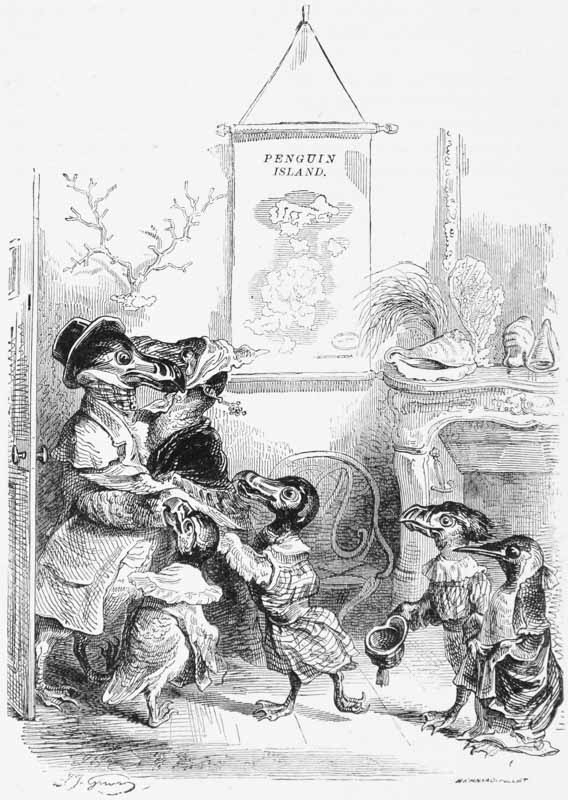
On landing, I first visited the people, who were well, next, my father-in-law, who, thank God, was better than the people. I then began to look for my dear wife and child, and—good heavens! I found my family had increased to four. My wife, poor soul, had taken another husband, thinking I had deserted her.
I at once repaired to my old friend and travelling companion, whose ability the King had sought to reward by making him Prime Minister; but he refused to add to his cares that of office, and retired to live as a hermit on the top of a rock. He had chosen the highest rock in the realm, whence, far above the turmoil of the state, he bent his philosophic gaze on the lower world which he had abandoned to its fate. I felt much in need of sympathy and advice. After recounting my woes, the answer of the recluse sent a thrill of despair through my heart.
“Bah!” he said, “I am sick of all the affairs of life. Each hour wounds, but happily, the last kills us. Forget your troubles. Arm your heart against the malignant influences that mar the peace of brutes and men. Why the devil should you be happy? (he was a profane bird). What have you done to merit happiness? How fared you in your journey? Have you seen enough of the world—sinned too much? Hah! hah! Is your punishment greater than you can bear? Poor deluded Penguin! you have been the football of our old enemy, fate. It must have been great fun for the old rascal, to mark your abortive attempts at heavenward flight with these half-formed wings. Hah! hah! what a capital joke!”
“You seem merry, my friend,” said I, “your levity wounds me deeply.”
“Listen, my child,” he replied. “You have spent the best of your days in vain pursuit of the unattainable. Depend upon it, the nearest approach to happiness is found in paths obscure and humble. Paths of duty along which kind Providence will ever act as our guide.”
“You puzzle me,” I remarked, “your language is as changeable as English weather. At one moment you are a wicked bird, at another a moral philosopher.”
“Nay, friend,” he said, “these are but the passing moods of the mind. I am told that men as well as birds have their moods. Even some most religious men, they tell me, wear a sombre cloak to conceal the sinful thoughts that are always present with them. They resemble the shells they employ in warfare; harmless enough, until thrown to the ground by some sudden shock of passion which fires the fuse and destroys them. It seems to me, in order to succeed in the pursuit of happiness you must prefer clouds to sunshine, rain to fair weather, grief to joy. You must possess nothing, and yet find yourself too rich, take all that is done as well done, all that is said as well said, believe nothing, and yet know everything. Dream while you are living, live in your dreams. After all when you feel really happy, have patience, and time will surely destroy the illusion.”
Here the philosopher paused for breath.
Reader, if you are unhappy, let me counsel you to take warning from the life of a poor Penguin, who blighted his hopes by worshipping at the shrine of a false goddess.
THE LAST WORDS OF AN EPHEMERA.
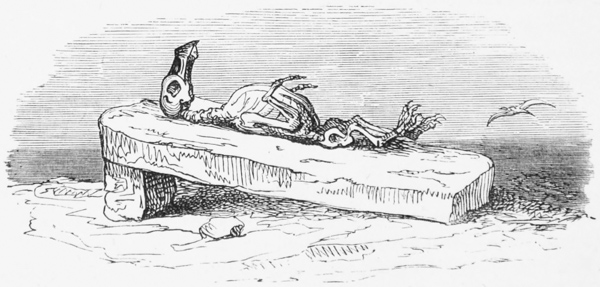
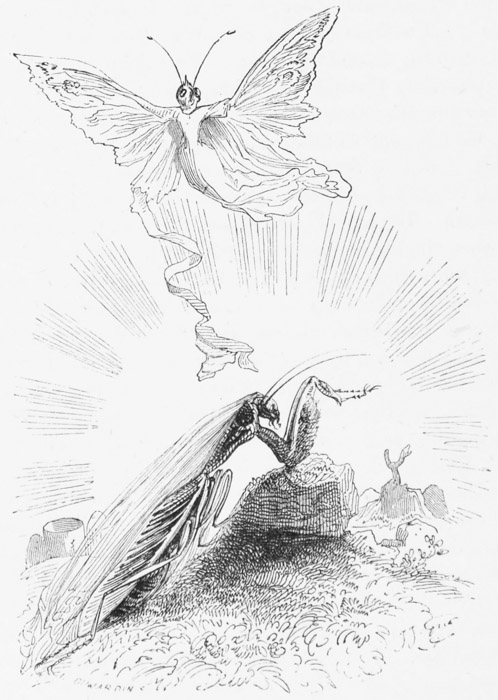
IT was the opinion of the savants of our race who lived in ancient times, many minutes, indeed, before we came into being, that this vast world would dissolve and disappear within eighteen hours. That this hypothesis is not without foundation, and at the same time worthy of the erudition of the ancients, I hope to be able to prove. The great luminary travelling through space has, during my own time, sensibly declined towards the ocean which bounds the earth on all sides. If, therefore, we base our calculation on the space traversed by the sun per second, it will be found that, before eighteen hours have elapsed, his fire will be quenched in the ocean, and the world given up to darkness and death. He has already passed the zenith. For all that, the moment when the bright disc will dip beneath the waves seems distant as eternity, when measured by the span of our lives. I myself have enjoyed several moments of existence, and feel age creeping on apace. I see children and grandchildren around me dancing in the joyous light. I may live a few seconds longer, and witness many changes; yet my life has been so full of sad experiences, as to convince me that, in the course of nature, I must soon follow those who have gone before. In reviewing my past existence, while clearly discerning its failures and follies, I venture to hope that it has not been altogether misspent. My researches have contributed not a little to solve some of the problems connected with the most curious phenomena of hedge-rows and ditches, keeping altogether out of account the facts which I have established connected with the duration of the earth. I have applied the most refined analysis to discover the true constituents of the atmosphere, and the meteorological conditions which promote or destroy insect life. I could reveal secrets to mankind, to which their microscopes and spectroscopes can never afford the faintest clue. These are certain elements necessary to our existence only known to ourselves, as also the important functions we perform in carrying out the wise economy of nature.
Men are blind to everything that does not, as they conceive, bear directly or indirectly on their own interest, and in their folly they imagine that our lives are worse than useless. They cannot perceive that we are ministering spirits of the air, sent by an all-wise Creator to correct abuses of which they themselves are the authors. But life is short; all too short for the labour it implies. Alas! my end draws near, and my friends console me by saying that I have done enough to earn lasting fame, and to promote the happiness of my race, until the eighteenth hour witnesses their destruction, and the wreck of this great plain which men call the earth.
THE SORROWS OF AN OLD TOAD.
MY father was already well up in years and corpulence, when the joys of paternity came upon him for the last time. Alas! his happiness was of short duration. My poor mother’s strength was overtaxed with a dreadful laying of eggs, and, in spite of the tenderest nursing, she at last succumbed to the effort of bringing me to the light. I was brought forth in sorrow, and to this fact I attribute the deep shade of melancholy which has clouded my existence. I was always of a dreamy, contemplative nature. This, indeed, formed the basis of my character. The early days of my Tadpole life are wrapped in gloom, so dense as to render them void of incident. I can just dimly recollect my father, squatted beneath a broad leaf on the bank of a stream, smiling benignly as he watched my progress. He had always a soft, liquid eye, in whose depths I could read the love of his tender heart. His eyes were of a greenish hue, and protruded. This, taken together with his noble proportions, his enemies attributed to high living. He was in reality a contemplative Toad, whose greatest success lay in the cultivation of philosophic leisure. He carefully avoided the water, and, little by little, withdrew himself from the scene of my exploits. I am ashamed to say that his absence never caused me to shed a tear. I had two or three brothers about my own age, with whom I giddily threw myself into all the pleasures of life. It was a joyous time! What would I not give to recall those fleeting hours of my youth, with all their happy experiences. Where is now the lovely stream, over whose dewy banks the reeds and grasses bent to watch the play of sunlight on its smiling face? Where the crystal pools, the scenes of my adventures in an enchanted world? the dark-bearded stones, ’neath which we followed many a giddy course, our hearts throbbed with fright as we came face to face with some motionless Eel, or touched the silver scales of a dreamy Carp? I can recall the great fish, troubled in his sleep, viewing us with a quick, angry glance, until, perceiving our shame and confusion, he smiled, and we renewed our game.
It is impossible to describe the pleasure of being rocked, caressed and fondled by the current as it pursues its tranquil course. Every ray of sunlight that found its way through the willows revealed new wonders. The dull, dead sand was glorified by the light until it shone like a bed of jewels. Myriads of creatures seemed to spring into life. The weeds flashed with a thousand hues, the hard-hearted pebbles flung back the rays with a brightness that pierced the deep recesses of the stony bed.
Delirious with joy, how often have I not dived to mingle with the light, to catch something of the fleeting charms it scattered so lavishly around. At such times I completely lost my head. (Pardon me, dear reader, should I seem to exaggerate; a Tadpole who has lost his head must make the most of his tail, as he has nothing more left to him.) We then thought ourselves indomitable, pursuing shoals of microscopic fish that sought and found shelter beneath the stones. But the huge Spiders, walking on the water and devouring all they came across, afforded rare sport. Gliding cautiously up behind, we used to lick the soles of their feet, and dart off, amazed at our own audacity, to seek cover beneath the shade of lily leaves. I have passed whole days under those leaves, examining with the profound admiration of youth, the delicacy and beauty of their configuration. In each one of their pores I discovered little lungs, and such a marvellous organisation, that I dared not touch them, so much was I moved by the notion that, like ourselves, they must have feeling as well as vitality. These reflections intensified my curiosity to such a degree, that I made my way among the roots to try and find out the secrets of plant life, and see for myself the source of so much beauty. It seemed to me that the water-lily was a perfect type of goodness. It ungrudgingly displayed its charms to the gaze of the world, at the same time sheltering with its broad leaves the tenderest forms of life. Flower, leaves, and root alike refused to yield up their secrets, and yet though silent, every detail of their form was eloquent with the praise of their Creator. Thoughts of the good fellowship subsisting between plants and animals brought tears to my eyes, which I suppose I must have shed and thus swollen the stream beneath which I was submerged. All those things made a permanent impression on my mind, although I have had my days of scepticism, when it appeared to me that disorder and misery were the ruling powers of the world. As my age advanced, my powers made corresponding progress; strange longings for a higher state of development filled my head, while my tail shortened and responded more and more tardily to its office of oar and rudder. Sharp pains shot through my posterior, ending in the growth of feet and lungs. In truth, I was becoming a Toad! The transformation is not without its moral significance. New members brought with them obligations to which I was a stranger, hardly knowing how to use the attributes Providence had placed at my disposal.
One day, I descried on the bank of the stream a Goose and her family about to take their daily bath. The scene was not new to me, but the emotions which filled my breast differed from anything I had experienced. The Goslings were lying all of a heap on a tuft of fine grass, and from my point of view, presented a confused mass of down, gilded by the sun. Here and there a little yellow beak might be seen. But the immobility of their position, and the utter abandonment of their postures informed me of their perfect contentment and tranquillity. The young brood was steeped in sleep, while the mother, bending a tender, watchful eye over them, uttered a sound so touching to their hearts, that every eye blinked, and every beak opened with a joyous quack.
“Good morning, mother,” they seemed to say, “Is it time for our bath?”
“Yes, lazy little ones. Do you not hear the music of the stream, or feel the heat of the mid-day sun? Your heads are exposed to its scorching rays.”
“O mother! don’t disturb our rest,” they replied. “You have no notion of our comfort. The drowsy humming of the bees, the languid nodding of the harebell, and the scent of the new-mown hay are soothing us to sleep.”
“Hush your silly prattle and wake. A little courage, a little self-denial, my dears, and up with you.”
This was too much for the Goslings who slowly separated, presenting a confusion of pink feet, plushy wings, and golden beaks most interesting to behold. Some rolled over and over in their attempts to gain their legs. At length they succeeded, and went waddling, and wagging their stumpy tails streamwards. When they reached the water’s edge, after many hesitations, strivings, and chatterings, they at last stretched their necks and entered boldly to float with the current.
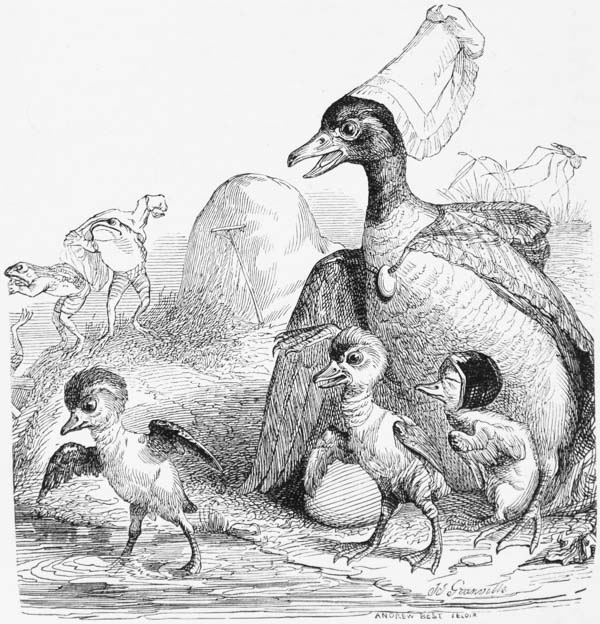
“Strike out, my dears,” said the dame. “Heads erect, mind. It is supremely vulgar, my children, to bend the head unless to pick up something to your advantage. Kick the water bravely; it is made to serve you.”
It was a beautiful sight, and I was about to ask permission to make one of their number, when the mother, in passing, haughtily tossed her beak in the air, saying, “Avoid slimy toads, and all such creatures—their presence is defiling!”
Judge, dear reader, of my pain and surprise. I dived into a dark pool to drown my wounded pride. When I again came to the surface, the interval had transformed me into a truly melancholy toad. A large spider, with whom I had become acquainted, passed over my head, smiling kindly at me; but he won no responsive smile. Feeling need of breath, I mechanically sought the bank, and was startled by a hoarse voice shouting—
“Confound you, reptile!” I turned, and perceived a gay personage decked in blue and gold—a Kingfisher. “What are you doing there, stupid? You with the four superfluous feet, body, head, and eyes. You slimy scoundrel! Don’t you know your vile presence poisons the stream? Get out, else I will swallow you like a gudgeon. Ugh!” I thought he was going to be sick. “Make off, you frighten my clients.” He was a fine-looking fellow, the colour of heaven itself; but with a voice like a lawyer, or the devil. To tell the truth, I was so afraid of him that I made for the bank. When fairly out of the water, I leant over its surface to return thanks for all the pleasure it had afforded me. To my horror, I beheld at my feet a strange misshapen thing, bearing some likeness to my father. I moved my head, it did the same; I raised my feet, it imitated the motion.
“Hah! hah!” shrieked the Kingfisher, “you lovely coquette! what do you think of your beautiful proportions?”
“What!” I said, “is that my image?”
“Yes, my treasure; are you not proud of the picture?”
It was all too true. There I was, and the willows above me as a frame, and the blue heaven as a background to my poor image. Well, after all, I thought the pure mirror of the stream was perhaps my truest friend, as it taught me to know myself. Bidding adieu to my former haunts, I turned my back upon the stream, and soon felt humbled and forsaken. My departure was quite unnoticed. The river went on its way as before, not a single blade of grass, not an insect moved to wish me a happy journey. Could I then be so completely dispensed with, I who at first had thought the world all my own? I felt so ashamed of giving offence that I asked pardon of the Kingfisher, who replied—
“Go to —— ! ” I dare not repeat his answer, it was of such a nature as to convince me that he was a bird of the world. Day began to decline, and feeling fatigued, I sat down to rest. Being of a dreamy disposition, I found pleasure in contemplating nature. In front was a forest wrapped in a veil of purple mist, behind which the sun was setting and shooting its rays like fiery arrows through the leaves. Above, the calm sky was of a pale green hue, so soft, so full of tenderness, it filled my breast with the feeling that after all I was not forsaken, and gave me courage to live on. Pray do not set me down as a foolish toad, living on the pleasures of imagination. It is in such follies as these that I have found the chief joys of my life. The disinherited ones of earth must gather consolation where they can. The air was hushed, the flowers and grasses sparkled with dewy gems, the birds had sought their evening perches, and were singing each other to sleep. All around were crowds of little beings, pushing on to their homes, tired of the business of the day and covered with dust. Some one, doubtless, was waiting and watching for the return of each insect wanderer. Such thoughts as these again weighed down my heart with a feeling of utter loneliness and despair. Happily, not far from where I stood, I perceived a hole between two roots, which I prudently approached, and timidly feeling the walls, I entered. Surely, I thought, this will prove a quiet resting-place, when I heard a regular monotonous noise resembling some one snoring.
“Who is there?” cried a gruff voice; at the same moment I felt a sharp prick in my hind-quarters.
“I am a young toad, sir, not long out of the water.”
“Oh, horrors!” continued the voice.
“Forgive my intrusion, I will leave your house.” My eyes had become accustomed to the darkness, and I made out my adversary to be a jagged ball—a porcupine, would you believe it? This redoubtable personage was rather good to me. The stab with his quills, which had nearly killed me, still causes great suffering in damp weather. On my assurance that I did not snore, he allowed me to pass the night in his quarters. After he had a fair view of me, he cried—
“You are ugly! and that is drawing it mild. You are ugly, feeble, clumsy, impotent, silly!”
“Yes,” I murmured, for I felt he spoke the truth.
“You little affected monster, do not add to your ridiculous appearance by simulating wisdom and modesty. You are neither rich enough nor independent enough to indulge in such vanities. You are doomed to be hated, strive to hate in return, it will give you strength, and when one is strong, one is joyful. Should any one approach you, spit at him! Resent even a look by your noxious spittle. Show your spots, your wounds, your slimy horrors. Make men flee and dogs bark at your hideousness. May the hatred of others be a shield to you. You, if you are not a fool, will find joy in hating. Be proud of your horrible envelope, as I am of my quills, and above all, do as I do—love no one.”