SCENE VI. STITCH-GNAWER AND LITTLE TROTTER. (continued 5)
Reading edition
Although I might have weighed before starting the dangers of so long a journey, and accordingly felt neither surprise nor discouragement at this first mishap, I am certain that you, who dread everything which menaces the uniformity of your life, would have borne the affliction with greater patience and fortitude. You have accustomed yourself to abide contentedly in one spot, so that this enforced repose which galls me, had you been the sufferer, would have in no way ruffled the calm of your head and heart. We are differently constituted, so differently that this constraint will drive me mad if I have to endure it much longer.
Oh how it affects my temper, and tunes my ear to a painful pitch of perfection! There is not a bird within hearing that does not sing false. My nearest neighbour is a Magpie, the stepmother of two little warblers, to whom she is a perfect tyrant, holding them in complete slavery, and taking pleasure in corrupting their natural tastes by making them sing all day long contralto airs unsuited to their voices.
This female friend is a widow who receives no one, and who spends her days in scolding, an occupation which she varies by picking faults and feathers out of her step-children. I flatly refused the proposal she made through an old Crow, to replace her when she felt inclined to leave the nest in search of pleasure. This occurs chiefly in the evening. I think she is a person of very doubtful morality indeed. The offer was a tempting one, but I would rather starve than aid the dark schemes of this wicked female; for dark they must be, as she takes no one into her confidence save a blackguard-looking Crow who, I am certain, lives by plunder.
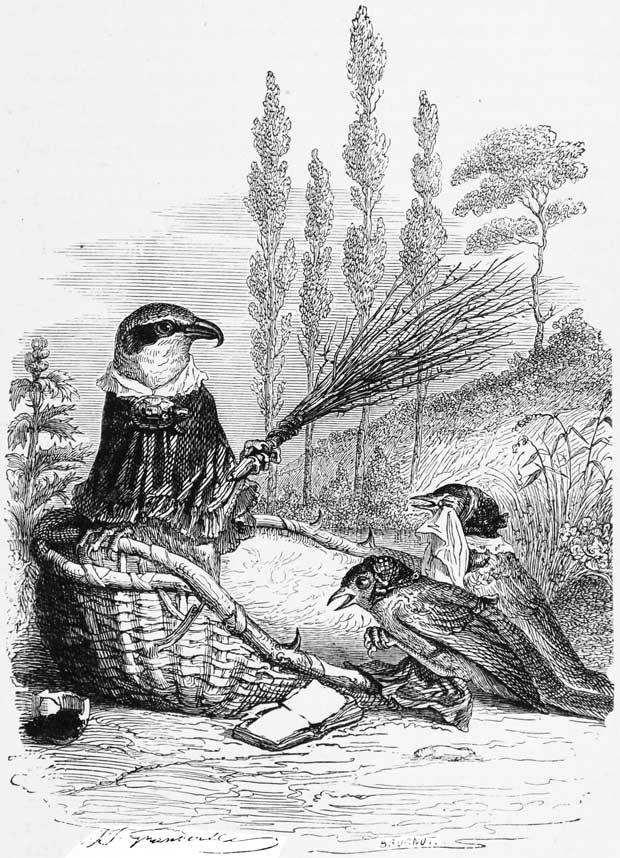
So you see I not only have the misfortune to be, but to have made, a formidable enemy of this unscrupulous dame. I think I shall risk destroying my bad leg, and limp out of the dilemma into pastures new and an atmosphere more congenial.
You whose goodness once drew me out of a like scrape, will pity my misfortunes and sigh for me more profoundly than I deserve. Still the thought of your kind interest will strengthen me nearly as much as if you were here to lend me a helping wing. I seem to feel as it were your guardian spirit hovering over my head; so real does it appear that I shall implicitly trust to its guidance. This you will set down as a morbid fad of mine, as your spirit knows better than to trust itself into such latitudes. Be that as it may, your influence, if not your spirit, is ever with me.
THE SWALLOW’S FIFTH LETTER.
It is now a month since I left my last lonely retreat. A Linnet who was wandering about without any fixed purpose promised to help me. You may judge how eagerly I seized the proffered help, and the glorious prospect of quitting my disagreeable neighbour, and the still more disagreeable hole in which I had been cooped up so long. My foot is far from well, and, although my friend tries to persuade me to the contrary, I fear I shall be lame to the end of my days. I ought here to quote the fable of the “Two Pigeons,” so often brought under my notice when you lectured me on my vagabond life.
Surrounded by strangers, enfeebled by suffering, my future seems to grow daily darker and more dim, while no opportunity offers for the ventilation of my peculiar views. The males here, as elsewhere, are our masters—one must own it if for no higher reason than to get one’s share of the necessaries of life. The cause seems hopeless, unless one could hit upon some quinine or vaccine matter that would cure us of the weaknesses and vanities of female nature. As it is, the malady or weakness is there, and males, as of old, continue their endeavours to beat, kick, and govern it out of us; one day they will succeed, when one kick too many will make us their masters. As for myself, who have not come under this peculiar bondage, I would gladly give my life for the enfranchisement of our sex; but females will persist in religiously following in the beaten track, pleasantly taking the alternate love and kicks as they come, and retarding progress. They thus maintain a prodigious inert force, against which active energy is broken like the waves of the sea against a solid rock.
I shudder at the thought of our impotency, and know not what course to follow that my name may receive the blessing of generations yet unborn. I shall wait, like a true philosopher, for my good star to light the path of this noble ambition and lead me to my goal!
My Linnet, who has no ideas, and is not accustomed to reflect, will, I fear, soon grow weary of my company, and of the heavy task her heart has imposed on her. I am not a very agreeable companion, and I do not fail to notice that she endeavours to escape from the tête-à-tête of our daily life.
Although sincerely in the humour to see the world, she took me yesterday to a meeting which at any other time would have filled me with hope.
Our sex alone were admitted, and the end to which all my aspirations tend was the theme the young hearts were waiting to discuss with noble impatience. Several points as to the ways and means by which our rights were to be secured and guarded were dwelt upon by various speakers, after which, I am sorry to say, a number of ill-favoured females entertained the meeting by recounting their love-experiences, gossip, and scandal.
These absorbing topics found a patron in the mistress of the occasion, an old Ringdove, who amiably recalled the far-off love-adventures of her youth.
Tired and dispirited, I retired to rest, not to sleep, but to brood over the future, till at last, weary of thinking of the where-to-go and what-to-do of to-morrow, my eyes closed for the night.
THE SWALLOW’S SIXTH LETTER.
MY DEAR FRIEND,—After so many shattered hopes, so many vain endeavours, I determined to narrow my ambition and end my journey with the Linnet. Were you not a grave true-hearted Canary, you would smile at this consummation. I am completely at your mercy, and you are too good to abuse your advantage.
Although there is something supremely ridiculous in all the fuss with which I set out to reform society, when one considers the result, I claim the privilege of pointing out that my scheme is none the less sound and good because it has failed. I am not converted. Society is not ripe for such a measure of reform. I have pleaded, solicited, preached—to deaf ears—and urged the adoption of my views; the males listened and shrugged their shoulders, the females refused to listen and shrugged their shoulders, and in order to continue the struggle single-handed, I should require a stock of patience with which nature has not seen fit to endow me.
Above all, I am lame, and to undertake—no matter what in this world—even to promote a good cause, one must begin with personal attractions that will appeal to the eye. A lame Swallow has therefore not much chance of success in this fast age.
The spring will again find me in Paris, when I shall present my little companion, who I am sure will please you, notwithstanding her gaiety. She may even seem to you giddy. All I can say is, she is genuine and good-hearted. I must tell you she fell in love the other day with a young fop, with whom she would have decamped had I not caught her in time to arrest her fate. I gave her a page or two of my own early experience, which produced a deep and, let us hope, lasting impression.
She wants looking after, guiding, and controlling. Yet why should I speak thus in opposition to my doctrine of freedom for the female sex, and lay my plans for her guidance? Can it be that my principles are gradually changing? It cannot be! Soon you will see me, my friend, sad but submissive, having found the world bad, and being unwilling to force it to become better. You will find me, as you would say, disenchanted—as I would say, reasonable, although, to tell the truth, the two expressions may mean one and the same thing. I have travelled far in search of that wisdom which I might have obtained without going out of my way. In my narrow view of life I had only been willing to notice the shortcomings of what is, and the advantages of what is not.
These advantages are still manifest, so also is the danger of any change, even though it might bring a certain measure of amelioration. It seems, indeed, better to keep and improve a defective form of government than to change it for something new—however good—and untried.
My only ambition now is to end my days near you.
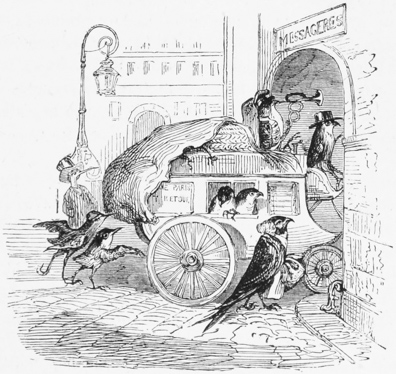
MEDICAL ANIMALS.
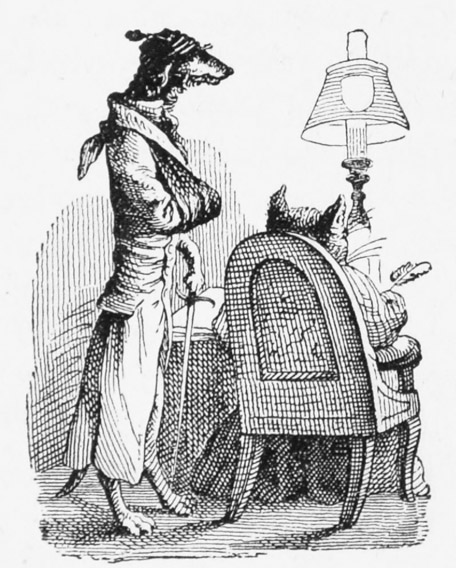
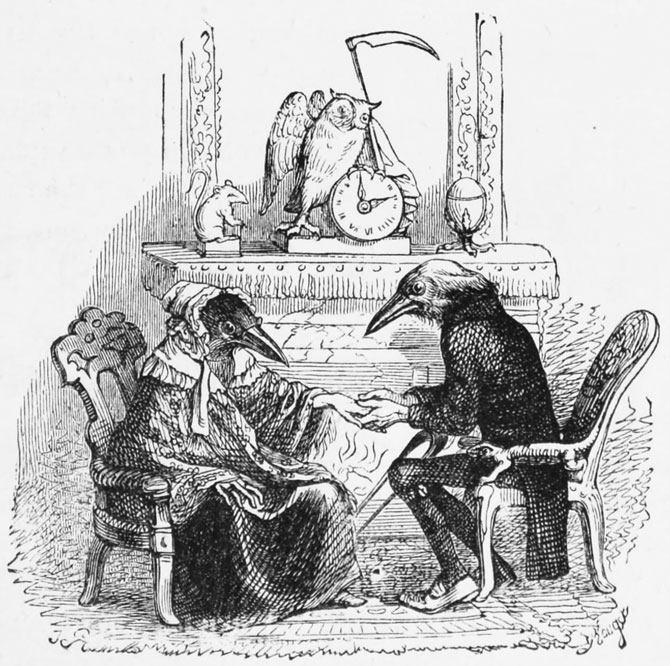
A VENERABLE Crow announces the approaching death of one of our colleagues; he flatters himself on being able to foretell the event. His prognostication is, we should say, certain to be verified, for at that moment the poor sufferer enters; he was a Dog—we say was, for he is now, alas! nothing more than the skeleton, the shadow of that long-suffering animal. We tenderly inquire how he feels.
“Ah,” he replies, “my only feeling is pain; they tried to cure me—that is, my illness—and behold the result. Ah, my brothers, what have you done? what is the world coming to? You have provoked the animals to write, your counsels have been pushed too far, many of us poor brutes have been forced to think. That is not all, some even dream of poetry, painting, and science. These fools would have us believe that such mad courses raise us above ourselves and our sublime instincts. Nightingales imagine themselves birds of prey, Donkeys masters of song, while Cats conceive they discourse the sublimest, sweetest harmony. Civilisation does it all; it is a muddle, my friends, a fearful muddle. But the last notion is by far the most dreadful. Our brothers, weary of dying a natural death, have resolved to found chairs of medicine and surgery. Already they have begun their work; behold me, the result of their experiments—skin and bone, gentlemen! skin and bone! I have just been ordering myself crutches and a coffin. Dear me, how faint I feel!”
“Have a drink?” said the Fox.
“Most thankfully,” replied the Dog, who had been a very jolly Dog in his day.
The Fox, preparing pen and ink, requests him to write down his mischances for the good of posterity. The Dog obeys—it is his nature to do so—only he requests the Fox to write at his dictation.
“Being honest,” he commenced, “I have no desire to conceal anything. There have been for some time amongst men certain individuals called Veterinaries—most damaging rascals; one is no sooner in their clutches, than they bleed, purge, and put one to the direct straits, bestowing a diet not fit for a Cat. I object to this most strongly, to this last phase of their treatment. They imagine that disease has a craving for food, and determine to kill it by systematic starvation; the result is too often the death of the animal, and not the disease, which lives and spreads to others. I was one of those who proposed a commission to inquire into and state facts. You would hardly conceive, gentlemen, on what fools—pardon—I mean on what creatures the choice fell; on Linnets and Moles—the one for clear sight, the other for seeing in the dark. The commission set to work, taking it for granted that the poor never complain without cause, and examined everybody as they would convicted felons. I do not know what happened, but soon a majority of the enlightened commissioners, who had discovered nothing, decided that the affair was understood. A compiler produced a work for which, in common with all the other members of the commission, he was handsomely rewarded, and that was all. As for me, I barked, howled, and manifested my disapproval; many of my friends thinking they ought to do the same, the agitation became general.”
“Let that pass, my friend, let that pass,” said the Fox; “everything has an end. Prudence and generosity forbid our dwelling on this subject.”
“In short,” replied Médor, somewhat crest-fallen (Médor was our hero’s name), “we agreed to form schools of secret medicine, and faculties of clandestine surgery, under the presidency of the Cock of Æsculapius and the Serpent of Hippocrates.
“Every animal, part of whose flesh or intestines had been used as a medicine, laid claim to the invention of the science, and all of them, from the least to the greatest, held that they each had been used by man-doctors as universal panaceas. Would you believe it, these biped physicians dared to prescribe Tortoise broth for languor, and jelly of Viper for impurity of the blood!”
“Médor, you are wise, and if ever we add an Academy of Sciences to our journal, you shall belong to it.”
“To the Academy, Prince?”
“No, to our journal; who do you take yourself for? Continue.”
“You have not forgotten, gentlemen, that your humble servant objected chiefly to the diet, not to the science”——
“Is it much longer?” inquired the Fox.
“I must finish my narrative, sir; that is all I can conscientiously say.”
“You are honest, but that is an useless quality nowadays.”
“My brothers,” continued Médor, “if we confine our attention to the remedies prescribed by men, we shall only foster sickness and hasten death. I once heard the remark made by a man, that the sublimest philosophy was that which stood the test of common sense. I am inclined to think that the sublime in the art of healing would be to return to and trust to instinct. These words are simple, but profound; think over them, although they will meet only with the world’s scorn.”
“Decidedly,” said the Fox. “It is most unreasonable, when one wants to found a science, to begin with common sense; that is a vulgar natural gift which can only stand in the way of science.”
“That is quite evident,” murmured a Bear, who had come forward with a subscription.
Médor scratched his ear and proceeded in a lower tone. “My opinions were blamed, I was cursed, beaten, and treated as an incendiary. When I wished to raise my paws to heaven to protect my innocence, one of them was broken, and my colleagues ironically inquired what remedy instinct and common sense suggested to me under the circumstances, and if any to apply it. But as they had taken care to knock me on the head before asking the question, I was unable to reply, and so stood convicted of insanity.”
“Herein is logic!” said the Fox.
“I was put to bed—on straw—and the chamber was soon filled by a Leech, a Crane, a heteroclitic animal, a Spanish Fly, and a dignified idler, who seated himself as soon as he arrived. The heteroclitic creature, a dry, cold, carefully-dressed personage, declared the séance open, the object of which was to effect my cure by purely scientific means. I thought I was dead, but a Sow who acted as my nurse reassured me by saying—
“ ‘Do not be afraid; the good die, the bad remain.’
“ ‘Old mother,’ I replied, ‘you were not placed here to poison my ear, on the contrary’——and I turned on my miserable couch.
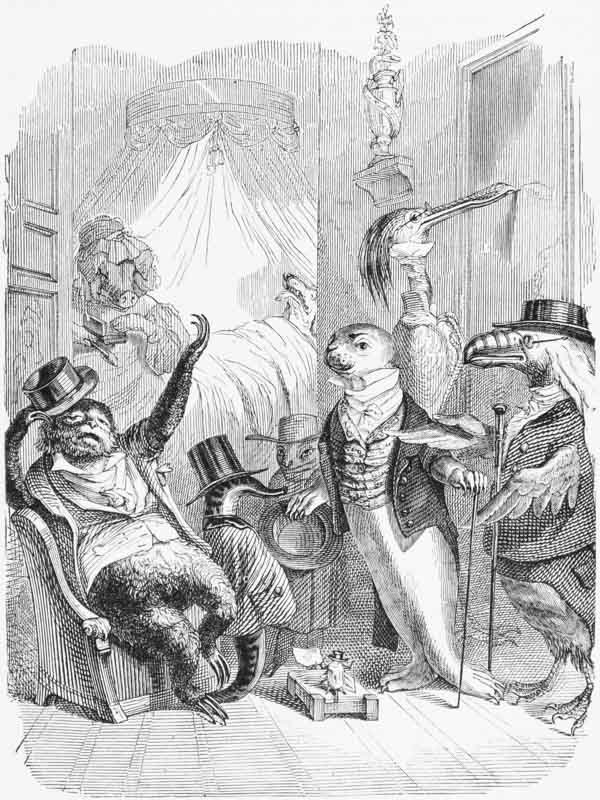
“The Leech then pronounced me delirious, and intimated his intention of sucking out the malady through a blood-vessel in my throat. Happily the Spanish Fly noticed that my tongue protruded in token of exhaustion, and proposed to apply what he termed a counter-irritant—that is, to set up a most painful competition between disease and remedy.
“ ‘My dear sir,’ said the Crane to the Fly, ‘neither your treatment nor your opinion can have the least weight; it is a well-known fact that six thousand four hundred of you weigh only a miserable half-pound. Half a pound weight, think of that.’
“ ‘What is your opinion, Mr. Idler?’ inquired the Heteroclite.
“ ‘I practise the leisurely science of meditating on the mysteries of life and death. We must consult together, and weigh the situation before we can hope to arrive at a just diagnosis of this important case. As a consulting physician, I’——
“ ‘My opinion is,’ gravely continued the first speaker, ‘that the abnormal humidity of the feet, head, chest, and all the members, is one of the gravest symptoms of this case.’
“The Seal shrugged his shoulders.
“ ‘Humidity I hold to be most dangerous, whether in the shape of rain, dew, or the saturation of a heated atmosphere. An umbrella or waterproof may ward off its influence, our patient is beyond that stage and requires more subtle remedies. As for myself, I am obliged to observe the greatest caution. I never travel without my carriage, and to walk over a cold flagstone without a carpet would be to court death. I have done: that being so, I make it a rule to inquire who is to pay me?’
“ ‘And us,’ cried a voice outside.
“ ‘Who are you?’
“ ‘We are the animal surgeons who alone can effect a cure; open, or we will cut our way through the door, just as we would to the heart of a disease.’
“The door was opened, and the Saw-fish entered, followed by its attendants. The operator showed his teeth, felt my pulse, and soon a circle formed round the couch. Under the circumstances it was natural to faint, and I did my best to do so; but as extremes sometimes meet, and there is but a step from fainting to delirium, I became mad. Dark scenes of dissecting-room practice passed before me. My name had changed from Médor to No. 33, just as if I had become a cab on a stand or a watchman. I was no longer a solitary invalid, but one of many stretched on beds in a long ward. My neighbour No. 32 had passed away, or rather his remains had been conveyed to a sort of dining-room at the end of the ward. The sole ornaments of this chamber were skeletons and bones. What had become of the flesh?”
“ ‘My friend, these hones were doubtless fossils. You are slandering your fellow-citizens. But you are free, continue.’
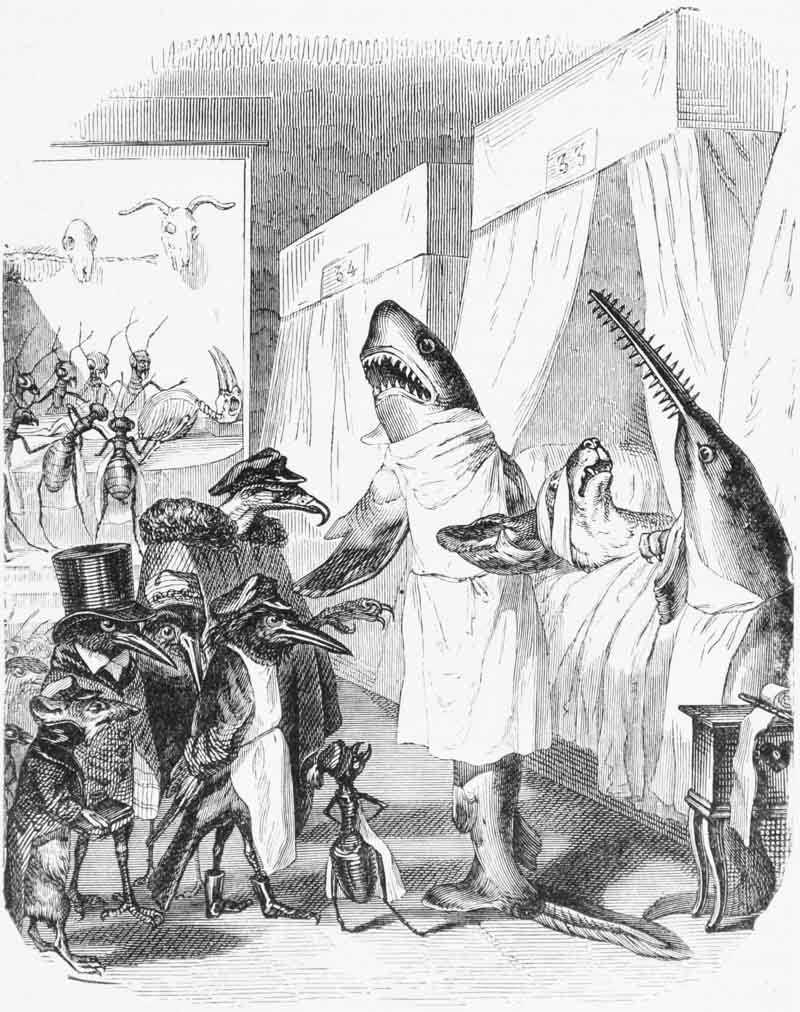
“I wished to raise my voice against this profanation, this brutality, this sacrilege, but the Shark, biting my ear till it bled, advised me to be calm, resolute, and happy.
“ ‘You must not puzzle your brain about the mysteries of clinical surgery,’ said he.
“ ‘I have already done that,’ I replied.
“ ‘Hush! I am about to describe your case to these gentlemen, who are only too anxious to see you on your legs again. It is necessary they should be made acquainted with the prognostics, diagnostics, the symptomatology, the dietetic and, shall we say, numismatic details, not one of which shall be overlooked. If you are not instantly cured, we will not waste precious time by following in the footsteps of physicians from whom we are separated by the strictum and the laxum, humours, mucous membranes, pores, not to name the 66,666 sorts of fever which specially attack the animal organisation. We will not occupy ourselves with Aristotle, Pliny, Ambrose Paré, a miserable idealist, who has said, “I dressed your wounds, but God healed them.” No, that is not our business. Our patron, our hero, is Alexander; our practice, to tighten or relax the tissues—oh no! Alexander knew better than that, he cut them.’
“ ‘Long live Alexander!’ said the Vultures, Rats, and Crows of the audience.
“ ‘You have understood me clearly,’ said the speaker. ‘I have now the honour to ask the opinion of the Saw-fish, my colleague, whose doctrines I hold in the highest esteem, although I have my own way of applying them; and now, gentlemen, we will proceed to incise the muscles, saw the bones, and in fact cure our patient,’
“They are bound to kill me, I thought; a thousand times death rather than vivisection.”
“And you played the dead Dog?” said the Fox.
“Just so, and some good little fellow said that it would be unwise to operate owing to my weakness: it often happens that the most trifling incidents delay the greatest events.”
“Say that again,” said the Fox with a tinge of irony, “it seems good.”
“Sometimes, sir, the smallest incidents delay the greatest events. It so happened that the orator fell not on the one who had interrupted him, but on his neighbour, whom he accused of lifting the hospital lint and bearing it off to line his nest.
“A large Vulture, a provincial student, as might easily be seen from his huge cloak and cap stuck on the back of his head, dared to remark that the profession of surgery was one of liberty, and that professors had no right to interfere in the private affairs of their pupils. In this way the question of the missing lint was satisfactorily disposed of, and the lecturer proceeded.
“ ‘Gentlemen, as the operation must be postponed for to-day, permit me, in the interests of science, to make a few remarks on the subject of morals.’
“That was flattering you,” remarked the Fox.
“Perhaps it was, at any rate, the little sermon which I here abridge was lost on me.
“ ‘Dear pupils, the true student of science is to a certain extent invested with a God-like nature; our profession is a priesthood, for you know the healing art in ancient times was only exercised by the priests: it requires therefore more than talent, it demands virtue.’
“ ‘Oh! oh!!’ exclaimed several students of the same year.
“ ‘Medicine will again become a priesthood, or, if you prefer it, a social function; doctors will preside over the public hygiéne. The fewer maladies there are, the more will medicine be honoured and recompensed. But in order to arrive at this desirable end it is necessary to raise the qualifications of the profession, and to exclude many aspirants, otherwise each family will have its physician. What, then, would become of us when there is a doctor to each floor and another to each attic? The study of our science is painful and costly. It must be rendered doubly so to check the influx of those who either by talent or morality are unfitted to enter our ranks.’
“ ‘But, my master,’ said the Vulture, ‘you are not reasonable; what you dread is the ability of the young generation which threatens to eat up your sinecures. Your paternal solicitude is misplaced!’
“Another student objected to slandering misery and privation, the true attributes that alone by strengthening and purifying genius render it serviceable to the world.
“ ‘Yes,’ he continued, ‘I myself have known that life is a hard, bitter struggle, but God is still all-powerful. The snow that covers every blade of grass and every seedling beneath its chill mantle, never caused me to doubt, even for an instant, that spring would come arrayed in its blossoms, or that autumn would again fill the storehouse with fruit and grain. I have known hunger, but never despair. What matters the numbers pressing forward to compete with us in allaying pain? There is room for all who honestly strive to make the world more joyous!’
“ ‘Long live joy!’ cried the Crow. ‘Misery is the poetry of the cottage, just as the garret is the palace of students. If life becomes still harder, why, to-morrow we will move up a story higher nearer heaven—go to the roofs. Now, my friends, here is the whole truth in a nutshell, the houses of Paris must be viewed thus: our lofty attics contain the head, and therefore the brain, of this large city, something too of the heart. It is there one thinks, it is there one dreams, it is there one loves, while waiting to descend to the first floor, to meditate on ambition and riches. Our master may talk; for all that, he himself is a living proof of success—of the fact that very little merit indeed is frequently rewarded by much wealth and fame.’
“ ‘Ah!’ replied the Shark, ‘you forget that one successful career is the product of a thousand failures. Only lofty qualities can bring the successful to the surface, while thousands sink into misery and obscurity. Some one said that the sun smiles on our successes, and the kindly earth throws her mantle over our failures. The truth is, the sun shines on a host of ungrateful convalescents, and the earth too soon receives our most astounding surgical cures!’
“The discussion was becoming too learned, I therefore slipped out by the foot of the bed—but not before they had resumed the discussion of my case—and left them in the thick of it to come here.”
Saying this, the poor cripple made his bow and disappeared, totally regardless of the future of his important revelations.
We beg any one who may know the whereabouts of Médor to keep the secret to himself; being unable to help our fellow-creatures in distress, we wish them kept out of our way, or taken to our next-door neighbour, who has probably more time and money at his disposal.
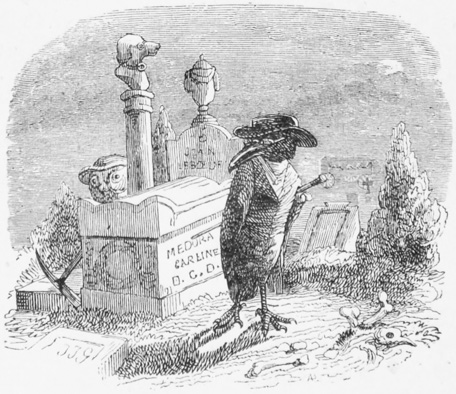
THE GIRAFFE’S TABLETS. JARDIN DES PLANTES.
LETTER TO HER LOVER IN THE DESERT.
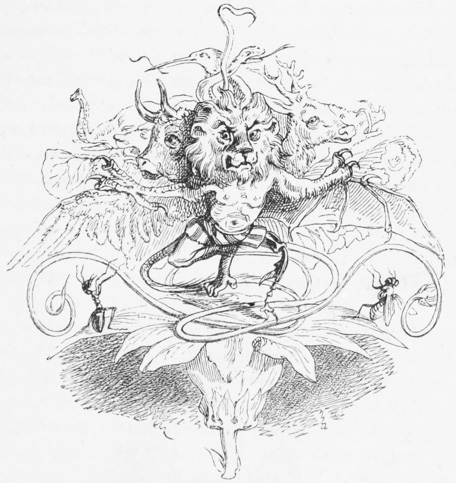
PRAISED be the good spirits that protect Ants, Giraffes, and probably men! Before many days we shall meet, never to part.
The learned men of whom I shall presently speak, who in this land make the weather—bad weather, as a rule—have decreed in their wisdom that it is not good for Giraffes to be alone, as the social habits of our race can never be truly ascertained from the study of a single individual. How this happens I cannot explain. I have, however, put you in possession of the fact that you may know as much as I do myself.
Here I am transported to a land one finds it hard to get used to, a land where the sun is pale, the moon dim, the wind damp, the dust dry and dirty, and the air icy cold. Of the three hundred and sixty odd days which make up the year, it rains during three hundred and forty, when the roads become rivers unfit for the dainty foot of Giraffes. During winter the rain becomes white, and covers all things with one uniform dazzling carpet, which wounds the eye and saddens the heart. The water becomes solid, and misery waits upon birds and beasts, who perish on the banks of the streams without being able to quench their thirst.
The species of animal that rules in this region is the most ill-favoured of all God’s creatures. His head, instead of conforming to our graceful model, is nearly round like a melon, and partly covered with short hair like hogs’ bristles, only thicker, darker, and not so clean looking; his neck is almost hidden between his shoulders, and only develops by becoming thicker and shorter; his skin is of an earthy colour; and to complete this ridiculous picture, he has got into the stupid way of walking on his hind-legs, and swinging those in front to maintain his equilibrium. It is difficult to imagine any figure more vulgar or absurd. I am inclined to think that this poor animal is afflicted with a painful sense of his deformity, for he hides as much of his figure as possible. He uses for this purpose an artificial covering fabricated out of the bark of plants and skins of animals. This device does not mend matters, as it renders him an ugly piece of patchwork. The first sight of a man—that is the name by which this hideous animal is known—will cause you to be thankful you were born clothed by the Creator in matchless attire, and that you have never fallen into the hands of a Parisian tailor.
We express our sentiments and needs in simple sounds and looks; they, on the other hand—who appear formerly to have enjoyed the same privilege—carried away by a fatal instinct, or, if one must believe the wisest of them, subject to a destiny of incomparable punishment, supplanted nature’s simple language by an almost continuous grumbling. They have invented sounds in abundance to signify what they don’t want and can’t get, and spend half their days in gabbling over the limited nature of their moral and physical appetites. These sounds sometimes express wishes, but more frequently what is called ideas. Ideas are in themselves nothing, although they are the key to all that is deficient, cross, and hostile in what these creatures call conversation. When two Men separate after conversing for hours, we may rest assured that the one ignores all that has been said by the other, and hates him more thoroughly than before.
It is also necessary for me to tell you that this animal is essentially ferocious, and feeds upon flesh and blood. This need not frighten you; either from his natural cowardice, or from a horrible refinement of ingratitude and cruelty, he only devours poor defenceless timid beasts, easy to surprise and kill, and who have often clothed him with their wool or enriched him with their service. Again, it is his custom to rear these victims in his own country. An animal from a strange land inspires a sort of religious respect, which is shown in the utmost care and homage. He lays out parks for the Gazelle, embellishes the Lion’s den, and digs a pond for the Hippopotamus. As for myself, he had planted rows of trees with nourishing leaves; beneath my feet is a mossy sward and belt of fine sand, a miniature desert, while my dwelling is kept at a uniform temperature. His poor fellow-creatures would only be too delighted if he took the same care of them. He cares for them at a distance, and at times, without warning, breaks out into a frenzy and slaughters them right and left.
These massacres are said to be caused by some high-sounding nothing called a word or an idea. Men—being by nature harmless or unarmed—have invented destructive weapons of the most formidable kind. When they cannot agree about any given idea they bring out their weapons, and the side which works the greatest destruction of life and property is always right. Right is built upon the wreck of empires, so Men say, until some giant power proves right to be wrong and dethrones it, showing that right is a sort of weathercock that changes with every wind of government.
There are Men, and there are also extraordinary Men—that is, a class called Scholars. The grubs of these creatures are bred in books. Many of them die while yet buried in printed leaves, in the chrysalis state, from which they never emerge; but the Book-worm, after many days, ought, full fledged, to soar away into the light of science.
It is the duty of Scholars to pay more attention to the words in which ideas are expressed than to the ideas themselves, as well as to invent words, which few will understand, to denote the commonest things. When speaking, the Scholar is careful to use words so seldom pronounced, that it would be better if they were not pronounced at all.
Above all, the most interesting human type is Woman, a poor, soft, elegant, timid, delicate creature, who became the slave of Man. I do not know where or when, but he has trained her to submit to him like the Horse, either by force or cunning. I tell you she is by far the most graceful form in nature, yet Man spoils her appearance; she is seen to greater perfection without him. She has few sentiments save love; the need of loving some one or something shows itself early, and never leaves her. During her youth the hours are spent in conjuring up in her mind some ideal Man with whom she is to live a blissful life. She after a time becomes the wife of some one in whom she thinks she has found the lover of her dreams. Alas! too often the illusion soon passes away, and she learns that the fond image of her youth was a being of a higher sphere.
You will be surprised at my giving you so many details regarding this country and its animals, but as yet I have told you nothing about the way they govern themselves. Politics pure and simple is the science most talked about and least understood in France. If you listen to one person on the subject of politics, his ideas seem obscure; if to two, they are confused; if to three, they are chaotic. When the number of speakers increase to four or five, they are prepared to strangle each other. Judging from the universal favour in which I am held by all classes, it has once or twice crossed my mind that all their political sentiments had found a calm centre in myself, and that they would at last elect me their king. This seems all the more likely since Frenchmen are utterly unable to agree as to the exact moral and intellectual qualities which should adorn a prince, and it may be they have in a friendly way resolved to choose their masters according to height. By adopting this plan, party spirit would be demolished, and all questions settled by measurement.
Last week I resolved to be present at a meeting of deputies to be held nearer to the river than my abode. I accordingly bent my steps that way, and soon arrived at a sort of palace filled with a tumultuous throng.
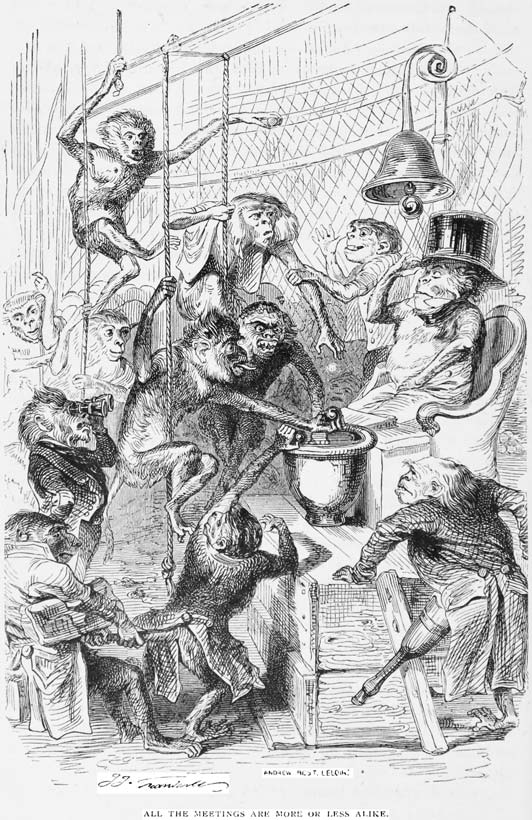
The members of the Cabinet only differed from other men in characteristic ugliness, the result, it is said, of grave habits of thought, and of the manner in which they snatch their pleasures from the cares of office. What surprised me most was their activity, which never permitted them to rest for an instant in the same spot, for I was witnessing by chance one of the stormy meetings of the session. They tossed themselves about, jumped and mixed into a hundred confused groups, apostrophising their adversaries with cries and menacing gestures, and showing their teeth with the most hideous grimaces. The object of most of them seemed to be to raise themselves above their fellows, and there were those who compassed this end by mounting on the heads and shoulders of their neighbours.
Unfortunately, though well pleased to witness the gambols of the assembly, owing to my superior stature I failed to catch a single word in the confusion of voices, and I retired sickened and deafened by the vociferation, grinding of teeth, whisking of tails, whistling and howling, without being able to form a conjecture as to the subject under discussion.
For all that, something was carried, and the speeches, it is said, appeared in the official organ next day in most harmonious prose. There are those who say that all the séances resemble this one in a greater or less degree, so I shall dispense with witnessing another.2
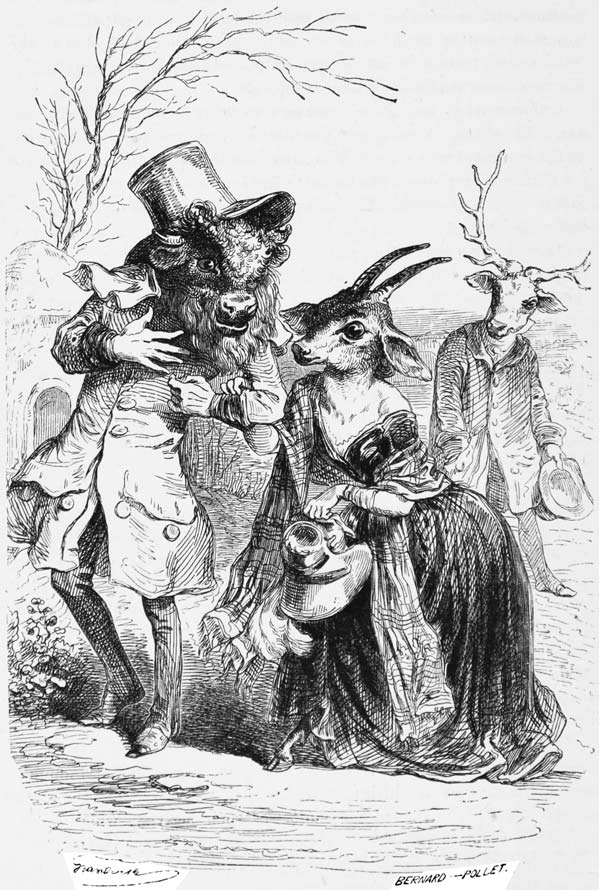
I had proposed to give you, before closing my letter, some specimens of the language now used in Paris. You will be able to form your own notions of it from the following sentences, which have just been exchanged between a young man with a Bison’s beard, and a young woman with the eyes of a Gazelle, to whom he was trying to justify his long absence:—
“I was preoccupied, beautiful Isoline, with sublime ideas, of which your woman’s heart has the noble intuition. Placed by the capacities which they have been willing to accord to me at the zenith of the adepts of perfectionabilisation, and long absorbed in philosophic, philanthropic, and humanitarian speculations, I was tracing the plan of a political encyclism which would moralise all peoples, harmonise all institutions, utilise all the faculties, and develop all the sciences; but I was not the less drawn towards you by the most passionate attraction, and I”——
“Say no more,” solemnly interrupted Isoline; “do not think me a stranger to those lofty aspirations, and pray do not suspect my spirit capable of being charmed by the baits of a coarse nature. Proud of your destiny, dear Adhimar, in the sentiment which unites us I only see an elective affinity which the instinct of cohesion has confounded with a sympathetic individuality, or, to express myself more clearly, the fusion of these isolated idiosyncrasies which feel the need of becoming simultaneous.”
Here the conversation was continued in a low voice, and I think I may suppose that it became more intelligible, for the young philosopher was beaming with pleasure when he left Isoline.
THE GIRAFFE.
THE CROAKINGS OF A CROW.
THE inferiority of man to the lower animals of the world does not admit of the faintest shadow of doubt, at least that is my belief, and in making it known, it must be understood that it is done honestly and without malice. I am one of the few creatures against whom man is powerless to do harm, happily considering me beneath his notice, as my flesh is too tough even to make soup for paupers. I am, in fact, a Crow, and consequently view the world and its inhabitants from a noble elevation.
Men themselves are conscious of their deplorable condition, and fully aware that their complex bodies are frequently impotent to respond to the wishes of their active brains. Poor architects are they who design impossible structures which no hands can build. Pitiable! pitiable!! Does any one believe that they are unconscious of their inferiority? If so, what can account for their eternal complaints, their incessant misunderstandings and litigations?
Mock, write, invent fables of moustached men. You shall never be able to render us animals ridiculous unless you first endow us with human vices, passions, and aspirations. You compel my pity, poor pariahs of the world; you who could not live for a day without us—without the wool of our friend the Sheep to make your attire, the silk of the Worm to line your coats or cover your umbrellas, for rain is often fatal to you, while the refreshing wind penetrates your thin pink skin and chills you to the heart. You doubtless wish you were a Crow like myself, to fly through the air in place of crawling along with your too solid bodies through slimy city streets. I dislike you least on horseback, and you yourselves are proud of borrowing a certain dignity from a brute; but the dignity belongs to the Horse, not to the rider, although the latter accounts it all his own, and, strange to say, thinks himself superior to the animal that carries him. Are you not weaker than the Ox or the Elephant? Does not the smallest insect become a burden to you? A Fly tickling your nose drives you mad, and in place of setting the misguided insect free, you take its life. The sting of a Gnat swells and deforms your face, and spoils the image of the God that made you; while the bite of a reptile a hundred times smaller than yourself proves fatal. Moreover, you cannot deny that you have spent whole nights in a bloodthirsty search for the Flea that has banished sleep from your pillow, and the little offender has after all evaded you. Tell me why do you grow pale before a caged Lion? It is, alas! his gentlest caress would break every bone in your frail body.
“Ah, well! We own our physical infirmity; it is of no consequence, as we are princes by our intelligence, and on that ground we defy you, Master Crow.”
You flatter yourselves, gentlemen. Do you suppose for a moment you have more ingenuity, ability, and patience than the Spider, who unaided produces the silken material and weaves the most marvellous fabric in the world? You cannot even make lint compared to it, although the cotton is grown ready to your hand. Who, like the Spider, can prevail upon his food to come to his door, and secure it so cunningly? and who so deftly can escape danger? Again, are you more crafty than the Fox, more subtle than the Serpent? You boast of your heart, and yet when you want a symbol of tenderness or devotion it is among our ranks you look for it. Show me the human mother who, like the Pelican, would daily pierce her side, or, like the Kangaroo, bear the constant burden of her little ones. Talk as you like of your paternal kindness, and the sacrifices you make to bring up your children; in short, you parade everything that will in any way minister to your own vanity. You are careful to publish your good deeds with assumed humility, that the world may trumpet them abroad. But for constancy and unobserved devotedness to her offspring the meanest bird will put mankind to the blush. Show me the father who, while attending to the duties of his office, would prepare his children’s food and rock them to sleep.
We, the birds and brutes of creation, do naturally what costs you an almost superhuman effort. We have no need of moral and religious institutions to teach us how dutifully to fill our allotted spheres. Natural instinct is our teacher, and we obey its faintest whisperings. We have no schools of music, the arts, or sciences; for all that, the Nightingale’s notes are true and harmonious, and the comb of the Bee continues to be constructed with matchless beauty and precision.
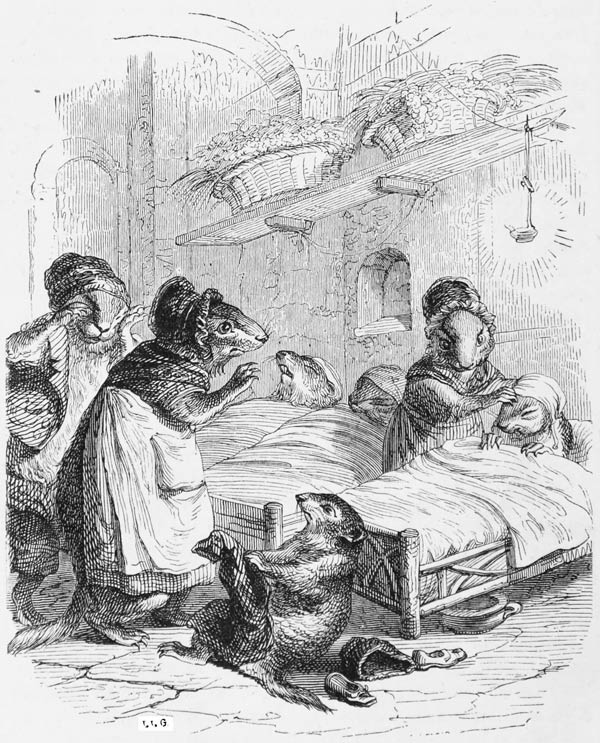
You live in families, so do we; but supposing a human family were compelled to spend an entire winter, like the poor Marmots, shut up in one dark chamber, what would be the result? I fear some broken tempers and more fractured bones.
You are proud, so is the Peacock; but the latter lives on his pride, while you frequently die of it—it chokes you.
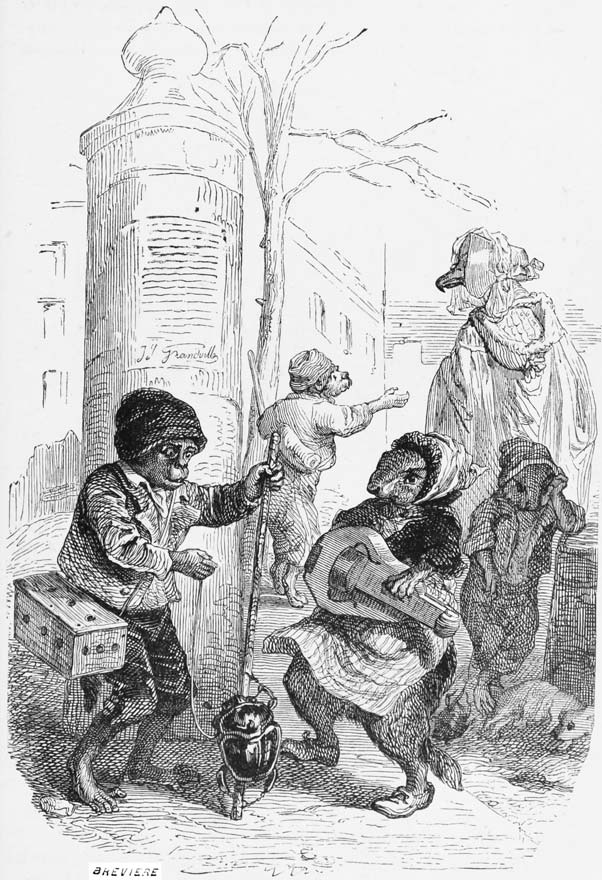
What can I say about human courage?—simply nothing. My own good nature prompts me here to draw the veil, only adding a word on the subject of mendicity.
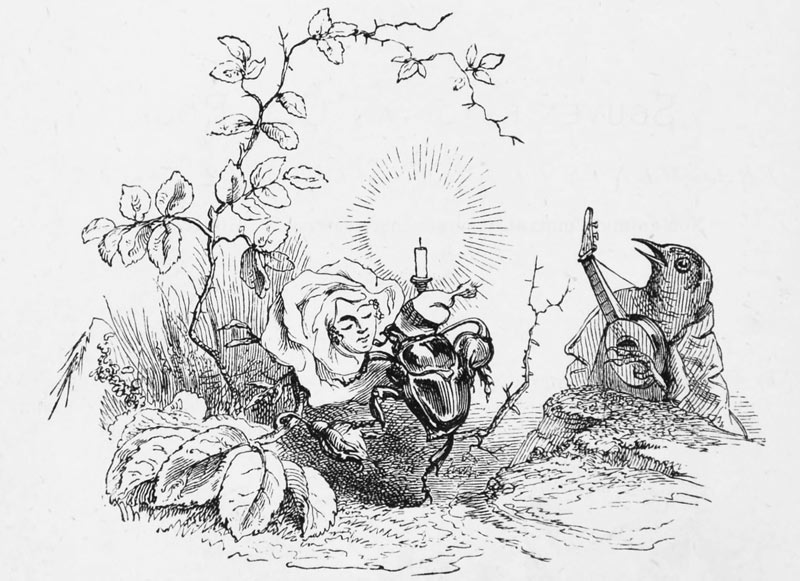
In our beastly kingdom mendicity is unknown. We would rather starve than mimic all the ills of life in order to gain a beggarly living. When we have performed our allotted tasks in life, and are unable to provide for ourselves, we die. Not so with men; they are doomed to cling to the last shreds of life when all its joy and lustre have gone, and live on as if overtaken by some fearful retribution. But here I touch upon a large and mysterious question, and being a modest Crow, I shall leave it, as I fold my wings to sleep, for the night is falling and the ink has dried on my quill. The twilight hour of love is passing, and the Nightingale is tuning his lute.—I have the honour to salute you.
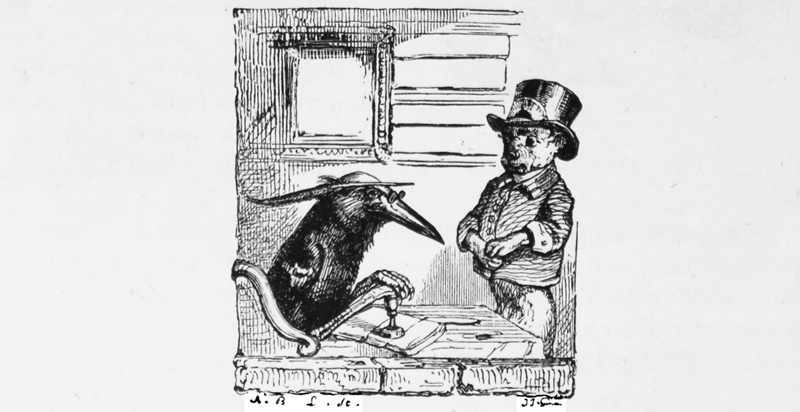
SOUVENIRS OF AN OLD ROOK. FRAGMENTS FROM AN ALBUM OF TRAVELS.
“Non animum mutant qui trans mare currunt.”—HORACE, Epistles.
SUMMARY.
Why does one travel?—An old castle.—The Duke and Duchess.—The Terrace.—An old Falcon.—The hosts of the Terrace.—Make yourself a Grand Duke.—A magic Carp.—How an Owl dies of love.—How Madame Crow ends her story.
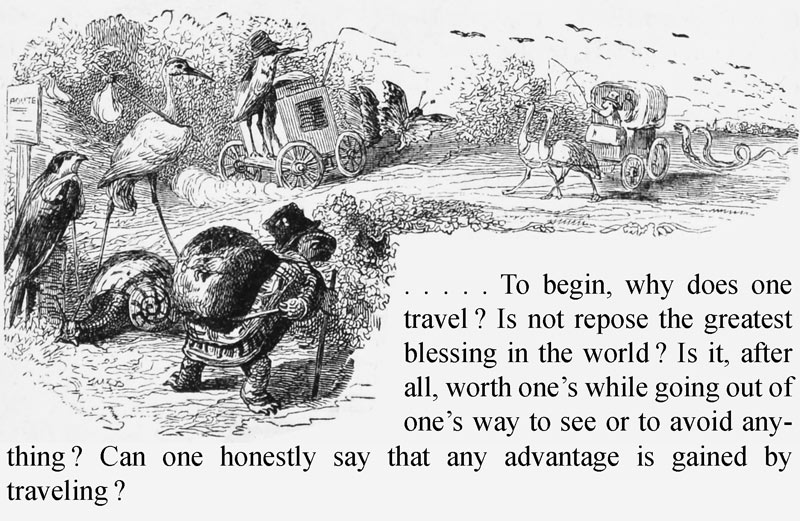
Some pursue happiness, and the pursuit invariably ends in the grave; others flee the evil which no one escapes. The Swallows follow the sun and flit with its beams, while Marmots close their eyes on all his wintry glory and court repose, having faith that nature will again awake at Phœbus’s bidding. There are many creatures who leave their homes to face unknown dangers, but few return, for space is vast, and the insatiable ocean cries for ever, “Give! give!” Many more go to sleep and few awake, for sleepers are near to the death that broods over them. The Butterfly travels because he has wings. The Snail, rather than remain in one place, shoulders his house and moves along; the unknown is so attractive. Hunger wounds these, love woos those; for the former some happy region teems with food, for the latter with sentiment. Those alone who travel without aim are burdened with satiety. As for the Squirrel who turns in his cage, we may say, “S’agiter n’est pas avancer.”3 Unfortunately, like him, many move, but few make progress. Thus it is said that the wise ones of the world prefer peaceful misery to active happiness; they are content to live on in the spot where they were born without troubling their heads about anything beyond the limits of their horizon, and they die, if not happy, at least tranquil. But it may be that this wisdom comes from the coldness of their hearts, and the weakness and powerlessness of their wings.
No one has answered the question, Why does one travel? better than a great writer of our sex, George Sand, who said, “One travels because no one is happy here below.” It must be that motion is everywhere, nothing is perfect, therefore there is no repose. As for me, I have travelled not because I had a liking for motion, for I loved my nest and the short walks over the village green.
“What is the good of these interminable speculations and questions at the beginning of your tale?” said an old friend and neighbour, whose advice I sometimes ask, always reserving my right to do as I please. “It is not because you occupy yourself with philosophy, &c. &c., that you must bore your readers. You will be accounted a pedant. Are you going to favour us with the particulars of all you have seen and thought during the century you have been in the world? Do you intend, after the mistake of living so long, to add the folly of travelling interminably over paper? Believe me, if you really want to be thought a bold adventurous spirit, a travelling genius, write a book of travels. The century of Columbus has passed, one has no need to discover new lands, one may now set up as a traveller at less cost and no risk. Discover, if you will, the spot where you were born, your neighbours and your neighbours’ affairs, yourself, or nothing, and write about them. Relate—what does it matter how you relate, so long as you do relate something? It is the time for stories. Imitate your contemporaries, those illustrious travellers, who, in the four corners of the globe, bravely write down their impressions while reclining on the straw or down of the paternal nest. Follow their example, I say, jot down everything about yourself, your friends, your servants; the time you dine, and all about your appetite. Detail the dishes you have, and those you have not, institute a comparison between the feathers of different birds, taking care never to dip beneath the surface, confine your descriptions to dress and manners. Whenever you come across an old tale, colour it freely and serve it up as new, and I shall promise you a great success. You will fall into many grave errors. What of that? they will never be discovered till after you are dead, when it may amuse your children to defend your reputation.”
These reflections had a certain fascination for me, the advice might be good, or bad, it was at any rate easy to follow. But my conscience kept me out of harm’s way, and I replied—
“One cannot always follow one’s own inclination, as for me, I am an honourable Rook, and will do my best at all times. If what you have just said is intended for advice, it is so precious you ought to keep it to yourself.”
“Be it so,” he said, bowing gravely.
I returned the salute and again took up my pen. I am undoubtedly an old Rook. Old as I am I have no notion of concealing my age. I was once young, that I can well remember, young as the Starlings yonder, and less giddy, having a proper notion of the respect due to age. Old age, in spite of all its infirmities, would meet with greater marks of tenderness and reverence if we thought a little more of the silent grave, on whose brink the feeble steps are tottering.
As far as I can remember I was married then; yes, when I was young, that is true, it is some fifty years ago, and I seemed to grow old in a day when I lost my dear husband. How strangely the scene comes back to my poor old head. It was a dreadful day, the wind was moaning dismally through the crevices of the old tower, while the thunder, bursting in terrible peals from the dark sky, shook the foundations of the grim cathedral, making its grey stones tremble as if with fear. Chill rain fell in torrents, and for the first time menaced our nest, though it was well protected under one of the doorways of the Cathedral of Strasbourg. “I am dying!” said a feeble, yet resolute voice. That was my husband, poor dear; he made up his mind to die and he died. He was always a very determined bird. “Mind the young ones, love!” These were his last words, and I did mind them, at least I tried to, but they, all of them, died within a week.
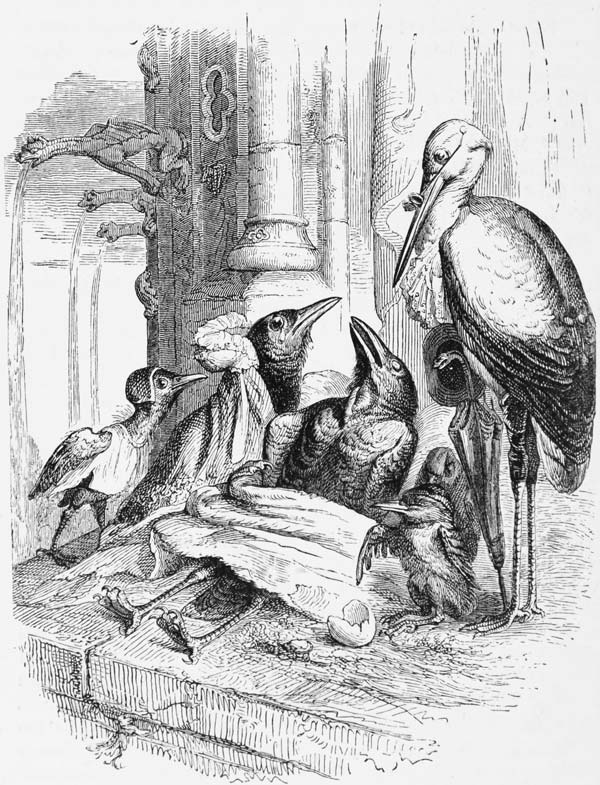
Worst of all, I could not die myself, and a sort of consolation did steal into my widowed heart, that made me feel I would not be justified in dying.
“Travel,” said an old Stork, who had nursed my husband. “You will start inconsolable, you will return calmed if not consoled. Many griefs have been starved out and left behind on the king’s highways.” This Stork was esteemed as a very sensible creature, but the world had hardened her heart: I would sooner kill my children than stifle grief! My children, alas! where are they? A number of friendly Crows, our neighbours, lent weight to the Stork’s advice by urging me to leave the old scenes, and I did leave the place, although I almost felt certain that my husband and little ones would reappear some day.
Talk of travelling! why, I have travelled without halting almost for the last fifty years, but it did not take me a fiftieth part of that time to find out that the worldly old Stork was right.
From the moment of entering seriously on my journeys, I was reminded of this proverb by a celebrated moralist.—“One travels in order to relate one’s travels.” I determined to follow this maxim, and accordingly, armed with note book, set out to explore the world. As occasion presented itself, I related my adventures, and was fortunate in securing listeners who, however, were afraid to applaud what might prove unpopular. At last a bird (in truth no friend of mine), well-known in fashionable circles, hazarded his patronage, saying aloud with the most perfect assurance, that my tales were decidedly good. That made my fortune, not that my tales were improved by this notice, but they became sanctioned, so to speak. Soon my stories flew from beak to beak; I found them everywhere. However little one deserves praise, it is always flattering, I therefore continue.
AN OLD CASTLE.
There was once an old castle—I begin story-telling after the good old fashion, it somehow gives one a fair start, and it is expected—
There was once an old castle, the castle of . . . it neither matters what nor where.
At a time when France boasted almost impregnable castles, this one had often resisted the fiercest onslaughts, although it had been taken and retaken times without number, when the loves of valiant knights for maidens fair caused many bitter feuds. The castle during troublous times had been overthrown little by little, so that almost nothing remained of the original building.
It is sufficient to say, it was taken and pillaged during the Revolution of ’93, which demolished many old strongholds; after that of 1815 it was about to be restored, and its fortune was visibly brightening when overtaken by the Revolution of 1830, so ably described by the Hare in the opening pages of this book.
The old fortress was then deprived of its rank and ancient aristocratic fame, and in its degradation, sold to a banker, an individual who, although rich, was ignorant of the archæological fitness of things. So it turned out that the purchaser while devoting wealth and ambition to his new property, gave it the final blow.
Masons were seen at work everywhere, filling up holes, plastering and whitewashing walls; just as if seeking to impart a delicate grace and refinement to a rugged old rock. A terrace was built (renaissance!), supposed to be in keeping with the old remaining parts of the castle, and the chapel became a billiard room. The old place was thoroughly rebuilt, and the new owner satisfied. There was a little of everything about it. Every style under heaven figured in the edifice, the heterogeneous mixture being hideous enough, to disturb the reposing dust of ancient Byzantine architects. For all that, the restoration was much applauded by the courtiers of this king of bullion.
Some parts of the building were happily overlooked, or rather saved.
Thus it came about that the poor old castle was renewed, decked with a painted and plastered mask, as inferior to the genuine original as the mask of a harlequin to the face beneath.
As I have already said, I was born in Strasbourg Cathedral, that gem of Alsace, beneath the classic sculptured stone in the great porch. When one has had such a cradle, reared as I was to venerate antiquity and all its triumphs of art, it is natural to protest against the impunity of those who destroy the noble works of the ancients.
The restored portion was tenanted—the terrace, I mean—by barn and other Owls, comical creatures who gave themselves the airs of the first lords of the soil, dukes and duchesses forsooth.
One evening after a long day’s flight I arrived at this castle, wearied and in the worst of tempers; out of tune with the world and myself. I was haunted by ennui, and one of those unskilful sportsmen who respect neither age nor species, and to whom nothing is sacred.
By chance I alighted on the balustrade of the terrace, from the midst of which a group of half-dead cypresses was waving as the hour of midnight sounded through the chill air. In romances this hour is never allowed to strike with impunity, but in the true tale I am relating, events must follow their natural course. The hour struck and nothing particular happened. It occurred to me to go to roost so as to be ready for a fresh start in the morning. I accordingly settled myself.
THE DUKE AND DUCHESS.
I was just going to sleep when the pale moonlight revealed an Owl sheltering with one wing an Owlet of rather striking appearance, while with the other he draped himself as would an operatic hero with his toga. I soon overheard them talking about the moon, the weather, &c., or rather singing sentiment to a very lame tune.
“Poor pale moon, if one only believed lovers, its light was made for them!”
I always shrank from intruding myself upon the hospitality of others, so I whispered to a passing Bat, “My dear, would you be so good as to tell your masters a centenarian Rook seeks shelter for the night.”
“Who are you addressing?” replied the Bat; “I am neither nurse nor lackey. I am in the service of the Duchess, and have the honour of being her first maid-in-waiting. But who are you, Mrs. Rook of a hundred summers? Where do you hail from? How shall I announce you? What is your title?”
“My titles to consideration are my age and need of rest.”
“What a silly old crone,” said the stupid creature as she left me. “Nobles are never tired. Weariness is no title, it is the common attribute of the vulgar!”
Soon I came across the third maid-in-waiting, who proved herself two degrees less impertinent. “Do you know,” she said, “the first maid has just been scolded on your account? The Duchess was just singing a nocturnal duet with my Lord, when she remarked, ‘How dare you? I am invisible to the poor.’ Besides, she only entertains titled persons, and it seems you have no title.”
“What do you say? have I not eyes to see that your Grand Duke and Duchess are simply Owl and Owlet, on whom those airs sit badly?”
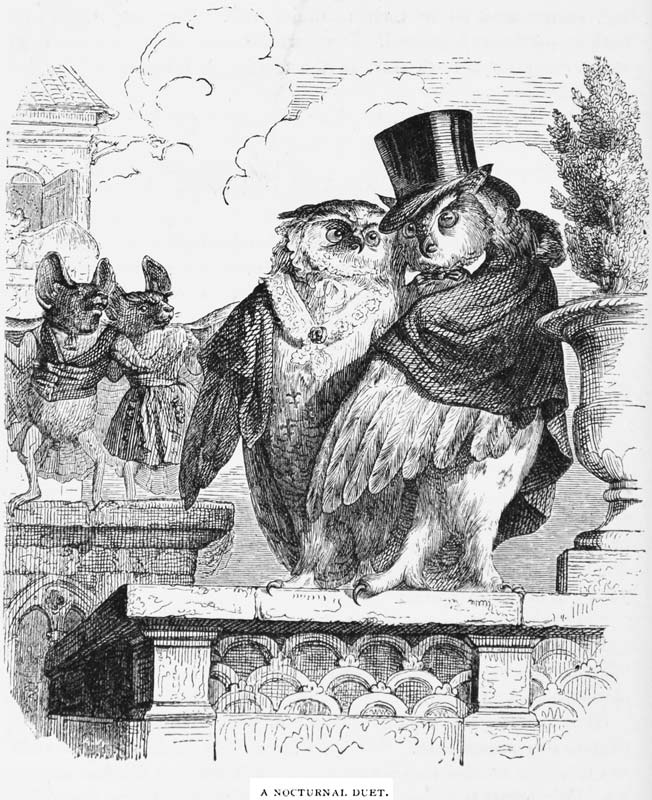
“Hush!” whispered the Bat, who was rather talkative. “Speak lower. Were it known that I listened to you, I would be drawn away and perhaps eaten. Since leaving the place of their humble birth they only dream of grandeur, and hope one day to become real aristocrats in the midst of these old tokens of nobility. Bah! the cowl does not make the monk, any more than the castle does the prince. Fly over there, my old friend, to the right, and you will find a better shelter in the ruins of the castle.”
“Show me them; lead me to the souvenirs of departed greatness, out of sight of this sickly, spurious, howling waste of plaster and paint, sham, and shoddy. Thank you, my dear, your mistress was only natural when she was rude.”
Very little remained of the old castle, yet I would have given fifty restored ones for a single wall of the old pile.
Is there anything more touching in the world than ruins which bear witness, so eloquently, to the greatness of the past?
How can we hesitate between old and new? The great present is but the mimicry of the greater past.
AN OLD FALCON.
This venerable wall enclosed a court as old as itself, and decked on one side with the green shoots of a vine. Lilies and wild tulips were growing between the stones of a dilapidated flight of steps partly covered with ivy. Sweet-scented wall-flowers and a variety of weeds were disputing the spaces with mosses, lichens, grass, briars, and nettles.
Parsley, tufts of samphire and poppies, found a home among the debris, the bright flowers rivalling flames of consuming fire.
When the art of man has ceased to usurp the soil, nature slowly but surely demolishes his handiwork, and recovers her domain.
The court belonged to an old Falcon who was ruined by the revolutions. He was a most hospitable bird, who spent all his income in entertaining, thus the court was the resort of creatures of every fur and feather; resourceless Rats, Shrew-Mice, Mining-Moles, Crickets, and other musicians, some of whom had even taken up their permanent abode within its walls.
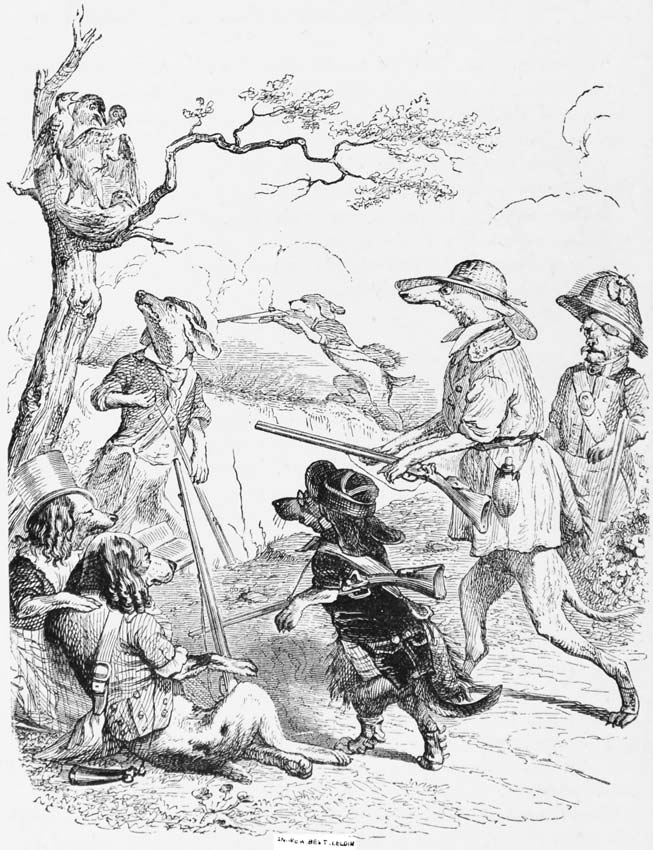
Alas, the chivalry and hospitality of the noble Falcon have vanished, and the old genuine sport in which he used to delight is mimicked by a troop of modern sportsmen whom the birds despise. They blaze away pompously with pellets and powder, secretly filling their bags at the nearest market-place.
During my stay at this ruin I had occasion to study the habits of a Chameleon, whose character interested me greatly. I therefore hasten to publish my observations on this peculiar type of reptile.
WHAT ANIMATES THE HEART OF A CHAMELEON.
I.
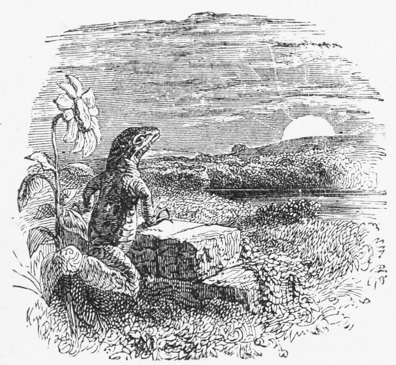
In one of the most picturesque niches of the old wall dwelt a Chameleon, one of the handsomest, most distinguished, and most amiable creatures in the world. His figure was slight, his tail slender, his nails curved artistically, his teeth white and pearly, and his eyes quick and animated. His changing colours were all of them most agreeable to behold, indeed the whole aspect of this charming creature was delicate and bewitching.
When he ascended the wall, twisting his body into a thousand elegant forms, or when running through the flowering grass, one never tired of looking at him. Besides no one could be more simple or unaffected than this king of Lizards. He had no experience of the world, at least he only once had occasion to go into society, into the little world of Lizards, which is a hundred times less-corrupt than the world of Snakes, or of men. Yet he determined never to return to it, as the single day which he spent from home seemed to him a century. His contact with the world had left no taint, he lost nothing of that natural candour born of the freedom of the fields, where one sees the budding flowers opening to their fullest, to court the scrutiny of the midday light.
II.
In vain did a crested Jay assure him of his descent from the famous Crocodiles of the Nile, and that his ancestors were thirty-four feet in length. Finding himself so small, and feeling assured that the greatest of his ancestors had not been able to add a single line to his tail, he never troubled himself about his origin. It was sufficient for him to know that he had been brought into the world somehow, and to feel thankful for it. He was alike devoid of aristocratic weaknesses and vulgar vices. The most singular phase of his character was complete indifference to the sentiment of love. The most attractive female Lizards knowing this, had disposed of their hearts and affections to others.
III.
The truth was he had given his heart away, unknown to his friends. Love had stolen upon him without he himself knowing how—it is thus that the passion makes the heart captive. Love had so taken possession of him, that he could not get rid of it if he would. This is how one loves well and wisely.
He loved the sun. When it was out, he was in it, and could think of nothing else. He slept while yet awake, realising the sweetness of noonday dreams.
IV.
Our hero held that Lizard-love was a sentiment unknown, yet beneath the stone on which he sunned himself, a pair of bright eyes feasted upon his every look and action, and a little heart throbbed for him alone. This romantic worshipper feeling that she might just as well lavish her love upon a stone, that her adoration was unobserved, and her passion unrequited, sank into a state of despondency. Haunted by dark doubts, she at last thought of death as the end of her sorrows.
In her extremity, she inquired of an old Rat, whether it was better to live and suffer, or to die and be done with dreams and delusions?
“Die, of course,” said the Rat, “if you cannot make yourself agreeable.”
“I will die!” she exclaimed; “but he shall know the reason, he shall know all!”
Such is the force of a noble resolution, that the little Lizard who had never till now dared to look her loved one in the face, came forward. But her approaches were met by the gradual retreat of our hero, for he was naturally timid in the presence of females.
“Stay,” cried the little one in a tone of despair. “I love you, and you do not even know that I exist. I must die.”
“Don’t die, my dear,” he kindly replied; “that would be highly improper. What do you mean by saying you love me? I am a stranger to you, yet a joke comes well from those pretty lips.”
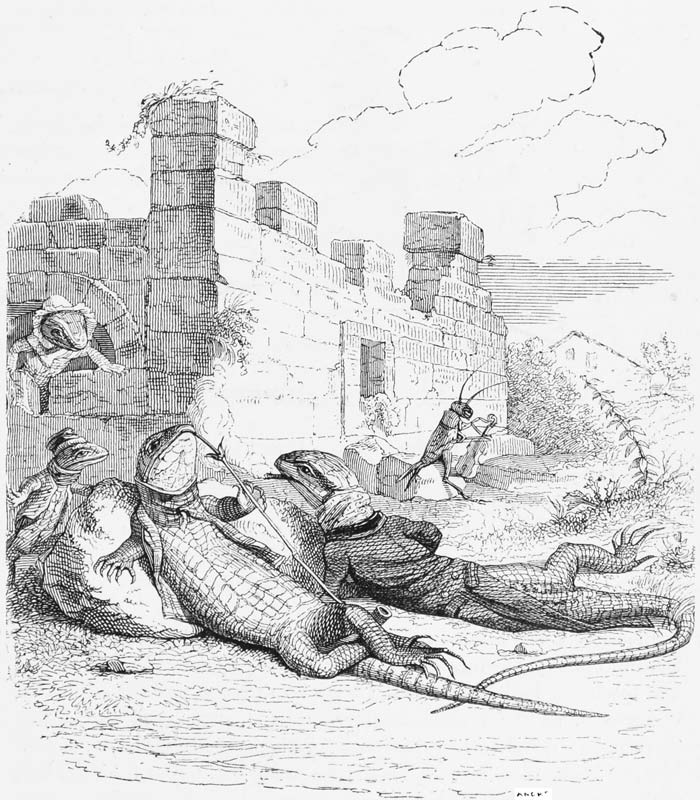
He instantly perceived, for he was an honest fellow, that his cold doubts wounded her sensitive nature, and a light warmer and brighter than the sun flashed from her eyes and took possession of him. He was conquered—he proposed, and they were married.
It always happens so with bachelors. It is the last straw that breaks the camel’s back, in love as in life.
Our hero still glories in the sunshine, and takes his ease stretched out before his own doorway.
HISTORY OF THE HOSTS OF THE TERRACE—Continued.
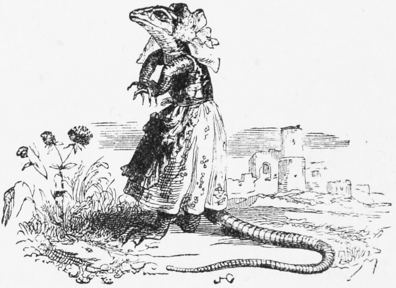
The Duchess was by nature a person born to be plump and healthy; to eat her food with the appetite of a country clown, and to enjoy drinking and dining with a savage relish. But she crushed and curbed these tendencies before the world, gratifying them only in secret. In token of her exalted station she professed sensitiveness and delicacy. She was frightened by the fall of a leaf, the flight of a bird or insect, and above all, by her own bulky shadow.
Before folk she uttered nothing but plaintive, feeble cries, reserving the full blast of her lungs for the ears of the Duke. The purest air was too heavy for this ethereal Owl, who detested the sun—the God of paupers, as she termed it—Her husband, astonished at the fine carriage, grace, and society-refinement of his poor barn-Owlet, exhausted his resources in efforts to keep pace with her. Alas! his highest flights left him far behind, so far, indeed, that his faithful spouse bemoaned and bescreeched her fate in being wedded to a person so hideously vulgar.
The Duchess eloped with a Kite, and no one pitied the Duke, for the fall brought by pride never begets pity.
As a finishing blow the lady left a perfumed note for her husband on the spot where they performed their moonlight duets on the terrace. It ran as follows:—
“THE DUKE,—It is part of my destiny to be misunderstood, I shall not therefore attempt to explain to you the motive for my departure,
“(Signed) THE DUCHESS OF THE TERRACE.”
The Duke stood petrified for some moments, after which, seized with a fit of despair, he rushed down to the edge of a dark pool, to ascertain whether the water would inspire him with courage to drown himself. First, he cautiously dipped his beak into the pool to feel its temperature, just as the moon stole out from behind a cloud, and he beheld his image on the surface. His mind at once grasped the frightful picture of his ruffled plumage, and he found sweet solace in arranging his toilet. The notion crossed his mind that the Duchess might repent, if she knew her Lord had died dressed in a style becoming his station.
Bracing his nerves for the fatal plunge, he bent over the pool at an unhappy moment, when it occurred to him, that birds about to die should think twice before they leap, and feel satisfied they have sufficient grounds for the sacrifice. Stepping backwards a few paces, he read his wife’s letter for the hundredth and first time.
“What a fool I am!” he exclaimed, “it is possible after all, I am imputing a wrong motive to my wife. There is no knowing; she may have simply gone to the country for a week’s repose, and will soon return.” In his doubts he determined to consult a Carp, reputed for her knowledge of past, present, and future, and many things besides. The misery of the world is the making of these sorcerers. Approaching the river he cried out, “Tell me my fate old fish famed for finding out facts of the future.” Slowly the Carp rose from the water—until her body was half way above the surface—and summoning a troop of piscine spirits, disposed them in a ring. Above floated circles of winged insects in the air, gleaming in the phosphorescent glow reflected from the scales of the water-witches. Dense clouds darkened the atmosphere, rendering the lurid light all the more intense; a profound stillness reigned, so hushed was the scene, that the Owl heard nothing, save the beating of his heart. The sorcerer placing herself in the centre of the ring, sent the spirits wheeling in a mad dance. After the third round, the Carp dived and brought up this reply,
“Your beloved wife is not dead!”
That said, she bent herself like a bow, kissed her tail, and bounding into the air, disappeared.
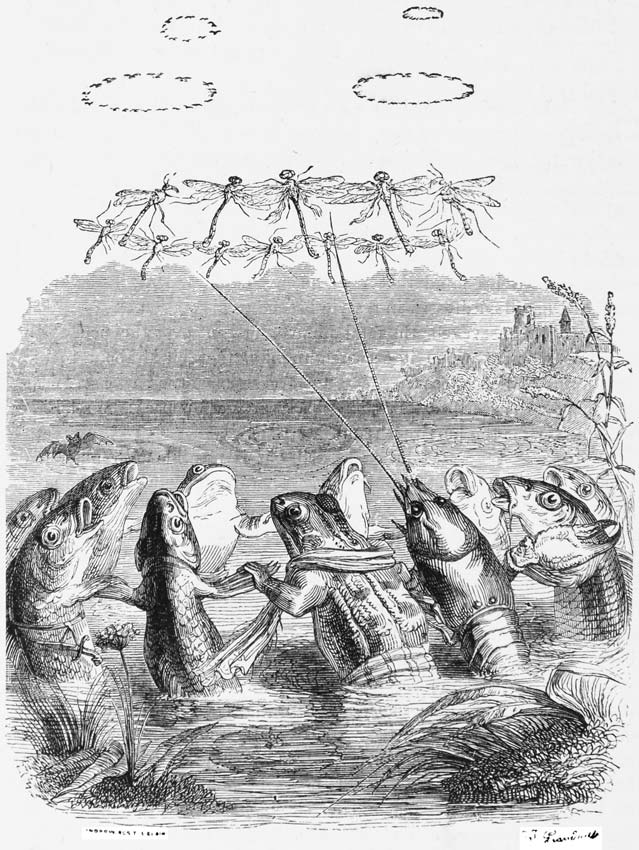
“She is not dead,” repeated the chorus. “Owl, it is said you must die!”
“She is not dead!” repeated the Owl.
“She must be!”——
“Well, never mind. To sacrifice a life so valuable as my own would not mend matters,” so he consigned the Carp and her oracle to the —— water.
I have been told that soon after these events, this rich, but weak-minded Owl poisoned himself with a Frog. That is how an Owl dies of love.
My tale ends here. I have plucked and used my last quill, and nothing remains but the stump. Age is telling on me, the effort to write seems too great. I must, therefore, see my physician.
LAST CHAPTER.
In which it will be shown that with beasts, as with men, one revolution follows another, and that they are all more or less alike in fair promises, and failures to fulfil them.
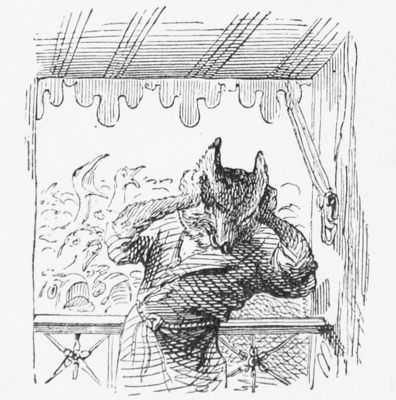
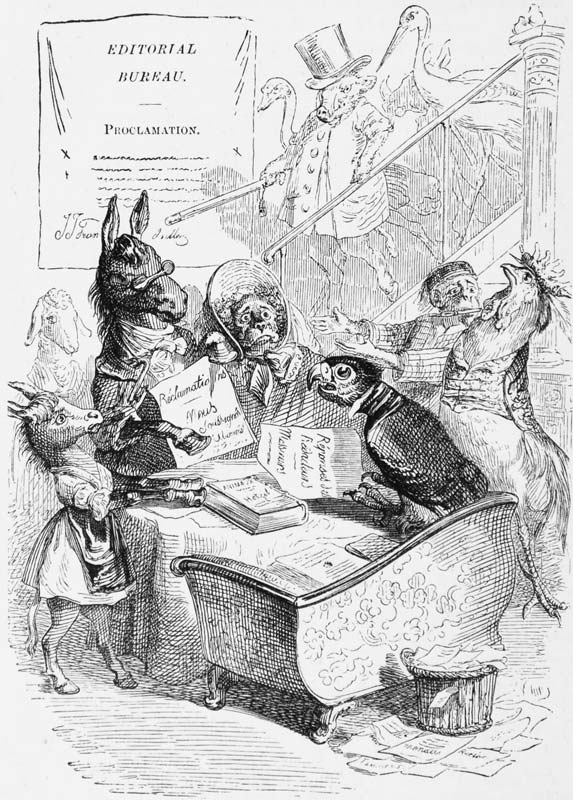
THE Animals were once more assembled, and the tumult of voices worse than ever. Each and all of them were clamouring for reform.
“Of what do you complain?” cried the Fox, addressing the crowd.
“If we only knew our grievances,” they replied, “we should not complain.”
“We do not know,” said a voice, “but if we examine we shall find out.”
“Examine them, by all means,” cried the Fox.
“What good have you done,” shouted the voice, “by compiling a one-sided history? Too much here, and too little there. Let us fight. A revolution will purge the kingdom.”
“That is all very well, my friend,” replied the orator, “but reason is better than haphazard revolution. You must have learned that by experience.”
“Gentlemen,” said the Weasel, coming to the aid of his accomplice, the Fox, “it is by practising deceit, we become perfect. Let us begin again.”
“I could have said so,” cried the Mocking-bird, “ink, ink, always ink; it blots out a multitude of sins where good actions would prove of no avail.”
“Bravo!” from all sides. “Down with the editors!”
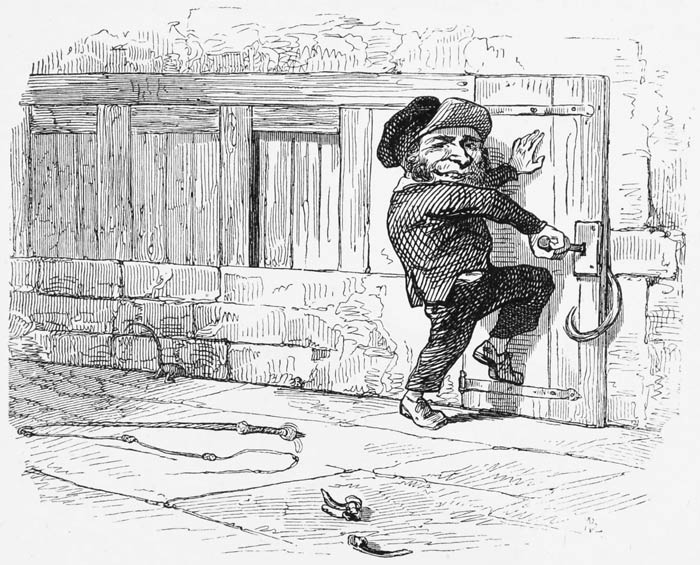
There was only one ink-pot in the room, and it was smashed.
“It is not good for us to be here,” said the Weasel to the Fox; “people invariably stone their prophets. Let us go hence!”
The volume was closed, the animals dispersed, for the keeper appeared on the scene to lock the door.
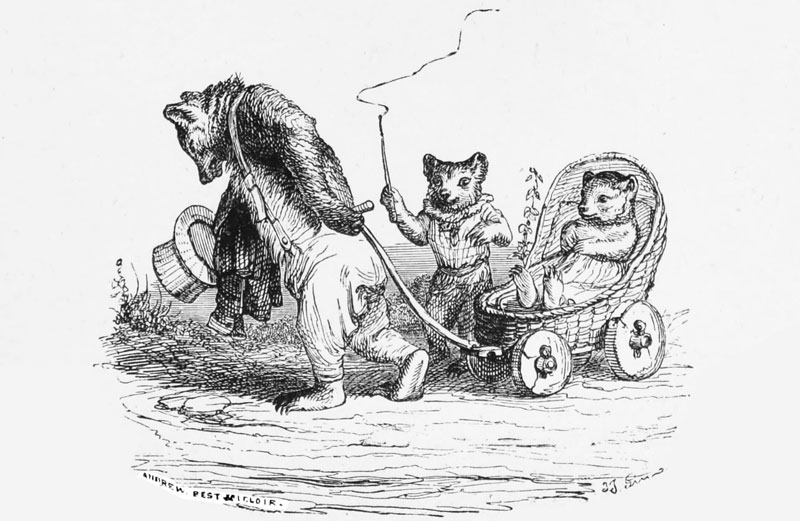
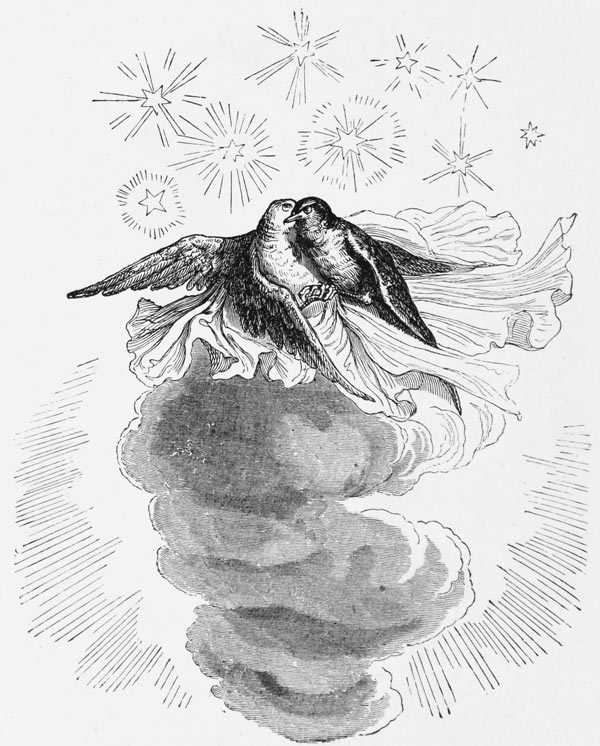
The Ringdoves mounted to their clouds; the Bear departed with his cubs; the Doves ascended heavenward; while Tortoises, Beetles, Bats, Shrimps, and Apes danced round a bonfire of rejected manuscripts.
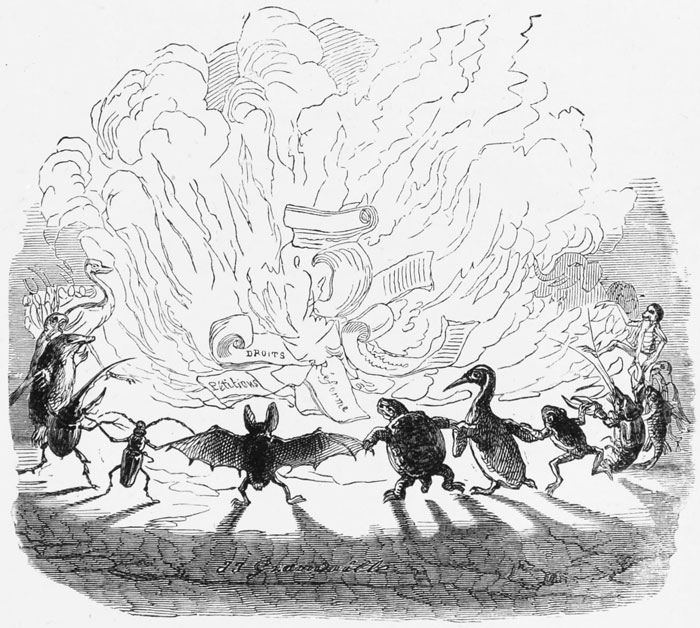
THE END.
PRINTED BY BALLANTYNE, HANSON AND CO.
EDINBURGH AND LONDON
TRANSCRIBER’S NOTE
Original spelling and grammar have been generally retained, with some exceptions noted below. Original printed page numbers are shown like {52} in the text edition, and are hidden in the html, epub, and mobi editions. The transcriber produced the cover image and hereby assigns it to the public domain. Original page images are available from archive.org—search for “b28131885”.
Page 61. On this page occurs the second heading 〈IV.〉. This and subsequent headings in the series have been retained.
Page 74. Added 〈s〉 to 〈it〉 in 〈I resolved never again to quit it shore〉.
Page 135. Added right single quotation mark after 〈depriving her of her dearest illusions.〉.
Page 137. Changed 〈therefore miserable fox.”〉 to 〈therefore miserable fox.’ ”〉. Added right double quotation mark after 〈Bashi-Bazouk in Bulgaria.〉.
Page 140. Added right double quotation mark after 〈So-and-so, captain of a ship, &c.?’〉.
Page 142. Changed full stop to comma in 〈elucidation of Comparative Instinct.〉.
Page 147. The name 〈Gobtouswell〉 was spelled 〈Gobtonswell〉 on page 143.
Page 158. Changed single quotation mark in 〈continued my master. ‘Mada”—〉 to left double quotation mark.
Page 172. Inserted right double quotation mark after 〈delighted with the result〉.
Page 181. Changed double quotation mark in 〈A popular writer passing, remarked, “These〉 to left single quotation mark.
Page 184. Changed 〈hardy〉 to 〈hardly〉 in 〈I can hardy call my Dog〉.
Page 185. Added right single quotation mark after 〈the club are everything.〉.
Page 187. Inserted right single quotation mark in 〈if you cannot save all, save the treasury!”〉, just before the ending double quotation mark.
Page 191. Changed the double quotation mark to single in 〈“with your face〉 and in 〈make life happy!”〉. Added left single quotation mark ahead of 〈I no longer love wild〉.
Page 194. Judging by the artist's signature, the illustration was flipped horizontally before printing. It has been retained as printed.
Page 204. Added right double quotation mark after 〈I have acquired this honourable embonpoint.〉.
Page 261. Changed section heading from 〈IX.〉 to 〈VIII.〉. Inserted right double quotation mark after 〈of her lover.〉.
Page 275. Changed 〈analagous〉 to 〈analogous〉. Inserted right double quotation mark after 〈of red-royal blood.〉.
Page 292–293. Four signatures 〈BÉBÉ.”〉 or 〈MINETTE.”〉 were originally printed inset and right-aligned in the last paragraphs of the relevant letters. Due to the inability of html code to accomplish that reliably in the epub or mobi editions, these signatures have been converted to separate paragraphs, with left double quotation mark added to preserve grammatical punctuation.
Page 337. Removed right double quotation mark after 〈reason of my sadness.〉.
Page 374. Added right double quotation mark after 〈on the king’s highways.〉.