SCENE VI. STITCH-GNAWER AND LITTLE TROTTER. (continued 3)
Reading edition
The closing words of this speech were listened to coldly, the respect due to the speaker alone preventing a demonstration.
“Civil war leads to despotism and not to liberty,” said the dean, as he sadly resumed his seat.
“Are we here to listen to a sermon?” roared the Lynx.
A number of agitators followed. It is necessary here to remark that the more indifferent the cause to be advocated the greater the crowd of speakers.
The Boar proceeded to address the assembly in a flow of eloquence, until domestic duties called him to the bosom of his numerous family.
Here we end our quotations from the “Journal of Reform,” and in justice to the rioters, will conclude with a literal account of the proceedings, furnished by a Ferret who was present at the meeting.
“For three hours the rioters, irrespective of the place, or the sacred presence of the dead around, kept up an incessant thunder of inarticulate sounds, stamping, groaning, and applauding. Sixty-three speakers addressed the audience simultaneously. The result of this tumult of voices may be more easily imagined than described.”
Our correspondent adds: “The art of whistling and howling has made such astonishing progress among the audience as to suggest a mass meeting in England!”
One of those doubtful dogs who have no political opinions, and who are to be found in every popular assembly attempted to gain a hearing.
“If we are vanquished!” he said.
“Vanquished! bah! Out with the cur!” cried the Bear, with that air of brutality so peculiarly his own.
“Out with him!” growled the Hyena; “barking is not enough, we must bite!”
“Beware of the spy,” shrieked the Weasel.
The prudent brute waiting to hear no more, tucked his tail snugly between his legs and bolted through a window.
Here the Ram ventured to point out that the editors had gained the confidence of the people.
“Popularity is no proof of genius,” said the Wolf. “The people will forget their idols.”
“And hate them,” growled the Hyena.
“If they neglect their love, they will nurse their hatred!” hissed the Snake.
The Fox perceiving that unanimity of sentiment was hopeless, adjourned the meeting by proposing that the rioters should refresh themselves by a night’s repose. So they departed each one to his den, and there dreaming of reform and rapine, rose with the sun to renew the conflict. They awoke to arms and assaulted the amphitheatre. The onslaught was severe, and in our extremity we inquired for Prince Leo.
“They have taken the amphitheatre,” said that great general, “and what is more they shall keep it.”
The prince’s firm attitude proved reassuring, for this renowned tactician had taken timely measures to teach the traitors a terrible lesson. He shut them in and secured the approaches, so that the stronghold was like to become the tomb of the insurgents. All attempts to relieve their position were vigorously repulsed by Prince Humble-Bee.
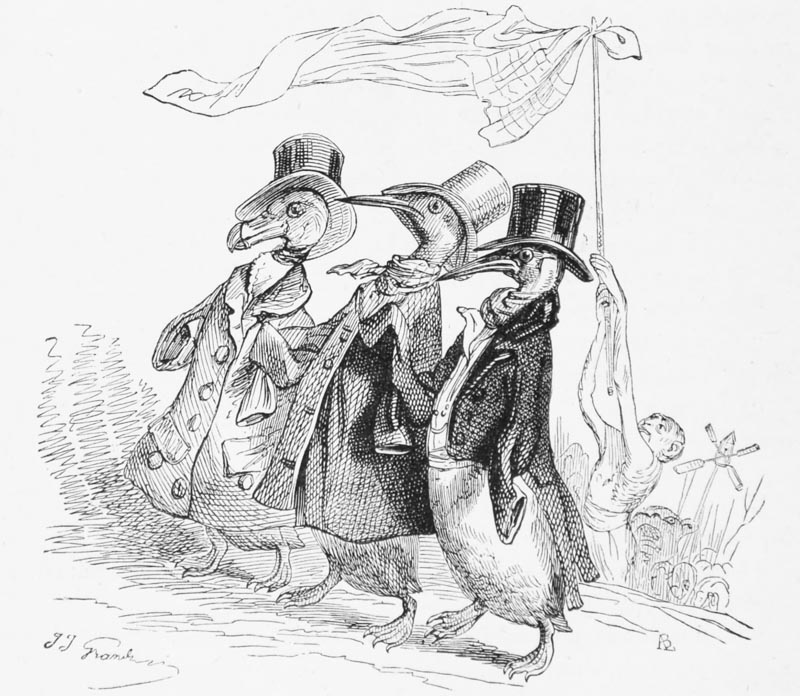
An audacious Ape mounted the amphitheatre roof and raised the standard of revolt; while a Mole proposed to entrench the army within its hill. The proposal was negatived, as the position was deemed already too strong.
A celebrated engineering Spider offered to spin a suspension bridge over which the insurgents might escape during the night. To this the Fly objected, while the Elephant urged that the work should be at once proceeded with.
The extraordinary simplicity of this giant of the forest inspired one of our friends with the idea for the following couplet, which we gladly insert (as it ought not to be lost to posterity), regretting, at the same time, that the gifted poet insists on remaining anonymous:—
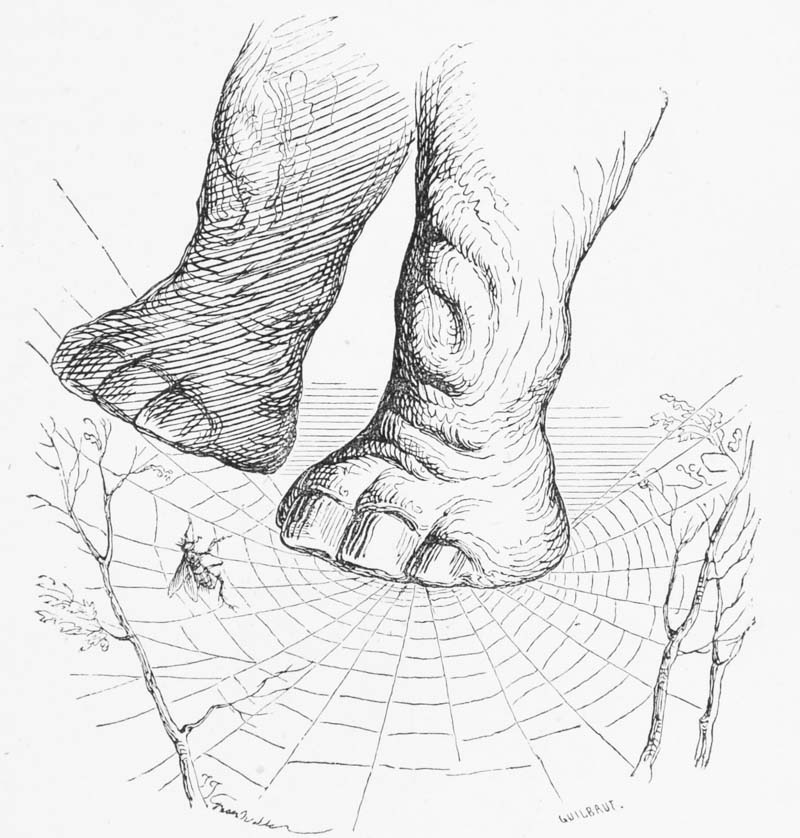
AIR—“Femmes, voulez-vous éprouver.”
“Un Éléphant se balançait
Sur une toile d’Araignée;
Voyant qu’il divertissait,
Une Mouche en fut indignée:
‘Comment peux-tu te rejouer,’
Dit-elle, ‘en voyant ma souffrance
Ah! viens plutôt me soucourir,
Ma main sera ta recompense.’ ”
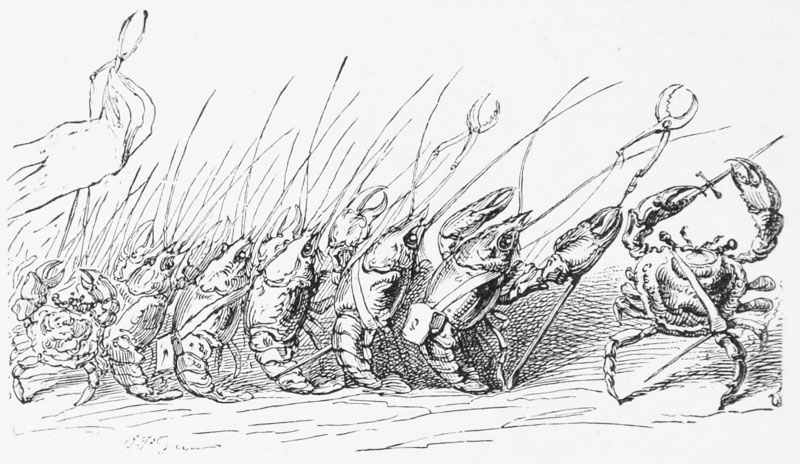
We secured a number of brave auxiliaries in the shrimps, who, headed by a valiant sea-crab, shouted, as they formed into marching order—
“Forward let us march
With our backs upon the foe.”
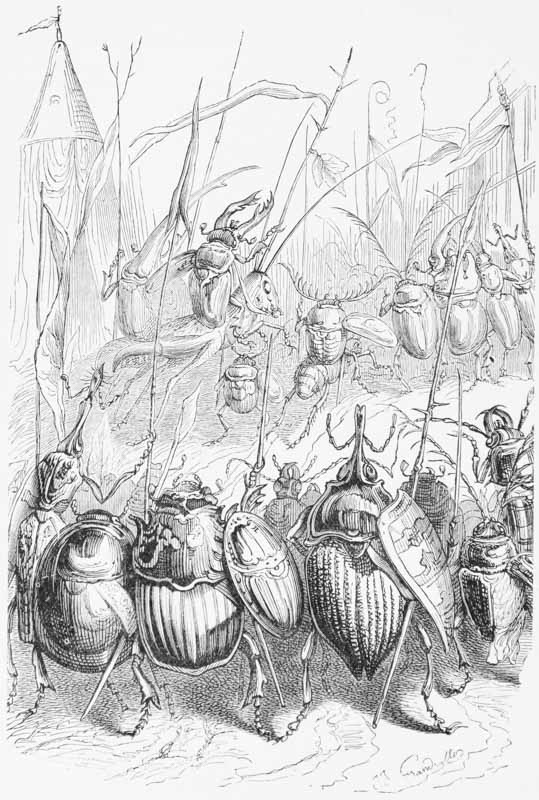
All good citizens were ordered to leave wife and children, and prepare to be everywhere at a moment’s notice, ready to fight for their country. Notwithstanding the happy stratagem which shut in the rebels, we were doomed to defeat. A company of the enemy’s flies, mechanics, were drafted to place the guns so as to command our position. The coolness of these creatures, foes though they were, won our admiration. They planted the weapons with an unconcern as complete as if preparing to storm the calix of a flower, while the result of their manœuvres soon told terribly on our left wing. Our swarms, impatient for the fray—displaying more valour than discretion—fell upon the foe in disorganised detachments. The right attacked the enemy’s left under the leadership of the Goliaths, but the light infantry under Prince Humble-Bee were as waves against a rock scattered in boiling foam. Our left was opposed by the mining, cutting, and carpentering Andrines, and the corporation of Rhinoceros-Beetles, who having only one horn, obeyed the mighty two-horned Stags. Flies, Moths, Grubs, and other insects attacked and routed our centre. Prince Humble-Bee calculated on the Rhinoceros-Beetles attacking his heavy troops, compelling them to traverse the field, separating the two armies; but the Beetle, who had been apprised of the plan of campaign by a deserter, commanded his troops to close their ranks and their wings, thus to await the enemy’s shock.
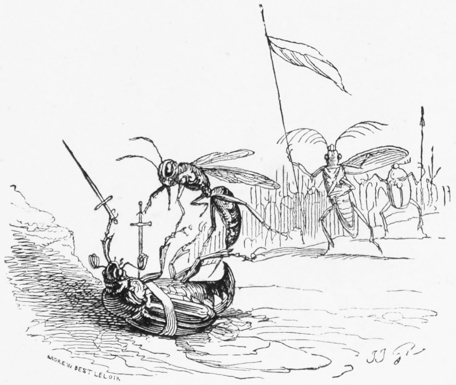
The colours floated in the wind, the sun shone brightly on the insects ranged in battle array, while martial music fired our foes with desperate resolve. From time to time grains of balsam, projected into the air by Stag-Beetles with much precision, fell among our troops, exploding and scattering death and dismay around. The enemy’s forces stood firm as a rock. Our army, thoroughly demoralised, made a final attack, and were beaten off with great loss. Bruised wings, scattered mandibles and limbs impeded their movements, till at last they fell back in disorder. As a climax to our misfortunes, the general of the May Bugs, rolling over on his back, was pierced by the sting of a rebel Wasp. It was a lost battle—the Waterloo of our cause! Prince Humble-Bee, not caring to survive his defeat, plunged into the thick of the fray, when, after performing prodigies of valour, he died the death of the brave, pierced by twenty-nine wounds.
Notes by the Office-Boy.
Knowing the anxiety of my chiefs to keep our readers posted up in news, I take the liberty of writing in my turn, and shall go on until I am arrested.
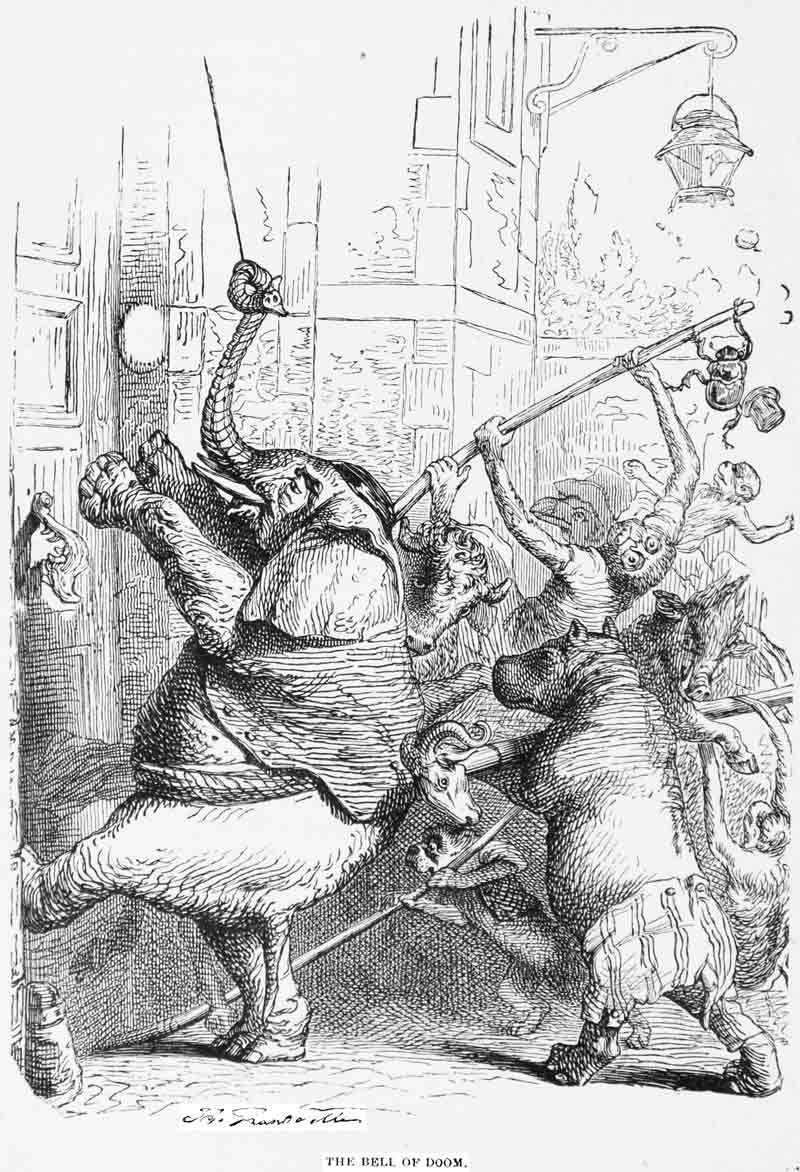
My masters had just finished speaking, when the door flew to atoms. The Elephant had rung out the hour of doom at the door bell, and shivered the door with his foot. The pen fell from Mr. Parroquet’s claw, and his eyes closed as if in deep thought.
“What do you see?” he inquired of Mr. Cock, who stood at the window.
“I see trouble upon trouble; we are menaced on all sides! Confound them!!” cried he bravely; “why should we yield?”
“Yield only to reason!” said the Monkey; “never to force!”
“What!” crowed the Cock, jumping on the back of the Ape; “you cowardly, man-like animal, reason would tempt you to yield up your post?”
“No doubt about it,” replied the Ape, who became as livid as this paper; “if I am”——
He had no time to finish his sentence; the cabinet door flew open and the Fox entered.
“Arrest these gentlemen,” said he to the Dogs who followed him, pointing to the trio of editors.
The Parroquet flew up the chimney, the Monkey hid beneath his arm-chair, while the Cock stood defiant, his comb never having assumed a hue so red. They were arrested.
“What are you doing here?” said the Fox to me.
“Whatever you choose, my lord,” I replied.
“Well, remain here,” he continued.
Many others had entered with the speaker, and shouted, “Long live my lord the Fox!” They were right, for never had I beheld so affable a prince.
“My friends,” he said, “nothing in this office is changed; only one additional animal appears.” (Cheers.)
The Fox, taking up the abandoned pen of the Ape, sat down to write his first proclamation.
FIRST PROCLAMATION.
“Inhabitants of the Jardin des Plantes, the editors having been removed, all cause for disorder has ceased.”
“THE FOX,
“Provisional President and Editor.”
“Read and sign this document,” said he to the ex-editors.
Whereupon the Cock replied, “Sir, I shall not dishonour myself by such a treacherous act.”
“We shall see,” replied the Fox.
He then proceeded to draw up another proclamation.
SECOND PROCLAMATION.
“Citizens, while you were asleep you were being betrayed, but friends were watching for you. Too long had we bowed our heads without murmuring; the time had come for us to assert our dignity. The traitors who governed and sold you breathe no more! The records of our nation will teach the world how the animal kingdom redresses its wrongs. During this hour justice has been executed, the work is finished, the culprits have paid with their lives the penalty of their guilt—they have been hanged!
“N.B.—Out of sacred regard for our ancestors who suffered the extreme penalty of the law, they have been hanged on new gibbets.
“THE FOX.”
The Cock listened unmoved to the reading of this second document.
“But,” said the Monkey, “my lord, we are not hanged.”
“Are you really thinking of hanging us?” cried the Parroquet, weeping at the prospect.
“No,” replied the Fox, “it is a proceeding I do not care to carry out, only you must appear to have been hanged.”
The shouts of the populace outside could be plainly heard, demanding the heads of the editors.
“Patience,” replied the Fox, addressing the people from time to time—“patience, if you are wise. You shall have some medals to commemorate this event. [Aside.] To refuse nothing, and to give nothing, is the way to govern wisely and well.”
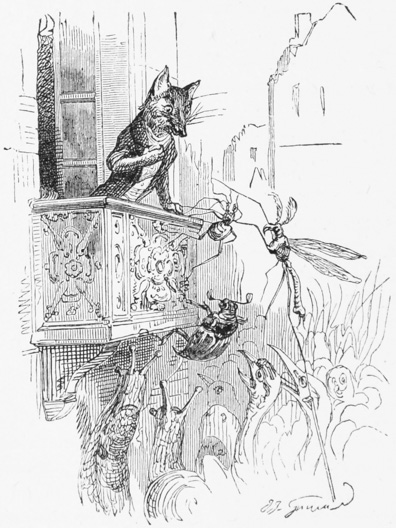
The shouts, “Death to the tyrants!” “Death to the editors!” redoubled.
“You hear, gentlemen,” said the Fox. “It is necessary to do something for the people; yet,” he added, “if you can find means to deceive them by preserving your lives, you may do so.”
“Means!” screamed the Monkey; “I have found them,” and in his joy he turned three somersaults.
Mr. Monkey had got possession of the stuffed body of an ancestor, no doubt with the intention of honouring his race. He at once produced the relic, and it was decided that this defunct relative should figure on the gibbet in place of his erring descendant. To better deceive the multitude, before sending the mummy to martyrdom the Monkey attired it in his coat and well-known cap; this he did, not without tokens of genuine grief.
“Now, my dear sir,” continued the Fox, “you must seek retirement for fifteen days, after which I think you may venture to show yourself again. There is no dead man or monkey who in Belle France has not the right to come to life audaciously at the end of a fortnight. The people are the most magnanimous of enemies—they forget everything.”
“They are also the most fickle friends,” replied the Ape; then, casting a last fond look on his boxes, his table, and his office, he vanished.
The Parroquet found means of communicating with an old friend, an ardent admirer of his talent, who volunteered to be hanged in his stead. A quarter of an hour after the execution, the ungrateful Parroquet was joking with his wife about the folly of martyrdom.
The Cock, who remained true to his principles, suffered death, much to the regret of a numerous circle of female admirers.
The crowd, drawn together with the view of seeing such mighty personages dangling in the air, had its wish gratified. Some silent worshippers of the illustrious dead could scarcely believe their eyes.
“Is it possible,” they said, “that animals of such influence can be hanged like common felons? What is the world coming to? They, only the other day, seemed to be the mainsprings of life!”
A bird whose name remains unknown published a pamphlet on this subject, in which he developed this proposition: “Is it good that he who governs is not the State? for should misfortune befall him, there would be an end to the State.”
After the executions had taken place the Fox thought proper to make the two proclamations public, and being in a mood for proclamations, issued a third.
THIRD PROCLAMATION.
“Inhabitants of the Jardin des Plantes, invested by your confidence with a post so important as that of directing the second and last part of our National History, it is needless here to expose the principles which obtained for me your suffrage. It is by my work you shall judge me. I shall make no pledges, although pledges cost nothing. I shall not tell you that the golden age is about to begin for you, whatever the golden age may be; but I can assure you that when you find neither pen, ink, nor paper in my office, it will be because they are not to be had at any price. My advice for all is to observe justice and sincerity. Remember, were these words blotted out of the dictionary, you would still find them indelibly engraved on the heart of a Fox.
“Your brother and director,
“THE FOX.”
The effect of these proclamations, which were circulated everywhere, was almost magical. Perfect tranquillity reigned; the politest civilities were exchanged by all; a little dust sprinkled over the dead, and one would imagine that neither war nor bloodshed had ever disgraced this smiling land. Some disagreeable animals who sneak about and ferret out everything, having no fault to find with the chief editorship of the Fox, inquired by whom he had been elected chief? What can it matter to them, so long as he has been elected? One names one’s self, but one is no less editor-in-chief for all that.
My lord, casting his eyes over my work, was pleased to inform me that I gave him satisfaction, and that he intended to recompense me. Yesterday I was office-boy, to-day I am His Highness’s private secretary! Yesterday my feet were trod on, to-day they are licked! I am evidently somebody, and can do something. I embraced the occasion to inform him I had been yard-dog in a college.
“I congratulate you on your university training. Even if one knows nothing on leaving the walls of such an institution, one is credited with profound knowledge. The important part of life consists not in being, but in appearing to be.”
It is said that I sold myself; it is a mistake, I was bought, that was all. Besides, the advantageous post just given to me belonged to no one; it was made expressly for me. There is a ring at the bell, it is a deputation of animals.
“We come,” said the chief of the deputation humbly, “to represent to your Highness that something is wanting in our glorious constitution.”
“What?” said the Fox.
“Sir,” replied the deputy, “what will posterity say to our pulling through a revolution without eating or drinking?”
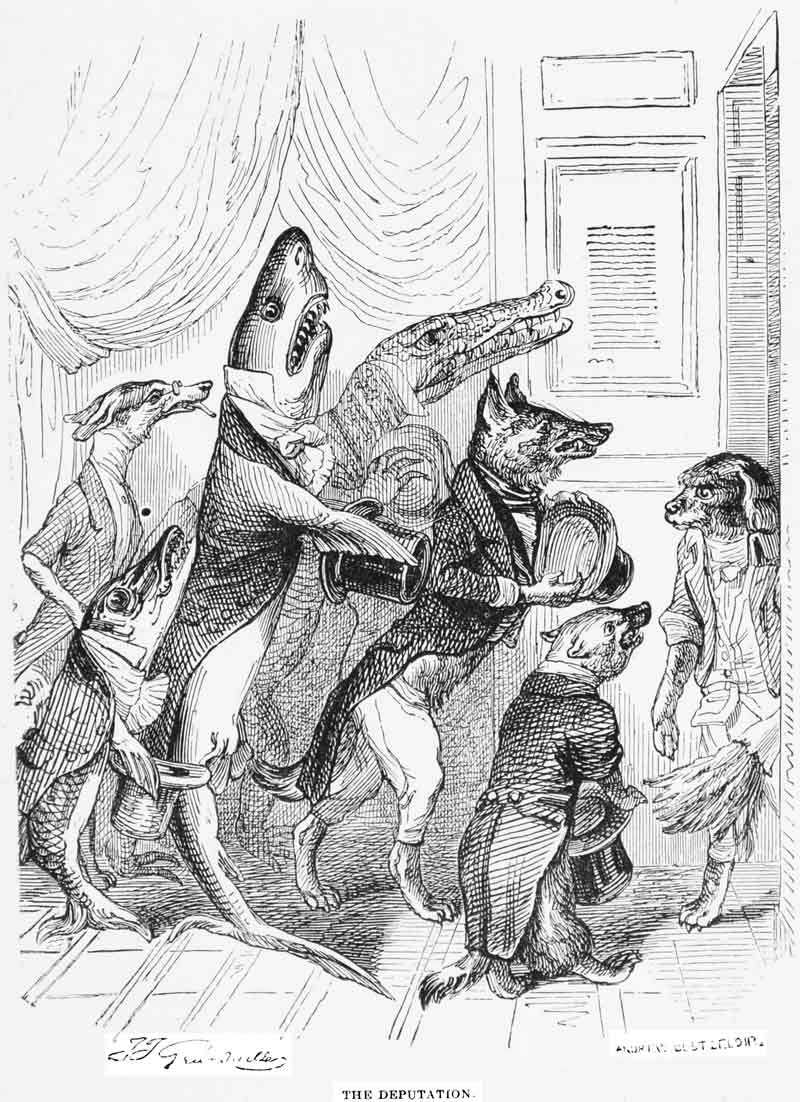
“Gentlemen,” said His Highness President Fox, “I note with pleasure your attention to important details, and that the country may rely upon your practical common sense. Go and dine.”
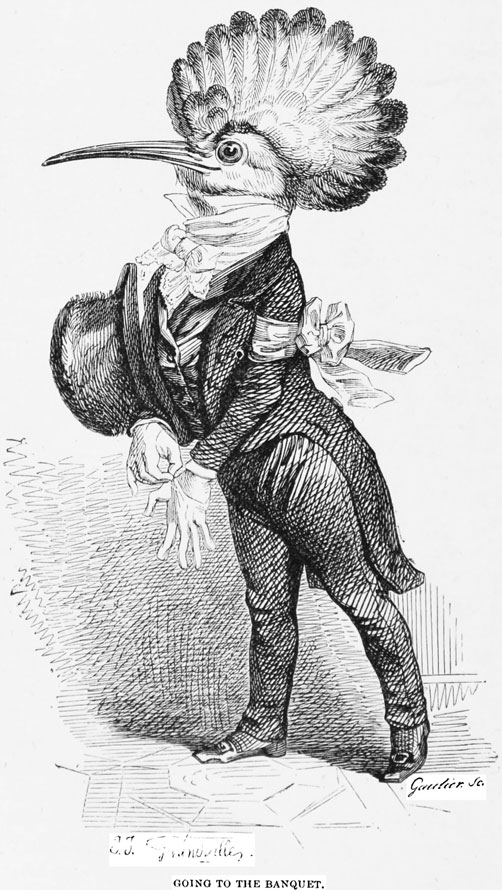
A great public dinner was prepared, in token of rejoicing, in a field in front of the amphitheatre. As on all similar occasions, there was much speech-making and little food, at least for many of the most deserving supporters of the republic. The Insects were relegated to an obscure position, politely called the place of honour, where they feasted on fine phrases. In consideration of his position, the Fox, as President, was supported by a Duck and Indian Hen, who kept a respectful distance from His Excellency. It was a most amicable gathering. The views expressed were as diverse as the individuals present. One said white, another black; one red, another green; and all agreed that the speakers were the living representatives of worth, genius, and national progress. The Fox was everything to every one. He had a smile and kind word for each guest. “You do not eat,” he said to the Cormorant. “Are you ill?” to the White Bear; “you seem pale.” To his vis à vis, “Have the Wolves no teeth now?” To the Penguin, who was yawning, “You require rest after your exploits.” To the Blackbird, “You seem silent.” And to all, “My good friends, use your pens freely.” At last came the toasts, the time for oratorical display. You should have watched how each one retired within himself, scratched his head or pensively caressed his tail as a means of inspiration, how each silently rehearsed his little speech. Unfortunately the order of the toasts had been arranged beforehand—not only the order, but the number as well. Splendid fasting might be forgiven, but the cancelling of a cherished toast—never! In spite of this wise precaution, there were so many speakers that my pen and patience alike failed to enumerate them. As may be imagined, the first toast was Liberty; this is traditional, and it is no fault of those who dine if liberty makes a poor show on such occasions. By courtesy the second was the Ladies, couched in these terms, “To the sex that adorns and ennobles life!” This toast, proposed by an amiable Hippopotamus well known for his gallantry, was greeted with applause.
Towards the close of the evening wine flowed freely, and as the contents of the cask fell, the spirits of the party rose to that pitch when all things earthly seemed steeped in the roseate light of a glorious dawn. The repast ended like all others of the kind, when the face of the universe is proposed to be changed, and the world forced backwards by eating and drinking. But the morning revealed the marvellous fact that the world still revolved in its old way, and that recourse must again be had to the common, traditional, time-honoured modes of life, at least so thought the Fox, who replaced his cap by a little crown, declaring at the same time that in future he would shun popular feasts as he would the devil.
“I am about to draw up a charter. A nation that has a charter wants for nothing. Here is my charter:—
“All animals who can read, write, and especially count, who have hay in their racks, and powerful friends, being all equal before the law, shall receive protection. The great ones of the Jardin des Plantes may therefore enjoy their ease. The lesser ones are requested to give up what little they have, and to become so small as to be imperceptible and impalpable.
“It is impossible to please every one; those who are displeased ought not to be astonished, as they have a right to complain. The right of drawing up petitions is solemnly recognised. But as it is well known that the moments of a ruler are precious, and as it would be impossible for him to receive all the petitioners, it is forbidden for any one to bring his petition to the august arm-chair. They will only be received when sent by post, postage prepaid, and will only be read when convenient to do so.”
The animals required no second telling. Every one having some source of complaint, petitions arrived in cartloads. The earth and air were thronged with messengers and couriers of every description. The charter had not been published two hours before the house, cellars, and lofts were packed full of petitions. They were even piled up against the outside door.
“Fools!” said the Fox, laughing in his sleeve to see they had taken him at his word. “How long will they imagine that governments are made to protect them? Yet I must look at these petitions, and in order to observe the strictest impartiality, will close my eyes.”
He opened one written by a Bittern, signed and crossed by many supporters. It ran as follows:—
“The undersigned declare that they have had enough of civil discords and of preliminary proceedings, and suggest that the white Blackbird should now be called upon to relate his history.”
“I like this petition,” said the Fox, “as it enables us to dispense with opening the others. The others may make a bonfire.”
No sooner said than done. They were burned.
HISTORY OF A WHITE BLACKBIRD.
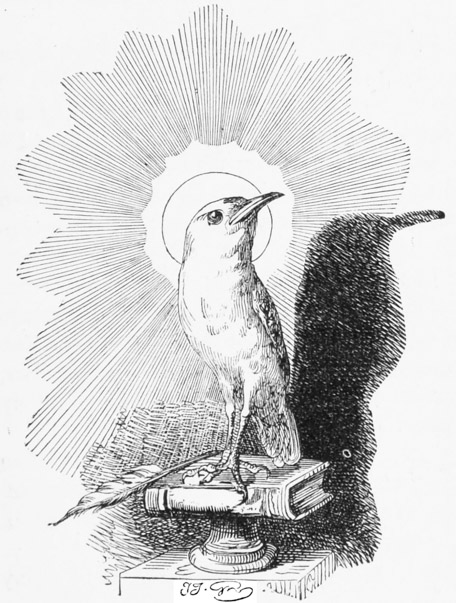
HOW glorious and yet how painful it is to be an exceptional Blackbird! I am not a fabulous bird. M. de Buffon has described me. But, alas! I am of an exceedingly rare type, very difficult to find, and one that ought, I think, never to have existed.
My parents were worthy birds, who lived in an old out-of-the-way kitchen-garden. Ours was a most exemplary home. While my mother laid regularly three times a year, my father, though old and petulant, still grubbed round the tree in which she sat, bringing her the daintiest insect fare. When night closed round the scene, he never missed singing his well-known song, to the delight of the neighbourhood. No domestic grief, quarrel, or cloud of any sort had marred this happy union.
Hardly had I left my shell, when my father, for the first time in his life, thoroughly lost his temper. Although I was of a doubtful grey, he neither recognised in me the colour nor the shape of his numerous posterity.
“This is a most doubtful child,” he used to say, as he cast a side glance at me, “neither white nor black, as dirty-looking as he seems ill-begotten.”
“Ah me!” sighed my mother, who was always coiled up in a ball on her nest. “You yourself, dear, were you not a charming good-for-nothing in your youth? Our little pet will grow up to be the best of our brood.”
While taking my part, my mother felt inward qualms as she saw my callow down grow to feathers; but, like all mothers, her heart warmed to the child least favoured by nature, and she instinctively sought to shield me from the cruel world.
When I was moulting, for the first time my father became quite pensive, and considered me attentively. While my down fell off he even treated me with some degree of favour, but as soon as my poor cold wings received their covering, as each white feather appeared, he became so furious that I dreaded his plucking me alive. Having no mirror, I remained ignorant of the cause of his wrath, and was at a loss to account for the studied unkindness of the best of parents. One day, filled with joy by a beam of sunlight and the warmth of my new coat, I left the nest, and alighting in the garden, burst into song. Instantly my father darted down from his perch with the velocity of a rocket.
“What do I hear?” he cried. “Is that meant for a Blackbird’s whistle? Is it thus I sing? Do you call that song?”
Returning to my mother with a most dangerous expression lurking round his beak, “Unfortunate! who has invaded our nest? who laid that egg?”
At these words my good mother jumped from her nest fired by proud resentment. In doing so she fell and hurt her leg; she wished to speak, but her heart was too full for words. She fell to the ground fainting.
Frightened and trembling, I cast myself at my father’s feet. “O my father!” I said, “if I whistle out of tune, and am clothed in white, do not punish my poor mother. Is it her fault that nature has not tuned my ear like yours? Is it her fault that I have not your yellow beak and glossy black coat, which recall a sleek parson swallowing an omelette? If Heaven has made me a monster, and if some one must bear the punishment, let me be the only sufferer.”
“That is not the question,” said my father. “Who taught you to whistle against rule?”
“Alas! sir,” I said humbly, “I whistled as best I could, because my breast was full of sunshine and stomach full of grubs.”
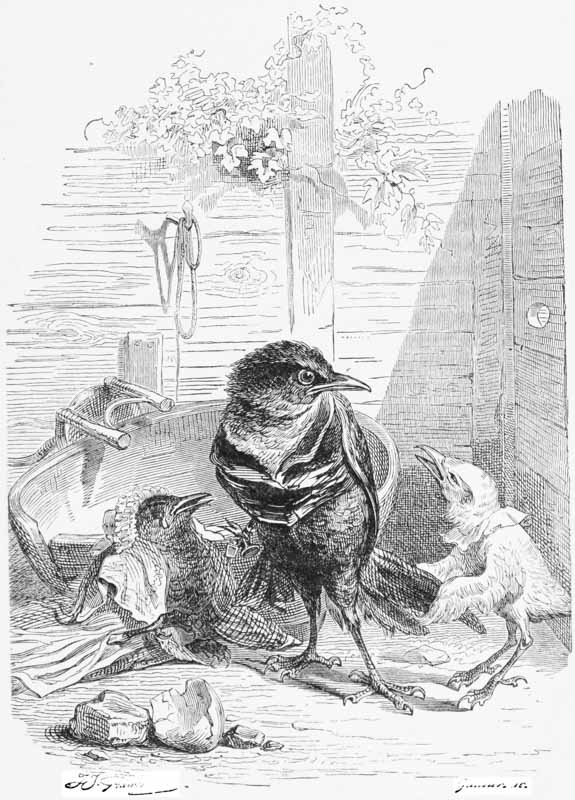
“Such whistling was never known in my family,” he replied. “For untold centuries we have whistled, from father to son, the notes alone by which we are known. Our morning and evening warblings have been the pride of the world since the dawn that awoke us to the joys of paradise. My voice alone is the delight of a gentleman on the first floor and of a poor girl in the attic of yonder house. They open their windows to listen to me. Is it not enough to have your whitened clown-at-a-fair coat constantly before my eyes? Were I not the most pacific of parents, I should have you plucked and toasted on the poor girl’s spit.”
“Well,” I cried, disgusted with my father’s injustice, “be it so, I will leave you—deliver you from the sight of this white tail you are constantly pulling. As my mother lays three times a year, you may yet have numerous black children to console your old age. I will seek a hiding-place for my misery; perchance some shady spout which shall afford flies or spiders to sustain my sad life. Adieu!”
“Please yourself,” replied my father, who seemed to enjoy the prospect of losing me; “you are no son of mine—in fact, you are no Blackbird.”
“And who may I be, pray?”
“Impossible to say; but you are no Blackbird.”
After these memorable words, my unnatural parent with slow steps left me, and my poor mother limped into a bush to weep. As for myself, I flew to the spout of a neighbouring house.
II.
My father was heartless enough to leave me in this mortifying situation for some days. In spite of his violence he was naturally kind-hearted, and had he not been prevented by his pride, he would have come to comfort me. I saw that he would fain forgive and forget, while my mother’s eyes hardly left me for an instant. For all that, they could not get over my abnormally white plumage, and bring themselves to own me as a member of the family.
“It is quite evident I am not a Blackbird,” I repeated to myself, and my image, reflected in a pool of water in the spout, confirmed this belief.
One wet night, when I was going off to sleep, a thin, tall, wiry-looking bird alighted close by my side. He seemed, like myself, a needy adventurer, but in spite of the storm that lifted his battered plumage, he carried his head with a proud and charming grace. I made him a modest bow, to which he replied with a blow of his wing, nearly sweeping me from the spout.
“Who are you?” he said with a voice as husky as his head was bald.
“Alas! good sir,” I replied, fearing a second blow, “I have no notion who I am; I imagine myself to be a Blackbird.”
The singularity of my reply, together with my simple artlessness, interested him so much that he requested me to tell him my history, which I did.
“Were you like me, a Carrier-Pigeon,” said he, “all the doubtings and nonsense would be driven out of your head. Our destiny is to travel. We have our loves—we also have our history; yet I own I don’t know who my father is. To cleave the air, to traverse space, to view beneath our feet man-inhabited mountains and plains; to breathe the blue ether of the sky, in place of the foul exhalations of the earth; to fly like an arrow from place to place, bearing tidings of peace or war,—these are our pleasures and our duties. I go farther in one day than a man does in six days.”
“Well, sir,” I replied, a little emboldened, “you are a Bohemian bird.”
“True,” he said; “I have no country, and my knowledge is limited to these things—my wife, my little ones; and where my wife is, there is my country.”
“What have you round your neck?”
“These are papers of importance,” he replied proudly. “I am bound for Brussels with news to a celebrated banker which will lower the interest of money one franc seventy-eight centimes.”
“Ah me!” I exclaimed, “you have a noble destiny. Brussels must, I suppose, be a fine city? Could you not take me with you? as I am not a Blackbird, perhaps I am a Carrier-Pigeon.”
“Were you a Carrier you would have returned my blow.”
“Well, sir,” I continued, “I will return it, only don’t let us quarrel about trifles. Morning dawns and the storm has abated, pray let me follow you. I am lost, have no home, nothing in the world; should you leave me, I shall destroy myself in the gutter.”
“Come along, follow me if you can.”
Casting a last look at the garden where my mother was sleeping, I spread my wings and away I flew.
III.
My wings were still feeble, and while my guide flew like the wind, I struggled along at his side, keeping up pretty well for some time. Soon I became confused, and nearly fainting with fatigue, gasped out, “Are we near Brussels?”
“No, we are at Cambray, and have sixty miles to fly.”
Bracing myself for a final effort, I flew for another quarter of an hour, and besought him to rest a little as I felt thirsty.
“Bother! you are only a Blackbird,” replied my companion, continuing his journey as I fell into a wheat-field.
I know not how long I lay there. When at last I made an effort to raise myself, the pain of the fall and fatigue of the journey so paralysed me that I could not move. The dread of death filled my breast when I saw approaching me two charming birds, one a nicely-marked coquettish Magpie, the other a rose-coloured Ringdove. The Dove stopped a few paces off and gazed on me with compassion, but the Magpie hastened to my side, saying, “Ah, my poor child, what has befallen you in this lonely spot?”
“Alas! madam, I am a poor traveller left by a courier on the road; I am starving.”
“What do I hear?” she exclaimed, and flew to the surrounding bushes, gathering some fruits, which she presented on a holly leaf. “Who are you?” she continued; “where do you come from? Your account of yourself is scarcely to be credited; you are so young, you have only cast your down. What are your parents? how is it they leave you in such a plight? I declare it is enough to make one’s feathers stand on end.”
While she was speaking I raised myself a little and ate the fruit ravenously, the Dove watching my every movement most tenderly. Seeing I was athirst, she brought the cup of a flower half full of rain-drops, and I quenched my thirst, but not the fire kindled in my heart. I knew nothing of love, but my breast was filled with a new sensation. I should have gone on dining thus for ever, had it been possible, but my appetite refused to keep pace with my sentiment, nor would my narrow stomach expand.
The repast ended and my energies restored, I satisfied the curiosity of my friends by relating my misfortunes. The Magpie listened with marked attention, while the tender looks of the Dove were full of sympathy. When I came to the point where it was necessary to confess ignorance of my name and nature, I felt certain I had sealed my fate.
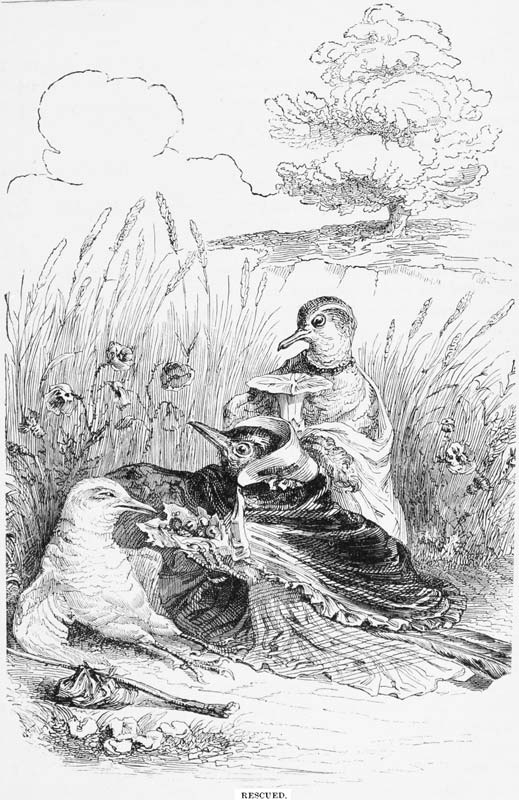
“Come,” cried the Magpie, “you are joking. You a Blackbird? Nonsense; you are a Magpie, my dear fledgling—a Magpie, if ever there was one, and a very nice one too,” she added, touching me lightly with her fan-like wing.
“Madam,” I replied, “it seems to me that I am entirely white, and that to be a Magpie—— Do not be angry, pray.”
“A Russian Magpie, my dear; you are a Russian Magpie.”
“How is that possible, when I was hatched in France, of French parents?”
“My good child, there is no accounting for these freaks of nature. Believe me, we have Magpies of all colours and climes born in France. Only confide in me, and I will take you to one of the finest places on earth.”
“Where, madam, if you please?”
“To my verdant palace, my little one. There you will behold life as it ought to be. There you shall not have been a Magpie for five minutes before you shall resolve to die a Magpie. We are about one hundred all told, mark you, not common village Magpies who pick up their bread along the highway. Our set is distinguished by seven black marks and five white ones on our coats. You are altogether white. That is certainly a pity, but your Russian origin will render you a welcome addition to our number. I will put that straight. Our existence is spent in dressing and chattering, and we are each careful to choose our perch on the oldest and highest tree in the land. There is a huge oak in the heart of our forest, alas! it is uninhabited; it was the home of the late Pius X., and is now the resort of Penguins. We pass our time most pleasantly, our women folk are not more gossiping than their husbands are jealous. Our pleasures are pure and joyous, since our hearts are as true as our language is free. Our pride is unbounded. Should an unfortunate low-born Jay or Sparrow intrude himself, we set upon him and pick him to pieces. Nevertheless, our fellows are the best in the world, and readily help, feed, and persecute the poor Sparrows, Bullfinches, and Tomtits who live in our underwood. Nowhere can one find more gossip, and nowhere less malice. We are not without devout Magpies who tell their beads all day long, and the gayest of our youngsters are left to themselves, even by dowagers. In a word, we pass our time in an atmosphere of glory, honour, pleasure, and misery.”
“This opens up a splendid prospect, madam, and I would be foolish not to accept your hospitality; yet, before starting on our journey, permit me to say a word to this good Ringdove. Madam,” I continued, addressing the Dove, “tell me frankly, do you think I am a Russian Magpie?”
At this question the Dove bent her head and blushed. “Really, sir,” she replied, “I do not know that I can.”
“In Heaven’s name, madam, speak; my words cannot offend you. You who have inspired me with a feeling of devotion so new and so intense that I will wed either of you if you tell me truly what I am.” Then softly I continued, “There seems to be something of the Dove about me, which causes me the deepest perplexity.”
“In truth,” said the Dove, “it may be the warm reflection from the poppies that imparts to your plumage a dove-like hue.”
She dared say no more. “Oh, misery!” I exclaimed, “how shall I decide? How give my heart to either of you while it is torn with doubts? O Socrates, what an admirable precept was yours, yet how difficult to follow, ‘Know your own mind’! It now occurred to me to sing, in order to discover the truth. I had a notion that my father was too impulsive, as he condemned me after hearing the first part of my song. The second part, I was fain to believe, might work miracles with these dear creatures. Politely bowing by way of claiming their indulgence, I began to whistle, then twitter and make little warblings, after which, inflating my breast to its fullest, I sang as loud as a Spanish muleteer in his mountains. The melody caused the Magpie to move away little by little with an air of surprise, then in a stupefaction of fright she described circles round me like a cat round a piece of bacon which had burned her, and which proved too tempting to relinquish. The more impatient she became, the more I sang. She resisted five-and-twenty bars, and then flew back to her green palace. The Ringdove had fallen asleep—admirable illustration of the power of song. I was just about to fly away when she awoke and bade me adieu, saying—
“Handsome, dull, unfortunate stranger, my name is Gourouli. Think of me, adieu!”
“Fair Gourouli!” I replied, already on my way, “I would fain live and die with thee. Such happiness is not for me.”
IV.
The sad effect of my song weighed heavily upon me. Alas! music and poesy, how few hearts there are who understand thee! Wrapped in these reflections, I knocked my head against a bird flying in an opposite direction. The shock was so great that we both fell into a tree. After shaking ourselves, I looked at the stranger, expecting a scene, and with surprise noted he was white, wearing on his head a most comical tuft and cocking his tail in the air. He seemed in no way disposed to quarrel, so I took the liberty of asking his name and nationality.
“I am more than astonished you do not recognise me,” he said. “Are you not one of us?”
“In truth, sir,” I replied, “I do not know who I am myself, far less who you are. Every one asks me the same question, ‘Who are you?’ Who should I be if I am not one of nature’s practical jokes?”
“Come now, that will do; I am no green hand to be caught by chaff. Your coat suits you too well; you cannot disguise yourself, my brother. You certainly belong to the illustrious and ancient family called in Latin Cacuata, and in the vulgar tongue Cockatoo.”
“Indeed, sir? Since you have been good enough to find me a family and a name, may I inquire how a well-bred Cockatoo conducts his affairs?”
“We do nothing, and what is more, we are paid for doing nothing! I am the great poet Cacatogan—quite an exceptional member of my family. I have made long journeys, crossed arid plains, and made no end of cruel peregrinations. It seems but yesterday since I courted the Muses, and my attachment has been most unfortunate. I sang under Louis XVI., I clamoured for the Republic, I chanted under the Empire, discreetly praised the Reformation, and even made an effort in these degenerate days to meet the exigencies of this heartless century. I have tossed over the world clever distiches, sublime hymns, graceful dithyrambics, pious elegies, furious dramas, doubtful romances, and bloody tragedies. In a word, I flatter myself I have added some glorious festoons, gilded pinnacles, and choice arabesques to the temple of the Muses. Age has not bereft me of poetic fire. I was just composing a song when we came into collision, and you knocked the train of my ideas off the line. For all that, if I can be of any service to you I am heartily at your disposal.”
“You, sir, can serve me,” I replied, “for at this moment I too feel something of the poetic fire of which you speak, although, unlike yourself, laying no claims to poetic fame. I am naturally endowed with a voice and song which together violate all the old rules of art.”
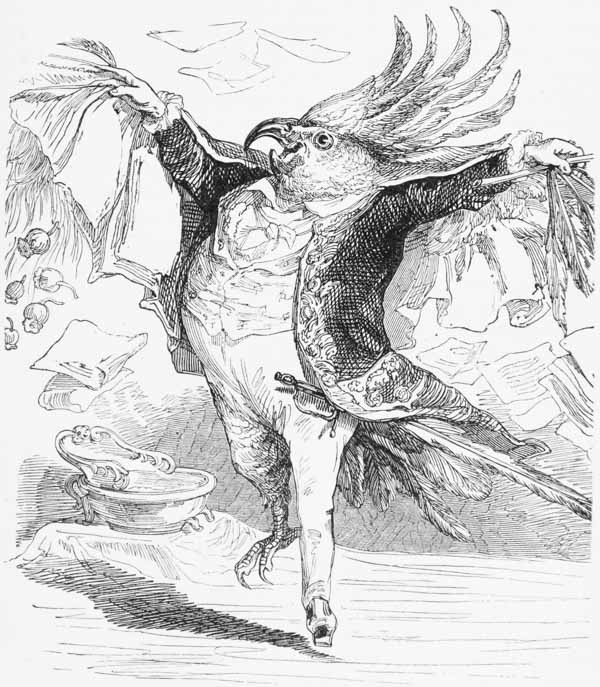
“I myself have forgotten the rules. Genius may not be fettered, her flights are far beyond all that is stiff and formal in schools of art.”
“But, sir, my voice has a most unaccountable effect on those who listen to its melody, an effect similar to that of a certain Jean de Nivelle whom—— You know the rest.”
“Yes, yes,” said Cacatogan. “I myself suffer from a similar cause, thoroughly inexplicable, although the effect is incontestable.”
“Sir, you are the Nestor of poetry. Can you suggest a remedy for this peculiarity of song?”
“No; during my youth I was much annoyed by it. Believe me, its effect indicates only the public inability to appreciate true inspiration.”
“That may be so. Permit me to give you an example of my style, after which you will be better able to advise me.”
“Willingly,” replied Cacatogan; “I am all ears.”
I tuned my pipe at once and had the satisfaction of seeing that he neither flew off nor fell asleep, but riveted his gaze on me, and from time to time displayed tokens of approbation. Soon, however, I perceived he was not listening; his flattering murmurs were lavished on himself.
Taking advantage of a pause in my song he instantly struck in, “It is the six-thousandth production of my brain, and who dare say I am old? My lines are as harmonious and my imagination as vivid as ever. I shall exhibit this last child of my genius to my good friends;” thus saying he flew off without another word.
V.
Left thus alone and disappointed, I hastened my flight to Paris, unfortunately losing my way. The journey with the Pigeon had been too rapid and unpleasant to leave any lasting impression of landmarks on my mind. I had made my way to Bourget, and was driven to seek shelter in the woods of Morfontaine just as night closed in.
Every bird had sought its nest save the Magpies and Jays—the worst bedfellows in the world—who were quarrelling on all sides. On the borders of a brook two Herons stood gravely meditating, while close at hand a pair of forlorn husbands were patiently waiting the arrival of their giddy wives, who were flirting in an adjoining hedge. Loving Tomtits played in the underwood, beneath a tree where a busy Woodpecker was hustling her brood into a hollow in the trunk. On all sides resounded voices saying, “Come, my wife!” “Come, my daughter!” “Come, my beauty!” “Here I am, my dear!” “Good-night, love!” “Adieu, my friends!” “Sleep well, my children!”
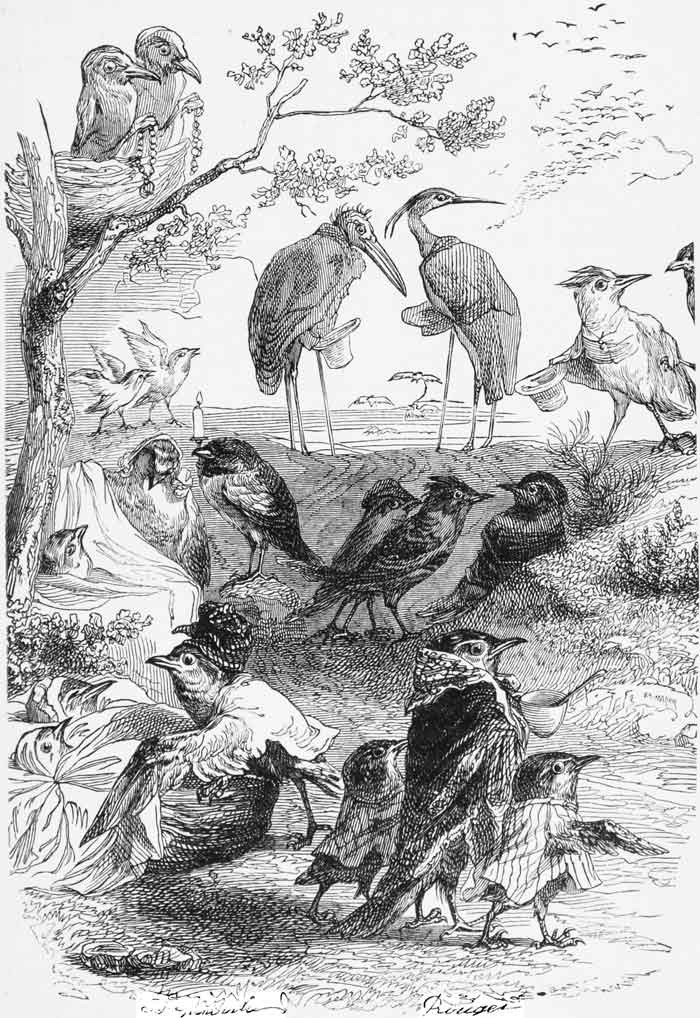
The situation for a celibate was most embarrassing. I was almost tempted to seek the hospitality of some birds of my own size, as we all looked alike grey in the dark. At last perching on a branch where there was a row of different birds, and modestly taking the lower end, I hoped to remain unobserved; but I was disappointed. My nearest neighbour was an old Dove, as thin as a rusty weather-cock. The moment I approached her, the few feathers which covered her bones became the objects of her solicitude. She pretended to pick them, but as they had only a slender hold of her skin, merely passed them in review, to make sure she had her right number. Scarcely had I touched her with the tip of my wing, when, drawing herself up majestically, she said, “How dare you, sir?” administering at the same time a vigorous British push that sent me spinning into the heath, on the top of a Hazel Hen, who would have willingly made room for me, only her spare bed was taken up by a son returned from the harvesting.
I heard myself called by the sweet voice of a Thrush, who made signs for me to join her companions. Here at last, I thought, are some birds of my feather, and nothing loath, took my place among them as lightly as a billet-doux disappearing in a lady’s muff. Alas! I discovered that the dames had feasted freely on the juice of the grape, so I left them, to flee I knew not where, as the night was pitchy dark. Onward I sped till arrested by a burst of heavenly music. It was the song of the Nightingale, and dame Nature, attired in her sombre hues, stood listening in silence to the glorious lullaby that had soothed her children to sleep. The song recalled the first notes that doomed me to become an outcast. There was a touch of melancholy about the music, a mournful refrain that seemed to breathe forth a longing for something brighter, purer, holier than all life’s experiences. My resolution to live my life out seemed to melt away in the liquid strain, and at the risk of becoming the prey of some nocturnal Owl, I plunged into the darkness determined to return to my home or die in the effort. At daybreak I descried the towers of Notre Dame, and soon perched upon the sacred building, to rest for a moment before alighting in the old garden. Alas! absence had wrought a sad change. Nothing remained to mark the site save a bundle of fagots. Where was my mother? In vain I piped and sang, and called on her to return. She had left the old familiar scene. There stood the woodman’s axe that had laid low the trees and severed the ties of kindred. The shrubs of the green lane were rooted up to make way for the cold grey stones of the abodes of men.
VI.
I searched for my parents in all the gardens around, but in vain; they had doubtless sought refuge in some distant spot, and were lost to me for ever. Overwhelmed with sorrow, I lingered about the spout from which my father’s wrath had exiled me. Sleep deserted me, and I lay down to die of hunger and grief. One day my sad reflections were interrupted by the jarring discord of two voices. Two slattern dames, standing slipshod, dirty, and bedraggled in the road beneath, were disputing over some point of household discipline, when one clinched the argument by exclaiming, “Egad! when you manage, you slut, to do these things, just let me know on’t, and my faith, I’ll bring you a white Blackbird.”
Here was a discovery; probably the little unforeseen circumstance destined to turn the tide of my fortune and land me at last in Elysium. I must be a real, though rare bird of a misguided type. Thus impartial speech is sufficient to justify the conclusion. That being so, humility ill befits me. It is a mistake to cheapen what in reality are attributes as rare as they are highly prized. I am the one living illustration that in nature, as in law, nothing is impossible—that black even may become white. In law, I am told, this transformation is effected thoroughly, but at the same time at great cost to clients, and only by highly-gifted members of the bar. In my own case, natural law has been manipulated to bring about a like end, intended clearly for my gain.
These sage conclusions led at once to my assuming the airs and importance of a creature who for the first time discovers that his genius has raised him from the gutter far above all his fellows. I seemed at once to acquire a more dignified and imposing strut while parading the spout, and at the same time a capacity for looking calmly into space, towards the place of my ultimate destiny, far removed from this narrow terrestrial sphere. All this was a wonderful transformation to be wrought by the careless boast of a tawdry gossip, and clearly proves how nicely poised are the affairs of life. Such incidents are not unknown among men, as the word of a fool has been known to arrest the overthrow of a kingdom.
Among other things, it occurred to me, since Nature has gone out of her way to make me what I am, I must be a poet. I can hardly explain the process of reasoning which led to this belief; for all that, the belief became so rooted in my brain that I must needs jot down my inspiration. It is universally acknowledged that the first step to be taken towards becoming a great poet is to look like one. I accordingly studied to look genius all over, and the result was, I was accepted as my own estimate. Next I determined to go in for classical verse, and bring out a poem in forty-eight cantos, so framed as to apprise the universe of my existence. I shall deplore my isolation in such a manner as to stir up the envy of the happiest beings on earth. Since Heaven has refused me a mate, I shall utterly condemn the law which divides the bird creation into families, each having its own distinctive attributes. I will cry down everything—prove that grapes are sour, that Nightingales sing one into despair, and that Blackbirds have fallen away from their primeval whiteness. But first I must lay hold of a good rhyming companion, a handy-book to lift me out of the horrors of fishing for words of the same sound. It will also be necessary to establish about my person a retinue of needy journalists and authors as an exhaustless source of inspiration, in order to deluge the world with rhymes copied from the strophes of Chaucer, and with plays decked out from the sentiments of Shakespeare. Thus shall I ease my overburdened soul, make all the Tomtits cry, the Ringdoves coo, and the old Owls screech. Above all, one must prove one’s self inexorable to the sweet sentiment of love. In vain shall I be waylaid and entreated to have compassion on maidenly hearts melted by my song. My manuscripts shall be sold for their weight in gold, my books shall cross the seas, fame and fortune shall everywhere follow me. In short, I shall be a perfectly exceptional bird, an eccentric, and at the same time brilliant writer, received with open arms, courted, admired, and thoroughly detested by a thousand rivals.
VII.
An interval of six weeks introduced my first work to the world, which turned out, as I promised myself it should, a poem in forty-eight cantos. It was slightly marred by a few negligences, the result of prodigious fertility of brain and the inability of my pen to keep pace with my inspiration. Nevertheless, I wisely concluded that the public, accustomed as they are in modern times to all that is swift in thought and action, would shield me from reproach. The success of this, my pristine effort, was simply as unparalleled as it was thoroughly deserved. The subject of the poem was my noble self; in this respect adhering to the prevailing custom, I related my sufferings and adventures, and put the reader in possession of a thousand domestic details of the most piquant interest. The description of my mother’s nest filled no less than fourteen cantos. With the most graphic minuteness were noted the number of straws, grasses, and leaves of which it was composed, the whole being idealised by the tints and reflections of poetic genius. I displayed the inside and the outside, the bottom and the brim, the graceful curves and inclined planes and angles, gradually leading the reader up to the grand theme of the contents—the remains of flies, may-bugs, and grubs which supplied the dainty fare of our home. Thus ascending, I reserved, with true poetic art, the dramatic incidents of my life for the grand dénoûement.
Europe was moved by the apparition of my book, and eagerly devoured its thrilling revelations. How could it be otherwise? I had not only laid bare the facts of my existence, but pictured the dreams which disturbed my repose for many years, even introducing an ode composed in the yet unbroken egg. Of course I did not neglect the subject which interests every one—that is, the future of humanity. This problem, which for a moment had arrested my attention, was dealt with, and dashed off in outline, giving universal satisfaction.
Every day brought its tribute of congratulatory letters and anonymous love declarations, while my door was besieged by newspaper correspondents and Western tourists seeking an interview. All personal intercourse I positively declined, until forced to make an exception to a Blackbird from Senegal and another from China, who announced themselves as relatives of my own.
“Ah, sir,” they said, nearly choking me with their embraces, “you are indeed a noble bird. How admirably you have painted in your immortal lines the profound sufferings of an unknown genius! If we are not already thoroughly misunderstood, we should become so after reading you. How deeply we sympathise with your griefs and your sublime scorn of vulgar opinion. Our own experience, sire, has made us familiar with all the troubles of which you sing. Here are two sonnets we humbly pray you to accept as a token of our worship.”
“Here is besides,” added the Chinese, “a song composed by my wife on a passage in your preface. She seems to have caught wonderfully the inspiration which it breathes.”
“Gentlemen,” I replied, “you seem to be gifted persons endowed with sentiments that are a credit to your nations, but permit me to inquire the reason of your manifest melancholy?”
“Ah, sir, see how I am formed. My plumage, it is true, is pleasant to behold; it is not without the tinge of emerald green, the glory of Ducks and dupes. For all that, my beak is too short and my claws too long, and whoever saw such a frightful tail as mine? I am nearly all tail. Is it not enough to give one the blues?”
“As for me, sir,” said John Chinaman, “my misfortune is a still more painful one. My comrade’s tail sweeps the streets, while the vulgar point the finger of scorn at me because I have only a stump.”
“Gentlemen,” I replied, “I pity you with all my heart. It is always painful to have too much or too little of anything, no matter what it is. But allow me to tell you that in our museums there are many examples of your class who have been stuffed and preserved in peace for years. My own case is infinitely worse than yours put together. I have the misfortune to be a lettered bird, a genius, and the only bird of my kind. In spite of my resolution to remain single, the return of spring-time caused me much uneasiness, and an event as unexpected as it was welcome decided my future. I received a letter from a young white Merle in London. It ran thus:—
“ ‘I have read your poem, and the devotion it inspired has constrained me to offer you my hand and fortune. God created us for each other. I am like you, for I am a white Merle.’
“My surprise and joy may be imagined. A white Merle! Is it possible? I hastened to reply to the charming note—equal in terseness and fathomless sentiment to a love message in the second column of the Times. I besought the fair unknown to come at once to Paris, the refuge of romance-stricken young ladies. My reply had the desired effect; she came at once, or rather soon after her second letter, which informed me that she would not bother her parents with details. It was better to tell them nothing, as they might deem it necessary to send an old carrion Crow to look into my character.
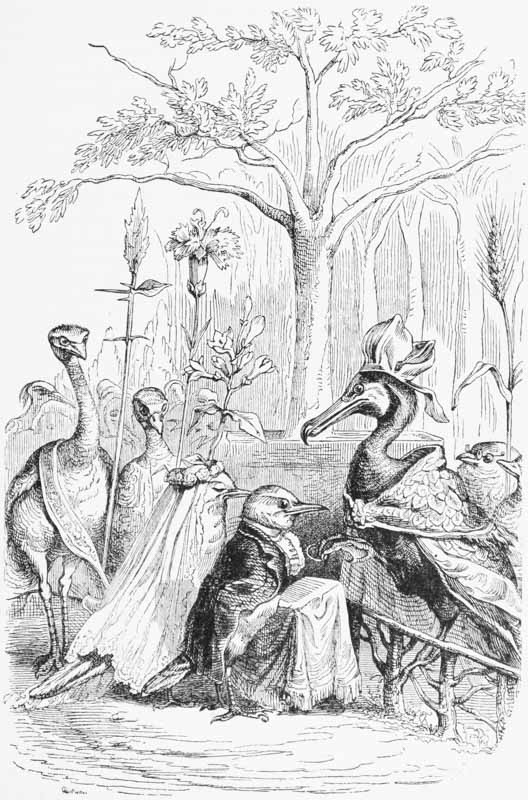
“She came at last. Oh, joy! she was the loveliest Merle in the world. Was it possible that a creature so charming had lived and been reared for me? All my father’s curses, and, above all, my sufferings were welcome, since Heaven had reserved such an unexpected consolation for me. Till to-day I thought myself doomed to an eternal solitariness, but now I feel, while gazing on my lovely bride, all the nobler qualities of a father fully developed within me. Accept my claw, fair one, let us wed in the Anglo-Saxon fashion, and start for Switzerland.
“Nay,” replied my love, “our wedding must be on a truly magnificent scale, all the Blackbirds of good birth must be invited. Birds in our position ought to observe the nicest ceremony, and not wed like water-spout cats. I have brought a provision of bank-notes with me. Arrange your invitations, and spare no cost in ordering the feast. I am of French origin and love display.”
Blindly yielding to the wishes of my charmer, our wedding was of extraordinary brilliancy. Ten thousand flies were slaughtered for the feast, and we received the nuptial benediction from an old father Cormorant, archbishop in partibus, and the happy day’s festivities concluded with a splendid ball.
The more I studied the character of my wife, the greater became my love. She combined in her dainty person every imaginable grace of body and mind. Only she was given to gossip, which I attributed to the influence of the English fog, and never had a moment’s doubt that our genial climate would dissipate this little cloud.
There was some mystery hedging her round, which troubled me with grave forebodings. She used to shut herself up with her maids, under lock and key, for hours together, engaged, so she said, at her toilet. Husbands as a rule have no patience with such proceedings. More than a score of times have I knocked at my wife’s door without receiving the slightest response. One day I insisted with such violence that she was compelled to open the door, but not without favouring me with a sample of her temper. On entering, the first thing that met my gaze was a huge bottle of a sort of paste made up of flour and whitewash. I inquired of my wife what she used that stuff for, to which she replied, it was a mixture for chilblains. This seemed rather strange, yet how could so charming a creature inspire me with anything but confidence.
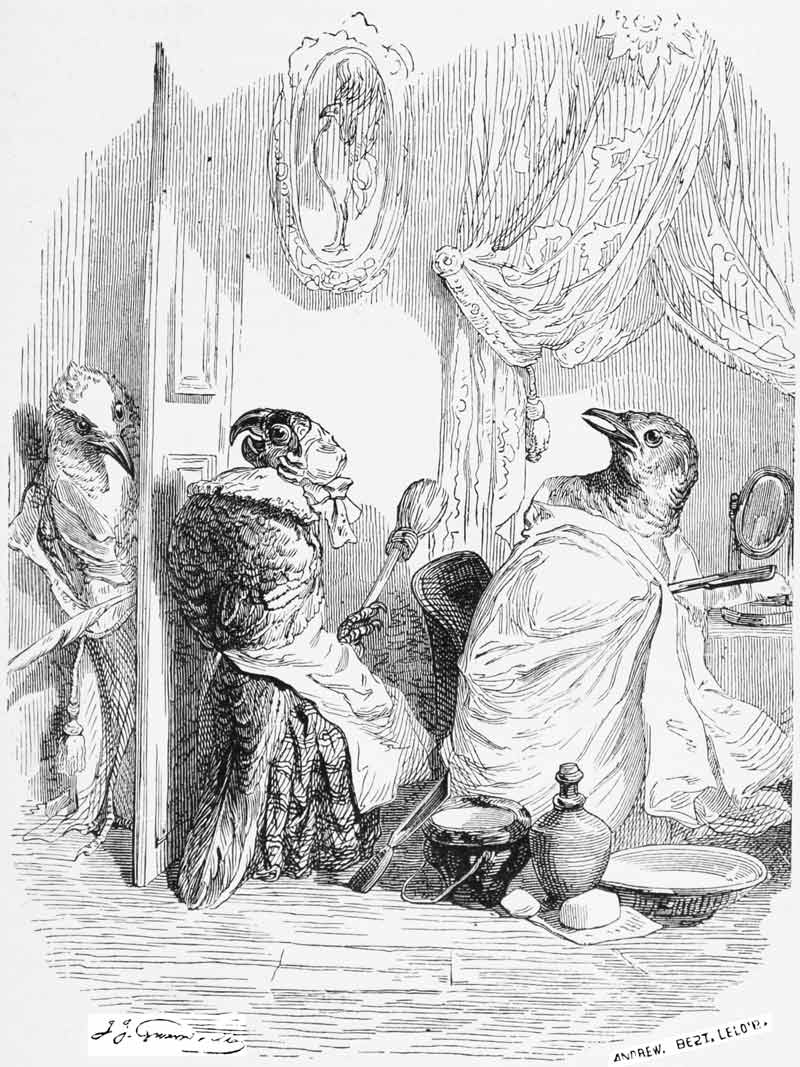
Up to the present time I had remained ignorant of the fact that my wife had cultivated letters. Imagine my joy on discovering that she was the author of a romance modelled after the style of the illustrious Sir Walter Scott. I was then not only the husband of an incomparable beauty, but of a truly gifted companion. From that instant we worked together; while I composed my poems, she covered reams of paper and displayed the rare gift of listening to my recitations without pausing in her task of composition. She composed her romances with a facility almost equal to my own, always choosing subjects of rare dramatic value; homicides, murders, and highway robberies, taking care in passing, to shoot poisoned shafts at the Government by advocating the cause of the Merula vulgaris. In a word, no efforts were too great for her mind, or tricks for her modesty. Never had she need to cross through a line, or lay her plans before beginning to work.
One day while my wife was toiling with unusual ardour, she perspired freely, and to my horror I beheld a black patch on her back. “Bless my soul, dear!” I said “what is that? Are you plague-stricken? Are you ill?” She at first seemed frightened and speechless, but her knowledge of the world soon restored her habitual self-composure, and she replied that it was a spot of ink, a stain to which she was subject in moments of inspiration. Inwardly I was greatly troubled. Does my wife lose her whiteness? was a question which cost me many wakeful nights. The paste bottle rose like a phantom before me. Oh heavens! what doubts. Can this celestial creature, after all, only be a painting, a work of art? Is she varnished to deceive me? Had I been wooed and won by a mixture of flour and whitewash? Haunted by doubt, I took measures to lay the apparition by investing in a barometer, and watching for signs of coming rain. I planned to decoy my wife some doubtful Sunday into the country, and try the effect of an impromptu wash, but we were in the middle of July, and the weather provokingly fine. Real happiness, and long habit of writing, had much increased my sensitiveness. While at work it sometimes happened that my affections were stronger than my inspiration, and I gave way to tears, while waiting for my rhyme. My wife loved these rare occasions, and strove to soothe my masculine weakness.
One evening while dashing through my writing according to Boileu’s precept, my heart opened. “Oh thou, my queen!” I said, “thou my only truly loved one, thou without whom my life is a dream, thou whose look, whose smile, fills my world with light. Life of my heart! dost thou know the height, the breadth, the depth of my love? Before thou camest to me my lot was that of an exiled orphan, now it is that of a king. In my poor breast thine image shall be enshrined till death. All! All my hopes and aspirations are centred in thee.”
While thus raving, I wept over my wife, and as each tear-drop fell upon her back, she visibly changed colour. Feathers, one by one, not even black, but red appeared—she must have coloured red to fill some other rôle. Soon I found myself vis-à-vis with a creature unpasted, unfloured, and nothing more than a vulgar Blackbird. How dare I publish my shame! I plucked up courage and resolved to quit the gay world, to give up my career, to flee to a desert, if that were possible, to shun the sight of every living creature.
VIII.
I flew away broken-hearted, and the wind, the good angel of birds, wafted me on its wings to a branch at Mortfontaine. It was night, the birds were asleep, but the Nightingale still sang. Alone in the darkness his heart overflowed with his song to God for His goodness, his breast expanded with the sacred theme, and with a rapture unfelt by the most gifted poets who sing for the ears of men. I could not resist the temptation of addressing him.
“Happy Nightingale, you sing because your heart is bursting with joy. You are indeed highly favoured, you have a wife and little ones which you sing to sleep on their pillow of moss. You have a full moon to cheer you, plenty to eat, and no journals to praise or condemn you. Rubini and Rosini are as nothing to you. You are equal to the one, and divine when compared with the other. I, sir, have wasted my life in pursuing the empty vanities of fame, while you have secured real happiness in the wood. May your secret be learned?”
“Yes,” replied the Nightingale, “but it is not what you imagine. My wife bothers me, I do not love her! I am passionately fond of the Rose; Sadi, the Persian, has spoken of it. I sing all night to her while she sleeps and is deaf to my praise. Her petals are closed at this hour. She cradles an old Scarab, and when the gray dawn breaks sadly over the wood, and my eyes are closing in sleep, then she will open her breast, and the Bee will be welcomed with the dainty pollen from the lips of her lover.”
THE QUEEN’S HUSBAND.
THE first political act in which I took part made so deep an impression on me, that I attribute the strange vicissitudes of my life to its influence. Permit me to begin my narrative without further introduction.
I had reached maturity and become a citizen of the hive, when one morning I was roused by a knocking at the partition, and some one calling on me by name.
“What is wanted?” I inquired.
“Come out at once!” was the instant rejoinder. “You are wanted. Monsieur is about to be executed, and you are required as one of the guards of honour.”
These awful words, which I scarcely comprehended, filled me with horror. I was, for all that, aware beforehand of the impending doom of Monsieur, but had no notion that my services would be required at the ghastly ceremony.
“Here I am!” I exclaimed, and finishing my toilet in all haste, precipitated myself outside the hive, a prey to the strongest emotion. I was not pale, but green! Monsieur was one of the finest drones in the hive, rather stout, but, withal, well made; his physiognomy was full of a pleasing, wistful, and yet proudly aristocratic expression—as novelists would say—I had often seen him accompany the queen in her daily rounds of inspection, tormenting her with his jokes, helping her with his foot, sharing with her the prestige of sovereignty, and altogether appearing to be the happiest of princes, and most beloved of husbands. The people loved him little, but feared him much, he had the queen’s ear, the queen had publicly kissed his forehead, and it was reported by one of the chamber maids that Monsieur was soon to be a father. This important news spread around, and filled each cell with joy. We saw ourselves transformed into nurses surrounded by groups of children, giving food to this one, rocking that one. Already in each chamber a soft couch was prepared to receive the new comer, and in the evening before going to sleep, certain flowers had been pointed out as those containing the sugar which would yield the most delicate honey, as food for the youngsters when they made their appearance.
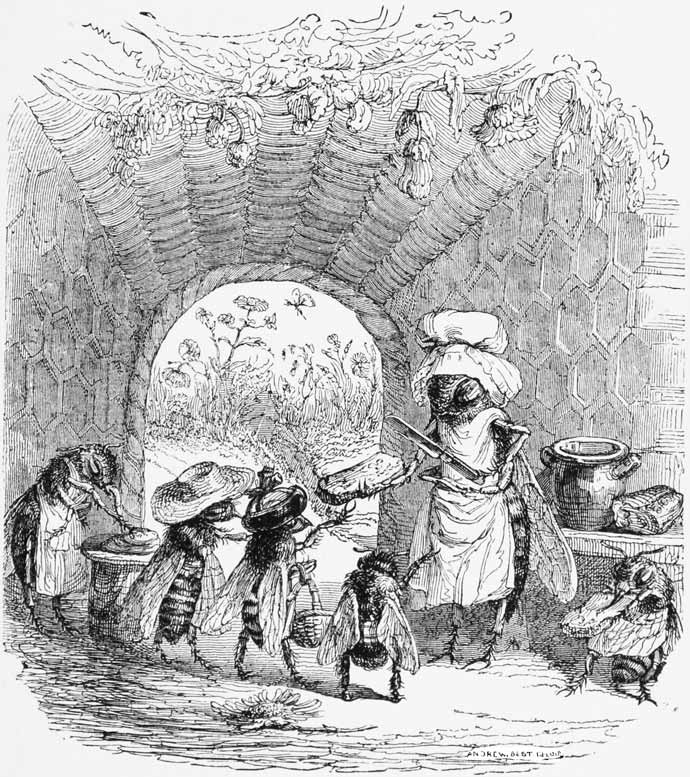
Our expectations were confirmed. Our beloved queen laid ten thousand twin eggs, all so beautiful that it was impossible to choose between them. The prince was radiant with joy, and spent his whole time in kissing the eggs one after the other. I had witnessed all this, had beheld him in his glory, and now, I was rudely awakened to see him dragged to his doom. More than that, oh horror! I was chosen to be his executioner. The prince, under the dreadful circumstances, showed decided reluctance to yield up his life. This seemed all the more pitiable as nature had deprived him of either offensive or defensive weapons. He was completely in our power.
“What have I done to deserve this doom? Oh, my queen, grant me but one hour!” he cried, kneeling before her, “but half an hour, nay, five minutes. I have revelations, confessions . . . ”
“Make haste!” said the queen, striving to conceal her emotion; “we must abide by the law. Away with him; put an end to him; he is now worse than useless.”
The queen retired to her chamber, still full of souvenirs of the prince, and in an instant he was pierced by a thousand darts. Should I live a century, I shall never forget the scene. I pretended to share in the outrage, yet never moved my sting from its sheath. Even among the most advanced communities there are barbarous laws. Poor Messieurs, poor Messieurs!
Of these Messieurs, vulgarly called Drones, there are from five to six hundred in one hive, each one to be called upon to mount the steps of the throne, and to pay with his life for the excess of honour thus accorded to him. The prospect of a tragic end gave many of them sad looks, which contrasted with the natural gaiety of their fellows. One could mark them crawling listlessly along among the thousands of orderly workers that thronged the streets, alleys, and cells of the city, dejected and oppressed by their coming glory. At the slightest noise they turned round tremblingly. “Is the queen calling us?” they would inquire, and speedily they hid themselves away among the crowd, and, escaping from the hive, sought the freedom of fields and flowers.
There are many troubles which fall to the lot of those in high positions. The fat, overfed idlers who strut about, are most of them merely servants and dependants, unworthy of the vulgar admiration lavished on them by the working class. This sentiment of aristocracy worship is a common folly to which I myself have been subject, and which it ill befits me to condemn. Shall I confess it? I madly loved a Drone. Yes, I loved him. He was handsome beyond description. When he entered the corolla of a flower, I trembled lest the contact with its petals should spoil his beauty. I was mad. Platonic love; for Nature permitted us only the ideal, impossible love of the poet, the dream of the artist. I loved this creature simply for his beauty.
I admired the blue Dragon-fly with his silken wings, as I watched him skimming over the grass at the close of the day. I had, indeed, an eye for everything beautiful, and above all, for my superb Drone.
One day I found him half drunk with honey, lying fast asleep in the heart of a lily; his face, though smeared with yellow pollen, still retained its noble expression. He was snoring in a most majestic and regular manner. I stood for a moment, quite rooted to the spot by the glorious spectacle. This then, I thought, is a future husband of our queen! I at last approached him, foolishly curious to examine the details of his figure, and gently touched him, when, yawning, he said—
“What does your Majesty want now?”
Then looking at me, he perceived his mistake, and added smiling—
“I am not in your way, my child, so proceed with your work, and permit me to rest in peace.”
There must have been a subtle odour in this flower which stole into my head, for I instantly forgot my work, and remained looking at him dreamily. What are we? I thought. Only miserable workers, makers of honey, moulders of wax, and neuter nurses to the children of those magnificent idlers who spend their days in sleeping in the heart of flowers, and dreaming that they hear the silvery tones of the queen’s voice calling them. I own myself ashamed of my humble, laborious calling. How could he love such a simple drudge? Were I even a Wasp, scouring lanes and hedgerows, and annoying wayfarers—careless, coquettish, unkind—always armed, offensive and useless; perhaps then he might love me. Is not fear the beginning of love? Hence is it not a means of seduction? Such thoughts, and a thousand others, were buzzing in my brain; still my admiration only became all the more intense, and I exclaimed, in spite of myself—
“O Prince, most handsome Prince, you are exceedingly beautiful!”
“All right,” replied the Prince, “I know it; my position requires it. Pray do not disturb my repose; go away, like a good fellow.”
This strange language to a neuter disturbed me not a little. He evidently did not even know my sex, far less my love for him. That which charmed me most was—I scarce dare write it—his glorious idleness, the helplessness of his fine body, and insolent coolness of his fine language. I scorned and yet loved him. I knew he was accustomed to snore daily when in this perfumed spot; I therefore got through with my work quickly, and made the flower my resort, after dressing the little ones confided to my care, and nearly choking them with hasty meals, so that I might go and prepare his place, and sweep away with my wings any yellow powder that would soil his coat. If a few drops of water had gathered in the corolla, I pierced it with my stings and left, so that my master might repose there without fear of rheumatism.
He was none the more thankful; his requirements only increased and kept pace with my love and care for him. He would smile, blissfully stretching himself, and request me to mount guard outside the flower, so that no common insect might trouble his dreams. It tried my temper, yet I watched. One day I saw him coming; he was very pale, but his walk was steadier than usual.
“What is the matter, Prince?” I inquired anxiously.
“Go away, little one. I have need of air, and the sun will not mind seeing me face to face to-day.”
I trembled for the misfortune that seemed to have overtaken him.
“To-morrow! to-morrow!!” he cried, making gestures which denoted the trouble of his mind. “To-morrow I shall be the queen’s husband!”
A mist obscured my eyes; deep resentment filled my heart. I was mad with jealousy.
“From to-day till to-morrow many things may happen!” I exclaimed.
“Silence! how dare you in my presence proclaim your seditions?”
“No,” I said, “you shall never wear the crown!” I flew at him, and profiting by a momentary turn of his head, pierced him to the heart with my sting. Hardly had he breathed his last, when I burst into remorseful tears.
I returned to the hive to find everything in the greatest disorder. The entire community, a prey to the deepest agitation, were jostling and knocking each other about.
“What has happened?” I inquired of the first Bee I met.
“What happened?” he replied. “Why, one of the Drones is missing.
“How is that known?” I continued with much fear.
“At the evening call there were only five hundred and ninety-nine Drones present. The queen has had a nervous attack, and one is lost in conjecture as to what will be the result.”
“A dreadful affair!” I replied, and hastened to mingle with the crowd.
The queen was inconsolable, and so was I myself, for the space of two whole days.
THE LOVES OF TWO INSECTS. PRESENTED AS AN EXAMPLE TO WISE MEN.*
SENTIMENTAL HISTORY OF ANIMALS.
I.
PROFESSOR GRANARIUS.
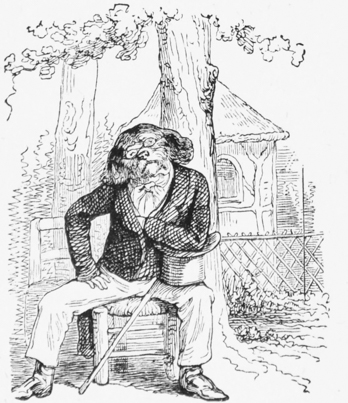
“CERTAINLY,” said Professor Granarius, one evening while seated beneath his limes, “nothing is more curious than the conduct of Jarpeado. In truth, if the French followed his example, we should have no need of codes, mandates, sermons, or social gatherings, for the advancement of mankind. Nothing proves more conclusively that reason alone—the attribute of which men are so proud—is the prime cause of all the evils of Society.”
Miss Anna Granarius, who was devotedly attached to a poor student, could not help blushing deeply, for her skin was fair and delicate. Anna was the typical heroine of a Scotch novel, the profound depths of her blue eyes almost betokening “Second-sight.” By the candid and caught look of the professor, she perceived he had said one of those foolish things which frequently fall from the lips of scientific dreamers. Leaving her father to follow out his dream on the depravity of human reason, she bent her steps to a favourite spot in the Jardin des Plantes which was closed for the night, as the month was July and the hour half-past eight.
“What does my father mean to say about this Jarpeado who turns his head?” she inwardly inquired, seating herself outside a hothouse. Pretty Anna remained pensively rooted to the seat, while her father, absorbed in his own thoughts, never missed her presence. The maiden was endowed with a highly strung nervous temperament which, had she lived four hundred years ago, would have brought her to the stake in the Place de Grève. But happily for her, she was born in more enlightened times.
II.
That which Prince Jarpeado found most extraordinary in Paris, was himself, like the dodge of Gênes at Versailles. He was undoubtedly a fine fellow, though small, remarkable for the classic beauty of his features. His legs might have been doubtful, a trifle or so bandy, but they were encased in boots garnished with precious stones and fixed up on three sides a la poulaine. On his back, as was the usage of Castraine, in his country, he carried a cape which cast into the shade those worn by the ecclesiastics of Charles X. It was covered with aberesques of diamonds on a ground of lapis-lazuli, divided into two equal parts like the two flaps of a trunk. These flaps were fastened by a gold clasp, and displayed like the priestly surplice, in token of dignity, for he was prince of Coccirubri. He wore a pretty necklace of sapphire and two aigrettes infinitely finer than any of the feathers in the caps of European potentates worn on State occasions.
Anna thought him charming, only his two arms were rather short and slender for embracing. This slight defect, however, was carried off by the rich carnation of his royal blood. Anna soon found out what her father meant, by witnessing one of those mysterious things which pass unnoticed in this terrible Paris, at once so full and so empty, so foolish and so wise, so preoccupied and so much on the alert, yet always so fantastic.
III.
The three thousand windows of this glass palace exchanged glances of moonlight so bright that the edifice seemed glowing at a white heat, ablaze with the fire, kindled by the rising orb which so frequently deceives the traveller. The cactus was breathing forth a store of strange odour, the vanilla its sweet perfume. The volcaneria distilled the vinous heat from its tufts, the jessamine exhaled a poetic fragrance, the magnolia intoxicated the air, while the aroma of the datura advanced with the pomp of a Persian king, and the powerful Chinese lily sent her breath onward with an overpowering force that assimilated all the other odours of the flowery scene.
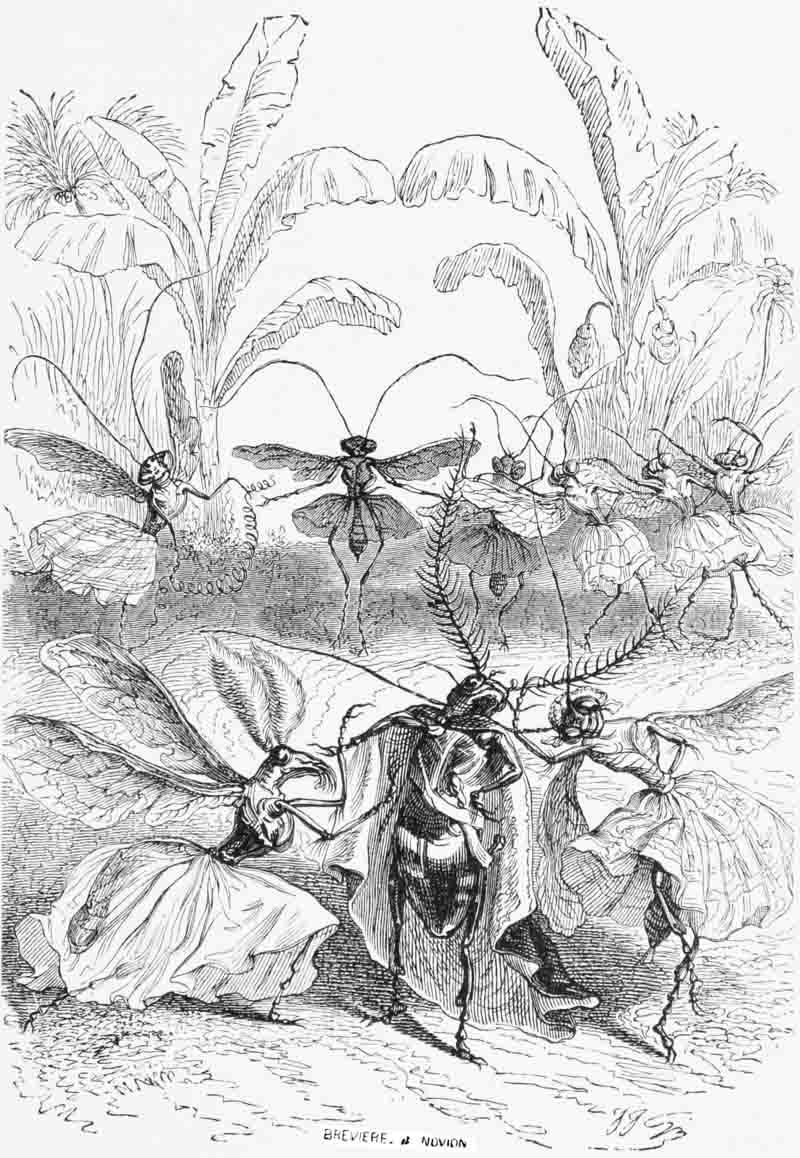
The perfume-laden air stood motionless to feast upon the spectacle presented by a troop of midnight spirits, as they rose from an enchanted spot shaded by a grove of bananas, whose wide-spreading leaves formed a canopy gilded by a phosphorescent light. Soft streams of music floated around, gently awakening the spirits to their nocturnal revels. Suddenly the lights fell on a patch of green cactus, revealing the gay form of Prince Jarpeado exposed to the witchery of the fairy queen and her gorgeous attendants, robed in costumes so aërial as to disclose the full charms of their lovely forms. Phantom-Crickets sang love-ditties in the daintiest retreats, while a choir of winged musicians chanted the praises of the prince, who stood unmoved by the seductive art of this witching band. The passion-imbued glance of the queen fell, shivered against the armour of Jarpeado’s true heart, where, enshrined in all its artless purity, he treasured the image of the fair Anna. The music ceased, and in a silvery voice the queen, radiant with an unearthly beauty, exclaimed—
“Jarpeado! Jarpeado! receive the homage of the fairy queen whose heart thou hast won.”
The moment was enchanting. The perfumed breeze wooed the flushed cheek of the prince, and whispered love. Jarpeado stood irresolute. It was but for an instant, when rousing himself from the subtle influences that were kindling a fire of unworthy passion in his breast, he replied—
“Fair spirit, whose unearthly radiance lays siege to a true heart, and who with cunning and skill have sought out the weak points of my armour, all thine arts, wiles, and hellish tricks can never quench my love for the fair Anna.”
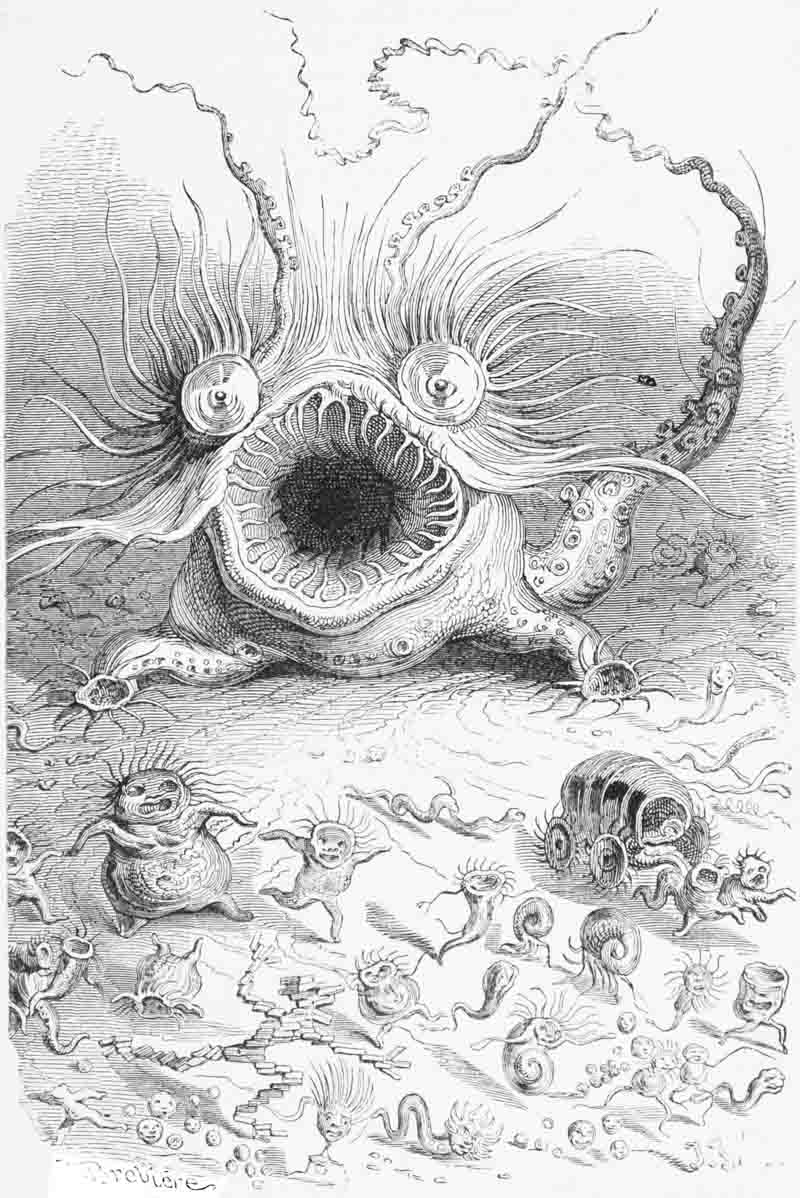
Scarcely had the last word escaped his lips, when the weird scene was blotted out from his gaze, and a ghastly green light disclosed a slimy waste alive with crawling monads, and all the simplest forms of life. The balmy air was chilled and its fragrance replaced by the noxious breath of animal decay. A flash of lightning and peal of thunder heralded the approach of a monster with mouth wide open, dark and deep as the bottomless pit, his horns erect, his tail fiercely sweeping the waste; onward he came, spreading terror around, and leaving death in his train.
This was the Valvos, which preyed like cholera on the people, but the prince escaped, saved by a fair maiden.
“Daughter of my country!” he exclaimed, “my deliverer, cruel destiny stands between us; I cannot wed thee.”
The scene changed, and Anna was transported unseen to the attic of her lover, the poor pupil of Granarius. Bent over his books, for a moment he raised his head, crying out—
“Oh! if Anna would only wait for me; in three years I shall have the cross of the Legion of Honour. I feel, I know, I shall solve this entomological problem, and succeed in transporting to Algeria the culture of the Cocus Cacti. Good heavens! that would be a conquest.”
Anna awoke and found herself in bed, she had dreamed a dream. But who was this Jarpeado of whom her father constantly spoke? She hastened to ask the old professor. It was necessary to be careful, she must watch, and after breakfast seize one of his lucid intervals; for in his normal condition, her father’s mind was absent exploring the fathomless depths of science. Seated at the breakfast table she exclaimed—
“Father!”—just as the professor was putting a spoonful of salt into his coffee—“what are you thinking about?”
“Well, Anna, dear, I was investigating the subject of monads, or rather the nature of these simple inorganic forms, twelve months before birth, and I come to the conclusion that”——
“That my dear father, if you succeed in introducing one of these ridiculous creatures to the scientists of Paris, you will both be decorated. But who, tell me, is this Prince Jarpeado?”
“Prince Jarpeado is the last of the dynasty of the Cactriane,” replied the worthy professor, who employed allegory in addressing his daughter, forgetful that her mind had matured, and she had ceased to play with dolls; “a large country, basking in the sun’s rays, and having a longitude and latitude—matters these you do not comprehend. The country is populous as China, and like that unhappy land, subject to periodical inundations, not of cold water, but of hot water, let loose by the hand of man. This depopulates the land, but nature has so provided that a single prince may alone repair the damage. This reminds me of something I discovered ten years ago in connection with Infusoria, the Rotafera of Cuvier, they”——
“Yes. But the prince, the prince!” cried Anna, fearing lest her father should fall into a reverie and she would hear nothing more.
“The prince,” replied the old professor, giving a touch to his wig, “escaped—thanks to the French Government—from the destroying flood, and he has been brought up without consulting his future, away from his fair realm. He was transported in his undeveloped form to my illustrious predecessor Sacrampe—the inventor of Ducks.
“Jarpeado came here at the request of the Government on a bed of dust, made up of millions of his father’s subjects, embalmed by the Indians of Gualaca, not one of the nymphs of Rubens, not one of Miéris’ pretty girls has been able to dispense with the mummies of this race. Yes, my child, whole populations deck the lips which smile upon or defy you from each canvas. How would you like the freak of some giant painter who would take generations of human beings on his palette, crushing them to produce the colours of an immense fresco? Heaven forbid that it should be so!” Here the professor fell into a profound reverie as was his wont after uttering the word heaven.
The pupil of Granarius, Jules Sauval, entered. If you have ever met one of those modest young fellows devoted to science, knowing much, yet possessing a certain simplicity, which, although charming, does not prevent him from being the most ambitious creature in the world, an innocent who would turn the earth upside down about a hyoïde bone, or a univalve shell. If you have seen a youth of this type, then you know Jules Sauval. He was as candid as he was poor—candour goes when fortune comes.—He venerated Professor Granarius as a father, and admired in him the disciple of the great Geoffroy St. Hilaire. Blessed be science, Jules Sauval would have just been the same, even supposing the professor had no pretty daughter Anna. He was a second Jarpeado alive among the dry bones and débris of antiquity. Just as the Coccus cacti—the subjects of Jarpeado—had been crushed to lend a glow of life to the finest works of art, so the young student identified himself with defunct organisms in order that science might all the more faithfully picture the forms and colours of pre-historic life. Like Jarpeado, Jules Sauval had his loves, he admired the fair Anna as a perfect type of a highly-organised sensitive animal—so he said.
In common with the professor he was intent upon uniting this red prince to some analogous creature. The men of science had come down to the level of the members of the Chamber of Deputies, and talked them into erecting a spacious hothouse to contain the finest plants of the tropics. Within its glass walls the illustrious professor has found a solitary living specimen of the Coccus cacti—Cochineal—Jarpeado, whose habits they had studied so profoundly as to discover that the prince was endowed with pride of race, and passion of sentiment, opposed to his union with any partner saving a princess of his own vermilion blood.
“Alas! Professor,” exclaimed Jules, “I have just left the glass-house, and all is lost! There is no possibility of uniting Jarpeado to any living creature, he refused the Coccus ficus caricæ. I had them under our best microscope.”
“Ah, you horrid creature!” cried Anna. “This is then a prince of the insect world, and yet his history is interesting. I might have known he was no human being, since you say he will die faithful to his first love.”
“Hush, child,” said Granarius, “I fail to note the difference between dying faithful and unfaithful, when it is a question of dying.”
“You will never understand me, sir,” said Anna, in a tone which startled the mild professor, “and as for you, Mr. Jules, all your science and all your charms will never tempt the prince to prove unfaithful. You, sir, shall never be capable of love such as his. A little less science and a trifle more common sense would have suggested keeping him among the dust of his defunct ancestors, where, perchance, he left his living partner, or will find another of red-royal blood.”
The professor and his pupil elated by this marvellous suggestion hastened to replace Jarpeado in the dust from which he had been taken.
Alas! sighed Anna, Jules loves me not, else he would have lingered with me to tell his love. I made the path clear for him. Yet he perceived it not, but has gone with my father to speculate on the introduction of this scarlet Coccus cacti dynasty into Algeria. Following them to the large hothouse in the Jardin des Plantes, Anna observed her father consigning the small paper of Coccus cacti dust into the centre of the first nopal that had flowered.
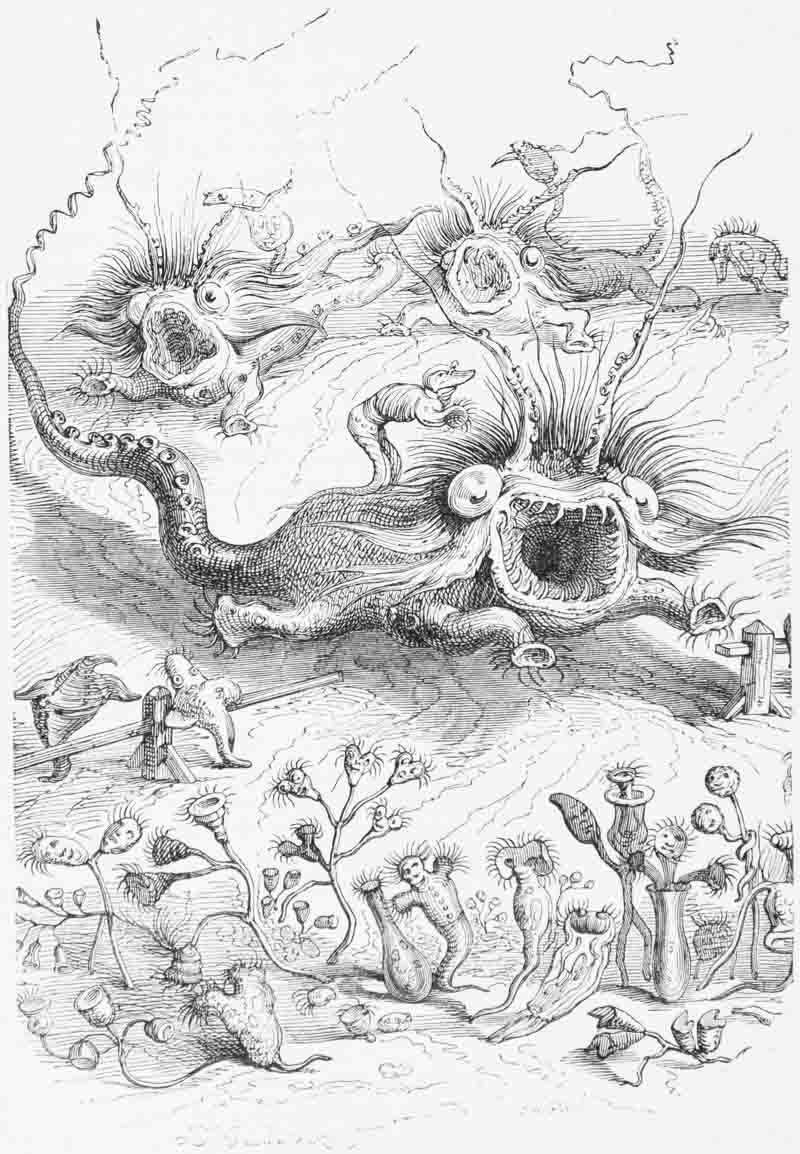
A jealous Englishman, witness of this scientific operation, remarked in passing, “This old fool uses the plant as a portfolio!”
“Heat the house well,” cried Granarius, as he fell into a profound reverie, leaving his daughter and Jules to talk of love, or science.
“So, Mr. Jules, you have ceased to love me,” said Anna.
“Nay,” replied Jules, “I do not think you do me justice, but I have come to the conclusion that sentiment, or passion, in all animals, follows a fixed natural law, and being divided between two creatures ought to form a perfect equation.”
“Oh, infernal science! thus to bamboozle a poor brain. Probably your sentiments are established on the equation of dowry, and you have yet to learn what love is, Mr. Jules. If you do not take care, science will claim possession, not only of your soul, but of your body, and you will become a beast like Nebuchadnezzar. History relates that he assumed this form because he devoted seven years to zoology in classing the different species, without once pausing to trim his beard. Six hundred years hence it will be said of certain zoologists that they were advanced types of the Orang-outang who stuck up for their race, and for themselves as examples of progression.”
Jules was called away by the professor, while Anna, turning to a huge microscope, beheld a new world of creatures, invisible to the naked eye. There she saw the Volvoce engaged in a steeple-chase, mounted on an animal making for the winning post. Many elegant Cercairæ were on the course, the prize being infinitely superior to that of the Derby; for the winner was to feast on the Vorticella, at once animals and flowers. Neither Bory, Saint Vincent, nor Müller—that immortal Dame—have taken it upon themselves to decide whether the Vorticella is more plant than animal; had they been bolder they might have drawn valuable conclusions from the man vegetable known to coachmen as melon.
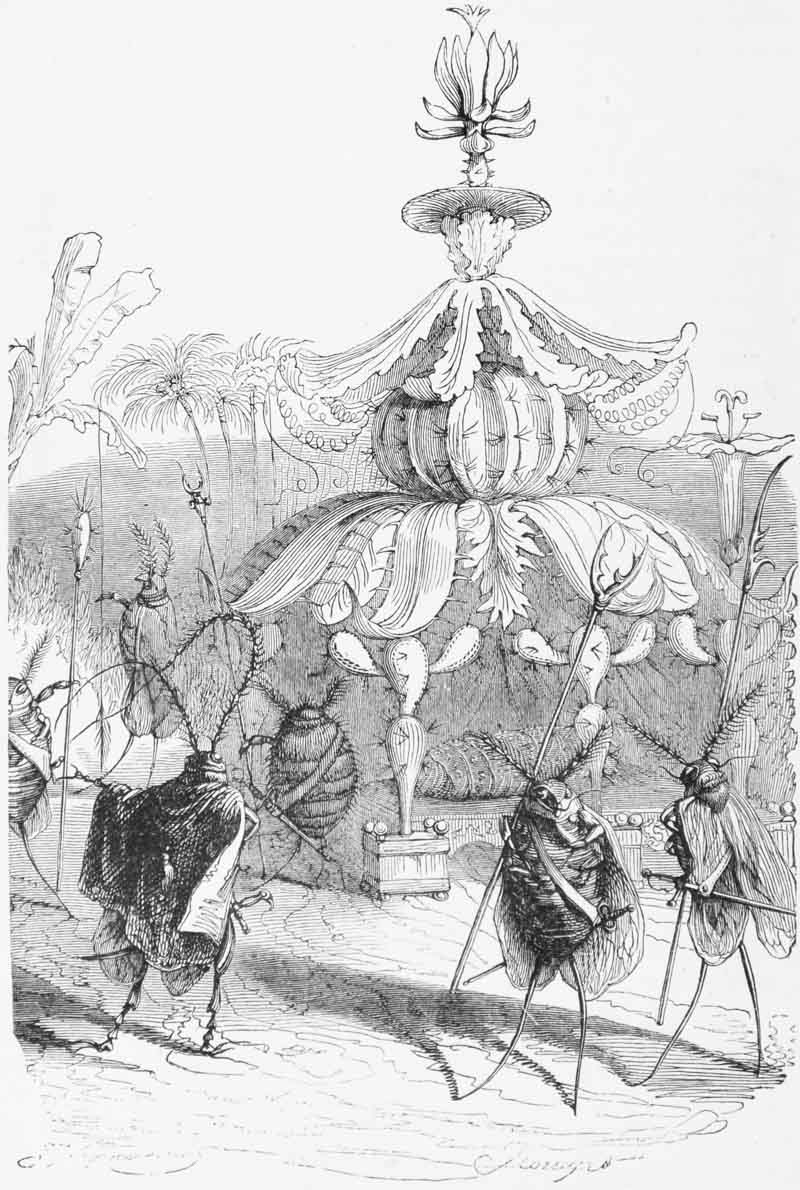
Anna was soon drawn from the contemplation of this little world to the fortunes of Jarpeado, who, in her vivid imagination, had become the hero of a fairy tale. He had at last discovered the object of his affections in a nursling of his tribe, over whom he watched as she lay in state beneath a perfumed pavilion, awaiting the incarnation common alike to heathen deities and zoological creatures. They were the Paul and Virginia of insect life. The pavilion was guarded by soldiers attired in madder. The prince proved himself a wise general, as well as ardent lover, for in order to protect his domain against a powerful-winged foe called the Muscicapa, he ordered all his intelligent subjects to throw themselves in such numbers on the monster, as to choke him, or else satisfy his hunger. For this service he promised decorations and titles; that was all he had to offer. The breast of Anna was filled with admiration of these cheap and valuable political inventions.
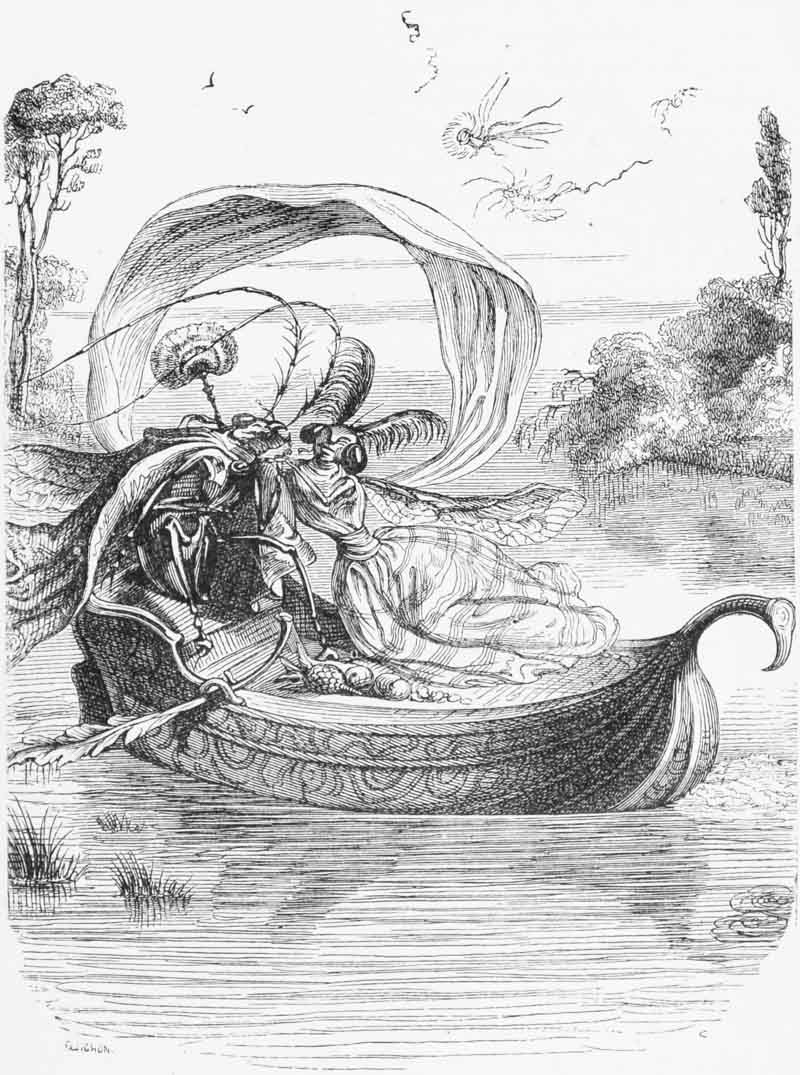
Invisible nuns shrouded the little princess in grey veils, so that nothing but her head was seen as she lay in state, awaiting her new winged life. Anna witnessed the joy of Paul, when, like Venus rising from the waves, Virginia quitted her winding sheet, and like Milton’s Eve—who is a real English Eve—smiled on the light, and looking at Paul, exclaimed, “Oh!”—this superlative of English astonishment. The prince, with a slave’s submission, offered to show the fair one the path of life, across the hills and dales of his empire.
Virginia, growing in loveliness and in the prince’s affections, returned his care with caresses, while Paul ministered to her wants, bringing the ripest fruits for her food; and they at last embarked in a little skiff, on a lake bright as a diamond, and hardly larger than a drop of water. Virginia was arrayed in a bridal robe of brilliant stripes and great richness, her appearance recalling the famous Esmeralda, celebrated by Victor Hugo, only Esmeralda was a woman, and Virginia an angel who would not for all the world have loved a Marshal of the court, far less a Colonel. Her whole affections were consecrated to Jarpeado. Happy pair, thought Anna, but alas! what came of it all? After the wedding came family cares, and a brood destined to make the fame and fortune of her much-loved, but faithless Jules.
A few evenings later, Anna was frowning on her father, and saying to Jules—
“You are no longer faithful to the palm-house, so much gazing on the Cochineal has affected your taste. You are about to marry a red-haired girl, with large feet, without any figure, devoid alike of ideas and manners, freckled. She wears dyed dresses, and will wound your pride twenty times a day, and your ears with her sonatas.”
She opened her piano and began to play with such feeling, that the Spiders remained pensive in their webs on Granarius’ ceiling, and the flowers put their heads in at the window to listen.
“Ah me!” said Anna, “animals have more sense than the wise men who preserve them in glass-cases.”
Jules left the room, sad at heart, for the talent, beauty, and brightness of this good soul was struggling with the concert of vulgar coins which his red-haired bride was bringing to his door.
“Ah!” exclaimed Professor Granarius, “what have we here in the papers? Listen, Anna.
“ ‘Thanks to the efforts of the learned Professor Granarius, assisted by his clever pupil Jules Sauval, ten grains of cochineal have been obtained on the Nopal in the great palm-house. Doubtless this culture will flourish in our African possessions, and will free us from the tribute we pay to the new world. Thus the expense of the great palm-house has been justified—against which opposition was not slow to make itself heard—but the costly structure will yet render many valuable services to French commerce and agriculture. M. J. Sauval is named Chevalier of the Legion of Honour.’ ”
“M. Jules behaves badly to us,” said Anna, “for you have commenced the history of the Coccus cacti, and he has impudently taken up”——
“Bah!” said the professor, “he is my pupil.”
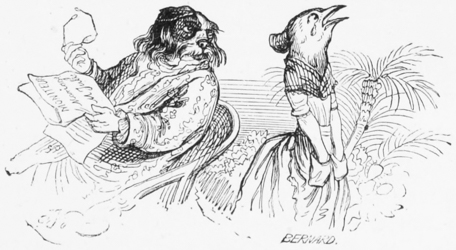

MINETTE TO BÉBÉ. FIRST LETTER.
“WHAT will you say, my dear Bébé, on receiving this letter from your sister supposed to be dead, for whom you have doubtless wept, as one who is almost forgotten.
“Forgive me, my sister, for supposing that you can ever forget me, although we live in a world where many more than the dead are forgotten.
“First of all I write to tell you I am not dead, that my love for you is as strong as ever, and that I am still animated by the hope of one day rejoining you, alas! my sister, that day may be far distant.
“This evening I thought about our good mother, who was always so kind and careful of our toilet, whose delight it was to watch the flicker of the fire-light on our glossy, silken coats, and to train us in the paths of domestic peace, virtue, and sobriety. I was touchingly reminded of our simple family-life, with its happy days, and innocent frolic, all hallowed by the light of love. Yet the brightness of that light of true hearts casts many dark shadows across my path, shadows of regret for neglected ministries of tenderness to my mother who is now perhaps no more. Above the sentiment that prompts me to write, is the desire to make a regretful confession of the circumstances which separated me from the dear ones at home.
“Silently I took up the pen, and the result is before you. I am bending over my task by the dim light of an alabaster lamp, carefully shaded from the eyes of my sleeping mistress.
“Although I am rich, Bébé, I would rather be poor and happy! Oh, my mistress is waking. I must quickly say good-bye. I have barely time to roll up my letter and push it under the cover of a chair, where it must remain till daybreak. When it is finished I will forward it by one of our attendants who is now waiting on the terrace. He will bring me your reply.
“My mother! my mother! tell me all about her.
“YOUR SISTER.”
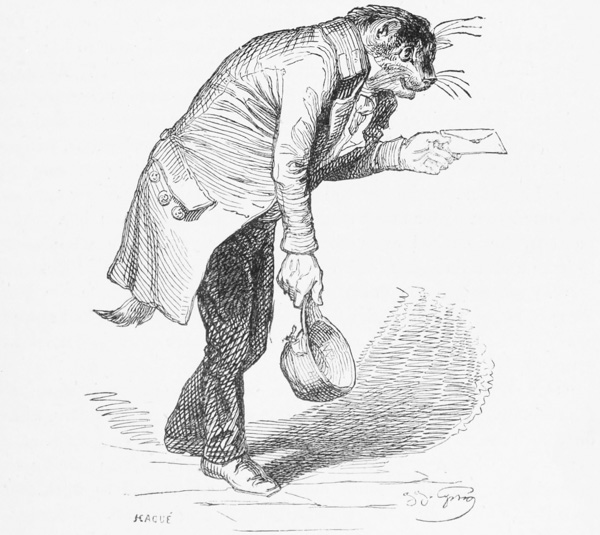
“P.S.—Place confidence in my messenger, he is neither young nor handsome, neither a Spanish Grandee nor a rich Angora, but he is devoted and discreet. He found out your address. He loves me and would do anything for me, so he has become my courier. He is a slave! Do not pity him; the chains of love are his fetters.
“You must address your letters to Madam Rosa Mika, that is the name I am known under here.
“My mistress is certainly waking up, she sleeps badly, and I dread discovery.
“Again, adieu! In all this scribbling you will recognise more of the heart than the hand of your sister.”
BÉBÉ TO MINETTE. SECOND LETTER.
“MY DEAR MINETTE,—I thought I should go mad on reading your letter, my joy knew no bounds, and indeed it was shared by all. One would willingly see all one’s relations die, if they all came to life again like you. Ah, Minette, your departure caused us great grief. Were you forced to leave us so long in doubt? If you only knew how everything is changed here since you left. To begin, your mother is deaf and blind, and the poor old creature passes her days at the door, without ever uttering a complaint. When I wished to tell her you were still alive, I could not make her understand, and she could neither read nor see your letter. Her many troubles have told sadly upon her. After you left, she searched everywhere in vain for you, and the loss seems to have undermined her health and left her the wreck I describe.