Chapter V · (continued 2)
Reading edition
“If you do not love me a little”—here he burst out laughing—“just a very little, why do you give me such good advice?”
“Why, my simple friend,” he said, “I do not love you. You amuse me, since the rôle you are about to play resembles my own. My enemies will be yours also. Don’t you see that the prospect of wounding their superfine feelings through such an ugly medium affords me a new pleasure? Let us be mutually accommodating, a joint-stock thorough nuisance to all who affect to loathe what God has made for some good end. I hardly know what I am made for, and next to erecting my quills offensively, like the bayonets on which some thrones are built, my chief happiness consists in doing nothing.”
These maxims seemed odious to me. I had no hand in making myself, otherwise my mouth should have been more contracted, and my stomach less capacious. Had I been consulted, I hardly think I would have chosen a “fretful porcupine” as my model, nor yet my father, poor old toad! who lived a contented sober life, and died regretting that his paunch had reached its fullest rotundity. It was no fault of mine that I inspired horror. If ugly and deformed, I was endowed with a profound love of the beautiful, which compensated in some measure for my awkward appearance, and, if I may use the expression, with a merciful provision of vanity, which enabled me ever to admire and cherish my own body. If my body was all too solid to respond to my every wish, yet my dreams and imaginings were unfettered as the wind. The reader, if he cares to study the habits of such an humble creature as the toad, will discover much truth in what I say; moreover, if he be an ill-favoured person, he may find comfort in my philosophic view of life.
A love-sick toad may be deemed by some an object worthy of ridicule; nevertheless, as my romantic experiences form one of the most eventful pages in my history, I am bound to take the reader into my confidence.
I had reached that period of development when, rejoicing in the strength of youth and the full maturity of my faculties, I leaped from place to place, not without aim, as many might suppose, but in the pursuit of knowledge, frolic, or recreation. The sun shone brightly, grass and flowers were in full bloom around, breathing an intoxicating perfume into the midday air, when I first beheld the object of my dreams. My enemies may think me a plagiarist, and that I have lifted my sentiment from some modern novel. All I can say is that my book is nature, which I recommend to the study of writers of fiction, many of whose works would poison the morals of toads, for these prefer unadorned truth to the gaudy tinsel of the literary showman.
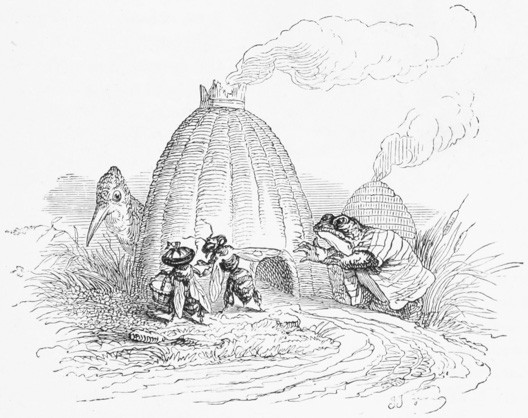
My love was bewitching in her dress of pale green. Oh how fondly I followed her with my eyes as she leaped from leaf to leaf, until at last I beheld her against the sky, her silken wings spread out to their fullest, descending lightly on to a blade of grass, which bending, swayed to and fro in the breeze! Flying in the air, toying with the flowers, making them quiver on their stems without soiling a single petal, skimming the placid water, admiring her own image on the wing, this fair creature won my heart. Vainly I strove to court her glance, forgetful that a vile toad in love is no more pleasing to the eye than a toad in grief or any other mood. At last she turned towards me, and in that weak moment I tried to smile, thinking I should look less repulsive. Alas! I discovered that my capacious mouth, bloated-looking eyes, and unyielding physiognomy, were powerless to respond to the sentiment of my heart. Besides, my pretty grasshopper failed to see me, or mistook my form for a clod of earth. Soon a deep shadow fell across me, and turning, I perceived a chubby boy advancing slowly, cautiously, armed with a huge net at the end of a long stick. I had already frequently observed him trying to catch butterflies and winged insects. When one of these poor, pretty, perfect little things escaped him, he lost his temper with his coveted prize, and savagely continued pursuit, crushing the first victim that fell to his net. I said to myself, “This is horrible! To this boy it appears a crime for an insect to strive to escape death. What have they done to warrant such a fate? They have not even the misfortune to be ugly.” This cruelty had such an effect on me, that one night I dreamed I saw large toads become light and mobile, catching men-children in their nets, and pinning them to the trunks of trees. I accepted the dream as a bad omen, and rightly, for not long after I descried the child coming towards the grasshopper, and divined that he was bent on capturing my lady-love. Not a moment was to be lost. I saw the danger, calculated my distance, and leaped just to the spot where the boy’s foot fell; he slipped on my back and rolled to the ground.
My love escaped from the snare! But I suffered greatly, having one of my hind-feet crushed and broken; yet, in spite of my agony, it was the sweetest moment of my life. The child got up crying, and seeing the cause of his fall, ran off in terror, only stopping in his flight to cast a stone at me. Happily he was as unskilful as wicked, and I was left with only a few scratches. My heroine, who had taken in the whole situation, came towards me accompanied by many friends. I should have preferred her being alone. Her companions were daintily dressed, perfumed with the fine essence of flowers, and seemed to be led towards me more by curiosity than compassion. When they had gathered around, I raised my eyes in hope of the happiness that I thought awaited me.
“Is it this poor wretch, did you say, my darling, who was crushed?” murmured a grasshopper in the tone of one about to perform a very disagreeable duty. “Oh! ah! This is really disgusting. Mark the creature’s wounds—how horrible! If one were not sustained by elevated sentiments, one would feel inclined to quit the scene. Oh, the hideous monster! Is it not strange that heroism should appear in such ignoble guise?”
Here this heartless drivelling fool stroked his chin with his foot and looked as if he had said rather a good thing. My grasshopper-goddess laughed affectedly, and I think made a sign to them to fetch her the strongest perfume to stifle the odour of my bleeding body. Addressing me, she said, “Say, my good fellow, why did you render me this service? Do you know that yours was a fine action?”
The moment had arrived for me to cast myself at her feet and proclaim my love, and I stammered out, “Willingly would I have sacrificed my life to save you, my love! my treasure! my” ——
Sad to relate, my voice was drowned in the coarse laughter of the lady and her foolish friends.
“Upon my honour,” said one, “this is a gay toad!” “Hah! hah! a mangled toad in love!” roared another. “Isn’t he a romantic-looking creature?” inquired a third. “Come, ladies, one of you waltz with him. Nay, don’t go too near, I think he has teeth.”
They then walked round and examined me with their glasses in the most insulting manner.
“I find him less hideous than grotesque,” murmured the queen. “It is his head that is unique. Why, his face is enough to make the daisies yellow, and freeze the swamps with fright! Have you all seen his eye?”
“Yes! yes! his eye,” they replied, “is very strange! very strange!”
Could anything be more galling to my pride to be thus made the butt of these hateful fools? Had they stabbed me to the heart, I think I should have survived in spite of them, but their jeers and laughter made me die a thousand deaths. Under the dominion of proud sentiment (of which I am now heartily ashamed), I raised myself on my bleeding foot and addressed the grasshoppers.
“I ask you for neither pity nor recompense. You yourselves witnessed” ——
“Listen!” said one; “he speaks well, although thick, like a person in liquor.”
“This is horribly interesting.”
“You witnessed,” I continued, almost fainting, “an act of devotion. I loved” —— The hilarity burst forth anew, and the grasshoppers, no longer able to control themselves, joined hands and danced round me like a troop of green devils, singing—
“Hail, lover, hail! joy to your tender heart.”
They certainly enjoyed themselves thoroughly that day. After all, they had only obeyed their nature, and I had mistaken my own.
I had fully proved my own vanity and stupidity—at least, that was the opinion of my friend the Porcupine, who that night drove me out of his den.
From that time I felt myself an outcast, and sought humbly to win the favour of my own kind by making myself useful in my own proper sphere. I became almost a creature of the night, and lost sight of much of the beautiful that had charmed me, for the world is full of beautiful things to those who can look out of and beyond themselves. It boasts also fortunate beings whose lives would be all the more happy if they would only consent, now and then, to yield up one of their joyous hours to gladden the hearts of the poor. I ask you, dear reader, is it not so? You may be a creature, charming in person, refined in manner, and successful. Their attributes, as you use them, may make you either a god-like ministering spirit in the world, or a fascinating fiend. Your strong sympathy and timely help may lighten the burden of the poor, may cause a deformed brother to forget his deformity and delight in your beauty as much as if it were his own. There would be no plain-looking or even ugly creatures to curse the day of their birth, were there no cruel, well-favoured observers to wound them with their looks and gestures. But I am forgetting the lesson which I myself learned late in life. I had put myself in the way of finding out by experience that a poor toad could never have wings, nor, though everything is fair in love and war, could he hope to win the heart of a grasshopper.
I am now full of years and philosophy; my wife, like myself, is a contemplative full-bodied toad, in whose eyes I am perfectly beautiful. I must own my appearance has greatly improved. The like compliment cannot be honestly paid to my mother-in-law, who has caused me no small trouble. She increases in age and infirmities. The reader will pardon my repeating, that notwithstanding my rotundity, I am no longer ugly. Should he have any doubt on this point, let him ask my wife!
THE THEATRICAL CRITIC.
MY DEAR MASTER,
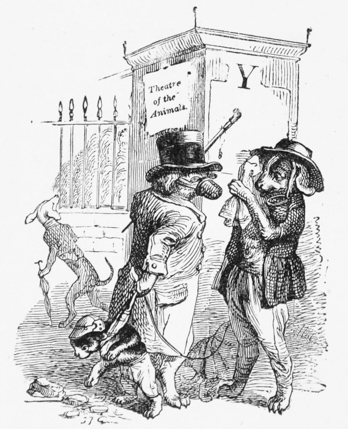
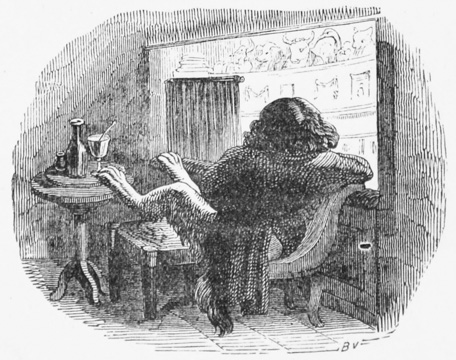
OU must feel alarmed during this hot weather at seeing the walls inscribed with “Death to poodle-dogs,” having yesterday, with your own hand, sent me adrift without either muzzle or collar. You knew that I wanted my liberty; I was indeed constrained to beg of you to let me go by what you would term “some subtle indescribable impulse.” To tell the truth, the conversation you carried on with your friends about Boileau, Aristotle, Smith’s last book, and the “five unities,” proved dull. I listened to you as long as I could, then yawned, and barked as if I heard some one at the door. Nothing would for one instant draw your attention from scientific discussion.
You even pushed me off your knee just as you had clinched an argument by pointing out that the ancients were always the ancients.
It was truly unkind of you to persist in remaining indoors when duty and inclination called me abroad. At last you let me go. I had found on the table an order for a stage-box in the Theatre of the Animals, a glorious place where they were only waiting for you and me. For two reasons I will refrain from writing down a full review of the play: first, because I am only a novice in the art; and secondly, because you, my master, gain your bread by descriptive writing. How could you. cram your paper daily if you had not at hand all the stock phrases of dramatic criticism? As for myself, I feel rich in the mine of poesy that prompts every wag of my shaggy tail.
I should be an ungrateful dog if I robbed you of your capital. Your imagination I have nothing to find fault with, seeing that your greatest successes, as a dramatic critic, were penned on plays you never took the trouble to witness.
I made my way to the theatre on foot, for the weather was fine. I came across some agreeable acquaintances on the way, all going with their noses to the wind. The bulldog at the door respectfully inclined his head as I entered the box and threw myself carelessly into a chair, my right foot on the velvet cushion in front, and my legs resting on a couch. This graceful attitude you yourself assume when preparing to sit out, or sleep out, a five-act play.
I had hardly been seated two minutes when the orchestra was invaded by musicians. These personages were the gayest to behold. The flute was played by a goose, while a donkey struck the harp—asinus ad lyram, wrote some erudite poet. A turkey clacked in E flat. The symphony began, and resembled those of which you speak so enthusiastically every winter. The curtain then rose, and my troubles as a critic commenced.
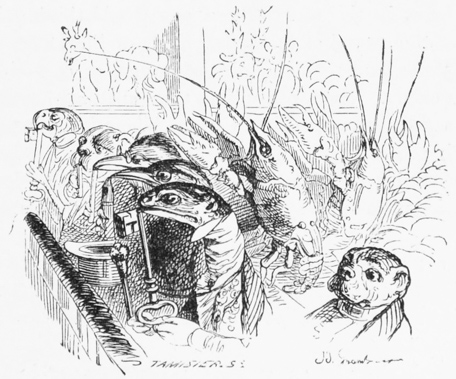
It was a very solemn drama, written by a sort of greyhound, or half-greyhound and half-bulldog, a half-English half-German animal, who had entered the Dogs’ Institute of Paris.
This great dramatic poet, whose name is Fanor, has a way of manufacturing dramas as ingenious as it is simple. He first goes to Mr. Puff’s Pug and demands a subject, next he makes his way to Mr. Scribe’s Poodle and engages him to write it. When the play is put on the stage, he employs six pariahs to applaud it, brutes they are who bark savagely. He is a wonderful fellow. Fanor wears his coat well brushed and most artistically curled, altogether he is just the sort of cur to wait upon rank and bow it into the boxes.
The play was said to be new. Let us skip the first scene. It is always the same—servants and confidants explaining the nature of the crimes, griefs, intrigues, virtues, or ambitions of their masters.
Do you know, my master, it was perhaps a great mistake to remove the muzzles of our poets. The traffic in the sublime has been left to an unmuzzled race of poodle-dog poetasters. It was not so with the ancients who wore the bands of art, and who dwelt far from the common crowd within the temple of the Muses. As well-fed watchdogs, they were thus restrained from poking their noses into the accumulated filth of history.
There is more in the muzzle than one would think. It is a safeguard against the spread of the hydrophobia of literature, so prevalent in our own times, and requiring all the bullets of cold-blooded critics to keep it in check. Evils other than the unnatural howlings and riot of modern tragedy are caused by liberty. There is an unearthing of old bones, which are scraped, polished, and displayed as the product of that modern genius the nineteenth-century dramatist, who with tragic instinct consigns the memory of their real owners to eternal death and oblivion.
The tendency of some grovelling dogs thus to become resurrectionists is too well known to require further comment at my hands. Death to those who before us said what we will to say, “Pereant qui ante nos nostra dixerunt!”
Little by little the plot expanded. When the pugs had revealed all their masters’ secrets and hidden thoughts, the masters themselves appeared, and in their turn gave us the paraphrase of what had preceded, together with the culmination of their passions. If you only knew how many odious persons I beheld. Imagine two old foxes in mourning for their tails: these with a couple of superannuated wolves, recumbent, and gazing vacantly around; a pair of badly-licked dancing bears, waltzing to soft music; weasels with frayed ears and gloved hands, made up a staff of threadbare comedians, all professing their loves and passions on the stage. Yet I am told that outside the theatre door they would tear each other’s eyes out for a leg of mutton or horse’s ham. But I had for the moment forgotten that the secrets of public life should be carefully walled around, so I dutifully returned to my analysis, in, I own, a roundabout sort of way. The language was not very intelligible. It was all about the sorrows of unfortunate Queen Zemire and her lover Azor. You have no notion of the singular and unaccountable stuff crowded into this hybrid composition.
The beautiful Zemire is a Queen of Spain, descended from a noble stock, counting among her ancestors a jolly dog named Cæsar.
In the back-kitchen of the castle, and in the noble rôle of turnspit, a mangey animal, but withal a worthy fellow, named Azor, turned the queen’s spit (while Queen Zemire had turned his head). He says—
“Belle Zemire, O vous, blanche comme l’hermine,
O mon bel ange à l’œil si doux
Quand donc à fin prendrez-vous
En pitié mon amour, au fond de la cuisine,” &c. &c.
These verses, improvised by the pale light of the lamp, were found admirable. The friends of the poet exclaimed, “Ah! sublime! They are perfumed with the profoundest sentiment!” In vain the linguists—curs, griffins, and boars—sought to criticise. “Why,” said they, “should kitchen and cookery in a high-class composition be mixed up with flowers and sentiment? What was there in a turnspit and its associations—the devouring appetite of the queen, &c.—to fan the flame of passion?” These expressions, let fall at random, nearly cost them their seats.
The verses were forcibly rendered by Azor, who scratched himself at intervals, either to relieve his feelings or lend piquancy to his love. At last the lover subsided into his daily barking prose.
“Zemire! Zemire! Oh how I long to kiss the ground beneath thy feet!” (in carrying out this ardent desire he would have encountered no reasonable difficulty, as the full-bodied lady left her footprints wherever she trod—this by the way). Azor howls in his agony of heart, when the kitchen-boy all at once throws some hot cinders into his eyes to remind him of his neglected duties at the spit.
I must tell you that in the castle there is a nasty dog, a Dane named Du Sylva, an intimate friend of the Count’s horses, with whom, for his own pleasure, he goes hunting. He is, as you shall see, a cur fierce, jealous, implacable, and desperately wicked. He is hopelessly enamoured of the beautiful Zemire, who treats the attentions of this northern boor with scorn. What does the Dane do? He, of course, dissembles with such craft one would imagine he had forgotten the insults heaped upon him. Alas! the traitor is only biding his time. One day he finds Azor in the castle moat, looking fondly towards his lady’s nest. “Azor, follow me,” says the Dane. He obeyed, and followed with his tail hung pensively between his legs. What does the Dane then do? He led Azor to a neighbouring pool, and ordered him to plunge and remain there for an hour. Azor obeys gladly. The cool water soothes his skin, and carries off the taint of cooking. It imparts lustre to his disordered fur, grace to his sickly body, vivacity to his eyes, which have been dimmed by the light of the fire. Leaving the pool, Azor rolls with delight on the sweet-smelling grass, impregnating his coat with the odour of flowers. He completes his toilet by whitening his teeth against the lichen of an old tree. That done, he feels the return of youth. The warm blood throbs through his heart, and his pensive tail wags briskly with the sense of new life. The whole world seems to open before him. There is nothing to which he may not aspire, not even the paw of Zemire. At sight of these extraordinary transports the Dane laughed in his sleeve, like the crafty rascal he was. He seemed to mutter, “Curses fall upon you, fool! You shall pay dearly for my fellowship!”
I ought to tell you, master, that this scene was played with great success by the celebrated Laridon. He is perhaps rather stout and old for his rôle, nevertheless, as they say in the papers, his energy and chic carry all before them.
Perhaps the finest scene was laid in the forest of Aranjuez, when the queen-dog walked pensively along with ears cast down, and a poodle held her graceful tail. Suddenly, at the bend of a path, she encounters Azor—Azor renewed, resplendent—the Azor of her dreams. Is it really he? Oh mystery! oh terror! oh joy!! Their eyes meet, and, eloquent with passion, tell their tale of love. Everything was forgotten in those moments of bliss. Had any one reminded Zemire that she filled one of the proudest thrones in the world, she would have replied, “What of that, so long as one loves?” Had Azor been informed of his humble position, he would simply have shown his teeth. Oh delights, miseries, joys of love! and also, to conclude my exclamations, oh vanity of vanities! know that every door has a hinge, every lock a key, on the rose is a grub, in the kennel a dog, and to every lamp, for the most cogent reason, there belongs a wick, and so in the forest of Aranjuez there lurks a terrible Dane who views our friends’ behaviour from afar.
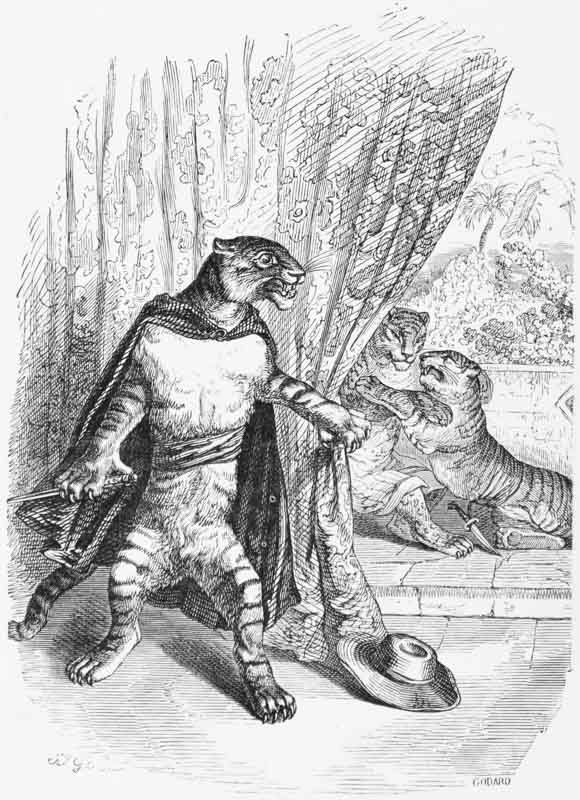
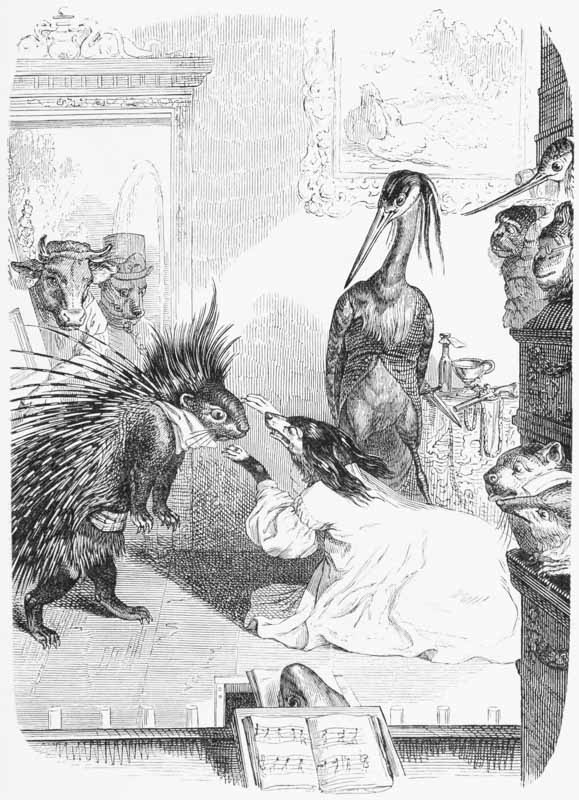
“Ah! oh! so you love each other, do you? Tremble! tremble! for your fate.” While speaking thus, when Zemire had quitted the scene, the Dane approached Azor. “So! so!” said he, “Zemire thinks you angelic in your borrowed beauty. You must now assume the skin of a porcupine, and with quills erect, dirty, hideous, smeared with sand and ashes, show yourself to Zemire, and break the spell that binds her!” Thus howled the Dane, giving full vent to his passion in foaming rage. Poor Azor obeyed, and appeared before his mistress. Standing beneath a frightful long-beaked heron, he bowed to the queen, declaring that he had played her false, as he was only an obscure turnspit, and begging her forgiveness. Then he remained motionless, prepared for his doom. Zemire cast herself at his feet, “Ah!” she said, “let me share your sorrows. I love you still, even in your vile condition. There! I give you my paw in the face of all the world.”
During this touching scene the whole house was moved to tears, and at the close came down with thunders of applause. Every one, beasts and birds—even to a flea on the tip of my nose—seemed delirious with excitement. With great presence of mind I bit the tail of an impulsive cock, arresting his flight to the stage to challenge the Dane. In a few soothing words I assured him that the villain was really a very decent fellow in his own house. At the same time I reminded him that, as the village cock, he might be missed in the morning from his dunghill, where he performed the useful office of heralding the dawn.
The curtain fell on the fourth act. As to the fifth, I do not intend to usurp your place as critic, but will conclude by saying that in this act the dogs had become tigers—a natural metamorphosis of which good authors avail themselves. The tiger, with equal consistency, killed his wife by mistake, and consoled himself by slaughtering his friends. It seems, when fairly married, Zemire became a tigress. This, I have heard, is one of those unaccountable changes which not unfrequently occur in real life. Be that as it may, the curtain at last fell on scenes of crime, murder, and confusion.
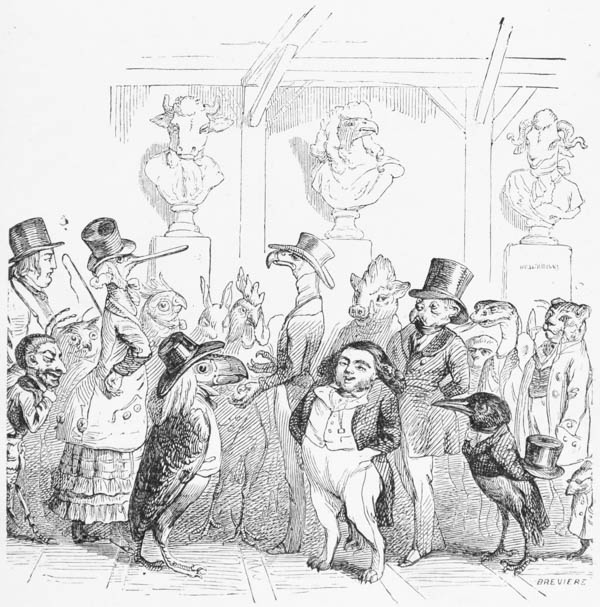
After the close of the drama, attendants handed round refreshments. As for me, I followed your example. As it was the first night of representation, I left the box at once with the air of one burdened with thought; and making my way to the green-room, joined a group of theatrical critics walking about with a supercilious pedantic air. One had the sting of the wasp, another the beak of the vulture, a third the cunning of the fox. Beasts of prey were there, hungering for helpless victims. Lions proudly showing their teeth. Of mischievous animals of all sorts, it was a goodly company. I ought to inform you, as soon as it became known that you belonged to me I was permitted to go behind the scenes, and to cultivate the acquaintance of the actors. But I must now conclude this rambling review, a friendly greyhound is waiting to join me at supper.
THE PHILOSOPHIC RAT.
PERSONAGES.
GNAWER, Rat with grey beard.
TROTTER, A young rat, pupil of Gnawer.
BABOLIN, Dispenser of holy water.
TOINON, Daughter of Babolin.
A VOICE.