SCENE VI. STITCH-GNAWER AND LITTLE TROTTER. (continued 4)
Reading edition
“Do not grieve too much, old age no doubt must take the lion’s share of blame. Besides, she sleeps, drinks, and eats well; and there is always plenty in the cupboard, as I would rather starve than let her want.
“Our young mistress has lost her mother, so she is more unfortunate than we are, as she has lost everything, except her pretty figure, which does not change.
“It was necessary to leave the little shop in Murais; to give up the ground floor, and all at once mount to the attic, and to work from morning to night, and from night till morning sometimes. But, thank heaven, I have a sure foot, good eye, and am a capital hunter.
“You touchingly remark that you are rich, and would rather sacrifice wealth for happiness. I do not clearly see how I can complain of being poor. How funny you are! you dine at a polished board, off gilded plates, and goodly fare. One would think from your way of putting it, that by stinting one’s self of food, one gets what riches cannot buy. Some wise cat will no doubt prove before long, that poverty is the cure for all evils. Seriously, do you believe that fortune impairs happiness? If that is your creed, become poor at once, ruin yourself! Nothing is easier than that, live by your teeth if you can. Tell me what you think of it. Complain of being unhappy, but not of being rich, for we who are poor are no strangers to misery. I scold you as your elder sister ought to do, so forgive me.
“Do you not know that Bébé would only be too happy to be of some use to you? Do not keep me waiting for another letter. I begin to fear you have been seeking happiness where it can never be found. Of course you will hide nothing from me. Ease your heart and write down your griefs on your perfumed paper, as you proposed. Adieu, Minette, adieu! This is enough, it is the hour for our mother’s meal, and it is yet running about in the loft. Things are not going on well there, the mice are clever, and every day seems to develop new instincts of cunning. We have feasted so long on them, they begin to notice it. My neighbour is a cat, not a bad specimen, were he not so original. He dotes on the mice, and pretends that some day there will be a revolution when mice will be able to hold their own against cats.
“You see I am right in profiting by the peace we now enjoy, hunting at will in their grounds. But do not let us talk politics!
“Adieu, Minette.
“Your messenger is waiting. He refuses to disclose your address. Shall we soon meet each other?
“Your sister till death,
“BÉBÉ.”
“P.S.—I own your old courier is very ugly. For all that, when I saw what he brought, I kissed him with all my heart. You should have seen him bow when he presented the letter from Madam Rosa Mika. Were you out of your mind Minette when you adopted such a name? Was Minette not a charming name for a cat so white as yourself? As I have no more paper, I conclude.”
A Starling had the misfortune of upsetting a bottle of ink over Minette’s reply to Bébé, so that several pages of the letter are illegible. The loss of these passages, however, does not interfere with the narrative. The missing matter is indicated by dotted lines.
MINETTE TO BÉBÉ. THIRD LETTER.
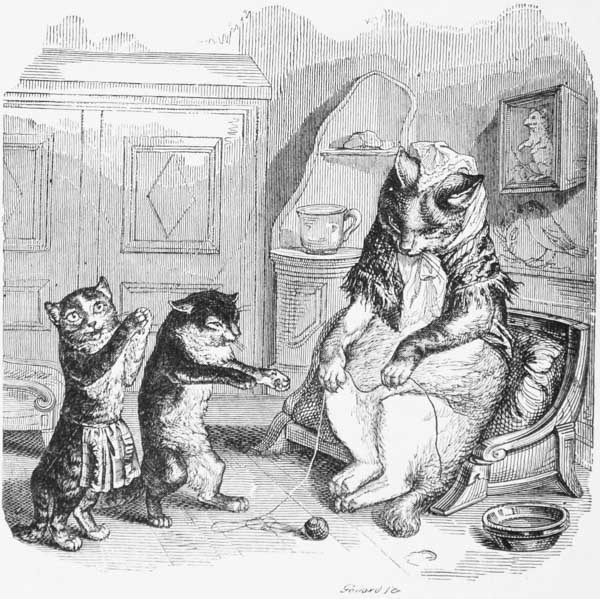
. . . . “Do you remember the doll given to us by our mistress, which soon became a subject of discord. How you used to scratch me. Oh dear! I almost feel my back bleeding when I think of it. How I used to complain of you to my mother when you so persistently called me a story-teller, but I got no satisfaction. It is from this point, this little wrong, that all my miseries sprang? Indignant at repeated miscarriages of justice, I resolved to fly from you and seek a happier home. Ascending to the roof, the heaven of cats, I viewed the distant horizon, and determined to wander to its furthest limit. The prospect for a kitten so young was not tempting. I foresaw many dangers to which I would be exposed in making my way into strange lands. I remember . . . . I seemed to hear choirs of voices in the air—
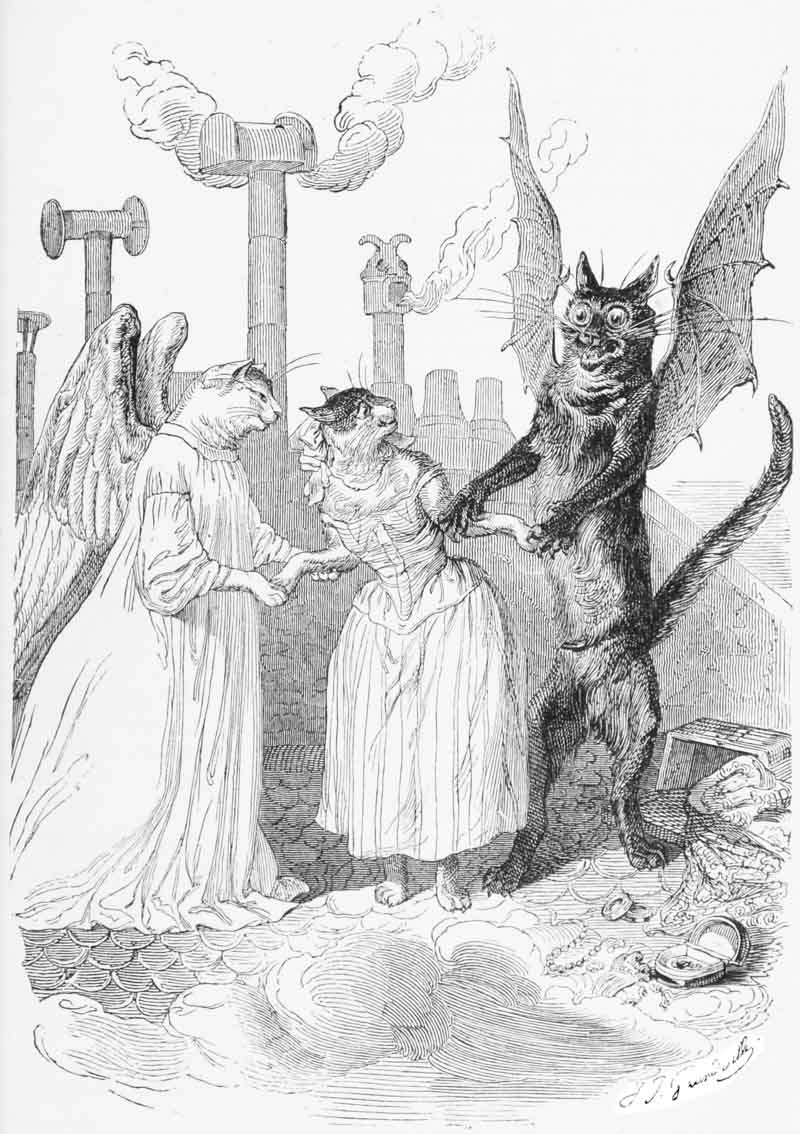
“ ‘Do not cry, Minette,’ whispered a voice—no doubt that of my evil genius—‘the hour of your deliverance approaches. This humble dwelling is an unworthy shelter for one born by nature to adorn the halls of a palace!’
“ ‘Alas,’ replied a voice softer and more musical—that of my conscience—‘You mock me, sir, I am a lowly maiden, a palace is no place for me!’
“ ‘Beauty is queen of the world,’ continued the first. ‘You are extremely beautiful, therefore you are queen! What robe is whiter, what eyes brighter than yours!’
“ ‘Think of your mother,’ said the pleading voice. ‘Can you forget her? Can you forget your sister Bébé?’
“ ‘Bébé makes you her slave, and your mother does not love you. You are a child of misfortune. You have been reared by chance. Chance is your foster-mother. You are alone indebted to chance. Come, Minette, come, the world is before you. Here is misery and obscurity, yonder, riches and fame!’
“My good angel in vain tried to picture a future of darkness and despair. The love of finery took possession of my heart and sealed my doom!
“The voice became more and more irresistible, and I blindly followed its commands.
“I had fallen into a faint, but when I became conscious, judge my surprise to find that my charmer was no illusion. Before me stood a young cat gazing tenderly down on me.
“Ah, Bébé, he was handsome! and his eyes sparkled with the flame of kindling love. He was the ideal cat of whom we sing when gazing on the moon veiled by the city smoke. At last, in a high-pitched rapturous voice, he exclaimed, ‘Divine Minette, I adore thee.’ I felt my tail expand at his audacity, but my heart expanded as if in unison, for I already felt that he was mine. Soon he settled down, his gaze riveted upon my face. You ought to have seen how humbly he begged for a single glance from me. How could I refuse his request, he who, perhaps, had rescued me from the terrible death of a fall from the tiles.
“If you had only heard his eloquence, Bébé. I confess I felt flattered and puffed up with pride, and saw myself prospectively arrayed in all the finery he promised to lay at my feet; lace, collars, jewels, and a superb ermine muff. This last gift brought me into great trouble.
“I was naturally indolent—he pictured to me a life of ease, with its soft carpets, velvet and brocade cushions, arm-chairs, sofas, and all sorts of fine furniture. He assured me that his mistress—an ambassador’s wife—would be delighted to receive me whenever I cared to visit her, and that all the collection which made her apartments a magazine of curiosities was at my disposal.
“Oh, it was delightful to dream of being waited on so; I would have a maid, and my noble mistress would serve me.
“ ‘We are called domestic animals,’ he said, why, it is impossible to say. What position do we fill in a house? Whom do we serve and who serves us, if not our masters? He assured me I was simply perfect, in tones so musical, that I heard the old landlady below screaming with delight. I said I felt lonely, and he swore eternal fidelity—Oh! how he did swear—and promised a life of cloudless joy. In a word I was to become his wife, and the ambassador’s titled cat.
“What more need I add. I followed him and thus became Madame de Brisquet.
FROM THE SAME TO THE SAME. FOURTH LETTER.
“Yes, Bébé, Madam de Brisquet.
“Pity me, Bébé, when I write this name it seems to me to contain the whole story of my misery, condensed and sublimated, yet I have imagined myself happy in the possession of wealth, honour, and his affection. Our entrance into the hotel was a real triumph, even the ambassador opened his window to receive us. The lady pronounced me the most beautiful creature she had ever seen, and after exhausting her store of agreeable flatteries, she rang for her people, told them all to respect me, and committed me to the care of her lady-in-waiting. I was at once named the queen of cats, the fashionable beauty, by all the most renowned Angoras in Paris. My husband was proud of my success, and I looked forward to a lifetime of happiness.
“O Bébé, when I recall all this, I often ask myself how it is I have any heart left.
“My honeymoon lasted fifteen days, after which I discovered that Brisquet had no real love for me. In vain were his assurances that his affection had not changed—I was not to be deceived. But love desires what is impossible, and is after all satisfied with very little. Even when all tokens of affection were at an end, I felt I still loved him, and would not believe that love so sincere awakened no kindred flame in his heart.
“Remember this, Bébé, there is nothing more transient than the love of cats. Far from being pleased at my constancy, Brisquet became impatient with me.
“ ‘I cannot understand,’ he exclaimed angrily, ‘why love, the most gay and agreeable pastime of youth, should become the most serious, absurd, and bothering business of our maturer years.’
“I abandoned my mother and sister, because I loved you! I, I——wept!
“My grief only hardened his heart, he became cruel, even brutal, and I, who had rebelled against my poor mother’s neglect, bent under his oppression, and waited, hoping for brighter days. But time is a pitiless monster, and teaches us many a hard lesson we would rather not learn. Time may also be likened to a good physician, who, after many days heals the deepest wounds. I became calm, feeling that the last ember of my unrequited love had been rudely stamped out; and I forgave him.
“Brisquet was one of those who love themselves better than all the world, and who are easily elated by anything that flatters their vanity. He was a true disciple of the school of gallantry, whose doctrines are framed to please, without the troublesome sentiment of love. Their hearts have two doors which open almost simultaneously, the one to let you in, the other to kick you out. Naturally, Brisquet while ceasing to care for me, had found another dupe. Fortune had furnished a singular rival, a Chinese creature from the province of Peichihli, who, soon after she had landed, set all the cats in Paris in a ferment. This gay intriguer had been imported by the manager of a theatre, who wisely foresaw that a Chinese cat would create a tremendous sensation among the Parisians.
“The novelty of this last conquest pricked the self-love of Brisquet, while the drooping ears of the foreigner did the rest. Not long after he announced his intention of leaving me.
“ ‘I found you poor, I leave you rich. You were despairing and knew nothing of the world, now, your instinct has been sharpened by experience. You owe all to me; thank me, and let me go.’
“ ‘Go,’ I said, ‘I ought never to have loved you,’ and he left me.
“His departure lifted a load from my heart. I no longer cared for him. O Bébé, if I could only have forgotten all, and become a kitten again.
“It was about the time of Brisquet’s disappearance that I renounced the world, and refused to quit my apartments. Under the able tuition of my mistress, I soon perceived that there was more probability in the fable of the cat transformed into a woman, than one would suppose. In order, therefore, to wile away the time, I took to the study of human nature from our point of view. I resolved to put together my observations in the form of a little treatise, entitled, ‘History of a Woman, as a Caution to Cats; by a Votary of Fashion.’
“Should I find an editor, this important work will soon see the light. Bébé, I have no heart to write more. Oh, that I had, like you, remained poor, and never known the pain of luxurious misery. Bébé, I have decided to return to the loft to rejoin you and my dear mother, who, perhaps, after some time may know me again. Do not deter me, I will work, I will forget all the pomp and vanity of riches. Adieu! I hope to leave for home to-morrow.”
BÉBÉ TO MINETTE. FIFTH LETTER.
“As I have just received and perused your long, sad letter, I can only say, that I am ready to welcome you home. Your story was read through a mist of tears. Although, as I say, I am ready to receive you, for your own sake, I entreat you to remain where you are. Think well before plunging into poverty, and exchanging the sentimental misery of your position for the real woes of want. Remain where you are, for beneath the richly-laden boards of the great, you can never feel privation. You can never feel the savage instinct that causes your poor relations at home to fight for the foulest refuse.
“Mark well my words, Minette. There is only one overwhelming type of misery in the world, and that is, born of poverty. I need say nothing to prove that our lot is a sad one. The masons have just left the loft, where they stopped up every mouse-hole, and transformed our happy hunting-grounds into howling wastes of bare timber and plaster. My mother, who knows nothing of all this, is dying for a meal. I have nothing to give her, and I have tasted nothing for days.
“BÉBÉ.”
“P.S.—I was begging the privilege of hunting in the neighbours’ preserves, and have been driven from their roofs and spouts. Keep your sorrows, you have leisure to weep over them, and over the sad lot of your poor sister and mother.
“It is said no one dies of hunger in Paris—we shall see!”
FROM BÉBÉ TO MINETTE. SIXTH LETTER.
“We are saved! a generous cat has come to our aid. Ah, Minette, how joyous it is to come to life again!
“BÉBÉ.”
FROM THE SAME TO THE SAME. SEVENTH LETTER.
“You do not reply, Minette. What is the reason? Ought I to excuse you? I have great news, I am going to be married. I have consented to wed our deliverer. He is elderly and fat, but very good. I feel certain you will approve of the step. His name is Pompon, a nice name which suits him well. It is, besides, a good match, he is a well-fed cat. You see my education has led me to view this union in a plain practical way. Write soon, lazy one!
“BÉBÉ.”
FROM MINETTE TO BÉBÉ. EIGHTH LETTER (written in pencil).
“While I write to you, Bébé, my maid—the one kept for me by my mistress—is engaged in making a linen bag, when finished I will be thrust into it, it will be sewn up, and I shall be carried off by the footman and thrown into the river.
“This is to be my fate.
“Do you know why, Bébé. It is because I am sick, and my mistress, who has the most superfine feelings, dreads the sight of suffering and death. ‘Poor Rosa Mika,’ she said, ‘how she is changed!’ and in a sad voice gave the fatal order, ‘Be sure to drown her well, do not have her suffer pain.’
“Ah, Bébé, what do you say now? Do you still envy my miseries? My illness prevented me from writing. Adieu.
“Bébé, in a few minutes all will be over.
“MINETTE.”
You know the history of my married life, would you wish me to begin again?
As for Bébé, her lot in life was a happy one, only marred by the death of her mother, who expired in her arms while blessing her daughter.
Pompon proved a devoted husband and father, for Bébé soon became the mother of a numerous family of little Pompons and Minettes.
EPILOGUE. CHIEF EDITOR’S NOTE.
“We are happy to say that poor Minette is not dead, a telegram has just been handed to us intimating that she escaped as if by a miracle the sad end which menaced her.
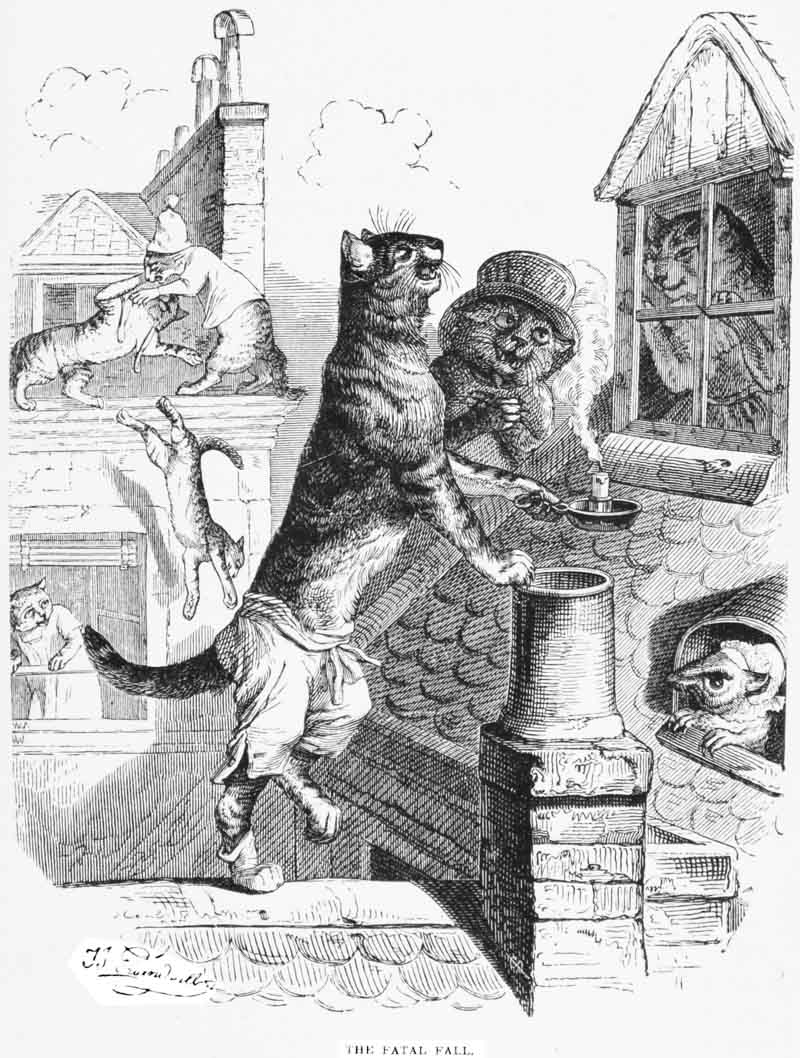
“Both mistress and maid died suddenly before the fatal bag was finished. Their death is an event most unaccountable, unless it was brought about to meet the exigency of this romantic tale. Minette, by means best known to the author of this faithful history, soon recovered, and was restored to her sister, with whom she lived happily for many years, enjoying neither riches nor poverty. Minette’s tranquillity was broken for a time by the news that Brisquet had first associated himself with a desperate gang of nocturnal serenaders, and ended his midnight exploits and his life by falling from a roof into the street. Bébé seeing Minette a lonely widow, was filled with compassion, and tried to persuade her to wed one of the friends of Pompon. All her efforts were vain. Minette remained unmoved, saying, ‘One only loves once. There are those for whom I might die, but with whom I must refuse to live. Besides, my resolution is taken—I shall end my days in widowhood.’ ”
CELEBRATED TRIALS.
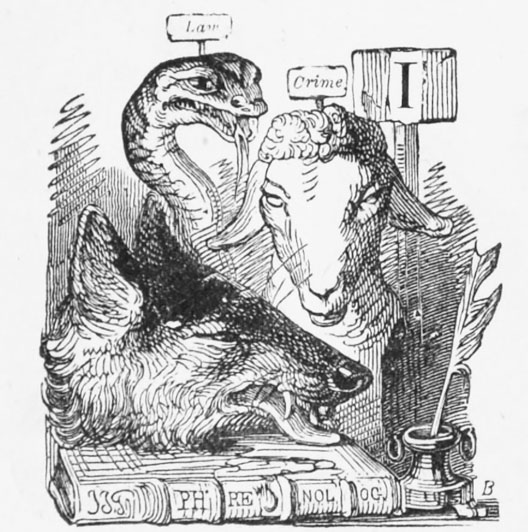
AM an old Crow, a member of the Bar of the animal kingdom. At the urgent request of my friends and a wide circle of admirers, and owing to the shortcomings of law reporters, I have resolved to set before you a succinct account of the last assizes. They created a great sensation; it could hardly be otherwise, since the happy thought had suggested itself of selecting most of the judges and jurymen from members of my own tribe, and these, by their grave solemnity of countenance, and by their black attire, presented an imposing spectacle to the crowd, for it was but natural to infer that creatures so skilled in ransacking dead bodies would be peculiarly apt in drawing conclusions as to the moral decomposition of prisoners.
A Stork was appointed President, his cold-blooded patience and stolidity rendering him not unworthy of that honour. Perched motionless on his chair with his eyes half shut, his breast puffed out, his head thrown back, he carefully watched for any contradictory statements made by the accused, and looked as if in ambush on the borders of some swamp. The post of Attorney-General had fallen to a wry-necked Vulture. This personage, if he ever possessed any sensibility, had long forgotten its influence. Ardent and pitiless, his only thought was to obtain success, or in other words conviction; his claws and beak were ever ready to attack but never to defend. The court of assizes was a field of battle, and the prisoner a foe who must be subdued at any price. He proceeded to a criminal trial like a soldier to an assault, throwing himself into the case like a gladiator into the arena. In short, the Vulture makes an admirable Attorney-General. The inhabitants of the holes, nests, copses, molehills, and neighbouring marshes flocked in crowds to attend these judicial ceremonies, while Geese, Bitterns, Buzzards, and Magpies swelled the throng. This is the way of the world. Seats were reserved for the representatives of the press—Ducks and Parrots most of them. With what eagerness these gentry hurried to their places! A reporter pounces upon a horrible trial as if it were his lawful prey. When such an occasion presents itself, the regular staff find themselves no longer obliged to task their imaginations, to cudgel their well-worn brains. Copy is supplied to them ready-made, needing no fresh spice to suit the public taste, but rather abounding in dramatic incidents, such as the journalists could never have invented themselves; so the editor can proudly cry out to his printer, “Strike off 10,000 additional sheets!”
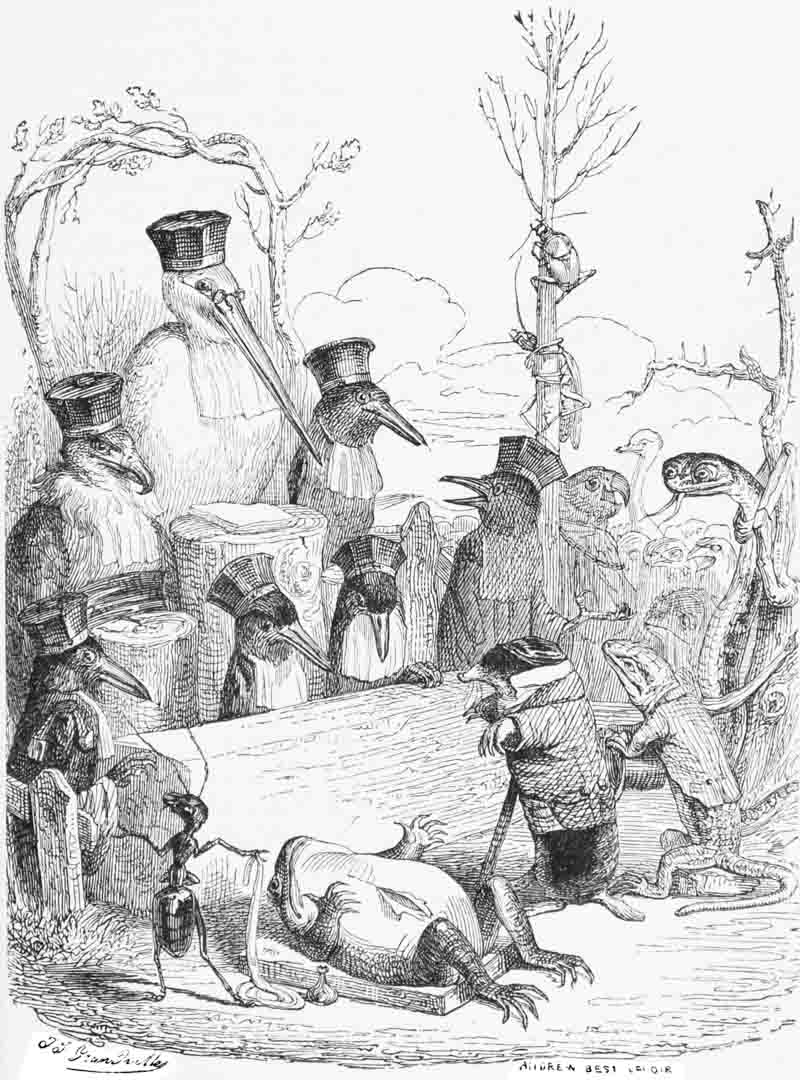
It is needless to describe in detail the whole business of the session. We will set aside the proceedings against a jolly Dog, who in a moment of excitement bit the tail off a rival in front of a tavern; against a Peacock for assuming an aristocratic title not his own, a Magpie for theft, a Cat for unlawful trespass on private tiles, a French Cock for stirring up hatred against the constituted government, a Fox for fraudulent bankruptcy. We will content ourselves by noticing the two leading trials, saying with a Rat of our acquaintance, who had gnawed his knowledge out of a book-worm’s library, Musa mehi causus memora.
In a recent issue of “The Microcosm,” a journal much patronised by the Ducks, one might have read the following words:—
“A crime has just been committed of a nature so diabolical as to rouse the indignation of the whole country. It is deeply to be regretted that at the moment when the confederated animals had sworn to maintain eternal friendship and peace, a Toad should be found foully poisoned in a field. Justice is making investigation; she investigated to such good purpose that two Sheep, three Snails, and four Lizards, all equally guiltless, were arrested on suspicion, and not released until they had been detained for ninety days in precautionary imprisonment. May Providence protect you, my friends, from having any idle charge ever laid at your doors. The first thing to be done will be to lock you up in a cell; there you will be detained in custody, that you may be interrogated, and even cross-questioned, about family antecedents and occupation, your mode of spending your leisure, and how you have been employed on certain days, at certain hours, for some months past. After it has been duly established that you are innocent, you will be politely requested to go back to your domicile. During all this time your affairs have languished and fallen into disorder, creditors have become furious, debtors have flown, your family has been injured, and calumnies of all sorts have been kindly set afloat concerning you, for we may always find plenty of animals who will say, ‘Where there’s smoke there must be fire.’ ”
Those who were arrested on suspicion in this instance were found to exhibit no traces of guilt. The inquiry was pushed with the greatest energy and activity under the direction of a pair of Tortoises, but the longer their examination continued, the more profound became the darkness and mystery which shrouded the Toad’s death. At last a Mole came tumbling up from under his hill, and stated that he had seen an enormous Viper—monstrum horrendum, as my friend the Rat would say—darting at the Toad. When brought face to face with the remains of the deceased, he swore positively to its identity. The Bulldogs were instantly despatched in search of the Viper, and falling valiantly upon him during his sleep, brought him before the judges.
The court is opened; the indictment is read; the Ant, a distinguished analyst, who had been ordered to examine the contents of the stomach, proceeds to read his analysis—marked attention.
“Gentlemen, our duty has been to examine the body and intestines of the unfortunate Toad, and to ascertain beyond doubt whether they contained traces of the poisonous matter distilled in the fangs of the Viper, called by the learned Viperium.
“This substance, combined with diverse oxides, acids, and simple bodies, forms variously Viperates, Viperites, or Viperures.
“We have analysed, with the greatest care, the stomach, the liver, the lungs, and the encephalic mass of the victim, using a variety of reagents pilfered from a homœopathic chemist who carried his medicine-chest in his pocket. After heating and evaporating to dryness the pancreatic juice and other substances contained in the stomach, we obtained a sweet solid body, which we treated with two milligrammes of distilled water; by placing the whole in a glass retort, and submitting it to ebullition for two hours and twenty-five minutes, we obtained no result. But this same substance treated successively with acetates, sulphates, nitrates, prussiates, and chlorates, yielded a liquid of a blue apple green colour which, when combined with certain powerful reagents, deposited a powder of an indefinite but most characteristic colour. This powder can be nothing but Viperium in its pure state.”
Such a lucid and conclusive report deeply impressed the audience.
This trial, which ended in the conviction of the Viper, would doubtless have excited greater interest had not public attention been drawn away by important political matters, and by the account of a still greater trial which took place about the same time.
The announcement of this affair appeared in the page of “The Microcosm” consecrated to the horrible, headed, as usual, “Another dreadful Tragedy.”
“A Ewe and her Lamb, setting a noble example to other domesticated animals, had escaped from their fold. Both were at once placed under the special protection of the Free Confederation of Animals, in spite of which they have been basely murdered.
“A wolf, believed by all to be the true assassin, has been arrested, thanks to the zeal and energy of the commander of the Bulldogs.”
The point of importance was to ascertain how the Sheep came by its death. Accordingly, to place this question beyond doubt, a Turkey was appointed to hold a post-mortem examination. Now this Turkey was among the most learned of birds. He had won a title by his marvellous skill, and had gained a well-deserved reputation by researches—unhappily inconclusive—into that important problem Quare opium facit dormire.
This eminent practitioner stated that the Sheep had certainly not succumbed to an attack of cholera as some had falsely reported, but from a wound six inches in length having been made in her neck, nearly severing the head from the trunk.
The trial was impatiently awaited, and at last came on for hearing. From break of day an immense multitude besieged the entrance to the court, but the authorities had taken measures to prevent disorder. At ten o’clock the accused is brought in; he looks pale, his dark eyes have lost their lustre, his attire though decent has nothing recherche about it. One can scarcely make out his features, which seem to shun the curious gaze of the public. An old Crow, who out of twenty applicants obtained the honour of defending the prisoner, was in his place in his professional robes prepared to enter upon his task. At length the examination commenced.
Q. “Prisoner, stand up! Your name and surname?”
Ans. “Canis Lupus.”
Q. “Your age?”
Ans. “Twelve years.”
Q. “Your profession?”
Ans. “Botanist.”
Q. “Your dwelling?”
Ans. “The woods.”
“The charges against you, Canis Lupus, will be read over.”
The indictment was read amid profound silence, after which the presiding judge resumed examination of the prisoner.
Q. “Canis Lupus, what have you to say in your defence?”
Ans. “I am innocent of the crime laid to my charge. I own, my lord, for a long time I was accustomed to destroy Sheep, but in so doing I consulted less my inclination than my hatred for man. If the death of a Sheep or Lamb gave me pleasure, it was simply because I knew that I thus carried off from my oppressors a portion of their daily food.
“For some time past I have looked upon Sheep with the tenderest solicitude, without in any way permitting this sentiment to interfere with my hatred for mankind. Picture my horror, my indignation, when a few days back I beheld the innocents of whose death I am accused, pursued by a butcher who struck them down without pity. I flew to their aid, the infamous executioner taking to his heels in terror. Just at that moment when I was preparing to bind up the wounds, the officers of the court apprehended me as if I were a vulgar assassin! Hereafter I propose to sue for false imprisonment and damages.”
The prisoner resumed his seat, placing his paw on his eyes. His address awakened the sympathies of the audience, especially of the fair sex.
“How well he spoke!” said a Crane.
“What wonderful grace and eloquence!” exclaimed a speckled Magpie.
“It is a thousand pities that a youth so handsome should be condemned,” said a Woodcock, sighing, “Ah me! ah me!”
It would almost seem that in order to please some ladies one must be a villain, but if one wishes to touch their hearts, hypocrisy must be called in to add attractiveness to crime. Let us, however, return to our mutton.
The judge replied—
“Prisoner, your version of the occurrence is full of contradictions and must be set aside as utterly false. It is opposed to the sworn testimony of the witnesses we are about to examine. Let us assure you, once for all, you will never be able to persuade your fellow-brutes that you are capable of one spark of generosity. Your antecedents are deplorable.”
Prisoner. “Alas! I have always been the victim of calumny.”
“You appear to have been reared in a hotbed of crime. At two years old you bit the mother who nursed you.”
Prisoner. “She bit me first.”
“Later in life you fell a-quarrelling with one of your neighbours and called him a Toad!”
Prisoner. “He had called me an Alligator.”
“Three years ago you were seen prowling round the royal rabbit warren, a place which no animal of your species is permitted to enter.”
Prisoner. “My lord, I never set foot inside it.”
“Perhaps not, but you intended to get in there, and to create a disturbance inside. The gentlemen of the jury will know how to take all these circumstances into account.”
The hearing of the witnesses followed, the Wolf cross-examining each with great ability—calm with some, ardent, jocular, or sarcastic with others, always ready with a reply to any damaging statement. Little by little, nevertheless, his strength failed him; to the strain of over-excitement there succeeded a sudden prostration, and at last he fainted away.
The trial had to be adjourned till the following week. For some days the Wolf was too feeble to appear. Never has an illustrious animal, the head of a family or a prince adored by his people—as official proclamations assure us—excited so keen a public interest during sickness as did this unlucky Wolf. The habitues of the court feared lest a sensational prosecution should be lost to them. The judge’s heart bled lest this important and popular trial should come to an end, depriving him of the opportunity of summing up, and so dealing with the evidence as to present to the jury the distorted form of justice seen through the illusive medium of the law. The executioner, his keen blade athirst for a victim, trembled lest it should be robbed of its proper prey. The Vulture general dreaded lest his eloquent speech should have to be shelved, again undelivered—a speech that had cost him three weeks of close study.
Every morning the press published a bulletin of the Wolf’s condition.
“The accused suffers dreadfully, and is closely confined to bed. He has always a number of Leeches near him; nevertheless he seems calm and resigned.”
“The prisoner had a bad night. Several Geese of the aristocracy have sent to the prison to inquire after his health.”
“The accused recovers slowly, he devotes his hours of convalescence to reading and writing. The chief subject of his study is the ‘Proverbial Philosophy of Martin Tupper.’ He has used during his captivity two thousand nine hundred and twenty-one sheets of paper. He is composing a drama in seventeen acts, entitled ‘Virtue’s Triumph,’ also a philosophical treatise on the desirability of abolishing capital punishment.”
The following verses were penned by the prisoner, and will doubtless be read with the interest they deserve:—
I.
“Ah, hapless is the prisoner’s fate in convict cell condemned to pine,
While birds abroad their songs uplift, and fields in summer’s glory shine.
If breeze-borne from the far-off flock, the fitful tinkling bells are heard,
If corn-fields wave their nodding ears, by wanton zephyrs lightly stirred,
All these the wretch’s sorrows swell, he scents but may not see the flowers,
And darker grows the lonely gloom which broods o’er all his friendless hours.
II.
“Soft coos the plaintive dove, the waves in whispering throbs their music pour,
Each after each in cadence breaks, and dies in rippling on the shore;
The woods and winds their voices blend, no heed the cheerless captive pays;
No joy to him the sunbeam brings, which o’er the smiling meadow plays.
Unhappy outcast! not for thee does universal gladness reign,
These joys were all in mockery sent to wring thy breast with deadlier pain.
III.
“The world outside, the busy world, its dear familiar rounds may tread,
But vain are dreams of pleasant life, when life’s long-lingering hope has fled.
Then, prisoner, cease to shake thy bars: no mercy cold mute iron shows;
In torments, terrors, threats, and tears, thy few remaining days must close.
Thy doom is sealed; the gaolers stern may never more their grip relax,
Until the headsman comes to claim thee for his hungry axe.”
I avow, ye gentlemen of the press, that the sort of enthusiasm of which this miserable Wolf became the object, inspired me with sad reflections. I have heard of unfortunate Nightingales, who for long years together have poured forth the most sublime songs without ever rising from obscurity, or obtaining a wider fame than that embraced in their native woodland shade, and yet this Wolf, because he has committed a foul crime, saw his clumsy doggerel rapturously applauded. I know of some good animals who, though they have proved themselves heroes of virtue, have never got a single line from the public press. Nevertheless the minutest sayings and doings of this condemned wretch have been chronicled to please the public craving. Mammas who would have thought twice before placing the fables of Florian in the hands of their daughters—mammas strict even in the choice of their own reading, have in the family circle freely discussed details which initiated their children into all the refinements of crime and depravity. Without ignoring evil, could not the reports of crime be so framed as to avoid the ghastly pomp and morbid parade with which they appear in the newspapers?
If an editor were to confine himself exclusively to the relation of good actions, he would frequently have to supply blank sheets to his readers.
As soon as the prisoner was able to appear at the bar, the proceedings began anew, and continued eight days. Twenty-eight witnesses were heard for and against the Wolf, while judges, jurymen, counsel, and defendants poured out their questions, interruptions, and observations in a never-ceasing flood. The result was that the whole affair, clear and simple as it had been at first, became gradually so confused as to be almost incomprehensible.
Most lawsuits are like the water of a fountain—the more it is stirred up, the muddier it grows.
The prisoner had used so many subterfuges to rivet attention, he became so thoroughly the lion of the day, that a profound feeling of sympathetic emotion prevailed when the Vulture delivered himself of the concluding speech for the prosecution.
“Gentlemen of the jury,” he said, “before I enter upon the details already submitted to your intelligent consideration, my duty commands me imperiously to put to you a question as grave as it is important. I ask you with feelings of the deepest grief and bitterest pain—I ask you, what is society coming to? In truth, gentlemen, turn where we will, look in which direction we may, we discover nothing but disorder—disorder, gentlemen, among quadrupeds, among bipeds, among geese, though they may use but one leg at a time. What we see is neither more nor less than symptoms of disorganisation, from bottom to top, from root to core. Yes, gentlemen, the social fabric is being undermined, the social body is corrupting; it totters to its fall, and fall it will, gentlemen, unless you are able to rear up a barrier which shall arrest its dreadful downward progress towards moral dissolution.”
The orator proceeded to view the crime in every possible light, showing how such atrocities were committed in ancient times, how they might be committed at any time by anybody, and how the guilt of this particular crime had been clearly brought home to the prisoner.
The counsel for the defence replied in an effective series of vigorous croaks, having first declared that in his opinion the finest spectacle on earth was that of innocence overtaken by misfortune.
At half-past twelve the jurors retired to a silent copse to deliberate, and soon returning, found the culprit guilty on all the charges of the indictment.
The judge touchingly inquired of the felon whether he had any objection to the sentence of death being passed upon him, to which the prisoner replied with a feeble grin.
“The Wolf is condemned to be hanged.”
The immense crowd remained gloomy and speechless, not a word, not even a bleat disturbed the scene, not a tail gave an involuntary wag. One would have imagined, when viewing all eyes bent on the Wolf, and all beaks hushed and dumb, that the assembly had been suddenly turned to stone, or that an electric shock had struck them all motionless for ever.
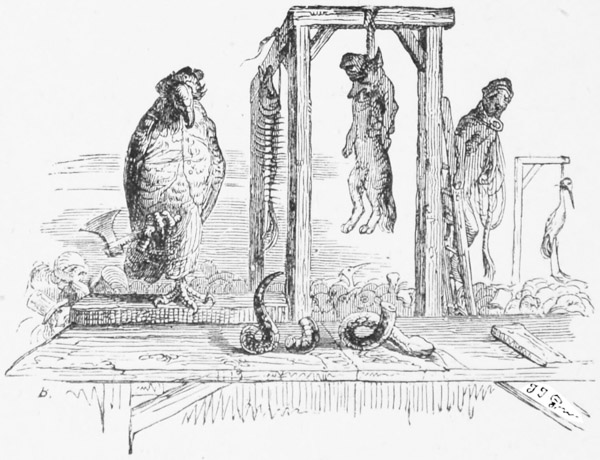
The Wolf was hanged this morning, gentlemen, and some zoophytes took good care to avail themselves of the opportunity for a demonstration in favour of the abolition of capital punishment. I confess that their arguments have little effect on me. I cannot conceive why they made so much fuss to save a wretch who destroyed his brother. It is to punish him more severely, they say, that they would permit him to live! How they deceive themselves! The convict always cherishes the consoling hope of being one day able to escape. It may be he will settle down contentedly to the undisturbed round of prison life. From a wretched outcast who gained a precarious subsistence by crime, he comes to take pleasure in his banishment. The burden of care has been lifted from his back. His wants are provided for by the State, and he need no longer dread the horrors of dying from hunger. The punishment inflicted has given him at last a recognised position in society.
If the penalty of death is to cease to be carried into effect, the nations of Europe, and the world at large, must commence by the abolition of war, for on the field of battle thousands of innocent lives are sacrificed as the penalty of the guilt or misgovernment of a single individual.
Let kings and emperors so raise the moral tone of their statesmen and subjects as to enable them practically to carry out the Divine command, “Thou shalt not kill.”
Twenty-two different portraits of the Wolf were issued, no one of them resembling another, yet all guaranteed likenesses.
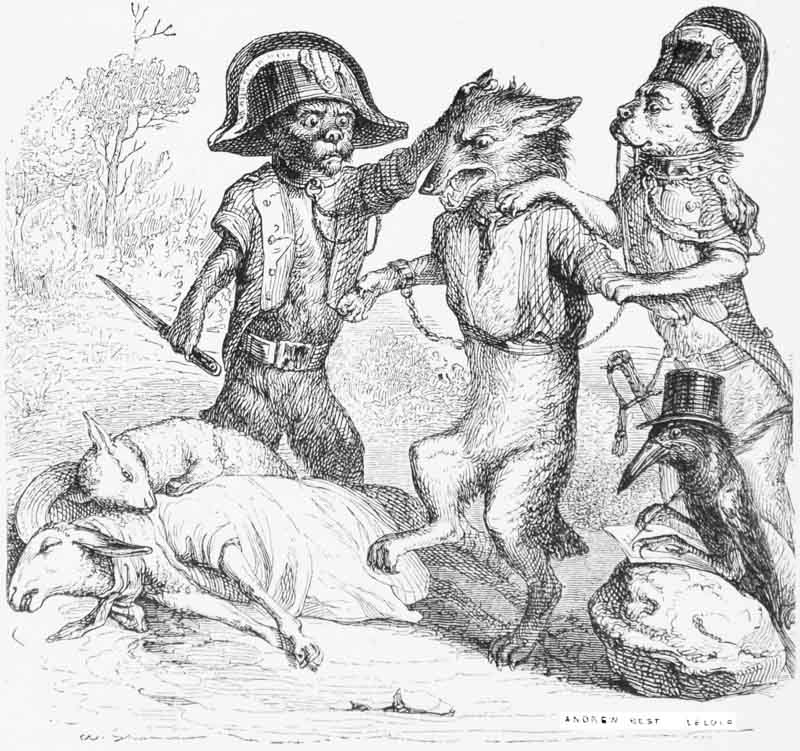
The complete account of the trial, drawn up by a clever shorthand writer, was sold by thousands. The memory of the Wolf was also enshrined in verse and recited in the streets.
I.
“Give ear, Jays, Hawks, and Magpies,
Attend, all Kites and Crows,
A story we shall now unfold
More black than ye suppose.
II.
“The story of a guilty deed,
For harpies vile befitted,
Which cunning Wolf with crafty tongue
And keen-edged tooth committed.
III.
“A tender Lamb one joyous morn
Beside its mother played,
The Wolf came creeping up
And friendliest greeting made.
IV.
“The Ewe responsive welcome gave,
The Wolf lay down to sleep,
But soon he started up again
And slew that trustful Sheep.
V.
“ ‘Help, mother dear!’ the Lambkin cried,
But oh! its cry was vain,
With cruel fangs the unsparing Wolf
Straight clove its neck in twain.
VI.
“But never while misdeeds abound
Shall wakeful vengeance fail,
Two Watch-Dogs bold, who guard the fold,
That guilty Wolf assail.
VII.
“ ‘Now, comrades,’ cries the wily Wolf,
‘Some healing balm obtain,
In yonder cave ‘tis stored;’ but soon
He found such tricks were vain.
VIII.
“For up and spake each trusty Hound,
‘Thou felon Wolf, say true,
Who bade thee slay this blameless Lamb,
And kill its mother too?’
IX.
“ ‘I cure, not kill,’ the Wolf replied,
‘Vex not a poor physician;
Such lies, base curs, would place my name
In quite a false position.’
X.
“The Watch-Dogs drag the prisoner off,
The courts his death decree,
Now hanged in chains his body swings
On yonder gallows-tree.
MORAL.
“Whene’er your steps incline to stray
Along the sinner’s wicked way,
A warning from this story take,
And know that truth sublime—
Each creature is a criminal
When he commits a crime.”
THE BEAR; OR, A LETTER FROM THE MOUNTAINS.
“WHEN introduced to the world, I brought with me a craving for solitude, doubtless bestowed for some wise purpose. But instead of directing my faculties to an end which answered my vocation in the harmony of beings, like most gifted natures, I followed my own inclinations.
“Soon after the event which brought me to light, a fall from a lofty tree lamed me for life, and contributed not a little to render me a prey to fits of melancholy.
“Our den was the favourite resort of Bears of the surrounding district. My father was a splendid hunter, and entertained his convives sumptuously with the produce of the chase. Life in those days seemed to be one endless round of dancing, gaiety, and feasting. As for myself, I remained a stranger to my father’s guests, whose visits bothered me. Although the good cheer was not wholly distasteful, the frequent and vulgar eating, drinking, and roaring bouts were odious to my nature. This repugnance was not to be attributed to a finely-strung organisation, although modern philosophy points to our organisation as the source and cause of our positive and negative affections.
Note.—This letter was meant for private circulation only; the young Bear from whom it was received thought he might venture, without offence, to divulge the secrets of friendship—more especially as the writer had died, leaving this, among other manuscripts, to his care. A dead Bear is not likely to complain of ingratitude.—ED.
“My love of silence and solitude at last settled into the gloomy moroseness of a misunderstood Bear, which has always passed as the token of incomprehensible genius, or of virtue too pure for the world. Years of self-examination, added to a growing feeling of dissatisfaction, convinced me at last that pride was the parent of my brood of sickly imaginings, whose ghostly food was the moonbeams, and the sighing of the mountains, as they whispered about me to the passing wind. Before resipiscence, it was needful I should suffer misfortune.
“My parents were grieved by my monomania. I had indeed determined to leave them, and seek some distant secluded spot in which I might remain undisturbed and alone. Conscience smote me in vain; my project was at last confided to a friend of the family, who after I had left broke the news to my parents, telling them I had voluntarily renounced the world. Never shall I forget stealing like a thief from the home of my childhood. The morning mist rose over the mountain from the valleys in blinding masses. Soon settling into clouds, one of pearly whiteness, fringed with the golden light of dawn, floated like a curtain in front of my old home.
“It was a glorious scene; I could dimly descry my father returning from the chase laden with a store of game. Snow mantled the heights, and an icy wind rising with the sun shook the dark pines. The violence of the wind increased, the clouds were driven, torn into shreds, against the jagged rocks, and scattered like flames of living fire flying over the pine forests. The wind, after a fearful blast and deep-drawn sigh, paused as if to view the sport, then rising suddenly, lifted the vapour from the hollows, chasing it from its warm bed up the snowy steeps, and spreading it out in a dark veil across the sun. In the deep gloom the voices of a thousand fiends seemed to rise from vale and crag. The caverns and gorges were filled with the spirits of a gathering storm, shrieking and clamouring like a crowd at the gates of hell, impatient to be let loose to lay waste the land. At last they burst forth; onward they came, guided by a sword of lightning that shivered a great rock close to my feet, and pierced the heart of my favourite tree. I rolled over in a faint of panic fear, and awoke to see the wreck of many a green sapling, the pathways strewn with leaves, branches, and the trunks of giant pines. The storm had abated, and in its track left angry torrents leaping from the once dry rocks, gathering force and roaring in brown torrents down through the chasms, to flood and wreck the smiling plains beneath. This is not all, for a sentimental Bear is a great observer.
“The sun again shone upon the scene with the brightness of hope to the torn breast of Nature, for every green thing took heart and expanded beneath its welcome rays. As for me, nothing daunted, I started and pursued my way until I found a spot inaccessible to everything but sweet solitude and myself.
“During live years my only visitor was an Eagle who perched on a stunted tree not far off. No other living creature had ventured to invade my horizon.
“My occupations were very simple. At dawn I sat on a ledge of rock watching sunrise. The freshness of the morning filled me with a sense of newness of life, and a vividness of imagination whose fruit was a palingenesian poem, in which I meant to express all the griefs of those who had raised the cup of happiness to their lips, only to find it empty and polluted.
“During the day I studied the healing properties of plants, while my evenings were devoted to watching the stars appear one by one in the sky. My heart expanded when gazing on the moon and the sweet planet Venus, and I even at times imagined I must have had some hand in creating the stars and moon, in order that they might shine for my special benefit. Five years were passed in dreaming, after which my eyes opened to behold the vanity of a Bear. My illusions vanished, and objects appeared in their true colours. A sense of loneliness took hold of me, the stars lost their lustre, the flowers and grasses their ethereal fragrance and heavenly hues. I considered my limbs, my claws, my coat, and behold they were made for climbing, crawling, clutching, and covering my nakedness. I found I could neither climb to high heaven nor clutch the stars; on the contrary, my attributes were practical, brutish, and earthly. These mortifying but useful discoveries compelled me to seek other scenes—to return, in fact, to the world and rejoin my fellows.
“Back I accordingly made my way, and, all unused to the craft of wise Bears, became a prey to the cunning of men.
“I started one morning early to carry out my resolution, and had not proceeded far when strange sounds smote my ear, voices shouting, ‘A Bear! a Bear!!’ Pausing to listen where the sounds came from, I was suddenly struck and stunned by an invisible weapon which sent me rolling over on the ground, where I was immediately surrounded by four savage Dogs, followed by three more savage men. In spite of the pain of my wound I struggled bravely, but was at last overpowered, and fainted from loss of blood.
“Upon recovering I found myself tied to a tree with a rope fastened to a ring in my nose. To this day I have never been able to make out how that solid metal ring was spirited into my nose. Verily the skill of man passeth the knowledge of Bears! Homer says the man who has lost his liberty has lost half his soul. I had sustained that loss, and had gained a permanent ornament, so fixed that to regain my liberty I must sacrifice my snout. There was no help for it, I had been rudely pulled up to survey my changed position. Wherein did the change consist? Sun, moon, and stars were still above me, but they had no longer the same interest for me; they were simply sun, moon, stars, and nothing more—heavenly bodies having their own affairs to look after, while I had mine, which proved all-absorbing. Formerly the beautiful in nature was my constant feast; there it was still around me, but it had lost its old fascination and power of feasting the senses.
“The truth is, I had never really renounced the world. For a time I was the slave of morbid fancies, and had no more given up the flesh-and-blood interest in life, than does the Buddhist bonze, who, while he courts seclusion and broods over the ethics of his creed, is careful to nourish and cherish the material part of his being.
“Here I was, by a mere fluke of misfortune, brought face to face with my real self, a heavy-footed, full-grown, and withal sentimental Bear. Many days passed in a sort of stupor of despair, followed by the sweet inward confession of my sins, which brought resignation and a calm I had never before experienced. If anything could replace the loss of liberty, it was the repose of my new life, for my master showed me uniform kindness. I was commensal of his house by day, and by night was consigned to a stable with some other socially-disposed animals.
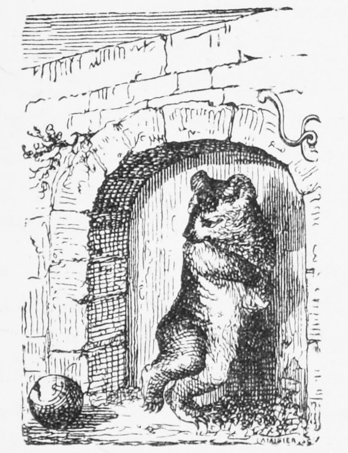
“Soon after daybreak I was taken to the doorway, where, seated beneath a plane-tree, the hours passed pleasantly in playing with my master’s children, who showed me much affection, while the thoroughfare along the highroad procured endless amusement.
“On fête-days the rustics came to dance under the tree; for my master was an innkeeper, and his house a favourite resort.
“There the noise of jingling glasses and songs of gay spirits sounded from dawn to sunset. I had always a formal invitation to the dances, which commenced after the evening repast, and were kept up far into the night. Usually I had the good fortune to open the ball with the prettiest girl of the crowd, by a dance similar to the one in vogue a Crete, invented for the amiable Ariadne. Since then I have been enabled to study the private life of men of rank, those on the upper range of the social ladder, and give it as my conviction that the poor mountaineers have a happier lot in life than those regarded by the world as the highly-favoured ones. The conclusion forces itself upon me, that men are happy just in proportion as they are ignorant. It is sad it should be so, as it brings them down to the level of the beast, and tempts some to regard even the Bear, owing to the simplicity of his nature and habits, as an infinitely happier animal than man. My rustic life lasted six months, during which time I followed the example of Apollo, deprived of his glory, guarding the flock of Admetus.
“One day, while I was seated as usual beneath the tree, a postchaise drawn by four horses stopped at the door, and I learned that its occupant, who had the air of a travelling aristocrat, was a poet of noble birth and European fame, who had been voyaging in search of adventure. This personage left the carriage to take some refreshment, and during his stay I seemed to be the subject of a conversation which ended in the stranger placing some pieces of gold in the hand of my master, who undid my chain and consigned me to the vehicle.
“The peaceful valley where I had spent so many happy days was leagues off before I recovered from my surprise. It is needless to remark that any change in my mode of life caused me much pain and anxiety. Believe me, dear reader, happiness is only to be found in the monotony of an uneventful life.
“As the scenes of my youth faded in the distance, sorrow took possession of my heart, and at last I bade adieu to my dear mountains. I felt for the first time that loss of one’s country is immortal, and that travels only produce fatigue of body and mind. Now I was enabled to comprehend how Calypso, arrayed in all her charms, could not tempt Ulysses to abandon his poor but much-loved Ithaca, or to relinquish the noble ambition which induced him to return and behold once more the smoke rising from his chimney.
“ ‘Vivite felices, quibus est fortuna peracta!
Vobis parta quies, nobis maris æquor arandum.’
“We embarked at Bayonne on board a ship setting sail for the British Isles, where I afterwards passed two years with my master in a Scottish castle. This gifted man was to me a most interesting study; at once poet and misanthrope, his example sealed my fate for life, thoroughly curing me of the monomania which had forced me into seclusion. I had at the same time contracted a depraved habit of composing verses or rhymes, which I could not shake off, never fully realising that only a few gifted poets have been enabled to win fame by placing their sentiments on record. Like most half-fledged misunderstood poets, I suffered acutely, being no favourite either of the Muses or the public. Inspiration would not come, in spite of great agony and superbearish effort. It was in vain I lay on my back or rolled on my belly—rhythm, rhyme, and romance proved my severest taskmasters. I walked fast in the dark lanes of the garden, as Pope used to do, scaring the birds by the deep growlings that escaped my breast.
“Who would believe it? My poetic breakdown stirred the worst passions of my nature, and drove me to hate every successful songster—to hate past, present, and future—to hate every one and everything saving my own soured self.
“Since Solomon’s time many books have been written, but the book which shall faithfully picture the miseries of a literary life has yet to be penned. My master himself, with his acknowledged genius and inordinate—— I must not retail his troubles, as most worthy recipients of his kindness might be tempted to do. I shall content myself, as a faithful servant, by merely raising the corner of the veil. The Muses were his true loves, to whom he was fain to prove unfaithful when he sought the joys of domestic life, to lay the storms of his heart in the haven of home. But it was all too late, the experiment failed, and he fled to end his accumulated woes on a foreign shore.
“Here was a lofty example for me, an unfortunate poetaster, proving as it did that poetic genius, just in proportion to its intensity, dries up the font of social happiness and plays fearful havoc with common sense.
“Fortunately for me, as it gave me my liberty, whatever it may have done for himself, my gifted master, at the sound of the strife of Grecian insurrection, determined to leave England, resolved to seek a brilliant tomb. Some days before his departure, wishing to make a last appearance in London, he profited by the representation of Hamlet, one of his favourite plays, to show himself once more to the British public. We drove to the theatre in an open carriage, and found the place crowded as we seated ourselves in a stage-box. Our appearance created a tremendous sensation, all eyes and eyeglasses were turned towards us; the ladies, bending over the balconies, recalled lovely flowers peeping out from rocky clefts. All were eager to get a glimpse of the great poet; so worshipful indeed was this well-dressed crowd, that the play was totally disregarded till the ghost of the prince stalked across the stage, and as a tribute to Shakespeare, the great character of the phantom was received with profound respect. The details of the tragedy appeared to be of a nature to familiarise the spectators with our presence, like the appropriate music which introduces and accompanies the hero in an opera. But the ghost was too signal an evidence of creative genius to be lightly passed over. This wonderful performance supplied all the metropolitan journals with a glowing leader. It is to these papers, for the past twenty years, we have been indebted for all the political, philosophical, religious, and literary achievements of learned Europe.
“Next day we embarked for France, and as good-luck would have it, my master made a roundabout journey to visit some ruins.
“One evening when he was seated at the foot of an old tower, I profited by the reverie in which he was plunged to make my escape. For four days and nights I fled from mountain to mountain without once looking behind. At last, on the evening of the fifth day, I again found myself in the Pyrenees. In an excess of joy I knelt down and kissed my native soil, after which I made for the cavern where I first breathed the air. It was inhabited by an old friend of the family, who told me that my parents were dead. After shedding a few tears to their memory, I took up my abode on Mount Perdu, and made myself a happy home.
“Although I am a poet in a small way, I love my wife, and find my children perfect; they are moulded very much after their father’s image. We do not see much company, almost none, save one or two desperate duns, who thought so well of me as to come over here all the way from London to “look me up,” as they say. Their excuse for intruding on my privacy is that they frequently pass my way, and it suddenly occurs to them they have each a trifling bill for Mr. Bear. These scraps of paper are the tender links which bind me to the past, and recall the licence of poetic inspiration. Happy is he who dwells at home, and who has never drifted into doggerel!
“All I now require is to be left alone to the use of my natural instincts, which have ripened under affliction, and to the enjoyment of the attributes with which nature has endowed me. I have been long in discovering my true self. Now that I have found the rascal, I will keep watch over him, and prove to the world that my wandering life has not been wholly spent in pursuits of vanity.
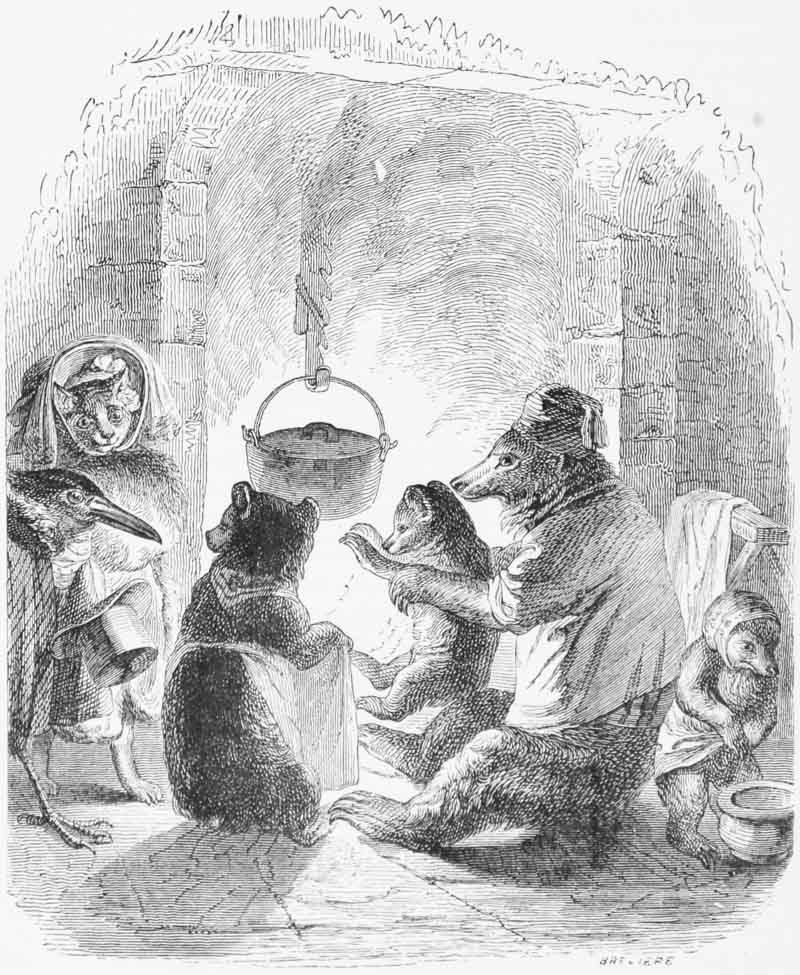
“What more do I require? Does not the naïad of the rock distil from the elements an exhaustless store of water to quench my thirst? The beloved tree of Cybele, does it not shelter my dwelling with its evergreen boughs? Above all, when the day’s toil is ended and I return laden with the trophies of the chase, have I not a devoted partner to welcome me home?
“I have now no ambition save one, and that is to make the acquaintance of that heavenly constellation which bears our noble name.”
CHAPTER OF DREAMS.
I.
WAS dead.
Dead as one perhaps dies when uncertain whether it is better to live or to die; dead without knowing when or how. I had indeed died painlessly, pleasantly, and mysteriously.
So easily had my life left my body, so little had it suffered in quitting the form of clay, that at first my body did not perceive the change.
Of the precise moment when from a living Turtle-dove I became a corpse, I remember nothing, unless it be that before death the moon shone brightly in a cloudless sky; and when my astonished spirit made out that it had fulfilled its duty on earth, the moon had not ceased to shine, and the sky was still cloudless. Probably my death, far from quenching the light of the moon, or sending the sky into mourning, had made no visible change in earth or heaven. What can it matter to fruitful nature whether a creature like me lives or dies? Yet after all, we are assured that a Sparrow shall not fall to the ground without its heavenly Father.
II.
I have no doubt my spirit rejoiced at finding itself free, since it could have no real love for a body so impotent to respond to its lofty aspirations. In truth, many times in the days of their union my poor flesh had been almost left alone to look after itself, while my spirit dreamt at ease of some peculiar mythical world. Is it not possible during dreams that the body is quietly left to slumber while the spirit roams about in ethereal realms of its own? First it carefully lays a telegraphic line from its slumbering solid dwelling on earth, and in an instant traverses space, sending back to the living brain flashes of strange intelligence from other spheres.
III.
Yet the spirit mourned, seeing its old tenement, whose strength and weakness, beauty and deformity, were all so familiar, falling into decay, marking the dissolution that had already set in, and would before long yield up the materials to the four winds of heaven and to the earth that supplied them. The spirit exclaimed, “Why was I thus released without a moment’s warning? The light has left the bright eye, nor will the wings respond to my wish. I cannot bear this parting! Awake, mute form! awake! cast a loving glance across the bright scene! Wake, and tell me our union was not a dream! Alas! then it must be farewell.”
IV.
For the first time the appeal of the spirit remained unanswered. Why love that which must die? Since we cannot enjoy the hope of eternity, let us part!
Of men alone it is written that their spirits after death shall at some future time reunite with the body, when the soul shall recognise and reanimate its ancient dust. Nevertheless, I have dreamt that the Dove shall again rise from the dead.
V.
The silence of night was alone disturbed by the falling leaves—for they too must die—and by the distant approach of a bird of prey. Tender flowers, green leaves that once sheltered my poor frame, bend over it now and screen its beauty from the impious Vulture.
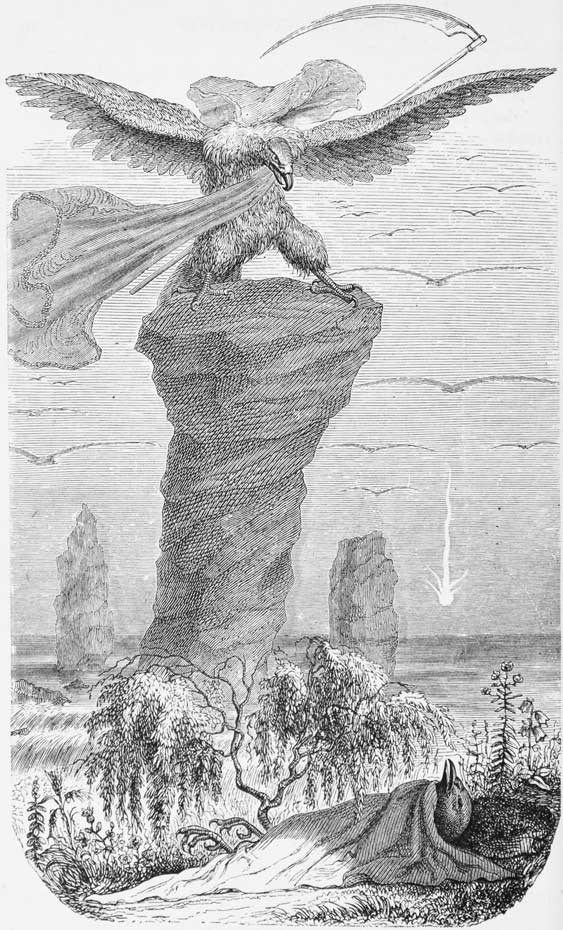
Alas! the dread sound came nearer and yet nearer, and the deep shadow of the bird of doom fell on the peaceful remains.
VI.
A musical voice hailed me from the air and bade me follow. Instinctively I floated upward with my spirit guide, who seemed to bear me on invisible wings far beyond the range of earth.
VII.
In a moment the past was severed from the future, all memory of my former being vanished. I soared through space without an effort, obeying my new condition implicitly, just as on earth one loves and thinks without knowing why one does so, or how thought and love have come to form so important a part of our earthly lives.
VIII.
I had floated away so far from the world that it seemed nothing more than a bright speck in an ocean of immensity. For a moment I recalled my loss, the body I had left behind, and exclaimed, “Shall the joys of my future banish regret, or is sorrow also eternal?”
IX.
Is there no link in heaven to bind one to what is dear on earth? Has my life among mortals been a dream? Still I was wafted upward and onward to a region full of stars, where I passed from one orb to another. Bright stars, whither am I going? But the stars, yielding no response, noiselessly ranged themselves to light me on my way.
X.
I was floating in a realm of light. Space spread out before me like an azure veil studded with diamonds. But the light of the stars was eclipsed by a greater refulgence. Filled with awe, I paused, and the voice—more silvery than the sweetest tones of earth—whispered, “Follow me, we shall only stop in a blissful region. You are at the gates of paradise. Follow me and fear not, doubt not. Doubt is born of the devil, faith is an attribute of heaven.
XI.
The speaker was a purified immortal, the spirit of a snow-white Dove that death had taken in all the beauty of its youth, unsullied by the sight of human misery. Its mission was to receive and guide liberated spirits on their way to the new world.
XII.
I then saw—what I had not been able to perceive before, owing to the imperfection of my sight—many disembodied spirits, each, like myself, floating towards some resting-place. My first sensation on finding myself in such company was fear mingled with a vague hope which impelled me onwards. “Sweet spirit,” I said to my guide, “the Turtle-dove’s paradise, is it far?”
“See,” he replied, smiling at my impatience—“see yonder orb alone. There is the seventh heaven, where our arrival is awaited.”
Who can want me there? I thought. Is it still alive?
XIII.
Ascending beyond worlds and spheres without number, we alighted at a gate whence shone the most dazzling light, eclipsing the sun in brightness. Above the portal was inscribed in letters of fire, “Here is the abode of undying love;” and beneath, “Here is no change save that of ever-growing love.” The door flew open, but what can I say of the sight revealed to my gaze? No words of mine can picture the glorious light which, without pain or strain of vision, revealed everything so clearly that the minutest details of the picture could be seen and understood.
XIV.
“I now leave you,” said my guide, “at the threshold of your new home.” The words still lingered in my ears when I beheld a pearly cloud in the sky; it was my treasure, my Turtle-dove, winging its flight towards me.
“Ah!” I cried, “pure spirit of my sister, do I indeed behold you, my sister?” She came, and our hearts were filled with a sacred joy, for she knew me and loved me still.
She had not changed; yet she seemed brighter, whiter, more beautiful, and as I looked, her beauty, like the beauty of a great painting, only increased. “Ah! my well-beloved and long-lost sister, this is indeed a joyous meeting. When I heard of your death the pain preyed upon me, and I soon followed you, for grief broke my heart.” Who dares to disbelieve in happiness? Alas! is it not a dream?
XV.
Alas! it was a dream. . . .
But why awake from such a dream? This dream that had carried me through space and filled me with unmixed joy, had been of so short duration that I awoke to find nothing had changed on earth. The moon still shone in the clear sky. Nothing, indeed, proved real save the bird of prey circling through the air near my nest.
NOTES ON THE LIFE OF THE AUTHOR OF THIS CURIOUS FRAGMENT.
We deem it our duty to place before our readers some biographical details concerning the author of the foregoing fragment, handed to us by the governor of a lunatic asylum.
“The author of these strange imaginings was early left an orphan. His parents without warning, without even leaving their future address, left him one morning while his young beak was deep in slumber, buried in his callow down. Yet these good birds, owing to the gentleness and simplicity of their habits, left a doubtful reputation behind them, the only inheritance of our young hero. A sympathetic circle of friends agreed that they had come to an untimely end, nothing short of death could have caused them to abandon their child. One or two old Magpies there were, who, putting their heads together, whispered among themselves that Parisian Doves were not so good as they looked, and that they had purposely deserted the youngster, who interfered with the pursuit of their own pleasure.
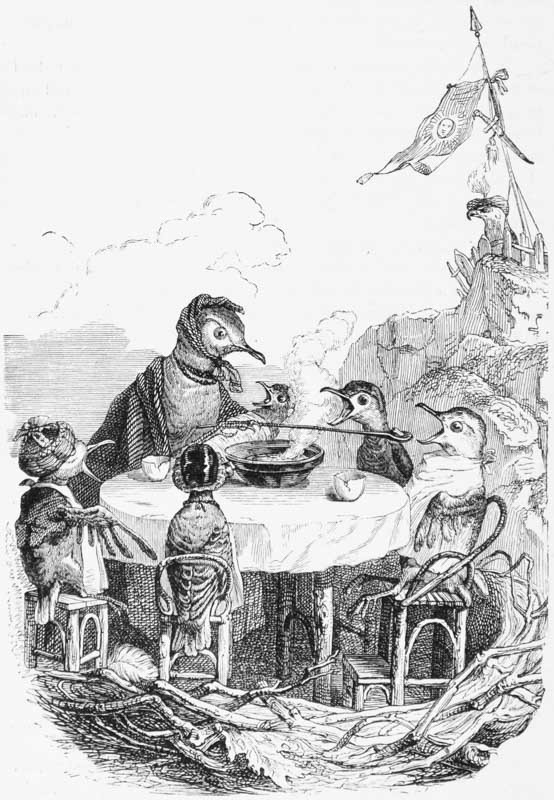
“Be that as it may, the parents were never again seen or heard of, and the little one struggled on wonderfully, being greatly indebted to the good offices of some poor but true-hearted thrifty friends. As soon as the orphan could leave the deserted home and trust himself to his wings, he commenced a search which only ended in disappointment, for the lost ones were nowhere to be found. For all that, day after day he persevered in his vain efforts, saying, ‘I must find my parents, or perish in the attempt!’
“In one of his journeys he fell in with a young Ringdove, who at once won his heart, first attracted by her guileless beauty and then conquered by her sympathy. But being an honest bird, this new sentiment in his breast could not tempt him from the path of duty; on the contrary, it only stimulated him to greater exertion, and he winged his flight anew. ‘I will return,’ he said; ‘my true love will wait for me.’ So he left, and she waited till her patience was worn out by waiting, and then wedded another.
“After many days of fruitless search our Dove returned to seek his bride, and found her surrounded by the family of his rival. The blow was too much for him, it broke his heart and drove him mad.
“Perhaps the Ringdove might have waited his return, had not his rival poisoned the ear of his mistress by whispering strange rumours about infidelity. When her first love returned she was seized with remorse and despair. What could she do? Like a sensible Ringdove, she continued to be a good mother, redoubling her care for her little ones, and doing her duty towards her husband, while her sorrows were buried deep in her own breast. No one knew her secret, even her most intimate friends, looking on her snug home, said, ‘How happy she must be!’ The same remark is made of a great many who have never known what happiness is.
“As for the poor Turtle-dove, he was perfectly harmless in his insanity, betaking himself constantly to the top of a mountain, where he dreamed away his days. That for which he had sought in vain in the solid realities of earth, perchance he found in dreamland, where at times even the wise ones of the world would like to abide. But, alas! they too must awake and be recalled to the rude realities of life.
“After his death, beneath a heap of leaves was found a manuscript entitled ‘Memoirs of a Madman,’ ‘Happiness is made of Dreams.’ It was really a poem in prose, written straight from the heart, free from the fetters of rhyme.”
Some feathered wits may be disposed to smile at the poor Turtle-dove, his misfortunes and writings. All we need say to such gaily-disposed critics is, that they have none of the gentle attributes of our loving but weak Ringdove.
P.S.—Out of consideration for those who dislike anything obscure in a story, we may add that the Ringdove, having reared her brood, when she heard of the fate of her first love, died of a broken heart.
Practical-minded Sparrows, and other common members of the feathered tribe, may think that the story would have been better as a whole had the lovers wedded and lived happily together. All we can say to this, as faithful narrators, is, “Truth is stranger than fiction.”
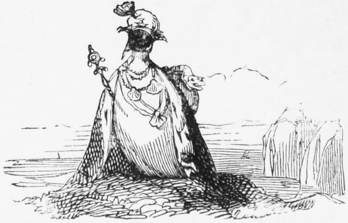

THE SWALLOW’S FIRST LETTER.
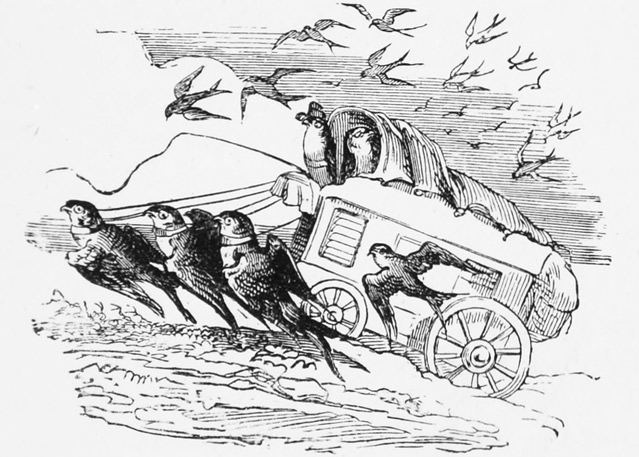
AT last, dear friend, I am free and flying with my own wings. Far behind me I can still descry the horrible barrier of Mount Parnassus, and the equally dreary plateau of social conformity, which I had already crossed. In the air which I breathe, and in my freedom of flight, there is truly an intoxicating charm. On starting I cast a scornful glance on my companions, the Swallows who prefer the solitude and obscurity of their deplorable existence to all the world and all its joys. You may think me puffed up with vanity, one of the meanest of vices, when I tell you that nature never intended me to do the work of a builder, for which all the wretched females of our race seem to have an aptitude. Let them spend their youth in building, in polishing with beak and wing the inside and outside of their dwellings. Let them, I say, continue to construct their homes with as great toil as if the frail tenements in which they rear families were to last for ever. My efforts to enlighten them have been fruitless, and I leave all those to their fate who fail to profit by the experience contained in the following account of my travels. I perhaps ought to congratulate myself on having no travelling companion, and never being tempted wholly to give up my heart and independence to another. You have often told me in a tone of friendly severity that, constituted as I am, I could never submit to the guidance of another, however much, by reason of youth and inexperience, I was incapable of guiding myself. For all that, I have followed my own course in spite of your sage advice, and I am proud of it. You have cursed my craving for seeing the world, which has carried me far from yourself and your wise counsels. It is true I greatly esteem your friendship and value your advice. The one has often lightened my sad heart, while the other, although good, has rarely been followed by me. I have fully understood your dread of adventure, but it has never influenced my pursuits. Our lives and our ways have nothing in common, and our meeting only shows all the more clearly the divergence of our courses in the world. Our thoughts do not harmonize, and our hopes do not point to the same end.
You first beheld the day through the bars of a prison in which you must live and die a captive, and the notion that beyond these bars lie a boundless horizon and liberty has never entered your head. Doubtless had such a thought crossed your mind, you would have crushed it as men are said to stifle the whisperings of the devil.
I was brought forth beneath the roof of an old deserted house in the corner of a wood. The first noise that fell upon my ears was the wind whistling through the trees. It was a sweet sound, the very thought of it wakes pleasant memories.
The first sight that met my eyes was that of my brothers poising themselves on the edge of the nest before flying away never to return. Soon I followed them.
While I was thus beginning my career, you had reached maturity, and your faint warblings had ripened into rich melody. Those who imprisoned you gave you food, and you blessed them for it. I should have cursed them, my gentle friend! When the sun shone brightly they placed your cage outside the window, never thinking that sunstroke might cut you off. No, you were their slave, so that all seemed for the best from your narrow point of view. As for myself, I followed the life of my nomadic tribe, sharing its toils and dangers, and gladly submitting to the privations experienced on our journeys. I became strong to suffer, and so long as I had free air, I forgot that there was little else in my lot worth having. To crown all, you readily accepted the husband provided for you, and implicitly obeyed his slightest wishes. It was of course necessary you should obey some one, and perhaps as well that your master should be your husband. You are now surrounded by a numerous family whom you love; you are a model wife and mother. My ambition does not extend so far. Were I surrounded by a bevy of little screamers such as yours, I should die. Your devoted and much-loved husband would also be a terrible bore. Love, alas! has torn my poor heart so deeply during the time it became its temporary abode, that I have barred the door for ever against the foolish passion.
I am aware of your cruel opposition to the recital of my griefs, and you were kind enough to attribute my fall to the slight importance I myself attached to the duration of a union you thought should be eternal. You are welcome to say whatever you like, but you need never hope to find the true clue to our misery in such unions.
Society is wrongly modelled from beginning to end, and so long as the dry-rot of conventionality is left to destroy its foundation there will be no happiness for superior beings or loving spirits. Not until the entire structure is levelled with the ground.
I entrust my letter to a bird of passage who will cross your latitude; the postman is so impatient to continue his course that I am compelled to postpone the details of my journey.
THE SWALLOW’S SECOND LETTER.
I have striven to beguile the days of absence by relating my experiences as they occur en route, knowing that loving hearts find a charm in incidents the most simple and the most indifferent to strangers. The weather favours my progress, and nature is arrayed in her gayest attire. It seems, indeed, as if the kindly sun shone her brightest to cheer me on my way.
I have made a multitude of new acquaintances, nevertheless you need neither feel jealous nor uneasy on my account. I have not the leisure, still less the desire, to make friends, although I am forced at times to halt and acknowledge courtesies, as my quality of stranger has opened the hearts and homes of many hospitable tribes. Notwithstanding the fact that pressing invitations pour in upon me, I studiously refuse to accept them, preferring as I do my wandering life, full of all that is unexpected and capricious, above the daintiest fare and the finest society.
You predicted ennui and disenchantment. I still happily await the advent of these foes, taking my amusements when and where I find them. Up to the present moment these last have come unbidden to my door.
This morning I breakfasted tête-à-tête with the most accomplished singer I have ever heard, a Nightingale, who, willingly yielding to my entreaties, at the close of our repast sang some of his favourite pieces.
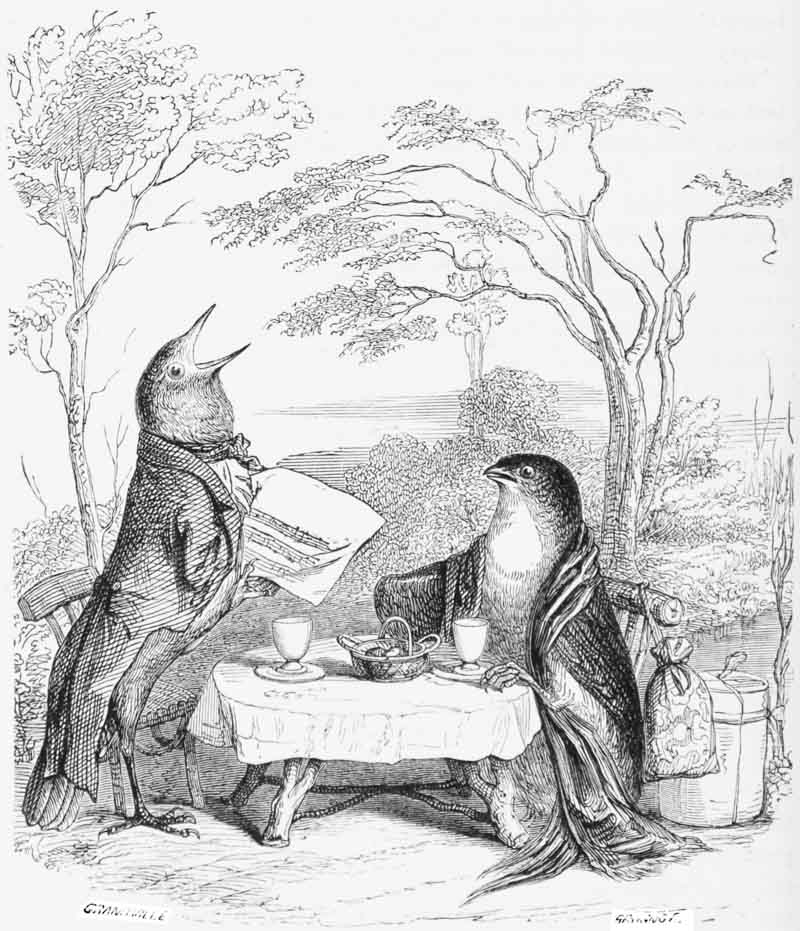
It was not without a feeling of vanity that I thought of those who would have given anything to fill my place. All distinctions, you know, are flattering, and the one which made me the sole listener to harmony so divine, made me more important in my own eyes.
I was strongly impressed with the simplicity of the artist. Seeing him so négligé in his dress, so careless in his posture and manner, no one would have thought that he was a person so distinguished, at least I have still a strange illusion that prompts me to look for talent only beneath a grave and dignified exterior. I have discovered that this is simply an illusion, you will therefore admit I have made some progress.
This remarkable tenor informed me that he lives for his pleasure, the best mode of living one can adopt; so he said, but I doubted the soundness of the opinion, and was careful not to be led away by doctrine so heterodox.
A happy and useless existence is not what I dream of, I who have the faculties of feeling and understanding. My desire is to add one more stone to the edifice which is rising up in the shade on the ruins of a dying civilisation. I have thought for some time of entering upon a literary career—all my tastes lie in that direction—as it would enable me to carry out my schemes for the regeneration of females. This question has absorbed my attention from my earliest youth. I can picture you smiling at what you call my folly and ambition, let me tell you once for all, you can no more conceive the pure happiness to which I aspire than I can accept life in your style.
But what does it matter; although we differ in opinion, our friendship is true, lasting, and sincere. The charming sweetness of your character enables you to overlook my faults and my extreme vivacity, and in return I hope that my deep regard helps to render your captivity less galling and monotonous.
I have just left my amiable songster, and, strange as it may appear, without regret. My curiosity and thirst for knowledge increase daily since I have at last begun to see and learn. A Jay whom I met in the environs preceded me, and promised to warmly recommend me on her way. In short, I can never find space to name, far less to praise, all those who have received me with a fraternal welcome. Had I followed your timid advice, I should have been constantly on my guard against tokens of affection, in case they might be held out as snares to betray me. But when I reflect on the life you lead, I am not surprised to find you swayed by warped notions of the world and its winged tribes. You cannot form just impressions of objects seen through the bars of a cage, they must appear distorted and confused. It must be so. You have never left your retreat, and your little world is filled by five or six creatures, objects of affection; all this renders it impossible for you to give an intelligent account of things of which you know absolutely nothing, or to appreciate without error what you have never seen.
It is true your youth was passed in a spacious aviary, where you respectfully received the lessons and counsels of some old fellows reputed for their wisdom; even these venerable teachers never breathed the air of liberty, and the sort of experience of which they were proud they owed solely to their great age, and not to free and independent research. I feel certain that I shall learn all these sages knew, and more, in a single journey. Before, indeed, I can venture to advocate reform in any shape I must travel, and read the living books in birds of every feather. I must study the degrading positions into which females of many so-called civilised lands have drifted, and find out how best to befriend them. My heart is filled by immense projects, and I need not disguise the fact that I may not see you for many days.
Adieu, it is getting late; I continue my journey—always southwards.
THE CANARY TO THE SWALLOW.
Will this letter ever reach you, my child? It is impossible to say, as I am ignorant of the direction of your last flight. I scarcely venture to hope that one day your eyes will fall on these words of maternal solicitude. Yet should fortune favour me, you will find that my affection is still unchanged, although it manifests itself in grumbling fears for the safety of a spirit so adventurous.
I grieved to see you set out on your journey, nor could I conceal my apprehension for your safety. Unfortunately the union of our hearts does not extend to our ideas, accordingly I did not succeed in changing your plans. Far from regarding myself as infallible, I own my mistake in wishing only for the things attainable in my sphere of life. If this be an error, yours is surely a greater one—the ambition which aspires to everything beyond your reach. The false inspiration derived from books has led you into a dark road, along which your tutors, believe me, will never follow you. Your life has become an illusion, and the more complete the illusion, the more terrible will the disenchantment prove. When the hour of awakening does come, as come it will, I tremble for the result.
I know that I am a mere dotard, and you are right to complain of my persistency in heaping sermons upon your head. Complain if you will, but allow me still to preach.
I have been told that many of our sex use their feathers for writing, and I perceive with regret that you are yielding to the popular mania with which they are possessed. For myself I seek nothing but knowledge, and I should like to know what good end is served by soiling snow-white paper. Let us handle this subject freely. Either you have great talent, small talent, or no talent at all. I do not see it can be otherwise. If by fatality you are favoured with great talent, as are the males, who make laws for others and reputations for themselves, these very males, by reason of constitutional jealousy, will not permit you to rise superior to themselves. The highest fame has always been, and must always be, male-fame, ill begotten as it is at times. That being so, females are by law, and, as males say, by nature, unfitted to fill the loftiest posts of honour. They are essentially the potter’s clay fashioned into humble vessels suited to adorn or to become useful in the household, whereas the males are the marble of which monuments are made.
Apart from the public life in which you are the slave of fame, you may wish to have a private domestic life hidden away from the world, to which you may betake yourself when weary of triumph and tinsel. But where will you find a partner vain or humble enough to share your lot, to joyfully wear the ridiculous livery inflicted on him by your success? Who would be the husband of a great female? Certainly no one you could respect and look up to for counsel and advice. You will remain, then, powerful and solitary. This is all very fine, but the position is trying, and high intelligence can better serve its God by dutifully lifting a small but compact circle to its own level of happiness than by striving to move the world. Fame brings many little cares of which I have not spoken; it has to bear hatred, envy, calumny—troubles these which seldom invade the quiet nest. On a column in sight of all, and in the full blaze of noonday light, the flaws and defects of the finest marbles are all observed and attacked by the critics. Let us descend from the column and come to the nicely-poised mind that would be so charming in some obscurer spots if only it could be schooled to perform its great feats in the shady nooks of the world. Here I lay my finger on the root of your malady. One makes a very good show among a circle of indulgent friends, but the public ought not to be disappointed, for they did not complain of the want of your special talent, and did not invite you to become their idol in the temple of fame. One must walk upwards to this shrine with timid step, for there are more thorns than roses by the way. When the foot grows bolder, one becomes used to the compliments that are lavished, as well as to the curses that are heaped, on one’s head by those over whose prostrate forms one tramples. At last life loses its lustre, and you become the slave of a cold, cruel, callous mind, possessed by aspiring to a glory it can never attain. Critics, at first silent, grow tired and bite; they rudely signify to your astonished friends that after all you are no Eagle, but only a Swallow.
This dawn of opposition irritates you, and self-love seeks consolation in the rapid flatteries of supporters whose pride prompts them to sustain you at all hazards, and the clever head, which might have been a reasonable one, is turned and lost!
I will, with your leave, now pass on to the third point in my observations, glancing for a moment at the picture of a daughter, wife, or mother who, in addition to all the other virtues, cultivates literature. She must indeed be an amiable authoress who with one hand rocks the babe to sleep, while with the other she wields the pen that is to wake the world.
During periods of inspiration the children tear her manuscripts, and add to her finest pages a sort of illumination on which she had not reckoned. Here you have a faithful description of this fantastic being whose infants are reared on a mixture of milk and ink. It is not, however, into the ridiculous that I fear to see you fall. I know your tastes too well, and hope they will shield you from such depths of depravity.
What I dread most is the vanity which has led you to adopt a course so ridiculous as advocating the right of females. It may lead you into many grievous mistakes unless common sense comes to the rescue.
I have spoken thus freely in order that my advice may be of service to you. Had I loved you less, my letter would have been milder and more pleasant to read. You may find it a bitter pill to swallow, but it will cure your malady!
THIRD LETTER FROM THE SWALLOW. A NEST OF ROBINS.
I have by the merest chance fallen in with a friend, a most obliging creature, who will wait for this letter and deliver it to you. He is the bearer of important despatches, and appears worthy of the trust placed in him. While he explores the environs of my present halting-place, I hastily take up the pen to let you know my whereabouts, and to recount the events of my journey. Happily they are few and far between.
As you do not seem to approve of female genius, I must make an effort to suppress the poetry that flows naturally from my pen. When I have finished a volume of inspired writing, you shall have a copy to study at leisure. Then, and not till then, shall I expect justice at your hands.
I should have delayed writing, had circumstances not forced me to remind you of my existence.
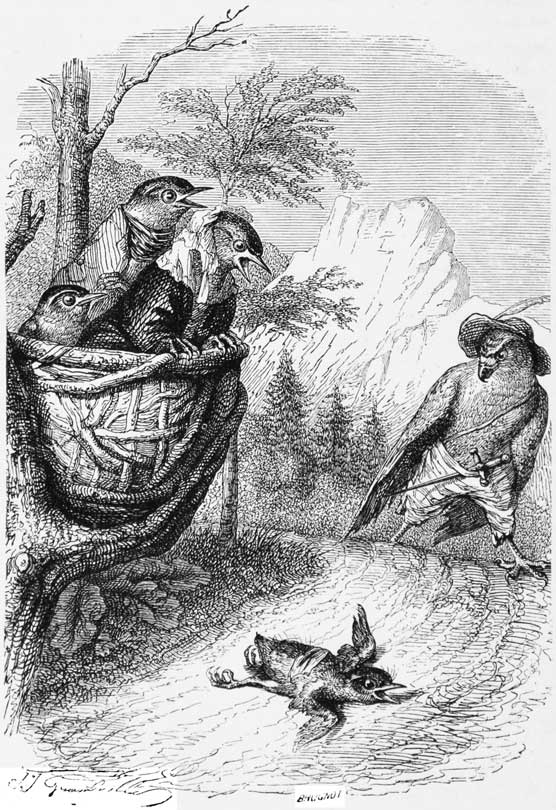
The day dawned under depressing auspices, which will account for the sad tone of this epistle. On arriving in this delightful neighbourhood, I made the acquaintance of a most agreeable family, consisting of a father, mother, and two little ones, the latter still under shelter of the maternal wings. As they had greeted my arrival with much grace and show of kindness, I thought it my duty, on waking this morning, to make a formal call at their nest. The manner in which I was received raised them tenfold in my estimation, but just as I had left them to return to my lodging, the air was suddenly filled with cries of distress. On wheeling round, I perceived that the situation was dreadful: one of the young brood had fallen to the ground in imprudently trying his wings; although the fall was not great, danger was none the less imminent. An enormous bird of prey, after swooping through the air in ominous circles, descended like a stone, straight to the scene of the disaster. The mother’s resolution was soon taken; addressing a few words to her husband touching the care of those she was leaving behind, and casting a fond look on the loved ones, she descended to the ground. There, showing a bold front to the enemy, she covered her little one with her wings; but the dread foe kept slowly approaching, and at last quickened his pace, trusting to the immobility of his victim for an easy victory. The poor mother unflinchingly met her doom; for the fierce bird, with eyes of fire, pounced down upon her and carried her away, leaving the little one unharmed on the ground. After a moment’s silence, the father descended and bore from the sad spot all that had been left by the bird of prey. I laid the little one in the hollow of the nest and took the vacant place of the mother. My sympathy rendered me speechless, while the father was mute with grief, he whose breast but a moment before had been bursting with joyous song. Suddenly a dull noise sounded near, our heads turned to the quarter whence a new danger seemed to threaten us. Imagine our joy when, in place of danger, we beheld our oppressor felled to the earth by an unseen hand, and the lost one returning safe to the nest. The delight of thus meeting one whom we thought dead filled all our hearts, and caused us to feel as one in happiness.
Yet I feared the indiscretion of remaining too long to share their joy, and had just retired when a huge animal, one of the species inhabiting towns called Poacher, whistling gaily, approached the tree which sheltered the Robins. On his back he carried a bag, from which the head of their enemy hung out, and on his shoulder the instrument that delivered them. The poor mother could not restrain a cry of joy on recognising her dead foe. It was a cry that might have moved a heart of stone, but brutes, it is said, have no hearts.
“Oh! oh!” cried the Poacher, “you sing sweetly, your song is most agreeable, but I would prefer the sound of you roasting on the spit. The little ones would not be worth eating, still one must be careful not to separate what God has united.”
After these words, he brought down my friends and consigned them to his bag. That is the reason of my sadness.
THE SWALLOW’S FOURTH LETTER.
MY DEAR FRIEND,—I have been suffering for some days past from the effects of a slight accident which befell me on the road and compelled me to rest. In spite of regrets and impatience, I see no prospect of moving out of my narrow uncomfortable abode. Yet I ought to feel thankful for shelter of any kind. Overtaken some distance from my resting-place by a great storm, the wind drove me with such violence against a wall as to fracture my leg. Nothing surprises me more than my inability to proceed, the injury seems so trifling. A tribe of Sparrows, who, with characteristic foresight, established themselves before the bad weather set in beneath the roof which shelters me, have shown me great kindness. Unfortunately for me the sun soon reappeared, and his first rays have carried off my good-hearted hosts; even my helplessness had no power to detain them. I therefore suffer all the more, as I had given them credit for pure disinterested charity. What little they have left in the shape of food will soon be exhausted, and I am still too weak to forage for myself.
It is at such a time as this, pressed by poverty and enfeebled by sickness, that all the true friendship I have enjoyed in life proves a real comfort to me. Now I feel the curse of solitude and the need of a partner’s care and affection.