THE MAIDEN’S TOMB
Marie Carmichael Stopes translation
Authorship of the Play
This piece is now commonly attributed to Kiyotsugu, and is supposed to have been produced at the end of the fourteenth century. Its exact date is not known, but Kiyotsugu was born in 1354 and died in 1406; yet it is most likely that he was an adapter and not the original author of the utai, parts of which were probably written long before his time. The play is still one of the most important of the Nō, and is indeed a test piece, as parts of the Shite’s chanting are exceptionally difficult. A foreigner cannot judge of this, but from my own point of view it is perhaps the finest of all the Nō.
Outline of the Story
The play is based on a story told—or rather written down, for it was probably told long before then—a thousand years ago in the Yamato Monogatari, or Tales of Japan. It is the story of the love of two men for one woman, and the fatal consequences thereof for all concerned.
UNAI, a maiden living near Ikuta, was loved by two equally gifted men. On the selfsame day they each sent her a letter declaring their passion, but she could not decide between them, fearing the anger of either rejected suitor. Her father determined that the one who shot most accurately should win her, but in the contest the two men pierced the same wing of the same bird with their arrows. This bird was a mandarin duck, a creature whose lifelong faithfulness to its mate was proverbial in Japan. The girl felt bitterly that she was to blame for the death of the bird and the misery its mate endured, as well as for the strife between the two men. Hence she drowned herself. Then the two men, visiting her tomb, were filled with remorse, and killed each other beside her grave. This, however, only added to the girl’s guilt, and much of the play is taken up with vivid descriptions of her agonising torments in the eight hells believed in by popular Buddhism.
The play opens with a traveller Priest passing the village of Ikuta on his way to the capital. It is early spring, and the village maidens are out gathering the first green shoots of the “seven herbs,” which used to be eaten at the beginning of the year as a kind of ceremony. The city folk make this herb-gathering a pleasure picnic, but the poor girls going out of necessity into the biting cold of January are envious of those who are better off in cities. The spirit of the long dead UNAI has joined them in the form of a young girl, but she takes part in the opening dialogue. The “Maiden’s (i. e. UNAI’S) Tomb” is one of the famous places in the district, and the Priest asks to see it. UNAI’S spirit remains behind when the village girls have been driven home by the cold, and she conducts the Priest to the tomb, conversing with him, and telling him the story of UNAI. Her spirit’s materialisation as a maiden then vanishes, and UNAI appears as a Ghost, for whom the Priest prays. The Ghost laments over the tomb, and the Chorus gives expression to her longing for the human world. The Ghost expresses her thankfulness for the prayer uttered by the Priest, and recounts her agonising sufferings in the eight hells. The Priest makes some effort, but not a very determined one, to inculcate in the poor Ghost the higher Buddhistic belief that all these things, even the hells, are delusions, and her mind could free herself of them. The play closes with the Chorus telling of her miseries in hell.
Comments on the Play
In its construction, and its presentment of the story as a whole, this play resembles strikingly one of the beautiful tryptic colour prints of Japan, in which an exquisite, softly coloured garden or woodland foreground, shaded with delicate mists, brings into intense relief the vivid figure of an armoured warrior going out to battle. In the opening passages of this play we have the soft, misted foreground, with the tender green shoots of the early spring-time. One sees the thin, frosted ice pushing aside the sprouting plants, and the scene is enhanced and the description of it embroidered by poetic references to the details of the picture. But among the maidens is one, outwardly like others, so that they do not recognise the difference themselves, but yet one who is a tragic figure, a temporary reincarnation of a spirit from hell. Then with the Priest the spirit converses, and paints in vivid colours this central figure, for whom the whole scene forms but the setting.
To us in the West the moral attitude of the play seems very strange. From her initial ‘sin’ in being sufficiently beautiful to attract the love of two men, and her guilt in causing the death of the mandarin duck (in a Buddhistic country no small crime), we see crime after crime laid upon the maiden’s head. And all the time in our eyes she appears utterly innocent of everything save a too ready yielding to a tender conscience, and a willingness to take blame upon herself. Hapless maiden, how different is this treatment of hers from that accorded in the West to charming girls. In Old Japan not all the eight hells would have been accounted sufficient for Helen of Troy.
In its religious attitude we see the popular beliefs of Buddhism contrasted with the higher form of the same religion. The circumstantial details of the hells and punishments were believed in by the common folk, but as the Priest says (on p. 49) all was delusion, both in the world and in heaven or hell, and the soul could escape from its torments by a recognition of this higher fact.
If only thou wouldst once but cast away The clouds of thy delusions, thou wouldst be Freed from thy many sins and from all ills.
THE MAIDEN’S TOMB[8]
DRAMATIS PERSONÆ
The Maiden UNAI (really her spirit temporarily incarnated as a maiden)(Shite)
Two of the Village Maidens(Tsure)
A Priest(Waki)
The Ghost of the Maiden UNAI(Nochi-jite)
Chorus
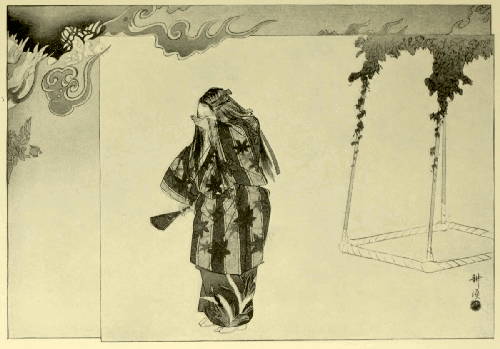
Plate 6.
THE MAIDEN’S TOMB
This illustration, from a Japanese coloured woodcut, shows the figure of the maiden Unai (see p. 35), who wears a dress resembling that still worn by country maidens, though with the volume of the garment and the size of the patterns both a little more exaggerated than those which are now customary. The designer of the woodcut has put in symbolic and formalized representations of the Mandarin ducks and the flames of hell-fire which were among Unai’s torments.
SCENE
The fields of ONO near the hamlet of IKUTA in Settsu, in the early spring.
[The Priest enters]
PRIEST
Far through the country has my journey lain, Far through the country has my journey lain, And to the capital I speed my way. I, a priest, am from the country, from the Western districts coming.[9] To the capital, which hitherto my eyes have never seen. The paths along the coast are manifold, The paths along the coast are manifold, That on this journey I have traced, and oft My way has lain by boat across the sea. Over the sea and mountains stretching wide I watched the sun rise up and set again, And now I reach Ikuta which I know Only by name as in Tsu province fair, The hamlet of Ikuta now I reach.
SPIRIT AND MAIDENS
Green shoots we gather, young green shoots of spring, And here in Ono by Ikuta blows The morning breeze so chill, so chill and strong It turns and billows out our flapping sleeves.[10]
MAIDENS
While in the distant mountains, on the pines The snow has even yet not disappeared.
SPIRIT AND MAIDENS
Oh, near the Capital the time has come To gather in the fields the shoots of spring. It makes our hearts glad just to think of that.
SPIRIT
But from the Capital this place is far,
MAIDENS
And we are country folk and therefore live A humble life here by Ikuta’s sea. Our lives and work are of the lowliest And to the field of Ono every year Without the thought of pleasure do we come.[11] The footmarks of the many village folk That go to gather the young shoots of spring Have left wide tracks across the snowy field. And tread a path, where else there would be none. And tread a path, where else there would be none. The young green shoots that grow on field and marsh We now must gather. When the snow has gone They will already have become too old— Though still the wind blows cold thro’ shady copse And on the field of Ono lies the snow, The seven herbs of early spring-time sprout In Ikuta then let us pluck the shoots, In Ikuta then let us pluck the shoots.
PRIEST
O good people, will you tell me if toward Ikuta I’m nearing?
MAIDENS
As thou dost know the name of Ikuta There should have been no need to ask us that!
SPIRIT
Dost thou not know it from the many views That scattered far and wide portray the place? First of all, dost thou not know it as the forest of Ikuta? See, the many clustered tree tops which are true to this its name.[12]
MAIDENS
And there the stream thou hast now deigned to cross, It is the far-famed river Ikuta.
SPIRIT
In the early breath of spring-time (like the shallows of the river) Do we gather, ’neath the snowy cloak, the young shoots of the field.
MAIDENS
And this field, too, where little sprouts as yet Are growing, why as Ono know’st it not?[13]
SPIRIT AND MAIDENS
The sweet wild cherry blossoms that do grow In Miyoshino and in Shiga too, The maple leaves of Tatsuta and those Of Hatsuse—they would be surely known By those who lived beside the poet’s home. But we, though living in this place know not The forest or the copse of Ikuta. So ask us not, for we know nothing here.
PRIEST
Ah yes. Unfolding now before my eyes The views I know—the forest, river, sea, And mist, the scenes of Ono now expand! And the far-famed tomb of Ikuta, the Maiden’s Tomb, where is it?
SPIRIT
Ah, in truth, the Maiden’s Tomb! That is a place that I have heard of; Whereabout it is I know not, yea, I know not in the least.
MAIDENS
But prithee, traveller, these useless things We beg thee ask us not, we prize the time[14] When we can gather these young shoots of spring.
SPIRIT
And thou thyself, too, journeyest in haste, So wherefore dost thou tarry with us here?
MAIDENS
Thereon an ancient poem has the words—
CHORUS[15]
I
“A charming hindrance to the traveller Are they who pluck young shoots in Ono’s field In Ikuta.”[16] Why ask then useless things?
II
“Thou, Watchman of the field of Tobuhi That lies in Kasugano, go and see,” “Thou, Watchman of the field of Tobuhi That lies in Kasugano, go and see If it is not yet time to pluck the shoots.”[17] Thou, traveller, that to the capital Likewise dost haste, how many days hast thou? “For his sake do I go to the spring fields To gather the young shoots, though on my robe Cling still the cold, unmelted flakes of snow.”[18] Let us then gather, snowy though it be And on the marsh the thin ice still remains, Pushing aside the sprouting watercress, Let us then gather the green-coloured shoots Let us then gather the green-coloured shoots.
III
Would there be much to gather? For the spring Is very early yet—and young shoots hide.
SPIRIT
“The spring-time comes, but as I see the snow Upon the plain, I think of the old year.”[19] The young green shoots of this year still are few So we must gather those with older leaves.
CHORUS
And yet, although the leaves are old and sere The young green shoots are fresh as the new year. Guard then thyself, thou field of the young spring!
SPIRIT
To the field of spring, To the field of spring, To pluck violets He came, and then Only purple leaves Of the weeds culled he Who came gathering.
CHORUS
Ah, yes, the colour of affinity[20] Has brought to my sad thought the memory Of Love’s light bridge which was asunder torn.[21]
SPIRIT
The aged stems of plants once gone to seed In Sano district still may sprout again,
CHORUS
And their green colour will be purple dyed.
SPIRIT
The Shepherd’s Purse of Chōan—[22]
CHORUS
And the hot shepherd’s purse, a useless thing, And other herbs white rooted, like the dawn,[23] Which, hidden by the snow we may mistake And gather in the place of those we want.
CHORUS
The morning breeze in Ono still is cold The lower branches of the pine trees still Are weighted down with snow. Where hides the spring We cannot tell. And though the river breeze Blows cold, our billowing sleeves are colder far. Let us go home, although we leave unplucked Some of the young green shoots, let us go home.
PRIEST
Now there is something I would speak of unto thee if thou permittest— All the maidens who were gathering the young greens have departed Save thyself, and wherefore then art thou alone remaining with me?
SPIRIT
For the Maiden’s Tomb but just now thou didst ask me. I will show thee.
PRIEST
Yes, indeed, I do desire to see it and I pray thee show me.
SPIRIT
This way honourably follow. And the Maiden’s Tomb is this!
PRIEST
What its history, and why then, is the Maiden’s Tomb so calléd? Pray minutely tell the story.
SPIRIT
Then will I the tale unfold. Once upon a time a maiden who was called Unai did live here, And two men there were, called Chinu and Sasada, and they loved her. And to her upon the same day, in the same hour, both declaring Fervent love, they sent two letters. But she thought that if she yielded Unto one, the other’s anger would be deep, and so to neither Would she yield (and then her father said the truest shot should win her). But upon Ikuta’s river did the two men’s flying arrows Pierce together but one water-fowl, and pierce the selfsame wing. And then I thought, how cruel now I am.[24] The wild fowl’s troth, though plighted deep and true Is broken for me, and the happy pair— Mandarin ducks—for my poor sake must bear The pain of separation. Piteous! So, with my life dismayed, I’d throw myself Into Ikuta river’s flowing tide[25] Here in the land of Tsu. Ikuta stands Merely a name to such a one as I.
CHORUS
These were her last words, as she took her way Into the river’s water. When they found They buried her beneath this mound of clay. Then the two men, her lovers, came to seek Her tomb. No longer will we live, they said, And like the stream of Ikuta, the tide Of their remorse rose up. Each with his sword Ended the other’s life. And that was too my sin! That too my sin! What can become of such a one, so full Of sins? I pray thee therefore give me help! So saying ’neath the tomb once more she sank Yea, down beneath the tomb once more she sank.
[Ghost of Unai appears]
PRIEST
Short as a young stag’s horns in summer time[26] The night of sleep! The weeds grow on her tomb, And from their shade appears again the ghost. I’ll raise the voice of prayer. “Thou spirit soul, Awake thyself to understanding true, Enter Nirvana casting off from thee Delusions of thy life and of thy death.”[27]
GHOST
Oh, the wide field, how desolate it is— My own deserted tomb and nothing else! Only wild beasts contending for the dead Which come and go in gloom, and o’er the tomb The watching spirits flying in the wind That circling ever beats upon the pines. The heaven’s lightening, and the morning dew Are still before my eyes, and symbolise The world of Earth, as transient as they. How many of the lonely tombs are those Of Youth, whose lives are so unlike the name Of Ikuta, so-called the field of life.
CHORUS
A man comes from the world I left long since. How thankful am I. ’Tis the voice of prayer!
CHORUS
I
O human world. How much I long for thee.
II
A [living] man while spending [in this world] Even a single day and single night, A [living] man while spending [in this world] Even a single day and single night, Eight billion and four thousand things has he To think about. But how much more have I, I, who left long ago the pleasant world— ’Twas in the reign of Tenchi and by now The second Horikawa holds his sway. Oh, that once more unto the pleasant world I might return. How long in shady weeds And ’neath the moss, how long I buried lie! But worse, not buried under the cool earth I suffer from a roasting heat and burn, Within a flaming dwelling-place, behold! Within a flaming dwelling-place, behold!
PRIEST
Alas! How truly piteous is thy state, If only thou wouldst once but cast away The clouds of thy delusions, thou wouldst be Freed from thy many sins and from all ills. “From evils all, and sins, from hells and fiends, Illnesses all and deaths, be thou set free.” Oh, quickly float thyself in buoyant thought!
GHOST
Ah, grateful am I, for the voice of prayer Has reached my ears, and tho’ my sufferings Do know no intermission, in hot hell The smoke clears back a moment, and I see A little open space. How glad I am! Oh, how terrible! Who art thou? What! Of Sasada the spirit? And thou art the ghost of Chinu? And from right and left you hold me By the hands, and saying to me “Come, come, come.” Though they torment me I don’t dare to leave the shelter of my burning house; for no one, Nothing, is there to rely on. And I see another spirit Flying from afar towards me. Oh, how terrible! I see it, ’Tis the duck, and turned to iron, turned to steel it is before me! With beaks of steel like naked swords the bird Pecks at my head and feasts upon my brain. Is it because of crimes I did commit? Oh, how resentful is it, cruel bird! Oh! I pray thee, Priest, I pray thee, from these sufferings relieve me!
PRIEST
“The time of torment fierce has now arrived.” The spirit had not finished saying this, When o’er the tomb flew out a band of flame.
GHOST
And then its light became a hellish fiend,
PRIEST
Who raised the torture rod, and drove at her.
GHOST
Before me is a sea if I attempt But to advance
PRIEST
While flames are in the rear.
GHOST
And on the left.
PRIEST
And on the right as well.
GHOST
By water and by fire am I now held In double torment.
PRIEST
Helpless utterly.
GHOST
When to the pillar of the burning house
CHORUS
I reach my hands, and do attempt to cling At once the column bursts out into flame— The blazing pillar must I then embrace. Oh, scorching heat! Oh, unendurable! The whole five members of my body turned Into black smoke by this fierce burning fire.
GHOST
And then when I arose—
CHORUS
And then when I arose, a jailor fiend Applied the torture-rod, and drove me out. I left the house and wandered through eight hells And there all suffering I underwent. Now I would show thee how I blotted out My many sins. Before thee lie the scenes First in the hell of all equality,[28] Then in the hell of black rope, devil led, And driven to the hell of gathering, Where all assemble. Then the hell of cries, Of bitter cries, came next, and then of heat, Of utmost heat, and then the hell of depth, Depth infinite, into whose space I fell Feet upwards and head downwards for three years And three months more, in agony the while. And after that a little interval— The devils left me and the flames expired, I thought there was a respite to my pain, But then the darkness grew more terrible And to my burning house I would return I thought—but where then was it? To myself I asked the question in the pitchy dark. And seeking, seeking, to and fro I groped. “The Maiden’s Tomb”—I searched it everywhere, And now at last I find “The Maiden’s Tomb.” Like flying dews leaving a grassy shade, Like flying dews leaving a grassy shade, The spirit’s form has once more disappeared The spirit’s shadow has now vanished.
END OF “THE MAIDEN’S TOMB”
(The play ends thus abruptly, leaving us in doubt as to whether or not the Priest’s admonition prevailed, and she escaped into Nirvana.)