Table of Contents
Marie Carmichael Stopes translation
PREFACEv
LIST OF ILLUSTRATIONSvii
TO THE READER1
THE MAIDEN’S TOMB35
KAGEKIYO53
TAMURA70
THE SUMIDA RIVER76
ENGLISH BIBLIOGRAPHY OF THE NŌ.
PLAYS OF OLD JAPAN THE NŌ BY MARIE C. STOPES
EPOCHS OF CHINESE AND JAPANESE ART. By Ernest F. Fenollosa. In two Vols. Crown 4to. Illustrated. 36s. net.
A HISTORY OF JAPANESE COLOUR-PRINTS. By W. von Seidlitz. Illustrated in Colour and Black and White. One Vol. Crown 4to. 25s. net.
JAPANESE PLAYS AND PLAYFELLOWS. By Osman Edwards. With twelve Coloured Plates by Japanese Artists. One Vol. Demy 8vo. 10s. net.
KAKEMONA: Japanese Sketches. By A. Herbage Edwards. One Vol. Crown 8vo. 7s. 6d. net.
A HISTORY OF JAPANESE LITERATURE. By W. G. Aston. One Vol. Large Crown 8vo. 6s.
IN JAPAN: Pilgrimages to the Shrines of Art. By Gaston Migeon, translated by Florence Simmonds. One Vol. Crown 8vo. Illustrated. 6s. net.
THE JAPANESE DANCE. By M. A. Hincks. One Vol. Crown 8vo. Illustrated. 2s. 6d. net.
LONDON: WILLIAM HEINEMANN
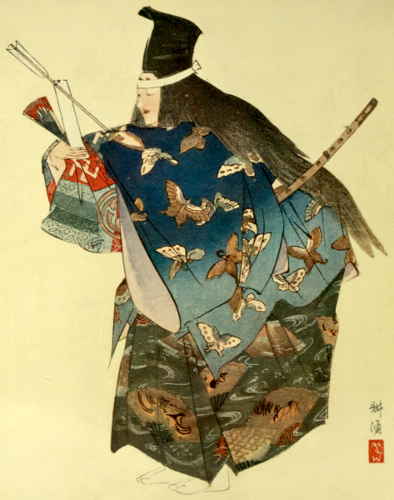
AN ACTOR OF THE NŌ IN FULL COSTUME
TADANORI
This plate, taken from a Japanese coloured woodcut, illustrates well the voluminous nature of the mediæval ceremonial garments. The figure is that of an ancient warrior of the Taira clan, to which Kagekiyo belonged (see p. 53), who was noted also for the high quality of his poetry. He composed a special verse, which he fastened in an arrow that he always carried in his quiver, and that proved to be the means of identification when he was found by his enemies, dead in the field of battle. In the illustration one may particularly note the mask, with the eyebrows painted so high on the forehead that they are above the fillet band. The feet are not bare, but are covered with the white tabi, or cotton boots with soft soles and a separate division for the big toe, in which the Nō dancers always perform their parts.