Act 1 — BIZET
Reading edition
WHEN Bizet wrote his music around Prosper Mérimée's story of Carmen, he reflected his familiarity with Spanish life and his long living in the Pyrenees mountains. The character of Michaela is not found in the novel, but the clever introduction of it into the opera story adds greatly to dramatic effect, since the gentle and loving character is in strong contrast with that of Carmen.
Bizet's name was Alexandre César Léopold, and he was born on October 25, 1838, at Bougival, and died June 3, 1875. He with Charles Lécocq won the Offenbach prize for the best operetta while Bizet was as yet a youth, and from that time his art gained in strength and beauty. In those days it was a reproach to suggest Wagner in musical composition, but Bizet was accused of doing so. Thus he was handicapped by leaning toward an unpopular school at the very start, but the great beauty of his productions made their way in spite of all. He wrote, as his second composition of importance, an opera around the novel of Scott's Fair Maid of Perth—in French, La Jolie Fille de Perth—and this was not a success, but that same opera survives through his Carmen. The Bohemian dance in that opera was taken from it and interpolated into the fourth act of Carmen.
Bizet died only three months after the production of this last opera, but he had lived long enough to know that he had become one of the world's great composers. He wrote exquisite pastoral music for "l'Arlésienne"—whose story was adapted from Daudet's novel of that name. In short, Bizet was the pioneer in a new school of French opera, doing for it in a less measure what Wagner has finally done for the whole world.
This genius left few anecdotes or personal reminiscences behind him. The glory of his compositions alone seems to stand for his existence.
CARMEN
CHARACTERS OF THE OPERA WITH THE ORIGINAL CAST, AS PRESENTED AT THE FIRST PERFORMANCE
Don José, Corporal of DragoonsM. Lhérie
Escamillo, ToreadorM. Bouhy
Zuniga, Captain of DragoonsM. Dufriche
Morales, OfficerM. Duvernoy
Lillas Pastia, InnkeeperM. Nathan
Carmen, Gipsy-girlMme. Galli-Marié
Michaela, a Village MaidenMlle. Chapuy
FrasquitaMlle. Ducasse
MercedesMlle. Chevalier
El Dancairo } Smugglers.
El Remendado
A guide. Dragoons, gypsies, smugglers, cigarette-girls, street-boys, etc.
The time of the story is 1820, and it takes place in and near Seville.
Composer: Georges Bizet.
Book: H. Meilhac and L. Halévy.
First sung at the Opéra Comique, Paris, March 3, 1875.
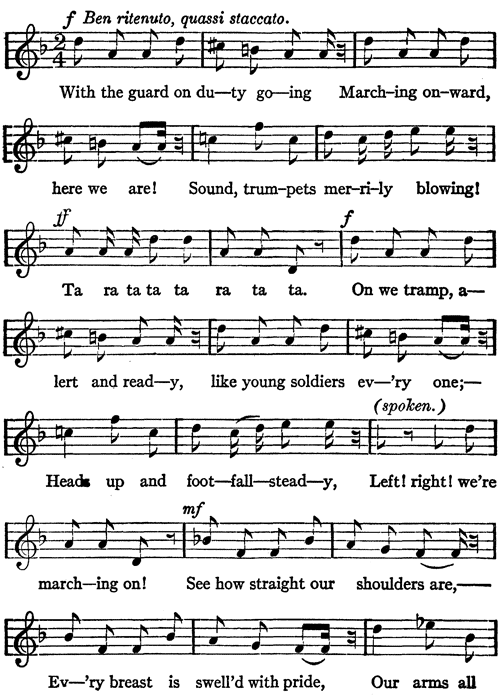
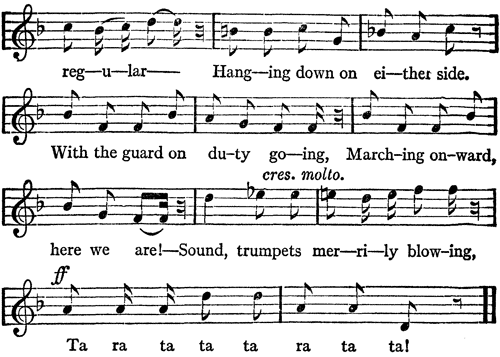
I knew a boy who once said: "That soldier thing in 'Carmen' is the most awful bully thing to whistle a fellow ever heard; but if you don't get it just right, it doesn't sound like anything," which was a mistake, because if you don't get it "just right" it sounds something awful. That boy's whistle was twenty per cent. better than his syntax, but his judgment about music was pretty good, and we shall have the soldier song in the very beginning, even before learning how it happens, because it is the thing we are likely to recall, in a shadowy sort of way, throughout the first act:
[Listen]
With the guard on duty going Marching onward, here we are! Sound, trumpets merrily blowing! Ta ra ta ta ta ra ta ta. On we tramp, alert and ready, Like young soldiers ev'ry one;— Heads up and footfall steady, Left! right! we're marching on! See how straight our shoulders are, Ev'ry breast is swell'd with pride, Our arms all regular Hanging down on either side. With the guard on duty going, Marching onward, here we are! Sound, trumpets merrily blowing, Ta ra ta ta ta ra ta ta!
That is the way it goes, and this is the way it happens: