Act 1 — ACT I
Reading edition
All Egypt was troubled with wars and rumours of wars, and in Memphis the court of the King was anxiously awaiting the decision of the Goddess Isis, as to who should lead the Egyptian army against Egypt's enemies. The great hall of the Memphis palace was beautifully ornamented with statues and flowers, and from its colonnades of white marble one could see the pyramids and the palaces of the city. It was in this vast and beautiful hall that Radames, a gallant soldier and favourite of the Egyptian court, met Ramphis, the High Priest, on the day when the Oracle, Isis, was to choose the general of the army.
Isis had already spoken, and Ramphis knew it, but he did not tell Radames. Together they spoke of Radames's loyal wish to serve his people, either as a great general or as a soldier. He was too modest to think that Isis would choose him, out of all the worthy men of the army, to lead the hosts of Egypt. His desire to do valorous deeds was inspired by his love for a slave girl, who attended the Princess Amneris. The slave's name was Aïda. The only thing that saddened him at the moment, was the fact of Aïda being an Ethiopian, for it was the Ethiopians whom the Egyptians were about to war against.
After he had spoken with the Priests, Radames sat down alone, in the hall, and fell to thinking of Aïda. Presently he sang of her loveliness:
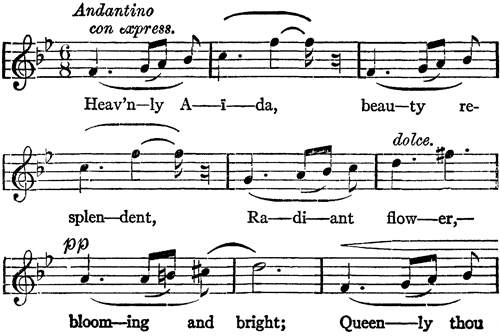
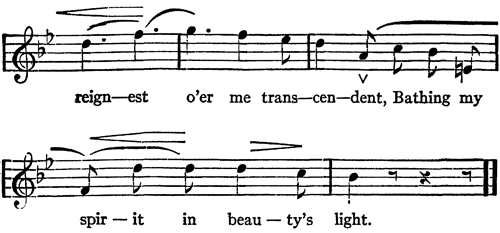
[Listen]
Heav'nly Aïda, beauty resplendent, Radiant flower, blooming and bright; Queenly thou reignest o'er me transcendent, Bathing my spirit in beauty's light.
Aïda could not be happy in an alien land, serving the daughter of the King who had been the conqueror of her people, and Radames knew this; but what he didn't know was that the Princess, herself, loved him, and therefore that her jealousy might do Aïda much harm. While he was thus sunk in deep reflection, Amneris, the Princess, entered the hall, attended by her slave. Radames no sooner looked at Aïda than his love could be seen by any one present. He was so sincere and honest that he could not conceal his feelings.
"Ah, Radames, you are very happy to-day! Something has happened to please you! Are you not going to tell me?" Amneris asked, smiling happily at him.
"Nay, Princess," he answered. "I am not more happy than before, only I am thinking of this war that is about to be, and how I should love to do some valiant deed—for us all," he added as an after-thought, but Amneris surprised the look of tenderness that he gave to Aïda. From that moment she watched the lovers closely.
"To-day the Goddess is to decide who shall lead the Egyptians against the Ethiops; I would it were to be I," he sighed. Amneris flushed with anger, as she again saw a look of devotion pass between the slave-girl and Radames, the darling of the court. Still, she pretended to be unsuspicious.
"Is there nothing to attract you in Memphis, that you wish to be off to the war?" she asked, narrowly observing him. Radames, so sensitive and so much in love, saw that he had betrayed his love for Aïda. All three became ill at ease, but the Princess called the slave girl to her, pretending great affection for her, and said:
"Why do you weep, Aïda? Neither you nor Radames seem to be happy to-day."
"Ah, Princess, I weep because of this war rumour. I have known the sadness and terror of war, and the thought of assembled war-hosts gives me pain. It means ruin and despair to so many."
"That is the only the reason for your tears?" she persisted, trying to hide her anger, but her glances belied the softness of her tone. Radames, noting this, trembled for Aïda. Even the life of the girl was in the hands of the Princess, and Radames knew it.
"Ah, my love, you are weeping for something besides a nation, and your blush betrays you," Amneris answered, gently enough, but in her heart she determined to punish the helpless girl. As the scene became more and more painful, trumpets, which always preceded the King's coming, were heard near at hand, and in he came, surrounded by guards, ministers, priests, and officers; a brilliant company, making a brilliant picture.
"Greeting!" he cried, "it is a mighty cause which brings us here together. A messenger has this moment arrived among us with news of great import. I need the support of all the gallant men of my kingdom. Now, messenger, come before us, if thou wilt, and tell thy news," the King cried in a fine and haughty manner, motioning the messenger before him.
"I came to tell thee, Sire, that Egypt is invaded by Ethiop's King, and all her border lands are laid waste. Our crops are destroyed, great havoc hath been wrought, and unless thou shouldst send an army to resist the invading hosts, we are lost."
"Ah, the presumptuous bandit!" the King cried, thus regarding his brother ruler, and it is probable that the King of Ethiopia did not feel more temperately toward the King of the Egyptians.
"By whom are the Ethiopians led?" the King asked.
"By one Amonasro—a warrior who hath never been conquered."
"What? the Ethiopian King, himself," all cried, because that was news with a vengeance. Amonasro was known to be an invincible warrior, and, if he was going to take the field in person, Egypt had indeed something to fear. At the name, Aïda started.
"Amonasro!" she began to cry, but checked herself. Amonasro was her beloved father! Since she was already a slave, her life would be in danger if it were known that the Ethiopian King was her father. She leaned, almost fainting, against the Princess's throne, and in the excitement her agitation passed unnoticed. The messenger continued to speak:
"All Thebes has risen and sallied forth to check this foe."
"Death and battle, be our cry!" the King shouted; and all his nobles took up the war-cry: "Death and battle, death and battle!"
"War, war, war! fierce and unrelenting," cried Radames, loudest of all, his war spirit and love of country both aroused. At his cry all became still, and the King looked at him with great affection.
"Egyptians, warriors, hear! the chief to lead our hosts against this bold invader has this day been named by the Goddess Isis." Every one leaned breathlessly forward. Many a brave fellow hoped the choice had fallen upon him. None listened more eagerly than the Princess and Aïda.
"There is the choice!" the King continued, pointing to Radames. A moment of silence followed, then Radames shouted:
"Ah! ye Gods! I thank thee! My dearest wish is mine." All the court and soldiers burst into shouts of joy and confidence.
"Now to the Temple of Vulcan, Chieftain, and there equip yourself and men for victory," the King cried, and all prepared to follow Radames.
"Take the war-standard from my hand, Radames," Amneris said, smiling at him with affection: but Aïda murmured unheard:
"Whom shall I weep for, my lover or my father?" Her heart was breaking, for the defeat of either her father or her lover would be a disaster to one so tender as she.
"Battle, battle," all cried excitedly, all certain of victory at the hands of their beloved leader, Radames. "May laurels crown thy brow!" they shouted, following him to the temple, where they were to don their armour, feel if their swords were sharp, and pray for success.
"Aye, may laurels crown thee," Aïda murmured. "I cannot wish thee ruin, yet what a wicked wish, since victory must mean my father's loss. If Radames shall conquer, I may see my father brought here in chains." The unhappy girl prayed in turn for her father and Radames.