Act 1 — ACT I
Reading edition
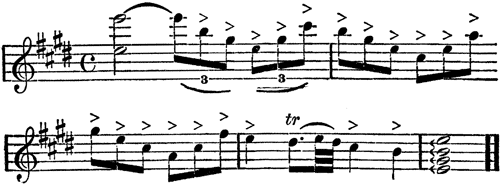
[Listen]
There you are, prepared for almost anything in the way of battle, murder, or sudden death, to the accompaniment of beautiful music; opera in true Italian style, at its second best.
Soldiers and servants were gathered about the beautiful columns of a porch of the Aliaferia palace just before midnight awaiting the return of the Count di Luna. Among them was Ferrando, the captain of the Count's guard. All were lounging in the vestibule of the palace gossiping till it was time to go on duty within.
"Hey, wake up! You'll be caught napping," Ferrando called to his comrades. "It is time for the Count to come. I suppose he has been under the Lady Leonora's windows. Ah, he is madly in love with her—and so jealous of that troubadour who sings beneath her windows that some day they will meet and kill each other."
This was an old story to the men, and in their effort to keep awake they clamoured for the story of the Count di Luna's brother, which all had heard told with more or less of truth; but Ferrando knew the whole horrible tale better than any one else; besides, it was a good story to keep awake on.
"Ah, that was a great tragedy for the House of Luna," Ferrando began with a shiver. "I remember it as if it were but yesterday:"
When the good Count di Luna here resided, Two children fair he numbered; One to a faithful nurse was once confided, By the cradle she slumbered. At morning when she woke and gazed about her, Sorely stricken was she, And what sight do ye think did so confound her? Cho. ... What, oh tell us did she see?
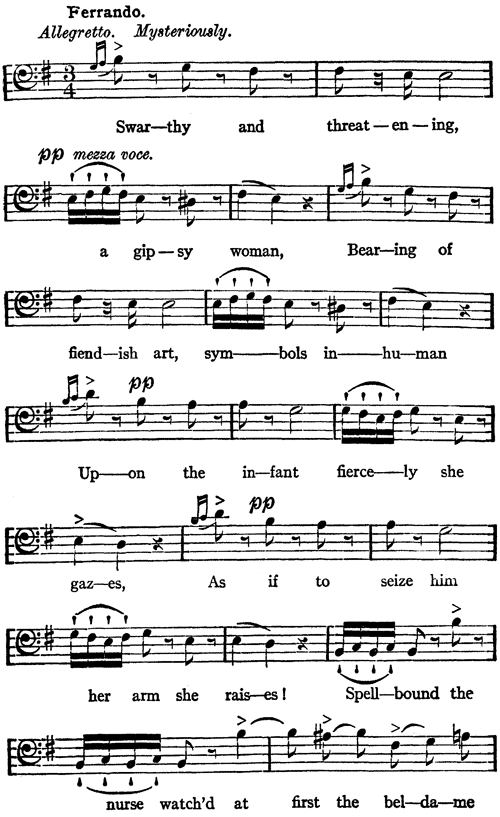
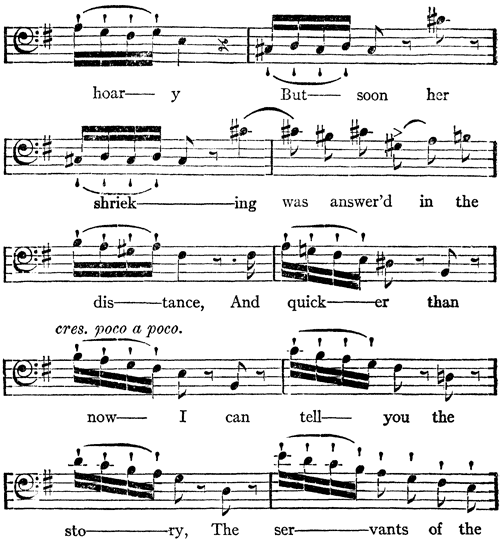
[Listen]
Ferrando. Swarthy and threatening, a gipsy woman, Bearing of fiendish art, symbols inhuman Upon the infant fiercely she gazes, As if to seize him her arm she raises! Spellbound the nurse watch'd at first the beldame hoary But soon her shrieking was answer'd in the distance, And quicker than now I can tell you the story, The servants of the
The frightful story was sung in a deep bass voice, by Ferrando. He sang of how the cry of the nurse on that morning years before had brought the servants running and they had put the gipsy out; but almost at once the baby grew ill, and the Count and his people believed the old hag had put a spell upon it, so that it would die. They sought wildly for her, and, when they finally found her, they burned her alive.
While that frightful scene was being enacted, the baby was stolen, outright, and the di Luna family saw it thrown upon the fire which had consumed the gipsy.
This deed was done by the daughter of the gipsy whom they had burned alive. There were those who believed that the child burned had not been the Count's, but a young gipsy baby—which was quite as horrible. The name of the young woman who had done this fiendish thing was Azucena, and the di Lunas searched for her year after year without success.
It was believed that the spirit of the hag they had burned had entered into the younger woman's body. The gossiping soldiers and servants sang:
Anon on the eaves of the house-tops you'll see her, In form of a vampire; 'tis then you must flee her; A crow of ill-omen she often is roaming, Or else as an owl that flits by in the gloaming.
While they were talking of this tragedy for the hundredth time, it approached the hour of midnight. The servants, through fear, drew closer together, and the soldiers formed a rank across the plaza at the back.
Each recalled some frightful happening in relation to witches; how one man who had given a witch a blow, had died, shrieking and in awful agony. He had been haunted. It was at the midnight hour that he had died! As they spoke of this, the castle bell tolled the midnight hour. The men, wrought up with fright, yelled sharply, and the face of the moon was hidden for a moment.