Act 2 — ACT II
Reading edition
It is about half-past ten, and everything ready for the elopement. The Captain is on deck playing a mandolin while holding a most beautiful pose (because Little Buttercup is also "on deck," and looking sentimentally at him). The Captain sings to the moon, quite as if there were no one there to admire him; because while this "levelling" business is going on in the Navy there seems no good reason why Buttercup or any other thrifty bumboat lady shouldn't do a little levelling herself. Now to marry the Captain—but just now, even though it is moonlight and a very propitious moment, there is other work on hand than marrying the Captain. She can do that almost any time! But at this moment she has some very mysterious and profound things to say to him. She tells him that:
Things are seldom what they seem, Skim milk masquerades as cream. High-lows pass as patent leathers, Jackdaws strut in peacock feathers.
And the Captain acquiesces.
Black-sheep dwell in every fold. All that glitters is not gold. Storks turn out to be but logs. Bulls are but inflated frogs.
And again the Captain wisely acquiesces.
Drops the wind and stops the mill. Turbot is ambitious brill. Gild the farthing if you will, Yet it is a farthing still.
And again the Captain admits that this may be true. It is quite, quite painful if it is. On the whole, the Captain fears she has got rather the best of him, so he determines to rally; he philosophises a little himself, when he has time. He has time now:
Tho' I'm anything but clever,
he declares rhythmically, even truthfully;
I could talk like that forever, Once a cat was killed by care, Only brave deserve the fair.
He has her there, beyond doubt, because all she can say is "how true."
Thus encouraged he continues:
Wink is often good as nod; Spoils the child, who spares the rod; Thirsty lambs run foxy dangers, Dogs are found in many mangers.
Buttercup agrees;—she can't help it.
Paw of cat the chestnut snatches; Worn-out garments show new patches; Only count the chick that hatches, Men are grown-up catchy-catches.
And Little Buttercup assents that this certainly is true. And then, just as she has worked the Captain up into a pink fit of apprehension she leaves him. While he stands looking after her and feeling unusually left alone, Sir Joseph enters and declares himself very much disappointed with Josephine.
"What, won't she do, Sir Joseph?" the Captain asks disappointedly.
"No, no. I don't think she will. I have stooped as much as an Admiral ought to, by presenting my sentiments almost—er—you might say emotionally, but without success; and now really I——"
"Well, it must be your rank which dazzles her," the Captain suggests, and thinks how he would like to take a cat-o'-nine-tails to her.
"She is coming on deck," Sir Joseph says, softly, "and we might watch her unobserved a moment. Her actions while she thinks herself alone, may reveal something to us that we should like to know"; and Sir Joseph and the Captain step behind a convenient coil of rope while Josephine walks about in agitation and sings to herself how reckless she is to leave her luxurious home with her father, for an attic that, likely as not, will not even be "finished off."
Of course Sir Joseph and her father do not understand a word of this, but they understand that she is disturbed, and Sir Joseph steps up and asks her outright, if his rank overwhelms her. He assures her that it need not, because there is no difference of rank to be observed among those of her Majesty's Navy—which he doesn't mean at all except for one occasion only, of course. At the same time, it is an admirable plea for his rival Ralph.
Now it is rapidly becoming time for the elopement, and Josephine pretends to accept Sir Joseph's suit at last, in order to get rid of him at half-past ten. He and Josephine go below while Dick Deadeye intimates to the Captain that he wants a word with him aside.
Then Dick Deadeye gives the Captain his information, thus:
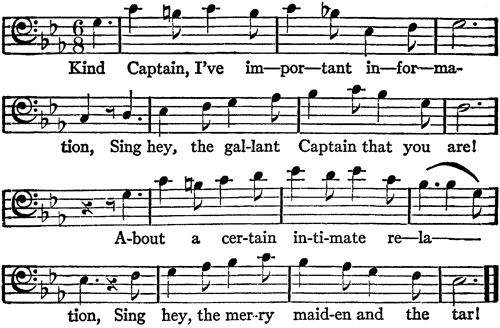
[Listen]
Kind Captain, I've important information, Sing hey, the gallant Captain that you are! About a certain intimate relation, Sing hey, the merry maiden and the tar! Kind Captain, your young lady is a-sighing, Sing, hey, the gallant Captain that you are! This very night with Rackstraw to be flying, Sing, hey, the merry maiden and the tar!
This information certainly comes in the nick of time, so the Captain hastily throws an old cloak over him and squats down behind the deck furniture to await the coming of the elopers.
Presently they come up, Josephine, followed by Little Buttercup, and all the crew on "tip-toe stealing." Suddenly amid the silence, the Captain stamps.
"Goodness me!" all cry. "What was that?"
"Silent be," says Dick. "It was the cat," and thus reassured they start for the boat which is to take the lovers ashore. At this crisis the Captain throws off the cloak and creates a sensation. He is so mad he swears just as Sir Joseph puts in an appearance.
"Damme!" cries the Captain.
"What was that dreadful language I heard you use?" Sir Joseph demands, highly scandalized.
"He said 'damme,'" the crew assure him. Sir Joseph is completely overcome. To excuse himself the Captain is obliged to reveal the cause of his anger.
"My daughter was about to elope with a common sailor, your Greatness," he says, and at this moment Josephine rushes into the arms of Ralph. The Admiral is again overcome with the impropriety of the situation.
"My amazement and my surprise, you may learn from the expression of my eyes," the Admiral says. "Has this sailor dared to lift his eyes to the Captain's daughter? Incredible. Put him in chains, my boys," he says to the rest of the crew, "and Captain—have you such a thing as a dungeon on board?"
"Certainly," the Captain says. "Hanging on the nail to the right of the mess-room door—just as you go in."
"Good! put him in the ship's dungeon at once—just as you go in—and see that no telephone communicates with his cell," whereupon Ralph is lugged off.
"When the secret I have to tell is known," says Little Buttercup, "his dungeon cell will be thrown wide."
"Then speak, in Heaven's name; or I certainly shall throw myself into the bilge water," Josephine says desperately.
"Don't do that: it smells so dreadfully," Buttercup entreats; "and to prevent accidents I will tell what I know:"
A many years ago, When I was young and charming, As some of you may know, I practised baby farming. Two tender babes I nursed, One was of low condition, The other upper crust— A regular patrician. Oh, bitter is my cup, However could I do it? I mixed those children up, And not a creature knew it. In time each little waif, Forsook his foster-mother; The well-born babe was Ralph— Your Captain was the other!
So, the murder is out! Nobody outside of comic opera can quite see how this fact changes the status of the Captain and Ralph (the Captain not having been a captain when in the cradle) but it is quite enough to set everybody by the ears. Josephine screams:
"Oh, bliss, oh, rapture!" And the Admiral promptly says:
"Take her, sir, and mind you treat her kindly," and immediately, having fixed the ship's affairs so creditably, falls to bemoaning his sad and lonesome lot.
He declares that he "cannot live alone," and his cousin Hebe assures him she will never give up the ship; or rather that she never will desert him, unless of course she should discover that he, too, was changed in the cradle. This comforts everybody but the changed Captain. Ralph has, in the twinkling of an eye, become the Captain of the good ship Pinafore, while the Captain has become Ralph, and Ralph has taken the Captain's daughter. But while he is looking very downcast, Buttercup reminds him that she is there, and after regarding her tenderly for a moment, he decides that he has always loved his foster mother like a wife, and he says so:
I shall marry with a wife, In my humble rank of life, And you, my own, are she.
The crew is delighted. Everybody is happy. But the Captain adds, rashly:
I must wander to and fro, But wherever I may go I shall never be untrue to thee!
Whereupon the crew, which is very punctilious where the truth is concerned, cries:
"What, never?"
"No, never!" the Captain declares.
"What—never?" they persist.
"Well, hardly ever," the Captain says, qualifying the statement satisfactorily to his former crew. And now that all the facts and amenities of life have been duly recognized, the crew and Sir Joseph, Ralph and the former Captain, Josephine and Buttercup, all unite in singing frantically that they are an Englishman, for they themselves have said it, and it's greatly to their credit; and while you are laughing yourself to death at a great many ridiculous things which have taken place, the curtain comes down with a rush, and you wish they would do it again.