Act 1 — Scene II
Reading edition
After travelling for a week and a day, the two adventurers came to a fine palace. Tamino sent the fowler with his chime of bells up to the great place to spy out what he could, and he was to return and bring the Prince news.
Without knowing it they had already arrived at the palace of Sarastro, and at that very moment Pamina, the Queen's daughter, was in great peril.
In a beautiful room, furnished with divans, and everything in Egyptian style, sat Monostatos, a Moor, who was in the secrets of Sarastro, who had stolen the Princess. Monostatos had just had the Princess brought before him and had listened malignantly to her pleadings to be set free.
"I do not fear death," she was saying; "but it is certain that if I do not return home, my mother will die of grief."
"Well, I have had enough of thy meanings, and I shall teach thee to be more pleasing; so minions," calling to the guards and servants of the castle, "chain this tearful young woman's hands, and see if it will not teach her to make herself more agreeable." As the slaves entered, to place the fetters upon her hands, the Princess fell senseless upon a divan.
"Away, away, all of you!" Monostatos cried, just as Papageno peeped in at the palace window.
"What sort of place is this?" Papageno said to himself, peering in curiously. "I think I will enter and see more of it." Stepping in, he saw the Princess senseless upon the divan, and the wretched Moor bending over her. At that moment the Moor turned round and saw Papageno. They looked at each other, and each was frightened half to death.
"Oh, Lord!" each cried at the same moment. "This must be the fiend himself."
"Oh, have mercy!" each shrieked at each other.
"Oh, spare my life," they yelled in unison, and then, at the same moment each fled from the other, by a different way. At the same instant, Pamina awoke from her swoon, and began to call pitiably for her mother. Papageno heard her and ventured back.
"She's a handsome damsel, and I'll take a chance, in order to rescue her," he determined, feeling half safe because of his chime of bells.
"Why, she is the very image of the Prince's miniature and so it must be the daughter of the Queen of the Night," he decided, taking another good look at her.
"Who art thou?" she asked him, plaintively.
"Papageno," he answered.
"I do not know the name. But I am the daughter of the Queen of the Night."
"Well, I think you are, but to make sure"—He pulled from his pocket the portrait which had been given to him by the Prince and looked at it earnestly for a long time.
"According to this you shouldn't have any hands or feet," he announced gravely.
"But it is I," the Princess declared, looking in turn at the miniature. "Pray, where did you get this?"
"Your mother gave this to a young stranger, who instantly fell in love with you, and started to find you."
"In love with me?" she cried, joyfully.
"You'd think so if you saw the way he carries on about you," the fowler volunteered. "And we are to carry you back to your mother even quicker than we came."
"Then you must be very quick about it, because Sarastro returns from the chase at noon exactly, and if he finds you here, you will never leave alive."
"Good! That will suit the Prince exactly."
"But—if I should find that, after all, you are an evil spirit," she hesitated.
"On the contrary, you will find in me the best spirits in the world, so come along."
"You seem to have a good heart."
"So good that I ought to have a Papagena to share it," he answered, plaintively, whereupon Pamina sang affectingly:
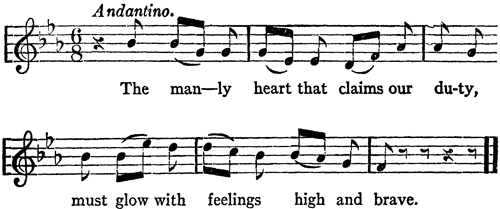
[Listen]
The manly heart that claims our duty, must glow with feelings high and brave.
It is a very queer and incoherent opera, and not much sense to any of it, but, oh! it is beautiful music, and this duet between the fowler and Pamina is not the least of its beauties. At the end of it they rushed off together—Pamina to meet the Prince and be conducted back to her mother.