Act 1 — Scene II
Reading edition
When the cloud which had hidden the moon's rays cleared away, a beautiful garden belonging to the palace was revealed. The place was very silent, the soldiers and servants, excepting those on guard, having gone within.
The Lady Leonora, whom the Count di Luna loved, was one of the suite of the Princess of Arragon, and when all in the palace were sleeping it was her custom to steal into the lovely gardens with her friend, Inez. Of late, when she came there, she had hoped, secretly, to find a mysterious young troubadour, who sang almost nightly beneath her windows. She loved this troubadour and not the Count.
The first time she had met the handsome youth was at a tournament. There he had come, dressed in a suit of black, and all unknown; wearing a sweeping sable plume in his helmet; and when the jousting took place, he had vanquished all the nobles. It was Leonora, herself, who had placed the wreath of the victor upon his brow. From that very moment they had loved. He had worn no device upon his shield by which he could be known, but she had loved him for a gallant knight.
He belonged to the retinue of a neighbouring prince, who was an enemy of the Princess of Arragon, and he risked his life each time he came to sing in the gardens to Leonora.
"Ah, I fear some harm will come of this love of yours!" Inez said to her friend and mistress. "The Princess awaits thee, dear Countess, and we must go within. I hope your trust will never be betrayed by this unknown knight and singer." The women mounted the gleaming marble staircase, and then Leonora paused for a moment looking down into the garden again.
She had no sooner gone than a man peered out from the shadow of the trees. It was the Count di Luna, jealously watching for the knight who sang beneath the lady's window. Also, he hoped to see Leonora, herself, but all was still, and after watching the balcony a moment, he started toward the marble steps. At that instant a beautiful voice stole through the moonlight.
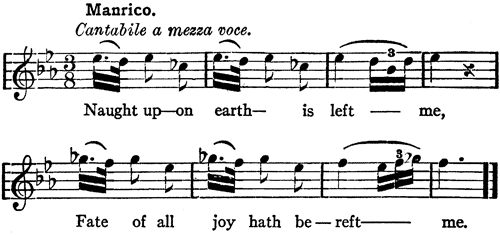
[Listen]
Manrico. Naught upon earth is left me, Fate of all joy hath bereft me.
It was Manrico the troubadour!
The Count paused upon the stair and looked down; but Leonora, too, had heard, and ran out upon the balcony, then down the steps, throwing herself into the Count's arms, mistaking him for Manrico. Manrico, still hidden by the shadows, witnessed this, and becoming enraged at the sight, believing Leonora faithless, he rushed upon them just as the moon again shone forth and revealed to Leonora that she was in the Count's arms, instead of the troubadour's.
"Traitress!" Manrico cried.
"Manrico, the light blinded me," she implored, throwing herself at the troubadour's feet.
For thee alone the words were meant, If those words to him were spoken,
she sang.
"I believe thee," Manrico answered; while the Count, enraged in his turn, cried:
"You shall fight with me, Sir Knight!"
"Aye, behold me!" Manrico answered, lifting his visor and standing in the bright light of the moon. At the sight of him di Luna started back:
"Manrico! The brigand! Thou darest——"
"To fight thee? Aye, have at it!" and Manrico stood en garde. Leonora implored them not to fight, but too late. They would fight to the death.
"Follow me," di Luna called, drawing his sword, which he had half sheathed when he had seen that his antagonist was not of noble birth like himself. "Follow me," and he hurried off among the trees, followed by Manrico.
"I follow, and I shall kill thee," the handsome troubadour cried, as he too rushed off after the Count. Whereupon the Countess Leonora fell senseless.