Part 2 — THE LOST PROVINCES.
Reading edition
XXII. SAN FRANCISCO.
I.
It is the way of sea-coasts, as observed from the water, to maintain a close reserve. If they allow us a cliff or two, a suggestion of green forests, or a mountain in the background, it is as much as they do. All their natural projections, from a steamer’s deck, retire into a straight line. “You have chosen your element,” they seem to say, “and you shall not enjoy at once the pleasures of both. If you can do without me, so can I without you, and until you take the pains to disembark you shall know nothing of the attractions I purposely keep out of sight just over the surf-whitened margin.”
The coast of California seems of even an especial moroseness in this respect. You pass some few islands, inlets at San Diego and Wilmington, the Santa Barbara Channel, and the bays of Santa Monica, San Luis, and Monterey; but for the most part the coast of the land of gold stretches on unbroken, low, brown, and bare. Search is vain for any suggestion of orange-grove or palm. It is foreign-looking to one who arrives from the east of the United States. Lions might come prowling down such slopes. It might be Morocco, and we, on our travels, some new Crusoe escaped in the long-boat, with Xury, from the Rover of Sallee, and afraid to land for the howlings of wild creatures.
If, in our Pacific Mail steamer, we were discovering the country for the first time—as every traveller does discover a new country for the first time, no matter what accounts he may have heard of it—we should try along without finding a single good harbor for four hundred and fifty miles, from San Diego, at the Mexican frontier, to San Francisco.
Then all at once comes an opening through bold Coast Range at the water’s edge, and we are in the far-famed “Golden Gate.” It is a mere eyelet—a strait, giving access to a wide expanse of bay. So happy is the opening, and commodious the shelter afforded, that the reversal of the churlishness prevailing up to this point seems miraculous.
There is no doubt, when once the site is understood, as to why San Francisco is located just where it is. It has the only natural harbor between Astoria, Oregon, to the north, and San Diego, to the south. It bears, besides, with this advantage, such a relation to the resources of the back country, that it could not escape a destiny of greatness.
It is not simply a bay upon which we have entered, but an inland sea, with a great commerce of its own. Immediately in front rise round-backed Goat Island and Angel Island, resembling monsters asleep; and terraced Alcatraz, with its citadel, as picturesque as a bit of Malta. Vistas open beyond on many sides, with gleams of light falling on white cities under lowering atmospheres of smoke. San Francisco, close at hand, piles up impressively on steep hills, its bristling structures covering their undulations sharply from numerous hills. The water-front is full of shipping. French and Russian and British frigates, and a Mexican gun-boat, are lying at anchor. Craft of all shapes and sizes cross one another’s wakes in the harbor. The lateen-sails of Genoese and Maltese fishermen and the junks of Chinese shrimp-catchers are among them. Large ferry-boats, superior, as a rule, to those we are familiar with at the East, ply to Oakland, the Brooklyn of the scene—a city already of fifty thousand people; Alameda, with its esplanade of bathing pavilions; Berkeley, with its handsome university and institution for blind, deaf, and dumb; San Quentin, with its prison; and rustic Saucelito and San Rafael, under the dark shadow of Mount Tamalpais.
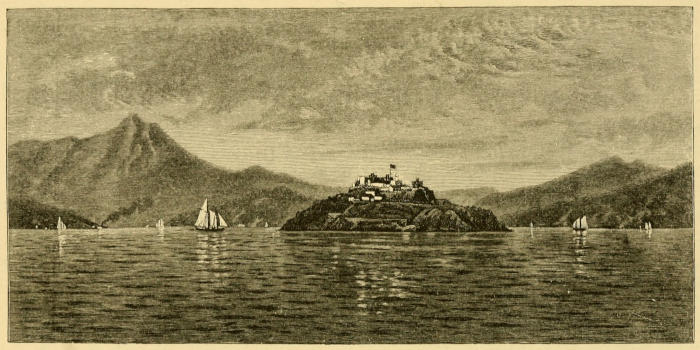
ALCATRAZ ISLAND.
From Oakland projects an interminable pier, built by the Central Pacific Railway. A mile in length as it is, it was to have gone on to a junction with vacant Goat Island, which would then have been made a city also, and become the terminus of all transcontinental journeys. This project was stopped by violent opposition from property-holders on shore.
Patches of yellow, under the Presidio, are taken by our novices on the steamer for the “Sand-lots,” famous in the Kearneyite agitations. The Presidio is a barracks, which was a fort and mission in the time of the first settlement by the Spaniards—to what slight extent they ever settled the place—in the year 1776. The man who has “been here before” plants himself squarely on the deck, pulls down a silk cap over his eyes, and explains that the Sand-lots are not the Presidio, but nothing less than the large yard of the new, unfinished City-hall, in the centre of town. But Kearneyism is dead and buried, he says—as the case proved—and there will be no chance to see one of these traditional assemblages.
He names for us the various hills, and points out the Palace Hotel, the Market Street shot-tower, and the homes of some of the great millionnaires who have made such a stir in their day and generation. Three or four of these latter top California, or “Nob,” Hill, with a prominence in keeping with their owners’ station. They are those of the railroad kings, Crocker, Stanford, and Hopkins—the mining kings having up to this time expended their principal building efforts in the country. “Nob” Hill is three hundred feet high, plebeian Telegraph Hill nearly as much, and Russian Hill, to the west—the latest precinct taken into favor for fine residences—three hundred and sixty. Murray Hill, New York, be it noted, is but seventy-eight. The riff-raff of Telegraph Hill climb, as is seen, by a multitude of wooden stairways; but how in the world do the Crœsuses get up to their habitations, which cut the sky-line so imposingly? We shall see.
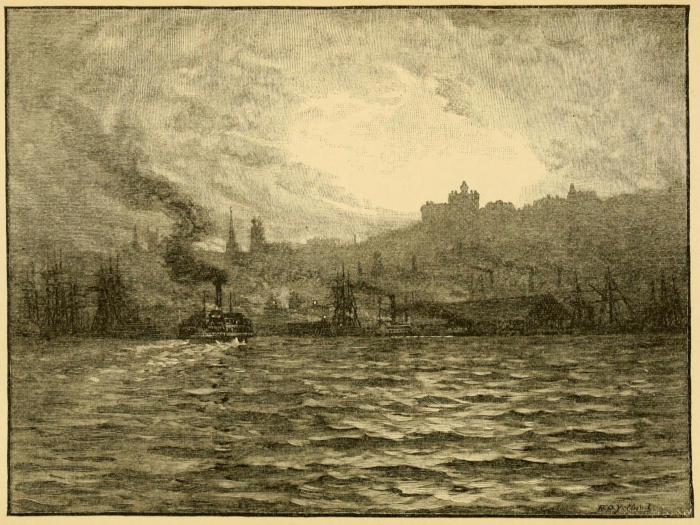
“NOB” HILL, FROM THE BAY.
The city does not begin directly at the ocean, but a mile or two within. It follows the inner shore of a long, narrow peninsula which comes from the south to meet one coming from the north, and forms with it the strait and bay.
It is, indeed, an inland sea, this bay. You go southward upon it thirty miles, northward as far, and thirty miles north-eastward to the Straits of Carquinez—which has Benicia on one side, and Martinez, the point of departure for ascent of the peak of Mount Diablo, on the other. Through these straits you pass, again, into Suisun Bay, which receives the waters of the Sacramento and San Joaquin rivers, and is itself some twenty miles in extent.
II.
You are struck, on coming ashore from Mexico, with the excessive thinness of everything American. Our belongings seem all of a piece with our light-running machinery, with the spider lines of yon American buggy waiting for its owner. We evade Nature by a deft trick, and do not obstinately oppose her. There the old walls were as solid yet as the everlasting hills; here we seemed to be living in flying-machines.
How strange, arriving from the other side of the world, to find people lining the dock dressed in the common way, and chattering the common speech, even to the latest bits of slang! A China steamer, however, had come in along-side just before us, and supplied a novel element of foreignness. Almond-eyed Celestials, in blue blouses, swarmed her decks and poured down her sides. Groups were loaded into express-wagons, and driven away uptown in charge of friends come down to meet them. Others trudged stoutly on foot, with their effects deposited in a pair of wicker baskets, at the ends of a long bamboo on their shoulders. This way of carrying burdens is constantly met with. The vegetable dealers hawk thus their wares from house to house, and present the aspect of the figures in cuts of the tea-fields. It is poor travelling when the curiosity alone and not the imagination is gratified, and San Francisco promises ample material for both.
Had we come in the gold days of ’49 we should have landed some half-dozen blocks farther inland than to-day. By so much has the water-front since been extended and built into a solid commercial quarter. The ’Forty-niners found but a scanty strip of sand at the base of the steep hills.
Why, then, did they stop here, and build their city at such infinite pains and expense, instead of seeking a more convenient site elsewhere? There is, or was, some even more serious objection to all other locations. At Oakland, insufficient depth of water; at Saucelito, where whalers, Russian and other, had been accustomed to refit, Tamalpais, 2700 feet high, as against Telegraph Hill, but 300. Distant Benicia and Vallejo—the latter now the naval station of the Pacific Coast, and once briefly the capital of the State—were much too far away. Steam was little in use. The greater part of the ships came under sail, and there were no tugs to pull them. They must be able to get in and out with all greatest attainable expedition.
Such ships as these were, according to the accounts we have of them! The most antiquated and dangerous hulks were furbished up once more for this last voyage. The eager humanity they carried took little heed of perils and discomforts so they were but on the way to the goal to which all adventurous spirits turned. When the port was still but a beggarly scattering of huts and tents it could muster two hundred sail, good and bad, at once. Many of them never got out again. It was not on account of nautical difficulties, but partly because they had no return cargoes, and principally because their crews ran away from them to the mines the moment foot touched shore. Certain craft were beached and converted into dwellings; others, utilized for a time as warehouses, rotted at their moorings, and to-day form “made ground.” The remarkable city to which they came, which had eight hundred and fifty souls in 1848, and twenty thousand in ’49, has now, in an existence of thirty-four years, three hundred thousand.
The buildings on the level made ground stand generally on foundations of piling. The practice prevails, too, of tying them well together with iron rods, against the jar of the occasional earthquake, which is among San Francisco’s idiosyncrasies. It is proposed to improve the water-front with a continuous, massive sea-wall, and a portion of this is already built. Extensive yards of attractive redwood lumber, which resembles cedar, and warehouses for grain, are seen. The elevator system, owing to lack of ships for properly carrying grain in bulk, is nowhere in use throughout California.
We reach next an area given up to heavy traffic in the fruits and produce of the country. Battery and Sansome streets succeeding are lined with large wholesale dry-goods houses similar to those in the greater Eastern cities. Montgomery Street shows stately office buildings, exchanges, and hotels. Kearney Street has been hitherto the chief site of the more elegant retail trade. Its prestige is passing, however, to Market Street, a wide thoroughfare which recalls State Street, Chicago. Having unlimited room for extension in the north and south direction of the peninsula, whereas the others named are contracted, Market Street is to be San Francisco’s Broadway of the future.
The financial centre is contained in the area of two blocks, between California and Bush, Sansome and Montgomery Streets. Here are those institutions whose great transactions and singular history are unknown now to but few parts of the world.
The Nevada Bank, financial lever of the Bonanza kings, and point from which has been supposed to emanate all the weightiest influences connected with mining matters, is a four-story and Mansard iron building, with the usual classic “orders.” The Bank of California, whence the brilliant Ralston rushed forth from his troubles to drown himself in the bay, is two stories, of “blue stone,” of a pleasant color, and exceedingly sharp, agreeable cutting. The Merchants’ Exchange, erected so long ago as 1867, is a very ornate, town-hall-looking building, of iron and stone, dark-colored, with a clock-tower in the centre. It is adjoined by the Safe Deposit Company, in a similar style, in the basement of which a glimpse is to be had of a splendid steel treasure-chamber, with a dozen life-size men in armor, gilded.
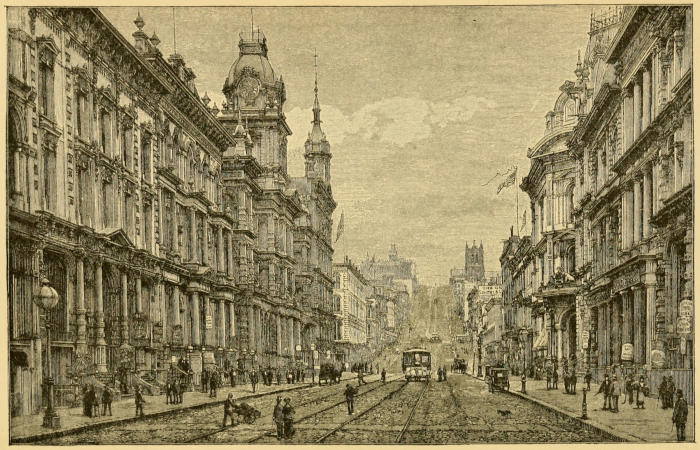
CALIFORNIA STREET, SAN FRANCISCO.
The large and agreeably proportioned Stock Exchange, on Pine Street, is of gray granite, with numerous polished columns. The board-room within is an amphitheatre, and a bronze railing protects the circle of seats. With its agreeable illumination and neat furniture, including Axminster rugs, it presents a much more home-like aspect than is the rule with such places. Mining stocks exclusively are dealt in.
It is quiet enough now. We have fallen upon evil days. Capitalists have withdrawn their millions to the East; ships come only in ballast, for grain, instead of with valuable exchange cargoes, and charge rates almost prohibitory; there is not one “turn-out” now on the Cliff House road where there were formerly a dozen; and real estate has shrunk fifty per cent.—if in some places it have any value at all.
This board was once the theatre of a speculative movement which took hold upon the community like madness. The aggregate value of the mining stocks on the list, at the period of highest prices, in the year 1875, was, in round numbers, $282,000,000. The aggregate value of the same stocks in the summer of 1881 was but $17,000,000. There had occurred a shrinkage of $265,000,000, or more than fifteen times the total value surviving.
What had happened? The “bottom had dropped out” of the famous “Comstocks,” perhaps the richest mines known to history. “Consolidated Virginia,” valued at $75,000,000, was now worth less than $1,000,000. “Sierra Nevada” fell from $27,000,000 to $825,000. But the greatest shrinkage of all was in “California.” This unhappy stock shrank from $84,000,000 to $351,000.
These figures explain a depression the vestiges of which, though the ruinous crisis has long passed, still remain. The stock-gambling mania possessed the community without distinction of station, and hardly of age or sex, and when the bubble broke there was reason enough for gloom with all who had laid up their treasure in such unstable form.
Some of the earlier buildings, now flat, thin, and unornamental, were obtained at expense quite out of proportion. The stone for the old City Hall was brought expressly from Australia; that of the Wells-Fargo building, and the Union Club, from China. The granite of the Branch Mint, a fine, classic design, was dressed in Oregon. The newer structures exhibit all the varieties of form and color in which the modern decorative taste delights. The material for most is procured in the State itself.
The idea of being in a remote part of the world is kept before you in many ways. Here is a sign of the “New Zealand Insurance Company.” Fancy New Zealand, where a cannibal population was lately eating missionaries, sending us over its insurance companies! Here is the Alaska Commercial Company, the Bank of British Columbia; and here, its inscription gilded in Chinese as well as English, the Hong-Kong and Shanghai Banking Company. An occasional building is without the usual entrance-doors, its staircase, in the comparative mildness of the climate, left as open as the street.
A system of alleys passes among the colossal structures, and these abound in refreshment resorts—“The Dividend Saloon,” “Our Jacob,” “The Comstock Exchange,” and “The New Idea”—to which the hastening business men repair in intervals of their labors. The San Francisco boot-blacks, a model to their class, are neatly uniformed men instead of ragged urchins. Favored by the climate, they establish their rows of easy-chairs on platforms under a canvas awning, have a newspaper and the gossip for you while you wait, and somewhat usurp the place so long sacred to the barber.
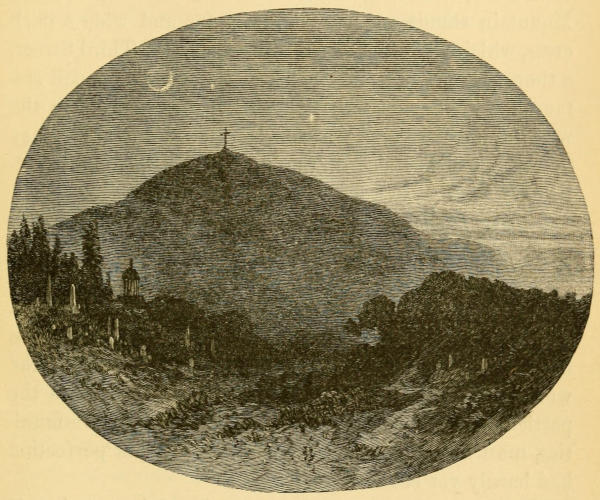
LONE MOUNTAIN.
The corner of California and Montgomery Streets may be considered one of two focal points in San Francisco; the “Lotta Fountain” is the other.
The Lotta Fountain—a tawdry, little, cast-iron affair, presented to the city by the actress after whom it is named—has been given a place of distinguished honor. Five important streets radiate from it. Its pedestal is a place where the timid seek refuge when entangled in the throng of vehicles. Market Street extends to the Oakland Ferry one way, and past the Mechanics’ Institute and pleasure resort of Woodward’s Garden to the distant Mission Hills in the other. Geary Street takes you, by a “cable road,” westward to Lone Mountain, around which all the cemeteries are grouped, and Golden Gate Park, stretching to the ocean. On the top of Lone Mountain stands up to view from far and wide a dark cross, which weirdly recalls that of Calvary. Third Street, a thoroughfare of working-people, abounding in small restaurants, markets, and “tin-type” galleries, leads to the water at a different angle from Market. Finally, Kearney Street debouches also at the Lotta Fountain, and Montgomery terminates but a few steps below.
The Palace Hotel, vast, drab-colored, of iron and stuccoed brick, looms up nine stories in height on Market Street, and closes the vista from Montgomery. Studded with bay-windows, it has the air of a mammoth bird-cage. The San Franciscan, wherever met with, never fails to boast of it as the most stupendous thing of its kind in the world. With the conviction that size is not always the particular in which our hotels, like some of our communities, most need improvement, I should say that perfection had hardly yet been reached.
Within it is more satisfactory. At night an electric light strikes upon many tiers of columns, as white as paint can make them, in a large glass-roofed court, with an effect quite fairy-like and Parisian. Twice a week a band plays there, and the guests promenade up and down their galleries or look over the balustrade. In the bottom there are flowers, people sitting in chairs, and carriages stand in a circular, asphalt-paved driveway.
Though the resident of San Francisco feels called upon to complain of its present stagnation, the bare existence of such a place strikes the new-comer with amazement.
Its air is not ephemeral, but of a fine, massive gravity. Its shops are filled with costly goods, its streets with comely, beautifully dressed women. It has an art and literature. Private galleries contain foreign modern pictures of the best class. Some local artists have made for themselves a more than local reputation. There is a well-attended “School of Design,” which has already graduated several pupils whose talent has been recognized abroad. The “Mercantile Library” is the most handsome and complete in its appointments of any American city.
San Francisco “society,” though a trifle bizarre in the use of its newly acquired wealth, has an under-stratum of unexceptionable refinement. Its most bizarre side, too, is certainly approved of in Europe, where its magnates entertain kings and give their daughters in marriage to lofty titles.
The European traveller who visits “the land of Barnum” and “of Washington” with literary intent must be cruelly broken up by what he will find here. Such a place should be a vast, motley camp, as it is known to European travellers that most American cities should be. With its thirty-three years, and its heterogeneous elements, it should exhibit a combination of squalor and mushroom splendor. The wretched shanty should elbow the vulgar palace, a democratic boorishness of manners, blazing in diamonds, the faint, refined natures that by any chance have ventured into such a Babel. But, alas! we live in an age of expedition, of labor-saving inventions. With unlimited means, such as here enjoyed, the work of years is condensed into months. Camp there is none, but a luxurious city, presenting all the ordinary characteristics of civilization.
An association comprising in a genial way most of the best elements of San Francisco is the Bohemian Club. It is found taking a very creditable interest in literature and the arts—it numbering the professionals and amateurs in these branches in its membership—and entertains and welcomes distinguished strangers. A monthly entertainment of a light, composite character is held, known as a “Jinks.” The grand festival of the year, however, is a “High Jinks,” which takes the form of an excursion into the country. The principal ceremonial of the High Jinks has sometimes been held at night, in masquerade costume, among the Big Trees, the enormous redwoods of Sonoma County, to the northward. It may well be believed that the doings on these occasions are as fantastic and amusing as the merry inventions of a couple of hundred bright social spirits can make them.
III.
A population of three hundred thousand souls is not extraordinary now, as populations go, but there are certain things which make San Francisco cosmopolitan beyond its actual size. An entirely new commercial situation gives rise to a new milieu. San Francisco faces toward Asia, the great English-speaking colonies of Oceanica, and the islands of the sea, as New York faces Europe. It enjoys already a trade with the Orient amounting to ten millions per annum in imports and eight millions in exports. The possibilities of this trade, extended among the teeming populations in the cradle of the human race, seem almost limitless. A way will be found sooner or later out of the imbroglio into which our inexperience has plunged us on the Chinese question, and communication will flow unimpeded. In countries separated by water, and demanding each other’s productions, cities arise at the places of transfer, and proportioned to its volume; and for all this San Francisco has one of the most remarkable of situations.
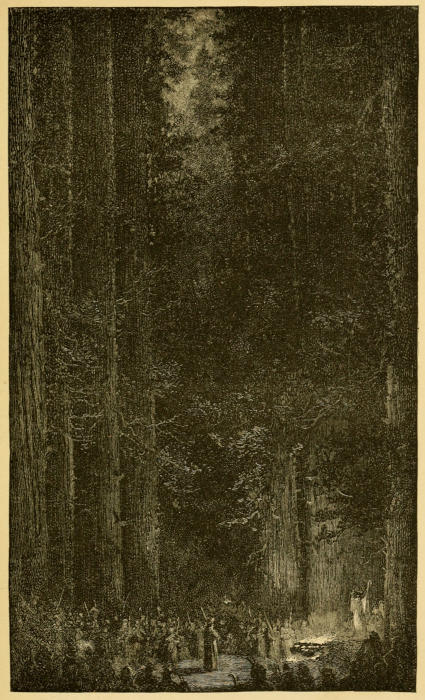
“HIGH JINKS” OF THE BOHEMIAN CLUB AMONG THE BIG TREES.
The Oriental trade is but a small item in the total. It has ships, besides those bound for the Eastern and European ports, going out to the British and Russian possessions in the North, Mexico, Central and South America, Tahiti, Feejee, Manila, the Sandwich and Friendly Islands—to all those far-off points in the South Pacific which now in their turn promise to shine with the light of civilization and become powers of the earth.
Coals are burned at firesides—not of the most desirable quality, it must be confessed—which come from the coast once characterized by the poet in the line—
“The wolf’s long howl on Oonalaska’s shore.”
Seventy millions pounds of sugar a year are brought from those Sandwich Islands which slew Captain Cook, now a civilized, modern state. But it is particularly Australasia, and our coming relations with it, that awaken admiring speculations. Melbourne, Australia, has already more than 280,000 people, Sydney 225,000, while along the coasts of that once cannibal New Zealand, now sending us its insurance companies, scatter also a line of flourishing cities: Dunedin, with its 43,000 people; Auckland, with 40,000; Christchurch, 32,000; Wellington, 22,000; and I know not how many others.
Astoria and Portland, in Oregon, San Diego, and, no doubt, ports to be created in time along the Mexican shores, will receive a share of these new influences in the world, but at San Francisco they touch us first and nearest.
There is a definite fascination in coming to the “jumping-off place,” the final verge of the latest of the continents. An excellent situation in which to feel it is to lie on the brown heather at the point above the Golden Gate—though it is a raw and gusty place in which to lie too long—or to look down from the parapeted road or piazza of the Cliff House.
Here practically nothing intervenes between you and Japan, except we make mention of the clump of Seal Rocks, upon which the grouty sea-lions are floundering and roaring, down there in the surf in front.
“Ah! when a man has travelled,” says Thoreau, “when he has robbed the horizon of his native fields of its mystery, tarnished the blue of distant mountains with his feet, he may begin to think of another world.”
Very well. Perhaps it may do a man no harm to think of another world now and then, if not upon one pretext, on another. At evening the Golden Gate is the way to the sunset. The orb of day settles into the sea at the end of the gleaming strait, precisely in that East where we always figure it to ourselves as rising in the morning. The great circle is at last complete; and, as the extremes of every kind, even of love and hate, are said to be identical, the old, quiescent East has become the bound of the new, impetuous West.
“What is a world to do,” you idly ask, “when it has no longer a West? How is it to get on without that vague open region on its borders, always the safety-valve and outlet for surplus population and uneasy spirits?”
“But when the race has quite arrived at this farther shore, will it stop here? or will it possibly start round the world again? Will it go on yet many times more, always beginning with the highest perfection yet attained, weaker types dying out in front to make room, till it shall become in its march a dazzling army of light? Is a millennium, perchance, to be reached in this cumulative way, as the power of a magnet is increased by the number of turns of the helix?”
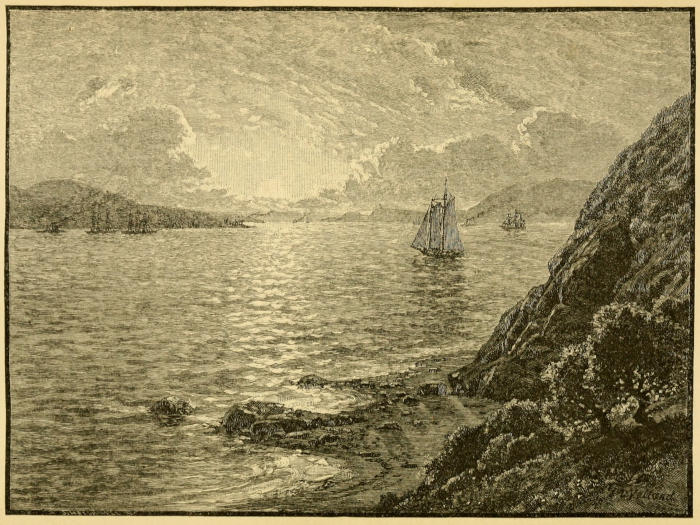
GOLDEN GATE, FROM GOAT ISLAND.
“The sentiment of gain,” I say, continuing these wise speculations, “has been the leading factor in drawing the nations around the globe. Gold has been dangled as a bait: first, the hope of it by conquest; later, in mines of the precious metals. It has danced, Ariel-like, will-o’-the-wisp-like, before them. Tantalized, disappointed, after floundering on a ways, they have paused to develop the lands upon which they found themselves.
“But now at length, when the vacant spaces are full, and the need of subterfuge exhausted, the bait is cast down, to be gorged upon by those who find it. Never before, till ’49, were its followers rewarded with such unstinted liberality. The treasure of the earth seemed piled up in the fastnesses of the far Pacific.”
I recall that their yield since the year 1848 has reached the sum of $2,100,000,000, and is still going on at $80,000,000 a year. Gold, scattered at first in the very sands, was later washed out of the gravel-banks, by the hydraulic process, and later yet got by crushing the quartz rock. When gold began to diminish it was followed by silver. The great “Bonanza” mines of Nevada were discovered. “Consolidated Virginia” alone produced $65,000,000 in seven years.
IV.
What fabulous sums besides—to go back to town—the managers made by the ingenious process of “milking the market” I do not undertake to compute. The prices of this celebrated stock at successive dates, not far apart, were: first, $17 a share; then $1; $110; $42; $700; and then, in the final collapse, in 1875, little or nothing at all.
I have seen a poor saloon called the “Auction Lunch,” on Washington Street, near the Post-office, said to have been kept by the once barkeepers, Flood and O’Brien, who attained such a splendid prosperity. There is no historic tablet over the door, but one naturally looks with reverence at the place where the beginning of such things could be. The proprietors of the “Auction Lunch” were in the habit of taking gold-dust occasionally in a friendly way from miners, for safe-keeping while the owners were enjoying themselves about town. It was from such persons that they obtained the “points” which resulted in their getting possession first of “Hale and Norcross,” and then of the greater part of the properties of the Comstock lode.
I fell in with a professed friend of theirs of early times, whose fortunes had not mended at all at the same pace. He descanted on the inequalities of fate, and what he termed “bull-dog” luck.
He could prove that Flood and O’Brien were not even good business men—“though Jimmy Flood does go about with a wise air,” he said, “and Billy O’Brien left, at his death, half a million dollars to each of eight or ten nieces.”
There is hardly a limit to the exceptional characters and exceptional doings to be heard of in San Francisco. Though the city affect—or has been driven into—a quiescent air now, it has hardly ever done anything like any other place. It began with the wild Argonauts of ’49, whom Bret Harte has so strikingly portrayed. It had had six great fires, which destroyed property to the amount of $23,000,000, when yet less than three years of age. It was ruled for months, in the year 1856, by a vigilance committee, which rid it of eight hundred evil-doers of one sort and another, the worst by summary execution, the rest by banishment.
The politics of the State before the war were Democratic, with a rather strong Southern bias. There was a long feud between the two great Senatorial paladins, Broderick and Gwin, which resulted in the death of Broderick by the duelling-pistol of one of the partisans of the latter. There was the long fight and a final deliverance from an incubus of forged Spanish land titles, the manufacture of which “had become a business and a trade,” and which covered the area of the city many times over. Then came the war, and the peculiarities growing out of the retention of a solid currency, while the rest of the country was deluged with a depreciated paper.
The brilliant period, later, when the Bonanza mines were pouring out their floods of riches, and the favorite stocks were running delightfully up and down the gamut from $1 to $700 a share, was followed, as I have said, by a depression of the deepest dye. In the unbearable disappointment of their losses, and the stagnation of trade, a part of the community snatched at a theory held out to them by demagogues, that it was their political institutions which were somehow to blame. Upon this basis a singular new party, wild and half-communistic in character, arose, and met with a brief success. The truckman, Denis Kearney, was its Caius Gracchus or Watt Tyler, and set it in motion with blasphemous mouthings from an improvised tribune in the Sand-lots. It elected a mayor who was at the same time a Baptist preacher. This mayor’s son—preacher, too—rode up one day and assassinated at his own door an editor who had passed strictures on their course. The party voted a new constitution, which was thought to be a prelude to universal confiscation, and capitalists fled before it in alarm.
And, finally, this remarkable city, having become the recipient of a Chinese immigration which has given to a part of it the aspect of a portion of the Flowery Kingdom, has been agitated by fears of complete subversion under Orientalism, and has originated new problems for political economy and international law.
After but a tithe of such violent and novel experiences any city would be glad to rest awhile. San Francisco seems entering upon a new period, and likely to do things henceforth more in the normal way. There has been a time of contemplation, and the lessons of the past have struck in. As things have slowly improved the gloom of the reaction has disappeared after the unhealthy inflation that gave it birth. The new political craze was of but short duration. I never saw anywhere so quietly conducted an election as that of the last autumn, which dismissed the Kearney-Kalloch faction from power. A special provision prevents the approach of any person but the voter immediately engaged within one hundred feet of a polling-place. I had rather expected to see dead and maimed Chinamen lying at every corner, or fleeing before infuriated crowds. But though San Franciscans entertain beliefs of their own as to the undesirability of a great Chinese immigration, during a long stay I neither saw nor heard of an attempt to molest any individual on account of it.
The new constitution itself proved a harmless bugaboo. It is a gratifying tribute, in fact, to native common-sense and Anglo-Saxon ideas that this instrument, produced in a time of great excitement, and, as was charged, with the most subversive intentions, should not only contain so little that is dangerous, but so much in a high degree commendable. It does not harm property. Frightened capital may return with entire safety. I profess myself so far a person of incendiary opinions as to hold that an honest directness of purpose in this new constitution, its effort to simplify legislation and sweep away embarrassments, often maintained much more in the interest of legislator and lawyer than the public good, is well worthy of imitation elsewhere.
Physical and commercial conditions are also changing. Life hereafter will depend less upon spasmodic “finds,” and more on the humdrum and legitimate industries. Mining, though the supply of treasure, with improved machinery, still holds out in a uniform way, takes a lesser rank. Agriculture and manufactures come every day more to the front. California produces an annual wheat crop of $50,000,000, a wool crop of $10,000,000, wines to the amount of $4,000,000, and fruits worth as much more, though these last two branches are but in their infancy. Of the greater part of all this San Francisco is the entrepôt.
The smoke of the soft coals of Alaska, Oregon, and Australia too may be allowed to thicken the air to some purpose, since it produces manufactures to the amount of $75,000,000 per annum.
XXIII. SAN FRANCISCO (Continued).
I.
Kearney Street (sharing its distinction now with Market Street) is, in sunshiny weather, the promenade of all the leisurely and well-dressed. It abounds in jewellers, who often combine the business of pawnbroking with the other, and are fond of prefixing “Uncle” to their names. Thus, “Uncle Johnson,” “Uncle Jackson,” or “Uncle Thompson,” all along the way, make a genial proffer of their hospitable service. There are shops of Chinese and Japanese goods, though this is not the regular quarter, and “Assiamull and Wassiamull” invite us to inspect the goods of the East Indies.
Perhaps European foreigners of distinction—English lords, M.P.’s, and younger sons, German barons and Russian princes—on their way round the world, are not more numerous than in New York, but they seem more numerous in proportion. The books of the Palace Hotel are seldom free of them, and they are detected, at a glance, strolling on the streets or gazing at the large photographs of the Yosemite Valley and the Big Trees which hang at prominent corners.
There is a genial feeling about Kearney Street, which arises, I think, from its being level—at the foot of the steep hills. The temptation is to linger there as long as possible. The instant you leave it for the residence portion of town you have to begin a back-breaking climb. The ascent is like going up-stairs, and nothing less.
The San Francisco householder of means is “like the herald Mercury new-lighted on a heaven-kissing hill.” How in the world, I have asked, does he get up there? Well, by the Cable road. I consider the Cable road one of the very foremost in the list of curiosities, though I have refrained from bringing it forward till now. It is a peculiar kind of tramway, useful also on a level, but invented for the purpose of overcoming steep elevations.
Two cars, coupled, are seen moving, at a high rate of speed, without jar and in perfect safety, up and down all these extraordinary undulations of ground. There is no horse, no steam, no vestige of machinery, no ostensible means of locomotion of any kind. The astonished comment of the Chinaman, observing this marvel for the first time, may be worth repeating once more, old as it is:
“Melican man’s wagon, no pushee, no pullee; go top-side hill like flashee.”
The solution of the mystery is an endless wire cable hidden in a box in the road-bed, and turning over a great wheel in an engine-house at the top of the hill. The foremost of the two cars is provided with a grip, or pincers, running underneath in a continuous crevice in the box with the cable. When the conductor wishes to go on he clutches with his grip the cable; when he wishes to stop he lets go and puts on a brake. There is no snow and ice to clog the central crevice, which, by the necessities of the case, must be open. The system has been applied, however, with emendations, in Chicago, and is about to be on the great Brooklyn Bridge, at New York.
The great houses on the hill, like almost all the residences of the city, are of wood. It seems a pity, considering the money spent, that this should be so. It is attributed to the superior warmth and dryness of wood in so moist and cool a climate, and also to its security against the shock of earthquakes. Whatever be the reason, the San Francisco Crœsuses have reared for themselves palaces which might be swept off at a breath and leave no trace of their existence. Their architecture has nothing to commend it to favor. They are large, rather over-ornate, and of no particular style.
The Hopkins residence—a costly Gothic château, carried out also in wood—may be excepted from this description. The basement stories, however, are of stone, and there is enough work in these and foundations to build many a first-class Eastern mansion. To prepare sites for habitations on the steep hills has been an enormous labor and expense. The part played by retaining-walls, terraces, and staircases is extraordinary. The merest wooden cottage is often prefaced by works which outweigh its own importance a dozen to one.
When a peerage is drawn up for San Francisco, the grader will follow in rank the railroad-builder and the miner. To hardly anybody else has such an amount of lucrative employment been open. What a cutting and filling! what gravelling and paving!
Striking freaks of surface and arrangement result. The city might have been terraced up, like Genoa, or Naples above the Chiaja. It is picturesque still, in the thin, American way, through the absolute force of circumstances. You enter the retaining-walls of stone or plank through door-ways or grated archways like the postern-gates of castles. You pass up stone steps in tunnels or vine-covered arbors within these; or zigzag from landing to landing of long, wooden stairways, without. Odd little terrace streets and “places,” as Charles Place, with bits of gardens, are found sandwiched between the regular formation. A wide thoroughfare, Second Street—cut through Rincon Hill, the Nob Hill of a former day, to afford access to water for vehicles—has been the occasion of leaving isolated, high and dry, some few old houses, with cypress-trees about them, approached by wooden staircases almost interminable. Dark at sunset against a red sky, for instance, they present effects to delight the heart of an etcher.
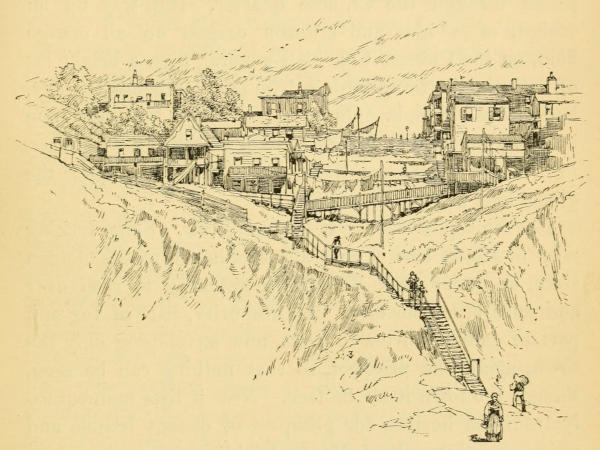
HIGH-GRADE RESIDENCES.
In this line, however, nothing is equal to Telegraph Hill, which bristles with the make-shift contrivances of a much humbler population. Bret Harte lived there at one time, and asserts that the goats used to browse on his pots of geranium in the second-story windows. They also pranced on the roof at night in such a way that a new-comer thought there had been a fine thunder-storm. Elsewhere, instead of precipices, you meet with chasms. Looking down from the roadway, you will see some poor figure of a woman sewing in a bay-window which was once filled with air and sunshine, but now commands only a patch of mildewed wall.
The views from the hills are of no common order. As you rise on the Cable road you hang in the air above the body of the city, and above the harbor and its environment. The Clay Street road, one of the steepest, passes through the Chinese quarter. Half-way up an ensign, of a blue-and-crimson dragon on an orange field, on the Chinese Consulate-general, flies, a bright bit of color in the foreground. The bay, far below the eye, has an opaque look. On some rare days it is very blue in color, but oftener it is of slate or greenish gray. Passing vessels criss-cross their wakes in white upon the green like pencils on a slate.
The atmosphere above it is rarely clear. Some lurking wisp of fog at best is generally stealing in at the Golden Gate, or under dark Tamalpais, watching to rush over and seize upon the city. An obscurity, part of fog and part of smoke, hovers in areas, now enveloping only the town, again the prospect, so that nothing can be seen, though the town itself be free. Now it lifts momentarily from the horizon for glimpses of distant islands and cities, and the peak of Mount Diablo, thirty miles away, and shuts down as suddenly as if these were but figments of a vision.
The view down upon the lights at night is particularly striking. Set in constellations, or radiating in formal lines, they are like the bivouac of a great army. It might be the hosts of Armageddon were encamped round about awaiting the dawn. For several days, from California Street Hill, there was the spectacle of a devastating fire in the woods of Mount Tamalpais. Its dark smoke rendered the sunsets lurid and ominous, and at night the burning mountain, reflected in the bay, was a more terrible Vesuvius or Hecla.
II.
One is hardly supposed to “travel” as yet in America as in Europe. We make our journeys here for definite objects, chiefly on business. No doubt, if we could bring ourselves to the same receptive frame of mind, the same readiness to be amused by odds-and-ends of experience, a good deal the same kind of pleasure could be got out of it as there. San Francisco at least appears to afford a few of exactly the same details which receive the attention of the leisurely abroad.
Italian fishermen eat macaroni, and drink red wine, and wait upon the tides, about the vicinity of Broadway and Front Streets. The Italian colony, for the rest, is pretty numerous. The part that remains on shore is chiefly composed of grocers, butchers, and restaurateurs. Chinese shrimp-catchers are found in the cove at Potrero, behind the large new manufacturing buildings of that quarter, and again at San Bruno Point, twelve miles down the bay. Their boats and junks are not on a large scale, but display the usual peculiarities of their nautical architecture.
The French colony is also numerous, and the language heard continually on the street. Taking advantage of the variety and excellence of supplies in the markets, French restaurants furnish repasts—including a half-bottle of wine of the country—of extraordinary cheapness. A considerable Mexican and Spanish contingent mingles also with the Italians, along Upper Dupont, Vallejo, and Green Streets. Shops with such titles as La Sorpresa and the Tienda Mexicana adjoin the Unità d’Italia and the Roma saloon. A Mexican militia company turns out, under the green, white, and red tricolor, on every anniversary of the national independence, the 16th of September. During the Carnival season a form of entertainment known as “Cascarone parties” prevails among the Spanish residents. The participants pelt one another with egg-shells filled with gilt and colored papers. Sometimes a canvas fort is erected in the street, and attacked and defended by means of these missiles and handfuls of flour. Such Spanish life as there is can hardly be said to have remained from the early days, since the Spanish settlement at best was infinitesimal. It has been attracted here in the mean time like other immigration. A dusky mother, smoking a cigarette, in a hammock, in a palm-thatched hut, on the Acapulco trail, told me of a son who had gone to San Francisco twenty years before and become a carpenter there. He had forgotten now, she heard, even how to speak his native language.
The Latin race seems to have been especially attracted to the country of a mild climate and original traditions like their own. But German and Scandinavian names too on the sign-boards—Russian Ivanovich and Abramovich, and Hungarian Haraszthy—show that no one blood or influence has exclusive sway. There appears to be an unusually free intermingling and giving in marriage among these various components. They are less clannish than with us. Lady Wortley Montagu remarked, at Constantinople, some hundred years ago, a similar fusion, and believed it a reason for a debased and mongrel race. But a very different class of blood mingles here from that of Orientals at Constantinople. Our much more cheerful theory is, that we are to combine the best qualities, the hardihood and good looks of all, while eliminating their defects. Certainly the bright, intelligent aspect of the children of San Francisco does nothing as yet to discredit such a theory.
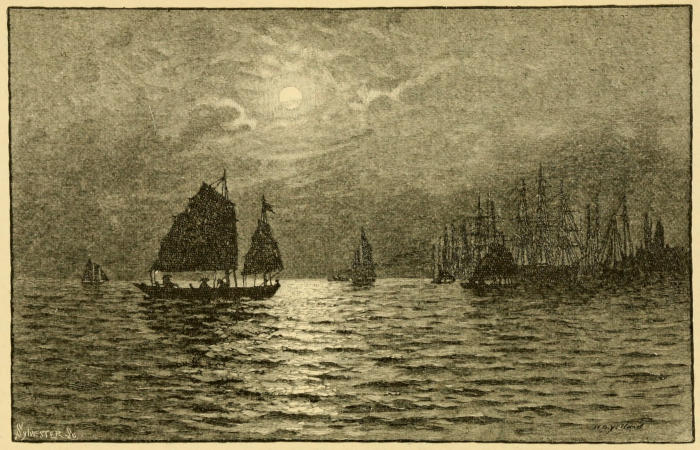
CHINESE FISHING-BOATS IN THE BAY.
Such vestiges of ’49 as yet remain are extremely few. I confess to surprise as well at the slightness of the historic records at the Pioneer Society. I make little doubt that they could be easily paralleled in many other libraries of the country. “North Beach,” under Telegraph Hill, may be visited both for its memories and present aspect of picturesque ruin. It is where the pioneer ships landed. Hence, also, the ill-fated Ralston swam out into the bay, and here are the remains of “Harry Meigs’s Wharf.” Harry Meigs was a famous prototype of Ralston’s in the Fifties. Defeated in brilliant financial schemes, and having endeavored to save his defeat by forgery, he was obliged to take flight. He chartered a schooner to take him to the South Sea Islands, which lay off the wharf for him at midnight.
“This is hell,” he is reported to have said as he stepped on board, expressing thus his Lucifer-like sense of humiliation and downfall.
He did not remain long at the South Sea Islands, but sailed for Peru. There he began the world again, built all the railways of that republic, became a great millionnaire, sent back and paid all his debts, and was divested, by act of Legislature, so far as legislation could do it, of the stigma of his crimes. His story is by no means a good one to hold up to the emulation of youth, but it is romantic, and in some sense characteristic of California.
The blackened old pier is a dumping-place for city refuse now, and swarms of chiffoniers gather around it to pick out such scraps of value as they may before they are washed away by the daily tides.
The leading streets of San Francisco commemorate the pioneers of State or place. A newer series adopts the names of the States of the Union, and simple numbers, which are carried already to Forty-fifth, for avenues, and Thirtieth for streets. The fast-growing, tough, fragrant, but scrawny, eucalyptus is much in use as a shade-tree. In the door-yards grow cypresses, the Spanish-bayonet, and the ordinary flowers, needing a great deal of sprinkling to keep them in good order.
The San Francisco school of writers, developed in the successful days of the Overland Monthly, have not made much use of the city itself in their literature. Bret Harte confined his local range to the doings of certain small boys, some “Sidewalkings,” and the disagreeable features of the climate, in “Neighborhoods I Have Moved From.” It was from Folsom Street that the adventurous Master Charles Summerton, aged five, set out for his great expedition to Van Dieman’s Land, by way of the Second and Market Street cars. I had occasion to visit Folsom Street sometimes, and even this slight incident—such is the potency of the literary touch—has given it a genial interest which many others, as good in appearance, and even stately Van Ness Avenue, on the other side of town—very much better—by no means share.
III.
San Francisco offers, in my view, the advantage of saving a trip around the world. Whoever, having seen Europe, shrinks from farther wanderings may derive here from a compact Chinese city of 30,000 souls such an idea of the life and doings of the Celestial Empire as may appease curiosity and take the place of a voyage to the Orient.
The Chinese immigrants, it is true, rarely erect buildings of their own, but fit themselves to what they find. They fit themselves in with all their peculiar industries, their smells of tobacco and cooking-oil, their red and yellow signs and hand-bills, opium pipes, high-soled slippers, sticks of India ink, silver pins, and packets of face-powder, their fruits and fish, their curious groceries and more curious butcher’s meat—they have fitted all this into the Yankee buildings, and taken such absolute possession that we are no longer in America, but Shanghai or Hong-Kong. The restaurants make the nearest approach to the national façades, but this is brought about by adding highly-decorated balconies, lanterns, and inscriptions, and not building outright.
I had the curiosity to try one of the best of the restaurants—quite a gorgeous affair, at the head of Commercial Street—and found the fare both neatly served and palatable. There was a certain monotony in the bill, which I ascribed to a desire to give us dishes as near the American style as possible. We had chicken-soup, with flour paste resembling macaroni; a very tender chicken, sliced, through bones and all, in a bowl; a bowl of duck; a pewter chafing-dish of quail with spinach. All the food is set out in bowls, and each helps himself, with ebony chopsticks, to such morsels as he desires. The chopsticks, held in the fingers of the right hand, somewhat after the manner of castanets, are about as convenient to the novice as a pair of lead-pencils. We drank saki, or rice brandy, in infinitesimal cups, during the dinner, and at dessert very fine tea.
The upper story of these places is reserved for guests of the better class. Those of slender purses are accommodated below. To these is served a second drawing of the same tea which has been used, and such meats as remain in a tolerable state. The upper story is decorated with carved work, painted scarlet, and heavily gilded, and screens, lanterns, and teak-wood tables and stools; while below pine-wood tables are deemed good enough.
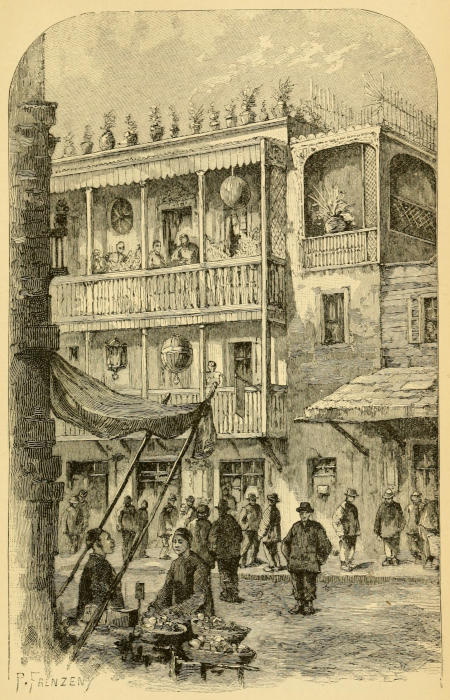
CHINESE QUARTER, SAN FRANCISCO.
Dropping in late one evening for a cup of tea, I had the fortune to witness a supper-party—a novel, genre picture, glowing with color. There were a dozen dignified-looking men, dressed in handsome silk clothing—black, blue, and purple. With them were as many women—young, slender, and pretty, of their type, while the women seen walking about the streets are very coarse and clumsy. Their black hair was carefully smoothed, and looped up with silver pins, and their complexions were daintily made of pink and white and vermilion, realizing exactly the heads painted on their silken fans. The most interesting girl was of Fellah or Hebrew aspect, and was probably not without an admixture of other blood in her veins. The men occupied carved teak-wood stools about a large table, spread with a white cloth, and covered with charming china. The women stood by and served them. Now and then one of the latter rested momentarily on a corner of a stool, in a laughing way, and took a morsel also. The whole was a bit of bright Chinoiserie worth a long journey to witness.
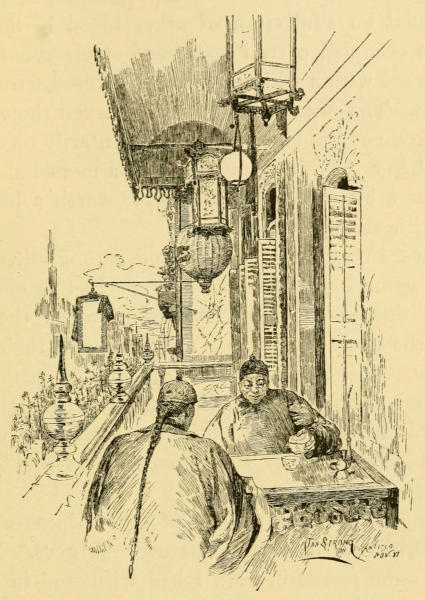
A BALCONY IN THE CHINESE QUARTER.
They were very merry, and played, among other amusements, a game like the Italian mora. In this one would hold up fingers in rapid succession, while the others shouted the probable number at the tops of their voices. What with this, their laughter, drumming on the table, and general hubbub, besides an orchestra of their peculiar music adding its din from behind a screen, they were not very unlike a party of Parisian canotiers and grisettes supping at Bougival.
The temple and the theatre of the Chinese emigrant have an identical character wherever he goes. I found here the same scenes in both I had witnessed in Havana at the beginning of my journey. The temple, economically set up in some upper rear room, abounds in gaudy signs and some good bronzes, but is little frequented. The theatre is far more popular. The dresses used here are rich and interesting. The performers are continually marching, fighting, spinning about, pretending to be dead and jumping up again, and singing in high, cracked voices like the whine of a bagpipe. A doughty warrior, who may be Gengis Khan or Timour the Tartar, and bear himself with the “most haughty stride and withering pride,” will sing you his lines in this same puny, whining voice, and no other. The slightness of the means of illusion is a naïve feature of interest in the Chinese drama. As one of the simple rustics in the Midsummer Night’s Dream holds up an arm to represent a wall, across which Pyramus and Thisbe are supposed to talk, so here, if it be designed, for instance, to represent the march of an army through the woods, a screen is put up at one side of the stage, bearing an inscription which no doubt says “Woods,” and around this the military betake themselves.
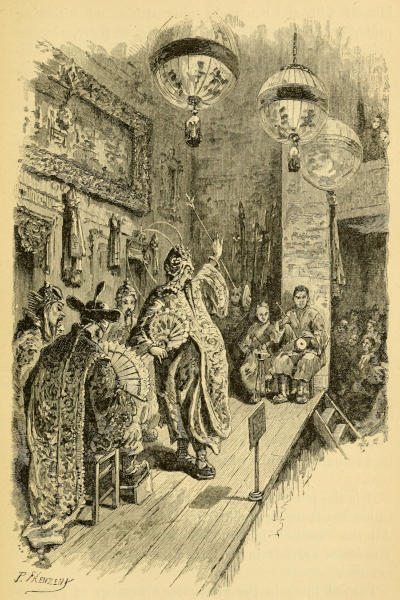
IN A CHINESE THEATRE.
The cemetery is more curious even than the theatre of Chinadom in San Francisco. I came upon it in the course of a long stroll one afternoon, and was almost the only spectator of some peculiar ceremonial rites in propitiation of the dead. It is not grouped in the general Golgotha at Lone Mountain, but adjoins that devoted to the city paupers, out among the melancholy sand-dunes by the ocean. It is parcelled off by white fences into a large number of enclosures for separate burial guilds, or tongs. These have large signs upon them—“Fook Yam Tong,” “Tung Sen Tong,” “Ye On Tong,” etc. One has almost difficulty to persuade himself that he is awake witnessing such doings as here take place in the broad sunlight of Yankee-land.
It is the practice to convey the bones of their dead to China, but there are preliminary funerals in regular form. All the “hacks” in San Francisco are often engaged. The bones are left in the ground a year or more before removal.
Toward three in the afternoon a number of express-wagons of the common sort drove up with freights of Chinamen and Chinawomen, and curiously assorted provisions. The “hoodlum” drivers conducted themselves peaceably enough, but seemed to have a certain sardonic air at the idea of having to draw their profits from patrons of such a class. The provisions were unloaded, taken up and laid on small wooden altars, of which there is one at the front of each tong. Most conspicuous were whole roast pigs, decorated with ribbons and colored papers. There were next roast fowls, rice, salads, sweetmeats, fruits, cigars, and rice brandy. The participants set to work to fire revolvers, bombs, and crackers, kindle packages of colored paper, make profound genuflections before the graves, and scatter libations upon them of food and liquors. Only the roast pigs were reserved and taken home again; all the rest was scattered about. The din and smoke increased apace; the strange-garbed figures pranced about like sorcerers, and the decorated pigs loomed out with a goblin air. It seemed a veritable witches’ Sabbath. Some of the fruits and cigars were hospitably offered to me as I looked on; and I will say that parsimony does not seem a vice of the Chinaman, though he lives upon so little, and is content with moderate returns.
Coming back the same way in the evening, I noted prowling figures of white men among the graves, gathering up the fragments cast down by the improvident heathen.
I am glad, on the whole, not to have the mooted Chinese question to settle in person. On the one hand, a great law of political economy—the natural right of man to seek happiness where he will; on the other, a view that the best good of a community does not necessarily consist in mere size and value of “improvements.” The reflective mind will find it rather in the greatest average distribution of comfort. I should say that there have been no evils of consequence experienced from the presence of the Chinese population as yet. Without them the railroads could not have been built, nor the agricultural nor mining interests developed. With all the complaint, too, of competition, the wages of white labor are better here than at the East, and the cost of living is certainly not more.
A proper male costume for San Francisco is humorously said to be a linen duster with a fur collar. The variability of the climate within brief spaces of time is thus indicated. It varies largely, in fact, in different parts of the same day, though the mean for the year is remarkably even. The mean for January—the coldest month—is but fifty degrees, and for September—the warmest—fifty-eight. It is a famous climate for work, but the average temperature, as is seen, is pretty low for comfort. People go away for warmth in the summer quite as much as for coolness. The rainy season—the winter—is really the pleasantest of the year. The air is clearer then, while the prospects are verdant and best worthy to be seen. At other times fogs prevail, or bleak winds arise in the afternoon, and blow dust, in a dreary way, into the eyes of all whose misfortune calls them to be then in the streets.
We return to town from our Chinese ceremony along wide Point Lobos Avenue, the drive to the Cliff House. It is skirted on one side by the public pleasure-ground, Golden Gate Park, an area of half a mile by three miles and a half, which is being redeemed from an original condition of drifting sand in a wonderful way. All the outer tract near the ocean is as desert and yellow as Sahara. A few scattered dwellings appear in the sands, each with its water-tank and wind-mill, a yucca-plant or two, and some knots of tough grass about it. The city appears on the edge of the steep, as if it were looking over in surprise.
XXIV. THE VILLAS OF THE BONANZA KINGS.
I.
I had marked out as a field of travel Southern California.
It is not easy to decide on the instant just what Southern California should be deemed to comprehend. Most of the State, leaving out the mining and lumbering districts, displays some of those tropical features in which the idea of Southernness to the imagination of the temperate climates consists. You see orange, fig, and pomegranate trees surrounding pleasant homes at Sonoma, well to the north of San Francisco. One of the most important districts for raisin-culture is near Sacramento and Marysville, north-west. At the springs of Calistoga, seventy-five miles north, is found a group of the finest palm-trees in California. It is safe to assume, however, that all this will be found in the greater perfection as the low latitudes are approached.
San Francisco lies not far from midway of the State, and Southern California may conveniently be taken as all that part south of the seaport and metropolis. It was upon the area just below, around the Bay, that the Rev. Starr King lavished his most polished eulogies, describing the “flowers by the acre, flowers by the square mile,” which he saw there, in the spring. To the vicinity of San José, fifty miles down, Bayard Taylor proposed (if he should live to be old, and note his faculties failing) to retire in order to renew his youth. And but seventy-five miles farther south are the summer resorts—and winter resorts as well—of Santa Cruz and Monterey.
I set out in mid-autumn, the time of the county fairs, when the products of an agricultural country should be seen to particular advantage. There was held at San José the combined fair of the counties of Santa Clara and Santa Cruz, and that I made my first objective point.
There are no means of exit from San Francisco by land except to the southward, the long, narrow peninsula on which it lies being surrounded on all other sides by water. One may cross, however, by ferry to Oakland—the Jersey City and Hoboken, as well as Brooklyn, of the place—and go around the bay on that side by a road which reaches San José also. In doing so you traverse Alameda County, which raises nearly a million bushels of wheat a year from a single township, together with tons of sugar-beets, and more hay than any other county in the State. It comes third also in rank for grape-vines, and has tropical pretensions of its own, making an exhibit of orange and lemon trees in certain favored nooks. But the more direct way is the coast division of the Southern Pacific Railway, down the peninsula.
Let us glance at topography a moment. California is fenced off into valleys by two long north and south ranges—the Sierra Nevadas, immensely high, and the lower Coast Range. These meet in acute points, north at Shasta, and south at the Tejon Pass, and become one. They enclose between them the vast central space known in its upper portion as the Sacramento Valley, and its lower as the San Joaquin Valley, from the two main rivers by which it is drained. The granite Sierra Nevadas contain the peaks of from thirteen to fifteen thousand feet elevation which have obtained an extensive fame in the world. The Coast Range, of softer materials, averages only from two to six thousand feet.
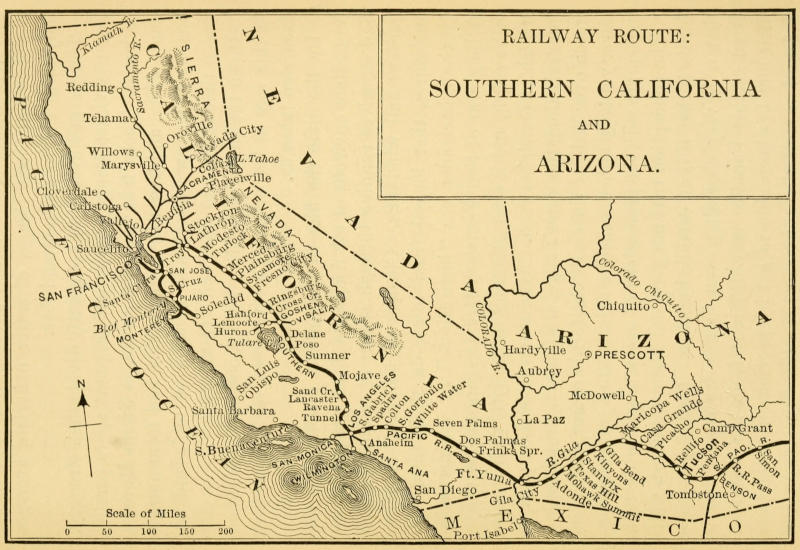
RAILWAY ROUTE: SOUTHERN CALIFORNIA AND ARIZONA.
The Sierra Nevadas do not greatly divide their strength, but the Coast Range throws out frequent spurs parallel to itself. These take separate names, as Sierra Morena, Santa Clara, and Santa Cruz mountains, and form numerous long, narrow valleys and benches of table-land between themselves and the Pacific Ocean.
Down the large Santa Clara Valley, one of those formed in this way in the midst of a diversified region, our first excursion takes us.
By the time the files of freight-cars constituting the immediate environs of all American cities are passed we find ourselves running through a tract of small vegetable gardens and windmills. Clusters of buildings in white enclosures, that looked from town, on their hills, like Mexican haciendas, are “institutions” of various sorts. A long arm of San Francisco Bay accompanies us thirty miles south, and is seen gleaming to the left, with a wide stretch of marsh between. Ark-like structures on piles, at intervals along the water’s edge, are guard-houses, keeping watch over beds of the small California oyster, which has never yet been either coaxed or driven into a grandeur commensurate with the pretensions of everything else about it.
The conception that has gone out about Southern California is that it is an earthly Paradise. I will say at once that it is very charming, even in the dry season, but it is an earthly Paradise very different from the best idea of it one has been able to get by previous investigation. I found myself there, in short, in the dry season, and most writers have spoken of it only as viewed in the season of rains and verdure.
The guide-book promises, “after a few minutes’ ride, orchards, vineyards, elegant farm-houses, prospects to charm all who love the beauties of nature.” But, really—one rubs his eyes—where are they? The ground is mournfully bare and brown. Hardly a tree or a bush is seen; not a green blade of grass. At length some small trees, a variety of scrub-oaks, at a little distance resembling the olive! Farm-houses are few, and not at all “elegant.” The hills are of the color of camel’s hide, and not unlike the camel’s humps.
At Millbrae, finally, there is a glimpse of the wooden towers, in the American style, of a villa, and a large dairy barn. At Belmont the low hills are close at hand. At Menlo Park a charming flower-bed is cared for, by the track, as at foreign railway-stations. We are in the chosen site for villa residences of the San Francisco millionnaires. The surface is flat, and with its growth of oaks recalls the outskirts of Chicago, as at Hyde Park or Riverside.
The valley widens till the hills are distant and veiled in blue, with tawny grain-fields between; but still no verdure! And where are the wild flowers? One hardly expects them now “by the acre and by the square mile,” it is true, since it is autumn; but of all the primroses, the larkspur, the lupin, the poppies of tradition, not one! Not a narcissus! not a chrysanthemum! Oh, my predecessors! what shall I think of you?
In the spring the flowers bloom and carpet the earth as grass carpets it elsewhere. Speaking of the spring the eulogists do not say a word too much. But it is my originality to have seen Southern California in the autumn and winter—as it is for seven months of every year, and as it may be, in exceptional seasons, the whole year through.
Not to make a great deal of this bareness and dryness would be to neglect a most essential feature. The annual rains begin in December, January, or February, and continue till June, diminishing in May, which is sometimes itself a dry month. In the autumn the leaves fall—what comparatively few there are to fall—as elsewhere, and are not renewed.
“But you set up to be a land of perpetual summer, you know,” one argues with the Californian, in the first state of surprise.
“So we are,” he replies; “but that does not necessarily mean perpetual verdure. Look at the thermometer! look at the fertility of the land! You have but to run water on it by irrigation, and it will do whatever you please. Contrast this brown season with your own white one. The land is dry and easy to get about on, and the sky above is uniformly pleasant. Do you prefer your fields of sheeted snow, under the howling blasts? your quagmires of mud and slush, alternately freezing and thawing?”
“Very true,” I admit, accepting this different point of view.
Then, perhaps, by way of finishing touch, he adds, rising to a dignity well justified by the facts, “California sets up to be a land of relations, commercial, agricultural, mineral, and social, which have made it a power in the world. It has revolutionized values, struck the key-note of new social conditions, and begun a new commercial era. California has arrived at a point where she takes her place in the Union on the ordinary terms. We no longer depend upon a repute for astounding beauties and eccentricities—though of these, too, there is no lack, as you will find.”
II.
San José, a city of twenty thousand people, contests with Sacramento the honor of being third in importance in the State. You alight there at the small station. In the vicinity are a waiting horse-car, a blacksmith’s shop, and rail-fences painted with advertisements. These have a very American look, to begin with, for a place with a romantic Spanish name—a place to which you are recommended to come in search of the elixir of life. And so have the small picket-fences an American look, and the comfortable little clapboarded wooden houses behind them, with scroll-sawed ornaments in their piazzas. With the exception of an unusual number of French and Italian names on the sign-boards, and some large, clean tuns in front of the shops of dealers in native wines, it is as downright a little Yankee town as ever was. There is much shade in the streets, and in a public green, but the trees are yet too small and low.
It is a clean, prosperous city, the centre of a rich agricultural district. It has excellent schools and all the other conveniences of life. A good deal of money has been spent on the principal business buildings. As in most other provincial towns throughout the State, they are much covered with bay-windows, in what might be described as the San Francisco style of architecture. An iron trestle-work tower was going up at the intersection of the two main streets, to rise to a height of two hundred feet, to contain an electric light and illuminate the town. The white Court-house, in the classic style, though not large, is agreeably proportioned, and quite a model of its kind.
The week’s doings at the Fair Grounds resolved themselves chiefly into trotting-matches. I was told that the combined display of the two counties was poorer this year than either was in the habit of making alone. There was racing and ornamental riding, one day, by young women, and those who took premiums were girls of but fourteen and sixteen. Another popular feature of these county fairs was “firemen’s tournaments,” in which different companies held contests of speed, equipped with all their paraphernalia.
There was but a scattering display of live-stock, and little or no fruit. The two-hundred-pound squash, the twenty-six-pound turnip, the beet five feet in length and a foot through, the apples and pears commensurate with these, were not shown. I had seen them before, and did not much regret their absence. I have a lurking suspicion that there is a standard of the vegetable as of the human race, and that the Tom Thumbs and General Bateses of the one are not more fortunate in their departure from it than those of the other.
The capacity of the country to produce fruits, not simply of abnormal size, but fine quality—excepting the apple, which requires extremes of heat and cold, and remains insipid—has, perhaps, been too well tested to need competitive exhibitions. What better county fair than the daily display of fruits and vegetables in the San Francisco market? The regular season for any and all of them is twice as long as on the Atlantic coast at corresponding latitudes.
I traversed the much-eulogized “Alameda,” an avenue of willows and poplars, of three miles, set out, in 1799, by Spanish friars. These founded a mission among the Indians at Santa Clara, to which town the avenue extends. There remains at Santa Clara the chapel of the mission, with its adobe walls, five feet thick, and flat wooden ceiling, rudely painted. It is now a part of a flourishing collegiate institution. Across the way is a clump of ruinous old adobe cottages of the same date; but we are adjured to pay no great heed to these, since we are going presently to Monterey, which has, as it were, a grand specialty of all that kind of thing.
The Alameda poplars and willows make but a moderate showing for their age, and can hardly be rated equal to New Haven elms, for instance. Behind them, along both sides of the road, are houses of a bourgeois comfort, as in the town. There are said to be residents of wealth and leisure who have been attracted here to pass the remainder of their days in peace. The Coast Mountains, they say, cut off the fogs and winds of the ocean, and a higher range on the other side bars out the heats of the country eastward. We endeavor to divine, in some superior refinement of taste and sentiment, the abodes of these particular ones. It is a pleasant conception, that of coming here to live for the pure physical delight in living, and highly interesting. Perhaps their daughters will stand by the gates with a certain repining mingled with their air of superior distinction, as if they, for their part, had not quite so willingly consented to abandon a world of larger opportunities. But we do not succeed. Some of these residents are simply rude mining men who have broken their constitutions in Nevada and Utah; and, after all, the desire to live a life of physical contentment does not imply taste in architecture and landscape gardening.
III.
One had expected a good deal of novelty and picturesqueness from these towns, of romantic “San” and “Santa,” and “Los” and “Del,” and feels rather aggrieved not to get so much of it. Its absence is explained in part by the fact that there were rarely original settlements corresponding to the present names. These are taken rather from ranches, springs, or mines in the neighborhood. On the arrival of the Americans in California there were but thirteen thousand Spanish, or Mexicans, all told, while the territory was as large as New York, Pennsylvania, and the six New England States put together.
Let us believe that the pleasing designations will act as a stimulus, and these communities will live up to their names in time, as they never could have done were they simply Smithville and Jonesville.
The impressions at San José, and in the country at large, resulting from a second visit a month later, were more agreeable. Something like the proper point of view had then been attained. The face of nature was to be parched, and the towns rather commonplace; but the continued cloudlessness of the sky, and quality of the air, were more, and the peculiar form of pleasure was settled where it belonged.
The district of villa residences of the millionnaires, when penetrated, gained much in attractiveness. There are white-oaks and chestnut-oaks, as well as scrub-oaks, in groups of a park-like appearance, and live-oaks, with long, gray Spanish moss depending from them. If there are no wild flowers, there are plenty of the cultivated sort, with lawns kept green by fountains and hose. Where there is water, the winter, or brown season, need never extend.
As a rule, long stretches of white picket-fence surround the places, and the houses themselves are white.
The bonanza kings have been invested with a greater air of magnificence than really belongs to them. Their places cost them immense sums, it is true, but a reduction should be made to Eastern standards. The outpouring of untold millions put up the prices of land, labor, and every commodity entering into the result, so that less was obtained for the money than an equal expenditure would have procured here. The Menlo Park district is inferior to Llewellyn Park, Englewood, Irvington, and others, in the neighborhood of New York.
The builders have struck out a kind of style of their own, perhaps in too great haste to wait for imported ideas. The houses are chiefly of wood. Flood, of Flood & O’Brien, and “Consolidated Virginia” when the great bonanza was struck, had just completed one of great size, on an estate of five hundred acres, at Menlo Park. There was a terrace, with a fine bronze fountain. The main steps were of polished marble with bronze sphinxes, and bronze dragons studded the ornate stables—the whole glaring, white, and over-gorgeous, like listening to the noise of a brass band.
There are some gentler, more home-like places, and recalling the tone of rural life at the East. Such a one is that of ex-Governor Leland Stanford, at Palo Alto. Here is a breeding farm for horses, one of the most complete of the kind in the world. Of seventeen hundred acres one hundred are occupied by stables, barns, and small paddocks, which, at the foot of a gentle rise of ground, make a small city by themselves. It is inhabited by a population of nearly five hundred animals, who return hither from business, as it were, in the pastures and race-tracks, and have two hundred persons employed in their domestic service. The spacious stables are uniformly floored and ceiled up with redwood, strewn with the freshest straw, and kept as neat as the most unexceptionable drawing-room.
Scions of the stock, representing the best thoroughbred and trotting strains in the country, are an important influence in improving the breed of horses throughout the Pacific slope. It was here that the curious experiments were conducted, at the expense of Governor Stanford, for arriving at a better understanding of the speed of horses by photographing them in motion. The photographer, Muybridge, of San Francisco, succeeded, by an ingenious arrangement of electrical wires, communicating with cameras, in securing twelve distinct views of a single stride. The attitudes are of the most unexpected sort, and some of them even comic.
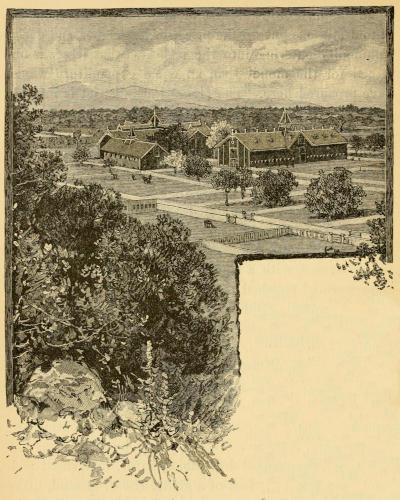
PALO ALTO.
From the time of foaling the colts are gently handled, and made as familiar with the touch of harness as with that of human hands. As a consequence they are tame, gentle, and even affectionate, and never need formal breaking. The effect of the system of training has been apparent in some notable records of speed. On the Bay District Association track, at San Francisco, in 1880, the two-year-old Fred Crocker lowered the record for a one-mile trot to 2′ 25¼″. Last year Bonita, a two-year-old filly, cut it down to 2′ 24½″. At the same trotting exhibition Wildflower, another two-year-old, made the mile in 2′ 21″; and Hinda Rose, a yearling filly, added to the fame of the farm by cutting down the yearling record to 2′ 36½″.
The interiors of these fine villas are, as a rule, better than the exteriors. The Mills house, at Millbrae, residence of a banking and railway magnate, now of New York, is a notable collection of portières and Oriental rugs, and bed-chambers done in the finest woods, with a picture-gallery of works of Gérôme, Detaille, and Bouguereau, while from all the windows are vistas of fan-palms, flower-beds, greensward, and bronzes.
Ralston’s old house, at Belmont, now the property of Senator Sharon, is of those of the greatest interest, through interest in the remarkable man who built it. Starting from humble origin, he rose to be a great capitalist and the promoter of brilliant schemes of improvement, both public and private. He conducted to success a hundred projects which in other hands would have been folly, and arrived thus at such an unbounded confidence in his star that he thought he could not fail. He was entangled at last, however, in schemes beyond his control. Strong and athletic, and in the prime of life, he went down to “Harry Meigs’s” wharf, in San Francisco—almost the very point from which his great prototype sailed away to Peru—and swam out half a mile into the bay. It was for refreshment in his troubles, as some say, but, as the general opinion is, with the purpose of suicide. At any rate he was never seen alive again.
The house that was his is notched into the hill-side, in a rolling country, much pleasanter than the plain at Menlo Park. A pretty gorge behind it is dammed to furnish a water-supply. There are gas-works, a bowling-alley, and an elaborate Turkish bath among the out-buildings, and a grange-like barn of solid stone, ivy-grown, which cost $80,000. The immense house is wood, white, in the usual fashion, and, with its numerous stories and windows, is not unlike a large country hotel. A peculiar arrangement and great spaciousness give it a palatial air within. The principal rooms open into one another by glass partitions, which can be rolled away, so that in large gatherings there need be no crowding through door-ways. There is an arcade above, around a grand staircase, with tribunes projecting, in which young women in colors, at an evening party, for instance, would look particularly houri-like. What in another house would be the ordinary veranda is here a delightful promenade, glazed in, and provided with easy furniture and a parquetry floor. Behind a row of such main apartments as drawing-room and library comes a parallel row, of which one is a great ball-room, entirely faced with mirrors. Pianos, mantels, and stair-posts are of California laurel—a new industry encouraged by the owner among many others.
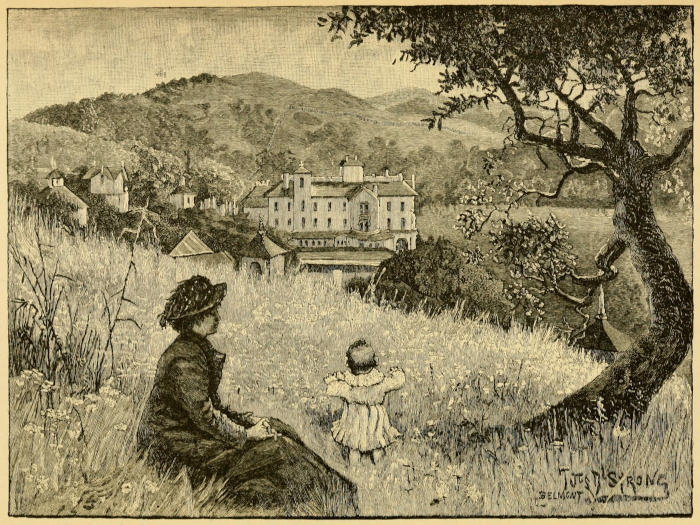
RALSTON’S COUNTRY HOUSE.
We drove from Belmont back through a succession of cup-like dells in the lower mountains, a number of them dammed to form pretty lakes, the sources of supply for the Spring Valley Water Company—a corporation of great prominence at San Francisco. The slopes at first were tawny with grain stubble; then scattered with the thick bush known as chaparral; then bare. We passed an occasional lonely farm known as a “milk ranch,” or “chicken ranch.” There are no farms in California; no matter how small the tract is, it is always a ranch.
In the strong, warm sunshine chance objects on the bare slopes cast intense, purplish shadows. That of a distant tree is as dark as if a pit had been dug under it. That of a bird, flying low, is followed as distinctly as the bird itself. You are reconciled at last to the brown tone. It is like Algeria. White stands out in brilliant relief against it. One would rather like it to be a different white, however, than that of the little wooden houses. The falconers of Fromentin might career or the rival Arab chiefs of Pasini hold conferences among such hills.
XXV. THE VINTAGE SEASON, AND MONTEREY.
I.
It was the pleasant vintage season at San José. Santa Clara County, of which San José is the capital, boasts of a number of acres of grape-vines under cultivation (over eleven thousand) second only to Sonoma County. Napa, however, to the north, and Los Angeles, to the south, greatly surpass it in gallons of wine and brandy produced.
I visited, among others, the Le Franc vineyard, which dates from 1851, and is the pioneer in making wine-growing a regular industry. Here are about a hundred and seventy-five thousand vines, set out a thousand, perhaps, to the acre. The large, cheerful farm buildings are upon a gentle rise of ground above the area of vines, which is nearly level. An Alsacian foreman showed us through the wine-cellars. A servant-maid bustling about the yard was a thorough French peasant, only lacking the wooden shoes. The long tables, set for the forty hands employed in the vintage-time, were spread with viands in the French fashion. Scarcely a word of English was spoken.
At other places the surroundings are as exclusively Italian or Portuguese. One feels very much abroad in such scenes on American soil. The foreigners from Southern Europe take naturally to wine-making and go into it, from the few hundred gallons of red wine made by the Portuguese and Italian laborers for their own families, to the manufacture of an American champagne on a large scale by the Hungarian, Arpad Haraszthy, at San Francisco. The Americans, who have not acquired the habit of looking upon wine as a necessity in the family, are not yet, as a rule, very active in its production.
A certain romantic interest attaches to this ancient industry. The great tuns in the wine-cellars and all the processes were very clean. It was re-assuring to see the pure juice of the grape poured out in such floods, and to feel that here was no need—founded on scarcity, at least—for adulteration.
Teeming loads of the purple fruit were driven up, and across a weighing scale. The contents are lifted to an upper story, put into a hopper, where the stems come off, and the grapes fall through to a crusher. They are lightly crushed at first. It is something of a discovery that the earliest product of grapes of every hue is white wine. The red wine gets its hue from the coloring matter in the skins, which are utilized in a subsequent ruder squeezing.
I shall not enter upon all the various processes—the racking off, clarifying, and the like—though, so much in the company of those who spoke with authority and were continually holding up little glasses to the light with a gusto, like figures in popular chromos, I consider myself to yield in knowledge of such abstruse matters to none. Immense upright casks, containing a warm, audibly fermenting mass, and others lying down, neatly varnished, with concave ends, are the most salient features in the dimly lighted wine-cellars.
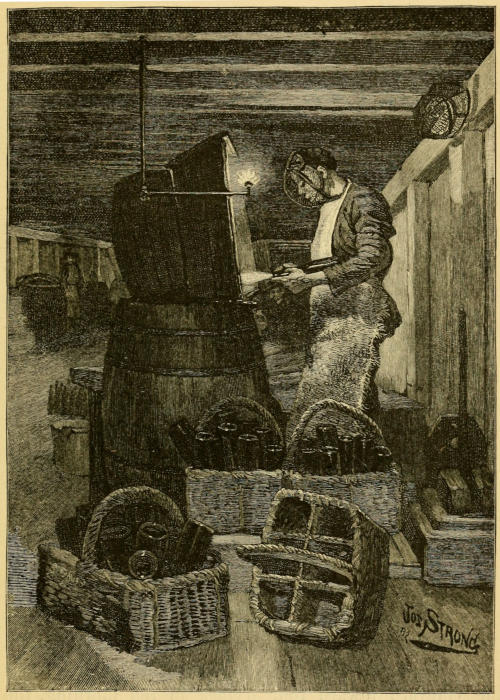
BOTTLING CHAMPAGNE AT SAN FRANCISCO.
They are not cellars, properly so called, either, since they are wholly above-ground. The casks rest on wooden sills upheld by short brick posts. In the cellars of General Naglee, a successful maker of brandy on a large scale, the cobwebs have been allowed to increase and hang like tattered banners. Through these the light penetrates dimly from above, or with a white glare from a latticed window, upon which the patterns of vine-leaves without are defined. The buildings are brown, gray, and vine-clad, with quaint, Dutch-pavilion-looking roofs, and dove-cotes attached. A lofty water-tank, with a wind-mill—a feature of every California rural homestead—here is more tower-like than usual.
Round about extend long avenues of eucalyptus, pine, tamarind, with its black, dry pods; the pepper-tree, with its scarlet berries; large clumps of the nopal cactus, and an occasional maguey, or century-plant. All is glowing now with the tints of autumn. Poplar and cottonwood are yellow. The peach and almond, the Lawton blackberry, and the vineyards themselves, touched by frost, supply the scarlet and crimson. The country seems bathed in a fixed sunshine, or in hues of its own wines.
The vines, themselves short and stout, and needing no support, yield each an incredible number of purple clusters, all growing from the top. They quaintly suggest the uncouth little men of Hendrik Hudson who stagger up the mountain, in “Rip Van Winkle,” with kegs of spirits on their shoulders.
No especial attention is given to the frosts now, but those of the early spring are the object of many precautions. The most effectual is to kindle smudge-fires about the vineyard toward four o’clock in the morning, the smoke of which envelops it and keeps it in a warmer atmosphere of its own till the sun be well risen.
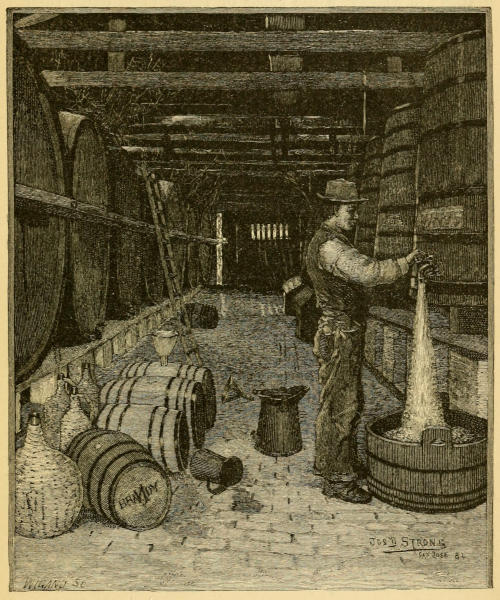
A BRANDY CELLAR, SAN JOSÉ.
Three to four tons of grapes to the acre are counted upon; while farther south, where irrigation is used, they expect from eight to twelve. But it is claimed, in the standing controversy on the subject, that the irrigated grapes are watery, while those of lesser yield excel them in quality. The best results, we were told, are got from such vines as the Mataro, Carignane, and Grenache, imported cuttings from the French slope of the Pyrenees. There were at Le Franc’s not less than sixty varieties, under probation, many of which will, no doubt, give an excellent account of themselves. They are assembled from Greece, Italy, Palestine, and the Canary Islands, so that we have all the chances of the development of something suited to our peculiar conditions.
II.
I left San José to drive along the dry, shallow bed of the Guadalupe River to the Guadalupe Quicksilver Mine, a more remote and less visited companion of well-known New Almaden. The mine is in a lovely little vale, with a settlement of Mexican and Chinese boarding-houses clustered around it. Some bold ledges of rock jut out above, and a superintendent’s house surrounded by flowers hangs upon the hill-side. A weird-looking flume conveys the sulphurous acid from the calcining furnaces to a hill-top, upon which every trace of vegetation has been blasted by its poisonous exhalations.
Then I made a little tour by rail southward through the immense “Murphy” and “Miller and Lux” ranches, comprising a grain country as flat as a floor.
We turned west through the fertile little Pajaro Valley, the emporium of which for produce, and fine redwood lumber, cut in great quantities on the adjoining Santa Cruz Mountains, is the thriving town of Watsonville. We ran along a rugged coast, past wooded gorges and white sea-side cottages, at Aptos and Soquel, to the much-frequented resort of Santa Cruz. Santa Cruz has bold variations of level, the usual commonplace buildings, a noble drive along cliffs eaten into a hundred fantastic shapes by the waves, and shops for the sale of shells, and its summer boarders, who become, with change of seasons, winter boarders in turn. Thence finally to the long-anticipated Monterey.
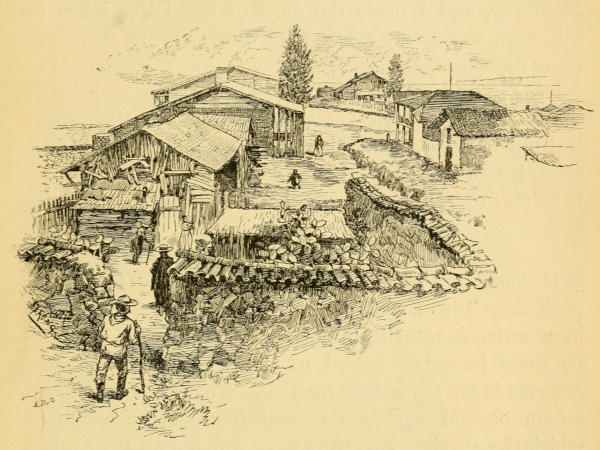
A BIT OF OLD MONTEREY.
Here at last was something to commend from the point of view of the picturesque without reservation. Monterey has a population which still, in considerable part, speaks Spanish only. It retains the impress of the Spanish domination, and little else. When you are told in your own country that somebody does not speak English, you naturally infer that it is brokenly, or only a little. But at Monterey it means absolutely not a word. There are Spanish signs on the shops, and even Spanish advertisements, as, for instance, the Wheeler & Wilson Maquinas á Coser, on the fences.
My Mexican experience was a liberal education for Monterey, and I made the most of it. I was taken to call upon an ancient señorita, in whose history there was some romance.
“Las rosas son muy secas”—(“The roses are very dry”) she said, apologetically, as we entered her little garden, laid out in regular parallelograms, behind an adobe wall topped with red tiles. Large yellow and red roses were blowing to pieces in the wind before her long, low adobe house.
She was one of those who spoke no English. It seems as if there were some wilful perversity in it, after having been since 1846 a part of the most bustling State of the most active country in the world. It seems as if it must be some lingering hatred of the American. But the señorita is far too gentle for that. There is, perhaps, no reason beyond a general mental inertness by virtue of which the Mexican survivors have suffered all their other interests as well as this to go by the board.
The señorita is a little, thin old lady of fifty. Her romance was with an American officer, it is said, thirty years ago, and she has never since married, but has withered, like her roses, at Monterey.
As seen from a distance, scattered loosely and white on the forest-crested slope of the fine bay, the little city, which has now perhaps two thousand inhabitants, does not show its unlikeness to other places. But when entered it consists almost exclusively of whitewashed adobe houses, and the straggling, mud-colored walls of enclosures, for animals, known as “corrals.” Many of them are vacant. At frequent intervals is encountered too some abandoned old adobe barracks, or government house, or military prison of historic fame, with its whitewash gone, holes in its walls, and bits of broken grating and balcony hanging aimlessly on, waiting only the first opportunity to let go.
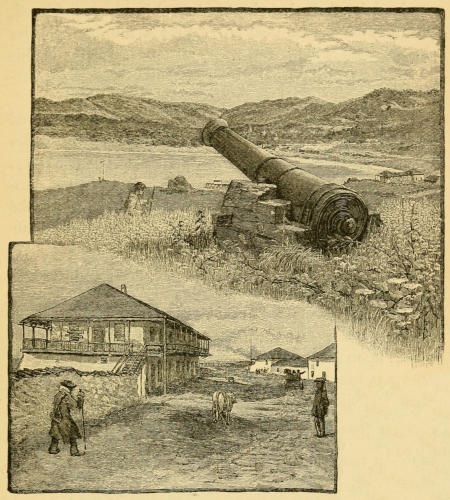
LOOKOUT STATION.
The travellers of my youth had a fashion of talking glibly of adobe, without explaining what adobe was. Let me not be guilty of the same error. Adobe is bricks made of about twice the usual size, and dried in the sun instead of being baked. Walls are made of great thickness, in order that, though outside and inside crumble off, there may be a good deal left. Like a number of other things, it stands very well while not assailed; and in this climate it is rarely assailed by violent extremes of temperature.
The typical adobe house of the best class is stuccoed and whitewashed. It is large on the ground, two stories in height, and has verandas. Again, it is of but one story, with an interior court-yard. It has green doors and shutters, and green, turned posts, in what we now call the “Queen Anne style,” and it is comfortable and home-like to look at.
One of them contains the first piano ever introduced into California, and the owners are people who made haste to sell out their all at San Francisco and invest it here, in order to reap the greater prosperity which was thought to be waiting upon Monterey. Two old iron guns stand planted as posts at the corners of the dwelling. In front of others are some walks neatly made of the vertebræ of whales, taken by the Monterey Whaling Company. The company is a band of hardy, weather-beaten men, chiefly Portuguese, of the Azores, who have a lookout station on the hill by the ruined fort, and a barracks lower down. They pursue their avocation from the shore in boats, with plenty of adventure and no small profit.
Monterey, which is now not even a county seat, was the Spanish capital of the province from the time it was thought necessary to have a capital. The missionary father, Junipero Serra, came here from Mexico in the year 1770. It was next a Mexican capital under eleven successive governors. Then it became the American capital, the first port of entry, the scene of the first Constitutional Convention of the State, and an outfitting point for the southern mines. Money in those early days was so plenty, I have heard tell, that store-keepers hardly stopped to count it, but threw it under the counter in bushelfuls.
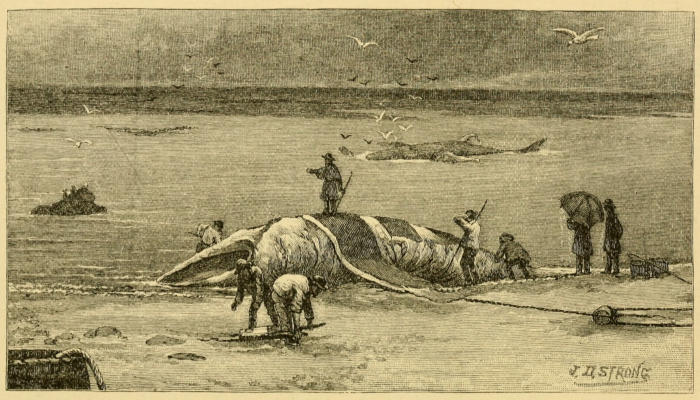
CUTTING UP THE WHALE.
A secret belief in the ultimate revival of Monterey seems always to survive in certain quarters, like that in the reappearance of Barbarossa from the Kylfhäuser Berg, or the restoration of the Jews. Breakwaters have been ambitiously talked of, and it is said that the bay could be made a harbor and shipping-point and the rival of San Francisco.
The only step toward such revival as yet is a fine hotel, built by the Southern Pacific railroad, which may make it, instead of Santa Cruz, across the Bay, the leading sea-side resort. Though not so grandiose a direction as some others, this is really the one in which the peculiar conditions of the old capital are most likely to tell. The summer boarder can get a tangible pleasure out of its historic remains and traditions of greatness, though they be good for nothing else. The Hotel del Monte is a beautiful edifice, not surpassed by that of any American watering-place, and unequalled in the charming groves of live-oak and pine and profusion of cultivated flowers by which it is surrounded, and the air of comfort combined with its elegant arrangements.
This is the way with our friends of the Pacific coast. If they do not always stop to follow Eastern ideas and patterns, when they really attempt something in the same line, they are as likely as not to do it a great deal better.
The climate at Monterey, according to statistical tables, is remarkably even. The mean temperature is 52° in January and 58° in July. This strikes one as rather cool for bathing, but the mode is to bathe in the tanks of a large bath-house, to which sea-water is introduced, artificially warmed, instead of in the sea itself.
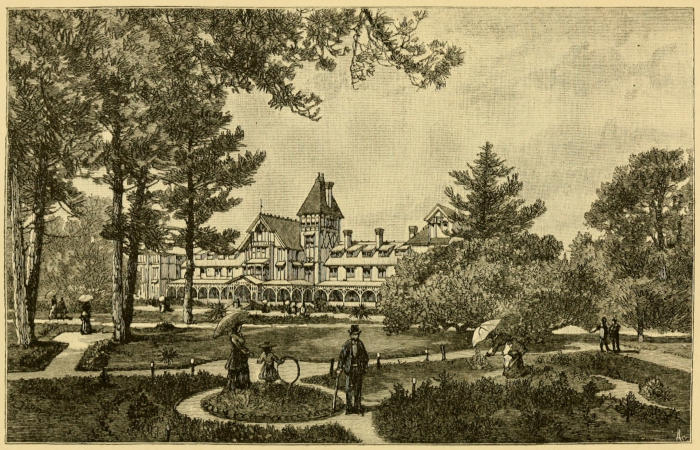
THE HOTEL DEL MONTE, MONTEREY.
In other respects the place seems nearly as desirable at one time of the year as another. The quaint town is always there; and the wild rocks, with their gossiping gulls and pelicans; and the drives through the extensive forests. There are varieties of pine and cypress—the latter like the Italian stone-pine—peculiar to Monterey. The more venerable trees, hoary with age and hanging moss, are contorted into all the fantastic shapes of Doré’s “Inferno.” They grow by preference on the most savage points of rock, and the wild breakers toss handfuls of spray up to them high in the air, in amity and greeting.
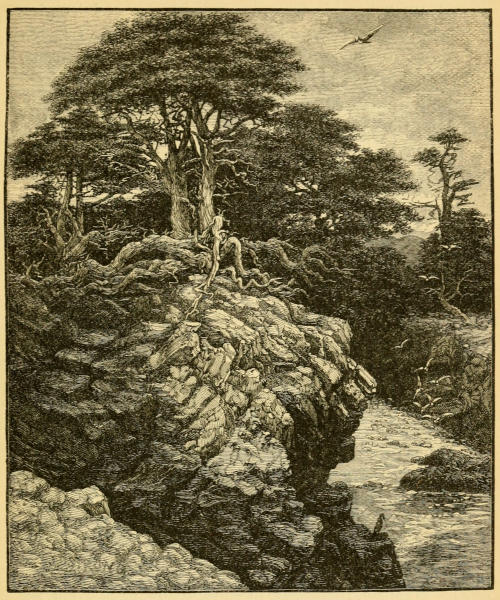
CLIFFS AND FOREST AT MONTEREY.
Along the beach on this far-away point of the Pacific Ocean we find a Chinese fishing settlement. Veritable Celestials, without a word of English among them, have pasted the usual crimson papers of hieroglyphics on shanty residences. They burn tapers before their gods on the quay, and fish for a living in just such junks and small boats as may be seen at Hong-Kong and Canton. They prepare avallonia meat and avallonia shells for their home market. One had rather thought of the Chinese element as confined to San Francisco alone, but it is a feature of quaint interest throughout all of Southern California.