Part 1 — OLD MEXICO. (continued 4)
Reading edition
We had a kind of picnic one day to the Barrio Nuevo, a very pretty coffee-and-milk-like cascade of the Rio Orizaba. Boys ran out from thatched cottages in the edge of town to pick flowers and offer them to the señoritas, expecting to be rewarded, of course, with a little consideration. There is another cascade, even prettier—the Rincon Grande.
The next day we went to the sugar ingenio of Jalapilla. A fine wide avenue of trees stretched up to it. The locusts were singing in them. The grass and trees were exquisitely green. The snow-peak of Orizaba, hidden at the town itself, here rises above intervening hills. There were arcades, and monumental gateways, and a massive aqueduct on arches, which brings the water from a fine torrent. In the sunless green archways of the old aqueduct the señoritas found with rapture specimens of rare and delicate ferns growing. Ox-wains brought the cane to the mills. We watched it through the processes of crushing in the machinery, and tasted the pleasant sap when first expressed, and later at some of the stages of boiling down. Aguardiente is also made on a large scale. The peasants along the road sell you a draught of it in its unfermented state, with tamales. The residence attached is a large, two-story white house, with a high iron gate between white posts. It was loaned to Maximilian as a country retreat by the conservative owners at one time. At present it is shabby and unfurnished, but a single room being occupied by the proprietor, who has the rough-and-ready tastes of a ranchero, and little taste for display.
III.
At one of the theatres at this time was playing, by a Zarazuela, or “variety” company, “La Torre de Neslo ó Margarita de Borgogno;” at the other, by a juvenile company, “La Fille de Madame Angot.”
Whoever would thoroughly enjoy Mexico must have the taste for old architecture. There is no end to it, and it is often the only resource. It is of that fantastic rococo into which the Renaissance fell, in the luxury and florid invention of its later stages; but even where least defensible, from the point of view of logic and fitness, it is redeemed now by its mouldering, its time-stains, and superposed layers of half-obliterated colors. Little can be said, except in this way, for the carvings and various detail, but the masses are invariably of a grand and noble simplicity. The material is generally rubble-stone and cement, and cannot be very expensive. The principal lines of the style are horizontal. The dome, semi-circular in shape, plays a great part in it. I have counted not less than eight, like those of St. Mark’s, at Venice, on a single church. The dome is built, if I mistake not, of rubble and cement also, on a centring of regular masonry, perhaps even of wood. It is a reminiscence of the Moors. These edifices were put up three hundred years ago, by builders in the flush of the Byzantine influence, which radiated from Granada, then lately conquered. I know of no school in which the niggling, petty, and expensive character of our own efforts in this line could be better corrected. Vamenos! Will not some of our leisurely young architects with a taste for the picturesque travel here, with their sketch-books, and bring us back plans and suggestions from this impressive work, for use among ourselves?
Some of the old churches take an added interest from their present fate. It would have been monotonous to have them all alike in full ceremonial, and now they are pathetic. I used to linger to hear the buglers practise in the cloistered church of Carmen, used as a barracks. It is stripped of everything, the pavement broken, the walls full of bullet-holes, and painted with the names of detachments, as 18º de Infanteria, 7º Compaña de Grenaderos, which have occupied it. In the smoke-stains, the damp, to which patches of gilding still adhere, and the vestiges of scaling fresco, dim, mysterious visions are made out. The bare chancel daïs, still surviving, gives to the interior the aspect of some noble throne-room. In our own country such a monument would be inestimably prized, and would become a pilgrimage-place from far and near; but here it is simply one of a great number.
In the little public plaza outside a few convicts were repairing the paths. A pair of them would bring some dirt, about an ordinary wheel-barrow full, on a stretcher, dump it in a leisurely way, and go back for more, all with plentiful deliberation. They might have been laborers, engaged by the city aldermen, on a New York boulevard. A couple of soldiers with muskets lounged on the stone benches to guard them as they worked. The punishment of the prisoners could hardly have been in what they did, but principally in the exposure—unless, indeed, they were taken from a different part of the country. I wondered if their friends came here sometimes and watched them; and what a pain it must have been for the sensitive to work thus, hedged round by an invulnerable restraint and infamy, in sight of the homes where they had lived and all the ordinary avocations of life in which they had engaged.
An important cotton-factory at Orizaba has a fine architectural gate-way, and a statue of the founder, Manuel Escandon (1807 to 1862), in the court, after the practice heretofore adverted to. Paper is also made here. A series of fines is prescribed, in printed rules, for the hands coming late in the morning and falling into other misdemeanors. The sum of these makes up a fund for charitable use among themselves. A savings-bank department is also conducted for the benefit of the operatives. To encourage savings an extra liberal interest is paid when the amount on deposit has reached fifty dollars. To avoid in part the interruption of the frequent church holidays, a dispensation had been obtained from the ecclesiastical authorities, allowing work to go on, on most of them, as usual.
IV.
From Orizaba the next stage was to Cordoba. Cordoba is in the full tropics, and there I first made acquaintance with the coffee culture, the leading industry of the place. The plant is less striking in aspect than I had expected. It is a bush, with small, dark, glossy leaves, its stem never over six or seven inches in diameter, even at an age of fifty years. It is twelve feet high at most, but usually topped and kept lower for greater convenience in harvesting the product. It bears a little axillary white flower, fragrant like jasmine, and the green berries at the same time. A coffee plantation has not the breadth of the platanaras, the fields of towering bananas; but it needs shade, and large oaks are left distributed through it which accomplish this purpose. If left to the sun wholly it yields large crops at first, then dies. The coffee plant should bear after the fourth or fifth year, and yield a half-pound yearly for fifty or sixty years. It should have cost, up to the time of beginning to bear, about twenty-five cents. This is supposing a high cultivation. By the more shiftless method commonly found in use here it costs but half as much, but, on the other hand, yields no more than three ounces on an average.
Some few Americans, and other foreigners, have established themselves at Cordoba, and lead a dreamy existence in the shade. At one time it was the scene of an extensive coffee-planting by ex-Confederate generals, but these attempts were not successful. I was fortunate enough to be conducted about by an old gentleman, of German birth, who had lived here forty years. He had the tastes of a naturalist and farmer, and the existence pleased him. He took in his hand a machete from the wall, and we set forth for a walk, with much improving discourse by the way, in the fields and plantations. The machete, a long half cleaver, half sword, opens you a path through a thicket, cuts you a coffee or an orange stick, lops an orchid from its high perch on the rugged tree-bark, or brings down a tall banana, and splits open its covering to serve as a protection to a budget of botanical specimens. Some small grandchildren of the house begged to accompany us. They had hardy, out-of-door habits, and ran by our sides with merry clamor, finding a hundred things to interest them along the way.
My genial guide had planted coffee himself. Much money has been lost at it, it seems, and it cannot be very profitable except under economical processes and an improved market. When transportation becomes cheaper we shall have introduced into the United States from Mexico also many choice fruits, notably the fine Manilla mango, not now known. The fruits of the country grow on you with experience. To my taste the juicy mango, which at its best combines something of the melon, pine-apple, peach, and pear, is the most delicious of them all. Other fruits are the chirimoya, guava, mamé, granadita (or pomegranate), zapote, chazapote, tuna, aguacate, and many more, the distinctive peculiarities of which I could not describe in a week.
The best soil for the coffee is that of virgin slopes, capable of being well manured. It should be manured once in two years. The planting takes place in the rainy season, and the principal harvest is in November and December. Women and children cut off the berries, which are then dried five or six weeks, and barked; or are barked earlier by a machine. The chief labor consists in destroying the weeds, which must be done from two to six times a year. The plants are set in squares, at a distance of about seven feet apart. The trees recommended for shade are the fresno, or ash, cedro (cedar), the huisache, aguacate, maxcatle, cajiniquil, and tepehuajé, the characteristics of which I could hardly explain, more than those of the fruits, except that they are generally dark and glossy-leaved, and many of them as large as our elms. There is a theory, too, in favor of shading by bananas, and plantations are found where the two grow together.
But a native proprietor with whom I talked objects to this. “The platano is a selfish and grasping plant,” he says, indignantly. “It draws twice and thrice its proportionate amount of nourishment from the soil. Is it not beaten down, too, in every storm? And the ravaging hedgehog comes in search of it, and, while he is about it, destroys the coffee as well. No, indeed, no combination of platano and coffee for me!”
The poor platano! However, it can stand abuse. How quickly it grows! Its great leaves, more or less tattered by friction, flap and rustle above your head like banners and sails as you walk about in the tropical plantation. It is called the “bread of the tropics.” An acre of land will produce enough of it to support fifty people, whereas an acre in wheat will support only two. If the tropics had had a good deal harder time in getting their bread, by-the-way, they would not have been in so down-trodden and slipshod a condition.
I will not say that we had the better coffee at our hotel for being in its own country. It is the old story of “shoemaker’s children” again, I suppose. On the contrary, I recollect it as especially poor. The hotel—possibly it has improved by this time—was wretchedly kept and served. They gave us half a dozen kinds of meat in succession, without ever a vegetable, in such a luxuriance of them. The waiters were sunk in apathy, the management even more so. They seem often to say to you, with an ill-concealed aversion, at a Mexican hotel, “If you will stay, if you will insist on bringing your traps in, we will do what we can for you, but we are not at all anxious for it.”
Pack-mules were kept in the court, and under a cloister at one side women and girls were stripping tobacco. Your room, at a provincial hotel, opens upon a gallery in which mocking-birds are hung in wooden cages—always one at least. It is the practice of the Mexican mocking-bird to sleep continuously throughout the day, so as to be in health and spirits for the exercise of the night. He begins at midnight, and continues his dulcet ingenuity of torture till daybreak. Naturalists have had much to say of the mocking-bird, comparing him to a whole forest full of songsters, and the like. It may be unwise to set up in opposition to so much praise, but there are times when a planing-mill in the vicinity, or a whole foundery full of trip-hammers, would be a blessing and relief in comparison.
Should the mocking-bird have injudiciously impaired his strength during the day, so as to allow of a brief respite, the interval is filled in by the shrill, quavering whistles of the street watchmen, who blow to each other every quarter of an hour during the night, to show that they are awake and vigilant.
You leave Cordoba at 4.30 in the morning; that is, if you go by the up-train. I was awakened an hour too soon at my hotel, which, having to call me, wanted it over as soon as possible. I had leisure while waiting to collect the views of one of these watchmen. He showed me the Remington rifle with which he was armed. He said that he went on duty at 7 P.M. and finished at 5.30 A.M., and received three and a half reals—forty-two cents—a day, which he did not think enough. There are no cabs at Cordoba. It is a tram-car, making a total of two trips a day, that takes you, bag and baggage, two dark miles or so to the station.
V.
But I did not leave before first visiting the Indian village of Amatlan. I do not insist that erudition of incalculable value has been brought to light in these travels, but they were a succession of excursions into the actual heart of things. I was pleased when I could find something unmodified by the innovations of railway travel, and witness the familiar, every-day life of the people. Perhaps we never thoroughly understand anybody until we learn his routine. A stimulus to what we usually neglect, and take as a matter of course, is aroused abroad. Law-making, education, buying and selling, eating and drinking, marriage, and the burial of the dead, all yield entertainment. The traveller who spreads before us only the outré and startling that he has seen may still leave us very much in the dark about where he has been. In Mexico, however, almost everything is outré.
To Amatlan and back is a comfortable day’s excursion. We found saddle-horses for hire, and a young Indian as a guide, and set off. My companion on this excursion was a commercial traveller, a sprightly young American of Spanish origin. Commercial traveller in machetes and other cutlery: such was his profession. The machetes were of American make. I have one hanging in my room at this writing which came from Water Street, in New York. This agent had taken his last order (having canvassed the little store-keepers in the plaza under my own view, as if they had been those of Kalamazoo, Aurora, or Freeport), and was awaiting the sailing of his steamer from Vera Cruz. Having nothing more to do, he entered into the examination of manners and customs for their own sake with a certain zest, though perhaps comprehending for the first time that such things could be worth anybody’s notice.
Amatlan is the richest Indian village in—well, one of the richest of Indian villages. Its plantations of pine-apples are the finest in the state of Vera Cruz, to which all this territory from Orizaba down belongs, Orizaba being its capital. The pines grow about sixteen inches in height, and should last ten years. They are set in narrow lines, and the general aspect of the field from a little distance is that of large sedge-grass. You will buy three of them sometimes for a tlaco, one cent and a half. We met natives driving donkey-loads of them to market. There were some fields of tobacco, of fine quality, in flower. The Peak of Orizaba is magnificently seen from all this district. It is lovelier and bolder than at first upon familiar acquaintance. Church, the painter, finds the preferable point of view farther up the railroad, using the wild gorges of Fortin as a foreground. The village proved to be composed chiefly of wooden and cane huts, shingled or thatched, and the population to be exclusively Indian. They do not wish any others to join them. They display everywhere the same clannish disposition. If persons of European origin who might come to remain could not be got rid of by churlishness, it is thought that severer means would be resorted to.
The Indian race, as a rule, is patient and untiring in certain minor directions. They make long, swift journeys, for instance, acting as beasts of burden or messengers, so that, seeing their performances, the words of Buffon come forcibly to mind: “The civilized man knows not half his powers.” But in the greater concerns of life, those requiring forethought for a permanent future, they are very improvident. Perhaps, however, those of Amatlan differ from others, or perhaps the general reputation may not be wholly deserved, for the Cordobans tell you that Amatlan is even richer than Cordoba.
There are said to be a number of native residents worth from $50,000 to $80,000 each. They buy land, and bury their surplus cash in the ground. It may well enough be that the lack of savings-banks, or any more secure place of deposit for money than the ground, has something to do with the improvidence complained of. The alcalde, the chief of them, was estimated as worth a million, though this I should very much doubt. He had no large ways of using his wealth, but was said to incline to avarice and delight in simply piling it up. There was a project at one time to build a tram-road hence to Cordoba, the capital to be supplied in part by the Indians, but it fell through. Some of the well-to-do send their sons to good schools, and even to Mexico, to take the degree of licentiate. These favored scions, on their return, must put on the usual dress, and live in no way differently from the rest. The daughters, on the other hand, are never educated, but set, without exception, to rolling tortillas and the other domestic drudgery.
VI.
We dined at an open-air shanty posada, with dogs and pigs running freely about under our feet. Coffee, without milk, sugar, and pine-apples were all supplied by the fields about. Some few spectators were interested, but not very much, in a slight sketch I made of their buildings and costume. My commercial traveller, by way of arousing greater enthusiasm in this, represented that it was to be “put in a machine” afterward, and showed, by a dexterous chuckle and twist of the thumb, how it would then be so improved that you would never know it. But even this stirred them only indifferently.
We visited the alcalde in his quarters. He was bristly-haired, clad in cotton shirt and drawers, and bare-legged, like the rest. Official business for the day was over, but he showed us the cell in which on occasion he locked up evil-doers. He was said to administer justice impartially to the rich and poor alike, and with a natural good-sense. But for occasional perversions of justice effected by a Spanish secretary he was obliged to employ, he himself being illiterate, it was thought that his court averaged well with the more pretentious tribunals of the country.
We rode back by a different way, through a large, cool wood. It abounded in interesting orchids, and there was an undergrowth of coffee run wild, the glossy green of its leaves as shining as if just wet by rain. There was not that excessive tangle and luxuriance supposed to be characteristic of the tropics; our own woods are quite as rampant. All that is found, you learn, in Tehuantepec, for instance, and Central America. There tree-growths seize upon a dwelling, crunch its bones, as it were, and bear up part of the walls into the air; and it is vegetable more than animal life that is feared. We forded three pretty brooks, and came to an upland where cows were pasturing, and the steeples of Cordoba were again in sight. Our young guide lassoed a cow, led her to a shed where tobacco was drying, and offered us the refreshment of a draught of new milk.
Being asked if this were quite regular and correct, he answered that the cows were there at pasturage in charge of his uncle. I trust that this was so.
XVII. PUEBLA, CHOLULA, TLAXCALA.
I.
You turn off from the junction of Apizaco, on the Vera Cruz railway, to go to the large, fine city of Puebla. It is the capital of the state of the same name, and has a population of about seventy-seven thousand. Many prosperous fabricas (factories) are seen along the fertile valley of approach; then the forts, attacked and defended on the great Cinco de Mayo, appear on the hills, looking down, like Mont Valerien and Charenton above Paris.
Certainly everything out of Mexico is not Cuatitlan. Puebla is very clean, well paved, and well drained. The streets are not too wide, as many of them are at the capital. I thought our hotel, De Diligencias, which was very well kept, by a Frenchman, much better than the Iturbide. It had been a palace in its day, and had traces yet of armorial sculptures. Our rooms opened upon a wide upper colonnade, where the table was spread. It was full of flowers, which shut out whatever might have been disagreeable to the eye below. I am bound to admit that the remorseless mocking-bird sang all night among them. I have mentioned heretofore the tiled front of a shop, “La Ciudad de Mexico.” A picturesque mosaic-work in tiles of earthen-ware and china upon a ground of blood-red stone abounds. Sometimes it is a diagonal pattern, covering a whole surface; again only a broad wainscot or frieze. Plaques, representing saints, which you take at first for hand-bills, are let into walls. These tiles are made at Puebla, where there are as many as ten fabricas of them, the best in the country. I visited one of these, found the manufacture cheap, and brought away some specimens. The workmanship is rude and hasty, but the effect artistic and adapted to its purpose. The most liberal example of their use, and one of the most charming interiors I have ever seen, was that of what is now the Casa de Dementes, or lunatic asylum for men, of the state of Puebla. It was formerly a convent of the nuns of Santa Rosa, and was decorated after their taste. Entrance, vestibule, stairs, central court, and cloisters, with fountain in the centre; balustrade, benches, tanks and bath-tubs, kitchen furnace, and numberless little garden courts, are all encrusted with quaint ceramics. It is like walking about in some magnified piece of jewelry. The blue-and-yellow fountain in its court is as Moorish as anything in Morocco.
There are forty-two patients in this institution, with an attendant appointed to each ten. The rich among them pay $16 a month, the rest nothing. Another one, San Roque, contains thirty-two women, also maintained by the state. The general hospital, of San Pedro, another large ex-convent, with a nice garden, was clean, cool, and well ordered; and—curious feature to note—departments for allopath and homœopath arranged impartially side by side. These governments take, officially, no sides with either, but give them both a showing.
The Cathedral at Puebla is equal in magnificence to that at Mexico. There is the usual Zocalo, full of charming plants, before it. The large theatre, “De Guerrero,” entered by a passage from the portales, had but a scant audience on the evening of our attendance, but was itself worthy of inspection. It had four tiers of boxes and a pit; the decoration was in white and gold, upon a ground of blue-and-white wall-paper, the whole of a chaste and elegant effect. The peasant costumes of women in each of the provinces vary in colors and material, though the same general shapes are preserved. At Cordoba, white and striped cotton stuffs were in order; at Mexico, Egyptian-looking blue-and-black woollen goods. Those in all this part of the country I thought particularly pleasing; and the great market and gay Parian, or bazaar, where they are principally displayed, were not soon exhausted as a spectacle. The men are usually bare-legged, and in white cotton. In the warm part of the day they carry their bright-colored serapes folded over one shoulder, and when it is cooler put them on, by simply inserting their heads through the slit.
Now comes by a woman in white, with a red cap and girdle; now two girls of fourteen, all in white, hurrying swiftly along under heavy burdens. Here are women in embroidered jackets, others in chemises, with profuse bands of colored beads, or rebosos of rayed stuff, like the Algerian burnous. Skirts are of white blanket material, with borders of blue, or blue with white, or yellow. The principal garment is a mere skirt of uncut goods, wrapped around the hips and kept in place by a bright girdle. Above this is whatever fantastic waist one pleases, or a garment with an opening for the head, after the fashion of the serape. To all this is added a profusion of necklaces of large beads, amber, blue, and green, and large silver ear-rings, or others of glass, in the Mexican national colors, green, white, and red. There is a universal carrying of burdens. The men accommodate theirs in a large wooden cage divided into compartments. The women tie over their backs budgets done up in a rug of coarse maguey fibre. Often they carry a child or an earthen jar in it; or, when full, pile a large green or red water-jar on the top.
Affording so abundant material for the artist, they were excessively suspicious of any attempt to turn it to account. There were traditions among them that bad luck would be encountered should they allow pictures to be taken. It was to take away something from themselves, and they would be left incomplete—probably to waste and die. Nor could their costumes be bought from them except with great difficulty. Much as still remains, there has been a great change, and disappearance, since the close of Maximilian’s empire, of local peculiarities in dress. There has been a disappearance, too, with the advent of machinery and imported notions, of many pretty hand-made articles that formerly adorned the markets. Among these were carvings in charcoal, once of a peculiar excellence. Of those that remain still of great interest are life-like puppets, in wax and wood, of figures of the country, costumed after their several types.
On the evening of May 19th, as we sat at dinner in the hotel corridor, down came the rain in the court. In a few moments a row of long gargoyles were spouting streams which were white against the blackness, and crossed one another like a set display. “Va! for the rainy season!” said the host. It usually begins by the 15th. “Voilà! ten months past in which we have had scarcely a drop!”
As almost any desired climate can be had by varying more or less the altitude, the rainy season is of variable date in different parts of the country. At Mexico it is very much later. I did not find it, either here or elsewhere, so incommoding as might be fancied. It rains principally at night, and the succeeding day is bright and clear. In Mexico, as in California, the rainy season means that in which rain falls about as with us, while the dry season is that in which there is none at all.
II.
Have any forgotten the tragic advent, and preliminary agitations, of the entry of Cortez into the sacred city of Cholula? He assembled the caciques and notables in the great square, and at a given signal, turned his arms upon them and slew them, to the number of three thousand. He had discovered an artful plot among them for the destruction of his army, and it was his aim in this way to strike such a terror into the country that he should have done with such things once for all. The god worshipped at Cholula was a far milder one than the bloody war god at Mexico—the peaceful Quetzalcoatl, God of the Air. He instructed the people in agriculture and the arts. His reign was a golden age. Cotton grew already tinted with gorgeous dyes, and a single ear of maize was as much as a man could carry. To his honor the largest of all the teocallis and temples was erected. He was represented with painted shield, jewelled sceptre, and plumes of fire. Could Cortez have waited till now (such are the changes of time) he might have gone into Cholula from Puebla, to the foot of this very pyramid, in a beautiful horse-car. A tramway, ultimately to be extended, and operated by steam, reached to this point, a distance of six miles, and our conveyance was a horse-car with a glass front (New York built) which I have never seen equalled elsewhere. The driver of it was a Tennessee negro, who had married an Indian maid and settled, much respected, in the country. He had formerly been body-servant of a Mexican general, had travelled with him in the United States and Europe, and picked up several languages. He called upon us afterward at our hotel, to politely inquire our impressions of his tramway.
The principal features of the trip were exquisite views of Popocatepetl and Ixtacihuatl across yellow grain-fields; a dilapidated convent turned to an iron foundery; an old aqueduct crossing the plain; a Spanish bridge, sculptured with armorial bearings, across the river Atoyac; and a fine grist-mill; and farther on a cotton-mill, turned by the water-power of the same river.
There has been a controversy as to whether the great mound was natural or artificial in origin. I do not see how there can be doubt about it now, for where numerous deep cuts have been made in it, for roads or cultivation, the artificial structure of adobe bricks is plainly visible. Such a place as it is to lie upon at ease and dream and go back to the traditions of the past! You may cast yourself down under large trees growing on the now ragged slopes, or by the pilgrimage chapel on the crest, where the God of the Air once reared his grotesque bulk. There is a sculptured cross, dated 1666, at the edge of the terrace, and rose-bushes grow out of the pavement. I know of no prospect of fertile hill and dale, scattered with quaint villages, in any country that surpasses it. An American was there that day with the purpose of buying a hacienda, if he could find one suitable, and I for one thought there were many plans much less sensible.
Cholula had four hundred towers in its pagan times, and it may have had round about it almost as many spires when the Christian domination succeeded. Let me recite the names of a few of the villages seen from the top of the great pyramid, all with their churches, by twos and threes, or more: San Juan; San Andres; Santiago; Chicotengo; La Santissima; La Soledad; San Rafael; San Pablo Mexicalcingo; San Diego; La Madalena; Santa Marta; Santa Maria; San Isidoro; San Juan Calvario; San Juan Tlanutla; San Mateo; San Miguelito (Little Saint Michael); Jesus; San Sebastian.
One of the old churches lying deserted in the fields might be purchased, no doubt, and utilized for the basis of a picturesque manor-house. Suppose we should take yonder one, for instance, down by the Haciendita de Cruce Vivo—the Little Hacienda of the Living Cross? A cloud is just now passing over, marking the place with a dark patch. A brook is leaping white through the meadow, trees stretch back from the walls, and the rest lying in strong light is divided by patches of an exquisite cultivation with the regularity of market-gardens.
We dined, at Cholula, at the clean Fonda de la Reforma, in a large, brick-floored room, invaded by flowers from a court-yard garden. No people can fashion such charming homes without excellent traits; so much is positive beyond dispute. We were admitted, I think, to the residence portion of the house, the owner of which was a doctor, and we examined, while waiting for our repast, a lot of his antiquated medical books, some dating from 1700.
The plaza is as large as at Mexico, but grass-grown—for the place is of but modest pretensions now—and lonely, except on market-day, when the scene is as gay and the costumes even prettier than at Puebla itself. In the centre is a Zocalo; at one side a vast array of battlemented churches. That of the Capilla Real, consisting of three in one, is now decayed and abandoned. On the other is a fine colonnade devoted to the Ayuntamienta, or town council, with the jail. What a pity it is that we have so scant accounts left us of the life of Mexico when all this feudal magnificence was in full blast!
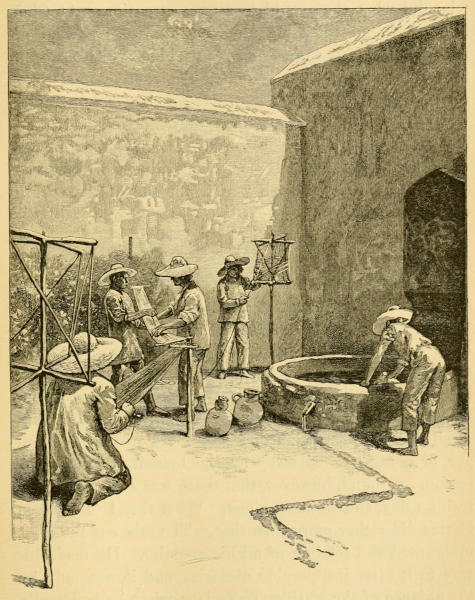
PRISONERS WEAVING SASHES AT CHOLULA.
I cannot say just why I visited so many prisons. Perhaps because they were always under the eye, adjoining the public offices, and the prisoners were a cheerful lot, who did what they could to attract attention. At Cholula we found them weaving, on a primitive kind of hand-loom, bright sashes of red and blue, which are sold in part for their own benefit. Their accommodations compared favorably with the barracks along-side. When we asked questions about them they stopped work and listened attentively. The guards, I fancy, thought we were trying to identify some persons who had robbed us—not conceiving of such a visit for the pure pleasure of it.
III.
When I inquired the way to Tlaxcala there was such an ignorance on the subject at my hotel, at Puebla, that it almost seemed as if I was the first person who could ever have been there. A luxurious Englishman abandoned me at this part of the expedition, claiming that nobody knew whether there were conveyances from the junction, whether there were even inns. It seemed to him a case of sitting on a Tlaxcalan door-step and perishing of hunger, or being washed away by the torrents of the rainy season. I found, however, that there was a choice of two trains a day, and went on alone. What then? I suppose Cortez did rather more than that. Tlaxcala was the most undaunted and terrible of all his enemies. He made his way to it after insuperable obstacles, and it was only by the alliance of the warlike Tlaxcalans, when he had finally won them over to his cause, that he effected the conquest of Mexico.
The recollection had involuntarily given me rather dark and depressing ideas of Tlaxcala, as a place of gloomy forests and gorges suited for martial resistance. Who that has not seen it, I wonder, has the proper conception of Tlaxcala?
IV.
It is not gloomy; there are no forests; the country is open and rolling; and the name “Tlaxcala,” it now appears, is fertility, the “Land of Bread.” I left at 11 A.M., and arrived at the village of Santa Ana, on the railroad to Apizaco, in a couple of hours. After a time a conveyance was to be had, in the shape of a dilapidated hack drawn by three horses, in the lead, and two mules. This was run as a stage-line to Tlaxcala; and in an hour more, largely of floundering over ruts and following the beds of swollen brooks—for nobody ever thinks of mending a road in Mexico—we were there. We met, on the way, the carriage of the state Governor, an ancient coupé, improved by the addition of a boot, and drawn by two horses and two mules. I was deposited on the sidewalk at the upper side of a plaza, and scrutinized keenly when there by the shop-keepers of the surrounding arcades and loungers on comfortable stone benches.
Tlaxcalan allies, in the shape of a small boy and a larger assistant, seized upon my satchel, and we set out for a personal inspection of such houses of entertainment as were to be heard of. The Posada of Genius was altogether too wretched and shabby, as is apt to be the way with genius. The Meson of the—I have forgotten its name—was too full to offer accommodation, and had a morose landlord, who seemed to rejoice in the fact. I came at last to a house where simply chambers were to be let. It was highly commended by my smaller Tlaxcalan ally, a very rapid-talking small boy, with the air of one much in the habit of dodging missiles.
“It will be two reals” (twenty-five cents) “the night, as you see it,” said the proprietor, waving a hand in an interior bare of furniture.
“Ah! two reals the night!”
“But perhaps the gentleman would desire also a bed, a wash-stand, and a looking-glass?”
“Yes, let us say a bed, wash-stand, and looking-glass.”
“Then it will be four reals the night.”
The larger Tlaxcalan ally, who had had nothing to do, established a claim for services by offering praise of each successive article of furniture as it was brought in, as, “Muy buena cama, señor!” “Muy bonito espejo!”—“A very fine bed, señor!” “A very charming mirror, señor!”—and the like.
V.
Now, all this is all exactly as it happened, and one should hardly be compelled to spoil a good story by adding to it. Yet this appearance of amusing stupidity is dissipated, after all, by remembering the methods of travel in the country. Many, or most, journeys are made on horseback, and the guest is likely to want only a room where he can lock up his saddle and saddle-bags and sleep on his own blankets, or, if luxurious, on a light cot, carried with other baggage on a pack-mule. This is all the accommodation provided at the general run of the mesones.
At the Fonda y Cafe de la Sociedad I supped, by the light of two candles, with a gentleman in long riding-boots, who had a paper-mill in the neighborhood. He told me that he had learned the business at Philadelphia. He was of a friendly disposition, and declared that I was to consider him henceforth my correspondent, so far as I might have need of one, on all matters, commercial and otherwise, at Tlaxcala. And to that extent I may say I do so consider him to this day.
My room had, first, a pair of glass doors, then a pair of heavy wooden ones, and opened on a damp little court, in which the rain was falling. There were no windows nor transom, positively no other opening than a couple of diminutive holes in the wooden door, like
“The fiery eyes of Pauguk glaring at him through the darkness,”
as one awoke to them in the early morning. Another streak under the door figured as a sort of mouth. There was a clashing of swords in a corner of the shady and handsome Zocalo when I went out, and I fancied at first a duel, but it was only a couple of Rurales going through their sabre exercise under direction of an officer. The morning was bright and beautiful. Hucksters were putting up their stands in the arcades for the day’s business. A new market elsewhere, consisting of a series of light, open pavilions, was one of the best in arrangement I have ever seen.
Tlaxcala recalls some such provincial Italian place as Este, seat of the famous historic house of that name. It has once been more important than now. The persons of principal consideration are the state employés. It is the capital of the smallest of the states, the Rhode Island or Delaware of the Mexican federation. I entered the quarters of the Legislature, and found there the Governor, a small, fat, Indian-looking man, scarred with a deep cut on his cheek, conferring with a committee of his law-makers. There are eight of these in all, and they receive an annual stipend of $1000 each. In the legislative hall a space is railed off for the president and two secretaries. There is a little tribune at this rail, from which the speeches are made. The members face each other, in two rows, and comfortably smoke during their sessions, after the custom of the Congress at Mexico also. The rest is reserved for spectators. On the walls are four quaint old portraits of the earliest chiefs converted to Christianity, all with “Don” before their names.
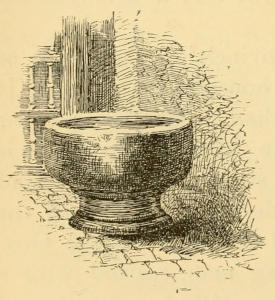
OLD FONT AT TLAXCALA.
The secretary of the Ayuntamienta has in a glass case in his office some few idols, the early charter of the city and regulations of the province, and the tattered silken banner carried by Cortez in the conquest. This last, once a rich crimson, is faded to a shabby coffee-color, and the silver has vanished from its spear-head, showing copper beneath. Tossed into corners were two large heaps of old, vellum-bound books from the convents. This is a common enough sight in Mexico. Treasures are abundant here which our own connoisseurs would delight to treat with the greatest respect. Apart from this there is no other museum nor especial display of antiquity. The town, kept nicely whitewashed, looks rather new. It contains, however, the oldest church in Mexico. The chapel of San Francisco, part of a dismantled convent, now used as a barracks, bears the date of 1529, and within it are the first baptismal font (the same in which the Tlaxcalan chiefs above-mentioned were baptized by Cortez) and the first Christian pulpit in America. The ceiling is of panelled cedar, picked out with gilded suns and the like. The approach is up an inclined plane, shaded with ash-trees. Through three large arches of an entrance gate-way, flanked by a tower, the town below appears as through a series of frames. A massive church in the town plaza was cracked and unfitted for use by an earthquake in the year 1800, and its ruins stand untouched, with the bells still hanging in the steeple.
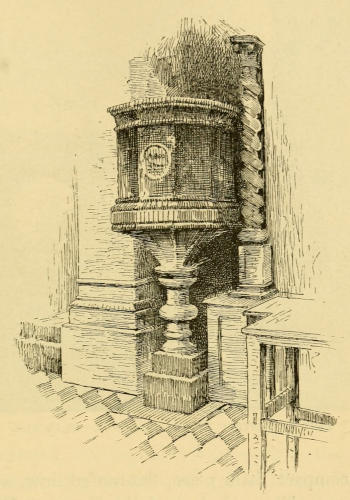
THE FIRST CHRISTIAN PULPIT IN AMERICA. TLAXCALA.
To counterbalance this a modern church, very white, and a landmark to all the country round about, has been put up on the high hill of Ocatlan, a couple of miles back. I climbed there and looked down upon the prospect. Women and girls were going up to the sanctuary with bunches of roses, on some religions errand. There were wild pinks by the wayside, the air was full of the twittering of birds, and the chimes rang musically. Looked down upon from the height, Tlaxcala was seen to be a compact little place, flat-roofed, low, almost exactly square. The wide bed of the Zatuapan River, now very shallow, wound by it. The opposite hills, hung over by vapors and rain-clouds with changing lights among them, were now purplish and now indigo black.
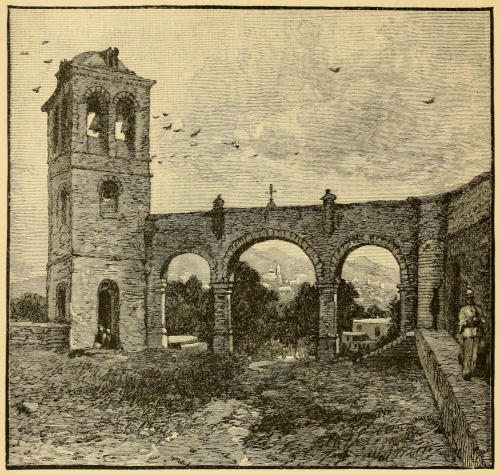
PART OF CONVENT OF SAN FRANCISCO. TLAXCALA.
VI.
On the floor above me at my lodging resided, in a comfortable way, a doctor. He had with him a friend, French by nationality but long resident at Mexico, who was at present paseando a little here for his health. This gentleman confided to me, mysteriously, that, since spending some time here, he had reason to believe that there were mines of silver and gold in the vicinity. In fact, he knew of some. “An Indian, some years ago,” he said, “brought to the padre of one of the churches two papers containing a fine dust. It was poudre d’or—gold-dust—nothing less. What do you think of that?”
I thought highly of it—as I always do of treasure stories; nothing is more entertaining.
“There are indications, in reading history,” he went on, “that much of the supply of the precious metals in the time of the Conquerors was taken from here. You are aware that most of the valuable mines were abandoned by the Spaniards in the terrors of the War of Independence, and have never since been worked. Often their very location has been forgotten. I have a friend here who has certain knowledge of a place where poudre d’or can be found.”
He paused, perhaps to allow an offer to be made for an interest in the attractive enterprise, but none was made.
He continued, alluringly: “It is my intention to enter into thorough explorations, now that I have leisure, as soon as my health is slightly more restored.”
I took the seat beside the driver on the ancient conveyance, going back to Santa Ana. We went along sandy lanes, in which the rain of the night before was almost dry, and between hedges of maguey. Maize on the right—tall but slender, and without the large ears we are accustomed to; barley and wheat on the left. All the country fertile. Malinche boldly in sight, and a sky of rolling clouds, as in Holland. Shock-headed Indian children, with a Chinese look, holding babies, and peering at us out of rifts in palisades of organ-cactus. Bright skeins of wool in door-yards, and glimpses of peasants weaving serapes in interiors. I recollect that morning as one of a few of unalloyed content. Perhaps it was because, in being at Tlaxcala, I had gratified a curiosity of an exceptional eagerness.
XVIII. MINES AND MINING TRAITS, AT PACHUCA AND REGLA.
I.
We bought tickets for Pachuca at the Hotel Gillow, in Mexico. Pachuca, one of the earliest, and richest, of the mining districts in the country, notable for both its earlier and later history, is, fortunately, also one of the most accessible to the traveller from the capital.
We took the train, from Buena Vista Station, at six in the morning. At Omeltusco, forty miles down the Vera Cruz Line, a group of diligences stood in waiting. Our own proved to be drawn by eight mules—two wheelers, four in the centre, and two leaders. We jolted along execrable roads, turned out where the mud-holes threatened to engulf us, and rode instead over high maguey stumps which threatened to hurl us back into them. The country was covered with magueys. The driver, by whom I sat, on the box-seat, for the better view of what was passing, asked me, in a patronizing way,
“Have the Norte Americanos also pulque? and do they se borrachau (get drunk) with it, like people here?”
We reached San Agostin, a shabby adobe hamlet, at eleven o’clock, waited there a while for the Philadelphia-built horse-car on the tramway, of which I have before spoken, and were at Pachuca about sundown. As to scenery, historically, and from the point of view of its returns, Pachuca is rivalled among raining districts perhaps only by Guanajuato; but the place itself is shabby, and, lying nine thousand feet above the sea, its atmosphere is raw and penetrating even in July. Regularly every afternoon blow up a breeze and a dust like those which have attained celebrity at San Francisco.
There were said to be ten thousand miners at work in the district. Perhaps five hundred are British subjects, originally from the tin mines of Cornwall. They manifest in their new surroundings a rude independence of character amounting to surliness. I heard here of my French engineer who had been sent over to examine mining property. He had eccentrically given his left hand, after a way some Frenchmen have, to the captain of one of the mines, on his descent, and the colony talked of nothing but this. They had banded together to guy and mislead him in his inquiries as much as possible, and one of them told me, with a bitterness the trivial circumstance hardly seemed to warrant, that if he came again, with his supercilious way of treating people, they would try to tumble him into some pit. Our poor friend, I fear, went away, if he believed what was told him, with some very singular items of information.
II.
Pachuca has become a good-sized city within a comparatively modern period, while Real del Monte, adjoining, once more important, still remains a village. The English element is not new in either. There was probably more of it toward 1827 than even now. On the close of the War of Independence an impression went abroad of most brilliant profits awaiting whoever would furnish capital to reopen and work the old Spanish mines abandoned and ruined in the disasters of the long struggle.
The idea was seized upon with especial avidity in England. It was represented that but two simple things were needed: the pumping-out of the water which had accumulated in the disused shafts, and improved machinery for working at lower levels, than those which had been within the reach of the primitive appliances of the country. Seven great English companies were formed, which proceeded to pour out millions upon millions of pounds, distributing the money among the several mining districts of chief repute; and these half depopulated Cornwall for laborers for the new interests. The idea was in itself a good one. Mexico had produced in three hundred years of mining, according to the estimate of Humboldt, $1,767,952,000 of value in the precious metals. The yield had been going on before the Revolution at the rate of $30,000,000 yearly. It was an industry of the greatest regularity. From 3000 to 5000 mines were in operation, and constituted its chief wealth. Its towns were mining towns; its great families mining families. The funds from this source had built the churches, the dams for irrigation by which the great agricultural estates were brought under cultivation, and had supplied the gifts and loans to the King by which the nobility secured their titles. By the Revolution this source of wealth was exhausted and dried up. The new Congress of the country felt the imperative need of doing something to reopen it, and encouraged the advent of foreign capital by a legislation which is still felt as a liberalizing influence in mining matters.
The idea was a good one, as I say, but the foreign investors did not sufficiently estimate the difficulties of their undertaking, the novelty of the country, language, persons, and processes, and the physical obstacles with which they had to deal. Almost without exception they lost money. The “boom” of 1824 was followed by a panic in 1826, a general depression at home, and, in course of time, the transfer of the interests to cheaper hands.
Among the English companies mentioned was the Real del Monte Company, which bought up, among others, all the mines of the Count of Regla, at Real del Monte and Pachuca. These had produced in fifty years $26,500,000. The history of the growth of the Count’s magnificence is briefly this. His principal vein, the Biscaina, had been worked continuously from the middle of the sixteenth century. Its yield in 1726 was nearly $4,500,000. In the beginning of the eighteenth century it was abandoned in consequence of the impossibility of drainage with the defective appliances of that day. A shrewd individual took up these mines anew in later years, and associated with him Don Pedro Tereros, a small capitalist, who became his heir. In 1762 Tereros struck a bonanza, and in twelve years took out $6,000,000. He procured the title of Count of Regla by his munificent gifts to Charles III., and, investing his money judiciously, entered upon the career of splendor to which reference has heretofore been made.
By 1801, however, he found himself at such a depth with his levels that the yield was insufficient to pay the expenses of extraction, and the mines were again disused. It was in this condition that the English company took them, knowing full well that there was treasure in the deeper levels, and proposing to bring it out with its improved machinery and Cornish labor.
The director took a salary of $40,000 a year, built himself a castellated palace, and rode out with a body-guard of fifty horsemen. A magnificent road was built to Regla, six leagues away. The only access thither, for the six hundred mules of the Count of Regla, had been by a dangerous bridle-path. Five large steam-engines and lesser machinery were dragged up from the coast at Vera Cruz, occupying the labor of a hundred men and seven hundred mules for five months.
In all this probably a million pounds was consumed. Treasure was not found as expected—what there was appearing instead in new mines. After struggling hopelessly a while the management passed into other hands. The parade was dispensed with, and the costly machinery sold out, to a Mexican company, for about its value as old iron, and then the property began to pay.
An English “Anglo-Mexican Company” also owned mines at Pachuca, and in like manner came to grief. There was an element of luck in all this, too, it must be admitted. Less than a hundred feet from where work was stopped in the Rosario, for instance, one of the mines of the latter, the new company struck a bonanza, which has been paying munificently ever since.
The present director, Señor Llandero y Cos, a brother of the Secretary of State, lives in the same castellated palace, but on a simpler scale. I had reason to know that even he had had not a little to suffer from the fierce independence of his surrounding Cornishmen. I descended into two of the richest mines, Santa Gertrudis and San Rosario. Of these Santa Gertrudis has paid in a brief space thirty-nine dividends of $20,000 each.
III.
The interior, even of the richest Mexican silver-mine, is hardly what the novice might expect. You put a candle, pasted by a lump of mud, on the top of your hat and crawl through all sorts of dark and dripping holes. Now and then a guide flashes his light on some black and grayish discolorations with a look of professional pride, but you do not exactly fall down in ecstasy over these. There are no forks and spoons hanging ready to your hand, no presentation plate, nor even ingots. The heaps of ore about the shafts do not glitter, and seem good for little but to mend the roads. The principal shafts are about sixteen feet in diameter, the galleries five by eight, and spaced about eighty feet apart. At the San Pedro mine the pumping-engine was of one hundred and fifty horse-power, and another of the same power drew up the malacate, or skip, full of ore in bags of maguey fibre. In some of the old mines, at Guanajuato and San Luis Potosi, they tell us, peons still tote the ore up the interminable ladders on their backs; but this, I think, must be rare. The depth of the Santa Gertrudis is about six hundred feet. The material is marl, limestone, and quartz, all of a soft character and easy to work, but requiring a heavy timbering-up. The clothing of the laborers is ransacked for nuggets by three separate searchers in turn, as they emerge from their work.
There is a Government School of Practical Mining at Pachuca, to which students are sent after finishing the theoretical course at the Mineria, or school of technology, in Mexico. The director, an affable man, showed us the process of beneficiating, or extracting the metal from the rough ore, in miniature. You see the rock first crushed and reduced, with water, to a paste, then mingled with sulphate of copper, common salt, and quicksilver, which get hold of the metal. The quicksilver is afterward withdrawn and reserved for continued use. He gave me, also, a pamphlet of his on a new form of application of “La Accion Mechanica del Viento”—the mechanical action of the wind. A large wind-mill was moving in the court-yard made in accordance with his principle, which substituted large zinc cones for the ordinary sails and slats.
The extracting processes were more entertainingly seen, however, at the beneficiating haciendas themselves. The “Loreto” is one of the principal. The ore is crushed either by the Cornish stamp, which drops a succession of iron-shod beams upon it; the Chilean mill, which grinds it by means of superposed revolving stones; or the arrastra. The last is the most primitive, cheapest, and still most in use. The crushing is done by common stones, hung to the arms of a horizontal cross, dragged round and round in a circular bed by mule-power.
Then follows the making of tortas, “the patio system,” which had its origin here in 1557. Numerous large mud-pies of the powdered ore and water are laid out on a vast open court floored with wood. The chemicals mentioned are thrown in in successive stages, and troops of broken-down horses are driven around in the mass for from two to three weeks in succession, thoroughly mingling it together. It is then brought in wheel-barrow loads to washing-tanks, where men and boys puddle it bare-legged till the metal falls to the bottom and the detritus runs away. “Rebellious” ores are treated by first calcining, then separating with mercury by “the barrel process.” This last is done chiefly at the hacienda of Velasco, on the way to Regla.
Of the two hundred and sixty-seven mines in the district, seven are worked by the Real del Monte Company. The paying mines are comparatively new, discovered within the last twenty or thirty years. The old Spanish mines do not pay, and are, in fact, little worked. The stories of old Spanish mines, abandoned, perforce, at the date of the Independence, and ready to yield splendid returns to whoever will reopen them, serves very well as romance; but it must be remembered that sixty years have elapsed since the Independence, and there have been plenty of prospectors with a shrewd eye for gain in the country in the mean time. The Mexicans themselves are good miners. It will not do to look on with amused contempt even where very primitive processes are largely retained, for these are often better adapted to the peculiar conditions than any others. Thus the puddling of the tortas by mules and human legs, with labor at but thirty cents a day, is deliberately preferred to machinery.
Whoever might care to make purchases in such a place would do well to buy among the newly discovered mines. Or one may yet prospect for himself, for the district appears by no means exhausted. Robbers in the state of Hidalgo long served as an impediment to freedom of prospecting in out-of-the-way places, and it is only of late that their power has been broken. The last Governor is said to have shot three hundred of them. Wild-cat properties and pitfalls of the usual sort await the unwary here. That perversity which, by some natural law, seems to take hold upon dealers in mines as well as in horses possesses them in Mexico not less than elsewhere.
The Mexican mine is divided into twenty-four imaginary equal parts, barras, and fractional parts of these are bought and sold as its stock.
IV.
As to the mining laws of the country, I have heard them described by some Americans as better than our own. In certain respects this is true. The reprehensible looseness with which our American “district recorders” receive conflicting claims covering the same property many times over is unknown. An official goes to the field and settles the equity of the case at once, and never records but one title. Litigation about the original title of a Mexican mine is almost unknown, while that of an American mine of any value is invariably in litigation.
On the other hand, there are some drawbacks. While a foreigner may hold property in mines in Mexico without being subject to the obligation of residence, as in respect to other real estate, provided he have a resident partner, nobody in Mexico, foreigner or otherwise, can acquire a mine outright and in absolute ownership. He cannot own it in fee, no matter what sum he pays for it. The legal theory is that the title to a mine is only that of “conditional possession,” and in the nature of usufruct, which is “the right of using and enjoying a thing of which the owner is another.” On violation of the conditions the title reverts to the sovereignty—formerly the King of Spain, now the Republic of Mexico. The body of the Ordinances as at present followed was promulgated by the King of Spain in the year 1783. To allow a mine to stand idle is assumed to be an injury to those who might otherwise work and extract profit from it. It is enacted, therefore, as follows:
“I (the King) order and command that any one who shall for four consecutive months fail to work a mine, with four operatives, regularly employed, and occupied in some interior or exterior work of real utility and advantage, shall thereby forfeit the right which he may have to the mine, and it shall belong to the denouncer who proves its desertion.”
The method of acquiring title to a new and original mine is to go before the proper officer in the district in which it has been discovered and register a claim. Ninety days is then allowed to any other persons who may advance pretensions to it also, to appear, after which it is confirmed to him whose case is best established. Abandoned and forfeited properties are “denounced” by a similar formality. Veins or mines may be denounced not only on common lands, but those of any private individual, on paying for the surface occupied. In order, however, to obviate malicious or idle destruction, the searcher may be made to give security, before beginning his trial, for any damage he may occasion to the owner of the ground. Sites and waters for reducing works are included in the same permission.
The denouncer must take possession and begin the prescribed work within sixty days. The discoverer may have three pertenencias, or claims, continuous or interrupted, on any principal vein which is absolutely new. The pertenencia consists of two hundred metres along the line of the vein and one hundred on each side (or as the miner may desire), as measured on a level. A person, not the discoverer, can denounce two contiguous mines, on the same vein, but one may acquire as many others as he likes by purchase.
The ancient code created a General Tribunal of Mining for New Spain, and gave it cognizance of all mining matters. It was composed of a President, Director-general, and three Deputies-general, elected by the Reales, or mining districts, and two Deputies besides, elected by each Real. The Real had to be a place containing a church, six mines, and four reducing establishments, in actual operation. The qualifications for holding office were, that one should have been engaged in practical mining for ten years, that he should be an American, or European Spaniard, free from all inferior blood, and that he should agree to “defend the mystery of the Immaculate Conception of Our Lady.”
It would seem that offices were not always in as active demand as in our days, for heavy fines are enacted for non-acceptance on election, besides being compelled to serve afterward. An honest and straightforward purpose appears in the rules of procedure quite worthy of imitation elsewhere. Let us cite some examples.
“As said classes of causes and suits,” says the King, “ought to be determined between the parties briefly and summarily, according to manifest truth and good faith, as in commercial transactions, without allowing delays, declarations, or writings of lawyers, it is my will that whenever any persons appear in said Royal Tribunals ... to institute any action, they (the tribunals) shall not admit any complaint or petition in writing until after they have cited the parties before them, if it be possible, so that, hearing orally their complaints and answers, they may settle with the greatest despatch the suits or dispute between them; and not being able to succeed in this, and the matter in question exceeding the value of two hundred dollars, petitions in writing will be admitted, provided they be not drawn up, arranged, or signed by lawyers.... In the judgments which may be pronounced no consideration shall be paid to any default in observing the minute formalities of the law, or to inaccuracies or other defects; but, in whatever stage of the proceedings the truth may be ascertained, the causes shall be decided and adjudged.”
The legal fraternity had secured a repute for sometimes misleading justice, it is seen, even so far back as this. There appears to have been a Consulado, or Tribunal of Commerce, upon pretty much the same plan. This ancient system has been swept away by various stages. Since the day of the republic the power once vested in the old tribunal has been lodged with the ordinary civil courts and political authorities.
It is doubtful whether mining has ever been pursued to better advantage, made more productive and regular, and more effectively freed from the element of wild-cat speculation, than in New Spain of the period considered.
There were decrees to prevent miners, especially those of affluence, from wasting their substance. Negligence in tunnelling, imperfect ventilation, and the like, by which life and health are endangered, were severely punished.
Criminals and vagabonds were made to labor in the mines, but the main bulk of laborers in early times consisted of the Indians, apportioned to proprietors as repartamientos, and held in a kind of slavery.
V.
The gorgeous Count of Regla was a great mine-owner here in his day. It was hence that he would have taken the ingots for the King of Spain to ride upon from the coast to the capital, should they have been called for by an actual acceptance of his splendid invitation before mentioned.
His ancient beneficiating hacienda of Regla, say eighteen miles from Pachuca, is of great interest. A most excellent wagon-road, constructed by the Real del Monte Company, at large expense, leads to it. As many as eighty heavily loaded ore-wagons, each drawn by from eight to a dozen mules, traverse it in a single day.
Señor Llandero y Cos kindly provided us, for this and the remaining part of our expedition, with horses and a mozo, to be kept at our convenience. White posts of substantial masonry dotted the abrupt slopes, by way of locating the various claims. Some lonesome-looking wooden structures, not unlike Swiss chalets, generally marked the shafts of the smaller mines as we went onward, while a small arrastra or two was turned by mule-power in the neighborhood. One, called the Fortune, if what was said were true, should rather have been the Misfortune or the Ill-fortune, for it had never produced a tlaco of profit.
Convolvuli and fragrant flor de San Juan touched with a trace of beauty the sterile hills. Real del Monte, embowered in rich woods, presented a scene like a fine landscape in Pennsylvania. We stopped first at the old Presidio, above the Tereros Mine, where the convicts drafted for mining labor were formerly kept; then dismounted and went down a ravine, to see the mouth of a tunnel, seven thousand yards in length, built to drain the works of the original Real del Monte Company.
Hamlets were set near together along the road, and the country continued bold and generously wooded. At the abandoned Moran Mine, one of the Count of Regla’s principal treasure-stores in its time, we found picturesque remains of walls and columns, with a round tower, which had once contained a hoisting drum. It was obliged to be abandoned, like the Sanchez, in the vicinity, for lack of water. Near the Sanchez is the mouth of the general drainage tunnel constructed by the Count. Esteemed very important in its day, it has been wholly eclipsed by works on a larger scale prevailing in the mean time. Velasco, where “rebellious” ores are treated, is presided over by an English superintendent. He had in use a crushing-machine of still a different pattern from those described. Heavy iron rockers, driven by steam-power, were worked back and forth upon the ore in a bath of water. It was claimed that one-fourth more work could be done with this at an equal expenditure of power than by the Chilean mill. Attached to the establishment in the usual way were a charming villa and gardens. The superintendent at Pachuca sometimes came there to pass a fortnight’s vacation.
The immediate approach to Regla is along the side of a deep tropical barranca. Bananas grow generously within it, and a palm-thatched Indian village crowns its opposite verge. The hacienda itself is set down in a most impressive natural formation. It is encompassed by grand columniated cliffs of basalt, like those of the Giant’s Causeway. The columns are hexagonal in shape, with an average diameter approaching three feet. At places whole areas of them have been distorted and twisted hither and thither in the cooling, with a most wild and singular effect.
A cascade like a little Niagara tumbles roaring down among them, and furnishes the strong water-power for the works. The hacienda belongs to the Real del Monte Company, and it is chiefly ores of that company which are brought to this strangely attractive scene to be treated. Troops of horses were going round in the usual way in a great walled patio, making the tortas. Connected with this were smelting-furnaces and kindred buildings of many sorts. Madame Calderon de la Barca, who also visited Regla, found it such a place as might have been conjured up by magic, by some giant enchanter, for his own purposes. Mediæval-looking towers, gateways, terraces, a chapel, and prison garnish it. Opposite the chapel is a pretty residence, Moorish in aspect, surrounded by vines and flowers. The whole is said to have cost some two millions of dollars.
We spent a night here with the superintendent, Don Ramon Torres, a youngish man, who had learned his avocation in the mines at Guanajuato. He seemed but too delighted, in his comparative isolation, to entertain company and honor the introduction of his chief, Señor Llandero. He dwelt in his talk upon the lack of ambition among the Indian laborers. He said, among other things, that in the Tierra Caliente the women were better workers than the men.
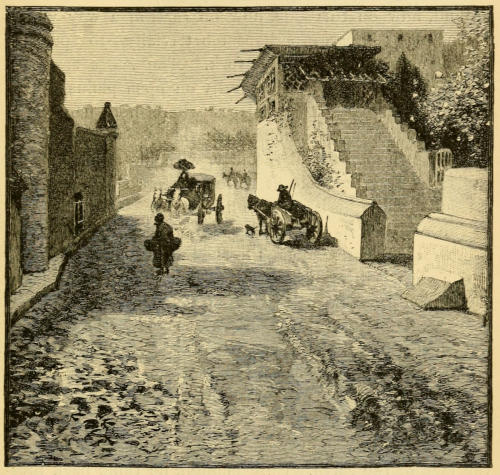
SUPERINTENDENT’S HOUSE AT REGLA.
Our next stage from here was to be the hacienda of Tepenacasco, near Tulancingo, where Mr. Brocklehurst and myself had been invited to visit, in order to witness the manner of life on one of the great country estates. Regla is rather famous for thunder-storms, and on the day of our departure we had one of the traditional sort. Within a few minutes after its commencement the cascade was blood-red with soil torn out by the swollen stream. The storm abated at first, but we encountered it in renewed fury on wide green uplands like an Illinois prairie, known as the Plains of Mata. As we galloped in the midst of it, the rain pouring in torrents from our rubber blankets, the lightnings (rayos) darted into the ground, now on this side, now on that, in a way which I can only compare—perhaps too trivially—to spearing for olives in a jar with a fork. The rayos are dangerous in this region, as naturally on open plains everywhere, and crosses mark places where herdsmen have been stricken down among their flocks. One of these victims had been found recently, with his animals gathered around in a circle at close quarters staring at him curiously, while he lay stark on his face.
The rain had its lulls and relapses, and twice in succession we took shelter under the sheds of isolated ranchitos which we fell in with. We were joined here by an occasional ploughman, wearing the long cloak of coarse woven grass, which diverts the water from the wearer. We were joined, too, by all the domestic animals of the neighborhood. The wait at the last retreat seemed as if it would never end. At last a pig ventured forth, and we said, idly, that if he should return we would accept it as an augury that the deluge was over and the waters had ceased upon the face of the earth. Sure enough, he came back presently, munching a green carrot-top; and, receiving this like the olive-branch brought to Noah, we sallied forth. Our confidence proved well justified. A lovely prismatic bow of promise was presently set in the sky, the clouds rolled away, scattering their last lingering drops, the rills babbled merrily, and the face of the country sparkled with an enchanting freshness. We paused again briefly at a hacienda which belonged to the Governor of the state. The main building was large, plain, and yellow-washed, and had before it an enclosed threshing-floor, on which grain is tramped out by the feet of horses. A young American girl had been employed as governess here up to a recent date.
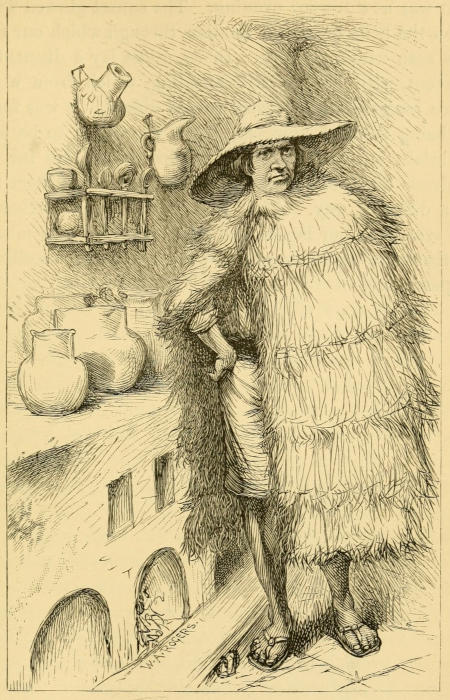
PLOUGHMAN IN GRASS CLOAK.
It was now toward evening. The sunset glowed warm upon the little hamlet of Acatlan, through which our road was seen winding below. In its midst lay a dismantled convent, with belfries still standing, which from a distance resembled an English ruined abbey. It was found on being reached, however, unlike the latter, to be built of bricks and adobe. I had at first taken this for our hacienda itself, but the hacienda proved equally attractive in a different way. After a couple of miles farther on we sent back our horses and guide with a warm missive of thanks to their owner, and were hospitably installed at Tepenacasco.
XIX. A WEEK AT A MEXICAN COUNTRY-HOUSE.
I.
With a taste for country life, so novel a domain to explore, and constantly agreeable weather, I found a week’s stay at the hacienda one of the most agreeable of experiences. From a distance the extensive habitation has a stately air, like some ducal residence. In approaching it you pass first through fields of maguey and blossoming alfalfa, then by a long stone corral for cattle, extensive barracks and huts of laborers, and a pond bordered with weeping willows. It is built of rubble-masonry and plaster, whitewashed, and consists of a single liberal story. The dwelling, with numerous connected buildings, makes in all a façade of about six hundred feet. A belfry, with two tiers of bronze bells hung in arches, sets off the centre. The large windows are defended by cage-like iron gratings. A door, flanked by holy-water fonts, at the left of that forming the main entrance, opens into a family chapel. In a gable above the main entrance is inscribed this motto—which has not, however, prevented the hacienda from being the scene of more than one sack by revolutionary forces:
“En aqueste destierro y soledad disfruto del tesoro de la paz”—“In this retirement and solitude I enjoy the treasure of peace.”
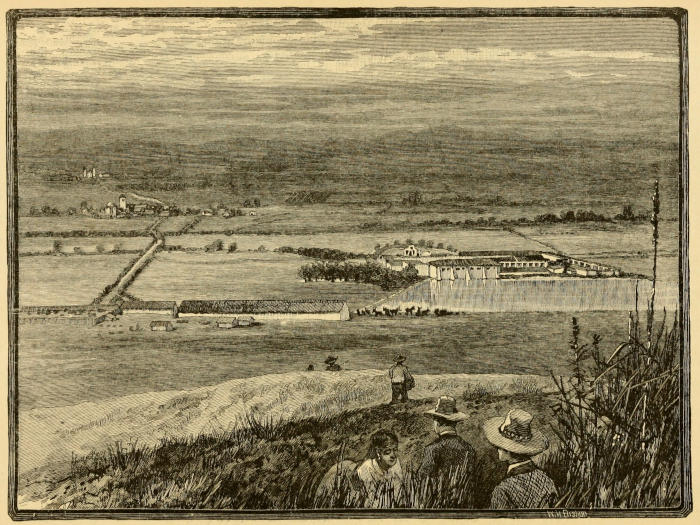
THE HACIENDA OF TEPENACASCO.
Immediately in front of the buildings is laid out, after a usual custom, a substantially paved and enclosed area, semi-circular at one end, used as a threshing-floor. Troops of running horses are driven around here upon the grain, like those in the patio process, only in a very much livelier fashion. The long façade was made up in part of massive trojes, or granaries, comprised under the same roof as the house. Each troje has a special name of its own inscribed upon it. There were, for instance, the “Troje de la Espigero” (“Corn in the Ear”), the “Troje de la Teja” (“Tiled Roof”); and the “Troje de Limbo” and “Troje de Nuestro Señor del Pilar.” The walls of these granaries were of great thickness, in order to preserve the contents cool and at an even temperature. Heavily buttressed, and with their long lines of piers, a yard square, extending down the dim interiors, they are more like basilicas of the early Christian era than simple barns. The central cluster of buildings alone, not counting those detached, covers perhaps from four to five acres. Mounting to the roof and looking over its expanse, broken by the openings of numerous courts, you seem to be contemplating, as it were, some agricultural Louvre or Escorial. Its rear wall is washed by a presa, or artificial pond for irrigation, which stretches away like a lake. Beyond this rises a charming grassy hill, called the Cerro. We climbed the Cerro, and lounged away more than one afternoon there in sketching, and contemplating the beautiful level valley of Tulancingo, spread out below.
The white hacienda with red roofs lay in front, reflected clearly in its pond. Tulancingo was a white patch at a distance, and other white patches nearer by were the hamlets of Jaltepec, Amatlan, and Zupitlan—the latter in ruins. Straight, lane-like roads led from one to another. The mountains on the horizon afforded glimpses of basaltic cliffs of the same formation as those at Regla, and of the white smoke of charcoal-burners rising from their forests. Cattle wandered in fine herds in the grassy pasture, each tended by its herdsman and dog. We saw a troop of them at twilight come to drink at the pond, and the complication of all their moving forms was curiously picked out in silhouette against the gleaming brightness of the water.
At evening there returned to the court-yard of the hacienda, to disband after their day’s labor, sometimes as many as forty ploughmen. If it had rained they wore their barbaric-looking grass cloaks. They drove yokes of oxen and bulls harnessed to the primitive Egyptian plough, and carried long goads to prod their animals. After them rode in now and then an armed horseman, wrapped in his serape, who overlooked and guarded them at work. At the same time came troops and droves of the other animals needing to be housed: black swine from the grassy slopes of the Cerro; mules released from harness; young horses and mules not yet put to work; milch-cows, and young steers and heifers, each wending its way sedately to its own department.
Most of the cattle, I observed, were hornless. This is brought about by a practice of paring the young horns when first sprouting. It would seem that this might be desirable among ourselves, both on the farm and especially in transporting cattle in the cars ordinarily in use. Milking-time came only once a day—in the morning—and not, as with us, twice. The hind-legs of the cows are lassoed together when being milked. The calves of tender age are also lassoed to the side of the mother, and it is a quaint and amusing sight to see their impatient demonstrations while awaiting the conclusion of the process.
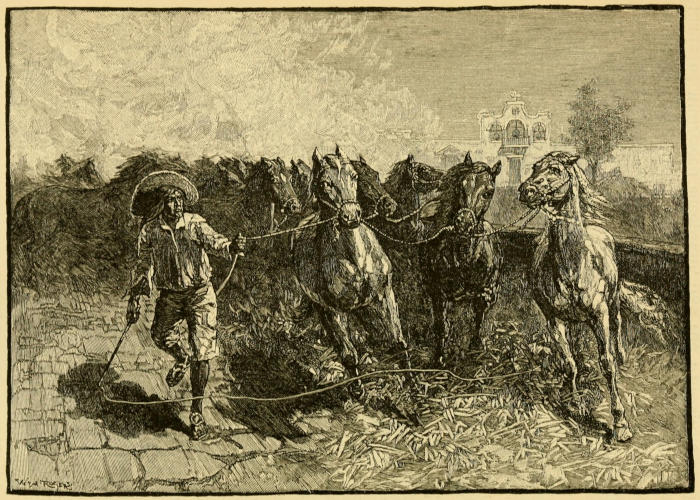
THE THRESHING-FLOOR.
I sat down one day with “Don Rafael,” the administrador, or salaried manager, of the estate, to make a rough map of its general distribution and extent. The property proved to be some eighteen miles in length by twelve in its greatest width, and of very irregular pattern. It had no less than eleven large presas, formed by dams at convenient points for irrigation. The principal dam was a mile in length, and by means of it had been formed a lake of two miles in its principal dimension. On the borders of this stands the feudal-looking ruined hamlet, with church and hacienda, of Zupitlan, before mentioned. The bulk of the estate was in grass, but irregular patches of ground had been taken out here and there for various crops, and to each was given its special name. Thus the field of San Pablo was devoted to maize and alfalfa; Las Animas, San Antonio the Greater, and San Antonio the Less were given up to maize; Del Monte and San Ignacio el Grande to barley.
The magueyales, or maguey fields, were of considerable extent. The making of the pulque from their product was confided to a special functionary called the tlachiquero. The heart of the maguey is cut out at a certain stage of its growth and a bowl thus formed, into which a quantity of sweet sap continues to run regularly for several months. By the end of that time the plant is dead, and is uprooted and replaced by another. The sap is at first called agua miel, or honey-water, which it resembles. The tlachiquero makes a daily pilgrimage to the fields, and draws off the agua miel by means of a bulky siphon formed of a gourd. Sometimes he bears simply a bag, made of undressed sheepskin, like the wine-skins of Old Spain, on his back; again, he is accompanied by a donkey loaded with a number of these skins. He transfers the sap to these bags, and returns with it to a department of his own, called the Tinecal. There he pours it into shallow vats of undressed skin, where it is allowed to ferment. Without describing the process farther in detail, in a fortnight it is ready for sale or for home consumption.
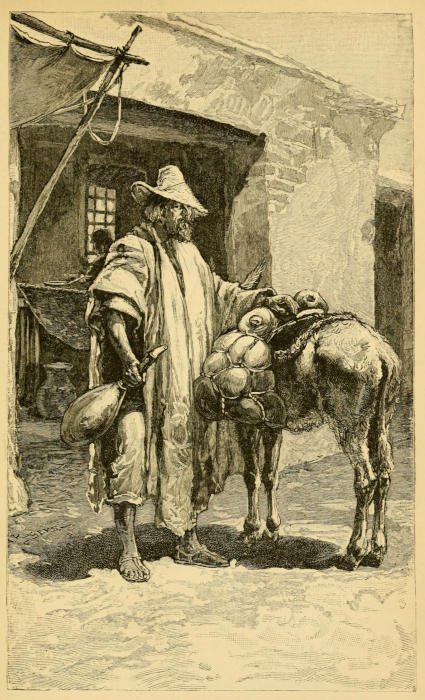
THE TLACHIQUERO.
The pasture fields have their distinctive titles also. There were, for instance, San Gaetano, San Ysidro, and San Dionysio; and, again, the corrals of San Ricardo, San Gaetano, and Las Palmas, where cattle were enclosed at various times. Dairy-farming was the principal industry of the estate. Its neat cattle numbered seventeen hundred head. The pay-roll showed a total for the week of eight hundred and fifty men and boys.
The living apartments of the dwelling were set along two sides of an arcaded court-yard, which had a dismantled fountain in the centre. Offices and store-rooms occupied the other two sides. A department for the butter and cheese making had a special court to itself in the rear. One of the store-rooms contained an ample supply of agricultural implements. Those of the slighter sort, I learned, such as ploughs, spades, picks, hammers, and the coa, a peculiar cutting-hoe, are made in the country, at Apulco, not far distant, where are also iron-works. An iron plough made at Apulco costs $7, while the imported American plough costs $10. There are wooden pitch-forks and spades among the implements. The wooden, or Egyptian, plough is much more in use than that of iron. It consists simply of a wooden beam shod with an iron point, and has an adjustable cross-piece for service in case the furrow needs to be made wider. The purpose to which it is most applied is that of turning shallow furrows between rows of corn, and for this it appears well enough adapted. At Pensacola, in the state of Puebla, such larger pieces of agricultural machinery as reapers, mowers, and separators are manufactured.
II.
We happened, among other accommodations, in our exploration of the corridors, upon a prison, described as for use in locking up the refractory peons when they will not work.
“Can you do that? Have you, then, such an absolute power over them?” I asked our host, in some surprise.
“Why, no,” he replied, in effect, deprecatingly, “I suppose not; but, you see, now and then it is the only way to manage them, and we have to. It is not civilizated, that people,” he continued, in an English which left something to be desired, “and we do the best what we can.”
This seems something very like a feudal control on the part of the hacendado, but his numerous dependents do not seem to complain of it. Cases of protest before the magistrates are rarely known, and should they be made it is not likely, since the magistrates are friends of their masters, and of the same social station, that they would meet with any great attention.
We found this laboring population living in squalid stone huts, often six and eight persons in a room. The floors were simply the dirt of the ground, and there was sometimes not even so much as the usual straw mat to sleep or sit upon. We were told here again that the peons are avaricious. They are believers in a general way, but not greatly given to religion. Few attend the services at the chapel, even on Sunday. They summon the priest when about to die, but not otherwise. But few of the children go to school. As a whole, they seemed about as wretched as the poor Irish, except for the advantage over the latter in climate. In every interior is seen a woman on her knees, rolling or spatting the interminable tortillas.
The laborers on the pay-roll were of two classes: those employed by the week, and those employed by the year. The former “found themselves;” the latter were “found” by the estate, and paid a certain sum at the end of the year. Wages ran from six cents a day for the boys to thirty-seven for the best class of adults.
III.
The administrador was assisted, in the management of the hacienda, by the mayor-domo and the sobre-saliente, who acted as his first and second lieutenants; a caporal, who had general charge of the stock; and a pastero, who had charge of the pastures. The pastero it was who indicated the condition of the various areas of pasturage, that the animals might be moved to one after another of them in turn. These minor officers were of the native Indian race. They were dark, swarthy men, very bandit-looking when armed and mounted on horseback, but in reality, when you came to know them, as mild and amiable persons as need be wished for.
One, “Don Daniel,” supervised the butter and cheese making interest. A book-keeper, “Don Angel,” kept an account of all the property of the estate—receipts, and disbursements, and an inventory of stock—upon a system which seemed a model of commercial accuracy. Every week a report was forwarded to the owners, at Mexico, upon a printed blank filled out in the most exhaustive detail, so that they could see at a glance how they stood.
The administrador, Don Rafael, was a steady-going man of middle age, a native of San Luis Potosi. He had land and casitas, little houses, of his own, which he rented. He had also a house in the city of Tulancingo, near by, occupied by his family, whom he visited once a week. His salary reached about $1000 a year, and he could be called a person of substance. A conspicuous scar on his forehead led it to be supposed that he might have seen service in the field; but he spoke with contempt of the wars of his country when questioned about it, and said that he had got his scar in breaking a horse.
“A sensible man can always find better occupation than fighting,” he said. “I have busied myself with regular industry. The North Americans, now, understand that. They have good ideas. There everybody works and gets a little ahead in the world. Without money in his pocket what is a man good for? He might as well take himself over to the cemetery yonder at once and have done with it.”
Don Angel was young, mild, taciturn, painstaking, and a native of Old Spain. His handwriting was small and neat, and he had a great head for details. His salary was the sum of $400 a year. The revenues of the estate which it was his province to cast up amounted, I was told, to $20,000 a year.
Don Daniel, the butter and cheese maker, was young also, but large, handsome, rosy, and had excellent teeth, with coal-black hair and beard. He was a model of robust health and lively spirits. He too had a wife at Tulancingo, whom he visited every Sunday, returning before daylight on Monday morning, to be in time for the milking. He was given to strumming on a guitar in the evening, and assembled around him in his room such convivial spirits as the hacienda afforded. Nonsensical refrains like
“Amarillo si, amarillo no, Amarillo y verde, me ho pinto,”
were heard proceeding from there long after more staid and decorous persons were in bed.
Another member of the household was, let us say, “Manuel,” a boy of eighteen, looking younger, who had formerly been a cadet at the national military school. He was here learning the business of a hacienda, or, as some said, he was a young scapegrace whom it was designed to keep out of mischief. At any rate, he was an aide-de-camp to Don Rafael, and took his orders about on horseback. He dressed, like Don Rafael, in a substantial suit of buff leather. He was a very garrulous and communicative person, and, as our attendant and guide—in which capacity he offered himself, I think, somewhat as an excuse for escaping more onerous labors—he furnished us much useful information. His elders took a tone of raillery with him, representing him as a very callow youth, whose views were of no consequence, and who should be seen but not heard from. They ridiculed his French, which he had learned at the military school, even affecting not to believe that it was French at all. Our visit was the occasion for a strenuous effort on his part to set himself right on this point.
“N’ai-je pas bien dit?” he cried to us, across the generous dining-table where we sat together, stretching at the same time a bony, school-boy arm for aid in putting the scoffers down.
One day we mounted to go to a beautiful clear spring of water, which was admired even as early as by Humboldt in his travels. On others we visited the adjacent hamlets, or Tulancingo, from which, later, we were to take the diligence homeward. Again, we made our objective points the various crops, a dam undergoing repairs, or the remoter pastures and corrals.
The herdsman and a boy-assistant at these corrals slept at night in their blankets under a mere pile of stones. The upper irrigating dams are discharged of their waters, when it is desired, by the primitive device of lifting up one cross-beam after another from a narrow gate in the centre. In some of the maize-fields are lookout boxes, aloft on high poles, as a device against crows and other marauders. The general surface over which we rode was the grassy plain, affording a delightful footing for the horses. It was of a fresh, soft green, and enamelled besides with flowers, like violets, the blue maravilla, and many varieties of a yellow flower resembling the dandelion, but prettier.
IV.
The room first entered from the main corridor in the house itself was devoted to the uses of a despacho, or office. Here was the department of Don Angel, and the master himself sometimes took his place behind the long, baize-covered table, strewn with matters of business detail, to hold audience with the peons of the estate, who came, with wide-brimmed hats humbly doffed, to make known various wants and complaints. In the corners stood rifles, spades, and the long branding-iron, which is heated in the month of August to brand the young cattle with the device of their owner.
A fat dark peon enters, and proffers a request for an allowance to be made him for a baptism in his family.
“A baptism?” says the master, briskly. “Well, now, come on! Speak up; don’t stand mumbling there! Let us see what your ideas are.”
The man suggests, deferentially, to begin with, the sum of $3 for a guajolote, or turkey, as a pièce de résistance for his feast.
“You are always wanting a guajolote, you people. You don’t need anything of the kind. However, let us say $1.50—twelve reals—for the guajolote. What next?”
“The pulque—about forty cuartillas of pulque.”
“Twenty cuartillas of pulque,” says the master, ruthlessly cutting down the estimate by half. “Well, what next? Speak up!”
The peasant, one of the laborers by the year, perseveres, in his humble, soft voice, regularly making his estimate for each article twice the real figure, and having it as regularly cut down. He caps the whole by demanding four reals for a sombrero, well knowing—and knowing perfectly well that his master knows also—that the kind of sombrero he would be likely to want costs but one real.
We had proposed to witness the festivities of this christening, but unfortunately delayed too long at table on the evening of its occurrence, and lost it. But the sky was gloriously full of stars as we went out among the huts and barracks. A woman came out of one of the tenements and made a complaint of a neighbor with whom she had had a row, but got no great sympathy, and hardly seemed to expect any. They are admirably polite, these poor rustics—nobody can deny them that. As we sat by the road one day at Amatlan, sketching, some of the women called to us as they went by:
“Buenas dias, señores! Como han pasado, ustedes, la noche? Adios, señores!”—“Good-day, sirs! How did you pass the night? Good-bye, sirs!”
We had not in any way first addressed them, and they did not stop, but went swiftly onward, scarcely turning their heads to look. These and many more of the sort are but their ordinary salutations.
The immediate family at the hacienda consisted of one of the several heirs, “Don Eduardo,” his wife, mother, and two small children, and their Indian nurses. They were in the habit of spending but a small portion of the year here, and, when they came, lived in quite informal style. Servants and employés, equally with her intimates, called the young mistress “Cholita,” a diminutive of her name Soledad. There was little or no receiving or paying of visits, owing to the great distances to be traversed and the scarcity of neighbors.
V.
Social life in the country is hardly known. We had piano music and singing in the evening in a stately, dimly-lighted salon of the style of the First Empire. One day a large farm vehicle, gayly decorated with boughs, was brought around, all hands got into it, and we proceeded to the lake at Zupitlan for a picnic. The provisions were carried on a litter by a couple of men, and a guard on horseback, with his rifle, rode along-side for our protection. Such a precaution was not absolutely needed, perhaps, but there had been a time—before the Governor of Hidalgo had taken his summary measures—when the brigands would have swooped down from the adjacent hills and seized upon such a procession with little ceremony. After dining al fresco we amused ourselves with shooting some of the ducks and cranes which abound on the lake.
We had chocolate and buns on rising in the morning, and two over-liberal repasts, resembling each other in character, at noon and nine in the evening. The dogs swarmed in and out over the house, which presented the aspect of a generous farm rather than a villa.
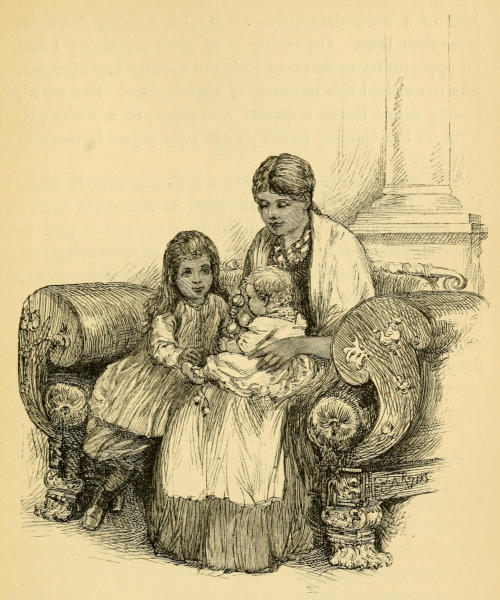
NURSE AND CHILDREN AT THE HACIENDA.